Connect with us
DAPA Banner
DAPA Coin
DAPA
COIN PAYMENT ASSET
PRIVACY · BLOCKDAG · HOMOMORPHIC ENCRYPTION · RUST
ElGamal Encrypted MINE DAPA
🚫 GENESIS SOLD OUT
DAPAPAY COMING

Business

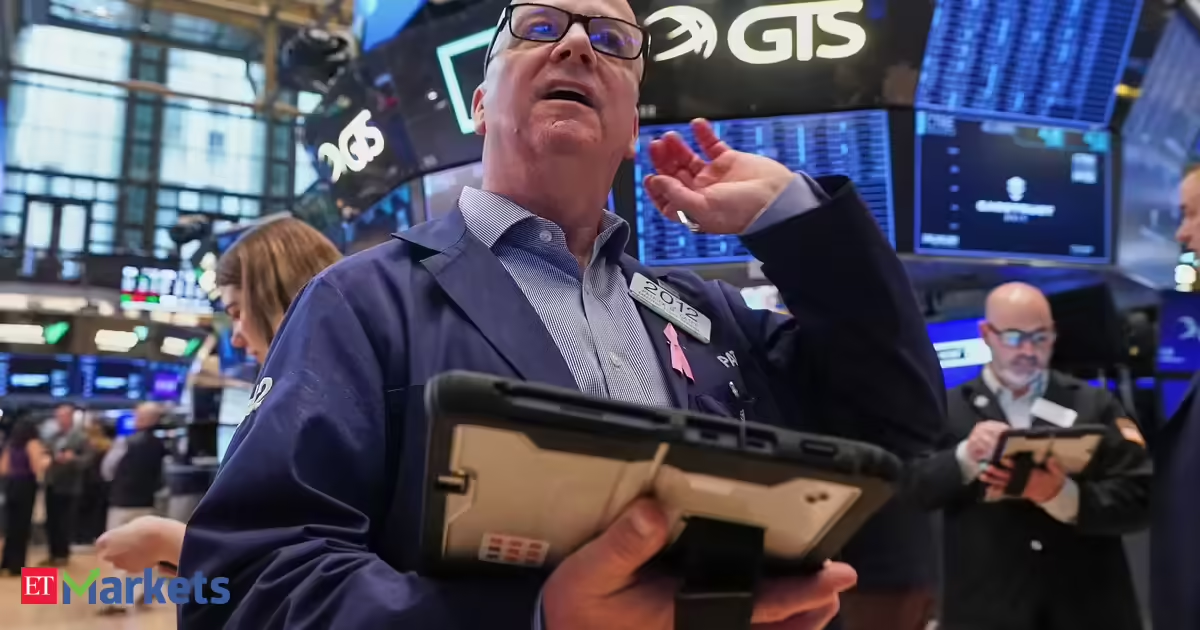
US stocks today: US stocks slip as inflation worries push Treasury yields higher

Published

on

US stocks today: US stocks slip as inflation worries push Treasury yields higher
Wall Street’s main indexes closed lower on Tuesday after the benchmark 10-year Treasury yield climbed to its highest level in more than a year on mounting inflation concerns. Elevated oil prices and anxiety over the lack of a peace agreement between the U.S. and Iran also weighed on investor sentiment.

The S&P 500 and the technology-heavy Nasdaq marked their third straight day of declines as investors booked profits following a strong rally since late March. Markets also weighed the possibility that the Federal Reserve could resume interest rate hikes if inflation remains persistent.

Although Brent crude futures settled down 0.73%, they remained above $110 a barrel, as traders tracked developments in the Middle East conflict, which has nearly shut the Strait of Hormuz, a key energy route. U.S. President Donald Trump said he had delayed a planned military strike on Iran but warned that action could resume if negotiations fail, even as he claimed Iran was pushing for a deal.

U.S. Vice President JD Vance said both sides had made progress in talks and were keen to avoid a renewed military campaign, offering some hope for de-escalation.

Advertisement

Meanwhile, the 10-year Treasury yield surged to 4.687%, its highest since January 2025, before easing slightly to around 4.65%, as inflation expectations strengthened.


“There’s nothing constructive that’s leading us to believe there’s going to be a ceasefire with any sort of substance. As long as there is nothing happening along those fronts, oil is remaining high, bond yields are remaining high, and the market’s anxiety levels are getting increasingly elevated,” said Michael James, managing director and equity sales trader at Rosenblatt Securities. He added, “As each day goes by and nothing substantive is happening, that becomes more problematic. That’s why you’re seeing equities having a tough time in the last few days.”
Traders have begun pricing in higher odds of rate hikes, with a 25-basis-point increase in December seen at a 41.7% probability and a 50-basis-point hike at 15.7%, according to CME Group’s FedWatch tool. Investors now await minutes from the Fed’s latest policy meeting for further guidance.”Rates are obviously front-and-center,” said Garrett Melson, portfolio strategist at Natixis Investment Managers Solutions. “It’s really not about the level of rates. It’s about the rate of change. Markets can handle a slow, steady grind higher, but when you have these step functions higher, that’s where it tends to translate to some indigestion in the market.”

According to preliminary data, the S&P 500 fell 48.74 points, or 0.66%, to 7,354.31, while the Nasdaq Composite dropped 216.56 points, or 0.83%, to 25,874.18. The Dow Jones Industrial Average declined 312.77 points, or 0.65%, to 49,373.35.

Sector-wise, the S&P 500 software index reversed earlier gains to end lower, while the Philadelphia Semiconductor Index saw choppy trade and was down more than 3% at one point. The defensive healthcare sector outperformed during the session.

Investors are also focused on Nvidia’s quarterly results due Wednesday, with markets looking for confirmation that AI-driven demand can sustain elevated valuations across the semiconductor space.

Advertisement

Among individual stocks, Akamai Technologies fell after announcing a $2.6 billion convertible bond offering.

Continue Reading
Click to comment

You must be logged in to post a comment Login

Leave a Reply

Business

Escalating Cyber Threats Raise Alarming Risks to Financial Stability

Published

on

Asia Emerges as Global Epicentre of a $688 Billion Fraud Crisis

The rapid digitalization of the global economy, combined with heightened geopolitical tensions, has significantly increased the frequency and severity of cyberattacks, posing a serious threat to global financial stability. The financial sector is particularly vulnerable, as sophisticated attacks targeting sensitive data and critical infrastructure can erode market confidence, cause deposit outflows, and trigger systemic shocks.

Key Points

  • Rising Threat Landscape: Cyberattacks against financial institutions have more than doubled since the pandemic, with the magnitude of extreme losses from such incidents quadrupling to $2.5 billion since 2017.
  • Systemic Risk: Financial firms, particularly banks, are primary targets. Successful attacks can lead to bank runs, market volatility, and the disruption of critical national payment systems, as evidenced by recent events in Lesotho and the United States.
  • Third-Party Vulnerabilities: Increased reliance on third-party IT providers and emerging AI technologies expands the attack surface, creating the risk of widespread, simultaneous outages across multiple institutions.
  • Policy Gaps: Many countries, especially in developing markets, lack sufficient national cybersecurity strategies or dedicated regulations to address these systemic threats.
  • Recommended Actions: The IMF advocates for:
    • Enhanced board-level cybersecurity expertise and better organizational “cyber hygiene.”
    • Regular systemic risk assessments regarding institutional interconnectedness.
    • Improved data collection, incident reporting, and information sharing among financial participants.
    • Strengthened international cooperation to combat cross-border cyber threats.
  • Resilience Focus: Since total prevention is unlikely, the sector must prioritize robust response and recovery procedures to ensure the continuity of critical business services during and after an attack.

To mitigate these risks, the IMF emphasizes that firms and regulators must move beyond individual defense mechanisms to establish comprehensive national and international cybersecurity frameworks that prioritize systemic resilience, improved governance, and standardized incident reporting.

To strengthen resilience in the financial sector, authorities should develop an adequate national cybersecurity strategy accompanied by effective regulation and supervisory capacity that should encompass:

  • Periodically assessing the cybersecurity landscape and identifying potential systemic risks from interconnectedness and concentrations, including from third-party service providers.
  • Encouraging cyber “maturity” among financial sector firms, including board-level access to cybersecurity expertise, as supported by the chapter’s analysis which suggests that better cyber-related governance may reduce cyber risk.
  • Improving cyber hygiene of firms—that is, their online security and system health (such as antimalware and multifactor authentication)—and training and awareness.
  • Prioritizing data reporting and collection of cyber incidents, and sharing information among financial sector participants to enhance their collective preparedness.

While cyber incidents will occur, the financial sector needs the capacity to deliver critical business services during these disruptions. To this end, financial firms should develop, and test, response and recovery procedures and national authorities should have effective response protocols and crisis management frameworks in place.

Advertisement
Continue Reading

Business

Young drivers targeted by 'ghost brokers' selling fake car insurance online

Published

on

Young drivers targeted by 'ghost brokers' selling fake car insurance online

The finance watchdog warns bogus brokers are selling fake car insurance through social media.

Continue Reading

Business

Ian Reight and the Ideas That Shaped a Surgical Career

Published

on

The British Business Bank (BBB) has announced an £8 million investment into NRG Therapeutics Ltd., a pioneering neuroscience company developing novel therapies for severe neurodegenerative conditions, as part of a £50 million Series B funding round.

Some careers are built through one major breakthrough. Others are built through years of steady decisions, small improvements, and a willingness to adapt. For Ian Reight, success in medicine came from learning how to stay calm, think ahead, and embrace change long before many others did.

Today, Reight is known as a general surgeon, healthcare leader, and former chief of surgery who helped guide teams through changing technology and growing demands inside modern hospitals. But his story started far away from operating rooms and robotic surgery systems.

Growing up in Maryland, Reight spent part of his early life as a volunteer firefighter and paramedic. The work exposed him to pressure, urgency, and responsibility at a young age.

“I learned early that people look for leadership when situations become chaotic,” Reight says. “You do not always have time for perfect decisions. You have to stay focused and move forward.”

That lesson would shape nearly every stage of his career.

Advertisement

How Ian Reight Built His Career in Medicine

Before entering medicine, Reight studied psychology at the University of Maryland College Park. Later, he earned his medical degree from the Medical University of the Americas.

He says studying psychology gave him an advantage many physicians overlook.

“Medicine is about people as much as science,” he explains. “You can be technically skilled, but if you cannot communicate well, patients and teams lose confidence.”

As Reight moved into surgery, he quickly realized the profession required far more than medical knowledge alone. Surgeons often lead teams during high-pressure situations where timing, communication, and trust all matter.

Advertisement

Over time, he took on larger leadership roles. He served as medical staff president, chief of surgery, medical director of a breast center, and medical director of wound care and hyperbaric medicine.

Each position brought different challenges. Some involved patient care. Others focused on managing teams, solving operational problems, and improving hospital systems.

“You cannot only think like a surgeon,” Reight says. “You also have to think about how every part of the hospital works together.”

Why Ian Reight Embraced Robotic Surgery Early

One of the biggest ideas that influenced Reight’s career was his willingness to adapt to new technology instead of resisting it.

Advertisement

As robotic surgery became more common in hospitals, many physicians were cautious about changing long-established methods. Reight chose a different approach. He became deeply involved in robotic surgery and eventually served as a lead robotic surgeon.

“At first, people naturally questioned whether it would become the future,” he says. “But medicine always evolves. You either learn with it or fall behind.”

Robotic surgery introduced greater precision and helped reduce recovery times for many patients. Reight believed the technology could improve patient outcomes if surgeons approached it with the right mindset and training.

“The technology itself is not enough,” he explains. “You still need discipline, preparation, and strong decision-making.”

Advertisement

His openness to innovation became one of the defining themes of his career. Rather than staying comfortable, he focused on learning continuously and helping teams adjust during periods of change.

“The moment you stop learning is the moment you become ineffective,” Reight says.

Leadership Lessons From the Operating Room

As Reight’s responsibilities grew, so did his focus on leadership. He believes many of the same principles that guide surgery also apply to business, management, and life.

In surgery, preparation matters. Communication matters. Consistency matters.

Advertisement

According to Reight, those same habits help organizations succeed during uncertain periods.

“People want leaders who stay calm when things become difficult,” he says. “Panic spreads quickly in any environment.”

During his years in leadership positions, Reight often worked between physicians, nurses, administrators, and staff members with different priorities and pressures. Keeping everyone aligned was not always easy.

He says one of the biggest mistakes leaders make is focusing only on their own responsibilities instead of understanding the bigger picture.

Advertisement

“You have to understand the pressures other people are dealing with,” he explains. “That is how strong teams are built.”

His leadership style focused less on authority and more on trust, communication, and consistency over time.

What Ian Reight Says About Long-Term Success

Reight believes long careers are rarely built through dramatic moments alone. Instead, they come from repeated habits and steady improvement.

That mindset helped him move through multiple areas of healthcare leadership while continuing to practice medicine directly with patients.

Advertisement

“Success usually comes from small decisions repeated over many years,” he says. “People often underestimate consistency.”

Outside the hospital, Reight enjoys spending time with his dogs and cooking, which he says helps him stay balanced after years in demanding medical environments.

Interestingly, he sees similarities between cooking and surgery.

“There is timing, preparation, and attention to detail involved in both,” he says with a laugh. “You learn patience very quickly.”

Advertisement

Looking back, Reight says the biggest ideas that shaped his career were not complicated. Stay adaptable. Keep learning. Communicate clearly. Stay calm under pressure.

Those ideas helped him navigate medicine during a period of enormous technological and organizational change.

And in an industry where change never stops, Reight believes those lessons matter now more than ever.

“Leadership is not about having all the answers,” he says. “It is about staying steady enough for other people to trust you when challenges come.”

Advertisement

Continue Reading

Business

Radar reaches unicorn status in series B funding round

Published

on

Radar reaches unicorn status in series B funding round

Radar, a startup backed by American Eagle CEO Jay Schottenstein that helps retailers manage in-store inventory and cut back on theft and lost merchandise, reached unicorn status with its latest funding round, CNBC has learned.  

The company, founded in 2013 by Spencer Hewett, raised $170 million at a valuation of over $1 billion in its series B funding round, which was co-led by Gideon Strategic Partners and Nimble Partners with participation from Align Ventures. 

The company also counts Schottenstein among its investors. He said American Eagle was the first retailer to implement Radar’s technology across its stores.

Through Radar, “American Eagle has unlocked greater inventory visibility, empowered our associates and sharpened our insights,” said Schottenstein. “With inventory digitized in real-time, we have enabled our creative, operations and technology teams to place their focus on creating seamless, customer-first experiences that define the American Eagle brand.”

Advertisement

Radar also works with Gap‘s Old Navy and other major retailers, covering more than 1,400 stores. 

When Hewett started the company with a boost from venture capitalist Peter Thiel’s fellowship for young entrepreneurs, his goal was to create a better way to do instant checkout, but the strategy evolved to inventory management. Using hardware mounted to the ceilings of brick-and-mortar stores, Radar’s technology can read any radio-frequency identification, or RFID, tag with 99% accuracy, the company said.

The tech addresses one of the most challenging aspects of running a retail business: inventory management. Between figuring out how much product to make, deciding where to send it and then keeping track of it once it arrives, retailers face a persistent challenge in overseeing their inventory. Errors can lead to lost sales and crush profit margins.

Radar primarily functions at the store level. It enables in-store employees to quickly hunt down an item a customer wants, addressing a pain point among shoppers who come to a store to buy a product listed as available online only to find it’s actually out of stock. 

Advertisement

“If a customer asks them, ‘I want this in a different size’ they can immediately see where in the store it is, no matter where it’s been moved, and get it for the customer,” Hewett told CNBC in an interview. “It gives them certainty that they can actually help the customer without them, like, saying we might have it in the back and disappear for like 15 minutes and then come back and be like, ‘Okay, actually the inventory system said we had it, but we don’t have it. I can’t find it.’”

As a result, some of Radar’s retail clients who offer a buy online and pick up in store option have seen order cancellation rates go from 25% to 3%, said Hewett. 

The tech also helps managers to keep a better eye on deliveries and more easily identify shrink, or inventory loss from theft, error or damage. Shrink sometimes comes from would-be customers stealing merchandise, but it’s murkier than that in many cases. It also frequently results from employees across the supply chain taking items or from administrative error.

For example, if a store expects a shipment of 100 T-shirts but receives 80, either because of theft at a distribution center or a packing error, it can be hard for a store manager to identify it, leading to out-of-stocks and lost sales. 

Advertisement

“You don’t have the labor hours to go and count every box that gets shipped, so you have to accept what they say is there and assume it’s true,” said Hewett. “With Radar, like, you actually have a real time check to make sure that it is true, and then flag it immediately if it’s not.” 

The company declined to share overall customer data showing the effectiveness of the tech, but Hewett said one of his clients saw a 60% reduction in shrink after launching Radar at one of its stores. 

When measuring shrink, companies tend to look at it on a net basis, factoring in both overages and shortages. One company may have a 15% shortage and a 15% overage, reflecting a net shrink of 0%, but that would also mean inventory was off by 30% for the customer, Hewett said. 

“Sizes and colors matter, like, if you don’t have my size, I’m not going to buy it, therefore, that’s a lost sale, and it shows up in your revenue and margin,” Hewett said. “We effectively eliminate that issue to make sure you’re always in stock in the sizes and colors and products that you want to have.” 

Advertisement
Continue Reading

Business

Tazo launching tea innovations

Published

on

Tazo launching tea innovations

The tea manufacturer is expanding its portfolio with three new product lines.

Continue Reading

Business

AVUV: Top Diversification By Company Size And By Value, Superior Long-Term Excess Returns

Published

on

AVUV: Top Diversification By Company Size And By Value, Superior Long-Term Excess Returns

This article was written by

Marty Popoff has over 20 years of capital markets experience, as a trader, marketer and in a pinch, structurer, primarily in the fields of Government and Corporate Bonds, Interest Rate Derivatives, Credit Derivatives, and Securitization. He has spoken at many conferences and taught Risk Management at the graduate level. From time to time he writes about topics that interest him. He often feels that investing in the markets takes a leap of faith.

Analyst’s Disclosure: I/we have no stock, option or similar derivative position in any of the companies mentioned, and no plans to initiate any such positions within the next 72 hours. I wrote this article myself, and it expresses my own opinions. I am not receiving compensation for it (other than from Seeking Alpha). I have no business relationship with any company whose stock is mentioned in this article.

Seeking Alpha’s Disclosure: Past performance is no guarantee of future results. No recommendation or advice is being given as to whether any investment is suitable for a particular investor. Any views or opinions expressed above may not reflect those of Seeking Alpha as a whole. Seeking Alpha is not a licensed securities dealer, broker or US investment adviser or investment bank. Our analysts are third party authors that include both professional investors and individual investors who may not be licensed or certified by any institute or regulatory body.

Advertisement
Continue Reading

Business

Stagwell Inc. (STGW) Presents at J.P. Morgan 54th Annual Global Technology, Media and Communications Conference Transcript

Published

on

OneWater Marine Inc. (ONEW) Q1 2026 Earnings Call Transcript

Stagwell Inc. (STGW) J.P. Morgan 54th Annual Global Technology, Media and Communications Conference May 19, 2026 4:15 PM EDT

Company Participants

Mark Penn – Chairman & CEO

Advertisement

Presentation

Unknown Analyst

All right. We’ll get started. I’m happy to have back at the conference from Stagwell, Mark Penn, Chairman and CEO. Mark, thanks for being here.

Advertisement

Mark Penn
Chairman & CEO

Thank you.

Advertisement

Question-and-Answer Session

Unknown Analyst

All right. So Mark, we are at an interesting moment for the marketing industry, significant AI-driven change, consolidation among some of your peers. We had the announcement yesterday that we’ll get to. But how do you see Stagwell is positioned? And where are you most focused currently?

Advertisement

Mark Penn
Chairman & CEO

Well, I think we’re strongly positioned for AI. I think AI and technology itself was at the core of why I created Stagwell, when I was coming from being Chief Strategy Officer at Microsoft. What I observed was in my work with the other companies was that they were not tech forward enough and they were not collaborative enough. And so on day 1, we opened up really a unique engineering team that was supposed to engineer innovation within the marketing space. And so as AI really came along here, this team is now able to produce AI marketing products that really kind of are part of a whole pivot to our business, which is very strongly positioned with digital transformation, but now is making a number of headline products, specifically AI based. And so I think it’s come along at a very good time for us.

Unknown Analyst

Advertisement

So you reported Q1 earnings at the end of April as it relates to the macro, I didn’t hear any red flags, but wanted to see if you could just update on this, what

Advertisement
Continue Reading

Business

UK Unemployment Rises to 5% as Iran War and Hormuz Shock Hammer Jobs Market

Published

on

UK Unemployment Rises to 5% as Iran War and Hormuz Shock Hammer Jobs Market

Britain’s labour market has buckled under the twin weight of geopolitical turmoil and stubbornly high interest rates, with the unemployment rate climbing unexpectedly to 5 per cent and payrolls plunging by 100,000 in April, the steepest monthly fall in years.

Figures released by the Office for National Statistics (ONS) on Tuesday showed the jobless rate edging up from 4.9 per cent in the first quarter, confounding City forecasters who had pencilled in no change. The fall in payrolls was sharply worse than the 28,000 decline economists had anticipated, and follows a 28,000 contraction in March, signalling that the cooling that has gripped the British jobs market for the best part of two years is now hardening into something closer to a freeze.

Job vacancies tumbled to their lowest level in five years, an ominous bellwether for small and medium-sized employers already squeezed by elevated borrowing costs and faltering consumer demand. The Bank of England, which only weeks ago warned that hiring intentions were weakening, now expects the unemployment rate to peak at 5.1 per cent in the second quarter, in line with its April 2026 Monetary Policy Report.

Iran war casts long shadow over hiring

Behind the figures lies a stark geopolitical backdrop. The United States–Iran war has now entered its eleventh week, with no immediate prospect of a reopening of the Strait of Hormuz, the narrow waterway through which roughly a fifth of the world’s oil and gas supply has historically transited. The closure has driven a fresh spike in global energy prices and forced UK businesses, from manufacturers to hospitality operators, to put hiring and capital expenditure on ice. The supply shock, as Business Matters has previously reported, has pushed oil close to $120 a barrel and rattled global markets.

For SMEs, the message from the boardroom is plainly defensive. Recruitment freezes, deferred investment and rationed inventory have become the order of the day across sectors most exposed to discretionary consumer spending. The ONS noted that the sharpest declines in vacancies and payrolls have come from hospitality and retail, two pillars of the British high street that were already grappling with rising employment costs before the energy shock landed. The squeeze echoes earlier warnings that hospitality has been hit hardest in the wake of recent tax rises.

Advertisement

Pay growth slips below price rises

Wage growth, once the great hope of households battered by the cost-of-living crisis, is also losing steam. Average weekly earnings excluding bonuses slowed to 3.4 per cent between January and March, down from 3.6 per cent, leaving pay rising only fractionally above the March inflation reading of 3.3 per cent. Including bonuses, the picture was slightly stronger, with average wages up 4.1 per cent compared with 3.9 per cent in the previous rolling quarter.

That fragile real-terms gain is unlikely to last. Headline inflation, which had been on a steady downward path, is expected to dip to 3 per cent in April when temporary government measures to cap household energy bills came into force, but economists warn the relief will be short-lived as the Bank of England weighs interest rate decisions against the Middle East oil shock. With Brent crude trading well above pre-war levels, food and fuel inflation are likely to reassert themselves over the summer.

Liz McKeown, director of economic statistics at the ONS, said the labour market remained “soft”, noting that vacancies were at their lowest level in five years and unemployment higher than a year ago. “The number of payroll employees continued to fall in the three months to March, while regular wage growth slowed further,” she said. “Lower-paying sectors such as hospitality and retail have seen some of the largest falls in vacancies and payroll numbers, both in recent months and over the last year.”

Real pay set to slide

For workers, the implications are sobering. Yael Selfin, chief economist at KPMG, warned that with both private and public sector pay growth easing, “workers are likely to face a period of declining real pay, as headline inflation is set to outpace earnings, driven by higher energy and food prices.” Martin Beck, chief economist at WPI Strategy, added that “the latest labour market data suggest the UK jobs market is starting to feel the repercussions of higher energy prices, geopolitical uncertainty and weaker business confidence.”

Advertisement

For Britain’s 5.5 million small businesses, the data is more than a statistical curiosity, it is a warning shot. With borrowing costs unlikely to fall meaningfully before clarity returns to the Gulf, and consumer-facing sectors bearing the brunt of weaker demand, the second half of 2026 looks set to test the resilience of the SME economy in ways not seen since the pandemic.

The Bank of England’s next move will be closely watched. Threadneedle Street faces an unenviable choice between cutting rates to support a softening labour market and holding firm against the inflationary echoes of the Hormuz crisis. Either way, the era of cheap hiring and easy growth that defined much of the post-pandemic recovery now feels firmly behind us.


Amy Ingham

Amy is a newly qualified journalist specialising in business journalism at Business Matters with responsibility for news content for what is now the UK’s largest print and online source of current business news.

Advertisement

Continue Reading

Business

Peter Kyle Refuses to Water Down 60-Day Late Payment Law for UK Small Firms

Published

on

Peter Kyle Refuses to Water Down 60-Day Late Payment Law for UK Small Firms

Peter Kyle has issued a defiant message to the boardrooms of corporate Britain: the government’s long-awaited crackdown on late payments will not be diluted, no matter how loudly big business lobbies against it.

In an interview with Business Matters, the Business Secretary said he would not “resile from delivering” what he described as a “step change in the relationship between all larger businesses and their supply chains” as the Small Business Protections (Late Payments) Bill is laid before parliament on Tuesday.

The legislation, billed by Whitehall as the most far-reaching shake-up of commercial payment rules in more than 25 years, caps payment terms at 60 days for large firms paying smaller suppliers, imposes mandatory interest of 8 per cent above the Bank of England base rate on overdue invoices, and hands the Small Business Commissioner sweeping new powers to investigate, name and fine serial offenders. It also outlaws the controversial use of “retentions” in the construction sector, a practice in which main contractors withhold a portion of a supplier’s bill, ostensibly as a defects guarantee, but which the government argues has long been abused to prop up cashflow further up the chain.

According to government figures, poor payment practices drain roughly £11 billion a year from the UK economy and contribute to the closure of an estimated 38 small businesses every day.

A line in the sand

Kyle was unequivocal when asked whether ministers would soften the bill in the face of pressure from corporate Britain. “I am fighting to bring more fairness to our economy,” he told Business Matters. “Sixty days is a solid, reasonable outer limit for paying a small business.”

Advertisement

He claimed the reforms would give the UK “the strongest legal framework in the G7” on commercial payments — a point ministers have made repeatedly since the package was first trailed earlier this year.

“An unhealthy economy is one in which businesses are exploited or strangled to death,” he said. “I don’t think there are many people in their personal lives, let alone in their professional lives, that think it’s reasonable to wait more than two full months to be paid.”

His comments come amid mounting unease in Westminster that the legislation could be watered down at committee stage. Both the British Retail Consortium and the Confederation of British Industry have flagged concerns. The CBI warned last week that the new rules must be “balanced carefully against the need to protect the competitiveness of larger businesses — particularly those operating across complex supply chains”.

Supporters of the bill, however, see those interventions as precisely the reason ministers cannot afford to flinch. Craig Beaumont, executive director at the Federation of Small Businesses, pulled no punches. “Many big businesses are using small businesses for free credit, and some are busy lobbying to keep it,” he said. “As this bill goes through parliament, it absolutely must not be watered down. Victims don’t want a balanced approach with perpetrators.”

Advertisement

A commissioner with teeth

For the reforms to bite, much will hinge on enforcement — and on Emma Jones, the small business commissioner appointed last year to take on Britain’s payment culture. Until now her office has been seen by critics as toothless, having not used its existing “name and shame” powers since Labour came to power. The government has said that is because no complaint from suppliers had merited that step.

Kyle insisted that would change once the new bill became law, and made clear he expected Jones to use her new powers assertively, including fines that could run into the tens of millions of pounds for “persistently” late payers.

“I’m empowering her to do these things, and she also has my full backing to act as swiftly as possible,” he said. “We need to have swift inquiries, swift judgments, and we need to have swift enforcement. And that will lead to the behaviour change we need.”

A drag on growth

The political logic for Kyle is clear enough. Cashflow remains the single biggest pressure point for Britain’s 5.5 million small and medium-sized enterprises, and recent figures suggest the problem is getting worse, not better, with UK firms hitting record levels of late invoice payments and SMEs collectively left more than £100 billion out of pocket last year.

Advertisement

For a government that has staked its growth agenda on unblocking the supply side of the economy, the message that businesses can no longer treat their smaller suppliers as a free line of credit is, by ministerial standards, an unusually sharp one. Whether the bill survives its passage through parliament without significant amendment will be the first real test of how serious Kyle is about that promise.


Paul Jones

Harvard alumni and former New York Times journalist. Editor of Business Matters for over 15 years, the UKs largest business magazine. I am also head of Capital Business Media’s automotive division working for clients such as Red Bull Racing, Honda, Aston Martin and Infiniti.

Advertisement
Continue Reading

Business

Son of Mango boss arrested over father's fatal fall from cliff

Published

on

Son of Mango boss arrested over father's fatal fall from cliff

Isak, 71, died in December 2024 after falling from a ravine while walking in the Montserrat mountains near Barcelona.

Continue Reading

Trending

Copyright © 2025