HEBRON, Ky. (AP) — Kentucky U.S. Rep. Thomas Massie lost his Republican House primary Tuesday in another test of President Donald Trump’s power over his party after he handpicked challenger and ultimate winner Ed Gallrein to oust the incumbent.
The result showed the president’s persisting influence over GOP voters and added to a growing number of Trump-backed primary challengers to defeat Republican lawmakers who angered him in his second term, including Sen. Bill Cassidy in Louisiana and several Indiana state senators who defied him on redistricting.
Massie, who has served in Congress since 2012, is one of the last and most outspoken holdouts. He pushed for the release of the Jeffrey Epstein files, criticized the war in Iran and voted against the president’s signature tax legislation last year. Still, he tried to convince voters that they could be for both him and Trump.
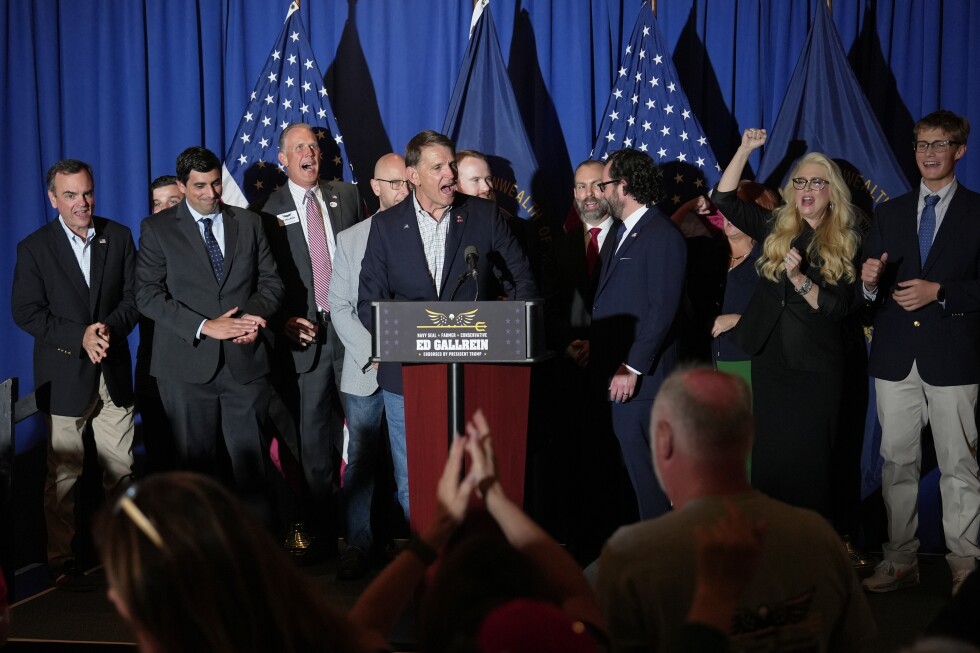
In the evening, after the primary result was known, Massie took the stage before a fired-up crowd that cheered and chanted throughout his speech, including slogans such as “no more wars” and “America First!”
Advertisement
Advertisement
“We stirred up something. There is a yearning in this country for someone who will vote for principles over party,” Massie said.
He also criticized unwavering fealty to Trump in Congress: “If the legislative branch always votes whichever way the wind is blowing, then we have mob rule,” he said. But if lawmakers follow the constitution, “we have a Republic.
Gallrein delivered a shorter, more muted speech at his victory party in Covington, where he first thanked Trump for his support and leadership.
Gallrein, a former Navy SEAL, ran on his military service and loyalty to the president and accused Massie of forsaking Trump and the party. He is expected to win the general election against Democrat Melissa Strange in the deeply red district.
The primary turned white hot in the final stretch of the campaign as Massie recruited a phalanx of other Republicans, including Rep. Lauren Boebert, in an attempt to show voters that they could support both him and Trump. Trump ratcheted up his social media attacks on Massie, calling him “an obstructionist and a fool,” and Gallrein shared a stage with Defense Secretary Pete Hegseth on Monday.
The race was the most expensive U.S. House primary in history.
Also Tuesday, Republicans statewide chose U.S. Rep. Andy Barr as their nominee to replace Mitch McConnell, the longtime U.S. Senate leader. In a contest representing a generational changing of the guard for the party, Barr, who was endorsed by Trump, bested Daniel Cameron, a former state attorney general who leaned into his Christianity on the campaign trail.
Advertisement
Massie’s challenge
Massie’s challenge was to win over voters who generally think favorably of Trump, the same man telling them to vote for Gallrein. It was not the first Republican primary Trump has tried to sway, but Massie’s overt rebelliousness has been a particular challenge to the president.
Gallrein embraced the role Trump gave him and focused his pitch to voters on his personal history and unwavering loyalty to the president.
Some voters were fed up with Massie bucking the party.
George Scherzer, who lives in the small town of Crestwood, supported Massie in past elections but did not like his lack of support for some of the president’s agenda, including last year’s tax and spending bill, known as the One Big Beautiful Bill.
Advertisement
“Some of his votes just did not make sense to me,” Scherzer said.
Massie noted that he voted with his party the vast majority of the time. As for the remainder, he said those were on proposals that violated his America First principles such as adding to the national debt and getting into military entanglements like the war with Iran.
Massie has voted against U.S. aid to Israel and faced accusations of antisemitism. He has denied the charges, arguing that he is generally against all foreign aid. But the race drew in millions of dollars against him from pro-Israel interest groups, including from the Republican Jewish Coalition Victory Fund.
That became a stump topic for Massie, who said the attempt to oust him was to send a warning to other lawmakers who oppose the president or aid to Israel.
Advertisement
In a last-minute pitch to Kentucky Republicans, Boebert posted photos of her with Massie and with Trump on the social platform X, saying, “I support both of these men.” Replying to that, Massie said: “she likes both Trump and me! Yes it’s possible!!”
Trump lashed out at Boebert on his Truth Social platform, asking for a Republican to challenge her — even though the filing deadline in her home state of Colorado has already passed. “Anybody that dumb deserves a good Primary fight!” he wrote.
Trump also influenced Senate primary
The president swayed the race not just through his endorsement but by offering a third challenger, Nate Morris, an ambassadorship just over two weeks before Election Day. Morris, who fashioned himself as the MAGA candidate, withdrew from the race and encouraged his backers to support Barr.
Barr was first elected in 2012 in the 6th Congressional District. As with Gallrein, he is expected to win the general election in the Republican-dominated state.
Advertisement
During the campaign both Barr and Cameron tiptoed around their relationship with McConnell, whom they previously called a mentor.
McConnell criticized Trump over the Jan. 6, 2021, attack on the U.S. Capitol and more recently voted against some of his Cabinet picks. He is stepping down after becoming the longest serving Senate leader in American history, coinciding with a transformation of the party under Trump.
Many Republicans, while admiring McConnell’s achievements, see him as out of step with the Make America Great Again and America First movements spawned by Trump. Both Barr and Cameron took note, and while ingratiating themselves to the president, they put some distance between themselves and the senator.
Former Transport Secretary Louise Haigh, who is tipped for a major role in a Burnham Cabinet, insisted Andy Burnham had a blueprint for his first 100 days in No10
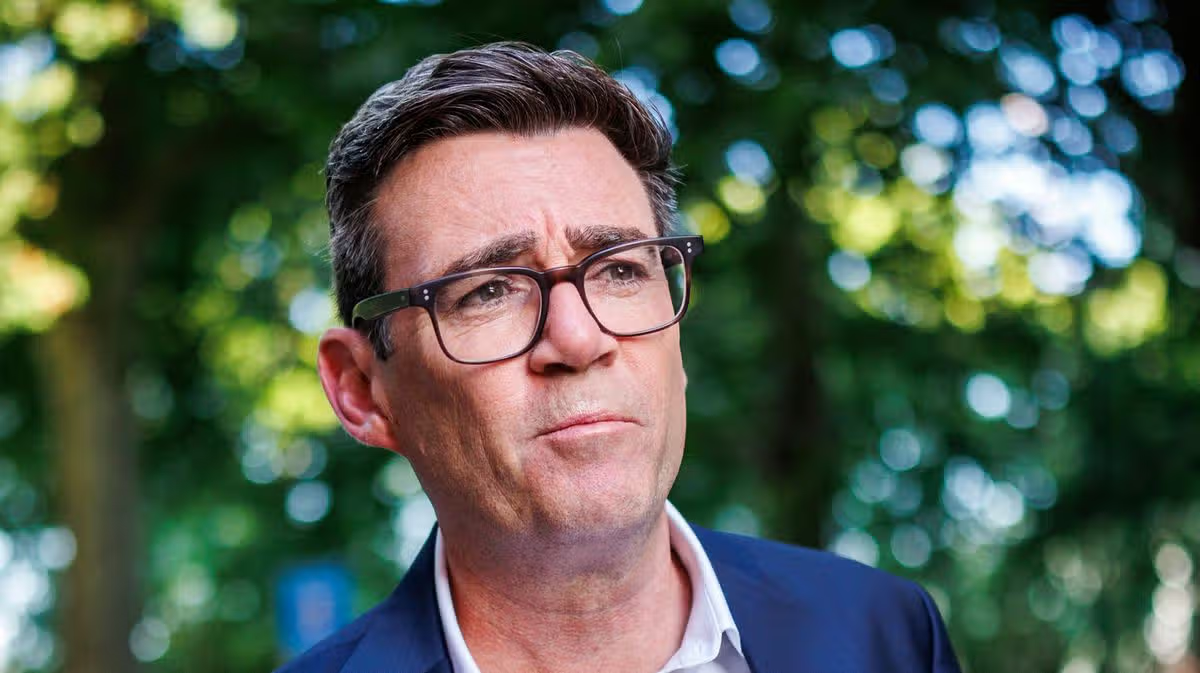
PM-in-waiting Andy Burnham has been working on his plan for Downing Street for at least a year, close ally Louise Haigh has said.
Advertisement
The former Transport Secretary – tipped for a major role in a Burnham Cabinet – insisted the ex-Greater Manchester Mayor had a blueprint for his first 100 days in No10.
Her comments came as Mr Burnham’s path to power became clearer as nominations opened on Thursday in the Labour leadership contest to replace Keir Starmer.
Former defence minister Al Carns – believed to be his last remaining Labour MP mulling a challenge- confirmed he would not stand against him. It means Mr Burnham will almost inevitably take office on July 20 without a contest.
Appearing on the BBC’s Political Thinking podcast, Ms Haigh was asked how long Mr Burnham had been thinking about what he might do as Prime Minister.
Advertisement
She replied: “I don’t think I am breaking any state secrets to say Andy has been thinking and has had his ambition, his ambitions have been clear for some time.”
She added: “Of course he’s run for leader twice before, so this is hopefully, touch wood, third time, third-time lucky. So he’s, you know, he’s been thinking about this and certainly planning for this, for this moment, for at least a year.”
Asked on whether there was a plan for the first 100 days, Ms Haigh said: “Yes, of course there’s a plan.” But she added: “I’m not going to tell you about it here.”
Advertisement
Ms Haigh – a crucial figure in Mr Burnham’s victorious Makerfield by-election campaign – has been involved in transition talks with the civil service in recent weeks.
She has been working alongside Mr Burnham and James Purnell, who is set to be the new No10 chief-of-staff, with a focus on national security, the economy, and devolution.
He said early mistakes including the decision to cut winter fuel payments for pensioners, “defined the government in a way that really did us a lot of damage”.
Advertisement
Ms Haigh rejected claims Mr Burnham was “unprepared or inexperienced” because of his nine years away from Westminster while Mayor of Greater Manchester.
She said: “He has spent that time thinking very deeply about how the country is run, what holds regions like Greater Manchester, and therefore most regions and the devolved nations of this country, back. He has got very, very clear ideas and a plan to put that right.”
Ms Haigh also criticised the outgoing Mr Starmer for the “hurtful” way he removed her from Cabinet and accused his operation of deliberately seeking to “knock my character down” with briefings afterwards.
The Sheffield Heeley MP quit as transport secretary in 2024, several months after Labour came into power, after it emerged she had pleaded guilty to a criminal offence related to incorrectly telling police that a work mobile phone was stolen in 2013.
Advertisement
She told the BBC that Downing Street had initially signed off a statement from her saying she had previously disclosed the matter to Mr Starmer – but then his chief of staff Morgan McSweeney rang and asked her to resign.
She said: “I had to really push even for a conversation with Keir, he didn’t want to have that conversation with him himself, and both Morgan and he kept saying, ‘Well, additional information has emerged’, but at no point would any of them tell me what that additional information was.
“And afterwards they repeated that. And it was painful because they could have said, ‘Look, these headlines are awful, and it’s not going to be nice for you to ride them out’.
“And it wasn’t. And to be honest, I would have agreed, and I would have gone on that basis because I didn’t particularly want to ride them out. It was embarrassing, and it wasn’t pleasant to go through.
Advertisement
“But to pretend that I hadn’t told him and to brief so consistently and so viciously for quite a number of weeks after that was a deliberate attempt to knock my character down.”
Dust off those dancing shoes – it’s Strictly season! (Picture: BBC)
Strictly Come Dancing fever is well underway ahead of the 2026 series, with several members of the cast already being revealed.
This year’s batch of competitors will no doubt be hoping to replicate the success of Lioness Karen Carney and professional partner Carlos Gu, who emerged as last year’s winners.
And the newcomers will be joining Strictly at an important time, with a number of enormous changes taking place on the BBC’s flagship dancing show.
Wake up to find news on your TV shows in your inbox every morning with Metro’s TV Newsletter.
Sign up to our newsletter and then select your show in the link we’ll send you so we can get TV news tailored to you.
Advertisement
As bosses look to usher Strictly into a new era – hopefully scandal-free from now on – let’s take a look at who has been confirmed and who is rumoured for the 2026 line-up.
Who is confirmed in the Strictly Come Dancing cast 2026?
Cach Mercer
In at number five is Love Island’s very own Cach Mercer (Picture: BBC)
Rolling in at number five is influencer Cach Mercer, who is already in good standing after winning reality show Love Island with his partner Toni Laites in 2025.
Off the back of his Casa Amor victory, he’s trading sunny days in Mallorca for the high-energy Strictly dance floor.
Although he may well feel right at home, given his social media fame comes from posts showing off his Afrobeat, hip-hop and street dance moves.
Advertisement
‘I have grown up watching the show with my family and am so excited to now be part of the cast. Dancing is a huge passion of mine and I can’t wait to learn Ballroom and do the Foxtrot for the first time!’ he said in a statement.
Time will tell if his moves, which have won over 1.3 million TikTok followers and counting, will be enough for the general public.
Chris Appleton
Celebrity hairstylist Chris Appleton is joining the fray (Picture: BBC)
Born in Leicester, the 43-year-old creative has made it all the way to Hollywood as a hairstylist to the stars, including bestie Kim Kardashian and other A-listers like J-Lo, Sofia Vergara, and Ariana Grande.
In 2023, Kim K even officiated his wedding to screenstar Lukas Gage (the couple later divorced), and his career continues to ascend even higher.
Now, he’s cha-chaing his way onto the dance floor to show just what he’s soaked up from all the performers he’s hung out with over the years.
Advertisement
He said in a statement: ‘I’ve always believed that the best things happen when you take a chance and try something new.
‘I may know my way around a salon floor, but the dance floor is a whole different story – and I can’t wait to get started.’
Delta Goodrem
Delta Goodrem was the third star announced (Picture: BBC)
The Australian singer-songwriter, Delta Goodrem, was just 15 years old when she signed her first record deal and her careers gone from strength to strength ever since.
Still, there’s a difference between singing and dancing, but that’s a challenge Deta is keen to take on.
Advertisement
‘I’ve been incredibly honoured to perform on many different stages throughout my career – from TV, theatre, film sets, to touring my own shows around the world, there is, however, one stage I’ve never stepped onto, and that is the ballroom floor,’ she said in a statement.
‘I’m absolutely thrilled to be joining Strictly and can’t wait to get started!’
With an attitude like that, is it any wonder Delta has reportedly been on the Strictly boss’s wishlist for years?
Lacey Turner
Lacey Turner is leading the charge for the confirmed Strictly 2026 cast (Picture: BBC)
As the 38-year-old soap actress takes a break from Albert Square to pursue new ventures, it seems her journey is taking her from the cobblestones straight onto the dance floor.
Advertisement
In the announcement, Lacey wrote: ‘I am so excited to be making my way to the dance floor this year to be a part of Strictly Come Dancing.
‘I am a huge fan and can’t quite believe I will be taking part and not watching at home this year! I look forward to meeting everyone and learning a new skill!’
It wouldn’t be the first time an EastEnders icon has appeared on Strictly – who could forget Jake Wood (aka Max Branning) with his Mambo No. 5 salsa?
Dani Dyer
Will Dani Dyer return to finish what she started? (Picture: Ian West/PA Wire)
Poor Dani Dyer had one of the briefest Strictly stints ever last year, as she was forced to withdraw shortly after the launch show due to an ankle fracture. But now – she’s back!
Dani was originally partnered with Nikita Kuzmin, who went on to reach the final with Amber Davies when she filled in at the last minute.
Advertisement
The reality TV star previously said on The Jonathan Ross Show that she would ‘love’ to do Strictly again, saying: ”If they rang me, I’d answer the phone. I was devastated. It was hell for me when I hurt my foot; I was so sad.’
Her dream has now become a reality, as she’s become the second celebrity to be confirmed for the 2026 line-up.
Don’t miss a TV review! Add us as a Preferred Source
As a loyal Metro TV reader, we want to make sure you never miss our articles when searching for stories. Our TV experts are here to bring you all the latest reviews, streaming updates, videos, and exclusive interviews, with a vibrant community of highly engaged readers.
Click the button below and tick Metro.co.uk to ensure you see stories from us first in Google Search.
‘I am so excited to be back in the ballroom this September! I just cannot wait to get my dancing shoes back on and hopefully this time around I can actually make it to week one!’ the 29-year-old said in a statement.
‘I’m just over the moon and cannot wait to find out who else is doing it!’
Advertisement
Who is rumoured for the Strictly Come Dancing cast 2026?
Dame Sarah Storey
It’s believed that Dame Sarah Storey will be the next name confirmed (Picture: Getty Images)
Paralympic athlete Dame Sarah Storey, 37, is said to have signed up to this series of Strictly, with an official announcement rumoured to be on the cards.
A source told The Sun: ‘Sarah is delighted to be taking part in Strictly and is really excited to be learning a new skill.
‘She is obviously very competitive and hopes to give the contest her all, while letting viewers get to know her personality.
‘She’s also keen to embrace the glamour of the show and is looking forward to getting dressed up.’
Cyclist Dame Sarah is Britain’s most successful Paralympian, having won 30 medals – including 19 Gold – over the course of her career.
Jeff Brazier is the former partner of late Big Brother star of Jade Goody (Picture: Ken McKay/ITV/Shutterstock)
The Brazier name will be familiar to Strictly fans – in 2023, EastEnders actor and model Bobby Brazier danced his way to runner-up with professional partner Dianne Buswell.
According to The Sun, Bobby’s father, 47-year-old Jeff, is in talks to compete in the upcoming series of the show.
A source told the publication that he had become ‘tempted’ after being approached by the BBC.
The insider added: ‘Previously he said he wouldn’t do it because he didn’t want to step on Bobby’s toes. But three years have passed now and it’s a massive opportunity for Jeff.
Advertisement
‘He has discussed it with Bobby who thinks it would be amazing if his dad was to give it a go. Jeff has yet to sign his contract but everyone around him is urging him to do it.’
Josie Gibson
Josie Gibson is said to have been on the Strictly bosses’ wish list for a while (Picture: Ken McKay/ITV/Shutterstock)
She rose to fame as a Big Brother winner and has since cemented herself as a British TV favourite.
Josie Gibson is now often seen presenting on This Morning, and, in 2023, she placed fourth in I’m A Celebrity… Get Me Out Of Here!
If reports are to be believed, though, she could be looking to at least earn herself a place on the podium by signing up to Strictly and wowing on the dance floor.
‘Josie has been on the BBC’s radar for a while, and they’ve not given up their pursuit,’ said a source.
Advertisement
They added to The Sun that the ball has already started: ‘They’re hoping this year is the year, and talks are progressing well.’
‘Bosses are convinced her down-to-earth charm will be the boost this year’s new-look show needs,’ the insider also claimed. ‘Warm and engaging, she’s just what they require right now and will be a sure-fire hit with fans.’
Josie, 41, certainly wouldn’t be the first ITV daytime star to tackle Strictly, with previous series signing up the likes of Alison Hammond, Ruth Langsford, Charlotte Hawkins, and, who could forget, Ed Balls.
Jake Quickenden
I’m A Celeb’s Jake Quickenden is no stranger to reality TV (Picture: Shutterstock)
Rising to fame on the X-Factor in 2012, Jake Quickenden has his roots in reality TV.
Subsequently appearing on I’m A Celeb and Dancing On Ice (which he won, back in 2018), Jake currently stars in the CBBC series Jamie Johnson FC.
Advertisement
Of those Strictly rumours, a source told The Sun: that he’d ‘caught the eye of the Strictly bookers.’
They added: ‘He’s fun, hunky and known as an all-round nice guy. He’s an actor and singer, so is a natural performer. And he won Dancing On Ice, so has clearly got the moves. And now he’s in the BBC stables, he’s part of the gang.’
The 37-year-old star said that he’d be keen to take part, revealing that he’d ‘love to do it’ should the opportunity arise.
Strictly Come Dancing returns to the BBC in September.
Advertisement
A version of this article was first published on May 31, 2026.
On Thursday afternoon, the BBC revealed that Cach would be the second former Love Island star to be taking part in the new series, joining fellow champion Dani Dyer on the line-up.
He said: “I have grown up watching the show with my family and am so excited to now be part of the cast.
“Dancing is a huge passion of mine and I can’t wait to learn ballroom and do the Foxtrot for the first time!”
Since leaving the vila, he’s enjoyed work as a model and DJ, and become a major presence on social media, with the BBC noting that he has accrued tens of millions of likes on TikTok, thanks to his posts “showcasing his Afrobeat, hip-hop and street dance moves”.
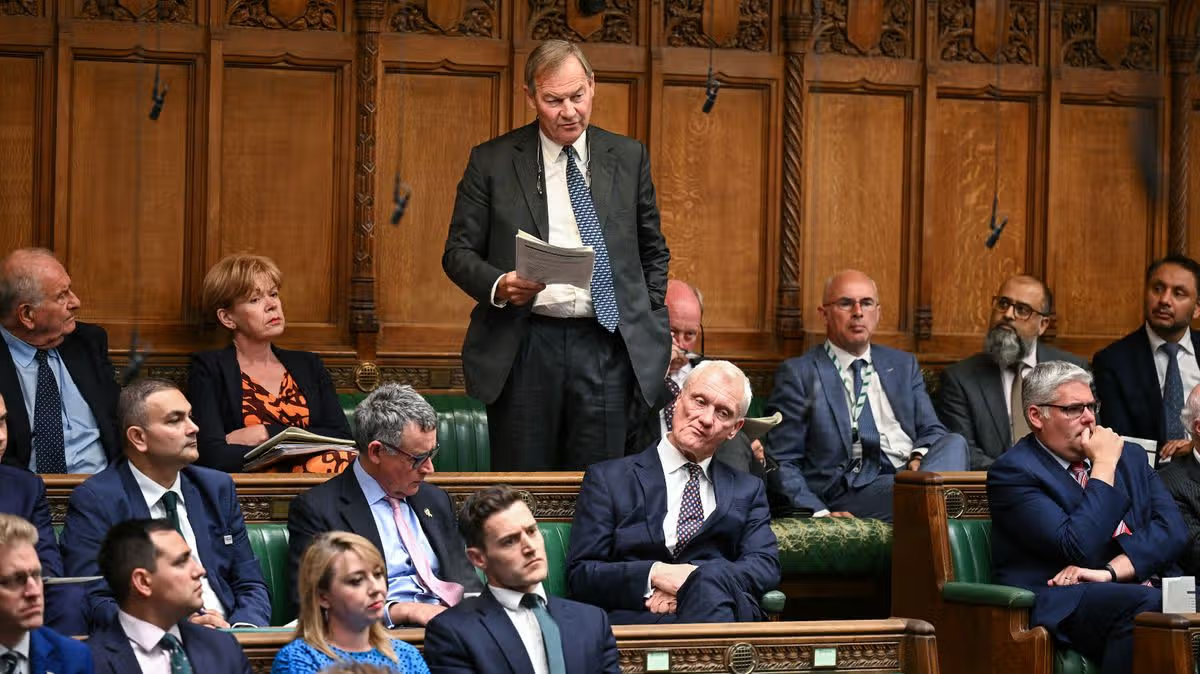
Stirling MP Chris Kane spoke in Parliament after the comments made by Rupert Lowe about the Tragedy on a recent episode of the podcast.
An array of local politicians have reacted angrily to comments made by the Restore Britain MP Rupert Lowe on a podcast – where he described the Dunblane Tragedy as “one murder”.
Advertisement
The right-wing politician has faced fury from across the political spectrum after the comments on the Joe Rogan podcast.
Sixteen children and teacher Gwen Mayor lost their lives in the Tragedy at Dunblane High School in March 1996, with locals quietly marking its 30th anniversary earlier this year.
Mr Lowe, a businessman and former owner of Southampton Football Club, appeared on the episode of the popular show and was asked to discuss gun laws in the UK.
On the episode, Lowe tells Rogan: “If you don’t have a farm, you’ll find it very difficult to get a gun of any kind. Even if you have a farm.”
Advertisement
Lowe, the MP for Great Yarmouth, continued: “They don’t want the public to have guns. As you probably know they banned handguns in the 90s, right in the late 90s, because there was a murder up in Dunblane.”
He added: “So everybody, my father used to shoot pistols for Oxford University and he had, he’s dead now bless him, but he had all his pistols were taken away.”
Advertisement
Stirling and Strathallan MP Chris Kane was among those who denounced Lowe’s remarks.
He submitted a point of order in the House of Commons, where he said the comments had caused “profound offence” and “diminished” those who gave their lives in 1996.
The point of order continues: “The people of Dunblane responded not with division, but with dignity, compassion and a determination that no other community should endure such horror.
“It is because of their courage, and the united action of this House, that the United Kingdom has some of the strongest firearms laws in the world and an ongoing cross party approach to ensuring those protections will not be weakened.”
Advertisement
Mr Kane followed those remarks up on social media, adding: “Like most reasonable people, my initial reaction to Rupert Lowe’s comments was one of fury and disbelief.
“However, unlike Mr Lowe, many of us have thankfully chosen to take the lead of the courageous parents and families forever touched by the Dunblane Tragedy and from the community that I am both proud and humbled to represent.
“They have conducted themselves with dignity, with a desire to unite people rather than to divide them, and in the hope that generations to come will be protected in a way that 16 – yes sixteen, not one – innocent five and six year olds and their teacher Mrs Mayor were not.
Advertisement
“Families across our country have children and grandchildren in our schools today who are alive because of that kind of selflessness and the determination that something positive would come from unimaginable evil.
“Mere words can never describe the sort of darkness that was visited upon Dunblane Primary School and our nation on March 13, 1996.
“Many people on that terrible day and since have lived with a kind of acute consciousness and pain that should never be visited on any human soul.
“The least the rest of us can do is to ensure that is forever acknowledged and honoured.
Advertisement
“Mr Lowe’s attitude does not reflect the sort of thoughtful society the vast majority of our nation and its people wish to have and which has been displayed day in and day out in my constituency for over 30 years.
“We can all learn something from the example of the good people and families of Dunblane. We can only hope that one day that includes Mr Lowe.”
Mr Kane’s remarks were echoed by Dunblane’s MSP and SNP deputy leader, Keith Brown, who said: “Rupert Lowe is a stain on our politics and his comments are beyond despicable.
Advertisement
“Despite these hideous remarks from Rupert Lowe, the Snowdrop Campaign that followed that terrible day ensured a ban on the private ownership of most handguns – that is the proud legacy of the bereaved families and the local community.
“Their courage and determination in the aftermath of the attack is something we should never betray and our community will never let the likes of Rupert Lowe do exactly that.”
Meanwhile, Mid Scotland and Fife MSP Stephen Kerr, whose children went to school close to Dunblane and were in lock-down during the attack, said: “Rupert Lowe’s comments are astonishingly insensitive and profoundly disrespectful to the victims of Dunblane, their families and everyone in Scotland who remembers that horrific day.
“To describe Dunblane as ‘one murder’ is not simply inaccurate – it diminishes one of the darkest days in Scotland’s modern history.
Advertisement
“Sixteen children and their teacher were murdered, and fifteen other primary school children were wounded.”
A Restore Britain spokesman told the Record: “Rupert was clearly referring to one incident.”
A men’s doubles semi-final at Wimbledon was interrupted by a medical emergency in the crowd
A men’s doubles semi-final at Wimbledon was suspended following a medical emergency in the crowd.
Advertisement
Marcelo Arevalo and Mate Pavic were facing Kevin Krawietz and Tim Puetz when proceedings were abruptly halted.
With temperatures hitting 33 degrees on Thursday afternoon, play was paused at 1-1 in the second set as staff rushed to help a spectator who had fallen ill in the stands.
“We’re just going to pause,” umpire James Keothavong announced.
“A fellow spectator requires medical assistance at the top.”
Advertisement
Both pairs of players remained at the net while waiting for clearance to continue.
Within 10 minutes, the umpire gave the all-clear for play to recommence.
Arevalo and Pavic subsequently secured their spot in the men’s doubles final, defeating Krawietz and Puetz in straight sets.
The first set went to a tiebreak, while the second stood at 2-2 before the sixth seeds claimed four games on the bounce to seal the win, reports the Express.
Advertisement
They will meet the victors of Henry Patten and Harri Heliovaara’s encounter with Aleksandar Kovacevic and Thanasi Kokkinakis, with the second semi-final set for 3pm.
Lorna Luxe details how managing her eating disorder became a ‘full-time job’ and she developed a ‘war mindset’ which saw her keeping her workouts a secret from husband John
Influencer Lorna Luxe has detailed how her eating disorder became a ‘full-time job’ and admitted she would do secret workouts that she hid from husband John.
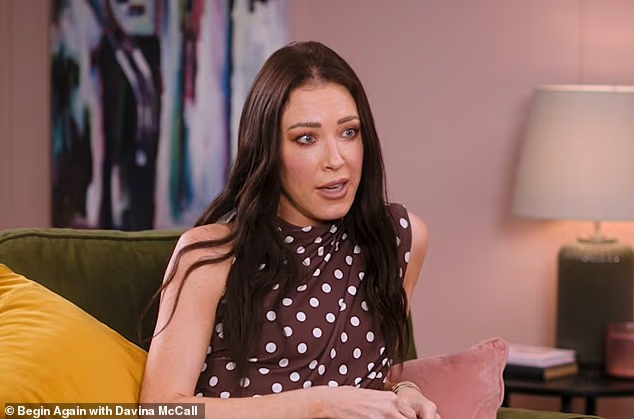
Talking to Davina McCall on her podcast Begin Again, Lorna, 43, recalled how she became incredibly unwell battling anorexia after getting a job as an air hostess.
And she admitted she developed a ‘war mindset’ when it came to managing her disorder, working out twice a day, with one workout being done in complete secret.
She told Davina about where she thinks her eating disorders originated, saying: ‘I had been at uni and like anyone, you’re drinking loads and you’re eating loads and I put a bit of timber on.
Advertisement
‘I was a bit of a curvier woman. Not that there’s anything wrong with that, but I wasn’t happy in how I looked.
Lorna Luxe has detailed how managing her eating disorder became a ‘full-time job’ and discusses the secret workouts she kept from husband John
And she admits she developed a ‘war mindset’ when it came to managing her disorder, working out twice a day, with one workout being done in complete secret
Advertisement
‘Then when I started to diet and lose a bit of weight, I also saw that people treat you differently, right? So I had interest from men I’d never had that before.
‘And when I got my Virgin job, when I went for my Virgin Atlantic interview back in 2002, they weighed you, they checked your height, they took a photo of your face, they wanted to see what you’d look like in the uniform. This was the norm back then.’
She continued: ‘And actually them as a brand, they’re so different that now, all their advertising is all about celebrating inclusivity, but at the time it was just a standard protocol. I imagine with all airlines that people had to fit a mould.’
Lorna said she believes she was rewarded in some way for losing weight.
Advertisement
She said: ‘I got in there because I’d lost a bit of weight. So, it was always in the back of my head from the day one of that job. Okay. you’ve been rewarded.
‘And so maintaining weight because if you changed uniform size, you got pulled into the office because it cost the business money.
‘So all these things were playing in my mind. I was living in Brighton, partying a lot, drinking, boozing, eating kebabs and having to manage my weight became an absolute full-time job.
‘And so sadly for me, I used my job, you know, flying away transatlantic. You stay down route somewhere for a couple of days, no one’s going to see what you’re up to.
Advertisement
Lorna said: ‘When I got my Virgin job, you know, I when I went for Virgin Atlantics interview, and this is back in 2002, they weighed you, they checked your height, they took a photo of your face, they wanted to see what you’d look like in the uniform. This was the norm back then’
John, who was 21 years Lorna’s senior, died in February after battling stage four adrenal cancer after being diagnosed in April 2023. The couple had been married 16 years
‘So your behaviours, your habits can really start to manifest. And I became incredibly unwell and it’s terrifying when I look back.’
Lorna admitted that as well as controlling her eating, she was working out like a ‘manic obsessive.’
Advertisement
She said: ‘I also think that you know the the real peak of my illness. I was with John now so he didn’t know about this either.
‘He’d got me a David Lloyd membership in Brighton, there’s one in Worthing and there’s one in the marina and I would go to the one in the marina in the morning.
‘I’d cycle all the way down the seafront which was a schlep if you know Brighton. I’d go down there and then in the evening I’d go to the Worthing one.
‘I’d be there for two, three hours and when I look back now I’m impressed at you know the energy I put into that.
Advertisement
‘How was I even keeping going? You get into this very war mindset where I was doing daft things and my behaviours were changing, my mood swings were up and down I was permanently cold.’
Lorna sadly lost her husband John in February. He died following a battle with adrenal cancer on February 11, 2026, at the age of 64
She said that at the height of her eating disorder battle, he did what he could to try and help her.
Lorna said: ‘He would often say like you just you lost a bit too much weight now. “You’re beautiful but you’ve just gone a bit too far”. And also on flights, I might fly with someone.
Advertisement
‘A girl that I’m still mates with now, Cla. She’d suffered with anorexia, so she recognized the signs straight away and she pulled me in the galley.
‘She went, “You’ve got a problem. This is not good. You need to look after yourself. I’m here if you need me.” And I treated her with such disrespect at the time.
‘I was rude to her. I was like, “Don’t be so ridiculous. This is actually really out of order. What are you saying? There’s absolutely nothing wrong with me.”
‘I think that’s such a brilliant defense mechanism because it does put people off talking to you about it. It frightens people from broaching it.
Advertisement
‘I’ve worked really hard to be skinny so you’re not going to [ __ ] with this now. And that was my headspace.
I was like, “don’t you dare try and come for me on this because this is the the only thing I’m really good at”.
‘I kept thinking, I’ve got the secret sauce here. They don’t know. But I’m on to something with this. And I was really proud of my ability to undereat and be hungry.
‘And that’s really terrifying. Thank God that I’ve come through the other end now. I definitely have control issues but just with different things now like my business is what I control and I John certainly gave me those tools to feel like I’m your safe place.
Advertisement
You don’t need to be in control anymore because I’ve got you. And he kind of stepped into that role for me in a big way.’
Catherine Zeta Jones leads tributes to relative Bonnie Tyler as she recalls singer performing at her wedding while Cliff Richard honours his ‘wonderful friend’ as she dies aged 75
Catherine Zeta Jones and Cliff Richard led the tributes to Bonnie Tyler following the news that the Total Eclipse Of The Heart icon died aged 75.
The Welsh pop star, whose real name is Gaynor Hopkins, died just months after she was treated in intensive care after being placed in an induced coma following an emergency intestinal surgery.
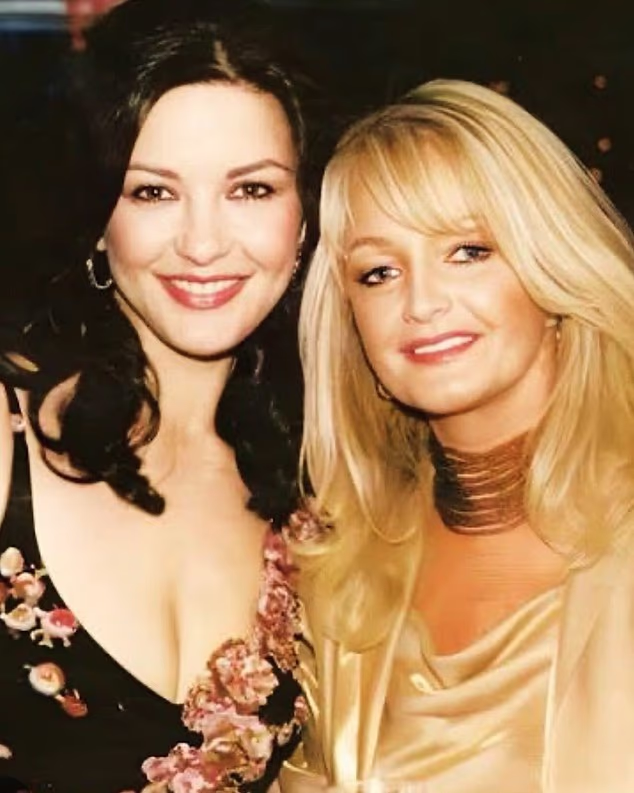
Fellow Welsh native Catherine, 56, revealed she had a close relationship with Bonnie after she married her cousin Robert and sang at her wedding to Michael Douglas.
Sharing her tribute alongside a picture of them together, she wrote: ‘My heart is broken with the news that our dearest Bonnie Tyler has passed away. Bonnie was married to my cousin and has been such a part of my life. We are photographed here together the night before my wedding.
Advertisement
‘So sang and rocked it at my wedding. An extraordinary woman with vocals to match. A one of kind artist, who so easily could have been a comedian because she was one of the funniest people I ever met.
‘Thank you Bonnie for the joy you brought so many. Sleep tight beautiful lady. We shall forever ‘Keep A Welcome In The Hillsides’ of Wales for you. Sending my love to Robert and the family. God Bless.’
Catherine Zeta Jones and Cliff Richard led the tributes to Bonnie Tyler following the news that the Total Eclipse Of The Heart icon died aged 75
Advertisement
Fellow Welsh native Catherine, 56, revealed she had a close relationship with Bonnie after she married her cousin Robert and sang at her wedding to Michael Douglas
Sir Cliff spoke of his ‘wonderful friend’ Bonnie on Facebook and shared a picture of himself with the late star
Sir Cliff spoke of his ‘wonderful friend’ Bonnie on Facebook and shared a picture of himself with the late star.
Advertisement
He said: ‘Another wonderful friend gone too soon. Bonnie’s infectious zest for life entertained so many around the world, and to be a good friend to all, including me.
‘It is shocking news to wake up to you this morning and I send my love to her family at this very sad time. RIP Bonnie…. Cliff’.
Sir Rod Stewart also shared a message for his ‘good pal’, writing: ‘We shared similar styles of vocalising. She was a good pal, a true soul stirrer. I sing It’s A Heartache every night on tour. I’ll miss you darling, Bonnie.’
American singer Suzi Quatro said of the iconic singer: ‘She took a song by the balls. Rest in peace, my friend, rest in peace.’
Advertisement
Bonnie is survived by her husband of more than 50 years, Robert Sullivan.
The statement on her website read on Thursday: ‘Bonnie’s family and team are heartbroken to announce that Bonnie unexpectedly passed away last night in hospital in Portugal as a result of the illness that she was being treated for.’
Vernon, 52, was among the first to pay tribute to Bonnie on his Radio 2 show, before playing her famous track Holding Out For A Hero.
Sir Rod Stewart also shared a message for his ‘good pal’, writing: ‘We shared similar styles of vocalising. She was a good pal, a true soul stirrer. I sing It’s A Heartache every night on tour. I’ll miss you darling, Bonnie’
Advertisement
Vernon, 52, was among the first to pay tribute to Bonnie on his Radio 2 show, before playing her famous track Holding Out For A Hero (stock image)
Nicole shared this throwback picture of Bonnie on Instagram Stories after learning the sad news
Nicole, pictured, simply wrote: ‘Bonnie RIP’ alongside a love heart emoji
This Morning hosts, Ben Shephard and Cat Deeley also paid tribute to Bonnie on the daytime show, saying ‘really, really sad news’ and commenting on what a lovely lady she was
Advertisement
He said: ‘Sad news that Bonnie Tyler has passed, so from us on mid-mornings on BBC Radio 2 and everyone on Radio 2, our thoughts are with her family.’
All Saints singer Nicole Appleton, 51, shared a throwback picture of Bonnie on Instagram Stories soon after hearing the news.
She simply wrote: ‘Bonnie RIP’ alongside a love heart emoji.
And This Morning hosts, Ben Shephard and Cat Deeley also paid tribute to Bonnie on the daytime show.
Advertisement
Ben said: ‘Really, really sad news has been announced just a few moments ago on Bonnie Tyler’s website.’
Nick Ferrari said: ‘I remember interviewing her years ago because I was the pop reporter on The Sun at the time of Duran Duran and all these people and she was the most grounded person.
‘She was lovely to interview and honestly, I remember her saying she couldn’t quite believe how lucky she’d been, you know, a girl from Wales and she never took it for granted, always grounded and really, really decent matter. Great loss.’
Cat said that she had bumped into Bonnie backstage at ITV when she had appeared on Lorraine in February, saying: ‘She was a lovely lady.’
Advertisement
Ben said: ‘Our thoughts are with all her her friends and family during this really distressing time.’
A representative for BBC’s Eurovision team also paid tribute to ‘humble and kind’ Bonnie, after she represented the UK in the contest back in 2013.
They said: ‘The BBC Eurovision team are greatly saddened to hear the news that Bonnie Tyler, who represented the UK at Eurovision in 2013 passed away last night.
‘Bonnie was a music legend and we were truly honoured that such an iconic performer represented the UK.
Advertisement
‘Behind the scenes she was humble, huge fun and very kind. She brought energy to the contest and was a joy to spend time with. We all have such fond memories. Our thoughts and best wishes go to Bonnie’s family.’
Elsewhere, many fans paid tribute on X, writing: ‘Such sad news about Bonnie Tyler. She was always one of those ”what you see, is what you get” pop stars. The big voice, the big hair, big 80s production matched her personality – larger than life, yet down to earth. Farewell to one of Wales’ finest performers.
‘RIP Bonnie Tyler, thank you for giving us the best Nicholas Galitzine scene ever, Jeff singing to Total Eclipse Of The Heart in Bottoms is iconic.
‘Dear Bonnie Tyler, thank you for your magnificent voice, the big smiles, the huge joy you have brought to us over the years. What a gift.’
Advertisement
Bonnie was due to perform at the Sunshine Festival in Worcester this summer, along with a number of European dates, and was also booked to perform at Cardiff’s Utilita Arena on December 17.
The singer was first admitted to hospital in May to be treated for emergency bowel surgery and a perforated intestine after a burst appendix.
A spokesperson for the singer confirmed at the time: ‘Bonnie has been put into an induced coma by her doctors to aid her recovery. We know that you all wish her well and ask for privacy at this difficult time please.
Bonnie died after going into cardiac arrest following surgery which left her in an induced coma (the singer is pictured in her last TV appearance in February)
Advertisement
Advertisement
Following news of Bonnie’s death, many fans paid tribute on X
‘We will issue a further statement when we are able to.’
Advertisement
It was first reported that Bonnie had started feeling unwell in May.
She had been bedridden for two days at her Algarve home before her worried husband Robert Sullivan took her to the private hospital she was seen at before being transferred to Faro.
The singer, who has had multiple hits in her long career and competed at the Eurovision Song Contest representing the UK in 2013, is believed to have been rushed to hospital on April 30.
A day earlier, when her health woes first emerged, the spokesman had said: ‘We are very sorry to announce that Bonnie has been admitted to hospital in Faro, Portugal, where she has a home, for emergency intestinal surgery.
Advertisement
‘The surgery went well and she is now recuperating.
‘We know that all of her family, friends and fans will be concerned about this news and will be wishing her well for a full and swift recovery.’
She was said to have been ‘stable’ in an intermediate care unit at Faro Hospital before an apparent worsening of her health led to her being transferred to intensive care.
On June 15, the singer’s team said she had woken up from a medically induced coma after suffering a cardiac arrest in Portugal a month previously.
Advertisement
They said at the time: ‘Bonnie is no longer in a coma, but remains seriously ill. Although her condition is improving, the recovery process is slow.’
Sources said she had been maintaining her professional activity in the run-up to being taken to hospital, despite complaining of persistent pain for several weeks.
Cardiac arrest is a medical emergency in which the heart suddenly and unexpectedly stops pumping blood, causing it to stop beating and disrupting oxygen flow to the body and brain.
It causes instant unconsciousness and collapse. Immediate action involving starting CPR and using a defibrillator where available is essential to prevent death.
Advertisement
A ruptured appendix is a severe medical emergency requiring immediate surgical intervention and antibiotics to prevent fatal infections.
When an infected appendix ruptures, it creates a hole and causes fecal matter and bacteria to leak into the abdominal cavity.
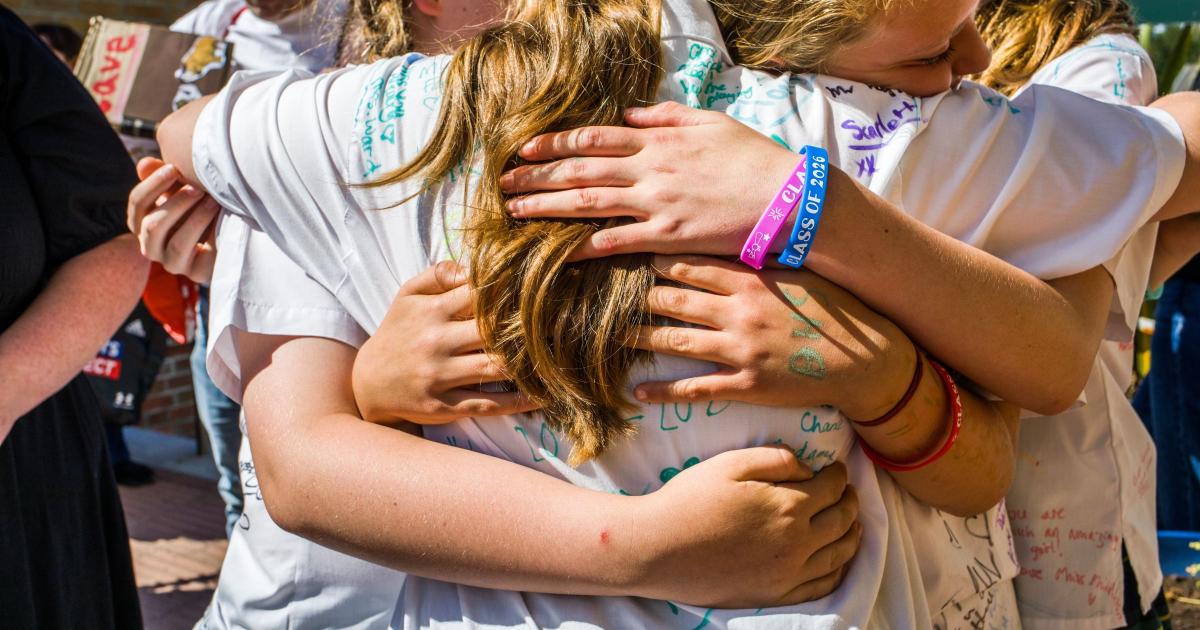
From September 2026, schools must limit the number of compulsory branded items of uniform and PE kit to three or fewer.
For secondary and middle schools, this limit increases to four, provided one of the items is a tie.
The new guidelines, stemming from the Education Act and the Children’s Wellbeing and Schools Act, aim to ensure that school uniforms are not a financial barrier for families.
Advertisement
The rules state that a branded item is any piece of clothing with distinctive characteristics, such as a name or logo, that make it unique to a school.
Examples include a blazer with an embroidered logo, a sweatshirt with a specific-coloured trim, or trousers with a unique style that are only available from a specific supplier.
To further reduce costs, schools are encouraged to allow parents to purchase generic items, like a plain navy skirt, from a range of retailers, giving them more choice and value for money.
The guidelines also say schools should avoid single-supplier contracts so parents have choice of where they can buy.
Advertisement
Schools are urged to ensure that opportunities to acquire second-hand uniforms are freely accessible to all parents, with information on how to acquire these items published on the school’s website.
It encourages schools to consider the total cost of their uniform to ensure it is affordable for all parents, particularly those from low-income households.
Schools are also advised to avoid frequent changes to uniform specifications and to minimise the cost of higher-cost items, such as blazers and jumpers.
The new rules reflect a shift in focus towards making school uniforms more affordable and accessible for all families, ensuring that no child is deterred from attending a school due to uniform costs.
Naylors, which led the deals, secured a combined total of almost 175,000 sq ft through transactions involving Headlam Group plc, Project Padel, and national logistics company 3PL.
The largest letting was for Centralway 65, a newly developed 65,000 sq ft industrial unit on Team Valley.
Keith Stewart, managing partner at Naylors, said: “Securing three lettings of more than 50,000 sq ft in a single quarter is an excellent result and reflects the resilience of the North East industrial market.
Commercial property consultant Naylors has completed three major industrial lettings across the North East during the second quarter of 2026, securing almost 175,000 sq ft of space for Headlam Group plc, Project Padel and logistics firm 3PL (Image: Supplied)
“Whilst there remain headwinds in the marketplace, deals are still being secured for the right properties in the right locations.
Advertisement
“Transactions are taking longer, with enhanced due diligence from occupiers to ensure the fundamentals stack up but these lettings demonstrate the continued demand for well-located, high-quality and adaptable space.”
The Team Valley unit was let to Headlam Group plc on behalf of UK Land Estates.
It attracted strong interest from multiple occupiers, highlighting ongoing demand for prime industrial accommodation.
Mr Stewart said: “The letting of Centralway 65 attracted significant interest from multiple occupiers, highlighting the appetite for best-in-class industrial accommodation.
Advertisement
“The Project Padel transaction demonstrates how existing industrial buildings can be successfully repurposed to support evolving occupier requirements, while the Blyth letting shows the value that high-quality refurbishment can bring to the market.”
The second deal saw Naylors secure a 52,972 sq ft warehouse in North Tyneside for Project Padel, acting on behalf of Columbia Threadneedle.
Following a complex change-of-use process, the leisure operator will transform the site into the region’s largest indoor padel facility.
Scheduled to open this summer, the centre will feature eight double padel courts, three single courts, two pickleball courts, a gym, spa, reformer studio, bar, and social workspace.
Advertisement
The third letting involved a 57,000 sq ft refurbished unit in Blyth, let to logistics firm 3PL on behalf of Mileway.
The deal was completed just six weeks after refurbishment—significantly faster than the standard three to six months typically required for an industrial letting.
The unit was upgraded following the departure of previous occupier APS.
Mr Stewart said: “On average, completing an industrial property letting deal in the UK typically takes three to six months, so to secure the Blyth transaction within six weeks of the refurbishment completing was a fantastic outcome.
Advertisement
“The quality of the refurbishment and the location were the key selling points.”
Knight Frank acted as joint agent on the Blyth and Centralway lettings.
Naylors was the sole agent on the Merlin Way deal, while Avison Young represented the tenant.
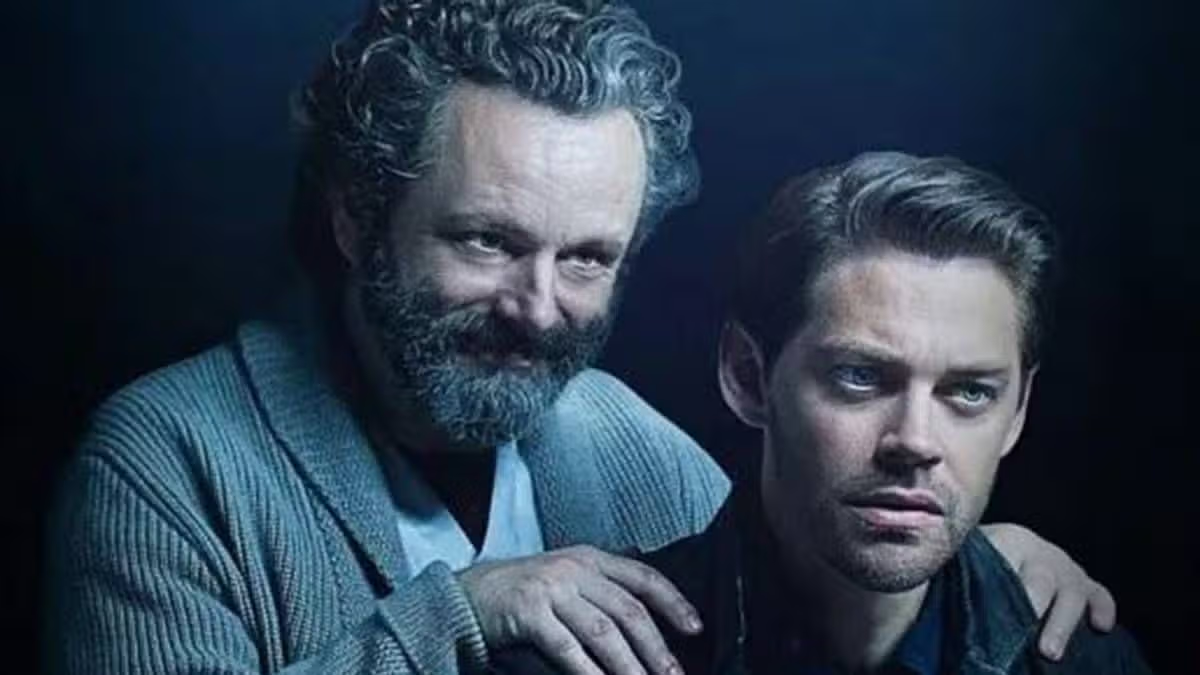
Welsh actor Michael Sheen’s crime drama has been hailed “truly special and original” by fans.
Fans of crime dramas should add a two-season series to their viewing lists after audiences praised it as “truly special and original”. The show originally premiered on Fox in 2019, centring on the son of a notorious serial killer known as ‘The Surgeon’.
Advertisement
Having severed all ties with his father, he is compelled to face him once more when a copycat killer begins to emerge.
Welsh actor Michael Sheen takes on the role of the deranged murderer Martin Whitly, who is locked away in a secure psychiatric facility having committed 23 killings.
The series in question is Prodigal Son, which is available to watch on Prime Video.
During the show’s original run, Sheen spoke candidly about inhabiting the role of a serial killer, revealing that he researched a number of real-life killers to perfect his performance.
Advertisement
He told press at the time: “I also looked at Harold Shipman – my character in this is a very well-respected surgeon, so the idea of a doctor who was very loved and respected by people and who took advantage of that and was killing them, I looked at that.
“Ted Bundy, who people found very charming and likeable… his biggest weapon is that he’s funny, and that people like him and warm to him and enjoy his company.”
Viewers flocked to IMDb to share their opinions, with one describing it as “phenomenal”, adding: “Prodigal Son is a great show to watch with the whole family.
Advertisement
“It mixes crime thriller and psychological horror brilliantly. The acting is solid, the cinematography is sleek, and the plot is engaging. If any show can make me emotional and feel a character’s pain (which is what Prodigal Son achieved with me) it’s a show worth watching.”
Another viewer remarked: “Prodigal Son is a truly special and original show that stands out in the crowded field of crime dramas.
“I particularly appreciated the originality of the concept, which brought a fresh perspective to the genre. The dynamic between father and son was absolutely captivating, and the cases were far from boring, unlike in many other shows of this type.”
Advertisement
Since its axing, fans continue to campaign for its revival, with one stating: “I can’t believe I just found out about this TV show. It’s fantastic. And a show like this has been cancelled? Really? This is one of the more entertaining series I’ve ever watched.
“My recommendation to everyone to watch it. Please bring back the Prodigal Son. Please, please.”
A further supporter urged: “Bring it back. This is a very well written show and incredible actors and actresses. There are so many more ways the stories could go. Please consider picking up the show on another network.”







![CORRECTION / Gold medallist Britain's Sarah Storey celebrates on the podium after winning the women's cycling road individual C5 time trial during the Tokyo 2020 Paralympic Games at the Fuji International Speedway in Oyama on August 31, 2021. (Photo by CHARLY TRIBALLEAU / AFP) / The erroneous mention[s] appearing in the metadata of this photo by CHARLY TRIBALLEAU has been modified in AFP systems in the following manner: [August 31] instead of [August 30]. Please immediately remove the erroneous mention[s] from all your online services and delete it (them) from your servers. If you have been authorized by AFP to distribute it (them) to third parties, please ensure that the same actions are carried out by them. Failure to promptly comply with these instructions will entail liability on your part for any continued or post notification usage. Therefore we thank you very much for all your attention and prompt action. We are sorry for the inconvenience this notification may cause and remain at your disposal for any further information you may require. (Photo by CHARLY TRIBALLEAU/AFP via Getty Images)](https://metro.co.uk/wp-content/uploads/2026/06/PRI_197179719-abc4.jpg?quality=90&strip=all&w=646)













































You must be logged in to post a comment Login