


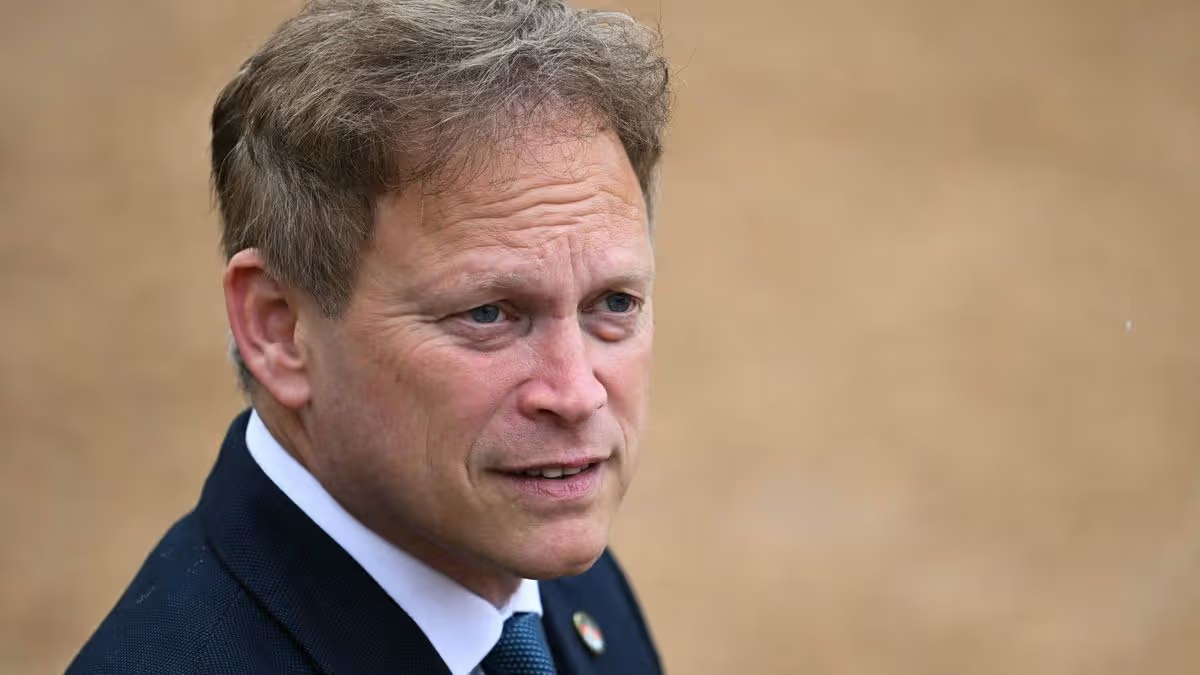
Sir Grant Shapps resigned as chairman of Cambridge Aerospace after he was contacted by an ethics watchdog
A former Conservative defence secretary has resigned from his job with a missile manufacturer over concerns he broke rules governing former ministers’ jobs. Sir Grant Shapps, who served as defence minister under Rishi Sunak, resigned as chairman of Cambridge Aerospace on April 30 “to simplify matters”.
It followed what he described as a “greater-than-anticipated focus on military technology” by the company. His resignation came after he was contacted by ministerial ethics watchdog Sir Laurie Magnus over concerns about his compliance with the rules in light of Cambridge Aerospace securing a multi-million-pound missile contract with the Government.
Sir Grant said he had no involvement with the contract or the company’s military work, saying despite his title of “chairman” he had not chaired its board or even been a company director, but rather “one of several co-founders”. In correspondence with Sir Grant, Sir Laurie said the former defence secretary had “allowed a perception of impropriety to develop” and “failed to uphold the standards expected in the rules”.
The now defunct Advisory Committee on Business Appointments (Acoba) approved Sir Grant’s role with Cambridge Aerospace in 2025 on the condition that he play no part in its defence-related work until two years after he left office. The decision was criticised by anti-corruption campaigners at the time, including Labour MP Phil Brickell who said Sir Grant’s claim the company was focused on “civilian aerospace” was “stretching credulity” given the firm’s own description of itself as involved in “defence tech”.
In correspondence with Sir Grant, Sir Laurie questioned whether he had complied with this condition, noting the company “seems publicly to have only one project, which is defence-related”. The watchdog initially contacted Sir Grant following the announcement on April 10 of a contract for Cambridge Aerospace to supply the UK and its Gulf allies with “Skyhammer” interceptor missiles.
Sir Laurie said the announcement “appears to be at direct variance with your original description of the role”. He added: “It is, on the face of it, difficult to reconcile the current scope of Cambridge Aerospace’s operations with the restriction that you avoid defence matters entirely, and in the absence of a fresh application for advice in view of changes to the nature of the business of Cambridge Aerospace under your chairship.”
Sir Grant said in response that he had “scrupulously” followed Acoba’s rules and was not involved “in any way, at any time, in any capacity” in the contract between Cambridge Aerospace and the Ministry of Defence. However, he apologised for not seeking further advice as Cambridge Aerospace began working on defence matters, saying this was “an oversight for which the excessive speed of events is the only mitigating circumstance”.
He added: “To simplify matters, in view of recent geopolitical events, and a greater-than-anticipated focus on military technology at Cambridge Aerospace, I have agreed to step down.” Sir Grant also declined to answer a series of detailed questions from Sir Laurie, citing “legal obligations of confidentiality which I cannot unilaterally waive”.
Mr Brickell said he welcomed Sir Grant’s resignation, but called for tougher sanctions for former ministers who broke the rules.He told the Press Association: “When ex-Conservative minister Grant Shapps moved from defence secretary to aerospace firms linked to sectors he oversaw, it only reinforced the public perception that ministers can cash in on their contacts and insider knowledge with little scrutiny.
“It is good that Shapps has finally resigned from the role he should never have taken, but unfortunately the horse has already bolted. Without meaningful sanctions, it risks looking like little more than a rubber stamp.”














































You must be logged in to post a comment Login