

Crypto World
Ethereum retests $2,100, but could ETH crash amid technical breakdown?



- Ethereum is testing the $2,140 level after an intraweek low near $2,070.
- A technical breakdown raises the risk of a sharp decline to $1,350, CryptoQuant notes.
- Bullish catalysts could include regulatory clarity and continued institutional demand.
Ethereum (ETH) briefly traded back above the $2,100 level on Wednesday after gaining about 1% over the past 24 hours as Bitcoin reclaimed the $77,200 mark.
While the rebound offered some relief for bulls, the altcoin remains under pressure following a sharp weekly decline.
Technical indicators continue pointing to elevated downside risk, with some analysts warning that ETH could face a deeper correction toward the $1,350 level.
Ethereum price today
Market data during the US session on Wednesday showed Ethereum testing the $2,140 zone after rebounding from intraweek lows near $2,070.
The rebound followed several sessions of heavy selling, although ETH remains well below recent swing highs.
Ethereum is currently trading nearly 7% lower for the week and roughly 28% lower year to date.
The Relative Strength Index (RSI) is hovering near oversold territory, which may suggest conditions for a short-term relief bounce.
However, ETH continues trading below all major moving averages on the daily chart, signaling that bearish momentum remains dominant.
Could ETH fall to $1,350 after a bearish breakdown?
One of the primary concerns for bulls is Ethereum’s breakdown below the support trendline of a triangle pattern.
The latest sell-off confirmed the structural breakdown on the daily chart, raising concerns that price action could mirror a similar technical failure earlier this year.
At the time, Ethereum’s price declined sharply from the $2,800–$3,000 range, falling roughly 35% over several days in February. If similar market conditions develop again, analysts warn that selling pressure could intensify further.
Analysts at CryptoQuant highlighted the downside risk in a recent market note.
“If Ethereum fails to reclaim the broken triangle structure, selling pressure could accelerate further, and price may target the $1,350 support level,” CryptoQuant author and analyst Pelin Ay wrote.
Macro conditions and weakening market flows have also added pressure to Ethereum’s price outlook.

Ethereum’s recent weakness has tracked Bitcoin’s broader lack of momentum, with BTC slipping toward the $76,000 area in recent sessions.
Meanwhile, spot Ethereum ETFs have recorded seven consecutive days of net outflows.
Persistent outflows have increased concerns that the recent technical breakdown could develop into a more prolonged downtrend.
Contrasting views and potential support levels
Not all market participants remain bearish on Ethereum’s longer-term outlook.
Bitmine’s Tom Lee said the recent pullback could represent a “buy low” opportunity, particularly as Bitmine’s treasury holdings now exceed 4.37% of Ethereum’s circulating supply.
Some bullish investors continue pointing to longer-term catalysts, including stablecoin growth on Ethereum, increasing staking adoption, and expanding interest in tokenized real-world assets (RWA).
Market participants are also monitoring regulatory developments that could influence broader institutional adoption trends over time.
In the near term, traders will closely watch whether buyers can push ETH back above the $2,200–$2,400 resistance zone.
Failure to reclaim that range could expose the token to another decline below $2,000, with some analysts identifying $1,350 as a possible downside target.



Network News
ETHEREUM COMMUNITY RESPONDS TO EF DEPARTURES: A wave of departures from the Ethereum Foundation (EF) is reigniting a debate inside the crypto industry: What is going on at the main steward behind Ethereum, and why does the community know so little about what is happening behind the scenes? Days after several high-profile figures said they had left the foundation during an internal shakeup, community members on X began openly questioning the organization’s direction, leadership structure and communication practices. “What’s happening at the EF?” crypto commentator Andy, the co-founder of the Rollup podcast, wrote in a post on X. Others echoed similar frustrations, arguing the EF has failed to clearly explain the rationale behind the changes or how responsibilities inside the organization are evolving. “Why can’t the EF just be transparent about things,” wrote Joon Ian Wong, a prominent figure in the crypto community events space. The criticism reflects a longstanding tension surrounding the Ethereum Foundation, the Switzerland-based nonprofit that plays a central role in funding research, coordinating upgrades and stewarding development of the world’s second-largest blockchain by market capitalization. Unlike traditional corporations, the EF has historically operated with a loose and decentralized structure. Some have argued that the model preserves Ethereum’s neutrality and prevents excessive concentration of power. Others say the approach has increasingly clashed with the expectations of an ecosystem now underpinning hundreds of billions of dollars in assets and decentralized financial activity. The latest departures appear to have reopened that debate. — Margaux Nijkerk Read more.
CITI SAYS BITCOIN PARTICULARLY EXPOSED TO QUANTUM THREATS: Quantum computing is emerging as a growing risk for digital assets, with Wall Street bank Citi (C) warning that recent breakthroughs are accelerating the timeline for potential threats to crypto security and internet infrastructure. In a report, the bank said advances in quantum computing are challenging the cryptographic systems underpinning cryptocurrencies, financial networks and online communications. “While large-scale quantum attacks remain a medium-term concern, the pace of progress has shortened the horizon and warrants closer attention from investors,” wrote analyst Alex Saunders. Quantum computing is a long-term threat to crypto because a sufficiently powerful quantum computer could break the cryptographic systems that protect wallets, exchanges and blockchains, especially public-key cryptography like ECDSA used by Bitcoin and Ethereum. In theory, a quantum attacker could derive private keys from exposed public keys, forge transactions, and steal funds. Still, the risk is not immediate. Experts say the hardware needed to do this at scale is still years away, and blockchains will probably migrate to post-quantum cryptography before then. The analyst highlighted Bitcoin as particularly exposed because of its conservative governance model and slower ability to implement protocol upgrades. Saunders pointed to vulnerabilities tied to public keys exposed onchain, dormant wallets and early pay-to-public-key (P2PK) addresses, including wallets believed to belong to Bitcoin creator Satoshi Nakamoto. Latest estimates put around 6.5 million–6.9 million bitcoin at quantum risk due to already-exposed public keys. This is about one-third of circulating supply, or roughly $450 billion worth, depending on the BTC price. — Will Canny Read more.
JUMP CRYPTO’S FIREDANCER CLIENT: Jump Crypto’s long-awaited Firedancer validator client is now producing blocks on Solana mainnet, marking a turning point in the project’s yearslong push to overhaul the blockchain’s performance infrastructure. “Firedancer is live and running in production,” Firedancer founding engineer Ritchie Patel told CoinDesk in an interview. “We have packed tens of millions of transactions over the last few months.” The rollout, however, is intentionally restrained. Patel said the team preferred to roll out progressively across the network rather than through a broad public launch, as the team remains cautious about rapidly increasing adoption. “We don’t want everybody to run it yet,” Patel said. “If half the network upgrades before we’ve done full security audits, that would be a bit much.” Firedancer, developed by Jump Crypto, is a validator client for Solana, or another version of the software that runs the blockchain. The effort emerged partly in response to concerns around Solana’s earlier outages and its reliance on a single dominant client maintained by Solana infrastructure firm Anza. Rather than framing Firedancer as a competitor to Anza, Patel described the relationship as collaborative. — Margaux Nijkerk Read more.
BUTERIN ON AI FORMAL VERIFICATION AND CRYPTO: Vitalik Buterin says artificial intelligence could make cryptocurrency systems and critical internet infrastructure more secure if developers combine AI-generated code with mathematically verified software. The Ethereum co-founder argued that AI-assisted “formal verification” could become one of the most important tools for cybersecurity as increasingly advanced AI systems make it easier to discover software vulnerabilities, in a lengthy blog post shared. Formal verification refers to the use of machine-checkable mathematical proofs to confirm that software behaves exactly as intended. While the technique has existed for decades, Buterin said recent advances in AI are making it more practical by helping developers write both code and the proofs needed to verify it. Buterin framed the technology as a response to growing fears that AI could overwhelm defenders by accelerating bug discovery and cyberattacks. Smart contract exploits remain a persistent issue across crypto, with attackers frequently draining millions of dollars from vulnerable decentralized finance protocols. Mathematically verified software could help reverse that trend, especially in areas where security failures would be catastrophic, Buterin argued. He specifically pointed to Ethereum infrastructure, zero-knowledge proof systems, consensus mechanisms and post-quantum cryptography as technologies that could benefit from formal verification. — Margaux Nijkerk Read More.
In Other News
- Qivalis, a group of European banks building a regulated euro stablecoin, said Wednesday that 25 more lenders joined the initiative, more than tripling its membership as banks across the region deepen their push into blockchain finance. The expansion brings the consortium to 37 financial institutions spanning 15 European countries. New members include ABN AMRO, Rabobank, Intesa Sanpaolo, Nordea, Erste Group and National Bank of Greece. The expansion comes as tokenization gains traction among large financial institutions and asset managers, with stablecoins — crypto tokens whose value is pegged to a traditional asset such as a fiat currency — playing a key role in settlement and asset trades on blockchain rails. The effort also reflects a broader push by European banks to expand the use of euro-denominated stablecoins and reduce dominance of U.S. dollar-backed tokens, which currently account for about 99% of the global stablecoin market. The total stablecoin market capitalization is about $318 billion, dominated by Tether’s USDT and Circle Internet’s (CRCL) USDC. Together they account for more than 80% of the total. By building a regulated euro-based alternative, Qivalis aims to strengthen the single currency’s role in digital payments and tokenized finance as blockchain settlement gains traction among institutions. “This infrastructure is essential if Europe is to compete in the global digital economy whilst preserving its strategic autonomy,” said Howard Davies, chairman of Qivalis’ supervisory board. — Kristzian Sandor Read more.
- Galaxy Digital said New York regulators granted the company a BitLicense and money transmitter license, allowing the crypto financial services firm to expand institutional digital asset operations in one of the industry’s most tightly regulated markets. The approval from the New York State Department of Financial Services authorizes GalaxyOne Prime NY, the company’s New York entity, to offer regulated crypto trading and custody services across the state. Galaxy said in a press release that the move gives New York-based institutions — including hedge funds, registered investment advisers and family offices — access to its digital asset platform, which the company said manages roughly $9 billion in client assets. “New York is home to the deepest pool of institutional capital in the country, and digital assets are no longer sitting at the edge of those allocations,” said Mike Novogratz, Galaxy’s founder and CEO, in a statement. — Helene Braun Read more.
Regulatory and Policy
- U.S. President Donald Trump ordered the federal government to update its regulatory frameworks to integrate “digital assets and innovative technology into traditional financial services and payment systems” in an executive order. According to the document, the U.S. should foster financial technology services into its existing payment and financial services rails. “It is therefore the policy of the United States to streamline regulatory processes, reduce unnecessary barriers to entry, and encourage collaboration between fintech firms, federally regulated financial institutions, and Federal financial regulators,” the order said. The order directed the heads of financial regulators to review their existing rules over the next three months and identify any rules or documents “that unduly impede fintech firms from entering into partnerships with federally regulated institutions.” Within six months, Trump directed regulators to “take steps to encourage innovation as a result of the review.” These steps include asking the Federal Reserve Board of Governors to review how it allows uninsured depository institutions and non-bank financial firms access to payment accounts and services. — Nikhilesh De Read more.
- U.S. Senator Elizabeth Warren is demanding the agency that regulates national banks explain its chartering of nine crypto-focused institutions, which, she argued, didn’t meet federal regulations and posed a risk to the financial system. The U.S. Office of the Comptroller of the Currency has granted trust charters to a series of banks as the agency embraced President Donald Trump’s agenda to elevate the crypto sector and establish a friendly regulatory environment. Now Warren, the ranking Democrat on the Senate Banking Committee, sent a letter to OCC chief Jonathan Gould, calling for an explanation of approvals for trusts belonging to companies including Coinbase, Paxos, Ripple, BitGo and Fidelity Digital Asset Services. “These companies are effectively crypto banks that want to evade the fundamental safeguards and obligations that come with being a bank,” Warren, who has criticized Gould’s decision previously in hearings, wrote in the letter. “Your decision to facilitate this regulatory arbitrage not only conflicts with federal law, it also poses serious risks to consumers, the safety and soundness of the banking system, and the separation of banking and commerce.” — Jesse Hamilton Read more.
Calendar
- June 2-3, 2026: Proof of Talk, Paris
- June 4, 2026: Stable Summit, New York
- June 8-10, 2026: ETHConf, New York
- Sept. 16-17, 2026: Avalanche Summit, New York
- Sept. 29-Oct.1, 2026: Korea Blockchain Week, Seoul
- Oct. 7-8, 2026: Token2049, Singapore
- Nov. 3-6, 2026: Devcon, Mumbai
- Nov. 15-17, 2026: Solana Breakpoint, London

Crypto industry-backed political action committees are embedding themselves more deeply in U.S. state contests, signaling a continued push to influence policy and the political landscape ahead of the 2026 midterms. In a string of Tuesday primaries, the Fairshake PAC and its affiliates rolled out a coordinated media and outreach effort backed by the kind of industry money long cited by proponents as essential to advancing crypto-friendly legislation.
The Fairshake operation, largely funded by Ripple Labs and Coinbase, poured a combined $20 million into supportive media across the Georgia, Kentucky, and Alabama races. The committees operate through vehicles such as Defend American Jobs, which backs Republican candidates, and Protect Progress, aimed at Democratic contenders deemed to be pro-crypto. The result, according to participants and public filings, was a notable showing for candidates aligned with crypto-friendly positions even as races remained tightly contested in several districts.
Fairshake spokesperson Geoff Vetter framed Tuesday’s outcomes as a bipartisan signal, telling Cointelegraph that “Fairshake’s 6-0 sweep tonight was a clear victory for pro-crypto leaders across the country,” adding that the momentum translates into a broader nationwide mandate “from Georgia to Alabama to Kentucky.”
Key takeaways
- Massive media spend backing crypto-friendly candidates. Fairshake and affiliates reported about $20 million in media support to shape outcomes in Georgia, Kentucky, and Alabama races, with major contributions from Ripple and Coinbase.
- Georgia and Kentucky see targeted spending on specific races. In Georgia, Protect Progress spent over $4.2 million to back Jasmine Clark in the 13th District; Defend American Jobs backed multiple GOP contenders, including $7.2 million for Kentucky’s U.S. Senate race and hundreds of thousands for several Georgia districts.
- Alabama’s Senate contest moves to a runoff; crypto-aligned money remains in play. Barry Moore secured support totaling about $7.4 million from Defend American Jobs, with the primary producing a runoff against Steve Marshall and Jared Hudson.
- Texas becomes a litmus test for crypto-influenced campaigns in a swing district. Protect Progress spent over $4.1 million to back Christian Menefee in Texas’ 18th District and more than $2.8 million opposing Al Green, who has opposed crypto-friendly legislation; a runoff has been triggered.
- Funding scale and historical context matter for policy risk. Crypto PACs have built a substantial war chest—Protect Progress once projected a multi-year spend plan and a larger war chest than in 2024—but past campaigns show money alone doesn’t always sway outcomes, as illustrated by Illinois’ 2024 experience where anti-crypto messaging did not prevent an incumbent’s victory.
Crypto money, candidates and the policy horizon
Tuesday’s results reflect a sustained strategy: deploy substantial media buys and targeted messaging to tilt local races in favor of candidates perceived as friendlier to crypto interests. The FEC filings cited by Cointelegraph show Protect Progress’ substantial expenditures in Georgia’s 13th District, where Jasmine Clark was the beneficiary of more than $4.2 million in campaign media support. In the same state, Defend American Jobs earmarked hundreds of thousands of dollars for other GOP candidates who are generally viewed as supportive of cryptocurrency industry positions.
In Kentucky, a push to bolster incumbents perceived as crypto-friendly translated into a sizeable corporate-financed effort for the U.S. Senate race, with about $7.2 million directed toward that contest. Alabama’s primary race for the U.S. Senate also emerged as a focal point of crypto-funded campaigning, with Barry Moore receiving about $7.4 million in backing from Defend American Jobs, setting the stage for a runoff against rival contenders when no candidate achieved a majority.
These dynamics matter for investors and builders who watch the policy environment closely. While this wave of spending demonstrates the industry’s willingness to align resources with electoral outcomes, it also underscores a broader challenge: the effectiveness of PAC-driven media campaigns in translating dollars into durable political influence remains uneven. Past episodes, including Fairshake’s experience in Illinois, where a sizeable outlay failed to derail an incumbent, illustrate that money can shape discourse and visibility, but not always final votes.
Texas test: Menefee vs. Green as a crypto-litmus district
The Texas 18th District race provided another important test case for crypto-aligned political activity. Protect Progress’ filings show more than $4.1 million spent to back Democrat Christian Menefee, who faces incumbent Al Green in a district with a history of moderate to liberal leanings. In parallel, the PAC reported more than $2.8 million spent to oppose Green, highlighting a bifurcated approach: build support for a crypto-friendly voice while actively challenging a candidate whose record includes opposition to certain crypto policies.
Green’s voting history on payment tokens and digital asset legislation has been cited by crypto advocates as a cautionary tale about anti-crypto sentiment in Congress. The campaign spotlight on the GENIUS Act and the CLARITY Act underscores the ongoing legislative battle over how digital assets are regulated, taxed, and integrated into the broader financial system. Tuesday’s fundraising and messaging dynamics will feed into how crypto advocates calibrate their strategy in Texas and beyond as other districts prepare for subsequent primaries and runoff elections.
Protect Progress’ plan, as outlined in prior coverage, is to press pro-crypto candidates while opposing anti-crypto lawmakers in the run-up to 2026. The group’s growing financial firepower—reflected in a war chest Reuters and industry observers have described as substantial—suggests that crypto firms intend to maintain a steady political cadence, even as electoral outcomes prove uneven across states.
A broader arc: money, influence and policy uncertainty
The breadth of crypto-pac activity in these primaries signals a continuing bet that policy changes could accompany or follow a reshaping of the political landscape in the 2026 cycle. It also raises questions about how much influence well-funded media campaigns can wield in state races where local issues, candidate quality, and party alignment often drive outcomes. For investors, this translates into a clearer sense of where the industry plans to lean on policy advocates—maintaining pressure on lawmakers who favor crypto-friendly rules while seeking to minimize the chances of bills perceived as punitive or restrictive.
Analysts will be watching how the crypto-aligned committees adapt to the next round of primaries and general elections. The pace of spending, the allocation across media, and the willingness to fund both Republican and Democratic candidates point to a strategic approach: partner with a broad spectrum of lawmakers and brands while staying ready to pivot as districts change hands or as regulatory proposals gain or lose steam in statehouses and Congress alike.
As Tuesday’s results settle, readers should monitor the ensuing runoffs and the feedback from candidate platforms on issues such as stablecoins, crypto taxation, and digital-asset market structure. The lessons from this cycle may help shape both campaign tactics and policy debates as the industry weighs its bets for 2026 and beyond.
What remains uncertain is how much these campaigns will influence actual policy outcomes, given the complexity of crypto regulation and the diversity of state legislative priorities. Still, with a broad coalition of donors, industry spokespeople, and media proponents actively shaping the narrative, the sector appears prepared to keep pressing its agenda through the next wave of elections.
Bitcoin is trading at $77.5k as the third week of May draws to a close. The market is recovering quietly from the $75k–$76k support zone after last week’s failed breakout attempt above $80k.
The structure has absorbed the pullback without breaking, the ascending channel floor continues to rise, and the on-chain picture tells a story that the price chart alone undersells. Sentiment is rebuilding from levels last seen at the very beginning of the previous bull market.
Bitcoin Price Analysis: The Daily Chart
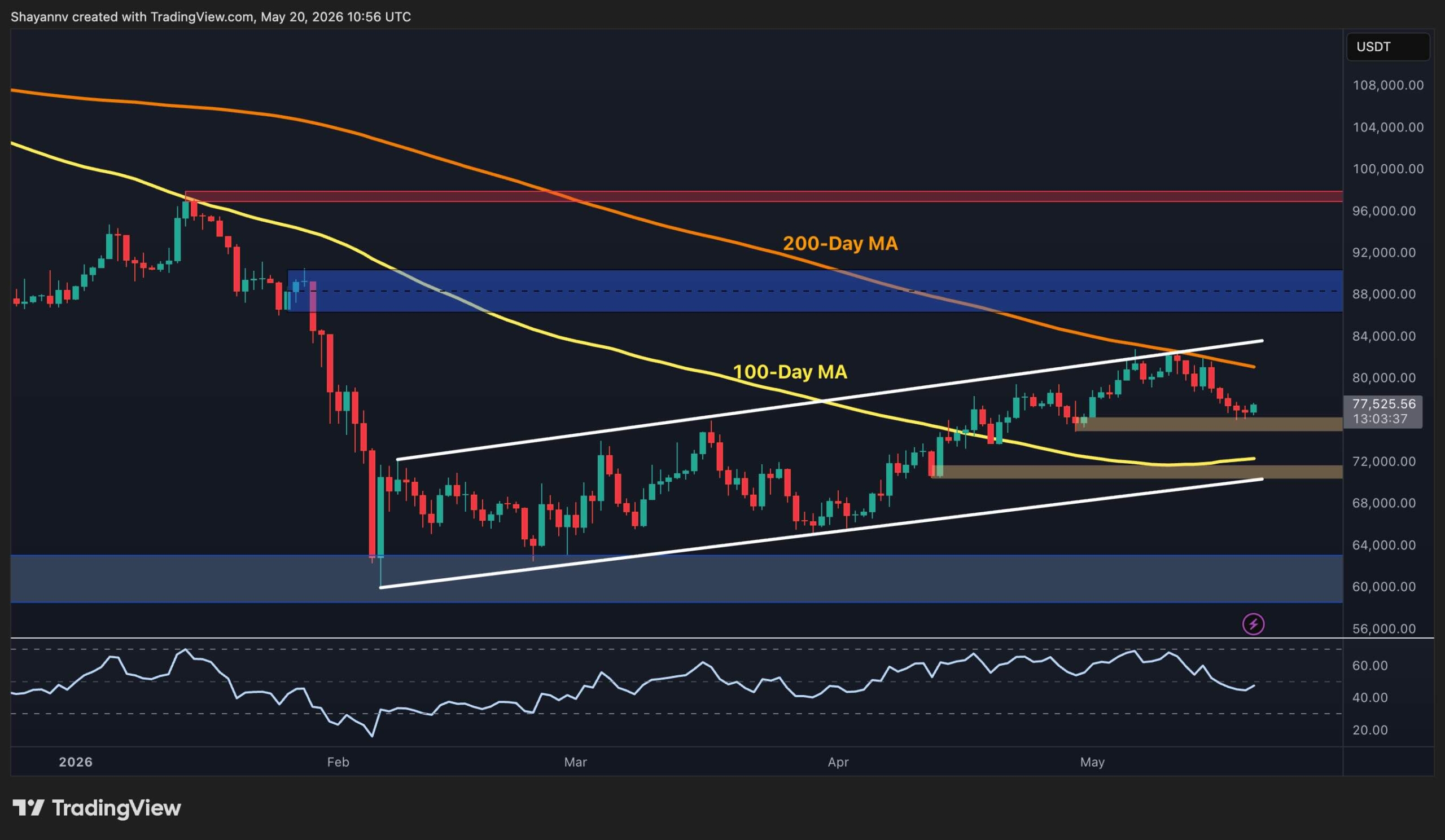
On the daily timeframe, the ascending white channel from the February low has held, with the asset bouncing from the upper edge of the $75k–$76k support zone today, rising toward $77.5k. The 100-day moving average is now sloping upward to approximately $72k and is now converging with that same support zone. This will likely create a strengthening combined support floor that rises a little further every week.
The RSI is also hovering around 50, showing little signs of directional momentum. A recovery back above $80k and a breakout above the 200-day moving average nearby are the immediate requirements to restore bullish momentum.
If this scenario materializes, the $88k–$90k band is the structural target above. On the other hand, a daily candle close below $75k and the 100-day MA near $72k would be the first serious structural damage of the recovery.
BTC/USDT 4-Hour Chart
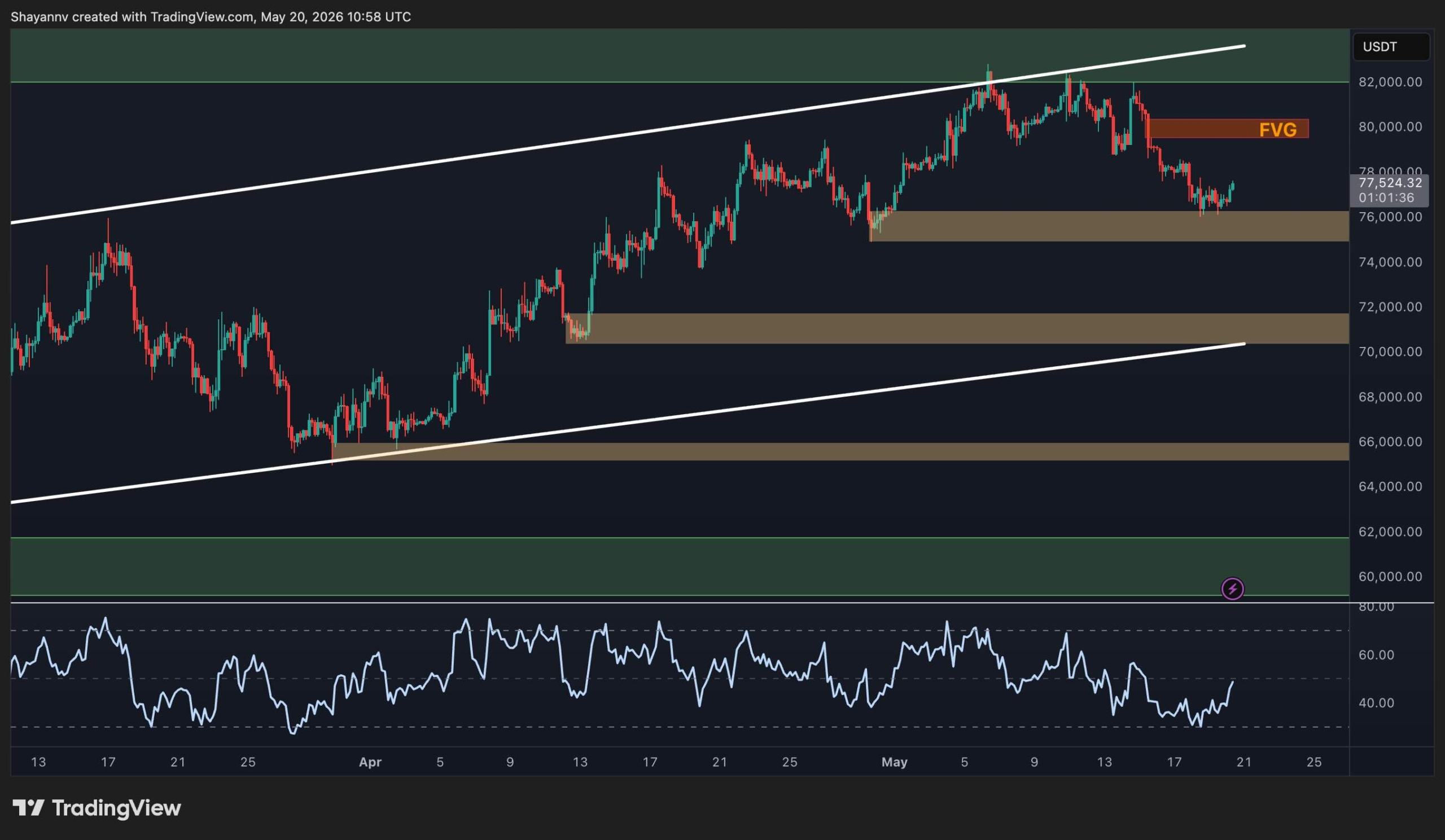
The bounce from the $75k–$76k support zone has lifted the 4-hour RSI from the low-to-mid 30s back to approximately 50. The asset is now tracking toward the bearish Fair Value Gap marked on the chart near $80k. This is a price imbalance left by the sharp sell-off from the $82k highs, which the underlying asset typically returns to fill before resolving direction.
The FVG is the immediate short-term target on the upside. A clean move through it would signal that the pullback is fully absorbed and the next push toward the $82k supply zone and the upper boundary of the daily channel is building. However, failure to trade through the FVG and a rollover back below $75k would suggest the selling pressure from the failed breakout is not yet exhausted, opening the path toward the lower demand zone at $70k–$72k as the next test.
On-Chain Analysis
The Net Unrealized Profit/Loss has recovered from its February low of approximately 0.12, which was the deepest reading since October 2023 and briefly demonstrated a capitulation period. The metric has now risen back to the current reading of 0.29. That number puts the market above the green zone, and the average BTC holder is sitting on moderate unrealized gains, but the kind of euphoria that precedes major tops is nowhere in sight.
The historical parallel is precise. NUPL crossed 0.29 in late 2023 near $40k on its way to the bull market peak. The journey from that level to the 0.50 threshold, where momentum historically accelerates, corresponded to a price move from roughly $40k to $80k. At $77.5k with NUPL at 0.29, the on-chain sentiment structure suggests the market is in a similar position. It’s likely past capitulation, rebuilding confidence, but with the majority of the cycle’s unrealized gains still ahead rather than behind.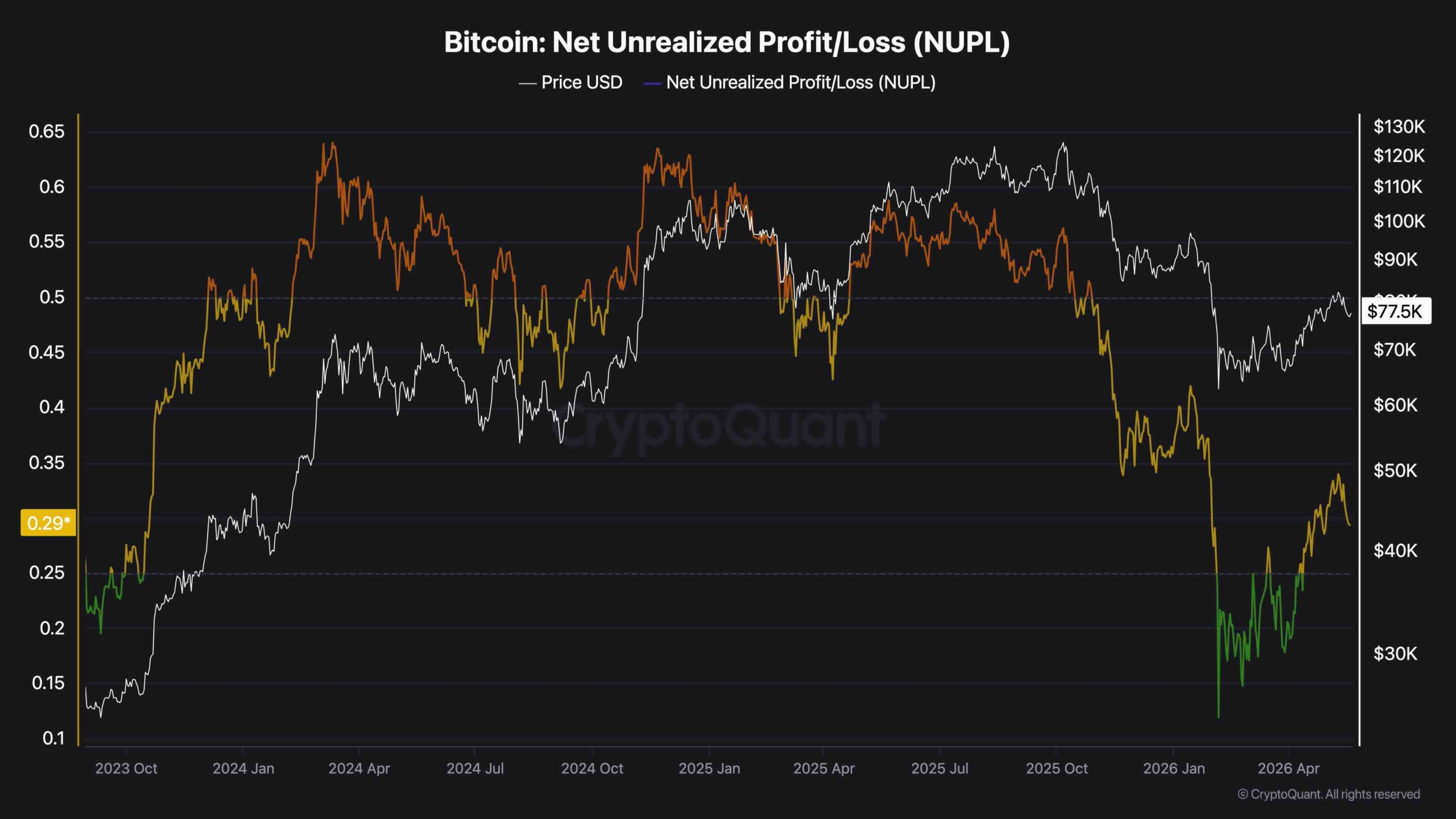
The post Bitcoin Price Analysis: On-Chain Metric Says BTC Is Coiling for a Big Move appeared first on CryptoPotato.
Crypto World
Latest Congressional swing at crypto tax reform would direct IRS to review de minimis exemptions


A bipartisan group of lawmakers introduced a revised crypto tax bill Wednesday that aims to update the tax code to better address crypto use cases and would, if signed into law, direct the IRS to analyze the effect de minimis exemptions might have.
Congressmen Steven Horsford (D-N.V.), Max Miller (R-Ohio), Suzan DelBene (D-Wash.) and Mike Carey (R-Ohio) reintroduced the Digital Asset Protection, Accountability, Regulation, Innovation, Taxation and Yields Act, otherwise known as the Parity Act, that Horsford and Miller had previously pushed a few times. The new language comes a week after lawmakers reportedly met to discuss crypto tax reform.
The new version of the bill calls for “regulated payment stablecoins” to incur no gain or loss unless the cost basis is less than 99% of the redemption value of the stablecoin, and it also creates a safe harbor for trading through brokers or in taxpayer accounts, defines how so-called “wash sale” rules might apply to digital assets and addresses how digital assets earned by acting as a validator.
The bill also directs the IRS to review what sort of tax burden crypto holders face when it comes to “small digital asset transactions” and how many transactions worth less than $200 are captured under existing law. This review should include the IRS’ needs if there was a de minimis exemption — meaning a carveout for activity that the law should consider too small to be concerned with — for crypto transactions, as well as whether and how such an exemption might be abused.
The crypto industry has long argued that freeing taxpayers of the burden of having to file and report taxes on small transactions would make it easier to use crypto as a payments tool for small items like a cup of coffee.
The bill is meant to just be a first step toward broader crypto tax reform, Horsford said at CoinDesk’s Consensus Miami conference earlier this month.
“I actually think tax is the foundation. Why? Because it’s tax policy that will determine number one, how these digital assets can be used in our finance system. And at a time when our federal tax code is outdated, it does not take into account the modernization of digital assets,” he said.
“For example, none of the current regulatory policy framework tells a consumer, an institution, or a builder what happens to their taxes when they sell a digital asset, earned staking reward, lend crypto on the U.S. platform or make a charitable contribution in bitcoin,” the lawmaker said “Those are tax questions. And they remain entirely unresolved.”
Hyperliquid's HYPE token crossed $50 on Wednesday for the first time since September 2025, in part fueled by a high-profile call from Bitwise's chief investment officer. Bitwise CIO Matt Hougan on Tuesday argued in a weekly memo that the market is undervaluing Hyperliquid. Hougan framed Hyperliquid… Read the full story at The Defiant
PI loses key support. Where will buyers return?
PI Network (PI) Price Predictions: Analysis
Key support levels: $0.15, $0.13
Key resistance levels: $0.16, $0.20
PI Loses Key Support as Sellers Return
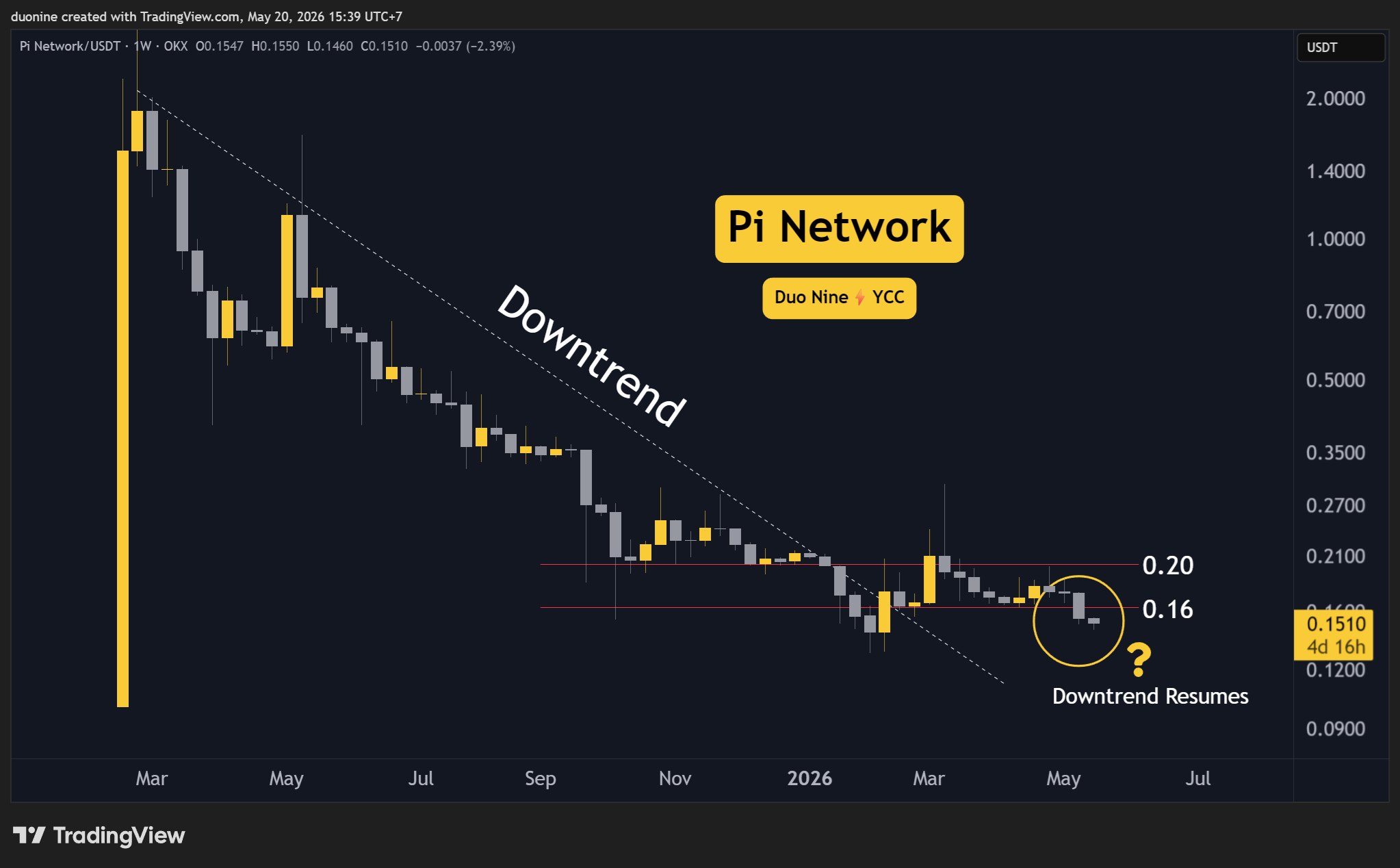
Since late last week, selling has intensified, which put pressure on the $0.16 support until this level could not hold any longer and broke. Because of this, it is now acting as a key resistance.
This breakdown could be interpreted as a resumption of the macro downtrend after a long pause that started in February when the price began to move sideways. To confirm the downtrend, the price will need to make a lower low under $0.13.
Bears Take Over the Price Action
Since PI lost support at $0.16, bears drove the price down to $0.15. Here, buyers appear to make a stand, but their conviction appears weak considering the low buy volume.
If buyers are unable to reverse this price action soon, then this cryptocurrency will likely test the all-time low at $0.13. A re-test of that level would be a bearish signal that could encourage sellers to push the price even lower.

Daily RSI Enters Oversold Area
Due to nonstop selling over the past five days, the daily RSI fell below 30 and entered the oversold area. This could explain why buyers may be interested here since a bounce is likely.
Sellers may need a break before they resume their pressure, which can give an opening for buyers to push back. However, any bounce may be short-lived, and a test of the key $0.13 support remains likely.

The post Pi Network (PI) Price Predictions for This Week, May 20 appeared first on CryptoPotato.


Securitize reported record quarterly revenue as the tokenization platform continued advancing toward an eventual public listing through its proposed SPAC merger with Cantor Equity Partners II (CEPT), underscoring growing institutional demand for tokenized real-world assets despite ongoing profitability pressures.
The Miami-based company said first-quarter revenue rose 39% year over year to $19.5 million, the highest quarterly revenue in its history, according to results released Wednesday.
Asset servicing revenue surged 201% to $8.3 million, reflecting the continued expansion of Securitize Fund Services, which serviced 650 active funds as of March 31. Tokenization revenue totaled $11.1 million, compared with $11 million in the same quarter a year earlier.
The company ended the quarter with $3.4 billion in tokenized assets under management, $24.9 billion in assets under administration and $1.9 billion in aggregated transaction volume.
Despite top-line growth, Securitize remained unprofitable as it increased spending on expansion efforts and preparations for becoming a publicly traded company. Net loss widened to $7.9 million, or 88 cents per diluted share, while adjusted EBITDA fell to $800,000 from $4.1 million in the prior-year period.
Chief Financial Officer Francisco Flores said the company continued investing in headcount and infrastructure to support long-term growth and its public-market transition, while maintaining what he described as disciplined expense management.
Securitize has agreed to merge with Cantor Equity Partners II, a Nasdaq-listed special purpose acquisition company, in a deal that would position it as one of the few publicly traded companies focused primarily on tokenized securities and real-world assets. Shares of CEPT rose 5% on Wednesday.

Bitwise Chief Investment Officer Matt Hougan described Hyperliquid as one of the most important crypto projects to emerge in recent years.
He believes that investors continue to underestimate both the platform’s long-term impact and the valuation of its native HYPE token.
Growth Trajectory
In a recent memo, Hougan said Hyperliquid has evolved beyond a crypto perpetual futures exchange into a financial “super-app” offering exposure to multiple asset classes, including commodities, S&P 500 futures, pre-IPO stocks, and prediction markets. According to Hougan, the platform’s growth has been driven in part by the regulatory environment emerging under SEC Chairman Paul Atkins, whose November 2025 remarks supported the development of multi-asset trading platforms operating outside conventional SEC structures.
The Bitwise exec noted that Hyperliquid now derives nearly half of its trading volume from non-crypto assets and claimed the figure could rise to 70% by year-end. Despite the platform remaining unavailable to US users, he described it as “one of the fastest-growing financial businesses” he has seen, while citing approximately $170 billion in monthly trading volume.
Hougan also stated that Hyperliquid represents a “Gen 2” token designed from Day 1 to accrue value, as he highlighted the platform’s reported policy of directing 99% of trading fees toward buying back HYPE tokens. This is very different from tokens launched during former chair Gary Gensler’s tenure. Hougan explained that those “governance tokens” that had little or no economic tie to the underlying blockchain or application, as they sought to remove any expectation of profit.
“In the future, I suspect this will be the norm for token design. In the meantime, it’s one of the reasons Hyperliquid is the best-performing large-cap crypto asset in the world over the past year.”
Hougan further claimed HYPE is currently one of the most mispriced assets in crypto due to category as well as anchoring error.
Institutional Momentum
His comments come days after 21Shares rolled out the first US spot ETF tracking Hyperliquid’s token under the THYP ticker. Bitwise followed suit with another exchange-traded fund tracking HYPE, under the ticker BHYP on the New York Stock Exchange (NYSE).
While other leading crypto assets continue to struggle, HYPE is leading the market rally. Over the past week alone, the token has amassed over 25% in gains.
The post Why Bitwise CIO Thinks Investors Are Mispricing Hyperliquid and HYPE Token appeared first on CryptoPotato.


Key takeaways
- PI has reclaimed the $0.1500 level after dropping below this critical area on Tuesday.
- The positive performance comes following the mainnet upgrade.
Pi Network has reversed its downward trend on Wednesday, climbing above the $0.1500 level following a major infrastructure upgrade to its mainnet nodes.
At press time, PI traded around $0.1518, extending recent losses while technical indicators hinted at the possibility of a short-term rebound.
Pi Core team completes major mainnet upgrade
The Pi Core Team announced that major mainnet nodes have successfully upgraded to Stellar protocol version 23, reflecting the project’s reliance on the Stellar blockchain infrastructure.
The update also included several backend improvements, such as migrating the operating system from Ubuntu 20 to Ubuntu 24 and upgrading the database engine from PostgreSQL 12 to PostgreSQL 16.
The latest upgrade is aimed at improving network performance, security, and long-term scalability as the ecosystem continues to evolve.
PI price outlook: Technical indicators suggest a possible recovery
The PI/USD 4-hour chart is still bearish and efficient as PI has underperformed over the past few days.
The bearish performance comes despite the infrastructure progress. The token is currently trading below both the 50-period Exponential Moving Average (EMA) near $0.1605 and the 200-period EMA around $0.1709, maintaining a broader bearish outlook.
However, momentum indicators suggest selling pressure may be weakening. The Relative Strength Index (RSI) has dropped to near 29, signaling oversold conditions while also forming a positive divergence as price approaches Tuesday’s low of $0.1463.
This type of divergence often points to a potential reversal or short-term bounce. If buying momentum increases, PI could attempt to retest a descending trendline resistance near $0.1519.
Meanwhile, the Moving Average Convergence Divergence (MACD) indicator remains flat below the zero line, indicating fading bearish momentum but not yet confirming a bullish recovery.

A successful breakout above the $0.1519 resistance level could open the door for a stronger recovery toward the 50-EMA at $0.1605, followed by the 200-EMA near $0.1709.
On the downside, the recent low at $0.1463 remains a critical support zone. A daily close below that level could invalidate rebound expectations and potentially trigger additional downside pressure for Pi Network.
Many leading altcoins, including Ethereum (ETH), Ripple (XRP), and Solana (SOL), have headed south over the past 30 days, moving in step with the market’s predominantly bearish tone.
However, Zcash (ZEC) has defied the overall pullback, posting a roughly 90% price increase during this period.
How Much Higher?
The privacy coin ZEC was the talk of the town towards the end of last year when its price surged from mere $50 to over $700 in a matter of two months. Back then, though, the entire crypto market was booming (even if Zcash was among the standout performers), whereas the recent surge appears far more unexpected.
Earlier this month, the token’s valuation briefly exceeded $630 before slightly retreating to the current $585 (according to CoinGecko’s data). Its market capitalization neared $10 billion, making ZEC the 14th-biggest cryptocurrency after flipping Cardano (ADA) and Bitcoin Cash (BCH). One factor that could have played a role in the ascent is the overall uptrend in privacy coins, with Monero (XMR) and Dash (DASH) also well in the green on a monthly scale.
Somewhat expected, crypto X is once again rammed with users envisioning further gains for ZEC. CryptoJack, for example, claimed that the asset has broken out of a descending channel, suggesting it could be starting a major move up.
Sjuul | AltCryptoGems and JAVON MARKS also gave their two cents. The former said ZEC looks “pretty bullish” as it’s potentially breaking out of a bull flag. JAVON MARKS noted the token’s strong progress and forecasted a possible rise above $700.
A Desired Correction?
Contrary to the bullish predictions made by the aforementioned market observers, ZEC’s Relative Strength Index (RSI) suggests the asset may cool off in the near term. The technical analysis tool ranges from 0 to 100, with ratios above 70 signaling that the coin is overbought and due for a potential pullback. On the other hand, readings below 30 are often considered buying opportunities. ZEC’s RSI briefly spiked beyond 80, while now it stands at roughly 66.

Such a correction, though, seems to be something that certain analysts would actually welcome. Altcoin Sherpa, for instance, said they want to hop on the bandwagon should the price drop to $470 or even lower.
The post Zcash (ZEC) Explodes 90% in a Month: Bull Trap or Major Rally Ahead? appeared first on CryptoPotato.

Man jailed over Charlie Kirk post wins $835,000 settlement

Roivant Sciences Shares Jump 14.43% to $32.28 on Strong IMVT-1402 Rheumatoid Arthritis Data

Ethereum Foundation’s high-profile departures spark fresh debate


-

 Crypto World5 days ago
BloFin War of Whales 2026 Grand Prix opens registration for $5M trading championship
-

 Fashion5 days ago
Weekend Open Thread: Theory – Corporette.com
-

 Crypto World5 days ago
E-Estate Announces 1 Year Live: Washington DC Summit as Real Estate Tokenization Enters Its Next Phase
-

 Tech6 days ago
Tech Moves: Microsoft AI leader jumps to OpenAI; former AI2 exec joins Meta; and more
-

 Tech5 days ago
Google reimburses Register sources who were victims of API fraud
-
 Crypto World6 days ago
Google’s Gemini AI Predicts Incredible Solana Price by the End of 2026
-

 Business5 days ago
H&R Real Estate Investment Trust (HR.UN:CA) Q1 2026 Earnings Call Transcript
-
 Entertainment6 days ago
Zara Larsson Has Blunt Response To Chris Brown Diss
-

 Sports5 days ago
Napoleonic enters 2026 Doomben 10,000 field via Abounding withdrawal
-
 Crypto World7 days ago
Two AI Tokens Lead May Rally, But Risks Are Rising
-

 Crypto World5 days ago
BeInCrypto 100 Institutional Awards Nomination: KAST for Best Digital Assets Neobank and Best Digital Assets Fintech
-

 Fashion4 days ago
On the Scene at Gucci’s Cruise Show in New York City: Mariah Carey, Kim Kardashian, Lindsay Lohan, Iman, and More!
-
 Crypto World5 days ago
Bitcoin Battles US Bond Nerves With BTC Price Dip Toward New May Lows
-
 Crypto World5 days ago
Wall Street’s Boldest Gold Prediction Has Russians Rushing to Buy
-

 Crypto World5 days ago
ICE and CME urge US regulators to curb Hyperliquid energy trading
-

 Fashion4 days ago
Trending Western Style Vests Perfect for Summer
-

 Entertainment5 days ago
David Letterman Returns to Late Show, Blasts Cancellation
-

 Politics6 days ago
DWP PIP Timms review continues to be an absolute farce
-

 Fashion4 days ago
Amazon Sundays: Memorial Day Hosting
-

 Crypto World5 days ago
IREN closes $3 billion convertible notes deal amid AI infrastructure expansion
You must be logged in to post a comment Login