Production at Gardenia’s Pandan Loop manufacturing facility will end on Jun 30
Home-grown bread manufacturer Gardenia is shifting its bakery production from Singapore to Johor Bahru, Malaysia. As a result, it will lay off 141 employees at its Pandan Loop facility, Channel News Asia reported on Wednesday (May 20).
The company cited ongoing efforts to improve operational efficiency and remain competitive amid an increasingly challenging global environment as the reason for the move.
Production at the Pandan Loop manufacturing facility will end on Jun 30.
“Gardenia informed employees of the decision at an internal meeting this morning and said affected staff will receive the appropriate notice period and support in line with local regulations and guidelines,” the company said in a media release.
Advertisement
“The company is also considering eligible employees for suitable roles within the group’s network of operations where possible.”
Singapore will remain Gardenia’s central hub for brand management, product development, quality and regulatory oversight, distribution, and supply chain—retaining about 250 employees post-transition.
Its Singapore team will also continue to oversee quality governance and ensure compliance with requirements set by the Singapore Food Agency and the Health Promotion Board.
Gardenia said that the Food, Drinks and Allied Workers Union (FDAWU) was informed in advance about the layoffs.
Advertisement
“This enabled the union to quickly mobilise support such as training, job placement assistance, and discussions on fair retrenchment terms. FDAWU was also able to quickly tap on its network of unionised partners to identify suitable vacancies for affected workers,” it added.
“The union worked closely with Gardenia to ensure fair compensation and transition support for affected employees.”
Nearly five decades ago, Gardenia started as one small bakery in Bukit Timah Plaza in 1978. Today, it operates across Malaysia, the Philippines, and Australia.
Gardenia’s decision comes after similar moves by other food and beverage manufacturers.
Asia Pacific Breweries Singapore, which brews Tiger Beer, also said recently that it would cut about 130 roles as it shifts production to other regional markets such as Malaysia and Vietnam.
Read more stories we’ve written on the latest job trends here.
Featured Image Credit: National Trades Union Congress
You’ve probably come across LinkedIn posts that sound way too polished. These feel inauthentic while trying to sound motivational and strangely empty. The kind that turns a basic workplace thought into five neat paragraphs that push a fake lesson, and a comment section full of robotic applause.
Well, LinkedIn is now calling this a problem. The platform says it is taking new steps to reduce the reach of what it calls “AI slop,” referring to low-effort, AI-generated content that may sound clean on the surface while offering little original thought, expertise, or lived perspective.
LinkedIn
How LinkedIn is cracking down on AI noise
LinkedIn’s Laura Lorenzetti says AI can be useful for refining language, although posts and comments still need to reflect the person behind them. So the company is building technology systems with its editorial team to identify signals of generic AI content. These systems are being trained to distinguish between posts that add perspective, context, or expertise and posts that feel repetitive, polished, and empty.
It doesn’t apply to full posts as the new system will recognize and act on comments created at scale using automation tools. These will include comments that have little to no human involvement. LinkedIn is also targeting replies that merely restate the original post without adding anything of substance.
LinkedIn isn’t saying every AI-assisted post will be punished. The focus is to make AI-generated content less present. When the platform detects such posts, it will be less likely to distribute it beyon the poster’s immediate network.
LinkedIn mentioned that early testing has been encouraging, with its systems correctly identifying generic content 94% of the time. The company also says members are already seeing fewer of these posts from outside their networks.
Advertisement
Alongside this, verification is playing a big role in fighting bots and fake AI profiles as well. With more than 100 million verified members, this could reduce the exhausting AI noise from dominating users’ feeds. It’s about time LinkedIn has started its fight against AI, with other companies like Meta and YouTube also readying tools against the avalanche of AI-generated content.
For many drivers, staying safe behind the wheel begins with putting on the seatbelt. While adult drivers New Hampshire don’t actually have a seatbelt law, the rest do, and it must be used at all times. But drivers in Utah are clicking their seatbelts far less often. Now, state officials are responding with a major awareness campaign aimed at changing that.
The move includes the use of new billboards, a TV commercial, and a heightened presence of law enforcement from agencies across the state. Thirty-seven Utah police departments are adding 335 additional shifts between May 18 and May 31. These shifts will be used to enforce the seatbelt law, targeting those drivers who aren’t buckled up. Under state law, all vehicle occupants must wear seatbelts and tickets will be handed out to offenders as needed by law enforcement.
According to the Utah Department of Public Safety, seatbelt compliance in the state fell to 89.6% in 2025, which was a drop from the previous two years. The issue has only gotten worse so far in 2026, with 16 fatal crashes involving unbuckled occupants resulting in 19 deaths. Data also shows that women are buckling up more than men, but only at a rate of 6.5% higher.
Advertisement
A closer look at seat belt use in Utah
New Africa/Shutterstock
According to the FY 2027 Statewide Problem Identification published by the Utah Highway Safety Office, unbuckled occupants accounted for 28% of all vehicle occupant deaths in crashes between 2020 and 2024. During that same period, the state reported 1,483 traffic fatalities overall, with 49% being drivers and 18% being passengers. Of those unrestrained vehicle deaths, 69% are male, with rural areas accounting for 55% of unbuckled vehicle deaths.
The state’s campaign to address the issue is presented on the Utah Department of Public Safety. Official messaging reinforces that buckling up is a simple move that can have a major impact in the event of a crash. Along with safety reminders, the site features educational materials, including several YouTube videos and playlists. All of the content helps to emphasize the importance of wearing vehicle seatbelts, which are actually inspired by racing technology.
Advertisement
There does not appear to be a definite reason why some drivers in Utah aren’t buckling up. However, the NHTSA points to seat belt use as often being influenced by behavior and perception. For example, many drivers still believe they are safe on short trips or trips they’ve made before.
Google on Wednesday published exploit code for an unfixed vulnerability in its Chromium browser codebase that threatens millions of people using Chrome, Microsoft Edge, and virtually all other Chromium-based browsers.
The proof-of-concept code exploits the Browser Fetch programming interface, a standard that allows long videos and other large files to be downloaded in the background. An attacker can use the exploit to create a connection for monitoring some aspects of a user’s browser usage and as a proxy for viewing sites and launching denial-of-service attacks. Depending on the browser, the connections either reopen or remain open even after it or the device running it has rebooted.
Unfixed for 29 months (and counting)
The unfixed vulnerability can be exploited by any website a user visits. In effect, a compromise amounts to a limited backdoor that makes a device part of a limited botnet. The capabilities are limited to the same things a browser can do, such as visit malicious sites, provide anonymous proxy browsing by others, enable proxied DDoS attacks, and monitor user activity. Nonetheless, the exploit could allow an attacker to wrangle thousands, possibly millions, of devices into a network. Once a separate vulnerability becomes available, the attacker could use it to then compromise all those devices.
“The dangerous part here is that you can just have a lot of different browsers together that you can in the future run something on that you figure out,” said Lyra Rebane, the independent researcher who discovered the vulnerability and privately reported it to Google in late 2022 in an interview. She said using the exploit code Google prematurely published would be “pretty easy,” although scaling it to wrangle large numbers of devices into a single network would require more work. In the thread of Rebane’s disclosure to Google, two developers said in separate responses that it was a “serious vulnerability.” Its severity was rated S1, the second-highest classification.
Advertisement
Since its reporting 29 months ago, the vulnerability remained unknown except to Chromium developers. Then on Wednesday morning, it was published to the Chromium bug tracker. Rebane initially assumed the vulnerability was finally fixed. Shortly thereafter, she learned that, in fact, it remained unpatched. While Google removed the post, it remains available on archival sites, along with the exploit code.
Anyone who scans store shelves for headphones quickly realizes that low prices usually indicate significant tradeoffs in noise reduction or listening time. Anker’s Soundcore Q20i, priced at $39.99 (was $70), disrupts this pattern by including features that continue to provide long after the first listen. Hybrid active noise cancellation is fundamental to the user experience. Four microphones inside and outside the ear cups detect ambient noise and reduce it up to 90% in real time.
Battery performance significantly improves the already impressive everyday reliability of these headphones. You can get up to forty hours of playback with noise canceling turned on, or sixty hours if you leave it off. Slap a cable in for five minutes and you’ll have four full hours of use, so if you fail to pack the cable, you won’t be stuck in the middle of your vacation. With that kind of battery life, most individuals can easily get by on a single charge for several days of continuous listening.
Hybrid Active Noise Cancelling: 2 internal and 2 external mics work in tandem to detect external noise and effectively reduce up to 90% of it, no…
Immerse Yourself in Detailed Audio: The noise cancelling headphones have oversized 40mm dynamic drivers that produce detailed sound and thumping beats…
40-Hour Long Battery Life and Fast Charging: With 40 hours of battery life with ANC on and 60 hours in normal mode, you can commute in peace with your…
The sound quality is likewise excellent, as the noise fades. The large 40mm drivers handle details wonderfully across the whole frequency range. The BassUp technology is also quite well executed; it adds depth without overpowering and muddying the rest of the sound. Hi-res audio support via the provided cable simply makes it sound cleaner when plugged in, which is a significant advantage for people who prefer wired connections. The free program includes twenty-two presets and adjustable sliders, allowing you to customize the sound to match your mood or music.
The most notable feature of these headphones is their comfort. If you’re concerned about weight, the memory foam cushions and flexible headband weigh less than half a pound combined. And the ear cups are very ingenious, as they spin right around to fold flat in a suitcase. Plus, the breathable mesh above the foam keeps things cool, even on long trips or study sessions. Did I mention transparency mode? With the press of a single button, you can hear voices and announcements, which is really beneficial if you need to stay informed of what is going on. Bluetooth 5.0 is also built in, so you can connect to two devices at the same time, making it easy to go from your laptop to your phone.
AMD’s answer to Nvidia’s DGX Spark AI workstations, codenamed the Ryzen AI Halo, will be available for pre-order later next month for anyone with $3,999 burning a hole in their pocket.
That might sound like a lot for an AI mini PC, but don’t worry. Compared to cloud APIs, it practically pays for itself. Or, well, that’s AMD’s sales pitch. The House of Zen argues that if you spend eight hours a day vibe coding, the system could save you $750 a month.
AMD claims its Ryzen AI Halo could say developers a whopping $750 a month by vibe coding with local models instead of cloud APIs.
Whether this helps you justify paying for hardware that less than a year ago could be found for between $2,200 and $2,999 or not, it’s (probably) not AMD being greedy here; the RAMpocalypse has been hard on everyone.
Much like the DGX Spark, which now retails for $4,699, up from $3,999 when we reviewed it last fall, AMD’s rendition aims to provide a curated developer environment for running local models and agentic AI frameworks.
Advertisement
This is really the core value proposition behind both of these devices. They aren’t the most powerful or the fastest AI systems, but they’re able to run models that a few years ago would have cost $20K or more.
A little box of TOPS
The diminutive system measures in at 5.9 x 5.9 x 1.7 inches (150 x 150 x 43 mm) and is powered by a 120 watt Ryzen AI Max+ 395 APU, better known by its codename Strix Halo.
Here’s a high-level overview of AMD’s Ryzen AI Max 400-series processors.
The chip is backed by 128 GB of LPDDR5x 8000 MT/s memory, which feeds both its 16 Zen 5 cores and 40 RDNA 3.5 GPU compute units, providing up to 256 GB/s of bandwidth, more than a Ryzen 9000 Threadripper (non-Pro) system.
For local AI enthusiasts, that’s enough to run models up to 200 billion parameters in size at 4-bit precision — just like the more expensive Spark.
Advertisement
The bulk of the Ryzen AI Halo’s compute comes from its integrated graphics, which are capable of delivering roughly 56 teraFLOPS at 16-bit precision.
While impressive for onboard graphics, that’s still between 55 and 88 percent slower than what the DGX Spark advertises.
Unlike the Spark’s Blackwell-based GB10 APU, Strix Halo doesn’t support FP8 or FP4 data types in hardware. At BF16, the Spark delivers 125, at FP8 250, and FP4 500 teraFLOPS. Double those figures if you happen to find a workload that can leverage Nvidia’s 4:2 sparsity.
That performance discrepancy won’t necessarily be obvious in every workload. In fact, in LLM inference, AMD claims the AI Halo generates tokens 4-14 percent faster than the Spark.
Advertisement
The lower end of that roughly matches what we saw when we pitted the Spark against a similarly equipped HP Z2 Mini G1a back in December. The G1a packs the same silicon as AI Halo, and in Llama.cpp with the Vulkan backend, eked out a small but meaningful lead over the Spark in tokens per second generated.
However, the speed any GPU can generate tokens at is largely dictated by effective memory bandwidth, not floating point performance. GPU compute has a much bigger impact on things like prompt processing time.
In our testing, the Spark’s more capable tensor cores gave it a 2x to 3x lead in prompt processing. For shorter prompts, this isn’t all that noticeable, usually the difference between waiting 100 ms versus 200 ms or 300 ms, but for longer prompts, it did become more pronounced.
We saw the Spark take similar leads in our image generation and fine tuning benchmarks, but it’s worth noting that AMD’s software stack has matured greatly since our initial review and the performance gap has likely closed somewhat since then.
Advertisement
AMD’s AI Halo does have two things going for it that can’t be said of the Spark. Alongside the GPU is an XDNA 2-based neural processing unit (NPU) that AMD rates for 50 TOPS. What good that’ll do you depends heavily on the application in question. Many content creation apps have now been updated to take advantage of it, but the number of generative AI inference engines that could properly harness it was quite limited the last time we looked.
The second thing AMD’s Ryzen AI Halo has going for it is that it’s a standard x86 box at its heart, and you can run Windows or your preferred flavor of Linux on it if that’s more your style. On the Spark, you’re stuck with a lightly customized version of Ubuntu 24.04. Beyond that, you’re coloring outside the lines.
Particularly for developers building for Microsoft’s NPU-accelerated AI PC ecosystem, this is an obvious advantage.
In terms of networking, AMD’s Spark-clone falls a bit flat. One of the hallmark features of Nvidia’s AI workstation is a 200 Gbps ConnectX-7 NIC, which allows for clustering of up to two and eventually four systems.
Advertisement
AMD’s AI Halo has a single 10 Gbps NIC, which should help with downloading large model files in a timely manner. In theory, the system should be able to achieve high-speed networking over USB-4, but it’s not clear whether this is actually a supported use case.
That said, Apple has already demonstrated just this using RDMA over Thunderbolt, so it should work so long as AMD has a playbook for configuring RDMA on its systems.
AMD’s own AI lab
As we mentioned earlier, much of the Ryzen AI Halo’s value proposition comes from being validated hardware with well documented playbooks for common use cases and known good software.
Finding the right combination of device drivers, ROCm, HIP, SYCL, CUDA, PyTorch, TensorFlow, and JAX has long plagued the AI/ML devs, regardless of which ecosystem you opt for.
Advertisement
Having validated environments for workloads, whether it be vLLM, Llama.cpp, Ollama, ComfyUI, or something else ensures users spend more time doing something productive than debugging mismatched dependencies.
At launch, AMD says the Ryzen AI Halo will ship with five preinstalled playbooks, with another 10 available online and additional playbooks to be added monthly.
Additionally, customers will gain access to AMD’s developer program, cloud credits, and exclusive playbooks.
More memory on the way
The 128 GB Ryzen AI Halo will be available for pre-order next month starting at $3,999, but if that isn’t enough for you, AMD is already prepping a higher capacity version of the system with 192 GB of memory on board.
Advertisement
Here’s a high-level overview of AMD’s Ryzen AI Max 400-series processors.
That system will feature a refreshed Ryzen APU in the AI Max+ 495, which just like the rest of AMD’s 400-series lineup gets a modest clock bump to the CPU, GPU, and NPU, and not a whole lot else.
Still, 192 GB of unified memory opens the door to even larger, more capable models, if you can stomach the presumably higher asking price. ®
Qivalis plans for a market launch in the second half of 2026.
Bank of Ireland and AIB have joined a consortium of European banks working towards issuing a euro-denominated stablecoin.
The two Irish banks joined the Qivalis consortium alongside 23 other banks – including Cecabank, Erste Group, Groupe BPCE and the National Bank of Greece – taking the group’s total strength to 37 banks from across 15 countries in the region.
The group wants to introduce euro-denominated stablecoins to expand Europe’s financial infrastructure and compete with US-backed versions, which make up the overwhelming majority of stablecoins in circulation. Big names such as Danske Bank, ING and KBC joined the consortium last September.
Advertisement
Stablecoins are a digital asset generally linked 1:1 to a chosen fiat currency. These digital assets allow for round-the-clock liquidity and near instant settlements.
The combined market capitalisation of all stablecoins exceeds $300bn, with around 90pc of it held by Tether and Circle; euro-denominated stablecoins only total around €395m, according to EU figures from November – or around 0.2pc of the total in circulation, according to Qivalis.
“The euro is Europe’s currency, and on-chain financial infrastructure should carry it – built by European institutions and governed by European rules,” said Jan-Oliver Sell, the CEO of Qivalis.
Formed in 2025, Qivalis is currently in pursuit of European regulatory approval to become an authorised electronic money institution. The consortium is targeting a market launch in the second half of 2026.
Advertisement
“We are investing in this consortium because we believe Europe needs trusted, regulated innovation in payments and settlement,” said Geraldine Casey, the managing director of retail banking at AIB.
“Qivalis will provide access to a euro-denominated stablecoin that is being developed to operate within the EU regulatory framework.”
As part of the consortium, AIB has said that it will collaborate with other European banks to innovate payments systems.
“This is a practical step for AIB to learn, innovate, test and collaborate with other leading European banks, and to help shape how new forms of digital money can be used safely, responsibly and within the regulated banking system,” Casey added.
Advertisement
The European Central Bank, meanwhile, has moved to the next phase of the digital euro project, with plans for a pilot digital euro project in mid-2027 and issuance in 2029.
Howard Davies, Qivalis’s chairperson, added: “This infrastructure is essential if Europe is to compete in the global digital economy whilst preserving its strategic autonomy.
“The euro’s role in the eurozone’s monetary system will increasingly depend on whether it is present – as the primary settlement currency – on the rails where global value moves.”
Don’t miss out on the knowledge you need to succeed. Sign up for the Daily Brief, Silicon Republic’s digest of need-to-know sci-tech news.
Disclaimer: Unless otherwise stated, any opinions expressed below belong solely to the author. Data sourced from the Economic Development Board and Singapore Department of Statistics.
After a turbulent 2025, following the return of Donald Trump to the White House and the wave of trade tariffs the US unleashed on the world, 2026 offered a promise of greater stability. Singapore weathered the storm exceptionally well, bouncing up to a 5% GDP growth, despite fears of a global recession, raising expectations for the new year as well.
Unfortunately, another geopolitical event shook the world on Feb 28, when the US and Israel decided to deal a final blow to the Iranian regime, leading to massive disruptions in oil and gas trade from the Persian Gulf and sending global energy prices soaring.
Since all economies depend on fuel and electricity, virtually every area of our activity is affected. It should be no surprise, then, that the city-state’s business outlook for the coming months has taken a tumble as a result.
Advertisement
Services reeling from fear, manufacturing still supported by AI
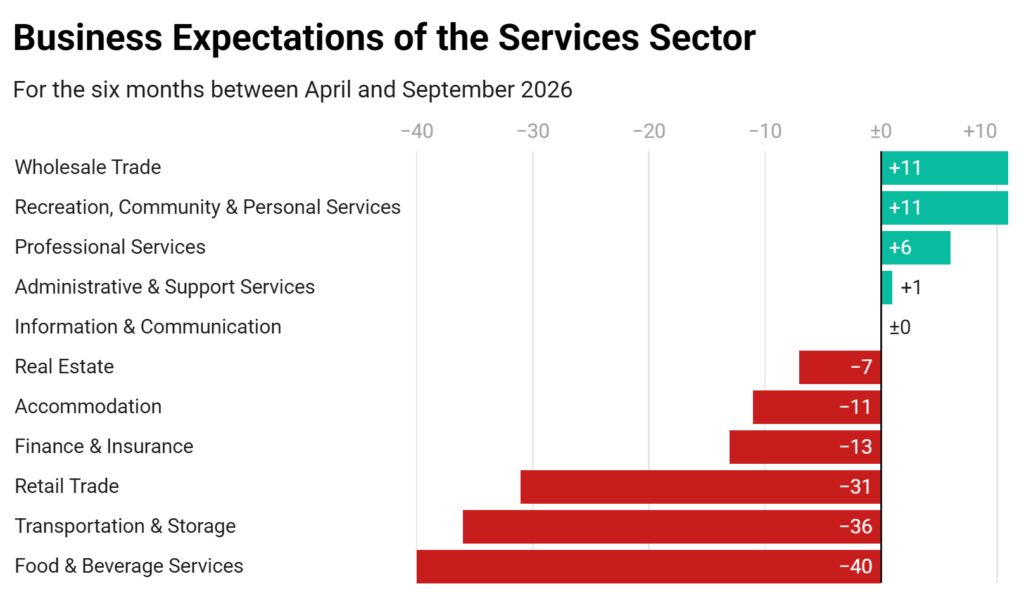
Expectations of Singapore-based businesses for the next six months are overwhelmingly negative. Only four industries expect an uptick in activity, with the rest firmly in the red (the figures show the net weighted percentage of positive/ negative answers collected by EDB and Singapore Department of Statistics in their quarterly surveys).
Local manufacturing is, fortunately, still on life support, thanks to the ongoing tech boom in Artificial Intelligence, which is keeping demand for semiconductor products and related sectors high.
Interestingly, the IT rally has been more than enough to offset the suffering of other manufacturing sectors, boosting the overall average:
You can see it reflected in employment forecasts as well, as manufacturing is expected to look for more employees than before. The caveat, of course, is that the demand is highly uneven and driven by a potential bubble which may suddenly burst, leaving thousands of people out of a job overnight.
Employment plans collapse
While this dire prediction about AI frenzy is still a ‘maybe,’ job prospects in services—where a large majority of Singaporeans are employed—are already very grim.
For comparison’s sake, let’s start with what the figures showed in the first quarter of the year:
All but two industries expected increased hiring, having just had a really strong 2025, against the odds and fears.
Now, however, let’s look at what Singapore employers are saying today:
As you can see, the mood has shifted entirely. Only those in Recreation & Personal services expect to bring more people on board (although it’s hard to say how many of these jobs are directed to Singaporeans).
Not even the lucrative Finance industry is being spared this time, and may see job cuts instead of hiring this quarter.
Advertisement
To understand just how big a shift it is, just look at the collapse in sentiments between the two quarters:
With the exception of Real Estate, which is somewhat insulated from the global turmoil (cooling measures for foreign buyers have been in place for a while already, while the local market remains stable and predictable), every other industry has seen a decline in expected hiring activity.
Retail trade appears to be worst hit, having dropped sharply, by 35 percentage points, from a net positive 12 to negative 23.
That said, virtually everybody is less optimistic than they were at the start of 2026. And unless the war with Iran comes to a conclusion soon, companies may be reluctant to increase hiring, given higher operational costs and uncertainty about the consequences of the conflict.
The only consolation is that we already lived through a similar turmoil around the same time last year. All’s well that ends well.
Advertisement
Read other articles we’ve written on Singapore’s job landscape here.
Featured Image Credit: Shadow_of_light/ depositphotos
On a balmy, 86-degree day in Mountain View, just outside Google’s sprawling campus, I sought refuge from the glaring California sun in a Volvo EX60 — or so I thought. The air conditioning wasn’t working.
To mitigate the heat even slightly, we opted to darken the transparent sunroof. And all we had to do was ask Gemini.
Advertisement
“Can you make the sunroof opaque?” Vivek Radhakrishnan, a technical program manager at Google, asked the car via voice command. Like magic, the electrochromic window stretching over us blocked the light beaming in from above. We didn’t have to rummage through the car’s settings to find the right button.
At Google’s I/O developer conference on Tuesday, I got an early look at a handful of new features coming to cars supporting Google Built-in and Android Auto. The upcoming capabilities, rolling out later this year, are designed to help you keep your eyes on the road while offering useful information. You can lean on Gemini AI to handle tasks like sharing your ETA, describing that landmark that caught your eye and even helping you order dinner.
Watch this: Google’s Car Update Helps You Keep Your Eyes on the Road
The Volvo EX60 comes equipped with Google Built-in, a native operating system for car infotainment systems that lets you tap directly into Google’s services. We could ask Gemini to identify a dashboard warning light, for example, or have it gauge whether a 65-inch TV we just bought would fit in the back.
Advertisement
Although we were technically parked outside of Shoreline Amphitheater, a giant TV in front of us simulated driving along a San Francisco road toward one of the city’s signature skyscrapers. We asked Gemini, “What’s that tall building in front of me, and can you tell me something interesting about it?”
Using the car’s front-facing camera, Gemini identified the Transamerica Pyramid, “which stood as the tallest building in San Francisco for 45 years.” We got some bonus information, too, as Gemini said, “Nearby, on your right, you’ll find the historic copper-clad Sentinel Building, a landmark that miraculously survived the 1906 earthquake and later became home to Francis Ford Coppola’s film studio.” It was neat to get that much detail and learn something new.
Afterward, we hopped over to the Kia EV9 (which thankfully had functioning A/C) to get a look at upcoming Android Auto features, which are available by connecting your phone to the vehicle. They include a more personalized dashboard design built on Google’s Material 3 Expressive, so you can display a picture of your cat alongside custom widgets, for instance.
While still parked, we then opened up YouTube and watched videos in 4K resolution at 60 frames per second, which can make the time you spend charging your vehicle a little more entertaining. Once you start driving, those videos automatically shift to audio-only so they’re not distracting.
Advertisement
Magic Cue can pull information from your email, calendar or other apps to quickly respond to texts asking for your ETA or other event details. In our demo, an incoming text asked, “What time is the pottery class?” and Gemini found the date and time automatically: June 1 at 2 p.m. Google Product Manager Alanna Veiga just had to tap to send it as a reply.
If you want to make sure your dinner arrives home when you do, you can also ask Gemini to place an order through a food delivery app. Using voice commands, we asked it to order two fish tacos from Pacific Catch on DoorDash. Gemini then pulled up the DoorDash app on the connected phone and added those items to the cart, tapping through the steps as if it were a human. Once it was time to check out, all Veiga had to do was tap to confirm the order.
On vehicles with both Google Built-in and Android Auto compatibility, you’ll be able to use the new Immersive Navigation for Google Maps, which shows a 3D view of buildings, overpasses and surrounding terrain, as well as details like lanes, traffic lights and crosswalks. That can help you get a better understanding of your surroundings and make navigation clearer and easier.
The updates are part of a wider expansion of Gemini into cars, phones, wearables and smart glasses. And while the supercharged AI features might not be able to fix your broken A/C, they can simplify menial tasks and help you stay focused on the road.
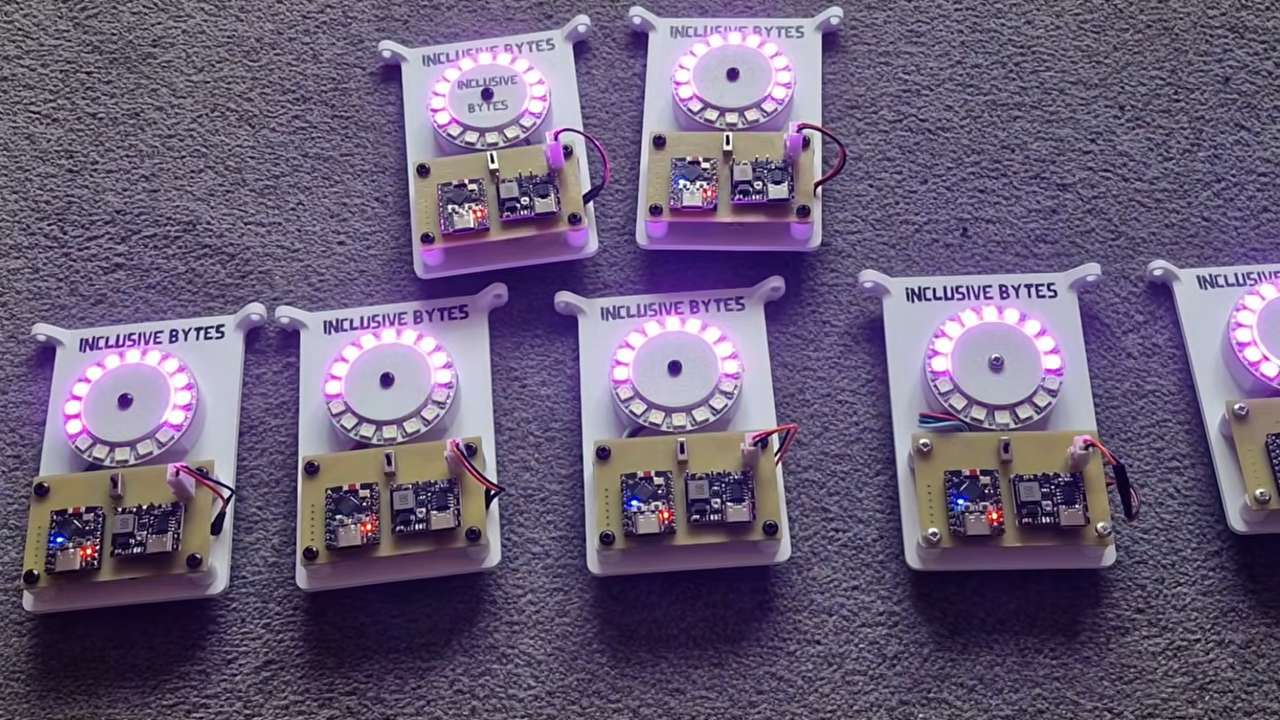
The CrowdClock badges each feature a ring of 16 addressable RGB LEDs. Running the LEDs is an ESP32 microcontroller, which has lots of neat wireless capability baked in from the factory. [Tony] decided to leverage the ESP-NOW wireless communication protocol to enable each badge to broadcast its current local clock tick. Each device also listens out for clock ticks from other badges in the area, and updates its current clock tick value if it receives a higher one from another badge. This behaviour allows a bunch of badges within radio range to all sync up automatically in short order, and then run their LED sequences in sync. There’s no need for a master designation or anything, the devices just all sync to whichever badge has the highest clock value and go from there.
It’s a really neat way to create propagating self-syncing behaviour in distributed wireless nodes. Files are on Github for those curious to learn more. Meanwhile, if you’ve ever wondered how those concert wristbands work, we’ve looked at that too. Video after the break.
Here’s an uncomfortable thought for every academic institution currently using AI detectors to police student and researcher submissions: the tools don’t work as reliably as institutions assume.
A paper presented at this week’s 2026 IEEE Symposium on Security and Privacy by researchers at the University of Florida concludes that commercially available AI-generated text detectors are “poorly suited for deployment in academic or high-stakes contexts.”
That’s a polite way of saying universities are making career-altering decisions based on results from tools that are essentially unreliable.
Google
What did the research actually find?
Patrick Traynor, Ph.D., professor and interim chair of UF’s Department of Computer & Information Science & Engineering, led a team that tested the five most popular commercially-available AI text detectors.
Using roughly 6,000 research papers submitted to top-tier security conferences before ChatGPT even arrived, they had LLMs create clones of those same papers, and then ran both sets through the AI detectors.
Advertisement
The results showed false positive rates ranging from 0.05% to 68.6%, and, even more surprising, false negative rates between 0.3% and 99.6%. That upper figure is close to 100%, meaning the worst-performing detector missed virtually all AI-generated text.
While two of the five detectors performed well initially, they were rendered largely useless after the researchers asked the LLM to rewrite its outputs using more complex vocabulary (the paper calls this a lexical complexity attack).
Claude
Why does this matter beyond academic integrity?
Traynor put it plainly: “We really can’t use them to adjudicate these decisions. People’s careers are on the line here.” An accusation of AI-generated writing in a submission can permanently damage a researcher’s reputation, but we can’t put blind trust on tools making those accusations.
The argument is that the evidence about widespread AI use in academic writing is itself unreliable. “For as many studies as we see claiming that a certain percentage of academic work is AI-generated, we actually don’t have tools to measure any of that,” Traynor added.
His research doesn’t just critique the tools; it exposes a systemic failure of due diligence by every institution that adopted these tools without demanding evidence whether they are accurate.

































































You must be logged in to post a comment Login