

Crypto World
Coinbase Premium Drops to Monthly Low as Institutions Sell


A fresh read on on-chain and derivatives signals suggests institutional appetite for crypto has cooled further, with the Coinbase premium slipping deeper into negative territory. The metric, which tracks the gap between Bitcoin prices on Coinbase (a venue favored by U.S. institutions) and Binance (more retail-oriented), slid to its lowest level this month at -0.0983% on May 21, underscoring renewed selling pressure from professional investors.
The premium has remained negative since late April, but the pace of decline picked up over the last week. CryptoQuant analyst Darkfost characterized the move as a heightening of selling pressure among institutional traders. “Institutional selling pressure has intensified recently,” Darkfost said. “This suggests that the population of institutional and professional investors trading on Coinbase Advanced is selling more aggressively than investors trading on Binance.”
Beyond the Coinbase premium, the broader macro backdrop appears to bolster a cautious stance among institutions. Gold—historically viewed as a hedge—has fallen about 5.8% over the past month, while equities across the S&P 500 and Dow Jones have shown gains since early April. That mix points to a risk-on tilt in traditional markets and a reallocation that may be weighing on crypto demand at the margin.
Key takeaways
- The Coinbase premium sits negative, with the May 21 reading at -0.0983%, signaling intensified institutional selling pressure on Coinbase Advanced relative to Binance.
- Analysts tie the shift to hedging behavior amid macro uncertainty, with institutions repositioning and possibly taking profits, which could dampen near-term crypto momentum.
- Bitcoin ETF outflows in the United States accumulate, totaling about $1.3 billion over four trading days since May 14, while derivatives demand shows signs of waning.
- Open interest in Bitcoin futures and perpetuals declined by roughly $1.5 billion in the week, suggesting a reset of leveraged bets and a potential reliance on actual spot demand for the next move.
- Bitcoin itself has fallen about 4.5% over the past week, trading near $77,600 after a monthly low just above $76,000, roughly 38% below its October peak.
Institutional positioning and the “premium” signal
The Coinbase premium has long been monitored as a proxy for the behavior of sophisticated buyers in the U.S. market. When the premium turns negative, it implies Coinbase’s price is softer than Binance’s, which can reflect a withdrawal of U.S. institutions from spot exposure or a shift toward hedging strategies. In this cycle, the trend toward negative readings has persisted for weeks, but the steep drop over the last seven days has heightened concerns about whether a larger cohort of funds is stepping back from fresh exposure to Bitcoin.
Nick Ruck, research director at LVRG, offered a cautionary angle: the drop in the premium could signal “the emergence of net selling pressure from larger holders,” potentially indicating profit-taking or portfolio rebalancing. He warned that such dynamics might weigh on near-term price momentum across major crypto assets, especially if spot demand remains lackluster as institutional selling persists.
By contrast, some market participants view the divergence between Coinbase and more retail-oriented venues as a gauge of sector rotation rather than a pure directional bet on price. Still, the current signal aligns with a broader pattern of institutions slowing or pausing fresh allocations while macro clarity remains elusive.
ETF outflows and dwindling derivatives activity
The latest data on U.S. spot Bitcoin ETFs adds another layer to the selling narrative. CoinGlass reports four consecutive trading days of outflows totaling roughly $1.3 billion since May 14. The pace of withdrawals suggests institutions are reallocating capital away from spot exposure or consolidating risk in other assets amid ongoing uncertainty.
Concurrently, operator activity in the derivatives market is cooling. Bitfinex noted that open interest—the aggregate value of outstanding Bitcoin futures and perpetual contracts—dropped by around $1.5 billion during the week. That retrenchment follows a period in which leveraged positioning had been building as Bitcoin moved toward the $82,000 region. The exchange framed the current environment as a transition: “With short-side fuel exhausted and long positioning reset lower, the next major move likely depends on spot demand.”
Bitcoin itself has retraced recently, posting a 4.5% decline over the past week and touching a monthly low just above $76,000 on Tuesday. At the time of writing, the asset hovered around $77,600, about 38% below its October peak. The combination of ETF withdrawals, falling open interest, and a still-fragile spot bid paints a picture of a market waiting for a catalyst—whether macro clarity, stronger institutional demand, or a sustained shift in risk sentiment.
Implications for traders and builders
These indicators point to a market environment where institutional demand remains tepid and price action is predominantly contingent on spot-buying vigor rather than leveraged bets. For traders, the deterioration in the Coinbase premium and the uptick in ETF outflows suggest a cautious stance: any upside move will likely require a tangible uptick in spot demand rather than relief rallies driven by derivatives leverage.
From an infrastructure and product perspective, the signals reinforce the importance of robust on-ramp options, transparent liquidity channels for institutions, and clarity on how macro shifts might influence hedging behavior. For developers and builders, evolving custody and settlement workflows, regulatory clarity, and improved access to compliant institutional products could help bridge the gap between retail enthusiasm and institutional participation.
Looking ahead, observers will be watching two intertwined threads: whether spot demand strengthens enough to absorb the existing overhang from hedgers and large holders, and how ETF and derivatives flows respond to fresh macro data and regulatory signals. If institutional selling persists and the premium remains negative, risk assets, including Bitcoin, could face the near-term pressure that many market participants already anticipate.
In the near term, investors should monitor whether spot demand improves or whether the current dynamics prolong the consolidation phase. The coming weeks will be telling for whether the dip in the Coinbase premium and ETF outflows translate into a broader regime shift or a temporary pause before renewed interest from institutional buyers returns.
What remains uncertain is how incoming macro developments—ranging from inflation data to regulatory updates and central-bank policy—will shape the risk appetite of large funds with crypto exposure. As ever, the market’s next move is likely to hinge on the delicate balance between hedging needs, liquidity availability, and the evolving appetite for risk across traditional and digital asset classes.

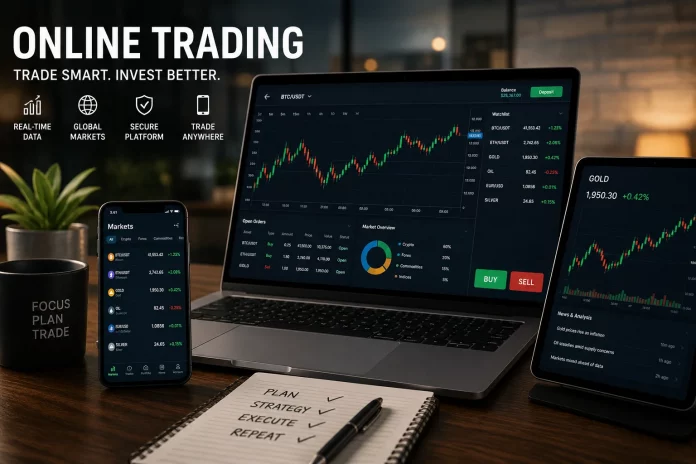

A New Generation of Trading Platforms Is Emerging
Online trading platforms have changed a lot over the past few years. Traders today expect more than basic charts and market access. They want speed, flexibility, mobile functionality, and access to different markets without needing multiple accounts across different platforms.
That shift is creating space for newer platforms to grow, especially those focused on simplicity and modern trading habits. One name that has started appearing more frequently in online trading discussions is Patexone.
The platform has been gaining visibility among traders looking for access to crypto, commodities, forex, and other markets through a single environment that feels easier to navigate than many traditional trading platforms. So, what exactly is Patexone , and why are more people starting to pay attention to it?
What Is Patexone?
 Patexone is an online trading platform that provides users with access to multiple financial markets through one account.
The platform focuses heavily on:
- Cryptocurrency trading
- Multi-market accessibility
- Mobile trading
- Fast execution and usability
Rather than building a platform designed only for highly technical traders, PatexOne appears to focus on creating a smoother experience that works for both newer users and active traders. The result is a platform that feels modern without becoming overly complicated.
Crypto Trading Remains a Major Focus
One of the biggest reasons traders are discovering PatexOne is because of its crypto trading environment.
Crypto markets move quickly, and traders often need:
- Real-time price updates
- Fast execution
- Responsive charts
- Mobile access at all times
Patexone performs well in these areas, which helps explain why it’s increasingly appearing in conversations among active crypto traders. The platform supports access to major digital assets while maintaining a relatively clean and accessible interface.
That combination matters because many crypto platforms either:
- Feel too limited or
- Feel overloaded with unnecessary complexity
Patexone sits somewhere in the middle.
More Than Just a Crypto Platform
 Although crypto trading is a major attraction, the platform also gives users access to additional markets such as:
- Gold and silver
- Oil and commodities
- Forex markets
- Other trading instruments
This creates more flexibility for traders who want to diversify instead of keeping their entire portfolio tied to one asset class. And honestly, diversification is becoming more important as traders realize opportunities shift constantly between markets.
One-month momentum is in Bitcoin Currency. The next month it’s gold or oil. Platforms that allow traders to move between markets easily are becoming increasingly valuable.
The Platform Feels Built for Mobile Trading
A major part of modern trading now happens on mobile devices. People monitor positions during work, check charts while travelling, and react to market moves throughout the day. Platforms that still treat mobile access like an “extra feature” are starting to feel outdated.
Patexone seems to understand this shift. The mobile experience feels smooth, responsive, and practical for day-to-day trading.
Users can:
- Monitor live markets
- Manage positions
- Access trading tools
- Move between assets quickly
without feeling restricted compared to desktop trading. That flexibility is becoming one of the platform’s stronger selling points.
Simplicity Is Part of the Appeal
 A surprising number of trading platforms make simple tasks feel unnecessarily complicated. Overloaded dashboards, endless menus, and confusing layouts can quickly frustrate users, especially newer traders.
Patexone takes a different approach. The platform focuses on keeping navigation relatively clean while still providing the tools active traders actually use.
That balance makes the platform feel more approachable without sacrificing functionality. For many users, that’s a major reason they continue using it after the initial signup phase.
Growing Attention Around the Platform
Patexone has also started gaining momentum through online discussions, reviews, and user feedback. As traders share their experiences across forums and social media, awareness around the platform continues growing, particularly among users interested in:
- Crypto trading
- Commodity markets
- Mobile trading flexibility
- Multi-market access from one platform
This type of organic visibility often matters more than aggressive marketing because it reflects actual user interest.
Bottom Line
Patexone is part of a broader shift happening in online trading. Traders are moving away from platforms that feel outdated, overloaded, or limited to one market category. Instead, they’re looking for environments that combine:
- Speed
- Simplicity
- Flexibility
- Multi-market access
- Strong mobile functionality
PatexOne appears to be building around exactly those priorities. And while every trader should always do their own research before choosing a platform, the growing attention around PatexOne suggests it’s becoming a platform more traders are starting to take seriously.
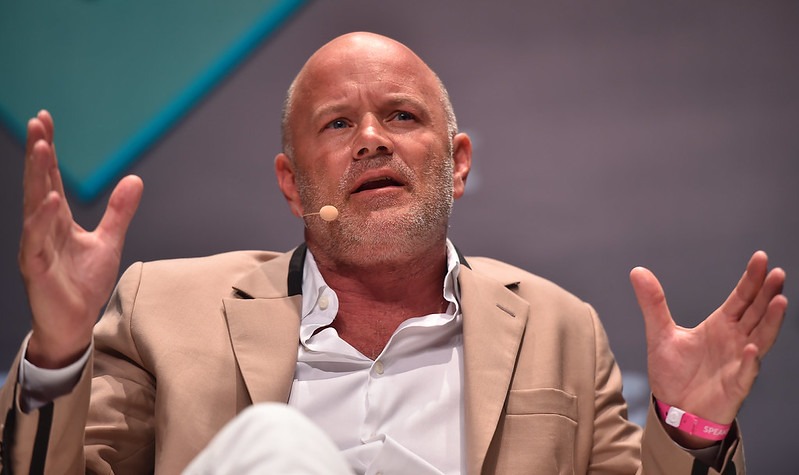
Galaxy Digital founder Mike Novogratz appeared in court on Tuesday to face off against BitGo CEO Mike Belshe in a long-running legal fight over a failed proposed $1.2 billion merger in 2021.
The planned deal was the largest-ever crypto merger at the time, set to create a massive conglomerate offering a suite of services at a time when investor interest in crypto was high.
Galaxy called off the deal in August 2022 as the crypto market was reeling from the collapse of the Terra ecosystem. BitGo has asked Galaxy to pay a $100 million fee for pulling out of the deal and also hid it was being probed by US authorities, while Galaxy has claimed BitGo failed to provide financial information on time.
According to Bloomberg, Novogratz testified in Delaware Chancery Court on Tuesday that he was “pushing to get this deal done,” but Galaxy and BitGo realized regulatory approval for the merger was unlikely because the Securities and Exchange Commission, then headed by Gary Gensler, made it “very difficult.”
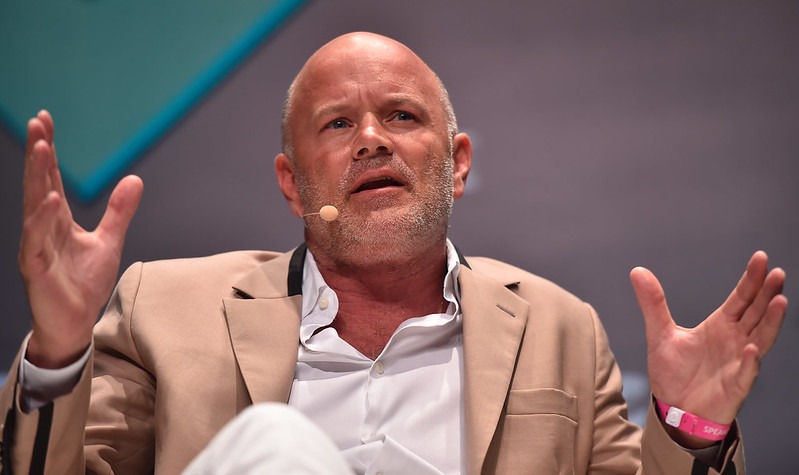
Mike Novogratz, pictured in 2018 at a conference in Hong Kong, has appeared in court over a failed merger with BitGo. Source: RISE
He also said Galaxy was not the subject of the probe and it would not have affected the merger, while BitGo did not provide the needed financial information in time, forfeiting its right to a $100 million termination fee.
Related: On-Chain, In Court: What happened in crypto legal news this week
BitGo bargained for the termination fee, including a deadline to hand over financial statements, but that was complicated by the SEC’s accounting rules requiring companies to record customer crypto holdings as liabilities.
“This was incredibly damaging,” Belshe testified on Monday, claiming that BitGo had provided all the needed information. “Galaxy is telling the world we can’t pass an audit.”
The trial is set to end this week, and a judge will decide whether BitGo should receive the $100 million fee.
Magazine: Guide to the top and emerging global crypto hubs: Mid-2026
The US Securities and Exchange Commission’s move to allow third parties to list tokenized stocks could risk two structural disruptions with liquidity and revenue fragmentation, according to Tiger Research.
Liquidity fragmentation may occur as capital disperses from centralized exchanges across multiple blockchain platforms, said Tiger Research director and head of research Ryan Yoon on Friday.
“Traditional finance views the breakup of its previously consolidated, centralized liquidity as a serious structural threat,” said Yoon.
When third parties tokenize the same listed stock across different blockchain networks and decentralized platforms, the trading volume and order flow that should concentrate on a single venue, such as the NYSE or Nasdaq, instead disperses across multiple venues, he explained.
“This creates price discrepancies across platforms, increases slippage on large orders, and ultimately degrades overall market efficiency.”
The research comes five days after the SEC announced its “innovation exemption” on Monday, which would allow third-party exchanges to list tokenized stocks without needing the issuer’s approval.
Revenue fragmentation remains a risk
The second potential structural disruption is revenue fragmentation, which follows directly from market fragmentation.
“As tokenized stocks trade across multiple platforms in disaggregated form, financial revenues that should accrue to domestic exchanges instead flow offshore, with direct implications for national financial competitiveness,” said Yoon.
Capital fragmentation is already underway with real-world asset open interest on the Hyperliquid decentralized exchange hitting an all-time high of $2.6 billion this week.
Related: Tokenized RWA market grows 420% since 2025 on regulatory clarity, access
Yoon concluded that this shift “poses the deepest strategic dilemma for incumbent financial institutions and regulators alike.”
CEO of digital assets at FG Nexus, Maja Vujinovic, also cautioned that markets could be split into “disconnected pools” which can create “dangerous price tracking errors and shadow-shorting vulnerabilities where there aren’t enough localized buyers to stabilize a specific token’s price.”
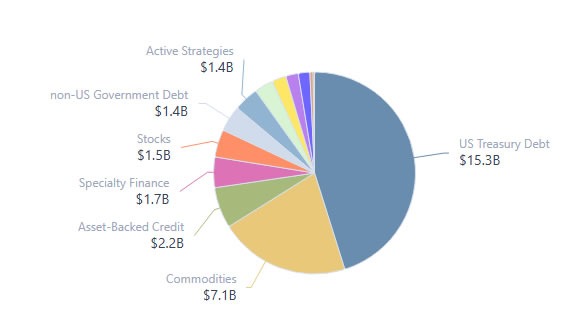
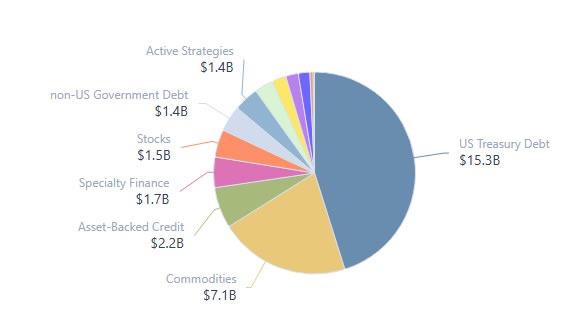
Tokenized stocks make up just 4.4% of total RWA onchain value. Source: RWA.xyz
Meanwhile, SEC Commissioner Hester Peirce said on Thursday that any exemption would be “limited in scope” by only permitting “digital representations of the same underlying equity security that an investor could purchase in the secondary market today.” The full ruling for what will and won’t be permitted has yet to be finalized.
Many practical market benefits
There are arguments that tokenized stocks provide practical market benefits, such as faster settlement, fractional ownership, lower transaction costs and the potential for round-the-clock trading, according to the Blockchain Council.
Global accessibility lets non-US investors gain exposure to high-demand US stocks without being blocked by local brokerage limitations.
Senior research analyst at Siebert Financial, Brian Vieten, said “We believe this will accelerate the transition of the US financial system from legacy rails to onchain blockchain-based rails.”
“We expect a portion of this flow to eventually flow to high-quality blockchain networks like Bitcoin and Hyperliquid,” he added.
Magazine: Crypto scammers face death, Aussie CGT makes Asian hubs attractive: Asia Express


- REAL Finance signs first securities tokenization deal with Factori AD.
- Agreement activates institutional pipeline exceeding $100 million in assets.
- Pilot covers 5 million Alpha Bulgaria warrants valued near €2.75 each.
REAL Technologies Inc., the parent company of REAL Finance, has signed its first securities tokenization agreement with Factori AD, a fully licensed and EU-regulated investment broker.
The deal marks the first live deployment of REAL Finance’s infrastructure for regulated securities and activates an institutional pipeline of more than $100 million in client assets.
The initial transaction will involve equity derivatives linked to Alpha Bulgaria AD, a Bulgarian Stock Exchange-listed investment company, and will be executed on an EVM-compatible blockchain before the planned launch of REAL Finance’s Layer 1 mainnet.
REAL Finance moves from infrastructure build-out to live deployment
REAL Technologies said the agreement with Factori AD represents a major step in the commercial rollout of REAL Finance’s tokenization infrastructure.
The company said the deal activates a committed institutional pipeline exceeding $100 million in client assets.
It also marks the first live deployment of REAL Finance’s tokenization infrastructure for regulated securities.
Under the structure, Factori AD will direct institutional and client assets through REAL’s infrastructure.
The broker will continue to manage all regulated brokerage functions, including client onboarding, KYC, AML compliance, licensed OTC execution, and segregated custody arrangements.
International securities custody will be maintained through Bank of New York. Bulgarian securities will be held at the Central Depository in Bulgaria.
The model is designed to keep regulated brokerage and compliance functions with the licensed broker, while REAL Finance provides the infrastructure and settlement layer for tokenization.
REAL Finance said its approach focuses exclusively on tokenizing real securities.
These include publicly traded equities and derivatives, private market shares, and bonds. The company said it does not focus on synthetic exposure products.
First tranche linked to Alpha Bulgaria warrants
The first transaction under the agreement involves equity derivatives tied to Alpha Bulgaria AD, a publicly traded investment company listed on the Bulgarian Stock Exchange under the ticker ALFB.
The pilot includes 5,000,000 warrants currently valued at approximately €2.75 each.
These warrants have been designated for tokenization through REAL’s infrastructure under Factori AD’s licensed custody and transfer-agent framework.
The transaction represents the first tranche of a broader institutional pipeline.
Factori AD has committed more than $100 million in additional client assets for tokenization through REAL’s infrastructure.
The transaction will be executed on an EVM-compatible blockchain before the planned launch of REAL Finance’s Layer 1 mainnet.
REAL Technologies said the pilot is designed to validate the full workflow for tokenized securities.
That workflow includes regulated sourcing, licensed OTC execution, regulated custody, and on-chain tokenization.
Dimitar Tsvetanov, managing director at Factori AD, said institutional interest in regulated tokenization infrastructure is growing.
We see growing institutional demand for regulated tokenization infrastructure that can bridge traditional securities markets with blockchain-based settlement systems. Through this agreement with REAL Finance, we are able to provide clients with a compliant framework for bringing real financial instruments on-chain while maintaining regulated execution, custody, and onboarding standards.
Regulated custody remains central to the model
REAL Technologies positioned the agreement as evidence that its tokenization model is now operational and under contract with a regulated broker.
“Signing this agreement demonstrates that REAL’s tokenization capabilities are operational and under contract with real securities and a regulated broker. The pilot allows us to validate the full model before we scale to service our multi-nine-figure committed assets pipeline,” said Ivo Grigorov, chief executive officer of REAL Technologies.
Valentin Dimitrov, chief operating officer of REAL Technologies, said the company had built the system around compliance and real financial instruments.
“We designed the architecture around licensed custody, full compliance, and genuine instruments. This first executed deal, together with the committed flow, confirms institutional demand for the infrastructure we are building,” Dimitrov said.
The deal comes amid rising institutional interest in tokenized real-world assets and blockchain-based settlement systems.
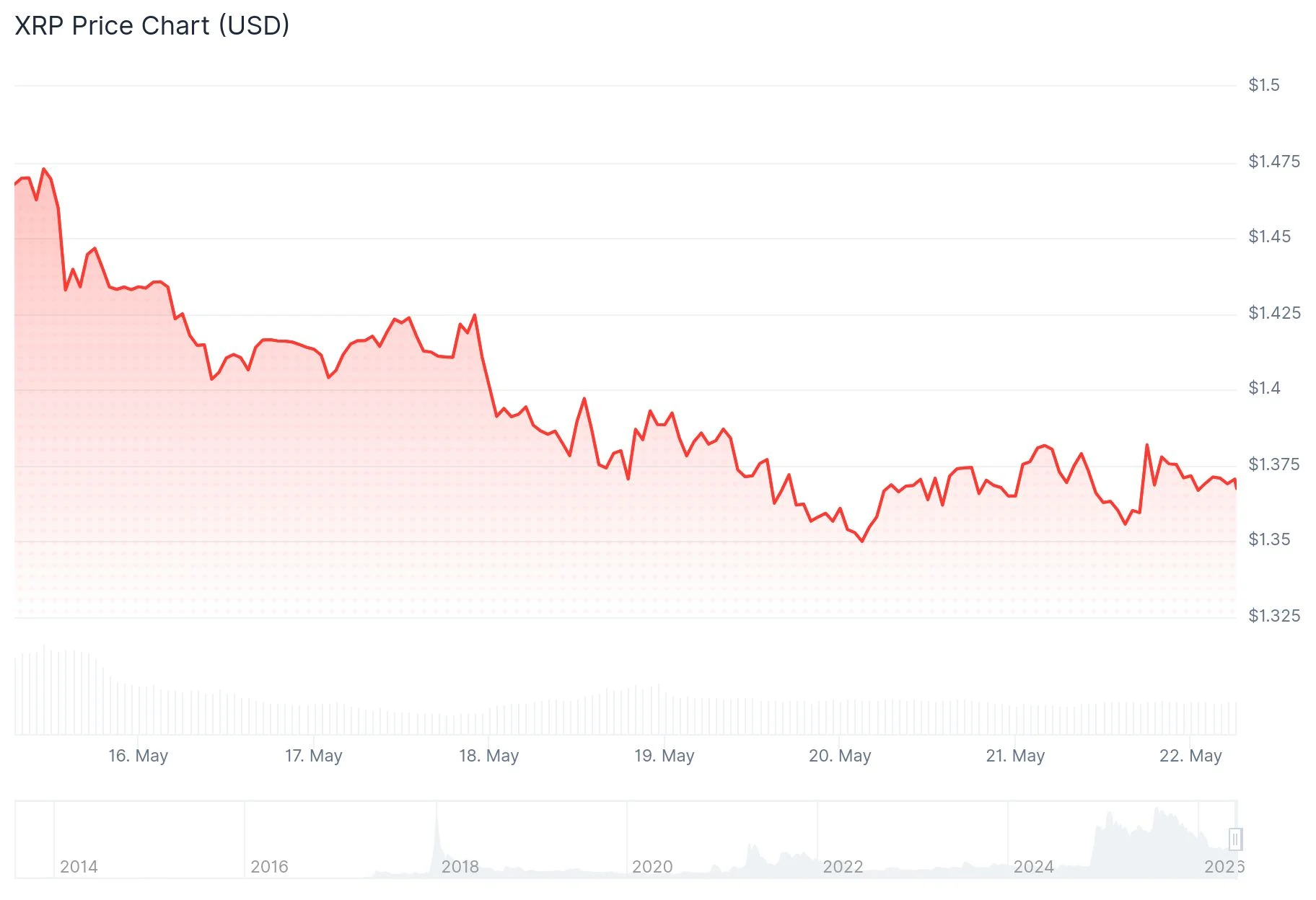
Key Highlights
- Steven McClurg, CEO of Canary Capital, forecasts XRP may reach prices exceeding $2.80 before 2026 concludes, anticipating a 30% surge in ETF participation.
- Last week witnessed XRP exchange-traded funds attracting $60 million in net capital, marking the most robust weekly showing in 2026 and pushing total inflows to $1.39 billion.
- XRPL mainnet version 3.1.3 deployment is confirmed for May 27, with half of all network nodes already running the updated software.
- Large holders purchased more than 71 million XRP tokens during the previous seven days, while 4,300 fresh addresses appeared within a single day.
- CME Group’s XRP derivatives products generated $62.87 billion in notional trading volume during their inaugural twelve months, with daily averages reaching $238 million.
Ripple’s native token currently hovers between $1.36 and $1.40, encountering significant price resistance at the $1.40 threshold. While institutional backing remains consistent, recent trading sessions have shown limited directional movement.
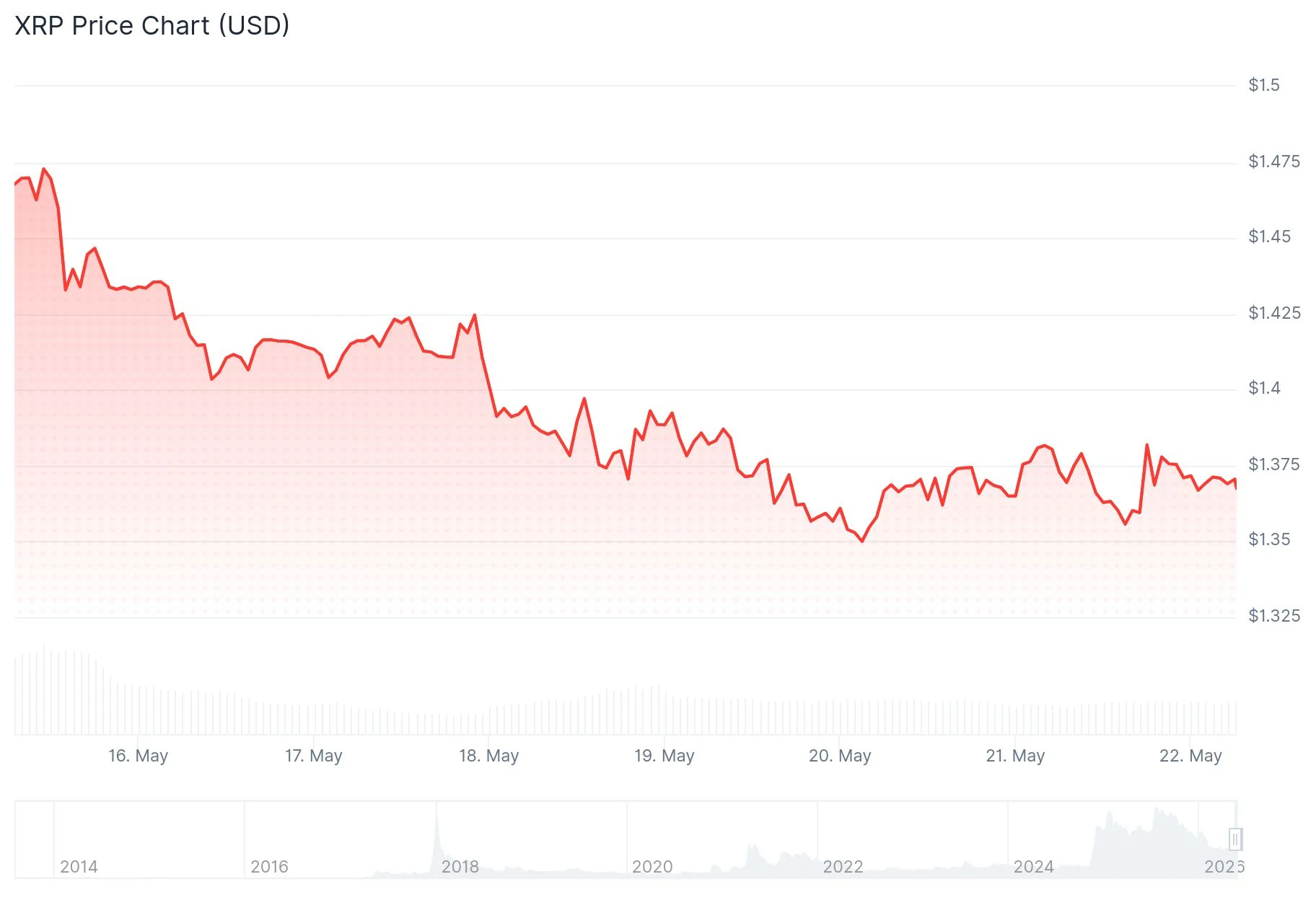
CME Group reported that its XRP futures offering surpassed $62.87 billion in notional value during the first year of operation. Daily trading volume averaged $238 million, representing approximately 1.32 million executed contracts and total exposure equivalent to roughly 28.6 billion XRP tokens.
Speaking with reporters this week, Canary Capital’s Steven McClurg stated that XRP has the potential to “probably double in price by the end of the year.” Based on the current trading range near $1.40, this projection would place XRP above the $2.80 mark by December 2026.
McClurg simultaneously projected a 30% expansion in exchange-traded fund participation before year-end. However, he cautioned against expecting a linear trajectory, characterizing the upcoming summer months as “a tough summer for equities and crypto across the board.”
His market outlook divides into three distinct phases. The initial phase involves challenging summer conditions. The second phase encompasses reduced market activity during the midterm electoral cycle as investors retreat from risk assets. The final phase anticipates a powerful post-election rally fueled by ETF capital deployment, implementation of the CLARITY Act, and accelerated tokenization of real-world assets.
XRP-focused exchange-traded products registered $60 million in net inflows during the previous week, representing the strongest seven-day performance recorded in 2026. Total cumulative inflows have now reached $1.39 billion.
Network Activity Demonstrates Growth
Blockchain analytics provider Santiment identified a significant increase in XRP network expansion this week. Data from Santiment reveals that 4,300 new wallet addresses were generated within a 24-hour window — representing the fourth-largest single-day increase observed in 2026. The firm emphasized that network growth metrics serve as reliable early indicators for identifying potential price trend reversals.
Large holder activity also demonstrated accumulation patterns. Blockchain monitoring data confirms that whale addresses acquired over 71 million XRP tokens throughout the past week, although the accumulation rate has decelerated compared to earlier monthly activity.
Major XRPL Network Enhancement Scheduled for May 27
The XRP Ledger mainnet is preparing for a significant upgrade scheduled for May 27 at 03:49 AM UTC. Version 3.1.3 incorporates the fixCleanup3_1_3 amendment, designed to resolve existing issues affecting NFTs, Permissioned Domains, Vaults, and the network’s Lending Protocol functionality.
Current statistics indicate that 50% of network nodes have successfully implemented the latest software version. Validator nodes have achieved complete 100% consensus regarding the proposed amendment. Nodes failing to complete the upgrade face the risk of becoming “amendment-blocked,” which would prevent them from processing transactions or participating in the consensus mechanism.
David Schwartz, Ripple’s CTO Emeritus, has responded to various community questions concerning the upcoming upgrade. This enhancement represents one component of the comprehensive XRPL development roadmap, which encompasses tokenized real-world asset integration, permissioned decentralized exchange capabilities, and post-quantum cryptographic security implementations.
Derivatives traders maintain optimistic positions on XRP reclaiming the $1.40 level before month-end. Open interest across futures markets has expanded in recent days as the upgrade date approaches, though diminished spot market volume continues to suggest potential headwinds for near-term price momentum.
Market analyst CRYPTOWZRD observed that a decisive breakthrough above $1.40 would establish a clear pathway toward $1.55, with subsequent movement beyond that level potentially targeting the $2.00 price zone.


TLDR
- New Glassnode analysis reveals 6.04 million BTC — representing 30.2% of total supply — faces quantum computing threats
- Bitcoin valued at more than $469 billion has public cryptographic keys exposed on the blockchain
- Major platforms including Binance and Bitfinex display quantum exposure rates of 85% and 100%
- AmericanFortress secures $8 million in funding to create post-quantum protection using zero-knowledge proof technology
- Proposed solution aims to safeguard Satoshi’s estimated 1.1 million BTC plus nearly 5 million additional dormant coins without requiring widespread migrations
Approximately 30% of the entire Bitcoin supply currently in circulation faces potential theft risk once quantum computers achieve sufficient processing power to break existing cryptographic protections, new data from Glassnode indicates.
The blockchain intelligence company conducted a comprehensive examination of Bitcoin’s ledger to identify coins with exposed public cryptographic keys. Their investigation uncovered 6.04 million BTC — valued at over $469 billion — in a quantum-vulnerable state. The balance of 13.99 million BTC remains protected without public key exposure.
Understanding the Security Gap
Bitcoin‘s security architecture depends on the pairing of private keys with corresponding public keys. In standard operations, public keys remain hidden from blockchain visibility. However, once exposed through outgoing transactions or repeated address usage, a quantum computer with adequate capabilities could deploy Shor’s algorithm to decrypt the private key and seize control of the assets.
Glassnode categorizes the vulnerable supply into two distinct classifications. The first, structural exposure, encompasses 1.92 million BTC, accounting for 9.6% of total supply. This segment includes original “pay-to-public-key” transactions associated with Bitcoin founder Satoshi Nakamoto, older multisignature configurations, and Taproot-based outputs.
The second and more substantial category, operational exposure, contains 4.12 million BTC, representing 20.6% of supply. These holdings became susceptible through repeated address utilization, where multiple transactions from identical addresses ultimately reveal the public key to the network.
Cryptocurrency exchanges contribute significantly to this vulnerability profile. Approximately 1.66 million BTC within the operational exposure category originates from exchange wallets. Coinbase demonstrates minimal exposure at just 5% of its tracked holdings. In contrast, Binance and Bitfinex register exposure rates of 85% and 100% respectively. Glassnode emphasized these figures reflect custody architecture decisions rather than indicating insolvency concerns.
Government-held Bitcoin reserves showed superior security positioning. National treasuries in the United States, United Kingdom, and El Salvador all recorded zero quantum vulnerability.
An Emerging Solution
Technology startup AmericanFortress believes it has engineered a viable remedy. The firm, supported by an $8 million seed financing round, has created a patent-pending post-quantum cryptographic signature system built on zero-knowledge proof foundations.
This protocol eliminates the need for large-scale fund transfers or launching alternative blockchains. Rather, it employs a backward-compatible soft fork mechanism to lock and shield inactive wallets — notably including Satoshi-period addresses that cannot undergo automatic modernization.
“Our quantum-resistant protocol would automatically freeze and protect those funds until governance decides what to do with them after Q-day,” said CEO Michal Pospieszalski.
The protection mechanism extends across Bitcoin, Ethereum, Solana, and Tron networks. For current wallet users, the upgrade process requires approximately 50 milliseconds through a simple wallet notification. The company estimates implementation costs comparable to a single rollup transaction.
AmericanFortress estimates that more than $600 billion in cryptocurrency holdings remain in vulnerable conditions, with Solana addresses showing 100% exposure. The firm’s cryptographic approach for Bitcoin should become available for community review within weeks, preceding a formal unveiling scheduled for June 2 in Paris.
Concurrently, Bitcoin’s developer ecosystem continues deliberating BIP-360, a technical proposal for implementing quantum-resistant transaction structures. Projections for “Q-Day” — the milestone when quantum computers could potentially compromise Bitcoin’s cryptographic defenses — span from 2030 through 2032. The United States government recently announced over $2 billion in investments toward quantum computing ventures this week.
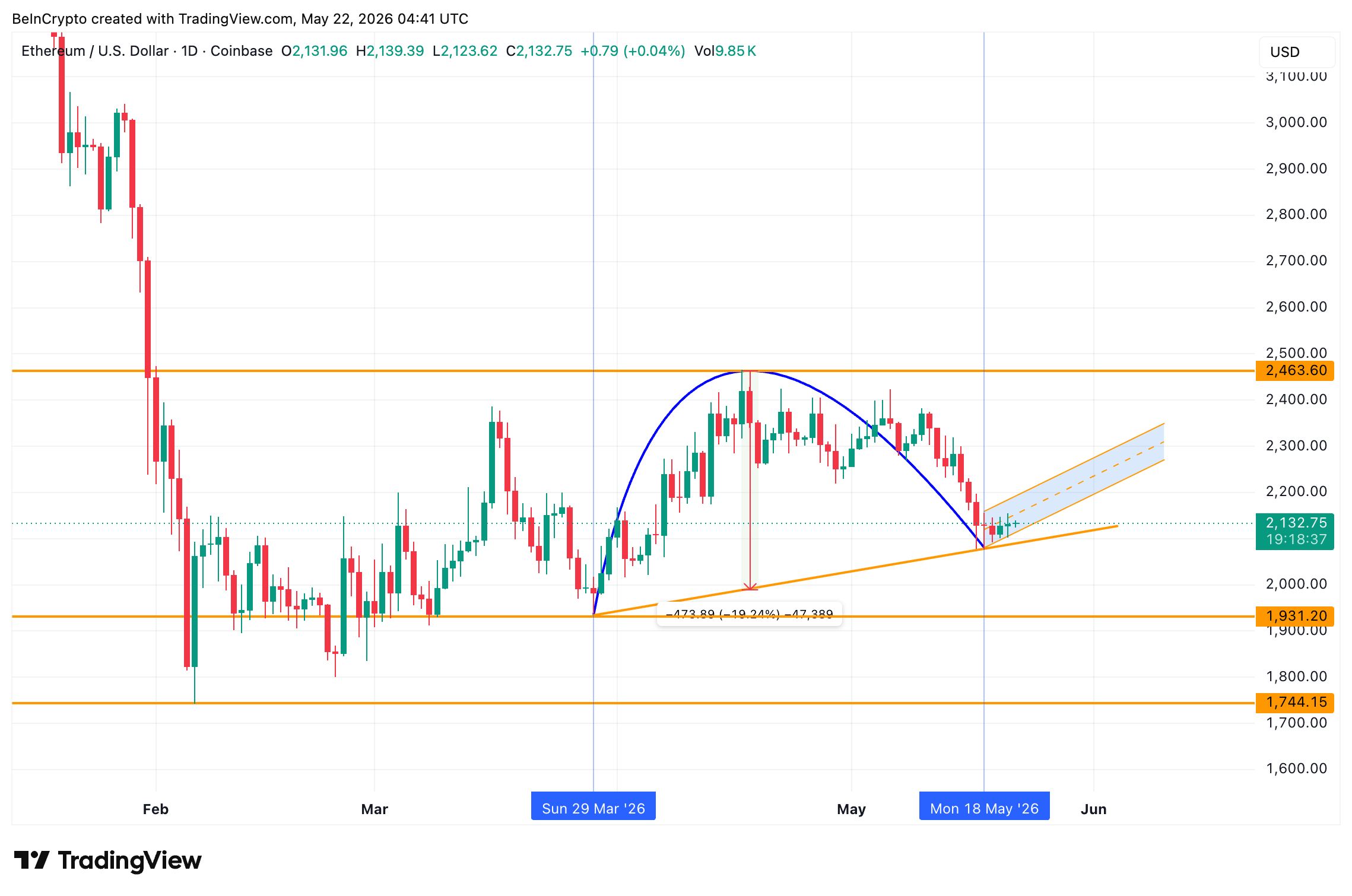
Ethereum (ETH) price trades at $2,132 on May 22, holding flat after a small rebound off recent lows. The action masks a deeper split between two on-chain cohorts pulling in opposite directions.
The price chart, whale supply data, and conviction holder behavior each tell different stories. Resolving the conflict points to one of two outcomes for Ethereum in the coming sessions.
Price Pattern and Whale Exit Point to Downside Risk
Ethereum has been trading inside an inverted cup and handle since March 29. The pattern is a bearish reversal formation where price climbs in a rounded arc before rolling over. The cup completed near May 18, with the small rebound since then forming the handle.
If the handle gives way, the measured move points to a 19% correction. The downside math would set up a cycle reset for Ethereum back to early February territory.
Want more token insights like this? Sign up for Editor Harsh Notariya’s Daily Crypto Newsletter here.

Ethereum whales have been adding pressure to that scenario. Santiment data shows the supply held by whales (exchanges excluded) sat at 125.36 million ETH on May 17. The reading has since drifted to 125.02 million. This is a drop worth $725 million at the current ETH price.

The whale exit started in mid-May, coinciding exactly with the cup completion phase. That timing suggests the largest stack is rotating out as the pattern matures.
The whale read validates the bearish technical setup, but a separate cohort tells a contradictory story.
Smart Money Stays Bearish While Hodlers Build Aggressive Positions
The Smart Money Index measures informed-investor conviction by comparing trading patterns. The reading currently sits below its zero line. That signals institutional and informed buyers have not returned, even with the small rebound since May 18.

This reinforces the bearish read from the pattern and the whale exit.
However, Ethereum hodlers, ones with a stash older than 155 days, moved in the opposite direction. The Hodler Net Position Change rose from 77,978 ETH on May 16 to 151,890 ETH by May 21. That works out to a 95% jump in conviction-holder accumulation over five days.

Whales sell, smart money waits, hodlers stack. The hodler buying looks paradoxical, but the cost basis distribution map explains why.
Ethereum Price Levels Hinge on Handle Support and the Cost Basis Cluster
The Glassnode cost basis heatmap shows a concentrated cluster at the $2,059 to $2,075 zone. Roughly 1.378 million ETH sits at that Ethereum cost basis range, the only meaningful supply cluster anywhere near the current price.
Hodlers are defending this floor. If the price holds above the cluster, their positions stay green, and the bid keeps showing up. If the cluster breaks, the conviction wave likely reverses.

The handle’s structural support sits at $2,102. A clean loss of $2,102 sends the price directly into the cost basis cluster. Below $2,059, the next stops are $2,017 and $1,896, with the full measured move target at $1,697.
That $1,697 reading sits below the February 6 ETH cycle low of $1,744. A move there would mark a true cycle reset, fresh territory for the current leg.

For the bullish thesis to gain traction, the Ethereum price needs to clear $2,292 first. A daily close above $2,462 would invalidate the inverted cup and handle. The $2,102 level separates a hodler defense holding the line from a full cycle reset to $1,697.
The post $725 Million in Ethereum (ETH) Just Left Whale Wallets: The Timing Is Suspicious appeared first on BeInCrypto.
Key Takeaways
- Billionaire Mark Cuban liquidated approximately 80% of his Bitcoin position following disappointing performance
- During the US-Iran geopolitical tensions, gold reached $5,000 while Bitcoin declined in value
- Cuban maintains his Ethereum holdings, emphasizing its practical applications in DeFi and smart contracts
- The investor characterized the majority of alternative cryptocurrencies as worthless
- Bitcoin supporters counter that the asset has gained more than 16% since tensions escalated, depending on measurement period
Billionaire entrepreneur Mark Cuban, known for owning the Dallas Mavericks, has divested approximately 80% of his Bitcoin portfolio. In an interview on the Front Office Sports podcast “Portfolio Players,” Cuban revealed that Bitcoin’s performance during recent geopolitical instability contradicted his investment hypothesis.
JUST IN: Billionaire Mark Cuban says he sold “most” of his Bitcoin.
“Bitcoin has lost the plot.” pic.twitter.com/8xbRbcPBpC
— Watcher.Guru (@WatcherGuru) May 21, 2026
For years, Cuban championed Bitcoin as an improved alternative to gold. He frequently cited its capped supply and decentralized framework as advantages that positioned it as a superior wealth preservation tool. Just months ago, in January 2025, Cuban publicly stated his preference for Bitcoin over gold during economic downturns.
His perspective has undergone a dramatic shift.
The Reasoning Behind Cuban’s Bitcoin Exit
“When all this hit the fan with the Iran war, bitcoin was always the best alternative to fiat currency losing its value,” Cuban explained. “Gold just blew up and went to $5,000. Bitcoin dropped.”
Cuban’s rationale centered on a straightforward expectation: whenever the U.S. dollar weakened, he anticipated Bitcoin would appreciate. The reality proved different. While gold rallied amid geopolitical uncertainty, Bitcoin experienced a decline.
Prior to 2026, Cuban’s digital asset allocation consisted of approximately 60% Bitcoin, 30% Ethereum, and 10% various other tokens. He previously stated he had never liquidated his Bitcoin holdings. That longstanding commitment has now dramatically shifted.
“Not the hedge I expected it to be, and that was really disappointing,” he remarked.
Cuban labeled most alternative digital currencies as worthless while noting his continued confidence in Ethereum.
Ethereum Retains Cuban’s Support
Despite his Bitcoin exit, Cuban retains his Ethereum position. He has repeatedly highlighted its smart contract capabilities and its foundational role in powering decentralized finance platforms and non-fungible tokens.
Cuban draws a clear distinction between Bitcoin, which he primarily evaluated as a value storage mechanism, and Ethereum, which he considers to have more tangible practical applications.
His recent statements indicate this differentiation has become increasingly significant in his investment framework.
Bitcoin Advocates Challenge Cuban’s Assessment
Cuban’s interpretation of recent market behavior hasn’t gone unchallenged.
Cryptocurrency proponents highlight that from the initial escalation of US-Iran tensions in late February, Bitcoin has appreciated over 16% while gold has declined more than 15%. The comparative performance varies significantly based on the selected timeframe.
Bitcoin currently trades around $77,500, representing approximately a 38% decrease from its October 2025 peak of $126,080. Gold is valued near $4,500 per ounce, having retreated from its $5,000 high.
Cuban’s decision appears isolated from wider institutional trends. Bitcoin spot exchange-traded funds collectively manage over $100 billion in assets, demonstrating sustained institutional appetite for the cryptocurrency.
Cuban’s portfolio adjustment represents an individual investment choice rooted in his specific expectations about Bitcoin functioning as a macroeconomic hedge — expectations he now believes the asset has not fulfilled.
Fundamental Background
The RBA’s third consecutive interest rate increase to 4.35% reflects the regulator’s concern over rising inflation: the conflict in the Middle East is increasing energy costs and putting upward pressure on prices. Annual consumer inflation stood at 4.6% in March. Analysts at CBA believe this rate hike should be sufficient, with the base-case scenario pointing to rates remaining unchanged until the end of 2026, provided neither the federal budget nor second-quarter inflation data deliver major surprises.
At the same time, the Australian dollar failed to hold near its May highs, as rising demand for safe-haven assets amid global uncertainty weighed on risk-sensitive currencies.
AUD/USD Technical Picture
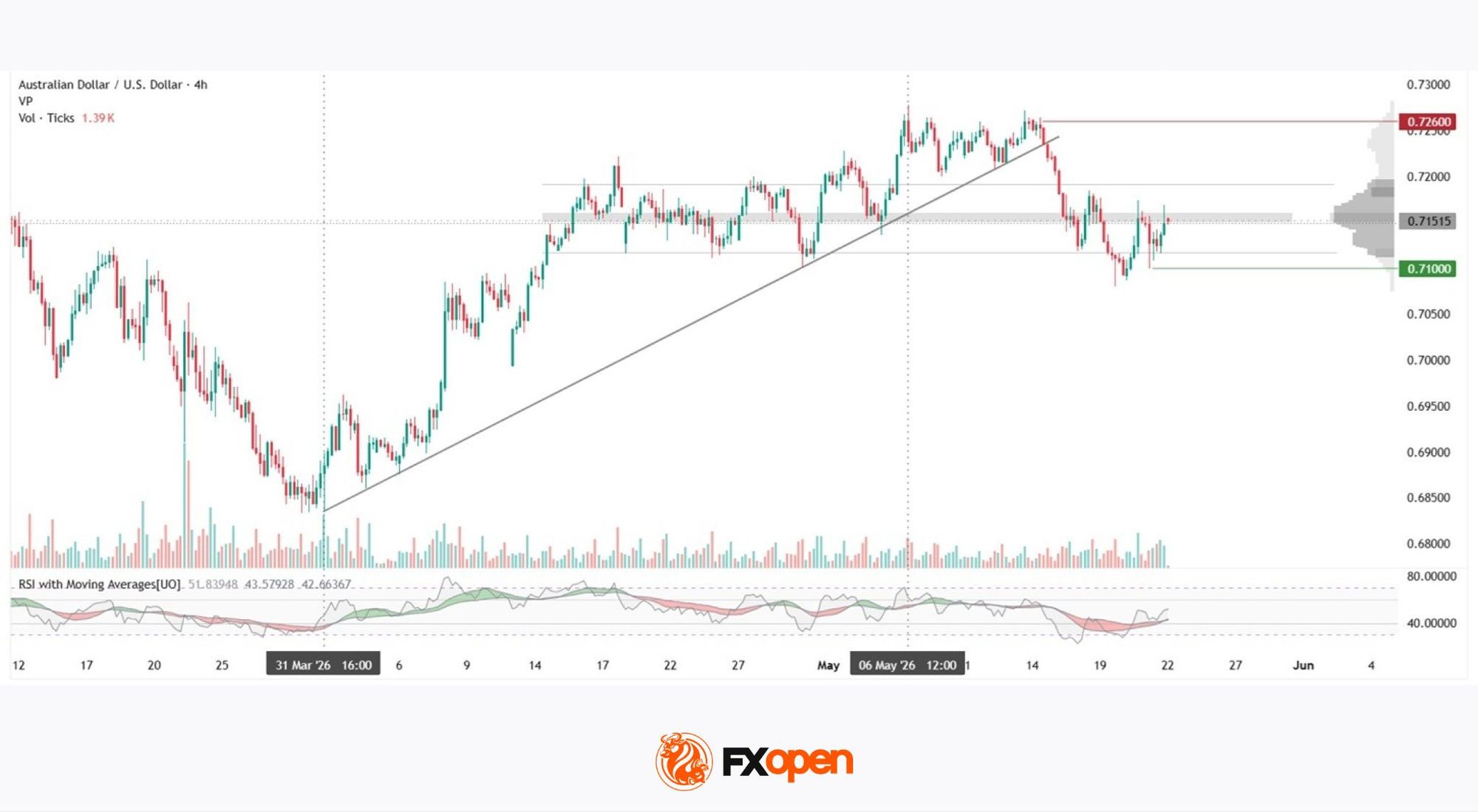
On the 4-hour AUD/USD chart, the upward movement from late March to early May is clearly visible, forming a pronounced trend with a characteristic wave structure. In mid-May, the trend was broken and the price declined towards the 0.7100 area, ultimately forming a green support level. The Point of Control (POC) zone is currently being tested from below, while the horizontal volume profile boundaries cover the 0.7120–0.7190 range — the corridor where the bulk of market activity is concentrated.
The 0.7190 level could act as resistance in the event of recovery attempts within the profile. The red resistance level at 0.7260 — the local May high — may remain an important reference point should the pair test the upper trend levels. The RSI + MAs indicator currently shows readings of 51 / 43 / 42, reflecting the market’s restrained and neutral character.
Key Takeaways
The key driver for the pair remains the balance between expectations for further RBA action and demand for safe-haven assets — for now, both forces continue to compete with one another. The RSI picture offers no clear advantage to either side, while price action remains close to the POC zone within a relatively narrow market profile.
Trade over 50 forex markets 24 hours a day with FXOpen. Take advantage of low commissions, deep liquidity, and spreads from 0.0 pips (additional fees may apply). Open your FXOpen account now or learn more about trading forex with FXOpen.
This article represents the opinion of the Companies operating under the FXOpen brand only. It is not to be construed as an offer, solicitation, or recommendation with respect to products and services provided by the Companies operating under the FXOpen brand, nor is it to be considered financial advice.
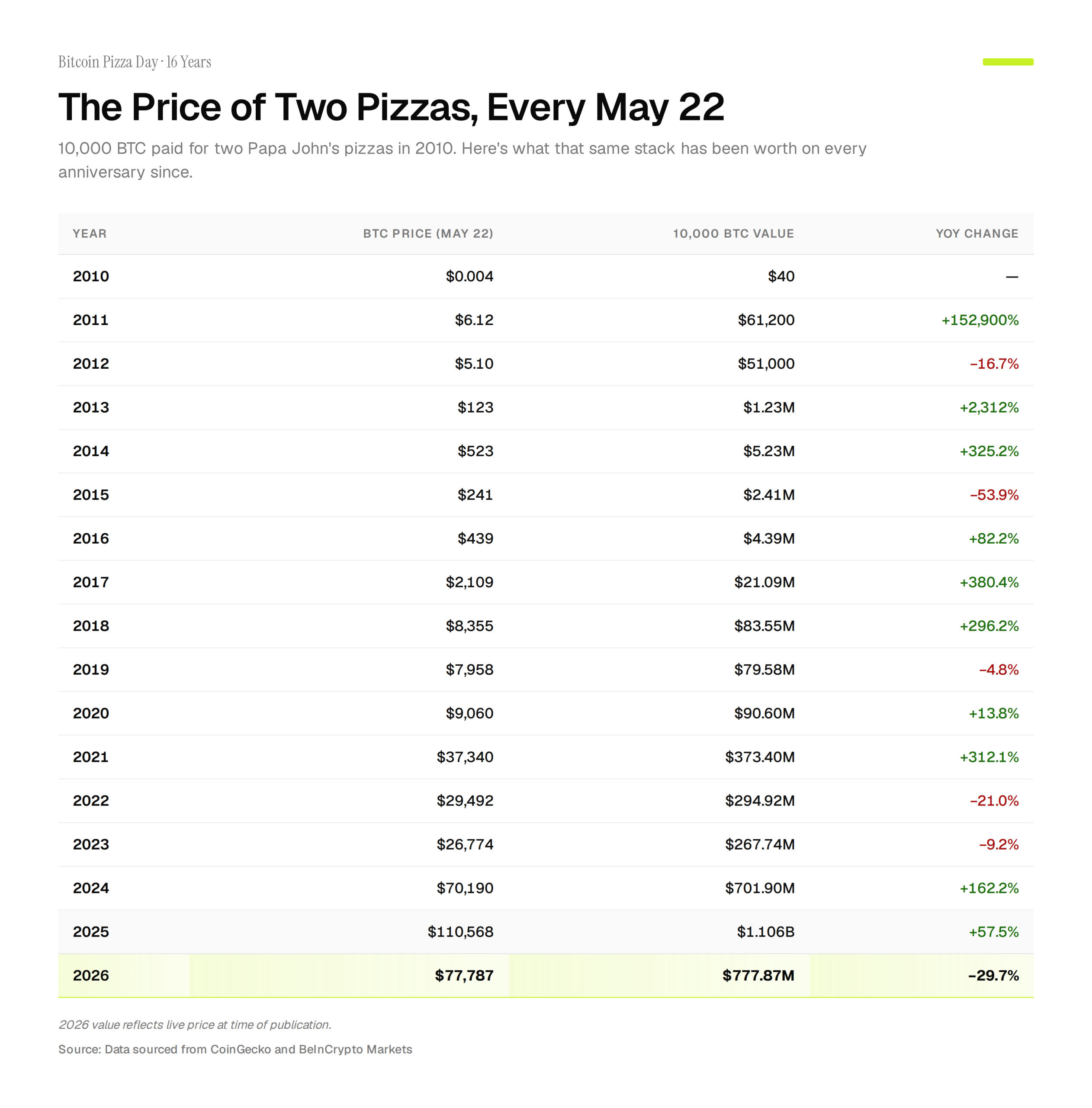
Bitcoin Pizza Day arrived with a $328 million loss this year. The 10,000 Bitcoin (BTC) that bought two Papa John’s pizzas in 2010 is now worth $777.87 million, down from $1.106 billion on the 15th anniversary in 2025.
The 29.7% year-over-year decline is the steepest drop in any Bitcoin Pizza Day stack since 2015, when the cryptocurrency fell 54% during a bear market.
Follow us on X to get the latest news as it happens

From a Billion-Dollar Stack to $777 Million
Last year’s anniversary arrived during a clear bull run. Bitcoin traded at $110,568 on May 22, 2025, setting new all-time highs at the time. Programmer Laszlo Hanyecz’s original 10,000 BTC stack had a notional value of $1.106 billion, per CoinGecko data.
Bitcoin extended that rally through the summer and into October. The cryptocurrency hit a new all-time high of $126,000 on October 6, 2025, amid strong institutional flows and muted retail participation.
That run ended four days later. On October 10, President Donald Trump announced 100% tariffs on Chinese imports, triggering nearly $200 billion in losses in the crypto market. Bitcoin fell from $122,000 to $107,000 following the announcement.
Bitcoin’s Journey From All-Time High to Worst Opening Quarter
Bitcoin spent the rest of 2025 below its October peak. By the time 2026 began, the rally that had powered Pizza Day 2025’s record valuation had broken.
Q1 2026 became the worst opening quarter since 2018. Bitcoin closed the period down 22.2%, with spot Bitcoin exchange-traded funds (ETFs) losing a net $496.5 million amid Iran tensions.
Q2 has brought partial relief. Bitcoin has climbed roughly 14% over the quarter. Nonetheless, the cryptocurrency remains in the red year-to-date.

Bitcoin traded near $77,787 on Pizza Day 2026. That sits 29.7% below last year’s $110,568 price and 38% below October’s $126,000 record.
The price has now fallen in six of 16 anniversaries. 2026 marks the largest absolute dollar drop in that streak.
Subscribe to our YouTube channel to watch leaders and journalists provide expert insights
The post Bitcoin Pizza Day 2026 Arrived Over $300 Million Lighter Than Last Year appeared first on BeInCrypto.

What Is Patexone and Why Are More Traders Talking About It?

Athletic Expenses, Profit/Loss for Top Schools in the West

GitLab 19.0 targets the gap between writing code and shipping it


-

 Crypto World6 days ago
BloFin War of Whales 2026 Grand Prix opens registration for $5M trading championship
-

 Fashion7 days ago
Weekend Open Thread: Theory – Corporette.com
-

 Crypto World7 days ago
E-Estate Announces 1 Year Live: Washington DC Summit as Real Estate Tokenization Enters Its Next Phase
-

 Tech6 days ago
Google reimburses Register sources who were victims of API fraud
-

 Business7 days ago
H&R Real Estate Investment Trust (HR.UN:CA) Q1 2026 Earnings Call Transcript
-

 Entertainment7 days ago
David Letterman Returns to Late Show, Blasts Cancellation
-

 Sports6 days ago
Napoleonic enters 2026 Doomben 10,000 field via Abounding withdrawal
-

 Crypto World6 days ago
BeInCrypto 100 Institutional Awards Nomination: KAST for Best Digital Assets Neobank and Best Digital Assets Fintech
-
 Crypto World6 days ago
Bitcoin Battles US Bond Nerves With BTC Price Dip Toward New May Lows
-

 Crypto World6 days ago
ICE and CME urge US regulators to curb Hyperliquid energy trading
-

 Fashion5 days ago
On the Scene at Gucci’s Cruise Show in New York City: Mariah Carey, Kim Kardashian, Lindsay Lohan, Iman, and More!
-
 Crypto World6 days ago
Wall Street’s Boldest Gold Prediction Has Russians Rushing to Buy
-

 Fashion6 days ago
Trending Western Style Vests Perfect for Summer
-

 Crypto World6 days ago
IREN closes $3 billion convertible notes deal amid AI infrastructure expansion
-

 Politics6 days ago
Watch: far-right flag-fanatics run over victim, attack locals – Setup By the Left wing for your entertainment
-

 Fashion7 days ago
Creative Ideas for Custom T-Shirts
-

 Fashion5 days ago
Amazon Sundays: Memorial Day Hosting
-

 Crypto World14 hours ago
Blockchain.com files with SEC for U.S. IPO
-
 Fashion7 days ago
Philip Jones Wedding Jewellery For Women
-

 Crypto World6 days ago
Crypto Market Structure Bill Clears Committee; Senate Vote in Focus
You must be logged in to post a comment Login