

Crypto World
Bitcoin price prediction: BTC faces critical resistance at $78,000 as ETF outflows mount



- Bitcoin ETFs posted $1.25 billion in weekly net outflows.
- BTC must clear $78,152 to sustain bullish momentum.
- Strategy paused Bitcoin purchases despite holding 843,738 BTC.
Bitcoin (BTC) continued to trade near the $77,000 level on Monday amid growing institutional outflows against improving macro sentiment and rising demand from spot buyers.
The world’s largest cryptocurrency was up 0.5% over the past 24 hours, trading at $77,182 at press time, slightly outperforming the broader crypto market.
The slight rebound pushed BTC’s price closer to a major resistance zone near $78,000, a level that traders are watching closely after weeks of volatile price action and heavy selling pressure from spot exchange-traded funds.
The market is reacting to easing geopolitical tensions after US President Donald Trump said a potential agreement with Iran was “largely negotiated,” reducing fears of a wider Middle East conflict.
Bitcoin ETF outflows continue to pressure sentiment
Institutional demand for Bitcoin ETFs weakened sharply over the past week, with spot Bitcoin ETFs recording roughly $1.256 billion in net outflows between May 18 and May 22, according to CoinGlass data.
Several of the largest withdrawals came from products linked to BlackRock and Fidelity, two firms that played a major role in driving institutional adoption after spot Bitcoin ETFs launched in the United States in early 2024.
The outflows added to concerns that institutional appetite for BTC exposure may be cooling as investors rotate capital toward other sectors, particularly artificial intelligence and semiconductor-focused investments.
At the same time, Strategy, formerly known as MicroStrategy, has paused its aggressive Bitcoin buying campaign this week.
Nevertheless, the company still holds 843,738 BTC, making it the largest corporate Bitcoin holder globally, but it chose to buy bonds instead of adding more Bitcoin to its treasury.
The move attracted attention across the crypto market because Strategy and executive chairman Michael Saylor have been among Bitcoin’s strongest corporate supporters over the past several years.
Meanwhile, BlackRock CEO Larry Fink adopted a more measured tone while discussing Bitcoin’s role in institutional portfolios.
Although Fink highlighted the success of Bitcoin ETFs, his recent comments reflected a more cautious stance compared to earlier bullish statements.
Still, not all institutional activity turned negative. El Salvador added another eight Bitcoin to its national reserves, extending the country’s long-running accumulation strategy under President Nayib Bukele.
Bitcoin dominance rises as traders rotate out of altcoins
Even with ETF outflows accelerating, Bitcoin managed to hold above key support levels as capital continued rotating away from smaller cryptocurrencies and into BTC.
Market data shows Bitcoin outperforming much of the altcoin market during the latest recovery.
At the same time, derivatives activity has increased sharply, with open interest in perpetual futures contracts jumping 11.44% within 24 hours, signalling rising leveraged positioning among short-term traders.
That increase in leverage amplified Bitcoin’s move higher but also raised the risk of sharper volatility if macroeconomic data or market sentiment shifts suddenly.
Technical indicators point to a critical resistance zone
Technical indicators currently present a mixed picture for Bitcoin’s short-term outlook.
Data from 23 technical indicators shows four buy signals and nine sell signals, leaving the broader short-term trend tilted bearish despite the latest rebound.
The most important resistance level sits at $78,152. Bitcoin needs a decisive close above that level to sustain upward momentum and target the next resistance near $79,331.
On the downside, immediate support stands at $76,773. A breakdown below that level could expose Bitcoin to deeper losses, especially if traders begin unwinding leveraged positions.
The 14-day Relative Strength Index currently stands at 47.70, suggesting neutral conditions rather than an overheated market.

Moving averages also continue signalling caution.
The Bitcoin price currently trades above only two of the five major exponential moving averages, while remaining below the long-term 200-day EMA, a level many traders use to assess broader market direction.
Analysts are also watching the 61.8% Fibonacci retracement level near $76,590, which has emerged as another important support area during the latest consolidation phase.



Tether and Georgia’s government will launch GEL₮, a stablecoin pegged to the Georgian Lari, in one of the first cases of placing sovereign fiat onto blockchain rails.
The launch sits inside Georgia’s new stablecoin regime, which the country built to align with the US GENIUS Act. This positions Georgia as one of the earliest jurisdictions pursuing regulatory interoperability with Washington’s digital asset rules.
Why a National Stablecoin Now
Stablecoins are moving from crypto rails into mainstream payment infrastructure. Monthly adjusted onchain volume hit $7.6 trillion in April 2026. Tether also noted that stablecoins are gaining traction for payments, settlements, remittances, and international transfers.
Meanwhile, forecasts keep climbing. Ripple projected $33 trillion in onchain stablecoin volume for 2026. Chainalysis estimates that adjusted stablecoin transaction volume will climb to $719 trillion by 2035 through organic growth alone.
The firm added that if broader macroeconomic catalysts, such as generational wealth transfer and point-of-sale saturation, accelerate adoption, the figure may expand toward $1.5 quadrillion.
Follow us on X to get the latest news as it happens
Georgia has positioned itself for the shift. The country already allows tax payments via instant conversion of digital assets. The fiat-pegged token extends that approach into sovereign monetary infrastructure.
GEL₮ will serve as a digital version of the Georgian Lari, offering lower transaction fees, near-instant settlement, programmable payments, and smoother value transfers across digital financial networks.
The initiative aims to strengthen cross-border trade, expand fintech innovation, improve digital payment systems, and widen access to programmable financial infrastructure across Georgia and the broader region.
“In partnership with Tether, the global leader in digital assets and stablecoin innovation, Georgia has the opportunity to become a strategic bridge between traditional finance and the digital economy of the future,” Vakhtang Turnava, Member of the Parliament of Georgia, said.
The announcement added that further details regarding GEL₮’s structure, rollout timeline, and regulatory framework will be disclosed at a later stage.
Whether other governments follow Georgia’s playbook of pairing national stablecoins with US-aligned rules will shape how sovereign fiat travels onchain.
Subscribe to our YouTube channel to watch leaders and journalists provide expert insights
The post Tether Plans Georgian Lari Stablecoin in Sovereign Currency Partnership appeared first on BeInCrypto.
Crypto World
Crypto News Today: Near Protocol ($NEAR) & Hyperliquid ($HYPE) Whales Flock To SurgeXRP As $SGP Presale Momentum Accelerates Across XRPL

A fresh rotation of whale capital is beginning to hit the XRP Ledger ecosystem, and traders previously positioned in Near Protocol ($NEAR) and Hyperliquid ($HYPE) are now turning attention toward SurgeXRP, the XRPL-based real estate marketplace whose ongoing $SGP presale is rapidly gaining momentum across crypto communities.
As profits continue flowing out of already-expanded narratives, many investors are now aggressively searching for earlier-stage opportunities with stronger upside potential before mainstream attention arrives.
That search is increasingly leading toward XRP ecosystem projects, particularly those connected to real-world assets.
SurgeXRP has quickly emerged as one of the most talked-about XRP presales after early contributors pushed the project beyond 10% of its presale soft cap within days of launch, triggering growing speculation that the current entry window may not remain open for long.
[Join SurgeXRP Presale]
What is driving the momentum is not just hype.
It is the structure behind the presale itself.
Unlike conventional crypto launches that lock in fixed valuations before public participation begins, SurgeXRP has removed the fixed token price entirely.
There is no set presale valuation.
Instead, the final price of $SGP will be determined entirely by the total amount of XRP raised during the presale period, creating a market-driven structure that is already fueling aggressive positioning from XRP whales and high-conviction traders attempting to secure exposure before public trading begins.
At the same time, the project has confirmed planned listings on XPMarket and MagneticDEX at a valuation 30% higher than the final presale price, creating an additional layer of urgency among early contributors.
For many traders, the logic is simple: position before the market fully notices.
Why Traders From NEAR & Hyperliquid Are Watching SurgeXRP
Whale rotations are one of crypto’s strongest early signals.
Once major gains begin slowing in established narratives, larger traders often move aggressively into earlier-stage sectors before retail momentum follows.
That pattern now appears to be forming around XRPL real-world asset infrastructure.
SurgeXRP is building a marketplace designed to bring rental real estate ownership on-chain through the XRP Ledger, allowing users globally to access fractional participation in income-generating rental properties using blockchain-based settlement and ownership infrastructure.
As the real-world asset sector continues becoming one of crypto’s fastest-growing narratives, many investors increasingly believe XRPL is positioned to become a major blockchain for tokenized assets due to its low fees, fast settlement, and native tokenization capabilities.
That narrative is helping SurgeXRP gain traction rapidly.
Additional Presale Incentives Fueling FOMO
The project has also introduced multiple bonus structures that are intensifying competition throughout the presale.
The first 100 contributors receive a 10% bonus allocation on purchased SGP tokens.
In addition, SurgeXRP is preparing to launch a real-time contributor leaderboard where the top 20 contributors will receive another 10% bonus allocation.
The upcoming live dashboard will allow users to monitor:
Estimated SGP allocations
Total XRP raised
Leaderboard rankings
Bonus eligibility status
Presale milestone progress
[Buy SGP Token]
$SGP Presale Details
Blockchain: XRP Ledger
Token: $SGP
Total Supply: 200 million SGP
Presale Allocation: 100 million SGP
Presale Price: Determined by total XRP raised
DEX Listings: XPMarket & MagneticDEX
Planned Listing Valuation: 30% higher than final presale price
First 100 Bonus: 10%
Top 20 Leaderboard Bonus: Additional 10%
As momentum across XRPL and RWA narratives continues accelerating, many traders believe SurgeXRP could become one of the most closely watched XRP ecosystem launches before the next phase of the market begins.
Website: surgexrp.com
Join Presale: surgexrp.com/presale
Whitepaper: docs.surgexrp.com
Telegram: t.me/surgexrpdotcom
Disclaimer: This is a Press Release provided by a third party who is responsible for the content. Please conduct your own research before taking any action based on the content.



The CLARITY Act cleared the Senate Banking Committee 15-9 on May 14, 2026, but the biggest threat to its passage was never the crypto skeptics or the SEC holdouts. It was the American Bankers Association. The ABA spent April and May running an emergency lobbying campaign to close what it calls the “stablecoin yield loophole” in the bill, a provision that lets crypto exchanges pay activity-based rewards on stablecoin balances. The ABA’s own research estimates that yield-bearing stablecoins could grow the market from $300 billion to $2 trillion at the direct expense of bank deposits, reducing lending capacity by 20 percent or more. The fight is not about consumer protection or financial stability. It is about banks defending a profit model built on zero-yield checking accounts against a structurally superior alternative. This is the political fight nobody is properly explaining.
Summary
- The CLARITY Act’s stablecoin rewards provision has become the main flashpoint between the crypto industry and U.S. banking groups over fears of deposit migration from traditional banks.
- The American Bankers Association warned that yield-bearing stablecoins could expand the market to $2 trillion and reduce lending capacity across consumer, small business, and agricultural sectors.
- Crypto industry advocates argued that banks are defending low-yield deposit models as exchanges push for activity-based stablecoin rewards under the proposed legislation.
What the loophole actually is
The CLARITY Act, in its current form, contains a provision that has become the most contested single fight in crypto legislation in 2026. Most coverage refers to it vaguely as “stablecoin yield provisions” without explaining what is actually at stake. The specifics matter.
The 2025 GENIUS Act, which established federal stablecoin regulation, prohibits stablecoin issuers from paying interest or yield on payment stablecoins. The ban applies to the issuer (Circle for USDC, Tether for USDT, Ripple for RLUSD, Paxos for various tokens). The intent was to keep stablecoins working as payment instruments rather than competing with bank deposits.
The CLARITY Act contains language that, as currently drafted, lets crypto exchanges and digital asset service providers offer rewards on stablecoin balances held with them, even though the underlying issuer cannot pay yield directly. The Tillis-Alsobrooks compromise language, released in early May, refined the original draft. The compromise prohibits rewards that are “economically or functionally equivalent to the payment of interest or yield on an interest-bearing bank deposit.” But it allows rewards tied to “activity-based” participation in exchange membership programs, including rewards calculated by reference to balance, duration, and tenure.
That last clause is the loophole the banking industry is fighting. From the ABA’s perspective, an exchange offering a 4 percent reward on USDC balances held in a membership program is functionally identical to a bank paying 4 percent interest on a checking account. The fact that the reward is technically tied to “activity” rather than balance does not change the economic reality for the consumer. The depositor sees yield. The depositor moves money. The bank loses the deposit.
The banking industry is correct this is a loophole in the original GENIUS Act framework. Whether it should be closed is the political fight that has dragged CLARITY’s path through the Senate Banking Committee.
The deposit flight argument
The American Bankers Association’s central argument against the CLARITY language is the threat of deposit flight, and the numbers the ABA cites are striking enough to deserve serious examination.
On April 13, 2026, the ABA published its own commissioned study estimating that yield-bearing stablecoins could grow the global stablecoin market from approximately $300 billion today to $2 trillion within several years. The growth, the ABA argues, would come largely at the direct expense of traditional bank deposits, particularly checking accounts and money market accounts that currently pay little or no interest.
A coalition of banking trade groups, including the ABA, Bank Policy Institute, Independent Community Bankers of America, Consumer Bankers Association, and Mid-Size Bank Coalition of America, wrote to Senate Banking Committee leaders in early May, warning that “research indicates deposit flight driven by the widespread adoption of yield-bearing stablecoins could reduce consumer, small-business, and agricultural lending by one-fifth or more.”
This is the headline number that gets cited in coverage. A 20 percent reduction in lending capacity would be a material macroeconomic event. Banks fund commercial loans, mortgages, small business credit, and agricultural lending substantially from deposit bases. If deposits flee to yield-bearing stablecoins, the funding capacity for those loans shrinks proportionally. The banks’ argument is that this is not a marginal concern. It is a structural threat to the way credit flows through the US economy.
The argument has surface plausibility. The FDIC’s own analysis of the 2023 spring bank failures (Silicon Valley Bank, Signature Bank, First Republic) found depositors with substantial uninsured funds were far more likely to run during stress events than insured retail depositors. The pattern suggests deposit stability is more fragile than banks publicly admit, particularly for uninsured balances and sophisticated depositors who actively manage cash positions.
What the deposit flight argument leaves out is the most important context. American checking accounts currently pay close to nothing. The national average interest rate on checking accounts is approximately 0.07 percent. On savings accounts, the average is approximately 0.43 percent. Both numbers have stayed near zero through the entire post-2008 era of low interest rates and have not risen materially even as the Federal Reserve raised the federal funds rate to over 5 percent in 2024.
The gap between what banks pay depositors and what banks earn on those same deposits has been one of the most profitable elements of the banking business for over a decade. Banks take in deposits at near-zero cost, lend them out at much higher rates, and capture the spread. The arrangement works for banks precisely because depositors have had no comparable alternative.
Yield-bearing stablecoins backed by US Treasuries can offer 3 to 5 percent returns to holders, depending on the underlying yield environment. The math is not subtle. A depositor with $10,000 in a zero-yield checking account is giving up roughly $400 per year in potential interest income. A depositor with $100,000 across various bank accounts is giving up roughly $4,000. The choice between zero yield in a bank account and 4 percent yield in a tokenized money market alternative is not a choice most rational consumers would make in favor of the bank, if the alternative existed at scale.
This is what the ABA’s deposit flight argument actually means in plain English. Banks are afraid the loophole will let consumers earn what their deposits should arguably have been earning all along. The “deposit flight” the ABA is warning about is, in part, consumers rationally responding to a better product.
What the banks are actually defending
The honest framing of the banking industry’s position requires understanding what banks are actually trying to protect.
The first thing banks are protecting is the zero-yield checking account business model. American banks currently hold approximately $17 trillion in customer deposits. A substantial portion of those deposits are in non-interest-bearing checking accounts or low-interest savings accounts. The interest rate banks pay on these deposits has been compressed near zero for over a decade. The income banks generate from lending these deposits at market rates is, in turn, one of the most reliable profit streams in the industry.
If stablecoins offering 4 to 5 percent yield became widely available and easy to access, the economic logic for keeping money in zero-yield bank accounts would weaken substantially. Banks would face a choice: raise deposit rates to compete (which would compress their net interest margins and reduce profitability), or lose deposits to stablecoin alternatives (which would force them to seek more expensive funding sources or reduce lending).
The second thing banks are protecting is the regulatory moat. Banks run under extensive regulatory requirements (capital adequacy, liquidity coverage, FDIC insurance assessments, Community Reinvestment Act obligations, Bank Secrecy Act compliance) stablecoin issuers do not face in the same form. The CLARITY Act would let stablecoin-related products compete with bank deposits without imposing equivalent regulatory burdens on the stablecoin side. Banks argue this creates an unlevel playing field. The argument has merit.
The third thing banks are protecting is the structural role of banks in credit creation. Under the current US banking system, deposits at commercial banks are the primary funding source for consumer and commercial lending. If deposits migrate to stablecoins, the funding model has to adjust. Banks would need to raise capital through wholesale funding (more expensive and less stable), or the lending capacity of the system would shrink, or some combination of both. The ABA’s argument this could reduce lending by 20 percent or more is contested but not implausible.
The fourth thing banks are protecting is their political position. Banking is one of the most heavily regulated industries in the United States, and the banking industry has spent decades building relationships with Congress, regulators, and the Federal Reserve. The political infrastructure banks have built gives them significant influence over financial legislation. Allowing stablecoins to compete with deposits would, over time, shift some of that political power to a new industry (the crypto industry) banks have historically opposed. Banks are not just defending their economic interests. They are defending the political ecosystem that protects those interests.
None of this is necessarily improper. Industries lobby for their interests. Banks have legitimate concerns about deposit funding, regulatory parity, and systemic stability. The argument is not that the banking industry’s position is illegitimate. The argument is the banking industry’s position is being framed as consumer protection and financial stability when it is, more straightforwardly, a defense of the existing profit model against a competitive threat.
The crypto industry’s response
The crypto industry’s pushback against the ABA campaign has been unusually pointed for what is typically a politically careful sector.
Paul Grewal, Chief Legal Officer at Coinbase, responded directly to the ABA’s lobbying campaign in early May. His argument was that banks have already had their preferred outcome in the GENIUS Act, which banned yield payments by stablecoin issuers themselves. Banks won “idle yield killed,” in Grewal’s framing, which was already a loss for consumers but a clear win for banks. The CLARITY Act compromise on activity-based rewards represents a further concession to banking industry concerns, and Grewal’s view is that the banks should “take yes for an answer.”
Cody Carbone, Chief Policy Officer at The Digital Chamber, was sharper. He criticized the banking industry for “waiting until the final days before the markup to raise objections.” The framing was that the banks had multiple opportunities to negotiate the language during the months of bipartisan negotiations and chose to wait until the eleventh hour to mount an emergency campaign. “The arrogance is astounding,” Carbone wrote in a public post.
The crypto industry’s substantive argument against the ABA is twofold. First, the deposit flight concern is overstated because banks can easily mitigate the issue by raising deposit rates to competitive levels. If banks paid 3 percent interest on checking accounts, the relative attractiveness of yield-bearing stablecoins would diminish considerably. The fact banks have chosen not to raise rates, even as the federal funds rate has stayed elevated for years, is a strategic choice rather than an unavoidable constraint.
Second, the lending capacity argument assumes banks are the only legitimate source of credit creation in the US economy. The reality is non-bank lending has grown substantially over the past decade. Private credit funds, fintech lenders, peer-to-peer platforms, and now potentially stablecoin-funded lending platforms all extend credit outside the traditional banking system. The deposit flight argument treats banks as irreplaceable. The economic reality is capital flows to where it can be deployed productively, and the structural role of banks has been gradually eroding for years.
The White House has taken a position broadly aligned with the crypto industry on this specific question. Patrick Witt, Executive Director of the President’s Council of Advisors on Digital Assets, publicly criticized the ABA’s late-stage lobbying effort, noting the bankers had been invited to the White House in February to discuss the compromise language and had not made themselves available at that time. The administration’s view is the Tillis-Alsobrooks compromise language is final, and the ABA’s continued lobbying is an attempt to relitigate a settled question.
Why the compromise still leaves space the banks oppose
The Tillis-Alsobrooks compromise language is the result of months of negotiation between crypto industry advocates and banking industry concerns. The language has been narrowed several times in response to bank lobbying. The current draft is, by ABA’s own admission, improved from earlier versions. But the banks are still fighting because the compromise still permits the specific mechanism that worries them most.
Under the current language, stablecoin issuers cannot pay yield directly. That part is unchanged from the GENIUS Act. Exchanges and crypto intermediaries cannot pay rewards “in a manner that is economically or functionally equivalent to the payment of interest or yield on an interest-bearing bank deposit.” This is the new restriction the compromise added.
But the language permits exchanges to pay rewards for “user participation in an exchange’s membership program,” with rewards potentially calculated by reference to duration, balance, and tenure. This is the loophole the banks want closed.
In practice, this means a crypto exchange could offer a membership program with tiered benefits. Higher membership tiers receive rewards based on the user’s overall engagement with the platform, including their stablecoin holdings. The rewards could be calculated as a percentage of the user’s average stablecoin balance over a given period, denominated in stablecoins or other tokens. The structure would be technically distinct from interest payments on a bank deposit, but the economic effect for the user would be similar.
The banking industry’s position is this structure is a designed workaround. The ABA’s letter to senators called the activity-based rewards provision “a significant loophole” that would let exchanges offer “interest-like incentives” through marginally different legal structures. If the goal of the GENIUS Act ban was to prevent stablecoins from competing with bank deposits, the ABA argues, the CLARITY language undermines that goal by allowing the same competition through a different mechanism.
The crypto industry’s position is activity-based rewards are not the same as yield payments and serve legitimate user engagement purposes exchanges should be allowed to design. The compromise language, on this view, is the correct balance: it bans the most direct form of stablecoin yield while preserving exchanges’ ability to compete on user experience.
The actual answer probably lies between the two positions. The activity-based rewards mechanism is, in practice, a partial substitute for direct yield. Whether it is enough of a substitute to trigger the deposit flight banks are warning about is an empirical question nobody can answer with certainty in advance. The compromise language is a bet that the answer is “no, or not by enough to cause systemic concern.” The banks’ continued lobbying is a bet that the answer is “yes, eventually, and the cost will be too high to undo.”
What this fight tells you about CLARITY’s real politics
The stablecoin yield fight reveals something about CLARITY’s broader political dynamics that most coverage misses.
The bill is being treated as a crypto industry victory in many headlines. The reality is that CLARITY is the product of extensive compromises with multiple stakeholder groups, each of which had to be partially accommodated for the bill to advance. The banking industry got the GENIUS Act ban on direct stablecoin yield. The crypto industry got the activity-based rewards carve-out. The progressive Democrats got partial ethics provisions that have not yet been finalized. The administration got the Anti-CBDC Surveillance State Act language. The CFTC got expanded jurisdiction over digital commodities. The SEC retained jurisdiction over digital securities.
The bill that emerged from this process is a negotiated settlement among multiple powerful interest groups, not a clean crypto industry win. The banks were not the only stakeholders who had to compromise. The crypto industry made substantial concessions, too. The bill that exists is the bill that could be negotiated, not the bill that any single party wanted.
This is normal for major financial legislation. The Dodd-Frank Act of 2010 was a similar product of multi-stakeholder compromise. The Bank Secrecy Act amendments over the years have been similarly negotiated. The legislative process is, in many ways, a process of finding the minimum acceptable set of concessions that lets a bill move forward.
What is unusual about CLARITY is that the banking industry is openly trying to extract additional concessions during the floor vote stage, after the committee process has completed. This is a high-risk strategy for the banks. If they push too hard and Democrats walk away from the bipartisan compromise, CLARITY could stall on the Senate floor. If they push successfully and the language is further restricted, crypto industry support could weaken, and Republican senators could face pressure from their own constituents to vote against a bill that no longer accomplishes what was promised.
The banks are betting they have enough political leverage to extract further concessions without killing the bill. The crypto industry is betting the banks have already overplayed their hand. Both bets cannot be right.
The realistic outcome
Based on the current political dynamics, several outcomes are plausible for the stablecoin yield provisions in the final CLARITY Act.
The first possibility is that the compromise language survives substantially unchanged. The Tillis-Alsobrooks framework was the product of months of negotiation. Both senators have indicated they consider the language final. If the Senate floor vote happens in June or July 2026, as the White House targets, the compromise language could move through with only minor technical refinements. This is the outcome the crypto industry wants, and the banks are trying to prevent.
The second possibility is that the language gets tightened during floor amendments. Democrats negotiating for the bipartisan votes needed to overcome a filibuster could demand additional restrictions on activity-based rewards in exchange for their support. The ABA’s lobbying campaign is designed to create this dynamic. If banks can convince Democrats that the loophole is too large, the floor amendment process could narrow the rewards mechanism further.
The third possibility is that the language gets removed entirely during conference reconciliation with the House version. The House passed its version of crypto market structure legislation in 2024 (FIT21), and the final CLARITY Act will need to reconcile differences between the House and Senate versions. The conference committee process is opaque and often produces unexpected outcomes. The stablecoin yield provisions could be substantially modified during reconciliation.
The fourth possibility is that CLARITY stalls or fails entirely. If the stablecoin yield fight becomes too contentious, or if the broader ethics provisions and law enforcement issues cannot be resolved, the bill could miss its July 4 White House signing target and slip past the 2026 midterm elections. Senator Cynthia Lummis warned that failure to clear the committee before Memorial Day could push the next viable legislative window past November 2026. The bill cleared the committee on May 14, but the broader timeline pressure is real.
The fifth possibility, which gets less attention, is that the law passes substantially as drafted, but the agency-level rulemaking process narrows the rewards mechanism in implementation. CLARITY would direct the SEC and CFTC to develop joint rules on stablecoin-related products. The rulemaking process, which stretches into 2027 and 2028, would let regulators apply more restrictive interpretations than the statutory language strictly requires. This is the outcome banks may quietly prefer if they cannot win during the legislative phase.
What this tells you about banks and crypto going forward
The CLARITY Act stablecoin yield fight is, in many ways, a preview of the larger battle between banks and crypto that will play out over the rest of the decade.
The fundamental dynamic is that crypto-native infrastructure (stablecoins, decentralized exchanges, on-chain settlement) can offer customers economic terms that traditional banks cannot match while protecting their existing profit models. The crypto industry’s competitive advantage is not the underlying technology. It is the lack of legacy infrastructure costs and regulatory overhead that lets crypto firms pass through more value to end users.
For banks, the existential question is whether they can adapt their business models to compete with crypto-native alternatives or whether they need to keep regulatory moats that prevent direct competition. The CLARITY Act fight is one specific instance of this larger question. Future fights over central bank digital currencies, tokenized deposits, programmable money, and DeFi lending will all touch on the same fundamental issue.
The banking industry’s preferred strategy, visible in the ABA’s CLARITY campaign, is to use regulatory and political channels to constrain crypto competition rather than adapt to it. This strategy has worked historically. Banks have successfully constrained money market funds, peer-to-peer lending, and other deposit substitutes through regulatory and political pressure for decades. The question is whether the strategy keeps working as crypto becomes more established and politically powerful.
The crypto industry’s preferred strategy is to win the legislative fights that establish clear rules for digital assets and then compete on the merits in the resulting regulated market. The CLARITY Act, in its current form, would give crypto firms a clearer legal framework than they have ever operated under in the United States. If the bill passes substantially as drafted, the crypto industry would have a structural opportunity to compete with banks on more level terms than has ever existed before.
Whether the banks succeed in narrowing the CLARITY language further, or whether the crypto industry holds the line on the compromise, will be determined over the next two to three months. The vote count on the Senate floor will be the proximate indicator. The ABA’s lobbying intensity in the coming weeks will be the leading signal.
For readers tracking the fight, three things are worth watching. First, whether Senator Tillis or Senator Alsobrooks shows any signs of reopening the compromise language under pressure from banking constituents. Second, whether the ABA’s deposit flight studies gain traction with moderate Democrats who could shift the floor vote dynamics. Third, whether crypto industry advocacy groups (Blockchain Association, Digital Chamber, Coinbase’s policy team) successfully counter-mobilize their own grassroots networks in the way the banking industry has done.
The bottom line
The CLARITY Act is on a path to becoming law in 2026, but the path is narrower than the headlines suggest. The single biggest obstacle is not the SEC, the CFTC, the Democrats opposing the bill on ethics grounds, or the libertarian objections to government oversight of crypto. It is the American Bankers Association and the broader banking industry coalition fighting to close the stablecoin yield loophole the Tillis-Alsobrooks compromise created.
The fight is not about consumer protection or financial stability, despite how the ABA frames it. It is about banks defending a profit model built on zero-yield deposits against a structurally superior alternative. The deposit flight scenario the banks warn about is, in part, consumers rationally responding to a better product. The lending capacity reduction is a real concern, but the underlying issue is whether banks should be the only legitimate channel for credit creation in the US economy, which is a contestable proposition.
The CLARITY Act, in its current form, represents a negotiated compromise that gives banks substantial concessions (the GENIUS Act ban on direct stablecoin yield) while preserving some space for stablecoin-related products to compete (the activity-based rewards mechanism). The compromise is not perfect from either industry’s perspective. It is, by the standards of major financial legislation, a reasonable balance.
What happens next will be determined by which side overplays its hand. If the banks push for further restrictions and Democrats walk away from the bipartisan compromise, CLARITY could stall on the Senate floor and miss its 2026 window entirely. If the crypto industry holds the line and the bill passes substantially as drafted, banks will face a structural competitive threat they have not faced in decades.
Both outcomes are plausible. Neither is guaranteed.
For crypto.news readers, the practical lesson is to watch the floor vote dynamics, the conference reconciliation process, and the agency rulemaking that will follow passage. The legislative outcome will set the framework. The administrative implementation will determine how much of that framework actually works in practice. Both phases will be shaped by ongoing pressure from the banking industry that is unlikely to stop just because the bill becomes law.
The banks are not trying to kill CLARITY because they oppose crypto regulation. They are trying to kill the specific version of CLARITY that lets stablecoins compete with bank deposits on terms banks cannot match without raising their own deposit rates. The fight is, in its essentials, about who gets to capture the spread between zero-yield deposits and Treasury-backed yields.
The answer to that question will shape American banking for the next decade.
This article is for informational purposes and does not constitute legal, financial, or investment advice. Legislative outcomes and policy debates evolve quickly; the analysis described reflects reporting available as of late May 2026. Always do your own research and consult appropriate counsel for specific regulatory matters.
Crypto World
Influence360 launches as the first AI & data-driven Web3 KOL platform with global KOL coverage and real attribution

Influence360 introduces a campaign engine that enables Web3 projects to discover KOLs globally, execute structured campaigns, and track real performance across regions, languages, and channels. A benchmark study of 143 Web3 KOLs highlights major gaps in payments, access, and campaign infrastructure, providing context for the platform’s launch.
May 25, 2026 — Influence360 today announced the launch of its platform, introducing a new infrastructure layer for Web3 influencer marketing built around trust, data, and global execution.
Projects can discover web3 KOLs across 10+ languages and key platforms, including X, YouTube, TikTok, and Telegram; launch structured campaigns; and manage execution in one place with AI-powered optimization, smart contract escrow, and real-time performance tracking, enabling transparent payments and clear attribution at a global scale.
“Web3 influencer marketing already moves serious budgets, but the infrastructure around it still feels too basic for the level the market has reached,” said Dejan Horvat, founder & CEO of Influence360. “The biggest issue in the industry is that campaigns don’t compound, as teams aren’t learning what actually drives performance. Influence360 turns every campaign into data, showing which creators deliver value, what content works, and how to optimize spend over time. That’s how we bring trust, structure, and measurable performance to Web3 marketing.”
Influence360 is built by a team with extensive experience in Web3 influencer marketing and campaign execution. Through their previous work at Innovion, the co-founders, Dejan Horvat and Laura Toma, have collaborated with leading blockchain projects and KOL networks across multiple regions over the last 9 years, managing campaigns and partnerships that directly informed the platform’s design and its focus on real-world execution challenges.

Influence360 also extends this infrastructure to Web3 agencies and talent managers. Through a permission-based system, influencers can grant agencies custom access levels covering everything from campaign applications to payment handling, while agencies manage their full roster from a single account. Agencies can apply to campaigns on behalf of creators, set their own pricing on top of influencer rates, and earn a share of platform fees from influencers they bring on, for life. This structure is part of Influence360’s broader referral program, which will expand to include a dedicated affiliate marketing feature focused on performance-based campaigns.
Influence360 is now open to Web3 projects looking to run structured campaigns, KOLs seeking reliable partnerships, agencies managing creator rosters, and affiliate marketing partners focused on performance-driven growth. Learn more and join at influence360.io.
For its launch, Influence360 is releasing The State of Web3 Influencer Marketing 2026, based on survey responses from 143 Web3 KOLs across seven global regions.
The research shows a financially active ecosystem, where more than half of KOLs earn between $1,000 and $5,000 per campaign, with experienced KOLs exceeding that range. The report highlights a persistent trust gap in the market, with only 35% of KOLs reporting that they have been paid by every project they have worked with.
The findings also confirm that Web3 influencer marketing is already a repeat-driven and increasingly professionalized channel. 97% of the KOLs surveyed have worked with the same projects multiple times, while most evaluate factors such as team transparency, investor backing, and project credibility before accepting collaborations. However, the lack of structured tooling, reliable payments, and performance attribution continues to limit efficiency and scale.
Influence360 is built to close this gap by combining campaign execution, real attribution, and a growing data layer that will power AI-driven campaign benchmarking and optimization. With a roadmap that expands into advanced analytics, UGC campaign infrastructure, and automation, the platform is positioning itself as a long-term growth engine for Web3 marketing, where campaigns are continuously measured and improved.
About Influence360
Influence360 is a Web3 creator marketing platform designed to make influencer campaigns transparent, fairly compensated, and measurable at scale. The platform enables global creator discovery across regions, languages, and niches; structured campaign execution; smart-contract escrow payments; performance tracking linked to real outcomes; and AI-powered campaign strategy and optimization.
For more information please visit influence360.io.
Bitcoin (BTC) starts the final week of May with traders optimistic about an $80,000 rebound — will it end up as a liquidity grab?
- Bitcoin recovers from its trip to monthly lows as shorts above $80,000 could get squeezed next.
- Excitement is growing over a US-Iran peace deal, and stock markets are already heading to record highs.
- Inflation pressures remain a headache for the Federal Reserve as PCE data for April is released.
- Binance has seen conspicuously high net BTC inflows over the past ten days and has added 16,000 BTC in a month.
- Bitcoin faces multiple bearish catalysts, research warns, predicting a “large liquidation event” as a result.
Bitcoin shorts face “significant” pressure at $80,000
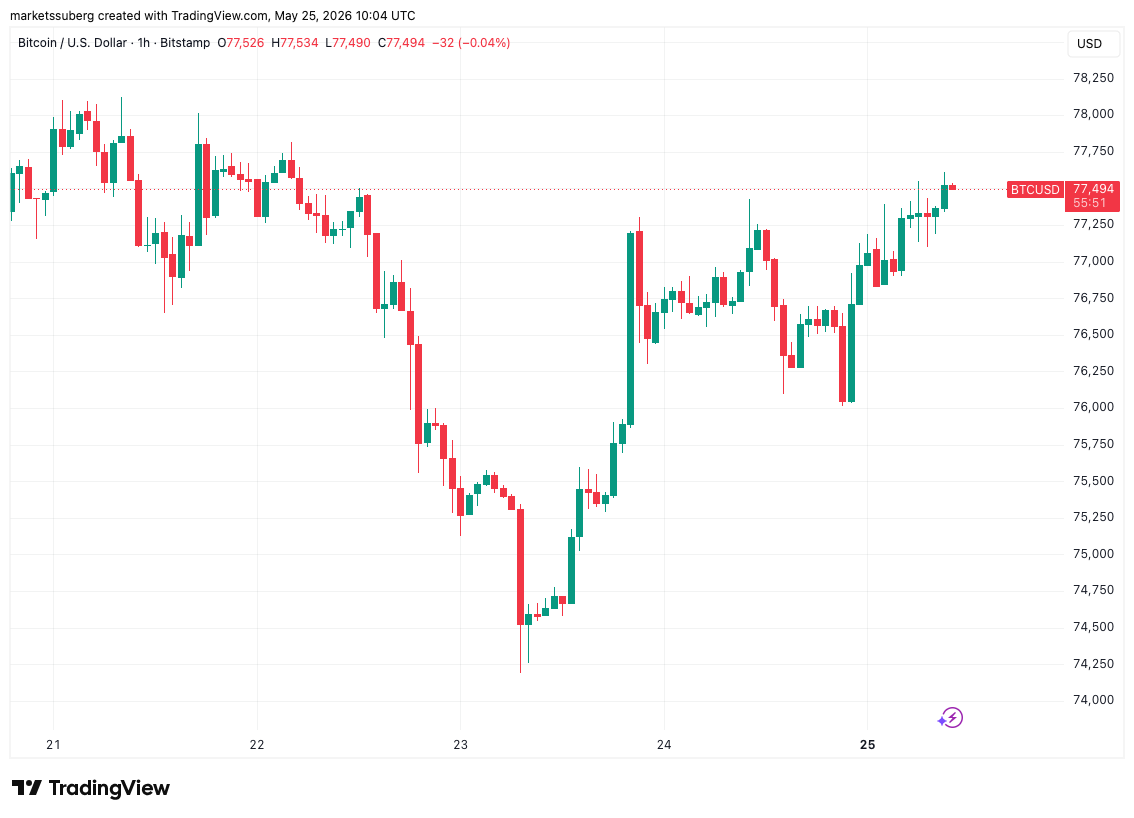
Bitcoin price action struggled over the weekend, dipping below $75,000 to its lowest levels since mid-April, per data from TradingView.
A rebound then brought $77,000 back into focus in line with optimism around a US-Iran peace deal.
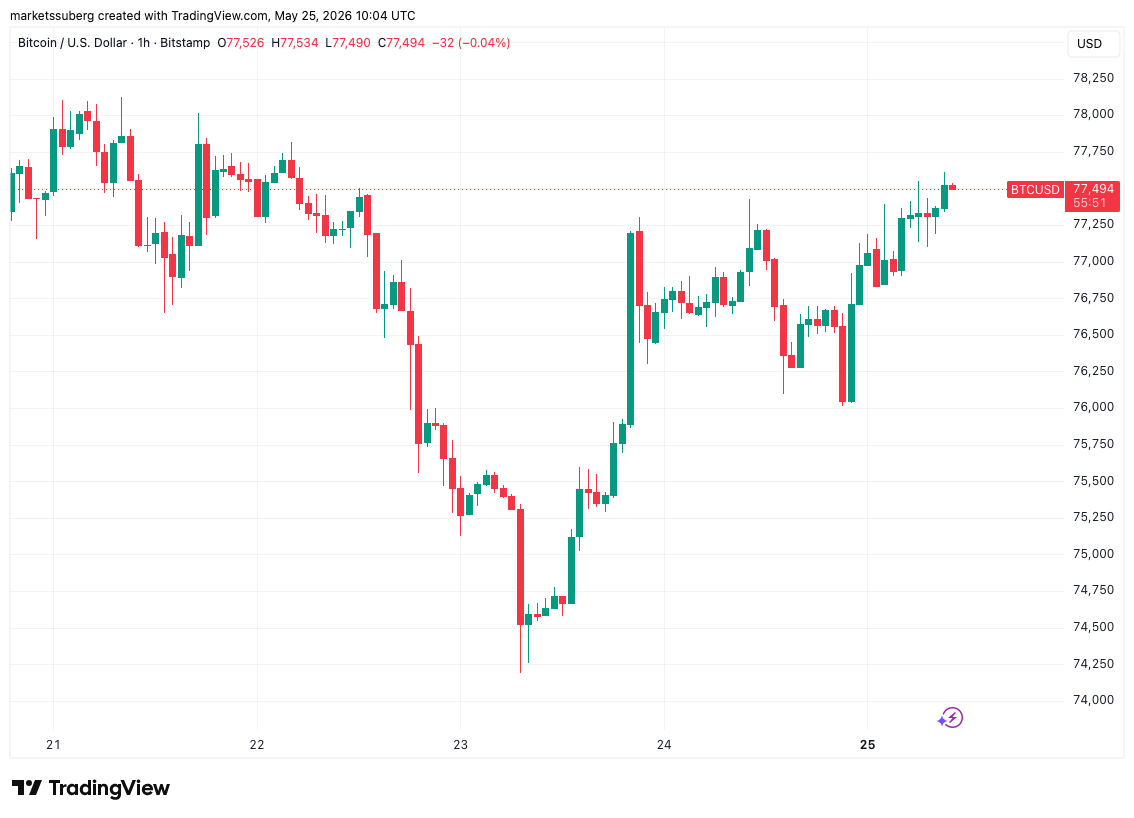
BTC/USD one-hour chart. Source: Cointelegraph/TradingView
In its latest market commentary, X analytics account Cryptic Trades called the dip a “fakeout,” noting its proximity to Bitcoin’s lowest levels of 2025, also seen in April that year.
“We saw a brief deviation below the high-timeframe support range aligning with the April 2025 bottoming formation,” it summarized.
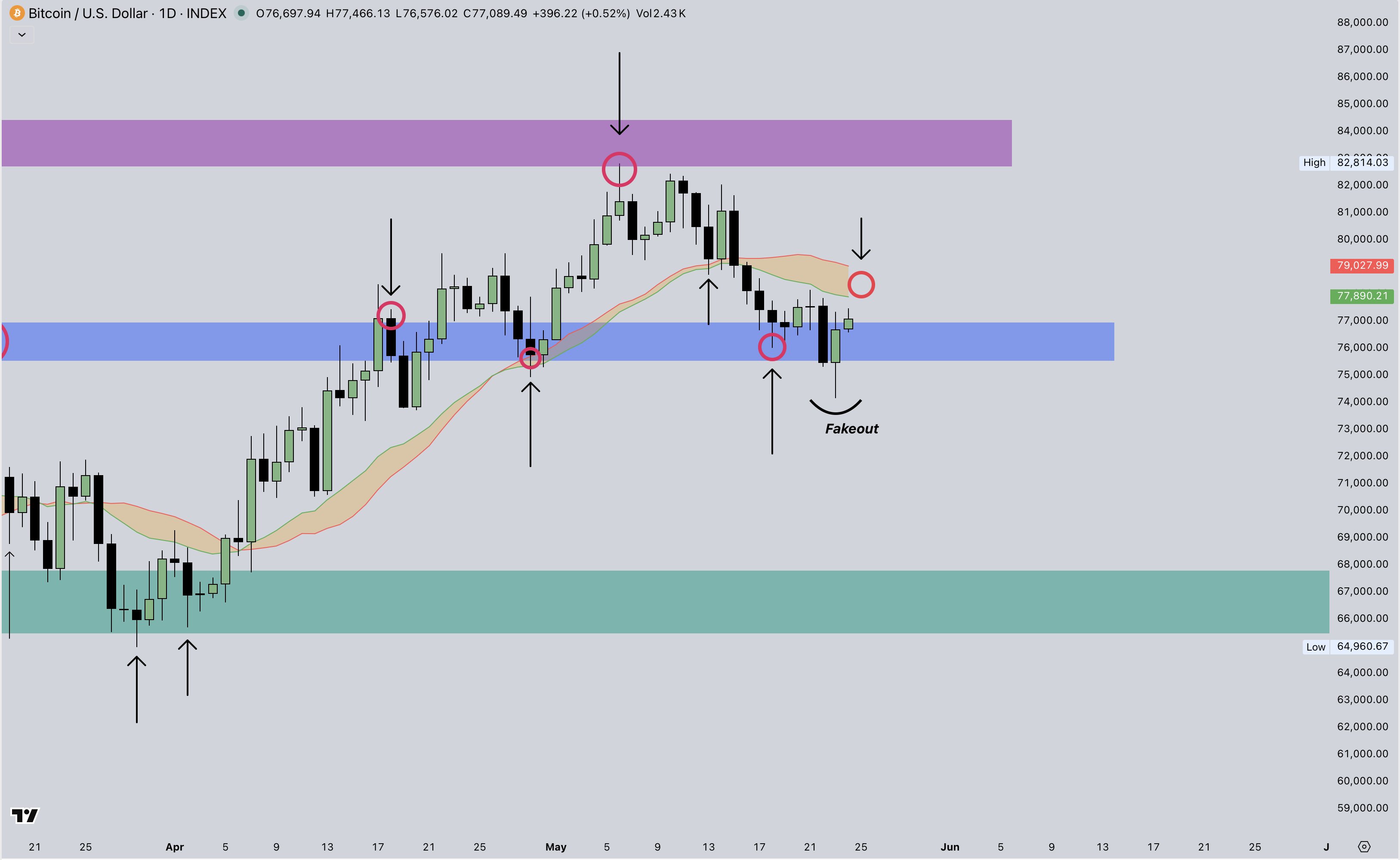
BTC/USD one-day chart. Source: Cryptic Trades/X
Cryptic Trades said that BTC/USD needed to reclaim its daily bull market support band — a “strong reversal zone over the last couple of months” — in order to have a bullish bias on low time frames.
“Bulls need to keep holding this area to keep this short/mid timeframe momentum in their favor,” trader Daan Crypto Trades agreed.
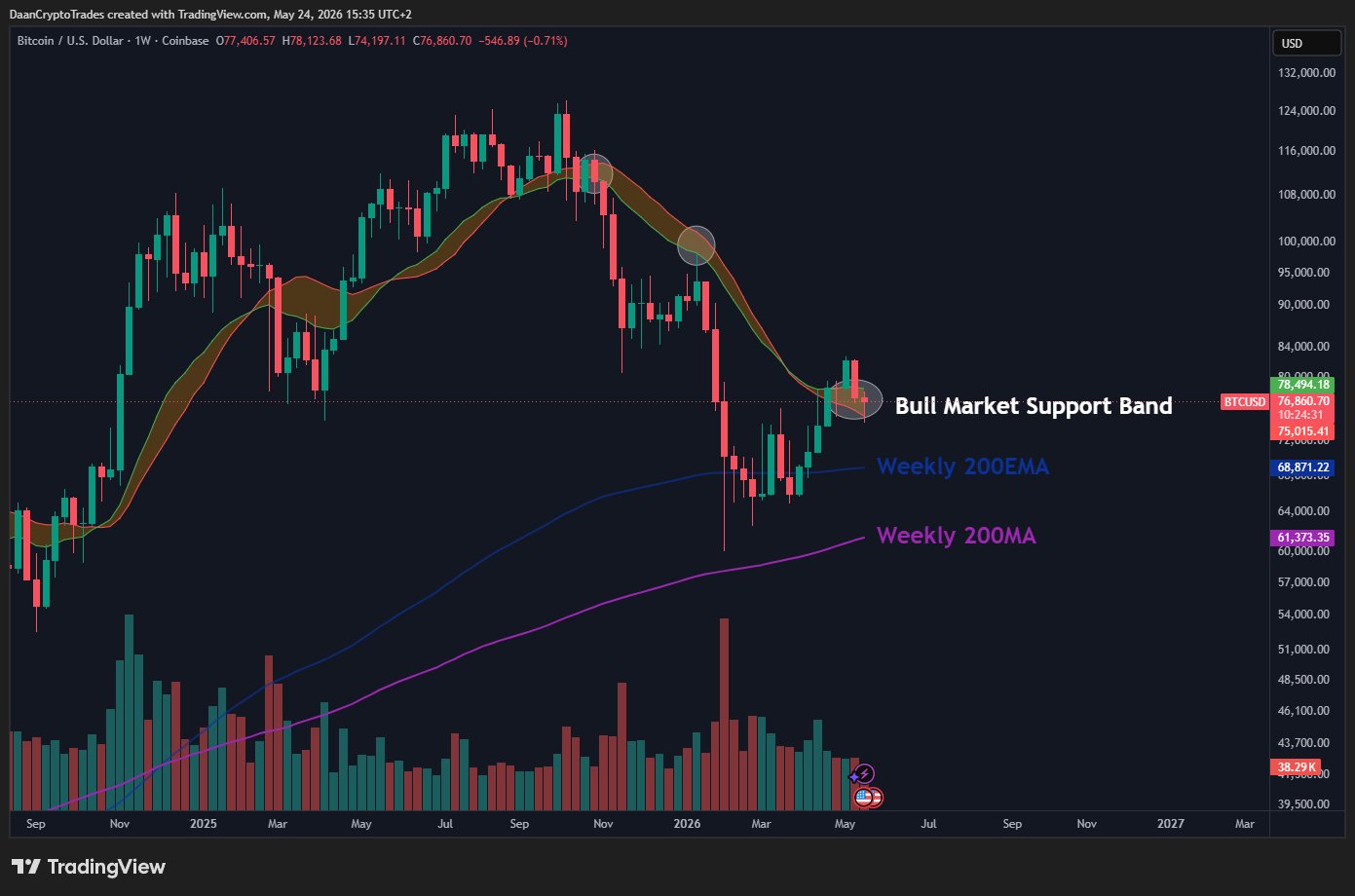
BTC/USD one-week chart. Source: Daan Crypto Trades/X
Trader and analyst Lennaert Snyder referred to Bitcoin’s trip below $75,000 as a “very nice liquidity sweep.”
“Strong daily close after the sweep and price is taking out the previous daily highs,” he told X followers.
“I’m intraday bullish on Bitcoin, and I’m still eyeing that 79/80 level to retest. Would be great if the 74.2K low could get us there, I’ll watch 79/80K closely for quality shorts after my trigger.”
Trader CW also eyed exchange order-book liquidity for clues as to how high the price might go next.
“$BTC has risen to just before the high-leverage short position zone. The upcoming rise will be a liquidation process for short positions,” they predicted.
“There is a significant amount of short position pressure until 80.5k.”
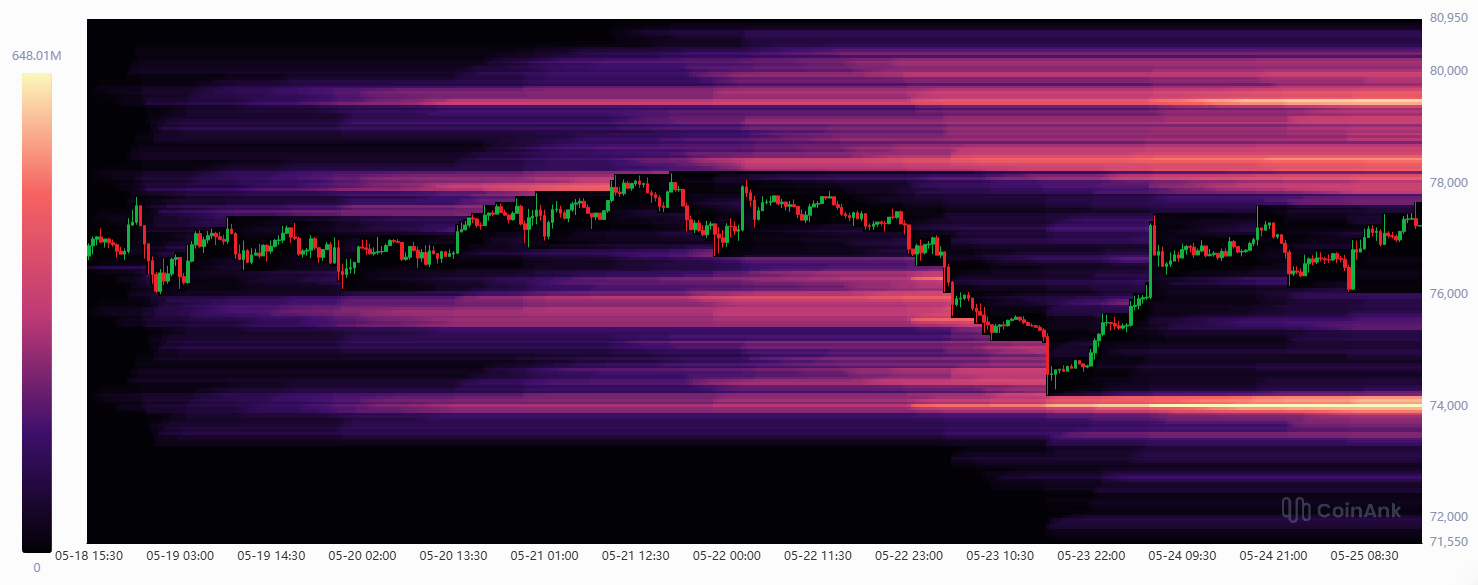
BTC liquidation heatmap. Source: CW/X
Iran peace deal bets send stocks to new highs
There may finally be some good news for risk assets when it comes to the US-Iran war this week.
A peace deal between the two sides seems closer than ever, and markets are already pricing in the end of the conflict.
US stocks futures surged at the weekly open, with both the S&P 500 and Nasdaq 100 hitting new all-time highs. Japan’s stock market gained 3.5%.
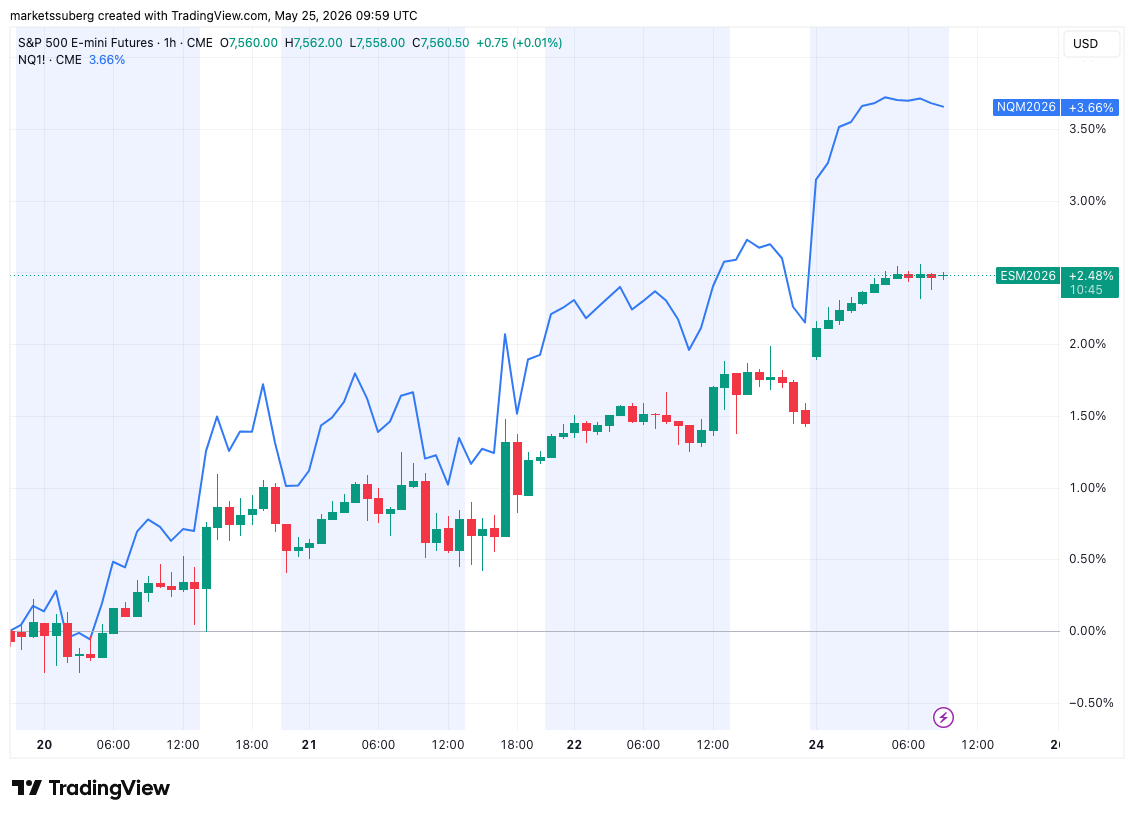
S&P 500 futures vs. Nasdaq 100 futures one-hour chart. Source: Cointelegraph/TradingView
Oil, by contrast, began to fall, with WTI crude nearing $90 per barrel.
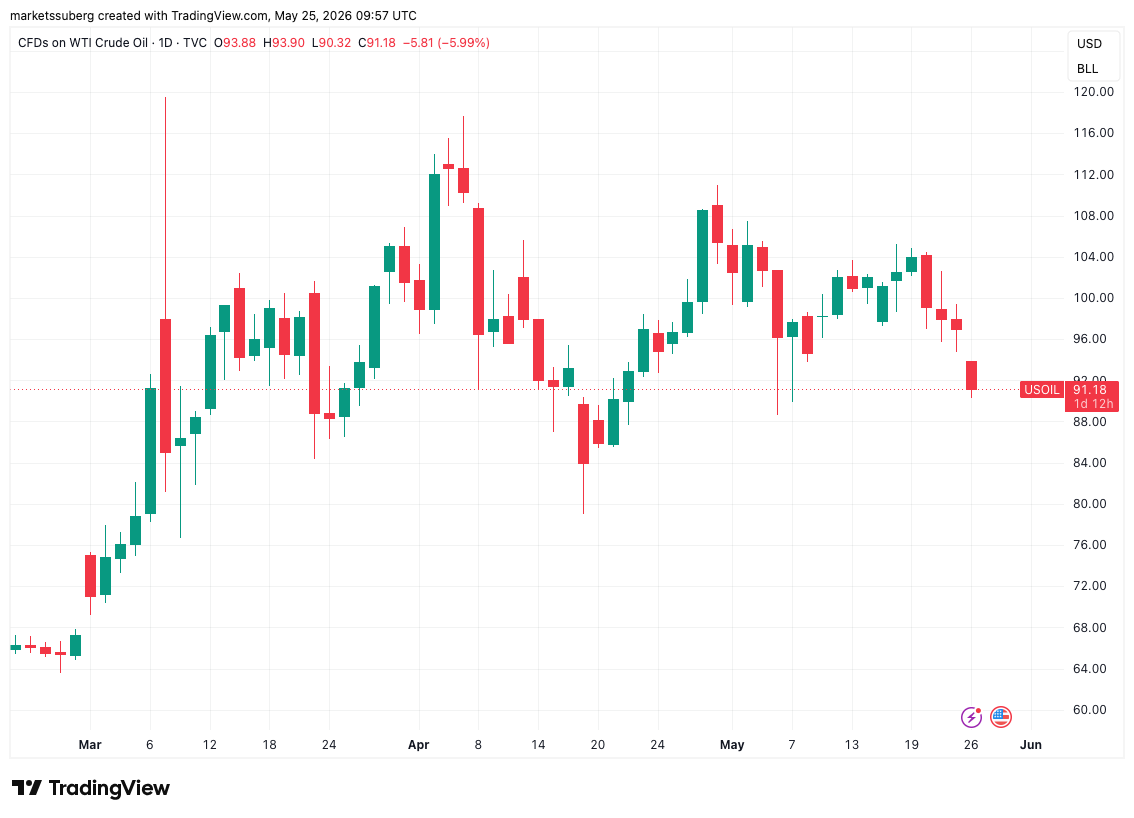
CFDs on WTI crude oil one-day chart. Source: Cointelegraph/TradingView
In a post on Truth Social, US President Donald Trump pledged to make a deal that was “good and proper.”
“Unlike those before me who should have solved this problem many years ago, I don’t make bad deals!” he wrote.
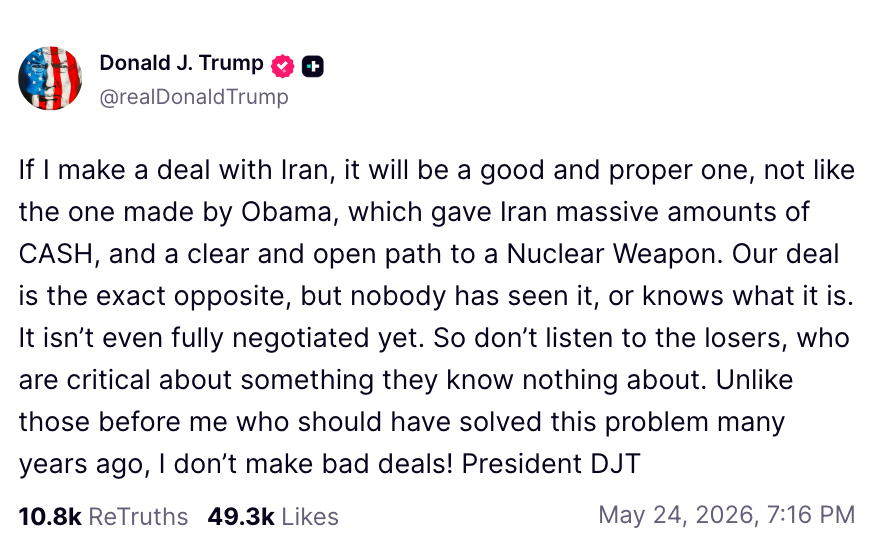
Source: Truth Social
Bitcoin’s response was more muted, continuing a trend from last week where stock market records failed to ignite upward momentum for crypto.
Nonetheless, market participants are already betting on the peace deal acting as the next tailwind.
“I think Bitcoin is ready for higher grounds,” trader and analyst Michaël van de Poppe commented on X.
Van de Poppe saw BTC/USD rising above $80,000 should a deal take effect.
“That is likely the plan,” he concluded, seeing risk assets performing strongly across the board.
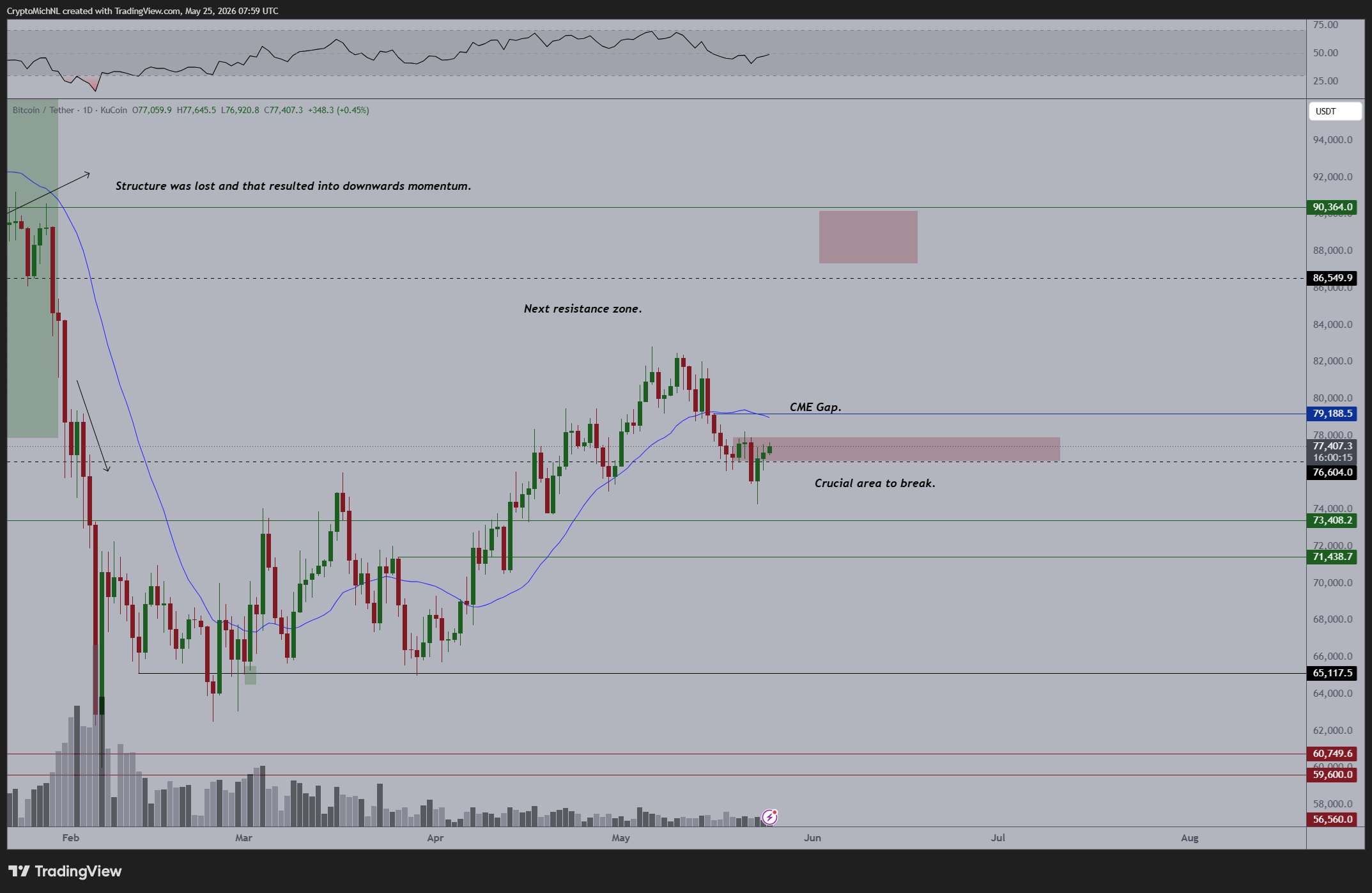
BTC/USDT one-day chart. Source: Michaël van de Poppe/X
Inflation flips Fed hawkish ahead of PCE data
The deal would also mean good news for US inflation trends, which have surged on the back of high oil prices.
This week, however, both markets and the Federal Reserve will have to contend with April’s Personal Consumption Expenditures (PCE) Index print, which will reflect the full impact of the Iran conflict.
PCE, known as the Fed’s “preferred” inflation gauge, will be the first for its new Chair, Kevin Warsh.
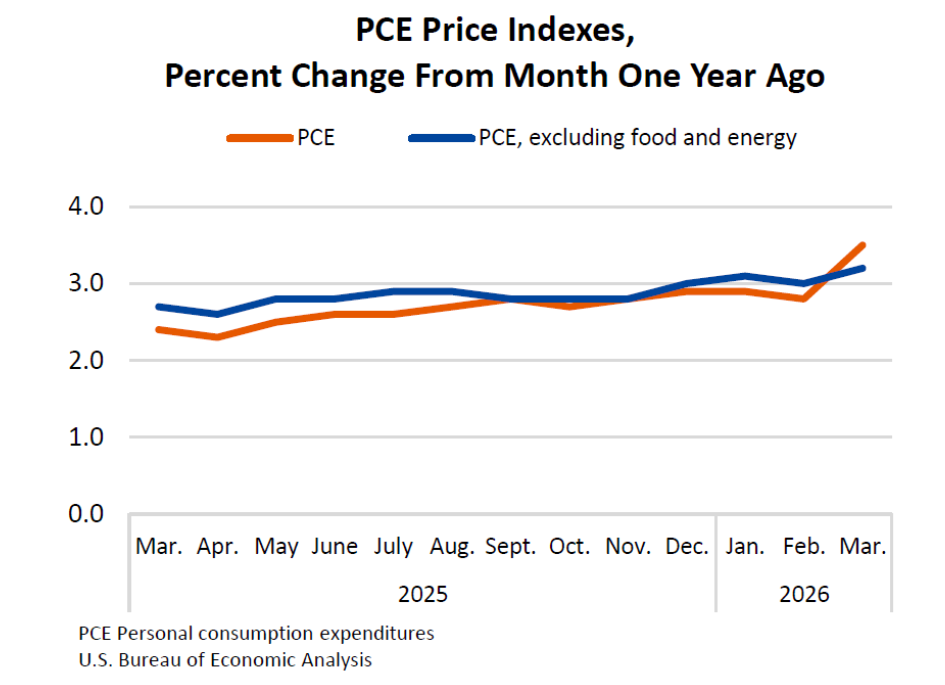
US PCE % change (screenshot). Source: Bureau of Economic Analysis
Expectations remain that policy could tighten to contain inflationary pressures this year. In the latest edition of its regular newsletter, “The Market Mosaic,” trading resource Mosaic Asset Company noted that even Fed officials themselves were changing their tone.
“In a speech last week, Christopher Waller stated that ‘inflation is not moving in the right direction’ and can ‘no longer rule out rate hikes further down the road,’” it reported, referring to a member of the Fed Board of Governors.
“Waller previously was a leading proponent for cutting rates on labor market concerns.”
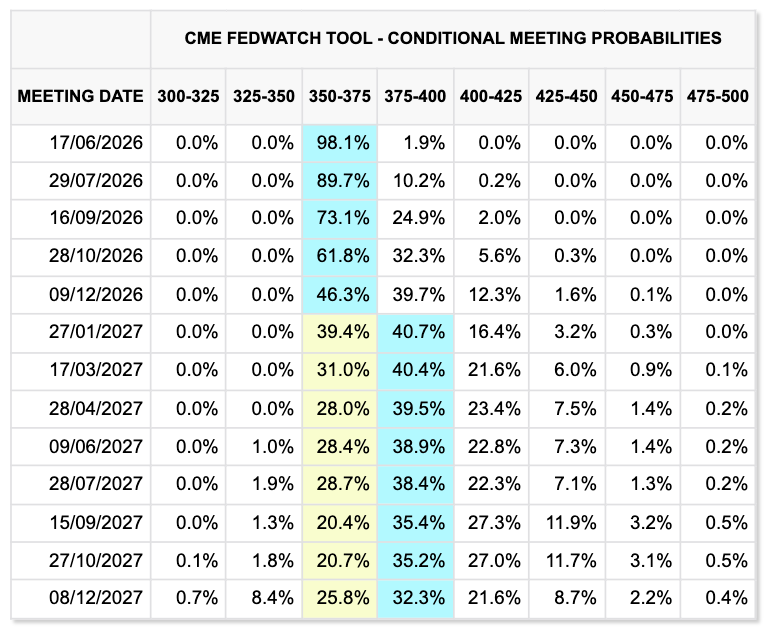
Fed target rate probabilities (screenshot). Source: CME Group
Data from CME Group’s FedWatch Tool likewise underscores the lack of optimism when it comes to interest-rate cuts before 2027.
While that is ostensibly a headwind for crypto, Mosaic acknowledged that Iran-based inflation upticks could be “temporary,” with stocks primed for further gains.
Binance inflow “intensity” causes alarm
Geopolitical uncertainty has led onchain analytics platform CryptoQuant to warn about a Bitcoin “sell signal.”
In one of its QuickTake blog posts on Sunday, contributor Darkfost flagged nearly 10 days of BTC inflows to the largest global exchange, Binance.
“On May 16th, the weekly average of inflows on Binance stood at 378 BTC. It now reaches 1,190 BTC today, representing a more than 3x increase in less than 10 days,” he revealed.
“The largest single day recorded over 3,600 BTC on May 18th, a relatively high level for a single day that clearly illustrates the intensity of the movement.”
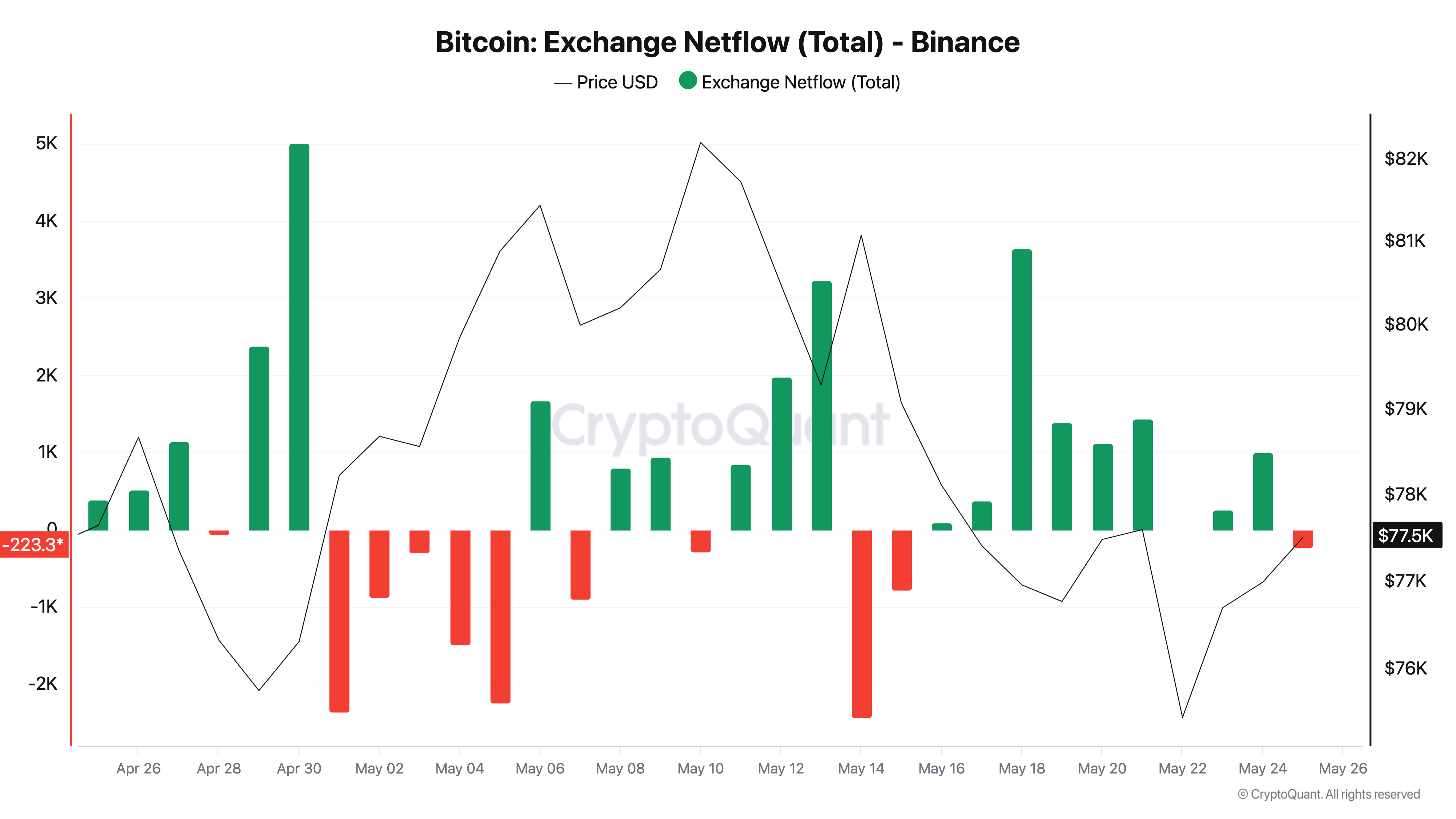
Bitcoin netflows for Binance. Source: CryptoQuant
Darkfost noted that Binance’s Bitcoin reserves had increased by 16,000 BTC in a single month.
“When inflows become dominant and consistent on a platform like Binance, this is traditionally interpreted as a potential sell signal,” he continued.
“Holders transferring their BTC to an exchange most often do so with the intent to sell, whether it be profit taking, reducing exposure, or a more defensive repositioning.”
Last week, Cointelegraph reported on weak US demand causing consistent downside price pressure after the Wall Street open. The Coinbase Premium Index, which measures the difference in price between Coinbase’s BTC/USD and Binance’s BTC/USDT pairs, hit its largest negative values in several months.
Analysis warns of “large liquidation event”
In further bad news for Bitcoin bulls, CryptoQuant contributor XWIN Japan described a cocktail of hurdles that remain unconquered.
Related: Bitcoin price record 90-day uptrend ‘resembles bull market rally:’ New analysis
In addition to the weak demand, institutional capital has been exiting the US spot Bitcoin exchange-traded funds (ETFs).
“US spot Bitcoin ETFs have now seen more than $1.74 billion in cumulative outflows, while the Coinbase Premium has turned deeply negative. Since this metric is often viewed as a proxy for US institutional spot demand, it suggests that large investors are becoming less active buyers,” a QuickTake post read.
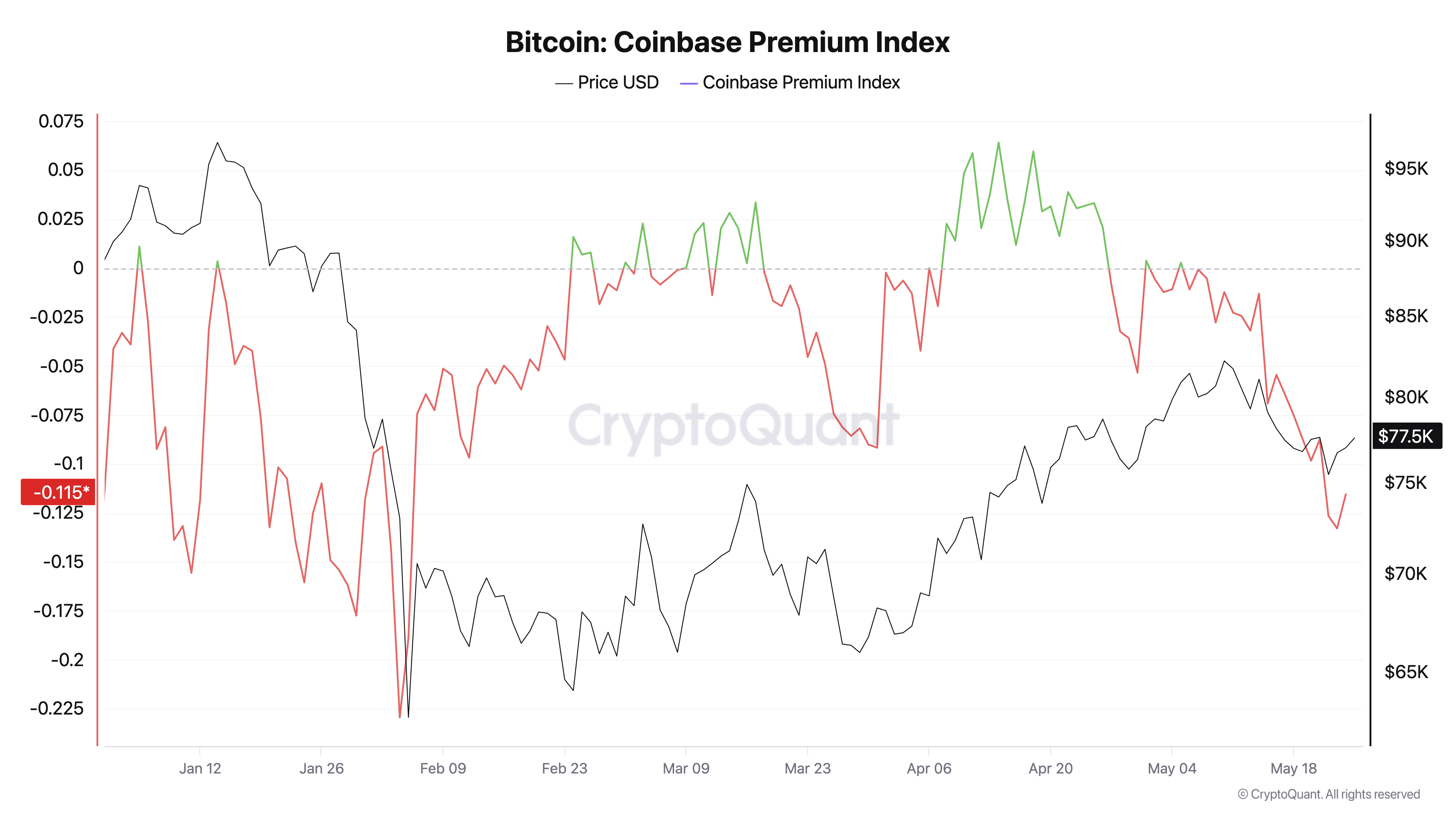
Bitcoin Coinbase Premium Index. Source: CryptoQuant
Binance’s netflows, meanwhile, come as stablecoin volumes decrease — a sign of waning liquidity and reduced risk appetite.
Traders who remain active, by contrast, are “aggressively long,” and positive funding rates imply that leverage is becoming more popular.
“The problem is that Open Interest remains well below late-2025 highs. This suggests the recent rebound is being supported more by leveraged futures activity than by strong spot demand,” XWIN explained.
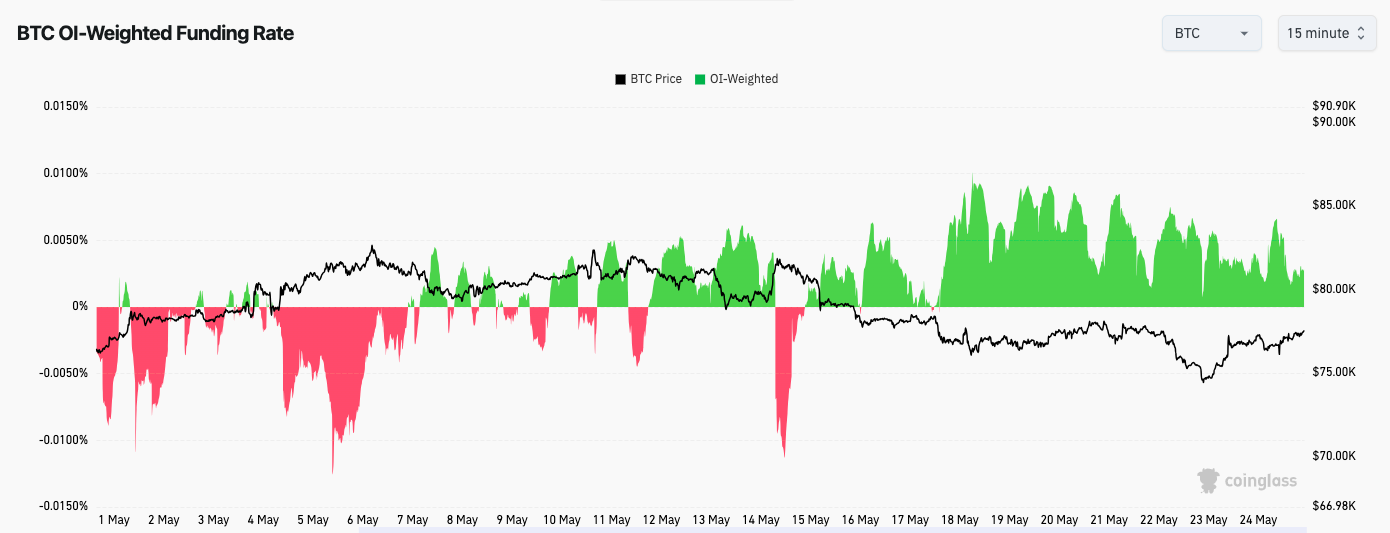
Bitcoin open interest-weighted funding rate (screenshot). Source: CoinGlass
Looking ahead, this combination of factors suggests that the market is due for a shakeout.
“Historically, periods with ETF outflows, negative Coinbase Premium, weak spot demand, and crowded longs have often preceded large liquidation events,” the post concluded.
“For now, Bitcoin looks less like a healthy bull market and more like a fragile rebound driven by leverage rather than real demand.”

The Bitcoin price prediction today shows the asset is trading around $77,400 after a modest +0.9% pump over the past 24 hours. Institutional infrastructure is expanding at its fastest pace in years, yet the spot price is in a technically fragile zone that analysts call “the edge of a cliff.”
Last week, the US Securities and Exchange Commission granted Nasdaq PHLX conditional approval to list European-style, cash-settled BTC index options under the ticker QBTC. These contracts track the CME CF Bitcoin Real-Time Index (BRTT), settle in US dollars, and, crucially, require no separate derivatives account, meaning traders can execute bitcoin volatility bets directly through standard brokerage platforms.
Each contract represents exactly 1 BTC of exposure (versus CME’s 5 BTC minimum), a reduction in size that makes precision hedging accessible to a much wider institutional audience. Bitcoin’s growing presence on Nasdaq-listed vehicles is becoming a pattern, not a novelty.
One catch remains: the Commodity Futures Trading Commission must still grant exemptive relief before QBTC options can actually trade. The SEC approval is real, but the product is not yet live.
Bitcoin Price Prediction: Can BTC USD Recover Above $80,000 Before the CFTC Decision?
The Bitcoin price prediction picture is under genuine pressure. The 50-day EMA has already been breached during recent US trading sessions, shifting near-term momentum firmly to the bears. The 200-day EMA near $76,500 is now the line in the sand; lose that, and the corrective structure deepens considerably.
On the upside, resistance layers stack quickly: the 20-day EMA sits near $78,800, followed by horizontal resistance around $79,600, and last week’s local high near $81,750.
Three scenarios deserve attention.
Bull case: the 200-day EMA holds, ETF inflows accelerate, and CFTC approval timing leaks bullishly, BTC reclaims $79,500–$81,000 within days.
Base case: price consolidates between $76,400 and $78,000 for one to two weeks while the market waits for regulatory clarity on QBTC.
Bear/invalidation: a daily close below $74,000 opens the door to a flush toward the $69,000–$72,000 range, where significant on-chain support clusters.
Discover: The Best Crypto to Diversify Your Portfolio
Bitcoin Hyper Targets Early-Mover Upside as Bitcoin Tests Key Levels

Here’s the uncomfortable reality for spot BTC traders right now: even a clean recovery to $80,000 represents roughly a 5% move from current levels. For risk-adjusted upside, some institutional desks are already looking further down the stack, specifically at Bitcoin-native infrastructure plays that haven’t yet been priced by the broader market.
Bitcoin Hyper ($HYPER) is generating attention as the first Bitcoin Layer 2 to integrate the Solana Virtual Machine (SVM), a combination that, in theory, delivers sub-second finality and programmable smart contract execution while inheriting Bitcoin’s base-layer security.
The project has raised $32.7M at a current presale price of $0.0136806, with staking already live. The structural thesis is straightforward: as Nasdaq-level products bring institutional capital into the BTC ecosystem, demand for faster, cheaper, programmable Bitcoin infrastructure logically follows.
Bitcoin’s historical bear market patterns also suggest that infrastructure built during consolidation phases tends to capture a disproportionate share of the upside in the next expansion. Those who want to explore the project further can learn more about Bitcoin Hyper here.
Discover: The Best Token Presales
This article is for informational purposes only and does not constitute financial advice. Cryptocurrency investments are highly volatile. Always do your own research.
The post Bitcoin Price Prediction: BTC Options Coming to Nasdaq appeared first on Cryptonews.
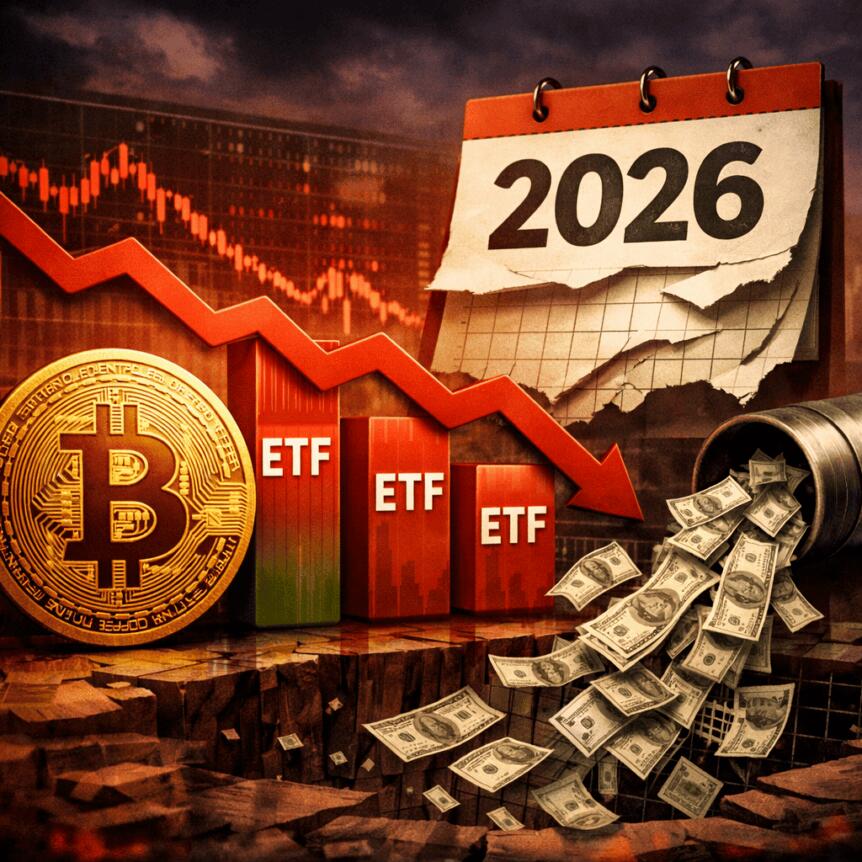
The US market for spot Bitcoin ETFs continues to wobble as Friday produced six straight days of outflows across the sector, even as year-to-date inflows remain in positive territory. Net inflows into US spot Bitcoin ETFs have cooled to roughly $536 million in 2026, with a Friday session that shaved another $105.2 million from fund totals. The bulk of 2026 demand remains focused on the iShares Bitcoin Trust (IBIT), which posted prominent net inflows of about $2.7 billion so far this year, while other funds saw red ink amid a crowded, fee-sensitive landscape.
On Friday, IBIT led the retreat, losing about $68.9 million, while the Fidelity Wise Origin Bitcoin Fund (FBTC) posted outflows of roughly $36.3 million. In aggregate, the broader group recorded $105.2 million in net withdrawals, contributing to a running total of about $1.55 billion in net outflows since May 14—the last date when any US spot Bitcoin ETF registered a net inflow. Data provider Farside Investors tracks flows across the U.S. spot Bitcoin ETF lineup, illustrating how investor demand has coalesced around a single large product while other funds struggle to keep pace.
Despite the churn, IBIT’s dominance remains intact for the moment. The fund’s cumulative inflows for 2026 are a major driver of the mainstream ETF appetite for Bitcoin exposure, underscoring how institutional demand has persisted even as competition intensifies and fee structures come into sharper focus. The latest numbers place IBIT in a different league from its peers, reinforcing a pattern from recent years where one vehicle captures the lion’s share of inflows even as others wander in and out of net flow territory.
Key takeaways
- IBIT continues to be the primary beneficiary of 2026 inflows, with about $2.7 billion in net inflows year to date, dwarfing other ETF activity.
- Morgan Stanley’s MSBT has emerged as a notable new entrant, attracting $264 million in net inflows since its April 8 launch and surpassing the early products from Invesco and WisdomTree.
- The broader US spot Bitcoin ETF landscape remains in net inflow territory for 2026, but the pace of inflows is uneven, with a heavy tilt toward IBIT and mixed results elsewhere.
- In a sign of shifting risk and pricing dynamics, several institutions trimmed exposure: Jane Street reduced its Bitcoin ETF holdings by roughly 70% in Q1, and Goldman Sachs cut its position by about 10%.
- Interest in altcoin or Ether-focused ETFs has lagged relative to Bitcoin products, as Ether ETFs show net outflows and newer offerings have not attracted the same demand.
Growing competition shapes the Bitcoin ETF landscape
The launch of the Morgan Stanley Bitcoin Trust ETF (MSBT) on April 8 marks a significant milestone in the US Bitcoin ETF race. MSBT has drawn $264 million in net inflows to date, positioning it ahead of rival launches from Invesco and WisdomTree, which entered the market in January 2024. The early momentum for MSBT is widely interpreted as a sign that investors are price-conscious and looking for an ultra-low-fee option in a crowded field; the fund is notable for a market-low fee of 0.14% per year.
Industry observers also took note of the broader competitive dynamics. Bloomberg ETF analyst James Seyffart suggested that the decision by Yorkville America—the sponsor behind the Truth Social-linked Bitcoin ETF plan—to pull multiple crypto ETFs could reflect the intense competition in this space. The 0.14% MSBT fee is a particularly compelling draw in a market where expense ratios have long been a swing factor for investors weighing Bitcoin exposure versus other risk assets. Earlier reporting from Cointelegraph highlighted MSBT’s low-fee approach as a potential differentiator against established incumbents.
Albeit the MSBT development has been positive for Morgan Stanley, the rest of the sector remains mixed. Data show that while the US spot Bitcoin ETF market as a whole remains in positive inflows for 2026, most of that positive momentum has rested with IBIT. In contrast, several other funds have retraced in 2026, and the pace of new capital into the space is not yet on track to replicate the massive inflows seen in 2025, when a single product drew about $25 billion in net new money for that year. That comparison underscores the persistent, yet uneven, demand for regulated Bitcoin access among institutional players.
Performance snapshot for related products
Alongside Bitcoin-focused products, the ether ETF ecosystem has faced headwinds this year, with US-listed spot Ether ETFs registering net outflows so far in 2026. In contrast, new altcoin ETFs have not demonstrated the same appetite from investors, underscoring a preference for established Bitcoin exposure amid ongoing regulatory and market uncertainty. The shift also highlights how issuers and fund sponsors must navigate an evolving regulatory environment and competition when structuring futures or physically-backed vehicles.
Beyond the flows and fund performance, the sector’s sentiment has been shaped by notable strategic moves from Wall Street banks. In Q1, Jane Street reduced its Bitcoin ETF holdings by approximately 70%, a telling sign that even major market makers are rebalancing exposure in a climate of thin liquidity and shifting risk appetite. Goldman Sachs—another heavyweight in the ETF space—trimmed its Bitcoin ETF position by roughly 10% in the same period, signaling a broader recalibration of Bitcoin allocation among traditional banks’ investment desks. Earlier coverage from Cointelegraph noted Goldman’s reduced exposure to crypto-focused ETFs in the first quarter of 2026, reflecting a cautious stance amid regulatory and macro headwinds.
On the regulatory and market-facing side, there was chatter about the potential launch of a Truth Social-backed Bitcoin product before Yorkville America withdrew multiple crypto ETF bids for the social platform. The episode has been read by analysts as evidence of the highly competitive and rapidly evolving environment for crypto asset investment products, where timing, pricing, and sponsor strength all play a role in whether a fund can attract sustainable capital.
Flows compiled by Farside Investors show a clear concentration of investment interest in a single, well-known conduit for Bitcoin exposure. The data also illustrate how institutional demand often follows the path of least resistance—where size, liquidity, and a favorable fee structure align—rather than dispersing evenly across the entire ETF family.
What this means for investors is nuanced. The ongoing inflow strength of IBIT signals that large institutions remain willing to allocate capital to regulated, cash-settled Bitcoin exposure, especially when the structure includes a trusted sponsor and transparent fee economics. At the same time, the emergence of MSBT and the strong early momentum it has shown indicate that new entrants can capture meaningful shares if they can offer a compelling price point and a clean regulatory narrative. As the market moves forward, observers will watch whether MSBT and other entrants can sustain inflows in a year that is already notable for macro volatility and regulatory scrutiny.
For readers looking ahead, the central questions are where net flows will land in the coming quarters, how much demand will accrue to the largest fund IBIT versus newer entrants, and whether altcoin-focused ETF offerings will begin to close the gap with Bitcoin products. The next few monthly data cycles will be telling as investors digest evolving fee structures, sponsor credibility, and the broader macro backdrop that has driven crypto allocations in recent years.
In the meantime, the landscape remains a study in how institutional appetite for regulated crypto exposure coexists with competitive pressure and shifting sponsor strategies. The market is watching not just the totals, but the composition of inflows across products, as well as the actions of major market makers and banks that help determine liquidity and price discovery in this still-nascent segment of traditional finance.
Looking ahead, investors should monitor whether MSBT and other competitive launches can sustain momentum, whether IBIT maintains its leadership in inflows, and how regulatory developments may influence fund flows and product approvals. The story of 2026’s US spot Bitcoin ETF market is still being written, with the balance of power likely to shift as new entrants refine their offerings and institutions reassess their exposure to regulated crypto investments.

XRP price is flashing warning signs as exchange’s liquidity index for XRP dropped to its lowest level since 2020. This is a structural shift that could bring volatility.
The liquidity drop on Binance coincides with the drop in XRP spot volume following the market bloodbath. XRP price itself is down to $1.35, or 2% drop this week.
The combination of thin liquidity and a high-stakes ETF narrative creates a textbook setup for outsized moves. Here’s where the technicals actually stand.
Discover: The Best Crypto to Diversify Your Portfolio
Can XRP Price Reclaim $3.65 ATH or Is a Deeper Pullback Coming?
XRP price is consolidating below its recent high above $1.50 as it is barely holding the upper band of its weekly range. Support clusters around $1.31, the lower boundary of the seven-day trading band.
Momentum is mixed. The 0.5% drop daily is walking side to side with its futures activity and exchange-level stagnation. These have been flagged as compounding factors in recent weeks, and the Binance data confirms the pattern is deepening and far from resolving.

Three scenarios frame the near-term outlook.
Bull case: ETF approval speculation intensifies, and XRP retests $1.50, with DeepSeek’s AI model targets $5 by late 2025 if institutional adoption accelerates.
Base case: Consolidation continues in the $1.30-$1.40 range as the market waits for a formal catalyst like the Clarity Act.
Bear case: Liquidity deterioration accelerates, spreads widen further, and a flush toward $1.31 support becomes the path of least resistance.
The ETF flow dynamic remains the primary variable to watch heading into Q3.
Discover: The Best Token Presales
LiquidChain Targets Early-Mover Upside as XRP Tests Key Liquidity Levels
XRP’s low liquidity underscores a structural problem that extends beyond a single asset. Fragmented liquidity across chains creates the exact spreads and execution failures currently distorting XRP’s price feeds. For traders watching that dynamic, the infrastructure layer becomes the investment thesis.
LiquidChain ($LIQUID) is a Layer 3 infrastructure project built specifically to solve this. Its Unified Liquidity Layer fuses Bitcoin, Ethereum, and Solana liquidity into a single execution environment.
What happens when three great chains are meticulously unified? — LiquidChain (@getliquidchain) May 25, 2026
The LiquidChain L3.  ⟁https://t.co/vqvBcdSQYC pic.twitter.com/I6itOtiDP4
With Liquid, developers deploy once and access all three ecosystems simultaneously. Its Single-Step Execution and Verifiable Settlement are core architectural features, eliminating the multi-hop bridging that fragments liquidity in the first place.
The presale has breached $800K amount raised milestone at a current price of $0.01463 per $LIQUID. Capital rotation into on-chain infrastructure has been accelerating as the $1M milestone approaches.
Research LiquidChain here before the next price tier opens.
The post XRP Price Outlook: Exchange’s Liquidity Lowest Since 2020 appeared first on Cryptonews.
Crypto World
Ethereum Price Prediction: Vitalik Streamlines Operations to Curb Ethereum Foundation Selling

In a candid Twitter post, Vitalik Buterin remarks on the Ethereum Foundation’s future direction with a structural reset that could change ETH’s long-term dynamics. This has brought the Ethereum price prediction into bullish territory.
Buterin published a lengthy personal statement outlining his vision for a leaner, more principled Ethereum Foundation, explicitly acknowledging that his own influence within the organization will continue to diminish, a transition he “personally welcomes.”
Crucially, the post signals reduced selling pressure from the Foundation going forward as operational streamlining takes hold. Vitalik framed the EF’s evolution through a sharp analogy, saying that Google once carried idealistic founding principles before commercial pressures eroded them.
Buterin’s message was blunt, and Ethereum must not repeat that mistake.
Discover: The Best Crypto to Diversify Your Portfolio
Ethereum Price Prediction: Can ETH Break Downtrend as Foundation Selling Pressure Eases?
ETH is still in the $2,100 handle this week, a weekly support after a brutal downtrend from $2,500. The stable daily candle this week came with visible accumulation signals that show slow positioning.
Currently, we are seeing an inverse head-and-shoulders pattern on the daily chart, with the neckline sitting near $2,150. If ETH breaks decisively above it, this pattern projects a measured target of around $2,600.
For ETH, it needs to at least hold above $2,150 on a weekly close. If the pattern confirms, momentum could carry it toward $2,400 first, then back above $2,500.

But the most likely scenario would likely see a Consolidation between $2,100-$2,200 through mid-year as macro conditions remain mixed, with $2,400 target acting as near-term resistance.
ETH’s ETF dynamics have added another layer to the structural demand picture, with institutional flows increasingly cited as a non-trivial price driver heading into the second half of 2025.
Discover: The Best Token Presales
Bitcoin Hyper Offers Early Mover Upside as ETH Stuck in $2,000 range
ETH is compelling, but the ceiling on a $250 billion asset is structurally different from what’s possible at the seed stage. Traders who’ve already captured the ETH move are quietly rotating into earlier-stage infrastructure plays where the asymmetry is sharper. That’s where Bitcoin Hyper ($HYPER) enters the picture.
Bitcoin Hyper is positioning itself as the first-ever Bitcoin Layer 2 with full Solana Virtual Machine (SVM) integration. It delivers sub-second finality and low-cost smart contract execution directly on top of Bitcoin’s security layer.
The pitch: Bitcoin’s trust, Solana’s speed, none of the trade-offs.
The presale has raised $32.7 million at a current price of $0.0136, with staking already live and generating high APY for early participants. A decentralized canonical bridge handles native BTC transfers, preserving the trustless architecture that Bitcoin holders actually care about.
Research Bitcoin Hyper before the next price tier.
The post Ethereum Price Prediction: Vitalik Streamlines Operations to Curb Ethereum Foundation Selling appeared first on Cryptonews.
Crypto World
Robotics Revolution: How Three Stocks Are Capitalizing on the $200B Humanoid Robot Boom

Key Takeaways
- Barclays projects the humanoid robotics sector will surge from approximately $2–3 billion currently to $200 billion by 2035
- Manufacturing costs per humanoid unit have plummeted from $3 million ten years ago to roughly $100,000 today
- AeroVironment delivered 143% revenue expansion to $408 million with a funded backlog exceeding $1.1 billion
- Rockwell Automation achieved 12% sales increase and 36% operating earnings growth in fiscal Q1 2026
- Symbotic reached profitability with $630 million in quarterly revenue, marking 29% annual growth
The humanoid robotics sector is experiencing explosive expansion, with several publicly-traded companies already capturing substantial market share. The financial data paints a compelling picture.
A recent Barclays analysis forecasts the humanoid robot industry will balloon to $200 billion by 2035. Current market valuation sits between $2 billion and $3 billion. While this represents massive growth, the underlying fundamentals support these projections.
Manufacturing expenses for humanoid robots have experienced a dramatic decline, falling from approximately $3 million per unit ten years ago to roughly $100,000 currently. Chinese producers have driven prices even lower through mass production capabilities and vertically integrated manufacturing ecosystems.
Deployment rates are climbing rapidly. Approximately 2,000 units entered service during 2024. This figure jumped to 15,000 throughout 2025, with forecasts indicating 60,000 installations in 2026. China dominates with roughly 85% of worldwide deployments, supported by significant government initiatives.
Barclays characterizes humanoid robots as the evolution beyond traditional industrial machinery and digital AI systems. Unlike previous generation robots engineered for narrow applications, humanoids function effectively in human-designed environments, utilizing standard tools and facilities without requiring extensive infrastructure modifications.
Market drivers include demographic aging trends, workforce availability constraints, and increasing challenges recruiting workers for physically intensive roles across manufacturing, distribution, healthcare, and elderly care sectors.
The research highlights three core technology pillars enabling humanoids: brains, encompassing artificial intelligence algorithms and sensor arrays; brawn, representing actuators and physical mechanics; and battery systems providing operational power.
Public Companies Showing Strong Performance Metrics
Beyond long-range forecasts, several corporations are delivering impressive financial performance right now.
AeroVironment, specializing in military drones and autonomous aerial systems, announced fiscal third quarter revenue reaching $408 million. This represented a remarkable 143% year-over-year increase. The company maintains a funded backlog totaling $1.1 billion, with management projecting fiscal 2026 revenue between $1.85 billion and $1.95 billion.
Rockwell Automation, a major industrial automation provider, recorded sales of $2.105 billion during fiscal Q1 2026, representing 12% year-over-year growth. Total segment operating earnings climbed 36% during the identical timeframe. Annual recurring revenue expanded 7%.
Symbotic, concentrating on warehouse automation and intelligent supply chain technologies, disclosed $630 million in fiscal Q1 2026 revenue, reflecting 29% year-over-year advancement. The organization achieved profitability, recording net income of $13 million versus a $17 million net loss in the prior year period. Second quarter revenue guidance targets $650 million to $670 million.
Investment Implications and Market Outlook
Financial markets are increasingly prioritizing concrete performance over speculative potential in robotics companies. Emphasis has transitioned toward quantifiable metrics: revenue expansion, margin enhancement, and robust order pipelines.
Barclays estimates the comprehensive physical AI ecosystem, incorporating autonomous transportation, unmanned aerial vehicles, and sophisticated robotics platforms, could achieve valuations approaching $1 trillion by 2035.
Investment strategies span humanoid manufacturers, component providers, and specialized robotics exchange-traded funds.
The three enterprises examined represent distinct robotics segments, spanning defense unmanned systems to industrial automation to warehouse optimization. Each company reported recent quarterly financials demonstrating sustained expansion with forward guidance signaling continued momentum.

Tether Plans Georgian Lari Stablecoin in Sovereign Currency Partnership
Jamie-Lynn Sigler reveals the story she regrets telling about James Gandolfini on “The Tonight Show”

Older Women Have Stopped Caring About These 6 Things


-

 Crypto World4 days ago
Blockchain.com files with SEC for U.S. IPO
-

 Fashion3 days ago
Holiday Weekend Open Thread – Corporette.com
-

 Crypto World3 days ago
Bitcoin Accumulation Weakens as BTC Realized Losses Hit $600M
-

 Business3 days ago
Dell Technologies DELL Stock Surges 15% on AI Server Momentum and Analyst Upgrades in 2026
-

 Crypto World3 days ago
Space X IPO Is ‘Bad News’ for Tech Stocks: But What About Bitcoin?
-

 Politics3 days ago
Makerfield: a tale of two social-media histories
-

 Crypto World2 days ago
Robinhood crypto COO Tanya Denisova exits
-

 Crypto World3 days ago
MicroStrategy’s Saylor Says Miners No Longer Set Bitcoin Price, Another Force Has Taken Over
-

 Business18 hours ago
NYT Strands Answers May 24 2026 Revealed for Puzzle No. 812 Theme Summer Essentials
-
 Tech3 days ago
A 0.12% parameter add-on gives AI agents the working memory RAG can’t
-

 Crypto World3 days ago
AI infrastructure race heats up as IREN pitches full-stack strategy, WhiteFiber lands $160M deal
-

 Tech4 days ago
WhatsApp ads could make Irish debut after discussions with DPC
-

 Tech3 days ago
You Can Now Add ChatGPT To PowerPoint
-

 Business3 days ago
Trump Invests $1M-$5M in Kura Sushi USA Chain With 27 California Locations
-
Crypto World7 days ago
Revolut Launches Dogecoin Debit Card Across UK and EU
-
 NewsBeat4 days ago
Charity run by Reform leader Malcolm Offord accused of ‘law breaking’ over Scottish registration
-

 Sports3 days ago
2026 CJ Cup Byron Nelson leaderboard: Brooks Koepka finds putting stroke in Round 1
-

 Crypto World3 days ago
Trump Media’s Bitcoin Stash Shrinks Again as 2,650 BTC Lands on Crypto.com
-
Business3 days ago
Goldman Sachs reinstates Ageas stock coverage with neutral rating
-

 Crypto World5 days ago
Exa Labs raises $250 million in funding led by a16z
You must be logged in to post a comment Login