

Crypto World
Bitcoin Mining Stocks Rally as AI Infrastructure Boom Accelerates

Several Bitcoin mining stocks rallied Tuesday, reflecting a broader equity surge driven by optimism around artificial intelligence productivity gains as more miners pivot toward AI and high-performance computing workloads.
In addition to TeraWulf (WULF), which rallied by as much as 17% on news of a Kentucky data center acquisition site, Hut 8 (HUT), IREN (IREN) and Riot Platforms (RIOT) closed more than 5% higher on the day.
The rally underscores growing investor enthusiasm for Bitcoin miners that are repurposing parts of their energy infrastructure and data center capacity to support AI and high-performance computing applications — businesses viewed as potentially more stable and lucrative than crypto mining alone.
The gains came as the S&P 500 index hit fresh record highs above 7,500, led by a sharp rally in information technology and semiconductor stocks.
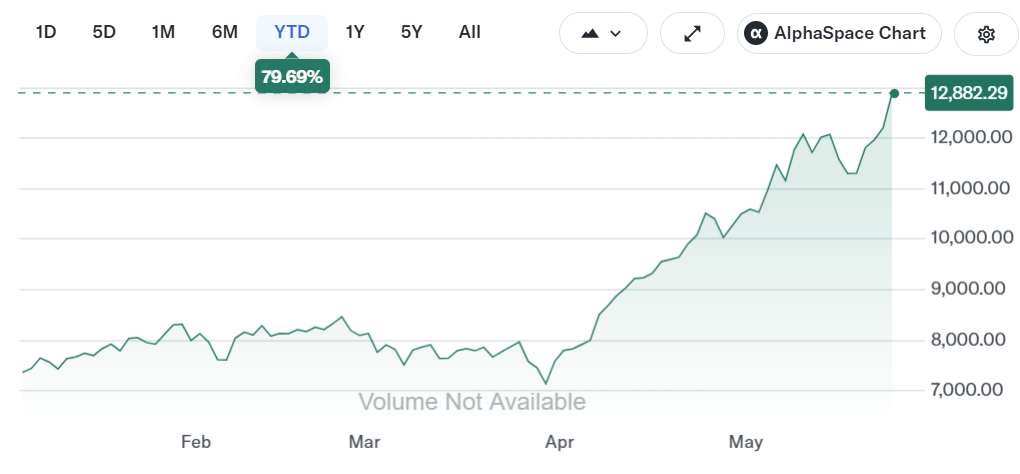
The Philadelphia Semiconductor Index, which tracks the performance of major US chipmakers and semiconductor companies, surged 5.6% on Tuesday and is now up nearly 77% this year.
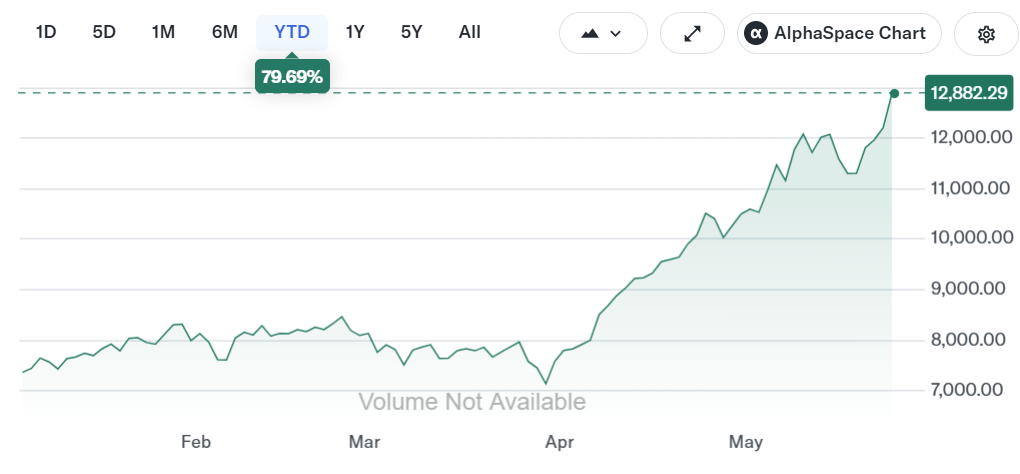
Year-to-date returns for the Philadelphia Semiconductor Index (SOX).
Source: Yahoo Finance
The semiconductor boom has also boosted sentiment around Bitcoin miners expanding into AI infrastructure, given their access to large-scale power capacity and data center operations needed to support high-performance computing.
Related: The real ‘supercycle’ isn’t crypto, it’s AI infrastructure: Analyst
Bitcoin miners emerge as AI infrastructure players
The link between Bitcoin miners and the AI infrastructure buildout is becoming increasingly pronounced as miners leverage their large-scale power access and data center expertise to support high-performance computing workloads.
Recent research from Bernstein found that 11 publicly traded Bitcoin miners control a current and projected power portfolio of roughly 27 gigawatts — a resource analysts believe could become critical as demand for AI data centers accelerates.
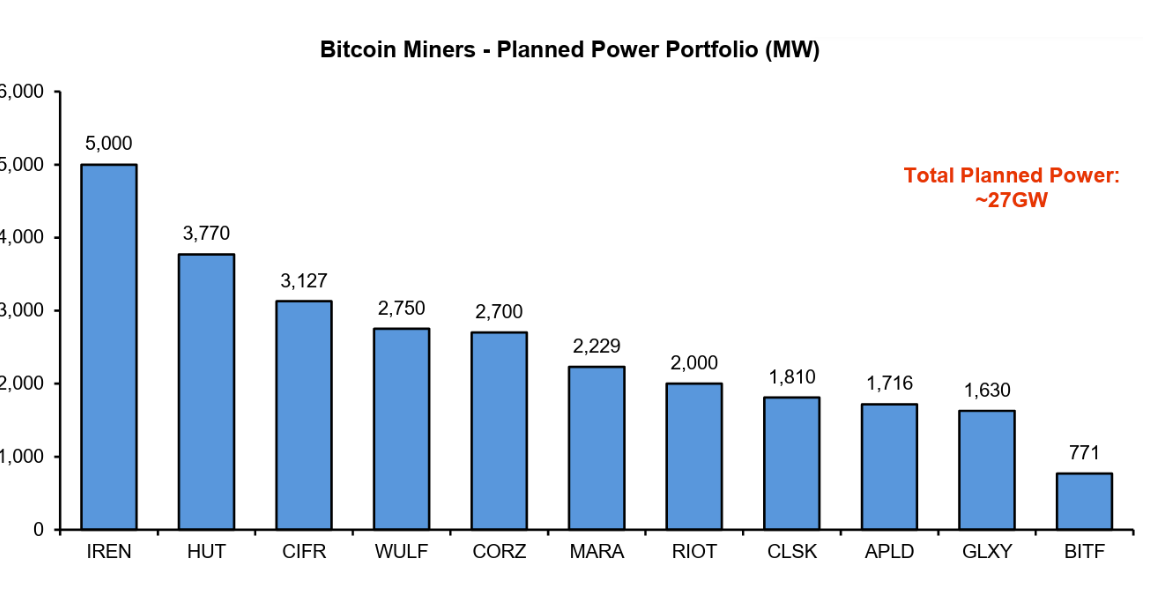
11 public Bitcoin miners have a planned power portfolio of roughly 27 gigawatts. Source: Bernstein
The report posited that access to reliable electricity, rather than semiconductors alone, is emerging as the primary bottleneck for scaling AI infrastructure. That dynamic positions Bitcoin miners as strategic partners for hyperscalers and AI companies seeking ready-made power capacity and operational infrastructure.
In a separate note, Bernstein analysts said the shift is already evident among large-scale miners, citing IREN as an example of a company increasingly pivoting away from Bitcoin mining toward AI infrastructure. The firm pointed to IREN’s recent agreement with Microsoft, which Bernstein estimates could support an annualized revenue run rate of roughly $3.7 billion for the company’s AI cloud infrastructure business.
Related: CoreWeave’s $8.5B loan shows how AI is replacing crypto mining finance

Crypto World
Binance Returns to the Philippines Through BlockShoals’ SEC-Regulated Sandbox Partnership

TLDR:
- Binance partnered with BlockShoals Technologies as its official SEC-registered crypto service provider in the Philippines.
- BlockShoals received in-principle SEC sandbox approval in November 2025 after a two-year regulatory engagement process.
- Filipino users can now access Binance through a locally registered, SEC-regulated entity for the very first time.
- Binance selected BlockShoals for its leadership’s deep background in capital markets, banking, and commodities sectors.
Binance, the world’s largest cryptocurrency exchange, is making a regulated comeback in the Philippines. The exchange has partnered with local fintech firm BlockShoals Technologies to operate under the Securities and Exchange Commission’s oversight.
This move follows more than two years of regulatory engagement. The partnership gives Filipino users access to a globally recognized digital asset platform through a locally registered entity for the first time.
BlockShoals Secures SEC Sandbox Approval After Lengthy Process
BlockShoals Technologies confirmed it is a registered Crypto Asset Intermediary under the SEC’s Crypto Asset Service Provider rules.
The company serves as Binance’s official local service provider in the country. This position came after a rigorous application process that lasted over two years with Philippine regulators.
The SEC commission en banc granted BlockShoals in-principle approval to enter the StratBox regulatory sandbox in November 2025.
Since then, the company has worked to meet every condition set by the regulator. Its goal is to ensure all products comply fully with Philippine law.
BlockShoals is led by businessman Anthony Te, a veteran across banking, commodities, and capital markets. Te currently serves as a director at a local stock exchange and a commercial bank. His background was a key factor in his firm’s selection as Binance’s local partner.
Binance’s global strategy involves entering regulated markets through experienced local partners. The exchange seeks partners with strong backgrounds in legal, regulatory, and financial services. BlockShoals and its principals met those criteria, according to both companies.
Binance Positions Partnership as a Step Toward Formal Crypto Access
The companies have framed this partnership as part of broader efforts to formalize crypto access in the Philippines.
Millions of Filipino users have reportedly relied on offshore trading platforms without local regulatory protection. This arrangement aims to change that by bringing Binance under local oversight.
Binance was direct about what this partnership means for Filipino investors. “For the first time, Filipino users will have access to the world’s largest digital asset exchange through a locally registered, SEC-regulated entity,” the exchange said in a statement.
Both firms also pushed back against criticism from unregulated crypto operators. They argued that operating outside regulatory oversight exposes users to serious risks. These include weak anti-money laundering compliance and limited legal recourse in disputes.
Binance stated that the SEC’s decision reflects the “maturity of the SEC as an Asian regulator.” The exchange added that the move advances investor protection across the country. This framing aligns with the SEC’s broader mandate to protect retail participants in digital asset markets.
The exchange was equally clear about its long-term vision for the region. “Binance believes the future of digital assets will be built alongside credible local institutions and experienced market participants,” it noted.
“In the Philippines, BlockShoals and its principals were selected for their deep experience across capital markets, banking, and commodities, as well as their understanding of local governance and regulatory expectations.”
The partnership also marks a turning point after years of scrutiny over offshore exchanges operating in the Philippines. Regulators had previously moved to block Binance over licensing concerns.
Through this new arrangement, both parties say they have found a compliant path forward that benefits Filipino investors directly.


A fake website impersonating Uniswap is draining funds from multiple crypto wallets. The prominent on-chain analyst, pseudonymously known as “b-block,” warned that the scammers currently control at least $400,000 in stolen assets.
Users were urged to rely only on official links and verify protocols through DefiLlama.
Uniswap Tops List of Most-Targeted Platforms
The latest update comes a month after security group SEAL reported a major rise in malicious Google Ads targeting crypto users. It found that attackers were impersonating popular DeFi platforms, wallets, and trading applications to steal funds.
SEAL said it recently blocked over 356 malicious Google ad URLs tied to crypto scams, which targeted platforms such as Uniswap, Morpho Finance, PancakeSwap, Hyperliquid, CoW Swap, and 1inch users
According to the report, attackers used hacked or fraudulently obtained Google advertiser accounts and relied on cloaking, fingerprinting, and nested iframe delivery systems to bypass Google’s automated review checks. Many of the fake ads used trusted Google services such as sites.google.com and docs.google.com to appear legitimate in search results.
SEAL identified crypto drainer families, including Inferno Drainer and Vanilla Drainer, as the most commonly used malware in the campaigns. The report said these tools trick users into signing malicious wallet transactions or entering recovery seed phrases on cloned websites, allowing attackers to take control of wallet assets.
SEAL also added that the advanced infrastructure used in the attacks, including Cloudflare Workers, Arweave-hosted payloads, traffic redirection systems, and proxy layers, can intercept Ethereum RPC requests and monitor user activity in real time.
Uniswap was the most impersonated platform, accounting for 41% of tracked malicious sites. Between March 13 and March 30, confirmed and unattributed losses linked to the campaigns exceeded $1.27 million, although the security group said the actual figure was likely significantly higher.
Rampant Phishing Campaigns
While the recent Uniswap-related scams mainly involved fake websites and malicious Google Ads, a separate phishing campaign earlier this year targeted Ledger users through fraudulent emails. The attack followed a data breach at Ledger’s third-party e-commerce partner, Global-e, which exposed customer contact and order information.
The scammers claimed in emails that Ledger and Trezor had merged and urged users to migrate their wallets via fake websites that requested 24-word recovery phrases. The phishing pages closely copied the companies’ official branding and messaging styles.
More recently, Ripple CTO David Schwartz warned of a phishing campaign that sent fake security alerts that appeared to come from Robinhood’s official email system. The emails passed authentication checks because attackers exploited Robinhood’s account creation flow, which made the messages appear legitimate.
The phishing note claimed a new login from an “iPhone 17 Pro” and prompted users to review suspicious activity through a “Review Activity Now” button, which then directed them toward credential theft. Robinhood later confirmed the issue, but stated that no systems were breached and no funds were affected.
The post Fake Uniswap Website Drains Crypto Wallets as Scammers Pocket $400K appeared first on CryptoPotato.


A meme coin tied to the 2026 FIFA World Cup turned a $341 investment into $48,000 via Pump.fun on Solana.
Summary
- A single trader bought $341 worth of World Cup Coin via five transactions shortly after its May 11 launch and sold $35,700 as the token hit a $6 million market cap in its first two days.
- The token hit an all-time high market cap of $12.2 million on May 21, representing more than 30,000% from the trader’s entry, with a total of $48,000 realised across three separate rallies.
- World Cup Coin is not affiliated with FIFA and launched on Solana’s Pump.fun launchpad alongside individual meme coins for each of the 48 national teams in the 2026 tournament.
A trader turned a $341 bet on World Cup Coin into $48,000 in realised gains after the Solana-based meme coin launched on Pump.fun on May 11, 2026. The token is themed around the 2026 FIFA World Cup, which begins on June 11, and is not an official FIFA project.
The trader entered via five separate transactions shortly after launch as the token traded sideways for the first 12 hours. The token then surged to a $2.18 million market cap before climbing to $6 million the following day, at which point the trader had sold $35,700 across the two initial rallies.
How the 14,000% gain unfolded across three separate price spikes
The token then corrected 49% to a $3.15 million market cap, before the defining move arrived on May 21 when World Cup Coin spiked to an all-time high of $12.2 million market cap. The full 14,000% headline gain reflects the return from the original $341 entry to the total $48,000 realised across all exits.
World Cup Coin launched alongside meme coins for each of the 48 participating national teams. France’s national team coin has reached the highest individual valuation among country-specific tokens, reflecting speculative positioning on tournament outcomes. On-chain data tracked by DEX Screener confirmed the trader’s entry timing and exit values across the three price events.
Crypto.news has reported on Pump.fun data showing nearly half of March 2026 traders ended the month in the red, with about 96% of wallets either losing money or making under $500 in profit. The World Cup trade sits at the rare extreme end of outcomes for retail Pump.fun traders. Crypto.news has also covered how meme coins on Solana are structurally fragile, with analyst warnings that concentration among early insiders and absent fundamental cash flows make sustained gains rare.
Why 2026 FIFA World Cup meme coins are attracting attention now
The 2026 World Cup is the first to feature 48 teams, expanding participation from 32 and extending the tournament window across the United States, Canada, and Mexico from June 11 through July 19. More participating nations and a longer schedule create more narrative windows for national team-themed tokens to attract speculative buying around individual match results and group stage eliminations.
Crypto.news has tracked Pump.fun’s expansion in 2026 beyond pure meme coin launches to include major token trading including WBTC and USDC, which broadens the platform’s reach and the range of traders who encounter new token launches on it.
The 14,000% outcome is real but contingent: the trader entered within hours of the May 11 launch and had closed the majority of their position before the deepest correction. The same token that created the $48,000 win also fell 49% in the week after its first rally, wiping out equivalent gains for anyone who entered at the top.

Hyperliquid’s native token, HYPE, is extending its rally as investor demand for the protocol’s exchange-traded products intensifies. Fresh fund flows into the HYPE wrappers are driving rapid accumulation and fueling expectations for potential new catalysts in the ecosystem.
Over the last nine days, inflows into the HYPE ETFs totalled about $89 million, equating to roughly $9.2 million of buying power per day. The combined assets under management (AUM) across Bitwise’s BHYP and 21Shares’s THYP reached the $89 million mark within days of launch, underscoring one of the fastest ETF-accumulation trajectories seen in crypto investment products.
On-chain metrics align with the price and fund-flow story, as Hyperliquid has drawn more than $1.1 billion in net inflows over the past month. In parallel, observers are weighing the implications of a forthcoming Grayscale GHYP product, which could unlock additional demand for HYPE.
HYPE’s supporters point to substantial potential upside if more wrappers come to market. Havoc, a prominent proponent of the token, noted that the forthcoming GHYP could contribute another $8 million to $12 million of daily inflows. He also suggested that, at varying average purchase prices, projected yearly demand could absorb roughly 8% to 33% of HYPE’s circulating supply, depending on market conditions and new supply dynamics.
Looking ahead, Havoc estimated that, assuming a 30% to 35% outflow analogous to what has been observed with spot BTC ETFs, yearly net demand for HYPE could land between about $2.9 billion and $3.6 billion—a formidable figure for a crypto asset with a relatively thin float. These projections illustrate how ETF-driven demand could become a meaningful structural driver for HYPE in the years ahead.
In a related measure of interest, market participants have been watching how HYPE’s activity translates into on-chain flow. Recent data shows sustained net inflows, with more than $1.1 billion moving into or through Hyperliquid’s ecosystem over the last month, underscoring a broader appetite for ETF-backed exposure within the tokenized sector.
Key takeaways
- ETF inflows and AUM: BHYP and THYP have drawn roughly $89 million in nine days, with combined AUM reaching $89 million shortly after launch.
- Price action and targets: HYPE’s breakout peaked at about $64.50 with consolidation above $59.40; traders eye extensions near $76, $89.50, and $101 based on Fibonacci projections.
- Derivatives momentum: Aggregated open interest on the space’s venues has surged toward $2 billion, with funding rates hovering around 0.004%, signaling persistent bullish positioning.
- Strategic demand drivers: The prospect of Grayscale’s GHYP and related inflows could significantly lift annual net demand and potentially absorb meaningful portions of HYPE’s circulating supply.
HYPE’s breakout and the chart narrative
HYPE surged to a fresh all-time high near $64.50 during the session, while Bitcoin remained range-bound below key resistance around $77,000. After breaking out above the prior level near $59.40, HYPE has entered a price-discovery phase, with traders looking at the next targets through a Fibonacci extension framework. The 1.236 extension sits near $76, followed by the 1.382 extension around $89.50 and the 1.618 extension near $101, outlining a bullish trajectory if the current momentum persists.
Trading-view analytics show continued accumulation in the derivatives market alongside rising open interest. Data from the Velo ecosystem indicates aggregated open interest approaching $2 billion as new positions were added during the rally, with aggregated funding rates near 0.004%, implying net bullish leverage remains in place for now.
Industry observers also reported that Hyperliquid has become a notable player in the derivatives landscape. Research by Byzantine General indicates Hyperliquid reached about $8.5 billion in aggregate exchange open interest, placing it as the third-largest derivatives venue behind giants like Binance and Bybit, with its market share climbing to roughly 7.2%—a fresh all-time high for the platform.
Risks, signals, and liquidity considerations
As with any rapid move in a relatively young market, some traders caution about the risk of a pullback after a sharp ascent. Community observers have flagged potential crowding as a risk indicator, suggesting that a brief pullback could help reset speculative positions. A notable scenario cited by traders is a dip toward the four-hour 200-period exponential moving average (EMA), which could provide a liquidity area for new entrants to re-enter or exit more orderly. The daily chart also reveals an unfilled fair-value gap between roughly $48 and $54, overlapping with the rising 50-day EMA, which could serve as a defensive liquidity zone if selling pressure intensifies.
These structural notes matter for investors and traders looking to map entry and exit levels as ETF inflows continue to shape HYPE’s price discovery. The combination of robust ETF demand, a growing on-chain footprint, and a broadder derivatives footprint suggests a multi-layer dynamic that could sustain the rally, but also warrants careful risk management in the event of shifting market sentiment or regulatory signals.
For context on broader ecosystem momentum, related coverage highlights the continuing expansion of tokenized and real-world asset (RWA) themes in crypto markets. A recent industry note examines the RWA market surpassing $51 billion as tokenized private credit activity accelerates, a trend that may intersect with the appetite for regulated, ETF-like exposure in crypto markets.
Further reading: RWA market hits $51B as tokenized private credits surges.
What’s next for HYPE remains tied to the trajectory of ETF inflows, the emergence of GHYP, and how liquidity and regulation evolve across crypto derivatives venues. Traders will be watching whether the current momentum can absorb ongoing supply pressures and how the broader market environment shapes the acceptance of bigger, ETF-backed exposure to Hyperliquid’s ecosystem.
Watch for updates on GHYP’s rollout timeline, any shifts in AUM across BHYP and THYP, and how new inflows interact with market liquidity as the sector navigates a complex regulatory landscape and evolving investor appetite.
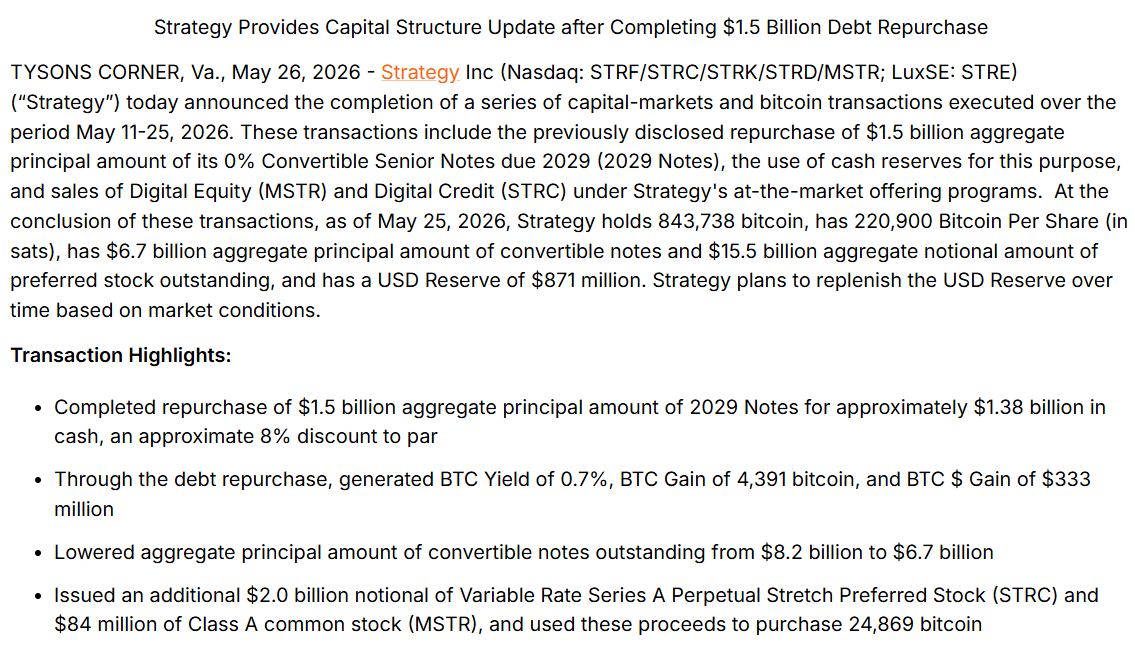
Michael Saylor’s Strategy, the largest corporate Bitcoin holder, has repurchased $1.5 billion of its 0% convertible senior notes due in 2029 for $1.38 billion at an 8% discount to par, in a move that significantly cuts future debt obligations.
The purchase reduces Strategy’s outstanding debt through convertible notes from $8.2 billion to $6.7 billion for 2029, the company announced on Tuesday. The notes were repurchased using the company’s cash reserves.
Strategy also reported an additional $15.5 billion in aggregate notional amount of outstanding preferred stock and a USD reserve of $871 million.
Buying back debt at a discount can strengthen the balance sheet of a company by reducing future payment obligations and shows active debt management from Strategy, typically seen as a positive sign by shareholders.
The update comes after Strategy did not announce a fresh Bitcoin purchase this week, following its $2.01 billion purchase the prior week. Four smaller Bitcoin treasuries stepped in to buy a cumulative 602.6 BTC worth about $46 million last week, Cointelegraph reported earlier on Tuesday.
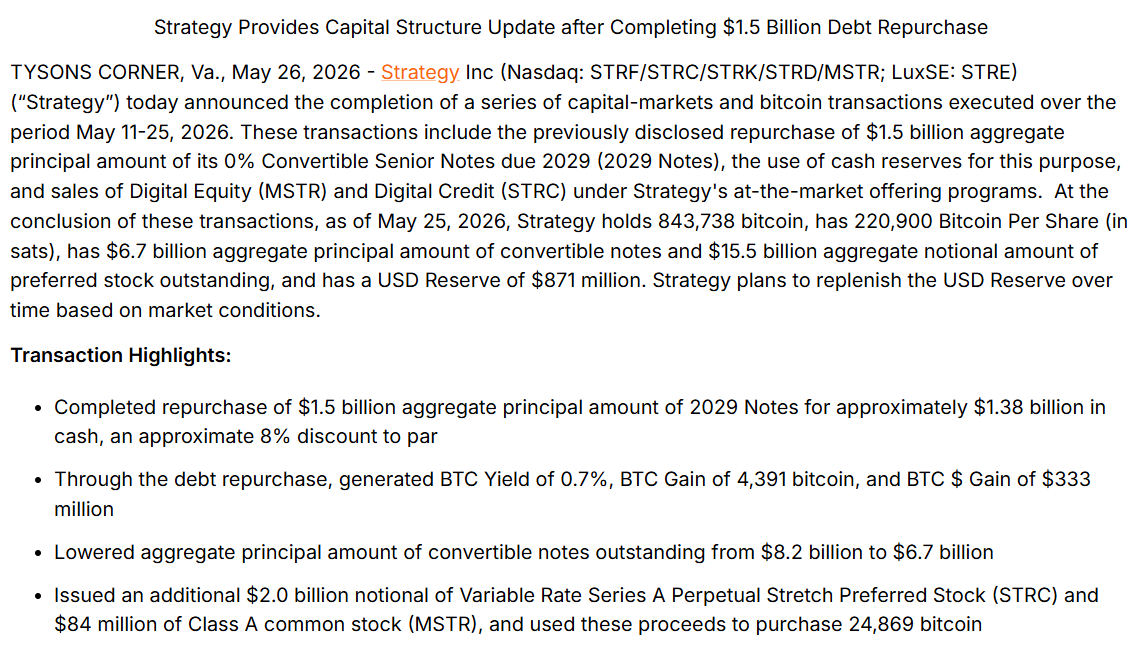
Strategy announces $1.5 billion outstanding note buyback. Source: Strategy.com
Crypto industry watchers praised the debt buyback.
“Great move by Strategy,” wrote asset management firm Bitwise’s European head of research, André Dragosch, adding that the debt reduction removes a “major uncertainty around the cash repayment wall in mid-2028,” as investors would likely demand repayment due to the relatively high conversion price of these notes, around $672.
Related: New York lawsuit tests lost property claim over dormant Bitcoin
Strategy shares sink 3% after announcement
While a reduction in outstanding debt is typically a positive sign for shareholders, Strategy’s stock price fell 3% in pre-market trading on Tuesday and was changing hands at above $159 at the time of writing.
The slide adds additional pressure to Strategy’s declining share price, which fell 10% during the past month and 59% during the past year, data from Yahoo Finance shows.
Bitcoin’s price also fell by about 1.2% during the past month and by 29% over the past year, according to TradingView.
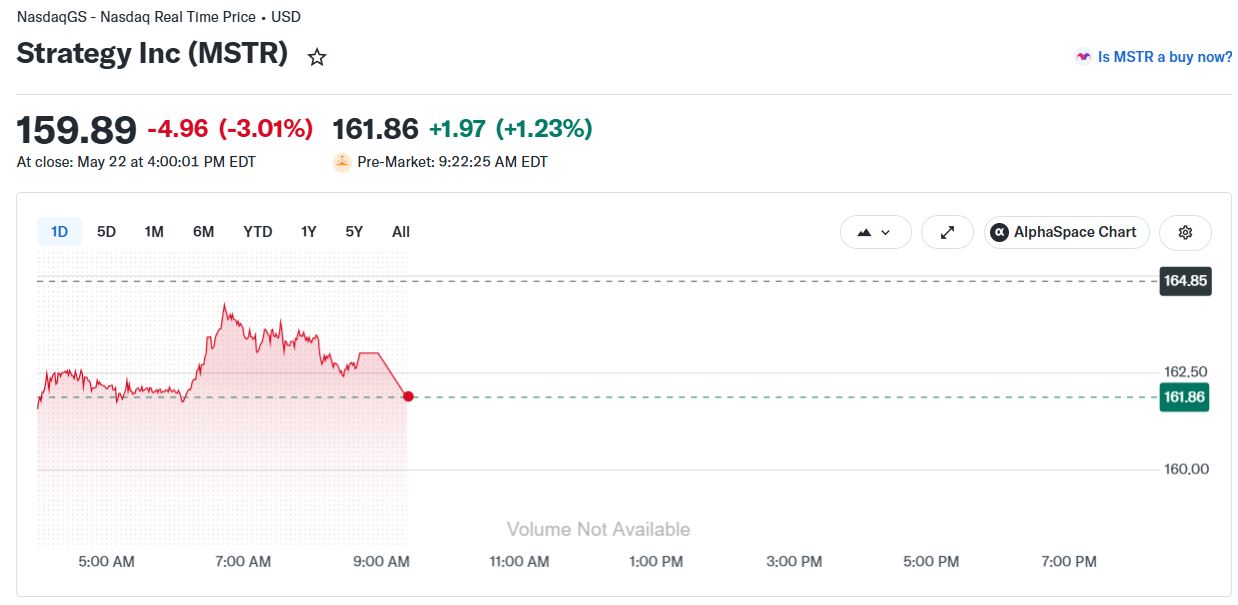
MSTR/USD, 1-day chart. Source: Yahoo Finance
The move comes a week after Strategy announced its third-largest investment of 2026, as it acquired 24,869 BTC for $2.01 billion between May 11 and 17, at an average purchasing price of $80,985 per BTC, Cointelegraph reported last Monday.
Magazine: Bitcoin ETFs bleed $1B, Aave’s $71M ETH unfreeze bid delayed: Hodler’s Digest, May 10 – 16
TLDR:
- HTX confirms the UK sanctions designation targets Huobi Global S.A., a entity legally separate from the HTX exchange.
- The exchange received no prior notice or supporting evidence from UK authorities before the sanctions were announced.
- HTX reaffirms its commitment to full legal compliance and active cooperation with law enforcement agencies worldwide.
- All HTX global operations remain fully unaffected, and the exchange has assured users that their funds are completely safe.
HTX has responded to the UK’s recent sanctions designations, clarifying that its online exchange remains fully operational.
The exchange stated that the listed entity, Huobi Global S.A., is legally distinct from the HTX platform. HTX also confirmed that all user funds remain safe and unaffected.
The exchange said it received no prior notice or supporting evidence from UK authorities before the designation.
HTX Draws Clear Line Between Exchange and Sanctioned Entity
HTX moved quickly to address confusion surrounding the UK sanctions announcement. The exchange made clear that Huobi Global S.A. is a separate legal entity from the online HTX platform.
According to HTX, the designation does not and should not affect the exchange’s day-to-day operations. The statement was shared across HTX’s official channels shortly after the UK announcement.
The exchange also confirmed its commitment to full compliance with all applicable laws. HTX stated it cooperates actively with law enforcement agencies worldwide.
This position, the exchange said, remains unchanged regardless of the sanctions action. HTX also noted it will continue monitoring the situation closely.
The UK’s sanctions package named 18 entities and individuals linked to Russia’s financial networks. Among those listed is Huobi Global S.A., the operator associated with the HTX exchange.
However, HTX stressed that the legal distinction between the two entities is critical. The designation targets Huobi Global S.A. and not the online exchange itself.
HTX also noted that the UK designation arrived without prior notice. No supporting evidence was shared with the exchange before the announcement.
Huobi Global S.A. has said it will work with relevant UK authorities to understand the basis for the action. The company aims to address any concerns raised by British officials promptly.
HTX Assures Users of Stability Amid Ongoing Developments
HTX confirmed that its global operations remain fully unaffected by the UK sanctions. The exchange reassured its user base that all funds held on the platform are safe.
No disruptions to services, withdrawals, or trading activity were reported following the announcement. HTX said it will provide updates as the situation develops.
The UK applied Regulation 17A of its Russia sanctions regime to crypto exchanges for the first time. This tool requires UK financial firms to freeze funds and trace transactions linked to designated entities.
Blockchain analytics firm Elliptic noted that HTX recorded roughly $3.3 trillion in trading volume last year. It also said the platform is suspected of links to Russia’s A7 payments network and sanctioned exchange Garantex.
HTX has not directly addressed the specific allegations cited by Elliptic or UK authorities. Instead, the exchange focused its statement on the legal separation between itself and Huobi Global S.A.
The exchange reiterated its lawful standing and its cooperation with global regulators. Further clarifications are expected as Huobi Global S.A. engages with UK officials.
The broader sanctions package also targets the A7 payments network, which British officials say moved over $90 billion last year. Several individuals were also designated for alleged sanctions-evasion activity.
HTX said it takes the matter seriously and will continue to respond transparently. The exchange urged users to rely only on official HTX communications for updates.
XRP faces a three-way test this week. An XRPL pilot in Uganda just launched, Binance spot liquidity hit a January 2020 low, and the daily chart now compresses inside a tightening symmetrical triangle near key support.
The altcoin traded near $1.33 on May 26, down 2.1% on the day. Price now tests the lower trendline of a symmetrical triangle, where adoption news and weakening market structure collide.
Uganda Pilot Pushes XRPL Into Genomic Identity
DNA Protocol confirmed on Tuesday that its Uganda pilots process genomic identity data from certified labs. The system generates zero-knowledge proofs and anchors them on the XRP Ledger Testnet.
DNA Protocol positions the design as a privacy-preserving way to validate genetic credentials without exposing the raw data. Uganda’s pilot routes lab outputs into proofs that any verifier can check on XRPL Testnet, the team said.
Mainnet deployment will run through a dual burn mechanism between XDNA and XRP, the project said on X. The XDNA token serves as the native unit for protocol fees, and the dual burn ties it directly to XRP supply mechanics.
The pilot aligns with a wider push to position the XRP Ledger as institutional infrastructure. Earlier work on institutional XRPL privacy already brought zero-knowledge payment rails to the testnet for developers.
Binance XRP Liquidity Sinks to a Five-Year Low
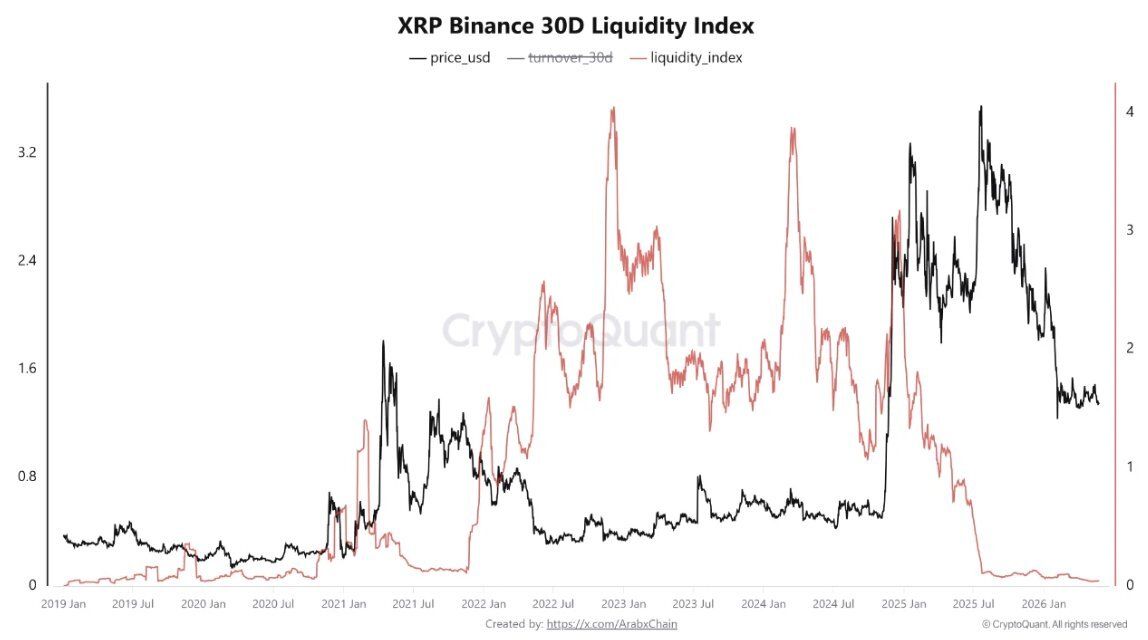
The 30-day liquidity index for XRP on Binance fell to roughly 0.043, according to CryptoQuant data. That marks the lowest reading since January 2020 and reflects a sharp drop in market depth on the exchange.
Between 2022 and 2024, the same index frequently ran above 3, and at times above 4. Heavier trading flows during that stretch coincided with the previous bull cycle and stronger speculative interest in XRP.
The drop toward zero began in early 2025 and has held for months. That trend parallels broader XRP liquidity concentration risks across major venues.
XRP’s price also reached new highs in 2025, while liquidity had already trended toward the floor. That divergence often precedes wider price swings once trading flows return.
CryptoQuant noted that thin order books amplify the impact of large orders. Periods of thin liquidity often coincide with sharper intraday wicks and weaker support absorption.
“Liquidity at these low levels could make the market more sensitive to sudden price movements, as large orders may have a greater impact on price.”

Triangle Compression Tilts Bearish Near $1.17 Support
The XRP/USDT daily chart on Binance shows a symmetrical triangle pattern that has guided price action since February 6. The upper trendline descends from a $1.70 swing high, and the lower trendline rises off the $1.17 February low.
Both bounds match Fibonacci retracements from the prior leg. The $1.7045 level marks the 0.618 retracement, while $1.1729 sits at the 0.786 retracement.
Price has just broken under the $1.40 zone that held since March. It now presses the lower triangle trendline near $1.33.

The Relative Strength Index sits in the mid-30s to low-40s, signaling fading momentum without oversold readings. Bollinger Band Width Percentile prints near multi-year lows, confirming the XRP volatility squeeze flagged in earlier sessions.
Daily volume has remained subdued during the recent slide. No clear capitulation candle has printed on the move below the $1.40 zone.
The current lean tilts breakout odds toward the downside. A confirmed daily close below $1.17 would open the path toward deeper retracement levels.
What to Watch Next for XRP
The setup combines drained liquidity, a coiled chart, and a fresh utility hook into a single decision point. Whether the Uganda pilot translates into network demand or the triangle breaks lower may shape the next leg.
The XRP May trajectory is likely to pivot on the next confirmed close above $1.40 or below $1.17.
The post XRP Faces Critical Test as Uganda Genomic Pilot Meets Binance Liquidity Drought appeared first on BeInCrypto.


SharpLink has secured inclusion in the Russell 2000 and Russell 3000 indexes, adding another milestone to the company’s push into Ethereum-based treasury management.
Summary
- SharpLink will join the Russell 2000 and Russell 3000 indexes on June 29 as institutional interest in crypto treasury firms grows.
- The company reported $12.1 million in quarterly revenue while recording a $685.6 million net loss tied mainly to Ethereum-related impairments.
- SharpLink also expanded its Ethereum strategy through a proposed $125 million on-chain yield fund with Galaxy Digital.
According to a report shared by Wu Blockchain, the Nasdaq-listed company, which trades under ticker SBET, will join both indexes when the U.S. market opens on June 29, 2026. The annual Russell index reconstitution places SharpLink among small-cap and broad-market U.S. equities tracked by institutional funds and exchange-traded products.
SharpLink expands Presence in public markets
FTSE Russell includes companies that meet specific market capitalization, liquidity, and listing standards. The addition of SharpLink means index-tracking funds will automatically purchase shares of the company once the changes take effect.
SharpLink chief executive Joseph Shalom said the company’s inclusion recognizes its Ethereum treasury strategy and may help increase shareholder participation. “This recognition supports our position as an institutional-grade Ethereum treasury platform,” Shalom said in a company statement.
Based in Miami, SharpLink rebranded from SharpLink Gaming in February 2026 after moving away from its sports betting business. The company now focuses on Ethereum treasury operations and digital asset-related financial services.
At the same time, BitMine Immersion Technologies, which trades under ticker BMNR, is also scheduled to join the Russell 3000 during the same reconstitution cycle.
Revenue growth comes with large ETH-Linked losses
SharpLink reported Q1 2026 revenue of $12.1 million, compared with $0.7 million during the same quarter a year earlier. Company filings also showed a net loss of $685.6 million for the quarter.
The company attributed most of the loss to non-cash impairments and unrealized declines tied to its Ethereum holdings. SharpLink currently holds more than 872,000 ETH equivalent, according to post-quarter financial disclosures.
While the revenue increase showed business expansion, the company’s balance sheet remains closely tied to Ethereum price movements. Public companies with large crypto treasury positions often face earnings volatility due to digital asset valuation changes.
According to company disclosures, SharpLink ranks among the world’s largest publicly traded Ethereum holders. The strategy has drawn attention from investors looking at corporate crypto exposure beyond Bitcoin-focused firms.
Galaxy Partnership adds deFi exposure
On May 11, SharpLink announced the proposed Galaxy SharpLink Onchain Yield Fund in partnership with Galaxy Digital. The planned fund includes $125 million in committed capital, including $100 million from SharpLink’s staked Ethereum treasury and $25 million from Galaxy.
The agreement remains non-binding at this stage. If finalized, the fund would become one of the larger institutional decentralized finance yield vehicles linked to a publicly traded company.
Company statements described the fund as part of SharpLink’s effort to expand institutional participation in on-chain finance products. Market participants are now watching whether the partnership proceeds into a formal agreement.
As previously reported by crypto.news, Galaxy Digital and SharpLink announced a non-binding agreement on May 11 to launch the Galaxy SharpLink Onchain Yield Fund, a $125 million limited partnership designed to deploy part of SharpLink’s staked Ethereum treasury across decentralized finance strategies. Galaxy will serve as the investment manager for the proposed fund.
SharpLink plans to contribute $100 million from its staked ETH holdings, while Galaxy will provide an additional $25 million in capital. Mike Novogratz, founder and chief executive officer of Galaxy, said the infrastructure supporting institutional participation in decentralized finance “has matured to a point where allocators can access yield, liquidity, and risk management with the same rigor they expect in traditional markets.
Solana privacy protocol Umbra has partnered with Streamflow to launch confidential vesting for the $97 billion token unlock market.
Summary
- Umbra and Streamflow launched confidential vesting that encrypts token unlock schedules, vesting amounts, and recipient addresses on Solana, preventing public front-running of insider allocations.
- The integration targets the $97 billion crypto token unlock market, where standard vesting contracts create publicly visible supply signals that traders use to position ahead of scheduled releases.
- Umbra is built on Arcium’s encrypted execution engine and raised $154.9 million in USDC commitments from over 10,000 participants via MetaDAO’s ICO framework in October 2025.
Umbra, the Solana-native financial privacy layer built on Arcium’s encrypted execution engine, has launched confidential vesting in partnership with Streamflow, the leading token distribution platform listed in Solana’s official documentation.
The integration encrypts vesting schedules, allocation amounts, and recipient wallet addresses so that on-chain observers cannot access the underlying parameters of token unlock agreements.
The problem the product targets is structural. Standard vesting contracts execute on a public ledger where anyone can see which wallets will receive tokens, the exact amounts, and when each tranche unlocks. Sophisticated traders build sell positions ahead of supply increases from team and investor allocations, creating structural selling pressure that directly disadvantages the projects and token holders they front-run.
What confidential vesting does and why it matters at institutional scale
Umbra’s infrastructure processes vesting operations over fully encrypted data using Arcium’s multi-party computation framework. The recipient’s identity, allocation size, and unlock schedule are all encrypted at the contract level, with actual token transfers settling on Solana without exposing the underlying parameters to the public mempool or to on-chain analytics tools.
Streamflow is integrated directly into the Solana ecosystem as the standard token vesting infrastructure and has processed contracts for hundreds of Solana-native projects.
The partnership connects Umbra’s privacy layer to that existing tooling without requiring a separate workflow, making confidential vesting available as a straightforward option within the same interface that teams and investors already use.
“Umbra is the initial proof of what becomes possible when you build financial infrastructure powered by encrypted compute,” said Yannik Schrade, CEO of Arcium, at the March 2026 public wallet launch that preceded today’s vesting integration.
The $97 billion figure represents the estimated total value of scheduled crypto token unlocks across major ecosystems through 2027. Solana accounts for a significant portion of this market given the concentration of recently launched protocols on the chain with multi-year vesting schedules still outstanding.
Why Solana’s privacy infrastructure has accelerated in 2026
Umbra raised $154.9 million in USDC commitments from more than 10,518 participants via MetaDAO’s ICO in October 2025. Arcium’s Mainnet Alpha launched in February 2026, Umbra opened its public privacy wallet in March, and confidential vesting marks the protocol’s first institutional product beyond individual transaction privacy.
Crypto.news has covered the growing institutional interest in privacy-preserving blockchain infrastructure as quantum computing concerns accelerate revaluation of cryptographic foundations.
Crypto.news has also tracked how privacy protocol capital rotation has driven ZEC to a 73% monthly gain as encrypted execution infrastructure gains institutional attention.
The confidential vesting launch extends Umbra’s privacy infrastructure from individual transactions into the corporate treasury and investor management workflows where the largest on-chain unlock volumes are concentrated.
Crypto.news has also noted how security and compliance standards now determine institutional capital access, a constraint that shapes how confidential vesting products must integrate KYC and audit capabilities alongside privacy protections.
Crypto World
Crypto Advocacy Group Pushes Back Against US Senator’s Claims on Companies’ OCC Charters
Update (May 26 at 9:30 pm UTC): This article has been updated to include statements from The Digital Chamber.
The Digital Chamber, a cryptocurrency advocacy group that has been closely involved in negotiations with US lawmakers over digital asset-related legislation, questioned three-term Massachusetts Senator Elizabeth Warren’s understanding of banking laws as applied to crypto companies.
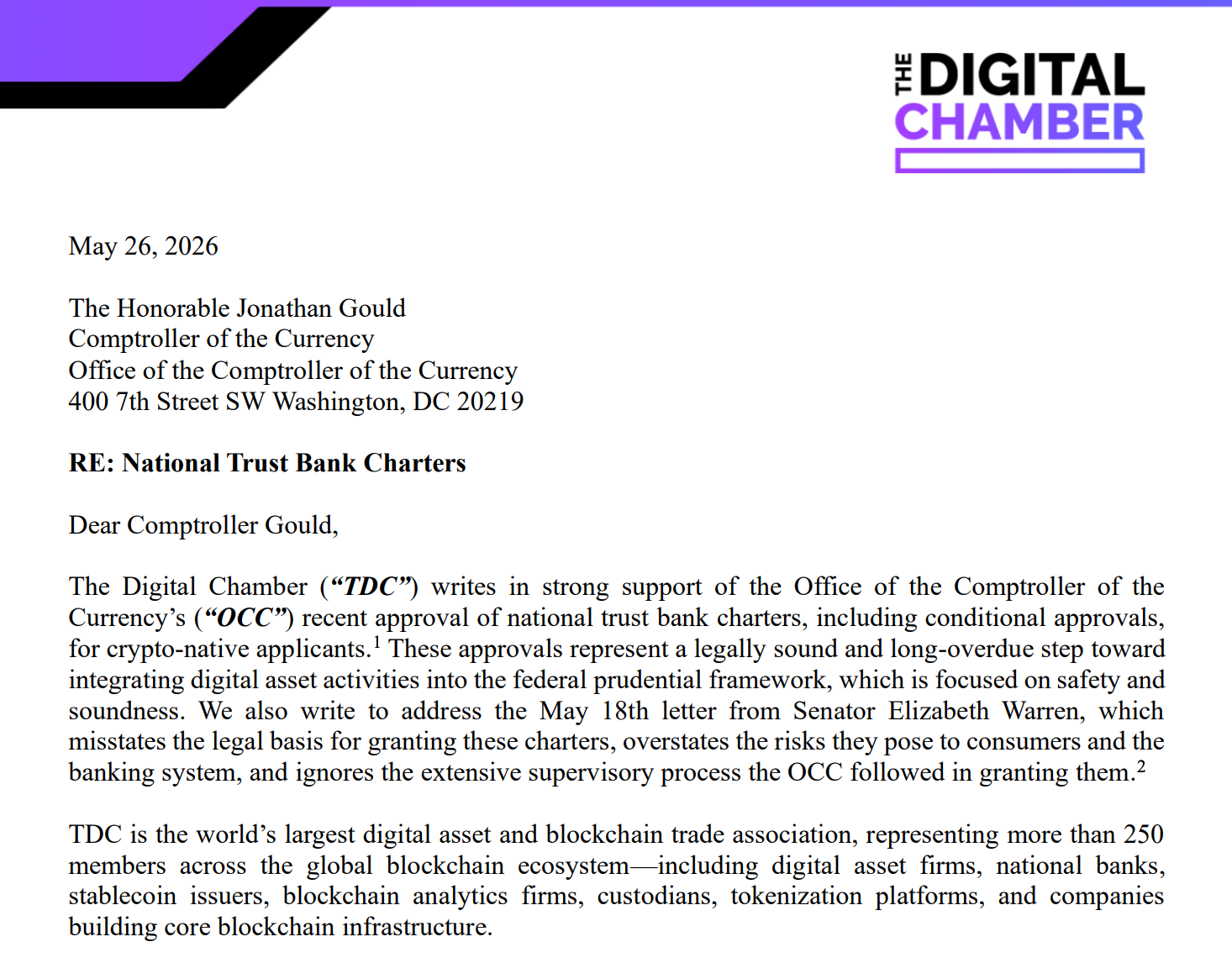
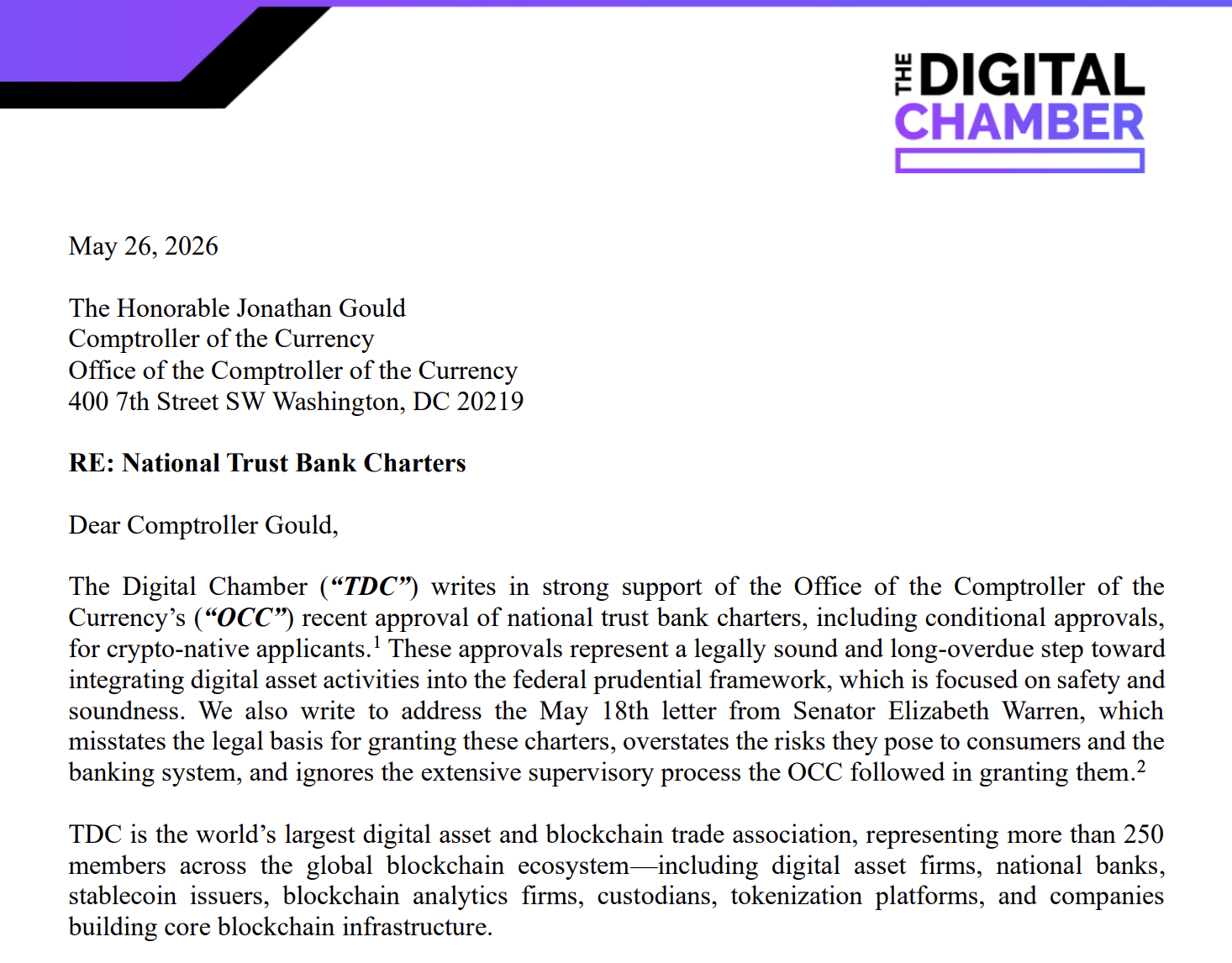
In a Tuesday letter to the US Comptroller of the Currency (OCC) Jonathan Gould, Digital Chamber CEO Cody Carbone challenged many of the claims in the Massachusetts lawmaker’s May 18 letter. In that letter, Warren said that the OCC may have violated the National Bank Act by approving national trust charters for nine crypto companies “that intend to engage in activities that appear to go far beyond the narrow set of activities permitted by law.”
“The claim that these firms seek to ‘evade’ regulations […] or pose risks to the safety and soundness of the banking system is contradicted by their own conduct,” Carbone said in his Tuesday letter. “These companies voluntarily sought federal oversight: each applied for a national trust bank charter, submitted to OCC examination authority, and accepted the compliance obligations that come with federal supervision.”
Source: The Digital Chamber
Warren’s concerns stemmed from OCC’s approving or conditionally approving charter applications from Coinbase, Crypto.com’s parent company, Ripple, Stripe, BitGo, Circle, Fidelity Digital Assets, Protego Holdings and Paxos. She said that the companies “want to evade the fundamental safeguards and obligations that come with being a bank” and questioned what led to the approvals, implying influence from the White House.
Related: Crypto PAC money pours into Texas primary runoffs, as prediction markets favor challengers
As the ranking member of the US Senate Banking Committee, Warren has repeatedly criticized lawmakers and regulators for supporting policies with potential conflicts of interest related to US President Donald Trump’s ties to the crypto industry. Cointelegraph sought comment from Warren’s office but did not receive an immediate response.
“If Senator Warren believes the OCC exceeded its authority, the appropriate response is to identify where the statute draws the line she says was crossed,” Carbone said in response to a request for clarification from Cointelegraph. “We’d welcome that debate. But ‘this seems wrong’ from a member of the Banking Committee isn’t a legal argument. And the OCC shouldn’t retreat from a legally sound decision because of political pressure, regardless of who’s applying it.”
Other crypto companies’ OCC applications are pending review
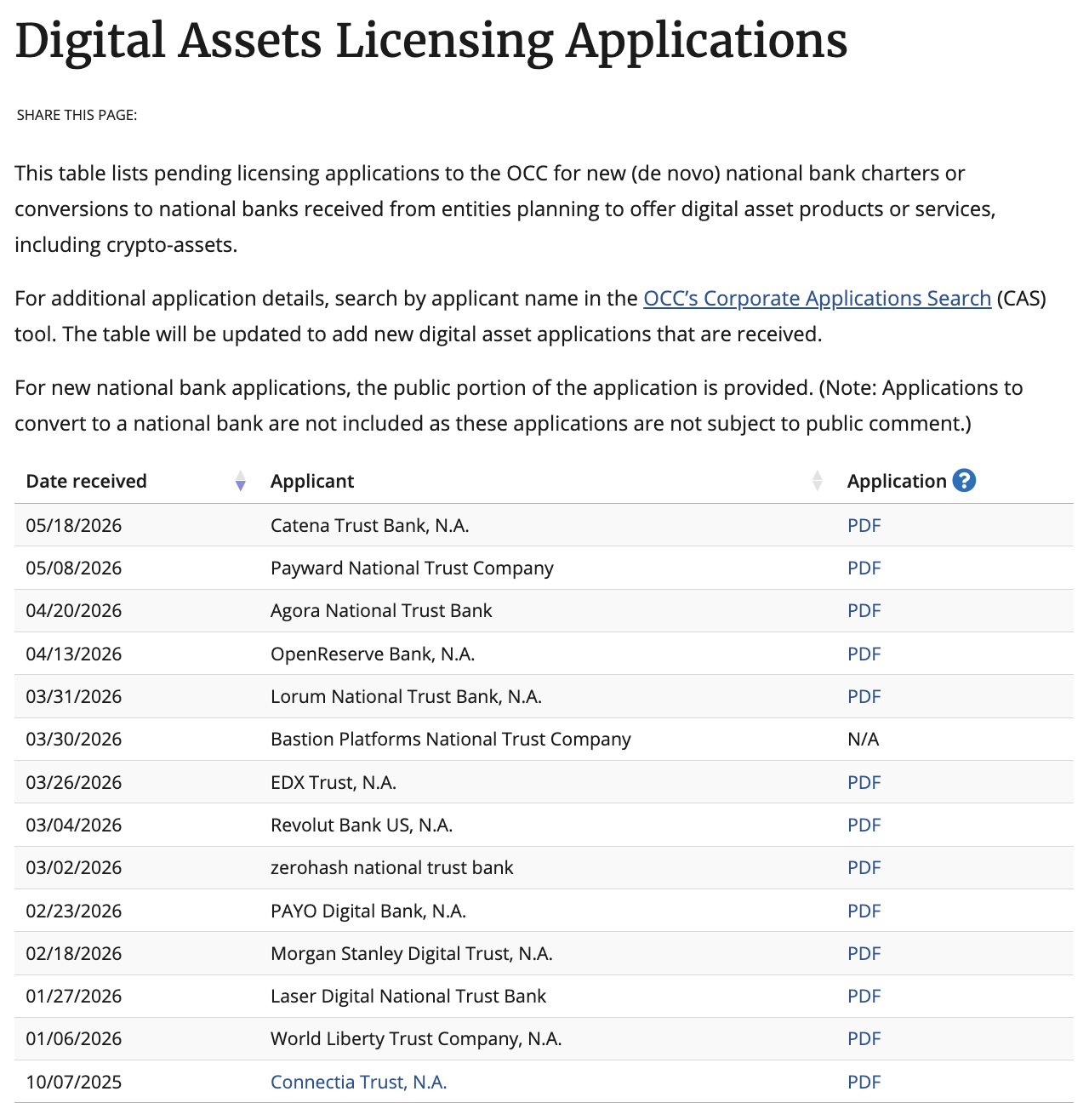
Warren’s concerns about the OCC approvals came as the banking regulator is considering applications from the Trump family-backed crypto business World Liberty Financial as well as Payward, the parent company of cryptocurrency exchange Kraken.
Source: OCC
Payward said it intended to “provide fiduciary custody and other services primarily for digital assets” if approved. In January, Warren called on Gould to delay consideration of World Liberty’s application until Trump divested from the platform, citing financial conflicts of interest.
As of Tuesday, the OCC listed 14 digital asset companies that had submitted licensing applications.
Magazine: 50K investors fight Korean crypto tax, Singapore cancels Bsquared: Asia Express

The Fed Just Set the Stage for a Major Crypto Market Rally in 2026

Man arrested in connection with Heaton Park synagogue terror attack

Oil Prices Swing Sharply on US Strikes in Iran as Strait of Hormuz Tensions Escalate


-

 Crypto World5 days ago
Blockchain.com files with SEC for U.S. IPO
-

 Fashion4 days ago
Holiday Weekend Open Thread – Corporette.com
-

 Business4 days ago
Dell Technologies DELL Stock Surges 15% on AI Server Momentum and Analyst Upgrades in 2026
-

 Crypto World5 days ago
Bitcoin Accumulation Weakens as BTC Realized Losses Hit $600M
-

 Crypto World4 days ago
Robinhood crypto COO Tanya Denisova exits
-

 Crypto World4 days ago
Space X IPO Is ‘Bad News’ for Tech Stocks: But What About Bitcoin?
-

 Politics4 days ago
Makerfield: a tale of two social-media histories
-

 Business2 days ago
NYT Strands Answers May 24 2026 Revealed for Puzzle No. 812 Theme Summer Essentials
-

 Tech1 day ago
Microsoft’s quiet Claude Code retreat and the real cost of enterprise AI
-

 Crypto World5 days ago
MicroStrategy’s Saylor Says Miners No Longer Set Bitcoin Price, Another Force Has Taken Over
-

 Tech5 days ago
WhatsApp ads could make Irish debut after discussions with DPC
-

 Crypto World4 days ago
AI infrastructure race heats up as IREN pitches full-stack strategy, WhiteFiber lands $160M deal
-
 Tech4 days ago
A 0.12% parameter add-on gives AI agents the working memory RAG can’t
-

 Tech5 days ago
You Can Now Add ChatGPT To PowerPoint
-
 NewsBeat6 days ago
Charity run by Reform leader Malcolm Offord accused of ‘law breaking’ over Scottish registration
-
 Crypto World2 days ago
Nvidia (NVDA) CEO Calls on Super Micro to Strengthen Export Controls Amid Smuggling Probe
-

 Business5 days ago
Trump Invests $1M-$5M in Kura Sushi USA Chain With 27 California Locations
-

 Tech1 day ago
Westone Audio and Etymotic Acquired by Fidelity Collective in Major IEM Market Move
-

 Sports5 days ago
2026 CJ Cup Byron Nelson leaderboard: Brooks Koepka finds putting stroke in Round 1
-

 Crypto World6 days ago
Exa Labs raises $250 million in funding led by a16z
You must be logged in to post a comment Login