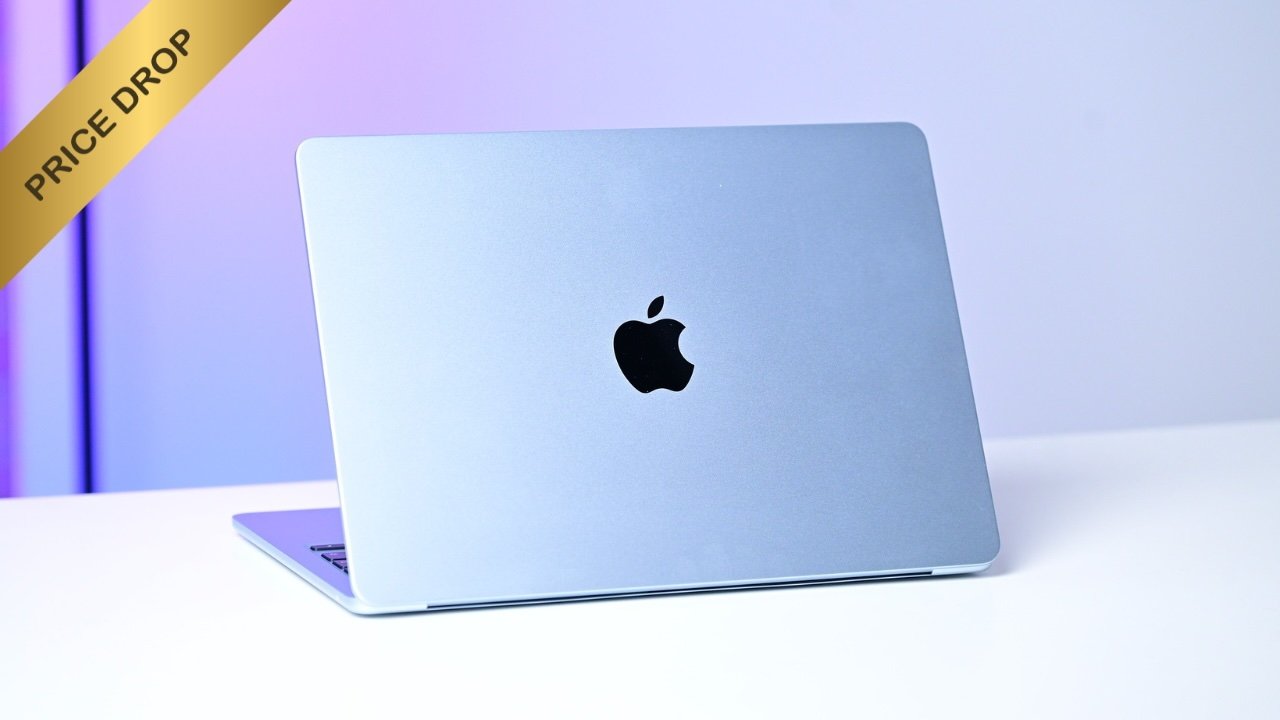
Amazon’s month-end Apple deals are heating up, with the lowest price ever hitting Apple’s iPhone Air MagSafe Battery, which is 40% off. Plus, save $200 on the M5 MacBook Air.
Kicking off the month-end Apple sale at Amazon is the lowest price on record for the iPhone Air MagSafe Battery Pack with a USB-C port. Normally $99, this accessory is marked down to $59, reflecting a 40% discount off MSRP.
We’re also following Amazon’s deals on 2026 MacBook Air models with the M5 chip. We covered the lowest price seen on the 13-inch line yesterday, with the standard model plunging to $899.99, but we’re also pleased to see this upgraded 15-inch model with 24GB of RAM and 1TB of storage is $200 off as well.
SiliconRepublic.com spoke with experts from Yahoo Mail about standing out in a competitive field and the opportunities open to jobseekers.
“Yahoo Mail is in the midst of our most significant engineering transformation in over a decade,” said Nikhil Gandhi, the senior vice-president of engineering at Yahoo Mail.
“We’re building a ground-up mobile redesign and a modernised desktop experience and embedding unique AI experiences across the product,” he said. “The team in Ireland plays a critical role in continuing to scale our work globally and the engineers we’re hiring have an opportunity to work on products with real reach and impact.”
Kiran Krishna Hegde, a senior manager and systems engineer at Yahoo Mail, explained that for now at the company, the focus is on the intelligence engineering hub in Ireland and moving from team build-out to delivery, making the right key hires and getting new team members onboarded and contributing.
Advertisement
To meet those needs, he said: “We are looking for engineers with strong fundamentals, sound judgement and real ownership. Coding and system design are the table stakes, but we are not just looking for people who can ship features. We want people who understand scale, reliability, trade-offs and the difference between getting something working and building it properly.”
He is of the opinion that the most suitable candidates for roles in this area are typically the ones with real production experience, who have seen how systems can fail and who have learned how to build more resilient systems as a result.
“A back-end engineer should understand platform and data concerns,” he said. “A data engineer should think like a software engineer, not just a workflow builder. Above all, we want people who care about engineering craft, can work through complexity and are comfortable being accountable for outcomes.”
He noted that collaboration and a one-team mindset also wouldn’t go amiss, as the Ireland-based team works closely with a larger US-based team, as well as colleagues across the globe, making engineers “who are low-ego, generous with context and motivated as much by collective progress as they are by individual success” valuable to the organisation.
Advertisement
Standing out
Of the potential challenges or pitfalls Hegde finds too many candidates list responsibilities, rather than explaining the outcomes. Those looking to stand out in a positive way should identify the problems they have solved, what changed and why it mattered in the broader scheme of things.
“Specific examples always carry more weight than broad claims,” he said. “We also pay attention to how candidates work with others. In a distributed environment, strong engineers do not just produce good individual work, they create clarity, collaborate across teams, share context early and help move the wider group forward. That combination of technical strength and a genuine one-team mindset stands out.”
Often, he explained, the biggest challenge for organisations when considering applicants is not the volume of candidates but rather the quality and whether or not their technical depth, practical experience and engineering judgement match the level required.
Hegde said: “Titles also do not always translate cleanly. In a market like Dublin, role scope in non-tech-first companies can be quite different, so a senior title on paper does not always mean the person has operated at that level in practice. We see this particularly in data and machine learning engineering, where there is often strong exposure to tools or theory, but less experience building production-grade systems under real scale, latency and reliability constraints.
Advertisement
“AI has made this harder as well, across the industry. Applications are more polished, but it now takes more effort to separate presentation from substance. That said, getting hired right is never a solo effort, and strong partnership with our recruitment team has been a big part of helping us navigate the local market, calibrate roles properly and keep momentum.”
Take a chance
“For early-career engineers, strong fundamentals matter most,” agreed Karim Al Srag, a director of engineering at Yahoo Mail. “Data structures, algorithms, problem-solving and, depending on the role, systems, data or machine learning basics. A degree helps, but it is only one part of the picture.”
For Al Srag, what matters is evidence of a body of work showing your interest and skill, via side projects, internships, open-source contributions, research and other practical work. “So yes, there are alternatives to traditional education, but whatever route someone takes, they still need to show strong fundamentals and real hands-on ability.”
Once situated, he noted the best support an organisation like Yahoo Mail can offer to new hires is in helping them become productive early on, while also giving professionals the context needed to grow into the role properly.
Advertisement
“In the Yahoo Mail intelligence hub in Ireland, we use structured onboarding plans for back-end, data and machine learning engineers. These combine targeted reading with practical, evidence-based tasks, so people can get set up properly and start contributing quickly.”
For Hegde, as the Yahoo Mail intelligence hub in Ireland is still being built, he explained it is not an environment where people can disappear into narrow roles or hide behind processes. Instead, he said: “It is a nimble, high-accountability team, which means every hire matters and every meaningful contribution has visible impact.
“If someone wants a very comfortable role with narrow ownership, this is probably not the right fit. But if they want to work with strong engineers, solve meaningful problems and help shape both the systems and the team while it is still taking form, it is a rare opportunity.”
For anyone interested in applying, there are currently openings for two professionals, a principal, senior data engineer and a principal, senior back-end engineer.
Advertisement
Don’t miss out on the knowledge you need to succeed. Sign up for the Daily Brief, Silicon Republic’s digest of need-to-know sci-tech news.
While Sony was technically first to market with an RGB backlit LCD TV in 2005, they’re just about last to the party in the new generation of RGB-lit LCD TVs. With models available from TCL, Hisense, LG and Samsung, Sony has taken its time in developing and perfecting its own offerings. They say, “good things come to those who wait” and the wait is over today with the release of not one but two models in Sony’s new True RGB line-up, the BRAVIA 7, Mark II and the BRAVIA 9, Mark II.
85-inch Sony BRAVIA 9 II.
Replacing their Mini-LED predecessors, the BRAVIA 7 and BRAVIA 9, the new Mark II models feature an entirely new backlighting system which uses individual lighting elements for each of the primary colors: red, green and blue. With RGB backlights, Sony is able to reach higher peak brightness levels, improve both color accuracy and saturation and extend the color gamut so that more of the colors available in the real world can be captured by the TV.
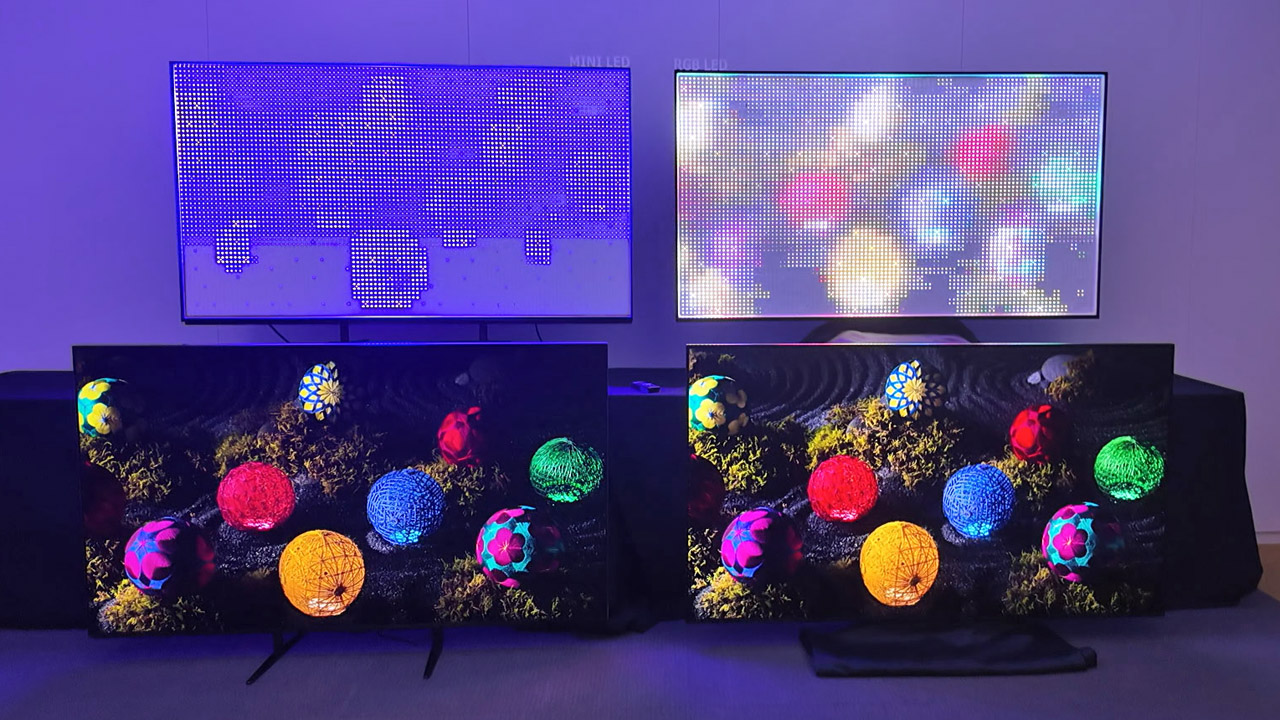
We’ve been able to check out the new TVs up close against their predecessors and against competitive models, both in final production form but also with their backlighting system exposed so we could get a look at their inner workings. Unlike some competitive models, the BRAVIA 7 II and BRAVIA 9 II maintain their full RGB backlighting system even when multiple colors are on-screen at the same time, preserving their extended color gamut while avoiding the color crosstalk artifacts we’ve seen on some competitors’ sets.
This shows color crosstalk on an RGB backlit TV (not a Sony). The dots should all be white, but they are showing a color tinge which bleeds over from surrounding areas of the screen due to RGB color crosstalk.
Compared directly to the BRAVIA 9 Mini LED TV, the BRAVIA 9, II TRUE RGB TV exceeded the performance of that set in just about every measurable (and subjective) way, with wider color gamut reproduction, impressive peak brightness — over 4,000 nits peak brightness on a 5% window — freedom from artifacts like aliasing and color banding and black levels and contrast that will give an OLED TVs a run for their money.
The BRAVIA 9 II also offered excellent off-axis viewing with minimal dimming and color shift when viewing it from well off to the sides. And it did all this while actually using less power than its predecessor, thanks to highly efficient power management and precise control over its RGB backlighting system.
BRAVIA 9 II comes in screen sizes from 65 inches to 115 inches (pictured here).
Mini LED TVs like the earlier BRAVIA 9 had and easier job when it came to color reproduction. The backlighting unit generated a single color, which means each pixel on the LCD panel itself created colors by adjusting the opaqueness of each LCD pixel’s red, green and blue subpixel. Because the backlight is uniform in color, the color filter process is entirely predictable and uniform from LCD pixel to LCD pixel. But with that simplicity came a narrower color gamut – that meant they simply couldn’t reproduce certain colors, at least not with useful brightness.
Sony BRAVIA 9 Mini LED (left) and backlight unit compared to BRAVIA 9 II True RGB TV and backlight unit (right).
With an RGB backlit TV like the BRAVIA 9, II, the image processor has to decide how to adjust both the intensity of each individual red, green and blue diode in the backlight unit and do further adjustment at the pixel level adjusting each of the red, green and blue LCD subpixels. This two-step process can lead to better color accuracy, wider color gamut reproduction and higher overall brightness, but at the expense of more processing power and complexity. It is just this complexity that has led to Sony taking its time in releasing its first RGB-lit TVs of the new era.
BRAVIA 9 II, Optimized for Any Room Lighting
Brand new on the BRAVIA 9 II flagship TV is Sony’s Immersive Black Screen Pro – an integrated screen treatment which absorbs and disperses ambient room light such as open window shades, overhead lighting and lamps. Unlike some competitors’ matte screen coatings which can sacrifice black tonality, Immersive Black Screen Pro provides exceptional reduction of reflections without any color shift in the black levels. In Japan, we got to observe a BRAVIA 9 II which had half of its screen coating removed. This allowed us to see exactly what impact the screen coating had on the incoming video signal when faced with high ambient room lighting like an open window or even a bright spotlight.
Advertisement
This BRAVIA 9 II had its Immersive Black Screen Pro coating removed from the left half so we could see a comparison of how a bright spotlight was reflected with and without the screen coating applied.
Off-axis viewing and glare reduction were both exceptionally good on the True RGB TV, with the new TV able to maintain rich black levels when in a brightly lit room. While there was occasionally some mild blooming on brightly colored images set against a black background, the use of RGB lighting elements made these faint artifacts nearly imperceptible. On traditional LCD TVs, the bloom or halo around a bright object is typically white, while on a True RGB TV, the light bloom matches the color of the on-screen object, making it much less noticeable. While the BRAVIA 9 II couldn’t quite match an OLED in this regard, it wasn’t far off.
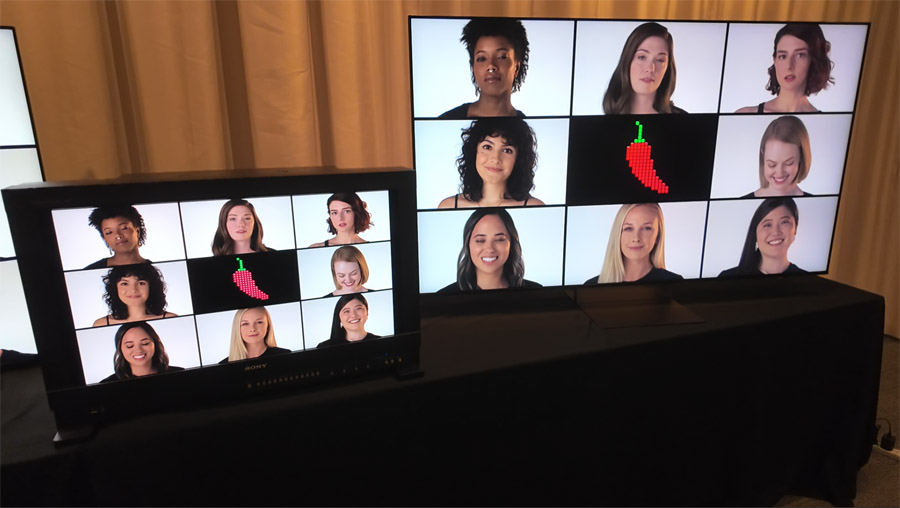
The BRAVIA 9 II (right) proved to be a close match to the professional broadcast monitor on challenging color reproduction tests like this skin tones test clip from the Spears and Munsil UHD Benchmark disc.
Color reproduction on the BRAVIA 9 II was outstanding. We did comparisons among the original BRAVIA 9, the BRAVIA 9 II and a Sony BVM-HX3110 professional broadcast monitor which sells for $30,000. The BRAVIA 9 II proved to be a very close color match to the BVM on most content and definitely edged out the Mini LED BRAVIA 9 for color saturation and wide color gamut coverage.
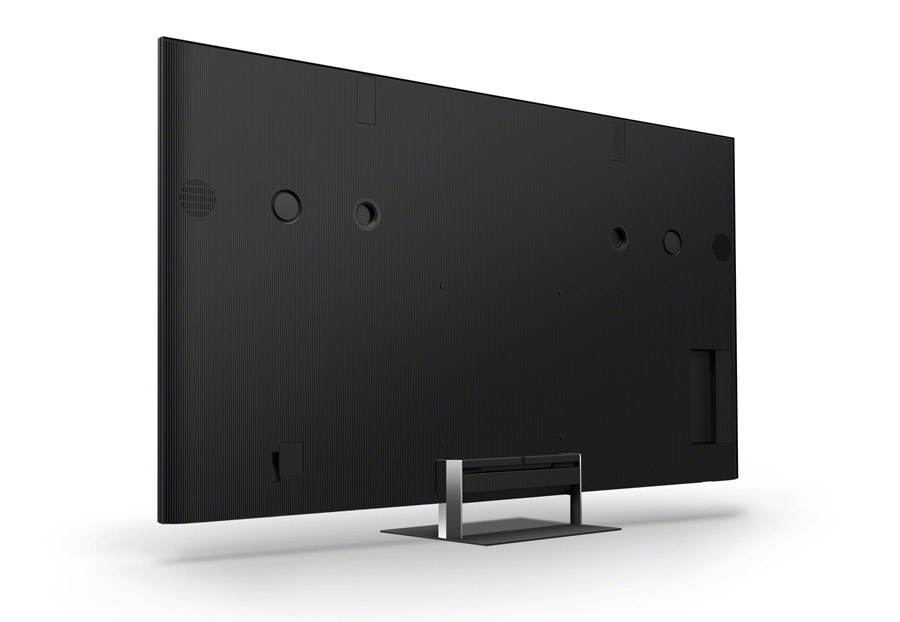
Sony BRAVIA 9 II rear view (85-inch).
We also viewed several challenging 4K/HDR clips highlighting HDR tone mapping and found that the new True RGB set outperformed the BRAVIA 9 MiniLED TV in both specular highlights and shadow detail. And the BRAVIA 9 is already a strong performer for tone mapping, so this was a pretty impressive feat. The 65-inch BRAVIA 9 II measured over 4,000 nits of peak white brightness at a 5% window which makes it a strong performer with HDR content, even in a bright room.
Advertisement. Scroll to continue reading.
A Unique Floating Look – the Mirage Stand
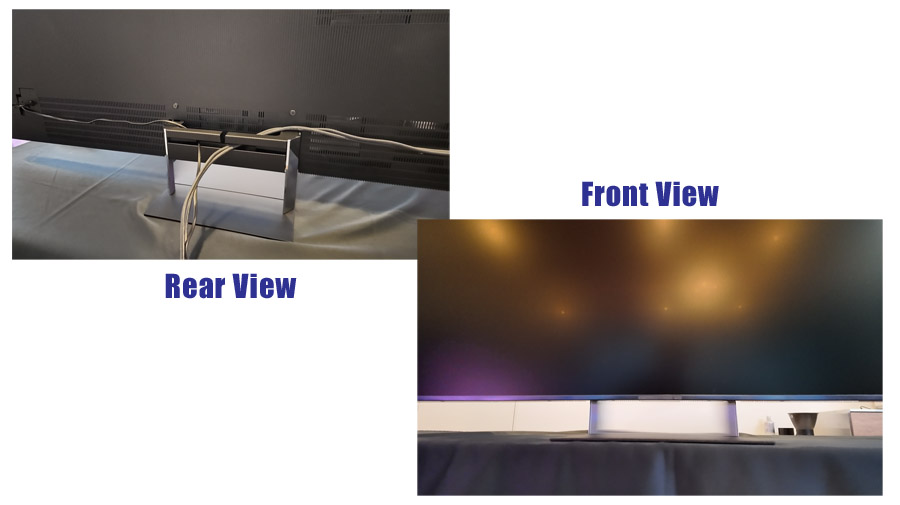
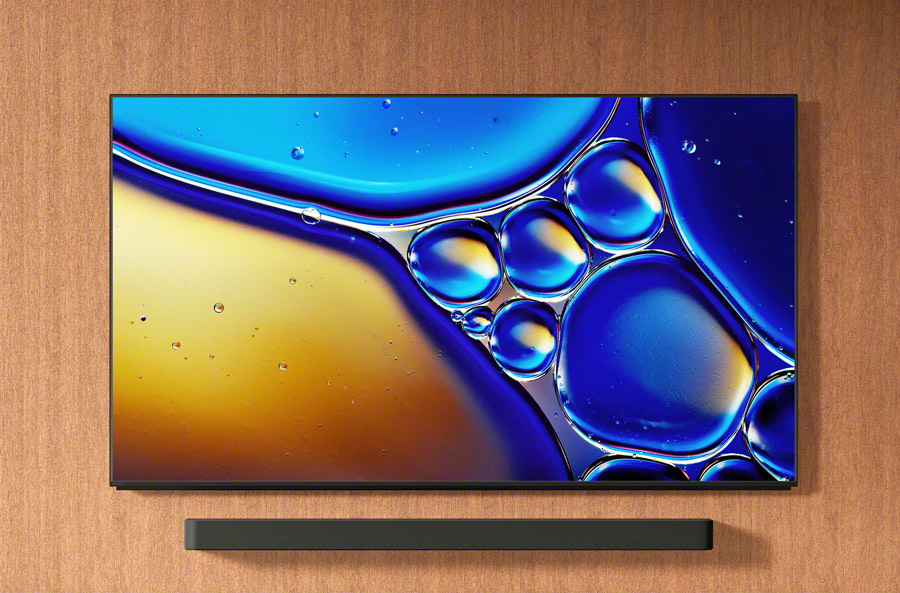
Both the BRAVIA 7 II and BRAVIA 9 II offer a new “Mirage” stand at sizes up to 85 inches. This base uses a lenticular translucent panel that allows light to pass through while power and HDMI cables that dangle behind the TV effectively disappear.
Thanks to a lenticular panel in the stand that lets light pass through but makes thin cables disappear, the BRAVIA 7 II and BRAVIA 9 II offer a “floating” look.
What’s The Difference? BRAVIA 7 II vs. BRAVIA 9 II
The BRAVIA 7 II and BRAVIA 9 II are more similar than they are different. They both include Sony’s TRUE RGB backlighting with RGB Backlight Master Drive Pro technology, the floating “Mirage” stand, four HDMI 2.1 inputs and similar ergonomic designs. However the BRAVIA 9 II features three times as many dimming zones compared to the BRAVIA 7 II for higher peak brightness, enhanced picture precision, reduced blooming and better image uniformity. The BRAVIA 9 II also includes the more powerful “Pro” version of Sony’s Luminance Booster processing (Luminance Booster Pro) for enhanced peak color and white brightness.
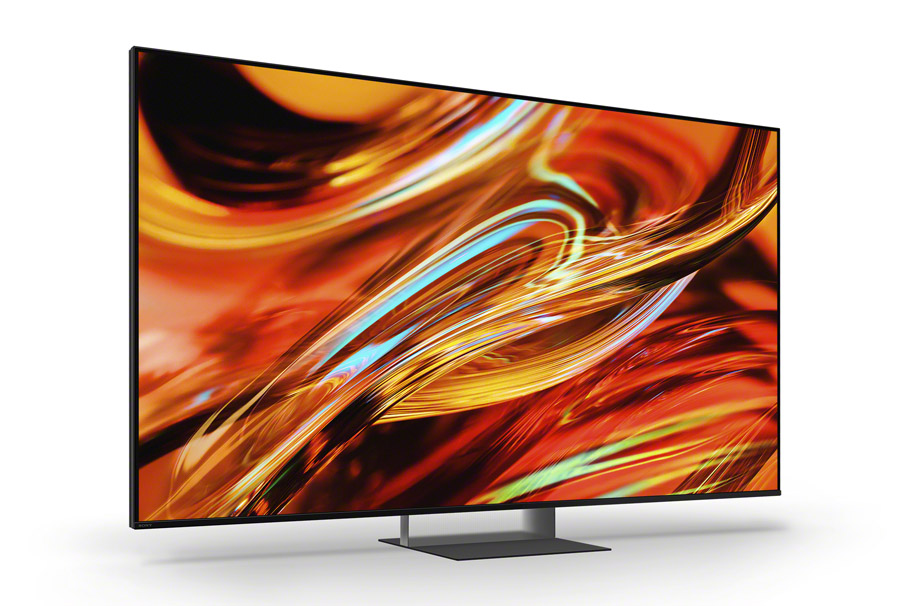
BRAVIA 7 II in 65-inch size with included mirage stand.
The Immersive Black Screen Pro screen coating is exclusive to the BRAVIA 9 II. The audio on the BRAVIA 9 II is also upgraded from the BRAVIA 7 II with Acoustic Multi -Audio+ technology which uses a Beam Tweeter at the top of the screen to make sure the sound perfectly matches the on-screen action.
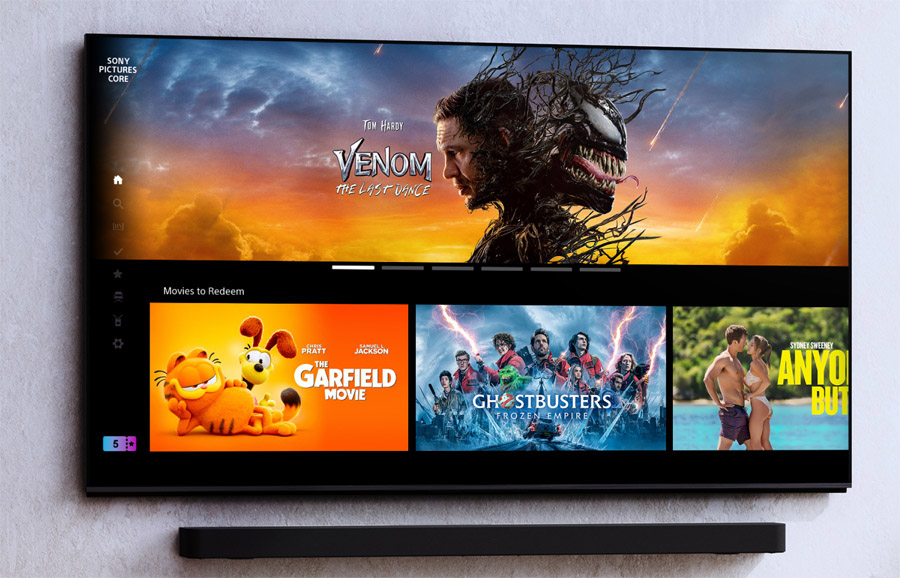
Sony’s BRAVIA 7 II and BRAVIA 9 II both include access to Sony Pictures Core.
Both sets are built on the Google TV operating system, with access to thousands of audio and video streaming apps, including Sony’s exclusive Sony Pictures Core streaming app which can compete with physical media like Blu-ray Disc in both video and audio quality. Both models feature Google’s Gemini AI on board for enhanced content recommendations and natural language interaction with viewers.
The BRAVIA 7 II is available in screen sizes from 50 inches for $1,599 to 98 inches for $8,999. The BRAVIA 9 II is available in sizes from 65 inches at $3,599 to 115 inches at $30,999. Complete size and pricing details are included below.
“Reports of My Death Have Been Greatly Exaggerated” – OLED TV
While some manufacturers are positioning their RGB-backlit TVs as “OLED Killers,” Sony has not announced any intentions to phase out their current OLED TVs, namely the BRAVIA 8 and BRAVIA 8, II. There are still some areas of picture performance, like black level reproduction, blooming and contrast, where OLED TVs are difficult to match. Instead, Sony is positioning their True RGB TVs as being ideal for bright room viewing and for those who want screen sizes beyond what OLED can currently deliver.
Advertisement
Sony will continue to offer the BRAVIA 8 and BRAVIA 8 II OLED TVs for the foreseeable future.
Based on Sony’s own research, 87% or more of TV viewing is done in non-ideal lighting conditions, e.g., rooms with open drapes with sunlight streaming in or moderate to bright room lighting. And, in these conditions, True RGB’s higher peak brightness and wider color gamut, as well as the Immersive Screen Pro light rejection tech on the BRAVIA 9 II, provide a superior overall viewing experience.
The Bottom Line
Sony has been working on its RGB backlighting system for several years and we’ve witnessed its path from prototype to production. They may be late to the RGB party, but from what we’ve seen so far, the wait has been worthwhile. By offering two lines of True RGB TVs at launch, starting at just under $1,600, Sony is hoping to appeal to TV buyers who are looking for the picture quality benefits of RGB backlighting without necessarily having to take out a home equity loan to pay for the privilege (unless you opt for the massive 115-inch model).
Having spent a fair amount of time with both the BRAVIA 7 II and the BRAVIA 9 II at events in New York City and Tokyo, my initial impression is that Sony’s TRUE RGB TVs will be among the top performers of 2026, of any TV technology. We’re looking forward to spending more quality time with both TVs over the coming weeks.
Pricing/Sizes of Sony’s 2026 True RGB TVs
Most models are available for pre-order now with expecting shipping dates as noted.
The data processing agreement (DPA) — the bedrock contract companies use to evaluate how vendors handle personal data — can no longer be trusted at face value. That is the central, and arguably most alarming, conclusion of DataGrail’s Privacy and AI Trends Report 2026, released today.
The San Francisco-based privacy platform analyzed 2,400 popular business software providers and found that 63.6% of vendors that prominently advertise AI capabilities do not disclose a third-party AI subprocessor in their legal documentation. The implication: the majority of companies purchasing AI-enabled software may be unknowingly exposing their customers’ data to AI models and pipelines they never reviewed, never approved, and may not even know exist.
“All software vendors are trying to move to become AI vendors, which makes sense, but the technologies are moving faster than AI governance can actually keep up,” DataGrail co-founder and CEO Daniel Barber told VentureBeat in an exclusive interview ahead of the report’s release. “The DPA should be the reliable document that teams use to evaluate AI risk, but based on that number, that’s not enough in 2026.”
The finding drops into an enterprise landscape where organizations with high levels of shadow AI already experience average breach costs of $4.63 million — $670,000 more than those with low or no shadow AI, according to IBM’s 2025 Cost of Data Breach Report. And it arrives in a year when U.S. states gave out $3.425 billion in privacy-related fines — more than the last five years combined — a trend Gartner expects to accelerate through 2028.
Advertisement
How researchers uncovered the growing gap between AI vendor contracts and reality
DataGrail’s methodology for arriving at the 63.6% figure goes well beyond reading contracts. The company’s research team cross-referenced DPA disclosures against product documentation, GitHub environments, API connections, and marketing materials for each of the 2,400 vendors in its tracking universe.
Barber walked VentureBeat through the process: “We looked at the DPA as the baseline, but then what we also looked at is the GitHub environment, the API connections that a particular vendor has, the product documentation, the marketing documentation, and triangulate that information to discern — okay, so the DPA document says use OpenAI, but actually you’ve got these three AI subprocessors over here in your product documentation outlining features and functionality, but that is not reflected in your DPA.”
When asked directly about how confident he was that these gaps represent actual shadow AI risk rather than vendors using proprietary technology, Barber was unequivocal. “Very confident, because we looked at the sample of the 2,400 systems, and we spent a substantial amount of time actually looking at product documentation, GitHub environments, looking at actual API connections, because we integrate with these systems as well, so we know how they process personal information. It is from primary research.”
The disclosure gap matters because it undermines the entire chain of trust that privacy programs rely on. Consider a scenario Barber described: A company invests in an AI recruiting tool. The tool’s DPA lists Claude as its foundational model. The company dutifully performs a security review of Anthropic’s AI. But the recruiting tool also quietly uses OpenAI and Gemini behind the scenes — models the company never evaluated.
Advertisement
Those undisclosed models then process thousands of resumes and execute automated hiring decisions. The company, without knowing it, has exposed sensitive personal information — home addresses, financial data, possibly Social Security numbers — to AI systems it never vetted, potentially violating FTC regulations on automated decision-making in employment. “How those vendors are evaluating and performing that automated decision making could be really disastrous for a business,” Barber said.
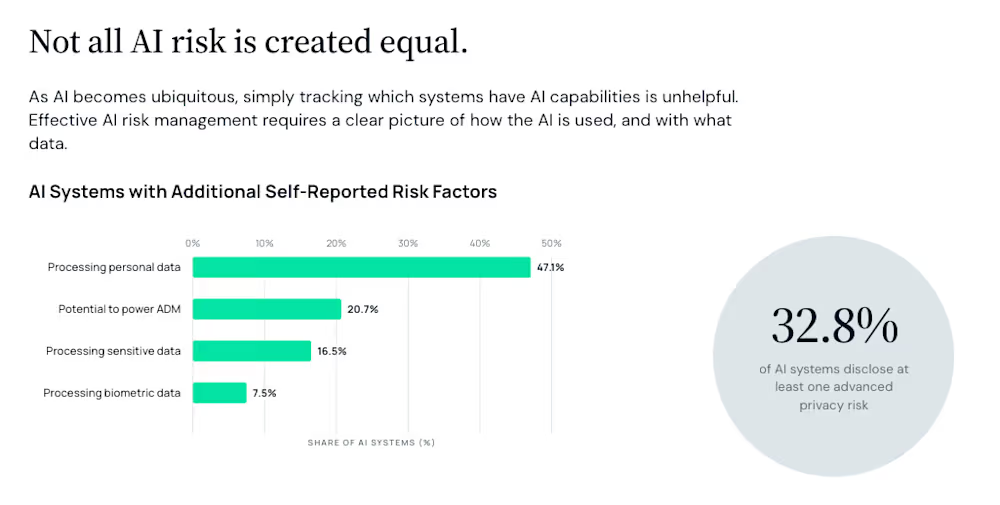
Nearly a third of AI systems acknowledge at least one advanced privacy risk in their disclosures — but with most vendors failing to update their data processing agreements, the actual figure is almost certainly higher. (Source: DataGrail Privacy and AI Trends Report 2026)
One-third of AI systems also process sensitive data, and the true number is likely higher
The disclosure gap alone would be concerning enough. But DataGrail’s report layers on another finding that makes the problem materially worse: 32.8% of AI systems that disclose AI capabilities also disclose at least one other high-risk activity, such as processing sensitive personal information or powering automated decision-making. Among AI systems with self-reported risk factors, 47.1% process personal data, 20.7% have the potential to power automated decision-making, 16.5% process sensitive data categories like health or financial information, and 7.5% process biometric data.
The report argues these figures almost certainly undercount actual exposure, since they reflect only what vendors have formally disclosed. Vendors could underreport access to personal data, and the inherent flexibility of AI means even good-faith vendors might not predict riskier user applications of their tools.
Advertisement
This has immediate regulatory implications. The CCPA’s new risk assessment requirement, effective January 1, 2026, requires businesses to conduct and document risk assessments for processing activities that present significant privacy risks — and will require submission to CalPrivacy by April 2028, with executive attestation under penalty of perjury.
Processing sensitive personal information with AI, or using AI for automated decision-making, are precisely the activities that trigger this obligation. The report finds that 42% of companies abandoned AI initiatives in 2025 with data privacy concerns cited as a primary obstacle — a statistic sourced to S&P Global research. Privacy teams that engage early with AI projects, Barber argues, can prevent that waste by ensuring safeguards are in place before launch, with AI risk assessments serving as the right starting point.
Gambling and consumer technology companies face the heaviest privacy assessment workloads, conducting roughly four times the annual reviews required in the entertainment industry. (Source: DataGrail Privacy and AI Trends Report 2026)
Why consent management became 2025’s most punished privacy failure
While shadow AI is still a newer category of threat, the report makes clear that traditional privacy challenges have not eased — they have intensified. Consent management was the busiest enforcement topic of 2025. California alone publicly reported $4.3 million in CCPA consent settlements, and 2025 saw over 1,400 class action wiretapping suits driven by private firms investigating tracking pixels and session replay software.
Advertisement
Despite this enforcement wave, 63% of the 5,000 websites DataGrail audited still fail to comply with universal opt-out mechanisms such as the Global Privacy Control signal. While that figure represents an improvement from 75% non-compliance in 2023, the pace of improvement is slow relative to the acceleration in enforcement.
Barber pointed to the case of Todd Snyder, the menswear retailer that the California Privacy Protection Agency fined $345,178 in May 2025, as evidence that enforcement is no longer reserved for big tech. “This is a business that has two or three stores across the U.S. They have 300 employees,” he said. “They run tight margins because they’re a consumer menswear clothing store.”
The California Attorney General also reached a $2.75 million settlement with Disney over failures to honor opt-out signals, while the California Privacy Protection Agency has brought enforcement actions against PlayOn Sports and Ford — a pattern that demonstrates both the breadth and depth of regulatory activity. Among the trackers that fire even after a user sends a GPC signal, the report found that 27.1% come from Google Analytics and 43.8% are for targeted advertising via platforms like Meta and Microsoft.
For users who do engage with consent banners, 48.3% click “Accept all,” while only 12.4% select “Essential only” and 2.3% customize their preferences. A full 37% simply exit the banner without making a selection. The practical takeaway: less than 15% of users make a conscious choice to opt out of tracking, which means consent banners present relatively low business risk when properly configured — but enormous regulatory risk when they are not.
Advertisement
Nearly half of users simply accept all cookies when a consent banner appears. Fewer than 15 percent actively choose to limit tracking — a pattern that makes proper banner configuration a high-stakes compliance question. (Source: DataGrail Privacy and AI Trends Report 2026)
Data deletion requests surge 567% as the cost of manual processing hits $1.5 million a year
Data subject request volume hit an all-time high for the fifth consecutive year. Deletion requests have surged 567% since 2021 and now represent 87% of all data subject requests. Access requests, by contrast, have gradually declined as consumers skip visibility and reach straight for the delete button.
The cost is staggering. For a mid-sized organization receiving 5 million annual web visitors, the report estimates manual DSR management now runs approximately $1.5 million per year, based on Gartner’s estimated cost of $1,524 per manual DSR. The average cost has climbed from $238,000 in 2021 to $1.51 million in 2025 — a trajectory that makes manual processing not just inefficient but, as the report argues, “irresponsible.”
Barber emphasized that these numbers reflect verified human requests with bot and spam traffic excluded, and that data broker scenarios — which will see their own massive influx of requests under California’s Delete Act — are reported separately. “That is a natural increase,” Barber told VentureBeat. “If you’ve now got 20-plus U.S. states with privacy regulation, it’s unlikely that we see a federal bill passed, even though we’ve seen one proposed. And while we don’t see federal awareness and regulation, we do see at the state level over 20 states, and that may actually increase awareness for the consumer even more.”
Advertisement
He added a telling detail about how businesses are responding in practice: “99% of DataGrail customers do process that deletion” even for residents of states without privacy laws, “simply because it’s too hard at this point. Discerning and even communicating to the person, ‘Hey, you live in Montana, sorry, you’re just in an unfortunate state without regulation’ — you just can’t do that.” Data brokers felt the impact most acutely, with a 398% increase in deletion requests compared to 2024 and an average of over 2,000 deletion requests handled per month.
The cost of handling consumer privacy requests by hand has risen more than sixfold since 2021. (Source: DataGrail Privacy and AI Trends Report 2026)
State regulators issued $3.4 billion in privacy fines last year, and both parties want more
The regulatory landscape underpinning all of these trends has fundamentally shifted from education to punishment. Nearly half of U.S. states now have a comprehensive privacy law in effect, plus over 160 AI-specific laws. State legislatures enacted 145 AI-related laws in 2025 alone, with another thousand introduced or reworked. According to Gartner, over 50% of the U.S. population is now covered by a comprehensive state privacy law, with 24 additional states expected to pass laws within five years. States have also begun pooling their resources, with ten forming the Consortium of Privacy Regulators last year and pledging to coordinate investigations across state lines.
Barber argued that privacy enforcement is fundamentally bipartisan, which insulates it from the shifting political winds of the current administration. “Privacy overall is a pretty bipartisan issue,” he said. “It’s easy to pass privacy regulation because constituents somewhat expect privacy in their day-to-day living. If you were flying on an airline and they said, ‘Okay, this seat, if you want your privacy, you’re going to have to pay $6 more,’ you’re like, ‘I’m going to go to another airline.’ It’s an expected part of a transaction at this stage.”
Advertisement
He predicted that other states will replicate California’s enforcement model. “California has their enforcement division, CalPrivacy. That group has one task: to ensure enforcement of privacy throughout businesses. Is it likely that we see other states get funding and support to fund these types of groups? Highly likely. The enforcement fines — the actual payments — go back to us as constituents. That type of model, you could imagine, being very popular across the country.”
Privacy teams are losing a third of their staff just as AI governance demands explode
Perhaps the most paradoxical finding in the report is that privacy teams lost as much as 33% of their headcount last year, even as their workloads expanded across every metric the report tracks. Cisco data cited in the report shows that 90% of privacy programs expanded in 2025 due to AI, while only 12% of AI governance programs are considered mature. Meanwhile, 74% of privacy teams planned to apply AI to privacy-related tasks in 2026, according to ISACA’s State of Privacy 2026 survey.
Barber sees this as part of a broader macroeconomic pattern rather than a sign that organizations do not value privacy. “It’s actually a fascinating macro trend, and probably one you’ve seen across all functions,” he said. “Businesses are driving more efficiency in all parts of the business. Privacy teams, five years ago, we would have said, ‘Well, there’s more regulation, the volume of deletions have increased 500%, we need more humans.’ It’s become clear that AI provides capabilities that can do the work for privacy individuals.” He drew an analogy: “They might have had a design team of 20 people five years ago, now they have a design team of five, courtesy of Claude Design or Gamma or whatever the tool may be. I think that’s what we’re seeing here as well.”
DataGrail has positioned its own AI agent, Vera — launched in March 2026 — as part of the answer. Vera is embedded within DataGrail’s existing platform and aims to automate privacy workflows across multiple jurisdictions. The company was also named the first production-ready Model Context Protocol server for privacy, using the standard created by Anthropic to enable customers to launch DataGrail tools from whatever application they are already working in, whether Slack, email, or Claude.
Advertisement
Can a vendor-produced report be trusted to diagnose the problems that vendor sells solutions for?
DataGrail is, of course, a company that directly benefits from the problems its report identifies. The company has raised a total of $84.2 million over five rounds, with its largest being a $45 million Series C in October 2022 led by Third Point Ventures. Its platform addresses precisely the data mapping, DSR automation, consent management, and risk assessment challenges the report spotlights.
Barber acknowledged the tension directly. “It’s a fair statement,” he said when asked about potential skepticism. “DataGrail doesn’t provide a service to keep DPAs up to date — that’s on a business to evaluate how they work with a vendor. What DataGrail does help to do is assessments, and automate those assessments using our AI agent, Vera, to assess that increased risk.”
He argued that the more neutral reading of the data is structural: “This is evidence to show that the DPA unfortunately is not keeping up with technology and the speed at which technology is innovating. That’s both exciting but also we need to accept that’s where we are.” The methodology does lend some credibility to this claim.
The report draws on anonymized privacy operations data from hundreds of enterprise customers, the 2,400-system AI tracking database, and the 5,000-website consent audit — sources that are at least partially independent of DataGrail’s commercial interests. And the broader findings on enforcement spending, DSR volume trends, and regulatory expansion align closely with independently published data from Gartner, Cisco, and state enforcement agencies.
Advertisement
The next frontier: agentic AI could spread unvetted data across entire organizations autonomously
When asked about the most important trend that did not make it into the report, Barber pointed to a next-generation risk that extends the shadow AI problem into far more dangerous territory: agentic AI workflows. Gartner predicts 40% of enterprise applications will feature task-specific AI agents by end of 2026, up from under 5% in 2025 — a pace of adoption that could rapidly outstrip the governance mechanisms companies are only now beginning to build.
“Where we go next with this research is agent processing,” Barber said. “How are agents then leveraging that information? Because the downstream ramifications would be far more concerning for a business. One particular system is using shadow AI, the business has no idea that that’s happening, and then an agent is propagating that information across a whole bunch of other places. The guardrails of you and I checking the system will be lower than maybe what we’ve seen in the past with agentic workflows.”
He framed the distinction in human terms: “The identity of an agent is different than a human. There is thought that goes into what am I about to use here, where did this information come from, how was it collected — that may not be considered in the same way for an agentic workflow. We need to solve the root of the problem, which is how are these businesses leveraging AI subprocessors. But this quickly becomes an agentic problem that could be far more concerning.”
For the enterprise privacy and security leaders absorbing this report today, the uncomfortable truth is that the foundational documents and processes they have relied on to manage vendor risk for years are decomposing in real time. The DPA is breaking down as a reliable instrument. State enforcement is accelerating on a bipartisan basis. Privacy teams are shrinking even as their mandates expand. And the next wave of agentic AI systems threatens to distribute unvetted data processing across networks of autonomous agents that operate with even less human oversight than today’s tools.
Advertisement
Five years ago, when DataGrail published its first trends report, deletion requests were a fraction of what they are today, only a handful of states had privacy laws on the books, and the phrase “shadow AI” did not exist. Every year since, the report has warned that the problem was getting worse. Every year, the data has proved it right. The companies that survive the next chapter will not be the ones with the biggest compliance teams or the thickest policy binders. They will be the ones that accept a disorienting new reality: in 2026, the contracts you signed may not describe the AI that is already processing your customers’ data — and by 2027, autonomous agents may be deciding what to do with it.
The Indian smartwatch market is a unique one. Unlike the rest of the world, where only established players like Samsung and Apple dominate, here in India, we have about 10,000 brands, each competing on razor-thin margins to attract consumers to their smartwatches (or should I say, smartbands repackaged as watches). This makes standing out in the sea of Apple Watch clones all the more difficult. One company that’s never really had that problem is Nothing. Their design language is unique, fun, and stylish. The company’s sub-brand CMF also makes plenty of accessories, including smartwatches.
In 2024, CMF launched the Watch Pro 2, which won the hearts of both experts and users for being a competent yet feature-rich take, with some fun additions. It’s been two years since that announcement, and CMF has just come out with its successor, the Watch 3 Pro (yes, the naming has changed). CMF says the 3 Pro brings many upgrades, including a bigger display, improved GPS, and sleep tracking. But is that enough to justify the new, higher sticker price of ₹7,999 or $99? To find out, I got the CMF Watch 3 Pro a couple of weeks back and put it against my Galaxy Watch. Spoiler alert: It’s really good.
CMF Watch 3 Pro
Hisan Kidwai
Advertisement
Summary
The CMF Watch 3 Pro is one of the best budget smartwatches on the market today. You don’t get gimmicky features. Instead, the design is unique in a fun yet stylish way, with a large dial and a bright AMOLED display that keeps animations fluid at 60Hz. The companion app is slick, and features like ChatGPT integration and Essential News are a decent addition. Workout tracking is fairly accurate, even compared to more expensive watches, and the running coach is genuinely helpful.
Advertisement
Design & Hardware
If you remember the last CMF Watch Pro 2, the 3 Pro would feel right at home, except that all the dimensions have been beefed up. There’s a new 1.43-inch circular AMOLED (up from 1.32 inches) and bezels that have been made slimmer. The panel’s rated for a peak brightness of about 620 nits, and I had no trouble reading notifications on a super-hot day and sending the curated quick replies. The 60Hz refresh rate is plenty to keep most animations fluid.
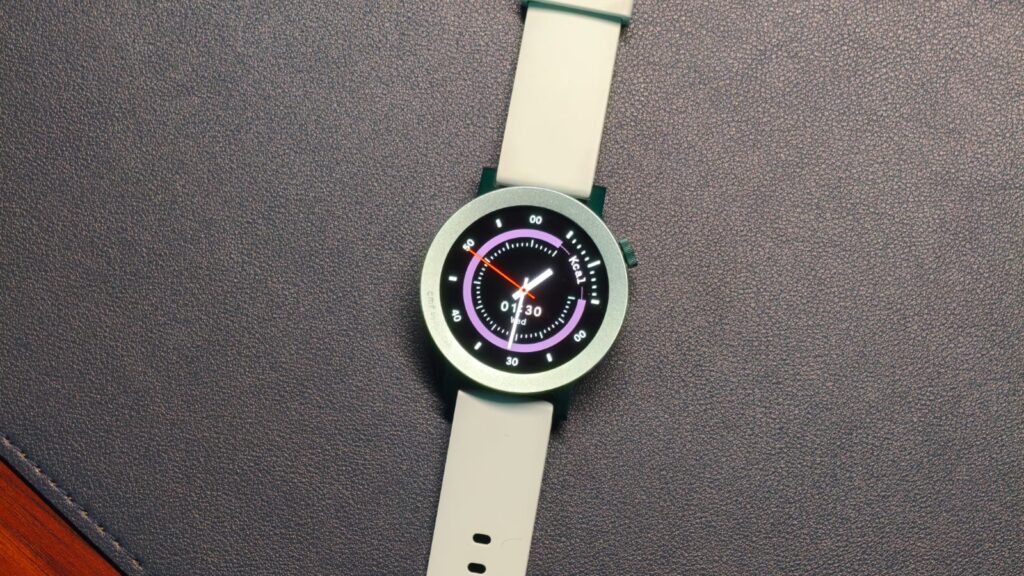
Returning to the design, you get four options. You can either go with my Light Green variant, which is a bit playful, or opt for the understated black look. Both these models have a color-matching ring, which I wish had a rotating dial, but we can’t ask for much at this price. If these two aren’t your vibe, there’s also orange, which feels a bit more rugged with etchings on the ring. At last, we have the light grey that houses a more curved, rounded ring that looks really good, at least to me.
But, you might wonder, why am I bothering with bezel options when CMF allows users to swap them as they wish? Sadly, the swappable bezel feature is gone. You cannot customize the watch, which was such an innovation to add personality. So, choose your design carefully. That complaint aside, I really do love the Watch 3 Pro’s design. You get a single rotating crown that’s used to navigate through the different menus and also serves as a button.
As far as comfort is concerned, there’s nothing to complain about here. The silicone strap is gentle enough not to irritate the skin and offers plenty of adjustments for different wrist sizes. Speaking of size, you might have already noticed that despite years of struggle in the gym, my wrists are thin. To me, the 47mm dial just looks too big, which is something I see many people, especially women, struggling with. Still, if you have big wrists, the CMF Watch 3 Pro would look perfect.
Features & Companion App
The CMF Watch 3 Pro runs on Nothing’s proprietary OS, and after spending years on WatchOS, it’s a breath of fresh air. Often, budget smartwatches feel laggy because no brand spares enough resources to optimize the UI. Well, that’s not the case with the Watch 3 Pro. Nothing has kept the software fairly clean, and everything just works. I didn’t experience any delays or jitters when switching between apps or toggling between workouts. The design language is unique and minimal, with plenty of black-and-white themes. I’d love to see a bit more color, since it’s an OLED display, but it works nonetheless.
While no third-party app support can be a bit of a bummer to some, Nothing has bundled quite a few features to curb that appetite. The newest addition is Essential News. It uses AI to gather today’s headlines and read them out to you. I tried it, and it works fairly well.
What is great, though, is the ChatGPT integration. Basically, there’s an app that lets you directly talk with the AI assistant for quick questions when you might not want to pick up the phone. There’s also a new transcribing feature that lets you record voice notes on the watch itself and transcribe them over on your phone.
Unlike its predecessor, the new watch pairs with the Nothing X app. It’s very polished, and there are many more health-tracking options. These include the ability to configure the frequency at which your heart rate is recorded. You can also configure what the watch does when you rotate or shake your arm.
Advertisement
Performance & Battery
Regardless of all the bells and whistles, the most important thing for any smartwatch is the tracking ability. It’s hard to get accurate numbers, especially when we have some watches that even measure a table’s heart rate. Fortunately, the CMF Watch 3 Pro does none of that. I put it against my trusty Galaxy Watch, and for the most part, it kept up. Heart rates on both watches were very similar, with a variation of just 2 BPM. I’m pretty active in the gym, so it’s important for me to track strength training. The Watch 3 Pro has over 131 workout/sports modes, some of which I’m hearing about for the first time. So whatever you’re into these days will probably be here.
I put the watch in Strength training mode, and yes, I was the guy wearing two health trackers at once. Nevertheless, both kept an eye on my workouts, recording my resting and elevated heart rate, and provided a detailed summary. There are different modes for when you’re using a Smith machine or working with dumbbells. There’s also a Blood Oxygen sensor, which I found comparable to a machine with only slight deviations in the reading.
Still, the best part about the CMF Watch 3 Pro is the running suite. Nothing has bundled a dual-band GPS, and it’s very solid. It takes about 5 seconds to lock onto your position before the run, and the readings were quite comparable to the Galaxy Watch except for the calories, which differed by about 15%. However, if you’re like me and have no experience of running, Nothing has bundled a custom running coach. You set it up in the app, including how many km you plan to run, your pace, and your time goal. Then, you need to complete a trial run. Once that setup is done, the watch creates a custom workout you can follow until your goal is achieved.
Sleep is something I don’t measure, since I don’t need a number telling me I didn’t sleep well last night because I was busy scrolling reels. But for this review, I did. It worked fine on the Watch 3 Pro, with stats such as overall duration and individual cycles. Beyond that, I love the battery life. It’s very nice to have a watch that doesn’t need to be charged every night. Nothing claims a 13-day battery life, but with AOD and sleep tracking, I got roughly 4-5 days of juice, which is pretty decent.
Verdict
At ₹7,999, the CMF Watch 3 Pro lands in a sea of smartwatches, each with its unique set of skills. But after testing it for a few weeks, I can say it’s one of the best I’ve tested so far, simply because it nails the basics. You don’t get gimmicky features. Instead, the design is unique in a fun yet stylish way, with a large dial and a bright AMOLED display that keeps animations fluid at 60Hz. The companion app is slick, and features like ChatGPT integration and Essential News are a decent addition. Workout tracking is fairly accurate, even compared to more expensive watches, and the running coach is genuinely helpful. Not to forget the awesome battery life. Overall, I recommend the CMF Watch 3 Pro.
In a growing number of states, you can add your ID to Apple Wallet. Here’s how to add them, how they work, where they are, what the limitations are, and what they can do.
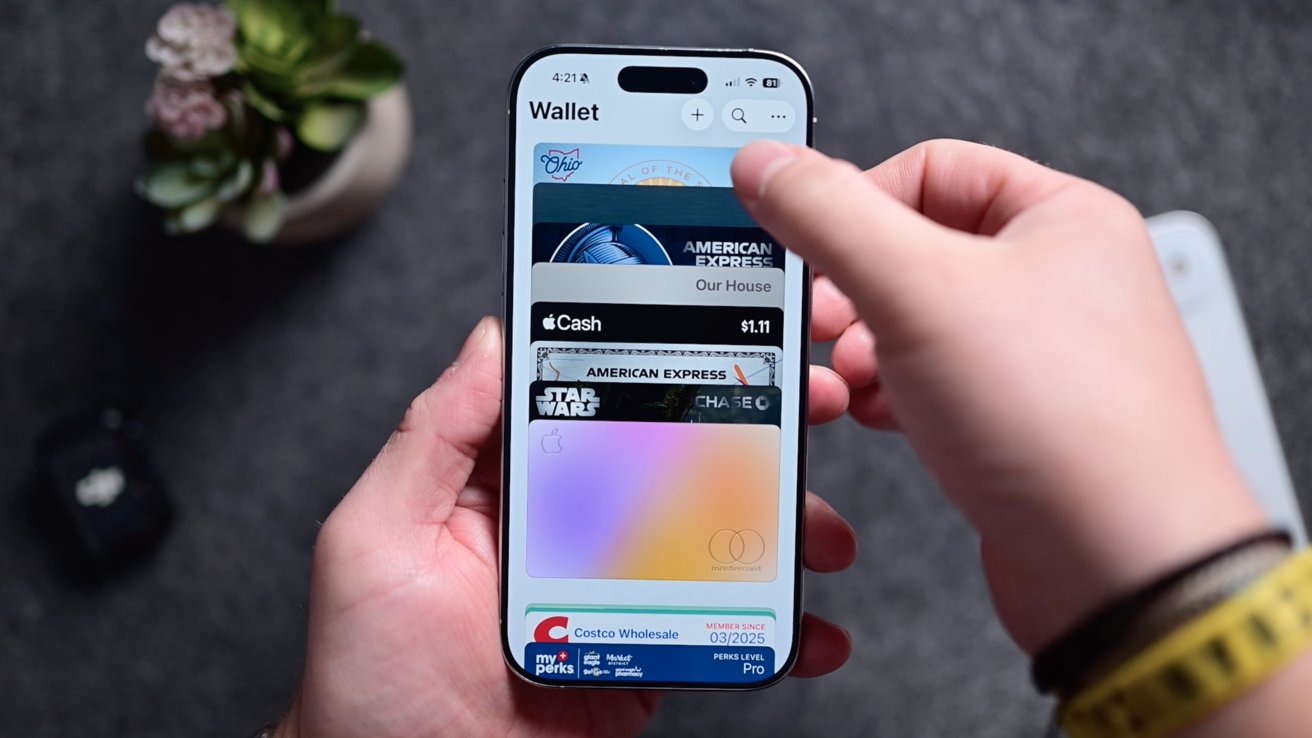
We’re moving closer and closer to a world where you can ditch your physical wallet. You can already add your credit cards, debit cards, loyalty cards, tickets and boarding passes, and most recently — your driver’s license to Apple Wallet.
But the license rollout is not everywhere. This has increased the uncertainty on whether or not your ID can be added and if it can be, where it can be accepted.
This article was last updated on May 27, 2026.
Advertisement
How to add your ID to Apple Wallet
Adding your driver’s license to Apple Wallet is simple.
The verification process will include ways to ensure you are the same person who is adding the ID. You’ll have to scan the front and back of your ID as well as take a series of selfies to match your image on file with the department of motor vehicles in your state.
Apple also introduced a digital ID based on the U.S. passport in iOS 26. Functionally similar to the licenses, it can be used as a form of identification at TSA lines, but it’s not used as an actual passport. It provides a way to make the ID without the person needing a driving license.
The process is similar, except it uses your passport.
IDs can only be added to one phone at a time. If you are setting up a new device before wiping your old one, your ID may fail to add until the erase is complete and the servers catch up.
Advertisement
Which states support digital IDs
One of the bigger problems with digital IDs is where they are supported. As each digital ID is managed by the issuing state, every state has to implement its own program to support them.
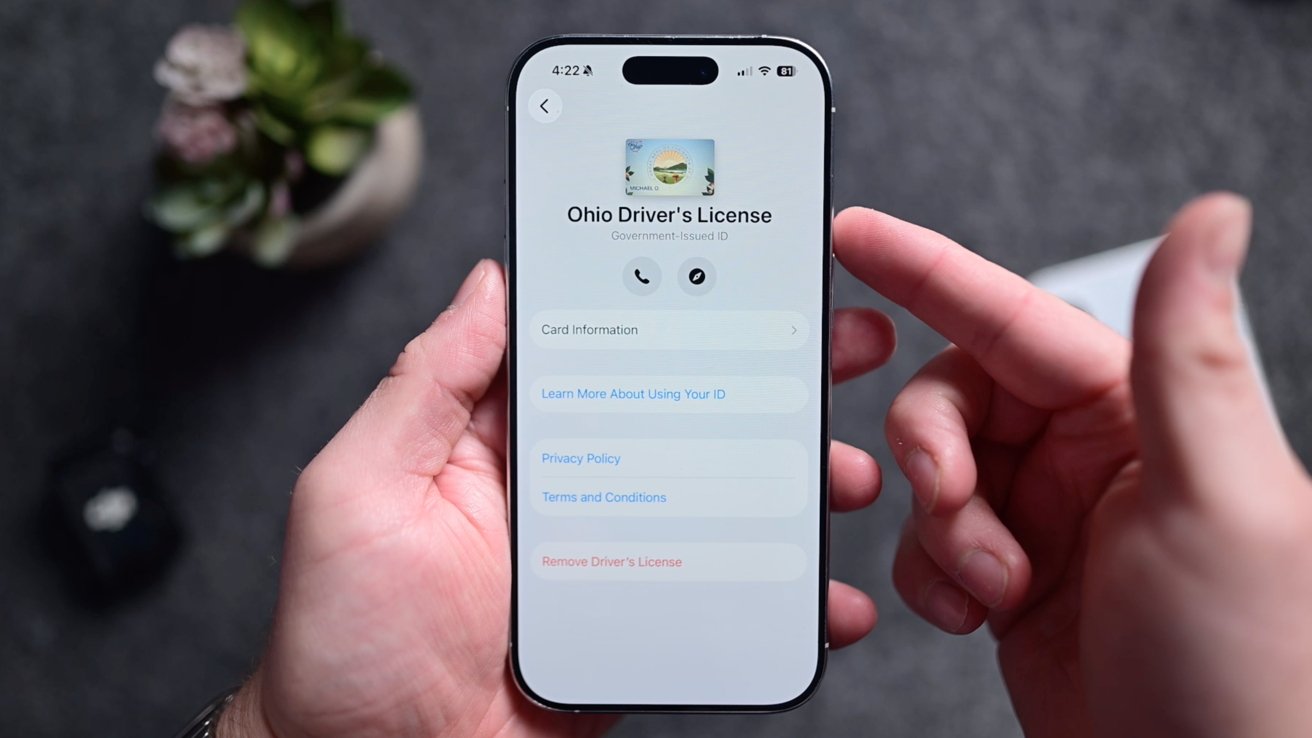
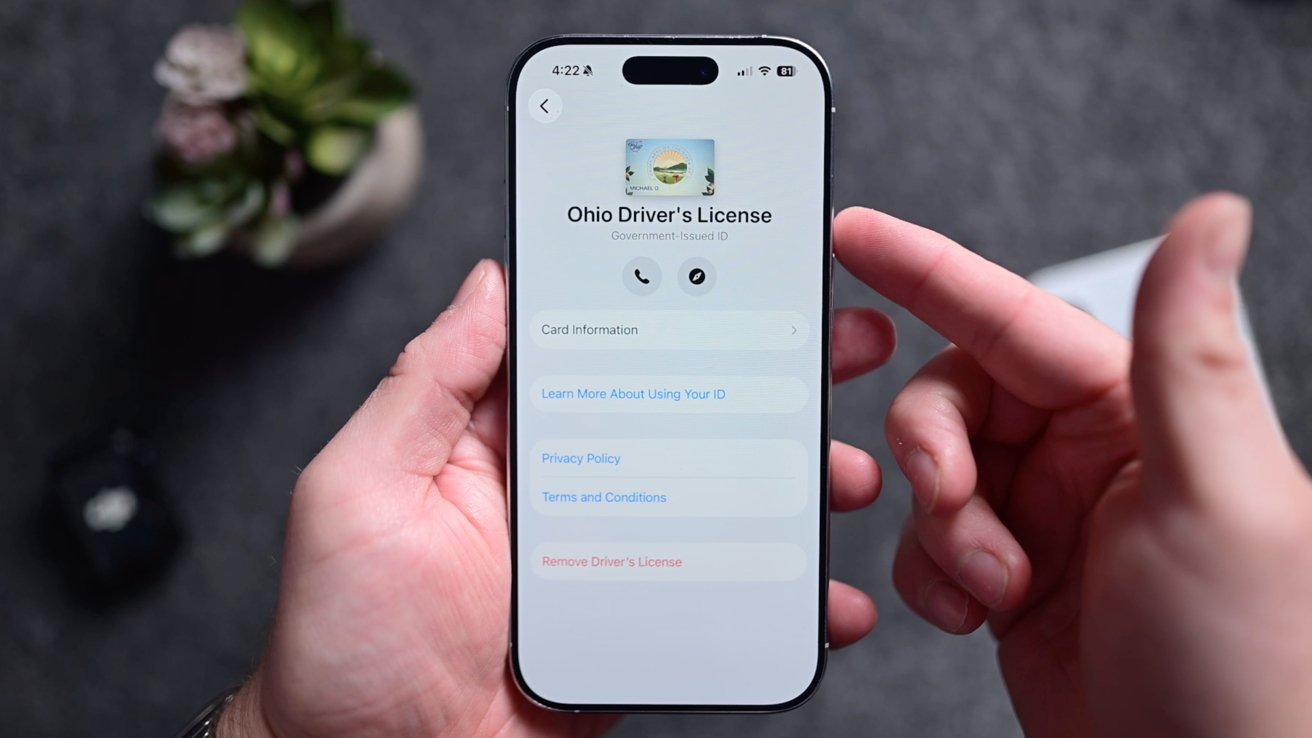
Ohio is one of 10 states and provinces that support digital IDs in Apple Wallet as of mid-2025
As of April 6, 2026, there are 14 states and territories that support Driver’s licenses in Apple Wallet.
Arizona
Arkansas
California
Colorado
Georgia
Hawaii
Illinois
Iowa
Maryland
Montana
New Mexico
North Dakota
Ohio
West Virginia
Puerto Rico
Which states will soon support digital IDs
More and more states are adding support, though. Other states, like Utah, have pledged support but have not implemented it yet.
As for where those states planning to support digital IDs in Apple Wallet are, the list as of April 6, 2026, includes:
Advertisement
Connecticut
Kentucky
Mississippi
Oklahoma
Utah
Virginia
Timelines for the states have not been confirmed, but they have been announced as being on board with the program.
In an ideal world, a digital ID would be accepted in any place your physical ID is accepted. It’s not that simple.
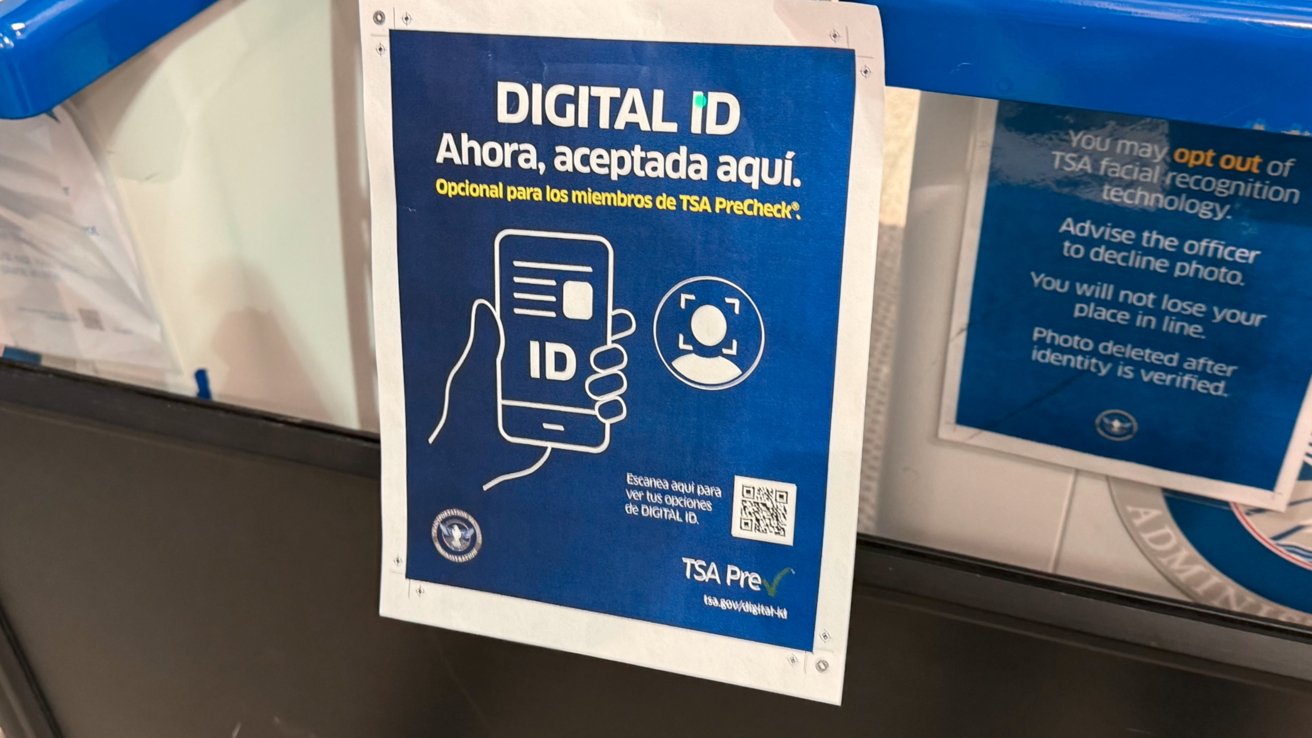
TSA is one of few that regularly supports digital IDs
The most common use for these digital licenses is in airports for TSA. Here in Ohio, we’ve tried it at all the major airports, including Columbus John Glenn International, CAK, and Cleveland Hopkins.
Advertisement
It’s so easy to walk through the TSA line, tap your phone to verify, and keep walking. Of course, if you fly to a state that doesn’t support digital IDs, you’ll still need your physical ID for the return trip.
Outside of airports, there’s not much else you can use it for. Places like bars, liquor stores, doctor’s offices, don’t accept it. There are just a handful of police districts that do, so even if you live in a state that it’s supported, you still need to carry your ID card around.
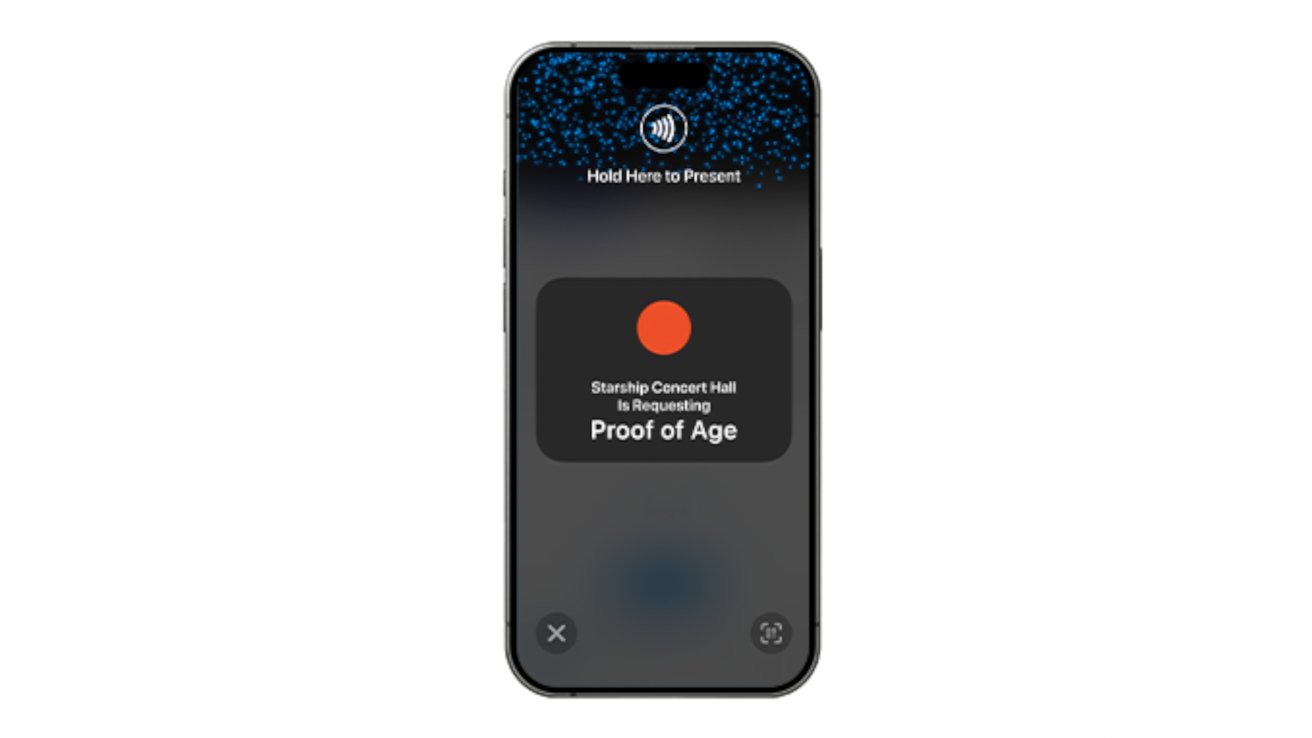
The free ID verification app can be used in Ohio to check digital IDs, like the age at a concert venue
The Ohio BMV offers a free iOS verification app that businesses can sign up for and use to verify any identities with a tap.
Advertisement
That sounds ideal, but in our experience, it is very limited. We’ve found only one business that had the app to verify our age.
Some of the different cards being stored in the Wallet app
Most retailers still requested our physical card to scan the code on the back or swipe it into their legacy point of sale system. That makes it difficult and still necessary to carry around your physical license.
Using digital IDs in apps
Of course, there are other uses for digital IDs rather than just in the physical world. Your ID can also be used in apps.
Advertisement
Apps that support Apple Wallet ID can similarly verify things like your age or identity. Apple says Clear, MyChart, UberEats, and others will be adding support, though it doesn’t look like any of them have as of August 8, 2025.
It’s all about privacy
One of the best parts of digital IDs is the privacy. You only share very limited information.
When you give someone your actual ID, they have all of that info displayed there. With a digital ID, you are only sharing what you are required to share.
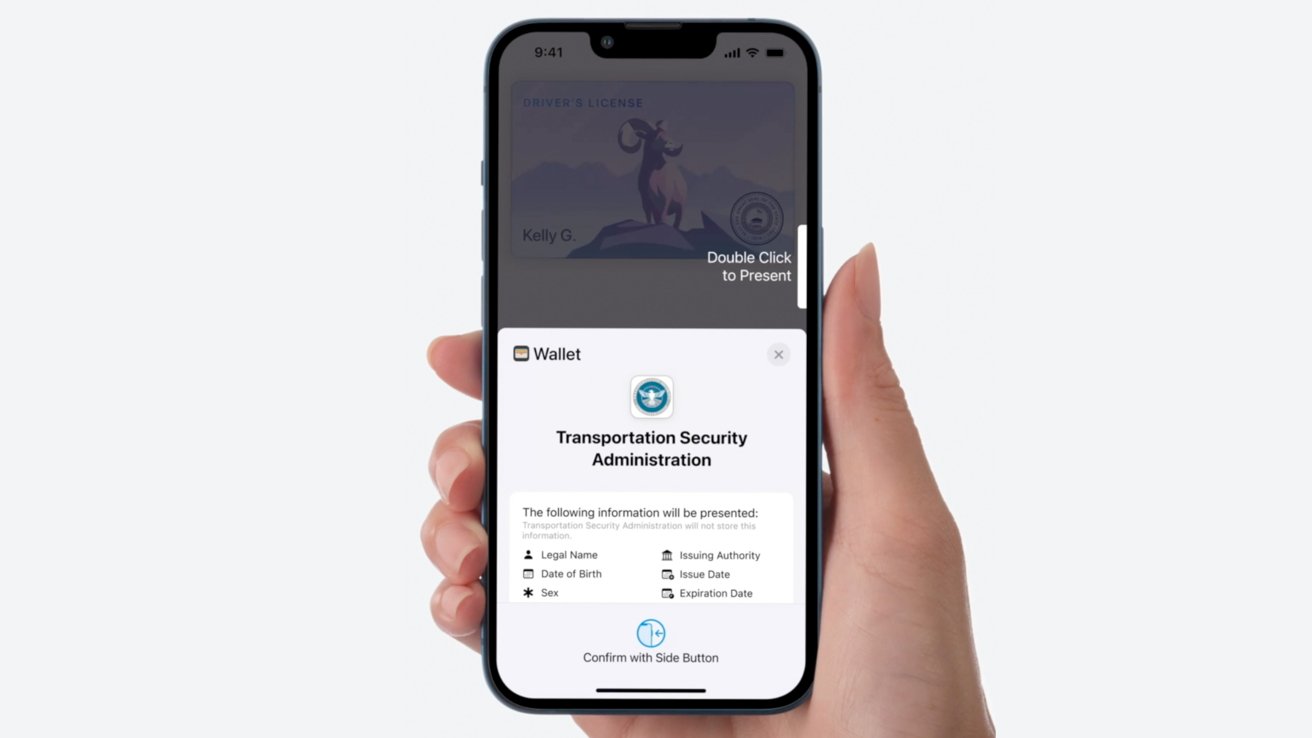
You explicitly get shown information to be shared, before it is transmitted
Advertisement
How it works is that when your ID is requested by either a tap or an app, a card appears with the information that needs to be shared. Before you approve the request, the iPhone will explicitly list what’s being asked for, before you accept the request.
Some may only need your name, while others may only need to request your age. That data is then encrypted, transmitted, and never stored.
Digital IDs may not appeal to everyone, but adoption has started to increase. Hopefully, we’ll see more states, police departments, apps, and businesses start supporting it as more states and users add it too.
Update November 18, 2025: Added Illinois to the list of supported states
Advertisement
Update April 6, 2026: Added Arkansas, Connecticut, Kentucky, Mississippi, Oklahoma, Utah, and Virginia to the coming-soon list.
Update May 27, 2026: Moved Arkansas from coming-soon to the list of supported states
It should be easier to tell at a glance if a YouTube video will contain AI-generated gunk.
YouTube is looking to make it easier for users to tell if a video was made using generative AI tools. The platform already requires creators to disclose any use of realistic-looking AI. Now, YouTube will analyze videos to look for signs of AI-generated content.
If a creator hasn’t disclosed whether they used genAI tools and YouTube’s systems “detect significant photorealistic AI use,” the platform said it will automatically apply an AI label to their video. If the creator believes the label was erroneously included on their video, they can update their disclosure. However, if YouTube detects that a video was made using Google AI tools such as Dream Screen or Veo, or it contains C2PA watermarks (an industry standard used to flag genAI creations), the label will remain in place permanently.
Advertisement
YouTube also suggests it’ll be easier for viewers to see this AI label, which denotes the use of “photorealistic and meaningfully AI altered or generated content.” The platform is making the label more prominent in videos, by placing it right underneath the video player, and on Shorts, where it’ll show up as an overlay.
More transparency (something YouTube says users have been asking for) is very welcome here, particularly for those who would prefer to avoid generative AI as much as possible. It would be nice if YouTube started placing these labels on thumbnails in search results and suggestions as well to make it even easier to avoid such gunk.
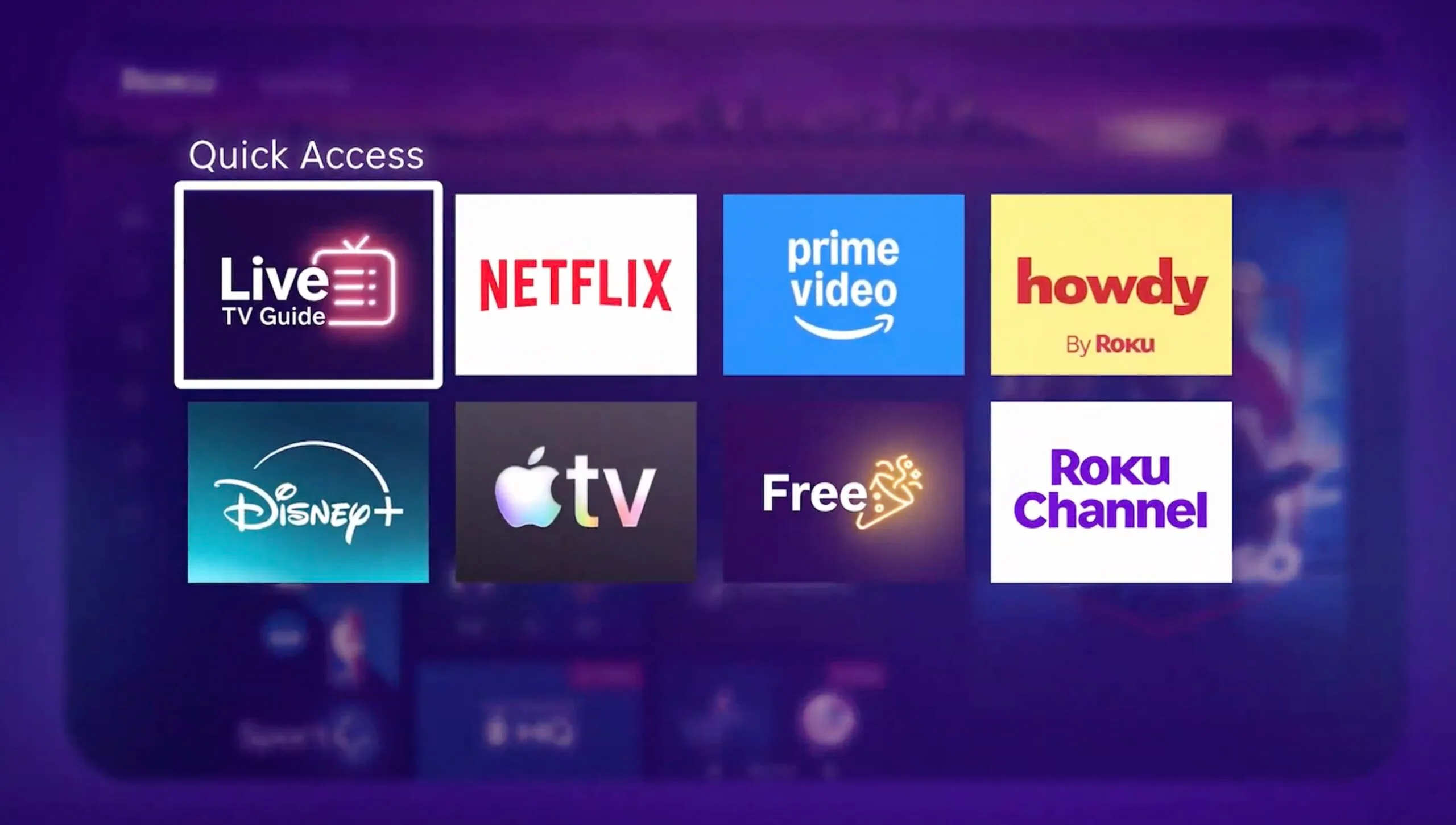
If you own a Roku TV or streaming device, your home screen is about to look very different. Roku just unveiled its most significant home screen redesign in over ten years, rolling out today across all Roku TVs and streaming devices in the US.
Here is everything that is new on your Roku home screen
Roku TV
The redesign introduces several new features built around getting you to content faster. The Quick Access section your most-used apps front and center, powered by AI that continuously adapts to your habits. You can also manually add or remove apps if you prefer to be in control.
At the top of the screen, Top Picks for You is an expanded, personalized content section showing what you love to watch, what is trending on Roku, and the biggest entertainment of the moment.
Roku TV
A new For You destination goes deeper, pulling fresh personalized picks based on your interests. The Subscriptions destination brings together content from all your paid streaming services in one place, so you are not hunting across apps.
Destinations are genre and mood-based hubs spanning comedy, movies, sports, and more, with context-aware search that adapts depending on where you are browsing.
Your Daily Scoop is a real-time AI-powered row that surfaces breakout shows and cultural trends updated hourly. The home screen menu is now collapsible, keeping the interface clean until you need it.
Advertisement
Roku TV
Shortcuts like Continue Watching, Sleep Timer, and Save List are also easier to reach. There is even a new Roku City tile that takes you into an interactive version of the iconic screensaver, complete with Daily Trivia, Roklue and retro games like Roku City Dash.
When will your Roku get the new home screen?
Roku TV
The update rolls out automatically starting today in the US, so just wait for your device to update itself. Roku founder and CEO Anthony Wood says every change was grounded in what users actually do and need, shaped by extensive viewer feedback and behavioral data. Last month, Roku also added six free channels covering classic sitcoms, reality TV, and films.
The RedMagic 11S Pro is a further optimised version of the already great RedMagic 11 Pro with immense, flagship-grade performance, solid battery life, and a bright, detailed and zippy screen. It is a fair bit dearer than its predecessors, though, and the dual 50MP camera array isn’t up to snuff for a phone at this price.
Immense power
Solid endurance
Gaming-centric software is a pleasant touch
Camera performance is underwhelming
More expensive than predecessors
Squirrel Widget
Advertisement
Key Features
Review Price:
£709
Advertisement
Qualcomm Snapdragon 8 Elite Gen 5 Leading Version
The RedMagic 11S Pro has the beefiest chip you can find in a mobile phone for immense gaming performance.
Advertisement
6.85-inch 144Hz AMOLED screen
It has a large and responsive OLED screen with good resolution and a high, zippy refresh rate.
Advertisement
7500mAh battery
This RedMagic phone has a huge battery, plus support for very fast wired and wireless charging.
Introduction
The RedMagic 11S Pro is touted to be the ultimate version of the brand’s latest flagship phone.
Advertisement
A lot of things haven’t changed from the standard RedMagic 11 Pro, with the same dual 50MP camera array, a large 6.85-inch 144Hz AMOLED screen and hefty 7500mAh battery with 80W charging support.
RedMagic seems to have pushed the flagship Qualcomm Snapdragon 8 Elite Gen 5 SoC that’s inside this phone a little by overclocking it against the version you’ll find in modern flagships such as the Oppo Find X9 Ultra, which should theoretically make it one of the best gaming phones we’ve tested.
Advertisement
Plus, its £709/$849 starting price seems rather reasonable for a phone this powerful with 16GB of RAM and 256GB of storage.
Advertisement
I’ve been putting the 11S Pro through its paces for the last week or so to see how it fares.
Design
Blockier, gamer-centric look
Excellent physical controls
Yes, it has RGB lighting
Devices designed more for gaming than anything else often have a funny look to them, and the 11S Pro is no different. Its look doesn’t deviate much from older RedMagic devices, with a blockier and almost more aggressive look than sleeker flagship handsets.
The key elements from the standard RedMagic 11 Pro model have been retained, such as its squared-off, blockier design, while the liquid-cooling window on the 11 Pro also lets you peep at the liquid being pumped around the phone.
Advertisement
Image Credit (Trusted Reviews)
Likewise, there’s all manner of lighting across the phone for added gamer flair, such as a light-up RedMagic logo on the rear, plus the phone’s active cooling fan has a smattering of RGB when in use. Each area can be customised to display a different colour, and you can make these LEDs pulsate along with the sound from the phone, pulse and strobe in different patterns, or just stay on all the time, which is neat.
The 11S Pro is available in two colourways, with the black and blue Nightfreeze colour I have here, plus a Subzero option that trades the black for white and silver for a little more style, and a different finish.
Advertisement
Image Credit (Trusted Reviews)
This phone excels with the physical controls that set it apart from more standard phones, coming with a pair of touch triggers for proper controller-like use alongside the usual power and volume keys. There is also a red toggle for RedMagic’s Game Space mode so you can game without interruptions. On the top side, you’ve even got a 3.5mm headphone jack.
RedMagic rates the 11S Pro to have IPX8 water resistance, putting it some way behind other choices – it provides resistance against submersion in water, although no rating for dust ingress, likely due to that fan.
Advertisement
Screen
6.85-inch 144Hz 1216×2688 AMOLED
1800 nits peak brightness
Sharp and responsive for games, navigation and more
RedMagic says it’s upgraded the screen for the 11S Pro against the 10S Pro by outfitting this new handset with a BOE X10 AMOLED screen. It’s a large 6.85-inch panel with a 1216×2688 resolution for solid detail that’s bright, sharp, and responsive, making it ideal for a gaming device such as this one.
The key thing with this panel is its maximum refresh rate of 144Hz, putting it a touch above the 120Hz we see on lots of other phones, giving it a wonderfully smooth and responsive feel for everything from gaming to general navigation. You can turn this down to 120Hz or 60Hz in the phone’s menus if you want to, or leave it in its default variable form.
Image Credit (Trusted Reviews)
Otherwise, the 11S Pro’s screen is plenty bright, with a peak figure of 1800 nits, making it plenty bright for indoor and outdoor use, and even on the bright summer days over the recent UK May Bank Holiday weekend, the panel stood up well.
The ultrasonic fingerprint sensor under the screen is responsive, and doesn’t suffer from the same issue as other Xiaomi or Honor phones I’ve tested, where it’s mounted quite far down the screen.
Advertisement
Advertisement
Cameras
50MP 1/1.55-inch main snapper
50MP ultrawide
Okay image quality, but only at the wide end
Let’s face it – you aren’t buying a phone as beefy as the 11S Pro for its camera system, although for a device that costs as much as it does, I’d expect a good degree of image quality.
This RedMagic handset features a similar setup to the standard 11 Pro, with a pair of 50MP lenses on the rear of the device – a 50MP main sensor with a 1/1.55-inch sensor, with a stabilised lens, plus a 50MP ultrawide. There isn’t a dedicated telephoto or zoom lens.
Image Credit (Trusted Reviews)
In general here, images out of the main sensor and with the ultrawide are pleasant enough, with reasonable colours and solid resolution of finer details at the wider end of the focal range. Colours tend to be sharpened up and a little brighter than they appear in the real world, though – a sign RedMagic is trying a little harder with its processing for a more ‘pleasing’ image in my view.
With this in mind, pixel-peeping reveals that the exposure of things such as the blue of a sky or the green leaves on trees can lack a little pop, while the lack of a dedicated telephoto lens means you won’t want to zoom in beyond 2x or so.
Advertisement
Advertisement
Image Credit (Trusted Reviews)
Even going up to the 5x range revealed a massive fall-off of quality, while the less about the maximum 10x digital zoom end, the better. Likewise, low light performance at the wide end is better than when zoomed in too much, with resultant images being grainy and lacking in detail.
The 16MP selfie snapper on the front is okay for casual snaps of yourself, although it left me looking a little washed out and smoothed over, unlike other handsets with much stronger detail retention and better colours.
Performance
Flagship class performance
Immense 3D results for gaming
Upgraded active cooling system
RedMagic has upgraded the power station inside the 11S Pro against the older 10S Pro to bring it on par with the standard 11 Pro model – it’s outfitted with the flagship Qualcomm Snapdragon 8 Elite Gen 5 SoC, albeit the Leading Version with higher clock speeds, which means some especially beefy performance that’s befitting of a top-end gaming phone.
Performance here is a touch stronger than that of other Snapdragon 8 Elite Gen 5-powered flagships, such as the Oppo Find X9 Ultra, in our synthetic benchmark tests, perhaps owing to the clever liquid cooling and active fan combo that’s been further optimised against older RedMagic handsets with a larger vapour chamber, upgraded liquid metal and a very fast fan.
Advertisement
Image Credit (Trusted Reviews)
3D performance is especially strong, with this handset blitzing the 3DMark Wild Life Extreme test with scores above the usual suspects of flagship phones, with a score that’s pushing 8000 points. The only thing that’s a little odd is that, in spite of using the same chip, the score here is somewhat lower than the standard RedMagic 11 Pro.
As much as synthetic benchmarking is only one side of the story, it translates well to real-world performance, with the 11S Pro offering remarkably brisk performance in the likes of Wuthering Waves and COD Mobile, which can bring lesser handsets to their knees. It’s more a question of what this phone can’t run than what’s possible with the flagship grunt inside.
Advertisement
Image Credit (Trusted Reviews)
With added touches such as the touch triggers on the side and as much power internally as the 11S Pro has, this feels like a proper gaming phone, rather than a phone that has enough power to play games, and I imagine all this will come in handy for folks wanting to push their phone into the emulation space.
You can spec the 11S Pro with either 12GB or 16GB of RAM, providing more than enough headroom for the intensive gaming this phone is designed for. The higher capacity is reserved for more storage, with 512GB available at the top-end.
Advertisement
Software & AI
RedMagic OS 11, based on Android 16
Oodles of gaming features
Some crud pre-installed
My general gripe with a lot of these lesser-known manufacturers is that they can tend to stuff their phones full of needless crud in terms of apps, system settings and functions you’re never going to use. With the 11S Pro, I was pleasantly surprised in some respects.
It runs RedMagic OS 11, which is the brand’s highly customised Android 16 variant that’s packed to the nines with an array of gaming features, such is the positioning of this phone.
The little red slider switch on the right side of the phone brings up RedMagic’s Game Space, which acts as a console-like dashboard where you can boot up your installed games. While you’re in games, there’s a feature-rich overlay for optimising performance, screen recording, preventing accidental touches and such.
Advertisement
Image Credit (Trusted Reviews)
One of the 11S Pro’s more unique features is the Mora digital assistant that’s likely to be perfect for the weebs in the audience. It’s the brand’s animated waifu mascot that you can do everything from chat to with their AI chatbot function, or leave sitting on your home screen, where they’ll make comments about the phone’s battery percentage, for instance.
Advertisement
Apart from this, this is a more run-of-the-mill Android device, with all of Google’s usual AI powers, such as Circle To Search, Gemini integration and the like, and with the 144Hz screen in tow, RedMagic OS 11 felt slick and zippy.
Image Credit (Trusted Reviews)
That being said, things aren’t entirely perfect. There is some guff pre-installed, such as the Booking.com and Facebook apps, alongside a modicum of games I didn’t ask for, although it’s easy enough to clean the OS up to get it to how you want it to be.
Battery Life
7500mAh battery
80W wired charging
80W wireless charging
This latest handset boasts one of the largest batteries I’ve seen on a modern smartphone, packing in a capacious 7500mAh capacity cell that, in theory, should put a lot of modern flagships to shame. It’s also a slight upgrade over the 7050mAh capacity cell in the old 10S Pro.
This worked out to around eight hours of screen-on time at a higher brightness level for my reasonably intensive day of multi-tasking for social media scrolling, streaming music through Roon Arc or Tidal, taking photos and sorting some work through Google Docs, not least because of how bright it is outside in the merry month of May in the UK at the time of writing.
Advertisement
Advertisement
Image Credit (Trusted Reviews)
For a more scientific test, a cursory run of the PCMark Work V3.0 battery test at 50% brightness worked out to around 12 hours of use. This isn’t ground-breaking, but it is still enough juice to get you through a working day or two with the handset with little fuss.
RedMagic ships an 80W wall plug with the 11S Pro, although it was European-flavoured, which meant I couldn’t use it to test the phone’s charging speeds. Instead, I used my usual 66W 6A Honor adapter, which was still brisk in its speeds, taking 30 minutes to get the phone back to 50 percent and 61 minutes to get back to full charge. It can also do 80W over wireless charging, assuming you’ve got a high-enough wattage RedMagic adapter, which I don’t.
Squirrel Widget
Should you buy it?
The overclocked Snapdragon 8 Elite Gen 5 SoC inside the RedMagic 11S Pro impresses with the immense grunt that pushes it to the top of our benchmark charts.
Advertisement
This phone has some trade-offs, though, such as a dual 50MP camera array that leaves a lot to be desired in terms of colour accuracy, detail resolution and zoom performance.
Advertisement
Final Thoughts
The RedMagic 11S Pro is a further optimised version of the already great RedMagic 11 Pro with immense, flagship-grade performance, solid battery life, and a bright, detailed and zippy screen. It is a fair bit dearer than its predecessors at £709/$849, though, and the dual 50MP camera array isn’t up to snuff for a phone at this price.
The normal RedMagic 11 Pro has a lot of the same fundamentals as this 11S Pro, and gives you a similar result for a little bit less in terms of money – it’s only the real power users who will benefit from the extra performance by its overclocked SoC.
The new Honor 600 Pro is a more rounded choice at a little bit of a higher price tag, with a much stronger camera system, similarly solid battery life and less polarising looks, although it doesn’t have as much grunt under the hood. For more options, check out our list of the best phones we’ve tested.
Advertisement
Advertisement
How We Test
We test every mobile phone we review thoroughly. We use industry-standard tests to compare features properly and we use the phone as our main device over the review period. We’ll always tell you what we find and we never, ever, accept money to review a product.
Find out more about how we test in our ethics policy.
Used as a main phone for over a week
Thorough camera testing in a variety of conditions
Tested and benchmarked using respected industry tests and real-world data
FAQs
What processor does the RedMagic 11S Pro have?
The RedMagic 11S Pro has the latest Qualcomm Snapdragon 8 Elite Gen 5 inside.
Advertisement
Is the RedMagic 11S Pro water-resistant?
The RedMagic 11S Pro has an IPX8 water resistance rating.
As we’ve previously noted, Brendan Carr recently launched a series of phony inquiries into ABC because Jimmy Kimmel made fun of the president’s wife. Carr can’t just come out and say that, so he’s launched a series of fake (and legally laughable) “investigations” into the company. They’re all designed to scare ABC, and other big media companies, away from platforming critics of the unpopular president.
“If you platform voices critical of the president you’ll face an endless barrage of costly and annoying legal headaches and bad press in the right wing media,” is the unsubtle threat.
It’s all a very big pile of racism, ignorance, zealotry, and censorship pretending to be serious adult policy. And you’ll notice the inquiries only go one way: Carr has nothing to say about Fox News (or countless local right wing broadcast new affiliates and AM radio stations) routinely airing right wing propaganda. Right wing outlets can do whatever they’d like without criticism or repercussion. Funny, that.
Advertisement
As part of the proceedings, Carr has repeatedly threatened to pull one of ABC’s eight broadcast licenses if they refuse to roll over to the administration (they haven’t… so far).
Last week, Carr pretended he was open to receiving public input about the whole ignorant mess. The FCC Media bureau issued a public notice seeking opinions on whether The View qualifies for the bona fide news exemption to the FCC’s equal-time rule, which requires equal time for opposing political candidates on non-news programming. From the notice:
“Does The View qualify as a bona fide news interview program? Does the federal equal opportunities statute pass relevant constitutional scrutiny, either as a general matter or as applied here? Are the relevant decisions on The View, including on format and participants, based on newsworthiness or on an attempt to oppose or support particular candidates within the meaning of FCC precedent? We welcome comment on these and any other relevant points.”
The last page of this document has details on how you can formally comment. Of course, Brendan Carr doesn’t really welcome public input; they’re looking to make this appear like a meaningful public policy initiative, and not the censorial witch hunt it actually is. I suspect the call for comments, as is usually the case, will be flooded with all sorts of bots and fake people.
As we’ve mentioned previously, ABC’s daytime talk show The View hosted Texas Democrat James Talerico last February. The Trump administration is apparently unhappy with the inroads Talerico has been making with Texas Christians and independents. So Carr has falsely claimed that platforming Talerico violated the FCC’s equal time rule, requiring ABC file appropriate paperwork and platform a Republican voice in opposition.
Advertisement
But as ABC’s recent notice to the FCC makes clear, The View was clearly granted an FCC Bona Fide Exemption to the rule back in 2002. Most talk shows have broadly been viewed as exempt since 1984 or so (and increasingly so, as the Internet challenged TV’s supremacy). So there’s nothing to really debate.
Carr knows that, so instead he manufactured a controversy. But it’s worse than that: as ABC’s filing made clear, Carr appears to have worked collaboratively with right wing local broadcasters to make it seem like ABC-owned Houston affiliate KTRK had done something wrong. They collaborated on a big performance to make it seem like KTRK broke the law.
This is all so profoundly stupid it would be laughed immediately out of court in a functional country. But a corporate media, worried they won’t get mergers approved (or could face costly legal headaches for having a spine), has generally chosen to roll over both in their official capacity, and as reflected by their journalism.
As a result, most of the reporting on Carr’s censorship has generally either failed to call out Carr’s behaviors as radical or extreme, or they’ve taken a “both sides” approach to the story where they frame everything as a matter of two equally valid opinions, in turn normalizing authoritarian censorship.
Advertisement
But make no mistake: Carr’s a censorial authoritarian zealot engaged in a laughable and racist government harassment campaign because the U.S. President is a giant baby with a historically fragile ego. And Brendan Carr should never be allowed to live it down.
Dropbox founder Drew Houston is stepping down as CEO after 19 years and will become executive chairman, with product chief Ashraf Alkarmi set to take over after a co-CEO transition period. CNBC reports: Drew Houston founded Dropbox
nearly two decades ago at age 24, eventually becoming a household name in Silicon Valley and the first tech entrepreneur to take a company from the Y Combinator incubator program all the way to the public market. Now, at 43, Houston is ready to do something else. […]
By almost any measure, Houston has had a great run at Dropbox, helping pioneer the cloud storage market, competing head-to-head with Google and Apple and building a net worth of more than $2 billion, thanks to substantial ownership in his company. But in the land of outsized expectations, Houston has overseen a company that peaked too soon and never became a generation-defining brand.
Dropbox’s current market cap of just over $6 billion is down by half from the high price on its first day of trading in 2018, and is below the $10 billion valuation it was ascribed by private market investors in 2014. […] In its latest quarterly earnings report, Dropbox said it has more than 18 million paying users, and the service remains popular with media professionals, graphic designers, architects, and others who share files and photos as part of their daily work. “Part of me has always thought, oh yeah, I’ll be the CEO of Dropbox until my last gasp of my career,” he said. “There’s never a perfect time, there was no part of me where I was like, ‘oh, this date is the date where it’s going to happen.’”
Since Alkarmi joined Dropbox from Vimeo in late 2024, the company has “become a lot more responsive to our customers and is taking bigger swings on innovation,” Houston said. “I trust the right leader,” he said. “The company’s in the right place.”
























































You must be logged in to post a comment Login