

Business
Which Semiconductor Stock Offers Best Value in Late 2026?


NEW YORK — As investors weigh opportunities in the semiconductor sector amid the ongoing artificial intelligence boom, the choice between Intel, NVIDIA and Taiwan Semiconductor Manufacturing Co. (TSMC) has become a central debate for portfolios seeking exposure to chips powering data centers, consumer devices and advanced computing.
Each company occupies a distinct position in the semiconductor ecosystem. NVIDIA dominates AI accelerator chips, TSMC leads as the world’s premier contract chip manufacturer, and Intel is executing a high-stakes turnaround in both processor design and foundry services. With the sector facing strong long-term demand but short-term volatility from capital spending cycles and geopolitical risks, analysts differ on which stock offers the most compelling risk-reward profile heading into the final months of 2026.
NVIDIA: AI Dominance with Premium Valuation
NVIDIA remains the clearest pure-play beneficiary of the AI surge. The company continues to command an estimated 80-85% share of the AI GPU market, with its Blackwell and upcoming Rubin platforms driving substantial revenue. First-quarter fiscal 2027 results showed record performance, though some investors have expressed caution over high valuations and potential slowdowns in hyperscaler spending.
The stock has delivered strong returns but experienced periods of consolidation in 2026 as the market digests massive prior gains. Analysts generally maintain bullish outlooks, citing sustained AI infrastructure buildouts and new applications in robotics and autonomous systems. However, the premium multiple leaves limited margin for error if AI capital expenditure growth moderates.
TSMC: Stable Foundry Leader with Clear Visibility
TSMC stands out as the most consistent and lower-risk option among the three. As the manufacturer for NVIDIA, Apple, AMD and others, it captures broad industry growth with exceptional execution. The company has raised full-year growth guidance multiple times in 2026, benefiting from strong demand for advanced 2nm and 3nm processes.
Analysts frequently describe TSMC as the “picks and shovels” play in the AI gold rush, with more predictable revenue streams and strong margins. Geopolitical risks tied to its Taiwan base remain a concern, but the company’s strategic importance has drawn international support and diversification efforts. For conservative investors seeking semiconductor exposure with lower execution risk, TSMC often ranks as the preferred choice.
Intel: High-Risk Turnaround with Significant Upside Potential
Intel has delivered one of the most dramatic stock recoveries in the sector during 2026, with shares surging over 200% in some periods after a multi-year slump. The company’s 18A process node has shown promising yields, and it has secured partnerships with NVIDIA, Tesla and others for foundry services. U.S. government support and foundry ambitions have fueled optimism.
However, Intel still faces profitability challenges in its foundry business and must prove it can consistently win major external customers against TSMC. Some analysts have grown cautious on valuation after the sharp rally, with recent downgrades citing rich pricing relative to near-term execution risks.
Comparative Outlook for Late 2026
NVIDIA offers the highest growth potential but carries elevated valuation risk. Strong AI demand should continue, yet any signs of hyperscaler budget fatigue could trigger volatility.
TSMC provides the most balanced profile — strong secular tailwinds, industry-leading technology and more stable financials. It benefits regardless of which chip designer wins market share.
Intel represents the highest-risk, highest-reward option. Successful foundry execution and data center CPU gains could drive further upside, but delays or competitive losses might pressure the stock.
Diversification across all three may offer the most prudent approach for many investors, balancing NVIDIA’s growth, TSMC’s stability and Intel’s turnaround optionality. Sector fundamentals remain supportive, with global semiconductor sales projected to approach or exceed $1 trillion in 2026, driven primarily by AI infrastructure.
Key Risks Across the Sector
Geopolitical tensions, particularly around Taiwan, represent a shared risk for all three companies. Supply chain disruptions, export restrictions and capital expenditure shifts by major cloud providers could influence performance. Additionally, energy costs for AI data centers and potential economic slowdowns remain watchpoints.
Longer-term, the AI investment cycle, advancements in alternative computing architectures and regulatory developments will shape relative performance.
Investment Considerations
Investors should assess their risk tolerance, time horizon and portfolio allocation before deciding. Those with higher risk appetites may favor NVIDIA or Intel for potential outsized returns, while conservative investors might prefer TSMC’s more predictable growth profile.
Dollar-cost averaging and thorough fundamental analysis remain advisable in this dynamic sector. Professional financial advice tailored to individual circumstances is recommended before making investment decisions.
The semiconductor industry’s importance to technological progress and economic growth ensures continued attention on these leading players. As 2026 progresses, quarterly results, AI adoption metrics and geopolitical developments will provide further clarity on which company is best positioned for sustained success.

Business
US Stock Market: Goldman Sachs raises S&P 500 target to 8,000 on AI-driven earnings optimism

The revised target implies a potential upside of about 6.4%, highlighting the brokerage’s growing confidence in the strength of the U.S. corporate sector despite concerns around inflation, geopolitical tensions, and slowing consumer demand.
According to Reuters, Goldman Sachs believes earnings growth has been the primary force behind the market’s rally this year and expects the trend to continue in the months ahead. The brokerage noted that rising profits, rather than valuation expansion, have largely powered gains in the benchmark index.
The Wall Street firm also upgraded its earnings-per-share estimates for the S&P 500. Goldman now expects earnings to reach $340 in 2026, representing a projected annual growth of 24%, while forecasts for 2027 were lifted to $385 per share, implying another 13% increase.
The bullish revision adds to a broader wave of optimistic calls from major brokerages. UBS Global Wealth Management also raised its market outlook recently, pointing to robust AI-driven earnings growth that could help offset inflationary pressures and supply-chain risks linked to the ongoing Iran conflict.

Goldman Sachs expects companies tied to AI infrastructure development, particularly semiconductor and technology firms, to remain key contributors to earnings growth. The brokerage estimates that AI-related beneficiaries could account for nearly half of the S&P 500’s earnings expansion this year.
While Goldman acknowledged risks from softer consumer spending and elevated operational costs, it believes strong investment in AI technologies and infrastructure will continue to support profitability across major sectors.Goldman analysts observed earnings estimates for the broader index rising faster than stock prices in recent months, while semiconductor companies central to the AI boom have continued to outperform even their improving earnings outlooks.
The latest forecast underscores how deeply AI enthusiasm has become embedded in Wall Street’s expectations for future corporate growth and market performance.

Shell has taken Woodside Energy and Paladin Resources to court over another clean-up bill to decommission Northern Endeavour, claiming $83 million in compensation.


FAA orders SpaceX to investigate Starship booster mishap

Abstract
- A Deloitte report positions Asia Pacific as the leading region for agentic AI adoption in retail, driven by over 4.3 billion consumers, 18 megacities, and existing super-app infrastructure. Currently 29% of consumer businesses in the region use agentic AI, a figure expected to reach 76% within two years.
- Despite this momentum, significant execution gaps remain, with only around 30% of businesses successfully moving AI initiatives into production. Retail executives broadly anticipate AI surpassing traditional search by 2026 and compressing the multi-step shopping journey by 2027, making data governance, system interoperability, and consumer trust central challenges for the industry.
The fate of retail’s future won’t be determined in Silicon Valley. That determination will happen in Jakarta, Mumbai, Singapore, and Shanghai, and the remainder of the world would do well to take careful note.
A new report from Deloitte makes the case plainly: Asia Pacific is positioned to lead the agentic era of commerce, not follow it. The numbers behind that claim are hard to argue with. The region is set to drive roughly two-thirds of the world’s new retail sales over the next five years, underpinned by more than 4.3 billion shoppers, 18 megacities, and the fastest-growing middle class on the planet. That is not a foundation that invites complacency. It is a launching pad.
The Tipping Point Has Arrived
Agentic AI, software that doesn’t just respond to prompts but acts autonomously on a user’s behalf, is no longer a laboratory experiment. It is entering the retail mainstream at a pace that should unsettle any executive still treating AI as a future-state aspiration.
Almost three-quarters of Asia Pacific consumers are already using AI to discover, compare, and learn about products. That figure alone reframes the competitive landscape. When the majority of your customers are already delegating parts of the shopping journey to an AI assistant, the question is no longer whether your business needs to respond. It is whether you are already too late.
The adoption curve reinforces the urgency. Today, 29% of consumer businesses in the Asia Pacific report they are adopting agentic AI, but that share is expected to surge to 76% within two years. In the history of enterprise technology, very few transitions have moved at this speed. The last comparable shift, the pivot to mobile commerce, took the better part of a decade for the industry to absorb. Agentic AI is on track to compress that timeline to a fraction.
A Region Built for This Moment
What makes Asia Pacific uniquely suited to lead this transition is not simply scale. It is architecture. Vivek Sharma, Consumer Industry Leader at Deloitte Southeast Asia, put it directly: “Agentic AI will redefine commerce in Southeast Asia because this is a region where discovery, conversation, and transaction already converge across super-apps, social platforms, and physical retail.”

He is right. The digital infrastructure that Western markets are still building, the convergence of payments, messaging, social commerce, and logistics into single platforms, already exists across much of the region. Asia Pacific consumers did not simply adopt e-commerce; they remade it. The step from super-app ecosystems to agent-mediated commerce is, in many ways, a natural evolution rather than a disruptive leap.
The Execution Gap Is Real
But the report does not offer uncritical optimism, and neither should we. Despite the momentum, only around 30 percent of Asia Pacific consumer businesses report that at least 40 percent or more of their AI initiatives actually reach production, with implementation challenges among the top barriers. This is the quiet crisis beneath the headline enthusiasm: a widening gap between strategic ambition and operational delivery.
Investing in AI and deploying AI at scale are two entirely different disciplines. The businesses that will capture disproportionate value in the agentic era are not necessarily those with the largest AI budgets. They are those who have done the unglamorous work of getting their data foundations right, building interoperable systems, and establishing governance frameworks capable of supporting autonomous action. Without these, even the most sophisticated AI agents will fail in production.
The Shopping Journey Is About to Collapse
Perhaps the most striking data point in Deloitte’s findings concerns the timeline ahead. Nine in ten retail executives expect AI to be used more than traditional search engines by 2026, while half expect today’s multi-step shopping journey to collapse by 2027. That is an extraordinary forecast to absorb. The discovery-research-compare-decide-purchase sequence that has structured consumer behaviour and retail strategy for decades may effectively cease to exist within the next two years.
What replaces it is a world in which a consumer’s AI agent does most of that work invisibly, searching, comparing, and in some cases completing the transaction, before the human ever becomes actively involved. Industry forecasts suggest agents could influence or directly handle as much as 25 percent of global e-commerce sales by 2030. Brands that are not structuring their data, pricing, and product information to be legible to AI agents, not just human shoppers, are building for a world that is already passing.
That said, trust will prove the decisive constraint on speed. Two-thirds of retail leaders surveyed by Deloitte do not expect customers to fully embrace agents purchasing on their behalf before 2028, though search, comparison, and AI-powered recommendations are far more imminent. Consumers are willing to delegate discovery. They are more cautious about delegating the checkout button. This is a nuance the industry should treat seriously rather than engineer around.
The Six Imperatives No Executive Should Ignore
Deloitte’s report outlines six business imperatives for retail leaders entering this era. Rather than rehearse them in full, it is worth dwelling on the two that most often get overlooked in the rush toward AI adoption.
The first is data governance. As agents get to work, organisations must shift from traditional data and analytics governance to continuous, policy-driven data management to ensure safe and compliant autonomous action. This is not an IT department issue. It is a boardroom issue. Autonomous agents operating on bad data, or without clear guardrails, will not merely underperform. They will actively damage customer relationships and brand trust at machine speed.
The second is the reinvention of physical retail. In a world where an increasing share of routine purchasing is handled by AI, the physical store must become something that AI genuinely cannot replicate. In Asia Pacific’s experiential and community-driven retail cultures, the retailers who lead will be those who reposition stores as intelligent, social and sensory-led environments in an increasingly automated landscape. The stores that survive the agentic era will not be the most efficient ones. They will be the most irreplaceable ones.
The Window Is Narrow
The strategic window for gaining a meaningful advantage in agentic commerce is not years wide. It is months wide. The businesses that move now, investing in the unglamorous foundations, redesigning customer experiences for agent-mediated journeys, and building the trust architecture that consumers will demand, are the ones that will still be relevant when the transition reaches full velocity.
Asia Pacific has the consumer base, the digital infrastructure, and increasingly the AI ambition to define what agentic commerce looks like for the rest of the world. Whether the region’s businesses execute on that potential is, as Vivek Sharma noted, a question of strategic vision and systemic transformation, with trust and governance at the core.
The technology is ready. The consumers are ready. The only remaining question is whether the industry is.
Other People are Reading

The strikes come despite a ceasefire between Tehran and Washington as the two countries hold peace talks.


Albert Anthony is the pen name of a business author on Amazon and his newest book is “How To Pick Stocks: 8 Steps For Long-Term Investing with Fundamental & Technical Analysis,” now available as a 2026 edition paperback and Kindle ebook in several regions including the US, UK, Canada, and Europe. The author is an analyst & contributor for investing platform Seeking Alpha since 2023, where he has nearly 2,000 followers and has covered hundreds of stocks in multiple sectors including banks/financials, REITs, insurance, pharma, and more. He has also written for platforms like Investing dot com, and has taken part in many business conferences includes Bloomberg Adria’s Investment Outlook 2026 as well as Money Motion 2026. Albert Anthony has Croatian-American roots, having grown up in the US and living in the NYC/New Jersey area as well as the Austin Texas area while working in enterprise IT roles at several prominent companies, including a top 10 financial firm. The author earned a B.A. from Drew University, and also completed certifications from Microsoft, CompTIA, and Corporate Finance Institute where he earned the specialization in risk management. He is founder of a boutique equities research firm, Albert Anthony & Company, which is a trade name both in the US and Croatia. Besides his writing and analyst work, the author has been active on camera as well, as a film/TV extra for casting agencies in Croatia/Europe, and also took part in roundtable panel discussions and appeared in several media stories in that region. You can also check out the author’s video content on the Albert Anthony channel on YouTube where he discusses investing topics, @author.albertanthony Please note: The author does not write about non-publicly traded companies, small cap stocks, crypto, or startup CEOs, so any such mail received and pitches from PR agencies will be deleted. Any official mail to the author should be sent to albertanthony.info@gmail.com. *Author Disclaimer: Albert Anthony and Albert Anthony & Co, is a US-based sole proprietorship registered as a trade name in Austin, Texas, and a sole proprietor registered in Croatia. The author nor his company are registered financial advisors and do not provide personalized financial advisory services to clients and do not manage client assets but provide general markets commentary and research as well as actionable insights based on publicly-available data and their own analysis. The author does not sell or market financial products and services, nor is compensated by any company for rating them. The author does not hold any material position in any stock he rates at the time of writing, unless otherwise disclosed. All investment is assumed to be at risk and readers are expected to do their due diligence beyond the scope of this author’s commentary, agreeing to indemnify the author of any liability for potential investment losses.
Analyst’s Disclosure: I/we have no stock, option or similar derivative position in any of the companies mentioned, and no plans to initiate any such positions within the next 72 hours. I wrote this article myself, and it expresses my own opinions. I am not receiving compensation for it (other than from Seeking Alpha). I have no business relationship with any company whose stock is mentioned in this article.
Seeking Alpha’s Disclosure: Past performance is no guarantee of future results. No recommendation or advice is being given as to whether any investment is suitable for a particular investor. Any views or opinions expressed above may not reflect those of Seeking Alpha as a whole. Seeking Alpha is not a licensed securities dealer, broker or US investment adviser or investment bank. Our analysts are third party authors that include both professional investors and individual investors who may not be licensed or certified by any institute or regulatory body.
Business
ETMarkets Smart Talk | Don’t mistake FII outflows for a loss of confidence in India’s growth story: Himanshu Srivastava

However, Himanshu Srivastava, Principal Analyst at Morningstar India, believes the outflows should not be interpreted as a loss of confidence in India’s long-term growth story.
In this edition of ETMarkets Smart Talk, Srivastava explains that the selloff was driven largely by a combination of global risk aversion, elevated US yields, geopolitical uncertainties and stretched valuations in certain pockets of the Indian market.
He argues that foreign investors are becoming more valuation-conscious rather than structurally bearish on India, while highlighting the resilience shown by domestic investors during the correction.
Srivastava also shares his views on the growing role of passive investing, the future of India’s weight in global emerging market portfolios, the impact of currency movements on foreign flows, and why the country’s structural growth narrative remains firmly intact despite near-term volatility. Edited Excerpts –
Kshitij Anand: In your report, you suggested that India-focused offshore funds and ETFs saw net outflows of nearly $5 billion in the March 2026 quarter. How much of this is India-specific, and how much is simply global risk aversion at play?
Himanshu Srivastava: I would say the outflows were driven by a combination of both global and India-specific factors, though global risk aversion was probably the larger driver during the quarter.
Globally, the investment environment turned extremely challenging for emerging markets. We had heightened geopolitical tensions in the Middle East involving the US, Israel, and Iran. We had a stronger dollar, elevated US bond yields, and uncertainty around the timing of Fed rate cuts. All these factors reduced global risk appetite among investors and led them to move towards safer assets such as US Treasuries and the dollar.
At the same time, India-specific factors also contributed. Indian equities were trading at relatively premium valuations compared with several other emerging markets, especially in the mid- and small-cap segments. After the strong rally over the years, many foreign investors chose to book profits as earnings growth expectations moderated.
If you look at these flows, they were not a reflection of a loss of confidence in India’s long-term structural story. Rather, it was a phase where global risk-off sentiment coincided with a valuation recalibration in Indian markets.
One of the most important factors we observed was that, during this correction and challenging market environment, domestic investors remained very resilient. They cushioned the markets from a deeper correction and prevented sharper dislocations. That, in itself, reflects confidence in India’s long-term fundamentals.
Kshitij Anand: Despite strong domestic fundamentals, FIIs remain aggressive sellers. Can we say that foreign investors have become more valuation-sensitive when it comes to India?
Himanshu Srivastava: Well, that is increasingly becoming more visible now.
Historically, foreign investors were willing to pay a premium for India because of its stronger growth outlook, relatively stable macroeconomic environment, and better earnings visibility compared with many other emerging markets. However, valuations in certain pockets, as we discussed earlier, especially in the mid- and small-cap segments, had become quite stretched.
As a result, FIIs are now becoming more selective and valuation-conscious. They are not just evaluating India’s growth story; they are also looking at the price they are willing to pay for that growth and that story.
During periods of global uncertainty and tight liquidity, investors naturally compare opportunities across markets, and premium valuations can lead to some profit-booking. That is what we have seen.
That said, this does not mean foreign investors are turning negative on India from a structural perspective. The long-term India story remains intact, but investors are now more sensitive to valuations and earnings visibility.
Kshitij Anand: In the report, you also suggested that ETFs were relatively more resilient than actively managed offshore funds. Does this indicate a structural shift towards passive investing in India globally?
Himanshu Srivastava: I would avoid calling it a complete structural shift at this stage, but there is definitely a gradual increase in the role of passive investing within India allocations globally. Yes, these could be early signs, but the growth has been quite gradual in nature.
Globally, ETFs have been gaining traction because they are cost-efficient, liquid, and operationally flexible. During volatile periods, investors often prefer ETFs because they allow quicker tactical allocation changes and offer an easier entry and exit mechanism compared to traditional active funds.
That is exactly what we observed during the quarter as well. While both segments witnessed outflows, ETFs were relatively more resilient than actively managed offshore funds.
However, it is important to note that actively managed India-focused offshore funds still account for nearly 70% of the category’s assets. That suggests many foreign investors still believe active management can add value in a market like India, where stock dispersion, sector rotation, and alpha opportunities remain significant.
So, rather than a complete shift away from active investing, I would describe it as a broadening of investor preferences, where passive vehicles are increasingly being used for tactical and flexible allocations, while active funds continue to remain relevant for long-term India allocations.
Kshitij Anand: The sharp correction in mid- and small-cap stocks triggered profit-booking globally. Do you think foreign investors are becoming more cautious about the India growth story? The reason I ask is that mid- and small-cap stocks are often seen as carrying much of the India growth narrative.
Himanshu Srivastava: I would differentiate between caution on valuations and caution on the India growth story. I think they are two very different aspects altogether.
I do not think foreign investors are losing confidence in India’s long-term potential. India continues to benefit from strong domestic demand, infrastructure spending, and relatively healthy economic growth.
What changed was that valuations in the segments we discussed had become quite expensive. During a phase of global uncertainty, investors naturally become more selective and cautious. In that sense, the outflows and the correction were more of a valuation reset or recalibration rather than a rejection of the India growth story.
This is just one quarter in which we have seen significant outflows. To get a much clearer picture, we need to wait for more time, more data, and more information to emerge before calling it something structural in nature.
If conditions improve from here, these trends can easily reverse. We have seen similar situations in the past, and reversals have occurred when the environment became more supportive.
Kshitij Anand: Looking at the bigger picture, do you think India’s weight in global emerging market portfolios can continue rising over, let’s say, the next five years despite near-term volatility?
Himanshu Srivastava: India’s weight in global emerging market portfolios has increased meaningfully over the years and is now an important part of the emerging market universe. Its representation in global indices is already significant. I think it is only behind Taiwan, China, and South Korea, at around 11% to 11.5%. I do not recall the exact figure, but it is somewhere around that level.
This has largely been supported by India’s relatively stronger economic growth, expanding market capitalisation, improving corporate earnings profile, and increasing participation from global investors.
While we have seen outflows in recent times, we have also seen global investors return to India whenever they identify compelling opportunities and believe valuations offer better value than what we are seeing at present. Again, this could be a temporary phase.
At the same time, flows and allocations can fluctuate in the short term because of factors such as global risk sentiment, valuations, currency movements, and liquidity conditions. So, near-term volatility may impact flows intermittently.
India continues to remain a very significant market within the broader emerging market landscape, and one simply cannot ignore India. Therefore, India’s weight can rise further going ahead, although the path may not be linear. If the fundamentals remain intact and the global environment remains supportive, I do not see a reason why India’s allocation will not increase over time.
Kshitij Anand: What role do currency expectations play in global investors’ decisions on India allocations?
Himanshu Srivastava: Currency plays a very important role because foreign investors ultimately measure returns in dollar terms.
Even if Indian equities deliver positive returns in local currency terms, rupee depreciation can reduce or even wipe out those returns when measured in dollars. Therefore, when the rupee is under pressure—for example, due to higher crude oil prices, a stronger dollar, or widening external imbalances—FIIs tend to become more cautious. Recent rupee depreciation is a good example of this.
That said, it is important to understand that currency weakness does not automatically make India unattractive. If investors believe that earnings growth and market returns can more than compensate for currency depreciation, they will continue to allocate capital to India.
However, a stable rupee, or one that depreciates gradually, is generally more comfortable for long-term foreign investors than a currency experiencing sharp volatility.
Kshitij Anand: Lastly, passive products such as ETFs are gaining market share globally. Could India eventually see a much larger ETF-driven foreign ownership structure?
Himanshu Srivastava: I do not think active management will lose relevance in India anytime soon. However, I do believe that foreign investor participation in Indian markets through ETFs could see a gradual increase.
Globally, ETFs are gaining market share because they are cheaper, more liquid, transparent, and easy to use for tactical allocations. For foreign investors, India-focused ETFs provide a quick way to increase or reduce exposure without taking on individual stock-selection or manager-selection risk. That is one reason why ETFs tend to remain relatively resilient and are often used for short-term allocation decisions.
However, India remains a market where active managers can potentially add value because of wide sector dispersion, stock-specific inefficiencies, and the breadth of opportunities across the large-, mid-, and small-cap universe.
Therefore, the likely outcome is not passive investing replacing active investing, but rather passive investing acting as a co-pilot to active investing in foreign investors’ portfolios, particularly for tactical and benchmark-linked allocations.
(Disclaimer: Recommendations, suggestions, views, and opinions given by experts are their own. These do not represent the views of the Economic Times)

There’s a massive behavioral shift going on in the world, that makes financial technology incredibly important right now. Technology completely alters how South Africans navigate their online entertainment hubs.
Even niche markets like live online roulette for South Africans benefit greatly.
Mobile financial tools break down massive barriers across many different industries. People without traditional bank accounts can suddenly shop online very easily. Anyone with a smartphone can now manage their digital payments instantly. This newfound accessibility is fueling huge growth across local e-commerce sectors. Digital subscriptions and mobile businesses are thriving primarily because of this.
Mobile payment systems are the actual engine behind this digital transformation. Smartphones are the only internet gateway for many people in South Africa. Mobile-friendly financial tools remain absolutely essential for modern digital commerce. Fintech companies are building incredibly lightweight and extremely fast payment solutions. These smart apps work perfectly even when internet connections randomly drop.
These modern technologies simplify transactions while cutting out annoying banking delays. Consumers absolutely refuse to wait around for slow payment processing anymore. People expect their checkout experiences to be completely fast and intuitive. Payments must blend seamlessly into the applications we use every single day.
Retail platforms and interactive services heavily prioritize smooth user onboarding processes. Companies integrating secure fintech infrastructure easily retain their most active users. Cloud computing acts as the hidden backbone for this massive expansion. Modern payment networks rely entirely on massive cloud servers to function. These systems process millions of real-time transactions without crashing a single time.
Real-time payment processing is non-negotiable within modern online ecosystems today. Shoppers expect instant deposits and rapid confirmations across all their platforms. Fintech providers spend millions building automated transaction systems right now. Artificial intelligence completely changes how these financial operations run on a daily basis. Machine learning tracks spending habits and personalizes the user experience completely. AI security tools monitor behavioral signals to spot hidden fraud instantly.
Cybersecurity remains a massive priority for South Africa’s expanding digital economy. Digital financial growth naturally attracts hackers and serious online phishing threats. Companies constantly fight against payment fraud and stolen user identities online. Fintech providers use strong encryption technologies to keep consumer data safe. Biometric verification completely changes how we log into our mobile apps. Fingerprint scanners and facial recognition make account access incredibly secure today.
Embedded finance is another massive trend currently shaping the local market. Apps now build digital wallets directly into their own user interfaces. Users never have to leave the application to process their payments. Rapid digital expansion demands incredibly powerful and scalable backend server infrastructure. Cloud networks help companies scale their resources during incredibly busy hours.
Digital entertainment markets clearly highlight all of these recent technological shifts. Platforms hosting live online roulette for South Africans depend heavily on speed. Secure payments and low-latency servers keep these specific platforms highly competitive.
Expanded mobile networks allow more consumers to enjoy these digital services. Faster internet speeds make real-time cloud applications incredibly reliable almost everywhere. Younger generations push this fintech adoption faster than anyone else today. Digital natives expect immediate results and highly simplified smartphone banking apps. Their specific habits dictate exactly how companies design new financial tools.
Government regulations also heavily influence local fintech innovation and overall growth. Authorities are drafting strict rules regarding digital identity and online privacy. Startups and global brands fight aggressively for valuable local market share. Consumers want financial tools to operate invisibly within their favorite apps. Future digital growth depends entirely on adapting to these technological shifts. Smart infrastructure and artificial intelligence will definitely drive the next phase.

AutoZone AZO -8.99%decrease; red down pointing triangle reported higher fiscal third-quarter sales boosted by domestic growth, but it said weather slowed momentum as the quarter progressed.
“This slowdown in sales was caused by unseasonably cool weather impacting our heat-related categories, which normally begin to ramp this time of year as summer heat begins to take hold,” said Chief Executive Phil Daniele, citing lower volumes in categories including air conditioning, starting and charging.
Copyright ©2026 Dow Jones & Company, Inc. All Rights Reserved. 87990cbe856818d5eddac44c7b1cdeb8
Business
ETMarkets PMS Talk | A ‘private equity approach’ to public markets has driven our investing success for 15 years: Sameer Shah

Over the past 15 years, ValueQuest Investment Advisors has built its investment framework around what Shah describes as a “private equity approach” to public markets—focusing on deep research, management quality, industry structures and long-term profit pools before making investment decisions.
In this edition of ETMarkets PMS Talk, Shah discusses how the firm’s investment philosophy has evolved across market cycles, why concentrated portfolios can outperform when backed by rigorous analysis, and the structural themes—from manufacturing and defence to AI, aerospace and energy transition—that could shape the next decade of investing.
He also shares his views on where alpha opportunities lie in today’s market and why some of the most compelling investment ideas remain under-owned and under-appreciated by the broader market. Edited Excerpts –
Q) Value Quest has completed 15 years in the investment management business. How has your investment philosophy evolved over the years, especially across different market cycles?
A) Over the last 15 years, our philosophy has remained anchored in identifying structural themes and trends early, supported by a strong top-down understanding of the economy and industry cycles.
We combine this with deep bottom-up research to identify businesses that are emerging leaders or credible challengers within those themes.
What has evolved over time is the institutionalisation of our process — we have added stronger guardrails around risk, portfolio construction and governance to improve consistency of outcomes across market cycles.
This balance of conviction-led investing and disciplined risk management continues to define ValueQuest’s approach.
Q) Your firm follows a high-conviction and concentrated portfolio strategy. In a market where diversification is often emphasised, what gives you confidence in this approach?
A) At ValueQuest, we follow what we often describe as a “private equity approach” to public markets — spending significant time understanding industries, management teams, competitive advantages, and long-term profit pools before making investment decisions.
We have always believed that informed concentration is different from speculative concentration. When you understand management quality, industry structure and business fundamentals deeply, a concentrated portfolio can lead to better risk-adjusted outcomes.
Diversification beyond a point it can dilute conviction and impact. Our focus remains on understanding businesses deeply and managing risks proactively.
Q) ValueQuest has consistently focused on identifying structural megatrends early. Which themes currently excite you the most over the next 5–10 years?
A) Over the next 5–10 years, we remain highly constructive on India’s manufacturing opportunity, driven by both domestic demand and global supply chain diversification. AI is emerging as a defining global theme, and select Indian companies are increasingly becoming part of the hyperscaler and data centre ecosystem.
We also see strong long-term potential in defence and precision engineering, especially across aerospace and space-linked opportunities. Energy transition continues to benefit from powerful structural and geopolitical tailwinds, while pharma CDMO and the emerging GLP-1 ecosystem remain compelling healthcare themes. These opportunities are being shaped by policy support, technological disruption and rising strategic self-reliance globally.
Q) Given the current market valuations, where are you finding alpha opportunities today — largecaps, midcaps, or emerging businesses?
A) We do not approach markets through the lens of market-cap segmentation. Our investment process is driven more by identifying emerging trends, structural shifts, and areas where large profit pools can potentially develop over the next 5–10 years.
Our top-down thematic research helps us identify sectors and businesses that are beneficiaries of these long-term changes, irrespective of whether they are classified as largecaps, midcaps, or emerging companies.
Historically, alpha generation has often come from identifying under-appreciated businesses early in their growth journey rather than focusing on size classifications.
Q) The factsheet highlighted sectors such as energy transition, defence, aerospace, and manufacturing as key focus areas. What makes these sectors particularly attractive from a long-term investment perspective?
A) These sectors are attractive because they are aligned with powerful structural, geopolitical and policy-led tailwinds. Energy transition is likely to accelerate further amid recurring oil shocks and the increasing global focus on energy security and localisation.
Defence spending is also set to rise meaningfully over the next decade as countries prioritise self-reliance and modern warfare shifts from traditional platforms towards drones, anti-drone systems and advanced technologies.
In aerospace and precision engineering, India has a strong structural advantage driven by its engineering talent, cost competitiveness and growing role in global supply chains.
Q) India’s manufacturing story is gaining global attention due to supply chain diversification and policy support. How are you positioning portfolios to capture this opportunity?
A) Manufacturing is entering a multi-year upcycle as the world moves from an asset-light model towards rebuilding hard assets and resilient domestic supply chains, creating long-duration opportunities for globally competitive Indian businesses.
We are positioning portfolios to capitalise on this opportunity largely through “picks and shovels” businesses – particularly capital goods, industrial technology and engineering-led companies that enable this broader manufacturing buildout.
Our focus remains on identifying companies with strong execution capabilities, technological differentiation and the ability to gain market share as both domestic capex and global supply chain diversification accelerate.
Q) As a firm managing over Rs 27,000 crore across mandates, how do you maintain agility and continue generating alpha at scale?
A) Generating alpha at scale requires staying ahead of emerging trends while maintaining deep research and strong risk discipline.
We prefer scalable businesses with strong execution and market leadership, which allows us to deploy capital meaningfully without losing agility.
Our “private equity lens” helps us develop differentiated insights, assess industries with a long-term ownership mindset, and identify early signs when an investment thesis is evolving or getting challenged.
We believe intellectual agility and deep engagement with portfolio companies are far more important than attempting to mirror benchmarks or cover every sector.
Q) Which sectors or themes do you believe are still under-owned or under-appreciated by the broader market?
A) Many of the most compelling opportunities today are still in relatively early stages of growth and often lie outside benchmark indices, which naturally leads to lower institutional ownership and market attention.
Aerospace, precision engineering and AI/ data center plays are still early in their growth journey and not fully reflected in market positioning.
Similarly, energy transition continues to be viewed narrowly despite the long runway and shifting profit pools emerging across the ecosystem. We recently put out a note highlighting the same.
(Disclaimer: Recommendations, suggestions, views, and opinions given by experts are their own. These do not represent the views of the Economic Times)
The UFO Capital of America Has a Bitcoin Wallet: Did Aliens Buy BTC?

Robert Pattinson Channels Chris Hansen In ‘Primetime’

‘Peel Green used to be full of shops – now there’s f*** all’


-

 Crypto World6 days ago
Blockchain.com files with SEC for U.S. IPO
-

 Fashion5 days ago
Holiday Weekend Open Thread – Corporette.com
-

 Crypto World6 days ago
Bitcoin Accumulation Weakens as BTC Realized Losses Hit $600M
-

 Tech3 days ago
Microsoft’s quiet Claude Code retreat and the real cost of enterprise AI
-

 Business6 days ago
Dell Technologies DELL Stock Surges 15% on AI Server Momentum and Analyst Upgrades in 2026
-

 Crypto World5 days ago
Robinhood crypto COO Tanya Denisova exits
-

 Business3 days ago
NYT Strands Answers May 24 2026 Revealed for Puzzle No. 812 Theme Summer Essentials
-

 Politics5 days ago
Makerfield: a tale of two social-media histories
-

 Crypto World6 days ago
Space X IPO Is ‘Bad News’ for Tech Stocks: But What About Bitcoin?
-

 Business6 days ago
Trump Invests $1M-$5M in Kura Sushi USA Chain With 27 California Locations
-

 Tech6 days ago
WhatsApp ads could make Irish debut after discussions with DPC
-
 Crypto World6 days ago
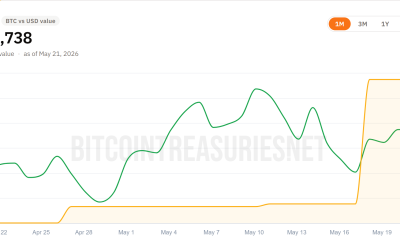
MicroStrategy’s Saylor Says Miners No Longer Set Bitcoin Price, Another Force Has Taken Over
-
Tech17 hours ago
The Samsung pay deal is the moment Korean unions changed register
-
 NewsBeat7 days ago
Charity run by Reform leader Malcolm Offord accused of ‘law breaking’ over Scottish registration
-
 Tech6 days ago
A 0.12% parameter add-on gives AI agents the working memory RAG can’t
-

 Crypto World6 days ago
AI infrastructure race heats up as IREN pitches full-stack strategy, WhiteFiber lands $160M deal
-
 Crypto World3 days ago
Nvidia (NVDA) CEO Calls on Super Micro to Strengthen Export Controls Amid Smuggling Probe
-

 Tech6 days ago
You Can Now Add ChatGPT To PowerPoint
-

 Tech3 days ago
Westone Audio and Etymotic Acquired by Fidelity Collective in Major IEM Market Move
-

 Sports6 days ago
2026 CJ Cup Byron Nelson leaderboard: Brooks Koepka finds putting stroke in Round 1
You must be logged in to post a comment Login