

Crypto World
Google Software Engineer Faces Charges Over Polymarket Bets

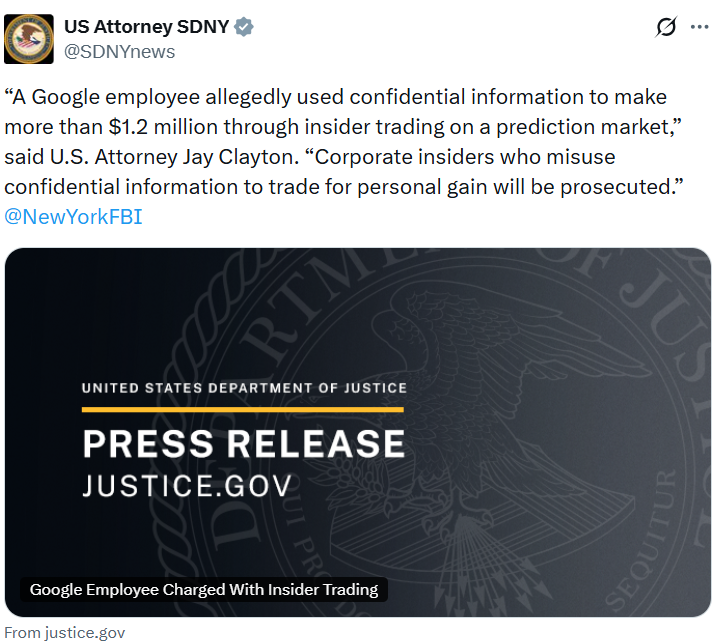
US authorities have charged a Google employee with allegedly using information from the company to make bets on Polymarket and profit $1.2 million.
The Justice Department said on Wednesday that it unsealed charges against Google software engineer Michele Spagnuolo, accusing him of accessing unreleased internal information at Google and placing 25 bets worth $2.7 million on markets related to the most searched individuals on Google in 2025.
Prosecutors said Spagnuolo owned the Polymarket account “AlphaRaccoon”, which profited $1.2 million on “outcomes that the market treated as unlikely” when Google published information on the most searched individuals in December.
The Commodity Futures Trading Commission filed a twin complaint against Spagnuolo on Wednesday, making similar allegations of insider trading.
Prediction markets are facing growing scrutiny over insider trading, with Congress launching a probe into Polymarket and Kalshi on Friday, questioning the companies’ response to incidents of insider trading on the platform, with lawmakers concerned that government officials are using insider knowledge to make bets.
Manhattan US District Attorney Jay Clayton said in a statement that the charges “reinforce a decades-old message: Corporate insiders cannot use confidential business information to turn a profit in our markets.”
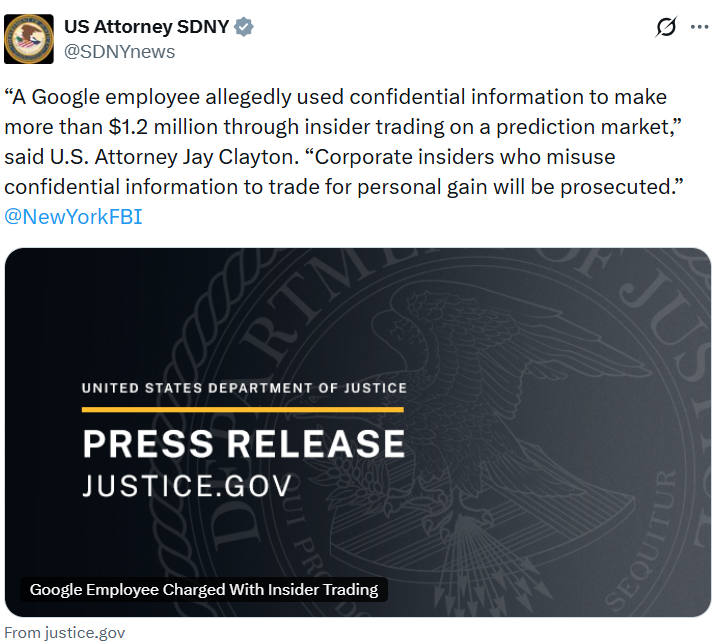
Source: US Attorney Southern District of New York
AlphaRaccoon account allegedly changed name
According to the court documents, communities on Discord and X started discussing the possibility that AlphaRaccoon was a Google insider in December. Soon after, the username was allegedly changed to a wallet address.
Prosecutors alleged that the funds in the AlphaRaccoon account were also sent to a decentralized crypto swapping service and to an unnamed transfer service that offers privacy protection for blockchain transactions
The Justice Department charged Spagnuolo with commodities fraud, wire fraud and money laundering, and could face a maximum sentence of 50 years in prison.
Related: Polymarket traders win $37K after Paris weather data glitch, raising suspicion
In its complaint, the CFTC seeks restitution, disgorgement, civil monetary penalties and trading and registration bans.
CFTC director of enforcement, David Miller, said in a statement that “the division is a cop on the beat in policing the illegal use of inside information in the prediction markets and other markets within the CFTC’s jurisdiction.”
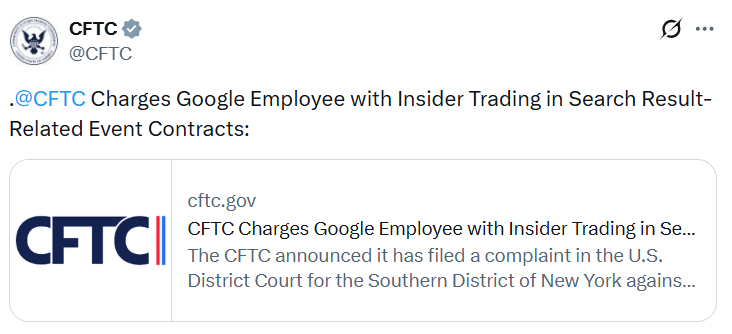
Source: CFTC
“We will continue to take action to protect markets from insider trading and other forms of fraud, abuse and manipulation,” Miller added.
It comes after the Justice Department charged a US soldier in April with using classified information to place bets on the US capture of former Venezuelan president Nicolás Maduro.
Magazine: ETH bears growling, Tom Lee’s buying, XRP to ‘explode’: Market Moves

Cryptocurrency markets have shed around $80 billion in value over the past 24 hours, with losses accelerating after the US reportedly carried out a new wave of military strikes on Iran.
The US military carried out new strikes late on Wednesday targeting an Iranian military site and shooting down four Iranian attack drones, which a US official told Reuters posed a threat around the Strait of Hormuz.
“These actions were measured, purely defensive, and intended to maintain the ceasefire,” the official said. Iran’s Islamic Revolutionary Guard Corps reportedly released a statement saying that it has retaliated by attacking a US airbase in Kuwait.
The strikes came during negotiations to end the war that began on Feb. 28 with US and Israeli attacks. US President Donald Trump said at a White House cabinet meeting on Wednesday that he was “not satisfied” with a deal with Iran and alluded to further military action.
The US strikes sent crypto markets tumbling to their lowest level since mid-April, after the market had climbed earlier this week after Trump hinted that a peace deal would soon be finalized.
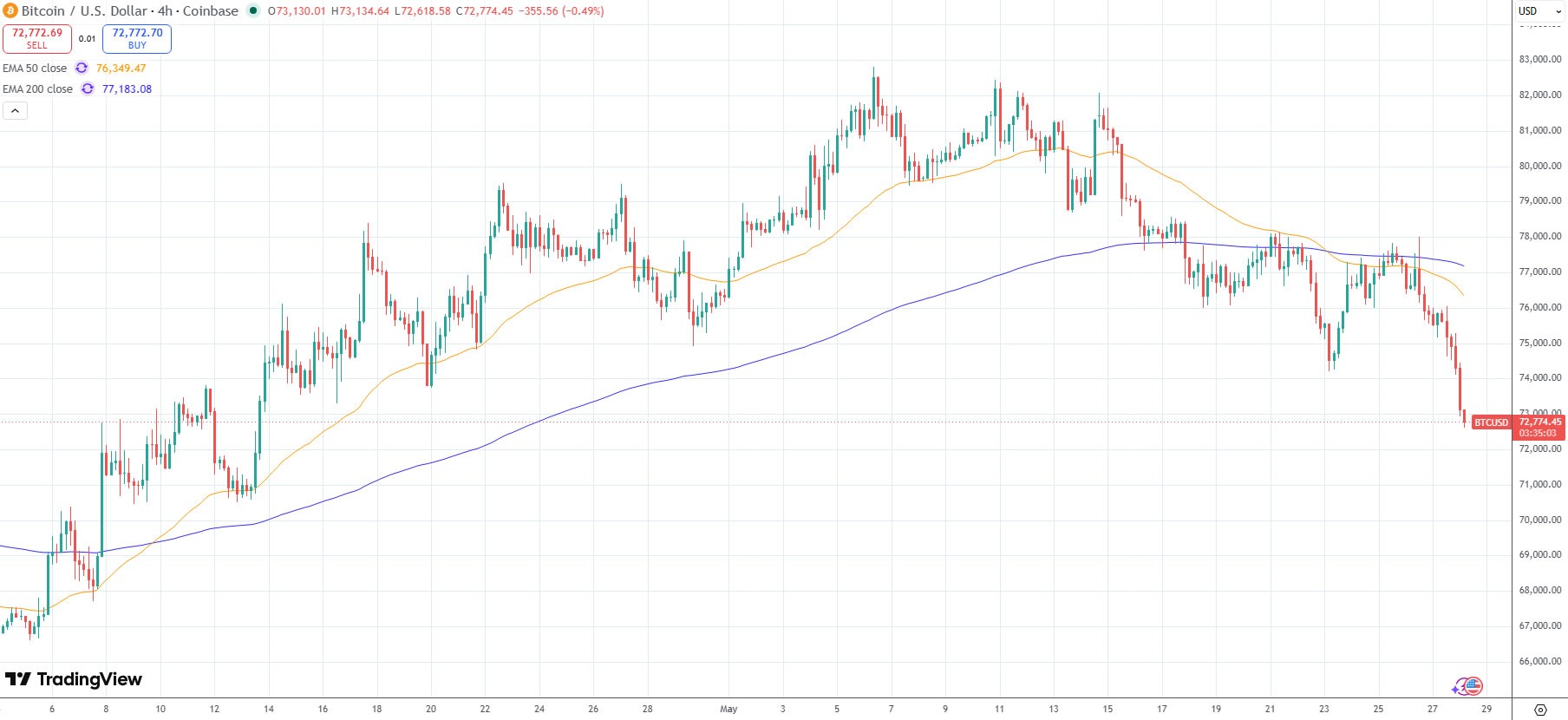
Bitcoin has lost 3.5% on the day, falling to $72,646 on Coinbase, its lowest level since April 13.
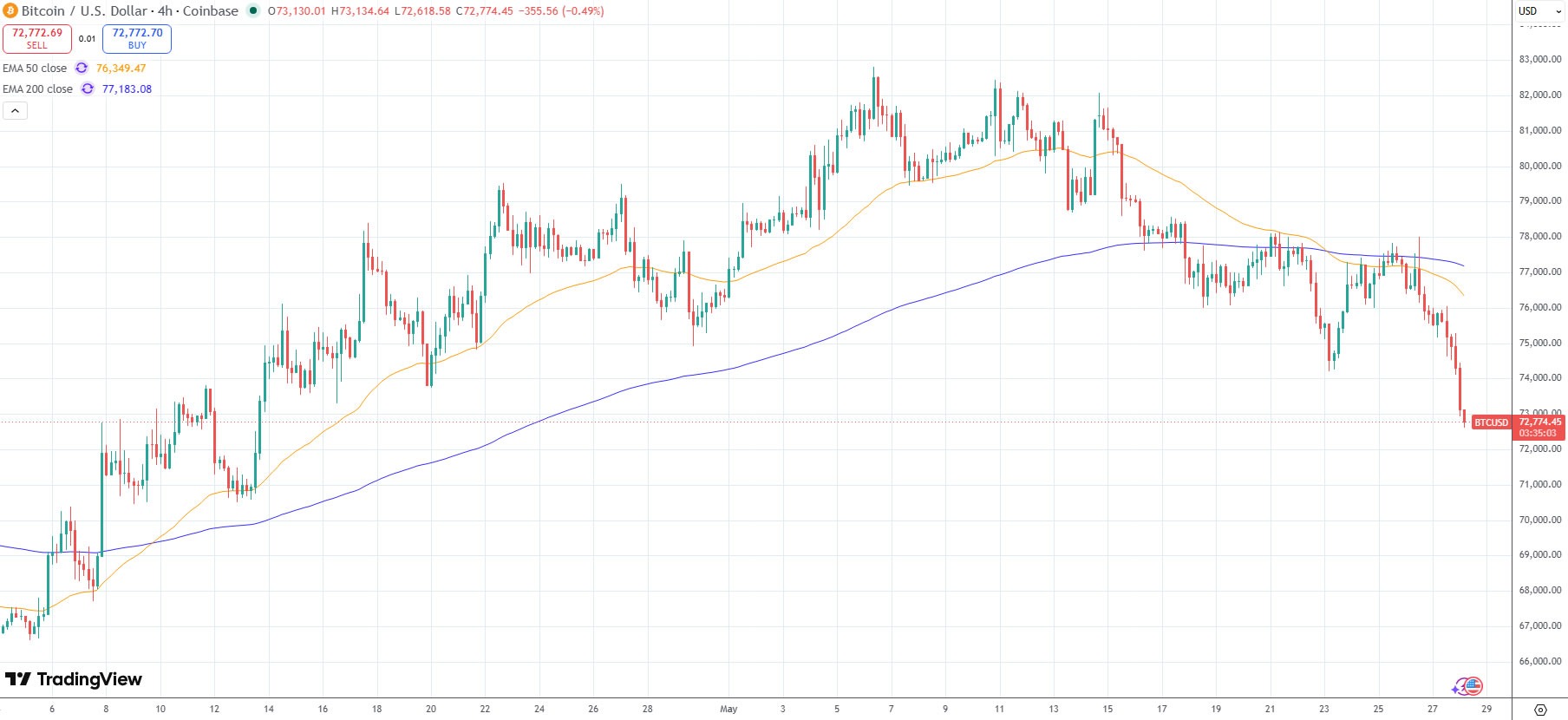
Bitcoin fell to a six-and-a-half-week low after US strikes on Iran on Wednesday. Source: TradingView
LVRG Research director Nick Ruck told Cointelegraph on Thursday that markets sold off as investors priced in heightened geopolitical risk, potential oil supply disruptions, and a flight to safety.
Related: Bitcoin falls further as BTC miners pivot to AI, pro-crypto legislation stalls
“Bitcoin and Ethereum, despite their long-term narrative as hedges, continue to behave more like high-beta risk assets during periods of uncertainty,” he said.
“Traders are now monitoring escalation risks in the Middle East, and any effects on inflation and Fed policy as crypto liquidity quickly thins, and leveraged positions get flushed out.”
Ether (ETH) also fell on news of the strikes, collapsing below the psychological $2,000 level, slumping more than 4% to $1,976 at the time of writing. The asset is at its lowest level since late March.
Crude oil prices also reacted with a 3.5% increase as WTI topped $92 while Brent climbed to $98 per barrel.
Magazine: Polymarket seeks Japan entry, Harvard dumps entire ETH position: Hodler’s Digest
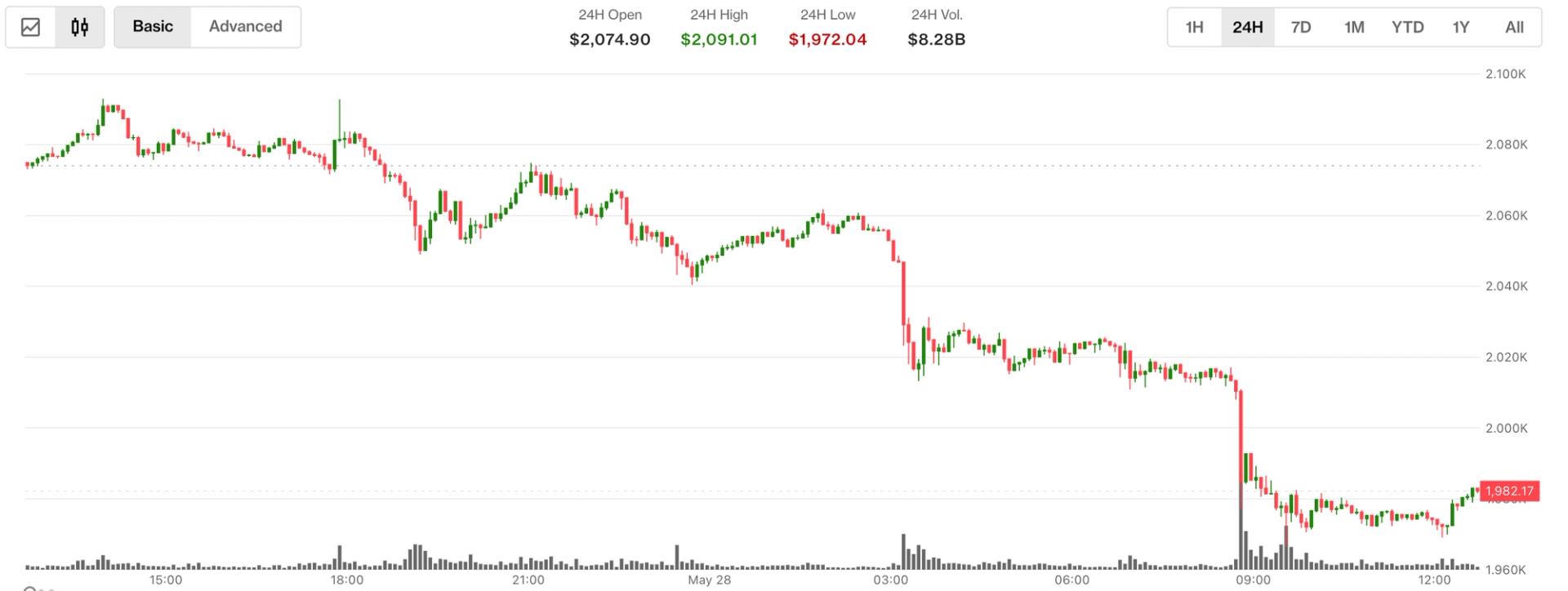
Ether’s (ETH) price sell-off is gathering steam amid broader market risk aversion. Yet its futures market is busier than ever, creating a notable divergence with bearish implications.
ETH dropped below $2,000 on Thursday morning for the first time since late March. It is down nearly 8% over the past seven days, with losses exceeding 5% in the last 24 hours alone, according to CoinDesk data.
“More and more people giving up on ETH as it doesn’t generate revenue and with higher bond yields the staking yield is unattractive. The only buyer has been Bitmine but they indicated that they will slow down their purchases,” Markus Thielen, founder of 10x Research, said in an email.
What makes ether’s sell-off particularly interesting is that open interest in ether futures has risen for the third straight day, hitting a record high of 16.39 million tokens, according to data source Coinglass. That equates to a notional open interest of about $32.5 billion. In simple terms, more money is flowing into futures, a leveraged product that amplifies both gains and losses.
However, this record open interest, combined with a negative seven-day OI-adjusted cumulative volume delta (CVD) and the falling spot price, points to aggressive net selling. A negative CVD indicates that price action is being driven by traders taking bearish bets via market orders rather than passive limit orders.
The bearish bias is not limited to futures. Spot Ether ETFs listed in the U.S. have seen cumulative outflows of $401 million this month, more than reversing the $354 million inflow recorded in April, according to SoSoValue data.
Sentiment around Ether has also deteriorated. The Ethereum Foundation has faced high-profile departures, including prominent contributors Carl Beekhuizen and Julian Ma.
“High profile departures from the Ethereum Foundation are also a sign that the original vision is no longer capturing these followers,” Thielen said.
This trend extends to prominent thought leaders and long-time holders. David Hoffman, co-founder of Bankless, recently announced he sold his ETH holdings after concluding that the long-standing thesis of “ETH is money” has largely played out.
Some analysts believe the market is increasingly questioning how much of Ethereum’s dominance in DeFi, tokenization, and other sectors is flowing back to its native token ETH.
“Ethereum’s problem is not that the chain has stopped mattering. It is that the market is questioning how Ethereum’s infrastructure strength translates back to ETH,” Web3 research and consultancy firm House of Chimera said on X.
The firm added that Ethereum still leads other smart contract blockchains in raw ecosystem development activity, with millions of meaningful GitHub events, but noted that prices and sentiment can weaken faster than developer commitment.


U.S. authorities have charged a Google software engineer with insider trading tied to prediction markets, as federal regulators continue tightening scrutiny around Polymarket and other event-based trading platforms.
Summary
- U.S. prosecutors and the CFTC have charged a Google engineer over alleged insider trading tied to Polymarket bets.
- Authorities said the trader used unreleased Google search trend data to place $2.7 million in prediction market wagers.
According to the U.S. Department of Justice, Google employee Michele Spagnuolo allegedly used confidential company information to place trades on Polymarket before Google publicly released its 2025 search trend rankings.
Prosecutors said the trades generated roughly $1.2 million in profit through a Polymarket account operating under the name “AlphaRaccoon.”
Court filings unsealed on Wednesday alleged that Spagnuolo placed 25 bets totaling about $2.7 million on markets linked to the most searched individuals on Google in 2025. Prosecutors claimed those bets targeted outcomes that Polymarket users had treated as unlikely before Google published the rankings in December.
Alongside the criminal case, the Commodity Futures Trading Commission filed a parallel civil complaint accusing Spagnuolo of insider trading violations in commodities markets. The agency said the case forms part of a growing enforcement focus on prediction-market activity involving confidential information.
Speaking in a statement released by the Justice Department, Manhattan U.S. Attorney Jay Clayton said the charges send a warning that “corporate insiders cannot use confidential business information to turn a profit in our markets.”
Federal agencies have recently intensified attention on insider trading risks tied to prediction markets. Earlier this year, seven members of the U.S. House of Representatives questioned why the CFTC had not acted more aggressively against suspicious trading linked to geopolitical event contracts involving Iran and Venezuela.
In their April letter to CFTC Chair Michael Selig, lawmakers described some event contracts as “morally obscene” and said trades tied to possible U.S. military actions raised concerns about the misuse of nonpublic information. The lawmakers also warned that weak oversight could damage confidence in the sector.
CFTC increases pressure on prediction markets
Separate statements from the CFTC have shown the agency moving toward a more aggressive enforcement approach. Enforcement Director David Miller said in April that insider trading laws apply to prediction markets and rejected claims circulating online that such activity falls outside existing rules.
Repeating that position on Wednesday, Miller said the enforcement division remains “a cop on the beat” for illegal use of inside information in prediction markets and other markets under the agency’s authority.
Federal prosecutors alleged that online users on Discord and X began suspecting in December that the AlphaRaccoon account belonged to a Google insider. According to court records, the account name was later changed to a wallet address after those discussions surfaced publicly.
Investigators also alleged that funds tied to the Polymarket account later moved through a decentralized crypto swapping platform and an unnamed transaction service that provides blockchain privacy protections.
The Justice Department charged Spagnuolo with commodities fraud, wire fraud, and money laundering. Prosecutors said the combined charges carry a maximum prison sentence of 50 years.
Meanwhile, the CFTC’s civil complaint seeks restitution, disgorgement, monetary penalties, and permanent trading and registration bans.
The case arrives as federal and state officials continue battling over who should regulate prediction markets in the United States. Earlier this month, the CFTC sued Minnesota after the state approved a law banning prediction-market activity from Aug. 1. The regulator argued that federally supervised event contracts fall under derivatives law rather than state gambling rules.
As previously reported by crypto.news, the White House Office of Management and Budget has begun reviewing a proposed CFTC rule for prediction-market contracts. The proposal reportedly follows a public consultation process that received more than 3,000 comments covering insider trading, market safeguards, and legal standards for event-based contracts.
Such debates have grown more urgent as platforms such as Polymarket and Kalshi face lawsuits and enforcement actions from several states, including Nevada, New Jersey, Maryland, Ohio, Montana, Illinois, and Minnesota.
Crypto World
Dallas-Based United Texas Bank Obtains National Charter to Compete With Major Banks in Crypto

Key Takeaways
- On May 15, 2026, United Texas Bank successfully transitioned from a Texas state charter to a national charter issued by the OCC
- UTB now operates with identical federal privileges as Wall Street giants including JPMorgan and Bank of America
- The institution processes approximately $10 billion monthly in dollar volume for international crypto companies
- UTB Atomic, a new AI-powered 24/7 payment infrastructure for crypto liquidity, is set to launch
- Annually, UTB facilitates more than $120 billion in cryptocurrency transactions and provides banking services to crypto firms rejected by traditional banks
A Dallas-based financial institution with four decades of history has emerged as a critical infrastructure provider for cryptocurrency companies across America. Now, it’s expanding its reach nationwide.
United Texas Bank received authorization from the Office of the Comptroller of the Currency to transition from its state banking charter to national bank status. The regulatory approval was granted on May 15, 2026, with final requirements completed by May 27.
This transition positions UTB as among the first financial institutions to successfully complete an OCC charter conversion in the 15 years since Dodd-Frank legislation was enacted.
According to CEO Scott Beck, the national charter upgrade grants UTB equivalent regulatory status to major money-center institutions such as JPMorgan Chase and Bank of America. This includes matching federal licensing, comprehensive trust capabilities, and unmediated access to the Federal Reserve’s wire transfer and automated clearing house networks.
Implications for Digital Asset Companies
The majority of cryptocurrency businesses face significant obstacles when attempting to establish banking relationships with major U.S. financial institutions. For approximately five years, UTB has addressed this market void, facilitating more than $120 billion in digital asset transactions each year.
“If you’re a digital asset player, you can’t get an account at a Bank of America or a Citibank,” Beck said. “You can come to United Texas Bank and basically have full access to the U.S. dollar.”
Currently, the bank processes $10 billion monthly in dollar transactions for international banking partners, over-the-counter trading desks, and prominent cryptocurrency exchanges. The national charter significantly enhances UTB’s capacity to support these clients through federal-level infrastructure.
Beck acknowledged that since 2024, the bank has operated under a Federal Reserve Consent Order concerning Bank Secrecy Act adherence. Instead of viewing this as a setback, UTB leveraged the situation to develop UTB Prism Sentinel, a proprietary compliance platform that conducts real-time blockchain monitoring.
UTB Atomic: Always-On Payment Infrastructure for Continuous Markets
UTB is introducing UTB Atomic, an artificial intelligence-powered real-time settlement network designed to address a critical market need. Following the failures of Silvergate and Signature Bank, continuous crypto liquidity infrastructure effectively disappeared.
Conventional banking institutions have business hours. Crypto markets operate continuously. This discrepancy creates settlement delays for institutional market participants during overnight hours.
UTB Atomic facilitates instantaneous, off-balance-sheet settlement between institutional counterparties regardless of time. Prism Sentinel operates concurrently, providing continuous transaction monitoring for regulatory compliance.
Beck noted the platform is engineered to accommodate forthcoming federal regulations, including stablecoin governance frameworks established under the GENIUS Act and Clarity Act.
UTB faces growing competition in this sector. Minnesota recently enacted legislation permitting state-chartered banks and credit unions to provide cryptocurrency custody solutions, broadening the competitive landscape.
A comprehensive digital asset custody and trust division is planned for launch at UTB during the upcoming summer months.
Beck characterized UTB as “a centralized value hub” — an institution that remains relatively obscure nationally but serves as essential infrastructure for crypto companies lacking alternative banking options.



Chainalysis says crypto firms entering the market in 2026 are starting with tougher compliance settings than many older firms used five years ago.
Summary
- Chainalysis says 47% of 2026 crypto entrants now meet 2020’s strictest alerting standards overall.
- Crypto exchanges still set higher indirect-alert thresholds than traditional banks, leaving weak monitoring gaps open.
- Related market coverage shows AML pressure rising across Polymarket, Binance, stablecoins, and blockchain bridges.
The finding points to a market where monitoring tools are now part of basic operating standards, not only a concern for large exchanges.
The report’s main angle is clear: crypto companies have raised their alerting standards, but indirect exposure still leaves room for bad actors to move funds through extra wallet layers before detection.
Chainalysis says new crypto firms use stricter alerts
In a May 27 report preview, Chainalysis said nearly 47% of organizations onboarded in 2026 now use alerting standards that would have ranked in the top 10% for strictness in 2020. The firm measured alert severity, trigger sensitivity, and minimum dollar floors for indirect illicit exposure.
Chainalysis said the change shows how fast baseline compliance has moved since 2020, when many firms were still setting common rules for on-chain risk alerts. “Standard compliance configurations today would have been considered industry-leading just five years ago,” the firm said.
Indirect monitoring remains the main weak spot
The report draws a clear line between direct and indirect exposure. Direct exposure covers funds that come straight from a known illicit source. Indirect exposure covers funds that pass through one or more intermediary wallets before reaching a platform.
Chainalysis said direct monitoring has become more uniform across regions. The gap sits in indirect monitoring, where alert thresholds can be much higher. For ransomware, fraud shops, scams, darknet markets, and sanctioned jurisdictions, indirect thresholds often sit 10 to 20 times above direct thresholds.
Banks still use lower alert thresholds
Chainalysis also found that traditional financial institutions keep tighter alerting floors than crypto exchanges. For indirect exposure to non-illicit flows, the firm said crypto exchanges set average alerting minimums at $950, compared with $150 for traditional financial institutions.
The gap narrows for illicit flows, but banks still run stricter settings. Chainalysis said crypto exchanges set alerts for illicit flows from $100, while financial institutions set the floor at $55. That difference matters as more banks test stablecoins, tokenized assets, and crypto custody.
Compliance pressure grows across crypto markets
The report fits a wider compliance push across the digital asset market. As previously reported by crypto.news, Polymarket tapped Chainalysis in April to monitor insider trading and manipulation across its prediction markets after volumes reached more than $7 billion monthly.
Separate crypto.news coverage also showed rising pressure around cross-chain AML gaps, Binance monitoring duties, stablecoin controls, and North Korean hacking activity. Chainalysis reported that North Korean-linked actors stole more than $2 billion in crypto in 2025, adding urgency to stronger fund-flow monitoring systems.


A Bank for International Settlements-led trial has shown that tokenized central bank money and bank deposits can complete cross-border payments in a single atomic step across currencies.
Summary
- Project Agorá has shown that tokenized central bank reserves and bank deposits can settle cross-border payments atomically across currencies.
- More than 40 private institutions and seven central banks have joined the BIS effort, which has now moved toward real-value transaction tests.
- Separately, the BIS has warned that stablecoins and crypto exchange “earn” products can expose users to unsecured repayment risk.
According to the Bank for International Settlements (BIS), Project Agorá has tested how tokenized central bank reserves and commercial bank deposits can settle transactions on an “all-or-nothing” basis, so neither side is left exposed if the other leg fails.
Project Agorá tests tokenized bank money
Under today’s system, the BIS said a cross-border transfer can pass through multiple intermediary banks before reaching the recipient, which can stretch settlement to days and add operational risk during reconciliation. In the Project Agorá design, the BIS and participants used tokenization and blockchain-style rails to reduce handoffs and complete settlement simultaneously across jurisdictions.
Project Agorá is a joint effort between the BIS, seven central banks, and more than 40 private financial institutions. The BIS said participating central banks include the Federal Reserve Bank of New York, the Bank of England, the Bank of Japan, and the Swiss National Bank, as well as major commercial banks and financial firms.
Project Agorá launched in April 2024 and spent about a year and a half in a design phase before moving into a prototype stage in 2025, the BIS said. Active testing began in January 2026, which the BIS described as the point where the initiative moved past concept work and into something closer to an operating system.
Participants now plan to move beyond simulations toward tests that involve real-value transactions using selected currencies and institutions, the BIS said. During the same week, the BIS said the Bank of Canada joined the initiative.
Tokenization efforts expand beyond payments
Outside the Agorá workstream, the BIS noted that financial market infrastructure providers and exchanges are building tokenized settlement systems for traditional securities. The BIS pointed to DTCC’s plan to roll out tokenized settlement infrastructure for stocks, ETFs, and U.S. Treasuries, while Nasdaq and Intercontinental Exchange are also developing blockchain-based systems for tokenized equities.
Project Agorá also sits alongside the G20’s cross-border payments roadmap set in 2020. The BIS framed Agorá as an attempt to show that unified ledgers and tokenization can deliver greater improvements than small changes to legacy payment plumbing.
BIS links payments research to crypto risk warnings
Even as it promotes research on tokenization, the BIS has maintained a cautious tone toward privately issued crypto instruments. The BIS has warned that stablecoins could create risks for the financial system and has urged faster progress on stablecoin regulation.
In addition, as previously reported by crypto.news last month, the BIS said crypto exchanges have operated as lightly regulated “shadow banks,” using customer deposits in ways that can increase leverage and contribute to large losses, including a $19 billion wipeout in 2025.
In that assessment, BIS noted that “earn” and savings-style products sold by exchanges function more like unsecured loans because platforms rehypothecate user assets into margin lending, proprietary trading, and market making.
Crypto World
Google Employee Arrested for Allegedly Exploiting Internal Search Data in $1.2M Polymarket Scheme
TLDR
- Michele Spagnuolo, a software engineer at Google, has been federally indicted for allegedly exploiting confidential company information for Polymarket wagers
- Prosecutors claim he operated as “AlphaRaccoon,” wagering $2.7 million and earning $1.2 million in profits
- The engineer allegedly leveraged a Google internal tool to monitor search trends before placing corresponding bets
- Federal charges include commodities fraud, wire fraud, and money laundering, carrying potential prison time of up to 50 years
- A parallel civil case from the CFTC demands financial restitution, penalties, and lifetime market prohibitions
Federal authorities allege that Michele Spagnuolo leveraged privileged access to Google’s search analytics to gain an unfair advantage on cryptocurrency prediction markets.
On May 28, the Department of Justice revealed criminal charges against Spagnuolo, a Google software engineer working within the Southern District of New York. According to prosecutors, he exploited confidential internal information to execute 25 separate wagers on Polymarket, a blockchain-based prediction marketplace.
The indictment alleges Spagnuolo utilized a proprietary Google analytics tool to identify which individuals were generating the highest search volume throughout 2025. He then allegedly placed strategic bets predicting these same people would appear on Google’s annual “most searched” rankings.
According to federal prosecutors, he conducted these activities through the Polymarket handle “AlphaRaccoon.” This account reportedly channeled approximately $3.8 million in USDC stablecoin to the platform and generated roughly $1.2 million in net gains.
Details of the Alleged Operation
The criminal complaint highlights a specific instance involving rapper D4vd, who faced recent murder charges. Spagnuolo allegedly reviewed Google’s proprietary trending analytics showing D4vd’s surge in search activity, then quickly placed a wager via AlphaRaccoon predicting his appearance among the year’s top searches—all within a matter of hours.
“Unlike the counterparties to his trades, Spagnuolo knew the outcome of these wagers before the trading public did,” the complaint stated.
Following successful wagers, Spagnuolo allegedly transferred 5 million USDC from his Polymarket wallet to external cryptocurrency addresses. These funds were subsequently processed through cryptocurrency exchange platforms and privacy-enhancing tools intended to mask transaction origins on the blockchain.
Investigators trace portions of these funds to an Italian payment processing service, connected to an account registered with Spagnuolo’s official identification documents.
Cover-Up Efforts Following Suspicion
Discussions emerged on Discord and X platforms in December, with community members theorizing that AlphaRaccoon had insider connections to Google. Soon thereafter, the account’s username was reportedly switched to a standard wallet address.
The Department of Justice has charged Spagnuolo with commodities fraud, wire fraud, and money laundering. If convicted on all counts, he could receive up to 50 years of imprisonment.
The Commodity Futures Trading Commission simultaneously launched civil proceedings, pursuing financial restitution, profit disgorgement, monetary sanctions, and lifetime prohibitions from market participation and registration.
CFTC enforcement director David Miller said the division is “a cop on the beat in policing the illegal use of inside information in prediction markets.”
Google has confirmed placing Spagnuolo on administrative leave. A company representative characterized exploiting confidential information for gambling purposes as “a serious breach of our policies,” while noting that the analytics tool in question was accessible across the employee base.
This marks the second significant insider trading prosecution involving Polymarket. Earlier in April, federal authorities arrested a U.S. Army servicemember accused of wagering on classified military intelligence regarding Venezuelan leader Nicolás Maduro’s potential capture.
Last Friday, Congressional lawmakers initiated an investigation into both Polymarket and competing platform Kalshi, expressing alarm that government personnel might be leveraging privileged information for financial gain through prediction markets.


The U.S. Commodity Futures Trading Commission has moved to scrap its $5 million settlement with crypto exchange Gemini after concluding that the enforcement case should not have been filed under the agency’s current standards.
Summary
- The CFTC has asked a federal court to vacate its $5 million settlement with Gemini after concluding the case should not have been filed.
- Regulators said the original complaint relied heavily on a whistleblower account that lacked credibility.
- Gemini had settled the case in January 2025 over allegations tied to statements made during the approval process for a Bitcoin futures contract.
In a joint motion filed Wednesday in a Manhattan federal court, the CFTC and Gemini asked the court to vacate the January 2025 consent order that resolved allegations tied to Gemini’s proposed Bitcoin futures contract.
The regulator said it had reviewed the matter and determined that continuing enforcement of the settlement’s remaining provisions would not serve the public interest.
As previously reported by crypto.news, Gemini agreed to pay a $5 million civil penalty to settle claims that it provided misleading information to the agency while seeking approval for what was set to become the first regulated Bitcoin futures contract in the U.S. The company settled the matter without admitting or denying wrongdoing.
According to the CFTC’s latest filing, the original complaint was “largely based on a whistleblower’s account known to be lacking in credibility.” The agency also said the lawsuit “would not have been” brought under its current enforcement approach.
The allegations were first raised in 2022, when the CFTC accused Gemini of making false or misleading statements between July and December 2017 during the self-certification process for its Bitcoin futures product. Regulators at the time argued that details tied to auction volume and market liquidity were material to evaluating the risks associated with the contract.
Gemini denied the accusations throughout the case, maintaining that there had been no manipulation of Bitcoin prices or harm to investors.
Inside the agency’s revised position
In its latest court filing, the CFTC argued that the whistleblower allegations relied on statements from Gemini’s former chief operating officer and another subordinate who allegedly threatened Cameron and Tyler Winklevoss and was “known to lie about material facts.”
At the same time, the regulator claimed Gemini itself had been harmed through a coordinated rebate fraud scheme involving two customers who allegedly exploited the exchange’s preferential fee structure.
According to the CFTC, the two customers admitted to defrauding Gemini of roughly $7.5 million, though the agency said prior leadership “did nothing” with those admissions.
The regulator is now seeking to remove ongoing obligations imposed under the settlement, including an injunction that bars Gemini from making false or misleading statements to the agency in the future.
“Applying the remaining provisions, including injunctive relief, prospectively would not be equitable,” the CFTC said in its statement.
Although Gemini has already paid the $5 million penalty tied to the January settlement, the agency did not indicate whether the company would receive a refund if the court approves the request.
Elsewhere in Washington, the filing adds to a growing list of crypto-related enforcement actions that federal regulators have abandoned or reconsidered since President Donald Trump returned to office.
Gemini’s founders, Tyler and Cameron Winklevoss, each donated $1 million to Trump’s 2024 presidential campaign.
Months before the latest filing, former CFTC chair nominee Brian Quintenz shared messages on X from Gemini CEO Tyler Winklevoss, who had asked whether Quintenz would review the agency’s case against the company if he became chair.
Trump later withdrew Quintenz’s nomination and backed Mike Selig, a former lawyer who has represented crypto firms and publicly supported the digital asset industry.
Apart from the CFTC matter, Gemini has also faced scrutiny from the U.S. Securities and Exchange Commission over its Earn product.
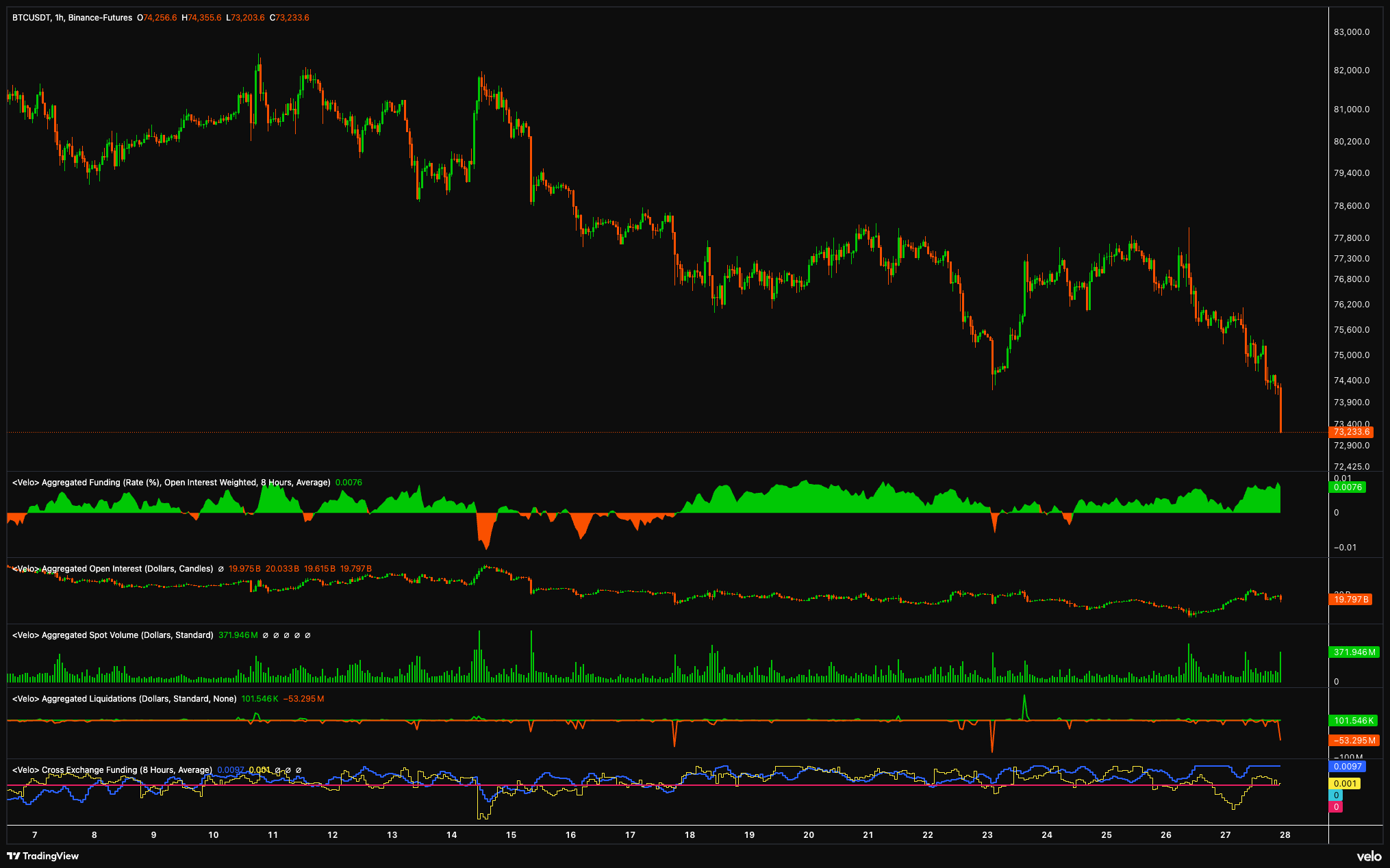
Bitcoin’s (BTC) rising funding rate and aggregated open interest suggest bullish investors are opening longs in an attempt to defend the range lows and an important support at $70,000, but another day of spot ETF outflows has investors concerned that the institutional stance on BTC is shifting.
As shown in the chart below, Bitcoin open interest remains relatively stable despite the day-over-day selling, further re-enforcing the view that long positions are either topping up to stay open or newly created. The cross-exchange funding rates (the last indicator at the bottom of the chart) are also mostly positive to neutral, indicating a long-leaning bias among investors.
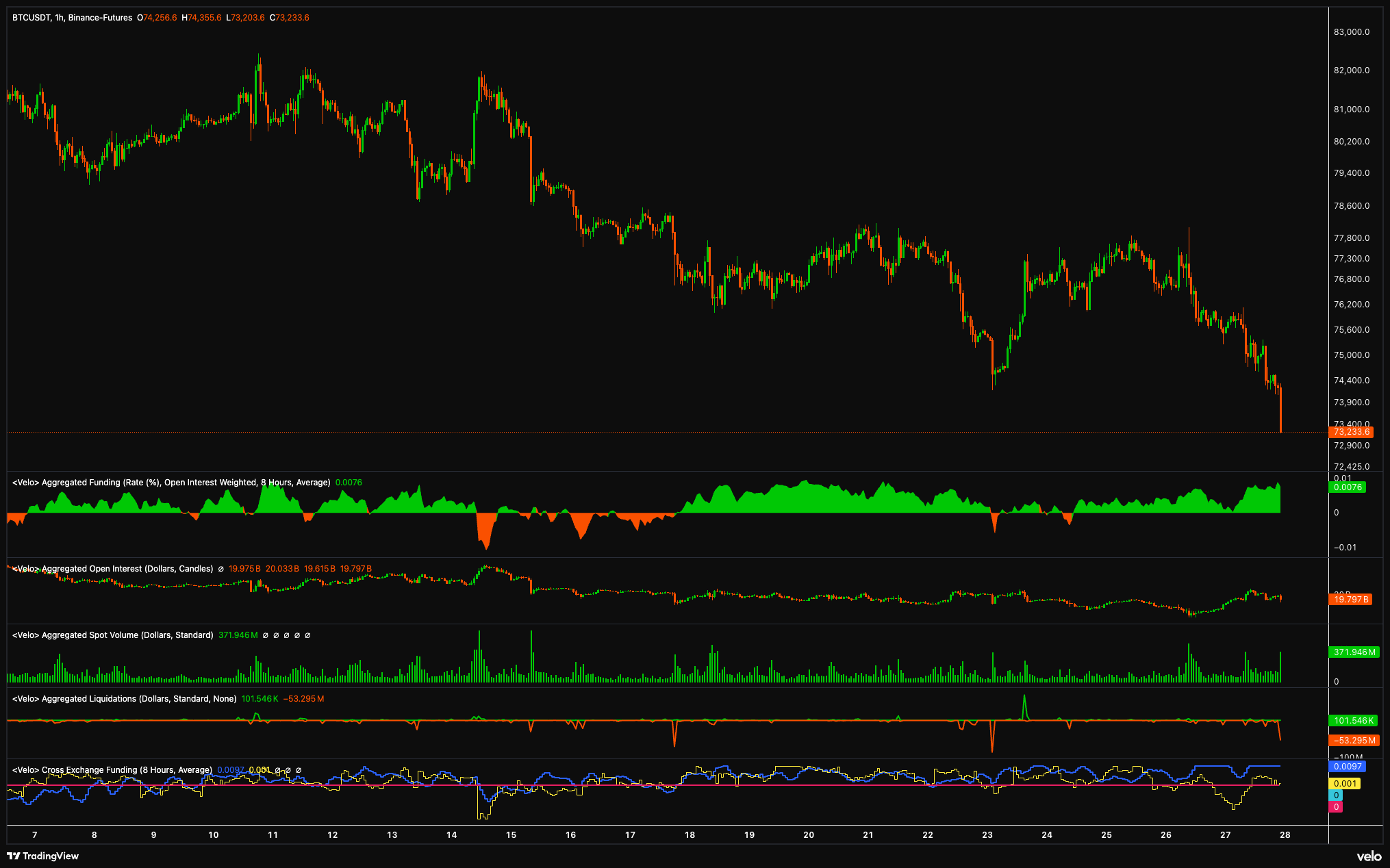
BTC/USDT one-hour chart. Source: Velo.xyz
Prior to the drop to $73,000, liquidations remained within norms of BTC’s intra-day range percentage-wise, suggesting that this week’s price action is a continuation of the current consolidation rather than early confirmation of a higher-timeframe trend change.
One important point to consider is “who” is propping BTC up. Hyblock’s True Retail Longs & Shorts Accounts indicator shows retail investors increasingly viewing corrections as dip-buying opportunities.
Hyblock analysts said that,
“Long exposure now sits near 62%, a level where retail traders have historically been vulnerable to getting trapped. Over the last three months, backtested 15-minute data shows that when retail long positioning was above 62%, BTC posted positive returns 82% of the time seven days later, with a median forward return of 3.6% across 1,459 occurrences.”
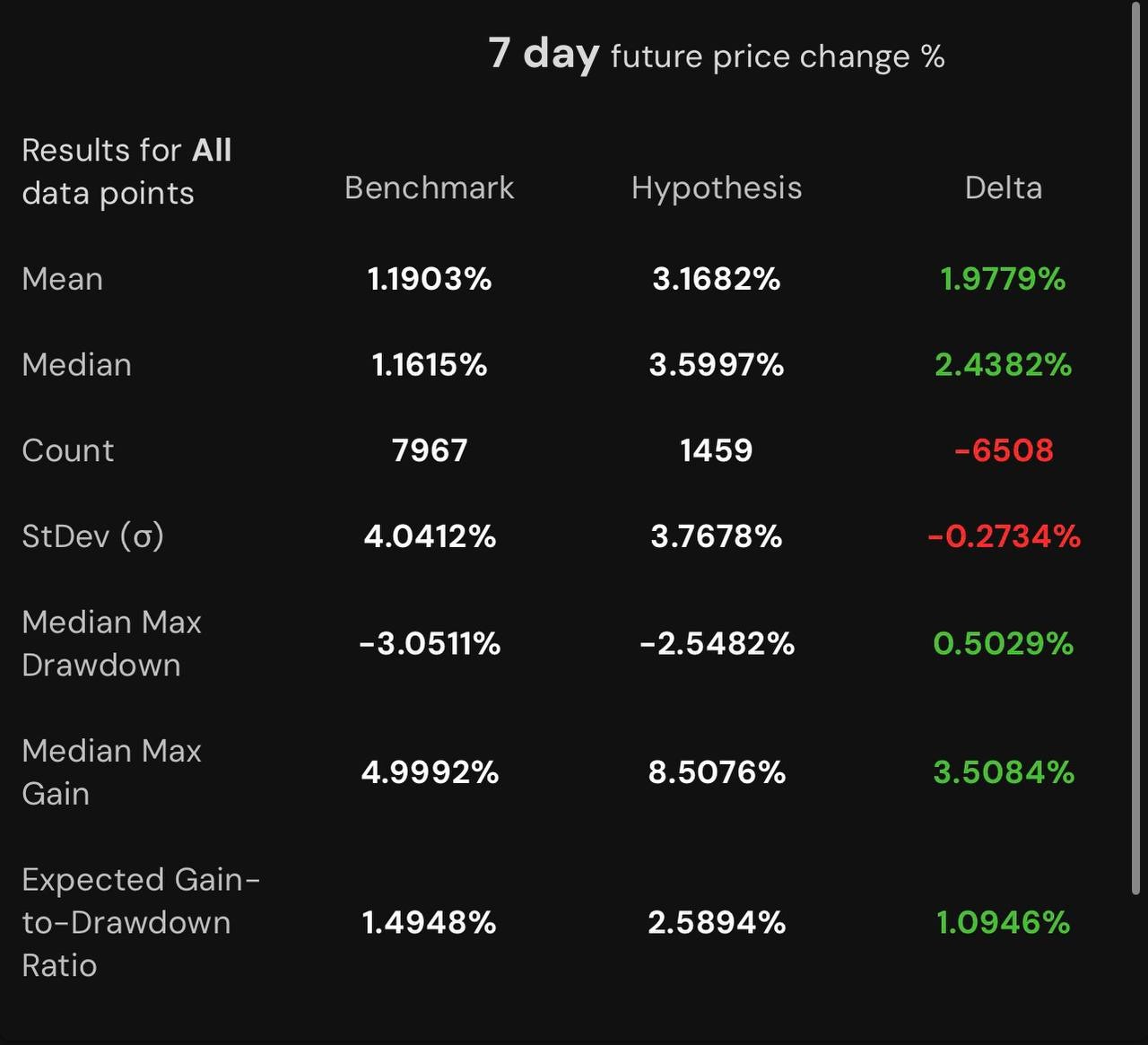
True retail longs and shorts accounts’ 7-day future price change %. Source: Hyblock
Related: Bitcoin miner inflows to Binance soar as BTC struggles to hold uptrend: Is $70K next?
ETF outflows, negative Coinbase premium counters spot and perp traders’ efforts
According to Bitfinex analysts, Bitcoin investors are “cautious heading into Thursday’s (May 29) Personal Consumption Expenditures (PCE) report for April.”
The analysts said,
“Since 15 May, futures open interest (OI) has fallen sharply following a price correction that has seen BTC fall over 10 percent from recent highs above $82,000. Bitcoin’s aggregated global OI has now dropped back below $55 billion, the lowest reading since 11 April, and is down 14 percent from when BTC was trading above $80,000.”
On Wednesday, outflows from spot Bitcoin ETFs topped $200 million, while cumulative outflows over the past 7 days exceeded $1.5 billion. In addition to the reversal in ETF flows, Bitfinex pointed to the negative Coinbase premium as a “significant warning sign.”
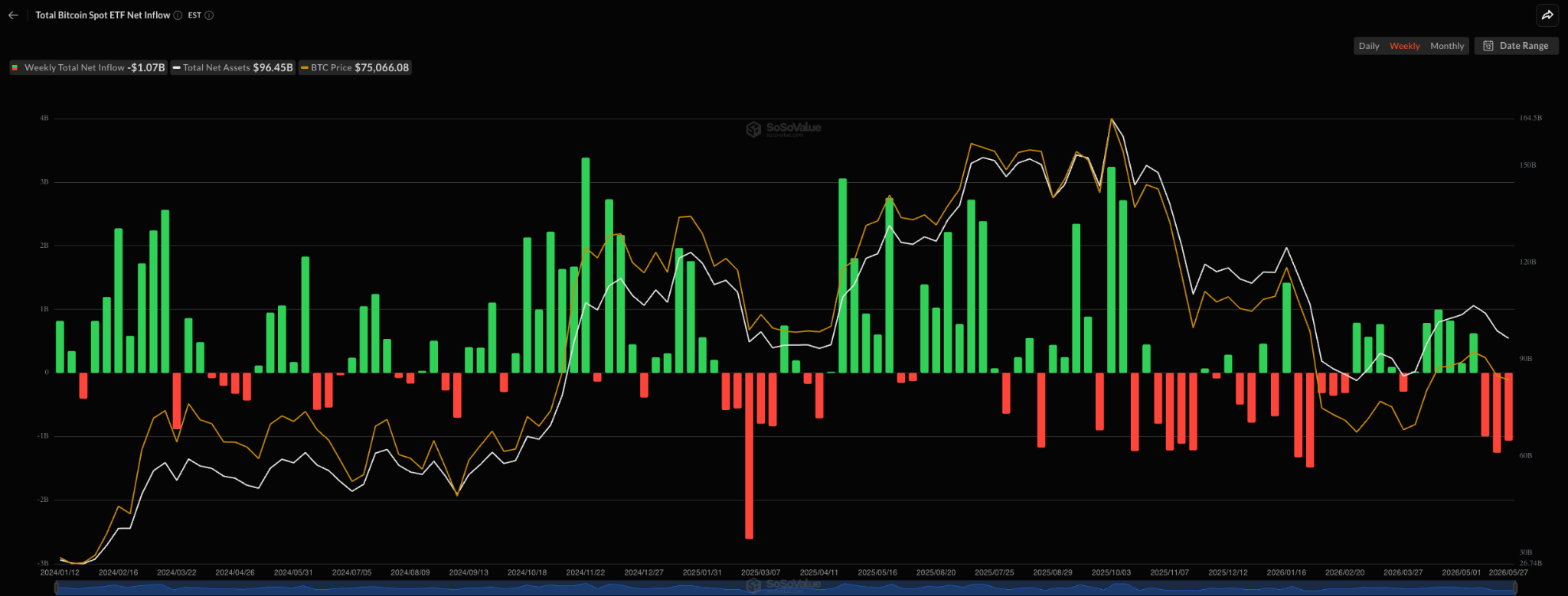
Spot Bitcoin ETF weekly flows. Source: SoSoValue.com
“In the post-ETF landscape, this reflects a structural reality: direct US spot demand on Coinbase has been largely displaced by indirect institutional demand via ETFs, structured products, and over-the-counter desks.”
The analysts noted that even while Bitcoin price is “in an uptrend on the lower timeframes since the breakout” from $72,000, “the continuation set-up is absent.”
“A strong uptrend is typically driven via the spot tape, which would mean persistent negative funding rates and a persistent positive Coinbase premium. The opposite is the case at present.”


Banca Sella crypto services gain Bank of Italy approval under MiCA, with custody and transfer tools planned for institutions by 2026.
Summary
- Banca Sella crypto services gained approval under MiCA rules in Italy.
- The bank will focus on custody and transfers for selected clients.
- The planned rollout is expected by the end of 2026.
Banca Sella crypto services are moving closer to launch after the Italian lender received authorization from the Bank of Italy under Europe’s MiCA framework. The approval allows the bank to offer custody and transfer services for crypto assets.
The rollout will focus on selected corporate and institutional clients, not broad retail trading. The bank expects to launch the service by the end of 2026, adding another regulated banking player to Europe’s digital asset market.
Banca Sella Crypto services move ahead under MiCA rules
Banca Sella crypto services cleared an important regulatory step after the bank completed the notification process with the Bank of Italy. Under MiCA, banks can follow a notification route when they plan to offer crypto asset services. This gives regulated lenders a clearer path than non-bank crypto firms.
The approval covers custody, receipt, and transfer of digital assets. These functions allow the bank to hold crypto assets for clients and move them between approved accounts. The model keeps the first phase narrow and controlled.
Banca Sella has not announced plans to offer direct crypto buying or selling. That detail matters because it separates the service from a full exchange platform. Instead, the bank appears focused on infrastructure support for clients already operating in regulated markets.
Andrea Tessera, Managing Director of Digital Banking at Banca Sella, described the approval as a major step. He said it aligns with Europe’s wider shift toward new digital models.
Banca Sella crypto services target selected clients
Banca Sella crypto services will not begin as a mass-market retail product. The bank has pointed to selected target groups, with corporate and institutional clients expected to take priority. This approach reduces operational risk during the first stage.
Digital asset custody is likely to be the core service. In practice, this means Banca Sella will manage secure storage for crypto assets. It will also support transfers when clients need to move those assets.
That structure fits the needs of institutions more than casual traders. Companies and financial firms often need regulated custody before they can hold digital assets at scale. They also need clear settlement and transfer processes.
The Bank of Italy approval also gives the project stronger credibility. In Europe, MiCA approval helps reduce uncertainty around compliance. It also places crypto services within a common legal framework across the region.
Banca Sella has worked around digital finance before this approval. The bank joined the Bank of Italy Fintech Milano Hub pilot in 2022. That earlier involvement helped position it within Italy’s developing fintech environment.
Digital asset custody fits broader European Banking push
Banca Sella’s move comes as European banks take slower but clearer steps into digital assets. Many lenders are avoiding speculative trading products. Instead, they are building custody, settlement, and token infrastructure.
This reflects a practical shift in the market. Banks can support crypto asset use without exposing clients to open trading risks. Custody and transfer services also match existing banking strengths.
Banca Sella is also linked to wider European stablecoin work. The bank is a founding member of Qivalis, a consortium involving 37 banking members. The group is working on a euro-based stablecoin project.
That involvement suggests the bank’s crypto strategy is not isolated. It sits within a broader move by European lenders to prepare for tokenized money and digital settlement. This may become more important as MiCA adoption expands.
The service could also make Banca Sella one of Italy’s early banking examples under MiCA. Its launch may guide how other banks approach digital asset custody. The final test will come when the bank begins serving clients by the end of 2026.

Justin Bieber Extends Record with Fifth Best Male Pop Artist Win at 2026 American Music Awards

Crypto Markets Shed $80B Amid Fresh US Strikes on Iran

Kevin Hart Weighs In On Tony Hinchcliffe’s George Floyd Joke


-

 Crypto World7 days ago
Blockchain.com files with SEC for U.S. IPO
-

 Fashion6 days ago
Holiday Weekend Open Thread – Corporette.com
-

 Crypto World6 days ago
Bitcoin Accumulation Weakens as BTC Realized Losses Hit $600M
-

 Tech3 days ago
Microsoft’s quiet Claude Code retreat and the real cost of enterprise AI
-

 Business6 days ago
Dell Technologies DELL Stock Surges 15% on AI Server Momentum and Analyst Upgrades in 2026
-

 Crypto World5 days ago
Robinhood crypto COO Tanya Denisova exits
-

 Business4 days ago
NYT Strands Answers May 24 2026 Revealed for Puzzle No. 812 Theme Summer Essentials
-

 Politics6 days ago
Makerfield: a tale of two social-media histories
-

 Crypto World6 days ago
Space X IPO Is ‘Bad News’ for Tech Stocks: But What About Bitcoin?
-

 Business6 days ago
Trump Invests $1M-$5M in Kura Sushi USA Chain With 27 California Locations
-
 Crypto World6 days ago
MicroStrategy’s Saylor Says Miners No Longer Set Bitcoin Price, Another Force Has Taken Over
-

 Tech6 days ago
WhatsApp ads could make Irish debut after discussions with DPC
-
Tech20 hours ago
The Samsung pay deal is the moment Korean unions changed register
-
 NewsBeat7 days ago
Charity run by Reform leader Malcolm Offord accused of ‘law breaking’ over Scottish registration
-
 Tech6 days ago
A 0.12% parameter add-on gives AI agents the working memory RAG can’t
-

 Politics3 days ago
Bridgerton Season 5: Cast, Release Date And Everything We Know So Far
-

 Crypto World6 days ago
AI infrastructure race heats up as IREN pitches full-stack strategy, WhiteFiber lands $160M deal
-
 Crypto World3 days ago
Nvidia (NVDA) CEO Calls on Super Micro to Strengthen Export Controls Amid Smuggling Probe
-

 Tech6 days ago
You Can Now Add ChatGPT To PowerPoint
-

 Tech3 days ago
Westone Audio and Etymotic Acquired by Fidelity Collective in Major IEM Market Move
You must be logged in to post a comment Login