Connect with us
DAPA Banner
DAPA Coin
DAPA
COIN PAYMENT ASSET
PRIVACY · BLOCKDAG · HOMOMORPHIC ENCRYPTION · RUST
ElGamal Encrypted MINE DAPA
🚫 GENESIS SOLD OUT
DAPAPAY COMING

Business

Earnings call transcript: Elekta Q4 2026 sees mixed results, stock drops 14%

Published

on

Continue Reading
Click to comment

You must be logged in to post a comment Login

Leave a Reply

Business

TSMC Stock Remains Strong Buy in 2026 as AI Demand Fuels Record Growth and Analyst Optimism

Published

on

TSMC has plans to open three fabrication plants in the United States

NEW YORK — Taiwan Semiconductor Manufacturing Company (NYSE: TSM) continues to stand out as one of the most compelling technology investments in 2026, with analysts overwhelmingly recommending buying shares of the world’s largest contract chipmaker amid explosive demand for advanced semiconductors powering artificial intelligence systems.

As of late May 2026, TSMC shares trade near $404–$423, reflecting substantial gains over the past year. The stock has benefited from robust AI infrastructure spending by major clients including Nvidia, Apple, AMD and Broadcom. Wall Street maintains a strong consensus “Buy” rating, with 13 out of 15 analysts recommending purchase and only two suggesting Hold. Average 12-month price targets cluster around $404–$465, implying modest to significant upside from current levels.

Recent performance has been impressive. TSMC reported record first-quarter 2026 revenue of $35.9 billion, up 35–40.6 percent year-over-year, driven by high-performance computing and AI-related demand. Gross margins reached 66.2 percent, exceeding expectations, while management raised full-year guidance citing “extremely robust” AI chip orders.

Strong AI Tailwinds Support Growth

TSMC’s position as the leading foundry for advanced nodes (3nm, 2nm and beyond) has positioned it at the center of the global AI boom. High-bandwidth memory and advanced packaging technologies critical for AI accelerators have seen particularly strong demand. Chairman and CEO C.C. Wei highlighted the shift toward “agentic AI,” which requires even greater computational power, during the April earnings call.

Advertisement

Analysts project TSMC’s revenue could grow more than 30 percent in 2026, with some forecasts calling for even higher figures if AI spending accelerates. Capital expenditure plans remain elevated at $52–$56 billion, reflecting aggressive capacity expansion to meet client needs. Advanced nodes already account for 74 percent of wafer revenue, with 3nm alone contributing 25 percent.

Morningstar recently raised its fair value estimate to $428 per ADR after strong results, noting the stock trades at a meaningful discount to intrinsic value. Several firms, including Bank of America, have increased price targets to $490–$500, citing sustained AI momentum and pricing power for leading-edge chips.

Valuation and Financial Strength

Despite strong gains, TSMC’s valuation remains reasonable compared to pure-play AI peers. The company trades at forward multiples that many analysts consider attractive given its market leadership, technological moat and consistent profitability. Strong free cash flow generation supports ongoing dividends and share repurchases, providing additional returns for long-term holders.

The balance sheet remains solid with low debt levels relative to cash flows. Geographic diversification efforts, including new facilities in the United States, Japan and Europe, help mitigate risks from geopolitical tensions in Taiwan.

Advertisement

Key Risks and Challenges

While the outlook is predominantly positive, investors should consider several risks. Geopolitical tensions between the U.S. and China, along with cross-strait relations, remain a perennial concern for Taiwan-based companies. Any escalation could disrupt operations or supply chains.

Intense competition from Samsung in foundry services and potential cyclical slowdowns in broader semiconductor demand could pressure margins. Rising capital expenditures may also weigh on near-term returns if utilization rates dip unexpectedly.

Currency fluctuations, particularly movements in the Taiwanese dollar, can impact reported earnings for international investors. Recent strength in the U.S. dollar has been somewhat supportive but remains a variable to watch.

Investment Considerations for 2026

For investors considering buying TSMC stock, the case centers on structural growth in AI and high-performance computing. The company’s irreplaceable role in the semiconductor supply chain, combined with proven execution, makes it a core holding for technology-focused portfolios.

Advertisement

Potential buyers may look for pullbacks toward the $380–$400 range for better entry points, especially if broader market volatility creates opportunities. Long-term investors benefit from TSMC’s technological leadership and exposure to multiple growth megatrends.

Those considering selling or staying sidelined cite potential valuation expansion limits after recent gains and the risk of geopolitical shocks. However, the overwhelming analyst consensus and strong fundamentals suggest limited downside at current levels for patient capital.

Diversification remains important. While TSMC offers high-quality exposure to semiconductors, pairing it with other sectors helps manage volatility inherent in technology stocks.

Broader Semiconductor Sector Context

TSMC’s performance reflects strength across the chip industry driven by AI adoption. The company’s success has ripple effects throughout the supply chain, benefiting equipment makers, material suppliers and design firms. Continued investment in advanced process technologies ensures TSMC maintains its competitive edge against rivals.

Advertisement

As artificial intelligence moves from training to inference and agentic applications, demand for sophisticated chips is expected to remain elevated. TSMC’s capacity expansion plans position it to capture a significant share of this growth.

Outlook for Remainder of 2026

Management and analysts project continued strong performance through 2026 and beyond. Key upcoming catalysts include progress updates on 2nm development, major client announcements and quarterly results demonstrating sustained AI momentum.

Risks to the outlook include slower AI adoption rates, intensified geopolitical pressures or broader economic slowdowns affecting technology spending. Positive surprises in earnings or capacity utilization could drive further upside.

As of late May 2026, TSMC represents one of the highest-conviction opportunities in global technology. Its combination of market leadership, technological superiority and structural tailwinds supports a bullish long-term view despite periodic volatility.

Advertisement

Investors should monitor quarterly earnings closely, particularly comments on AI demand, pricing trends and geopolitical developments. Professional financial advice tailored to individual circumstances is recommended before making investment decisions in this dynamic sector.

Continue Reading

Business

Why Britain’s SME Owners are Facing a Retirement Reality Check

Published

on

In today’s rapidly evolving digital world, technology is more than just a tool for efficiency—it’s a catalyst for transformation. Businesses across the UK are not only adopting digital solutions to stay competitive but are also leveraging them to redefine the very frameworks of their industries.

Many directors have built wealth inside their companies rather than in formal retirement plans. In 2026, that familiar SME model is looking more exposed.

The plan behind the business is being tested

Ask most UK employees about retirement, and they can usually point to a workplace pension. Ask an SME owner, and the answer is often less tidy.

Many directors have paid themselves through salary and dividends, reinvested cash into the company and treated the business itself as the pension. The assumption was simple: build, sell and fund the next chapter. In 2026, more owners are realising that the plan may need a harder look.

The savings gap is moving into view

Research on self-employed workers and owner-directors has repeatedly shown weaker pension saving than among comparable employees. The latest Retirement Living Standards put a comfortable retirement at £43,900 a year for a single person and £60,600 for a couple.

The full new State Pension is £241.30 a week, or around £12,548 a year, depending on NI record. Private pension access is changing too, with the access age rising from 55 to 57 from 6 April 2028.

Advertisement

Against that backdrop, McCarthy Wealth Management, a trading style of Clarity Wealth Management LLP and an FCA-regulated UK firm, has published guidance on retirement affordability planning for owner-directors weighing pensions, State Pension entitlement and business assets.

The owner-manager model creates blind spots

The issue is structural, not careless. Directors are not swept into pension saving in quite the same way as employees. Contributions are often an active decision rather than a default.

Dividend-led pay can be efficient during working life, but it may leave some owners with fewer National Insurance qualifying years than expected. Owners also tend to prioritise staff, premises, growth and cash reserves ahead of personal planning.

The familiar “business is my pension” model is not automatically wrong. For some founders, a sale may support retirement. The risk is assuming it will happen at the right time, at the right valuation and without the founder still being central to the company’s value.

Advertisement

Sales outcomes depend on timing, buyer demand, margins, management depth and whether the business can operate without the owner. A profitable firm is not always saleable at the preferred price, particularly where customer relationships and day-to-day control sit with one person.

The State Pension is only part of the picture

The State Pension remains an important foundation, but it rarely matches the lifestyle expectations of successful SME owners on its own.

MoneyHelper notes that 10 qualifying years are needed to receive any new State Pension, while 35 qualifying years are usually needed for the full amount. For directors who rely on dividends, the forecast can be more revealing than the assumption.

What better-prepared owners are reviewing

The planning areas now being reviewed are broad. Director pension contributions may be relevant where company-funded contributions interact with corporation tax, remuneration and cashflow. State Pension forecasts may help identify gaps. Business sale realism may support more cautious exit planning.

Advertisement

Succession planning is central too. A company that can operate without the founder is usually easier to step back from and potentially easier to sell. Cashflow modelling can test early exit, gradual exit, full sale, partial sale, continued dividends or no sale. Estate planning has moved up the agenda, with most unused pension funds and death benefits due to fall within a person’s estate from April 2027.

McCarthy Wealth’s view

Adam McCarthy, Financial Planner at McCarthy Wealth Management, said: “Owner-director retirement planning is one of the most under-served areas of UK personal finance. Standard retirement guidance is often written for salaried employees, yet business owners have different income patterns, asset structures and risks.

“The issue is not that using a business to support retirement is wrong. It is that relying on one best-case sale outcome can be fragile. Director pension contributions, succession planning and cashflow modelling increasingly need to sit alongside the business plan.”

The questions worth asking advisers

For SME owners, the questions are practical. What is the actual State Pension forecast? How many qualifying years are recorded? Have director pension contributions been reviewed across recent financial years? What might the business sell for under cautious assumptions?

Advertisement

What happens if the sale price disappoints? How does salary versus dividend income affect National Insurance and retirement income? What is the cashflow position after exit? Do pension and inheritance tax changes affect estate planning?

The exit plan needs more than hope

The SME owner retirement gap is not really about pension product choice. It is about the fundamental difference between how employees and business owners build long-term financial security.

For UK SME owners, the most useful retirement decisions are made early, modelled realistically and reviewed regularly, not left until the final 12 months before an exit. A business may still form an important part of the retirement picture, but it works better when tested alongside pensions, State Pension entitlement, cashflow, succession planning and estate considerations.

Retirement planning works best when it sits beside the business plan, with personalised advice that reflects individual circumstances. The most expensive retirement mistake an SME owner can make in 2026 is not a bad investment decision. It is assuming the business will quietly handle everything when the time comes.

Advertisement

This article is for general information only and does not constitute financial, tax, legal or accounting advice. The value of investments can go down as well as up, and past performance is not a reliable indicator of future results. Tax treatment depends on individual circumstances and may change in future. Some retirement, pension, tax and estate planning matters may fall outside FCA regulation. McCarthy Wealth Management is a trading style of Clarity Wealth Management LLP, authorised and regulated by the Financial Conduct Authority, FCA Firm Reference Number 575252.

Advertisement
Continue Reading

Business

Medtronic's Fair Value Falls Between Caution And Optimism

Published

on

Medtronic's Fair Value Falls Between Caution And Optimism

Medtronic's Fair Value Falls Between Caution And Optimism

Continue Reading

Business

Bennett law firm expands to Adelaide, joins defence and space precinct

Published

on

Bennett law firm expands to Adelaide, joins defence and space precinct

Perth law firm Bennett has expanded to South Australia, in a bid to work more closely with clients delivering complex defence projects.

Continue Reading

Business

Ousted BP chairman hits back at 'lies' about his behaviour

Published

on

Ousted BP chairman hits back at 'lies' about his behaviour

Albert Manifold said no-one should be “allowed to hide behind anonymity” when commenting on his time at BP.

Continue Reading

Business

West Country businesses among ‘most resilient’ in UK

Published

on

Business Live

Businesses expect investment levels to grow over the next 12 months, but remain concerned about the economy

An aerial view of Bristol city centre

An aerial view of Bristol city centre(Image: Getty Images)

West Country firms are among the “most resilient” in the UK but lack confidence in the country’s economy, according to new research.

The latest Barclays Prosperity Index reported a net confidence level of 36 per cent for the region’s companies – more than 20 base points below the UK average.

But, according to the survey, South West businesses showed greater resilience in international trade activity than the rest of Britain. SME clients within Barclays Business Bank saw inbound (-0.8 per cent) and outbound (-1 per cent) international payments fall at a slower rate than the UK average.

More of the region’s companies also appear to be accessing external finance, with loan volumes rising 0.5 per cent and overdraft volumes growing 3.3 per cent.

Advertisement

The research suggests some of the demand for longer-term borrowing may be to support future investment plans. South West businesses expect investment levels to grow by eight per cent over the next 12 months – the strongest growth of all regions – and four percentage points higher than the UK average.

The top areas firms in the region are looking to invest in are researching and/or developing new or improved products, or services (33per cent) and new or improved digital products or subscriptions (31 per cent).

But Barclays said the stronger-than-average growth in overdraft usage could indicate that part of the increase in borrowing reflected short-term liquidity management.

James Jordan, head of region for the South West at Barclays, said: “Despite continued geo-political and associated economic uncertainty, businesses across the South West are demonstrating strong resilience and adaptability.

Advertisement

“Our data suggests firms are taking a disciplined approach to cash management while continuing to invest selectively in the areas that will support long-term productivity and growth.”

Nationally, geopolitical tensions have hit confidence and investment across the UK, with one in five firms (20 per cent) pausing spending plans in light of the uncertain landscape.

Meanwhile 68 per cent expect to increase cybersecurity investment over the next 12 months, but almost half (46 per cent) believe the adoption of new technologies is increasing their exposure to cybersecurity risks.

Six in 10 firms now proactively use agentic AI, with cloud, cyber and AI together accounting for 44 per cent of planned technology budgets over the next year.

Advertisement

Businesses of all sizes are split on their pricing strategy in response to rising costs, with 37 per cent passing them on to customers and 32 per cent absorbing the impact within margins.

Continue Reading

Business

Agilent Technologies, Inc. (A) Q2 2026 Earnings Call Transcript

Published

on

OneWater Marine Inc. (ONEW) Q1 2026 Earnings Call Transcript

Q2: 2026-05-27 Earnings Summary

EPS of $1.49 beats by $0.08

 | Revenue of $1.84B (10.01% Y/Y) beats by $36.52M

Agilent Technologies, Inc. (A) Q2 2026 Earnings Call May 27, 2026 4:30 PM EDT

Company Participants

Tejas Savant – Vice President of Investor Relations
Padraig McDonnell – CEO, President & Director
Adam Elinoff – Senior VP, CFO & Principal Financial Officer
Simon May – Senior VP and President of Life Sciences & Diagnostics Markets Group
Mike Zhang – Senior VP & President of Applied Markets Group

Advertisement

Conference Call Participants

Vijay Kumar – Evercore ISI Institutional Equities, Research Division
Patrick Donnelly – Citigroup Inc., Research Division
Tycho Peterson – Jefferies LLC, Research Division
Puneet Souda – Leerink Partners LLC, Research Division
Daniel Brennan – TD Cowen, Research Division
Michael Ryskin – BofA Securities, Research Division
Dan Leonard – RBC Capital Markets, Research Division
Luke Sergott – Barclays Bank PLC, Research Division
Catherine Ramsey – Robert W. Baird & Co. Incorporated, Research Division
Casey Woodring – JPMorgan Chase & Co, Research Division

Advertisement

Presentation

Operator

Ladies and gentlemen, thank you for joining us, and welcome to the Q2 2026 Agilent Technologies Inc. Earnings Conference Call. [Operator Instructions]

I will now hand the conference over to Tejas Savant, Vice President of Investor Relations. You may begin.

Advertisement

Tejas Savant
Vice President of Investor Relations

Thank you, Karina, and welcome, everyone, to Agilent’s conference call for the second quarter of fiscal year 2026. With me on the line are CEO, Padraig McDonnell; and CFO, Adam Elinoff. Joining for the Q&A will be Simon May, President of the Life Sciences and Diagnostics Markets Group; Angelica Riemann, President of the Agilent CrossLab Group; and Mike Zhang, President of the Applied Markets Group.

This presentation is being webcast live. The press release for our second quarter financial results, investor presentation and information to supplement today’s discussion along with a recording of this webcast are available on our website at investor.agilent.com.

Advertisement

Today’s comments will refer to non-GAAP financial measures. Non-GAAP measures are

Advertisement
Continue Reading

Business

Abercrombie & Fitch Co. 2026 Q1 – Results – Earnings Call Presentation (NYSE:ANF) 2026-05-28

Published

on

OneWater Marine Inc. (ONEW) Q1 2026 Earnings Call Transcript

Q1: 2026-05-27 Earnings Summary

EPS of $1.47 beats by $0.19

 | Revenue of $1.11B (1.50% Y/Y) misses by $8.20M

This article was written by

Seeking Alpha’s transcripts team is responsible for the development of all of our transcript-related projects. We currently publish thousands of quarterly earnings calls per quarter on our site and are continuing to grow and expand our coverage. The purpose of this profile is to allow us to share with our readers new transcript-related developments. Thanks, SA Transcripts Team

Advertisement
Continue Reading

Business

Somerset wedding venue to house Hinkley Point C workers

Published

on

Business Live

All 15 caravans on the grounds are to be let out to nuclear power plant workers until 2031

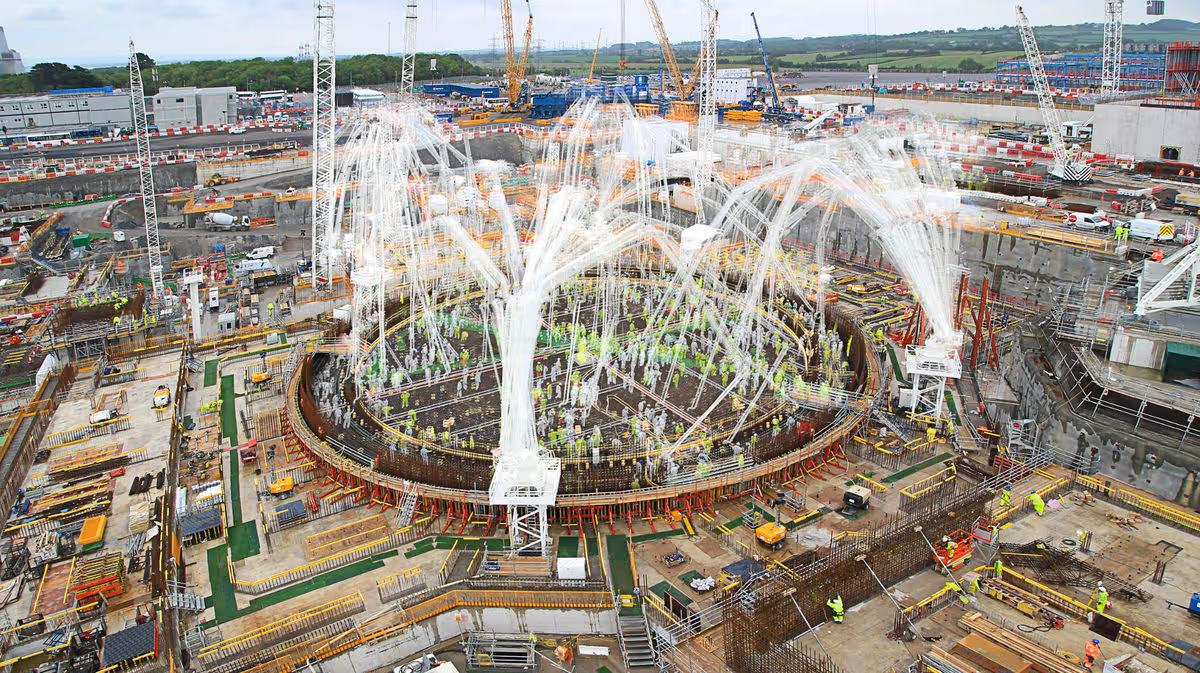
The view south across the Hinkley Point C Construction Site showing the main excavations and pipework for the cooling water systems of unit 1.

The view south across the Hinkley Point C(Image: EDF Energy)

A Somerset wedding venue has been granted planning permission to house extra workers from Hinkley Point C on its premises.

Advertisement

Greenway Farm, on Skimmerton Lane on the western outskirts of Bridgwater, can host up to 60 guests for civil ceremonies in its wedding barn, and also features a restaurant area.

Owners Martin and Susan Felstead obtained planning permission in June 2023 to position 10 caravans on the site for those working at the nuclear power station, in addition to five already let out to members of the Caravan and Motorhome Club.

Somerset Council has now given the green light for all 15 caravans to be rented out to Hinkley Point staff until 2031 – although this timeframe could be extended should construction experience any further setbacks.

The caravans are positioned in the western section of the venue’s grounds, well shielded from both Skimmerton Lane and the nearby Shell petrol station, which houses a Budgens store and Greggs outlet.

Advertisement

Since the initial caravans were installed, a private waste treatment facility has been established and additional trees planted to further separate the campsite from the rest of the wedding venue.

Entrance to Greenway Farm wedding venue on Skimmerton Lane in Bridgwater. CREDIT: Google Maps. Free to use for all BBC wire partners.

Entrance to Greenway Farm wedding venue on Skimmerton Lane in Bridgwater(Image: Local Democracy Reporting Service / Google Maps)

A spokesperson for Clive Miller Planning (representing the Felsteads) said: “The site is well positioned for Hinkley Point C workers, being within walking distance of the bus service which runs along the A39 Quantock Road to the South West of the site.

“Occupancy of the 10 pitches on the site currently allocated on the site has been consistently high. These pitches are currently full and there is further strong demand for more pitches for workers.

“At the moment, the owners of Greenway Farm are having to turn new Hinkley Point C workers away when they enquire about such a provision.

Advertisement

“These pitches are highly appealing to Hinkley Point staff who have their own caravans or motor-homes, are working away from home and wish to keep”

“This also reduces the impact on the local affordable housing provision by providing an alternative choice to the local private rental sector.

“Despite the presence of the BP service station, the Greenway Farm site is relatively quiet, rural and provides the ability for workers to separate themselves from their colleagues when not at work.”

The proposals were granted approval by the council’s planning officers using their delegated powers, bypassing a public ruling by its planning committee north, which oversees major applications within the former Sedgemoor area.

Advertisement

Greenway Farm sits within walking distance of the Centenary Heights development to the north of Quantock Road, where Cavanna Homes South West and Martin Grant Homes are jointly delivering 675 new homes, a primary school and community hub.

The council is expected to reach a verdict imminently on proposals for a further 275 homes at the western edge of the site, just yards from the boundary with Greenway Farm.

Continue Reading

Business

Fidelity Magellan Fund Q1 2026 Commentary

Published

on

Fidelity Magellan Fund Q1 2026 Commentary

Fidelity’s mission is to strengthen the financial well-being of our customers and deliver better outcomes for the clients and businesses it serves. With assets under administration of $12.6 trillion, including discretionary assets of $4.9 trillion as of December 31, 2023, Fidelity focuses on meeting the unique needs of a broad and growing customer base. Privately held for 77 years, Fidelity employs more than 74,000 associates with its headquarters in Boston and a global presence spanning nine countries across North America, Europe, Asia and Australia. Note: This account is not managed or monitored by Fidelity, and any messages sent via Seeking Alpha will not receive a response. For inquiries or communication, please use Fidelity’s official channels.

Continue Reading

Trending

Copyright © 2025