

Business
Italian consumer confidence beats expectations in May while business morale drops


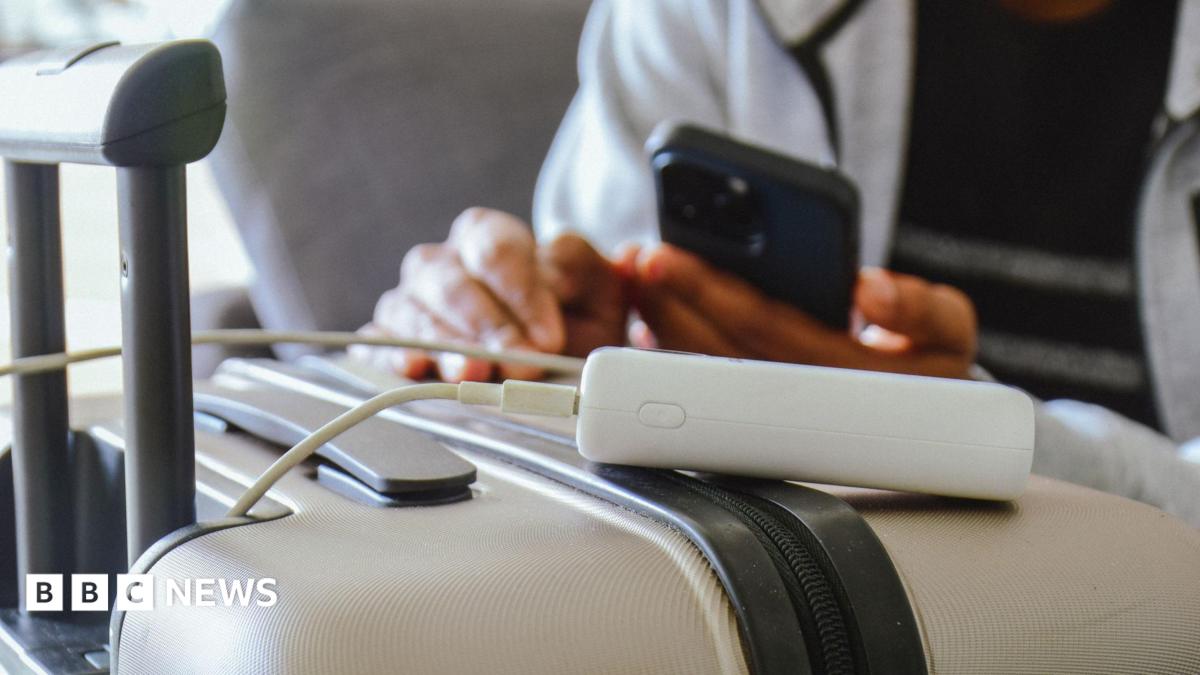
Flight passengers are being warned not to pack power banks or vapes in their hold luggage ahead of the busy summer holiday travel period beginning for parts of the UK.
The fire risk posed by lithium batteries is now the number one safety risk to aircraft, according to the aviation regulator, as the number of devices found in hold bags has nearly doubled in a year.
The Civil Aviation Authority (CAA) says the average person now takes four different lithium powered devices on a flight.
Ahead of the school summer holidays, which begin in Scotland first this week, people are being reminded to take devices in the cabin with them.
The batteries can store huge amounts of energy in a small space, and are now commonly used in lots of electrical items including laptops, vapes, power banks, mobile phones and smart watches.
They’re incredibly useful and versatile. But if the batteries overheat or are defective, a fire can result which spreads very quickly and is hard to control.
In 2024, 316 incidents of devices with lithium batteries detected in hold bags were reported to UK authorities. In 2025, that rose to 643.
Reports of devices overheating or malfunctioning also nearly doubled the same year, from 123 to 206.
Most of these issues occurred in the cabin where crew could deal with the situation, but the concern is that if this happens in the hold, the problem may not be discovered until it’s too late to control it.

Harbor Mid Cap Core ETF Q1 2026 Commentary

Form 4 Trulieve Cannabis Corp For: 25 June


House Speaker Johnson tries to patch things up between Trump and Congress

Wise: Q4 Confirms The Compounding Story

What does the future of work look like? The companies building the most popular AI tools are a good place to check.
While many companies across the U.S. have been struggling to get their employees to use artificial intelligence, OpenAI, Google and Anthropic are getting their workers to share complicated tasks with AI.
Copyright ©2026 Dow Jones & Company, Inc. All Rights Reserved. 87990cbe856818d5eddac44c7b1cdeb8
Form 4 Spero Therapeutics Inc For: 25 June

Southeast Asia has consolidated its position as the world’s most dynamic fintech market heading into the second half of 2026. A Money20/20 survey of more than 130 senior fintech leaders across Asia found that Southeast Asia was identified as the primary growth target by 22.9% of respondents — making it the leading destination despite a slight pullback from the prior year’s 31.4%, a sign of market maturation rather than retreat.
The drivers are structural and well-documented: a 670-million population with a median age around 30, high mobile penetration, and a legacy banking system that left hundreds of millions underserved. Fintech is now embedded in e-commerce platforms, reflecting evolving consumer behaviour where users expect financial services to be available seamlessly without switching between applications. Approximately 77% of consumers in Southeast Asia already use embedded finance through digital wallets, buy-now-pay-later services, or in-app loans, with around 75% considering it essential to their digital experience.
From payments to infrastructure
The region’s most consequential development is the rapid buildout of cross-border payment infrastructure — a direct response to the chronic friction of operating across 11 jurisdictions with distinct currencies, regulators, and banking ecosystems.
By December 2025, there were 29 QR and person-to-person payment linkages within ASEAN and with external partners, recording millions of transactions and hundreds of millions of dollars in transfers — figures cited by the 2026 Joint Statement of ASEAN finance ministers and central bank governors as evidence of maturing adoption.
Thailand sits at the centre of this buildout. In late 2025 and into 2026, the Bank of Thailand deepened bilateral QR linkages with China’s Weixin Pay, Alipay, and UnionPay QR, and advanced ASEAN Regional Payment Connectivity efforts — including the official launch of Thailand-China cross-border QR payment acceptance, enabling Chinese tourists to pay Thai merchants in RMB and Thai users to pay in CNY via linked wallets.
The growth trajectory is steep: QR cross-border payments in Thailand increased by more than 300% in 2024 compared to 2023, and in Malaysia by 550% over the same period. The tailwind from intra-ASEAN tourism is significant — intra-ASEAN visitors accounted for 42% of total regional arrivals in 2023, up from 36% in 2019, with tourism contributing roughly 8% of regional GDP and 12% of employment.
The longer-term architecture is Project Nexus, a multilateral framework backed by the Bank for International Settlements. Rather than requiring each payment system operator to build custom bilateral connections for every partner country, Project Nexus requires only a single connection to the Nexus platform — a design with significant implications for scalability. The Reserve Bank of India has already joined, potentially connecting India’s Unified Payments Interface — the world’s largest instant payment system — to the ASEAN network.
The fragmentation problem
For all the momentum, a fundamental tension persists. The same market heterogeneity that drove fintech innovation also constrains it. Vietnam’s Deputy Prime Minister, speaking at the ASEAN Future Forum 2026, warned that ASEAN would struggle to build a strong fintech ecosystem if countries remained divided by fragmented data systems, incompatible standards, and governance gaps.
ASEAN’s fintech ecosystem is expanding rapidly, but growth remains uneven due to fragmented regulation, infrastructure gaps, and highly concentrated funding that limits firms’ ability to scale and extend services to underserved populations. A fintech that achieves product-market fit in Thailand still faces a materially different regulatory stack in Indonesia, Vietnam, or the Philippines — requiring duplicated compliance infrastructure and slowing regional expansion.
Cross-border payment interoperability remains constrained by regulatory barriers, particularly around processing payments with one leg outside domestic jurisdictions, making bilateral linkages complex and difficult to scale. Existing linkages were described at the 2026 Asian Banker Summit as operationally difficult to implement, while multilateral frameworks such as Nexus are viewed as more promising but still face unresolved challenges for wholesale use cases.
A different model of disruption
What distinguishes Southeast Asian fintech is its departure from the adversarial Western playbook. Rather than pitting challengers directly against legacy banks, the region has moved toward an “impact era” in which commercial success and social good are increasingly inseparable. Fintech firms are collaborating with traditional banks while still competing in certain areas, building ecosystem infrastructure rather than chasing outright disruption — visible in practice in the partnership between Singapore’s Grab Financial and Thailand’s Kasikornbank to expand digital wallet and e-money services across the region.
The Money20/20 APAC survey found that 90.6% of executives affirmed financial inclusion and social good as a core business strategy — a figure that would have been implausible in a Western fintech context five years ago, and one that reflects both genuine intent and the commercial reality that the largest untapped markets in Southeast Asia are the unbanked and underbanked.
Thailand’s position
Thailand is one of the fastest-growing fintech markets in ASEAN and has one of the world’s largest consumer bases for fintech mobile banking. Internet and mobile banking remain the most popular e-payment channels, with transaction volumes continuing to climb through late 2025, per Bank of Thailand data.
Thailand’s foundation for digital finance is reflected in near-universal financial account ownership at 96% and mobile phone penetration at 100%. The Bank of Thailand has been instrumental in fostering fintech startups through regulatory sandboxes, and PromptPay — the real-time payment network enabling instant transactions via national IDs, phone numbers, or QR codes — has significantly accelerated cashless adoption.
The central bank’s cross-border ambitions extend well beyond the China linkage. BOT has expanded PromptPay’s coverage to other ASEAN countries as part of the ASEAN Payment Connectivity initiative, with linkages also forged beyond ASEAN to countries with strong economic ties — particularly those with large flows of migrant workers and tourists.
The outlook
The structural case for Southeast Asian fintech remains intact. Demographic tailwinds, rising incomes, and a policy environment broadly supportive of digital financial services create durable demand. The cross-border payment buildout — particularly Nexus and the expanding QR linkage network — could materially reduce the cost of regional expansion for both fintechs and the small businesses they serve.
The constraint is not demand but architecture. Proposals for an ASEAN-wide fintech sandbox to allow cross-border financial technology solutions to be tested in a controlled environment remain aspirational. Without convergence on data standards, KYC/AML frameworks, and licensing reciprocity, the region risks consolidating into a collection of sophisticated national markets rather than an integrated economic bloc. That distinction matters for investors underwriting regional growth stories — and for the millions of small enterprises and migrant workers whose access to affordable financial services depends on whether the infrastructure eventually connects.
Other People are Reading

INGLEWOOD, Calif. — The United States men’s national team can complete an unbeaten group stage when it faces Türkiye in its final Group D match at the 2026 World Cup on Thursday night.
The Americans have already secured top spot in the group with victories over Australia and Paraguay. Türkiye, meanwhile, has struggled offensively despite taking 62 shots across its first two matches without finding the net.
Kickoff is scheduled for 10 p.m. ET at SoFi Stadium. The match offers the U.S. an opportunity to build momentum heading into the knockout rounds while Türkiye seeks to salvage its tournament with at least a goal and positive result.
Team News and Lineup Considerations
U.S. coach Mauricio Pochettino faces decisions about squad rotation with the group stage already decided. Key players including Christian Pulisic have been managing injuries, while others have accumulated yellow cards that could lead to suspensions in the round of 32.
Pulisic has returned to full training after missing the Australia match with a calf issue. The coach must weigh the benefits of giving him minutes against the risk of further injury.
Defensive anchors Tyler Adams, Chris Richards and Antonee Robinson, along with forward Folarin Balogun, sit on yellow cards. Limiting their minutes or benching them entirely could preserve their availability for the knockout stage.
Türkiye enters the match desperate for offensive production. Arda Güler and Kenan Yıldız have underperformed relative to expectations, leaving the team searching for breakthroughs.
The Turks’ inability to score despite volume of shots has been a major disappointment. Their defensive organization has been solid, but clinical finishing remains elusive.
Betting Odds and Analysis
FanDuel lists the United States as -110 favorites on the 90-minute money line, with Türkiye at +260 and the draw at +300. The over/under for total goals is set at 2.5, with the over at -140.
SportsLine experts have provided various picks, including both teams to score at -158 and Ricardo Pepi as an anytime goalscorer at +165. Pepi has impressed in limited opportunities and could start if Pochettino rests Balogun.
The game’s outcome may depend heavily on Pochettino’s lineup choices. A heavily rotated U.S. side could create opportunities for Türkiye, while a strong American lineup would likely maintain control.
Tactical Outlook
The United States has demonstrated tactical flexibility and depth throughout the group stage. Their ability to control matches while creating scoring chances has been impressive.
Türkiye’s approach has focused on high pressing and volume shooting, but execution in the final third has been lacking. Improving clinical finishing will be essential if they hope to avoid an early exit.
Pochettino’s system emphasizes possession and quick transitions. The coach’s ability to integrate younger players while maintaining structure will be tested if he opts for significant rotation.
Historical Context
The United States has shown improvement in recent international competitions. Hosting the 2026 World Cup alongside Canada and Mexico provides additional motivation and home advantage.
Türkiye has a proud footballing tradition but has struggled in recent World Cup cycles. Their current campaign reflects both promise and frustration as they seek to make an impact.
The match represents an opportunity for both teams to gain valuable experience. For the U.S., maintaining momentum heading into knockouts is crucial. For Türkiye, ending the group stage positively could build confidence for future competitions.
Player Spotlight
Pulisic remains the U.S. team’s creative focal point when available. His ability to unlock defenses with dribbling and passing makes him a constant threat.
Younger American talents have stepped up throughout the tournament, demonstrating the depth Pochettino has cultivated. This development bodes well for long-term international success.
For Türkiye, Güler’s creativity and Yıldız’s potential have yet to translate into goals. Their performances against the U.S. could influence perceptions of their future international prospects.
Broader Tournament Implications
The United States’ strong group stage performance has boosted national pride and expectations heading into the knockout rounds. A positive result against Türkiye would further enhance momentum.
Türkiye’s campaign highlights the challenges of international competition. Despite early promise, converting chances has proven difficult against organized defenses.
The match at SoFi Stadium continues the World Cup’s showcase of American venues. The atmosphere is expected to be electric with strong U.S. support.
As the group stage concludes, focus shifts to the round of 32 matchups. The U.S. position as group winner provides advantageous positioning for the knockout bracket.
Looking Ahead
Pochettino’s squad selection will reveal priorities for the remainder of the tournament. Balancing player health, tactical experimentation and result-oriented play presents an interesting challenge.
Türkiye will likely adopt an aggressive approach seeking their first goal of the tournament. Their desperation could create an open, entertaining match.
The game offers valuable minutes for squad players on both sides. Depth and rotation management will be crucial as the tournament intensifies.
For American soccer fans, the match represents another opportunity to celebrate the national team’s progress on home soil. The U.S. performance throughout the group stage has exceeded many expectations.
The 2026 World Cup continues delivering compelling storylines as it moves toward the knockout stages. The United States-Türkiye matchup provides one final group stage chapter before the intensity increases.


California seeks court order to block reversal of state emission rules

Toofan – Toofan – Money (Clip Officiel)

The Supreme Court’s TPS decision could affect 1.3 million immigrants

Warning over power bank fire risk on flights as summer holidays begin


-

 Fashion6 days ago
Weekend Open Thread: Miami – Corporette.com
-

 Entertainment5 days ago
Renter of Home in Anne Heche Crash Denies Settlement With Son
-
 Sports2 days ago
Two goals and an assist by sheer aura: Cristiano Ronaldo just entered the World Cup chat
-

 Tech3 days ago
Microsoft accidentally kills epic Outlook email threads
-

 Business5 days ago
Soccer-U.S. defends Iran World Cup travel restrictions, says discussions ongoing
-

 Politics6 days ago
Andy Burnham and the meaning of Makerfield
-

 NewsBeat6 days ago
Keir Starmer Allies Question His Chances For No 10
-

 Tech4 hours ago
A Look At A Gaggle Of Transputer Boards
-
Crypto World2 days ago
Bitcoin (BTC) Dips Below $62K, Ethereum (ETH) Plunges 6% Daily: Market Watch
-

 Crypto World2 days ago
Securitize Wraps Roubini's SEC-Registered ETF as Dubai VARA Digital Security
-
Business2 days ago
Entergy settles forward sale agreements, raises $672 million in cash proceeds
-
 Business6 days ago
Wall Street Week Ahead: Investors see Micron earnings as pulse check of AI rally momentum
-
 Crypto World6 days ago
Can Charles Hoskinson Really Rescue Cardano?
-

 Crypto World6 days ago
HIVE shares jump as $220M AI deal speeds Bitcoin mining pivot
-

 Crypto World6 days ago
Jake Chervinsky accuses CME of protecting derivatives monopoly
-

 Entertainment6 days ago
Jose Alvarado Wants Taylor Swift at More Knicks Games
-
 Tech4 days ago
Signal’s Meredith Whittaker says AI chatbots ‘are not your friends’ and calls Copilot agents a backdoor
-

 Sports11 hours ago
India vs Bangladesh LIVE Score, Women’s T20 World Cup: Bangladesh Opt To Bat; India Enter ‘Do-Or-Die’ Stage As Semi-Final Race Heats Up
-

 Tech3 days ago
Nearly 7,000 fake Amazon domains registered ahead of Prime Day 2026, researchers warn
-

 Sports7 days ago
FIFA World Cup 2026: Canada beat 9-men Qatar 6-0 to register first ever win | FIFA World Cup 2026
You must be logged in to post a comment Login