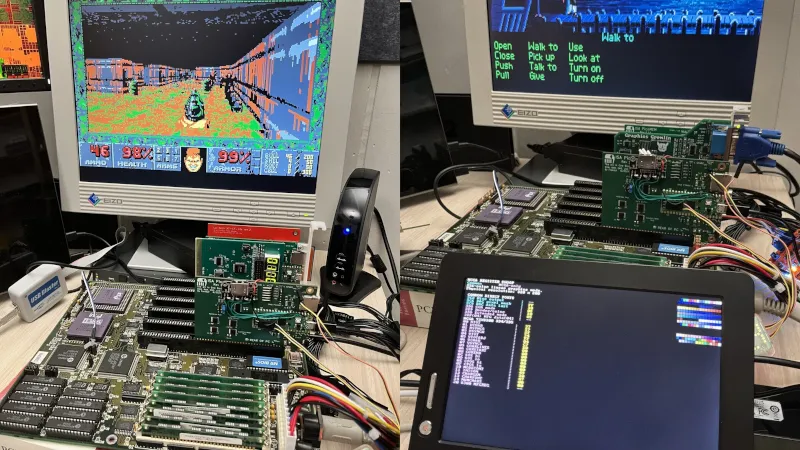
The monitors used on older computers are now becoming difficult to find, as we doubt anything for MDA, CGA, Hercules, or EGA has been manufactured in decades. Even VGA, though there are plenty of surplus flat panels to be found, is not as ubiquitous as it once was. Where does that leave the retrocomputing enthusiast with an ISA PC and no screen? Perhaps [Ian Hanschen] has the answer with the PicoGraph, an ISA-to-USB-to-Displaylink adapter.
In hardware terms, it’s using a PicoMEM, a more general-purpose ISA card for emulating cards with a Pi Pico. The Pico hosts a USB DisplayLink adapter, which can connect to the screen of your choice. The software on the PicoMEM does the heavy lifting and provides MDA, Herc, EGA, and VGA support, as well as support for one of the 1990s Cirrus Logic SVGA chipsets. And yes, it appears to work with DOOM.
The practice of using 2020s microcontrollers to lend functionality to retrocomputers has revolutionised the art. We’ve seen many, with one of the more recent being a minimap add-on for an 8-bit Sinclair Spectrum.
Fitness tracker pricing can be, well, a bit misleading. For example, say the $399 Oura Ring 5 seems to be within your budget at first glance. But to make it remotely useful, you’ll need to pay an extra $6 per month or $70 per year. Your total cost jumps up to around $550 after only two years. (And if you hang onto it for five years, you’re looking at at least $750.)
Oura isn’t even the most egregious subscription-based offender in this space. Whoop, the popular screenless fitness tracking band, requires a membership starting at $199 per year. Granted, that includes the device itself, unlike others. But you don’t need to be a math whiz to realize how quickly its cost can add up over the long term, too.
That’s why Google’s recently released Fitbit Air is so interesting. It’s basically a Whoop, with a one-time cost of $100. You can use most of its features without an additional subscription. What a concept! Let’s take a closer look at the landscape following the Fitbit Air’s entry, to see where you can cut through the paywall noise.
Advertisement
Fitbit Air
Cherlynn Low for Engadget
The Fitbit Air, starting at only $100, is the company’s direct rival to Whoop. Crucially, Google’s screenless band gives you all of its core features without a monthly fee. Only the Gemini-powered Al Coach and other perks (like workout videos) require a Google Health Premium subscription. If you do opt for that, you’ll pay $10 per month or $100 per year. But again, it’s more of an add-on than a necessity.
The device’s battery life is about seven days, half the Whoop’s 14-day uptime. But the Fitbit Air does charge quickly, so it shouldn’t be a huge deal. For example, our review unit went from 36 percent to 58 percent in just five minutes.
The Fitbit Air works with both Android and iOS phones. However, it requires the Google Health app and won’t sync natively with Apple Health.
Advertisement
Garmin vívosmart 5
Garmin
Unlike the Fitbit Air and Whoop, the vívosmart 5 has a narrow, monochrome OLED display. That, combined with its slim profile, makes it a solid way to split the difference between a full-on fitness watch and a screenless tracking band.
The device logs your heart rhythm, sleep, steps and workouts. And Garmin’s Body Battery score estimates how long to wait before your next intense workout. Like the Fitbit Air and Whoop, the vívosmart 5 lacks built-in GPS and instead uses connected GPS via your paired phone.
Best of all, there’s no monthly fee whatsoever, so your $150 upfront investment unlocks everything the device can do.
Advertisement
The Garmin vívosmart 5 is compatible with Android and iOS. Its companion Garmin Connect app can sync with Apple Health and Google Health.
Samsung Galaxy Ring
Sam Rutherford for Engadget
Although it has its limitations, the $400 Samsung Galaxy Ring also functions 100 percent without a monthly fee. It tracks sleep (duration, stages, and skin temperature) and activity. It can automatically detect walking and running and provide detailed metrics for both. It can last at least six days on a charge.
Unfortunately, the Galaxy Ring doesn’t work with iPhones. And while it works just fine with Android phones from other manufacturers, a Samsung device is required for Galaxy AI features and its double-pinch gesture controls.
Advertisement
Apple Watch Series 11
Cherlynn Low for Engadget
Okay, maybe we’re cheating a bit here by including a full-fledged smartwatch. But the Apple Watch Series 11 has loads of health-tracking features without a monthly fee.
This latest model has longer battery life than the previous generation: up to 24 hours with regular use. On the health front, this model adds hypertension alerts. The watch can monitor your heart rate and blood oxygen levels, track your sleep (including a sleep score), and log a long list of workouts.
On the downside, the Apple Watch Series 11 starts at a hefty $400. It’s also iOS-only, so folks with Android phones are left out.
Advertisement
Xiaomi Smart Band 10
Xiaomi
On the opposite end of the pricing spectrum is the Xiaomi Smart Band 10. The budget fitness tracker costs around $50 and has no subscription fees. Hard to beat that.
The device has a bigger, brighter and sharper display than its predecessor, with an improved screen-to-body ratio. It covers the basics, including heart rate monitoring and sleep tracking. It can last up to 21 days on a single charge. As a quirky bonus, you can even wear it as a necklace or attach it to your shoe.
What’s compromised at this ridiculously low price? First, the Xiaomi Smart Band 10 lacks built-in GPS. Its suite of sensors is also limited: It can’t sense ECG, blood pressure, skin temperature, barometer, altimeter, or HRV. Its sleep tracking also gets mixed feedback. This isn’t the device to get if you want premium health monitoring; it’s more about keeping the cost down.
Advertisement
The Xiaomi Smart Band 10 pairs with the Mi Fitness app, which is available on iOS and Android.
We may receive a commission on purchases made from links.
Air conditioners are a great way to stay cool in the summer. Many have central air in their homes to beat the heat, while some opt for plug-in, stationary window units to cool things down. Aside from those, there are also portable air conditioners. These stand on their own, have an exhaust hose, and can roll around on wheels or be picked up and moved as necessary.
Advertisement
There are plenty of benefits to a freestanding air conditioner. For one, if you’re trying to cool down a room but the windows are too small for a window unit, a portable air conditioner and its much smaller exhaust hose could be a prime solution. Window units are also heavy and awkward to carry on your own. A portable unit rolls around easily, so you can move it around and store it by yourself. Some of these portable units rank among the best budget-friendly air conditioners on the market today, too.
With that said, if you’re looking for reliable, effective cooling in a portable air conditioning format, no matter the price, there are plenty of strong options to consider. These are some of the best currently available in 2026, according to online sentiment.
Advertisement
LG LP1419IVSM
In addition to its more well-known products, like refrigerators and washing machines, LG has also delved into portable air conditioners over the years. Among the brand’s best models is the LG LP1419IVSM, a $699.99 10,000 BTU SACC unit. LG markets it as a unit for rooms between 301 and 500 square feet, features an automated swinging vent that moves the cool air around, and has LG’s Auto Evaporation System to minimize water drainage and simplify maintenance. It is also compatible with the LG ThinQ app to monitor the unit and manage certain functions.
This LG unit is quite highly praised. The New York Times included it among its recommendations for best portable air conditioners in 2026, specifically praising the easy setup and teardown. New York Magazine’s praise echoed those strengths, while also highlighting how well the LG cools a room, its low-volume operation, and a premium construction that matched the higher cost. Similarly, Business Insider had a lot of good to say about this unit in its review, noting that its comparatively low energy consumption doesn’t hinder its ability to bring a room’s temperature down in short order.
Advertisement
Midea Duo MAP14S1TBL
Midea is another brand with a huge catalog of appliances, including a selection of air conditioners. One of the most well-regarded of its portable offerings is the Midea Duo MAP14S1TBL, which retails through the official Midea website for $659.99. This 12,000 BTU SACC unit cools, dehumidifies, and ventilates, utilizing two hoses to remove warm air from your space while pumping in the cool stuff. IT also has Wi-Fi support for remote control. It’s advertised as cooling up to 550 square feet, and according to reviews, it does so quite well.
Many regard the Midea Duo MAP14S1TBL as one of the best portable air conditioners available for sale. It topped Forbes’ list of the best portable air conditioners for 2026, receiving praise for its fast and effective cooling, as well as its low 42 to 49 dB noise level. Business Insider praised it for similar reasons, in addition to applauding its easy setup and the usefulness of its app connectivity. YouTuber Silver Cymbal gave this Midea unit high marks, too, recommending it as a worthwhile model that can cool down a sizeable room impressively well, despite the somewhat lacking connection points on the dual hoses.
Advertisement
Whynter ARC-1230WN
Whynter specializes in cooling appliances, from small refrigerators to ice machines, and is also considered one of the most reliable air conditioner brands out there. The Whynter ARC-1230WN, one of its many air conditioners, is often regarded as one of the strongest available today. Typically found around the $600 mark, depending on where you buy it, this 12,000 BTU SACC unit is cools and circulates air through spaces up to 600 square feet. It also has Wi-Fi connectivity and compatibility with Amazon Alexa, Google Home, or the NetHome Plus app. Whynter also claims that this unit offers 40% to 50% energy savings compared to similar models.
Advertisement
Opinions of this Whynter unit are very positive. Forbes‘ 2023 review considered it the best portable air conditioner money could buy. The outlet felt that the dual-hose system made for quick setup and great cooling, while the wheels made it easy to move, despite its 75-pound weight. TechGearLab gave this unit high marks, too, noting that its impressive cooling — the unit dropped the outlet’s test room by around 12 degrees in roughly an hour — made up for its weight. Rtings considers the ARC-1230WN the best portable air conditioner it’s tested as of 2026, with cooling performance, ease setup, and low noise among its strengths.
Advertisement
Dreo AC515S
If there’s one thing Dreo knows, it’s cooling. The Dreo AC515S — not to be confused with the similar Dreo AC516S air conditioner — is one of the best portable air-conditioning units available for those with tighter budgets and smaller rooms to cool. This is a less powerful unit than others on this list; it has 8,000 BTU SACC of cooling, with a recommended room size of around 350 feet. It is more affordable than other units, though, costing $539.99.
While it’s a bit weaker, this Dreo air conditioner has received very positive reviews since its introduction. For example, Reviewed ranked it among the top five best portable air conditioners of 2026. The publication described it as a quiet unit that cools effectively and blows straight across 16 feet with ease. Popular Mechanics appreciated its cooling capabilities, too, praising the Dreo app’s connectivity, physical remote, and the air conditioner’s price point. Bob Vila thought quite highly of the unit, too, thanks to its good cooling, impressive humidity control, and low noise output.
Advertisement
How we selected these air conditioners
Gautier Normand/Shutterstock
Selecting these portable air conditioners was a multi-step process. We dug into brands both large and small, getting a feel for the current portable air conditioner landscape. We combed through their products, looking for a balance of functionality, portability, and price, to ensure the units considered could deliver on multiple fronts. Of course, marketing speak on brand websites and online storefronts was not enough.
There also had to be multiple sources online to help justify these units’ place on this list. We relied on written reviews, video tests, and other assessments to develop an understanding of what these air conditioning units have to offer. We omitted air conditioners with a lot of negative opinions, persistent problems, or other issues, focusing on highly praised units with great features and compelling value for this list.
This week, NASA shared more information about its planned moon base missions, Blue Origin’s New Glenn rocket exploded on the launchpad and the James Webb Space Telescope spotted a supermassive black hole that researchers say “may have formed within the first second after the big bang.” But first, we have updates on NASA’s X-59 quiet supersonic research plane and SpaceX’s Starship following last week’s test flight. Catch up here on this week’s science news.
Key test flights approach for NASA’s quiet supersonic plane
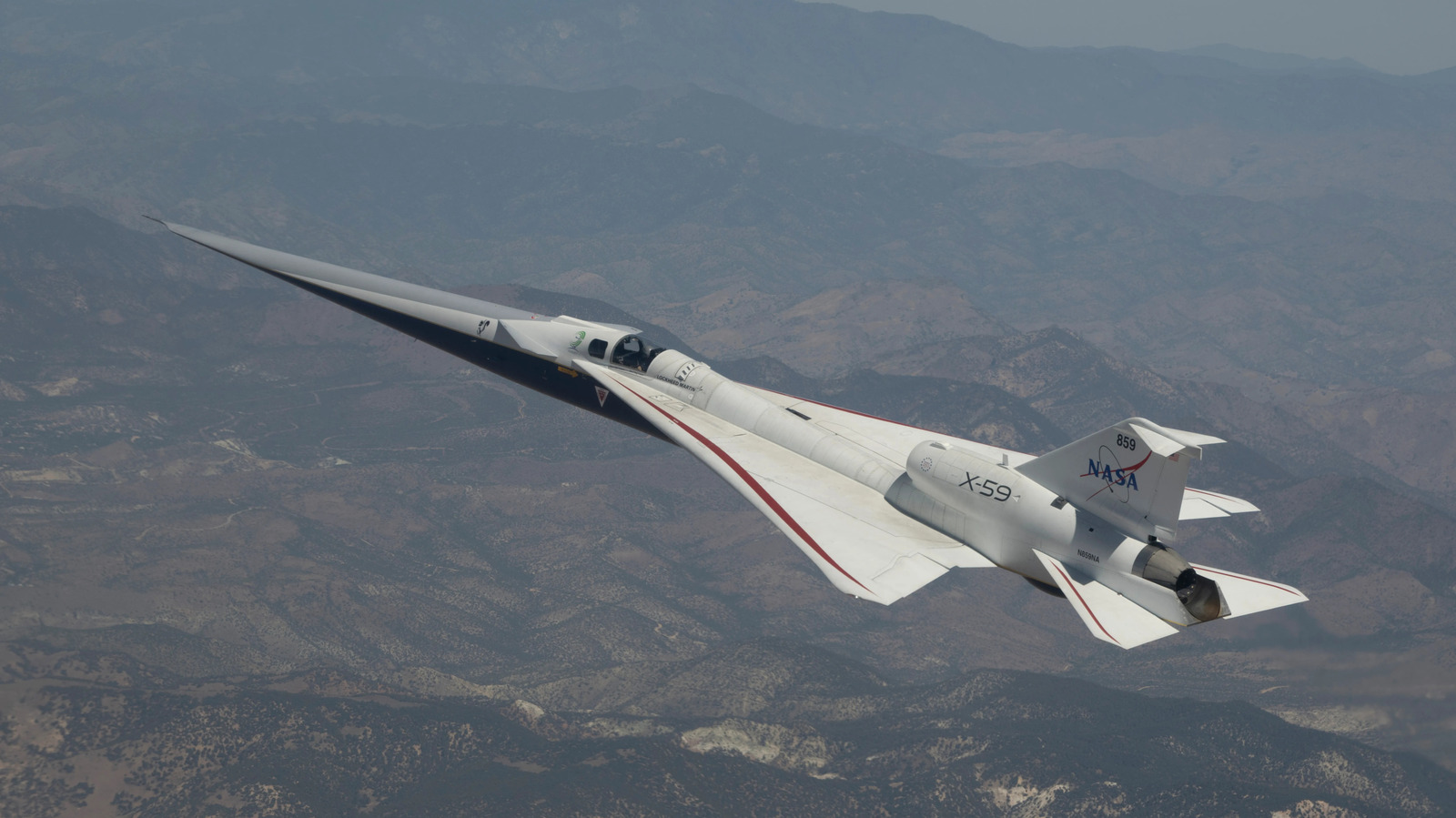
Over the last decade, NASA has been developing an aircraft that could one day reach supersonic speeds — or travel faster than the speed of sound — without producing the thunderous sonic booms typically associated with this feat. The plane, called the X-59, took its first ever flight back in October and has conducted several more in the months since. Now, NASA says it’s ready to go supersonic. The X-59 is scheduled to take its first supersonic flight, hitting over 630 mph at an altitude of about 43,000 feet, in early June, according to the space agency.
Then, in a followup “mission conditions” test, it will reach 925 mph (Mach 1.4) at about 55,000 feet. After that, it’ll go for its max speed: Mach 1.6, or 1,218 mph, at an altitude of 60,000 feet. NASA isn’t ready to show off the X-59’s quiet supersonic capabilities yet, though. For this phase of testing, NASA noted in a blog post, “The X-59 will be accompanied by a traditional supersonic chase plane, so any quiet thump it produces in the current phase of testing will be obscured by louder, traditional sonic booms from the chase.”
Advertisement
FAA grounds Starship after ‘mishap’
SpaceX’s Starship V3 launched for the first time last week in a test flight that achieved much of what the company set out to do. But, it wasn’t entirely without hiccups, and the Federal Aviation Administration (FAA) has since ordered a pause on Starship flights while it investigates what went wrong and prevented the Super Heavy booster from making a soft splashdown as intended.
The issue arose after Starship separated from Super Heavy. “Following stage separation, the Super Heavy booster performed a directional flip maneuver and attempted its boostback burn,” SpaceX explained in a blog post following the launch. “It was unable to light all planned engines and performed a partial boostback burn that ended early. Super Heavy attempted to reignite its engines for the landing burn before experiencing a hard splashdown in the Gulf of America.” Starship went on to complete its journey and splashed down at the planned site in the Indian Ocean.
“After a thorough assessment of the operation, the FAA has determined the May 22 SpaceX Starship Flight 12 launch resulted in a mishap,” the agency said in a statement released this week. “The mishap involved the Super Heavy booster as it flew back to the Gulf of America after stage separation. There are no reports of public injury or damage to public property.” It added, “The FAA is requiring SpaceX to conduct a mishap investigation. The FAA will oversee the SpaceX-led investigation, be involved in every step of the process, and approve SpaceX’s final report, including any corrective actions.”
Advertisement
It’s not an uncommon move on the FAA’s part, and SpaceX has faced several such groundings over the years, many of which have been wrapped up fairly quickly. It likely won’t be very long before we see Starship back in action. “A return to flight of the Starship-Super Heavy vehicle is based on the FAA determining that any system, process, or procedure related to the mishap does not affect public safety,” the FAA noted in its statement.
20 Snap alumni launched Ghost Angels to back AI startups building beyond the ad-driven social media model. Five deals done, 15 more planned.
Twenty Snap alumni have launched Ghost Angels, an angel fund backing the next generation of social media and consumer AI startups. The fund has invested in at least five companies and plans to deploy remaining capital into at least 15 more within the next year. It declined to disclose total fund size.
Max Rivera, who led global partnerships at Snap, started the fund in 2025 to formalise an already growing alumni angel community. He currently works at Microsoft’s AI division. The roughly 20 founder members include Alexandra Levitt, who ran Snap’s corporate accelerator, and Will Wu, a founding member of Snap’s product and design team.
“We were intentional about the mix,” Rivera told TechCrunch. “That diversity of thought and experience is core to how we evaluate deals and support founders.” The membership includes former senior executives alongside people earlier in their careers, plus a small number who still work at Snap.
Advertisement
Ghost Angels invests at pre-seed to seed stage in AI startups building in social media and consumer. Rivera said the biggest trend he has noticed is that “social” and “media” have actually split into two distinct categories.
The 💜 of EU tech
The latest rumblings from the EU tech scene, a story from our wise ol’ founder Boris, and some questionable AI art. It’s free, every week, in your inbox. Sign up now!
What consumers know as social media today is a platform that relies on ads, with algorithms driving content and recommendations. “A lot of people are disillusioned with that relative to the original promise of connecting people in your life,” Rivera said. The next generation is moving away from generalised platforms and toward niche communities.
Advertisement
Ghost Angels is backing both sides of the split. On the social side, founders are applying AI to deliver on the original promise of human connection. On the media side, AI-native formats and generative creative tools are lowering the barrier to creation and distribution across music, gaming, sports, and fashion.
Rivera has noticed that today’s founders operate differently from when he joined Snap nearly a decade ago. Teams are leaner. Founders launch fast and iterate in public. Monetisation is diversifying beyond ads into subscriptions, token-based models, usage-based pricing, and outcome-based revenue.
Meta’s launch of Forum this week underscores how the incumbents are also sensing the split. Forum, a standalone app built from Facebook Groups, is designed to capture the community discussion use case that Reddit currently dominates. The fact that Meta is unbundling Groups into a separate app validates Ghost Angels’ thesis that niche community tools are the next category.
Molly DeWolf Swenson, co-founder and CEO of portfolio company Mozi, said the “Snap alumni network is full of brilliant, influential people who inherently understand the problem space I’m playing in.” The fund’s value proposition to founders is not just capital but domain expertise from people who helped build one of the defining social platforms of the last decade.
Advertisement
The broader startup landscape is rewarding AI-native approaches that build for new categories rather than optimising existing ones. Peec AI hit $10 million ARR in six months by building for generative engine optimisation, a category that barely existed before ChatGPT changed how people search. Ghost Angels is betting that the same dynamic applies to social: the platforms that win will be built for AI-native interaction, not retrofitted with AI features.
The Snap alumni network is one of the most active in consumer tech. Snapchat’s culture of experimentation, its bet on ephemeral content, its early investment in AR, and its willingness to build products that looked strange before they looked obvious produced a generation of product thinkers who now see the next cycle forming. Ghost Angels is the vehicle for putting that conviction to work.
These deals caught my eye because not long ago, CEO Tim Cookwarned that significant changes in the memory market could lead to an “increasing impact” on Apple’s products.
Advertisement
Who knows what means – but I suspect it could translate into a mix of product shortages in high-memory SKUs and higher base costs for MacBooks, making it an excellent time to upgrade. Both slimline laptops feature the vibrant and beautiful Liquid Retina display, and come in a range of colors to suit your style. I’ve also seen the MacBook Air (M5) with 24GB RAM and 1TB SSD down to $1499 (was $1699) at Amazon, if you want a performance boost.
Today’s best MacBook Air deals
A better deal than an entry-level MacBook Neo?
Is the MacBook Neo the better budget pick? That depends on your use, with the MacBook Air being the power powerful, portable option.
Advertisement
The Neo uses the considerably slower Apple A18 Pro CPU versus the M4 and M5 CPUs that higher-end MacBooks above offer.
The deals, as they stand, are unlikely to be beaten any time soon. For a larger display and a slightly beefier CPU, go with the M5 route. The more compact M4-based model’s additional 8GB of RAM is handy for memory-intensive workloads or even some light localized AI use cases.
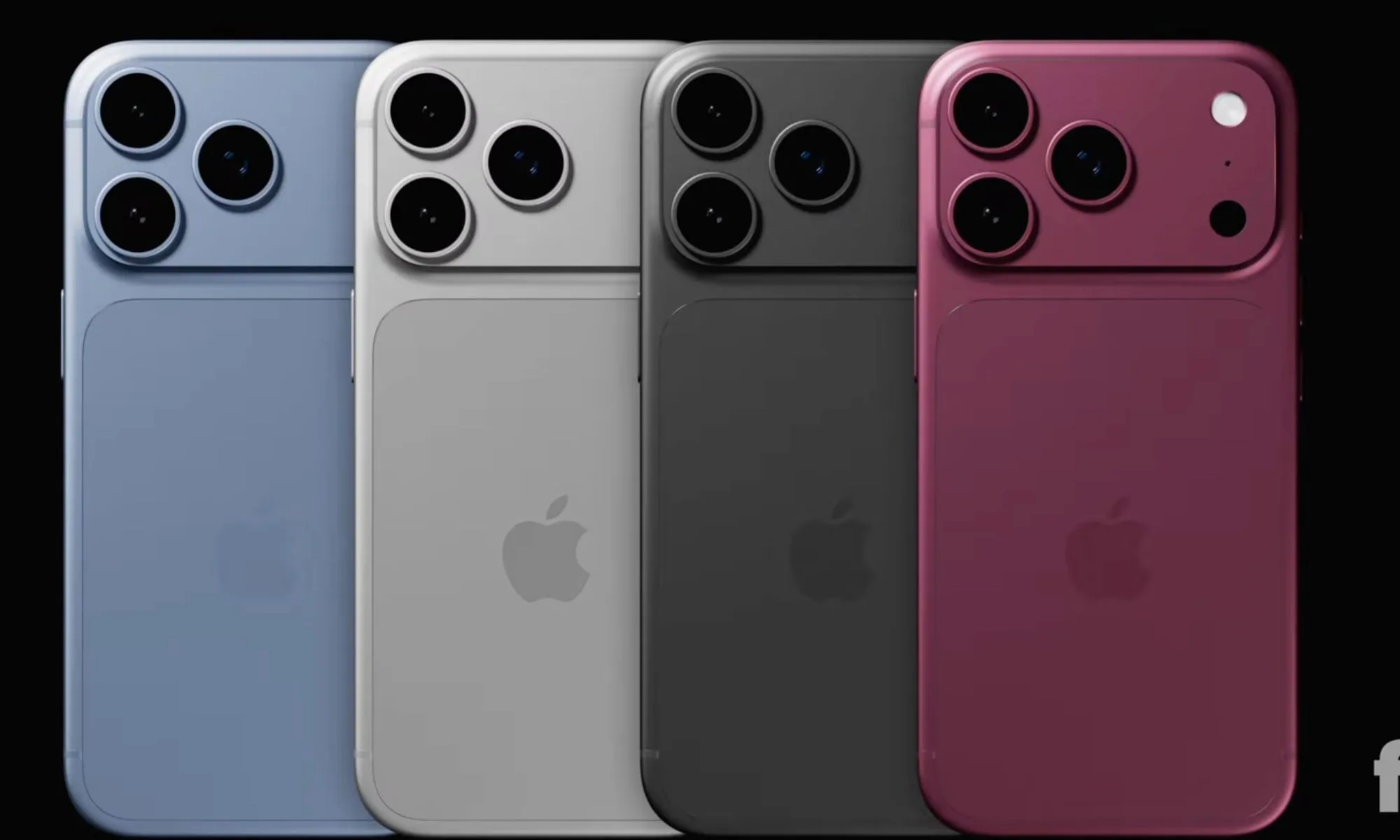
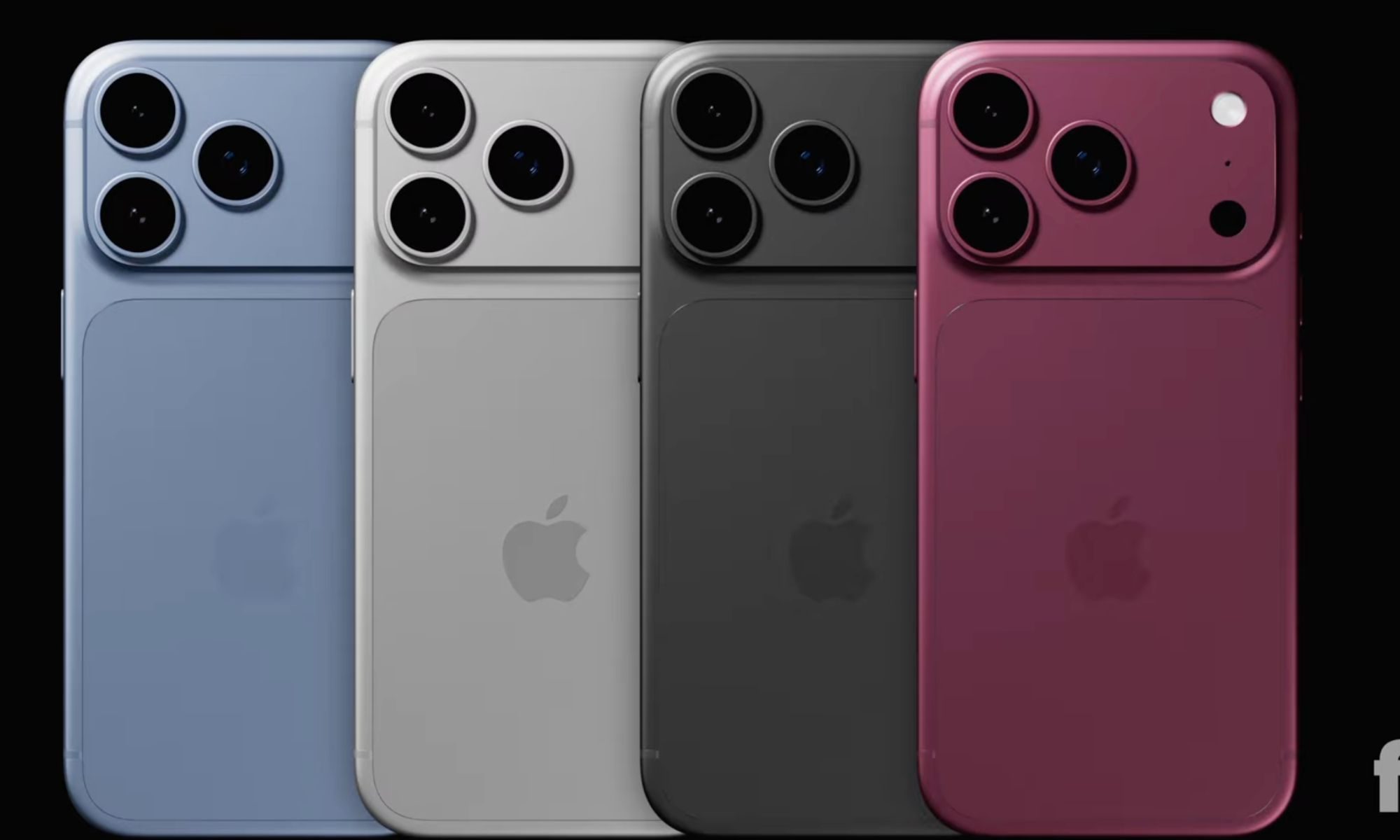
Apple’s next-generation Pro iPhone could arrive with one of the biggest camera upgrades the company has introduced in years. But according to new analyst reports quoted by Forbes, that improvement may also come with a significant increase in manufacturing costs – raising fresh questions about whether future iPhone prices could climb even higher.
The focus of the latest leak is the iPhone 18 Pro and iPhone 18 Pro Max, which are expected to debut a new variable aperture camera system. Supply chain analyst Ming-Chi Kuo claims the upgraded camera module could cost Apple roughly 50 percent more than the camera hardware currently used in its Pro models.
That may not sound dramatic at first, but camera systems have increasingly become one of the most expensive and important components inside modern flagship smartphones.
A camera upgrade Apple has been chasing for years
Variable aperture technology has been rumored for iPhones for several years, and reports now suggest the feature has finally entered production for the iPhone 18 Pro lineup. Unlike current iPhone Pro models, which use a fixed aperture lens, the new system would allow the camera to physically adjust how much light enters the sensor. In practical terms, that means improved exposure control, more flexibility in challenging lighting conditions, and potentially more natural background blur effects without relying entirely on software processing.
Advertisement
Fpt. on YouTube
Apple has largely relied on computational photography to improve image quality over the years, but a variable aperture would represent a more traditional camera hardware upgrade similar to features already seen on some premium Android phones.
According to Kuo, the new lens assembly is substantially more expensive than the seven-element plastic lens system Apple currently uses. Chinese supplier Sunny Optical is expected to handle a significant portion of production for the upgraded component.
Why this matters
The bigger story may not be the camera itself, but what it could mean for future iPhone pricing.
Apple has so far avoided major flagship price increases despite rising memory costs, more advanced chips, and growing manufacturing expenses. However, reports suggest the iPhone 18 Pro lineup is accumulating several expensive upgrades at once, including new camera technology, next-generation silicon, and additional connectivity features.
Macworld
That has led to growing speculation that Apple may eventually need to pass some of those costs onto buyers.
Online reactions have already been mixed. Some users see variable aperture as a meaningful photography upgrade, while others argue that most everyday users may never notice the difference enough to justify higher prices.
Advertisement
What happens next
Apple is expected to unveil the iPhone 18 Pro series in late 2026, and current reports suggest the devices could arrive alongside Apple’s first foldable iPhone.
For now, it remains unclear whether the higher camera costs will directly affect retail pricing. Apple has historically absorbed some component increases to maintain pricing stability, particularly in highly competitive markets.
Still, if the leaks prove accurate, the iPhone 18 Pro could become a test of how much consumers are willing to pay for advanced camera hardware. Apple clearly believes better photography remains one of the strongest reasons people upgrade their phones. The question is whether buyers will feel the same if the improvements arrive with a heavier price tag attached.
“Unlimited” is a funny term. Unlimited cell phone plans often come with a long list of footnotes, terms, conditions, and exceptions. Mercifully, all of the Big Three cell companies have, by now, ditched throttling on their most expensive plans and include 5G data access in all their unlimited plans. Yet there are still many differences in the services they offer, and there are many differences between each carrier’s various tiers.
Cheaper “unlimited” tiers do offer unlimited talk and text. But they still have rules on how much data you get before they start throttling your speed, and some “unlimited” plans may throttle your data at any given time. It’s been a fixture of cell service plans for years.
It can be overwhelming, which is why I’ve broken it down. Below, I’ve highlighted what each of the three major carriers offers for “unlimited” individual and family plans to help you figure out which unlimited plan is best for you and your budget.
If you absolutely want to avoid slower data speeds at peak times, you’ll likely be choosing among the plans here. But look to our guide to the Best Prepaid Phone Plans for lower costs at the expense of some limitations. Also check out WIRED’s guides to the Best Android Phones, Best iPhones, and Best Cheap Phones.
Advertisement
Update February 2026: We updated prices and plans for all three major carriers. We added T-Mobile’s Essentials Saver Plan and rebranded Better Value Plan as well as AT&T’s rebranded Premium PL, Extra EL, Saver SL, and Value Plus VL plans.
The Best Unlimited Plan Right Now: T-Mobile Experience More/Better Value Plans
The Essentials plan (with autopay, taxes/fees not included): 1 Line for $60/month | 2 Lines $90 | 3 Lines $90 | 4 Lines $100 | 5 Lines $125.
Essentials Saver plan (with autopay, taxes/fees not included): 1 Line for $50/month | 2 Lines $80 | 3 Lines $140
Experience More/Better Value (with autopay, taxes/fees not included): 1 Line for $85/month | 2 Lines $140 | 3 Lines $140 | 4 Lines $170 | 5 Lines $200
Advertisement
Experience Beyond (with autopay, taxes/fees not included): 1 Line for $100/month | 2 Lines $170 | 3 Lines $170 | 4 Lines $215 | 5 Lines $260
T-Mobile has the best 5G coverage among the big three, the highest 5G speeds, the fastest downloads and the best overall reliability, according to analysis from OpenSignal and Ookla. The carrier also makes claims to winning on value, when you take into account perks that include entertainment bundles, airplane WiFi, and access to satellite data in emergencies.
T-Mobile has rebranded its unlimited offerings this year but still offers three (or kinda four) main unlimited talk and text plans: Essentials, Experience More, and Experience Beyond. Only the two Experience plans offer true unlimited 5G data without any throttling or deprioritizing (i.e., making your phone stand in line for data behind other, more important, phones during peak demand.)
For merely occasional jet-setters and those who want consistent phone upgrades, Experience More is the best affordable phone plan among all services. This adds WiFi during flights, 4K video, 60 gigs of high-speed mobile hot-spotting, a modicum of international data, a AA membership, free ad-supported Netflix, and cheap ($3) Apple TV. It’ll also let you upgrade your phone every two years so random children don’t make fun of your ancient iPhone at a rest stop (yes, this has happened to me.)
Advertisement
If you want 3 lines or more and you’re a new T-Mobile customer (or a 5-year T-Mobile customer), you have access to an even better deal. The limited-time-only Better Value plan is in fact., possibly the best deal in phonedom at the moment. For the same price as the 3-to-5 line Experience More plans, you add free ad-supported Hulu, access to the T-Satellite emergency network, unlimited mobile hot-spotting, 30 gigs of international data in hundreds of countries, plus additional watch and tablet lines for just $5 a line. With the exception of phone upgrades every two years instead on every year, the perks are actually better than T-Mobile’s highest price plan, at a much lower price. This sale price is also locked in for 5 years.
Snapchat is already packed with little symbols that can be weirdly hard to decode. You have streaks, emojis, badges, scores, Best Friends, and if you use Snapchat Plus, a tiny solar system that shows where you sit in someone’s closest-friends list.
The feature is called Friend Solar System, though most people just call it Snapchat Planets. It takes your position in a friend’s Snapchat orbit and turns it into a planet. From Mercury to Neptune, these celestial bodies signify how close a person is to you.
The important thing to know is that Snapchat Planets is a Snapchat Plus feature, and it is now off by default for first-time subscribers. To use it, you’ll need to subscribe to Snapchat Plus and manually turn on Friend Solar System from the Snapchat Plus feature management page. Snapchat says the feature can be toggled on or off at any time.
Snap
What are Snapchat Planets?
Snapchat Planets are part of Snapchat’s Friend Solar System feature. When it’s enabled, Snapchat turns a friend’s Best Friends list into a solar system, with that friend as the sun and you as one of the planets around them.
In simple terms, the planet shows where you rank in that friend’s Best Friends list. If you appear as Mercury, you’re their closest Snapchat friend. If you appear as Venus, you’re second. If you appear as Earth, you’re third, and so on.
Advertisement
Snap
You can find this by opening someone’s Friendship Profile and tapping the Best Friends or Friends badge with a gold ring. Snapchat says tapping that badge shows which planet you are in their Solar System.
The planet you see is about your place in their solar system. It does not automatically mean they have the same position as yours.
Snapchat Planets order and meaning
The Snapchat Planets order follows the real solar system, minus Pluto. Mercury is the closest planet, while Neptune is the farthest.
As such, the planets of your friends in order from closest to furthest are as follows:
Mercury
Venus
Earth
Mars
Jupiter
Saturn
Uranus
Neptune
And yes, Pluto gets left out again.
Snapchat
So, if you tap a badge on someone’s profile and see Earth, that means you are third in their Snapchat Friend Solar System. If you see Neptune, you are still in their top eight, just farther out in the ranking.
Snapchat
Best Friends vs Friends: What’s the difference?
Snapchat Planets can appear through two badges: Best Friends and Friends. A Best Friends badge means both of you are in each other’s closest-friends circle. In other words, you are in their top group, and they are in yours too. Meanwhile, a friend’s badge means you are in their Friend Solar System, but the relationship may not be mutual in the same way. You might be one of their top friends, even if they do not appear in the same position on your side.
Either way, tapping the badge is what reveals your planet, provided you have Snapchat Plus and the feature is turned on.
Advertisement
How to see your Snapchat Planet
To check your Snapchat Planet, follow these steps:
Step 1: Open Snapchat.
Step 2: Go to a friend’s Friendship Profile.
Step 3: Look for a Best Friends or Friends badge with a gold ring around it.
Step 4: Tap the badge.
Step 5: Snapchat will show which planet you are in that friend’s Solar System.
If you do not see a badge, it usually means you either do not have Snapchat Plus, Friend Solar System is not enabled, or you are not in that person’s visible friend ranking.
How to turn on Snapchat Planets
Before you can use Snapchat Planets, you need Snapchat Plus. Pricing can vary by region and plan, so the safest way to check the current cost is inside the Snapchat app or through Snapchat’s subscription page. Snapchat also offers multiple Plus-related plans in some regions, and availability can vary.
Once you have Snapchat Plus, you may still need to turn on Friend Solar System manually.
Step 1: Open Snapchat and go to your profile.
Step 2: Tap your Snapchat Plus membership card or banner.
Step 3: Open the Snapchat Plus feature management page.
The astounding growth of the hair-transplant industry in Turkey is not just a medical tourism success story; it’s also a tale of “hacked” medical equipment and algorithmic craftsmanship.
From a biological and evolutionary perspective, human hair is often viewed as an unremarkable mass of keratin that still plays some important functions—protecting our scalps from the sun’s harmful ultraviolet rays and regulating our body temperatures—but, for the most part, is no longer essential to our survival.
Yet, since ancient times, our subconscious perceptions of whether another person is healthy, young, or fertile have been based on visual cues such as skin radiance, the integrity of teeth, and hair density. Deep within our perceptions, hair has become one of the most powerful representations of our identity and self-confidence. It’s key to social communications and perceptions.
Today, the global hair-transplant and restoration industry, which has evolved around this deep psychological and evolutionary need, has grown into a massive, multibillion-dollar industry. Various research firms have estimated the total size of the global hair-transplant market as sitting somewhere between $7.33 billion and $11.61 billion in 2024. And those figures don’t include the underground economy. According to Ministry of Health data, 1.39 million people visited Turkey for medical treatments in 2025. The revenue generated from medical tourism is $3 billion in 2025 (roughly the same as in 2024). While there is no data about how many of these individuals came for hair transplants specifically, it is estimated that one-third of them visited for aesthetic treatments.
Advertisement
The role that hair transplantation plays in promoting Turkey is also noteworthy. For example, Turkish Airlines is occasionally referred to as “Turkish Hair Lines” or simply “Turkish Hair,” a nod to how significant hair transplants are when it comes to tourism to the country. (Similarly, Istanbul Airport has been jokingly referred to as “Istanbul Hairport.”)
It’s possible to see current examples of this in virtually every aspect of popular culture. Last March, a social media user shared a post titled “There won’t be a single bald Spaniard left in the world,” accompanied by an image of the famous soccer player Andrés Iniesta with long hair. It was in response to Spanish prime minister Pedro Sánchez’s stance against the war in Iran, a position that Turkey supports. The post went viral and made headlines on Spanish news channels. Similarly, American basketball star Shaquille O’Neal’s joke in Turkcell’s 5G ads—“I’m here for a hair transplant” while wearing a long curly wig and footage from Turkey’s seven regions—is likely to be talked about for a long time.
Turkey’s global success in hair transplantation and the dominant position the country has achieved are issues too complex to be explained solely by affordable labor, low costs, and favorable exchange rates. Instead it is the result of a bold and at times chaotic yet highly innovative evolution. This includes everything from the adaptation of motors designed for dental devices and sapphire blades used in eye surgery to Anatolia’s ancient craft culture and the master-apprentice relationship transferred to microsurgical techniques.
Makeup for the Modern Man
The development of the institutional infrastructure needed to meet this massive demand in Turkey dates back to the late 1990s. At a time when Turkey’s most famous figures were traveling to Europe for cosmetic surgeries, Dr. Mustafa Tuncer, who attended the Medica trade show in Düsseldorf in 1999, adopted a radical new vision. Tuncer laid the foundation for the Esteworld plastic and aesthetic surgery clinics when he announced, “If Turkey’s celebrities are going to Europe for cosmetic surgery, I will build the best hospital, hire the best doctors, and bring Europeans to Turkey.” Thus, Health Tourism 1.0 began, characterized by fully equipped institutions that combined plastic surgery and hair transplantation under one roof while raising standards to the highest level.
Advertisement
As medical director of the Esteworld Health Group and a member of the second generation of his family to share this vision, Dr. Burak Tuncer says that at the heart of this innovative evolution lies a philosophy with psychological and medical depth—one that does not view the matter merely as a cosmetic procedure. “Hair is a tissue that cannot be replaced or cloned,” he says, adding, “If roots are damaged during the hair-transplant process—whether while being extracted or implanted—we permanently lose that unique tissue. That is why we treat every single strand of hair with the same value and care as we would a kidney or a heart.”
London AI lab Inherent raised $50M from Index Ventures and Radical Ventures to build self-improving AI for scientific discovery. Ex-UK AI tsar Matt Clifford advises.
London-based AI lab Inherent emerged from stealth on Wednesday with a $50 million seed round co-led by Index Ventures and Radical Ventures. Nvidia’s venture arm NVentures also participated, alongside Ex/Ante, Metaplanet, Macroscopic Ventures, and Mythos Ventures. It is among Europe’s largest AI stealth-to-launch rounds in 2026.
The founding team comes from DeepMind, Microsoft, and Reka AI. Tantum Collins and Edward Hughes previously collaborated on cooperative AI research at DeepMind. Louis Kirsch, another co-founder, also worked at DeepMind. Kaloyan Aleksiev came from Reka AI and Microsoft.
Collins has a policy background that most AI lab founders lack. He worked on AI policy at the Biden White House before co-founding Inherent. Matt Clifford, co-founder of Entrepreneurs First and the UK government’s former AI tsar, has joined as an adviser.
Inherent is building a platform called Faraday, named after the scientist. Its purpose is not to answer questions faster. It is to figure out which questions are worth asking in the first place.
Advertisement
“Most AI is built to answer questions. What it can’t do yet is figure out which questions are worth asking, the open-ended curiosity that produced penicillin, the microwave, the GPU,” said Danny Rimer, partner at Index Ventures. “That’s the gap Inherent is building into.”
Faraday pairs human researchers with AI agents that are designed to improve themselves iteratively on hard scientific problems. The company describes this as “AI-native science,” a paradigm it says will look and feel different from the scientific method as practised for the past 400 years.
Index Ventures framed the bet in those terms. “AI-native science will be messier, less legible, but capable of exceptional outcomes,” the firm wrote in a blog post announcing the investment. The conviction is that the most valuable application of frontier AI is not automating existing workflows but enabling discoveries that human researchers could not reach alone.
Inherent is structured as a public benefit corporation, a legal form that requires the company to consider its impact on society alongside shareholder returns. The structure is unusual for a venture-backed AI lab. It signals that the founders view governance as a competitive advantage rather than a constraint.
Advertisement
European AI startups are increasingly demonstrating that they can raise at scales previously reserved for Silicon Valley. Inherent’s $50 million seed sits alongside Peec AI’s $10 million ARR in six months, Lovable’s $100 million single-month revenue, and Mistral’s $300 million ARR. The gap between European and American AI funding is narrowing for companies building in categories where the technology is genuinely new.
Anthropic’s Glasswing project demonstrated that frontier AI can find vulnerabilities at a rate that outpaces human remediation. Inherent’s bet is that the same dynamic applies to scientific discovery: AI agents that can explore hypothesis spaces faster than human researchers can, while humans provide the judgment, taste, and ethical guardrails that agents cannot.
The team’s combination of DeepMind research credentials and White House policy experience gives it unusual positioning. It can credibly pitch to both the scientific establishment and the government institutions that fund basic research. Whether Faraday delivers on the promise of AI-native science will take years to evaluate. The $50 million buys the time to find out.














































You must be logged in to post a comment Login