Fellow listed retailers Boohoo, Debenhams and Huddled also release trading updates amid sector-wide pressures
Michael Hunter www.cityam.com
12:45, 03 Jun 2026Updated 12:46, 03 Jun 2026
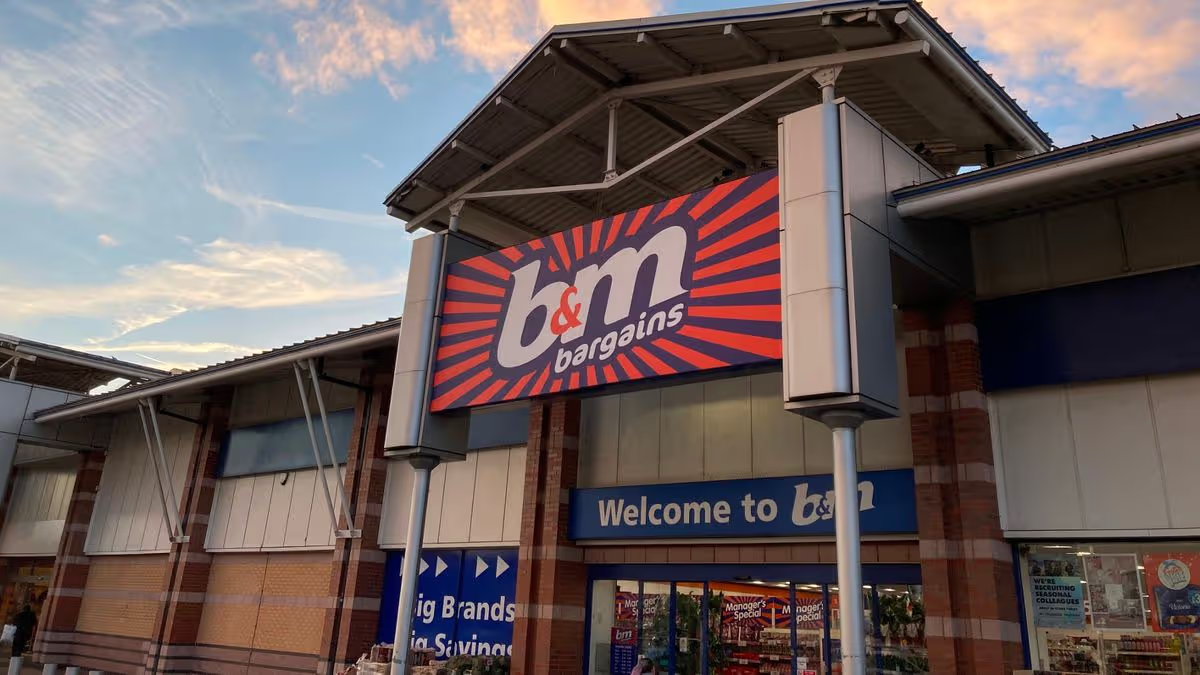
B&M has hundreds of stores across the country(Image: MEN)
A raft of trading statements from London-listed retailers has shed light on the ongoing tussle for sales between online platforms and bricks-and-mortar stores, as household budgets remain squeezed.
FTSE 250 retailer B&M has revealed an almost 50% plunge in annual profit during what it described as a “difficult year”.
It was the most striking development in a flurry of updates from London-listed retailers on Wednesday.
They underscored the competitive struggle playing out across the sector between conventional stores like B&M and their own digital operations, alongside newer internet-only players such as Peeko, and one established former high-street heavyweight, Debenhams, which has now shifted entirely to an online model.
B&M reported a drop of more than 47% in group profit before tax to £227m for the year ending 28 March, from revenue of £5.8bn, down 3.6%, as reported by City AM.
Tjeerd Jegen, chief executive of the discount homeware and grocery retailer, characterised it as “a difficult year that saw profits fall due to a challenging market and execution issues”.
He noted that the 700-store chain unveiled a turnaround strategy in October aimed at “restore like-for-like sales growth at B&M UK”.
The business also operates roughly 150 locations in France.
Over the year, like-for-like sales — those from shops trading for at least a year — declined by 0.1%. Jegen added: “The past six months has seen us sharpen our pricing, improve on-shelf availability in best-selling brands and revamp our in-store promotions.”
Current deals include Visage Pour Homme aftershave at £3.99 and an eight-pack of Duracell AA batteries for £4.50, while a box of 200 Yorkshire Tea bags is priced at £5.79.
Jegen added B&M was “confident we can offset rising energy costs in the year ahead through cost mitigation, the benefits of which will flow through to our bottom line once we have returned B&M UK like-for-like sales to growth”.
The Liverpool-based retailer was founded in Blackpool in 1978 and today employs approximately 35,000 staff, serving around 4m shoppers each week. It held a position in the FTSE 100 before being relegated from the prestigious index in 2024 following a four-year stint.
Competition across the retail sector has been fierce as financially stretched consumers have reined in discretionary spending amid successive waves of inflation, driven by soaring energy costs and rising prices triggered by Russia’s invasion of Ukraine in 2024.
The war in Iran waged by the US and Israel this year has fuelled the latest surge in global oil prices, which looks set to have a comparable knock-on effect.
As unavoidable costs continue to climb, new research published this week from Vanquis — the banking firm specialising in providing credit to consumers who may struggle to obtain it elsewhere — has caught the attention of industry observers. Nearly a third of respondents to its Financial Wellbeing Index are relying on credit to meet everyday expenses, the research revealed. It also found that energy bills have surged by 17% over two years.
The study identified groceries as one of the most frequent triggers for using up savings, cited by 25 per cent of respondents, followed by car repairs at 19 per cent and utility bills at 17 per cent.
With household budgets stretched to their limits, Wednesday also shed light on the mounting challenges facing conventional retailers as purely digital rivals continue to gain ground.
The findings came from Huddled, a London-listed company behind the Peeko website, which offers discounted surplus stock from a variety of suppliers.
Revenue reached £4.2m in the first quarter of 2026, down slightly from £4.4m during the same period the previous year, reflecting a “strategic decision to moderate volume while structural issues were addressed.”
The most striking figures related to customer activity on the platform. Between January and April, the site processed 86,000 orders, with an average order value of £37 and a product margin per order of £17.
Huddled positions Peeko as “an online Costco”, currently stocking Comfort Professional Sensitive Classic Fabric Cleaner in 4.8 litre packs for £6.99, alongside boxes of 24 Mars Bars for £12.99. Martin Higginson, Huddled’s chief executive, said: “We have a great value proposition, next-day delivery, genuine customer loyalty, and the margins to justify scaling. The hard part is done. What comes next is the exciting part.”
The owner of the Debenhams brand also released an update that echoed these recent trends.
Once a well-established fixture on the British high street, Debenhams boasts a heritage stretching back to 1778, when it began life as a drapers’ shop at 44 Wigmore Street in London’s West End. The business adopted the Debenhams name in 1813 when William Debenham invested in what had previously traded as Flint & Clark.
By the 2020s, however, the retailer was in serious difficulty. Boohoo snapped up the brand for £55m in January 2021 in a deal that excluded the physical stores and their workforce. At that point, 118 department stores remained in operation, all of which had shut their doors by the end of May that year.
Today, Debenhams is positioned by its Manchester-based parent company as “Britain’s online department store”.
Boohoo reported that during the first quarter to the end of May, “momentum in the Debenhams Group multi-year turnaround accelerated”. Gross Merchandise Value climbed by 0.5% year-on-year, with trading in May described as “particularly strong”.
Boohoo also operates its own-name website alongside the PrettyLittleThing brand. The company announced today that gross margins in the first quarter to May reached 53.5 per cent, up from 52.1 per cent the previous year. Returns dropped by approximately 5 per cent, while exceptional costs were slashed by 72 per cent and capital expenditure reduced by 54 per cent year-on-year.
Debenhams signs appeared on Dale Street in Manchester city centre after fashion giant Boohoo rebranded(Image: Reach)
Chief executive Dan Finley said: “Debenhams Group has returned to growth, and Q1 marks the inflection point we have been working towards.
“This is the result of the heavy lifting of our multi-year turnaround: the move to an asset light marketplace model, the warehouse consolidation, the cost reset, and the rebuild of every brand on a single proprietary platform.”
The contrasting fortunes among London-listed retailers lay bare the pressures facing an industry that contributes around £490bn in annual sales to the UK economy in 2025 — and one that also stands as the largest private sector employer, accounting for roughly 3m jobs.
City investors will be keeping a close eye on developments, eager to distinguish the sector’s winners from its losers as this vast industry continues to evolve.
Wednesday’s announcements were warmly received by the markets. B&M’s shares surged 17 per cent to 199p, Huddled climbed 7 per cent to 0.78p, and Boohoo rose more than 11 per cent to 21p.
Peel Hunt analyst Jonathan Pritchard, assessing B&M’s results, noted they “were a beat versus our and consensus expectations” with earnings around “2% clear of hopes”. He continued: “There are a lot of things going on at B&M, and some of the ‘back to basics’ plans are clearly having an impact.”























































You must be logged in to post a comment Login