Connect with us
DAPA Banner
DAPA Coin
DAPA
COIN PAYMENT ASSET
PRIVACY · BLOCKDAG · HOMOMORPHIC ENCRYPTION · RUST
ElGamal Encrypted MINE DAPA
🚫 GENESIS SOLD OUT
DAPAPAY COMING

Business

Macy’s (M) earnings Q1 2026

Published

on

Macy's (M) earnings Q1 2026

People walk around the Macys Flagship store in New York City on January 14, 2025. 

Eduardo Munoz Alvarez | Corbis News | Getty Images

Macy’s posted its strongest first-quarter comparable sales performance in four years on Wednesday, as the legacy department store’s turnaround continues to show progress. 

Advertisement

Led by the 200 so-called reimagined stores Macy’s has upgraded, comparable sales grew 3% overall during the quarter and 1.6% at its namesake banner.  

At Bloomingdale’s, comparable sales grew 10.2%, helped by an array of buzzy brands, a “fun factor” unique in the luxury landscape and the recent bankruptcy of rival Saks Fifth Avenue, CEO Tony Spring told CNBC in an interview. 

“Is the disruption in the marketplace helpful to us? Sure,” he said. “Is it the primary reason we’re growing? No.” 

Spring said better-than-expected sales and profitability led the company to raise its full fiscal year guidance after taking a cautious outlook earlier in the year. 

Advertisement

It’s now expecting 2026 net sales to be between $21.5 billion and $21.75 billion, largely ahead of expectations of $21.59 billion, according to LSEG. It anticipates earnings per share will be between $2 and $2.20, up from a previous range of between $1.90 and $2.10. 

It now expects comparable sales to climb between 0.5% and 1.2% for the year, versus a previous outlook of a 0.5% drop to a 0.5% increase.

Many retailers have reported strong growth during their fiscal first quarters in recent weeks due in part to higher than usual tax refunds. Some companies issued more cautious guidance for the current quarter over concerns less stimulus in the economy could lead to slower demand, especially as shoppers pay more for gas due to the war in the Middle East.

Spring said tax refunds “definitely” helped during the first quarter, but weren’t the only reason why Macy’s grew. Crucially, the same trends the company saw during the first quarter have so far continued into the second, he said. 

Advertisement

“We did raise our guidance in both sales and profit for the remainder of the year to reflect the business trends that we’re seeing as we start the second quarter, so pleased with the second quarter to date and the breadth of the categories that are performing,” said Spring. “Don’t see any significant change in the consumer approach to our categories and our business across all three of our name plates.” 

He said the steady consumer behavior led Macy’s to hike its outlook “despite the macroeconomic and geopolitical uncertainty.”

Here’s how the department store did in its first fiscal quarter compared with what Wall Street was anticipating, based on a survey of analysts by LSEG:

  • Earnings per share: 13 cents adjusted. The figure wasn’t immediately comparable to estimates. 
  • Revenue: $4.68 billion vs. $4.61 billion expected

The company’s reported net income for the three-month period that ended May 2 was $63 million, or 23 cents per share, compared with $38 million, or 13 cents per share, a year earlier. Adjusting for restructuring costs and other one-time charges, Macy’s posted earnings per share of 13 cents.

Sales rose to $4.68 billion, up about 2% from $4.60 billion a year earlier. 

Advertisement

Macy’s is about two years into a three-year turnaround that Spring has spearheaded since taking over as the retailer’s chief executive. It’s included closing underperforming stores at dead malls across the country and reinvesting in the ones it decided to keep open.

Those investments have included a focus on retail fundamentals, like ensuring stores have enough staff, are enjoyable to spend time in and are stocked with items people actually want to buy.

“We’re not doing the fancy stuff, we’re doing the stuff that makes the biggest difference in the business,” said Spring. “We are really focused on product, we are really focused on taking care of the customer, and I think the results show that when we do those two things consistently, and we don’t get bored, we stay relentless in our commitment, we get the results we’re looking for.”

Choose CNBC as your preferred source on Google and never miss a moment from the most trusted name in business news.
Advertisement
Continue Reading
Click to comment

You must be logged in to post a comment Login

Leave a Reply

Business

Universal Corp: The Three Reasons Why I Am Downgrading To Hold

Published

on

Woman holding regular, electronic cigarette and disposable vape on white background. Tobacco heating systems.

Universal Corp: The Three Reasons Why I Am Downgrading To Hold

Continue Reading

Business

Established SMEs play a key role in Welsh private sector employment

Published

on

Business Live

New research on their impact has been carried out by Oxford Economics on behalf of Allica Bank

Conrad Ford chief product and strategy Officer at Allica Bank.

Established SMEs in Wales out punch their weight in terms of their contribution to jobs in the Welsh economy, show new research.

A report , carried out by Oxford Economics on behalf of Allica Bank, shows that established businesses account for over two in five jobs in the private sector despite making up just 22.8% of the Wales’ business population.

Advertisement

Established SMEs are firms with between five and 250 employees – of which in Wales there are 23,965.

Their contribution of 44% of all private sector jobs in Wales, is nine percentage points above the UK average of 35%, and significantly higher than London, where established businesses account for 30% of private sector employment. Of the nations and regions of the UK, the rate is only higher in Northern Ireland at 46%

Across the UK, established businesses are a critical driver of economic activity, accounting for more than a third of private sector employment and 37% of private sector turnover. They also support almost one in every two private sector jobs in rural areas.

Given their importance to growth, the report also highlights the challenge many established businesses face in accessing the finance they need to invest. The report highlights a £65bn lending gap to UK SMEs, accumulated over the past 25 years, which is restricting the finance and working capital available to businesses that want to expand, boost productivity and create jobs.

Advertisement

It also shows the impact that can be unlocked when established businesses can access the finance they need. In 2025, Allica Bank’s lending to established businesses enabled an estimated £520m contribution to GDP in Wales and supported 8,700 jobs locally.

UK-wide, 78% of the GDP contribution and 80% of the employment impact supported by Allica Bank’s lending occurred outside London and the south east, underlining the role productive finance can play in supporting local economies.

Conrad Ford, chief product and strategy officer at Allica Bank, said:“I speak to established businesses all the time and you quickly see how important they are to their local areas. These are the manufacturers, logistics firms, hospitality operators and specialist businesses that employ local people, support supply chains and keep communities thriving.

“The report puts numbers behind that. Although established businesses make up a minority of the wider SME business population, they account for around 60% of private sector employment.

Advertisement

“In 2025, Allica Bank’s lending to established businesses enabled an estimated £8.4 billion contribution to GDP in the UK and supported 118,000 jobs across the country. That shows what can happen when established businesses get the finance they need to invest and grow.”

Continue Reading

Business

Lloyds, Halifax and Bank of Scotland app users hit by outage

Published

on

Lloyds, Halifax and Bank of Scotland app users hit by outage

“We’re aware some customers are having issues with our app and online banking. We’re really sorry about this,” Lloyds Bank posted on X.

Continue Reading

Business

Library building in Brecon transformed into a new learning campus

Published

on

Business Live

The £6m project was carried out by Swansea-based Andrew Scott

The repurposed Ship Street Library building in Brecon.(Image: Phil Boorman Photography Ltd)

Work on a £6m project repurposing a listed building that served as a library in Brecon into a new learning campus has been completed.

Contractors Andrew Scott carried out the work on the Ship Street Library building on behalf of NPTC Group of Colleges.

Advertisement

The refurbishment and retrofit marks the next chapter in both the building’s history and the college’s development. By relocating a significant portion of its Brecon campus to a central town location, NPTC Group of Colleges aims to improve accessibility for students

The project is also expected to strengthen links with the local community and increase footfall in Brecon town centre. The building has been intentionally designed without canteen facilities to encourage students to make use of town centre amenities and support local businesses.

Inside the building.(Image: Phil Boorman Photography Ltd)

Designed by Rio Architects, the building now provides ten general teaching classrooms, student support and welfare spaces, staff areas, social learning zones, and four start-up business units, alongside a new lift to improve access.

Mark Bowen, managing director of Swansea-based Andrew Scott, said: “We are delighted to have completed the renovation and enhancement of the grade II listed Ship Street Library.

Advertisement

“This project has provided an opportunity to preserve a much-loved historic building while creating an inspiring and accessible learning environment for students and the wider community. We hope the revitalised space will strengthen local connections, support nearby businesses and inspire the next generation of learners.”

The library was originally designed by the County Architects Department under the direction of county architect JA McRobbie. It was officially opened by the then Prince of Wales in 1969 and is considered a significant example of post-war architecture of national importance.

NPTC Group of Colleges works in partnership with Coleg Sir Gâr, Coleg Ceredigion, Cardiff and Vale College, and Pembrokeshire College to develop higher technical education and employer-led training and innovation.

Advertisement
Continue Reading

Business

ADP National Employment report May 2026: Private sector adds 122,000 jobs

Published

on

ADP National Employment report May 2026: Private sector adds 122,000 jobs

This is a breaking news story about the ADP national employment report for May. Please check back for updates.

Companies in the private sector added 122,000 jobs in May, payroll processing firm ADP said in its latest report on Wednesday.

Advertisement

The figure is above economists’ estimates of a gain of 117,000 jobs. The prior month’s payrolls number was revised lower to a gain of 105,000 from an initially reported gain of 109,000.

TOP CEOS BRACE FOR DOWNTURN, WARN US ECONOMY WILL WORSEN IN NEXT 6 MONTHS

Elementary school educators in Maryland

ADP released data from its May National Employment report on Wednesday. (Amanda Andrade-Rhoades/For The Washington Post via Getty Images)

HOW AI EXPOSURE IS RESHAPING JOBS IN CREATIVE FIELDS

Which industries are hiring the most workers, according to the ADP report?

What experts are saying about the ADP report data

The ADP data is released before the Labor Department’s nonfarm payrolls report, which is due on Friday morning and can differ notably. The government data is expected to show an increase of 85,000 positions, below the 115,000 reported in April.

Advertisement
Continue Reading

Business

NorthStandard reports solid results despite global risks on the rise

Published

on

Business Live

The marine insurance mutual saw premium income grow substantially to $938m (£697.1m)

NorthStandard managing directors Paul Jennings (left) and Jeremy Grose

NorthStandard managing directors Paul Jennings (left) and Jeremy Grose(Image: GRAHAM FLACK)

Conflicts in the Middle East, Persian Gulf and Ukraine are creating a more challenging world for shipowners, one of world’s largest insurers in the sector has said. Tyneside-based NorthStandard says changing tariffs and expansion of sanctions have created uncertainty in the global market.

It comes as the Newcastle-based mutual has published what it called strong results showing a 5.8% lift in premium income to US$938m (£697.1m) in its 2025/26 year with an underwriting deficit reduced from $96m (£71.3m) to $39m (£28.9m). The provider of third party liability and related cover to shipowners and operators also reported $123m (£91.4m) growth in free reserves to $923m (£686.2m).

Writing in the membership group’s annual review, NorthStandard chairman Cesare d’Amico said: “Conflict in the Middle East from Gaza to the Persian Gulf, the continuation of the war in Ukraine, the uncertainty caused by changing tariffs, and the steady expansion of sanctions regimes all combined to undermine predictability in trade, compliance and insurance. Shipowners faced higher costs, greater operational disruption and a more complex liability landscape, often driven by events entirely outside their control.”

It is now three years since the merger of Newcastle’s North P&I and London-based The Standard Club to create NorthStandard, which is one of the top global marine insurance providers with offices in Europe, Asia and the Americas. The firm employs about 300 people on Tyneside.

Advertisement

Bosses said the objectives of that merger had now been met, including development of specialty lines, opening of new offices, expanded resources and new partnerships to benefit members. Since the merger, growing geopolitical instability – notably events in the Strait of Hormuz – has rocked the shipping world, with NorthStandard saying it has provided vast amounts of guidance to members, particularly around war risks.

And on sanctions, the club said it has invested to create a stronger service for members including the appointment of a head of sanctions who operates on a global level from the Newcastle offices.

During the year, NorthStandard also consolidated its Coastal & Inland and Sunderland Marine teams under one leadership, offering a ‘one stop shop’ for small and specialist craft. It also set up an Upstream Energy and Marine & Energy Liabilities team to target those markets.

Jeremy Grose, NorthStandard managing director, said: “The shipping industry is navigating profound change, as technological advancement and the fuel transition reshape how vessels are operated, crewed, and maintained. Our services are evolving in step, ensuring Members can adopt new fuels, technologies, and operating models with confidence.

Advertisement

Fellow managing director, Paul Jennings, added: “People are our biggest strength, and our strong performance is a direct reflection of their dedication—many of whom are based right here at our headquarters in the North East. We remain deeply committed to supporting our communities, economy, and environment through strategic, long-term collaboration and investing in our people and innovation”.

Continue Reading

Business

Poland’s Breakthrough Star at Roland Garros 2026

Published

on

Elina Svitolina
Maja Chwalińska
Maja Chwalińska

Maja Chwalińska, the 24-year-old Polish left-hander ranked outside the top 100 at the start of the 2026 French Open, has captured global attention with a remarkable run to the quarterfinals at Roland Garros, emerging as one of the biggest Cinderella stories of the tournament.

Chwalińska’s journey from qualifier to quarterfinalist, defeating high-profile opponents including Olympic champion Qinwen Zheng and former top-10 player Maria Sakkari, highlights her resilience and talent. Her story combines athletic achievement with personal challenges, making her one of the most compelling figures in women’s tennis this season.

Here are 10 essential things to know about the rising Polish player:

1. Rapid Rise at Roland Garros 2026 Chwalińska entered the 2026 French Open as a qualifier ranked around No. 114. She stormed through the qualifying rounds and main draw with dominant performances, reaching the quarterfinals after victories over Zheng, Elise Mertens, Sakkari and Diane Parry. Her run marked the first time a player ranked outside the top 100 achieved such a deep breakthrough at Roland Garros in recent memory.

2. Career-High Ranking and Momentum The Polish player achieved a career-high singles ranking of No. 113 in May 2026. Her French Open success is projected to propel her significantly higher, potentially into the top 50. This surge reflects strong form on the WTA 125 and ITF circuits, where she captured multiple titles.

Advertisement

3. Left-Handed Game with Technical Precision Standing at 5-foot-5 (1.64 m), Chwalińska plays left-handed with a two-handed backhand. Observers praise her clean technique, variety, and court craft. Analysts describe her style as old-school with modern efficiency, generating consistent pressure on return games while maintaining solid baseline rallies.

4. Early Start and Polish Roots Born on October 11, 2001, in Dąbrowa Górnicza, Poland, Chwalińska began playing tennis at age 7. She turned professional in 2015-2016 and has remained based in her home country, representing Poland in Fed Cup/Billie Jean King Cup competition with a solid 4-3 record.

5. Openness About Mental Health Struggles Chwalińska has been candid about her battle with depression, which sidelined her for periods and affected her early career progression. Her willingness to discuss mental health has resonated with fans and fellow athletes, positioning her as an advocate for greater awareness in professional sports.

6. Strong Challenger and ITF Success Before her Grand Slam breakthrough, Chwalińska built her career through consistent performances on the ITF and WTA 125 circuits. She has won three WTA Challenger singles titles, including events in Montreux (2025) and Florianopolis (2024), along with seven ITF singles titles.

Advertisement

7. Doubles Expertise In addition to singles, Chwalińska has enjoyed success in doubles, with a career-high ranking of No. 91. She has secured three WTA 125 doubles titles, demonstrating versatility and strong net play that complements her baseline game.

8. Coaching Stability She is coached by Jaroslav Machovsky, who has helped guide her technical development and mental approach. Their partnership has been credited with her recent consistency and ability to perform under pressure at major tournaments.

9. Historic Polish Representation Chwalińska’s deep run at Roland Garros 2026 made her the second Polish woman, alongside world No. 3 Iga Świątek, to reach the fourth round in the same year. This milestone underscores the growing strength of Polish women’s tennis on the international stage.

10. Humble Personality and Future Ambitions Known for her humble and grounded demeanor, Chwalińska expressed surprise and gratitude during her French Open press conferences. She stated her seasonal goal was simply to break into the top 100, a target she has now surpassed. Fans and commentators highlight her likeable character and work ethic as key factors in her appeal.

Advertisement

Chwalińska’s prize money has surpassed $860,000 in her career, with a significant boost expected from her Paris performance. Her story echoes previous Grand Slam underdog runs, drawing comparisons to players who used breakthrough tournaments to launch sustained top-level careers.

The left-hander’s success comes after years of grinding on lower circuits while managing personal challenges. Her mental health advocacy adds depth to her profile, showing strength beyond on-court results. As she faces higher-ranked opponents in the quarterfinals and beyond, Chwalińska’s composure and fighting spirit will be tested.

Tennis experts note her well-rounded game suits clay courts particularly well, where her patience and tactical awareness shine. If she maintains this level, a top-50 breakthrough appears likely, with potential for further Grand Slam success in the coming seasons.

Poland’s tennis federation and fans have rallied behind Chwalińska, celebrating her as a fresh talent alongside established stars like Świątek. Her run has boosted national pride and inspired younger players in the country’s growing tennis community.

Advertisement

As the 2026 season progresses, Chwalińska’s focus will shift toward consistency at the tour level. Sustaining momentum after a major deep run often presents challenges, but her proven resilience suggests she is prepared for the next steps in her career.

Chwalińska represents the new generation of Polish tennis talent — technically sound, mentally tough, and authentically connected with supporters. Her breakthrough at Roland Garros serves as a reminder that perseverance and belief can overcome ranking disadvantages on tennis’s grandest stages.

With several years ahead in her prime, the tennis world will watch closely to see how far this late-blooming star can climb. For now, her magical run in Paris has already secured her place among the memorable stories of 2026.

Advertisement
Continue Reading

Business

Ampol's $1.1b EG acquisition approved

Published

on

Ampol's $1.1b EG acquisition approved

Ampol will have to sell 41 petrol stations to Metro Petroleum as a condition of the ACCC’s approval of its $1.1 billion acquisition of EG Australia and its over 500 sites.

Continue Reading

Business

B&M profits plunge nearly 50% after ‘difficult year’ for discount retailer

Published

on

Business Live

Fellow listed retailers Boohoo, Debenhams and Huddled also release trading updates amid sector-wide pressures

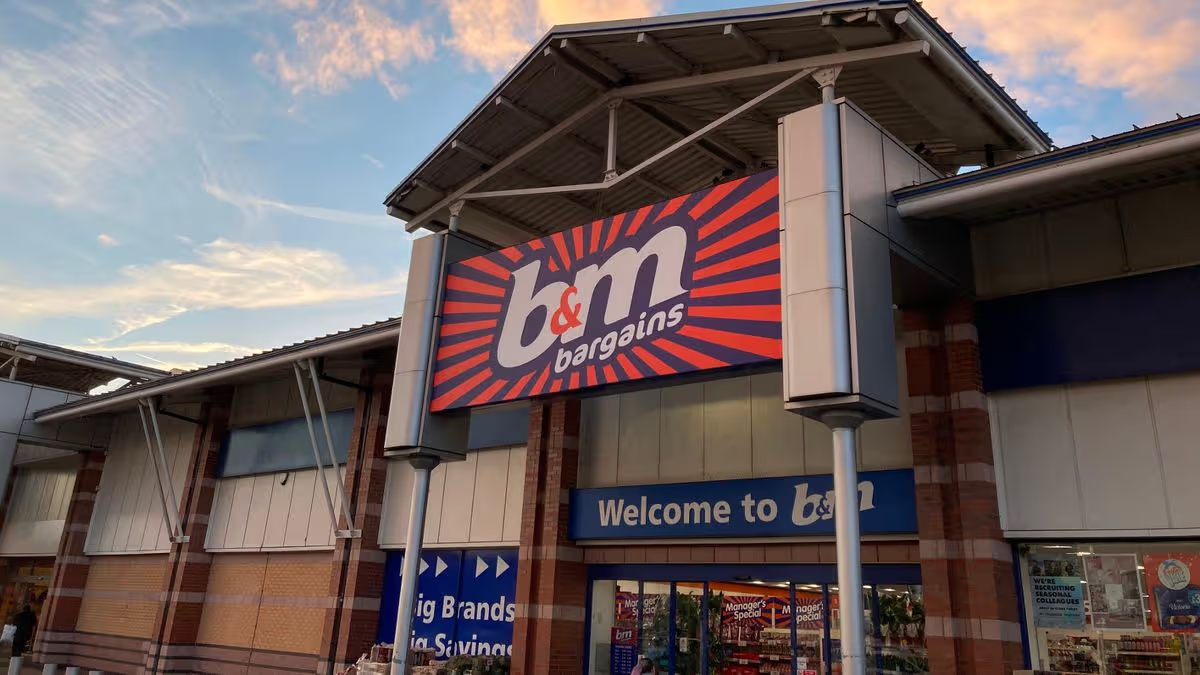
An image of a B&M Bargains store

B&M has hundreds of stores across the country(Image: MEN)

A raft of trading statements from London-listed retailers has shed light on the ongoing tussle for sales between online platforms and bricks-and-mortar stores, as household budgets remain squeezed.

Advertisement

FTSE 250 retailer B&M has revealed an almost 50% plunge in annual profit during what it described as a “difficult year”.

It was the most striking development in a flurry of updates from London-listed retailers on Wednesday.

They underscored the competitive struggle playing out across the sector between conventional stores like B&M and their own digital operations, alongside newer internet-only players such as Peeko, and one established former high-street heavyweight, Debenhams, which has now shifted entirely to an online model.

B&M reported a drop of more than 47% in group profit before tax to £227m for the year ending 28 March, from revenue of £5.8bn, down 3.6%, as reported by City AM.

Advertisement

Tjeerd Jegen, chief executive of the discount homeware and grocery retailer, characterised it as “a difficult year that saw profits fall due to a challenging market and execution issues”.

He noted that the 700-store chain unveiled a turnaround strategy in October aimed at “restore like-for-like sales growth at B&M UK”.

The business also operates roughly 150 locations in France.

Over the year, like-for-like sales — those from shops trading for at least a year — declined by 0.1%. Jegen added: “The past six months has seen us sharpen our pricing, improve on-shelf availability in best-selling brands and revamp our in-store promotions.”

Advertisement

Current deals include Visage Pour Homme aftershave at £3.99 and an eight-pack of Duracell AA batteries for £4.50, while a box of 200 Yorkshire Tea bags is priced at £5.79.

Jegen added B&M was “confident we can offset rising energy costs in the year ahead through cost mitigation, the benefits of which will flow through to our bottom line once we have returned B&M UK like-for-like sales to growth”.

The Liverpool-based retailer was founded in Blackpool in 1978 and today employs approximately 35,000 staff, serving around 4m shoppers each week. It held a position in the FTSE 100 before being relegated from the prestigious index in 2024 following a four-year stint.

Competition across the retail sector has been fierce as financially stretched consumers have reined in discretionary spending amid successive waves of inflation, driven by soaring energy costs and rising prices triggered by Russia’s invasion of Ukraine in 2024.

Advertisement

The war in Iran waged by the US and Israel this year has fuelled the latest surge in global oil prices, which looks set to have a comparable knock-on effect.

As unavoidable costs continue to climb, new research published this week from Vanquis — the banking firm specialising in providing credit to consumers who may struggle to obtain it elsewhere — has caught the attention of industry observers. Nearly a third of respondents to its Financial Wellbeing Index are relying on credit to meet everyday expenses, the research revealed. It also found that energy bills have surged by 17% over two years.

The study identified groceries as one of the most frequent triggers for using up savings, cited by 25 per cent of respondents, followed by car repairs at 19 per cent and utility bills at 17 per cent.

With household budgets stretched to their limits, Wednesday also shed light on the mounting challenges facing conventional retailers as purely digital rivals continue to gain ground.

Advertisement

The findings came from Huddled, a London-listed company behind the Peeko website, which offers discounted surplus stock from a variety of suppliers.

Revenue reached £4.2m in the first quarter of 2026, down slightly from £4.4m during the same period the previous year, reflecting a “strategic decision to moderate volume while structural issues were addressed.”

The most striking figures related to customer activity on the platform. Between January and April, the site processed 86,000 orders, with an average order value of £37 and a product margin per order of £17.

Huddled positions Peeko as “an online Costco”, currently stocking Comfort Professional Sensitive Classic Fabric Cleaner in 4.8 litre packs for £6.99, alongside boxes of 24 Mars Bars for £12.99. Martin Higginson, Huddled’s chief executive, said: “We have a great value proposition, next-day delivery, genuine customer loyalty, and the margins to justify scaling. The hard part is done. What comes next is the exciting part.”

Advertisement

The owner of the Debenhams brand also released an update that echoed these recent trends.

Once a well-established fixture on the British high street, Debenhams boasts a heritage stretching back to 1778, when it began life as a drapers’ shop at 44 Wigmore Street in London’s West End. The business adopted the Debenhams name in 1813 when William Debenham invested in what had previously traded as Flint & Clark.

By the 2020s, however, the retailer was in serious difficulty. Boohoo snapped up the brand for £55m in January 2021 in a deal that excluded the physical stores and their workforce. At that point, 118 department stores remained in operation, all of which had shut their doors by the end of May that year.

Today, Debenhams is positioned by its Manchester-based parent company as “Britain’s online department store”.

Advertisement

Boohoo reported that during the first quarter to the end of May, “momentum in the Debenhams Group multi-year turnaround accelerated”. Gross Merchandise Value climbed by 0.5% year-on-year, with trading in May described as “particularly strong”.

Boohoo also operates its own-name website alongside the PrettyLittleThing brand. The company announced today that gross margins in the first quarter to May reached 53.5 per cent, up from 52.1 per cent the previous year. Returns dropped by approximately 5 per cent, while exceptional costs were slashed by 72 per cent and capital expenditure reduced by 54 per cent year-on-year.

Debenhams signs have appeared on Dale Street in Manchester city centre after fashion giant Boohoo rebranded

Debenhams signs appeared on Dale Street in Manchester city centre after fashion giant Boohoo rebranded(Image: Reach)

Chief executive Dan Finley said: “Debenhams Group has returned to growth, and Q1 marks the inflection point we have been working towards.

“This is the result of the heavy lifting of our multi-year turnaround: the move to an asset light marketplace model, the warehouse consolidation, the cost reset, and the rebuild of every brand on a single proprietary platform.”

Advertisement

The contrasting fortunes among London-listed retailers lay bare the pressures facing an industry that contributes around £490bn in annual sales to the UK economy in 2025 — and one that also stands as the largest private sector employer, accounting for roughly 3m jobs.

City investors will be keeping a close eye on developments, eager to distinguish the sector’s winners from its losers as this vast industry continues to evolve.

Wednesday’s announcements were warmly received by the markets. B&M’s shares surged 17 per cent to 199p, Huddled climbed 7 per cent to 0.78p, and Boohoo rose more than 11 per cent to 21p.

Peel Hunt analyst Jonathan Pritchard, assessing B&M’s results, noted they “were a beat versus our and consensus expectations” with earnings around “2% clear of hopes”. He continued: “There are a lot of things going on at B&M, and some of the ‘back to basics’ plans are clearly having an impact.”

Advertisement
Continue Reading

Business

Nation's largest carbon farming project unveiled on WA's south coast

Published

on

Nation's largest carbon farming project unveiled on WA's south coast

Some 16 million trees will be planted across 28,000ha of Great Southern farmland for a project worth an estimated $40 million.

Continue Reading

Trending

Copyright © 2025