

Crypto World
Cardano (ADA) Faces Make-or-Break Moment as Social Buzz and Network Activity Explode


Cardano has become one of the most talked-about cryptocurrencies after its price briefly dropped below $0.16 for the first time since December 2020, according to on-chain analytics platform Santiment.
The surge in attention appears to be linked to growing concerns surrounding Cardano founder Charles Hoskinson, who recently said he was “taking a break” after warning that the ecosystem could face a “wave of failures” due to project shutdowns and funding difficulties.
Social Frenzy
According to Santiment’s data, the developments triggered a sharp increase in both social activity and on-chain engagement. Cardano’s social dominance climbed to around 0.52%, its highest level in 2026. This means that more than one in every 190 cryptocurrency-related discussions on social media focused on ADA.
At the same time, daily active addresses reached 28,459, representing the highest reading in four months. According to Santiment, the spike in network activity indicates that users were actively interacting with the blockchain as the sharp price volatility created strong divisions among traders. Bearish sentiment appears to be dominating much of the discussion.
Despite the negative market reaction, Santiment explained that Cardano continues to have one of the most loyal and vocal communities in the crypto sector. The analytics firm said ADA holders have, for years, remained committed through multiple market cycles, and have often supported the network during periods when institutional participation was limited.
“The next few weeks and months will likely be a make-or-break stretch for the #15 market cap, as the community hopes institutionals consider entering into positions while prices are now at 5.5 year lows. Many investors are now looking for ecosystem growth, successful project launches, and of course some more positive future words from Hoskinson to validate the long-term vision that Cardano supporters have championed for years.”
Cardano – Brazilian Olympic Committee
In a separate development, the Cardano Foundation announced a partnership with the Brazilian Olympic Committee (COB) to bring blockchain, artificial intelligence (AI), and Internet of Things (IoT) technologies into the country’s sports sector.
According to the organizations, the three-year collaboration will focus on identity and certification systems, fan engagement, equipment tracking, and improving governance and transparency. The first pilot projects are expected to launch in the coming months.
The post Cardano (ADA) Faces Make-or-Break Moment as Social Buzz and Network Activity Explode appeared first on CryptoPotato.



Amir Haleem has stepped down as chief executive of Nova Labs, the company behind the Helium decentralized wireless network, handing the role to Mario Di Dio. Haleem moves to chairman. The transition, announced Thursday in a Helium Blog post written by Di Dio, comes as HNT — Helium's native token —… Read the full story at The Defiant
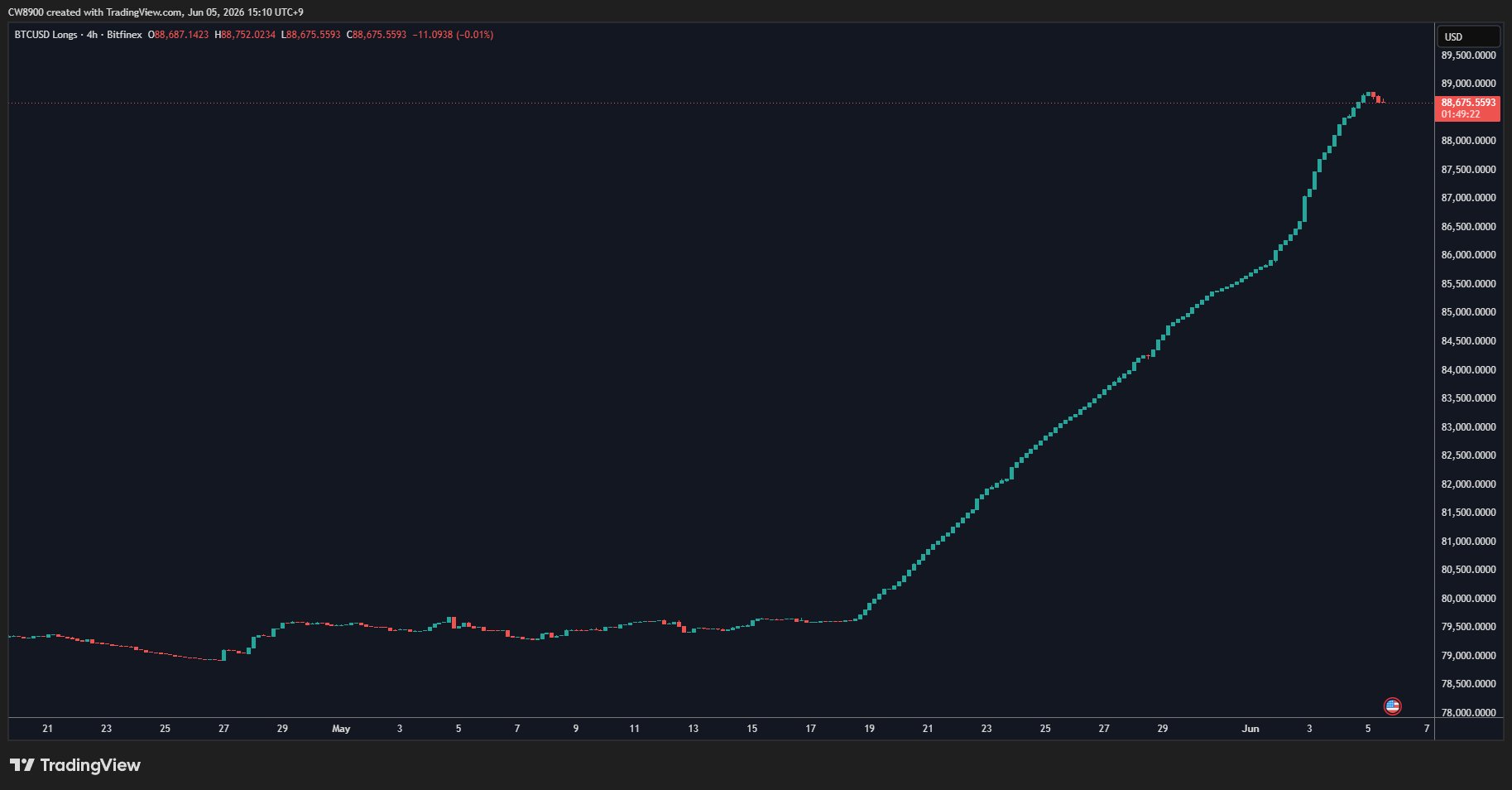
Bitcoin (BTC) has fulfilled two of three key conditions to spark the next BTC price “rally,” new analysis says.
Key points:
- Bitcoin whales on Hyperliquid and Bitfinex are already pointing to the beginning of a BTC price uptrend, according to the latest findings.
- Bitcoin markets now need demand to return in the form of the Coinbase and Kimchi Premium.
- Other preconditions for a bear market bottom are also in the process of forming.
Bitcoin price comeback hinges on US, Korea demand
Bitcoin whale traders are laying the foundations for BTC price relief, even as BTC/USD plumbs four-month lows.
In an X post on Friday, trader CW confirmed that Bitcoin whales on both Hyperliquid and Bitfinex are signaling a market rebound.
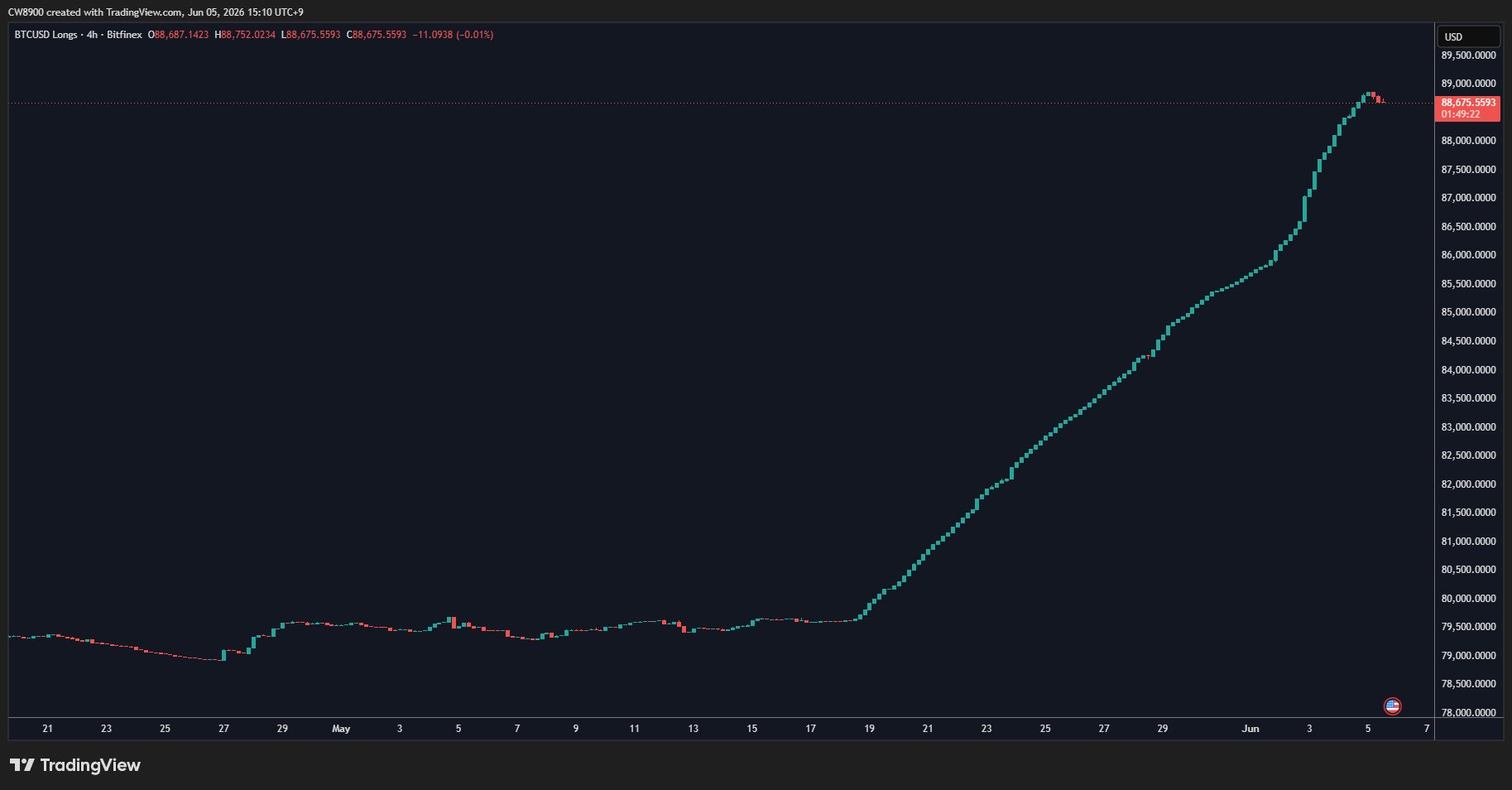
BTC/USD long positions on Bitfinex. Source: CW/X
CW notes that Hyperliquid whales have adopted a “bullish stance” on the market, while on Bitfinex, long positions have tailed off. The latter is a classic sign that an uptrend is due next.
“What remains is for the Kimchi Premium and Coinbase Premium to turn positive,” he commented.
The Coinbase Premium is the difference in price between Coinbase’s and Binance’s BTC/USDT pairs and has been mostly negative in 2026.
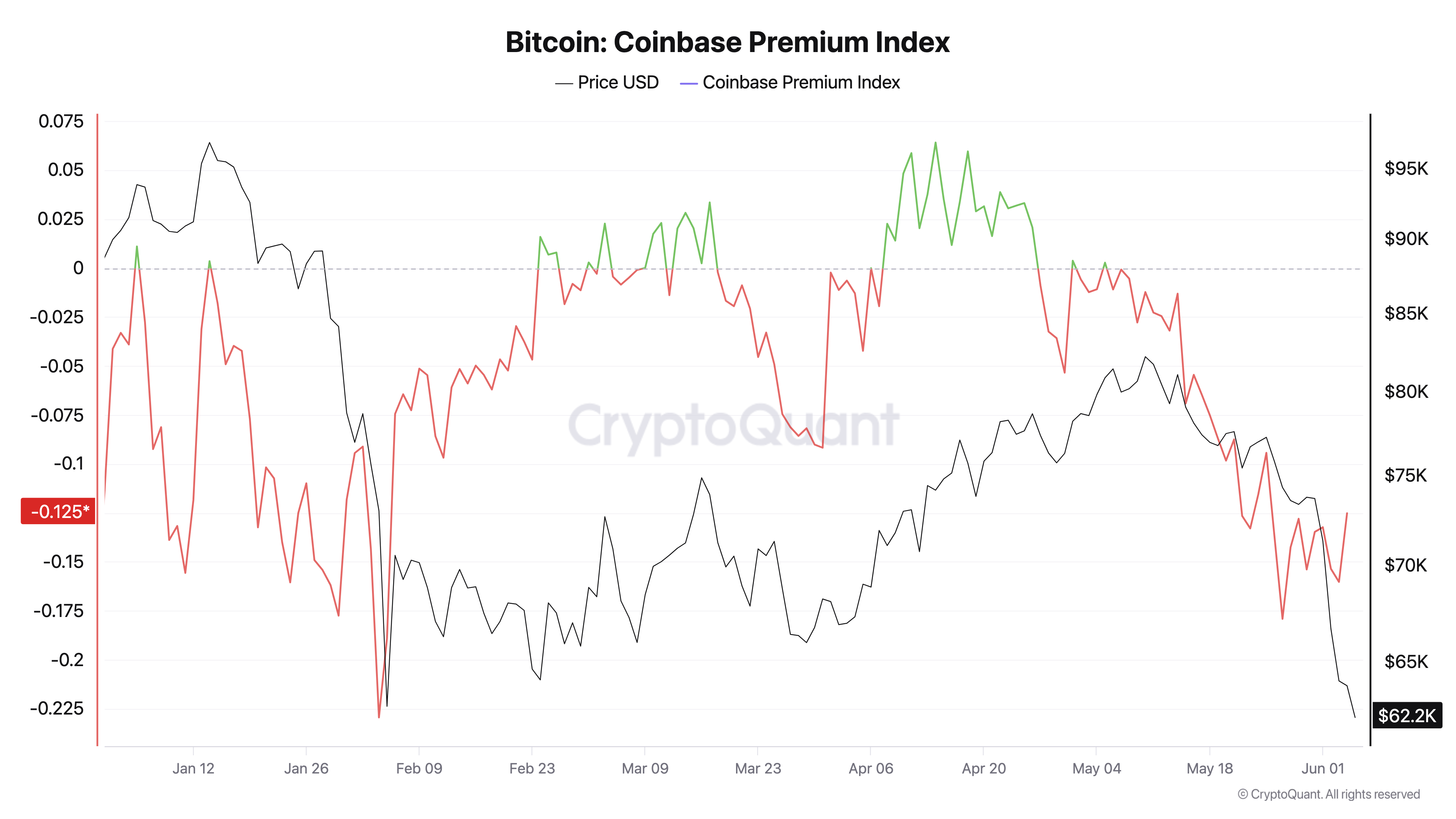
Bitcoin Coinbase Premium Index. Source: CryptoQuant
A negative premium reflects weak US demand, while the Kimchi Premium monitors the South Korean exchange sector.
Once demand returns across the board, Bitcoin has a better chance of reentering a sustainable uptrend.
CW acknowledged that the Kimchi Premium has already “decreased significantly” versus earlier in the week.
Bitcoin starts its latest “bottoming out” phase
As Cointelegraph reported, consensus overall favors a macro bottoming phase playing out for BTC/USD next.
Related: Trump says Iran will ‘work out well’: Five things to know in Bitcoin this week
The week has seen the pair touch a key bear-market trend line in the form of its 200-week simple moving average (SMA) — another essential ingredient in a bottom formation.
“Bitcoin has only just started deviating below the 200-week SMA,” trader and analyst Rekt Capital emphasized to X followers on Friday.
“The significance of this is that historical Bear Market Bottoming out formations have started to develop via such deviations.”
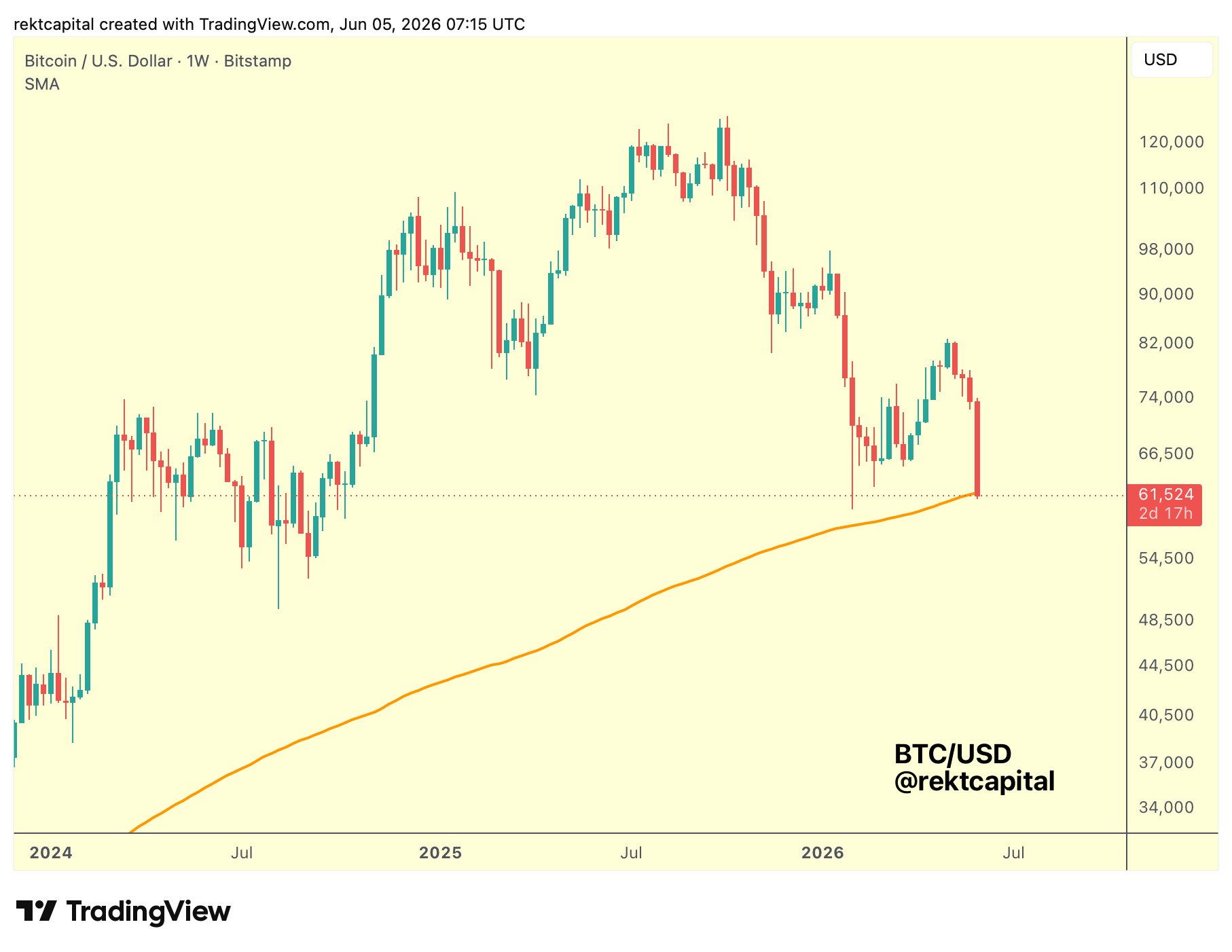
BTC/USD one-week chart with 200SMA. Source: Rekt Capital/X
Earlier, trader Leviathan described BTC price action as copying the 2022 bear market “almost perfectly.”

Ether (ETH) slid to a 13-month low near $1,540 on Friday as risk-off sentiment seeped through crypto markets. The move came amid a cascade of derivative-driven liquidity drains and fresh security worries that have kept bulls on the back foot even as ETH trades well below its late-2025 highs. In parallel, a critical vulnerability in Zcash’s shielded pool—exposed by AI-driven tooling—fed fears of broader contagion across blockchains and DeFi protocols.
On the macro side, derivatives data painted a decidedly bearish picture. Futures markets showed negative funding rates, signaling higher demand for short exposure, while a wave of leveraged longs was liquidated, eroding any quick relief rally. The market backdrop was underscored by a sharp pullback in ETH’s real-use case metrics, with Ethereum’s Total Value Locked (TVL) signaling a pullback in DeFi activity and wallet flows remaining strained.
Key takeaways
- Ether derivatives tilt bearishly as cascading liquidations erase attempts at relief, with leveraged longs cut by over $1.28 billion across a five‑day window.
- Negative annualized funding rates for ETH perpetual futures indicate continued appetite for short bets, reinforcing a risk-off posture among traders.
- Demand for downside protection spikes in options, with Deribit ETH put-to-call premium reaching multi‑week highs, signaling growing hedging interest amid uncertain momentum.
- Ethereum’s on-chain activity frays as TVL sinks to the weakest level since February 2024, with notable DApps posting multi‑tens of percent contractions in user and capital inflows.
- A AI‑driven discovery of a Zcash vulnerability stokes fears of systemic risk, as investors question whether other networks could harbor similar blind spots.
Derivatives signal a risk-off regime for ETH
Market data show a clear tilt toward selling pressure in ether derivatives. The perpetual futures market turned negative on Friday, reflecting a thinning of upside conviction and a shift toward hedges or outright shorts. This dynamic is particularly concerning for bulls, given that ETH had already traded about 67% below its all‑time high from August 2025.
In the backdrop, roughly $1.28 billion in highly leveraged long positions were liquidated over five days, dimming prospects for a swift bounce. While price action remains volatile, the combination of losses and negative funding metrics underscores a fragile balance for those seeking risk-on momentum in ETH.
The derivatives picture is complemented by a rising demand for downside hedges in the options market. Data show the ETH put-to-call premium on Deribit climbing to roughly 3.7x on Friday, with the metric lingering at elevated levels since early in the week. This pattern points to a crowded hedging psyche among market participants and suggests that casual bidders may remain reluctant to chase rallies in the near term.
ETHTVL and DeFi activity: a pullback across the ecosystem
The retreat in on-chain activity is visible in Ethereum’s ecosystem metrics. DefiLlama data indicate Ethereum’s network TVL has slid to its lowest level since February 2024, a development that cynically reduces the available on-chain liquidity for users and dampens the revenue prospects for DApps built on the network.
Top ETH-based decentralized applications have also borne the brunt of this shift. Spark, Ether.fi, EigenCloud, and KernelDAO each reported double-digit declines in TVL, reflecting a broader correction in DeFi liquidity as funds migrate away from riskier protocols amid higher macro uncertainty.
The timing of this TVL erosion intersects with a broader narrative about security and risk in DeFi: a bug in Zcash’s shielded pool was discovered to enable unlimited minting, a finding attributed to AI-powered review tooling. While the vulnerability relates to Zcash specifically, it has intensified concerns about whether other chains harbor hidden flaws that could catalyze outflows and force risk repricing across ecosystems. The exposure was reported on a May 29 discovery using Anthropic’s Opus 4.8 AI model, amplifying market nerves about cross-chain contagion.
Beyond the immediate concern about security, April’s hack-and-exploit wave continued to color risk assessments. Across 25 protocols, hacks by KelpDAO and Drift Protocol accounted for a large share of losses—together around $573 million—illustrating how breaches have stressed a broad set of networks and liquidity pools, and implying that risk management remains a central topic for users and builders alike.
Supply dynamics and what they imply for ETH risk and recovery
On-chain supply metrics add another layer to the bear case. Glassnode data show that only about 30% of ETH supply remains profitable relative to the last time those coins moved. This kind of supply dynamic has historically preceded meaningful price action, contrasting with episodes where a larger portion of supply was profitable and markets traded in a more constructive fashion. In the current context, a limited pool of “on‑the‑move” ETH suggests fewer buyers stepping in to relieve selling pressure unless a catalyst appears.
Further complicating the outlook is the scale of unrealized losses in top ETH treasury holders. Bitmine (BMNR US), the largest ETH treasury holder, reportedly sits on an unrealized loss of about $10.5 billion, representing roughly 4.5% of the entire ETH supply. If the market continues to tighten and lenders and lenders’ risk appetites stay constrained, such concentrated exposure can amplify downside volatility during forced liquidations or correlated de-risking waves.
Taken together, these data points suggest a fragile recovery path for ETH at present. Prices could press lower toward key levels, with the psychological threshold near $1,550 providing a potential point of relief if buyers emerge. However, the confluence of weak on-chain activity, persistent derivatives headwinds, and the specter of cross-chain vulnerabilities keeps the risk skewed to the downside in the near term.
For readers tracking risk and opportunity, the next few weeks will be telling. Watch for fresh data on DeFi liquidity, any new security alerts across major networks, and whether cross-chain risk dynamics begin to stabilize as market participants reassess hedging needs and capital allocation.
Source-style data points cited include Laevitas on ETH futures funding (see https://app.laevitas.ch/assets/perpswaps/ETH/funding), DefiLlama for on-chain TVL shifts, and Glassnode’s profitability metrics (https://studio.glassnode.com/charts/supply.ProfitRelative?a=ETH&mScl=lin&resolution=24h). The Zcash vulnerability and related AI-review context were reported in coverage noting an AI-assisted discovery of a vulnerability that enabled unlimited minting, with a related Cointelegraph reference to the broader security implications of such flaws (see https://cointelegraph.com/news/zec-tanks-30-after-ai-security-review-discovers-critical-zcash-vulnerability).


According to a fiscal year 2027 budget bill passed by the Illinois General Assembly, the state is moving forward with a new tax on cryptocurrency transactions that would apply to digital asset brokers operating in Illinois.
Summary
- Illinois lawmakers approved a budget bill containing a 0.2% tax on crypto transactions and new registration rules for digital asset brokers.
- Unregistered brokers could face Class 3 felony charges, carrying penalties of up to five years in prison and $25,000 in fines.
- Industry groups including the Digital Chamber and Illinois Blockchain Association have urged Governor JB Pritzker to reject the measure.
Included within the state’s $56 billion budget package, the proposal introduces a 0.2% tax on crypto transactions under a provision known as the Digital Asset Privilege Tax Act. Lawmakers approved the measure along party lines on Monday, leaving only Governor JB Pritzker’s signature before it can become law.
State budget documents estimate the tax could generate approximately $60 million in revenue. Under the proposal, any entity classified as a digital asset broker would be required to register with the state before facilitating covered crypto transactions.
Failure to comply could carry criminal consequences. The legislation states that brokers operating without meeting registration requirements after Jan. 1 may face Class 3 felony charges, which in Illinois can result in prison sentences ranging from two to five years and fines of up to $25,000.
Industry groups have opposed the proposal
Opposition emerged shortly after the bill cleared the legislature. In a joint letter released on Wednesday, the Digital Chamber and the Illinois Blockchain Association urged state officials to reject the Digital Asset Privilege Tax Act, arguing that the proposal would harm the local digital asset industry.
The organizations said the measure was introduced without meaningful consultation with industry participants and noted that no other U.S. state currently imposes a comparable tax on crypto transactions.
Separately, the Digital Chamber stated in a post on X that the proposal raised concerns because stakeholders received little advance notice before lawmakers incorporated it into the budget package. The group described the tax as economically damaging and called for its removal before final approval.
Attention has also focused on the way the measure advanced through the legislature. Critics have argued that the crypto tax was embedded within a 1,624-page budget bill rather than being debated as standalone legislation.
States and Congress are increasing scrutiny of digital assets
The Illinois proposal arrives as policymakers across the United States examine new approaches to digital asset oversight and taxation.
Earlier this year, Governor Pritzker signed Executive Order 2026-04 prohibiting Illinois state employees from using nonpublic information obtained through their official duties to trade prediction market contracts or assist others in doing so. According to the governor’s office, the order was intended to strengthen ethics safeguards as prediction markets continue to expand.
A similar measure was adopted in New York one day later when Governor Kathy Hochul signed Executive Order 60, which bars state officials from using confidential government information for personal gain in prediction markets and authorizes disciplinary action for violations.
Meanwhile, federal lawmakers are considering separate crypto tax proposals. On June 5, the U.S. House Ways and Means Committee released seven discussion drafts covering subjects including stablecoin payments, staking rewards, mining income, DeFi lending, wash-sale rules, charitable donations, and voluntary disclosure programs for crypto taxpayers.
According to the committee, the proposals will be discussed during a June 9 congressional hearing and draw from ideas previously included in the PARITY Act and legislation introduced by Senator Cynthia Lummis.
Governor Pritzker has publicly indicated that he intends to sign Illinois’ budget package, though the measure had not yet received final approval as of Friday morning.

Key Takeaways
- FuelCell Energy releases fiscal Q2 2026 earnings before markets open Monday, June 8
- Wall Street forecasts a loss of $0.43 per share with revenue reaching $40.51 million
- Shares have surged more than 190% in 2025, propelled by AI infrastructure power needs and renewable energy momentum
- First quarter fiscal 2026 delivered 61% revenue increase to $30.5M year-over-year, though gross margin losses expanded
- Analyst community remains divided — ratings range from Hold to Sell, with recent insider selling activity and zero insider purchases over three months
FuelCell Energy (FCEL) will unveil its fiscal second quarter 2026 financial performance before trading begins on Monday, June 8.
Analyst consensus points to an anticipated per-share loss of $0.43 against projected revenue of $40.51 million.
The stock has emerged as one of 2025’s standout performers, climbing north of 190% since January. This remarkable ascent has been primarily powered by market excitement surrounding artificial intelligence data center energy requirements and accelerating clean energy adoption.
However, a closer examination of the company’s financial health reveals a more nuanced picture.
Top-Line Expansion Masks Profitability Struggles
During the first quarter of fiscal 2026, FCEL achieved impressive 61% year-over-year top-line expansion, generating $30.5 million in revenue. At first glance, this appears encouraging.
The challenge lies in the company’s worsening gross margin performance. Market observers have highlighted that the first quarter’s revenue spike stemmed from one-time project work rather than new agreements tied to AI infrastructure or data center contracts.
This differentiation is critical. Project-based revenue streams don’t establish the sustainable, repeating business framework that long-term investors seek.
The company currently holds a GF Score of 61 out of 100, with profitability metrics scoring only 2 out of 10. Its financial strength registers at 5 out of 10. These figures paint a concerning portrait for risk-averse investors.
Wall Street’s Cautious Stance
Seeking Alpha’s quantitative rating system assigns FCEL a Hold designation. Seeking Alpha’s analyst consensus tilts toward Sell. The broader Wall Street community maintains a Hold rating.
One market analyst stated bluntly: “There is no denying that this is a risky investment. Most conservative investors would exclude FuelCell from the investment universe after glancing at the financial statements for 30 seconds.”
The analyst further emphasized that for the stock’s current valuation to be justified, management must demonstrate at least two back-to-back quarters of positive EBITDA alongside a concrete strategy for scaling its Torrington manufacturing capacity to 350 MW.
That represents a substantial hurdle for an organization still generating quarterly losses.
Throughout the previous three months, earnings per share projections have received two upward adjustments with zero downward changes. Revenue forecasts, conversely, paint the opposite picture — one revision higher, four revisions lower.
Regarding insider transactions, the past three months witnessed one insider sale involving 2,500 shares. No insider purchase activity has been documented during this period.
FCEL has historically surpassed EPS expectations 88% of the time across the past two years, a noteworthy track record heading into Monday’s announcement. The company has exceeded revenue projections 50% of the time.
The stock currently trades at a price-to-sales multiple of 3.7. With a market capitalization hovering around $1.13 billion, the market is clearly betting on substantial future expansion — yet the underlying financial performance remains unproven.

TLDR
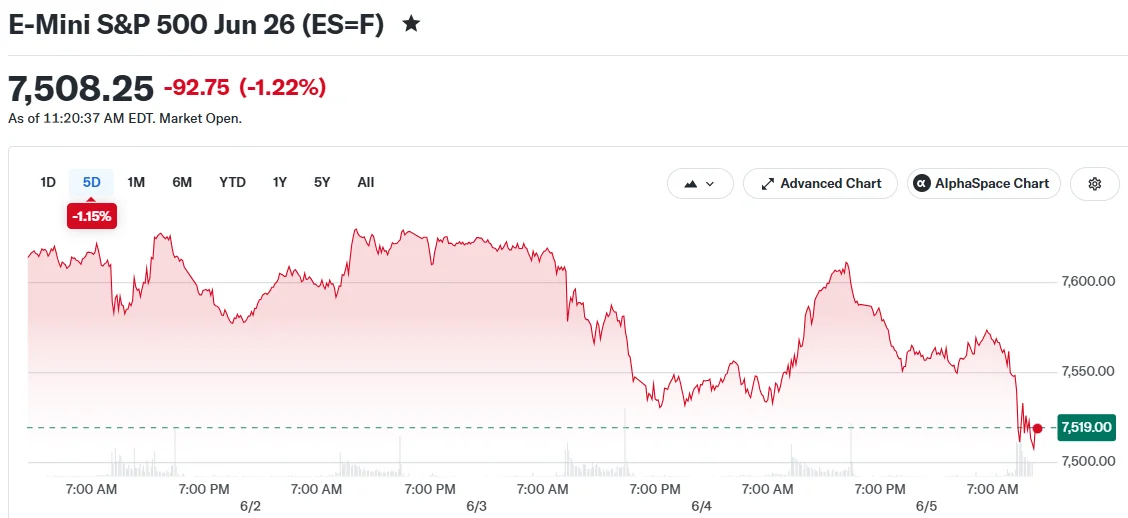
- Major indices tumbled Friday with Nasdaq sinking 2.1%, S&P 500 declining 1.1%, and Dow losing 140 points
- Employment data revealed 172,000 new positions in May, significantly exceeding the 88,000 anticipated
- Robust labor market pushed Federal Reserve rate hike probability to 68.3%, eliminating prospects for immediate cuts
- Semiconductor stocks declined following Broadcom’s disappointing earnings performance
- The S&P 500 faces potential end to its 9-week rally, which would be the longest advance since 1985
Equity markets experienced significant declines Friday following employment data that exceeded analyst projections, simultaneously driving up interest rate hike expectations while technology stocks faced renewed pressure over artificial intelligence investment concerns.
The Nasdaq Composite plummeted 2.1%. The S&P 500 declined 1.1%. The Dow Jones Industrial Average retreated approximately 140 points, representing a 0.3% decline.
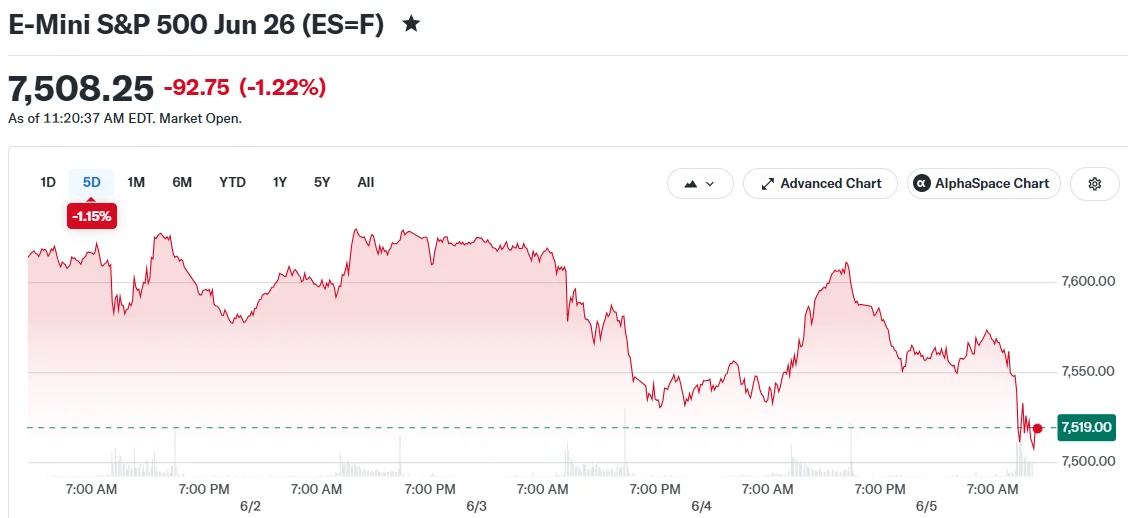
The market downturn resulted from two distinct pressures converging simultaneously.
Employment Data Surprises Markets
The May nonfarm payrolls release revealed American businesses added 172,000 positions during the month. Analysts had projected approximately 88,000 additions. The jobless rate remained unchanged at 4.3%.
The unexpectedly strong employment figures altered market expectations regarding Federal Reserve monetary policy. Market participants rapidly adjusted positioning to account for at least one interest rate increase before year-end.
Probability of a rate hike surged to 68.3%, climbing from 50.4% just one day earlier. This development essentially eliminates any possibility of rate reductions in the near term.
Eric Winograd, chief US economist at AllianceBernstein, said the data shows the economy is still holding up. “That’s enough to keep the Fed on hold,” he wrote.
This development occurs while President Trump maintains public pressure for rate reductions. Kevin Warsh, Trump’s appointee, has recently assumed the role of Fed chair.
Semiconductor and AI Stocks Extend Declines
Broadcom shares had already experienced substantial losses Thursday after releasing quarterly results. Friday brought additional selling pressure.
The wider semiconductor industry mirrored these losses. Market participants have adopted a more cautious stance regarding artificial intelligence capital expenditures, with Broadcom’s financial results amplifying these apprehensions.
Technology equities had experienced robust gains throughout recent weeks, providing substantial support to benchmark indices. This positive momentum has now dissipated.
The Nasdaq had emerged as a primary beneficiary of AI-related enthusiasm. It now faces the steepest losses as market sentiment reverses.
Historic Rally Faces Termination
The S&P 500 began Friday positioned to achieve a tenth consecutive week of advances. Such an achievement would have represented the longest winning sequence since 1985.
That remarkable streak now confronts potential termination.
The benchmark index has retreated as multiple adverse factors materialized simultaneously — escalating rate anxieties, technology sector vulnerability, and geopolitical instability.
News regarding stalled US-Iran ceasefire discussions contributed to the cautious atmosphere permeating Wall Street. President Trump characterized negotiations as entering their “final” phase, though considerable uncertainty persists.
Equity futures had already signaled weakness before the employment report’s release, with Nasdaq 100 futures spearheading morning session declines.
The convergence of an overheated labor market, hawkish monetary policy expectations, and a stumbling artificial intelligence rally left limited havens within equity markets Friday.


Travala has launched an AI-powered hotel booking protocol that gives agents access to more than 2.2 million properties and enables near-instant USDC payments on Base for about $0.01 per booking.
Summary
- Travala launched Travel MCP, allowing AI agents to search, book, and pay for hotel stays using USDC on Base.
- The protocol supports over 2.2 million hotel listings and uses Coinbase’s x402 infrastructure for gasless payments costing around $0.01.
- Travala plans to expand the AI booking system to flights after growing its travel network through partnerships with Trivago and Skyscanner.
According to reports, Singapore-based crypto travel platform Travala has released Travel MCP, a protocol that allows artificial intelligence agents to search, reserve, and pay for hotel stays using USDC on Coinbase’s Base network.
The system is already live through Claude Desktop, while third-party developers can integrate it into their own AI travel assistants.
Built on the Model Context Protocol, an open standard designed to connect AI applications with external tools, the protocol links Travala’s hotel inventory directly to AI agents.
Travala said payments are processed through Coinbase’s x402 protocol, enabling gasless USDC transactions with near-instant settlement and transaction costs of roughly one cent.
Although the booking process can be handled inside an AI conversation, travelers still retain final control over payments. Travala said authorization must be manually approved by the user, meaning the system is not fully autonomous despite automating much of the booking workflow.
Describing the launch as the beginning of a more automated travel economy, Travala CEO Juan Otero said in a statement that the company’s new protocol removes friction from the booking process and moves travel transactions closer to AI-assisted execution.
“The launch of the world’s first agentic AI travel protocol marks the death of the checkout button.”
The protocol combines AI booking with stablecoin payments
Inside the protocol, ERC-7715 session keys allow AI agents to request payments while leaving signing authority in the traveler’s wallet, according to Travala.
The company added that Travel MCP can maintain context across searches, bookings, and cancellations within a single chat session, allowing users to manage an entire trip through one conversation.
Set against a growing push toward machine-to-machine payments, the launch follows recent developments across the crypto industry. Recently, x402-linked wallets on Base surpassed 100 million transactions, while companies including Fireblocks, MoonPay, Exodus, and Oobit have introduced infrastructure designed for AI-driven stablecoin payments.
To encourage adoption, Travala said developers using the protocol will receive a 10% Coinbase Wrapped Bitcoin (cbBTC) rebate on completed hotel stays booked through AI agents.
Travala expands beyond crypto payments into AI infrastructure
At launch, the protocol covers more than 2.2 million hotel listings, including properties from Marriott, Hilton, and IHG that are sourced through Travala’s aggregator partners. The company said future updates will extend support to additional travel services, including flight bookings.
The release adds another layer to Travala’s expansion strategy. Earlier in 2025, crypto.news reported that the company integrated with Trivago, allowing travelers to book more than 2.2 million properties using over 100 cryptocurrencies. The platform has also established partnerships with Skyscanner and offers rewards in Bitcoin and its native AVA token.
Attention on the company increased further after it introduced a Bitcoin and AVA treasury reserve plan following more than $100 million in annual revenue during late 2024. Under that program, a portion of treasury assets and profits is allocated to Bitcoin and AVA, both of which support Travala’s loyalty ecosystem.
Founded in 2017, Travala competes with crypto-focused travel services such as Sleap.io and Alternative Airlines. While those platforms primarily focus on digital asset payments, Travel MCP places Travala in the emerging market for AI-powered booking infrastructure, where cryptocurrency payments and autonomous software tools are increasingly being combined into a single user experience.
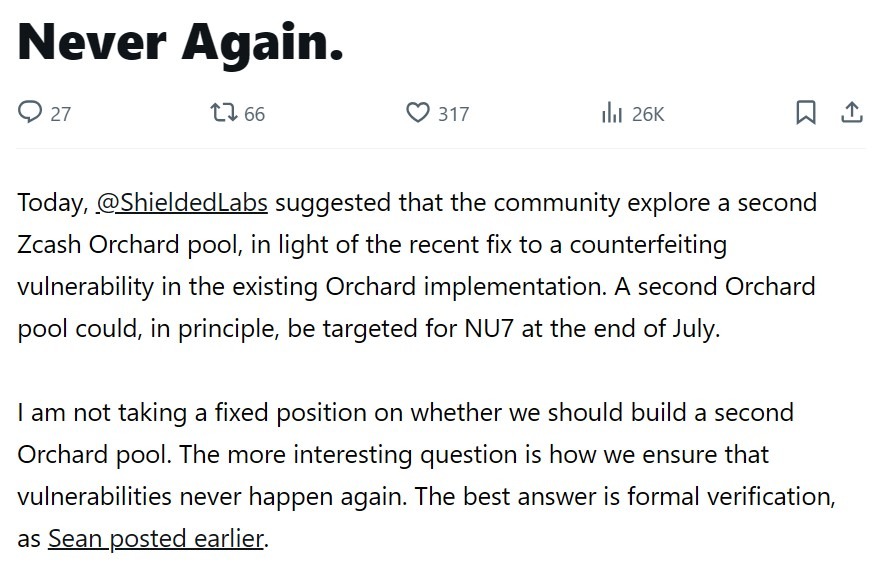
Zcash developers and researchers are discussing whether a new shielded pool could help restore supply verification confidence after a recently patched Orchard vulnerability.
Shielded Labs, an independent Swiss-based Zcash support organization, said in a security update on Friday that it is exploring a proposed network upgrade that would deploy a new shielded pool and enforce “turnstile accounting” on coins moving from Orchard, giving users a clearer way to verify the integrity of funds moving out of the pool.
The group said the proposal is still subject to further explanation and community review. Shielded Labs said it plans to publish a follow-up post next week explaining how the upgrade would work and what tradeoffs it could involve.
Zcash Open Development Lab (ZODL) founder Josh Swihart said in a separate X post that a second Orchard pool could, in principle, be targeted for Zcash’s NU7 upgrade at the end of July. However, he said he was not taking a fixed position on whether the community should build a second Orchard pool.
The discussion follows an emergency Zcash upgrade that patched an Orchard vulnerability Shielded Labs said could have allowed counterfeit ZEC within the pool, though it said prior exploitation was unlikely.
Cointelegraph reached out to ZODL, the Zcash team and Shielded Labs for comment but had not received a response by publication.
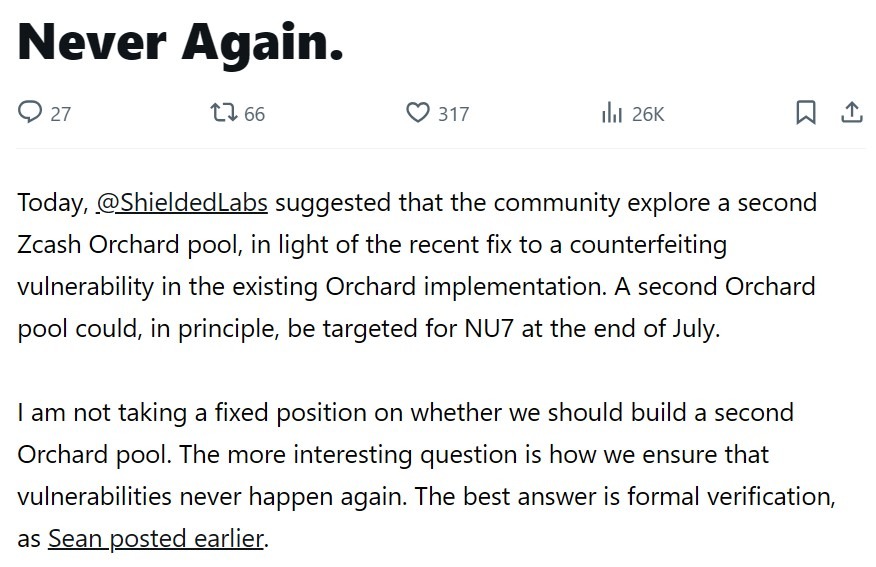
Source: Josh Swihart
ZEC falls after vulnerability disclosure
In the security update, Shielded Labs said the Orchard vulnerability could have allowed a bad actor to create an unlimited amount of counterfeit ZEC within the Orchard pool. The group said there is no cryptographic way to prove whether the bug had been exploited before it was fixed, though it believes that prior exploitation is unlikely.
As Cointelegraph reported on Wednesday, Zcash developers temporarily suspended Orchard transactions after discovering the vulnerability and restored functionality through an emergency network upgrade.
On Friday, ZEC fell by around 50% from a daily high of $550.30 to as low as $264.80 after the team publicly disclosed the vulnerability, according to CoinGecko data. The token had recovered to $308.07 at the time of writing, still down sharply from its Friday high.
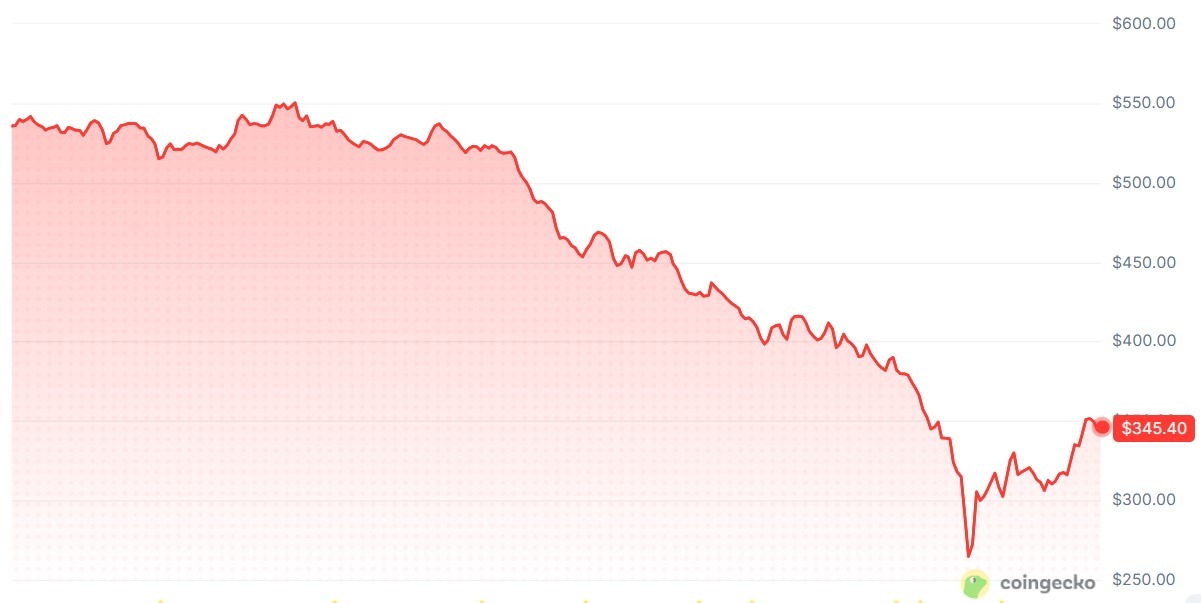
Zcash token’s 24-hour price chart. Source: CoinGecko
While the market crashed, some community members defended the team’s response to the incident. Justin Bons, founder and chief investment officer of CyberCapital, said the market was overreacting because the bug had been fixed and “the good guys caught it first.”
Gemini co-founder Cameron Winklevoss said the discovery reflected Zcash’s investment in security researchers rather than a reason for alarm, arguing that bugs are inevitable in layer-1 networks and that the key issue is whether teams can find and fix them before attackers do.
Related: Crypto exploit losses in May fall 90% over month to $68M: CertiK
Formal verification enters security debate
The incident renewed discussion around formal verification, a method that uses mathematical proofs to check whether software or cryptographic circuits follow their intended specifications.
Zcash developer and cryptography researcher Sean Bowe said that shielded protocols provide privacy by relying on cryptographic assumptions to preserve supply integrity. He said the long-term answer is to make shielded protocols and their implementations formally verifiable.
Swihart echoed that view, saying the Orchard vulnerability was a flaw in the circuit’s handwritten rules rather than in the underlying cryptography. He said formal verification could reduce human review to a concise specification and allow computers to check whether the circuit matches those rules.
Wei Dai, a research partner at blockchain venture firm 1kx, also said in an X post that the Orchard circuit bug appeared “obvious in retrospect” but had been missed by diligent protocol designers, cryptographers and auditors. He said expanding formal verification coverage is “probably the only long-term solution.”
Magazine: Bitcoin miners are pivoting to AI, so why is the hashrate near ATHs?
The U.S. House Ways and Means Committee circulated seven discussion drafts of digital asset tax legislation ahead of a Tuesday hearing, signaling a concentrated effort to reshape how crypto activities are taxed under the Internal Revenue Code. The drafts tackle a broad range of topics, including stablecoins, mining, staking, and on-chain transactions, with an emphasis on easing compliance burdens while clarifying entitlement, classification, and reporting rules for market participants.
Specific proposals under consideration include reducing the tax paperwork for crypto holders, clarifying the tax treatment of mining and staking rewards, and potentially introducing a de minimis reporting threshold for smaller transactions. The seven drafts were released in advance of a formal hearing chaired by Republican Jason Smith, underscoring bipartisan interest in modernizing digital asset tax policy.
According to Cointelegraph, industry advocates have been pressing lawmakers to lessen reporting burdens for mining and staking activities and to create a de minimis exception to relieve small-value transfers from onerous tax documentation.
In parallel, a draft bill released by members of Congress in March and officially introduced in May as the Digital Asset PARITY Act proposed a $200 reporting threshold for stablecoin transactions, while explicitly excluding a similar threshold for cryptocurrencies such as Bitcoin. The aim, supporters say, is to introduce tax clarity that could encourage broader onshore activity in the diverse digital asset space.
Cody Carbone, CEO of The Digital Chamber, framed the debate around tax clarity as essential to the sector’s growth: “We need digital asset tax clarity or activity will never fully onshore.” His remark reflects a broader push from industry groups to align U.S. policy with how digital assets are traded and held in practice, rather than forcing all activity into existing traditional-asset tax constructs.
Despite momentum in the House, officials note that any bill or amendment addressing crypto tax policy will require bipartisan support in Congress before enactment. While the House hearing proceeds, Senate leadership has indicated that lawmakers will first advance a budget reconciliation package before turning to a separate digital asset framework, such as the CLARITY Act, as part of a broader policy workflow.
As policymakers refine their approach, related policy conversations continue in other jurisdictions and at the state level. For instance, a broader tax-policy debate around crypto has featured discussions of exemptions and thresholds that would lessen reporting for small-value transfers and reduce administrative friction for exchanges, mining operations, and staking services alike. In a related vein, discussions in Congress intersect with ongoing questions about how digital assets should be treated under securities and banking frameworks, as well as how they align with international regulatory standards.
Wyoming Senator Cynthia Lummis has publicly signaled that there is consideration in both the House Ways and Means Committee and the Senate Finance Committee of a de minimis threshold for Bitcoin transactions—an approach described in her own draft legislation released in July 2025 and cited in Congressional discussions. The idea would be to provide a clear, lower-cost compliance path for routine, low-value transfers, potentially harmonizing federal treatment with state-level efforts and market practice.
Key takeaways
- The Ways and Means Committee circulated seven draft bills aimed at digital asset taxation, covering stablecoins, mining, staking, and on-chain transactions, ahead of a Tuesday hearing chaired by Rep. Jason Smith.
- Proposals include reducing reporting requirements for crypto holders and establishing a de minimis threshold for small transactions, along with clearer guidance for mining and staking activities.
- The PARITY Act envisions a $200 reporting threshold for stablecoins but does not extend the same threshold to major cryptocurrencies such as Bitcoin, reflecting a tiered approach to governance across asset types.
- Legislative momentum in the House faces cross-chamber dynamics: the Senate is prioritizing a budget reconciliation package before pursuing a standalone digital asset framework such as the CLARITY Act.
- State-level developments are progressing in parallel. Illinois passed a budget that includes digital asset taxation provisions, with a planned 0.2% tax on brokered digital asset transactions pending signing by the governor.
National policy proposals and regulatory intent
The seven draft bills demonstrate an attempt to codify tax treatment for a broad array of digital asset activities. By proposing a lighter reporting burden for ordinary holdings and transactions, lawmakers appear to acknowledge the friction between tax administration and the practical realities of retail and institutional crypto usage. At the same time, the drafts seek to provide clearer classifications for mining and staking rewards, which have historically presented ambiguity under existing tax rules. This alignment could impact how exchanges, mining operators, staking-as-a-service providers, and other service entities structure their compliance programs and reporting workflows.
The Digital Asset PARITY Act’s focus on a $200 stablecoin reporting threshold highlights a deliberate split in policy design: stablecoins, as near-term payment rails with high on-chain usage, may warrant a lower reporting bar to minimize friction for everyday transactions. By contrast, the act does not extend a similar exemption to widely traded cryptocurrencies like Bitcoin, signaling a differentiated treatment based on perceived risk profiles and regulatory oversight needs. Industry observers have framed the PARITY Act as a stepping stone toward more comprehensive clarity, while critics caution that stability-focused thresholds could invite regulatory arbitrage or uneven enforcement across asset classes.
The inclusion of a potential de minimis exemption for small transactions—the so-called de minimis reporting cut-off—addresses a common pain point for users and intermediaries. If adopted, such thresholds could reduce the administrative burden on individuals who engage in modest crypto activity and on smaller exchanges that currently face disproportionate compliance costs relative to transaction scale. Yet, setting thresholds also raises questions about coverage—whether off-chain exchanges, over-the-counter desks, and cross-border transfers would be encompassed—and how authorities would verify and enforce exemptions without creating loopholes.
From an institutional standpoint, tax clarity is viewed as a prerequisite for broader onshore participation by wallets, custodians, miners, and staking providers. The industry push aligns with a broader regulatory objective: to foster a transparent and predictable tax environment that minimizes dispute resolution and improves the quality of tax data for enforcement and compliance workflows. While lawmakers weigh the balance between simplicity and precision, financial institutions and crypto firms will closely monitor the approach to reporting thresholds, asset classifications, and the scope of taxable events.
State-level developments and compliance implications
The Illinois General Assembly approved a state budget that allocates new digital asset tax provisions as part of the fiscal framework. If signed into law by Governor JB Pritzker, crypto users would face a 0.2% tax on transactions conducted through brokers registered with the state. The move underscores how state-level policy can shape the day-to-day operational posture of exchanges, custodians, and other market participants that interact with Illinois residents. For market participants with multi-jurisdictional footprints, state tax rules add another layer of complexity to tax reporting, client communication, and regulatory compliance programs.
These developments occur in a broader context where financial-services firms—ranging from traditional banks to crypto-native institutions—are assessing how digital assets should be integrated into their risk, AML/KYC, and licensing frameworks. Tax policy changes at the federal and state levels can influence licensing requirements, reporting expectations, and cross-border cooperation, particularly in an environment where enforcement priorities and regulatory interpretations continue to evolve.
Additionally, observers note the broader policy conversation intersects with international efforts and market structure considerations, including how U.S. tax policy aligns with global standards and regional frameworks. While the specifics of MiCA, SEC, CFTC, or DOJ enforcement strategies exist outside the immediate legislative drafts, the direction of U.S. policy can influence global capital flows, cross-border reporting, and the design of stablecoin regulation and banking integration for crypto firms.
Industry and policy researchers will be monitoring how the state and federal proposals unfold, particularly around threshold levels, the treatment of mining and staking, and the scope of which activities trigger taxable events. The working assumption remains that bipartisan support is necessary for any substantive reform to pass both chambers and gain presidential approval, given the mixed track record of crypto tax legislation in recent years.
Related context in other jurisdictions, such as Israel’s approach to voluntary crypto disclosures and tax reporting, underscores the global sensitivity around compliance and enforcement. These comparative developments illustrate the practical challenges that regulators face when balancing innovation with robust tax administration and consumer protection.
Meanwhile, discussions surrounding de minimis exemptions continue to anchor debates about how best to calibrate tax policy with market realities. Senator Cynthia Lummis’s de minimis proposal for Bitcoin, introduced as part of a broader policy effort, reflects a recognition that a nuanced approach—distinct from other asset types—may be necessary to address the realities of digital asset usage and reporting.
As the legislative process unfolds, practitioners should prepare for a future where tax compliance programs, reporting systems, and licensing strategies are redesigned to accommodate a more explicit and harmonized set of rules for digital assets. Financial institutions, exchanges, and miners alike will need to align internal controls with evolving definitions of taxable events, thresholds, and asset classifications.
Closing perspective: The pace and direction of crypto tax policy in the United States will hinge on cross-chamber consensus and the ability to translate policy goals into implementable rules that withstand judicial and regulatory scrutiny. Watch for developments around the CLARITY Act, reconciliation timelines in the Senate, and state-level actions that could foreshadow a broader national framework.

Visa is testing whether privacy-enabled blockchain networks can support institutional stablecoin settlement without exposing sensitive transaction data, in a proof of concept with stablecoin infrastructure company Brale and the Canton Network, a permissioned ledger backed by major Wall Street firms.
The project, announced Thursday, uses SBC, a US dollar-backed stablecoin issued by Brale, to simulate institutional payment flows on Canton as Visa evaluates whether SBC could become another stablecoin option in its settlement program.
The initiative extends Visa’s earlier experiments using stablecoins for settlement on public blockchains, which began in 2021 with USDC settlement on Ethereum but now target banks and market infrastructure providers that want onchain efficiency without broadcasting counterparties, positions or flows on a public ledger.
The push comes as policymakers and analysts anticipate a broader shift in how payment stablecoins are used.
S&P Global Ratings said in a Thursday report that global stablecoin issuance has already surpassed $300 billion across currencies, with most demand still tied to crypto trading.
Related: Solayer launches Visa-compatible card for USDC payments
US payment stablecoins that comply with the Guiding and Establishing National Innovation in US Stablecoins (GENIUS) Act are poised to expand into merchant remittances and certain types of commercial payments once rules are finalized, the report said, with one of the most promising near-term use cases being cross-border payments. However, such flows currently represent only a minimal, if growing, share of global international payment volumes.
Canton network at center of institutional privacy push
Canton, developed by Digital Asset, connects permissioned blockchain applications operated by institutions including JPMorgan, Goldman Sachs, BNP Paribas and the Depository Trust & Clearing Corporation.

Visa and Brale explore private stablecoin settlement. Source: Businesswire
Unlike public chains, Canton is designed so that only transaction participants and authorized regulators can see specific deal data, while still allowing atomic settlement across tokenized assets, cash-like instruments and other financial contracts.
The proof of concept will assess how Canton’s privacy architecture can support faster, more programmable settlement while allowing financial institutions and payment companies to retain strict control over the visibility of sensitive transaction and settlement data, Visa and Brale said in the release.
For banks, the stakes go beyond technology experimentation. Over time, S&P Global said stablecoins could threaten a portion of banks’ payments income and shift funding from insured retail deposits toward more concentrated wholesale balances.
Banks that issue stablecoins or tokenized deposits themselves may also capture new fee and funding opportunities, driving large financial institutions to test privacy-preserving settlement networks that can support GENIUS-style payment stablecoins and tokenized deposits, according to the report.
Cointelegraph reached out to Visa, Brale and Digital Asset, but had not received a response by publication.
Magazine: AI-driven hacks could kill DeFi — unless projects act now

2026 Belmont Stakes horses, odds, post time: Picks by elite horse racing handicapper

What is Cryptocurrency Trading & How to Start Crypto Trading in Pakistan

Trump says he wants Pulte to cut national intelligence agency staffing



-

 Business4 days ago
Jade Biosciences, Inc. (JBIO) Discusses Positive Interim Results From JADE101 Phase I Healthy Volunteer Study and Development Plans Transcript
-
 Tech7 days ago
SpaceX just won a second Golden Dome contract. This one is $4.16 billion.
-

 Sports3 days ago
French Open 2026 results: Alexander Zverev beats Rafael Jodar and will play Jakub Mensik in semi-finals
-
 NewsBeat7 days ago
FIRST NIGHT REVIEW: Take That bring the Circus back to life in spectacular sun-soaked style
-

 Business7 days ago
Is the Spurs Phenom Already Better Than Prime Diesel?
-

 Tech4 days ago
CryZENx Releases Fresh Playable Content Deep Inside Jabu-Jabu for His Ocarina of Time Remake
-

 Politics7 days ago
The House | Inside Andy Burnham’s Makerfield Campaign: “Nobody Thinks This Is In The Bag”
-
Crypto World15 hours ago
LBank Surpasses 25 Million Users Worldwide as AFA Partnership Continues to Drive Global Growth
-

 Business3 days ago
Trump Taps Housing Chief Bill Pulte as Acting Intelligence Director After Gabbard Exit
-
 Entertainment7 days ago
Weak ‘Supergirl’ Box Office Tracking Amid Milly Alcock Backlash
-
 Entertainment7 days ago
One of the Greatest Sitcoms of All Time Shoots Up Apple TV’s Charts 11 Years Later
-

 Business7 days ago
Demand Conditions Improve In Chemicals Sector In April 2026
-
 NewsBeat7 days ago
Everything you need to know as Cambridge’s Strawberry Fair returns after cancelled year
-

 Fashion7 hours ago
Weekend Open Thread: Evereve – Corporette.com
-
 Crypto World3 days ago
Seagate (STX) Stock Surges to Record High on AI Boom and Legal Settlement
-
 NewsBeat3 days ago
Republicans balk at Trump’s attempt to appoint a MAGA enforcer to lead National Intelligence
-
 Entertainment7 days ago
Britney Spears Shares Troubling Update After Hard Year
-
 Crypto World3 days ago
EU AI Data Center Project Faces Delays as Funding Gaps Grow
-

 Business3 days ago
Aehr Test Systems Stock Soars 17% Amid Surging AI Demand and Conference Spotlight
-
 Business7 days ago
US-led AI investments risk capital destruction: Chris Wood
You must be logged in to post a comment Login