

Politics
Why can’t we win it? Inside the Japanese embassy for Sunday’s World Cup opener.

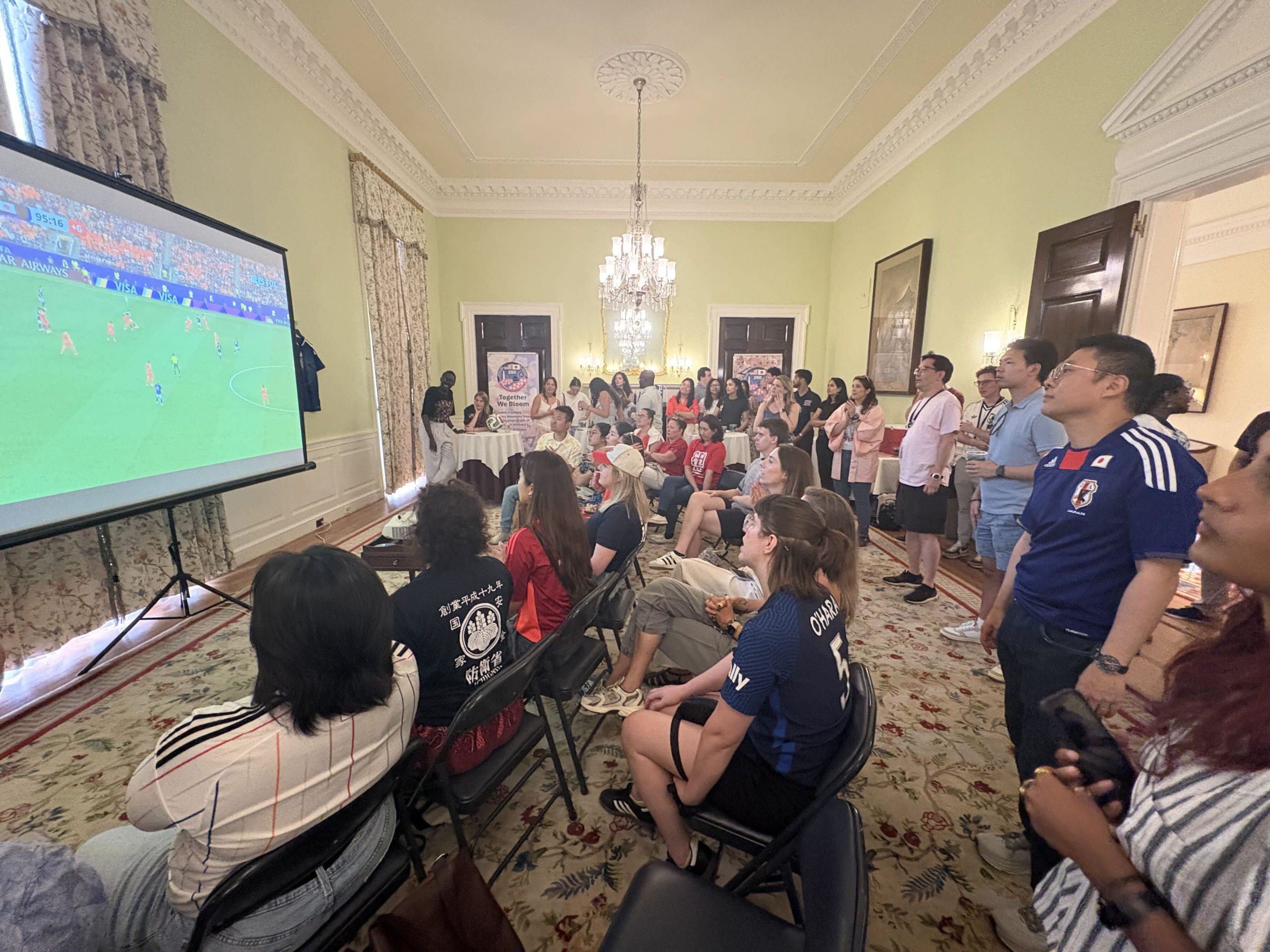

Around a hundred Samurai Blue superfans crowded the Old Ambassador’s Residence at the Japanese embassy in Washington, on Sunday for a watch party marking its World Cup opener against the Netherlands.
The supporters — a motley group including erstwhile English teachers in Japan, state department workers and embassy staffers — lounged around a projector set in the building’s front room, plates piled high with nigiri. Drinking Kirin Ichiban lager and Asahi Super Dry, they winced when the Dutch team had the ball in the opposing third and burst into cheers and sang “Vamos Nippon” when Daichi Kamada’s header tied the game in the 89th minute.
“The World Cup itself is a competition,” said Masatsugu Odaira, the embassy’s minister of public affairs, at the watch party. “But from the perspective of policy and diplomacy, it’s a very good chance to connect people across borders.”
At the event, POLITICO spoke to soccer fans who are already excited about Japan’s growing diplomatic footprint and soft power projection. And they hope the World Cup will buoy that cultural momentum, stimulating tourism — one of the nation’s most lucrative sectors — and drawing eyes to Japan.
The World Cup is “just a visceral way to connect people who have not yet had the opportunity to travel to Japan to be swept up in the enthusiasm of an international competition,” said Andrew Wylegala, president of the National Association of Japan-America Societies.
Japan is already “at the top of its game” in terms of soft power projection, Wylegala added — and “soccer now fits in with that.”
Embassy staff wore pink shirts with the American and Japanese flags on the back. “Together We Bloom,” they read.
The end result, a 2-2 draw against the Dutch, the world’s eighth ranked international side, only added to their enthusiasm.
The women’s team has a far more prolific record. Fans still hark back to their 2011 World Cup final victory over the U.S., months after a massive earthquake and tsunami slammed the country.
But the men’s team has won just seven World Cup games in its history. Japan’s best-ever finish: The round of 16, where they’ve fallen four separate times.
But there’s hope that, this year, the underdogs could pull off an upset. From Ajax’s Takehiro Tomiyasu to Kamada, a Crystal Palace midfielder, the Samurai Blue have more than enough talent to compete with the sport’s upper crust.
Odaira’s hope for this year? “Oh, becoming a champion,” he said.

Politics
Lord Ashcroft: My survey of Reform members – Will they win? How will the Civil Service react? Who should follow Farage?
Lord Ashcroft KCMG PC is an international businessman, philanthropist, author and pollster. For more information on his work, visit lordashcroft.com
Last month I surveyed 850 members of Reform UK, asking about their priorities for government, their attitudes to Britain, Conservative defectors, how they see prominent figures inside and outside the party, whether they trust elections, and how they think the civil service and the political establishment would react to a Reform victory. A separate survey of the general population allows us to compare their views with those of the general public.
Policies and priorities
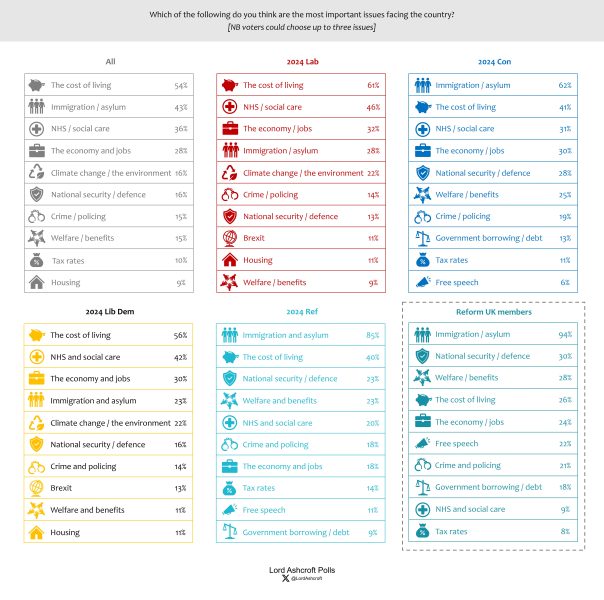
Ninety-four per cent of Reform members named immigration and asylum among the three most important issues facing the country. Second was national security and defence, chosen by 30 per cent, followed by welfare and benefits. The cost of living was in fourth place chosen by just over a quarter. The general public were more than twice as likely as Reform UK members to choose the cost of living, less than half as likely to choose immigration and asylum, and four times as likely to choose the NHS and social care. Reform members were more than four times as likely to mention free speech as the general public.
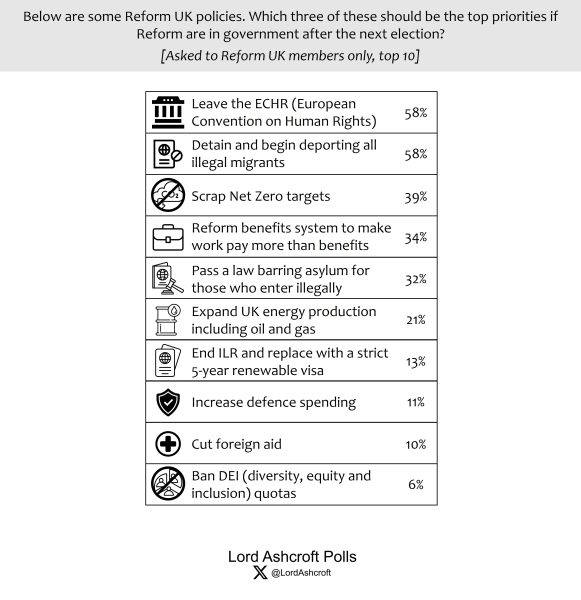
Asked which Reform policies they see as the most important priorities for government, party members were most likely to choose leaving the ECHR and detaining and deporting illegal migrants. These were followed by scrapping net zero targets, reforming welfare and ensuring that anyone entering Britain illegally is ineligible for asylum.

Presented with a selection of policy ideas (not currently Reform UK policies), Reform UK members were most supportive of a law stating that women-only spaces should be defined by biological sex (98 per cent, compared to 68 per cent of the general public), banning the burqa and other religious coverings (also 98 per cent, compared to 51 per cent of the general public), deporting illegal migrants even if they have since been granted asylum (96 per cent, compared to 54 per cent of the general public), and requiring civil servants to sign a contract promising to implement the wishes of the elected government (also 96 per cent, compared to 40 per cent of the general public).
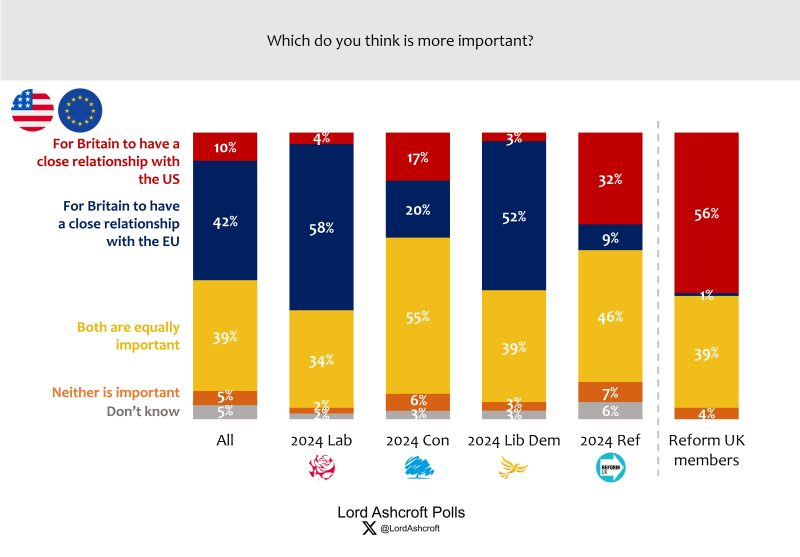
A majority of Reform UK members said it was more important for Britain to have a close relationship with the US than with the EU. A further 39 per cent thought the two were equally important. Only one in a hundred thought it was more important to have a close relationship with the EU than with the US. The general public were as likely as Reform UK members to say the two were equally important, but were much more likely to prioritise the EU relationship than the US one.
Nigel Farage, Reform leadership and other political figures
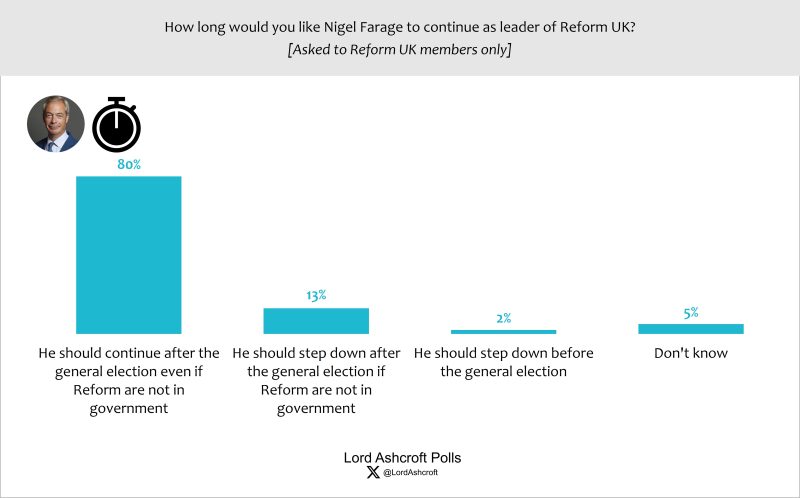
Four out of five Reform UK members said they would want Nigel Farage to continue as leader even if the party is not in government after the general election. Thirteen per cent said he should step down if Reform UK are not in government.

Just under two thirds of Reform UK members said they think Farage attracts more people to the party than he puts off. Just under three in ten think he attracts and repels people in equal numbers. Only 3 per cent think he puts more people off than he attracts. Voters as a whole were slightly more likely to think Farage puts off more people than he attracts than the reverse.
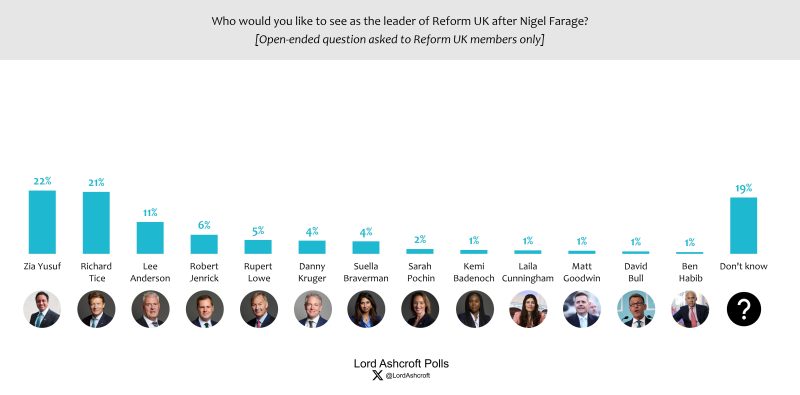
Asked unprompted to say who they would like to see as the next Reform UK leader, party members were most likely to name Zia Yusuf, closely followed by Richard Tice. Just over one in ten named Lee Anderson, with 6 per cent suggesting Robert Jenrick.

The most popular political figures among Reform UK members were Nigel Farage, Richard Tice, Lee Anderson and Zia Yusuf. More members gave a positive score to Kemi Badenoch than to Danny Kruger, Rupert Lowe or Nadhim Zahawi.
Conservative defectors
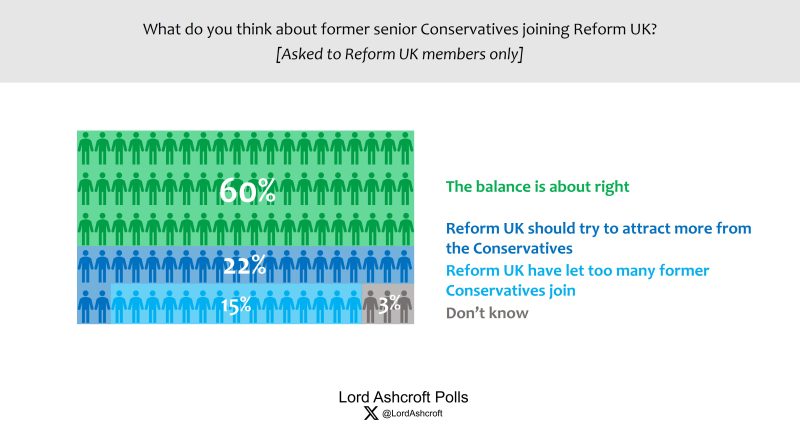
Three quarters of Reform UK members thought either that the party had let too many former Conservatives join or that the balance was about right. Only just over one in five said Reform should try to attract more from the Conservatives.
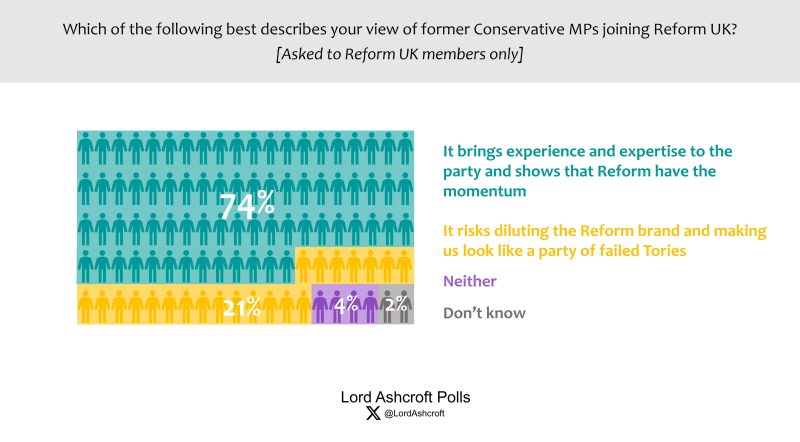
Nearly three quarters of Reform UK members said Conservative MPs joining Reform UK brought expertise and experience to the party and showed that Reform had the momentum. Just over one in five said it diluted Reform’s brand and made it look like a party of failed Tories.
The next general election
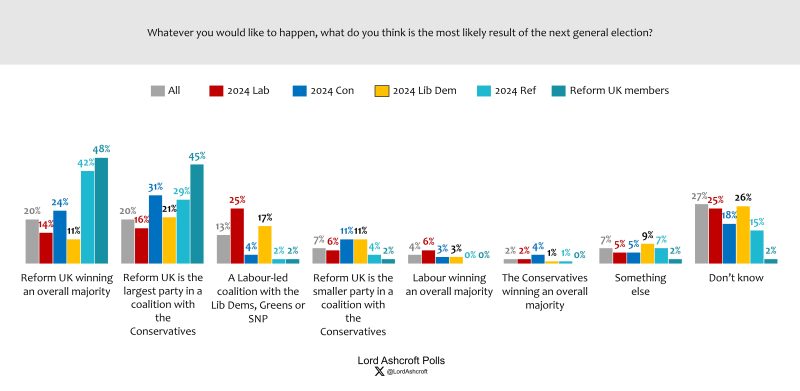
Just under half of Reform UK members expected the party to win the next general election with an overall majority. A further 45 per cent said the most likely result was Reform UK being the largest party in coalition with the Conservatives. Overall, 95 per cent of members expected the party to be in government after the election. The public as a whole were equally likely to expect a Reform UK majority or a Reform-Conservative coalition (20 per cent each), with 13 per cent expecting a Labour-led coalition with other parties of the left.
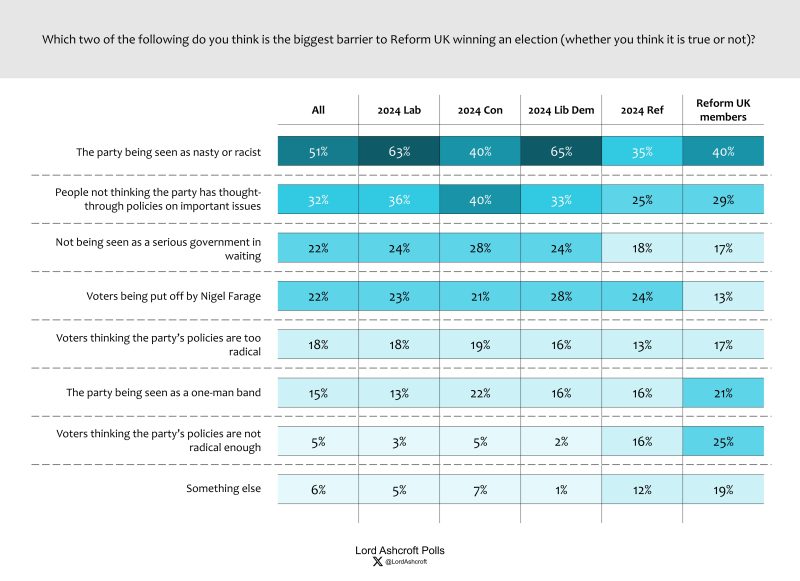
Reform UK members were most likely to see “the party being seen as nasty or racist” as one of the biggest barriers to winning the next election, followed by “people not thinking the party has thought-through policies on important issues”. They were more likely to think the party’s policies not being radical enough was a potential obstacle than being seen as too radical. Only 13 per cent thought voters being put off by Farage himself was one of the biggest barriers.
Voters as a whole agreed with Reform UK members on the two biggest barriers (the party being seen as nasty or racist, and not having thought-through policies). However, they thought the next biggest obstacles were not being seen as a serious government in waiting, and voters being put off by Nigel Farage.
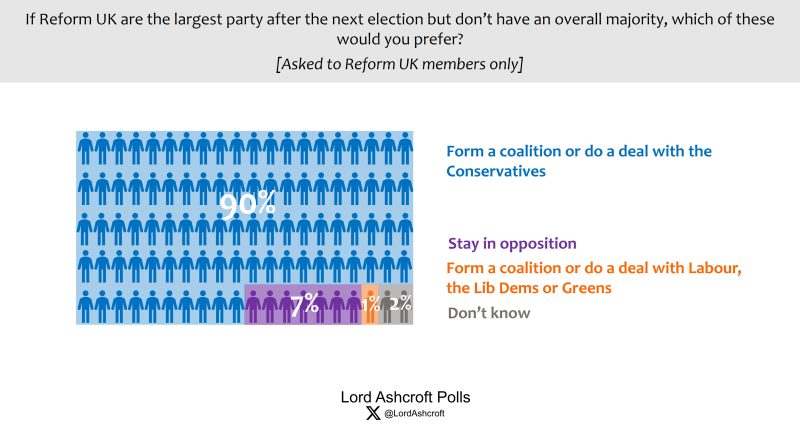
Nine out of ten Reform UK members said they would want a coalition or a deal with the Conservatives if Reform were the largest party after the election but don’t have an overall majority. Seven per cent said they would rather stay in opposition.
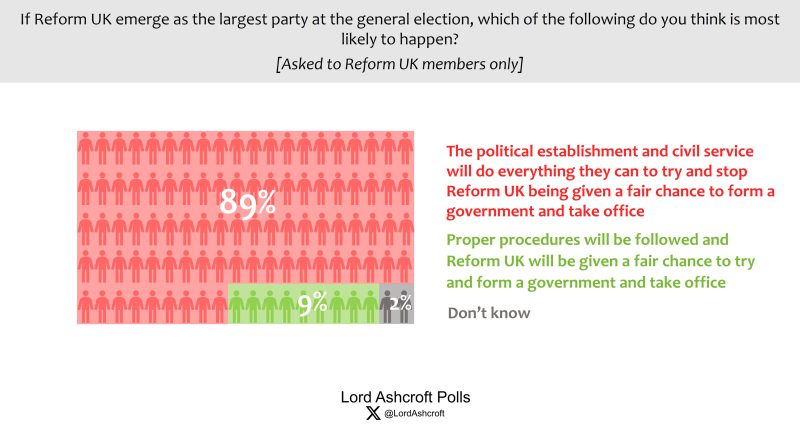
Fewer than one in ten party members think Reform UK would be given a fair chance to form a government and take office if they emerge as the largest party after the general election. Nearly nine out of ten think the political establishment and the civil service will do everything they can to stop this happening.

A majority of Reform UK members said they were not confident that elections in Britain are conducted fairly. This included 17 per cent who said they were not at all confident. Among the public as a whole, two thirds said they were somewhat or completely confident that British elections are conducted fairly.
A Reform UK government and the civil service
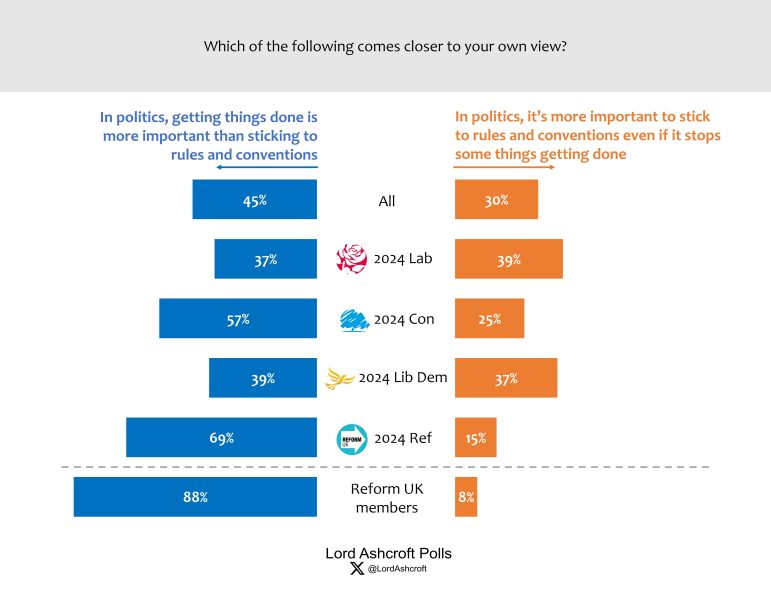 Nearly nine out of ten Reform UK members said that in politics, getting things done is more important than sticking to rules and conventions. They were nearly twice as likely to think this as the general public, who were nearly four times as likely as Reform UK members to think it was more important to stick to rules and conventions even if it stops some things getting done.
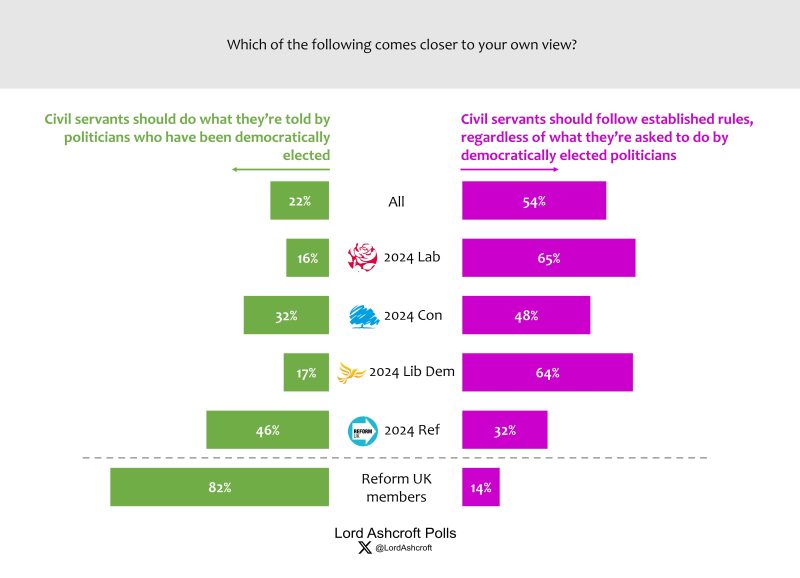
More than eight out of ten Reform UK members said civil servants should do what they’re told by politicians who have been democratically elected. Fourteen per cent said they should follow established rules regardless of what elected politicians ask them to do. By contrast, a majority of the general public said civil servants should follow established rules regardless of what they’re asked to do by elected politicians.
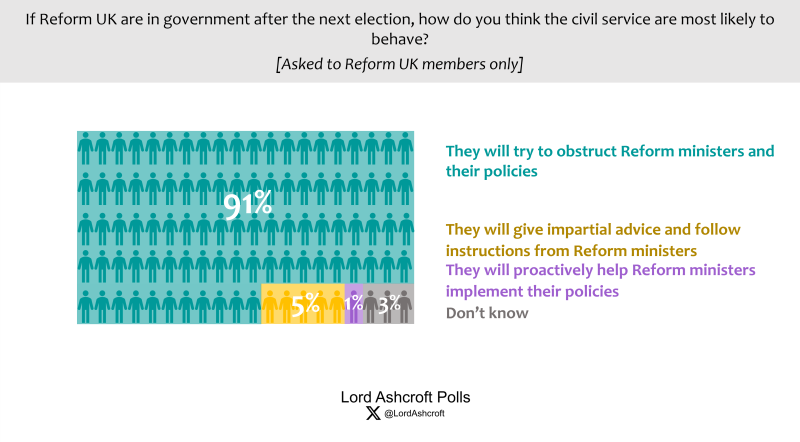
More than nine out of ten Reform UK members think the civil service will try to obstruct Reform ministers and their policies if the party is in government after the election. Only 0ne in twenty think civil servants would give impartial advice and follow instructions, and only 1 per cent think they would proactively help Reform ministers implement their policies.
Attitudes to Britain
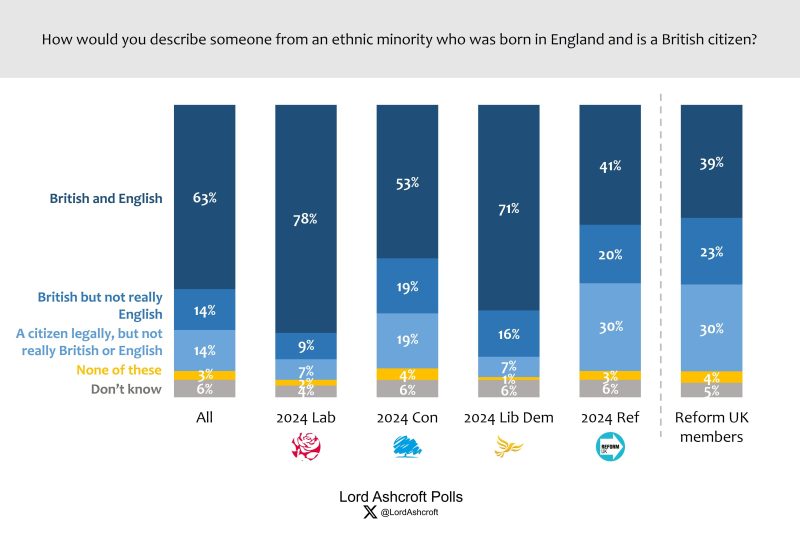
Just under four in ten Reform UK members said they would describe someone who was from an ethnic minority, was born in England and was a British citizen as both British and English. Just under a quarter said the person would be British but not really English. Three in ten said the person would be a citizen legally, but not really British or English. Among the public as a whole, a clear majority said the person would be both British and English.
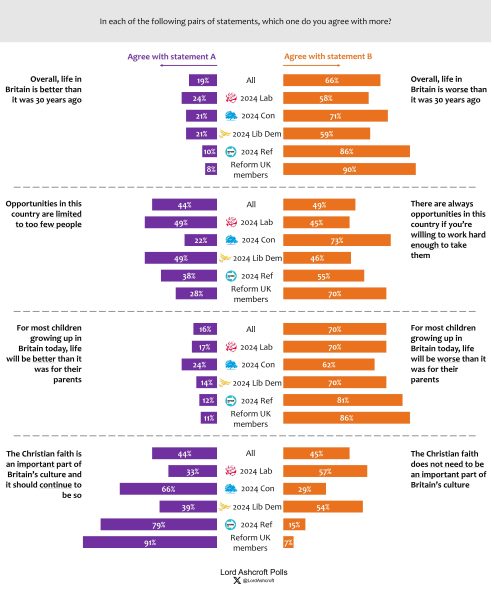
Nine in ten Reform UK members say life in Britain is worse than it was 30 years ago, compared to two thirds of the public as a whole. Seven in ten Reform UK members say there are always opportunities in this country for people willing to work hard enough to take them, compared to 49 per cent of the general public. Nearly nine in ten Reform UK members think that for most children growing up in Britain today, life will be worse than it was for their parents, compared to 70 per cent of the public as a whole. More than nine in ten Reform UK members say the Christian faith is an important part of Britain’s culture and should continue to be so, compared to 44 per cent of the general public.
Previous support and alternative parties

Nearly three quarters of Reform members said they had supported the Conservatives before Reform UK. 8% named the Brexit Party, with 6 per cent each naming Labour and UKIP. A further 6 per cent said Reform was the first party they had supported.

Asked who they would vote for if no Reform candidate was available in their constituency, 42 per cent of Reform UK members named Restore Britain. One in three named the Conservatives. A further 13 per cent said they would not vote.
Full data tables at LordAshcroftPolls.com
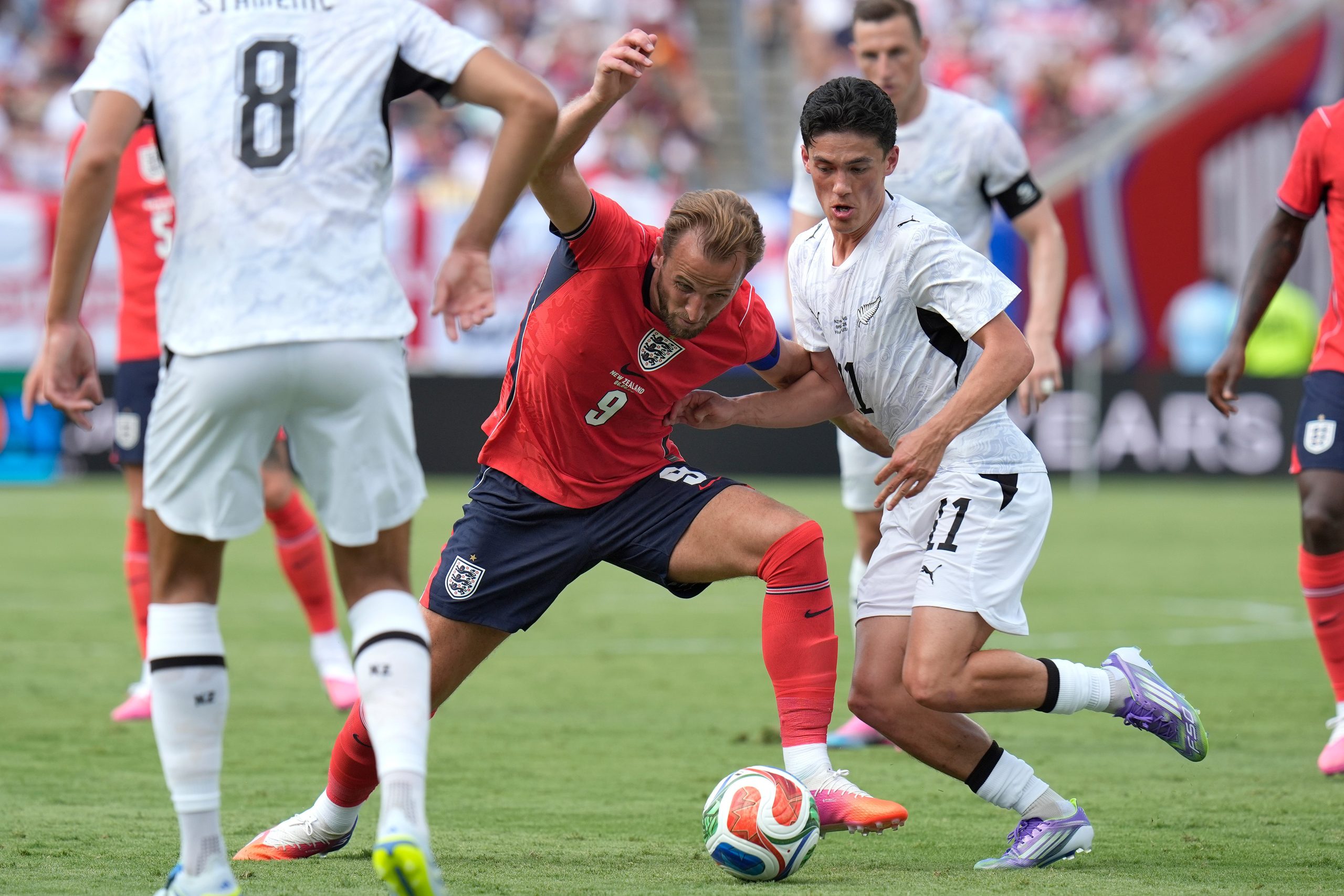

LOS ANGELES — In many World Cup host cities, competing teams also find themselves jostling for soft-power supremacy around their matches. But before its first match tomorrow in Los Angeles, New Zealand has had the diplomatic landscape all to itself.
New Zealand is scheduled to face Iran, which has not had formal diplomatic relations with the United States since 1980. Even as President Donald Trump claims an end to the countries’ monthslong war is at hand, Iran will be competing in the World Cup under severe travel restrictions. The team has been forced from its original Tucson training camp to Tijuana, and is being forced to effectively commute to its matches in the U.S. without a full government delegation.
That has left New Zealand alone in pressing its off-field agenda in Los Angeles. On Sunday evening, New Zealand consul-general Katja Ackerley opened her Brentwood mansion to a “New Zealand on the World Stage” networking reception sponsored by the government agencies overseeing the country’s trade, sport and foreign-investment portfolios.
“It’s all about soft power, it’s all about person-to-person,” said Peter Miskimmin, the government’s head of sports diplomacy. “We are building relations through sport rather than bringing up arms against one another.”
The country’s Los Angeles diplomatic outpost typically focuses on promoting exports of wine and lamb, expediting visas for Hollywood personnel traveling for location shoots and addressing the perpetual crisis of “Kiwis losing their passports in Las Vegas,” as one previous inhabitant of the office put it.
A delegation of New Zealand officials was preparing for their first World Cup appearance since 2010 uncertain whether any of their opposite numbers from Iran would attend, and how that might affect the standard match-day pageantry.
“This is our first World Cup in 16 years so we can’t tell what’s different,” said James Wear, a general manager of the New Zealand Football Association. “We don’t have anything to compare.”
The faction supporting the TSSA rail union’s deeply unpopular general secretary Maryam Eslamdoust has called police to remove the union’s president from the chair of its annual conference. Former TSSA assistant general secretary broke the news on his social media feeds:
Unbelievably, the @TSSAunion Executive Committee has tried to remove the President from Annual Conference in contravention of the Rules, and he has refused to leave the chair. So the Police have been called!!!
— Steve Coe (@stevecoe1057) June 13, 2026
When police refused to intervene in a civil dispute, the rail union then found a pretext to suspend Adam Wilson and prevent him carrying out his duties as president and chair:
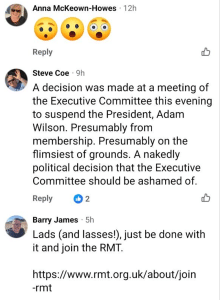
The 2026 conference began after the long-delayed close of the 2025 conference, which Eslamdoust and her supporters ordered abandoned to avoid announcing Wilson’s win as president — and to prevent a no-confidence motion against Eslamdoust by outraged members. TSSA only admitted months later that Wilson had won the presidential election.
Even before conference 2026 began, alleged management manoeuvres were underway. The conference venue was changed, followed by an announcement that members would not be able to attend because of lack of capacity:
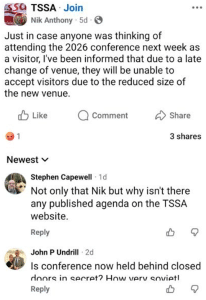
But that was only the start. As the 2025 conference was finally declared over, the rail union announced that the venue it had communicated to members for the 2026 conference had been changed — only two hours before the start. Coe called this “incompetence”, but in context others might disagree:
Incompetence knows no bounds at @TSSAunion! 2 hours before Annual Conference starts, it has been announced that the venue for the conference is NOT the one on the agenda or other info to delegates.
This follows yesterday’s 140 minute late start to the online conference!!!
— Steve Coe (@stevecoe1057) June 13, 2026
Rail Union — Years of worker and member revolt
The latest scandal follow years of anti-democratic manoeuvres by the Eslamdoust regime against her opponents, who have reacted with outrage to her attacks on their democracy and on the union’s workers. TSSA staff have repeatedly gone on strike over Eslamdoust’s conduct and accused her of crossing their picket line. Her behaviour has already seen her lose a number of no-confidence votes. One branch summarised her record in a January 2026 demand for her to be suspended from her role:
Since the election of Maryam Eslamdoust:
- Illegitimate closure of Women in Focus the TSSA self-organising group for women that was central in exposing the sexual harassment of the previous leadership
- Suspension in breach of process of three leading TSSA activists, one of whom remains suspended without a hearing for more than 20 months.
- Created dispute with TSSA staff resulting in two industrial action ballots strike and now continuous action short of strike action
- Created an intolerable environment for staff which has been demonstrated by GMB survey and horrendously high rates of sickness of the staff
- Denial of any democratic challenges that presided over a disastrous annual conference in 2024
- Withholding the election results for President and Treasurer in May 2025 on the basis of an investigation into the conduct of that election. An investigation that has never had an outcome and it remains unjustified why the vote has not been counted.
- Creating a trumped-up allegation against President candidate Duncan Bates that he was a train driver when he was not to exclude him from the President election and EC seat.
- Creating a further spurious allegation against Duncan Bates following his successful subsequent election onto the EC from which he remains suspended
- Refusal to hear any appeal from members or branches at TSSA Conference 2025 in breach of rules.
- Presided over the sabotage of TSSA conference 2025 leaving about half of the conference business unheard.
- Cancelling of the reconvened conference in November 2025 and providing no alternative dates
- Removed representative credentials from 4 London Underground Management representatives without a fair process and with no consideration of the impact for the representation of our members
- Refusal to respond to the vast majority of democratic challenges submitted by individual members, branches, divisional councils, representative groups or indeed union trustees.
With the denial of any form of democratic process or the ability for any candidate to be allowed to stand that may challenge the leadership control we have no option other than to publicly call for the investigation and suspension of the General Secretary
Eslamdoust then de-recognised TSSA staff’s workplace union, the GMB when it refused to prioritise her over its members — a move that any union leader would condemn from an employer.
The apparent efforts of Eslamdoust and her supporters to thwart efforts for justice and redress have seen the TSSA’s reputation trashed and both members and staff rising up in disgust. Now those efforts appear to have collapsed a third conference in a row into chaos.
TSSA has not responded to a Skwawkbox media enquiry since 2024.
Featured image via Peter Macdiarmid/Getty Images
By Skwawkbox
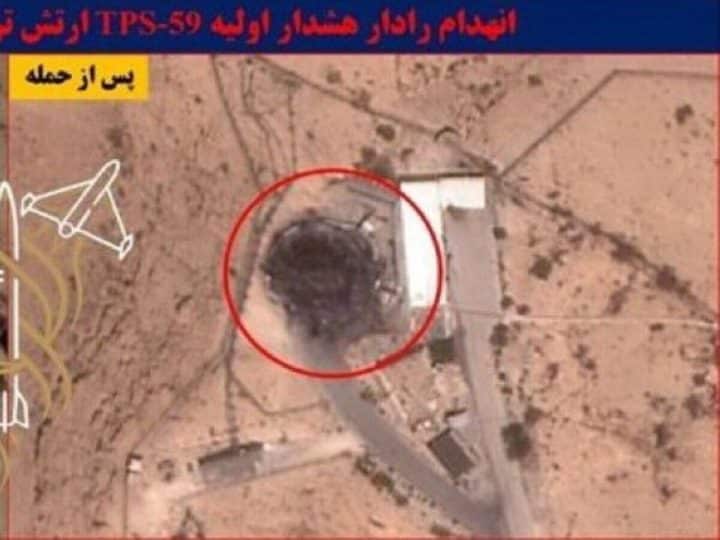
New satellite images reveal that Iran’s strike successfully hit a US AR-327 Early-warning Radar system at Jabal ad Dukhan in Bahrain.
Confirmed hit at Jabal al-Dukhan Long Range Radar site, Bahrain.
*found a photo of the hill on a hiking website, matches the cropped image of smoke on the mountain. https://t.co/Q8SbembFPu pic.twitter.com/AlmT2Tdxhc
— MenchOsint (@MenchOsint) June 11, 2026
The imagery shows that Iran completely destroyed the radar site in its attack on June 11.
Iran published satellite images of the confirmed drone/missile strike against the US AR-327 Early-warning Radar system in Bahrain.
The radar is capable of tracking ~470 km away https://t.co/QTUA3xmVDP pic.twitter.com/L2mbkekthF
— Arya Yadeghaar (Backup) (@AryJeayBackup) June 13, 2026
This came after Iran said it had targeted & hit the US 5th Fleet in Bahrain with various drones.
The drones attacked the communication antennas & radar facilities of the 5th Fleet’s Patriot system.
The early-warning radar site was capable of tracking targets up to 470km away and cost the US upwards of $40m.
Iran — Ending US colonialism
Iran has focused on hitting US targets in West Asia since the US and Israel launched their illegal attacks on Iran in early March. So far, it has destroyed several very costly radar systems. This severely depletes the US’s ability to detect missiles in the region.
Iran also published satellite images of a confirmed strike on a 1000-ASR Early-Warning Radar system at the Ali Al Salem Air Base in Kuwait. The strikes completely destroyed the radar system.
Iran also published satellite images of a confirmed missile/drone strike on a 1000-ASR Early-Warning Radar system at the Ali Al Salem Air Base, in Kuwait.
The radar system has been destroyed. https://t.co/eGuKYAzV8P pic.twitter.com/kXm5WyraRM
— Arya Yadeghaar (Backup) (@AryJeayBackup) June 13, 2026
Obviously, the US claimed it intercepted all of these missiles. But Trump’s main personality trait is lying.
The US claimed all these missiles were intercepted https://t.co/uIumc9MrXM
— Borzou Daragahi
(@borzou) June 13, 2026

It’s a shame the early warning systems didn’t, erm, warn the US they were about to be obliterated?
Iran also targeted the Al-Azraq airbase in Jordan with 12 long-range ballistic missiles.
BREAKING:
Iran struck a US military base in Jordan with a long-range ballistic missile.
Satellite imagery from february showed that more than 60 US aircraft were deployed at the base, including 30 F-35 stealth fighters and 36 F-15 fighter jets. pic.twitter.com/9ZTuYzVqCw
— Current Report (@Currentreport1) June 11, 2026
Satellite imagery from February showed over 60 US military aircraft were stationed at that base. This included 30 F-35 stealth fighters and 36 F-15 fighters.
The Iranian Revolutionary Guard announced it had directly struck the Muwaffaq Salti military base in Jordan.
The base housed US F-35 fighter jets. pic.twitter.com/ZGKQK61t3s
— Aleksey The Great
(@aleksthgrt) June 10, 2026

Iran has also targeted two vessels in the Strait of Hormuz. This was in retaliation for several waves of US attacks, along with Bahrain’s Sheikh Isa airbase and Kuwait’s Ahmad Al-Jaber airbases.
The US’s Central Command announced further strikes on “multiple targets” inside Iran.
The US bombed Qeshm Island as well as the ports of Sirik, Jask and Bandar Abbas. It also destroyed two water reservoirs, cutting off water to 20,000 people, and damaged a telecommunications tower.
The US military said the strikes were at President Donald Trump’s “direction” and:
in response to Iran’s unwarranted and continued aggression.
This completely ignores the fact that the only reason Iran is firing at US targets is that the US illegally attacked Iran, alongside Israel, back in March. The US seems to forget that Iran has the right to defend itself against illegal attacks.
Consequences
As of March 2, it was reported that Iran had already destroyed around $2 billion worth of US military equipment.
This included an AN/FPS-132 early-warning radar system at Al Udeid Air Base in Qatar, valued at $1.1 billion.
Since then, the US has lost several radar sites and several aircraft, meaning that the cost will be far higher.
Iran has done more this year to end US colonialism in three and a half months than the rest of the world has ever done.
Whether it’s his ties to Epstein, raping children, or bombing sovereign nations, Trump has always believed he is above the law. However, Iran is now proving that the US will not continue to get away with its longstanding colonial traditions without serious and expensive consequences.
Feature image via X
By HG
Politics
Haiti coach: we must be proud of our historic performance against Scotland despite the loss

Sébastien Migné, the Haiti national team coach, emphasized that his players should feel proud of their performance against Scotland, despite the 1-0 loss in their opening match of Group C in the 2026 World Cup.
Following the match, Migné told Reuters that his side displayed strong character and competed until the final whistle, stressing the importance of maintaining faith in their ability to reach the knockout stages, despite the disappointing result.
The match held special significance for Haiti, marking their first World Cup appearance since 1974—a 52-year absence from the world’s biggest football stage. While Haiti previously participated in the 1974 West Germany tournament, this current generation played their first-ever World Cup match as the Caribbean nation returned to the tournament for only the second time.
Migné noted that his team is accustomed to overcoming adversity, citing their qualification journey, which wasn’t secured until the final round. He affirmed that the group remains wide open, despite facing formidable opponents like Brazil and Morocco alongside Scotland.
Haiti conceded a first-half goal to Scotland’s John McGinn, but they pushed hard in the closing minutes and nearly found an equalizer, demonstrating their ability to go toe-to-toe with a more experienced international side.
Haiti faces an even tougher challenge in the next round when they meet Brazil, before concluding their group stage against Morocco.
Featured image via Justin Setterfield/Getty Images
By Alaa Shamali
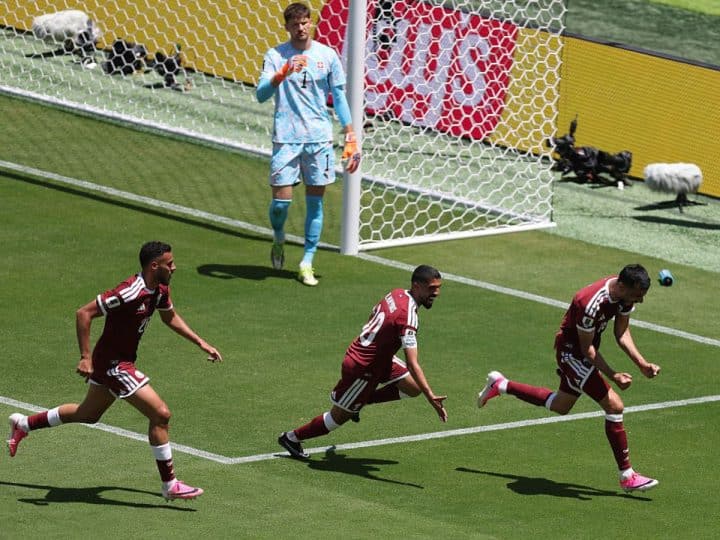
The fifth minute of stoppage time in the match between Qatar and Switzerland was not just the moment Boualem Khoukhi scored the equaliser; it might have been the birth of a new chapter for the Qatari national team in the World Cup.
The 1-1 draw gave “Al Annabi” their first point in the history of their World Cup participations, but the impact of this result goes far beyond the scoreline. The current tournament structure offers teams a path to qualification not only by finishing in the top two spots but also by competing as one of the best third-placed teams.
For long stretches, it appeared the Qatari team was headed toward another loss against a dominant Swiss side that controlled possession and threatened the Qatari goal with dozens of attempts. Yet, the match found a different hero.
Goalkeeper Mahmoud Abunada stood firm against the Swiss offensive surge, delivering one of the most remarkable individual performances of the tournament so far. By saving eight dangerous shots, he kept his team in the game until the very end. It was no surprise when he was named Man of the Match, making him the first Qatari player to achieve this honour in World Cup history.
Qatar — a historic result
While Qatari fans celebrated the historic result, the European press was more focused on what they saw as a missed opportunity for Switzerland. Despite registering 26 shots on goal, the Swiss managed to score only once, leaving them with a draw that failed to reflect their dominance on the pitch.
However, football is rarely decided by statistics alone. While Switzerland left the stadium lamenting two dropped points, Qatar walked away with a single point that could prove invaluable as the tournament unfolds.
This result is particularly significant given the new 2026 World Cup format. Securing a point against one of the group’s strongest competitors could prove decisive for qualification, whether the team advances via second place or as one of the top third-placed sides.
Beyond the complex math, the Qatari national team emerged from this encounter with three clear victories: their first-ever World Cup point, their first-ever Man of the Match recipient, and the proven ability to compete against opponents with vastly more World Cup experience.
Qatar’s draw with Switzerland today may be viewed as a positive result, but only the coming days will determine whether this point is merely a footnote in the record books or the start of a journey toward Qatar’s first-ever qualification for the World Cup knockout stages.
Featured image via Fran Santiago/Getty Images
By Alaa Shamali
Politics
Flags, chants, and messages of solidarity: Palestine makes its presence felt at the 2026 World Cup
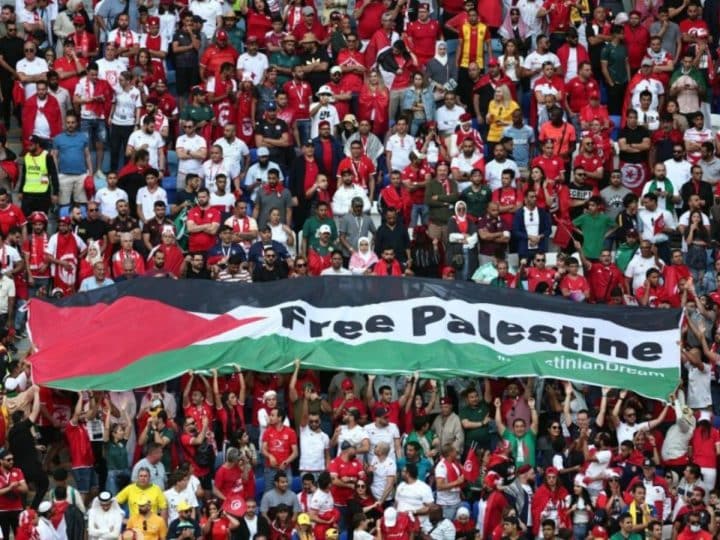
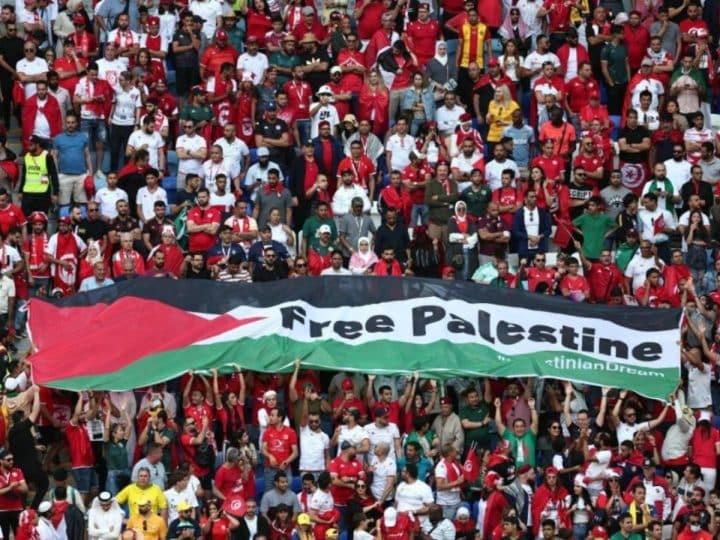
Palestine did not need a team in the 2026 World Cup to be present in the spotlight.
From the very first days of the tournament, held in the United States, Canada, and Mexico, the Palestinian cause emerged as one of the most visible topics in the public sphere surrounding the World Cup. It was seen through flags waving at public events, protests accompanying the matches, and chants of solidarity shared across social media platforms, transforming into a parallel narrative to the world’s biggest football event.
As the eyes of billions of viewers turn to the pitch, fans and activists have seized the immense media momentum of the tournament to keep Palestine in the global spotlight, reaffirming that football, as it has always been, is inseparable from the issues that occupy global public opinion.
Outside the stadiums: The Palestinian flag leads the way
If the matches are the main event inside the stadiums, the Palestinian flag has been one of the most prominent symbols outside them.
In Mexico City, at the start of the tournament, activists organised a solidarity event near the Azteca Stadium, where they formed a human Palestinian flag in a scene that drew attention and went viral across media and social platforms, becoming one of the first images associated with the World Cup outside the sporting arena.
The Palestinian presence was not limited to Mexico; it also moved to Canada, where the city of Toronto saw protests demanding that FIFA take a stance regarding Israel, while Palestinian flags fluttered among participants who seized the global event to highlight the ongoing war in the Gaza Strip.
Photos and videos of participants wearing pro-Palestine slogans also spread, turning the protests into one of the most discussed issues on the fringes of the tournament during its opening days, reflecting the activists’ determination to use the global interest in the World Cup to deliver their messages to an audience watching from various continents.
Palestine — From fan zones to stadium chants
Palestine’s presence was not confined to protest events; it extended to the fan gatherings surrounding the matches.
During fan activities related to the Qatar vs. Switzerland match, social media platforms circulated clips and images of Qatari fans raising Palestinian flags and chanting in support of Palestine. The scene repeated itself during the fan activities accompanying the Morocco vs. Brazil match, where the Palestinian flag appeared among Moroccan fans who were keen to highlight the cause around the tournament.
The most widely shared moment came from fans of Bosnia and Herzegovina during the match against Canada, after footage of chants supporting Palestine by Bosnian fans went viral, an image that reflected the widening circle of solidarity to include fans from outside the Arab world, reaffirming the status that the Palestinian cause still holds among large sections of sports fans around the world.
A message beyond football
Between the flags fluttering in the streets, the chants echoing in fan gatherings, and the protests surrounding the matches, it appears that Palestine has once again succeeded in imposing its presence on the margins of the world’s largest sporting event.
For many fans and activists, the World Cup represents not just a football tournament, but a global platform that captures the attention of billions, making it an opportunity to keep humanitarian issues in the spotlight of international interest.
These scenes served as a message from fans who chose to use the world’s biggest sporting platform to confirm that the Palestinian cause remains present in the global consciousness, and that the war in Gaza has failed to silence the voices demanding justice or to obscure the suffering of Palestinians from the world’s view.
Despite Palestine’s absence from the list of participating teams, it was strongly present in the World Cup’s public scene, through flags, chants, and messages of solidarity that confirmed that some issues can cross borders and reach the world’s biggest sporting stages.
Featured image via LeftVoice
By Alaa Shamali
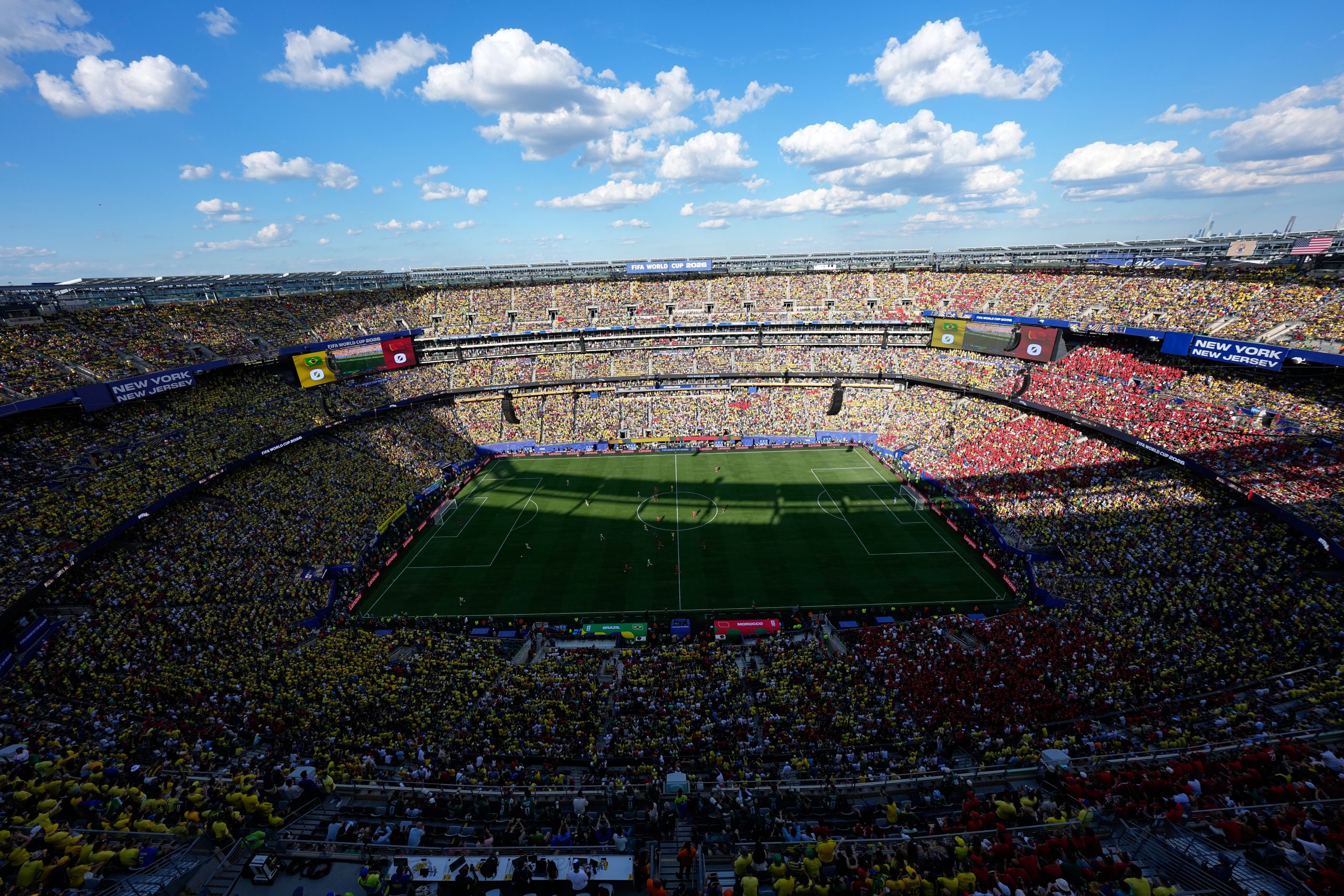

EAST RUTHERFORD, New Jersey — During the World Cup, FIFA officials, law enforcement agencies and transit planners across New York and New Jersey will be keeping an eye on things from a constellation of command centers and control rooms.
The sites — spread from Miami to Trenton, New Jersey to Brooklyn — will house a small army of public officials ready to respond to whatever pops up during eight matches being played at MetLife Stadium in East Rutherford, New Jersey.
The number of distinct command or operations centers that will be in use is almost comical: The New Jersey State Police, the New York Police Department, multiple transit and transportation agencies in New York and New Jersey, Amtrak and the Port Authority of New York and New Jersey all have their own spot on the map to work out of. Some these are permanent control rooms where officials are used to working in front of huge screens to monitor video and data feeds. Others are temporary or specific to the tournament: There’s an operations center near the entrance to MetLife Stadium that the host committee and others are using and FIFA has an operations center in Miami.
But each has a distinct function and some will be staffed by officials from other agencies to help with coordination. During the World Cup, a command center in Trenton is the big dog.
“At the end of the day, though, they all report in to the larger command center, which is the ACC, the area command center, which looks at the overall region, the impacts to the region for any events, the asset allocation at different sites,” said Lt. Col. David Sierotowicz, the deputy superintendent of the New Jersey State Police and World Cup incident commander.
Before the first match here on Saturday, New Jersey Gov. Mikie Sherrill paid a visit to officials at an operations center on an elevated platform in the MetLife parking lot. After Brazil and Morocco battled to a draw and the sun had set, one of her top transit advisers could still be seen looking out over winnowing crowds boarding buses and trains to go home.
And for at least part of the summer there will be yet another command center: Over July 4 weekend, when President Donald Trump is expected in town for a massive parade of warships and a military airshow, there will be a popup command center run by the federal government at Jacob Javits Center in Manhattan.
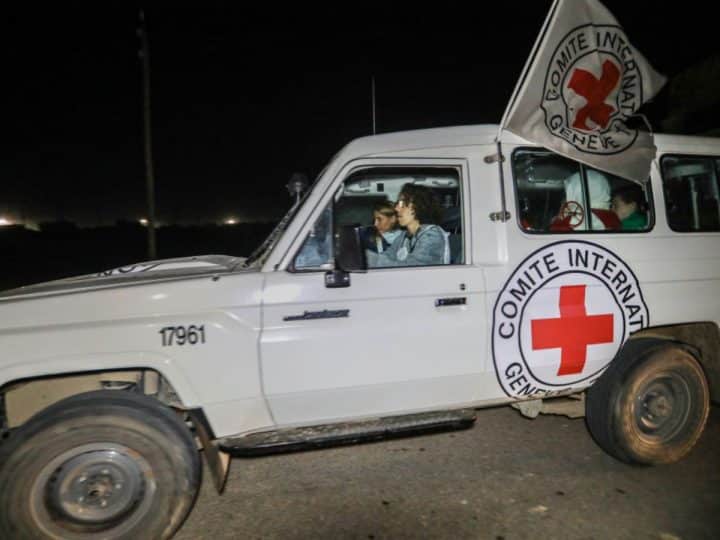
On 4 June, Israel’s Supreme Court ordered the government to lift the ban on International Committee of the Red Cross (ICRC) visits to Palestinian detainees. It had been in place since 7 October 2023, and affected all those held in Israeli occupation prisons and military detention facilities.
Israeli occupation’s ban on ICRC visits to Palestinian detainees is to be reinstated
The court found there was no legal basis to justify the continued restriction. It claimed the “Israeli” government’s ban on ICRC visits violated both “Israeli” law and international humanitarian law.
The decision was made following a petition by various human rights organisations. They had challenged the occupation’s decision to block all ICRC visits, and withhold information from it about Palestinian detainees. This was the first time in 50 years that these visits were prevented from taking place.
The ICRC visits detainees during armed conflicts. It assesses detention conditions, meets prisoners privately and organises contact with families. Palestinian prisoners are currently enduring the worst conditions ever known in Israeli occupation detention facilities. So these visits are essential for their welfare, and also provide one of the few forms of independent oversight available.
But it took the occupation’s Supreme Court more than two years to overturn the ban
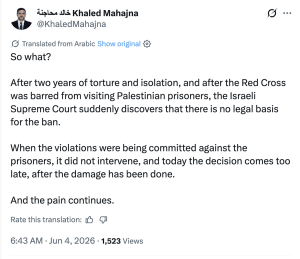
But why did it take the occupation’s Supreme Court two and a half years to decide that the ban on ICRC visits was illegal?
Palestinian lawyer, Khaled Mahajna posts on X:
The “National Security Committee” in the Knesset has moved swiftly against the Supreme Court’s decision. It has now voted to approve, for its first reading, a bill to ban members of the ICRC from visiting Palestinian prisoners.
Judicial rulings are used to improve “Israel’s” image, and Knesset has moved to legislate the ICRC visit ban
The Committee chairperson, Tzvika Foghel, spoke at the opening of the debate in the Knesset.
He said:
Preventing visits to terrorists in prisons is part of the war, and we will prevail in that as well.
David Bavli, Ben-Gvir’s adviser, said:
The Red Cross is not a neutral organization, and our opposition to its visits is very clear….There are now thousands of terrorists who are effectively ticking time bombs. They are familiar with the High Court ruling and intend to use it. Once the Red Cross enters, prisoners will make false claims. This would create an insane situation that we have no way of handling.
The Palestinian Commission of Detainees’ Affairs, and the Palestinian Prisoner’s Society (PPS), have released a statement about these recent developments. They question the effectiveness of the occupation’s judicial decisions. The PPS say judicial rulings such as this are just for show. They are used to “improve the image of the Israel’s legal system” in the eyes of the international community. But at the same time, legislation is passed that entrenches the occupation’s violations and provides them with legal cover.
International silence and lack of accountability when it comes to “Israel’s” crimes threaten the credibility of the whole human rights system
The Commission and the PPS warn about the absence of international accountability. They claim it encourages the criminal Zionist regime to escalate its violent crimes against Palestinians. Silence prevails, while the genocide and starvation in Gaza continue and “Israel” systematically tortures, neglects, and even kills Palestinian detainees. The credibility and effectiveness of the international human rights system are also at stake, due to the weakening respect for international law standards.
The Israeli occupation’s policies, and the violations associated with them, are far-reaching in nature, and extend far beyond Palestinians. Around the world, human rights defenders and those in solidarity with Palestine are also affected.
The occupation’s actions in the occupied Palestinian territory threaten the global human rights framework, because it erodes all respect for international law. The Zionist regime systematically ignores binding UN resolutions and international court rulings, with impunity. This signals to other countries that they can also restrict humanitarian aid, target civilian infrastructure, or commit any other war crimes, without consequence. Preferential treatment for the terrorist state needs to end, as the double standards also threaten the credibility of the entire human rights system.
According to the PPS, as of 10 June 2026, there are approximately 9,500 Palestinian detainees. 3,324 are held without charge or trial. There are 95 female prisoners, nearly 360 children, and 1,316 detainees from Gaza, classified by Israeli occupation authorities as “unlawful combatants.”
By Charlie Jaay


DALLAS — The Trump administration has elevated dozens of more complex World Cup visa decisions to senior leadership as officials try to balance FIFA commitments with national security concerns.
In an interview Sunday, White House World Cup task force Executive Director Andrew Giuliani said many high-profile or complicated visa cases have ultimately reached his desk for a final determination.
“Dozens, I would say dozens,” Giuliani said when asked how many edge cases had required senior-level review. He also suggested that some applicants who might otherwise face difficulties entering the country have received additional consideration because of U.S. commitments tied to hosting the World Cup.
“That’s part of the contract the U.S. government signed with FIFA,” Giuliani said.
In light of President Donald Trump’s tough border policies, these details provide a glimpse into the administration’s process of reviewing visas ahead of the largest World Cup tournament in history — a task that’s involved the State Department, Department of Homeland Security and the White House World Cup task force to keep the process moving.
Giuliani defended the decision to deny entry to Somali referee Omar Abdulkadir Artan, saying it was made by Customs and Border Protection and Homeland Security Secretary Markwayne Mullin.
While declining to discuss specific intelligence, he said Artan had been communicating with “bad actors” shortly before he was scheduled to travel to the U.S.
Giuliani had conversations with FIFA about Artan’s case because the Somali is one of the organization’s referees.
“We talked about it, obviously, right? I mean, it’s one of their referees,” Giuliani said.
“There are some things we can’t talk about,” Giuliani said. “We want all those players and coaches to come to the United States of America, and officials and referees, as long as they’re not communicating and coordinating with bad actors.”
Giuliani emphasized that the overwhelming majority of players, coaches, referees and officials have received visas without issue.
Still, Giuliani said the administration’s red line remains national security. Referencing broader concerns about individuals linked to terrorist organizations, he said the World Cup would not serve as a justification for admitting people deemed security risks.
“The first thing that is so key to this tournament being successful is the national security of the country,” Giuliani said. “We’re not going to let the World Cup be the excuse.”

XRP BREAKING NEWS!!! (U.S. SENATOR DROPS A HUGE WARNING ON CRYPTO!)

Top 5 Myths About Income Protection Insurance, Busted by Experts!

CFTC Pulls New Mexico Into Prediction Markets Battle


-

 Crypto World4 days ago
Oppenheimer backs SpaceX as $70 billion retail frenzy builds
-

 Business15 hours ago
No Jackpot Winner as $257 Million Prize Rolls Over to $269 Million Monday Draw
-

 Crypto World4 days ago
Markets Rally as SpaceX IPO Looms Amid Iran Tensions and Inflation Surge
-

 Sports7 days ago
FIFA WC 2026 Group C: Morocco, Scotland challenge Brazil’s hunt for glory | FIFA World Cup 2022
-

 Fashion3 days ago
Weekend Open Thread: Tuckernuck – Corporette.com
-
 Crypto World7 days ago
Eli Lilly (LLY) Stock Surges 4% Following Breakthrough Sleep Apnea Trial Results
-
 Crypto World7 hours ago
Zimbabwe Requires Crypto Businesses to Register Annually Under New FIU Regulations
-
 Sports6 days ago
Bangladesh beat Australia after 20 years in ODIs, register only their second win over six-time world champions | Cricket News
-

 Entertainment6 days ago
The Ryan Gosling True Crime Thriller On Netflix That Gets Even Stranger, Stream It Now
-

 Tech2 days ago
NanoClaw integrates JFrog registries to secure AI agent downloads
-

 Tech3 days ago
This Week In Security: Microsoft On Microsoft, Register Your Domains, Linux On ARM, And FreeBSD Joins The File Cache Club
-

 Crypto World2 days ago
Bitget enters Argentina’s regulated crypto market through PSAV registration
-

 Politics4 days ago
Politics Home | Healey Resignation Is “Colossal Failure Of Government”, Says Former Labour Defence Secretary
-
 Tech5 days ago
‘This is Seattle’s position on AI’: City Council votes unanimously to pause big new data centers
-
 Entertainment4 days ago
Donnie Wahlberg & More Heat Up Las Vegas at Circa’s Barry’s Downtown Prime
-

 Sports4 days ago
First Time Since 1971: Australia Register Historic Low In ODI Cricket
-
 Tech4 days ago
Dutton Ranch star claims they ‘didn’t see any disruption’ on set following Chad Feehan’s exit from Yellowstone spinoff fueled by Taylor Sheridan clash rumors
-
 Tech4 days ago
Opendoor Ends India Operations, Fueling a Bigger Conversation About AI and Outsourcing
-

 Tech7 days ago
Nvidia and Hyundai deepen their robotics push around Atlas
-

 NewsBeat3 days ago
El Nino has formed in the Pacific and could set records, forecasters say
You must be logged in to post a comment Login