

Crypto World
Meta’s Manus Unwind Killed the Singapore Loophole for AI Companies



Meta has completed an operational separation from Manus, cutting the agentic AI startup off from its systems and halting all data sharing as both companies work to unwind a $2 billion deal Beijing ordered reversed. The move ends a strategy Chinese AI founders had quietly relied on: relocate to Singapore, raise Western capital, and call it a clean break.
Last week, Meta barred Manus staff from accessing its internal data systems and told its own employees to stop using Manus tools for internal projects. The separation follows Beijing’s April order to reverse the acquisition, which law firm Zhonglun described as unprecedented under China’s foreign investment security review mechanism.
“Singapore Washing” Has a Shelf Life
The startup, built by parent company Butterfly Effect, moved its headquarters and core teams to Singapore in mid-2025. Meta then announced its $2 billion acquisition in December. The logic was to put distance between the company and China, and Beijing’s arm would stop at the border.
“Beijing has sent a message to its tech sector that ‘Singapore washing’ has limits,” said Han Shen Lin, China managing director at The Asia Group.
Washington received a lesson, too, he added, shining a light on ownership structures can be as effective as any prohibition.
The problem for Manus runs deeper than any restructuring can fix. “Once another company’s engineers have been inside your stack, you can delete the repository, but you can’t make them unsee what they’ve seen,” said Matthias Hendrichs, a Singapore-based advisor to global AI firms.
Beijing’s July 1 Rules Close the Door
Beijing issued new outbound investment rules earlier this month that take effect July 1. The framework extends Beijing’s reach to markets, including Taiwan, and gives it the power to punish foreign firms from countries that restrict Chinese investment.
“If Chinese money touched a deal, Beijing can now assert jurisdiction over the exit, the restructuring, or the reinvestment,” Han said. He called it “a retroactive and forward-looking chokehold” on outbound capital.
The new directives specifically targeted deals like Manus, “a high-profile move that suggested a leading Chinese AI firm was turning away from the domestic market, an example Beijing didn’t want others to follow,” said Tilly Zhang, an industrial policy analyst at Gavekal Dragonomics.
What Comes Next for Manus
Manus co-founders are in early discussions to raise roughly $1 billion from outside investors to buy the company back from Meta, according to May reports, a path that could lead to a Chinese joint venture structure and a Hong Kong listing. Chinese AI firms, including MiniMax and Zhipu, have already listed in Hong Kong this year as the city sees a surge in AI debuts.
For U.S. tech firms eyeing Chinese AI assets, Hendrichs offered a warning that now carries weight. The Singapore escape route is closed.
The post Meta’s Manus Unwind Killed the Singapore Loophole for AI Companies appeared first on BeInCrypto.

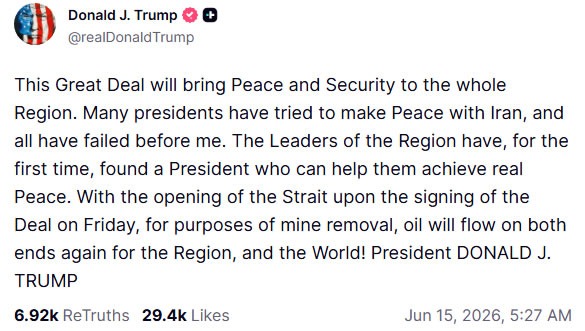
Bitcoin came just shy of $66,000 during Monday morning trading after US President Trump claimed that the US had brokered a peace deal with Iran that would reopen the Strait of Hormuz.
“The deal with the Islamic Republic of Iran is now complete. Congratulations to all!” Trump posted on his Truth Social platform late on Sunday.
“I hereby fully authorize the toll-free opening of the Strait of Hormuz, and, simultaneously herewith, authorize the immediate removal of the United States Naval blockade,” Trump said. “Ships of the World, start your engines. Let the oil flow!”
“With the opening of the Strait upon the signing of the deal on Friday […] oil will flow on both ends again for the region, and the World!” he said in a separate post.
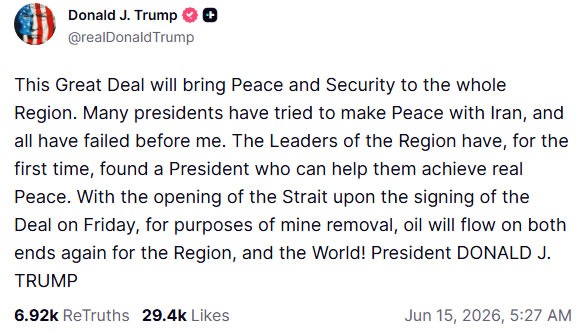
Source: Donald Trump
Trump has claimed dozens of times over the last two months that a deal to end the war was near, and the crypto markets have traded on news of the Iran war since it started in February with US-Israeli strikes.
Markets reacted positively to Trump’s latest claim, with Bitcoin (BTC) reaching $65,881 on Coinbase on Monday morning, according to TradingView. It is the highest the asset has traded over the last 12 days, having not been over $66,000 since June 3.
Andri Fauzan Adziima, the research lead at Bitrue Research Institute, told Cointelegraph that the potential deal “removes a major geopolitical risk premium, triggering a clear risk-on move as uncertainty fades.”
“Bitcoin has broken above $65,000, fueled by traders rotating back into crypto amid lower oil pressure and a broader stability narrative under a pro-crypto administration,” he added, but cautioned that there could be “last-minute signing issues” with the deal.
The details of the deal between the US and Iran were not immediately available, and it would not be implemented until Iran signs, which is expected on Friday under mediation by Pakistan, the Associated Press reported.
Related: Trump says Iran peace deal to be signed Sunday, contradicting Tehran
Iran’s deputy foreign minister, Kazem Gharibabadi, confirmed the agreement on state television while the secretariat of Iran’s Supreme National Security Council said the war on all fronts “will end immediately and permanently beginning tonight” and that the US blockade “will be terminated immediately and in full.”
Bitcoin has been gradually trending up since it fell below $60,000 briefly on June 6; however, it remains 48% down from its peak of over $126,000 in October.
The broader crypto market also gained 2% in total capitalization on the day, with several altcoins, including Hyperliquid (HYPE), Zcash (ZEC) and Near Protocol (NEAR) were outperforming, some with double-digit percentage gains.
There was also movement in crude oil prices, with WTI Crude falling 5% to its lowest level since early March at just over $80 per barrel, while Brent Crude mirrored the move, dropping 4.6% to $83.30.
More volatility may be ahead
Wednesday could add more volatility to crypto markets as the Federal Reserve is scheduled to make its interest rate decision, the first under new chair Kevin Warsh.
The new central bank chair appears more receptive to cuts, but increasing inflation, which has topped 4% again, strengthens the case for rate increases.
The CME Fed Watch tool currently predicts a 96.6% probability that rates will remain unchanged at 3.5% to 3.75%
Magazine: OpenAI files for IPO, SEC scraps 611 rule and Hungary overhauls crypto: Hodlers Digest


Ripple’s UK and Europe head Cassie Craddock says banks and financial institutions see clear value in digital asset technology, but many still need a simpler way to use it.
Summary
- Ripple says banks want partners to handle custody, liquidity, settlement and compliance for digital assets.
- UK and Luxembourg licences give Ripple a regulated base for cross-border payment growth in Europe.
- Banks are increasingly seeking blockchain payment tools that reduce technical complexity and streamline implementation.
In a post shared after her appearance on FinTech Futures’ What the FinTech? podcast, she said institutions want support across custody, liquidity, settlement and compliance.
Craddock said banks want partners that can reduce the work needed to connect with digital asset rails. She wrote that firms want to focus on “delivering better experiences for their customers,” rather than building every part of the system alone.
Ripple points to licensing push
Ripple has framed its UK and European strategy around regulated access to blockchain-based payments. The company secured an Electronic Money Institution licence and Cryptoasset Registration from the UK Financial Conduct Authority in January 2026. It later received full Electronic Money Institution approval from Luxembourg’s CSSF, giving it a route to scale payment services across the European Union.
Craddock said financial institutions now want partners that pair new technology with clear legal standing. In her post, she said Ripple’s recent licences in the UK and Luxembourg form part of a regulatory base that supports “faster, more transparent and more cost-effective cross-border payments in a compliant way.”
https://x.com/CraddockCJ/status/2066373507634565340
Meanwhile, on the podcast, Craddock discussed Ripple’s investment plans in the UK and Europe, the region’s rules for digital assets and the future of cross-border payments. FinTech Futures said the episode also covered stablecoins and how Ripple’s dollar stablecoin fits into its wider payment strategy.
Craddock said Ripple has worked with large banks for many years. She added that this record helps the company present itself as a trusted partner for firms that need tested infrastructure. The message fits a wider push by crypto payment firms to serve banks without forcing them to manage every technical part of digital asset settlement.
Broader market moves toward regulated rails
Recent crypto.news coverage shows that institutional payment firms are building products that hide blockchain complexity from banks and businesses. Circle launched a managed stablecoin settlement service for banks and fintechs. Cecabank also moved a MiCA-regulated custody and trading platform into production for financial institutions in Europe.
These launches point to the same demand described by Craddock. Banks want faster settlement and lower costs, but they also need controls, licence coverage and clear operating rules. That need gives regulated crypto infrastructure firms a stronger role in payment services. It also places more attention on providers that can manage onboarding, monitoring and reporting inside one service.
Ripple’s pitch centers on cross-border payments, where banks still face delays, fees and capital tied up in old systems. Its licensing in the UK and Luxembourg gives the company more room to offer regulated services in key European markets. The company’s next task is to turn licensing progress into steady bank usage across real corridors.
Crypto World
Bitcoin traders have a reason to watch Tuesday’s BOJ rate decision. Yen shorts are at a nine-year high


These carry trades have helped fuel bull markets on Wall Street and in government bond markets across the advanced world for years. Some analysts believe they have also supported crypto markets.
As a result, a sharp unwinding could destabilize markets broadly, including bitcoin.
The current setup is strikingly similar to the one preceding the BOJ’s rate hike in late July 2024. At that time, yen short positions were at record highs.
After the hike, the rapid unwinding of those shorts drove a sharp rally in the yen, sparking volatility across Wall Street, Japan’s Nikkei, and crypto. Bitcoin plunged from roughly $65,000 to $50,000 within a week of the July 31 decision.
Today’s setup rhymes with that sequence, so traders should closely watch the BOJ’s meeting on Tuesday. If the hike comes as expected and Governor Kazuo Ueda’s tone remains cautious, markets may shrug it off and stay relatively steady.
However, if Ueda signals a faster pace of tightening, or surprises with language suggesting rates could rise well beyond 1.0%, the yen could strengthen sharply, causing jitters across financial markets.
Crypto, historically one of the most sensitive assets to sudden liquidity shifts, would likely be among the hardest hit.

New Mexico has become the latest U.S. state to clash with the Commodity Futures Trading Commission (CFTC) over the regulator’s asserted authority to oversee prediction market products that state governments view as regulated gambling. The dispute underscores an emerging, high-stakes boundary issue in U.S. crypto and fintech regulation: when state gaming or consumer-protection laws can apply to platforms offering event-based contracts, and whether federal commodities law preempts those state measures.
On Friday, the CFTC announced that it filed suit in federal court to prevent New Mexico from enforcing state gaming laws against CFTC-registered contract markets. The action targets New Mexico Governor Michelle Lujan Grisham, Attorney General Raúl Torrez, and members of the New Mexico Gaming Control Board, with the CFTC arguing that the state’s approach intrudes on the “exclusive” federal scheme governing commodity derivatives markets.
Key takeaways
- The CFTC sued New Mexico to block the state from applying its gaming laws to CFTC-registered contract markets offering prediction market products.
- New Mexico’s lawsuit against Kalshi alleges that the company is effectively offering sports betting without a state license and that it permits participation by individuals aged 18 to 20, below New Mexico’s minimum gaming age of 21.
- In the CFTC’s complaint, event contracts are characterized as “swaps” under federal commodities law, positioning the contracts as subject to the CFTC’s exclusive jurisdiction.
- The case continues a broader pattern: multiple states have faced CFTC lawsuits after pursuing enforcement actions against prediction market platforms.
- A separate legal thread—highlighted by former regulators’ arguments—raises uncertainty over whether Congress intended Dodd-Frank swap definitions to cover sports event contracts.
CFTC vs. New Mexico: a preemption fight over “exclusive jurisdiction”
According to the CFTC, the agency filed suit to “block the state’s efforts to apply state gaming laws against CFTC-registered contract markets.” The CFTC’s position is that its federally regulated contract markets fall within an exclusive oversight framework created by Congress for U.S. commodities derivatives markets.
The regulator is asking the court to declare certain New Mexico state laws invalid as applied to transactions on CFTC-regulated designated contract markets (DCMs). The CFTC also seeks a permanent injunction preventing the state from taking action against prediction market platforms operating under CFTC registration.
In its complaint, the CFTC argues that the relevant event contracts should be treated as “swaps” under federal commodities statutes and that Kalshi’s market structure qualifies as a DCM. This matters legally because, if the federal characterization holds, it strengthens the case for preemption—limiting how far states can go under their own licensing and gambling frameworks when the product is regulated as a federal derivatives instrument.
In a statement, CFTC Chairman Mike Selig said New Mexico’s attempt to apply state gaming laws to federally regulated DCMs “intrudes on the exclusive federal scheme” for commodity derivatives. The statement frames the litigation as a question of jurisdiction and regulatory competence rather than consumer preference, emphasizing that the CFTC believes it has both the responsibility and expertise to oversee these products within its statutory mandate.
New Mexico’s complaint against Kalshi centers on licensing and age limits
New Mexico’s earlier action against Kalshi, filed June 4, claimed the platform was offering sports betting without proper authorization under state law. The state argued that the company’s sports event contracts function in substance like traditional sports wagering, which—on New Mexico’s view—triggers licensing obligations and other gambling-related requirements.
New Mexico also asserted that Kalshi allowed users aged between 18 and 20 to access the platform. The state’s position is that this contradicts New Mexico’s minimum gaming age of 21. These claims place age restrictions and licensing compliance at the center of the state’s regulatory rationale, which is typical of state gambling frameworks that treat similar conduct as regulated wagering rather than market-traded financial products.
The dispute illustrates a practical compliance problem for institutional-facing platforms and service providers: even when a company is operating within a federal registration model, state authorities may still pursue enforcement under local gaming and consumer-protection statutes if they consider the products to be functionally equivalent to gambling.
Pattern of multi-state litigation: the CFTC’s broader push
This case is described by the CFTC as part of a broader sequence of enforcement and jurisdictional disputes. New Mexico is reported as the eighth state involved in lawsuits initiated by the CFTC after state authorities took action against prediction market platforms.
Authorities and industry reporting have pointed to earlier conflicts involving states including Rhode Island, Wisconsin, Minnesota, New York, Arizona, Connecticut, and Illinois. (Cointelegraph has covered several of those disputes, including the CFTC’s actions in Minnesota and New York.)
For compliance teams, the repeat nature of these lawsuits suggests that jurisdictional clarity is not yet established at the state level, and that companies may face overlapping regulatory assessments. For institutional observers, the litigation pattern also highlights how legal outcomes may shape the operational viability of certain event-based trading or market access models across U.S. jurisdictions.
Former CFTC/SEC chair’s criticism: whether Dodd-Frank covers sports event contracts
Alongside the CFTC’s lawsuit posture, legal arguments submitted by former regulators have added nuance to the core jurisdictional debate. Gary Gensler—who previously chaired both the U.S. Securities and Exchange Commission (SEC) and the CFTC—filed an amicus brief in connection with Kalshi litigation involving Ohio, urging the Sixth Circuit to view the product differently under the Dodd-Frank framework.
In the amicus brief, as reported in court filings, Gensler argued that the Dodd-Frank Act’s swap definition, which was enacted in 2010 in the aftermath of the 2008 financial crisis to regulate swaps, was not intended to encompass sports betting contracts. The argument emphasizes statutory interpretation: that the swap definition does not reach sports event contracts and that the purpose and language defining a swap in commodities law focus on hedging economic risk.
Gensler’s position, as reflected in his supplemental commentary, is that sports bets are not commonly about hedging and therefore do not fit the conceptual and legal boundaries of swaps as intended by Congress. He also described the issue as turning on whether Congress intended to remove the ability of states to regulate in this area and instead place it with a federal agency.
These arguments do not decide the dispute on their own, but they underscore a persistent uncertainty that matters to regulated market operators: the legal theory that converts event outcomes into federally defined derivatives instruments may be contested, not only by states but also by observers outside the current regulator.
Closing perspective
The New Mexico case may become another key test of whether federal commodities law preempts state gambling enforcement in the context of prediction market contracts. Analysts and compliance professionals will likely watch how courts interpret Dodd-Frank’s swap definition, whether preemption applies broadly to event-based markets, and whether additional states pursue or pause enforcement while awaiting legal clarification.
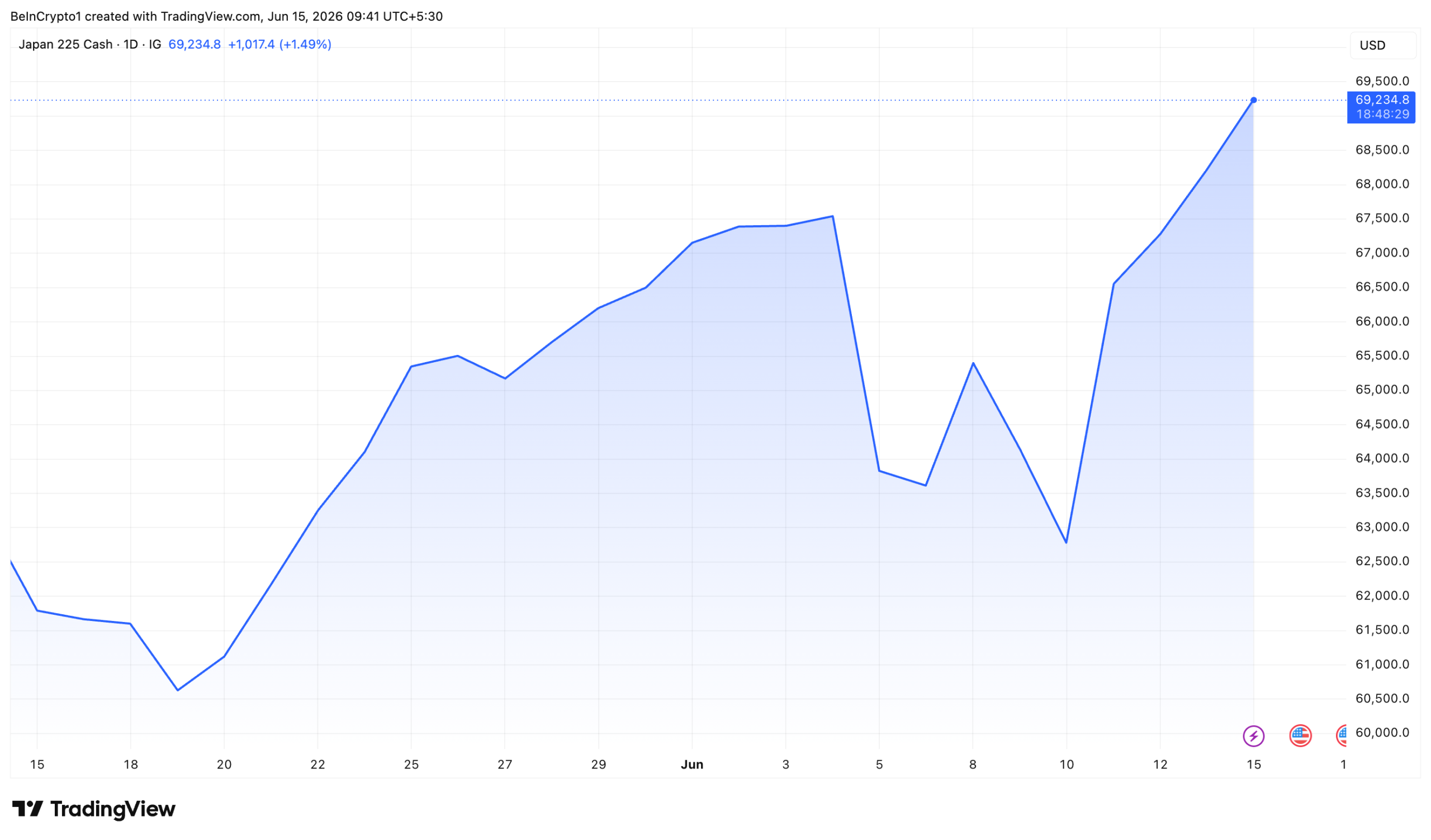
Japan’s Nikkei crossed 69,700 for the first time. It hit an intraday high of 69,705 on Monday, climbing over 5% as a US-Iran agreement to end their war ignited a broader stock market rally.
The benchmark added roughly $465 billion, or 77.22 trillion yen, in market value. At press time, Nikkei stood at 69,234.

Follow us on X to get the latest news as it happens
US-Iran Deal Triggers a Wider Stock Market Rally
President Donald Trump’s announcement of a deal to end the conflict lifted equities. The agreement halts the US naval blockade of Iran and reopens the Strait of Hormuz, a key oil route.
The agreement will be signed in Switzerland on Friday. Crude prices fell on the news, with West Texas Intermediate down about 4.6% and Brent Crude off roughly 5%.
Stocks and crypto moved in the opposite direction. US equity futures pointed sharply higher, with Dow Jones Industrial Average futures up 342 points, or 0.7%. Contracts tied to the S&P 500 gained 0.9%, and Nasdaq 100 futures led the way with a 1.4% rise.
Asian benchmarks posted the day’s biggest moves. South Korea’s KOSPI topped the region with a 5.46% surge. Japan’s Topix climbed 3.3%.
Digital assets also joined the advance. The total crypto market capitalization rose close to 2%, and Bitcoin (BTC) pushed toward 66,000.
The Rate Decision That Could Reverse The Rally
Nonetheless, sentiment could shift quickly. The Bank of Japan (BOJ) is widely expected to raise its policy rate to 1% from 0.75% on Tuesday.
Higher Japanese interest rates reduce the appeal of the yen-funded carry trade by increasing borrowing costs and narrowing the yield advantage available in overseas markets. In this strategy, investors borrow yen at low rates and invest the proceeds in higher-yielding assets abroad, including equities, bonds, and cryptocurrencies.
As carry trades become less profitable, investors may reduce leverage and repatriate capital to Japan, potentially weighing on global equity markets and other risk assets.
Because markets have largely priced in a rate increase, investors may focus more on the BOJ’s guidance than the hike itself. A Reuters poll showed that economists expect the BOJ to follow up with another hike to 1.25% in the fourth quarter.
Any signal that policymakers intend to tighten policy more aggressively than expected could pressure stocks, cryptocurrencies, and other risk-sensitive assets by accelerating the unwind of yen-funded positions.
Subscribe to our YouTube channel to watch leaders and journalists provide expert insights
The post Japan’s Nikkei Crosses 69,700, but Tomorrow Brings Rate Risk appeared first on BeInCrypto.


Premium leisure used to mean a velvet rope and a membership card; today it increasingly means a curated digital experience enjoyed from a favourite armchair, and online casinos sit right at the centre of that change.
Much like crypto exchanges and trading apps reshaped how Britons handle money, vetted comparison hubs for online casinos UK players now occupy the same mental space as boutique hotel reviews or watch buyers’ guides.
These resources rank licensed sites by welcome offers, wagering terms, withdrawal speed and accepted payment methods, including crypto, while explaining their testing process, player-protection checks and responsible-gaming tools alongside a clear affiliate disclosure.
For a reader who treats research as second nature, that kind of vetted, transparent overview is exactly the sort of starting point premium leisure now demands.
The Old High End: Gatekeepers and Glamour
 Rewind a couple of decades and the picture of upmarket entertainment looked almost cinematic. Think Monte Carlo, dinner jackets, and the hush of a room where everyone seemed to know the unwritten rules.
Access depended on location, connections and a healthy disregard for travel costs. The glamour was real, but so was the friction. You had to be in the right city, dressed the right way, at the right time.
That model fed a particular idea of luxury, scarcity equals status. The harder something was to reach, the more desirable it became.
Readers of UK business and lifestyle blogs will recognise the pattern from other corners of the high-end world, limited-run Patek Philippe watches, invitation-only property launches in Mayfair, or the early days of exclusive members’ clubs like Soho House before they expanded across the map.
The thrill came partly from the experience and partly from the sense of belonging to a small, lucky circle.
What Changed: Technology Flattened the Velvet Rope
Then the internet did to leisure what it had already done to trading, banking and shopping. The same forces that turned forex into something anyone could try from a phone or made buying fractions of Bitcoin as easy as topping up an Oyster card reshaped how people enjoy their downtime. Convenience became the new luxury.
This is the heart of the “then versus now” story. The status symbol is no longer simply getting through the door, it is curating an experience that fits seamlessly into a busy life.
Academic work on how affluent shoppers make choices points to exactly this evolution, high-end consumers increasingly value experience, personalisation and frictionless access over pure exclusivity. They want quality on their own terms, not a queue.
That mindset shows up everywhere an ebusinessblog reader looks. Premium streaming has replaced the cinema box. Peloton brought the boutique studio home. Revolut Metal and Amex Platinum turned concierge perks into app notifications.
Online leisure entertainment slotted neatly into the same trend, refined, on-demand and judged by the same exacting standards people apply to any other luxury purchase.
The Modern High End: Curated, Not Crowded
 Today’s version of premium leisure favours discernment rather than mere access. The person who once flew to a glamorous resort now spends ten minutes reading a thorough comparison before choosing where to spend an evening.
The instinct is identical to how a careful investor reads a fund factsheet before committing capital, or how a property buyer studies yield figures before viewing a flat.
What does that careful eye look for?
The same things that define quality anywhere:
- Transparency: Clear terms rather than buried small print.
- Speed and convenience: Getting money in and out without unnecessary delays.
- Choice of payment: From debit cards to e-wallets to crypto, mirroring how people already manage money elsewhere.
- Certified quality: Content from respected, independently tested studios rather than anonymous outfits.
In other words, the modern high-end consumer treats leisure the way they treat any other considered purchase, with a bit of homework and a strong preference for trusted, vetted sources.
How Leisure Time Itself Has Shifted?
There is a wider social backdrop to all this. National figures on how Britons spend their free hours show how much of modern downtime now happens at home and on screens.
The commute-free evening, the flexible working pattern, the blurring of work and rest, all of it nudges people towards entertainment that is immediate and adaptable.
For the entrepreneur juggling a side hustle, or the trader who keeps half an eye on the markets after dinner, time is the scarcest resource of all. Luxury, in that context, means experiences that respect your schedule.
A refined evening no longer requires a reservation made three weeks ahead, it can begin the moment the laptop closes.
Where This Leaves the Discerning Reader?
 The thread running through all of this is consistency of taste. Someone who appreciates a well-made espresso machine, a thoughtfully designed banking app and a properly researched investment tends to bring that same standard to their leisure. They are not chasing novelty for its own sake. They are looking for quality, clarity and control.
That is why vetted comparison resources matter so much in the current landscape. They do the heavy lifting, testing, ranking and explaining, so the reader can make a confident, informed choice and then simply enjoy it. It mirrors the way trusted review sites guide decisions on everything from business software to commercial mortgages.
The velvet rope has not vanished entirely, it has simply moved. Where it once kept people out, today’s version invites them in, provided they value transparency and do their research.
High-end leisure, in its modern form, favours the curious and the careful, the very qualities this audience already brings to money, property and everything in between.
Bitcoin rose to its highest level in nearly two weeks on Monday after the United States and Iran announced a peace deal expected to reopen the Strait of Hormuz and ease pressure from energy markets.
Summary
- Bitcoin recovered above $65,500 as the U.S.-Iran deal eased oil and inflation fears across markets.
- ETF outflows and Strategy’s small BTC sale still raise doubts about sustained institutional demand ahead.
- Technicals show weaker downside pressure, but BTC still needs volume above $68,000 to confirm recovery.
The move pushed bitcoin above $65,500, extending its rebound from last week’s drop below $60,000. According to crypto.news market data, BTC traded near $65,759, up about 2.2% over 24 hours, with its daily high near $65,893.
Meanwhile, the market reaction followed statements from U.S. President Donald Trump, Pakistani Prime Minister Shehbaz Sharif, and Iranian state media confirming that an agreement had been reached.
Trump wrote on Truth Social that “The Deal with the Islamic Republic of Iran is now complete,” and said he had authorized the reopening of the Strait of Hormuz and removal of the U.S. naval blockade. The full text has not been released, and reports said the formal signing is set for Friday.
Oil prices fell after the announcement. Brent crude dropped more than 4% toward $83 a barrel as traders removed part of the premium that had kept energy prices high since late February.
Lower oil prices can ease inflation pressure and reduce fears that central banks may keep rates higher for longer. Asian stocks rallied, Japan’s Nikkei 225 advanced toward a record close, and U.S. stock futures climbed as the dollar weakened.
Bitcoin rebound follows sharp selloff
Bitcoin had been under pressure before the deal. The asset fell below $60,000 last week, marking its weakest level since October 2024. That decline came as oil stayed elevated, inflation concerns rose, and traders pulled money from risk assets. The peace deal reversed part of that move, putting BTC about 9% above last week’s low.
Bitcoin is now testing the upper end of the $60,000 to $65,000 support area. The next key area sits near $68,000, where sellers may try to stop the recovery. The broader crypto market also gained. Ether rose to about $1,721, solana traded near $71, XRP moved close to $1.19, and Hyperliquid’s HYPE rose more than 7% to near $65.
CoinGlass data showed more than 102,000 traders liquidated over 24 hours, with total liquidations near $338.3 million. The largest single order was a $6.1 million BTCUSDT liquidation on Binance.
Bitcoin technical signals remain mixed
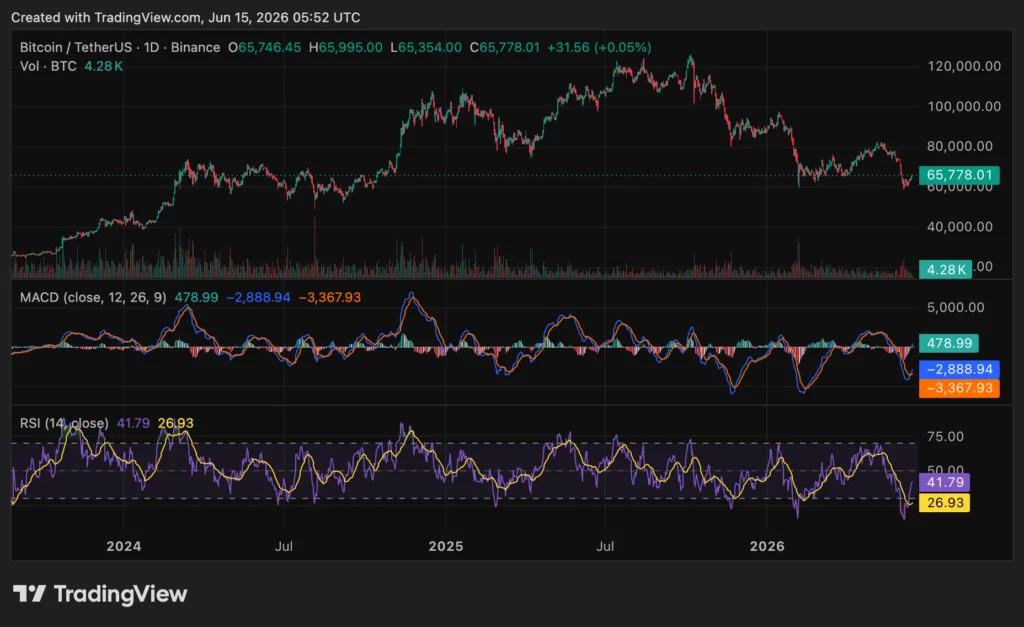
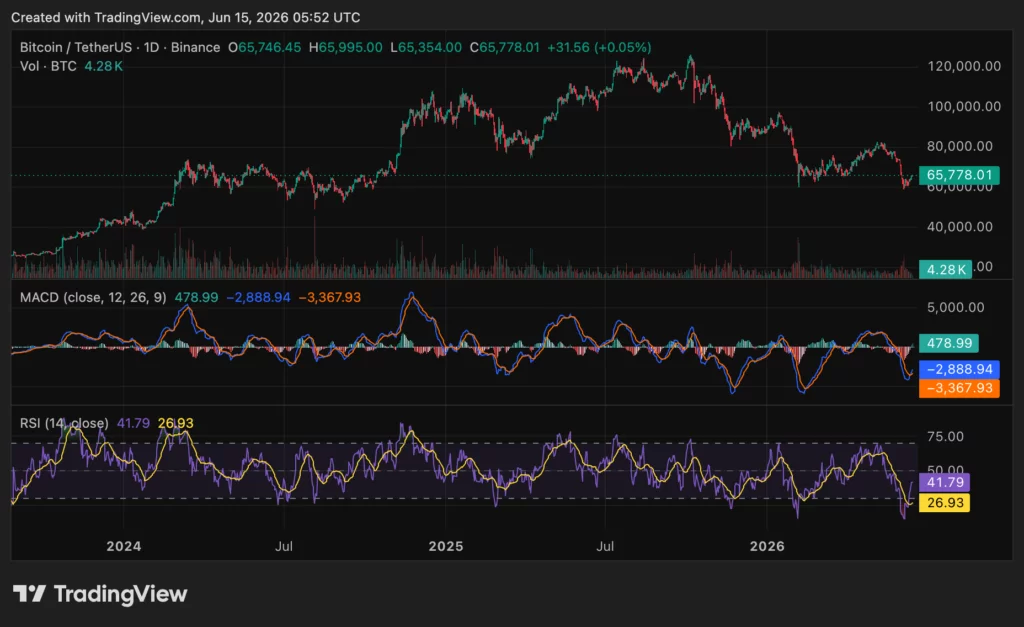
Bitcoin’s chart still shows a weak higher-timeframe setup. BTC has formed lower highs and lower lows since late 2025, and the recent bounce has not reclaimed the $80,000 resistance zone. That keeps sellers in control of the broader structure, even as the short-term move has improved.
The MACD line remains below the signal line, showing that bearish momentum has not fully faded. The histogram has turned slightly positive, but the move remains small.
The RSI stands near 41.8, below the neutral 50 level, while the RSI moving average near 26.9 points to recent oversold conditions. Volume has also declined compared with the larger rally and distribution phases seen in 2024 and 2025. A stronger move above $68,000 would need higher volume to confirm demand.
ETF flows and Strategy sale remain in focus
The peace deal removes one macro pressure point, but it does not answer every question facing bitcoin. Spot Bitcoin ETF outflows remain a concern after U.S.-listed products saw a long redemption streak between mid-May and early June. As previously reported by crypto.news, ETF withdrawals played a major role in the latest BTC pullback.
Strategy’s sale also changed market psychology. The company sold 32 BTC between May 26 and May 31 for about $2.5 million, with proceeds expected to help fund preferred stock distributions. Strategy later said the transaction was a process test, not a sign of cash stress.
In addition, crypto analyst Crypto Lens offered a more bearish view, saying BTC had rejected a long-term resistance area and could move toward $48,000 or $43,000 if the downtrend continues. That forecast remains one scenario, not a market consensus.
For now, bitcoin needs a clean move above $68,000 to extend the rebound. A failure to hold $60,000 to $65,000 would put last week’s low back in focus. Traders will also watch whether ETF flows improve with the risk-on mood or stay weak after the Iran relief trade fades.
Disclosure: This article does not represent investment advice. The content and materials featured on this page are for educational purposes only.
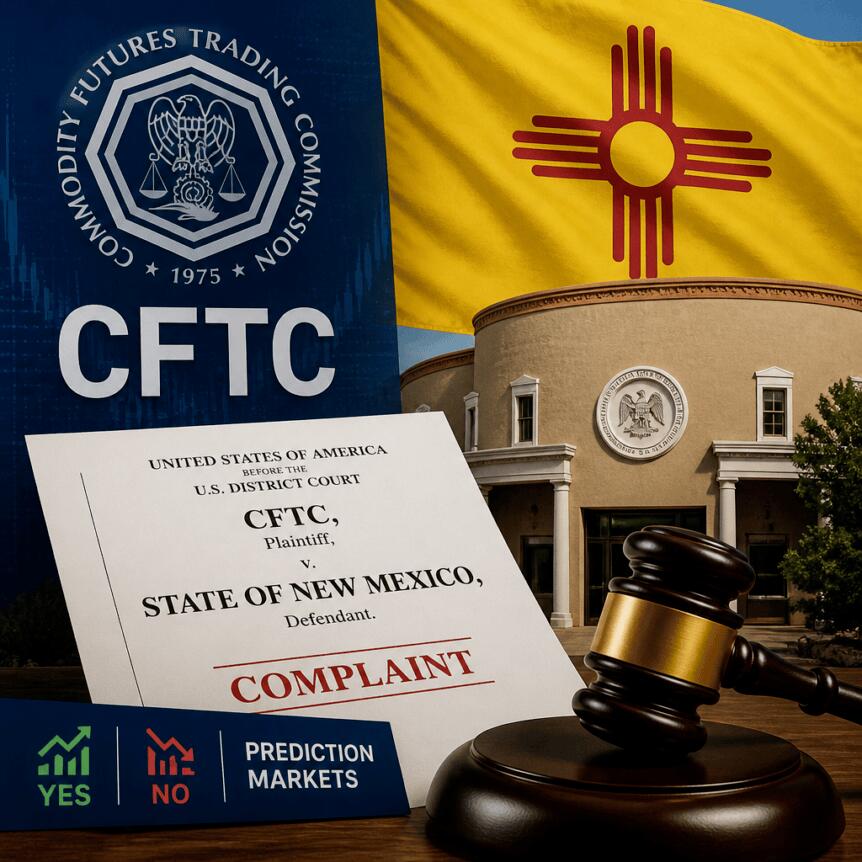
New Mexico has become the latest US state to clash with the Commodity Futures Trading Commission (CFTC) over the regulator’s authority to oversee prediction markets. The CFTC said it filed suit in federal court to stop New Mexico from applying state gaming laws to CFTC-registered contract markets, targeting Governor Michelle Lujan Grisham, state Attorney General Raúl Torrez, and members of the New Mexico Gaming Control Board.
The dispute began after New Mexico sued Kalshi on June 4, alleging the company offered sports betting to residents without the required license and that its sports event contracts operate like traditional sports wagers. The state also argued Kalshi permitted users aged 18 to 20—below New Mexico’s minimum gaming age of 21—to access the platform.
Key takeaways
- The CFTC is asking a federal court to block New Mexico from applying state gaming laws to CFTC-registered contract markets.
- New Mexico’s lawsuit claims Kalshi’s sports event contracts function like sports betting and argues licensing rules and age limits were not followed.
- The CFTC’s position is that event contracts qualify as “swaps” under federal commodities law and fall under the CFTC’s exclusive jurisdiction.
- Gary Gensler, in a separate amicus brief tied to Kalshi litigation, has argued that Congress never intended Dodd-Frank swap definitions to cover sports betting contracts.
CFTC steps in to preserve “exclusive jurisdiction”
In a statement released Friday, the CFTC said it sued New Mexico state officials “to block the state’s efforts to apply state gaming laws against CFTC-registered contract markets.” The regulator framed the case as an attempt by a state to interfere with a federal regulatory scheme established by Congress for commodity derivatives.
According to the CFTC’s lawsuit, event contracts should be treated as “swaps” under US commodities law, placing them within the CFTC’s “exclusive jurisdiction.” The regulator argues that because Kalshi is a Designated Contract Market (DCM), transactions on such platforms fall under federal oversight, not state gambling rules.
The CFTC asked the court to declare that New Mexico laws aimed at restricting transactions on CFTC-regulated DCMs are invalid, and it sought a permanent injunction preventing the state from taking enforcement action against prediction market platforms.
CFTC Chairman Mike Selig said the CFTC would continue to defend its role in overseeing commodity derivatives markets. In the regulator’s view, attempts by states to impose their own gaming frameworks on federally regulated venues undermine “black letter law” and decades of judicial precedent.
The CFTC’s complaint was filed in federal court. The CFTC described its filing in a press release, and court records list the case in a docket for “United States of America v. State of New Mexico.” The docket is available on CourtListener.
New Mexico’s original challenge to Kalshi
New Mexico’s action against Kalshi, filed June 4, argued that the company is effectively offering sports betting without a state license. The state’s complaint, as summarized by the New Mexico Department of Justice, asserts that Kalshi’s sports event contracts are not meaningfully different from traditional sports wagers in how they are used and understood by consumers.
New Mexico also emphasized age eligibility. The state alleged that Kalshi enabled individuals aged between 18 and 20 to participate on the platform, despite New Mexico’s minimum gaming age of 21.
These allegations reflect a broader theme in the emerging prediction market regulatory fights: states are not only questioning whether prediction market products are different from gambling, but also whether they comply with specific state licensing and consumer protection requirements.
A widening map of CFTC-vs-state lawsuits
New Mexico becomes the eighth state the CFTC has sued after state authorities moved against prediction market platforms. The CFTC’s legal actions include earlier cases involving Rhode Island, Wisconsin, Minnesota, New York, and Arizona, Connecticut, and Illinois—according to Cointelegraph’s earlier reporting on those disputes. Cointelegraph covered the Minnesota fight, and earlier reporting detailed New York’s challenge. A broader roundup of earlier state actions also included Arizona, Connecticut, and Illinois.
For investors and platform operators, the growing number of cases increases legal uncertainty around the rules prediction markets must follow across state lines. Even where platforms are registered and approved under federal frameworks, states may pursue enforcement routes through their own gaming laws. The CFTC’s repeated push is that federal jurisdiction should prevent that kind of patchwork regulation.
Gensler questions whether sports bets fit swap law
While the CFTC is arguing that event contracts fall squarely under the federal definition of swaps, former SEC and CFTC chair Gary Gensler has publicly disputed the premise in an amicus brief connected to Kalshi’s litigation with Ohio’s authorities.
In the amicus filing, submitted to the Sixth Circuit on Thursday, Gensler argued that the Dodd-Frank Act—passed after the 2008 financial crisis to establish rules for swaps—was not intended to reach sports betting contracts. He contended that Congress did not include sports betting agreements within the statutory definition of a swap and that sports event contracts do not align with the purpose and language of commodities swap rules, which he said are oriented toward hedging economic risk.
“Sports bets are very rarely, if ever, about hedging,” Gensler argued, according to his statements. The amicus brief is posted on CourtListener in the docket for Kalshi’s case.
Gensler also told CNBC on Thursday that the central question is whether Congress intended to remove state regulation from this category of contracts, suggesting the answer is “categorically ‘No.’”
For markets, this matters because federal outcomes in one case can influence how other states and courts interpret the same statutory framework. The dispute in New Mexico turns on similar legal mechanics—whether state gaming rules can be applied at all to products the CFTC considers federally regulated swaps.
What to watch next
As New Mexico’s federal fight with the CFTC plays out, the key uncertainty is how courts will reconcile state gambling enforcement with the CFTC’s claim of exclusive federal jurisdiction over DCM-cleared event contracts. The more states escalate their legal efforts, the more likely it becomes that appellate decisions addressing whether sports event contracts truly qualify as swaps will shape the regulatory map for prediction markets nationwide.
Aztec Connect, a deprecated decentralized finance platform, was drained of around $2.1 million in crypto on Sunday after an attacker exploited its verification function.
Aztec Labs posted to X on Sunday that it was “investigating a potential exploit affecting Aztec Connect,” adding that around $2.1 million was transferred from the platform’s smart contract, which did not affect users or assets on the current Aztec network.
The exploit is the latest in the $44 million worth of crypto that has been stolen so far this month from at least 12 other exploits, according to DeFiLlama.
A private key compromise on the Humanity Protocol has been the largest so far in June, with $30 million lost on June 8, followed by the Syscoin Bridge, which saw $8 million swiped in a fake proof exploit the previous day.
Crypto security firm BlockSec said that an attacker exploited a mismatch in how the platform verified transactions and settled them on Ethereum.
It said that verified transactions on Aztec Connect’s contract were “not effectively bound to the transaction set enforced by the ZK proof,” allowing its verification path and settlement logic on Ethereum “to interpret the transaction list differently.”
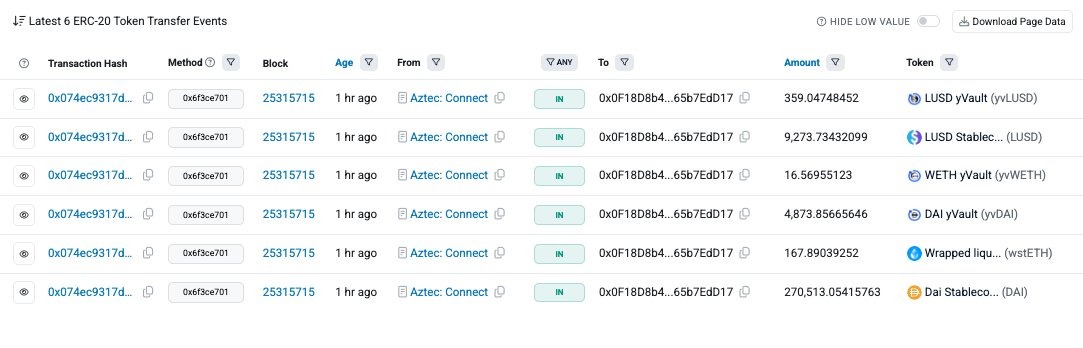
The attacker could then place transactions where the contract credited value without validating it on Ethereum, which created unbacked balances that could then be withdrawn. The attacker did this seven times across seven different assets.
The attacker made off with 909 Ether (ETH), 270,000 Dai (DAI), 167 of wrapped staked ETH and a handful of other cryptocurrencies.
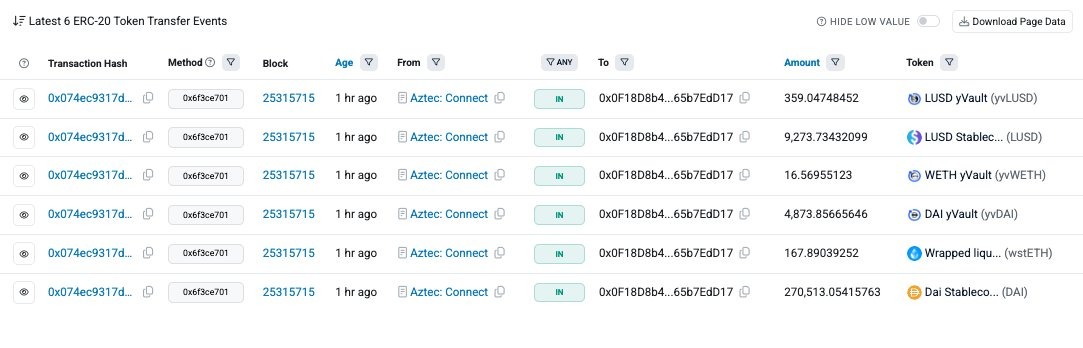
Some of the assets stolen in the exploit. Source: CertiK
Aztec Network is a privacy-focused layer-2 zero-knowledge (ZK) rollup on Ethereum. Aztec Connect was the previous version of the platform that launched in 2022 as a DeFi bridge.
Related: Crypto exploit losses in May fall 90% over month to $68M: CertiK
Aztec Connect was deprecated in March 2023, with deposits halted and the team shifting resources to the next-generation Aztec Network.
“Aztec Labs holds no admin keys or control over the system; it cannot be paused or upgraded by us,” the team said.
Crypto developer “Param” said Aztec Connect’s smart contracts became “fully immutable” and could no longer be upgraded or paused.
“The incident is another reminder that abandoned DeFi contracts can still become targets years later,” they said.
Magazine: OpenAI files for IPO, SEC scraps 611 rule and Hungary overhauls crypto: Hodlers Digest
New Mexico is the latest US state to be pulled into the Commodity Futures Trading Commission’s legal fight for its jurisdiction over prediction markets after the state sued Kalshi for allegedly offering illegal sports betting.
The CFTC said on Friday that it sued New Mexico Governor Michelle Lujan Grisham, state Attorney General Raúl Torrez, and members of the New Mexico Gaming Control Board in federal court “to block the state’s efforts to apply state gaming laws against CFTC-registered contract markets.”
New Mexico sued Kalshi on June 4, arguing the company is offering sports betting to residents without a license and that its sports event contracts function the same as traditional sports bets.
The state also claimed Kalshi allowed those aged between 18 and 20 to use the platform, below New Mexico’s minimum gaming age of 21.
New Mexico is the eighth state that the CFTC has sued after state authorities had taken enforcement action against prediction market platforms, with Rhode Island, Wisconsin, Minnesota, New York, Arizona, Connecticut and Illinois also facing lawsuits from the regulator.
In its complaint against New Mexico, the CFTC claimed that event contracts are “swaps” under federal commodities laws, and Kalshi is a Designated Contract Market (DCM) under the “exclusive jurisdiction” of the CFTC.
“New Mexico’s attempt to prevent a CFTC-regulated DCM from offering CFTC-approved financial products intrudes on the exclusive federal scheme Congress designed to oversee United States commodity derivatives markets,” the CFTC argued.
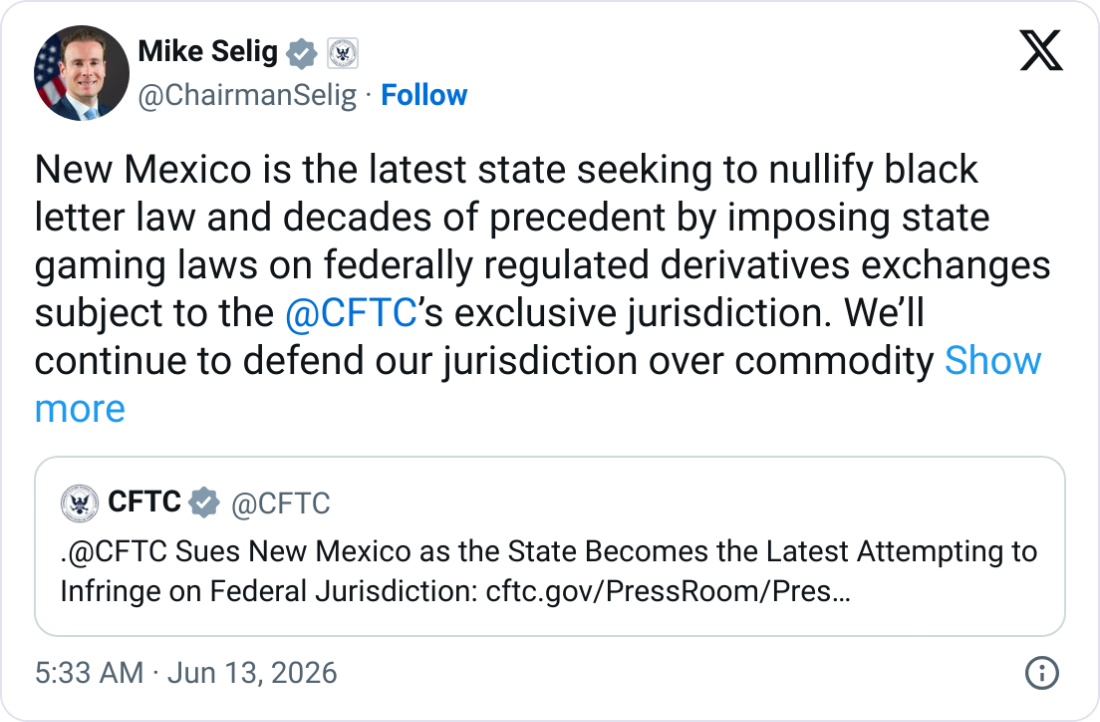
“New Mexico is the latest state seeking to nullify black letter law and decades of judicial precedent by imposing state gaming laws on federally regulated derivatives exchanges subject to the CFTC’s exclusive jurisdiction,” CFTC Chairman Mike Selig said in a statement.
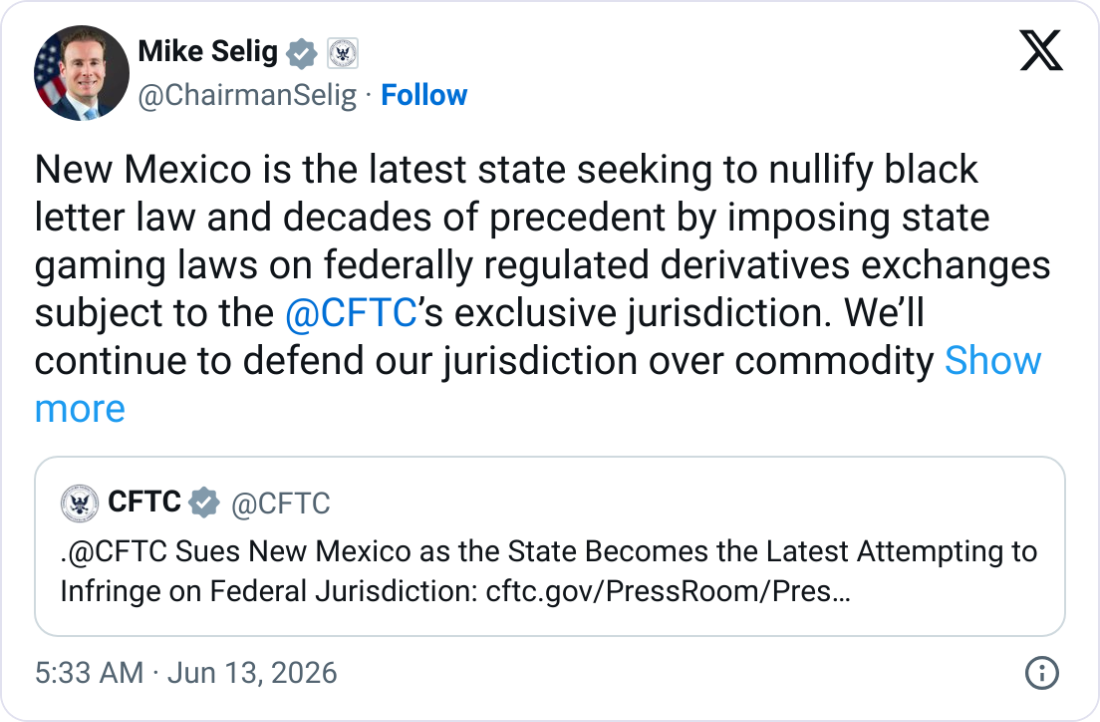
Source: Mike Selig
“The CFTC has the expertise and responsibility to protect its exclusive jurisdiction over commodity derivatives, and that’s exactly what we’ll continue to do,” he said.
The CFTC asked the court to rule that New Mexico state laws that would apply to transactions on CFTC-regulated DCMs are invalid and for a permanent injunction prohibiting the state from taking action against prediction market platforms.
Gary Gensler doubts CFTC claim over sports bets
Gary Gensler, a former chair of the Securities and Exchange Commission and the CFTC, also weighed in on the CFTC’s legal battle with the states, casting doubt on the federal regulator’s claim that it has authority over sports event contracts.
In an amicus brief filed to the Sixth Circuit on Thursday in Kalshi’s fight with Ohio’s authorities, Gensler argued that the Dodd-Frank Act, passed in 2010 in response to the 2008 financial crisis to regulate swaps, was not meant to encompass sports event contracts.
Related: CFTC proposes framework favoring sports event contracts over gambling
“Congress did not include sports betting contracts within the statutory Dodd-Frank definition of swap,” Gensler argued. He added that sports event contracts do not fit the purpose or language defining a swap under commodities laws, “which focus on hedging economic risk.”
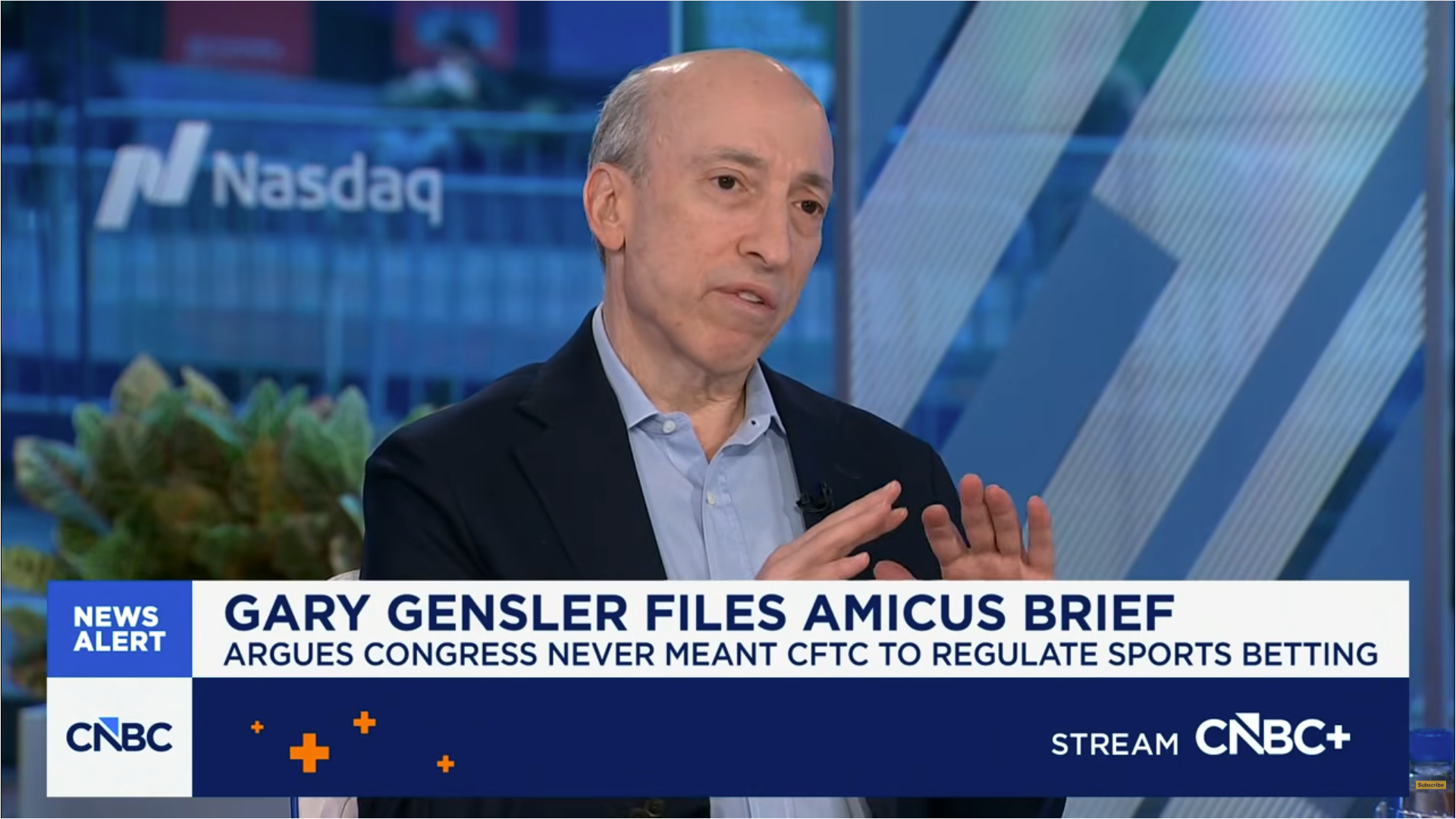
Gary Gensler appearing on CNBC to discuss his amicus brief. Source: YouTube
“Sports bets are very rarely, if ever, about hedging,” Gensler argued.
Gensler told CNBC on Thursday that the question “at the core of this issue is did Congress in 2010 say, ‘No, none of the states can regulate this’ — it’s going to this little small agency that I once was proud to run — and the answer is categorically ‘No.’”
Magazine: Should users be allowed to bet on war and death in prediction markets?

Bitcoin Nears $66K After Trump Announces Iran Peace Deal

Kim Kardashian, Chicago Celebrate Lewis Hamilton’s Victory

Iran War One Of Trump’s ‘Worst Foreign Policy Blunders’, Expert Says


-

 Crypto World4 days ago
Oppenheimer backs SpaceX as $70 billion retail frenzy builds
-

 Business16 hours ago
No Jackpot Winner as $257 Million Prize Rolls Over to $269 Million Monday Draw
-

 Crypto World4 days ago
Markets Rally as SpaceX IPO Looms Amid Iran Tensions and Inflation Surge
-

 Sports7 days ago
FIFA WC 2026 Group C: Morocco, Scotland challenge Brazil’s hunt for glory | FIFA World Cup 2022
-

 Fashion3 days ago
Weekend Open Thread: Tuckernuck – Corporette.com
-
 Crypto World7 days ago
Eli Lilly (LLY) Stock Surges 4% Following Breakthrough Sleep Apnea Trial Results
-
 Crypto World8 hours ago
Zimbabwe Requires Crypto Businesses to Register Annually Under New FIU Regulations
-

 Entertainment6 days ago
The Ryan Gosling True Crime Thriller On Netflix That Gets Even Stranger, Stream It Now
-
 Sports6 days ago
Bangladesh beat Australia after 20 years in ODIs, register only their second win over six-time world champions | Cricket News
-

 Tech2 days ago
NanoClaw integrates JFrog registries to secure AI agent downloads
-

 Tech3 days ago
This Week In Security: Microsoft On Microsoft, Register Your Domains, Linux On ARM, And FreeBSD Joins The File Cache Club
-

 Crypto World2 days ago
Bitget enters Argentina’s regulated crypto market through PSAV registration
-

 Politics4 days ago
Politics Home | Healey Resignation Is “Colossal Failure Of Government”, Says Former Labour Defence Secretary
-

 Tech5 days ago
‘This is Seattle’s position on AI’: City Council votes unanimously to pause big new data centers
-
 Tech4 days ago
Dutton Ranch star claims they ‘didn’t see any disruption’ on set following Chad Feehan’s exit from Yellowstone spinoff fueled by Taylor Sheridan clash rumors
-
 Entertainment4 days ago
Donnie Wahlberg & More Heat Up Las Vegas at Circa’s Barry’s Downtown Prime
-

 Sports4 days ago
First Time Since 1971: Australia Register Historic Low In ODI Cricket
-
 Tech4 days ago
Opendoor Ends India Operations, Fueling a Bigger Conversation About AI and Outsourcing
-

 NewsBeat3 days ago
El Nino has formed in the Pacific and could set records, forecasters say
-

 Tech7 days ago
Nvidia and Hyundai deepen their robotics push around Atlas
You must be logged in to post a comment Login