

Crypto World
Anthropic Races to Reverse Fable 5, Mythos 5 Export Controls



Anthropic has reportedly sent senior technical staff to Washington to meet White House officials and undo export controls that took its most powerful AI models, Fable 5 and Mythos 5, offline days after launch.
The trip comes amid a turbulent week that began with a Friday order barring foreign access to the models, forcing Anthropic to disable them for foreign nationals.
Follow us on X to get the latest news as it happens
Anthropic Races to Reverse Fable, Mythos Export Controls
The two sides have talked since Friday’s order. Anthropic technical staff have held virtual meetings with White House officials, a source close to the company told Axios.
The Wall Street Journal reported that Commerce Secretary Howard Lutnick and Cyber Director Sean Cairncross joined Saturday’s discussions. Anthropic co-founder and chief compute officer Tom Brown took part, alongside policy chief Sarah Heck.
Both parties want the models back online, though it is not clear yet what a fix would look like. Some officials view the pairing of Anthropic engineers with government security researchers as an early path toward compromise.
The standoff carries weight beyond AI policy. Anthropic has confidentially filed a confidential S-1 with the SEC, giving the company the flexibility to proceed with an IPO. A prolonged fight with Washington could shape how investors read that debut.
BeInCrypto has contacted the White House and Anthropic for comment.
Subscribe to our YouTube channel to watch leaders and journalists provide expert insights
The post Anthropic Races to Reverse Fable 5, Mythos 5 Export Controls appeared first on BeInCrypto.



Premium leisure used to mean a velvet rope and a membership card; today it increasingly means a curated digital experience enjoyed from a favourite armchair, and online casinos sit right at the centre of that change.
Much like crypto exchanges and trading apps reshaped how Britons handle money, vetted comparison hubs for online casinos UK players now occupy the same mental space as boutique hotel reviews or watch buyers’ guides.
These resources rank licensed sites by welcome offers, wagering terms, withdrawal speed and accepted payment methods, including crypto, while explaining their testing process, player-protection checks and responsible-gaming tools alongside a clear affiliate disclosure.
For a reader who treats research as second nature, that kind of vetted, transparent overview is exactly the sort of starting point premium leisure now demands.
The Old High End: Gatekeepers and Glamour
 Rewind a couple of decades and the picture of upmarket entertainment looked almost cinematic. Think Monte Carlo, dinner jackets, and the hush of a room where everyone seemed to know the unwritten rules.
Access depended on location, connections and a healthy disregard for travel costs. The glamour was real, but so was the friction. You had to be in the right city, dressed the right way, at the right time.
That model fed a particular idea of luxury, scarcity equals status. The harder something was to reach, the more desirable it became.
Readers of UK business and lifestyle blogs will recognise the pattern from other corners of the high-end world, limited-run Patek Philippe watches, invitation-only property launches in Mayfair, or the early days of exclusive members’ clubs like Soho House before they expanded across the map.
The thrill came partly from the experience and partly from the sense of belonging to a small, lucky circle.
What Changed: Technology Flattened the Velvet Rope
Then the internet did to leisure what it had already done to trading, banking and shopping. The same forces that turned forex into something anyone could try from a phone or made buying fractions of Bitcoin as easy as topping up an Oyster card reshaped how people enjoy their downtime. Convenience became the new luxury.
This is the heart of the “then versus now” story. The status symbol is no longer simply getting through the door, it is curating an experience that fits seamlessly into a busy life.
Academic work on how affluent shoppers make choices points to exactly this evolution, high-end consumers increasingly value experience, personalisation and frictionless access over pure exclusivity. They want quality on their own terms, not a queue.
That mindset shows up everywhere an ebusinessblog reader looks. Premium streaming has replaced the cinema box. Peloton brought the boutique studio home. Revolut Metal and Amex Platinum turned concierge perks into app notifications.
Online leisure entertainment slotted neatly into the same trend, refined, on-demand and judged by the same exacting standards people apply to any other luxury purchase.
The Modern High End: Curated, Not Crowded
 Today’s version of premium leisure favours discernment rather than mere access. The person who once flew to a glamorous resort now spends ten minutes reading a thorough comparison before choosing where to spend an evening.
The instinct is identical to how a careful investor reads a fund factsheet before committing capital, or how a property buyer studies yield figures before viewing a flat.
What does that careful eye look for?
The same things that define quality anywhere:
- Transparency: Clear terms rather than buried small print.
- Speed and convenience: Getting money in and out without unnecessary delays.
- Choice of payment: From debit cards to e-wallets to crypto, mirroring how people already manage money elsewhere.
- Certified quality: Content from respected, independently tested studios rather than anonymous outfits.
In other words, the modern high-end consumer treats leisure the way they treat any other considered purchase, with a bit of homework and a strong preference for trusted, vetted sources.
How Leisure Time Itself Has Shifted?
There is a wider social backdrop to all this. National figures on how Britons spend their free hours show how much of modern downtime now happens at home and on screens.
The commute-free evening, the flexible working pattern, the blurring of work and rest, all of it nudges people towards entertainment that is immediate and adaptable.
For the entrepreneur juggling a side hustle, or the trader who keeps half an eye on the markets after dinner, time is the scarcest resource of all. Luxury, in that context, means experiences that respect your schedule.
A refined evening no longer requires a reservation made three weeks ahead, it can begin the moment the laptop closes.
Where This Leaves the Discerning Reader?
 The thread running through all of this is consistency of taste. Someone who appreciates a well-made espresso machine, a thoughtfully designed banking app and a properly researched investment tends to bring that same standard to their leisure. They are not chasing novelty for its own sake. They are looking for quality, clarity and control.
That is why vetted comparison resources matter so much in the current landscape. They do the heavy lifting, testing, ranking and explaining, so the reader can make a confident, informed choice and then simply enjoy it. It mirrors the way trusted review sites guide decisions on everything from business software to commercial mortgages.
The velvet rope has not vanished entirely, it has simply moved. Where it once kept people out, today’s version invites them in, provided they value transparency and do their research.
High-end leisure, in its modern form, favours the curious and the careful, the very qualities this audience already brings to money, property and everything in between.
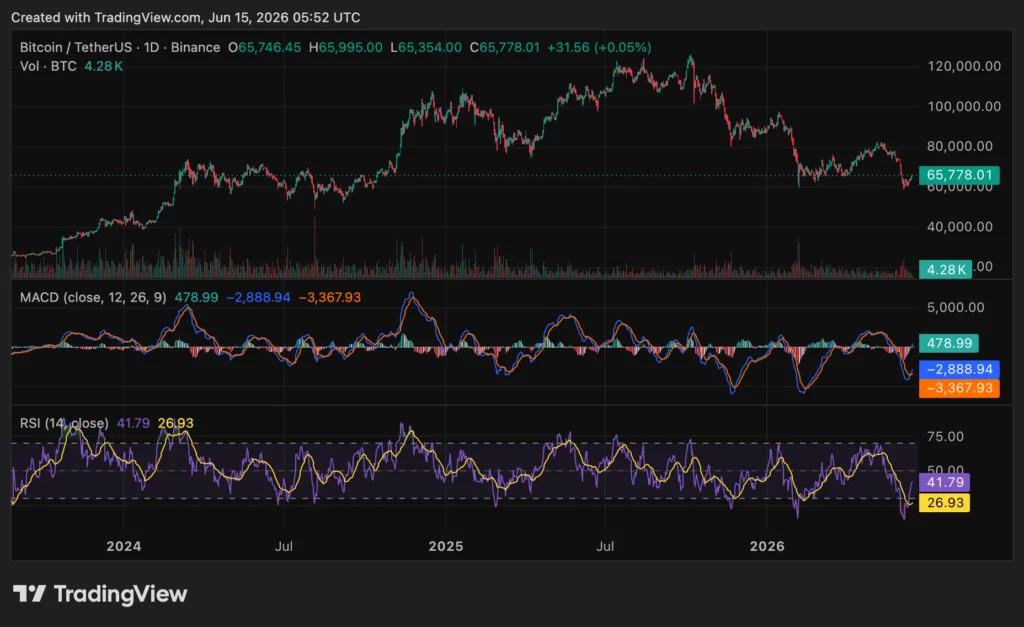
Bitcoin rose to its highest level in nearly two weeks on Monday after the United States and Iran announced a peace deal expected to reopen the Strait of Hormuz and ease pressure from energy markets.
Summary
- Bitcoin recovered above $65,500 as the U.S.-Iran deal eased oil and inflation fears across markets.
- ETF outflows and Strategy’s small BTC sale still raise doubts about sustained institutional demand ahead.
- Technicals show weaker downside pressure, but BTC still needs volume above $68,000 to confirm recovery.
The move pushed bitcoin above $65,500, extending its rebound from last week’s drop below $60,000. According to crypto.news market data, BTC traded near $65,759, up about 2.2% over 24 hours, with its daily high near $65,893.
Meanwhile, the market reaction followed statements from U.S. President Donald Trump, Pakistani Prime Minister Shehbaz Sharif, and Iranian state media confirming that an agreement had been reached.
Trump wrote on Truth Social that “The Deal with the Islamic Republic of Iran is now complete,” and said he had authorized the reopening of the Strait of Hormuz and removal of the U.S. naval blockade. The full text has not been released, and reports said the formal signing is set for Friday.
Oil prices fell after the announcement. Brent crude dropped more than 4% toward $83 a barrel as traders removed part of the premium that had kept energy prices high since late February.
Lower oil prices can ease inflation pressure and reduce fears that central banks may keep rates higher for longer. Asian stocks rallied, Japan’s Nikkei 225 advanced toward a record close, and U.S. stock futures climbed as the dollar weakened.
Bitcoin rebound follows sharp selloff
Bitcoin had been under pressure before the deal. The asset fell below $60,000 last week, marking its weakest level since October 2024. That decline came as oil stayed elevated, inflation concerns rose, and traders pulled money from risk assets. The peace deal reversed part of that move, putting BTC about 9% above last week’s low.
Bitcoin is now testing the upper end of the $60,000 to $65,000 support area. The next key area sits near $68,000, where sellers may try to stop the recovery. The broader crypto market also gained. Ether rose to about $1,721, solana traded near $71, XRP moved close to $1.19, and Hyperliquid’s HYPE rose more than 7% to near $65.
CoinGlass data showed more than 102,000 traders liquidated over 24 hours, with total liquidations near $338.3 million. The largest single order was a $6.1 million BTCUSDT liquidation on Binance.
Bitcoin technical signals remain mixed
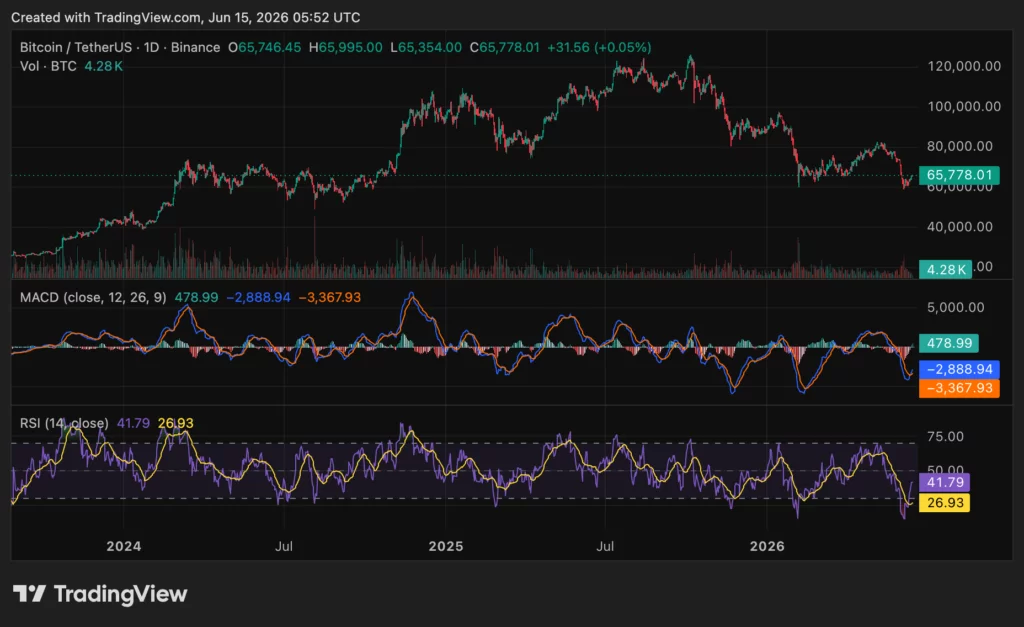
Bitcoin’s chart still shows a weak higher-timeframe setup. BTC has formed lower highs and lower lows since late 2025, and the recent bounce has not reclaimed the $80,000 resistance zone. That keeps sellers in control of the broader structure, even as the short-term move has improved.
The MACD line remains below the signal line, showing that bearish momentum has not fully faded. The histogram has turned slightly positive, but the move remains small.
The RSI stands near 41.8, below the neutral 50 level, while the RSI moving average near 26.9 points to recent oversold conditions. Volume has also declined compared with the larger rally and distribution phases seen in 2024 and 2025. A stronger move above $68,000 would need higher volume to confirm demand.
ETF flows and Strategy sale remain in focus
The peace deal removes one macro pressure point, but it does not answer every question facing bitcoin. Spot Bitcoin ETF outflows remain a concern after U.S.-listed products saw a long redemption streak between mid-May and early June. As previously reported by crypto.news, ETF withdrawals played a major role in the latest BTC pullback.
Strategy’s sale also changed market psychology. The company sold 32 BTC between May 26 and May 31 for about $2.5 million, with proceeds expected to help fund preferred stock distributions. Strategy later said the transaction was a process test, not a sign of cash stress.
In addition, crypto analyst Crypto Lens offered a more bearish view, saying BTC had rejected a long-term resistance area and could move toward $48,000 or $43,000 if the downtrend continues. That forecast remains one scenario, not a market consensus.
For now, bitcoin needs a clean move above $68,000 to extend the rebound. A failure to hold $60,000 to $65,000 would put last week’s low back in focus. Traders will also watch whether ETF flows improve with the risk-on mood or stay weak after the Iran relief trade fades.
Disclosure: This article does not represent investment advice. The content and materials featured on this page are for educational purposes only.

New Mexico has become the latest US state to clash with the Commodity Futures Trading Commission (CFTC) over the regulator’s authority to oversee prediction markets. The CFTC said it filed suit in federal court to stop New Mexico from applying state gaming laws to CFTC-registered contract markets, targeting Governor Michelle Lujan Grisham, state Attorney General Raúl Torrez, and members of the New Mexico Gaming Control Board.
The dispute began after New Mexico sued Kalshi on June 4, alleging the company offered sports betting to residents without the required license and that its sports event contracts operate like traditional sports wagers. The state also argued Kalshi permitted users aged 18 to 20—below New Mexico’s minimum gaming age of 21—to access the platform.
Key takeaways
- The CFTC is asking a federal court to block New Mexico from applying state gaming laws to CFTC-registered contract markets.
- New Mexico’s lawsuit claims Kalshi’s sports event contracts function like sports betting and argues licensing rules and age limits were not followed.
- The CFTC’s position is that event contracts qualify as “swaps” under federal commodities law and fall under the CFTC’s exclusive jurisdiction.
- Gary Gensler, in a separate amicus brief tied to Kalshi litigation, has argued that Congress never intended Dodd-Frank swap definitions to cover sports betting contracts.
CFTC steps in to preserve “exclusive jurisdiction”
In a statement released Friday, the CFTC said it sued New Mexico state officials “to block the state’s efforts to apply state gaming laws against CFTC-registered contract markets.” The regulator framed the case as an attempt by a state to interfere with a federal regulatory scheme established by Congress for commodity derivatives.
According to the CFTC’s lawsuit, event contracts should be treated as “swaps” under US commodities law, placing them within the CFTC’s “exclusive jurisdiction.” The regulator argues that because Kalshi is a Designated Contract Market (DCM), transactions on such platforms fall under federal oversight, not state gambling rules.
The CFTC asked the court to declare that New Mexico laws aimed at restricting transactions on CFTC-regulated DCMs are invalid, and it sought a permanent injunction preventing the state from taking enforcement action against prediction market platforms.
CFTC Chairman Mike Selig said the CFTC would continue to defend its role in overseeing commodity derivatives markets. In the regulator’s view, attempts by states to impose their own gaming frameworks on federally regulated venues undermine “black letter law” and decades of judicial precedent.
The CFTC’s complaint was filed in federal court. The CFTC described its filing in a press release, and court records list the case in a docket for “United States of America v. State of New Mexico.” The docket is available on CourtListener.
New Mexico’s original challenge to Kalshi
New Mexico’s action against Kalshi, filed June 4, argued that the company is effectively offering sports betting without a state license. The state’s complaint, as summarized by the New Mexico Department of Justice, asserts that Kalshi’s sports event contracts are not meaningfully different from traditional sports wagers in how they are used and understood by consumers.
New Mexico also emphasized age eligibility. The state alleged that Kalshi enabled individuals aged between 18 and 20 to participate on the platform, despite New Mexico’s minimum gaming age of 21.
These allegations reflect a broader theme in the emerging prediction market regulatory fights: states are not only questioning whether prediction market products are different from gambling, but also whether they comply with specific state licensing and consumer protection requirements.
A widening map of CFTC-vs-state lawsuits
New Mexico becomes the eighth state the CFTC has sued after state authorities moved against prediction market platforms. The CFTC’s legal actions include earlier cases involving Rhode Island, Wisconsin, Minnesota, New York, and Arizona, Connecticut, and Illinois—according to Cointelegraph’s earlier reporting on those disputes. Cointelegraph covered the Minnesota fight, and earlier reporting detailed New York’s challenge. A broader roundup of earlier state actions also included Arizona, Connecticut, and Illinois.
For investors and platform operators, the growing number of cases increases legal uncertainty around the rules prediction markets must follow across state lines. Even where platforms are registered and approved under federal frameworks, states may pursue enforcement routes through their own gaming laws. The CFTC’s repeated push is that federal jurisdiction should prevent that kind of patchwork regulation.
Gensler questions whether sports bets fit swap law
While the CFTC is arguing that event contracts fall squarely under the federal definition of swaps, former SEC and CFTC chair Gary Gensler has publicly disputed the premise in an amicus brief connected to Kalshi’s litigation with Ohio’s authorities.
In the amicus filing, submitted to the Sixth Circuit on Thursday, Gensler argued that the Dodd-Frank Act—passed after the 2008 financial crisis to establish rules for swaps—was not intended to reach sports betting contracts. He contended that Congress did not include sports betting agreements within the statutory definition of a swap and that sports event contracts do not align with the purpose and language of commodities swap rules, which he said are oriented toward hedging economic risk.
“Sports bets are very rarely, if ever, about hedging,” Gensler argued, according to his statements. The amicus brief is posted on CourtListener in the docket for Kalshi’s case.
Gensler also told CNBC on Thursday that the central question is whether Congress intended to remove state regulation from this category of contracts, suggesting the answer is “categorically ‘No.’”
For markets, this matters because federal outcomes in one case can influence how other states and courts interpret the same statutory framework. The dispute in New Mexico turns on similar legal mechanics—whether state gaming rules can be applied at all to products the CFTC considers federally regulated swaps.
What to watch next
As New Mexico’s federal fight with the CFTC plays out, the key uncertainty is how courts will reconcile state gambling enforcement with the CFTC’s claim of exclusive federal jurisdiction over DCM-cleared event contracts. The more states escalate their legal efforts, the more likely it becomes that appellate decisions addressing whether sports event contracts truly qualify as swaps will shape the regulatory map for prediction markets nationwide.
Aztec Connect, a deprecated decentralized finance platform, was drained of around $2.1 million in crypto on Sunday after an attacker exploited its verification function.
Aztec Labs posted to X on Sunday that it was “investigating a potential exploit affecting Aztec Connect,” adding that around $2.1 million was transferred from the platform’s smart contract, which did not affect users or assets on the current Aztec network.
The exploit is the latest in the $44 million worth of crypto that has been stolen so far this month from at least 12 other exploits, according to DeFiLlama.
A private key compromise on the Humanity Protocol has been the largest so far in June, with $30 million lost on June 8, followed by the Syscoin Bridge, which saw $8 million swiped in a fake proof exploit the previous day.
Crypto security firm BlockSec said that an attacker exploited a mismatch in how the platform verified transactions and settled them on Ethereum.
It said that verified transactions on Aztec Connect’s contract were “not effectively bound to the transaction set enforced by the ZK proof,” allowing its verification path and settlement logic on Ethereum “to interpret the transaction list differently.”
The attacker could then place transactions where the contract credited value without validating it on Ethereum, which created unbacked balances that could then be withdrawn. The attacker did this seven times across seven different assets.
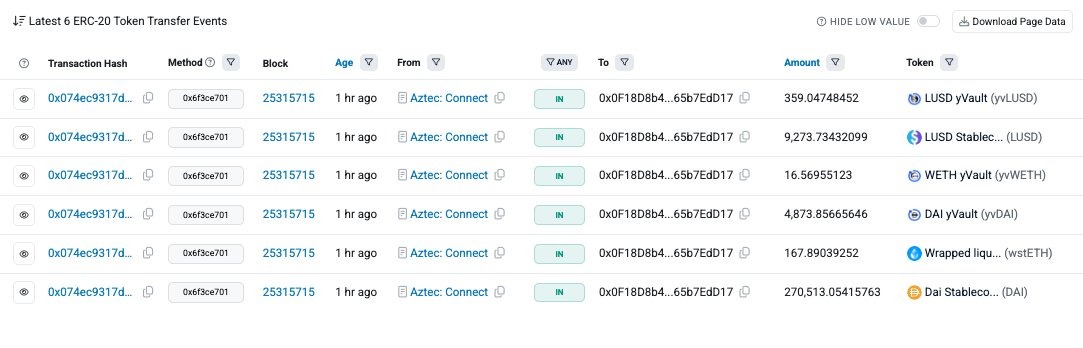
The attacker made off with 909 Ether (ETH), 270,000 Dai (DAI), 167 of wrapped staked ETH and a handful of other cryptocurrencies.
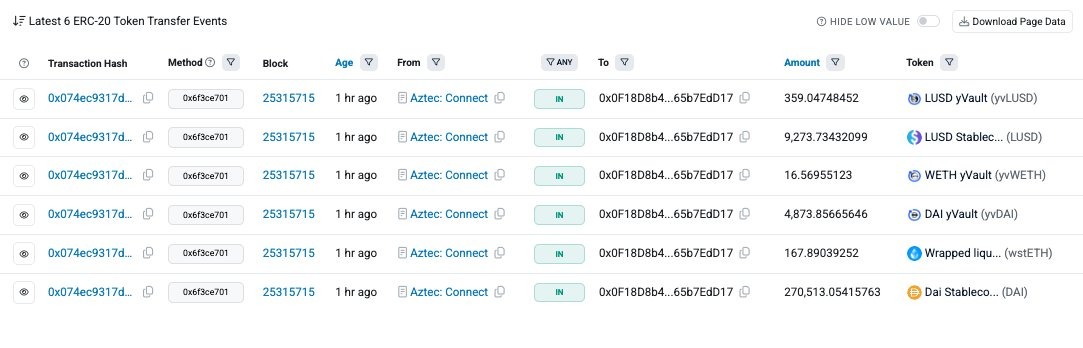
Some of the assets stolen in the exploit. Source: CertiK
Aztec Network is a privacy-focused layer-2 zero-knowledge (ZK) rollup on Ethereum. Aztec Connect was the previous version of the platform that launched in 2022 as a DeFi bridge.
Related: Crypto exploit losses in May fall 90% over month to $68M: CertiK
Aztec Connect was deprecated in March 2023, with deposits halted and the team shifting resources to the next-generation Aztec Network.
“Aztec Labs holds no admin keys or control over the system; it cannot be paused or upgraded by us,” the team said.
Crypto developer “Param” said Aztec Connect’s smart contracts became “fully immutable” and could no longer be upgraded or paused.
“The incident is another reminder that abandoned DeFi contracts can still become targets years later,” they said.
Magazine: OpenAI files for IPO, SEC scraps 611 rule and Hungary overhauls crypto: Hodlers Digest

New Mexico is the latest US state to be pulled into the Commodity Futures Trading Commission’s legal fight for its jurisdiction over prediction markets after the state sued Kalshi for allegedly offering illegal sports betting.
The CFTC said on Friday that it sued New Mexico Governor Michelle Lujan Grisham, state Attorney General Raúl Torrez, and members of the New Mexico Gaming Control Board in federal court “to block the state’s efforts to apply state gaming laws against CFTC-registered contract markets.”
New Mexico sued Kalshi on June 4, arguing the company is offering sports betting to residents without a license and that its sports event contracts function the same as traditional sports bets.
The state also claimed Kalshi allowed those aged between 18 and 20 to use the platform, below New Mexico’s minimum gaming age of 21.
New Mexico is the eighth state that the CFTC has sued after state authorities had taken enforcement action against prediction market platforms, with Rhode Island, Wisconsin, Minnesota, New York, Arizona, Connecticut and Illinois also facing lawsuits from the regulator.
In its complaint against New Mexico, the CFTC claimed that event contracts are “swaps” under federal commodities laws, and Kalshi is a Designated Contract Market (DCM) under the “exclusive jurisdiction” of the CFTC.
“New Mexico’s attempt to prevent a CFTC-regulated DCM from offering CFTC-approved financial products intrudes on the exclusive federal scheme Congress designed to oversee United States commodity derivatives markets,” the CFTC argued.
“New Mexico is the latest state seeking to nullify black letter law and decades of judicial precedent by imposing state gaming laws on federally regulated derivatives exchanges subject to the CFTC’s exclusive jurisdiction,” CFTC Chairman Mike Selig said in a statement.

Source: Mike Selig
“The CFTC has the expertise and responsibility to protect its exclusive jurisdiction over commodity derivatives, and that’s exactly what we’ll continue to do,” he said.
The CFTC asked the court to rule that New Mexico state laws that would apply to transactions on CFTC-regulated DCMs are invalid and for a permanent injunction prohibiting the state from taking action against prediction market platforms.
Gary Gensler doubts CFTC claim over sports bets
Gary Gensler, a former chair of the Securities and Exchange Commission and the CFTC, also weighed in on the CFTC’s legal battle with the states, casting doubt on the federal regulator’s claim that it has authority over sports event contracts.
In an amicus brief filed to the Sixth Circuit on Thursday in Kalshi’s fight with Ohio’s authorities, Gensler argued that the Dodd-Frank Act, passed in 2010 in response to the 2008 financial crisis to regulate swaps, was not meant to encompass sports event contracts.
Related: CFTC proposes framework favoring sports event contracts over gambling
“Congress did not include sports betting contracts within the statutory Dodd-Frank definition of swap,” Gensler argued. He added that sports event contracts do not fit the purpose or language defining a swap under commodities laws, “which focus on hedging economic risk.”
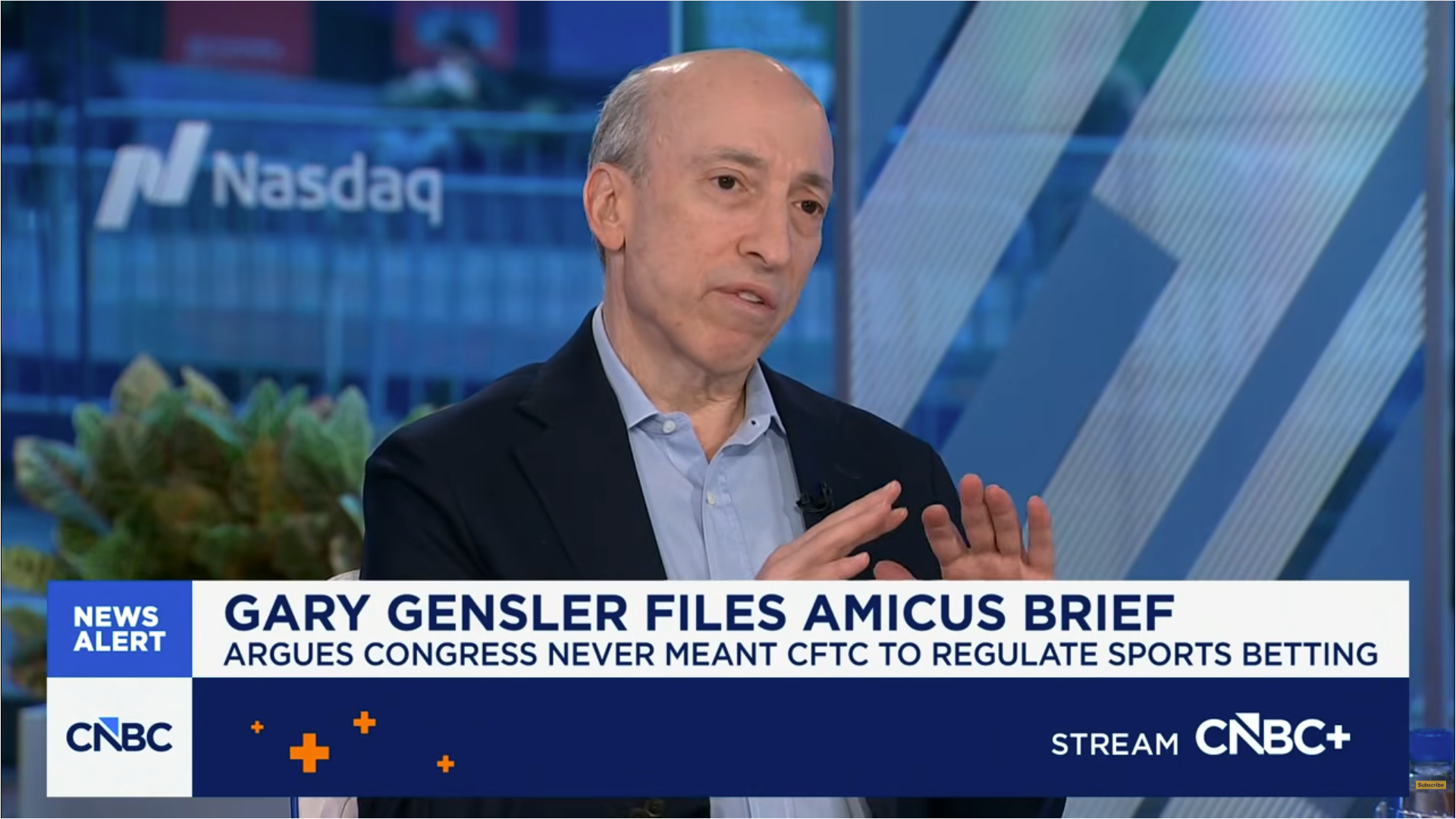
Gary Gensler appearing on CNBC to discuss his amicus brief. Source: YouTube
“Sports bets are very rarely, if ever, about hedging,” Gensler argued.
Gensler told CNBC on Thursday that the question “at the core of this issue is did Congress in 2010 say, ‘No, none of the states can regulate this’ — it’s going to this little small agency that I once was proud to run — and the answer is categorically ‘No.’”
Magazine: Should users be allowed to bet on war and death in prediction markets?


A familiar pattern shows up whenever someone gets serious about crypto: they start on one big, all-in-one trading service, then slowly drift towards more flexible, self-custodied tools. That same shift is now mirrored in how UK players approach digital entertainment funded by digital assets, which is why curiosity about offshore options has grown.
Many readers comparing these spaces eventually land on an explainer covering the best non-GamStop casino sites, venues licensed overseas that operate outside domestic rules, accept crypto and card payments, run their own bonus structures, and pair all of it with clear responsible play warnings.
For anyone already comfortable holding Bitcoin or stablecoins, understanding how these offshore-licensed venues actually work matters, because the payment logic feels almost identical to what they already do on an exchange.
Why Are Choice and Self-Custody Driving the Next Phase of Crypto Adoption?
The Centralised Starting Point Everyone Knows
 Most people’s crypto journey begins in the same place. They open an account on a large centralised exchange, think the household names that dominate app store charts, because it is the path of least resistance. One login, a verified identity, a balance that sits neatly in a dashboard. It feels like online banking with a slightly more exciting paint job.
Centralised exchanges took off for a reason. They handle the awkward bits: converting pounds to tokens, storing private keys, smoothing out the technical friction that scares newcomers away. For a UK entrepreneur dabbling in a side hustle, or an investor parking a small slice of a portfolio in Ethereum, that convenience is the whole appeal.
The trade-off, of course, is control. The user trusts a single company to hold the funds, set the rules, and stay solvent, a dynamic explored in depth by a systematic literature review comparing centralised and decentralised market structures.
Why the Pendulum Swings Towards Hybrid?
After a while, habits change. The headlines about exchange collapses, frozen withdrawals, and sudden account limits do their quiet work on the collective mood. Crypto holders start spreading assets across several services. They move funds into personal wallets. They experiment with decentralised swaps where no middleman ever touches the coins.
This is the hybrid stage, and it is where most of the UK crypto crowd now sits. People rarely abandon the big exchanges entirely, they are simply too handy for buying and cashing out. Instead, they blend them with self-custody and on-chain tools, picking whichever option suits the task.
Researchers at the Bank for International Settlements have examined how decentralised finance functions and what its growth means for broader financial stability, and the through-line is consistent: users increasingly want choice rather than a single gatekeeper deciding everything for them.
That mindset bleeds into every corner of digital life. Once a person grows used to moving value freely, instantly, and across borders, they start expecting the same flexibility everywhere else they spend online.
The Same Logic, Applied to Entertainment
 Here is where the parallel becomes striking. The journey from “one trusted hub” to “a flexible mix of options” maps almost perfectly onto how digital entertainment funded by crypto has evolved.
A decade ago, anyone wanting to spend online used a tightly controlled, domestically governed service, the equivalent of that first big exchange. Everything sat under one roof, neatly contained.
But as crypto holders grew accustomed to choice, many began looking outward at venues licensed in other jurisdictions, much as they began using exchanges based in Malta, Singapore, or the Cayman Islands.
These offshore-licensed iGaming venues accept Bitcoin, stablecoins, and sometimes a long list of altcoins, alongside cards and e-wallets. To a crypto-native user, sending tokens to one of these venues feels no different from funding a trading account.
The wallet works the same way. The blockchain confirmation looks the same. The psychological leap is tiny, which explains why the two trends have risen in lockstep.
What the Centralisation Debate Reveals?
The crypto world loves to talk about decentralisation, yet the reality is messier. Even “decentralised” tools often rely on a handful of dominant entities, a tension unpacked by analysis of the centralisation paradox in crypto markets.
True independence is rare; what most people actually achieve is a hybrid, partly self-directed, partly reliant on big intermediaries.
The same nuance applies to offshore entertainment venues. They market themselves as freer and more flexible than domestic alternatives, and in payment terms they often are. But “outside domestic rules” cuts both ways.
Less oversight can mean lighter consumer protection, slower dispute resolution, or bonus terms that look generous on the surface and tighten in the small print.
The reputable offshore venues publish responsible play guidance and deposit-control tools precisely because they know discerning users now expect it.
For a finance-minded reader, the lesson is the one they already apply to crypto itself: flexibility and risk travel together. Spreading money across several venues reduces single-point failure, but it also multiplies the number of operators a person has to vet.
Reading the Trend Without Getting Swept Up
 None of this is about cheerleading for any particular approach. It is about recognising a behavioural arc that repeats across the whole digital-asset economy.
People start centralised because it is easy. They move towards hybrid because they want control and choice. And they carry that expectation into adjacent corners of online life, from trading to spending to leisure.
For UK readers tracking crypto, the practical takeaway is to apply the same diligence everywhere. Check who actually holds the funds. Read the terms before the bonus tempts you. Treat any venue operating outside familiar rules with the same caution you would give an unproven exchange.
The tools that make digital money so liberating are the same ones that demand a clear head. Understanding why these trends mirror each other is the first step to navigating both wisely.


Meta has completed an operational separation from Manus, cutting the agentic AI startup off from its systems and halting all data sharing as both companies work to unwind a $2 billion deal Beijing ordered reversed. The move ends a strategy Chinese AI founders had quietly relied on: relocate to Singapore, raise Western capital, and call it a clean break.
Last week, Meta barred Manus staff from accessing its internal data systems and told its own employees to stop using Manus tools for internal projects. The separation follows Beijing’s April order to reverse the acquisition, which law firm Zhonglun described as unprecedented under China’s foreign investment security review mechanism.
“Singapore Washing” Has a Shelf Life
The startup, built by parent company Butterfly Effect, moved its headquarters and core teams to Singapore in mid-2025. Meta then announced its $2 billion acquisition in December. The logic was to put distance between the company and China, and Beijing’s arm would stop at the border.
“Beijing has sent a message to its tech sector that ‘Singapore washing’ has limits,” said Han Shen Lin, China managing director at The Asia Group.
Washington received a lesson, too, he added, shining a light on ownership structures can be as effective as any prohibition.
The problem for Manus runs deeper than any restructuring can fix. “Once another company’s engineers have been inside your stack, you can delete the repository, but you can’t make them unsee what they’ve seen,” said Matthias Hendrichs, a Singapore-based advisor to global AI firms.
Beijing’s July 1 Rules Close the Door
Beijing issued new outbound investment rules earlier this month that take effect July 1. The framework extends Beijing’s reach to markets, including Taiwan, and gives it the power to punish foreign firms from countries that restrict Chinese investment.
“If Chinese money touched a deal, Beijing can now assert jurisdiction over the exit, the restructuring, or the reinvestment,” Han said. He called it “a retroactive and forward-looking chokehold” on outbound capital.
The new directives specifically targeted deals like Manus, “a high-profile move that suggested a leading Chinese AI firm was turning away from the domestic market, an example Beijing didn’t want others to follow,” said Tilly Zhang, an industrial policy analyst at Gavekal Dragonomics.
What Comes Next for Manus
Manus co-founders are in early discussions to raise roughly $1 billion from outside investors to buy the company back from Meta, according to May reports, a path that could lead to a Chinese joint venture structure and a Hong Kong listing. Chinese AI firms, including MiniMax and Zhipu, have already listed in Hong Kong this year as the city sees a surge in AI debuts.
For U.S. tech firms eyeing Chinese AI assets, Hendrichs offered a warning that now carries weight. The Singapore escape route is closed.
The post Meta’s Manus Unwind Killed the Singapore Loophole for AI Companies appeared first on BeInCrypto.


Tap to pay has become second nature for most people in the UK. The wallet stays in the pocket, the card barely comes out, and a quick thumbprint or face scan settles the bill. That same instinct for friction-free spending has spilled into online leisure, where a growing number of UK players now favour digital money over the old card-and-bank routine.
It is one reason a casino not on gamstop has drawn so much attention: these new sites, often licensed in Malta, Curaçao or Gibraltar, build their entire appeal around modern funding methods like Revolut and cryptocurrency, alongside fuller game libraries and bigger sign-up bonuses.
For UK players who want options outside the domestic system, including those under a Gamstop ban, the combination of offshore access and contemporary payment habits has proven a powerful draw.
A Habit That Started With the Morning Coffee
 The shift did not begin at the gaming table. It began with everyday spending. Splitting a restaurant bill through an app, sending a fiver to a friend before the night is out, topping up a holiday card in three taps, these small routines reshaped expectations about how money should move.
Revolut sits at the centre of that change for millions of British users. What started as a travel card has grown into a full money app, complete with budgeting tools, instant transfers and built-in crypto buying.
So when someone already manages their week through that app, using the same balance for an evening of entertainment feels like a natural extension rather than a leap. The behaviour was learned long before, ordering a flat white or paying for parking. Online leisure simply inherited it.
It also helps that the underlying idea is no longer a mystery to most. The Bank of England’s own explainer on cryptoassets lays out how these tokens work as a digital form of value that exists outside traditional banking rails. For people who already grasp that idea, spending a fraction of a holding online is less of a puzzle and more of a practical use case.
From Trading Apps to Spending Tokens
For a slice of the audience, the comfort runs even deeper. UK readers who follow forex, multi-asset trading and crypto exchanges have spent years watching Bitcoin and Ethereum move through their screens. Holding a small balance in a wallet is no longer exotic; it is part of a broader portfolio.
It also helps that the technology has matured. Faster networks and stablecoins pegged to the pound or dollar have stripped away a lot of the old volatility worries that once made crypto spending feel risky.
The appeal is not limited to die-hard enthusiasts, either. Recent figures from Pew Research show that around one in five adults have used cryptocurrency in some way, a sign of how far the idea has travelled from niche forums into ordinary financial life. As that share grows, so does the everyday willingness to treat tokens as something to spend rather than only something to stockpile.
Speed, Privacy and Fewer Hoops
 Ask people why they prefer crypto or app-based money over a debit card online, and the answers tend to cluster around three themes: speed, privacy and a sense of control.
Speed matters because traditional bank transfers carry their own delays and the occasional declined transaction, particularly when a high-street bank flags anything connected to gaming. A crypto transfer or a Revolut payment sidesteps much of that drama. Money moves, the balance updates, and the session continues without a phone call from the fraud team.
Privacy is the second pull. A blockchain transaction does not splash a player’s leisure spending across a monthly bank statement in plain English. For people who simply value discretion in how they spend their own after-tax money, that quiet is part of the attraction. None of this is about hiding anything; it is the same instinct that makes someone prefer a private browser tab when planning a surprise birthday gift.
Control rounds out the picture. Setting aside a fixed amount in a separate wallet creates a natural ceiling. Once that pot is gone, it is gone, which suits anyone who likes to keep entertainment money walled off from the household budget.
Why Businesses Are Listening?
This is not a one-sided story driven only by spenders. The operators on the receiving end have strong reasons to welcome digital money too, and the logic mirrors what is happening across UK small business more broadly.
Plenty of merchants beyond gaming now weigh up the same decision. Guidance from the U.S. Chamber of Commerce on accepting cryptocurrency payments highlights the familiar trade-offs: lower processing costs than card networks, faster settlement across borders, and access to a customer base that actively prefers paying this way.
For an online operator serving players in dozens of countries, skipping the tangle of currency conversion and card fees is a serious commercial advantage.
Where the Trend Settles Next?
 The bigger picture is that paying with crypto or an app like Revolut no longer feels like a statement. It feels ordinary, in the same way contactless once seemed novel and now barely registers. The technology has caught up with the habit, and the habit was built one small purchase at a time.
For UK readers tracking fintech, personal finance and the steady creep of digital money into daily life, online entertainment is simply one more arena where these tools have landed.
The momentum behind offshore sites that embrace Revolut and crypto reflects a wider truth: people gravitate towards whatever lets them move money quickly, quietly and on their own terms.
That preference is unlikely to reverse, and the spending methods built around it look set to keep spreading well beyond the screen where they first took hold.


Aztec Connect, a deprecated DeFi bridge linked to the privacy-focused Aztec ecosystem, was exploited on Sunday after an attacker drained about $2.1 million from an old Ethereum smart contract.
Summary
- Aztec Connect’s old contract lost $2.1m, while the current Aztec Network stayed unaffected, Aztec said.
- The attack used a verification mismatch, letting unbacked balances move through settlement on Ethereum records.
- DeFiLlama data shows June already has several hacks, led by Humanity Protocol and Syscoin losses.
Aztec Labs said on X that it was “investigating a potential exploit affecting Aztec Connect.” The team said about $2.1 million had moved from the platform’s immutable contract, but added that current Aztec Network users and assets were not affected.
The statement drew attention because Aztec Connect was no longer an active product. The platform was deprecated in March 2023 after Aztec Labs shifted work to the next version of its privacy network.
Old Aztec Connect funds stayed in the contract
Aztec Connect had once allowed users to access DeFi through a privacy-focused ZK rollup. Deposits were halted when the system was phased out, and users had time to withdraw their funds from the old platform.
Some assets remained in the contract. Crypto developer Param said the contracts later became “fully immutable” and could no longer be upgraded or paused. Aztec Labs also said it holds no admin keys or control over the old system.
Unlike a live protocol, the old Aztec Connect system had no operator able to pause activity. That made the response depend on public warnings, tracing, and checks by remaining affected users online.
That setup left no simple way to stop the exploit once the attacker found the path. The old code still lived on Ethereum, and the contract still held funds, even though the product had been abandoned.
Security firms explain the attack
BlockSec’s Phalcon team said the attack targeted Aztec Connect’s RollupProcessorV3 contract on Ethereum. The firm said losses exceeded $2.15 million after suspicious activity hit the contract.
According to BlockSec, the issue involved a mismatch between how transactions were verified and how they were settled on Ethereum. In simple terms, the proof system and the settlement logic did not read the transaction list in the same way.
That gap allowed the attacker to create balances that were not backed by valid value on Ethereum. The attacker then withdrew those balances. The same pattern was repeated seven times across several assets.
CertiK data shared on X listed the stolen assets as including 909 ETH, around 270,000 DAI, 167 wrapped staked ETH, and smaller amounts of other tokens. Param also said the attacker funded the wallet through Tornado Cash before the exploit.
June hack losses keep rising
The Aztec Connect exploit adds to another active month for DeFi security incidents. DeFiLlama’s hacks tracker shows several June losses, including $30 million from Humanity Protocol on June 8 and $8 million from Syscoin Bridge on June 7.
As previously reported by crypto.news, Humanity Protocol said more than $36 million was stolen after attackers compromised administrative keys linked to its bridge infrastructure across Ethereum and BNB Smart Chain.
Crypto.news also reported that hack losses fell to $68.3 million in May, down nearly 90% from April. Still, CertiK said code flaws caused about $45 million of May’s losses, making them the largest attack path for that month.
The Aztec case shows why old DeFi contracts remain part of the security map. Even when a product is discontinued, any funds left in immutable contracts can still draw attackers years later.

Bitcoin’s network difficulty eased noticeably on Sunday, falling by 10.09% in what Galaxy Research described as the blockchain’s 11th-largest downward adjustment. The change reduces the work required to find new blocks, offering a short-term relief for miners coping with weaker margins amid a softer Bitcoin price.
According to Galaxy Research, difficulty moved from 138.96 trillion to 124.93 trillion at block 953,568. The adjustment came after an “epoch” lasting 15.6 days—longer than the usual 14—suggesting a meaningful amount of mining capacity went offline during the period.
Key takeaways
- Bitcoin mining difficulty dropped 10.09% to 124.93 trillion, easing block-finding conditions for miners.
- Galaxy Research linked the adjustment to a longer-than-usual epoch (15.6 days) and offline hashrate.
- Total hash rate is about 886 EH/s, down 12% this month and 23% from its October peak, per Blockchain.com.
- Hashprice rose to around $33 per PH/s per day, potentially pushing more fleets toward gross breakeven, according to Hashrate Index and The Energy Mag.
- Next difficulty adjustment is expected on June 27, with Coinwarz forecasting a slight increase to roughly 127 trillion.
Why difficulty fell: margins pressured, hashrate thinned
Mining difficulty adjusts to help keep Bitcoin’s block production rate stable even as the total amount of mining power changes. When less hashrate participates, difficulty can decrease so blocks remain discoverable at the target pace.
Galaxy Research said Bitcoin is down roughly 15% so far in June, a move it framed as having “squeezed miner margins.” In that environment, some miners—particularly those with higher operating costs—may turn down or disconnect equipment, reducing competition and lowering the network’s effective hashrate during the adjustment window.
Galaxy Research also pointed to the timing of the last adjustment cycle: the epoch ran 15.6 days rather than 14, consistent with hashrate coming offline earlier or more persistently than normal. The outcome was the second biggest difficulty decline of 2026, and about a 20% drop from the difficulty peak recorded in November.
Hash rate declines and the miner “breathing room” effect
While difficulty determines how hard it is to mine blocks, total hash rate reflects how much computing power is actively competing. Blockchain.com data cited in the report places total hash rate at approximately 886 exahashes per second (EH/s). That figure is down 12% since the beginning of the month and about 23% below the network’s October peak.
With less hashing competing, miners that remain online typically see an improvement in expected rewards per machine—because each miner’s share of the network’s work rises when the overall hashrate falls. Crypto trader Merlijn Enkelaar said the remaining miners are earning around 9% more per machine.
For investors and operators, this combination matters: difficulty reductions can offset part of the revenue hit from falling coin prices, helping keep marginal miners from exiting as quickly. That does not guarantee profitability for every operator—electricity costs, fleet efficiency, and hedging strategies still determine who stays competitive—but it can shift which mining capacity is economically viable.
How far the relief goes: hashprice rises above a key threshold
Alongside the difficulty move, the metric used to gauge operational economics—hashprice—improved. Hashrate Index data cited in the report shows hashprice climbing 13% to about $33 per petahash per second per day.
Hashprice is often used as a practical proxy for how much revenue miners may earn per unit of hash power, before considering all costs. The Energy Mag reported that $33 represents an important threshold because it can move more efficient mining fleets toward a gross breakeven point.
The same report noted an expected divergence in outcomes: efficient operators may continue generating profits even at lower hashprice levels, while older-generation machines with higher electricity costs are more likely to be idled. In other words, the difficulty drop may reduce pressure overall, but it can also accelerate the ongoing shakeout between newer, lower-cost hardware and higher-cost legacy equipment.
Looking ahead to June 27: a rebound or renewed pressure?
Bitcoin’s next difficulty adjustment is expected on June 27. Coinwarz predicts a slight increase of about 1.69% to around 127 trillion.
What happens after this point will depend on whether the reduced hashrate is a temporary pause or the start of a longer re-pricing of mining economics. If a portion of offline capacity returns—raising hash rate—the difficulty is more likely to creep upward again at the next adjustment. If equipment remains curtailed as Bitcoin’s price stays under pressure, the downward pressure on difficulty may persist.
For now, Sunday’s decline provides a measurable reprieve: fewer competitive hashes to mine against and a higher hashprice than before the adjustment. Readers should watch the next few weeks for changes in reported network hashrate, as that will largely determine whether June 27 brings relief or the return of tougher mining conditions.

19 Last-Minute Father’s Day Gifts That Will Still Arrive on Time

All-Ireland SFC draw LIVE updates as Round Threes pairings are made

Improving Magento Store Performance with Smart Checkout and Product Presentation Solutions


-

 Crypto World4 days ago
Oppenheimer backs SpaceX as $70 billion retail frenzy builds
-

 Business15 hours ago
No Jackpot Winner as $257 Million Prize Rolls Over to $269 Million Monday Draw
-

 Crypto World4 days ago
Markets Rally as SpaceX IPO Looms Amid Iran Tensions and Inflation Surge
-

 Sports7 days ago
FIFA WC 2026 Group C: Morocco, Scotland challenge Brazil’s hunt for glory | FIFA World Cup 2022
-

 Fashion3 days ago
Weekend Open Thread: Tuckernuck – Corporette.com
-
 Crypto World7 days ago
Eli Lilly (LLY) Stock Surges 4% Following Breakthrough Sleep Apnea Trial Results
-
 Crypto World7 hours ago
Zimbabwe Requires Crypto Businesses to Register Annually Under New FIU Regulations
-

 Entertainment6 days ago
The Ryan Gosling True Crime Thriller On Netflix That Gets Even Stranger, Stream It Now
-
 Sports6 days ago
Bangladesh beat Australia after 20 years in ODIs, register only their second win over six-time world champions | Cricket News
-

 Tech2 days ago
NanoClaw integrates JFrog registries to secure AI agent downloads
-

 Tech3 days ago
This Week In Security: Microsoft On Microsoft, Register Your Domains, Linux On ARM, And FreeBSD Joins The File Cache Club
-

 Crypto World2 days ago
Bitget enters Argentina’s regulated crypto market through PSAV registration
-

 Politics4 days ago
Politics Home | Healey Resignation Is “Colossal Failure Of Government”, Says Former Labour Defence Secretary
-

 Tech5 days ago
‘This is Seattle’s position on AI’: City Council votes unanimously to pause big new data centers
-
 Entertainment4 days ago
Donnie Wahlberg & More Heat Up Las Vegas at Circa’s Barry’s Downtown Prime
-

 Sports4 days ago
First Time Since 1971: Australia Register Historic Low In ODI Cricket
-
 Tech4 days ago
Dutton Ranch star claims they ‘didn’t see any disruption’ on set following Chad Feehan’s exit from Yellowstone spinoff fueled by Taylor Sheridan clash rumors
-
 Tech4 days ago
Opendoor Ends India Operations, Fueling a Bigger Conversation About AI and Outsourcing
-

 NewsBeat3 days ago
El Nino has formed in the Pacific and could set records, forecasters say
-

 Tech7 days ago
Nvidia and Hyundai deepen their robotics push around Atlas
You must be logged in to post a comment Login