

Crypto World
Hanging Man Candlestick Pattern Explained

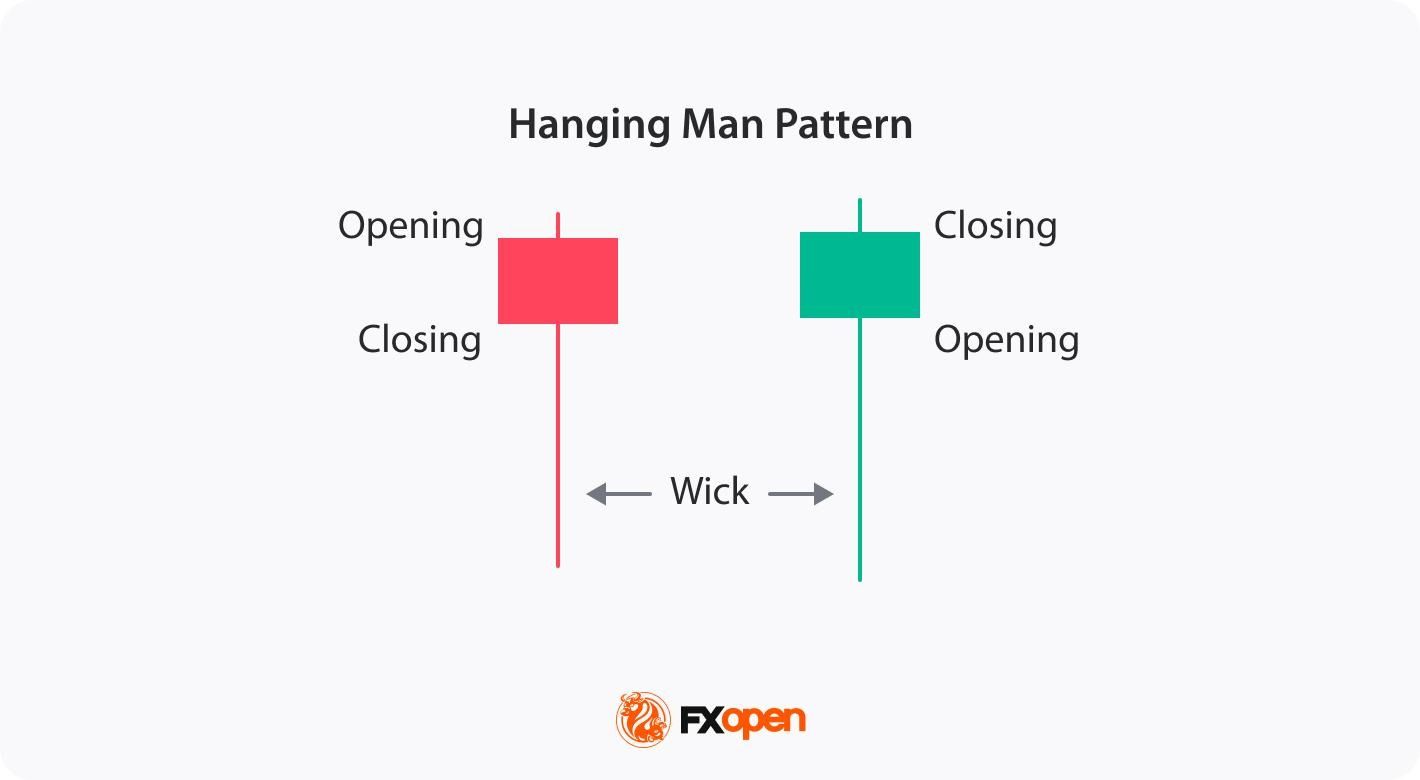
The hanging man candlestick is a single-bar pattern that forms after an uptrend. It consists of a small body near the top and a long lower shadow. It points to a possible bearish reversal. Most traders wait for a confirmation candle before acting.
In the world of technical analysis, candlestick patterns are commonly used to decipher market trends and potential reversals. Among the many setups, the hanging man holds particular significance. This distinctive formation captures traders’ attention as it often serves as a warning sign of a possible trend reversal. This article will go through the technical analysis of the hanging man formation and explain how traders can trade with it.
What Is a Hanging Man Candlestick Pattern?
A hanging man candle is a single-bar pattern that forms after an uptrend and warns of a possible bearish reversal. It has a small real body near the top, a long lower shadow, and little or no upper shadow. The colour of the body is secondary, though a bearish close adds weight.
Psychology Behind the Hanging Man Pattern
The psychology behind the hanging man candlestick pattern reflects a shift in market sentiment. Buyer exhaustion sits at the core of the hanging man pattern. After a long advance, demand thins and fewer buyers step in at higher prices. Sellers then emerge and drive the long lower shadow, signalling a possible uptrend reversal.
The long lower shadow shows that sellers were able to push prices down significantly during the trading session. Although buyers managed to drive prices back up, the close near the open price suggests weakening bullish sentiment. This pattern signals that seller pressure is increasing, potentially leading to a bearish reversal as confidence among buyers diminishes.
The hanging man is a versatile formation that can be applied across a wide range of financial instruments, including stocks, indices, commodities, and forex, on different timeframes.
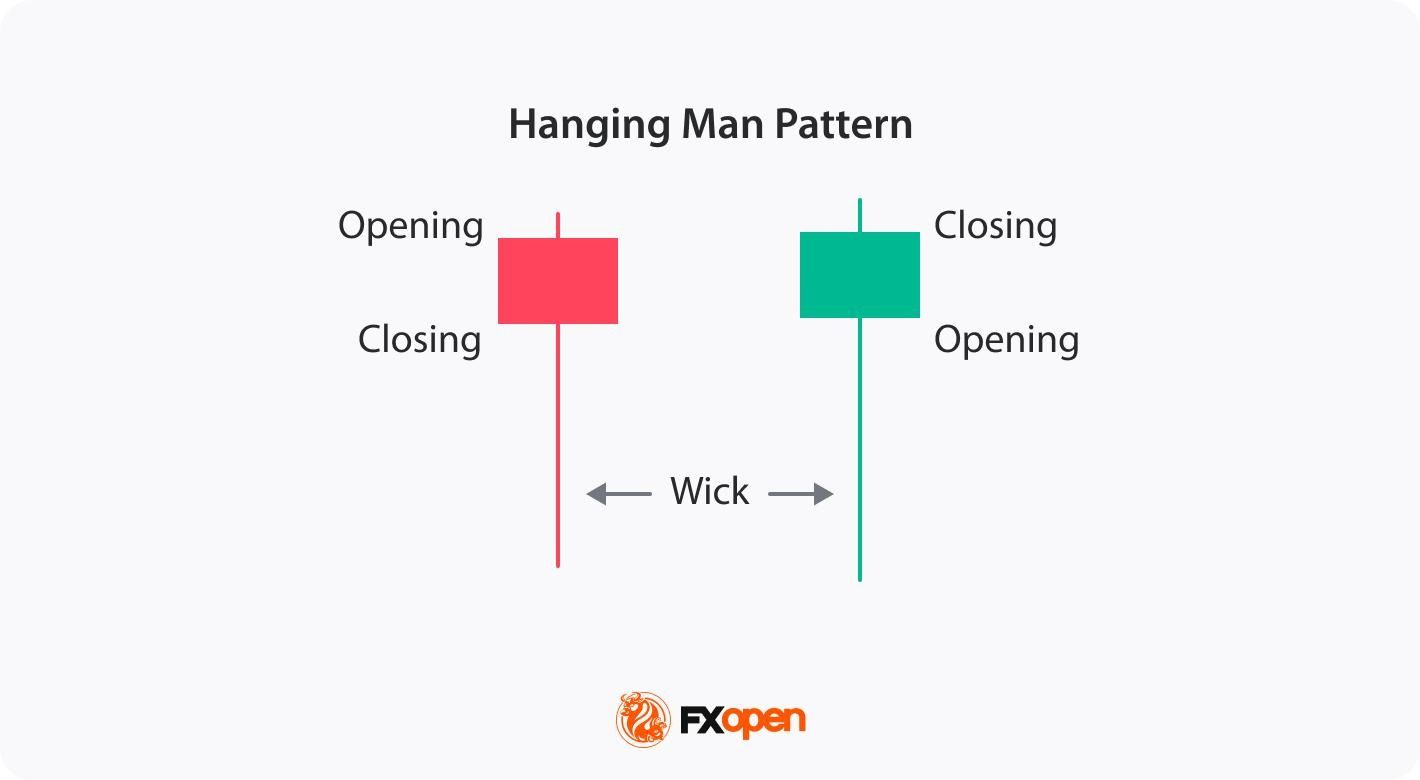
Characteristics of a Hanging Man Candle
A hanging man candle has a clear shape that sets it apart on a chart. Five features define it. Each one matters, and the pattern carries more weight when all five line up after a strong uptrend.
- Small real body: the open and close price sit close together, near the top of the range.
- Long lower shadow: the shadow runs at least twice the length of the body.
- Little or no upper shadow: price closes near the session high.
- Prior uptrend: the candle forms after a sustained move higher.
- Confirmation: a bearish follow-through candle is needed before the signal holds.
Without a prior uptrend, the same shape is read as a hammer rather than a hanging man candlestick. Context, not colour, gives the candle its meaning.
How Traders Identify a Hanging Man Candlestick
To spot a hanging man pattern in stocks and other financial instruments, you may follow these steps:
- Look for an existing uptrend: Start by identifying a prevailing upward price movement on the chart.
- Find a small real body near the top of the range: It should have a long lower shadow and little to no upper shadow. This formation resembles a figure hanging from its head.
- Check the lower shadow runs at least twice the length of the real body: A short shadow weakens the signal.
- Treat colour as secondary: The colour of the candle doesn’t matter, but if it’s bearish, the signal is stronger.
- Consider supporting indicators: Utilise other technical indicators or oscillators to further validate the potential reversal. These can include trendlines, moving averages, or momentum indicators that align with the bearish interpretation.
Even with all five checks met, the hanging man candlestick still needs a confirmation candle before it carries weight. The pattern is a warning, not a trigger.
What Is the Confirmation Candle for a Hanging Man?
A hanging man confirmation candle is the bearish bar that follows the pattern and provides the candlestick confirmation that validates the reversal. Without it, the hanging man is only a warning. Traders typically watch for one of three signals in their candlestick chart analysis.
The first is a bearish engulfing candle that fully covers the prior body. The second is a strong bearish close well below the hanging man’s real body. The third is a clean break below the hanging man’s low. Each shows that sellers have taken control after the initial warning. The stronger the confirmation, the more weight the signal tends to carry.
Trading the Hanging Man Pattern
Those trading the hanging man reversal pattern apply a systematic approach. Here are a few steps traders usually follow to trade this pattern:
- Spot the pattern: Identify the setup by using the steps mentioned above.
- Look for confirmation signals: The setup alone is not sufficient for making trading decisions. Seek additional confirmation through subsequent candlestick patterns or technical indicators. This can include bearish candlestick patterns (e.g. bearish engulfing), a pullback from a resistance level, or the convergence of other indicators signalling a potential reversal.
- Define your entry point: Traders typically consider an entry point either when the next candlestick confirms the bearish sentiment or when the price breaches a significant level.
- Identify profit targets: The candlestick itself doesn’t provide specific targets. Traders could identify profit targets by looking at previous support levels, Fibonacci retracement levels, or other technical analysis tools like moving averages or pivot points.
- Consider risk management: Traders might set a stop-loss order above the hanging man pattern. Some traders assess the risk-reward ratio of the trade to ensure the trade aligns with their risk tolerance. Risk management tools like position sizing, setting stop-loss orders, and diversification may help traders calculate risks.
- Monitor the trade: Traders keep a close eye on their positions as they progress. They pay attention to any changes in market conditions or additional signals that may invalidate the trade.
- Learn from outcomes: Regardless of the outcome of the trade, traders analyse it afterwards to identify areas for improvement. They assess whether the setup provided accurate signals and identify any factors that may have affected the trade.
Live Market Example
Consider a hanging man that forms on the USD/JPY pair after a steady uptrend. The candle has a small body near the top and a long lower shadow. A bearish candle follows and closes lower, which validates the setup.
A common approach places the stop loss just above the high of the hanging man, since a move back above it would weaken the bearish case. The take profit order is at the next level of support. The gap between entry and that support sets the risk-reward ratio for the trade.
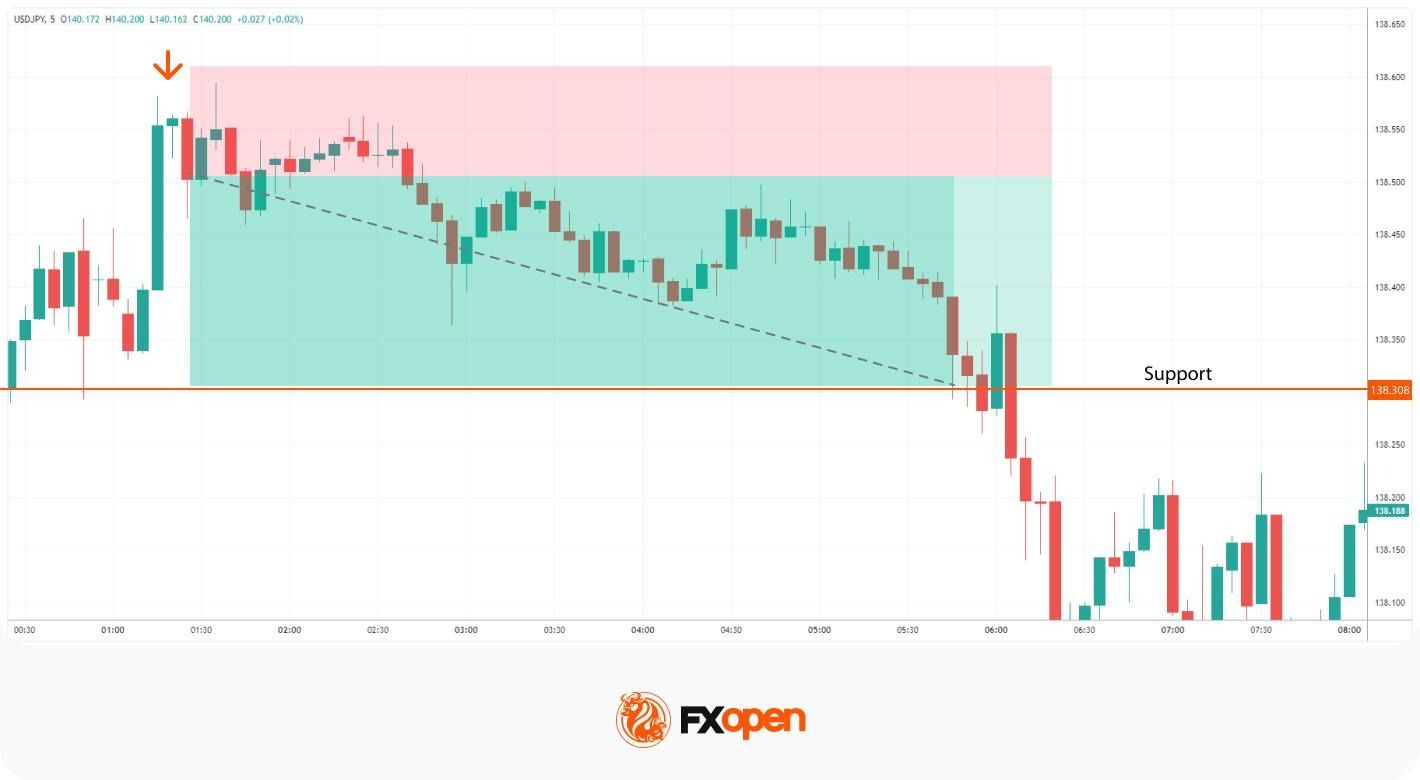
Traders can consider using the TickTrader platform to test the hanging man pattern rules.
Limitations of the Hanging Man Pattern
The hanging man candlestick pattern, while useful, has certain limitations that traders need to consider:
- False Signals: The hanging man can produce false signals, especially in volatile markets where price movements are erratic. A candle that looks valid can still fail once the next bar prints.
- Market Context: The reliability of the pattern varies depending on the broader market context and prevailing trends. The same shape means little without a clear prior uptrend behind it.
- Timeframe Sensitivity: The pattern’s signals can vary across various timeframes; what works on a daily chart may not be a strong signal on an intraday chart.
- Not Standalone: It is used as part of a comprehensive trading strategy that includes other indicators and risk management tools.
Context does most of the work here. The pattern flags a possibility, not a certainty.
Hanging Man vs Similar Candlestick Patterns
Understanding how the hanging man pattern differs from similar candlestick patterns may help in accurate technical analysis.
Several single-candle formations look almost identical to it, which makes them easy to confuse. The difference comes down to three things: the trend the candle forms in, where the body and shadow sit, and the signal it gives. The three comparisons below break it down against the hammer, the pin bar, and the shooting star.
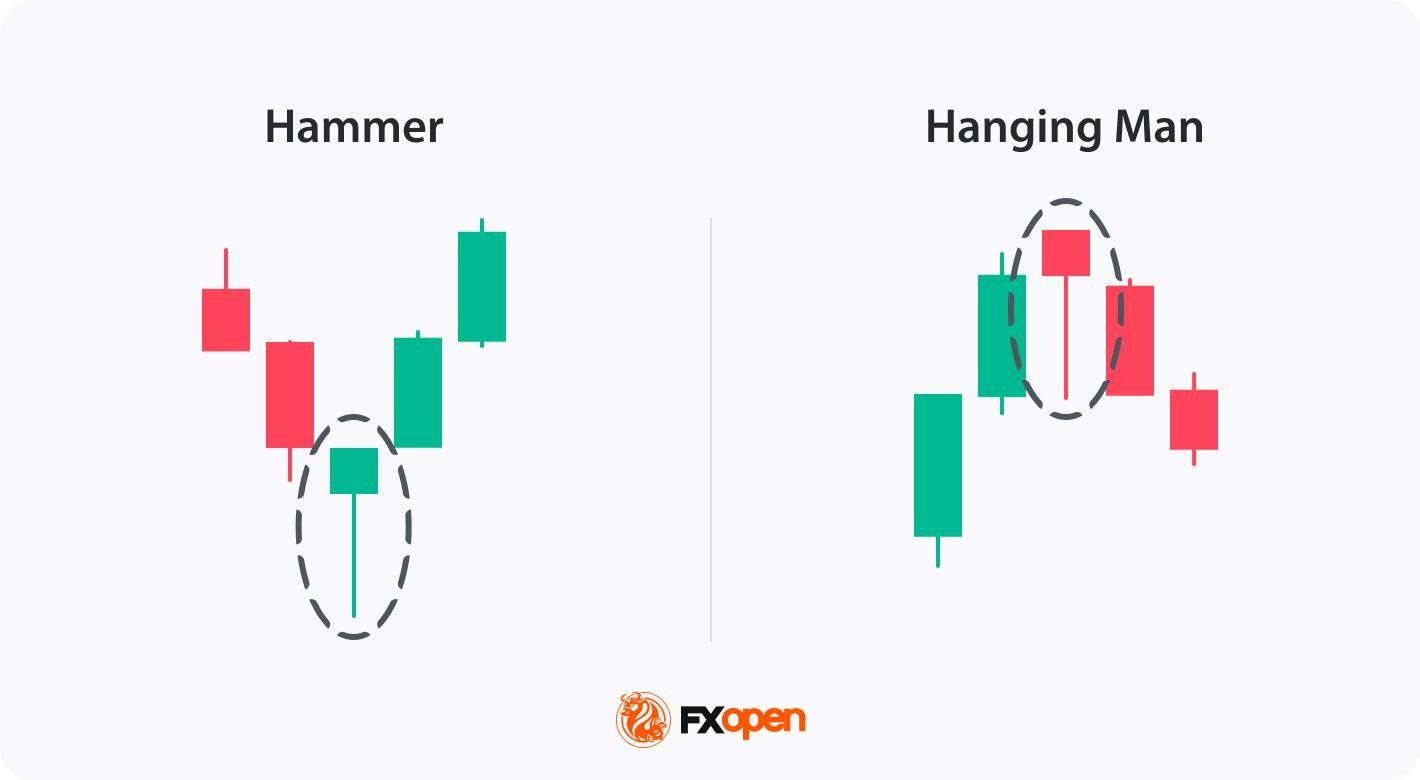
Hanging Man vs Hammer
Both candles share the same structure: a small body near the top and a long lower shadow. The hanging man vs hammer difference comes down to the trend each one forms in.
The hanging man candlestick forms in an uptrend and signals a potential bearish reversal, while the hammer appears in a downtrend, indicating a potential bullish reversal. Both candles require confirmation from subsequent price movements. They are typically analysed within the context of the overall market trend and other technical indicators.
Hanging Man vs Pin Bar
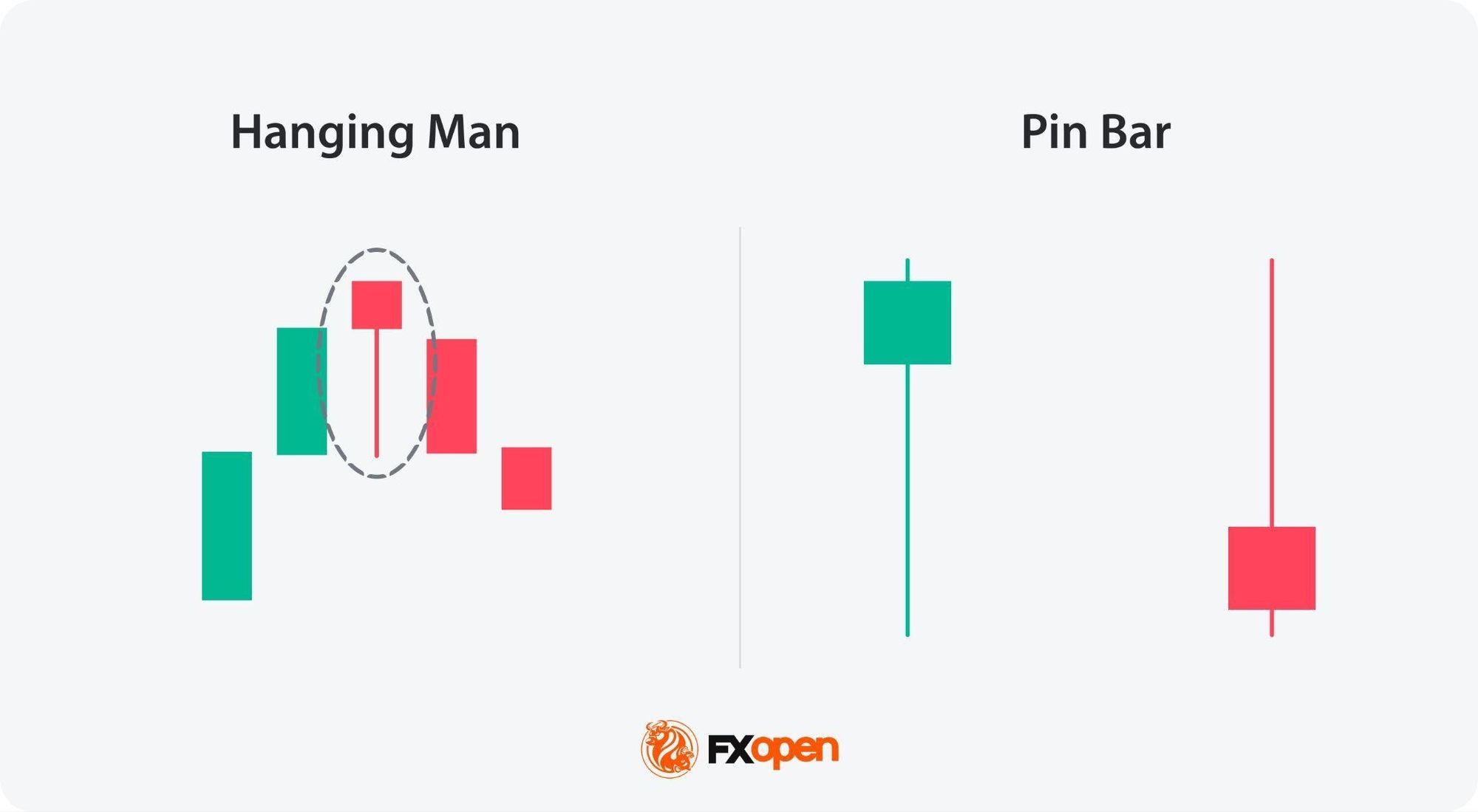
A pin bar and a hanging man are both single-candlestick patterns with small bodies and long shadows, but they serve different purposes in price action trading. The pin bar has a small body and a long tail, indicating a reversal, but it can appear in bullish and bearish markets. In a bullish trend, it’s called a shooting star, it has a long upper shadow and a small body, and signals a downward reversal. In a bearish trend, it’s called a hammer, it has a long lower shadow and a small body, and signals a bullish reversal. Its long tail shows a strong rejection of a certain price level, with the body pointing in the direction of the anticipated reversal.
The hanging man, however, specifically occurs after an uptrend and signals a potential bearish reversal, characterised by a small body at the top and a long lower shadow, indicating selling pressure.
Hanging Man vs Shooting Star
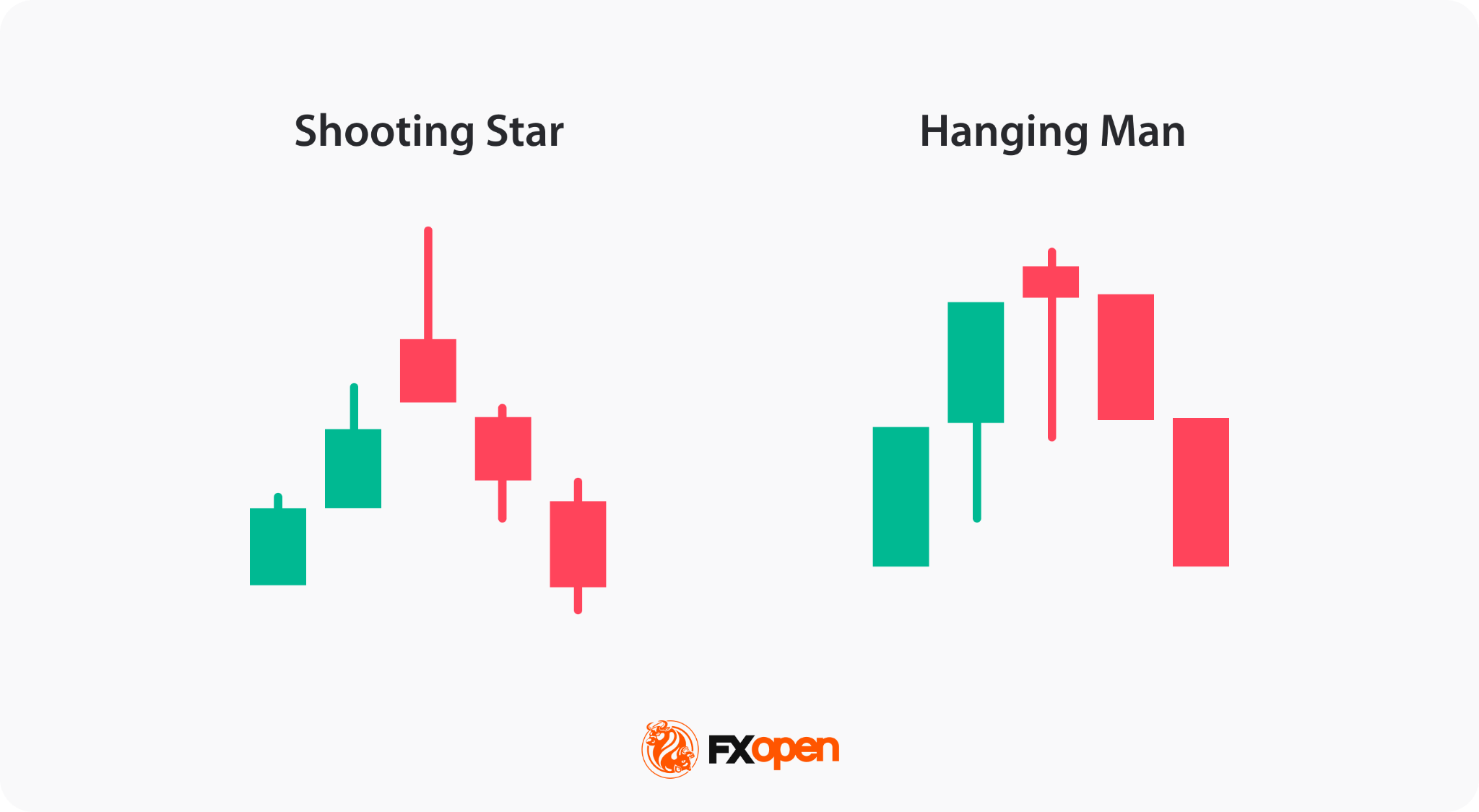
The shooting star and the hanging man are both bearish reversal patterns, but they differ in their appearance and context. A shooting star occurs after an uptrend and features a small body at the bottom with a long upper shadow. It indicates that the price was pushed up significantly but fell back down, showing strong selling pressure.
The hanging man also appears after an uptrend but has a small body at the top with a long lower shadow. It suggests that sellers dominated the session despite an initial push by buyers.
Both require confirmation from subsequent candlesticks to validate the reversal.
Is the Hanging Man Pattern Reliable?
On its own, the hanging man is a moderate signal. Its reliability depends on what surrounds it, not the candle alone. Four factors decide how much weight it carries.
Market context matters first. The pattern means little without a clear, sustained uptrend behind it. The same shape inside a choppy range carries almost no signal.
Trading confirmation comes next. A hanging man without a bearish follow-through candle is just a warning, and many resolve back into the uptrend. A confirmed signal is far more dependable than an unconfirmed one.
Timeframe shapes reliability too. A hanging man candle on a daily or weekly chart tends to hold more weight than one on a one-minute chart, where noise produces frequent false signals.
Supporting tools round it out. Traders often pair the pattern with support and resistance, volume, or momentum readings as part of their hanging man technical analysis. Agreement across signals raises the odds the reversal holds.
The takeaway is simple. The hanging man pattern flags a possibility, not a certainty, and works as one input among several rather than a standalone trigger.
Final Thoughts
While the hanging man alone is insufficient for making trading decisions, it serves as a warning signal that buyers may be losing control and that selling pressure could increase. Traders seek additional confirmation through subsequent candlestick patterns, support and resistance levels, and other technical indicators to validate the potential reversal.
In short, identify the candle by its small body, long lower shadow, and prior uptrend, then wait for a bearish confirmation candle before the trend reversal signal carries weight. By understanding the implications of the setup within the broader market context and employing proper risk management strategies, traders can support their decision and identify different setups across the markets. Once comfortable with a strategy, traders may consider opening a forex trading account with FXOpen to apply it across more than 700 markets.
FAQ
What Does the Hanging Man Pattern Indicate?
The hanging man trading pattern in technical analysis typically indicates a potential bullish trend reversal. It suggests that the buyers, who have been driving the market higher, are losing control, and the selling pressure may increase. The hanging man is represented by a small body near the top of the candlestick, a long lower shadow, and little to no upper shadow.
Can a Hanging Man Candle Be Bullish?
No, there is no such thing as a bullish hanging man candlestick pattern. The bearish hanging man pattern indicates a potential trend reversal from an uptrend to a downtrend.
Is the Hanging Man Pattern Reliable?
The reliability of the hanging man pattern, like that of any candlestick formation, depends on the broader market context and supporting technical signals. Although it is widely recognised as a potential bearish reversal pattern, it isn’t used as the sole basis for trading decisions. Traders typically seek confirmation through subsequent bearish price action, such as a strong bearish candle following the pattern, as well as additional technical indicators that support the likelihood of a trend reversal.
What Is the Confirmation Candle for the Hanging Man?
A confirmation candle for the hanging man is a bearish candlestick that follows the pattern, confirming the reversal. This can include a bearish engulfing candle or a candlestick closing well below the hanging man’s body, indicating increased selling pressure.
Is the Hanging Man Pattern Bearish?
Yes, it is generally considered a bearish pattern that appears after a strong uptrend. It is formed when the price’s open or close is near or at its high and there is a significant decline during the trading session.
Does the Colour of a Hanging Man Candle Matter?
No, colour is secondary. A hanging man can close red or green, and both versions are valid. However, a bearish red close adds weight, since it shows sellers ended the session in control. The shape and the prior uptrend drive the hanging man candle meaning far more than the body colour.
Can a Hanging Man Appear in Forex Markets?
Yes. The hanging man appears across forex, stocks, indices, commodities, and other markets on any timeframe. In hanging man forex trading, it often forms on major pairs after a sustained uptrend. The signal reads the same way regardless of instrument, though confirmation and market context still decide its reliability.
What Timeframe Is Commonly Used for a Hanging Man Pattern?
Higher timeframes tend to be more reliable. A hanging man on a daily or weekly chart usually carries more weight than one on a one-minute chart. Lower timeframes produce more noise and more false signals. Many traders treat the hanging man trading pattern as stronger when it forms on longer timeframes near key levels.
What Indicators Are Often Used With a Hanging Man Candle?
Traders often pair the candle with momentum and trend tools. Common choices include the RSI, moving averages, volume, and resistance levels. These may help confirm whether the bearish reversal candlestick signal is likely to hold. No single indicator confirms the pattern alone, so agreement across several tools tends to raise the odds.
This article represents the opinion of the Companies operating under the FXOpen brand only. It is not to be construed as an offer, solicitation, or recommendation with respect to products and services provided by the Companies operating under the FXOpen brand, nor is it to be considered financial advice.



The decline is a reflection of a broader slump in investor sentiment toward digital asset-linked stocks. After a wave of crypto IPO enthusiasm last year, bitcoin and cryptocurrency prices have tumbled, and attention has increasingly turned toward artificial intelligence (AI) companies and a pipeline of highly anticipated tech listings like SpaceX (SPCX).
Several crypto companies, including Kraken and Consensys, have halted their efforts amid turbulent crypto markets.
BitGo provides custody, trading, staking and settlement services for digital assets. It also issues USD1, the U.S. dollar stablecoin tied to the Trump family-backed World Liberty Financial project.
The firm has also been promoting its Germany’s BaFin-regulated infrastructure platform as an option for companies adapting to the European Union’s digital asset regime, MiCA, ahead of a licensing deadline at the end of the month.

Most tech startups discover the same uncomfortable truth about PR at some point in their journey. The moment they most need press coverage — when they are launching a product, closing a funding round or trying to establish themselves in a new market — is exactly the moment they are least equipped to get it. The team is stretched, the budget is tight and the process of securing meaningful coverage in the right publications feels opaque and slow.
This problem is particularly acute for tech startups building in the artificial intelligence space. The AI sector generates enormous media interest at the industry level but that interest does not automatically translate into coverage for individual companies. Getting a specific startup’s story into the finance and technology publications that investors and customers actually read requires a media distribution infrastructure that most early-stage companies simply do not have.
Kooc Media has spent eight years building that infrastructure. The agency is a specialist PR and media distribution service with deep roots in the technology, crypto and fintech media ecosystem, and it has now introduced a range of AI-focused PR campaigns designed specifically around the needs of tech startups building in the artificial intelligence space. The service delivers guaranteed placements, same-day publication and distribution across the precise media landscape that AI startup audiences inhabit.
What AI-Focused PR Campaigns Actually Mean in Practice
The phrase AI-focused PR campaign gets used loosely by a lot of agencies. For Kooc Media it has a specific meaning that shapes every element of how campaigns are built and executed.
AI-focused means content that is written with an understanding of artificial intelligence as a technology and a market. Press releases for tech startups in AI need to communicate clearly to multiple audiences simultaneously — investors who care about market opportunity and competitive positioning, enterprise buyers who care about practical applications and business outcomes, developers who care about technical capability and integration, and general business audiences who are trying to understand what AI means for their own operations. Getting that balance right requires an editorial approach that is specifically calibrated for AI communications rather than adapted from a general technology PR template.
AI-focused also means distribution that reaches the specific publications where AI startup audiences are most active. Finance and investment media, specialist technology platforms, crypto and Web3 press, business and economic news sites — these are the outlets that the investors, customers and partners of AI tech startups read. Reaching them requires a network built within this ecosystem, not a generic list of websites assembled to produce impressive-sounding placement numbers.
Kooc Media’s AI-focused PR campaigns are built on both of these foundations — content crafted for AI audiences and distribution designed for the media landscape those audiences inhabit.
Owned Publications Deliver Guaranteed Results Every Time
The single most important feature of Kooc Media’s PR service for AI tech startups is the owned publication portfolio that makes guaranteed placements a genuine operational reality rather than a marketing claim.
Blockonomi, CoinCentral, MoneyCheck, Parameter, Beanstalk and Computing are all publications owned and operated by Kooc Media. They are established brands in the finance, cryptocurrency and technology publishing space with real editorial authority, genuine reader communities and meaningful credibility in the sectors that AI tech startup audiences follow. Every client receives confirmed placements across all of these publications as part of their campaign — not as a best-efforts goal but as a guaranteed outcome.
Press release approved by the client. Published across all owned sites the same day. No journalist outreach. No editorial pitch process. No uncertainty. This is how every Kooc Media AI PR campaign operates, and the difference it makes for tech startups trying to coordinate press coverage with specific business activities is significant.
Product launches, funding announcements, partnership reveals and platform updates all benefit from guaranteed same-day publication. News in the AI sector has a narrow window of peak relevance and coverage that appears days or weeks after the moment has passed delivers a fraction of the impact it would have had if it had gone live immediately. Kooc Media’s owned media model solves this problem completely. All owned publications are listed on the Kooc Media sites page.
Scaled Distribution Across Partner Networks and Global Platforms
Every AI tech startup PR campaign begins with confirmed in-house placements and extends outward through Kooc Media’s AI-focused campaign distribution network to reach audiences across the full scope of relevant finance and technology media.
The partner distribution network adds hundreds of additional websites and thousands of syndicated outlets to every campaign, ensuring that press releases from AI tech startups circulate broadly across the relevant media ecosystem rather than being confined to the owned portfolio. This layer of distribution is what turns a solid baseline of guaranteed coverage into a campaign with genuinely wide reach across the publications and platforms that AI startup audiences are following.
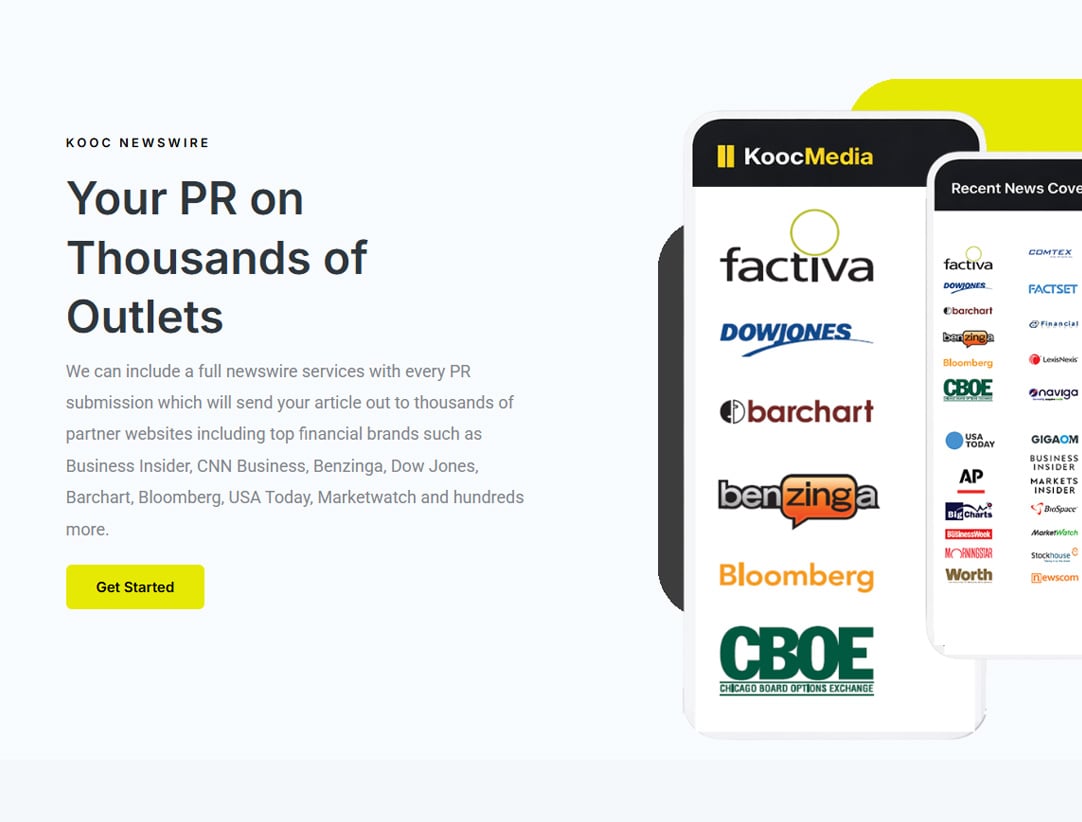
Premium distribution packages provide access to a third tier of reach through the most authoritative business and financial media platforms in the world. Through these channels press releases from AI tech startups can appear on Business Insider, Bloomberg, Benzinga, MarketWatch, USA Today, Dow Jones feeds and comparable global platforms that carry enormous credibility with institutional investors, global enterprise clients and international industry press.
For tech startups at the stage where a single well-placed media mention in a globally recognised publication could change the trajectory of an investor conversation or an enterprise sales process, this level of distribution access is genuinely transformative.
Michelle De Gouveia, spokesperson for Kooc Media, said: “Tech startups in AI are building some of the most significant products of this generation. The challenge is not that their stories are not worth telling. It is that they have not had access to a PR service that is genuinely built for them — fast enough to keep up with the pace of the sector, targeted enough to reach the audiences that matter and guaranteed enough to actually deliver on its promises. That is exactly what our AI-focused campaigns provide. We built this service to give AI tech startups the media infrastructure that was previously only available to much larger companies.”
AgentLocker.ai — Ongoing Visibility Beyond the Campaign
Every tech startup that runs an AI-focused PR campaign with Kooc Media receives a permanent free listing in AgentLocker.ai, the dedicated AI tools and agents directory that Kooc Media has developed and operates.
AgentLocker.ai was built to solve the discovery problem that has emerged as the AI tools market has expanded. The number of AI-powered products available across categories including productivity, automation, content creation, coding assistance, data analysis, customer service, marketing and research has grown faster than any general search mechanism can effectively organise. AgentLocker.ai provides a structured alternative — a purpose-built directory where users can find, compare and evaluate AI tools across specific categories with confidence.

The strategic value of an AgentLocker.ai listing for AI tech startups lies in what it delivers over time. Press coverage is enormously valuable at the moment of publication — it creates immediate awareness, drives traffic and generates the kind of third-party credibility that no owned content can replicate. But its impact is concentrated in time. An AgentLocker.ai listing works differently. It places a startup in a directory visited by users who are actively searching for AI tools, generating a consistent stream of targeted visibility that continues indefinitely.
The listing is included at no additional cost, created during the campaign and permanently active. For startups that are building for the long term, the combination of press campaign impact and sustained directory presence creates a media approach with both immediate reach and enduring value.
Fully Managed With No PR Experience Required
Kooc Media’s AI-focused PR campaigns are completely managed by the agency from first brief to final report. Tech startups do not need communications staff, pre-written press releases or any prior experience of running PR campaigns to get started.
The editorial team handles all content creation based on a brief from the client. Finished copy is shared for review and approval before anything is published. Distribution begins the same day approval is received. A comprehensive results report with live links to every placement follows when the campaign is complete.
Those links serve as investor-facing evidence of media coverage, website press mentions that build credibility for new visitors, backlinks that strengthen search engine performance and validation signals that support enterprise sales and funding conversations.
Give Your AI Startup the Media Presence It Deserves
The AI tech startups that will define their categories over the next five years are building right now. The ones that invest in media presence early accumulate credibility and recognition that compounds over time and becomes increasingly difficult for competitors to overcome. Kooc Media’s AI-focused PR campaigns provide the fastest, most reliable and most guaranteed route to that media presence — built specifically for the pace, complexity and audience profile of the artificial intelligence sector.
Kooc Media’s AI packages are available now through the company’s website at https://kooc.co.uk/ai-pr/.

Hackers are sneaking malware into Steam Workshop wallpaper downloads that are capable of stealing crypto wallet information and installing crypto miners.
The wallpaper malware operation, discovered by cybersecurity firm Kaspersky, relies on Wallpaper Engine, one of the many apps available on Valve’s Steam Workshop.
Kaspersky discovered that downloads were being loaded with malware that included “infostealers” such as Lumma and Vidar, and the ReEngine loader.
In the case of the Lumma infostealer, it’s capable of stealing data from crypto wallets and installing further malware that allows it to search for wallet files, browser extensions, and local keys from the likes of MetaMask, Electrum, and Exodus.


Read more: Crypto malware creators allegedly infected their own PCs
The RenEnginer loader, meanwhile, has been utilised in pirated game launchers for the likes of Assassin’s Creed, FIFA, and Need For Speed, and is also capable of crypto wallet data extraction.
Kaspersky also noted that some hidden malware was installing crypto miners. This malware often would run unnoticed; however, a tell-tale sign of an illicit crypto miner is often an unusual decrease in computer performance.
Crypto malware wallpaper download by tens of thousands
The infected wallpaper packages had anywhere between thousands and tens of thousands of downloads.
Kaspersky claims that users from China and Russia were downloading most of them, with users also found in Singapore, Hong Kong, Germany, Vietnam, India and Canada.
The firm believes that the malware, which relied on the legitimacy of Steam Workshop, is likely the work of multiple individual bad actors and not a collective hacking group.
Steam has reportedly removed all the identified malicious wallpaper packages.
Read more: GitHub breach traced to poisoned VS Code extension
In 2023, a popular fan-made version of Super Mario Bros was found to have been laced with malware and infostealers that installed miners and stole personal information.
Last year, it was theorised that the US might be helping actors deploy similar malware against Russian Solana developers in order to disrupt Kremlin-linked ransomware gangs.
In another case from 2025, one group of 16 alleged creators of a malware-as-a-service bot were charged by the US.
The group allegedly leased the bot to bad actors and helped deploy malware to over 300,000 computers across the globe. They’re believed to have caused $50 million worth of damage.
Legal documents noted that the alleged creators also infected their own PCs both deliberately and accidentally.
Got a tip? Send us an email securely via Protos Leaks. For more informed news and investigations, follow us on X, Bluesky, and Google News, or subscribe to our YouTube channel.

May and early June 2026 underscored the split-screen nature of crypto investing, where policy momentum can lift prices, but macro conditions and geopolitical risk can quickly overwhelm those gains. Bitcoin started the period with a move above $80,000, helped by institutional interest and progress on U.S. regulation. Within weeks, that optimism faded as investors repriced interest-rate expectations and risk appetite deteriorated, pulling prices back toward the low-to-mid $60,000s.
Below is a market-focused read of the key forces shaping the period, drawing on commentary from Moneyfarm’s portfolio team and the supporting market context described in that note. The takeaway is not that regulation or institutional adoption has stopped, but that crypto’s trading dynamics remain sensitive to the same macro variables that influence broader risk assets.
Bitcoin’s regulatory lift, then a fast reversal
The early phase of the rally coincided with a notable U.S. legislative milestone. The proposed CLARITY Act, intended to create a clearer framework for cryptocurrencies and outline regulator responsibilities, cleared the Senate Banking Committee on May 14. The approval was followed by a short-lived jump in Bitcoin price action, according to the note, with the asset briefly moving near $81,965.
Yet the move also faced skepticism from on-chain and market-structure observers. CryptoQuant, as cited in the note, suggested that the rise into the upper-$70,000 range appeared driven largely by speculative activity rather than broad, sustained spot demand. In other words, the market may have been responding to headlines faster than it was building durable, day-to-day accumulation.
By the end of May, the pattern became harder to defend. Bitcoin ended May around $73,500, down roughly 3.7% for the month, after backing away from earlier intramonth highs. Ethereum closed near $2,100, remaining below an April peak around $2,460. Bitcoin dominance held at approximately 58%, consistent with a market period commonly referred to as “Bitcoin Season.”
Rates and geopolitics reassert crypto’s “high-beta” role
Macro factors took center stage in the run-up to June. The note describes three overlapping developments: a new Federal Reserve (Fed) chair, the breakdown of a ceasefire, and a shift away from expectations for rate cuts. The incoming chair, Kevin Warsh, was confirmed May 13 by a narrow margin, and sworn in May 22. While the note characterizes him as unusually crypto-literate, the immediate market reaction still hinged on rate math.
Warsh inherited a policy environment where inflation pressures remained, oil was elevated, and bond yields were higher. By early June, traders were pricing in a higher probability of no rate cuts in 2026, and the note says some positioning reflected the possibility of hikes. Bitcoin, the note adds, tracked the repricing closely, slipping from around the low $80,000s in mid-May to the low $60,000s.
Geopolitics then acted as an accelerant. The note points to renewed escalation involving Iran, including strikes launched June 3 associated with attacks in and around Kuwait International Airport and other regional targets. In the narrative, leveraged positions were liquidated within hours, and Bitcoin fell below $65,000, reaching roughly $61,351 by early June. A key interpretive point for market participants is that crypto’s drawdown was described as steeper than equities in that episode, reinforcing the idea that crypto still trades as a high-volatility risk asset during acute shocks rather than behaving as a hedge.
The broader sentiment indicators in the note also moved in the same direction. The Crypto Fear and Greed Index dropped to 23, classified as “Extreme Fear,” and total crypto market capitalization fell from about $2.53 trillion in mid-May to roughly $2.25 trillion by early June.
Policy progress, but implementation is still ahead
Even with the CLARITY Act clearing a key committee vote, the practical timeline remains a constraint. The note describes the bill as assigning the CFTC exclusive jurisdiction over digital commodities and requiring stablecoin issuers to maintain a 1:1 reserve mandate. It also highlights that passage still depends on additional Senate floor votes, with the ethics provision regarding officials’ crypto holdings described as a central unresolved obstacle.
According to the note, the White House is targeting a July 4 signing, but enforceable rules would not be expected before 2027 regardless. That distinction matters for markets because “headline approval” can drive short-term price reactions, while the actual regulatory operating environment tends to take longer to crystallize.
On-chain and derivatives signals stayed mixed
The note describes a mixed picture in activity and supply indicators. Daily active wallets were cited at roughly 531,000, with new wallet creation around 203,000, the lowest levels in about two years. At the same time, exchange reserves were said to have reached multi-year lows earlier in May. Those signals can be consistent with different interpretations, such as more selective retail participation, profit-taking, or shifts in how traders move coins.
On the derivatives side, the note references a June 1 product development: the Chicago Mercantile Exchange launched Bitcoin volatility futures. For institutional markets, volatility contracts can help with hedging and risk management, though they do not necessarily stabilize spot prices on their own. The broader context is that crypto market plumbing continued to evolve while spot demand appeared less consistent than the early rally suggested.
ETF flows flipped, changing the “floor” narrative
Perhaps the clearest shift in the period described in the note concerns spot Bitcoin ETF flows. The market had seen a strong run earlier, with a six-week inflow streak through April, and total spot Bitcoin ETF net assets crossing $100 billion. But that supportive backdrop deteriorated starting around May 20.
The note says ETFs recorded ten consecutive days of net outflows totaling about $3 billion, with more than 40,000 bitcoin leaving the products. It also cites a weekly outflow around late May of approximately $1.47 billion, characterized in the note as the largest of 2026. By early June, year-to-date flows were described as negative at around -$3.1 billion.
For traders, this matters because ETF flows have increasingly functioned as a visible, capital-access channel. When inflows turn to outflows, the market’s ability to absorb selling pressure can weaken, especially during periods when macro uncertainty is already rising.
What investors are watching next
The Moneyfarm commentary concludes that the situation remains fluid, with the regulatory path, Fed transition, and geopolitical risk all contributing to a fast-changing environment. It also notes that investor attention may be rotating toward other high-risk themes, including the broader pull of technology and IPO-related capital, citing SpaceX’s IPO as an example of competition for speculative interest.
For crypto markets, the near-term focus will likely remain on the interaction between macro policy expectations and the direction of ETF flows. Regulation remains a medium-term tailwind, but the period described here shows that for Bitcoin and Ethereum, price momentum can hinge just as much on interest-rate pricing, leverage conditions, and global risk sentiment as on legislative progress.
Investing in crypto involves a high level of risk. The value of investments can go down as well as up, and investors may not get back the amount originally invested. Past performance does not guarantee future results. This article is for informational purposes only and does not constitute investment advice.
A viral post claiming a $1,499 desktop could break Nvidia’s AI empire is racing across X.
The market is not waiting to judge it. Money is already leaving Nvidia stock. And that money could be flowing into AMD, at least for now.
A $1,499 Box and a Big Claim?
The post comes from an account called reputable researcher Bull Theory and landed on June 16.
AMD may have just broken Nvidia’s most profitable business, the renting out of AI compute in the cloud. At CES in January, AMD chief Lisa Su held up a mini PC near that price. It runs large AI models on a desk, with no cloud and no rented GPU.
Want more insights like this? Sign up for Editor Harsh Notariya’s Daily Newsletter here.
The thread frames the math as brutal for Nvidia. It cites a consultant who swapped a $2,800 monthly cloud bill for a few dollars of electricity.
Every firm that buys the box, the post argues, stops paying for cloud AI for good. Lawyers, banks, and doctors with private data are the customers it expects to switch first.

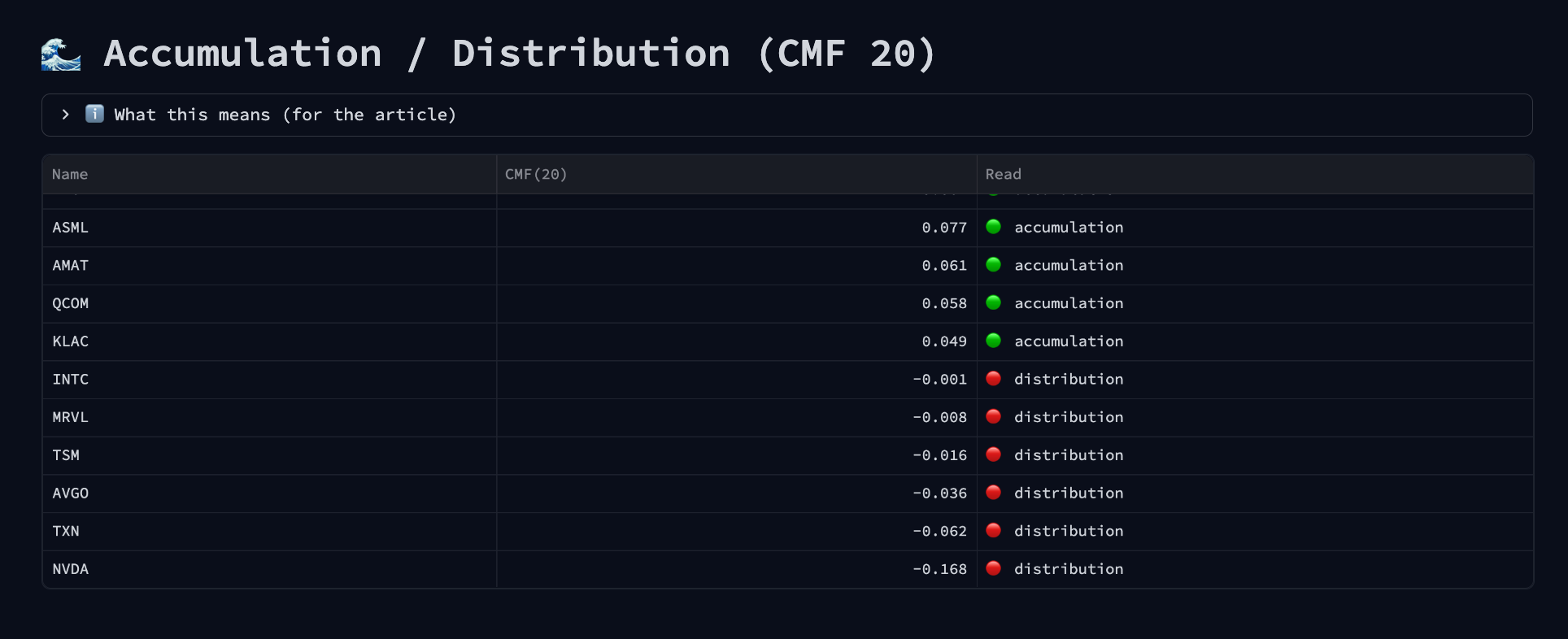
Not surprising to see that the Nvidia stock is already seeing the deepest bit of institutional capital erosion, as highlighted by the negative CMF counter. More on that later in this piece.
The Threat to NVDA Is Bigger Than One Box
The slogan oversells one box, but the trend behind it is real. The bigger threat is not on a desk; it is inside the cloud.
Nvidia’s largest customers are now building their own AI chips to lean on it less. Google has committed up to one million of its chips to Anthropic and is in talks to supply Meta.
Amazon runs its own custom silicon across its cloud at scale. Those in-house chips already make up about 28% of AI server shipments, up from roughly a fifth a year ago.
The cheaper hardware is real too. AMD’s Ryzen AI Halo box opened pre-orders this month at $3,999, below Nvidia’s competing DGX Spark at $4,699. Both trends attack the same thing, the demand for Nvidia’s chips, which is where its revenue comes from.
Nvidia still holds about 70% of the AI chip market, so this is erosion, not collapse. But for the first time, its own customers and a cheaper rival are routing around it.
The Money Has Already Picked a Side, and Its Not Nvidia
The thesis is loud, but the quieter signal is the telling one. The money is already moving. Chaikin Money Flow tracks whether cash is entering or leaving a stock. On Nvidia it has turned firmly negative at -0.168, the weakest reading of any major chip name.

AMD sits at the opposite end, with a positive +0.209, seeing one of the strongest accumulations in the AI chip group.

The trend agrees. Against the SOXX semiconductor index, Nvidia scores just 58.5 on relative strength, while AMD scores 123.
The company that defined AI compute is trailing its own sector, while the rival it once dwarfed leads it.
Nvidia Traders Are Leaning the Same Way
Positioning has turned with the story. In the options market, the Nvidia put/call ratio by volume has risen to about 0.63. Just a day earlier, it sat at a call-heavy 0.49. A rising ratio means puts are gaining on calls, a tilt toward downside hedging.The put-call ratio is still call-heavy but several bearish positions showed up post the viral mini PC post on June 16.

Crypto traders lean in the same direction. On Nansen, the smart money holds its largest chip short against Nvidia, ahead of every peer. The options desk and the perpetual market rarely agree.

Right now, both point away from the Nvidia stock as the money has already picked a side. Despite that, NVDA still manages to keep a near 10% year-to-date uptick, trading around $207 at press time.
The post Nvidia Stock’s Biggest Threat Now Costs $1,499 and Fits on a Desk? appeared first on BeInCrypto.


Prediction market platform Kalshi has partnered with StarCompliance to give financial institutions real-time visibility into employee trading activity as it expands efforts to address insider trading concerns and attract institutional participants.
Summary
- Kalshi has partnered with StarCompliance to give financial firms real time monitoring of employee prediction market trades.
- Employees at participating firms will be required to link their Kalshi accounts, allowing compliance teams to flag suspicious activity.
- The agreement follows Kalshi’s recent compliance push, which included employer disclosures, market risk reviews, and more than 100 blocked insider trading attempts in Q1 2026.
According to a Barron’s report, employees at firms using StarCompliance will be able to link their Kalshi accounts to compliance systems that monitor trades and flag potentially suspicious activity.
The arrangement allows employers to oversee prediction market participation in much the same way they already supervise employee trading in stocks and derivatives.
The partnership comes days after Kalshi introduced new compliance controls across its platform, including employer disclosure requirements for traders participating in markets considered more vulnerable to insider trading.
Earlier this month, the company said it had conducted more than 150 investigations, blocked over 100 suspected insider-trading attempts, and referred 20 cases to law enforcement during the first quarter of 2026.
According to the companies, financial institutions face new risks as prediction markets become more popular because employees may attempt to profit from material nonpublic information through event-based contracts.
StarCompliance said its software will help firms monitor activity on Kalshi and enforce internal compliance policies.
Explaining how the system works, Kelvin Dickenson, chief product officer at StarCompliance, said firms can permit employee participation while requiring account disclosure.
Dickenson said the framework allows employers to tell staff, “You can engage in this activity, but in order to engage in this activity you have to disclose your accounts to me.”
For now, the arrangement focuses on monitoring transactions after accounts are connected. Dickenson told Barron’s that additional controls could be introduced later if clients request them, including requirements for employees to obtain approval before placing prediction market trades.
Compliance measures expand as institutional interest grows
Recent moves suggest Kalshi is putting compliance infrastructure at the center of its push into traditional finance.
Speaking to Barron’s, Max Crowley, vice president of business development at Kalshi, said the company is “obsessed with compliance” and described strong monitoring systems as a basic requirement for working with major financial institutions.
Crowley said the StarCompliance integration emerged after discussions with a large New York hedge fund that wanted to hedge risk through a Kalshi institutional account but could not participate because the platform lacked a StarCompliance connection.
Recalling the conversation, Crowley said the fund’s response was, “You don’t have an integration with StarCompliance.”
The latest announcement follows several steps Kalshi has taken to strengthen oversight. Alongside employer disclosures for higher-risk markets, the company recently launched a whistleblower reporting channel and introduced a risk-scoring process for every proposed market before listing.
Pressure on prediction markets has intensified following a series of alleged insider-trading cases across the sector.
Earlier this month, NPR reported that the U.S. Department of Justice and the Commodity Futures Trading Commission were investigating former U.S. Representative George Santos after Kalshi detected suspicious trading tied to a market involving President Donald Trump’s State of the Union address.
The company froze the account and referred the matter to authorities, according to NPR.
Federal prosecutors have also pursued separate cases involving trading activity on prediction market platform Polymarket.
One case involved a U.S. Army Special Forces soldier accused of using classified information to place trades related to former Venezuelan President Nicolás Maduro, while another involved a Google software engineer accused of using confidential company information to trade Google-related contracts.

For years, the crypto industry has been driven by narratives.
From ICOs and DeFi Summer to NFTs, GameFi, the Metaverse, AI tokens, and memecoins, markets have repeatedly chased stories that promised future growth. Capital flowed toward attention, speculation, and potential rather than measurable business performance.
But the industry is evolving.
As crypto matures, a new narrative is emerging—one that may prove more durable than any trend cycle before it:
Revenue is the new narrative.
The Shift From Hype to Fundamentals
In traditional finance, companies are often evaluated based on revenue, profitability, cash flow, and long-term sustainability. Crypto, however, spent much of its early history prioritizing network growth, token distribution, and community expansion over actual economic output.
This approach made sense during the industry’s formative years. Protocols needed users, developers, liquidity, and network effects before they could focus on monetization.
Today, many blockchain networks have achieved scale. The question investors are increasingly asking is no longer:
“How many users does this protocol have?”
Instead, they are asking:
“How much value does this protocol generate?”
This subtle shift represents one of the most important transitions in digital asset markets.
Why Revenue Matters
Revenue demonstrates that a product solves a real problem for real users.
When individuals or institutions repeatedly pay fees to use a protocol, it creates tangible economic activity rather than speculative demand alone.
Revenue-generating protocols often possess:
- Sustainable business models
- Strong product-market fit
- Loyal user bases
- Defensible network effects
- Long-term growth potential
While revenue does not guarantee success, it provides a measurable signal that users find value in a platform’s services.
In an industry often criticized for speculation, revenue offers a foundation grounded in actual utility.
The Rise of On-Chain Businesses
One of crypto’s most fascinating developments is the emergence of fully on-chain businesses.
Decentralized exchanges generate trading fees.
Lending protocols earn interest spreads.
Infrastructure networks collect usage fees.
Stablecoin issuers generate treasury income.
Prediction markets monetize information flows.
Tokenized asset platforms create revenue from issuance and management services.
These businesses operate globally, transparently, and continuously, often with financial metrics visible in real time.
Unlike traditional companies that report earnings quarterly, blockchain protocols frequently provide open access to their economic performance.
This transparency allows investors to evaluate projects using objective data rather than relying solely on marketing narratives.
Revenue and Token Valuation
The growing focus on revenue is also changing how market participants evaluate tokens.
Historically, token valuations often depended on future expectations:
- Potential adoption
- Partnership announcements
- Ecosystem growth
- Narrative momentum
Today, investors increasingly examine:
- Protocol revenue
- Fee generation
- Treasury growth
- Token buyback mechanisms
- Value accrual models
- Economic sustainability
Projects that successfully connect protocol revenue to token holder value may attract greater long-term investor confidence.
As markets become more sophisticated, financial performance is becoming a larger component of token analysis.
The Era of Productive Capital
Another reason revenue is gaining importance is the changing nature of capital allocation.
During periods of abundant liquidity, speculative assets can thrive regardless of fundamentals.
As markets mature, however, investors become more selective.
Capital increasingly flows toward protocols that generate measurable economic activity rather than simply promising future growth.
This creates a feedback loop:
Strong products generate revenue.
Revenue attracts investors.
Investment funds expansion.
Expansion generates additional revenue.
Protocols capable of sustaining this cycle may become the dominant digital businesses of the next decade.
Beyond Revenue: Quality Matters
Not all revenue is created equal.
Sophisticated investors look beyond headline figures to evaluate:
- Revenue consistency
- User retention
- Revenue diversification
- Organic demand
- Cost efficiency
- Long-term scalability
A protocol that earns sustainable revenue from loyal users may ultimately outperform one that generates larger but highly volatile fee streams.
The quality of revenue is becoming just as important as the quantity.
What This Means for Crypto’s Future
The rise of revenue-focused investing signals a broader maturation of the digital asset industry.
Crypto is gradually transitioning from an experimental ecosystem driven primarily by narratives into an industry increasingly evaluated through business fundamentals.
Narratives will never disappear. Stories remain powerful drivers of innovation and capital formation.
However, the strongest narratives of the future may be those supported by measurable economic performance.
In the years ahead, attention alone may no longer be enough.
Protocols will need users.
Users will need products.
And products will need revenue.
The next generation of crypto winners may not simply be the projects with the loudest communities or the strongest narratives.
They may be the projects that generate real value, serve real customers, and produce sustainable revenue at scale.
Because in an increasingly mature digital economy, revenue is no longer just a metric.
Revenue is the narrative.
REQUEST AN ARTICLE


Disclosure: This article does not represent investment advice. The content and materials featured on this page are for educational purposes only.
Bitcoin miners face rising costs as AI computing and cloud mining models gain traction across the industry.
Summary
- U.S. Bitcoin miners face pressure from the halving, power costs, and competition as AI cloud mining gains traction.
- Ei Crypto promotes AI-powered cloud mining, letting users access BTC, ETH, XRP, and other assets without hardware.
- Rising mining costs are pushing investors toward AI-managed cloud computing platforms focused on automation and security.
As the global digital asset industry enters a new cycle of development, U.S. Bitcoin mining companies are facing unprecedented operational pressure. Influenced by multiple factors, including the Bitcoin halving, rising electricity costs, accelerated equipment upgrades, and intensifying market competition, the profit margins of traditional mining enterprises continue to be squeezed. Industry analysts point out that under the current environment, how to improve computing power utilization efficiency, reduce operating costs, and achieve stable returns has become a topic of common concern across the entire industry.
At the same time, AI-powered computing power and cloud mining models are rapidly emerging, becoming a new area of interest for an increasing number of investors and digital asset holders.
U.S. mining companies face profit pressure as the industry accelerates its search for transformation
Since Bitcoin completed its latest halving, the block rewards received by miners have been further reduced. At the same computing power level, the revenue of mining companies has been directly affected.
At the same time, electricity prices continue to rise in certain regions of the United States, leading to steadily increasing operating costs for large-scale mining facilities. In addition to electricity expenses, traditional mining companies must also continuously invest in equipment procurement, mining machine maintenance, cooling system construction, and personnel management costs.
Industry experts believe that future competition in the mining industry will increasingly focus on operational efficiency and intelligent management capabilities. Platforms that can reduce costs and improve computing power utilization through technological innovation will possess stronger market competitiveness.
Against this backdrop, AI-powered computing power management systems and cloud mining models are gradually gaining increasing attention from the market.
AI Cloud computing power is transforming traditional mining models
Unlike traditional mining farm models, cloud mining provides users with a more convenient way to participate in digital assets through centralized computing power resource management.
As one of the global intelligent computing power platforms for digital assets, Ei Crypto integrates global computing power resources through its AI-powered scheduling system, enabling 24/7 automated operation. Users do not need to purchase mining machines, bear electricity costs, or possess professional technical experience to participate in digital asset cloud computing power services.
The platform supports a variety of mainstream digital assets, including:
- BTC
- ETH
- XRP
- USDT
- LTC
- BCH
- USDC
Users only need to select a computing power plan that suits their needs, and the system will automatically complete computing power allocation, earnings calculation, and operational management.
Ei crypto platform advantages gain market attention
As the digital asset industry gradually matures, investors are placing higher demands on platform security, stability, and transparency.
Ei Crypto continues to improve its platform infrastructure and adopts a multi-layered security protection system:
- AI-powered risk control system for real-time monitoring of abnormal activities
- Cold wallet storage mechanism to ensure asset security
- SSL data encryption technology to protect user information
- Multi-factor authentication (2FA)
- Third-party security audit mechanism
- Global server deployment
- 24/7 customer service support
Through its intelligent management and secure operational framework, the platform provides global users with a more stable digital asset service experience.
Getting started with Ei Crypto cloud computing power services
Step 1: Register an Account
Visit the official Ei Crypto website to complete the registration.
New users can receive a $15 trial reward after registration and can also claim a $0.60 daily check-in reward by logging in each day.
Step 2: Deposit Digital Assets
The platform supports deposits of a variety of mainstream digital assets, including:
- BTC
- ETH
- USDT
- XRP
- LTC
- USDC
- BCH
After completing the deposit, users can participate in the cloud computing power program.
Step 3: Choose a computing power plan
Ei Crypto offers a variety of computing power plans based on different user needs.
Sample Plans:
Starter Plan
$100 — 2-day term — Total earnings of approximately $108
Stable Plan
$1,200 — 10-day term — Total earnings of approximately $1,362
Advanced Plan
$5,000 — 20-day term — Total earnings of approximately $6,500
Long-Term Plan
$27,000 — 30-day term — Total earnings of approximately $43,200
After making a selection, the platform will automatically activate the computing power service. The system operates around the clock, and users can monitor their earnings in real time and choose to withdraw or continue reinvesting based on their personal needs.
AI cloud computing power becomes a new trend in the digital asset market
As profit margins in the traditional mining industry continue to shrink, the industry is accelerating its development toward intelligence, automation, and lower barriers to entry.
An increasing number of BTC holders have stated that, compared with simply waiting for market prices to rise, participating in digital asset earning programs through AI-powered cloud computing can further improve asset utilization efficiency and generate continuous returns during the holding period.
Industry analysts believe that, as artificial intelligence technology continues to integrate with digital asset infrastructure, AI cloud computing power is expected to become an important component of the global digital asset ecosystem and provide more investors with more flexible and efficient earnings management solutions.
Conclusion
In the face of continued profit pressure on U.S. mining companies and intensifying industry competition, AI-powered cloud computing and cloud mining models are attracting increasing attention from more and more market participants.
Through its AI-powered computing system, global resource integration capabilities, and comprehensive security protection framework, Ei Crypto provides users with a more convenient and efficient digital asset earnings solution. For investors who wish to continue creating value while holding digital assets, AI cloud computing is gradually becoming a new option worthy of attention.
For more information, visit the official website and download the mobile app.
Disclosure: This content is provided by a third party. Neither crypto.news nor the author of this article endorses any product mentioned on this page. Users should conduct their own research before taking any action related to the company.

A coalition of more than 50 gaming associations, tribal governments, and labor unions submitted a letter to the Senate on June 16, demanding that the Digital Asset Market Clarity Act include explicit language banning prediction markets from offering sports and casino-style event contracts. This is a direct shot at platforms like Polymarket and Kalshi that have built substantial real-money event contract businesses under CFTC oversight.
— NewsTongue (@NewsTongueX) June 17, 2026
 Gaming groups urge Senate to ban sports prediction markets in crypto bill
The American Gaming Association, Indian Gaming Association, and Association of Gaming Equipment Manufacturers sent a letter to the Senate calling for language in the Clarity Act that would explicitly… pic.twitter.com/TKcgGM4J4E
Signatories include the American Gaming Association (AGA), the Indian Gaming Association (IGA), and UNITE HERE, which represents 300,000 hotel, gaming, and food-service workers across the U.S. and Canada.
The letter argues that prediction market platforms have engineered the largest expansion of gambling in U.S. history over the past 18 months without state authorization, legislative approval, or meaningful consumer protections.
Discover: The Best Token Presales
Coalition’s Core Argument: CFTC Was Never Built to Police Gambling
The coalition’s legal framing is specific and worth unpacking. The groups are not simply arguing that sports betting is a bad policy. According to the coalition, the CFTC structurally lacks the authority and institutional infrastructure to regulate it. “Sports betting falls outside the CFTC’s remit and cannot be offered through prediction market platforms,” the letter states.
The CFTC was established to oversee commodities and derivatives markets, not to police wagering integrity, underage access, or problem-gambling safeguards – none of which it has enforcement history on.
AGA President Bill Miller has previously stated that gaming integrity frameworks are “being undermined by so-called ‘prediction markets’ who are invading state, local, and tribal authorities.”
UNITE HERE’s president, Gwen Mills, framed it as an employment threat: workers’ livelihoods are “now threatened by prediction markets conducting illegal sports betting in violation of Tribal sovereignty and state laws.”
The IGA’s concern runs deeper still, that the Clarity Act, without explicit carve-outs, could functionally back-door legalize nationwide sports betting by routing it through CFTC-registered platforms, bypassing the tribal-state compact system that currently governs where and how wagering is offered.
The American Gaming Association has also claimed states have lost approximately $1 billion in tax revenue to prediction markets since the start of 2025, though prediction market operators dispute that figure.
Senator John Hickenlooper of Colorado put the jurisdictional argument plainly: “The CFTC has literally no experience in regulating sports betting. Even worse, CFTC has failed to use the authority it does have to protect sports bettors from insider trading, market manipulation, predatory advertising, and financial instability.”
Discover: The Best Crypto to Diversify Your Portfolio
Clarity Act Legislative Battlefield: Three Obstacles, Nine Days, One Threshold
The gaming coalition’s letter lands on a bill already under structural strain. The Digital Asset Market Clarity Act cleared the Senate Banking Committee 15–9 on May 18, a meaningful vote count but one that does not resolve the three distinct obstacles still blocking floor passage.
An unresolved ethics fight embedded in the bill’s language, two competing committee texts that must be merged, and a 60-vote cloture threshold that demands bipartisan buy-in well beyond what the committee vote demonstrated.
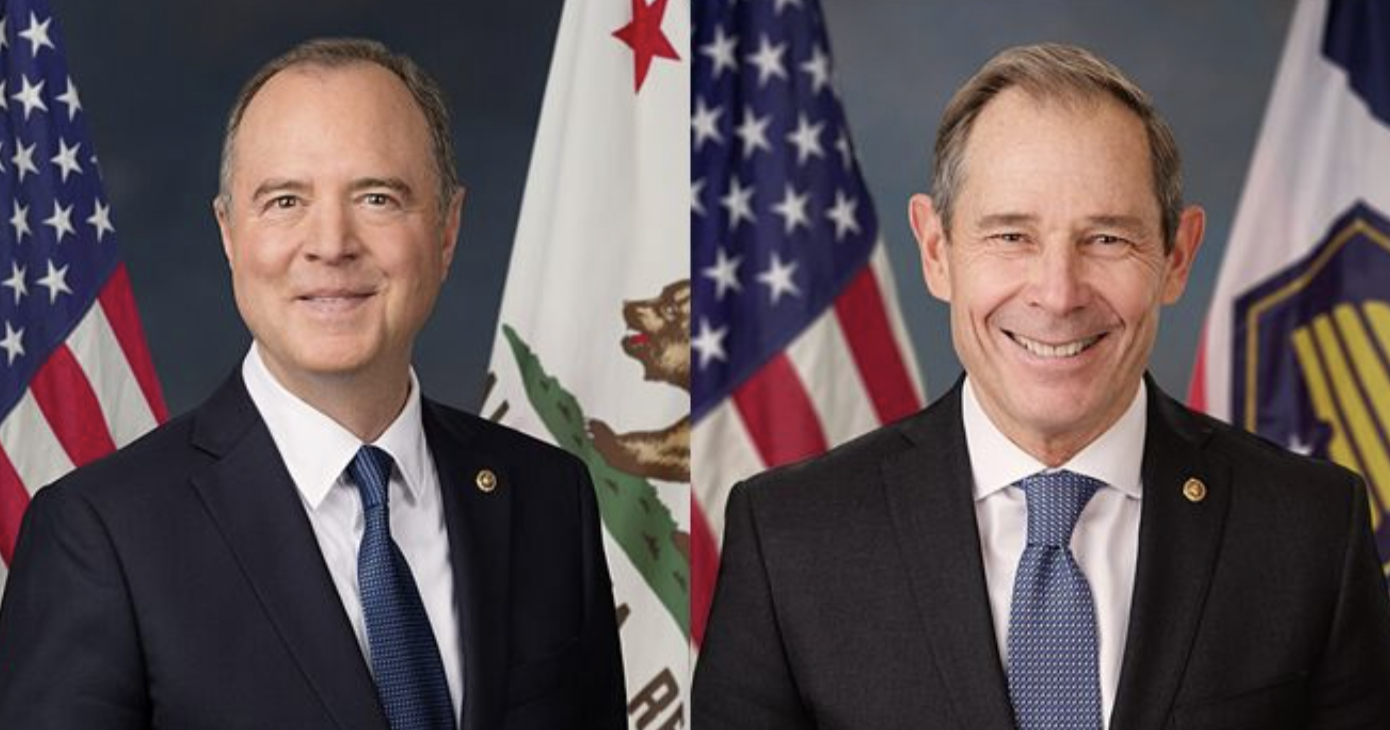
With just nine working days before the July 4 recess, Senate drafters face a compressed timeline to decide whether to fold the gaming coalition’s anti-sports-betting language directly into the Clarity Act text or leave it to the separate Schiff-Curtis bill. S
Senators Adam Schiff and John Curtis introduced the Prediction Markets Are Gambling Act (S.4160) in March 2026, which would amend the Commodity Exchange Act to explicitly bar CFTC-registered entities from listing contracts tied to any sporting event or athletic competition, or offering casino-style products like poker or blackjack. That bill preserves state and tribal gaming jurisdiction as the governing framework, exactly what the IGA and AGA want codified.
The immediate regulatory trigger for this lobbying push was the CFTC’s early June 2026 rulemaking, which advanced a framework formally permitting certain sports event contracts on prediction markets. Banning markets on injuries, officiating calls, high-school athletics, and pure-chance games, but leaving skill-influenced event contracts potentially open.
Discover: The Best Token Presales
The post Casinos, Tribes, and Unions Urge Senate to Ban Sports Betting From the Clarity Act appeared first on Cryptonews.

CoinMENA, a cryptocurrency exchange operating in the United Arab Emirates, has signed a banking agreement with Standard Chartered to enhance how customers move between crypto and fiat. The deal is designed to strengthen fiat payment infrastructure, with Standard Chartered set to support key functions including on- and off-ramps and transaction management through virtual account arrangements.
In a separate development, Bloomberg reports that the Central Bank of the UAE has approved Revolut’s applications for Stored Value Facilities and Retail Payment Services licenses—another sign that mainstream fintech is preparing for deeper involvement in the UAE’s regulated financial landscape, even as questions remain about whether digital-asset services will be included at launch.
Key takeaways
- CoinMENA says Standard Chartered will support fiat on- and off-ramps, client money accounts, and virtual-account transaction management in the UAE.
- The exchange frames the partnership as a way to improve transparency and liquidity settlement with approved global counterparties.
- CBUAE approval of Revolut’s Stored Value Facilities and Retail Payment Services licenses indicates regulatory progress for broader fintech payments in the UAE.
- Revolut’s reported licenses cover payments and stored value; they do not amount to a clear, explicit green light for digital-asset trading or related services.
CoinMENA links fiat rails to Standard Chartered
CoinMENA announced that it has entered a banking agreement with Standard Chartered, aiming to “strengthen fiat payment infrastructure” for customers in the UAE. According to a press release shared with Cointelegraph, the exchange will use Standard Chartered to facilitate fiat on- and off-ramps as well as client money accounts.
The agreement also covers virtual account-based transaction management, which CoinMENA says is intended to bring more structured handling of transfers. The exchange believes this will help improve transparency and liquidity settlement when transacting with approved global counterparties.
The move comes as the UAE’s digital asset ecosystem continues to mature and attract more institutional participation. For many exchanges, reliable access to regulated banking infrastructure is increasingly treated as a prerequisite for scaling fiat volumes, reducing operational friction, and meeting compliance expectations tied to customer funds handling.
Standard Chartered emphasizes the UAE’s regulatory pull
Standard Chartered UAE, Middle East and Pakistan CEO Rola Abu Manneh said in the announcement that the UAE has positioned itself as a leading regulatory environment for digital assets. She suggested this creates collaboration opportunities for financial institutions and regulated firms.
That emphasis matters because crypto firms increasingly rely on bank partnerships not just for payment convenience, but for settlement reliability and compliance processes that can be difficult to replicate through non-bank alternatives. In this context, CoinMENA’s choice to anchor parts of its fiat flow around a major global bank reflects a broader trend in which exchanges seek “bank-grade” rails as they expand.
CoinMENA co-founders Dina Sam’an and Talal Tabbaa underlined the strategy in a joint statement, arguing that the industry’s future hinges on banking, regulatory, and operational foundations—not solely on technology.
Why bank agreements are becoming a competitive lever
For UAE-based exchanges, fiat rails are often the difference between frictionless onboarding and a payment process that can be slow, inconsistent, or difficult to scale. While the press release does not quantify outcomes such as reduced settlement time or improved throughput, it does outline the operational components involved: fiat on- and off-ramps, client money accounts, and virtual account transaction management.
These elements are particularly relevant for exchanges that want to attract a wider range of users, including those who prefer predictable banking workflows and clear custody or segregation practices for customer funds. The pledge of “improved transparency” also suggests that CoinMENA views clearer transaction handling and settlement processes as critical to trust and compliance.
Investors and users should watch how partnerships like this translate into day-to-day experience—such as deposit and withdrawal reliability, the smoothness of conversion flows, and whether settlement with counterparties becomes more consistent as volumes grow. Over time, exchanges with stronger banking connectivity may be better positioned to handle institutional-level demand that depends on dependable fiat processing.
Revolut’s UAE licenses signal wider payments expansion
Separately, Bloomberg reports that the Central Bank of the UAE has approved Revolut’s applications for Stored Value Facilities and Retail Payment Services licenses. The report frames this as the fintech moving closer to a UAE launch, with Revolut reportedly planning to build out technology, operations, and local capabilities before it makes its services available.
Bloomberg also notes that UAE users are expected to receive multi-currency accounts, physical and virtual cards, and domestic and international transfers through Revolut’s app. The combination of stored value and retail payment services indicates a focus on payments infrastructure and consumer financial utility rather than a direct digital-asset platform at the outset.
At the same time, the scope of authorization remains a key point for readers. The licenses approved in the report relate to stored value and retail payment services, not an explicit waiver for “virtual asset” activity. Revolut has not publicly confirmed—per Bloomberg’s reporting—whether its UAE offering will include digital asset trading, transfers tied to crypto, staking, or access to its Revolut X exchange.
Cointelegraph reached out to Revolut for comment but did not receive a response before publication, leaving details about a possible digital-asset component uncertain.
Bloomberg also reports that Revolut is considering additional expansion across the Middle East and North Africa, including Turkey and Morocco. If so, the UAE could become a test case for how rapidly the firm scales regulated payments in the region ahead of any expanded service offerings.
What to watch next in the UAE’s regulated finance build-out
These two developments—CoinMENA’s banking agreement with Standard Chartered and Revolut’s central bank licensing progress—highlight the UAE’s push toward deeper integration between regulated banking rails and digital finance services. The immediate questions for market participants are whether CoinMENA’s fiat improvements translate into measurable user and liquidity outcomes, and whether Revolut’s UAE rollout stays strictly within payments or eventually broadens into explicitly licensed digital-asset functions.

The Fruit Paul Hollywood Insists You Start Adding To Your Sourdough

Ryanair boss slams EU rule change to flight bookings
Northland reiterates Ambarella stock rating on AI workload shift


-

 Business3 days ago
No Jackpot Winner as $257 Million Prize Rolls Over to $269 Million Monday Draw
-

 Crypto World6 days ago
Oppenheimer backs SpaceX as $70 billion retail frenzy builds
-

 Fashion5 days ago
Weekend Open Thread: Tuckernuck – Corporette.com
-

 Crypto World6 days ago
Markets Rally as SpaceX IPO Looms Amid Iran Tensions and Inflation Surge
-
 Crypto World3 days ago
Zimbabwe Requires Crypto Businesses to Register Annually Under New FIU Regulations
-

 Tech5 days ago
NanoClaw integrates JFrog registries to secure AI agent downloads
-

 Crypto World4 days ago
Bitget enters Argentina’s regulated crypto market through PSAV registration
-

 Tech5 days ago
This Week In Security: Microsoft On Microsoft, Register Your Domains, Linux On ARM, And FreeBSD Joins The File Cache Club
-
 Tech6 days ago
Dutton Ranch star claims they ‘didn’t see any disruption’ on set following Chad Feehan’s exit from Yellowstone spinoff fueled by Taylor Sheridan clash rumors
-

 NewsBeat6 days ago
El Nino has formed in the Pacific and could set records, forecasters say
-

 Politics6 days ago
Politics Home | Healey Resignation Is “Colossal Failure Of Government”, Says Former Labour Defence Secretary
-
 Entertainment6 days ago
Donnie Wahlberg & More Heat Up Las Vegas at Circa’s Barry’s Downtown Prime
-
 Tech6 days ago
Opendoor Ends India Operations, Fueling a Bigger Conversation About AI and Outsourcing
-

 Politics6 days ago
Belfast burns, while Met chief points finger at Iran and Russia
-

 Sports6 days ago
First Time Since 1971: Australia Register Historic Low In ODI Cricket
-

 NewsBeat5 days ago
FBI searches office of Ohio voter registration group
-

 Business6 days ago
AT&T: Verizon's 27% Outperformance Sets Up A Solid Entry Point
-
 Tech6 days ago
Anthropic is spending $150M to embed 1,000 AI fellows inside nonprofits. No degree required.
-

 Politics6 days ago
Modi thanks Trump for wishes as US attacks Indian seafarers
-
 Entertainment6 days ago
‘The Pitt’s Fan-Favorite Doctor Confirms Noah Wyle Gave His Blessing to Return [Exclusive]
You must be logged in to post a comment Login