

Tech
Canadian pension giant joins race to fund India’s AI-fueled data center boom


As global investors race to fund the infrastructure underpinning the artificial-intelligence boom, Canada Pension Plan Investment Board’s CPP Investments has committed up to ₹70 billion (about $741 million) to Indian data center operator CtrlS, betting on India’s growing role in the global buildout of cloud and AI infrastructure.
Under the partnership announced on Wednesday, CPP Investments will invest ₹40 billion (around $423 million) to acquire an 8.2% stake in CtrlS and commit up to ₹30 billion (about $317 million) to a joint venture to develop hyperscale data center campuses across India.
CPP Investments will own 48% of the joint venture, while CtrlS will hold the remaining 52%, the companies said in a joint statement.
Founded in 2007, CtrlS operates more than 15 data centers across India. The Hyderabad-based company has been expanding its footprint to meet rising demand from cloud providers, enterprises, and AI workloads.
India has become a major destination for data center and AI investments as global technology companies and investors ramp up spending to meet surging computing demand. Companies including Amazon, Google, Microsoft, OpenAI, and Uber have announced investments in the country in recent months, while operators are rapidly expanding capacity amid a broader global race to build AI infrastructure.
“As one of the world’s fastest-growing digital markets, India represents an important pillar of our global data center strategy,” said CPP Investments’ global head of real assets Max Biagosch in a statement.
CPP Investments, Canada’s largest pension investor, has been investing in India since 2009 and had net assets of about $20 billion in the country as of March 31, making it one of the largest foreign institutional investors in the market.
The investment builds on CPP Investments’ broader push into digital infrastructure. The pension fund said it has invested in the data center sector since 2017 and has built a portfolio of assets and joint ventures across major markets worldwide.
The partnership will help CtrlS expand capacity and build infrastructure tailored for AI workloads, said CtrlS founder and chief executive Sridhar Pinnapureddy.
The CPP-CtrlS deal is the latest in a string of investments targeting India’s data center sector. Earlier this month, Blackstone-backed AirTrunk said it would invest $30 billion to build five gigawatts of data center capacity in India by 2030. Meta, meanwhile, partnered with Reliance Industries last week on a 168-megawatt AI-enabled data center in the western state of Gujarat.
New Delhi has sought to position India as a global hub for digital infrastructure through a range of policy measures, including tax exemptions for foreign cloud providers on services sold overseas through 2047, provided those workloads are run from data centers located in the country.
Indian conglomerates have also accelerated expansion plans to capitalize on the opportunity. Adani Group and Tata Consultancy Services are among the companies that have unveiled major data center projects aimed at supporting AI and cloud workloads. In 2023, CtrlS announced plans to invest $2 billion over six years to expand its data center footprint across India.
India’s growing role in AI infrastructure has not yet been matched by similar progress in developing frontier AI models. While the country has a handful of startups building indigenous AI models, including Sarvam, much of the underlying AI technology used by Indian companies continues to be supplied by U.S. firms.
The rapid buildout of data centers is also expected to increase pressure on electricity and water resources, highlighting some of the challenges that could accompany India’s ambitions to become a major AI infrastructure hub.
When you purchase through links in our articles, we may earn a small commission. This doesn’t affect our editorial independence.


Samsung has finally opened pre-orders for the high-end Galaxy XR headset in the UK ahead of release on 8th July, following its release in the States in October 2025.
The launch marks Samsung’s first major step into mixed reality hardware, with Galaxy XR developed in partnership with Google and Qualcomm. It is also the first device to ship in the UK with Android XR, Google’s new extended reality platform, which means tight integration with familiar Google services as well as compatibility with existing Android apps.
The headset runs on Android XR and centres its feature set on multimodal AI interactions that allow users to navigate virtual and real environments through voice, vision and gesture controls. Samsung says the software experience will feel familiar to existing Galaxy users too, with an interface influenced by One UI.
Google’s suite of services sits at the core of the experience, with Gemini available as an in-headset assistant for contextual queries, Google Maps offering immersive 3D exploration with personalised location suggestions, and YouTube providing access to a library of 180 and 360-degree VR content alongside a spatial tab for 3D-converted videos.

You can also use apps such as Chrome, Gmail, Netflix and Paramount Plus in floating windows, giving the headset a broader productivity and entertainment pitch than simple VR content consumption.
A Circle to Search feature extends that discovery layer into the physical world, letting users draw a circle in the air around any real-world object in pass-through mode to trigger an instant search result without removing the headset. Gemini integration also goes beyond simple voice assistance, with the ability to ask questions about what you are seeing around you or to use AI-guided help while exploring places in Google Maps.
The Galaxy XR is built around dual 4K Micro-OLED displays, with Samsung saying each panel is roughly postage-stamp-sized. It runs on Qualcomm’s Snapdragon XR2 Plus Gen 2 platform, which the company says delivers around 20% faster CPU performance and roughly 15% stronger GPU performance than the standard XR2 Gen 2 chip. Samsung has also equipped the headset with 16GB of memory and 256GB of storage, while support extends to 4K per eye at up to 90fps.
For mixed reality use, the headset includes two world-facing cameras for full-HD colour passthrough, six hand-tracking cameras and four eye-tracking cameras, allowing for controller-free navigation in many situations.
Samsung Galaxy XR is available for pre-order now on the Samsung website, with general sale beginning on 8th July. It will also be available in select Samsung stores in London and Manchester, as well as the KX store.
Pricing starts at £1,699 for the headset itself, while the optional XR controllers cost £249, the travel case is priced at £249, and the smart keyboard costs £90.
Tech
Xbox: A Mess, Moving Back To Exclusivity Deals, & The Layoffs Microsoft Promised Wouldn’t Happen

from the chaos dept
There’s something going on over in Microsoft’s Xbox division and it isn’t good. Don’t take my word on that. Apparently the bosses over there are circulating an email to staff talking about how properly fucked everyone is if something doesn’t change soon.
Xbox CEO Asha Sharma and Xbox Game Studios head Matt Booty just sent an email out to all Xbox employees with a clear, yet terrifying message: “this cannot continue.”
Shared publicly via Xbox Wire, the email paints a picture of a broken division, bogged down by the weight of both years of unsuccessful investments and unchecked excess, and battered by the winds of outside economic forces. Sharma, now having been in charge for 100 days, has made it clear that what she is spearheading is indeed going to be a hard reset, complete with hard decisions that will make or break the division and ripple out through the lives of its thousands of employees.
The letter itself attempts to paint a rosy picture at the outset, but then lays out the challenges. The Xbox division has a 3% margin, which is laughably low. The crises in pricing and availability of computer component parts is out of control and likely to get much worse, thanks in no small part to the bumbling buffoons who currently run the country. Complex internal and vendor relationships have led to communication issues and speed-to-market deficiencies throughout the division. Pretty much everyone agrees that there are mass layoffs coming to the Xbox division as a result of the above. And then there’s this:
We expanded our studio system when we needed a pipeline of content to meet multiple strategies across subscription, streaming, and devices. In the process, we have found ourselves over extended as we executed on changing strategies in a landscape of more readily available content. We are the fortunate stewards of industry-defining franchises that have enormous potential and player demand, but we have not adequately funded them to compete and win. At the same time, as we saw this past weekend at Showcase, a reliable pipeline of first- and third-party exclusives and new IP are critical to our success. We need to reassess the balance between these and our investment priorities for the next 5 years.
There are two, separate things being stated here. Let’s take them in order, because both are important.
The expansion of the studio system being a problem is absolutely hysterical. Xbox does indeed have a hefty portfolio of studios operating under its ownership. More than half of those studios came over to Microsoft in the Zenimax and Activision Blizzard acquisitions. Both acquisitions came with regulatory challenges, the latter being far more involved from the FTC. Both acquisitions also got past regulators in the courts specifically by being positioned as vertical acquisitions rather than horizontal acquisitions, meaning that there wouldn’t be “efficiency layoffs” as a result of bringing them on board, and that the acquisition would lead to lower prices, better games, and faster development for the gaming public.
Here is the Xbox people themselves saying that it isn’t working and that the sprawl of the studio system itself is having a negative effect on game production.
Oh, and about those layoffs that wouldn’t happen? They began happening in January of ’24, leading the FTC to point out to the court that it had been lied to. Then came the Zenimax studio layoffs in May of ’24 and more Xbox layoffs in July of ’25. All while the current, new Xbox bosses complain that they are overextended in terms of their studio sprawl? Cool.
Then there’s the second half of the quote, in which it appears that the Xbox strategy will return once more to a strategy built in part of stupid, dumbass console exclusives to try to entice people to buy Xbox devices. Matt Booty, Xbox Chief Content Officer, elaborated on this recently in an interview.
“[We] want people to have a reason to get on board with Xbox,” Booty said. “We want them to have a reason to buy an Xbox reason to be an Xbox fan. At the same time we want to reward all our players that have been with us for a long time. We know that exclusives are important. That’s why we got Gears coming in 2026, Clockwork in 2027.”
He continued, “We also want to be clear, our big multiplayer games, live service, games are going to continue to be multiplatform. If we’ve promised something to players already, we’re going to honor that promise, right? And then we’re going to really, I think Asha said it, we’re going to make the right decision, not the fast decision.”
The Xbox team has never been able to get its story straight on console exclusives. But when you’re clearly running in third place in a console war that consists of 3 consoles, and you’re not particularly competitive at that, trying to coerce your way into console success by holding games hostage to your platform is a recipe for destroying gaming franchises and still losing the console wars.
There’s a very good reason that the trend over the past decade or so has been one of less exclusivity, not more. Getting games out there, particularly when you’re directly publishing a bunch of games because of that same studio sprawl we talked about earlier, is the most important thing for the bottom line. Xbox should want all the games it publishes itself to be on every platform everywhere, in order to maximize sales. Spending money on third-party exclusives makes little sense, either, particularly when you clearly have a console series in decline.
I imagine it must be a very uncomfortable time to be an Xbox employee. And that’s too bad. I have no doubt there are a ton of good people working there and at their studios. But I’m not going to pretend to be surprised that Xbox overall as a platform is not doing well, considering all the lies, the acquisitions that probably shouldn’t have been allowed, and the chaos in messaging that has come out of that group.
Of course, that discomfort apparently applies directly to some of the top execs who reported directly to Booty, who have started to get out before the situation gets even worse.
Filed Under: asha sharma, exlusives, layoffs, matt booty, xbox
Companies: microsoft
Tech
Craving Ice Cream at a Moment’s Notice? The InstantChill Delivers Fresh Scoops Without Any Overnight Prep


Cravings rarely check the calendar. Most ice cream makers force a long pause because their bowls need a full night in the freezer before anything can happen. That single requirement turns an impulse into a project and leaves the machine collecting dust more often than it gets used. The Instant Pot InstantChill removes that barrier with a built-in compressor and cold plate that start working the moment the machine turns on.
Mix together a simple base of cream, milk, sugar, and flavorings, then pour it into the machine, which will immediately freeze and churn. In most cases, you can get soft serve consistency in around twenty minutes. The benefit is that you don’t need to plan ahead of time, you don’t have to take up a lot of freezer room with a hefty bowl, and you don’t have to wait until the next day. Six one-touch apps cover the usual suspects, with a few extras to try. Ice cream, gelato, and sorbet each have their own setting that produces the desired texture and overflow every time. A non-dairy program automatically handles plant-based milks including coconut cream. The rolled ice cream mode allows you to simply pour the mix directly onto the cool plate, spread it thinly with the provided paddles, and produce those gorgeous swirly ribbons that end up as neat tiny cylinders, making dessert more of a show.

Instant Pot InstantChill Ice Cream Maker with Built‑In Compressor, No Pre‑Freezing, Real Ice Cream in…
- NO PRE‑FREEZING, ICE CREAM IN MINUTES*: Built-in compressor and cold plate system rapidly freezes and churns ultra-smooth fresh ice cream, gelato…
- BUILT‑IN COLD PLATE FOR FASTER RESULTS: Churn in the bowl or pour directly onto the cold plate for even faster freezing. Roll, or scoop—your…
- 6 ONE-TOUCH PROGRAM MODES: (6) precision pre-set programs deliver the ideal balance of speed and timing for perfect results every time. Make Ice…
A smart alarm will sound when it is time to add the mix-ins. Chocolate chips, berries, cookie bits, and almonds are all added at the appropriate moment, resulting in an equally distributed mixture rather than sinking or becoming mushy. That small detail can make a huge difference in texture and saves you a lot of trial and error with other machines.
The finished batch yields roughly two pints, which is ideal for feeding two to four people or experimenting with new flavor combinations without wasting anything. Because the machine does not need to be re-frozen between batches, you may run numerous batches in succession, which is ideal for a long afternoon of creating different flavours without the normal downtime. Some early testers have even reported producing three distinct flavors in a single session without the customary breaks.

The machine is quiet enough to use in an apartment or in the evening while watching a movie in the next room. The control panel is straightforward to operate, with clear icons on the display, and you can see what’s going on via the transparent lid without opening it. It’s also a relatively tiny machine, being approximately eighteen inches long, twelve and a half inches broad, and nine inches tall, and weighing nearly twenty pounds, so it won’t get banged around on your counter.
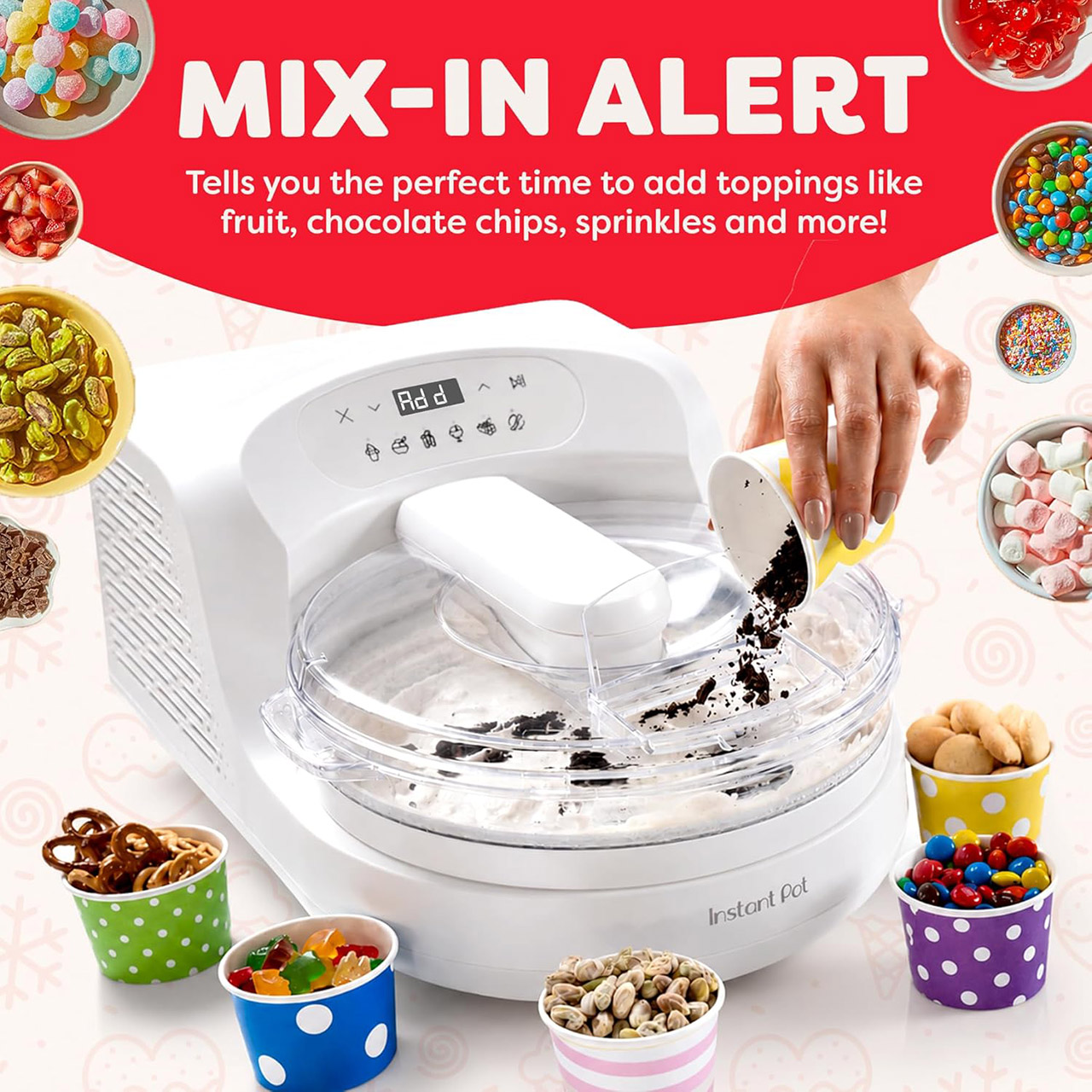
Cleaning up is also simple because the churning paddle can be washed in the dishwasher, the bowl rinses quickly, and the cold plate only requires a damp towel. You don’t have to disassemble it or get into any weird positions; just a quick clean and it’s done. Some early response has emphasized the creamy results (whether you’re making dairy or non-dairy), the consistent time, and the fact that people want to use it on weeknights rather than just special events.

Up until a few weeks ago, I had never heard of the Tartan Army (despite being one-quarter Scottish and having an actual family tartan of my own!). But now that the World Cup has begun and the Scotland fans known as the Tartan Army have descended on my home state of Massachusetts, they’re inescapable. And that’s not a bad thing.
Full disclosure: I live in a suburb outside Boston, so I haven’t had any firsthand experiences with any of these kilted soldiers, but I have been following their exploits in the news and on social media, and I’m so glad they’re here. (If I were in a neighboring house to visiting tourists who were playing bagpipes throughout the day, it’s possible I’d feel differently.)
The Tartan Army has been going viral over the past week or so, partly due to their sheer numbers — it’s estimated up to 40,000 Scottish fans have traveled to Massachusetts for the group stage of the tournament — and partly because of the festive atmosphere they’ve brought to places like Fenway Park. Upwards of 10,000 fans attended a Red Sox game last weekend, and on the streets, they’ve marched while wearing their signature kilts and playing the bagpipes. And they’ve done their research as tourists, too.
They know that the real tourist attractions in Boston are Dunkin’ and the Cop Slide, a slide at the playground on Boston’s City Hall Plaza known for causing injuries because some people accelerate so fast. The slide went viral when a police officer attempted to use the slide and… it didn’t go well. (We can laugh now because he’s OK.) But this is why we now have a video of a man playing the bagpipes while descending the Cop Slide.
I don’t know if anyone thought that would be one of the byproducts of hosting the World Cup, but this World Cup has provided us with so many unexpected and delightful moments. The Cape Verdean goalkeeper, Vozinha, who went from virtual unknown to worldwide legend during his team’s 90-minute match against Spain, is another story that’s sparking joy, along with yet another viral police officer video, this time of Boston cops joyfully dancing with fans after the Cape Verde-Spain match. All these little dopamine hits really add up.
Bostonians and most New Englanders have a reputation for not being warm. It’s a remnant of the Puritanical and stoic values imported by our earliest settlers and that have lingered for centuries — this can make us seem standoffish and aloof at times, when really it’s more an innate reservedness that some of us can’t shake, no matter how hard we try. But the Scots are cracking our tough outer shell, at least temporarily.
A scroll through TikTok will turn up dozens of videos of gratitude, both from the Scots, thanking Boston for the warmth they’ve been shown, and from locals who have been charmed by the exuberant and joyful visitors. Fans and pundits alike keep talking about how the World Cup really has become the great unifier we need right now, and the influx of Scottish tourists in our state feels like it has lifted the local mood.
But alas, we won’t get to call the Tartan Army ours for long. The team and their fans will stick around for one more match on June 19 against Morocco before traveling down to Miami for their final group-stage match against Brazil on June 24. Sure, Miami has beautiful beaches, and we’ll probably get a viral video of a bagpiper on a jet ski out of this, but we’ll miss the Tartan Army when they’re gone. At least we’ll always have Cop Slide.
from the building-state-TV dept
CNN brass have been waiting to get federal approval of their problematic $111 billion merger with Paramount. As we’ve detailed exhaustively, the high debt load from the CBS/Paramount and Warner Brothers merges is going to result in mass layoffs, higher consumer prices, and sagging quality control at the resulting company. It’s what always happens. It’s not really a debate.
Curiously, while CNN has been waiting for regulatory approval, their resident fact checker, Daniel Dale, appears to have curiously disappeared from the company’s cable TV schedule:
“In late February, Daniel Dale appeared on CNN to dismantle the more than 20 false or misleading claims that he identified during Donald Trump’s State of the Union address…But that appearance, more than three months ago, marked the last time Dale was seen on CNN’s air for his trademark rapid-fire fact checks.”
Shortly after the Status story popped up, Dale just as curiously appeared on air again. Along with a statement of denial from CNN that they’d ever try to court regulatory favoritism by dampening their journalism:
“There is no truth to this. Daniel is a multiplatform reporter whose regular fact checks of the President are an important part of CNN’s political coverage. Like all CNN reporters, his on-air appearances are determined by the news of the day — any suggestion otherwise is false.”
Maybe that’s true. Maybe it’s not. Nothing we’ve seen from major corporate media outlets during Trump’s tenure should indicate they’re deserving of any benefit of the doubt. Last Friday the Trump DOJ approved the deal, falsely claiming it will be great for competition and labor. CNN brass almost certainly already knew approval was coming before they put Dale back on the air.
One thing of note. There’s been a lot of hushed reverential commentary about what’s potentially happening to CBS and CNN. As if these corporate journalism outlets hadn’t been steadily degraded for years by corporate ownership. As if CNN and CBS didn’t go well out of their way to hire more lying on-air authoritarians as a direct act of appeasement to Trumpism even before the mergers.
That said terrible U.S. media can always get worse; and recall the reporting from last fall that Larry Ellison personally met with Trump to carve out which CNN analysts they’d have fired post-acquisition.
Like the CBS Ellison acquisition (where we saw Skydance execs making management decisions before the ink was dry), not yet having a signed deal won’t prevent companies like this — in a country with no working regulators — from getting a running head start on their ambitious censorship plans.
Filed Under: censorship, consolidation, daniel dale, donald trump, fact checking, first amendment, larry ellison, media, mergers, propaganda, state television
Companies: cbs, cnn, paramount


In 2012, a new form of bootkit was demonstrated. Instead of targeting machines through the BIOS or master boot record, one such bootkit attacked Mac OS X systems by infecting the EFI, a package of firmware that started the boot process. A second very primitive bootkit targeted Windows 8 machines by infecting the UEFI bootkit, the predecessor to the UEFI. Around 2013, a researcher demonstrated a more advanced UEFI bootkit for Windows named Dreamboat.
The first known case of a real-world attack targeting the UEFI came in 2018 with the discovery of malware dubbed LoJax. A repurposed version of legitimate anti-theft software known as LoJack, it was created by the Kremlin-backed hacking group tracked under names including Sednit, Fancy Bear, and APT 28. The malware was installed remotely using malware tools that can read and overwrite parts of the UEFI firmware’s flash memory.
In 2020, researchers unearthed the second known instance of real-world malware attacking the UEFI. Each time an infected device rebooted, its UEFI checked whether a malicious file was present in the Windows startup folder and, if not, installed it. Researchers from Kaspersky, the security provider that discovered the malware, named it “MosaicRegressor.” Researchers have yet to determine how the compromised UEFIs became infected. Since then, a handful of new UEFI bootkits have come to light. They are tracked under names including ESpecter, FinSpy, and MoonBounce.
Necessity is the mother of invention
In response to the more menacing threat of UEFI bootkits, Microsoft worked with device makers to develop Secure Boot, an industry-wide standard that uses cryptographic signatures to ensure that each piece of firmware loaded during startup is trusted by a computer’s manufacturer. Secure Boot is designed to create a chain of trust that prevents attackers from replacing the intended bootup firmware with malicious firmware. If a single link in the startup chain isn’t recognized, Secure Boot will prevent the device from starting.
Tech
SanDisk Packs 8 Terabytes Into a PlayStation 5 Drive Built for Owners Who Hate Deleting Games, Costs Nearly $3K


SanDisk designed its latest storage expansion with a very specific group in mind. PlayStation 5 and PS5 Pro owners who have watched their internal space fill up quickly now have an official way to add serious room without constant file management. The Optimus GX Pro 850P arrives as an 8TB M.2 NVMe drive that carries full Sony licensing and a custom heatsink shaped to drop straight into the console’s expansion slot.

Installation is simple because the drive has already been modified to match Sony’s basic criteria for the PS5 family. It’s just the standard M.2 2280 size, connects via the blisteringly fast PCIe 4.0, and has a top-tier cooling to keep the temperature under control, all within the sealed bay. You also don’t have to deal around with any extra parts or changes. Owners simply pop the side panel, slip it in, and the console will automatically configure itself for immediate use on either a conventional PS5 or a PS5 Pro.

PlayStation®5 console – 1TB
- PlayStation 5 Console – 1TB, includes wireless controller, 1TBSSD, Disc Drive, 2 Horizontal Stand Feet, HDMI cable, AC power cord, USB cable, printed…
- 1TB of Storage, keep your favorite games ready and waiting for you to jump in and play
- Ultra-High Speed SSD, maximize you play sessions with near instant load times for installed PS5 games
Performance is also exceptional, with sequential reads reaching a stunning 7,200 megabytes per second and writes coming up close at 6,600 megabytes per second on the 8TB version. Random read/write operations exceed an eye-watering 1.2 million IOPS (input/output operations per second) in both directions, resulting in flawless game streaming and lightning-fast loading, even with enormous open-world titles or numerous installs running.
Capacity is perhaps the main draw here, as the 8TB disk can store approximately 200 games with an average file size of 36 gigabytes each. So, whether you have a large back catalogue or are a completionist who buys every big release, you don’t have to worry about which previous games to retire to make way for something new. Furthermore, the drive works just as well in a Windows desktop with an open M.2 slot if you wish to switch systems later.
SanDisk backs up its claims with a 4,800 TBW (terabytes written) durability rating and a robust 5-year warranty. The homemade heatsink even bears the PlayStation logo and fits inside the console’s height constraints, which is quite useful. So, both power draw and thermal performance can withstand extended gaming sessions inside the PS5 chassis.
Now, the price is currently around $2,960. That includes Sony’s official licensing costs and the price of the high-capacity memory itself, as well as all of the additional labor and testing required for console approval. Similar high-end computer drives are expected to be much cheaper, although they will most likely lack the fancy heatsink and Sony certification.


For decades, data professionals have struggled with the challenge of managing both operational and analytical databases in a unified approach that doesn’t introduce latency and performance degradation.
Agents made the problem structural. A system that reasons continuously and acts on live data cannot tolerate a pipeline between itself and the information it needs to act on.
At the Data + AI Summit on Tuesday, Databricks announced two products aimed at collapsing that infrastructure. Lakehouse//RT delivers millisecond query latency directly on governed Delta and Iceberg tables, eliminating the dedicated real-time serving tier that enterprises have maintained alongside their lakehouses. LTAP, short for Lake Transactional/Analytical Processing, stores Postgres-native transactional data in Delta and Iceberg format from the point of write, removing the ETL pipelines that have connected operational and analytical systems for decades.
Reynold Xin, co-founder of Databricks, described a simpler data stack as “the holy grail for agents” in a briefing with VentureBeat, arguing that as users vibe code more applications, the agents reasoning analytically on top of those apps need the underlying infrastructure out of the way to move fast.
“The agents really prefer a much simpler stack, because they can move way faster,” he said.
LTAP bets on storage-layer unification where HTAP tried engine convergence
Many vendors have tried various approaches over the decades to unify analytical and transactional data.
Back in 2014, analyst firm Gartner coined the term HTAP, an acronym that stands for Hybrid Transactional/Analytical Processing as a way to describe vendors that attempted to unify the two types of databases. Vendors including MemSQL (now known as SingleStore) SAP HANA and Oracle’s MySQL Heatwave are among many HTAP vendors in the market.
LTAP is Databricks’ answer to HTAP, using the Lakebase architecture to unify data at the storage layer rather than the engine level. Lakebase is Databricks’ serverless cloud-based PostgreSQL database service that became generally available in February.
“HTAP to us is kind of more of a failure of the industry rather than a success,” Xin said.
The LTAP approach goes to the storage layer instead of the query layer. Lakebase previously stored Postgres data in Postgres format on object storage, requiring conversion before the Lakehouse’s analytical engines could use it efficiently. With LTAP, transactional data lands directly in Delta or Iceberg format, sharing the same copy that analytical workloads read. Postgres remains the transactional engine. Spark and the Lakehouse remain the analytical engine.
“The whole point is, hey, you use the best tool for the job at the query engine level, we just make sure underlying storage is a single copy of the data,” Xin said.
The central engineering challenge is latency. Object storage carries response times in the seconds range, far too slow for OLTP workloads that require sub-millisecond performance. Lakebase handles this through a caching layer between Postgres compute instances and object storage. The key design decision is where the column conversion happens: idle CPU capacity in that caching layer performs the row-to-column conversion before data lands in object storage.
“When you convert data from row to column, it compresses more than 10 times, typically, so now you substantially reduce the network cost of that basic caching layer between that caching layer and the object stores,” Xin said.
Lakehouse//RT delivers millisecond query latency on live lakehouse data without a separate serving tier
Lakehouse//RT is Databricks’ answer to the dedicated real-time serving tier — the separate system enterprises have maintained alongside their lakehouses to handle low-latency queries, at the cost of data copies, split governance and pipeline complexity agents cannot work around. Key capabilities of Lakehouse//RT include:
Reyden compute engine: Built specifically for high-concurrency, low-latency serving, Reyden queries Delta and Iceberg tables directly without moving data out of the lakehouse.
Latency and throughput: Lakehouse//RT delivers sub-100ms latency at 12,000 queries per second, with response times as low as 10ms on smaller datasets and up to 16x better performance than existing dedicated serving stacks.
Governance and data access: Every query runs within Unity Catalog’s governance framework with no separate permissions layer, no data copies and no ingestion pipelines.
VB Transform · July 14–15 · Menlo Park · Agentic context layers
Your agents are only as good as the data they can reach.
Sessions at Transform cover the RAG architectures powering agentic systems at scale — including how enterprises are connecting agents to live genomics, clinical, and enterprise data.
Analysts see the agentic framing and open format approach as the real differentiators
The problem both products address is well-documented among enterprise data teams, but analysts draw a distinction between the pain point and the specific claim Databricks is making.
“Enterprises have had HTAP, streaming, cloud warehouses, and operational stores for years,” Stephanie Walter, Practice Leader for AI Stack at HyperFRAME Research, told VentureBeat. “What is different is the agentic AI framing.”
Walter noted that agents need live operational data, historical context, governance, retrieval, and write-back in the same workflow.
“That is a strong architecture argument, but Lakebase still has to prove it can meet the latency, reliability, and operational maturity CIOs expect,” she said.
Mike Leone, analyst at Moor Insights and Strategy, said the path to genuine differentiation is more specific than the unification concept itself. He also noted that open analytics on a data lake is table stakes now, with many vendors providing some sort of service.
“The less common move is letting the transactional writes land in open formats too, so the operational database isn’t sitting in a proprietary box while only the analytics half is open, “Leone told VentureBeat.
He added that the open format approach, paired with Lakehouse//RT querying live data directly off the lake, is what gives the architecture a credible case for retiring a whole row of specialized systems.
The technical claim that will face the most scrutiny is also the most central one. “The piece I’d still want their engineers to walk through is how both engines truly share one copy without a quiet conversion step doing the syncing in the middle,” Leone said.
What this means for enterprises
For data engineers evaluating their stack for agentic workloads, the question is no longer which best-of-breed tool to run for each job — it’s whether running separate tools at all is still defensible.
Enterprises that built separate operational databases, real-time serving tiers and analytical lakehouses could previously treat the gaps between them as a maintenance burden. Agents surface those gaps as an operational risk: a system reasoning across governance boundaries will find the inconsistencies faster than any human team.
The market is moving away from specialized serving layers faster than most vendor roadmaps anticipated. According to VB Pulse Q1 2026, a three-wave longitudinal survey of 100-plus employee organizations, hybrid retrieval intent tripled from 10.3% to 33.3% across the quarter while standalone vector database adoption declined across every tracked vendor. The same consolidation logic is now hitting the real-time serving tier.
The traditional approach — best-of-breed tools for each workload type, pipelines between them — was built for human-speed analytical consumption. Agent workloads don’t tolerate that architecture.
“The pain they’re pointing at, all the copying and syncing between operational and analytical systems, is real and expensive, and anyone running this at scale feels it,” Leone said.
Tech
Collecting robot training data is dirty, unglamorous work. Some AI labs are already paying XDOF to do it
Two weeks ago, OpenAI said it would relaunch the robotics program it shuttered in 2021 — the latest signal that the biggest AI labs are racing to teach machines to operate in the physical world. But building capable robots requires something the AI industry doesn’t yet have, which is the training data to match that used for language models.
That gap is creating a new kind of infrastructure business. Unlike LLMs that were trained on a vast sea of publicly available text, robots need data that captures physical interaction, and that kind of data barely exists. YouTube videos and footage captured by gig workers are low-fidelity and hard to reconcile with the physical world.
XDOF (pronounced “ecks-doff”), emerging from stealth today, is betting that the next great bottleneck in AI isn’t models or chips, but the data feedback loop needed to teach robots how to interact with the physical world.
The startup aims to build the data pipelines, collection tools, and annotation systems that frontier labs and robotics companies can’t easily build themselves — and has raised $70 million from Thrive Capital, Spark Capital, a16z, Lux, and WndrCo to do it. Co-founder and CEO Philippe Wu says XDOF, which has about 60 employees, is already working with 20 customers including several frontier AI labs, but cannot name them.
“All of the top labs are trying to pursue robotics,” Wu said. “We’ve already seen some of the downfalls of falling a little bit behind in the language model race … you don’t want to be in this type of situation where you pursue this technology too late, and everyone is in this boat where physical AI is the next frontier.”
Wu ran into this problem himself as a PhD student at UC Berkeley. His focus was on enabling robots to learn skills from large-scale data sets. There was just one problem.
“We didn’t have large-scale data to work with,” he told TechCrunch. “There was this chicken-and-egg problem — we first needed to actually collect data before we could even ask how to train a foundation model for robotics.”
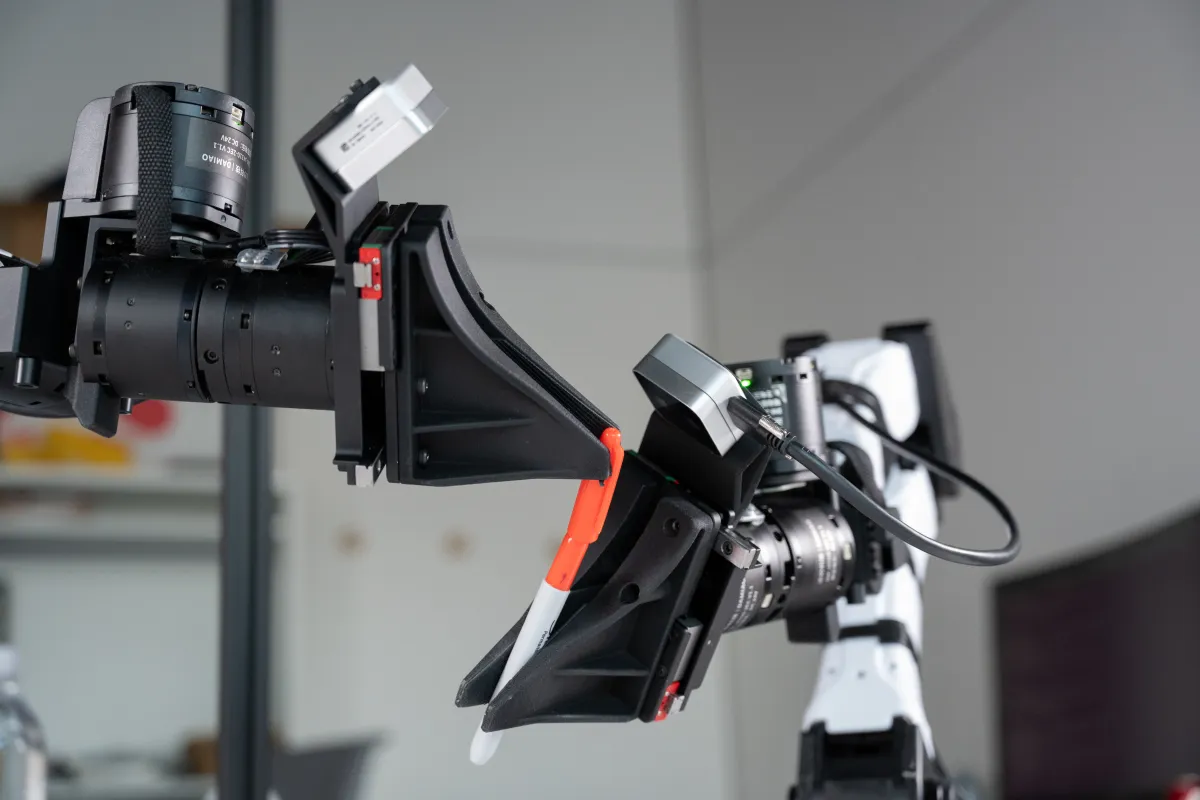
Wu and his future XDOF co-founder and CTO, Fred Shentu, worked on a project called GELLO, a low-cost teleoperation system that lets a human operator control a robotic arm to generate training data. “It ended up becoming a very influential paper in robotics, because a lot of people had similar needs and bottlenecks, and many started leveraging this type of device for data collection,” Wu said.
Spotting the opportunity, Wu, Shentu, and third co-founder and Chief Operating Officer Nemo Jin launched XDOF in October 2024 to provide a data ecosystem for companies pursuing robotics models. Mindful that data provision alone can be a dead-end business, the company is also focused on data cleaning, tooling, and annotation — creating a self-reinforcing feedback loop for robot trainers.
As a starting point, the company is partnering with UC Berkeley’s AI Research lab to release what it believes is the largest collection of high-quality robot training data ever assembled, dubbed ABC. It includes 130,000 trajectories of robot manipulation data, 300 hours of simulation, and 100 hours of evaluations. That kind of scaled-up pre-training data has never been available to academia before.
“We’ve seen in language, image generation, and other fields, that when models and data are released, the community achieves things that you wouldn’t necessarily have expected,” David McAllister, a Berkeley PhD student who helped organize the release, told TechCrunch.
The team has already used the data to train robots on benchmark tasks like folding T-shirts and flattening boxes, or loading AirPods into their cases.
Unlimited degrees of freedom
The company plans to work across three tiers of a data pyramid. The most valuable tier is teleoperation data collected on the actual robot being deployed; next comes teleoperated robots gathering more general data, as with GELLO; and finally “egocentric” data gathered by humans performing everyday tasks, for which XDOF plans to build its own wearable sensors.
“Your camera choice is going to affect the quality of your data — which is going to affect how your hand-tracking algorithm performs,” Wu said. “If you don’t design the hardware well from the start, the data you collect might have very specific problems that you didn’t anticipate.”
The company plans to hire and train armies of teleoperators and egocentric data operators around the world — a labor-intensive model that raises an obvious question: Why aren’t the major labs doing this data production work themselves?
“You need a warehouse of hundreds of thousands of square feet with hundreds of robots,” Wu said. “You need to maintain these robots, calibrate their physical parameters, and properly train operators.”
It’s a build-out that requires focus, capital, and operational scale that most AI labs would rather outsource — which is precisely the market XDOF is betting on.
The name XDOF is a play on the robotics term “degrees of freedom,” which describes the number of independent motions a robot can perform. Your arm, from shoulder to wrist, has seven degrees of freedom. Humanoid robotics company Figure.AI’s latest robot has 30. The X in the company’s name captures its ambition: “Arbitrary degrees of freedom, unlimited degrees of freedom,” Wu says.
When you purchase through links in our articles, we may earn a small commission. This doesn’t affect our editorial independence.


The beauty of Android Auto has always been that it seamlessly integrates your smartphone’s capabilities into your car’s dash display. Features like GPS, music, call, and text controls are at the top of the list for most people, but there are a lot of great Android Auto apps available that you probably aren’t using. These can expand the technology’s capabilities, putting ever more utility at your fingertips. What’s more, new apps and features come to Android Auto all the time. Some of these are released with a lot of noise and fanfare, but others get quietly added without so much as a peep from the company.
One new addition that has quietly joined the list of Android Auto-compatible apps is Adobe Acrobat Reader, which was added to the platform as part of the v26.5.0.45958 update. Your car’s touchscreen display might not offer as much fine control as a desktop when it comes to file modification, but there’s still a lot that this PDF maker, reader, and editor can do, even during your morning commute. Unfortunately, it looks like the full capabilities of this application will only be available to those who are subscribed to one of the Adobe Acrobat Tiers. That said, those already subscribed will find a surprisingly useful new tool at their disposal. Those who aren’t can still take advantage of several free-to-use features available, and even play around with some of the paid features via the platform’s 7-day free trial if they would like to try it out.
What’s free on the Android Auto Adobe Acrobat Reader?
In terms of free-to-use features, there isn’t much of the standard mobile toolkit that translates directly to your car’s dashboard. The free mobile version of Adobe Acrobat Reader allows you to access scanned PDFs and view them in the app’s Liquid Mode, which Adobe advertises as “the best PDF reading experience” available. This allows you to search and navigate documents as well as adjust font sizes and spacing. You can also annotate PDFs by adding sticky notes and comments, as well as being able to highlight text–a handy group of tools for revising and reviewing documents before sending them to others or simply leaving notes for yourself to make adjustments later. Then there’s the PDF signer. This allows you to fill out, sign, and send PDF documents. This could be handy for everything from schoolwork to legal documents. This PDF viewer and reader can also connect to Google Drive.
But here’s the caveat: You can’t perform any of these visual functions on your car’s screen. Android Auto disables those tools completely since it isn’t safe to read and drive. However, the free version is far from useless once plugged into your car. Instead, the update unlocks a built-in, traditional “Read Aloud” text-to-speech engine. For free users, the app functions like a basic media player, converting standard text PDFs into audio using system voices so you can safely listen to reports or documents cover-to-cover during your drive.
How’s the paid Adobe Acrobat Reader on Android Auto?
While the free “Read Aloud” feature is nice for basic listening, paid subscribers get something much better. The update lists the feature as “Paid” but states that users can “Choose free voices or upgrade for high-quality options.” This suggests that users will have access to the more natural, human-sounding voices that the company has developed for a superior listening experience. This is great for working professionals and students alike, as you can use your morning commute to review research papers or reports without needing to take your eyes off the road. Heck, you could even listen to a whole book if you had the inclination.
That isn’t all, either. The version available to Adobe Acrobat subscribers will include several other useful hands-free features. The app will give you access to Adobe Acrobat’s AI assistant, which lets you control multiple files with voice or text prompts. You can ask it questions and gather information, generate summaries, and connect with email, text, notes, and blogs. There’s also the full mobile editing suite, optical text recognition (OCR), a PDF merging tool, and compression tools. Unfortunately, it looks like the Android Auto version of the app is primarily just a basic media player. Currently, you can’t access these features through your dashboard, even though they’re hands-free; however, some have speculated they may become available in a future update.

MGK Moved To Safety As Another Concert Is Canceled Midway

Bolton police stage romance fraud awareness session in Nationwide

InCred Money gets Sebi in-principle nod for mutual fund licence, plans launch in 6-9 months


-

 Business3 days ago
No Jackpot Winner as $257 Million Prize Rolls Over to $269 Million Monday Draw
-

 Crypto World6 days ago
Oppenheimer backs SpaceX as $70 billion retail frenzy builds
-

 Fashion5 days ago
Weekend Open Thread: Tuckernuck – Corporette.com
-

 Crypto World6 days ago
Markets Rally as SpaceX IPO Looms Amid Iran Tensions and Inflation Surge
-
 Crypto World3 days ago
Zimbabwe Requires Crypto Businesses to Register Annually Under New FIU Regulations
-

 Tech5 days ago
NanoClaw integrates JFrog registries to secure AI agent downloads
-

 Crypto World4 days ago
Bitget enters Argentina’s regulated crypto market through PSAV registration
-

 Tech5 days ago
This Week In Security: Microsoft On Microsoft, Register Your Domains, Linux On ARM, And FreeBSD Joins The File Cache Club
-
 Tech6 days ago
Dutton Ranch star claims they ‘didn’t see any disruption’ on set following Chad Feehan’s exit from Yellowstone spinoff fueled by Taylor Sheridan clash rumors
-

 NewsBeat6 days ago
El Nino has formed in the Pacific and could set records, forecasters say
-

 Politics6 days ago
Politics Home | Healey Resignation Is “Colossal Failure Of Government”, Says Former Labour Defence Secretary
-
 Entertainment6 days ago
Donnie Wahlberg & More Heat Up Las Vegas at Circa’s Barry’s Downtown Prime
-
 Tech6 days ago
Opendoor Ends India Operations, Fueling a Bigger Conversation About AI and Outsourcing
-

 Politics6 days ago
Belfast burns, while Met chief points finger at Iran and Russia
-

 Sports6 days ago
First Time Since 1971: Australia Register Historic Low In ODI Cricket
-

 NewsBeat5 days ago
FBI searches office of Ohio voter registration group
-

 Business6 days ago
AT&T: Verizon's 27% Outperformance Sets Up A Solid Entry Point
-
 Tech6 days ago
Anthropic is spending $150M to embed 1,000 AI fellows inside nonprofits. No degree required.
-

 Politics6 days ago
Modi thanks Trump for wishes as US attacks Indian seafarers
-
 Entertainment6 days ago
‘The Pitt’s Fan-Favorite Doctor Confirms Noah Wyle Gave His Blessing to Return [Exclusive]
You must be logged in to post a comment Login