

Crypto World
Bitcoin and Ethereum Derivatives See $1.7B Binance Open Interest Reset


TLDR:
- BTC open interest on Binance swung nearly $878M, from +$258M to -$620M within 24 hours.
- ETH Binance open interest dropped $821M, falling from +$131M to -$690M in under 48 hours.
- Bybit and Deribit also posted negative OI changes, confirming a broad cross-venue deleveraging.
- BlackRock’s IBIT and ETHA led spot ETF inflows even as derivatives exposure contracted sharply.
Bitcoin and Ethereum derivatives markets recorded a sharp synchronized open interest reset on Binance, the sharpest since April 2026.
BTC open interest change on Binance swung from +$258 million to -$620 million within 24 hours, a net reversal of nearly $878 million.
Ethereum followed almost simultaneously, with open interest change on Binance falling from +$131 million to -$690 million. Together, the two assets posted a combined Binance open interest swing of roughly $1.7 billion.
BTC and ETH Derivatives Exposure Contracts Across Major Venues
The Bitcoin open interest reset on Binance marked one of the sharpest single-day reversals recorded since April 2026.
The move from +$258 million to -$620 million represents a net swing of nearly $878 million over 24 hours. That scale of reversal reflects a meaningful shift in how traders were positioning across BTC derivatives.
Ethereum’s open interest change on Binance fell from +$131 million to -$690 million within a window of less than 48 hours.
The net decline came in at approximately $821 million, making it a near-mirror of what played out on the Bitcoin side.
Both moves occurred within the same narrow time frame, pointing to a coordinated reduction in derivatives exposure rather than isolated activity.
The reset was not confined to Binance alone. Other major derivatives platforms recorded negative open interest changes during the same period. Bybit posted approximately -$116 million on Ethereum, while Deribit recorded around -$78 million on Bitcoin.
Together, the cross-venue contraction adds further evidence that this was a broad derivatives deleveraging event. Position closures spanning multiple platforms and both major assets suggest traders were broadly reducing risk rather than rotating within specific markets.
Spot ETF Inflows Continue Amid Derivatives Pullback
On the spot market side, U.S. spot Bitcoin ETFs recorded total net inflows of $10.0643 million on June 16, according to SoSoValue data.
BlackRock’s IBIT led the Bitcoin ETF category, pulling in $16.3526 million in net inflows on that date. The inflow data shows continued institutional appetite for Bitcoin exposure through regulated products.
Spot Ethereum ETFs recorded total net inflows of $9.5876 million on the previous day. BlackRock’s ETHA led the ETH ETF category, recording $17.3358 million in net inflows.
The positive flows occurred even as derivatives positioning across ETH markets contracted sharply on Binance and other venues.
This type of synchronized open interest contraction typically reflects aggressive position closures, reduced leverage, or traders cutting risk after a heavily positioned market period.
It does not automatically confirm bearish price continuation. However, it does confirm that derivatives exposure across both BTC and ETH has been sharply reduced.
The divergence between declining open interest and continued spot ETF inflows presents a split picture across market structure.
Derivatives traders appear to be reducing risk, while ETF investors continue adding exposure through regulated channels. How these two dynamics interact in the near term will likely shape price behavior for both assets going forward.




Tether is winding down Alloy by Tether and its gold-backed derivative stablecoin aUSDT after reviewing user activity, market demand and wider business priorities.
Summary
- Tether is ending Alloy and aUSDT while steering users toward XAUT and core stablecoin products.
- Users can return aUSDT for XAUT until Sept. 17 before recovery through Alloy fully ends.
- The move follows Tether’s wider shift toward liquid products, tokenization, AI, robotics and infrastructure bets.
The company said it will stop support for the product in phases, starting with an immediate block on new positions and new aUSDT minting.
The move ends a product launched in June 2024. Alloy allowed users to deposit Tether Gold, or XAUT, as collateral and mint aUSDT through Ethereum smart contracts. The structure gave users dollar-like liquidity without selling their gold exposure. It also gave Tether a live test of how users treat gold-backed collateral in on-chain markets.
Users face September deadline
Tether said existing users can still return aUSDT and remove their XAUT for three months. The cut-off date is Sept. 17, 2026. After that date, users who have not returned aUSDT will no longer be able to recover XAUT through the Alloy platform.
The company said Alloy gave it data on demand for gold-backed digital assets, collateral products and tokenized real-world assets. It said it will now focus on products with “stronger user demand, deeper liquidity, and broader long-term market opportunity.” Alloy’s market cap stood near $1.2 million, backed by 14.73 kilograms of gold worth about $2.2 million, according to Tether.
XAUT stays at center of gold strategy
The decision does not mark a pullback from tokenized gold. Tether is keeping XAUT as a core product. XAUT gives users exposure to physical gold through a blockchain-based token, while aUSDT was a separate product built on top of XAUT collateral.
As previously reported by crypto.news, Tether listed XAUT on Maxbit in Thailand as demand for gold-backed digital assets grew. That report also noted that aUSDT was designed to track one U.S. dollar while relying on gold reserves rather than a standard fiat reserve model. Tether has since kept XAUT closer to its main gold plan than Alloy.
By comparison, XAUT remains much larger, with about $3 billion in market value and more than 22,000 kilograms of physical gold backing, according to company figures. That gap helps explain why Tether is keeping the gold token while ending the smaller derivative product.
Tether trims smaller products
Alloy is not the only product Tether has cut. In February, Tether said it would stop supporting CNHT, its Chinese yuan stablecoin, due to low interest and limited community demand. The company had also stopped support for EURT, its euro stablecoin, after citing market and regulatory conditions in Europe.
These moves show a tighter product strategy. Tether is keeping focus on USDT, XAUT and infrastructure that can support larger market demand. The company has also built Hadron, its tokenization platform, and has looked at new currency products, including a planned Georgian lari stablecoin.
Tether’s product review comes as the company expands outside stablecoins. It has put money into Bitcoin mining, artificial intelligence, cloud tools and robotics. As previously reported by crypto.news, Tether joined Neura Robotics’ $1.4 billion funding round alongside firms such as Nvidia, Amazon and Qualcomm.
The company has also been active in tokenization partnerships. As previously reported, Tether signed an MoU with DMCC to explore blockchain adoption, digital payments and tokenized asset projects in Dubai. The aUSDT wind-down fits that wider shift toward products with more liquidity, clearer use cases and larger markets.
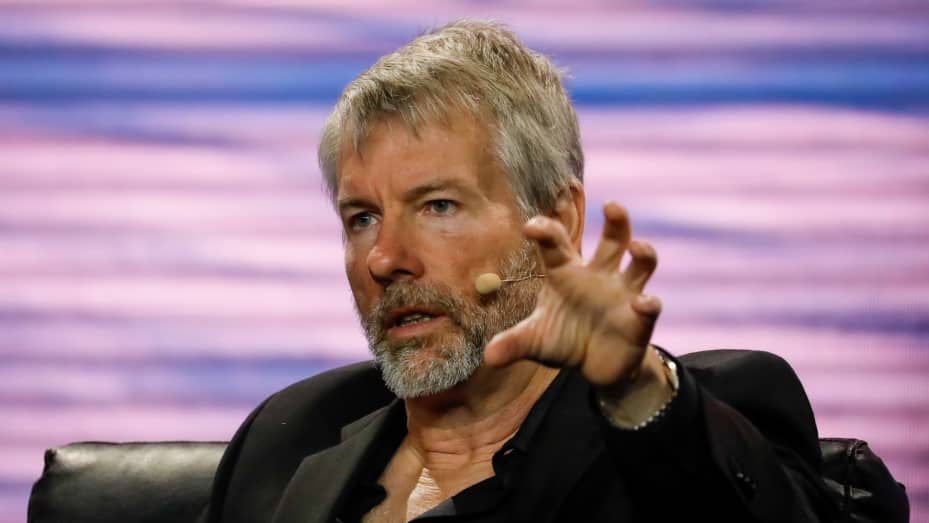
Strategy executive chairman Michael Saylor says the company’s core purpose is creating financial products backed by Bitcoin (BTC), a business model he compared to a reserve bank.
According to him, Bitcoin’s next stage of development should be about building a layered capital market around it.
From Digital Gold to Digital Architecture
In a June 16 article published on X, Saylor crowned BTC as the foundation of a digital asset stack that includes digital credit, digital money, digital yield products, and digital equity.
According to him, Bitcoin’s heavy price volatility is exactly what makes it suitable as a base asset for financial products that satisfy different investor needs. He propounded that corporations, banks, insurers, retirees, and payment companies may soon drift towards other forms of exposure and away from directly holding Bitcoin.
“The answer is not to change Bitcoin, it is to build products above Bitcoin that match the needs of each pool of capital,” the American entrepreneur’s article read.
He also explained that digital money should be pegged to fiat since the world’s obligations are still priced in fiat. In his opinion, most people don’t want a checking account that moves 5% in a day, and stablecoins have proved there’s genuine product-market fit for digital dollars.
That broader view was echoed by analyst Maksym Sakharov, who recently argued that Bitcoin’s long-term use case extends beyond the “digital gold” narrative. According to him, settlement activity, collateral usage, and financial infrastructure built around Bitcoin may become more important adoption metrics than short-term price performance.
For Saylor, that evolution is already underway.
“Bitcoin remains Bitcoin,” he wrote. “The world builds on top.”
Speaking in an interview with Coin Stories host Natalie Brunell during the annual BTC Prague conference, Saylor clarified how the largest publicly traded BTC treasury company uses its holdings to support credit instruments for investor income.
“Yeah, well, our company is like a Bitcoin reserve bank. The idea of the company is you have a tower of equity of $50 billion or more of equity capital, you own Bitcoin with that equity capital, and then you issue credit against it,” he told Brunell.
Saylor Pushes Back Against Critics
The Strategy executive chairman also pushed back against critics, who’ve been laying into him for selling 32 BTC at the tail end of May and claiming that the company was part of why the market had been trading in the red.
“I got very, very famous for saying, you don’t sell your Bitcoin to the plebs. And on X, the Twitter trolls thought it’s pretty easy to say, ‘the most famous guy in the world for saying, don’t sell your Bitcoin, just sold some Bitcoin,’” the businessman said.
In the same interview, the permabull reaffirmed his belief that Bitcoin could see a 500x jump from its current levels, although it would need global credit markets to pull institutional capital into the Bitcoin ecosystem.
The post Michael Saylor Calls Bitcoin the Base Layer for a New Digital Capital Stack appeared first on CryptoPotato.


Stablecoin issuer Tether is winding down Alloy by Tether and its gold-backed, overcollateralized aUSDT stablecoin after just two years to focus on products and areas with stronger demand.
Tether announced its “strategic changes” on Wednesday following a review of user activity, market demand, and the company’s “broader priorities.”
Tether said it has decided to focus resources on areas where it is seeing “stronger user demand, deeper liquidity and broader long-term market opportunity,” including its gold-backed digital asset XAUT and other core products across its ecosystem.
While stablecoins remain Tether’s core business, the company has shown a growing interest in technology outside stablecoins. Its investments include Bitcoin mining infrastructure, artificial intelligence, cloud computing and robotics. Most recently, it led German tech company NEURA’s $1 billion funding round on June 11.
Tether’s aUSDT is an overcollateralized derivative product built on top of XAUT using Ethereum smart contracts, which also reflects the demand for gold-backed and tokenized real-world assets.
Alloy by Tether allowed users to deposit XAUT as collateral to mint aUSDT, with the value of XAUT locked exceeding the value of aUSDT issued, similar to how some stablecoins or synthetic dollars are created against crypto collateral in DeFi.
Users could borrow or mint against their XAUT holdings, letting them access dollar-like liquidity without selling their gold exposure.
Alloy by Tether, announced in June 2024, has a current market capitalization of $1.2 million and is backed by 14.73 kilograms of gold worth around $2.2 million, according to Tether.
Tether Gold remains popular
The winding down will happen in phases, the first of which starts immediately by preventing the opening of new positions or the minting of new aUSDT. Users have three months to return their aUSDT and reclaim their XAUT until the cut-off date on Sept. 17.
Related: Tether expands robotics push with lead role in NEURA’s $1B-plus funding round
XAUT remains popular with a market capitalization of $3 billion and is backed by 22,169 kilograms of physical gold, according to the company.
Its market cap surged earlier this year when gold prices hit an all-time high of just over $5,300 per ounce. However, it has retreated by 19% since then.
Tether also bought a 12% stake in precious metals platform Gold.com for $150 million in February, with plans to integrate XAUT into the platform.
Chinese yuan and euro stablecoins axed
Alloy by Tether is not the only product the company has shelved this year.
In February, Tether announced it was discontinuing its Chinese yuan stablecoin, CNHT, citing “evolving market conditions, low interest in the product, and limited sustained community demand,” relative to other supported assets.
In November, it wound down its euro stablecoin, EURT, citing European regulatory issues and a focus on other initiatives such as Hadron, its asset tokenization platform launched in 2024.
However, in May, Tether announced that it planned to launch a Georgian lari stablecoin, GELT, in cooperation with the government of Georgia.
Magazine: The end of anon? AI could unmask crypto’s hidden identities

Kentucky has sued five prediction market platforms, including Kalshi and Polymarket, adding to a wave of US states launching legal fights with prediction markets over sports event contracts.
State Attorney General Russell Coleman said in a statement Wednesday that his office filed lawsuits in state court against Polymarket and Kalshi — also naming Kalshi partners Coinbase, Robinhood and Webull — accusing them of “operating unlicensed and illegal sports betting and gambling platforms.”
“Kalshi and Polymarket are operating illegal sportsbooks in Kentucky and breaking our laws,” Coleman said. “These multi-billion dollar corporations and their legal fictions don’t pass the sniff test. As one of our state legislative leaders said it best, ‘If it looks like a duck and quacks like a duck…’”
Kalshi and Polymarket together recorded $25 billion in monthly trading volume in May, per Token Terminal. Lawsuits from multiple US states risk locking them out of some of the largest markets in the US.

Kentucky Attorney General Russell Coleman gives a speech in April. Source: YouTube
At least 17 other states have taken prediction market operators to court, attracting the involvement of the US Commodity Futures Trading Commission and the White House.
Multiple state authorities have argued that event contracts tied to sports are sports betting and require state-level licenses. Prediction markets have argued that their event contracts are swaps regulated under federal commodities law.
That position is backed by the CFTC, which has sued eight states after they took action against prediction markets, claiming they were stepping on its authority.
Kentucky’s lawsuits claimed that Polymarket, Kalshi and their partners are “doing business without a Kentucky gaming license or following state regulations” and that their sports event contracts “fall squarely within the definition of ‘sports wagering’ under Kentucky law.”
The state also alleged the platforms offer users “few or no resources” to identify or seek help for a gambling problem as required by state law.
A Polymarket spokesperson told Cointelegraph Kentucky’s action “runs counter to the CFTC’s established framework for regulating prediction markets. We look forward to addressing these claims through the appropriate legal process.”
Kalshi spokesperson Jacki McGavick told Cointelegraph that “Kalshi is a federally regulated exchange — the CFTC is our regulator, not the states. Courts have already recognized this, and we’re confident they will here too.”
The CFTC did not immediately respond to a request for comment.
Related: Prediction market battle gets closer to Supreme Court
Kalshi and Polymarket, through a coalition of platforms, are already tied up in legal action with Kentucky after suing the state on Friday to claim its first-in-the-country 14.25% tax on prediction market transaction fees is discriminatory and oversteps federal law.
Kentucky’s action comes after authorities in Montana, Nevada, Utah, Iowa, Illinois, Ohio, Tennessee, New York, New Jersey, Connecticut and Maryland had issued cease-and-desist letters to prediction markets and were subsequently sued by the platforms.
Washington, Arizona, New Mexico, Wisconsin, Michigan, Massachusetts and Kentucky have also chosen to sue prediction market platforms, including Kalshi.
Some of the legal battles have so far reached appeals courts and have seen mixed results. On Wednesday, a Michigan federal judge ruled against Polymarket in its lawsuit against the state, finding that its sports event contracts are not swaps under the CFTC’s authority.
Other courts have also sided with prediction markets, such as the Third Circuit Court of Appeals’ ruling in April that New Jersey regulators could not prevent Kalshi from offering sports event contracts in the state.
US President Donald Trump, whose son Donald Trump Jr. is on the advisory board for Polymarket and is an adviser to Kalshi, said in May that it was “critically important that the CFTC’s exclusive authority over Prediction Markets is maintained.”
Magazine: Should users be allowed to bet on war and death in prediction markets?


Bitcoin has recently been flirting with a level that has historically proved a near-perfect entry point for bulls, generating handsome returns, crypto exchange Kraken’s Chief Economist Thomas Perfumo told CoinDesk.
That level is the 200-week simple moving average (SMA), which represents the token’s average price over that period, providing traders with a clear glimpse of the long-term trend while cutting through day-to-day noise.
Twice in the past two weeks, BTC dipped briefly below its 200-week SMA before climbing back above it by the end of each week. As of writing, bitcoin is trading at $63,900, just above the 200-week SMA of $62,358.
That’s notable because, as per Perfumo, closes below this level have been rare, occurring on only about 10% of trading days since mid-2017, and have historically marked unusually attractive entry points for buyers.
“Historically, buyers at this level have gone on to see median returns north of 113% over the following year and 313% over two years,” Perfumo said in an email.
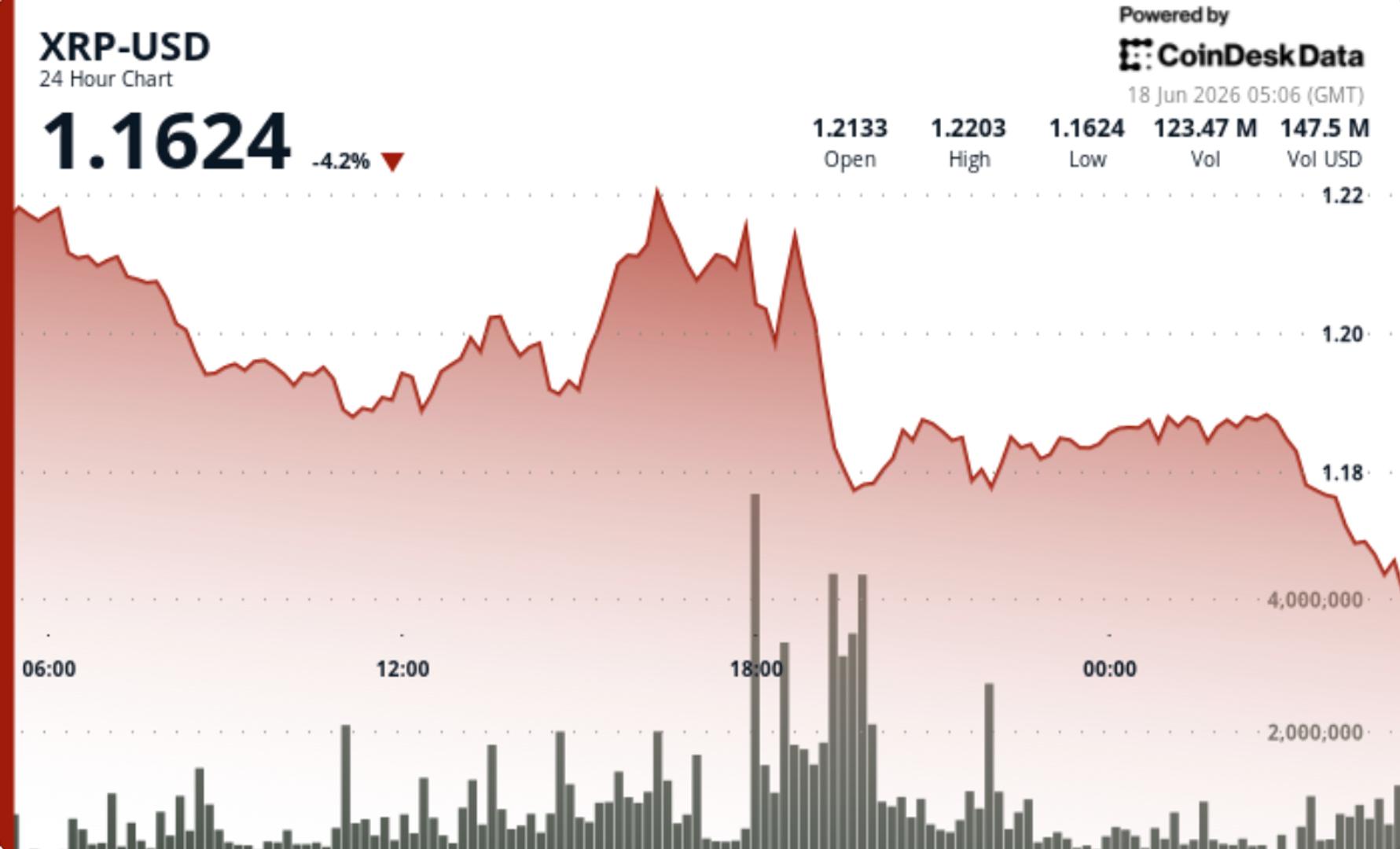
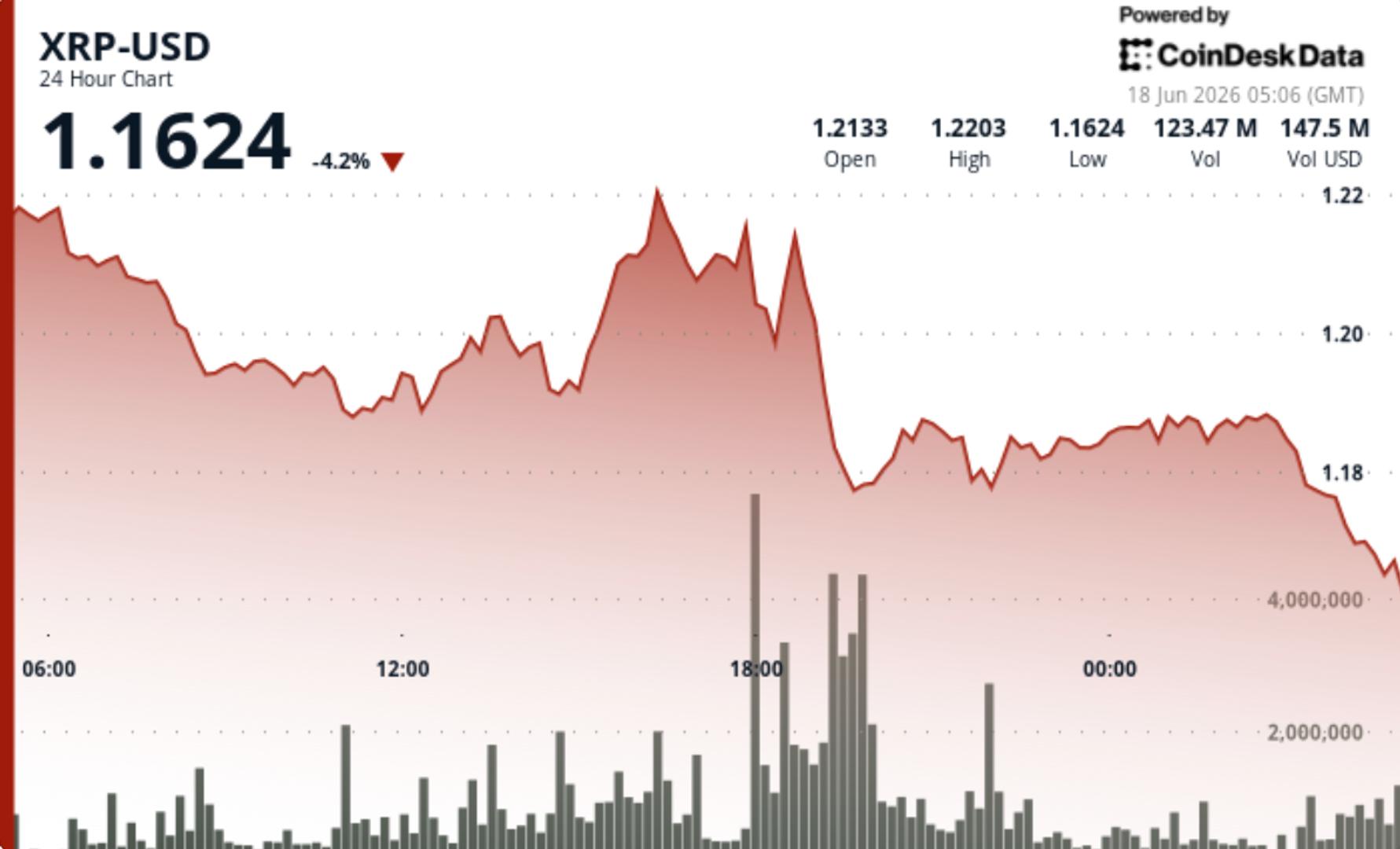
XRP’s push toward $1.25 ran into the same problem that has capped every rally since the spring selloff: sellers waiting overhead. After briefly trading above $1.22, the token lost the $1.20 level on heavy volume and spent the rest of the session trying to stabilize above support near $1.18.
The pullback doesn’t fully undo last week’s breakout, but it does show buyers still have work to do before the market can challenge higher resistance levels.
News Background
• XRP remains in focus after recent ETF inflows and growing institutional participation helped drive last week’s rally above $1.20.
• Analysts continue to watch the $1.11-$1.15 demand zone that launched the latest recovery, viewing it as the line separating a correction from a larger breakdown.
• Longer-term charts still show XRP trading beneath major moving averages despite the rebound from early June lows.
Price Action Summary
• XRP fell from $1.2170 to $1.1869 during the 24-hour session, losing 2.5%.
• Selling intensified during the June 17 19:00 UTC session when volume surged to 128.7 million XRP, more than double normal levels, breaking support at $1.20.
• The token later found buyers near $1.1750 and recovered modestly into the close, holding above the session low of $1.1747.
Technical Analysis
• The loss of $1.20 is the key development. That level had acted as support after XRP’s breakout above $1.14 and $1.18 earlier in the week.


Kentucky Attorney General Russell Coleman has filed lawsuits against Kalshi, Polymarket and several related partners, accusing them of offering unlicensed sports betting in the state.
Summary
- Kentucky says prediction markets crossed into sports betting, while platforms claim federal law controls contracts.
- Kalshi and Polymarket now face lawsuits, tax disputes, and split court rulings across several states.
- The CFTC backs federal oversight as state regulators push licensing, consumer protections, and gambling rules.
The Kalshi case also names Coinbase, Robinhood and Webull, which Kentucky says helped give users access to sports event contracts.
The lawsuits were filed in Franklin Circuit Court. They argue that the platforms offered markets tied to game winners, point spreads and player statistics without a Kentucky gaming license. Coleman said, “Kalshi and Polymarket are operating illegal sportsbooks in Kentucky and breaking our laws.”
State says sports contracts fall under betting law
Kentucky claims the products fit the state definition of sports wagering, even when platforms call them event contracts. The state says users can place trades on outcomes that look similar to wagers offered by licensed sportsbooks, including money lines, spreads and prop-style markets.
The attorney general’s office also accused the platforms of offering few or no tools for users who may need help with gambling problems. Kentucky law requires licensed operators to meet consumer protection rules. The state says those protections are missing from the platforms named in the cases.
Kalshi and Polymarket reject state control
Kalshi and Polymarket have argued in other cases that their products fall under federal commodities law, not state gambling law. Kalshi has said it operates as a federally regulated exchange under the Commodity Futures Trading Commission. A company spokesperson said, “The CFTC is our regulator, not the states.”
Polymarket has also pushed back against state action. The company said Kentucky’s lawsuit goes against the CFTC’s framework for prediction markets and said it will address the claims through the legal process. Both companies say state licensing rules should not control contracts listed under federal commodities oversight.
Broader legal fight grows across the U.S.
The Kentucky cases come as prediction market firms face pressure from several state regulators. Montana, Nevada, Utah, Iowa, Illinois, Ohio, Tennessee, New York, New Jersey, Connecticut and Maryland have sent cease-and-desist letters or taken legal steps against operators. Washington, Arizona, New Mexico, Wisconsin, Michigan, Massachusetts and Kentucky have also sued platforms tied to sports event contracts.
The CFTC has taken the opposite view in several disputes. The agency has sued states, saying event contracts traded on federally regulated exchanges fall under its authority. Courts have not reached one clear answer. The Third Circuit sided with Kalshi in a New Jersey case, while other courts have allowed state gambling cases to move forward. For users, the cases may decide which rules platforms must follow before offering sports markets.
Tax dispute adds another front
Kentucky is also fighting prediction market firms over taxes. A coalition that includes Kalshi, Crypto.com and Polymarket sued the state over a new 14.25% tax on prediction market transaction fees. The group says the tax targets federally regulated markets and treats prediction platforms worse than some state gambling businesses. The tax suit remains separate from the new gambling complaints.
The legal pressure comes as trading volumes and product lines grow. Kalshi has expanded into crypto-linked perpetual futures and reported more than $5.5 billion in volume within two weeks of launch. At the same time, compliance concerns are rising. Kalshi recently partnered with StarCompliance to help financial firms monitor employee prediction market trades.


It was the first decision under new Chairman Kevin Warsh, who said there had been rigorous debate before the vote and vowed the central bank would deliver price stability. A more hawkish Fed means tighter financial conditions, which tend to drain the liquidity that fuels risk assets like crypto.
Stocks took the week’s news better, helped by a separate development. President Donald Trump signed an interim deal to end the war with Iran and reopen the Strait of Hormuz, putting the agreement into effect.
S&P 500 futures rose as much as 0.9% and Nasdaq futures gained 1.5%, while Brent crude fell toward $78 a barrel. Crypto did not catch that bid, a sign it is trading more on the Fed than on the geopolitical relief for now.
Analysts expect bitcoin to stay rangebound until a clearer catalyst arrives.
“We expect bitcoin to continue to trade in the $60,000 to $70,000 range in the coming weeks absent any major catalyst,” said Gerry O’Shea, head of global market insights at Hashdex, naming the signing of the CLARITY Act, a crypto market-structure bill, into law or further US-Iran de-escalation as the kind of trigger that could break the range.
He added sentiment has been weak as IPOs and AI stocks pulled attention away from crypto, but expects capital to rotate back as institutional interest grows and regulation formalizes.
Bernstein has reaffirmed its buy rating on Coinbase and maintained a $330 price target after the company unveiled a series of new products designed to extend its business beyond crypto trading.
Summary
- Bernstein maintained a buy rating on Coinbase and kept its $330 price target after the System Update event.
- Coinbase unveiled AI-powered trading tools, prediction markets, tokenized stocks, and pre-IPO trading products.
- Barclays stayed bearish with a $107 target, while Benchmark and Cantor Fitzgerald remained bullish.
According to Bernstein, the latest announcements from Coinbase’s System Update event support its long-term bullish view on the company despite a sharp reduction from its earlier $440 target following the broader crypto market downturn.
Bernstein continues to see substantial upside in Coinbase shares, citing growth opportunities across stock trading, stablecoin infrastructure, blockchain services, custody, and institutional products.
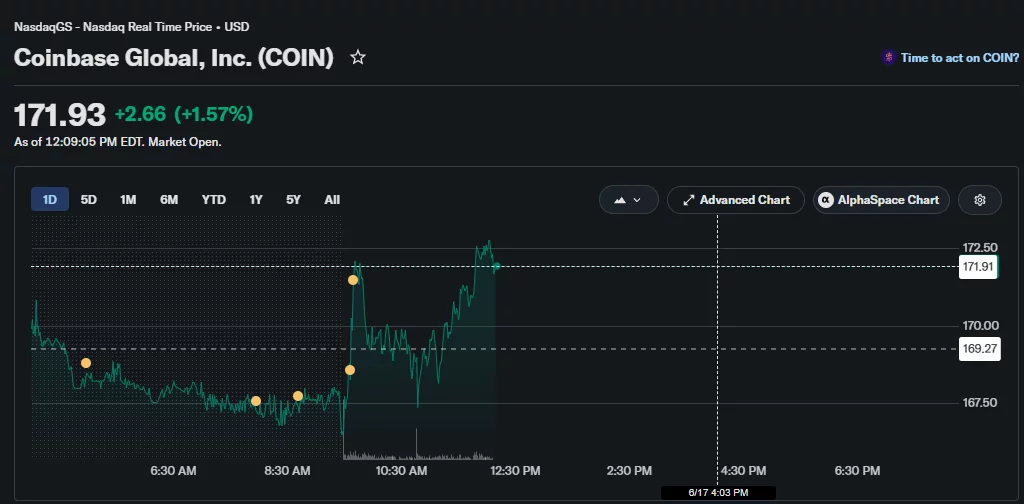
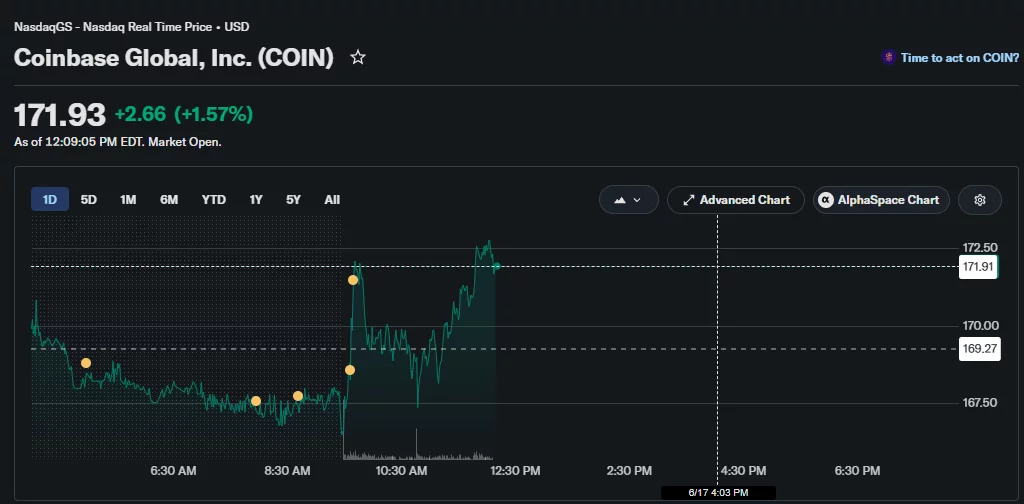
Coinbase shares traded higher on Wednesday, rising about 1.6% to around $171.93 after closing 0.2% lower at $169.27 in the previous session. While investors continued monitoring the Federal Reserve’s policy decision and the outlook for interest rates, several Wall Street firms reassessed Coinbase’s latest product expansion and long-term growth strategy.
Coinbase adds AI tools and traditional market products
During its System Update event, Coinbase introduced an SEC-registered AI investment advisor that can access customer portfolio data and account history. According to Coinbase Chief Executive Officer Brian Armstrong, users will be able to interact with the advisor through natural language prompts and receive portfolio suggestions directly through the platform.
The company also announced that artificial intelligence agents can now connect directly to Coinbase. Using systems such as ChatGPT and Claude, customers can establish trading parameters and authorize AI-powered agents to execute trades on their behalf.
Alongside the AI products, Coinbase revealed plans to expand access to derivatives, prediction markets, and pre-IPO trading products tied to large private technology companies. The rollout follows the exchange’s recent announcement that it intends to launch tokenized stocks backed one-for-one by underlying shares.
According to Coinbase, the initiatives form part of its effort to develop what it describes as an “Everything Exchange,” combining crypto services with products traditionally associated with mainstream financial markets.
Analysts remain divided on Coinbase valuation
Not all Wall Street firms share Bernstein’s optimism. Following the same product event, Barclays reiterated its underweight rating and maintained a $107 price target on Coinbase shares.
According to Barclays, new offerings including tokenized equities, AI-powered advisory services, equity options, and agentic payments are unlikely to fully compensate for weaker crypto trading activity if market volumes remain subdued.
Elsewhere, Benchmark reiterated its buy rating and set a $270 price target. Benchmark analyst Mark Palmer argued that Coinbase is evolving beyond its role as a cyclical crypto brokerage and is building a platform capable of attracting demand from traditional financial markets.
Cantor Fitzgerald also maintained its overweight rating and kept its $250 price target unchanged. According to the firm, Coinbase’s continued product development during a challenging market environment strengthens its competitive position, although analysts cautioned that fluctuations in crypto asset prices could still create cyclical headwinds.
At the same time, broader market conditions remain a factor for Coinbase and other crypto-related stocks. Bitcoin briefly fell below $65,000 ahead of the Federal Reserve’s policy decision, while stronger-than-expected retail sales data reinforced expectations that policymakers could keep interest rates elevated for longer.

Key Highlights
- Amazon Web Services has joined CrowdStrike’s Project QuiltWorks AI-driven cybersecurity initiative
- Enhanced Falcon AI Detection and Response now supports AI applications developed on Amazon Bedrock, Kiro, and Strands Agents
- Three Falcon security solutions now available with complimentary 30-day trials through AWS Marketplace
- Enhanced capabilities include AWS PrivateLink support across regions and streamlined CloudWatch and S3 connectors
- Shares of CRWD advanced 1.1% to $687.51 after the partnership news broke
CrowdStrike (CRWD) unveiled Wednesday a significant expansion of its collaboration with Amazon Web Services, incorporating AWS into Project QuiltWorks while broadening its AI-powered security capabilities to encompass applications developed on AWS infrastructure.
The stock traded 1.1% higher at $687.51 when the partnership expansion was announced.
CrowdStrike Holdings, Inc., CRWD
Project QuiltWorks represents CrowdStrike’s strategic framework built to provide ongoing monitoring and protection for cloud workloads facing AI-specific security threats. With AWS now part of this initiative, the scope of protected cloud infrastructure expands considerably.
The centerpiece of Wednesday’s announcement involves broadening Falcon AI Detection and Response capabilities. This security solution now supports AI applications developed on AWS platforms, specifically Amazon Bedrock, Kiro, and Strands Agents.
The technology delivers immediate security assessment of interactions between agents and large language models. Its primary objective is identifying and stopping prompt injection attacks, unauthorized data exposure, and harmful AI behaviors in real-time.
CrowdStrike has also simplified the onboarding process for prospective clients. Three flagship offerings — Falcon Next-Gen SIEM, Falcon Cloud Security, and Falcon Endpoint Security — can now be accessed via AWS Marketplace featuring 30-day complimentary trials through flexible pay-as-you-go pricing.
This approach creates a frictionless entry point for enterprises looking to evaluate the platform before committing.
Enhanced Developer Resources and Network Capabilities
For software developers, the company unveiled a Falcon MCP integration compatible with Kiro. This integration enables developers to access CrowdStrike threat intelligence and security information directly within their development environments while building applications.
The integration connects with Falcon Next-Gen SIEM and Falcon Cloud Security to safeguard non-human identities and manage data movement throughout AWS ecosystems.
Network infrastructure receives notable improvements as well. CrowdStrike now supports AWS PrivateLink functionality across multiple regions, enabling companies to keep Falcon platform communications entirely within AWS’s private network infrastructure instead of traversing public internet connections.
Additionally, Quick Start connectors designed for Amazon CloudWatch and Amazon Simple Storage Service access logs are being introduced to accelerate deployment processes.
Continuing Strategic Growth
This AWS partnership enhancement doesn’t exist in a vacuum. CrowdStrike recently secured AWS Agentic AI Specialization Partner designation, and Wednesday’s announcement represents a natural progression of that relationship.
Project QuiltWorks is simultaneously growing beyond the AWS ecosystem. CrowdStrike continues expanding its Falcon AI Detection and Response solution across additional AI gateway collaborators, including Databricks, Google Cloud, and Microsoft Azure.
The cybersecurity firm has also been strengthening identity protection capabilities. Its recently introduced Continuous Identity for AI Agents functionality provides real-time authorization of AI agent activities based on assessments of agent ownership, calling identity, and device risk profiles.
From an analyst perspective, Piper Sandler maintains an Overweight rating on CRWD. InvestingPro data indicates 27 analysts have recently increased their earnings projections for the company.
CrowdStrike reported $5.1 billion in revenue over the trailing twelve months, marking 23% year-over-year growth, while achieving a gross profit margin of 75%.
The company’s latest announcement acknowledges that certain referenced features remain under development and may undergo modifications.

Market has already priced in plenty of negativity; outlook looks promising: Prashant Khemka

Tether shuts down Alloy as XAUT becomes bigger gold bet

Firefox has an ambitious new roadmap, the browser is also losing millions of users a month


-

 Business4 days ago
No Jackpot Winner as $257 Million Prize Rolls Over to $269 Million Monday Draw
-

 Fashion5 days ago
Weekend Open Thread: Tuckernuck – Corporette.com
-

 Crypto World7 days ago
Oppenheimer backs SpaceX as $70 billion retail frenzy builds
-

 Crypto World7 days ago
Markets Rally as SpaceX IPO Looms Amid Iran Tensions and Inflation Surge
-
Crypto World3 days ago
Zimbabwe Requires Crypto Businesses to Register Annually Under New FIU Regulations
-

 Tech5 days ago
NanoClaw integrates JFrog registries to secure AI agent downloads
-

 Crypto World5 days ago
Bitget enters Argentina’s regulated crypto market through PSAV registration
-

 Tech6 days ago
This Week In Security: Microsoft On Microsoft, Register Your Domains, Linux On ARM, And FreeBSD Joins The File Cache Club
-

 NewsBeat6 days ago
El Nino has formed in the Pacific and could set records, forecasters say
-
 Tech7 days ago
Dutton Ranch star claims they ‘didn’t see any disruption’ on set following Chad Feehan’s exit from Yellowstone spinoff fueled by Taylor Sheridan clash rumors
-

 Politics7 days ago
Politics Home | Healey Resignation Is “Colossal Failure Of Government”, Says Former Labour Defence Secretary
-
 Entertainment7 days ago
Donnie Wahlberg & More Heat Up Las Vegas at Circa’s Barry’s Downtown Prime
-
 Tech7 days ago
Opendoor Ends India Operations, Fueling a Bigger Conversation About AI and Outsourcing
-

 Sports7 days ago
First Time Since 1971: Australia Register Historic Low In ODI Cricket
-

 Politics7 days ago
Belfast burns, while Met chief points finger at Iran and Russia
-

 NewsBeat5 days ago
FBI searches office of Ohio voter registration group
-

 Business7 days ago
AT&T: Verizon's 27% Outperformance Sets Up A Solid Entry Point
-
 Tech6 days ago
Anthropic is spending $150M to embed 1,000 AI fellows inside nonprofits. No degree required.
-

 Politics7 days ago
Modi thanks Trump for wishes as US attacks Indian seafarers
-
 Entertainment6 days ago
‘The Pitt’s Fan-Favorite Doctor Confirms Noah Wyle Gave His Blessing to Return [Exclusive]
You must be logged in to post a comment Login