

Crypto World
Lummis Says CLARITY Act Will End Crypto Developer Prosecution for Writing Code



Senator Cynthia Lummis wrote on X: developers should not need lawyers to know if their code is legal. The CLARITY Act, she argues, is the fix.
The Digital Asset Market Clarity Act has recently cleared two major legislative hurdles, passing the House in July 2025 with a 294-134 bipartisan vote before the Senate Banking Committee advanced it 15-9 in May 2026. The bill now sits on the Senate Legislative Calendar awaiting a floor vote.
When Writing Code Became a Federal Risk
The case that brought this debate into focus is that of Roman Storm, a co-founder of Tornado Cash, an open-source privacy protocol built on Ethereum (ETH).
On August 6, 2025, following a four-week trial, a jury found Storm guilty of conspiracy to operate an unlicensed money transmitting business. The jury was deadlocked and unable to reach a verdict on the two more serious charges: conspiracy to commit money laundering and conspiracy to violate sanctions.
The charge carries a maximum sentence of five years in prison.
The conviction turned on a contested legal question that the CLARITY Act is aiming to address. Tornado Cash provides an open-source protocol that breaks the link between senders and recipients of cryptocurrency in order to enhance privacy. Once deployed, neither the platform itself nor its creators ever took custody of the assets at issue.
Storm’s defense argued that holding a developer liable for what independent users do with self-executing code sets a dangerous precedent. The case asked whether writing and deploying open-source privacy software can expose its creator to criminal liability for how others use it, and after the verdict, that question remains only partially resolved.
The Tornado Cash case was not isolated. The SEC issued a Wells Notice to Uniswap Labs in 2024, alleging the primary developer of the world’s largest decentralized exchange protocol was operating an unregistered broker-dealer.
The Commodity Futures Trading Commission (CFTC) separately pursued the Ooki DAO developers, arguing that participating in open-source governance made individual contributors personally liable for how end-users interacted with the platform.
What the CLARITY Act Changes for Developers
The CLARITY Act addresses this directly through Section 604, drawn from the Blockchain Regulatory Certainty Act (BRCA). The provision codifies a principle from FinCEN’s 2019 guidance: that developers and infrastructure providers who do not take custody or control of user funds are not money transmitters under federal law.
Writing open-source software, running a node, or validating transactions would not trigger Bank Secrecy Act obligations.
More than 60 CEOs and founders across the industry, including executives from Coinbase, Uniswap, Kraken, a16z crypto, and Paradigm, signed a letter to Senate leadership in June calling on the full Senate to pass the bill with the developer protections intact, describing Section 604 as a non-negotiable condition of their support.
The post Lummis Says CLARITY Act Will End Crypto Developer Prosecution for Writing Code appeared first on BeInCrypto.



Taiko has urged users to withdraw funds from all bridges deployed on its network after confirming a compromise of its chain state verification mechanism.
Summary
- Taiko urged users to withdraw bridge funds after confirming a chain verification mechanism compromise.
- Blockaid said flawed source-signal proof checks enabled unauthorized releases from Taiko’s ERC20 Vault on Ethereum.
- Taiko also stopped proposers from producing blocks and asked exchanges to suspend TAIKO deposits immediately.
The Ethereum Layer 2 project said the security assumptions behind its bridge system could no longer be relied upon.
The notice followed alerts from blockchain security firm Blockaid, which said its exploit detection system found an ongoing attack on Taiko’s ERC20 Vault on Ethereum. Blockaid put losses at more than $1 million and shared the victim contract, attacker wallet and exploit transactions.
Blockaid points to Taiko proof validation flaw
Blockaid said the likely root cause was a flaw in Taiko bridge source-signal proof validation. The firm said crafted message proofs were accepted as valid on Ethereum L1 even though there were no matching legitimate “MessageSent” events on the Taiko source chain.
That allowed the attacker to register and later retrieve fraudulent bridge messages, leading to unauthorized asset releases from the ERC20 vault. Taiko later confirmed a broader verification problem and said it was working with the Security Council and ecosystem partners.
Moreover, Taiko also said all proposers had temporarily stopped producing new blocks while the team investigates and resolves the issue. The project asked centralized exchanges to suspend TAIKO deposits immediately and said deposits should resume only after an official notice.
The team published several attacker addresses as part of its update. It said it would take technical and legal steps where needed, but did not give a timeline for restoring bridge security or restarting block production.
Bridge risks remain in focus
Taiko is a Type 1 Ethereum-equivalent ZK-EVM rollup designed as a based rollup, where Ethereum L1 validators are expected to help order transactions. The network launched mainnet in May 2024 and supports Ethereum-compatible smart contracts and tools.
Meanwhile, crypto.news recently reported that cross-chain bridge exploits caused $28.6 million in May losses, or about 42% of that month’s total reported by CertiK.
The incident comes after other cross-chain security failures this year. As previously reported by crypto.news, Verus Protocol’s Ethereum bridge lost more than $11.5 million in a forged-transfer exploit, while Axelar disabled Secret Network bridge routes after a $4.7 million exploit.
Moreover, as crypto.news earlier reported, an old Aztec Connect contract lost about $2.1 million after a verification mismatch let unbacked balances move through Ethereum settlement records.


Venture capital funds have poured $12.3 billion into defense technology startups since the start of 2026, nearly double the amount raised over the same stretch last year.
Conflicts in Ukraine and the Middle East have exposed an urgent demand for weapons systems that are cheaper and faster to build. That demand has turned military hardware into one of the year’s most sought-after bets.
VC Funds Pour $12.3 Billion Into Defence Tech in 2026
According to the Financial Times, the figure already exceeds the $9.95 billion the sector attracted across all of 2025. This signals how quickly investor appetite for drones, autonomous vessels, and battlefield artificial intelligence has grown.
The capital is concentrated among a small group of active investors. According to PitchBook, Gaingels, Alumni Ventures, and Andreessen Horowitz ranked among the most prolific check writers in the first quarter.
Daniel Rudnicki Schlumberger, head of JPMorgan’s security and resiliency initiative for Europe, the Middle East, and Asia, noted that the surging valuations come as funds increasingly treat defense as a lasting opportunity.
“We’re seeing the most important change in the way wars are being fought arguably ever,” Schlumberger said.
Follow us on X to get the latest news as it happens
Crypto Venture Funding Moves the Other Way
The defense rush stands in contrast to crypto, where venture investment has cooled sharply. Galaxy Research found that VCs deployed about $4 billion across 355 crypto deals in the first quarter.
That marked a 50% drop in capital from the prior quarter, though deal count fell only 16%.
“The decline from Q4’s spike was driven primarily by a drop in very large, later-stage financings. The number of completed deals fell much less than the amount of capital invested, indicating that smaller early-stage and seed rounds continued to get done even as Q1 lacked Q4’s concentration of mega-rounds,” Galaxy Research wrote.
Annualized, the pace implies roughly $16 billion in 2026, below last year’s near-$20 billion total. Meanwhile, new fund formation also stalled.
Crypto-focused venture funds drew about $1.1 billion in the first quarter, spread across just eight vehicles. That count marked the slowest quarter for new fund launches since the third quarter of 2020.
Galaxy attributed part of the shift to spot exchange-traded products and digital asset treasury firms, which now compete with venture funds for allocator capital. Still, the firm affirmed that “crypto venture activity remains relatively healthy overall.”
Subscribe to our YouTube channel to watch leaders and journalists provide expert insights
The post Wars Have Driven $12.3 Billion in VC Investment Into This Sector appeared first on BeInCrypto.
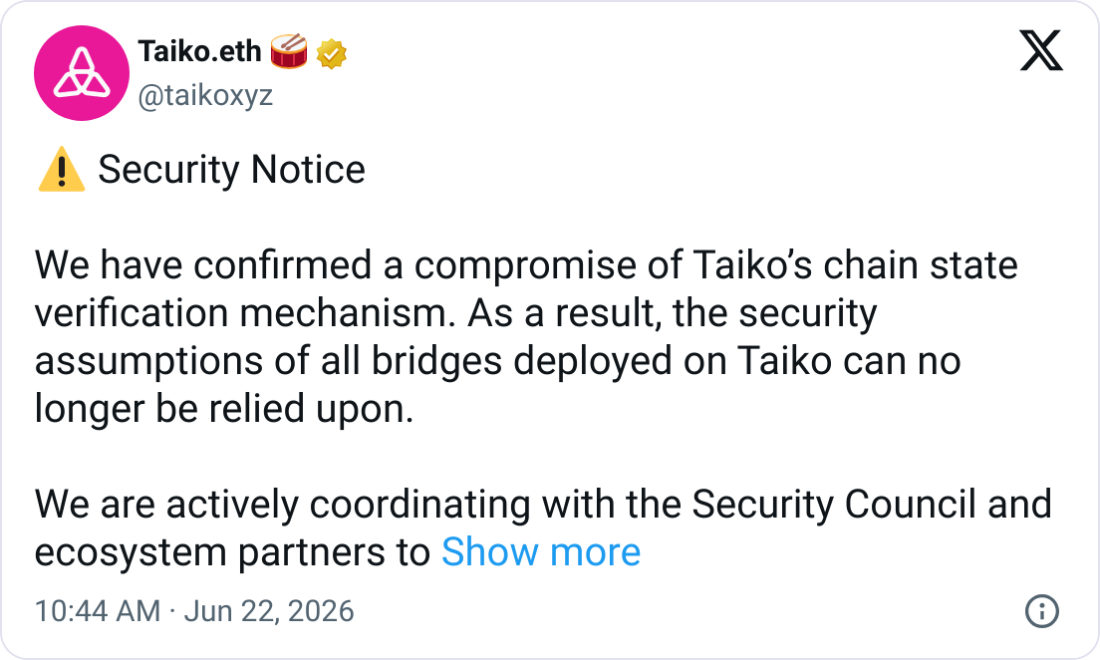
Taiko, an Ethereum layer-2 blockchain, has urged its users to withdraw assets from the network’s bridges after an exploit on one of its bridge protocols saw attackers make off with $1.7 million in the latest decentralized finance hack this month.
“We have confirmed a compromise of Taiko’s chain state verification mechanism,” Taiko posted to X early on Monday. “As a result, the security assumptions of all bridges deployed on Taiko can no longer be relied upon.”
“We strongly advise all users to withdraw their funds from all bridges deployed on Taiko immediately,” it added.
It is the latest in a series of crypto protocol exploits this month, which now number at least 23, according to DeFiLlama. The Humanity Protocol and Syscoin Bridge, which lost over $30 million and $8 million, respectively, have been the largest two exploits so far in June.
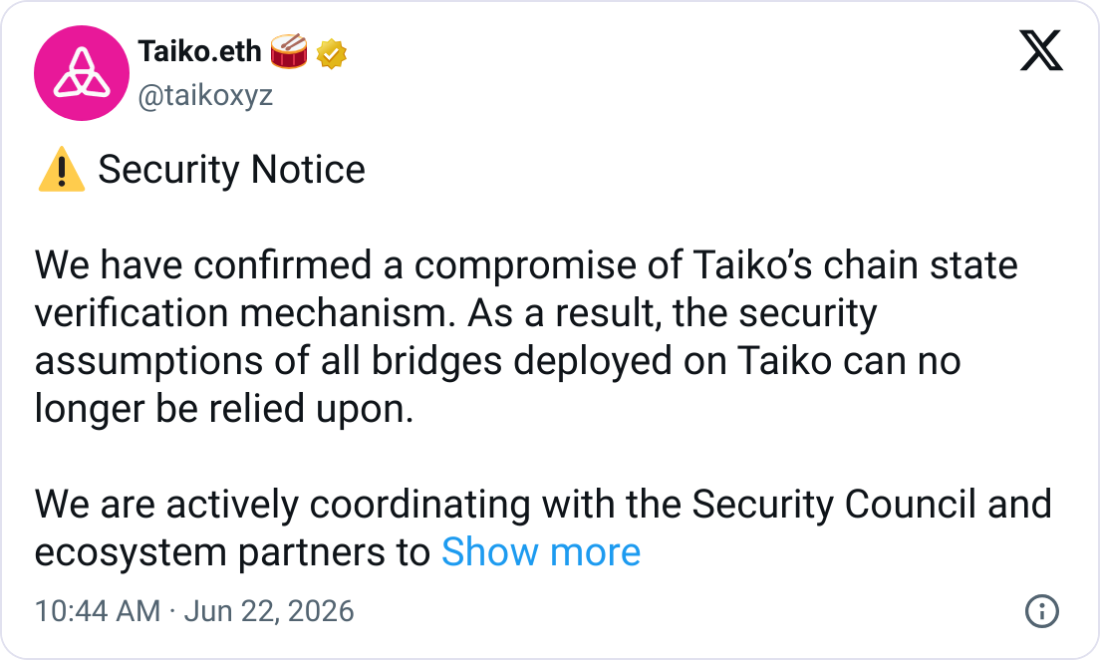
Source: Taiko
Taiko said it was coordinating partners to contain the incident and had paused affected systems.
Crypto security firm Blockaid said that the root cause appears to be a flaw in how the Taiko bridge validated source signals.
It said that message proofs were accepted as valid on Ethereum without corresponding legitimate proofs on the Taiko blockchain.
“This allowed the attacker to register and later retrieve fraudulent bridge messages, resulting in unauthorized asset releases from the ERC20 vault,” Blockaid said.
Blockaid estimated that at least $1 million had been stolen, while Lookonchain and PeckShield suggested the value of assets stolen could be as high as $1.7 million.
The exploiter has already transferred 1.99 million Taiko (TAIKO) tokens worth around $189,000 to MEXC, stated PeckShield. TAIKO is currently trading down 98% from its 2024 peak at $0.084, according to CoinGecko.
Related: Secret Network bridge exploited for $4.7M with ‘infinite mint’ bug
Blockchain intelligence firm Arkham shows Taiko exploiter wallets holding around $1.5 million, primarily in Ether (ETH).
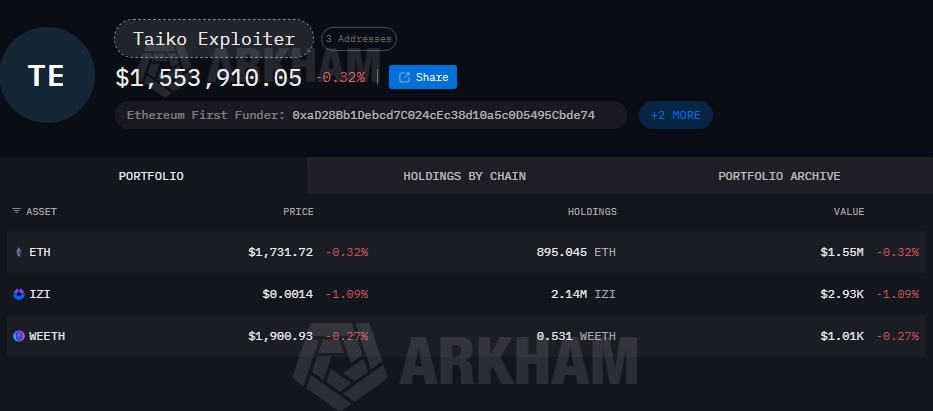
The Taiko exploiter account holds more than $1.5 million in ETH. Source: Arkham Intelligence
Exploits in June are mounting up
The attack comes just days after the discovery on Friday of a smart contract exploit on the Secret Network, which resulted in the theft of $4.67 million worth of assets.
On Saturday, around $1.1 million was drained from the OLPC/LABUBU liquidity pool on PancakeSwap. LABUBU is a memecoin inspired by the popular toys of the same name.
Other notable exploits in June include Aztec Connect, RetoSwap, Raydium AMM, and the largest one so far this month, Humanity Protocol.
Magazine: Bitcoin decouples from tech stocks, Ether eyes ‘selling wave’: Market Moves

Crypto markets spent the weekend in the red as hopes for a peace deal between the US and Iran remain fragile.
US equity market futures have opened lower as investors await details of US-Iran talks in Switzerland, according to the Kobeissi Letter.
Meanwhile, President Trump has ramped up the rhetoric again, posting on Truth Social on Sunday:
“Iran must immediately stop their highly paid proxies in Lebanon from causing trouble. If they don’t, we’ll hit Iran very hard again, just like we did last week, only harder!!!”
Economic Events June 22 to 26
The week kicks off with June’s S&P Global PMI data on Tuesday, and May’s new home sales figures are out on Wednesday.
However, all eyes are on the May Personal Consumption Expenditures (PCE) report, the Federal Reserve’s preferred inflation measure, due on Thursday.
The data follows last week’s FOMC meeting, where policymakers held interest rates steady while signaling a more inflation-focused monetary policy stance.
If PCE comes in hotter than expected, which is likely given that energy prices are rising, markets could price in fewer rate cuts, and risk assets may face pressure.
“The June FOMC meeting, with half of the committee leaning toward a tighter policy path, sent a hawkish jolt through markets,” said Bloomberg analysts.
“Even though Warsh didn’t submit his own dot for the dot plot, his tone at the news conference seemed notably hawkish to us. A hot PCE inflation reading will likely reinforce that hawkish message.”
The current odds for a rate hike at the Fed’s next meeting in late July are around 40%, according to the CME Fed Watch tool.
More economic data follows on Thursday with the US first-quarter GDP report, shedding light on the rate of economic growth.
June’s Michigan consumer sentiment data and inflation expectations data are due out on Friday, rounding off a busy week for economic reports.
Key Events This Week:
1. June S&P Global PMI data – Tuesday
2. May New Home Sales data – Wednesday
3. May PCE Inflation data – Thursday
4. US Q1 2026 GDP data – Thursday
5. June MI Consumer Sentiment data – Friday
6. June MI Inflation Expectations data – Friday
The…
— The Kobeissi Letter (@KobeissiLetter) June 21, 2026
Crypto Market Outlook
Crypto markets spent the weekend mostly flat, with total capitalization hovering around $2.3 trillion. More volatility is expected this week, and the path of least resistance is downwards.
Bitcoin has been trading tightly around $64,000, where it is at the time of writing on Monday morning in Asia. There has been a quick dip towards $63,000, but it recovered quickly. The weekly close was at $63,267, forming a support base.
Ether prices remain at multi-year lows, struggling to make any headway above $1,700, while most altcoins are still in retreat.
The post 4 Things That Could Move Crypto Markets This Week appeared first on CryptoPotato.
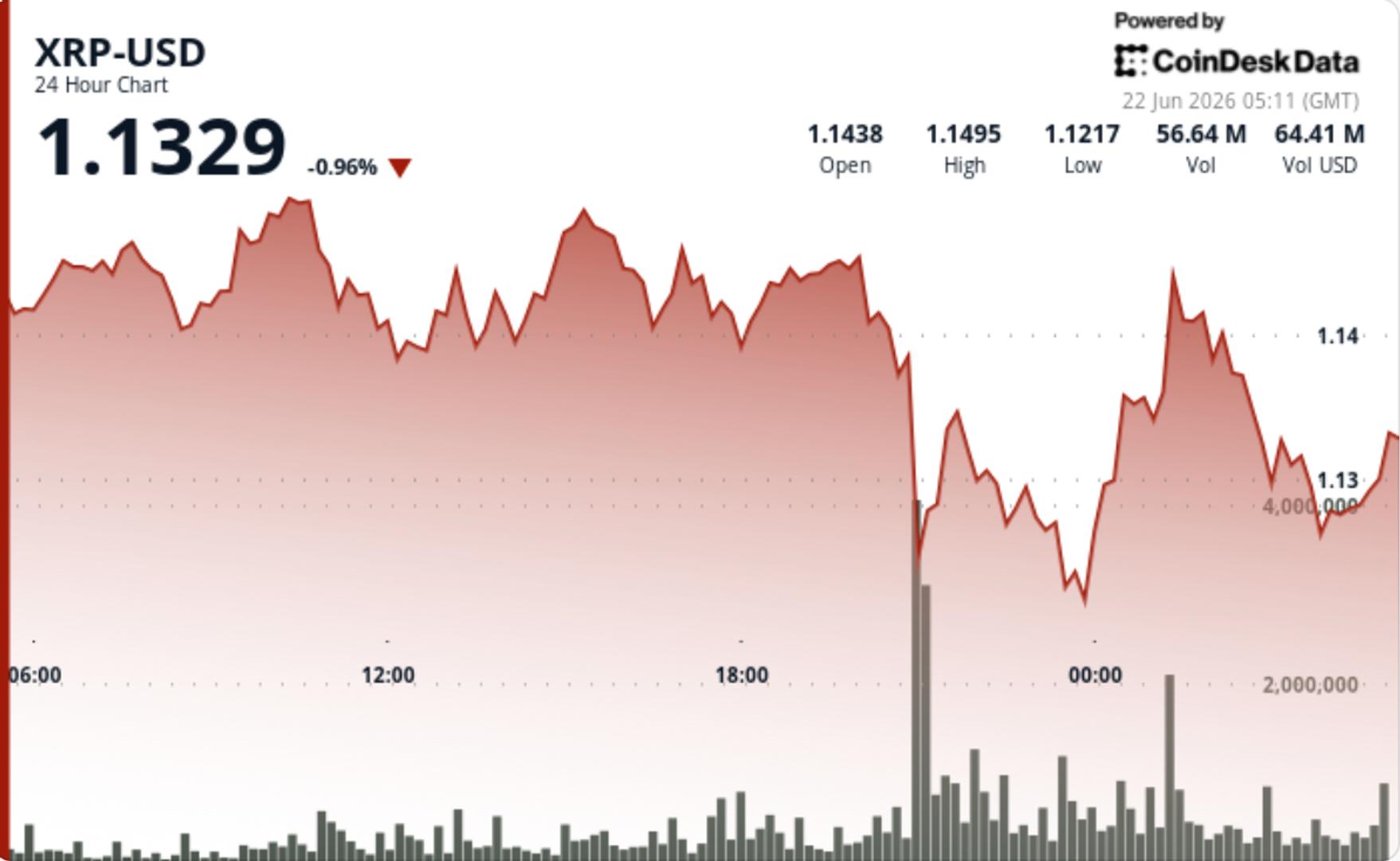
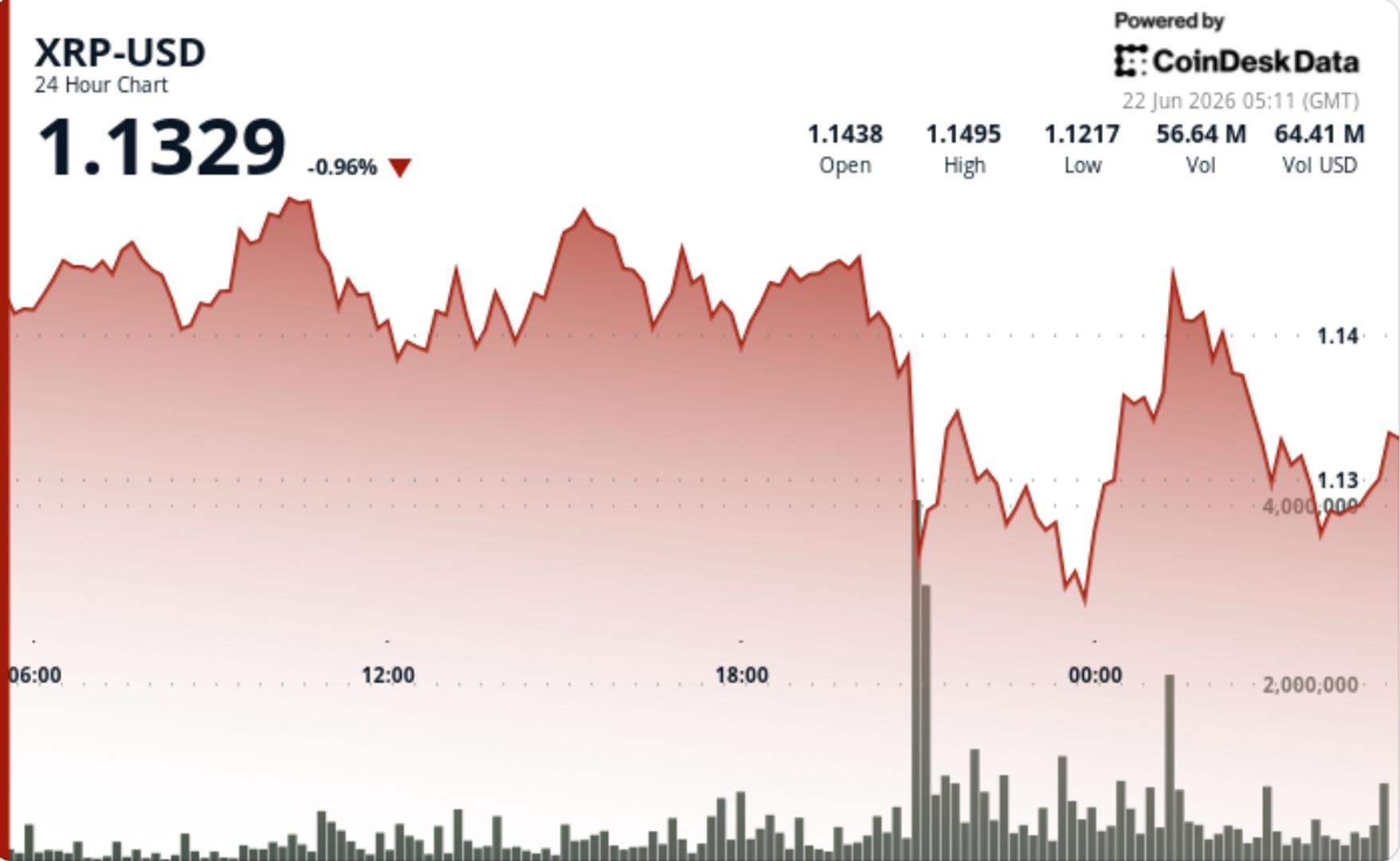
XRP briefly broke below a closely watched support level on Sunday before buyers stepped in.
The token fell to roughly $1.12 on some of the session’s heaviest volume, then rebounded toward $1.15 within hours, leaving traders focused less on the decline itself and more on whether the latest test of support signals accumulation or another pause in a broader downtrend.
News Background
• XRP continues to trade inside the same broad $1.10-$1.30 range that has contained price action for most of June.
• Analysts remain split between viewing the range as a base-building phase and a continuation pattern within a larger downtrend.
Price Action Summary
• XRP fell from $1.1451 to $1.1383 during the 24-hour session, a decline of roughly 0.6%.
• Selling accelerated around 21:00 UTC when volume surged to 85.8 million XRP, pushing price down to a session low near $1.1213.
• Buyers quickly absorbed the move, driving XRP back toward $1.148 and recovering most of the breakdown before consolidation set in.
Technical Analysis
• The initial break below $1.1385 looked significant, particularly because it occurred on the largest volume spike of the session.
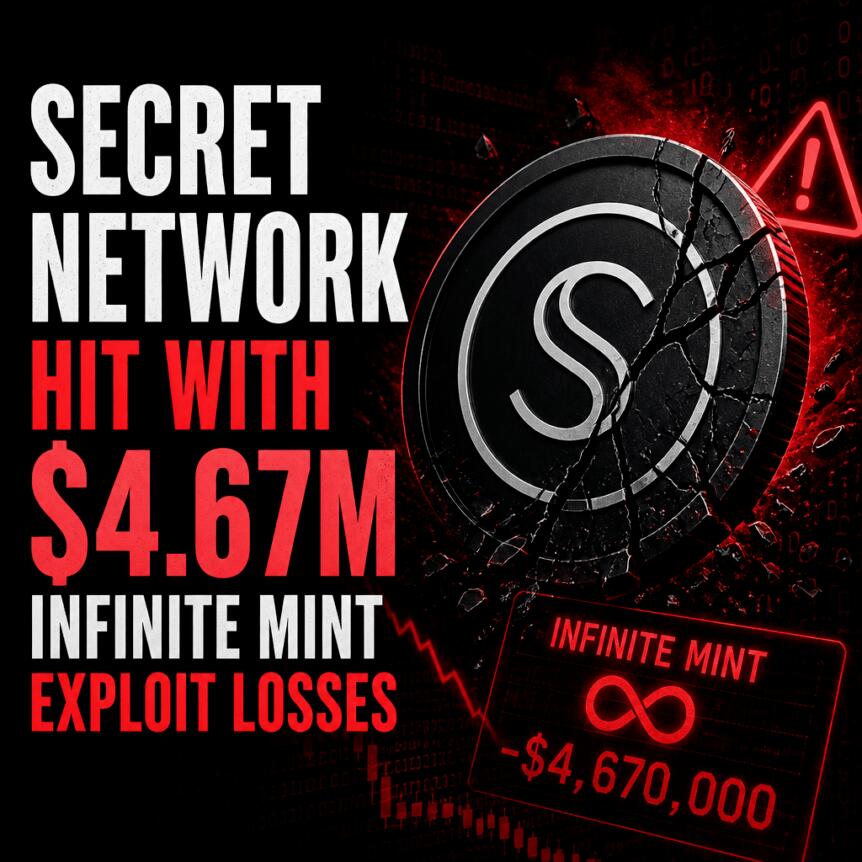
An attacker exploited an “infinite mint” vulnerability in a smart contract on Secret Network to create wrapped versions of Axelar-backed assets without the normal backing. According to Common Prefix, the resulting loss reached $4.67 million, with the incident first occurring on June 10 and later being detected on June 17 after irregularities surfaced during a failed cross-chain transfer.
The exploit relied on a flaw in how inbound transfers were handled: the contract minted genuine saTokens without verifying that the tokens being deposited originated from a legitimate source. After discovery, the attacker redeemed the forged saTokens through Axelar’s standard routes, draining the real wrapped assets held in escrow. Common Prefix reported the issue on Friday, citing on-chain findings and the sequence of redemptions.
Key takeaways
- An “infinite mint” bug on Secret Network allowed unbacked Axelar-wrapped assets (saTokens) to be minted.
- The vulnerability stemmed from missing verification of the inbound transfer source before minting, enabling forged deposits to produce real tokens.
- Common Prefix estimates the exploit’s impact at $4.67 million, with detection coming a week after the June 10 attack.
- The attacker redeemed saTokens back to the underlying assets held in escrow, then moved proceeds to Ethereum and split holdings across multiple wallets.
- Axelar said its network and IBC were not compromised, and that the affected contract was not developed or maintained by Axelar.
How the Secret Network “infinite mint” unfolded
The Secret Network incident centered on a smart contract that minted Axelar-wrapped tokens (saTokens) tied to assets held in escrow. Common Prefix’s analysis indicates the contract did not verify the source of inbound transfers prior to minting. As a result, deposits that were forged over an attacker-controlled channel could trigger minting of genuine saTokens without corresponding backing assets.
Common Prefix said the attacker then redeemed those Axelar-wrapped saTokens back through legitimate channels. Because the real wrapped assets were stored in escrow, the redemption process allowed the attacker to withdraw the backed collateral that should have corresponded to the issued tokens. In short, the breach converted what should have been a “wrapped claim” into an extractable withdrawal by breaking the token-to-collateral link at the minting stage.
Assets targeted and the size of the exploit
Common Prefix reported that multiple Axelar-wrapped tokens were minted without backing. The affected set included saUSDT, saUSDC, saDAI, saWETH, saWBTC, saWBTC? and saBNB, as well as sawstETH (as listed in Common Prefix’s report). The firm estimated the total exploit impact at $4.67 million.
Secret Network is a privacy-focused layer-1 blockchain in the Cosmos ecosystem. Axelar, meanwhile, is an interoperability network designed to connect different blockchain ecosystems. The incident highlights the risk that can arise when wrapped assets and cross-chain messaging rely on correct validation logic—especially when minting depends on the integrity of inbound transfer proofs.
Discovery, attacker movement, and where funds ended up
While the exploit happened on June 10, Common Prefix said it wasn’t detected until June 17. The delayed discovery was linked to a failed cross-chain transaction that returned an “insufficient funds” error involving the drained account. That error drew attention to the fact that tokens had likely been minted without sufficient backing.
After redemption, Common Prefix reported that the attacker moved the stolen assets to Ethereum and converted the proceeds to Ether (ETH). The firm also said the attacker split the funds across roughly 30 wallets, eventually depositing with exchanges including KuCoin, ChangeNow, and HitBTC—details that matter for monitoring and potential recovery efforts, since multi-wallet distribution can slow down tracing and enforcement.
Secret Network and Axelar respond: what was and wasn’t compromised
Secret Network posted a security incident warning, advising holders of Axelar-bridged saXXX tokens on Secret that the backing for those tokens was affected and that their funds may be lost. The warning, published after the incident became public, focused on user risk rather than suggesting that all tokens on Secret were compromised.
Axelar addressed the incident separately after “some confusion” circulated around the breach. In a post on Saturday, Axelar stated that neither Axelar nor IBC was compromised. It also said the exploited token smart contract was not developed, deployed, or maintained by Axelar, and that Axelar’s firewalling helped prevent broader impact across chains. For users and builders, the distinction matters: it suggests that the failure was contained to the contract logic on Secret’s side of the integration rather than a systemic breach across the broader Axelar interoperability stack.
Why this case fits a broader pattern of bridge and wrap exploits
Common Prefix placed the Secret Network hack in the context of a busy month for crypto exploits. According to DeFiLlama data cited in the article, crypto protocol hacks and exploits now number at least 22 for the month, reflecting continued pressure on cross-chain infrastructure and token-wrapping mechanisms.
Earlier this month, Cointelegraph reported major losses tied to other cross-chain incidents, including Humanity Protocol and Syscoin Bridge, which lost $32 million and $8 million, respectively. Together, these cases underscore a recurring theme: cross-chain systems can fail at multiple layers—message validation, escrow accounting, wrapped-token minting, and redemption logic—meaning that a vulnerability in one link can lead to direct fund drains if the surrounding checks are incomplete.
For investors and traders, the practical implication is that token “existence” on a destination chain does not always guarantee collateral backing. In the Secret Network incident, the tokens were minted in a way that broke that assumption, turning wrapped representations into potentially uncollectible claims. For developers, the bigger lesson is straightforward: minting logic that depends on inbound data must treat verification as part of the core security model, not an optional step.
Looking ahead, users holding affected saTokens on Secret should monitor Secret Network’s incident updates and any follow-on recovery or remediation announcements. Meanwhile, builders integrating interoperability routes should watch closely for contract-level fixes and updated validation requirements—because as this exploit shows, a single missing verification step can propagate into real withdrawals from escrow even when the interoperability provider itself insists it was not compromised.


Eli Ben-Sasson, cofounder of StarkWare and a founding scientist of Zcash, has shared his view on the recent debate around the Ethereum Foundation.
Summary
- Eli Ben-Sasson said Ethereum should weigh merit and technology more heavily than ecosystem alignment debates.
- His comments followed Foundation exits and warnings about core development funding pressure within coming months.
- StarkWare’s past choices on STARKs, Cairo and zkVM were once viewed as misaligned by critics.
His comments came as Ethereum faces questions over leadership changes, funding pressure and the role of layer-2 teams in the wider ecosystem.
Ben-Sasson said he was not joining criticism of the foundation and was not claiming that Ethereum is near its end. He also said he was not trying to defend the foundation by saying everything was fine. “Ethereum has many strengths, and it also has its politics,” he wrote.
StarkWare history frames his point
Ben-Sasson said StarkWare’s first paid project in 2019 and 2020 focused on a post-quantum secure, scalable ZK-STARK system for Ethereum. He said the work aimed to help Ethereum scale and become more ready for future quantum security risks.
He also pointed to StarkWare’s later choices, including STARKs, Cairo, zkVM work, native account abstraction and Bitcoin scaling. He said those choices were not always popular and were sometimes viewed as “misaligned.” Ben-Sasson said he was glad the team made them because he sees them as the right technical decisions.
Exits and funding worries add pressure
His comments came during a tense period for the Ethereum Foundation. As previously reported by crypto.news, Hsiao-Wei Wang stepped down as co-executive director and board member after returning from a sabbatical. Her exit followed other staff changes and came after Tomasz Stańczak also left a co-executive director role.
The debate also includes funding concerns. Former Ethereum Foundation contributor Trent Van Epps warned that Ethereum core development could face a funding gap within three to nine months. He linked that risk to spending cuts and the end of the Client Incentive Program. Tom Lee later rejected that warning, saying there was “zero chance” of such a crisis.
Merit versus alignment becomes the issue
Ben-Sasson’s main point centered on how Ethereum should judge teams and ideas. He said the ecosystem placed too much weight on whether teams appeared aligned or misaligned. He argued that technical merit should matter more than social labels or political positioning.
“As part of the ecosystem and supporter of all things crypto, I hope the new system that will arise will give a lot of weight to merit and technology, and less for alignment,” Ben-Sasson wrote.
He added that he would want to work more closely with that system if it moved in that direction.
That framing also answers past complaints that StarkWare moved outside Ethereum’s preferred path. In his view, useful engineering can start outside consensus and still become part of the broader stack later. The post did not propose a formal governance plan for the wider ecosystem.
His comments place StarkWare’s experience inside a wider Ethereum governance debate. Layer-2 teams depend on Ethereum, but they also make independent technical choices. That can create tension when foundation priorities, roadmap work and community expectations do not move at the same pace.
Toss Bank has signed a memorandum of understanding with the Solana Foundation to test blockchain-based global remittance and settlement infrastructure.
Summary
- Toss Bank will test Solana-based remittance and settlement infrastructure before broader digital asset reviews begin.
- The partnership arrives as South Korea prepares new rules for virtual asset transfer services nationwide.
- Crypto.news reported similar stablecoin remittance tests by KB Financial, Western Union and SBI Remit recently.
The agreement was signed in Seoul on June 19 and disclosed on June 22, according to Digital Today.
The bank called the deal the first direct one-to-one strategic partnership between a South Korean internet-only bank and the Solana Foundation. The two sides will study how the Solana network can support overseas transfers, payments and later digital asset services.
Remittance test leads cooperation
The first area of work will be a proof of concept for global remittances and settlement. Toss Bank plans to test whether stablecoins can make overseas transfers faster and easier while keeping the service close to existing banking flows.
Toss Bank said the cooperation covers a joint review of blockchain-based payment and settlement models. It will also assess future financial services linked to stablecoins, digital assets and tokenized assets. Park Jin-hyeon, head of strategy at Toss Bank, said the deal was a “starting point” for applying blockchain-based financial infrastructure to services the bank already runs.
South Korea rules shape timing
The timing links the Toss Bank plan to South Korea’s changing digital asset rules. As crypto.news recently reported, South Korea is considering whether fintech firms should join a new licensing regime for cross-border virtual asset transfers due to take effect in December.
That policy shift may matter for banks and fintech firms testing blockchain remittances. Approved firms could offer blockchain-based overseas transfers and foreign exchange services under formal oversight. Toss Bank said it will review its plans while responding to domestic moves to legislate stablecoin-related rules.
Stablecoin pilots move into banking
The Toss Bank deal follows other bank-linked stablecoin tests in Asia. As crypto.news earlier reported, KB Financial tested won stablecoin issuance, offline QR payments, merchant settlement and Vietnam remittances. The Vietnam transfer finished in under three minutes and cut fees by about 87%, according to that report.
Meanwhile, stablecoin remittance trials are also expanding beyond Korea. As previously reported by crypto.news, Japan’s SBI Remit partnered with Fasset to build cross-border stablecoin infrastructure for remittances, payments and settlements across international markets.
Toss has already shown interest in blockchain beyond remittances. Crypto.news reported in April that the broader Toss group had been weighing a custom Layer 1 or Layer 2 blockchain and a native token for its “Money 3.0” stablecoin strategy. The Solana MOU gives Toss Bank a separate path to test public blockchain infrastructure before any broader rollout.
Solana gains payment use case
For Solana, the partnership adds another financial institution to its payments and stablecoin work. As crypto.news reported in May, Western Union launched USDPT on Solana, using the network for a regulated payment stablecoin tied to settlement and future customer services.
Lily Liu, chair of the Solana Foundation, said the partnership could help create a “new standard” for faster and smoother global remittances by combining bank trust with blockchain efficiency. The statement places the project inside a broader market shift toward stablecoin settlement, where banks, payment firms and fintech companies are testing faster cross-border rails.
The MOU does not mean Toss Bank has launched a live stablecoin remittance service. It starts with testing and feasibility reviews. The main questions now are whether the proof of concept can meet Korean regulatory standards, reduce transfer friction and fit into Toss Bank’s existing financial services. No public launch date has been announced yet.


Bitcoin started the week drifting near $64,000, sitting out a rally in Asian equities as the US and Iran moved closer to a lasting peace deal.
The token traded around $63,996 on Monday, down 0.4% over 24 hours and 2.2% on the week, per CoinDesk data. The rest of the market was mixed. Solana rose 3.7% on the week to $74 and tron added 2.2%, while ether held roughly flat at $1,733. The losses ran deeper down the board, with BNB off 4.2% on the week, XRP down 4.3% to $1.13 and dogecoin the weakest major, off 6.5%. Hyperliquid’s HYPE, the standout of early June, fell 5% on the day and has cooled to a 1.9% weekly gain.
The macro backdrop turned friendlier without pulling crypto along. The US and Iran agreed on a roadmap toward a final peace deal within 60 days, and Brent crude slid 1.7% to about $79 a barrel.
An MSCI gauge of Asian stocks rose 0.6%, led by a technology rally tied to continued optimism over artificial intelligence, while US futures were softer, with S&P 500 contracts down 0.5%.


The first session of high-level US-Iran talks concluded in Switzerland on Monday. Mediators from Qatar and Pakistan confirmed a roadmap toward a final deal within 60 days under the framework of the Islamabad Memorandum of Understanding.
The joint statement confirmed the creation of a High-Level Committee providing political oversight, with chief negotiators leading dedicated working groups on nuclear issues, sanctions, and dispute resolution.
The parties also formed a communication line to prevent incidents and ensure safe commercial passage through the Strait of Hormuz. A de-confliction cell involving the US, Iran, and Lebanon will enforce the termination of military operations there. Technical talks continue through the remainder of the week at Burgenstock.
What to Expect When Markets Open
The statement resolves the sharpest fear heading into Monday’s session. A reported Iranian walkout on Sunday had raised Black Monday fears across oil and crypto, keeping traders on edge into the open.
Oil is the most direct read. The Strait of Hormuz communication line, confirmed explicitly in the joint statement, is the detail markets will price most aggressively. When the original June 14 memorandum was announced, oil fell over 12% and the Dow Jones hit a record high. A credible, institutionalized Hormuz mechanism could extend that oil price relief.
Equities should follow, with lower energy costs easing inflation expectations and improving the earnings outlook. That same macro channel feeds crypto. Bitcoin has tracked risk sentiment tightly throughout the conflict, rising on de-escalation and selling off on fresh strikes, with BTC holding near $64,200 ahead of Monday.
The ceiling on any rally remains the Federal Reserve. The Fed’s hawkish hold on June 17 erased post-MoU gains across stocks and crypto. The Lebanon de-confliction cell is the geopolitical tripwire to watch, Iran’s Foreign Minister Abbas Araghchi called it the “first real test” of the agreement, and any renewed fighting there is the fastest path back to risk-off across all asset classes.
The post US-Iran Agree on 60-Day Deal Roadmap: Markets Open Monday appeared first on BeInCrypto.

China’s import of custard apples sparks fears in Taiwan

SolarEdge's Outlook: Revenue Is Up, Execution Is Everything

Taiko warns users to exit bridges after $1m vault exploit


-
 Crypto World7 days ago
Crude Oil Plunges Over 4% as US-Iran Agreement Reopens Hormuz Strait
-

 Fashion2 days ago
Weekend Open Thread: Miami – Corporette.com
-

 Tech5 days ago
The Adder At The Heart Of Intel’s 8087 FPU
-
 Business2 days ago
Wall Street Week Ahead: Investors see Micron earnings as pulse check of AI rally momentum
-

 Crypto World2 days ago
HIVE shares jump as $220M AI deal speeds Bitcoin mining pivot
-

 Sports3 days ago
FIFA World Cup 2026: Canada beat 9-men Qatar 6-0 to register first ever win | FIFA World Cup 2026
-

 Business1 day ago
MHP SE 2026 Q1 – Results – Earnings Call Presentation (OTCMKTS:MHPSY) 2026-06-20
-

 Crypto World2 days ago
Jake Chervinsky accuses CME of protecting derivatives monopoly
-

 Business3 days ago
Brexit cost 6% of UK economy, Bank of England company data suggests
-

 Crypto World4 days ago
Anthropic’s Dario Amodei Urged AI Unity at G7, Even as US Banned His Models
-

 Business1 day ago
Soccer-U.S. defends Iran World Cup travel restrictions, says discussions ongoing
-
 Crypto World2 days ago
Can Charles Hoskinson Really Rescue Cardano?
-

 Tech4 days ago
Weeks Of In-The-Field Testing And A Verdict
-

 Tech4 days ago
Adobe adds its AI assistant to Premiere, Illustrator and InDesign
-

 Entertainment1 day ago
Renter of Home in Anne Heche Crash Denies Settlement With Son
-

 Politics2 days ago
Andy Burnham and the meaning of Makerfield
-
 Crypto World4 days ago
Iren (IREN) Stock Surges on Jefferies Buy Rating: AI Infrastructure Play Gains Momentum
-

 Tech3 days ago
Instagram Now Lets You Add A Unique Caption To Each Carousel Slide
-

 Politics3 days ago
BBC Reporter Discusses Cross Party Criticism Of Trumps Iran Deal
-

 News Videos3 days ago
Nightcore – MONEY ON THE DASH (Soft Rock Version) (Lyrics)
You must be logged in to post a comment Login