

Crypto World
LINE NEXT unveils Unifi Pay for zero-fee stablecoin payments

LINE NEXT has opened developer pre-registration for Unifi Pay ahead of a planned global launch in the third quarter, with the payment infrastructure set to support USDT, JPYC and IDRP through its Unifi stablecoin wallet.
Summary
- LINE NEXT has opened developer pre-registration for Unifi Pay ahead of its planned global launch in the third quarter.
- Unifi Pay will support USDT, JPYC and IDRP, with users in Japan and Indonesia able to top up local stablecoins directly from bank accounts after identity verification.
- The service offers zero payment fees, an average settlement of about one second, and an SDK that lets developers create payment pages in about 10 minutes.
According to a CoinPost report, LINE NEXT, the U.S.-based affiliate of LINE Yahoo, announced on June 30 that Unifi Pay will be launched globally after a beta phase that handled 100 billion Korean won in cumulative payments and settlements over the past year.
The company, which has access to LINE Yahoo’s 300 million users, is building the service on its Unifi stablecoin wallet and has started accepting pre-registrations from global developers before the official rollout.
Unifi Pay will support Tether’s USDT, the Japanese yen-denominated JPYC and the Indonesian rupiah-denominated IDRP at launch. In Japan and Indonesia, users will be able to complete online identity verification and directly top up JPYC or IDRP from their bank accounts. LINE NEXT also said it plans to add local stablecoins in more countries, depending on what each market’s regulations allow.
Unifi Pay offers wallet-based settlement with zero payment fees
Using a wallet-based structure, Unifi Pay directly connects users and suppliers and removes payment fees from the transaction process, according to the announcement. LINE NEXT said the service offers an average settlement speed of about one second.
The company will also provide a function that allows settlement funds to be sent directly to bank accounts through connected crypto exchanges and blockchain remittance solutions. This gives suppliers and developers a path to move stablecoin payments into bank accounts after receiving funds through the wallet.
For developers, AI builders, and creators, LINE NEXT is introducing the Unifi Pay SDK to simplify the process of adding global payments. The company said the SDK uses an A2A, or Agent-to-Agent, task execution method for AI agents, allowing a payment page to be created in about 10 minutes through a single command input.
Developer companies that keep payment proceeds in the wallet may receive annual rewards of up to 5%, depending on the type of stablecoin used. LINE NEXT said the reward model is tied to stablecoin holdings inside the wallet.
The beta version of Unifi Pay recorded 100 billion Korean won in cumulative payment and settlement volume over the past year, equal to about 10 billion Japanese yen based on the announcement’s conversion rate of 1 won to 0.1 yen. LINE NEXT CEO Youngsu Ko said the company plans to establish Unifi Pay as a payment infrastructure that connects developers, creators, and users around the world through its developer tools.
The planned launch also follows LINE NEXT and Kaia’s earlier stablecoin work through Project Unify, which was announced during Korea Blockchain Week in September 2025. Kaia described Project Unify as a stablecoin super-app designed to bring payments, yield, on/off-ramps and access to more than 100 decentralized apps into LINE Messenger, which the company said had nearly 200 million monthly active users across Japan, Taiwan, Thailand and Indonesia.
Kaia said at the time that Project Unify would support USD, JPY, KRW, THB, IDR, PHP, MYR and SGD at launch, while offering developers and issuers a Unify SDK with a focus on regulatory compliance, especially in South Korea. The project followed the 2024 merger of LINE’s Finschia and Kakao’s Klaytn into Kaia, which has described itself as Asia’s stablecoin orchestration layer.



K Wave Media has sold its remaining Bitcoin holdings, ending a short-lived treasury push that once aimed to turn the Nasdaq-listed Korean media company into a major corporate BTC holder.
Summary
- K Wave Media sold its remaining 88 BTC to repay $6 million in debt obligations.
- The company once said it wanted to expand Bitcoin holdings toward 10,000 BTC quickly afterward.
- K Wave’s filing shows it halted Bitcoin strategy while shifting focus toward AI infrastructure investments.
The sale came less than a year after the company said it had access to up to $1 billion in financing for its Bitcoin strategy.
K Wave sells 88 BTC to repay debt
In a June 30 SEC filing, K Wave said it liquidated 88 Bitcoin held in its treasury and used the proceeds to repay $6 million of Initial Notes. The transaction was tied to an April 29 amendment to its securities purchase agreement with Anson Funds.
The same filing says K Wave sold all of its Bitcoin holdings on May 6. It also says the company has not abandoned its treasury strategy, but has decided to halt it and focus on AI infrastructure. That shift puts its Bitcoin balance at zero after it once marketed itself as a Korean media company with a Bitcoin-backed treasury model.
Company once aimed for 10,000 BTC
K Wave’s exit marks a sharp turn from its July 2025 announcement. At the time, the company said it had secured $1 billion in total capital capacity through a $500 million convertible note agreement with Anson Funds and a $500 million standby equity purchase deal with Bitcoin Strategic Reserve.
The company said it had completed an initial purchase of 88 BTC and planned to scale its holdings.
“Our objective is clear: to scale our holdings toward 10,000 Bitcoin as soon as possible,” said CEO Ted Kim.
The company also said at least 80% of net proceeds from the first Anson tranche had to be used to buy Bitcoin.
AI strategy replaces Bitcoin plan
K Wave later changed course. As previously reported, K Wave redirected up to $485 million from its Bitcoin treasury plan toward AI infrastructure, including data centers, GPU compute operations, and possible acquisitions. Its shares fell about 25% after that update.
The SEC filing adds more detail to that pivot. K Wave said it has started a strategic transformation toward AI infrastructure and is pursuing data centers, GPU clusters, AI cloud platforms, power systems, cooling systems, and related technology assets. The company also expects shareholders to consider the planned sale of Play Company and the disposal of its Solaire stake.
K Wave is also dealing with Nasdaq compliance issues. The filing says Nasdaq notified the company in January that its shares failed to meet the $1 minimum bid rule. Nasdaq sent another notice in June after the company failed to meet the required $15 million market value of publicly held shares.
Treasury firms face wider pressure
K Wave’s move adds to stress across the digital asset treasury sector. As crypto.news reported, Sequans sold half of its Bitcoin as debt pressure tested its treasury plan. That report also cited K Wave’s earlier Bitcoin-to-AI shift as another case of public firms rethinking BTC reserves.
The wider model has also come under review. Crypto.news explained that Bitcoin treasury companies often depend on investor demand, share premiums, and access to fresh capital. When those conditions weaken, debt and dilution can make the structure harder to maintain.
Previously, crypto.news reported that Strive’s Ben Werkman warned that a long Bitcoin downturn could force some treasury firms to restructure, especially those that relied on convertible debt. K Wave’s sale shows how a company can move from an aggressive BTC target to debt repayment and a new business focus within one year.
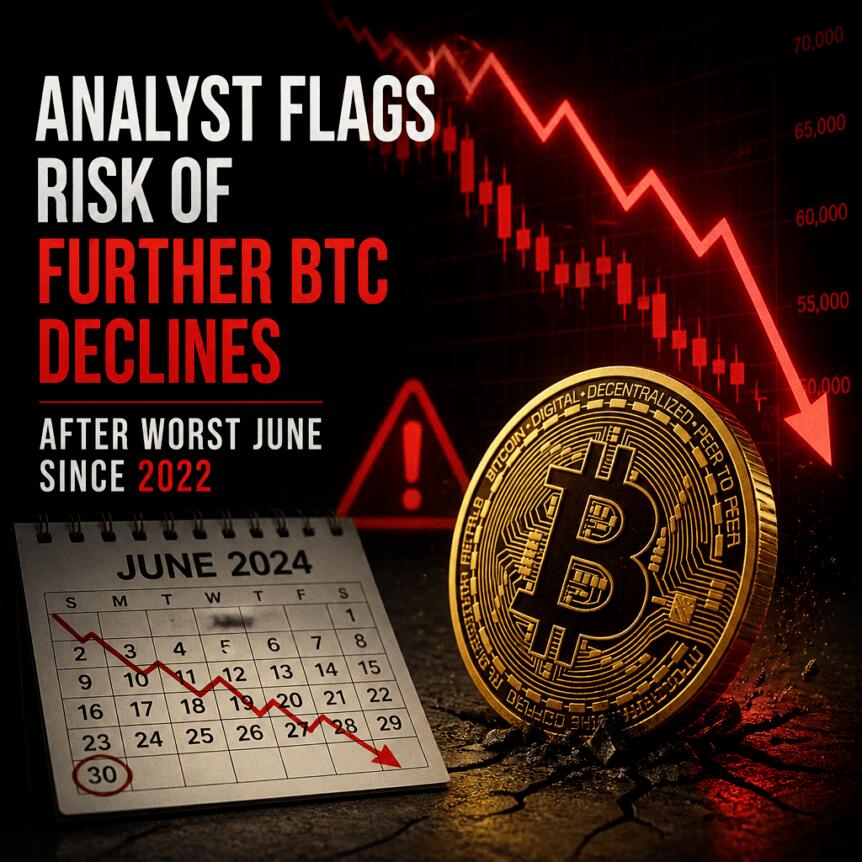
Bitcoin ended June at $58,526, sliding 20.5% over the month and recording its weakest monthly performance since June 2022. The retreat left the flagship cryptocurrency trading below its 200-week moving average near $62,000, but still above a key on-chain valuation metric known as realized price (around $52,000), a configuration that some analysts interpret as a warning that the market may not have reached a full bear-market bottom.
Crypto analyst PlanB, creator of the stock-to-flow pricing model, argued that this price positioning matters because previous bear-market troughs occurred below realized price. In a post shared this week, PlanB said the setup suggests Bitcoin’s downside could continue, potentially revisiting the realized-price area and beyond.
Key takeaways
- Bitcoin’s June close at $58,526 placed it below the 200-week moving average (about $62,000) while remaining above realized price (~$52,000).
- PlanB says earlier bear-market bottoms formed below realized price, implying the market may still be searching for its bottom.
- Analysts at Bitrue Research Institute and Bitget Wallet both described the June-to-$60,000 region as a developing bottom zone, but with risk of further drawdowns.
- Benjamin Cowen suggested Bitcoin may see a cycle-bottom window tied to the US midterm election year, historically aligning with accumulation phases in 2018 and 2022.
Why June’s “in-between” level is drawing attention
PlanB’s argument centers on what he views as the relationship between price and realized price during bear markets. According to the stock-to-flow analyst, Bitcoin’s historical bear-market bottoms have not simply arrived after price fell below major moving averages; they also tended to appear after price moved to levels beneath realized price.
In earlier posts, PlanB highlighted that if Bitcoin breaks down below realized price, it would align with that prior pattern. He referenced the possibility that Bitcoin could fall to $52,000, which would correspond closely with realized price.
From an investor perspective, this distinction can be important because realized price is often used as an on-chain proxy for the average cost basis of coins in circulation. When market price trades above realized price, the market may still be able to bounce; when it slips below, the distribution of holders’ costs versus current valuations tends to become more unfavorable, which can prolong bearish conditions.
Realized price explained—and what it signals
Realized price is calculated by valuing all Bitcoin outputs (typically discussed in terms of unspent transaction output or UTXO cohorts) at the price when each coin last moved on-chain. The result is an aggregate measure of the average acquisition price for the existing supply.
Because realized price reflects holder cost basis, it is frequently used to identify potential support areas during downtrends. The idea is that when price is substantially below realized levels, the market is effectively pricing Bitcoin below what many holders paid when they last moved coins, which can coincide with capitulation phases and supply shakeouts.
Against that backdrop, June’s outcome—still above realized price but no longer above the 200-week moving average—has led analysts to frame the current range as transitional rather than conclusive.
Analysts see a bottom developing, but not confirmed
Andri Fauzan Adziima, research lead at Bitrue Research Institute, told Cointelegraph that Bitcoin’s June close carried a signal consistent with prior cycles. He said the month’s finish above realized price but below the 200-week moving average “signals the bear bottom is still ahead per prior cycles.”
Adziima added that he is watching for a potential capitulation period in late 2026 before a subsequent move higher—while also arguing that the decline could be shallower this cycle due to the role of institutions.
Meanwhile, Lacie Zhang, research analyst at Bitget Wallet, characterized the current consolidation around $60,000 as an area that may be approaching a bottom. She told Cointelegraph that if further downside occurs, the market could build “strong historical and technical support” around $55,000.
Taken together, these views reflect a common tension in market bottoms: technical indicators and on-chain benchmarks can both suggest stabilization, yet neither can confirm capitulation has fully played out. In this case, the “middle” positioning—between the 200-week moving average and realized price—is leaving room for additional volatility before a more durable floor forms.
Cycle-bottom theory tied to US midterms
Beyond on-chain valuation levels, some analysts are also looking at macro calendar effects. ITC Crypto founder Benjamin Cowen speculated that Bitcoin may see a cycle bottom this year, pointing to the fact that it is a US midterm election year.
Cowen argued that the second half of midterm years often marks an accumulation zone and a market cycle bottom, noting that such timing previously coincided with bear market bottoms in 2018 and 2022. The next US midterms are scheduled for Nov. 3, with all House of Representatives seats and about a third of Senate seats up for election.
While this framing is not the same as a realized-price breakdown model, it can influence how traders time risk—particularly when they treat the calendar as a factor that shapes liquidity and positioning. Investors watching this thesis would likely focus on whether Bitcoin’s downtrend stabilizes into accumulation rather than continuing to grind toward or below realized price.
For now, the key takeaway from all perspectives is that June’s close did not neatly resolve the debate. Bitcoin is weak enough to be below its long-term trend proxy, but it has not yet fallen to the on-chain valuation zone that PlanB says has marked prior trough formation.
Traders and long-term holders will likely watch whether Bitcoin can hold above realized price around $52,000 and whether weakness extends toward $55,000 support. The market’s next step—whether it stabilizes into accumulation or breaks below realized valuation—may determine if this is merely consolidation or the start of a more complete bear-market bottom.
Crypto World
ENS Community Member Proposes Dissolving DAO After Founder Blocks Security Council Renewal


Christoph Jentzsch proposed on X that ENS DAO dissolve itself rather than continue operating under what he called a broken governance structure. "As it seems, the ENS DAO is broken," he wrote. "I would propose turning this into a win, by actually dissolving it. Its goals have been accomplished, the… Read the full story at The Defiant


Solana Foundation has introduced Solana Governance Proposals, a new onchain process for validators to move major network questions into stake-weighted votes.
Summary
- Solana validators can now move core governance questions into stake-weighted onchain votes through SGPs directly.
- A proposal needs 15% active stake support before it can enter formal network voting period.
- Validators need at least 100,000 SOL delegated to take an SGP onchain under current rules.
The system gives validators a formal route to submit, support, and decide governance items that may shape Solana’s future protocol direction.
Meanwhile, the Solana Governance Proposals repo says SGPs are documents proposed by Solana validators for stake-weighted, onchain voting through the svmgov program. The process is for high-level questions that ask whether the network should move in a certain direction, rather than detailed technical changes. This keeps SGPs focused on broad network direction only.
A validator vote account needs at least 100,000 SOL staked to take an SGP onchain. The proposal then needs support from at least 15% of active stake before it can enter voting. The Solana Governance documentation says validators create proposals, other validators support them, and voting weight is proven through Merkle proofs against an onchain stake snapshot.
The process separates signals from code
The SGP process sits beside Solana Improvement Documents, which cover detailed protocol design. In simple terms, SGPs ask whether Solana should pursue a direction, while SIMDs explain how a change would be built. The repo says, “A ‘yes’ on an SGP is a mandate to proceed.”
The lifecycle moves from idea to draft, support, voting, acceptance, and activation. Once a proposal reaches the 15% support threshold, it enters a fixed 11-epoch process. That includes seven epochs for discussion, one epoch for a Node Consensus Network snapshot, and three epochs for voting.
There is no quorum rule. A proposal passes only if “For” votes reach at least 66.67% of “For” plus “Against” stake. The repo also says SGPs are not mandatory for every technical change. If validators do not reach support, developers can continue through normal SIMD review.
Governance arrives as upgrades continue
The launch comes as Solana continues to test large infrastructure changes. As previously reported, the Alpenglow upgrade entered community validator testing in May. Alpenglow aims to cut confirmation times to about 150 milliseconds and remove Proof of History and onchain vote transactions from Solana’s core process.
The new SGP route could give validators a clearer way to request network-wide direction before developers prepare technical work. The GitHub repo uses Alpenglow as an example of a proposal that could have first taken a directional vote before later SIMDs defined the build path. That example shows how Solana may use SGPs when validator input is needed before engineering details are complete.
Recent Solana activity adds context
Solana’s validator set has also been tied to other recent network tools. As crypto.news reported, DoubleZero launched Edge in April with 379 validators publishing shreds and about 43% of Solana’s total stake covered at launch. The project aims to deliver Solana block data through private fiber paths.
Solana has also seen renewed market activity around network use. Crypto.news reported that Solana’s tokenized stock activity helped drive an 18% weekly SOL rebound in late June. Earlier, crypto.news reported that Galaxy Digital proposed a voting model for Solana inflation, showing that validator voting design has already been part of the network’s policy debate.


Türkiye-based digital asset platform Paribu has launched DeFi access inside its main app, adding DEX trading, perpetual contracts through Hyperliquid, and Polymarket-linked option markets.
Summary
- Paribu now offers Hyperliquid perpetuals and Polymarket markets through its main self-custodial DeFi app section.
- The platform opened a waitlist for NYSE, Nasdaq, and Borsa Istanbul stock trading access soon.
- Paribu says users can trade DeFi products without separate wallet apps, seed phrases, or transfers.
The company also opened a waitlist for stock trading as it works to combine crypto, DeFi, yield products, and equities in one app.
Paribu said it is the first regulated exchange to offer both Hyperliquid perpetuals and Polymarket option markets through a centralized exchange interface. Users can access the DeFi section with their existing balance, without a separate wallet app, seed phrase, or new account. The company said each DeFi position remains self-custodial, while trades settle onchain through linked protocols.
DeFi access targets Türkiye’s retail market
Paribu framed the launch around Türkiye’s active crypto market. The company cited TRM Labs data showing Türkiye ranked fifth globally in retail crypto activity, with $40 billion in volume in Q1 2026. The figure rose 7% year over year while global retail crypto volume fell 11%.
The company said many local retail users keep their main crypto holdings inside one app and have not used DeFi wallet tools. Paribu’s DeFi access is designed to let these users reach onchain markets without switching platforms. Its blog post on DeFi access says the wallet setup uses passkeys and recovery tools instead of seed phrases.
Hyperliquid and Polymarket enter the app
The Hyperliquid integration lets Paribu users trade perpetual contracts from the DeFi section of the app. Trades route to Hyperliquid’s decentralized blockchain, while positions remain in users’ self-custodial wallets. Paribu said Hyperliquid has processed more than $4 trillion in cumulative trading volume.
The launch follows wider activity around Hyperliquid. As reported by crypto.news, Kalshi launched CFTC-regulated HYPE perpetual futures, lifting HYPE futures open interest to $2.48 billion. Moreover, crypto.news reported thatHyperliquid added validator-settled outcome markets under HIP-4, expanding beyond perpetual futures.
Paribu also added access to Polymarket markets through the same DeFi section. The company said it will list curated markets only, with each contract reviewed for integrity, liquidity, and risk profile before appearing in the app. Paribu serves as the interface, while execution and settlement happen onchain through Polymarket infrastructure.
The rollout comes as prediction markets face closer review in several jurisdictions. As crypto.news reported, the CFTC is preparing new rules that could affect Polymarket and Kalshi. Crypto.news also reported that the CFTC sued Kentucky to block state action against Kalshi, Polymarket, and related partners.
Stock trading remains pending
Paribu is also preparing to offer equities. Its brokerage arm has received establishment authorization from Türkiye’s Capital Markets Board and is waiting for an operating license. The company said NYSE, Nasdaq, and Borsa Istanbul stocks will become tradable after the license process is complete.
For now, users can view real-time market data for U.S. and Turkish stocks inside the app. Paribu said the stock waitlist is open before trading goes live. Founder and CEO Yasin Oral said, “Paribu is becoming a single app for all of finance: crypto, DeFi, equities, and yield.”
The expansion follows other Paribu moves. Previously, crypto.news reported that Paribu’s $240 million CoinMENA acquisition led a weekly crypto funding period in December 2025. The company has also said Clave joined Paribu in 2026 to support passkey-based account abstraction and self-custody tools.
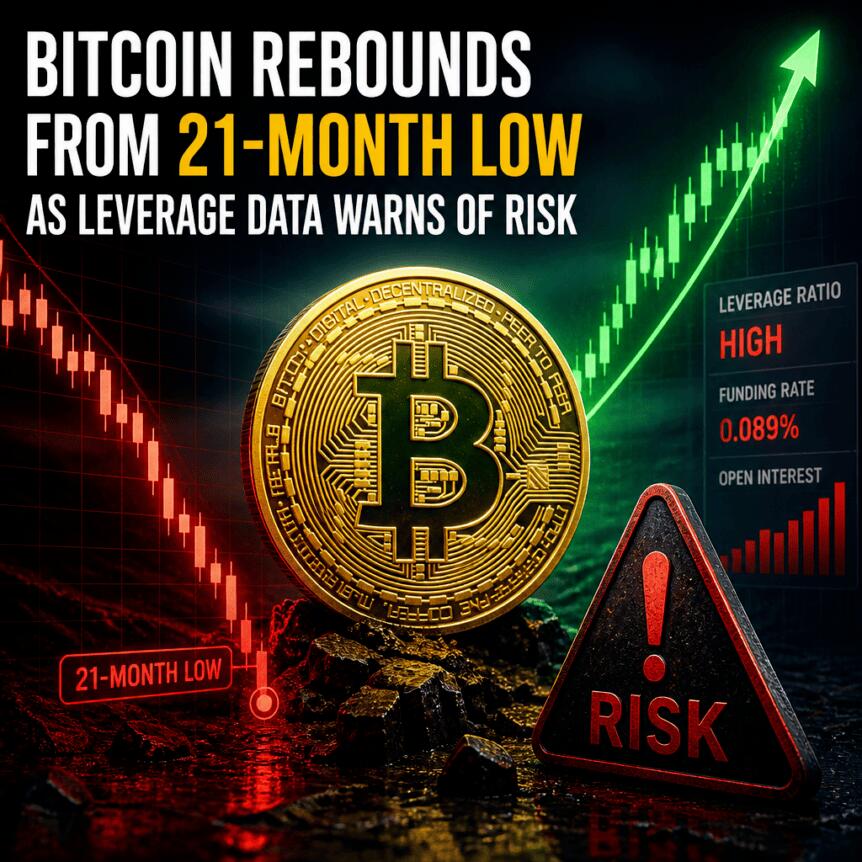
Bitcoin rebounded on Wednesday after tagging a 21-month low, with BTC rising as high as $60,200 and gaining roughly 2.7% over the past 24 hours from earlier losses. The bounce lifted major alternatives as well: Ether (ETH) rose about 3%, while Solana (SOL) climbed roughly 4.85%.
Still, the recovery is happening against a backdrop of persistent caution. According to the Crypto Fear & Greed Index maintained by Alternative.me, sentiment is around 11 out of 100—an “Extreme Fear” reading—suggesting many market participants remain nervous about what comes next. Even with today’s uptick, Bitcoin is still down about a third since the start of the year.
Key takeaways
- Bitcoin’s intraday bounce followed a fresh 21-month low near $57,737, but broader confidence remains weak with the Fear & Greed Index in “Extreme Fear.”
- US spot Bitcoin ETF flows have been net negative recently, including a reported $4.5 billion outflow in June—the largest since the funds launched—indicating cautious institutional positioning.
- On-chain data points to strength from long-term holders, with an estimated addition of roughly 270,000 BTC over the past two weeks.
- Funding rates have stayed positive for three straight days, implying leverage is still leaning toward long exposure even as price remains under pressure.
- Liquidation risk appears heaviest in the $57,000 to $60,500 band, meaning sustained moves beyond roughly $61,000 or below $56,000 could accelerate volatility.
Fear remains elevated even after the rebound
Market pricing today reflects a tug-of-war between dip-buyers and the fear of further downside. The latest sentiment readings underline that many traders are still operating defensively, despite Bitcoin’s recovery attempt from the yearly low area.
This matters because fear can shape how quickly the market absorbs negative news. When sentiment is extremely negative, rebounds often face selling pressure not just from those who missed the decline, but from participants who are using rallies to reduce risk. The result is a market that can rally sharply—then struggle to build follow-through.
ETF outflows versus long-term accumulation
One of the clearest contrasts in the data is between institutional product flows and on-chain holder behavior.
US spot Bitcoin exchange-traded funds (ETFs) have seen more money leaving than entering in recent weeks, including a reported total outflow of $4.5 billion in June, described as the largest since the funds began launching. That pattern typically suggests that, at least for now, some traditional investors are not convinced enough to add exposure during a drawdown.
At the same time, on-chain indicators show long-term holders accumulating. According to the on-chain data referenced in the analysis, long-term wallets added about 270,000 BTC over the past two weeks. In crypto market interpretation, that kind of accumulation is often read as evidence that bigger investors view the recent decline as an opportunity rather than a prompt to sell.
The tension between these two signals—net outflows from ETFs versus accumulation by long-term holders—helps explain why the market can bounce without fully transitioning into a sustained uptrend. Flows may stay cautious while deeper capital continues to build positions more quietly.
Funding rates stay positive as leverage crowds in
Another point to watch is leverage. The analysis highlights that Bitcoin’s funding rate has remained positive for three consecutive days. In practical terms, that means the prevailing derivatives positioning has continued to lean toward bets that prices will rise.
Positive funding while spot prices are weak can be a volatility risk. When one side of the market becomes overcrowded with leveraged longs, a further downside move can force liquidations that amplify the drop—especially if price breaks key support levels. Conversely, if the market stabilizes or turns upward while longs remain funded, the same mechanism can also support rallies through short-covering and stop-trigger effects.
As of now, the key point is that leverage appears active, but price confirmation has not yet clearly followed through in a way that would suggest the market has fully flipped from fear to conviction.
Liquidations cluster around current trading levels
Where liquidation risk sits is often central to understanding how quickly price can move during stressful periods. Using a three-exchange, three-day liquidation heatmap (as cited in the analysis, sourced from Hyblock), the highest concentration of leveraged positioning appears roughly between $57,000 and $60,500. That zone closely overlaps with the trading range Bitcoin has held since late June.
Above that area, the density of liquidation risk thins out noticeably between approximately $61,000 to $62,000. Below, a similar reduction appears around $55,000 to $56,000. This distribution suggests that a move breaking out of the present range could encounter less immediate “magnet” pressure from nearby liquidations—while a move that stays within or slightly beyond the clustered zone could lead to sharper, more abrupt price reactions.
In the near term, the analysis argues that most forced unwind potential sits close to current prices rather than far away. That is why decisive movement beyond roughly $61,000 to the upside—or below about $56,000 on the downside—could create room for accelerated liquidation-driven volatility.
Looking ahead to the next 24 hours, the outlook described here is neutral. A meaningful change would likely require stronger evidence that leveraged positioning is both rising and aligning with a rising spot price—an interaction the analysis notes has not clearly emerged yet.
Traders and investors should monitor whether ETF flow weakness persists alongside continued long-term accumulation, and whether derivatives conditions evolve—particularly funding rate direction and liquidation clustering—as these factors together will determine whether this bounce becomes a trend or fades back into range-bound action.

Venice AI, the privacy-focused AI platform founded by Erik Voorhees, has raised $65 million in Series A funding at a $1 billion valuation, bringing the company to “unicorn” status. The round—led by Dragonfly and backed by Coinbase Ventures, F-Prime, North Island Ventures, Morgan Creek and others—was announced on Wednesday, and represents Venice AI’s first outside capital raise since it launched in 2024.
The funding arrives as privacy concerns around mainstream AI services are drawing renewed attention. Earlier this month, Anthropic cut off foreign access to two of its latest models, and in the broader public debate over AI data handling, a class-action lawsuit recently accused OpenAI of sharing ChatGPT data with third parties. Against that backdrop, Venice AI positions itself as a layer between users and model providers, designed to reduce what third parties can see about user activity.
Key takeaways
- Venice AI reached unicorn status after closing a $65 million Series A round at a $1 billion valuation, led by Dragonfly.
- The platform claims 3.5 million users and routes traffic through a proxy that can obscure IP address and user/account/session data from model providers.
- Venice AI says the new capital will fund more of its own infrastructure, including owning GPUs via data center expansion rather than relying entirely on rental capacity.
- The announcement lands amid heightened scrutiny of AI data privacy, including legal claims involving tracking technologies and alleged sharing of user information.
Unicorn funding for a privacy-first AI delivery layer
Venice AI’s Series A funding was announced by the company in a blog post published Wednesday, with Erik Voorhees describing the company’s mission in constitutional terms in a separate X post. Voorhees said the funding will be used to uphold the First and Fourth Amendments “as they relate to mankind’s interaction with AI.” In the U.S. legal framework, the First Amendment protects core freedoms including speech, while the Fourth Amendment restricts unreasonable government searches and seizures.
While the fundraising headlines focus on valuation and total capital, the more meaningful detail for potential users is the product model: Venice AI’s platform is built to act as an intermediary between a user and over 200 AI models. According to the company, users can choose the level of privacy they want, with different models routed through different privacy protections.
How Venice AI says it protects user data
Venice AI claims it has 3.5 million users. For models associated with OpenAI, Anthropic, xAI and Google, Venice AI says its proxy obscures users’ IP address as well as account and session data. The company also claims “other models offer higher levels of privacy,” indicating that its approach is not one-size-fits-all and may vary depending on which model is being accessed.
The core premise is that owning (or controlling) the “delivery stack” matters: if the intermediary is the part that can see traffic patterns and data flows, then that component can potentially reduce exposure to outside entities that operate the underlying model endpoints. Dragonfly managing partner Haseeb Qureshi framed the strategic stakes in those terms, arguing that whoever runs the AI delivery layer can see more about users’ behavior and ultimately influences the conditions under which users get access to powerful systems.
Where the $65 million will go
Voorhees said the Series A funding will be used to continue building Venice AI’s data center infrastructure. A central element of that plan is ownership of the compute resources—specifically, owning GPUs that power the platform—rather than renting them at higher costs.
Beyond infrastructure, Voorhees said remaining capital will support growth initiatives including expanding the customer base, entering new markets, hiring talent, and acquiring what he described as “additive businesses.” The acquisition language suggests Venice AI may be looking to broaden capabilities around its platform, though no specific targets were named in the materials provided.
Privacy scrutiny pushes privacy-focused AI into focus
Venice AI’s funding timing underscores how quickly privacy questions have become a defining topic for AI adoption. Earlier coverage from Cointelegraph reported that a user who consults an AI for legal matters could face the risk of chat logs being used against them in court. The broader theme is that AI interactions can generate sensitive records—even if users are not providing personal data intentionally.
In parallel, researchers and industry figures have proposed technical approaches to limit exposure. For example, the Ethereum Foundation’s AI lead Davide Crapis and Ethereum co-founder Vitalik Buterin proposed using zero-knowledge proofs and other techniques to help ensure that a user’s interactions with large language models are kept private.
Legal concerns have also intensified. In May, a proposed class action was filed in California federal court accusing OpenAI of disclosing private ChatGPT user data to third parties including Google and Meta. The complaint alleged that Meta Pixel and Google Analytics were embedded into ChatGPT.com, so that when users send queries, duplicate data is allegedly sent to Meta and Google along with advertising cookies and personally identifiable information—information that could then be used for targeted advertising.
These developments highlight a tension for users: modern AI platforms often involve multiple layers of data collection, analytics, and third-party integration, which can be difficult to disentangle from “model inference” itself. Venice AI’s proxy concept is an attempt to restructure that data path by introducing a dedicated intermediary that can obscure certain identifiers from model providers.
The recent industry shifts also reinforce why an intermediary approach is gaining attention. Anthropic’s sudden reduction in foreign access to two of its latest AI models earlier this month served as another reminder that availability and access controls can change quickly—while privacy-focused architectures aim to give users more predictable control over how their data is handled.
What to watch next
With Venice AI scaling its infrastructure and expanding adoption, the key question for investors and users will be how effectively its proxy-based design delivers measurable privacy protections across a wide set of models and real-world integrations. Readers should watch for more transparency around which metadata is obscured under each privacy mode, and whether Venice AI’s compute buildout translates into faster, more consistent performance without sacrificing its stated privacy goals.

The Erik Voorhees-founded Venice AI has achieved unicorn status after raising $65 million in Series A funding at a $1 billion valuation.
Led by Dragonfly and with backing from Coinbase Ventures, F-Prime, North Island Ventures, Morgan Creek and others, the funding round announced on Wednesday marks the company’s first external capital raise since launching in 2024.
The fundraising came in the same month Anthropic was forced to suddenly cut foreign access to two of its latest AI models, and comes just weeks after OpenAI was accused in a class-action lawsuit for sharing ChatGPT data with third parties, highlighting the potential appeal of privacy-focused AI platforms.
“This capital will be used to uphold the First and Fourth Amendments to the Constitution as they relate to mankind’s interaction with AI,” Voorhees said in an X post on Wednesday.
The First Amendment is part of the United States Constitution protecting five essential freedoms including the freedom of speech. The Fourth Amendment protects people from unreasonable searches and seizures by the government.
Venice AI courts privacy-focused users
Venice AI, which claims to have 3.5 million users, offers access to over 200 AI models but adds a proxy between the user and the models and allows users to choose the level of privacy they want.
For models from OpenAI, Anthropic, xAI and Google, the proxy obscures users’ IP address, account and session data. Other models offer higher levels of privacy.

Source: Erik Voorhees
“Control over intelligence is the defining fight of the coming decade,” Haseeb Qureshi, managing partner at Dragonfly, said on Wednesday.
“Whoever owns the AI delivery stack owns a direct window into your interior life. They log all your chats, train on them, and will hand them over when asked. And in the end, they decide the terms on which you’ll get to access the most powerful systems humankind has ever built.”
Voorhees said the capital will be used to further build out its own data center infrastructure, owning the GPUs that power its platform rather than being forced to rent them at higher costs.
The remaining capital will be used to grow its customer base, enter new markets, hire talent and acquire “additive businesses,” he added.
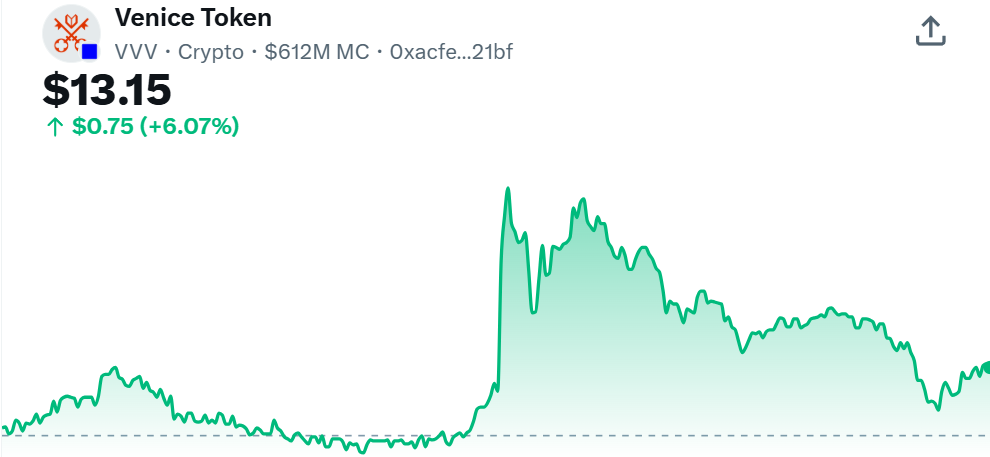
Venice Token rose 6% on Wednesday. Source: X
AI privacy concerns in spotlight
The capital raise comes amid mounting concerns over user privacy when using AI models.
Earlier this year, lawyers told Cointelegraph that a user consulting an AI for legal matters could have their chat logs used against them in court.
Related: AI’s power crunch turns Bitcoin miners’ grid access into an asset
In February, Ethereum Foundation AI lead Davide Crapis and Ethereum co-founder Vitalik Buterin proposed a way to use zero-knowledge proofs and other methods to ensure that a user’s interactions with large language models are private.
Conversations about privacy when using AI were stirred again in May, when a proposed class action was filed in California federal court accusing OpenAI of disclosing private ChatGPT user data to Google and Meta.
The complaint alleged that OpenAI embedded Meta Pixel and Google Analytics into the ChatGPT.com website, so that when a user sends a query, the website allegedly sends duplicate data to Meta and Google alongside advertising cookies and personally identifiable information, which is then used to target advertisements to the user.
Magazine: Bitcoin slides to $58K, XRP hits $1 but onchain data promising: Market Moves
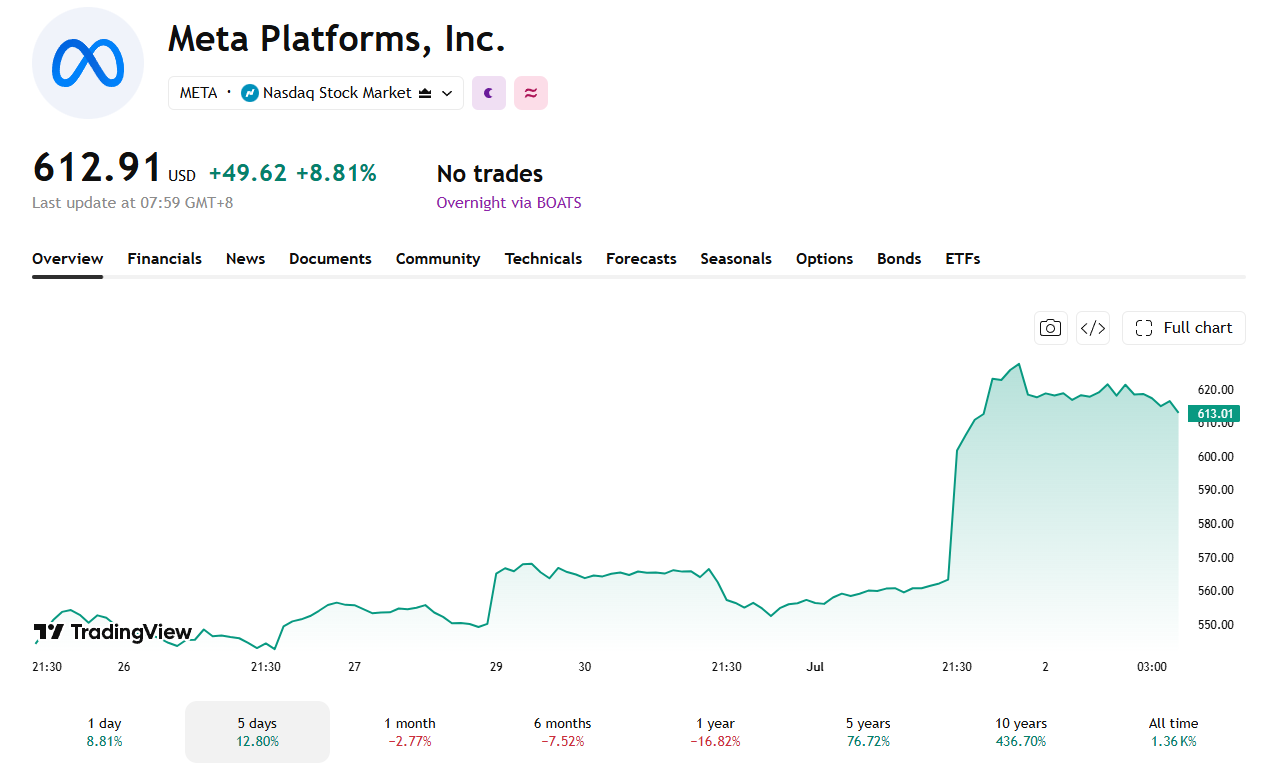
Meta’s plan to sell surplus computing power hit chip stocks hard on Wall Street. Meta’s own shares climbed nearly 9% on the news.
The announcement flipped years of assumed AI compute scarcity into a supply warning. It erased billions in semiconductor and neocloud value in a single session.
A Supply Signal Rattles Wall Street
Meta is building a business called Meta Compute. The unit will lease idle data center capacity to outside clients. The approach mirrors SpaceX’s model. SpaceX has rented spare capacity to firms including Anthropic.

For years, investors rewarded chip suppliers on one premise. They believed AI demand always outstripped supply. Meta’s admission of excess capacity broke that premise. Recent Nvidia institutional money flow data already show large investors pulling back.
Micron sank more than 10% on July 1. SanDisk, Intel and AMD each lost between 6.9% and 10.6%. Nvidia slipped just 1.25%, a modest decline that stood out against the broader rout.
Neoclouds and Big Tech Diverge
CoreWeave and Nebius rent GPU capacity to AI developers and saw their stocks fall 14% and 17% respectively on fears that Meta will undercut their pricing.
Meta has paid for similar cloud services before, but its shift into the same business now puts it in direct competition with its own vendors.
Other Magnificent 7 members gained ground. Apple, Microsoft, Amazon, Alphabet and Tesla all closed higher as some strategists link the split to AI spending cycle winners rotating away from pure hardware plays.
South Korea Feels the Spillover
The sell-off spread to Asia as Samsung and SK Hynix memory stocks fell more than 7% and 9% respectively in early trading and the KOSPI triggered another trading halt. The move extended a pattern from a prior Big Tech selloff spillover that hit Asian chipmakers earlier this year.
The post Meta Compute Launch Sends AI Compute Stocks Tumbling Globally appeared first on BeInCrypto.


Modern day crypto trading has become a deeply fragmented battleground that favors the institutional algorithms and punishes the retail trader. On one hand, there are high-frequency funds exploiting total visibility over public order books; on the other hand, ordinary market participants are forced into transparent matching pools where their pending stop-losses are openly hunted. Ouinex, a community-backed multi-asset platform, is trying to eliminate this structural asymmetry to shield retail orders from predatory manipulation.
Summary
- Ouinex says its Fair Execution Engine separates retail orders from institutional liquidity providers to reduce exposure to predatory trading strategies.
- The platform combines crypto markets with stock indices, commodities, forex, and equities through one interface with leverage of up to 500x.
- Ouinex says its OUIX token excludes venture capital allocations and uses trading based incentives instead of early institutional distribution.
For retail crypto traders, the core operational hurdles boil down to having to pit their personal portfolios against institutional-grade execution power, which creates a highly uncompetitive scenario where the everyday investor is structurally outmatched from the start. That’s the technological disparity Ouinex is trying to address.
“If I’m an institution that has 20 traders working around the clock with a trading infrastructure that is worth multi-million dollars with low latency, and I’m trading against the retail guy that’s sipping a coffee at Starbucks on his Wi-Fi, who do you think is going to win the battle? It’s a little bit like you’re swimming in a pool and you’re the little fish and there are sharks,” Ouinex CEO Ilies Larbi told crypto.news during an interview.
Professional trading venues typically rely on what is called a Central Limit Order Book, or CLOB. What this does is it matches bids and offers systematically to execute transactions.
On traditional platforms like Nasdaq or NYSE, retail investors are structurally insulated from the raw matching engine. Regular retail orders are typically routed through intermediary brokers or internalized by market wholesalers, meaning everyday retail capital rarely interacts directly with predatory institutional algorithms on the public book.
However, when this same methodology is transplanted across crypto trading venues, that protective buffer disappears. Most crypto platforms force everyday retail accounts and hyper-capitalized automated market makers onto the exact same matching engine, creating what Larbi calls an “absolutely unfair environment” for the retail trader.
This has been the core structural friction that has led Larbi and his team to come up with their proprietary Fair Execution Engine, which, simply said, drops the central limit order book for a more isolated, retail-protected matching model.
“We have built this Chinese wall between retail clients and institutions,” Larbi said, trying to explain the technology in layman’s terms.
What the Fair Execution Engine does is continuously scan and filter incoming institutional quotes in real time, thereby creating the hypothetical Chinese wall that keeps sensitive retail order details safely hidden on internal servers. As a result, the external trading algorithms cannot query a public order book to map out pending positions, and artificial liquidation hunts become mechanically impossible.
“Our retail users are fully protected because institutions cannot take liquidity on our platform, they’re only allowed to make markets, and that’s it. They don’t have access to things like stop losses or limit orders, because everything is sitting on our servers, and orders only get sent for execution once the market reaches that level.”
More than just crypto trading
Neutralizing predatory execution solves only half the equation for a modern brokerage, as sustaining active trader volume requires looking beyond a purely digital asset class. The modern day trader is always looking out for diverse financial instruments that can be accessed directly on a single platform without having to move capital in and out every time an opportunity arises outside the crypto arena.
We have already seen this structural integration materialise across several digital asset platforms that now offer traditional financial instruments like commodities, stock indices, and fiat pairs alongside native tokens.
Larbi agrees that “mixing” the two landscapes is the correct approach, especially with how recent geopolitical events have boosted traditional financial volumes while crypto activity has remained sidelined.
However, Ouinex is taking a different approach compared to what most crypto exchanges do when introducing traditional assets through a perpetual framework, which, according to Larbi, “doesn’t offer much liquidity” in most cases because they synthesize entirely new contracts rather than tapping into mature and established markets.
“What we’ve done is used traditional financial infrastructure to provide these instruments through a system that has existed for the last 50 years. On Ouinex, for example, when you trade TradFi, you’re basically trading at a cost that is about seven times cheaper than anything related to perpetuals, in a market that is approximately 20 times more liquid.”
Citing Hyperliquid as an example, Larbi noted that utilizing traditional financial plumbing makes trading the euro-dollar pair roughly seven times cheaper on Ouinex.
Furthermore, the executive pointed out that this infrastructure secures approximately $5 million in top-of-the-book liquidity, which represents a significantly deeper pool of available capital when compared to the mere $100,000 in depth of market on the competing venue.
As of publication time, besides the multiple crypto native instruments, Ouinex offers traditional instruments like stock indices, commodities, foreign exchange, and equities. Users can navigate all these asset classes through a unified interface that supports up to 500x leverage.
Eliminating predatory venture capital allocations
It’s not just market execution pipelines where Ouinex is taking a defensive posture to safeguard retail participants. Larbi also drew attention to token launch dynamics, flagging structural allocation manipulation as a serious issue fueling the “pump and dump schemes” that has been rampant throughout the ecosystem, especially during the years lacking clear crypto regulation.
“Exchange gets an allocation, VC gets an allocation, the founder spends money on marketing to hype the project, retail clients come in and buy, buy, buy, buy, buy. Once the market goes up, the exchange or the VC just dumps. They make millions. Retail people just lose money, right? That’s just the reality of 90% of what’s been happening in the crypto market.”
Addressing this structural misalignment required rewriting the tokenomics architecture for the platform’s native utility token, OUIX ($OUIX), from scratch. According to Larbi, Ouinex has completely excluded venture capital funds from the token’s distribution ledger, thereby preventing early-stage institutional dump pressure post-listing.
“We decided not to include any type of VCs in any of our token allocations, so no VC has a token allocation,” Larbi stated.
Additionally, operating a native trading ecosystem allows the firm to host its own token listing, bypassing the extortionate, unvested supply demands typically levied by third-party centralized exchanges. Retaining the asset entirely within its internal ecosystem forces the management team to assume full accountability for market stability, ensuring retail users are never treated as corporate exit liquidity.
“Because we are an exchange, we don’t need to actually go to another exchange to list the token… we make ourselves responsible fully for the performance of the token,” he added.
Instead of relying on traditional, one-off marketing promotions that attract temporary speculative hype, the exchange structures its token distribution through an active incentive model tied directly to network usage.
Participants can complete basic social tasks and accumulate NEX Points by engaging in either demo or live trading environments and then claim campaign payouts in OUIX or other supported cryptocurrencies at the end of each recurring campaign.
Targeting a lean ecosystem of dedicated traders
In his concluding remarks, Larbi said that Ouinex does not plan on competing against mass-market exchange giants that have already accumulated millions of casual, low-volume retail accounts. Instead, the platform wants to prioritize building a highly concentrated user base composed entirely of dedicated market participants.
“My goal is to go after 50,000 or 100,000 of the right users, people that are true traders that trade the market, and that’ll be enough for me to do right. So, if in two years we’re able to accomplish this, I’ll be absolutely happy. It’s a leaner operation, more quality traders, more revenue with less obviously operational cost, and that’s where you know we were trying to position, that’s how we’re trying to position Ouinex.”
According to company documents shared with crypto.news, Ouinex has raised over $9 million through a combination of community-equity financing and pre-sale rounds, establishing a base of over 5,000 retail and professional community investors with zero VC capital involved.
The platform is operated by an executive team averaging more than 25 years of experience in legacy financial systems and brokerage markets. It currently operates across multiple jurisdictions, with active compliance entities maintained in South Africa, Australia, Poland, and Saint Vincent and the Grenadines.
The architecture of the native OUIX ($OUIX) token introduces a deflationary mechanism sustained by trading fees generated across more than five asset classes. To safeguard the asset’s long-term market health, the tokenomics framework places over 50% of the pre-sold supply under a strict three-year cliff lockup schedule.

Will Nifty rally if India’s Finance Minster Nirmala Sitaraman is changed?

Cadbury confirms it has shrunk Heroes and Roses tubs

Franklin Floating Rate Daily Access Fund Q1 2026 Commentary


-

 Fashion5 days ago
Weekend Open Thread: Staud – Corporette.com
-

 Politics6 days ago
The House | Manchesterism won’t survive the painful trade-offs unless it gets citizens on board
-

 Crypto World2 days ago
Strategy authorizes up to $1.25B in Bitcoin sales under new capital plan
-

 Politics6 days ago
Potential 2028er World Cup attendee leaderboard
-

 Business6 days ago
Asia stock markets slide as tech shares slump
-

 News Videos3 days ago
MAJOR BITCOIN & MARKET UPDATE!!!! (MUST WATCH ASAP!!!)
-

 Tech6 days ago
A Look At A Gaggle Of Transputer Boards
-
 Crypto World6 days ago
Dell (DELL) Shares Tumble Over 5% Following Analyst Downgrade to Hold
-

 Crypto World5 days ago
Coinbase, Circle Deepen Crypto Stock Losses Despite Resilient S&P 500
-

 Business2 days ago
Australia treasurer says alleged access of prime minister’s bank data ’incredibly concerning’
-

 Crypto World5 days ago
Kraken's xStocks Opens Bending Spoons IPO Registration to EEA Retail
-

 Sports5 days ago
FIH Pro League: India defeat Pakistan 7-1, register biggest win of campaign | Other Sports News
-
 Crypto World6 days ago
Bitcoin Sparks $600M Hourly Liquidations With $65,000 Set To Become Resistance
-

 Tech4 days ago
Bluekit phishing kit adopts browser-in-the-middle for login theft
-

 Tech2 days ago
Anonymous researcher drops 0-day ‘exploitarium’ repo
-

 Tech5 days ago
Russian hackers now target Signal backup recovery keys
-
 Crypto World6 days ago
Hyperliquid Named on Singapore MAS Investor Alert Register
-

 Crypto World6 days ago
RTX holders must register wallets before token distribution begins
-

 Sports16 hours ago
Broncos roster: OL Ben Powers (No. 74) entering final year of contract
-
 Business2 days ago
The AI boom won’t burst all at once. It will pop in ‘rolling bubbles’: Macquarie
You must be logged in to post a comment Login