

Crypto World
Injective Files SEC Transfer Agent Application for Onchain Securities

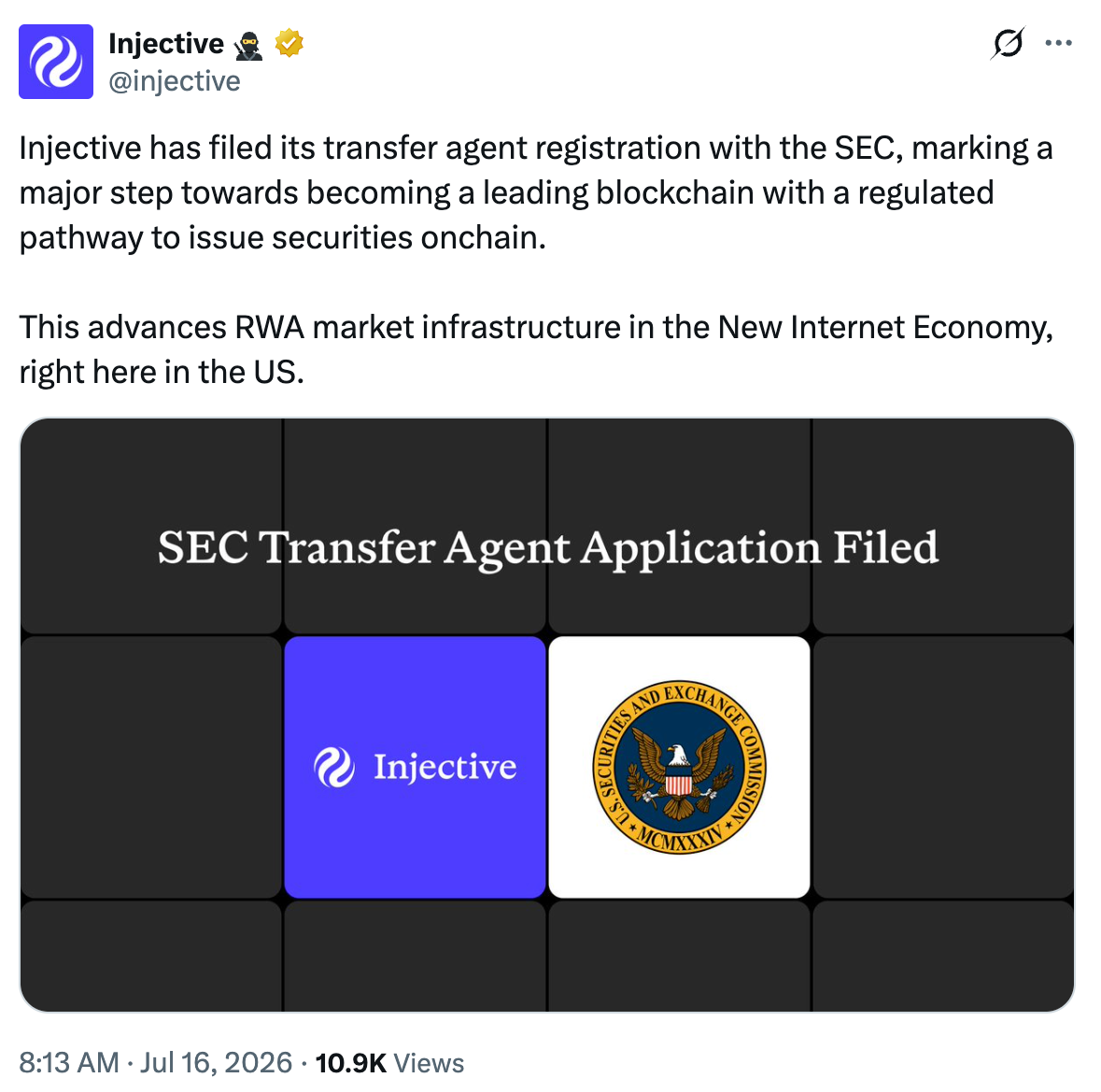
Injective said Thursday it has filed a transfer agent registration with the US Securities and Exchange Commission, seeking to bring one of the core record-keeping functions of securities markets onto blockchain infrastructure.
Transfer agents are a core part of US market infrastructure, maintaining shareholder records and tracking changes in securities ownership. Injective, a layer-1 blockchain focused on decentralized finance and tokenized real-world assets, said bringing that function onchain would create a regulated pathway for issuing and managing tokenized assets.
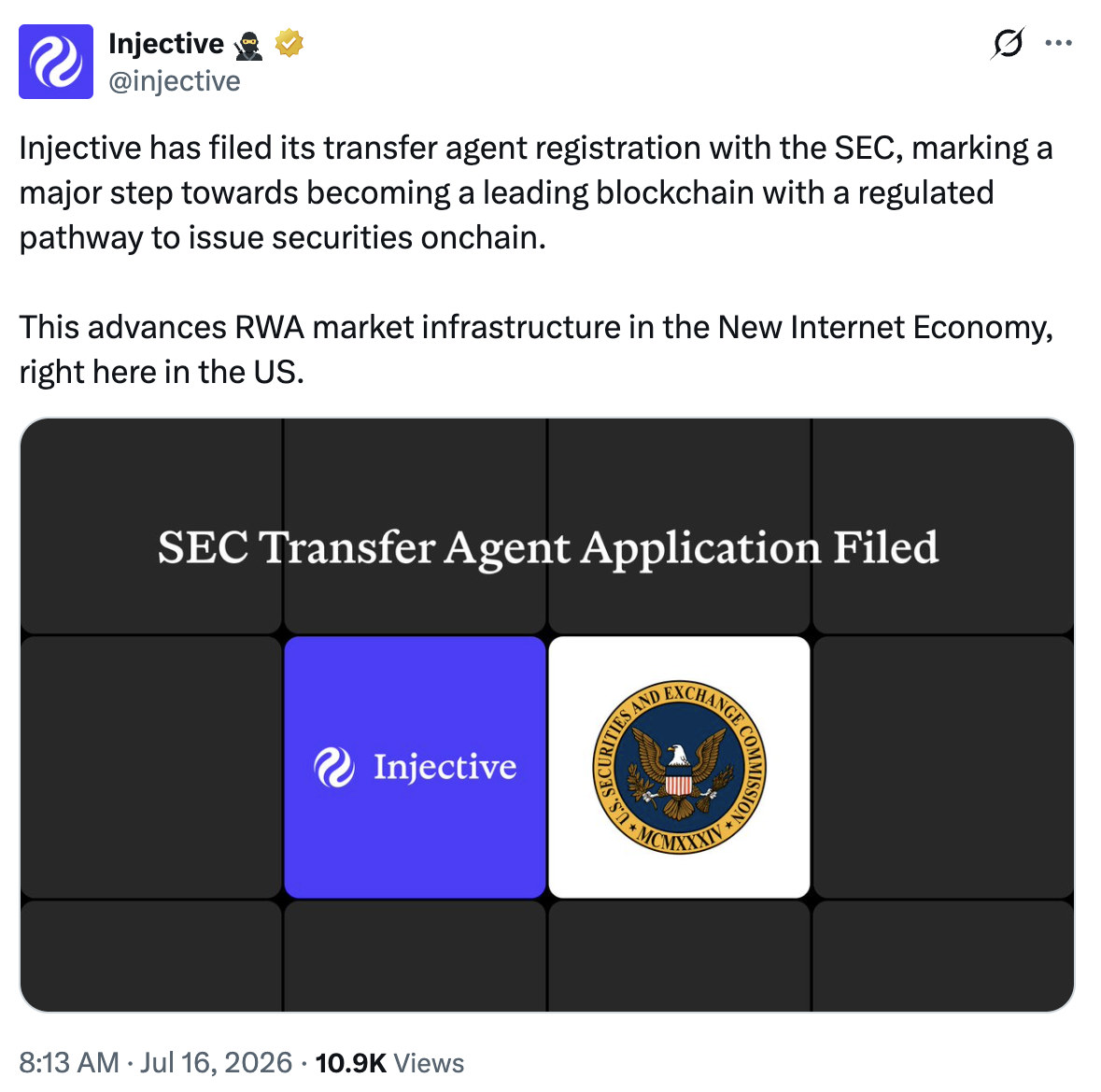
Source: Injective
If approved, the registration would move Injective beyond blockchain infrastructure for tokenized assets and into the regulated systems that determine who legally owns a security. Injective said the approach could reduce delays and reconciliation between intermediaries.
“Tokenized securities and RWAs need compliant ownership records on infrastructure that settles in less than a second,” Injective wrote in an X post, adding that it aims to offer the capability at scale in the United States.
Injective did not identify the legal entity behind the application or provide a public SEC filing, and Cointelegraph could not independently verify the submission at the time of publication.
Related: Hackers tried to backdoor Injective NPM package to steal wallet keys
Capital markets infrastructure moves onchain
Traditional financial institutions have increasingly turned to blockchain to modernize the infrastructure underpinning capital markets. Beyond tokenizing assets, exchanges and market operators are applying the technology to market data distribution, securities issuance, settlement and other post-trade functions.
Nasdaq has been among the most active. Last month, the exchange partnered with onchain financial data network Pyth to distribute its proprietary TotalView market data to blockchain applications. Earlier this year, Nasdaq also partnered with Kraken and tokenization firm Backed to develop infrastructure linking traditional equities to blockchain networks.
Intercontinental Exchange, the parent company of the New York Stock Exchange, has also expanded its tokenization strategy through a partnership with Securitize to develop infrastructure for onchain stocks and exchange-traded funds designed to support 24/7 trading and instant settlement.
Meanwhile, the Depository Trust & Clearing Corporation, the primary post-trade infrastructure provider for US securities markets, is preparing to launch its tokenized Collateral AppChain platform to automate collateral management and settlement across financial markets.
Magazine: Is Robinhood Chain’s success bullish or bearish for ETH the asset?


Coinbase CEO Brian Armstrong has rejected calls for a new AI self-regulatory body, arguing that existing laws already provide enough protection against harmful AI.
His remarks came just a day after the crypto exchange disclosed that AI now writes over 95% of its code, more than twice the figure the company reported earlier in the year.
Armstrong Says Existing Laws Already Cover AI Risk
It all started with a proposal from Google DeepMind CEO Demis Hassabis on July 14, where he called for the creation of a federally overseen standards body to test and certify frontier AI models before they are deployed.
According to him, artificial general intelligence could arrive within a few years, with increasingly capable models possibly introducing cybersecurity and biological risks as well as a multitude of national security issues. He therefore proposed a public-private organization, much like the Financial Industry Regulatory Authority, that would at first conduct voluntary reviews before potentially moving to mandatory testing for the most advanced AI systems.
Reactions from Hassabis’ peers were quick, with tech entrepreneur Chamath Palihapitiya calling the framework “quite well reasoned, and OpenAI’s Sam Altman describing it as “a thoughtful proposal.” Microsoft CEO Satya Nadella also chipped in, calling it “an important piece” and adding that the goal should be to avoid “any model that breaks the world.”
However, Armstrong disagreed, maintaining that such arrangements often create a dual approval process that forces businesses to satisfy both state regulators and industry bodies. He insisted that AI needs neither an SRO nor a government watchdog, since, so far, there has been no harm done that couldn’t be compensated.
“Why design regulation around a hypothetical problem,” the crypto chief posited. “The existing laws which prevent fraud, award damages when victims are harmed (tort), UDAP Laws (Unfair and Deceptive Acts and Practices) etc provide broad protections if one of the frontier labs issues a model that does harm.”
Furthermore, he pointed out that AI developers also have a strong commercial incentive to release safe products since users will most likely avoid tools they consider dangerous.
Coinbase Doubles Down on AI Across Its Business
Armstrong’s interest in the direction of AI isn’t a passing fad, considering the company he heads has deeply embedded AI use in its processes.
This was revealed by a colleague of his, Coinbase’s head of platform Rob Witoff, who recently told Cointelegraph that between 95% and 100% of the crypto exchange’s code is now written by or with large language models, more than doubling an estimate the company shared in February of roughly 40%.
Recall that in May, the exchange announced a 14% cut of its workforce, with the intention being to reorganize around smaller, more experienced teams with AI at the center of its operations. According to Witoff, AI usage on Coinbase varies depending on the task, with sensitive areas such as cryptography still getting detailed human review while internal prototypes can be built almost entirely through automation.
Other crypto firms, including Gemini, Crypto.com, Kraken, Messari and Dune, have also reduced headcounts this year while expanding on AI use.
But that rapid AI adoption has not been without a few setbacks, as seen earlier this month, when Coinbase was forced to investigate an AI-generated notification that incorrectly reported the result of the FIFA World Cup match between Norway and Brazil before the match had even started.
The post Coinbase CEO Brian Armstrong Rejects Calls for a New AI Regulatory Body appeared first on CryptoPotato.
Trump Media & Technology Group has unveiled a paid data service that will deliver real-time posts from Truth Social’s highest-ranking accounts to financial firms and news organizations.
Summary
- Trump Media will sell real-time Truth Social posts through a licensed API for financial firms.
- President Trump’s 12.9 million-follower account gives the paid feed its main market appeal.
- Ethics experts question whether presidential information should generate revenue for a family-linked company.
According to Trump Media, the Truth API will provide licensed access to public posts that may carry time-sensitive political, policy, or market information. The company plans to offer the feed to trading firms, financial data providers, media outlets, and other businesses that monitor influential accounts.
Subscribers will receive what Trump Media described as “immediate, verified access” to posts published on the platform. Interim CEO Kevin McGurn presented the API as a licensed alternative to unauthorized data scraping, which companies often use to collect posts from social networks.
“Markets already move on Truth Social posts,” McGurn said.
Trump Media expects the service to generate recurring revenue outside its advertising and subscription businesses. Other social media companies already charge data providers and institutional clients for API access, which trading desks can use to monitor sentiment, policy announcements, and events affecting stocks, currencies, commodities, or digital assets.
Trump’s posts give the feed market value
President Donald Trump’s account had 12.9 million followers as of Thursday morning, making it the largest account on Truth Social. Trump regularly uses the platform to announce or discuss tariffs, foreign policy, government decisions, and other matters watched by financial markets.
Although Trump Media did not name the president in its API announcement, his posts remain among the platform’s most closely followed content. Financial firms and newsrooms monitor presidential statements because announcements involving trade or government policy can affect asset prices.
Trump’s family also remains financially connected to the company. SEC filings show that about 114 million Trump Media shares issued to the president were later moved into a revocable trust controlled by Donald Trump Jr. after Trump won the presidency.
Trump Media trades on Nasdaq under the ticker DJT. By licensing rapid access to posts from its most prominent accounts, the company is seeking to turn Truth Social’s role in political communication into a commercial data product.
Paid access raises conflict concerns
The service has also attracted criticism over the president’s connection to both Truth Social and Trump Media. According to CNBC, Democracy Defenders Fund ethics attorney Virginia Canter called the arrangement “a huge conflict of interest.”
Canter argued that Trump has a public duty to distribute presidential information widely, while the API gives paying customers faster access through a company tied to his family’s holdings. She also described Truth Social as the “de facto presidential press room.”
Questions about Trump’s platform activity had emerged before the API announcement. A CNN investigation reported that Trump promoted more than 20 companies on Truth Social after investments linked to those businesses appeared in his financial disclosures. The White House denied that the activity created conflicts of interest.
Trump’s 2025 financial disclosure also reported about $1.4 billion in crypto-related earnings, adding to scrutiny of his family’s business interests while his administration shapes digital asset policy. By selling licensed access to presidential posts, Trump Media is now placing those communications inside a data market already used by financial firms to identify trading signals.
Crypto World
Trump’s Teleprompter Operator Made $100,000 Betting on a President Who Ignores the Script


A White House teleprompter operator allegedly made over $100,000 on Kalshi, ABC News reported on July 16. He bet on what President Donald Trump would say before the words left the podium.
Gabriel Perez has run Trump’s teleprompter since 2016. He is now in settlement talks with the Commodity Futures Trading Commission (CFTC).
How the Trump Speech Bets Worked
Kalshi runs Mentions markets. Traders bet on whether a word or topic will come up in a public speech.
Perez had the script in his hands. Investigators say he bet on more than a dozen Trump speeches in three months, including February’s State of the Union.
His edge had one weakness. Trump often abandons his script, and Perez allegedly exited bets mid-speech when scripted words never came.
“You know, when you go up here, you take a big chance, especially me because I go off teleprompter about 80% of the time,” Trump said in January remarks to the Detroit Economic Club.
Follow us on X to get the latest news as it happens
Investigators believe Perez bet on that speech, too. Kalshi’s surveillance team caught the pattern and told its regulator.
“Our surveillance team promptly flagged and referred these trades to the CFTC, and we are cooperating and assisting regulators,” Kalshi enforcement chief Bobby DeNault said in a statement.
Kalshi Insider Trading Rules Face a Hard Test
Kalshi launched three market integrity measures just weeks ago, including risk scoring and employment checks. Its own report says screening tools blocked over 100 potential insider trades in Q1 2026. The same quarter brought 150+ investigations and 20+ law enforcement referrals.
The platform had already adopted an employer disclosure rule after White House scrutiny. The White House warned staff in March against betting on inside information. However, Perez still runs Trump’s teleprompter today.
Manhattan prosecutors declined to bring criminal charges. Instead, the CFTC may settle. Perez would return his profits and stop similar trades.
He is not the first. The DOJ says a US Army soldier turned $33,000 into roughly $410,000 on Polymarket using classified Maduro intel.
Even Wall Street is wary. Goldman Sachs recently limited employee prediction bets on Kalshi and Polymarket. The bigger question remains. Can employment checks beat a trader who reads the script before the market does?
The post Trump’s Teleprompter Operator Made $100,000 Betting on a President Who Ignores the Script appeared first on BeInCrypto.
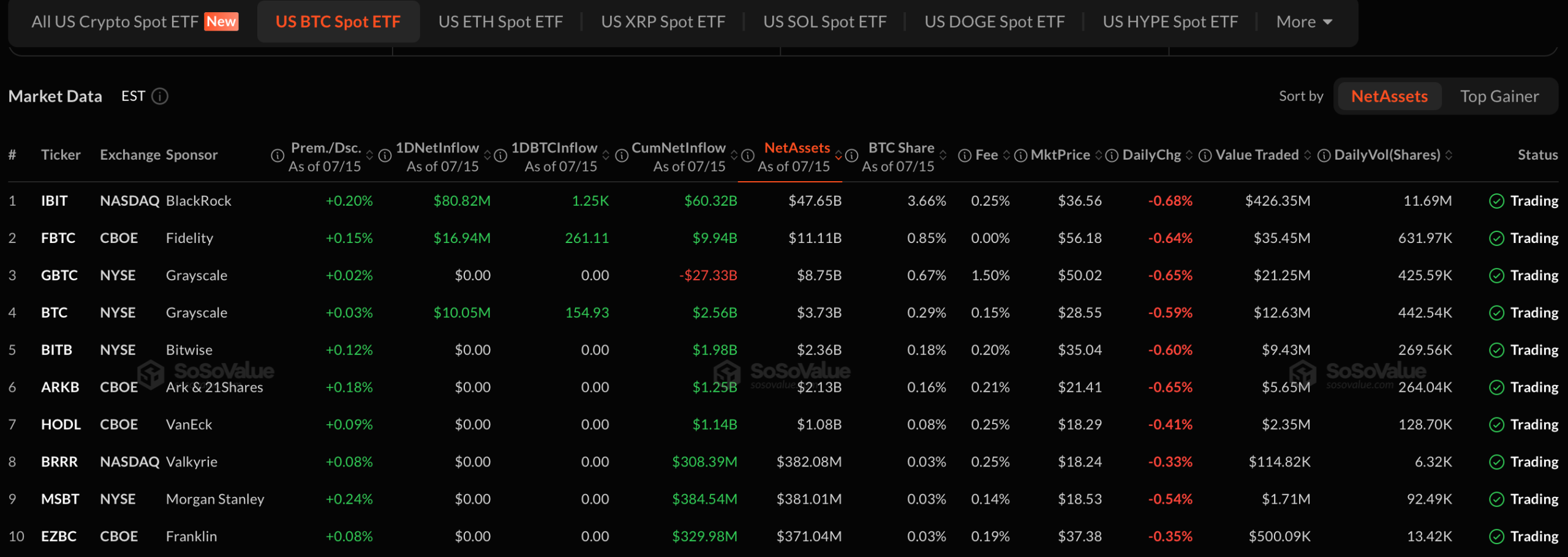
Morgan Stanley’s E*TRADE platform has launched spot cryptocurrency trading, allowing eligible clients to buy, sell and hold Bitcoin, Ether and Solana through a partnership with crypto infrastructure provider Zero Hash.
Clients can view their crypto holdings alongside stocks and other traditional investments on the E*TRADE platform, while transfer functionality for moving digital assets on and off the platform is expected later this year.
The self-directed channel served 8.6 million households and held about $1.56 trillion in client assets as of March 31, according to Morgan Stanley’s latest financial supplement.
According to Thursday’s announcement, trades carry a 50-basis-point fee, while custody and transaction services are handled through separate Zero Hash accounts that are not covered by FDIC or SIPC protections. Morgan Stanley said it expects to transition the digital asset services to Morgan Stanley Digital Trust, its national trust bank currently in organization.
Morgan Stanley also introduced several non-crypto updates across the customer platform, including fractional share trading, a revamped retirement planning tool and new features for its Power E*TRADE Pro desktop platform.
The rollout follows a pilot launched in May, when the company began testing the service with a limited group of users before expanding access to eligible E*TRADE clients.
Related: Stanford study says 5-minute Bitcoin prediction markets enable settlement manipulation
Morgan Stanley broadens crypto strategy
Beyond retail spot trading, Morgan Stanley has expanded its digital asset business into stablecoin reserve services and crypto exchange-traded funds this year.
In April, the Wall Street giant launched a stablecoin reserve offering that allows issuers to hold the assets backing their tokens in one of the firm’s money market funds while earning interest.
The same month, the company launched its spot Bitcoin ETF with a 0.14% management fee, making it the lowest-cost Bitcoin ETF on the US market at the time. The fund debuted on NYSE Arca as the first spot Bitcoin ETF launched by a major US commercial bank.
During its first six trading days, the ETF attracted more than $100 million in net inflows, surpassing the cumulative inflows of WisdomTree’s spot Bitcoin ETF, which launched in January 2024. At the time of writing, the fund has attracted about $385 million in cumulative net inflows, according to SoSoValue data.
In June, Morgan Stanley amended its proposed spot Ether and Solana ETF filings to set management fees at 0.14% after first applying to list the funds in January.
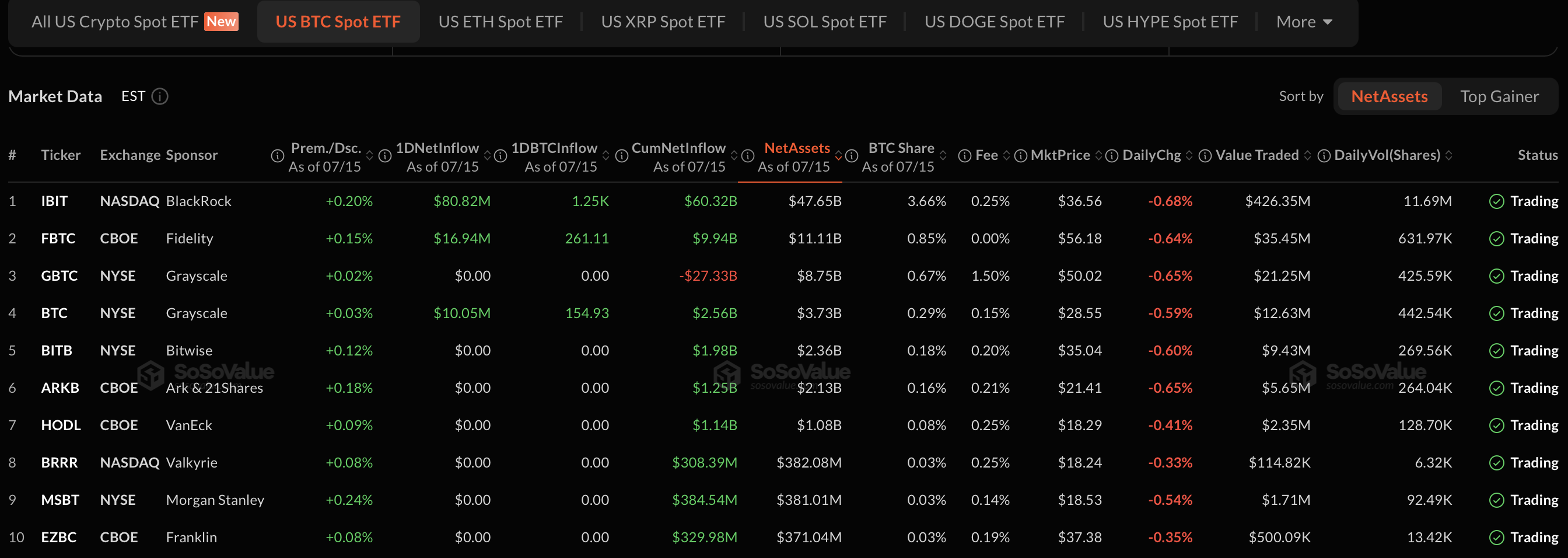
Top 10 Bitcoin ETFs. Source: SoSoValue
Magazine: Gambling on random Pokémon cards: Onchain gagcha hits record high as crypto sinks
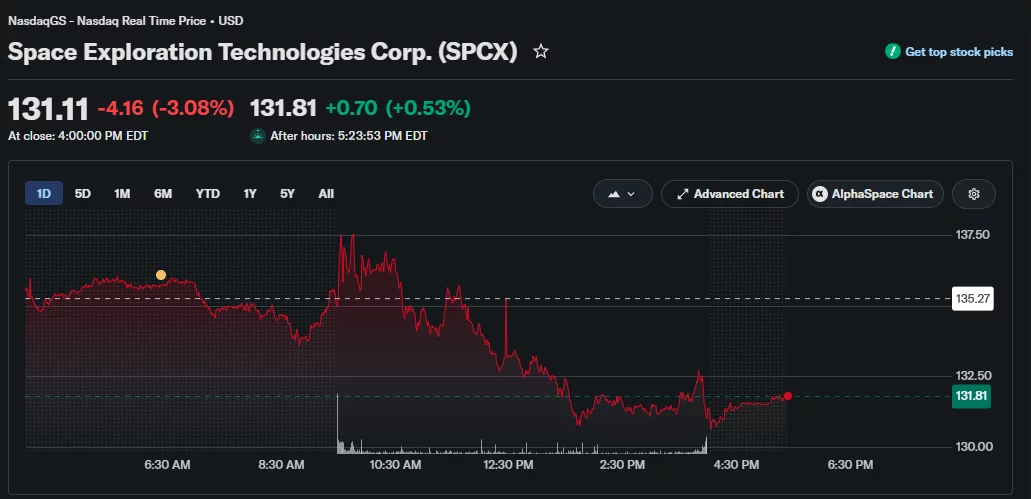
Cathie Wood’s Ark Invest has purchased about $52.1 million of SpaceX stock, lifting its investment since the June IPO above $475 million as the shares trade below their $135 offer price.
Summary
- Ark Invest bought $52.1 million of SpaceX shares as the stock fell below its IPO price.
- SpaceX has dropped about 42% from its $225.64 post-listing record.
- A strong descending channel keeps $128–$130 support and $133–$135 resistance in focus.
According to Ark Invest Tracker, Ark bought the shares through its ARKK, ARKQ, ARKW, and ARKX exchange-traded funds during the week ending July 10. The purchases followed roughly $444 million of buying around SpaceX’s June 12 market debut.
Wood’s latest move came as SpaceX lost much of its early IPO gain. After opening at $150 and reaching $225.64 shortly after its listing, the stock closed at $131.11 on Thursday, according to Yahoo Finance.
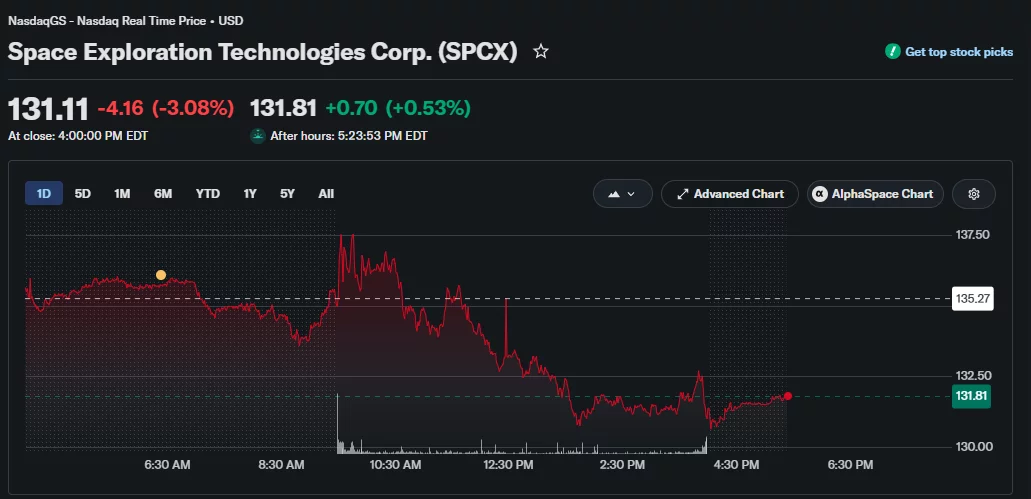
At that price, SpaceX has fallen about 42% from its record and closed below the $135 IPO price for the first time. Thursday also extended the stock’s losing run to five sessions.
Ark’s buying reinforces its long-term conviction
Ark’s renewed buying indicates that Wood has treated the decline as an opportunity to expand her position. Still, the investment firm has not provided a short-term price forecast tied to its latest purchases.
The position also carries valuation and supply risks. According to Reuters, SpaceX trades at about 49 times revenue, compared with roughly 15 times for Tesla, while the company’s market value has fallen to around $1.8 trillion.
Selling pressure could increase when employee and early-investor restrictions begin expiring in August. Reuters reported that the first lockup release could make 911.5 million shares available after SpaceX publishes its initial earnings results, although unlocked shareholders would not be required to sell.
Bearish traders have already profited from the retreat. Data from Ortex Technologies, cited by Reuters, showed that short sellers had accumulated about $8.7 billion in paper gains since the IPO, with nearly 49% of the available shares on loan.
SpaceX stock remains trapped in a bearish channel
On the one-hour TradingView chart provided, SpaceX stock remains inside a descending channel that has formed through a series of lower highs and lower lows since early July. The latest candle closed near $131.07 after trading between $131.01 and $132.89.
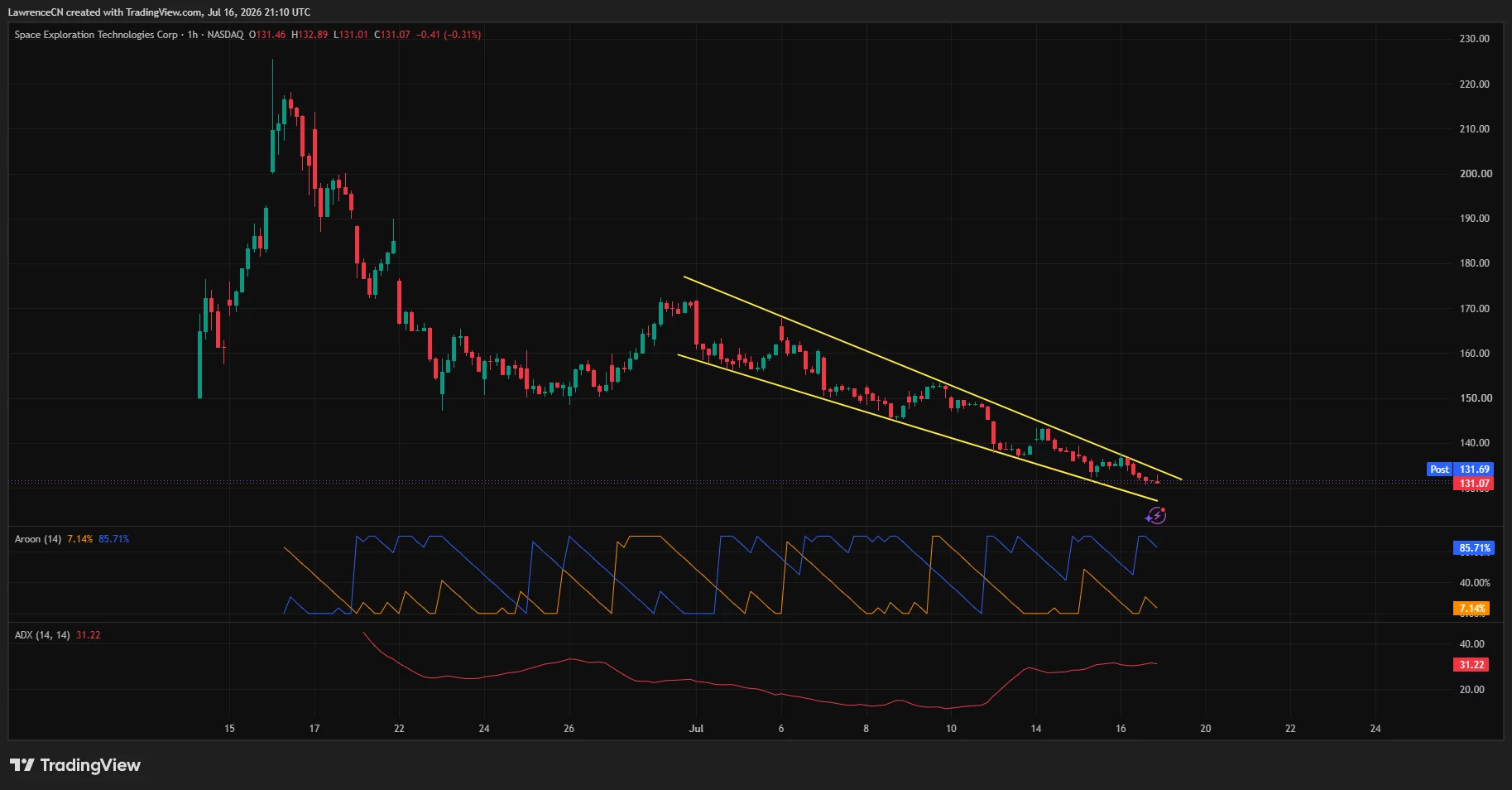
Aroon readings on the chart show Aroon Down at 85.71%, compared with Aroon Up at 7.14%, indicating that sellers continue to control the short-term price structure. At the same time, an Average Directional Index reading of 31.22 shows that the existing trend retains notable strength.
The channel floor places immediate support around $128 to $130. Based on the chart structure, a confirmed break below that area could expose $125, while the upper channel boundary creates the first resistance zone between $133 and $135.
For a stronger recovery, the chart shows that buyers would need to reclaim the channel ceiling before challenging $140. Until such a breakout occurs, Ark’s latest purchase provides an institutional vote of confidence but does not reverse the stock’s bearish technical structure.
Crypto World
Ethics in Crypto Market Structure ‘Really Not Our Concern,’ Says Blockchain Association CEO
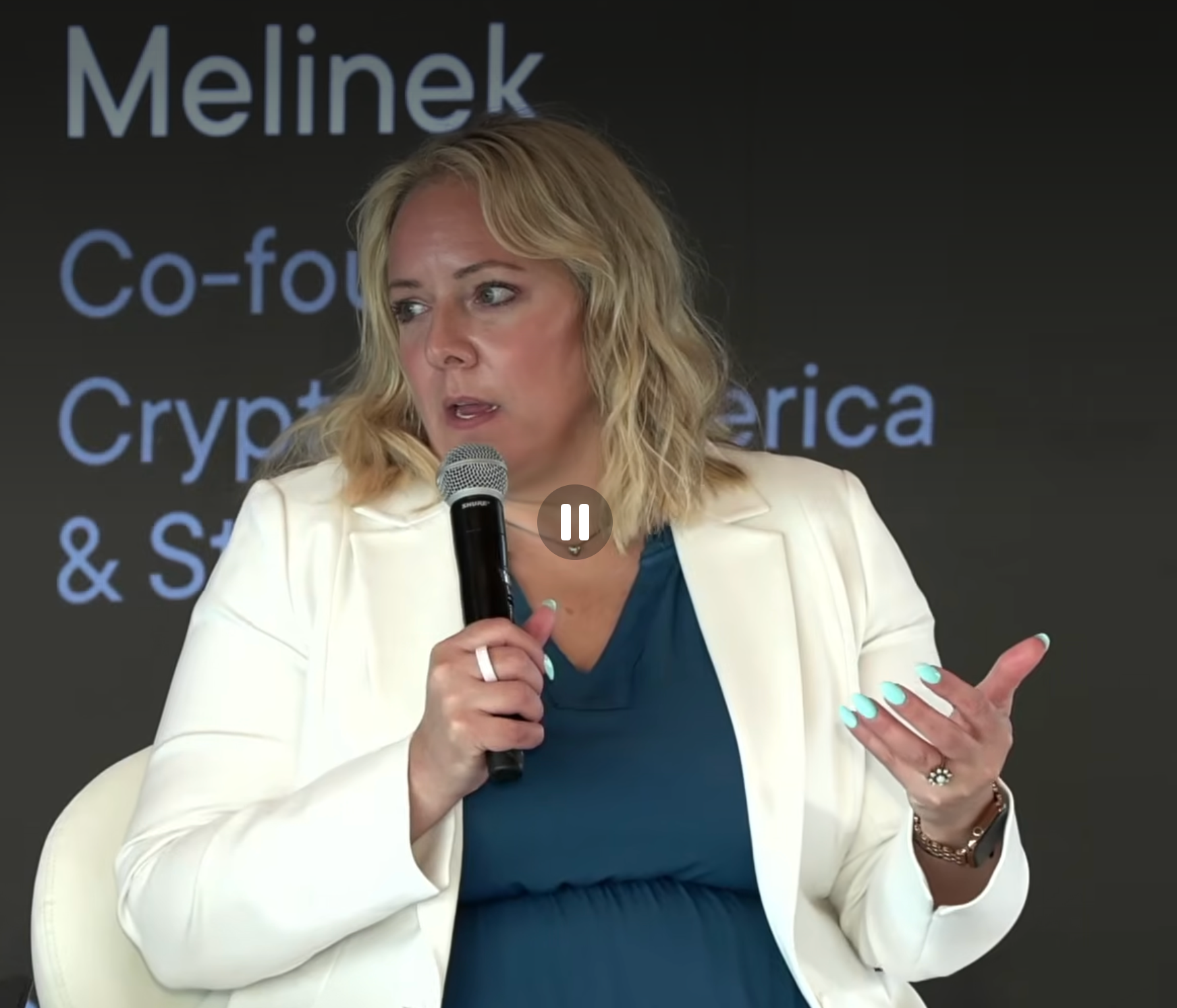
Summer Mersinger, the CEO of the Blockchain Association and a former commissioner at the US Commodity Futures Trading Commission (CFTC), anticipated a vote on a cryptocurrency market structure bill as soon as next week with the window closing for lawmakers before August state work periods.
Speaking at the Injective Summit in Washington, DC, on Thursday, Mersinger said that US lawmakers working to advance the Digital Asset Market Clarity (CLARITY) Act in Congress had a “few little nits that they’re still working out” but were “very close on the main part of the language” around the bill. According to the Blockchain Association CEO, a vote in the Senate could come as early as next week, provided lawmakers reached an agreement on ethics.
“Ethics is the big elephant in the room,” said Mersinger on the crypto bill. “That’s what we hear from every office is that we’ve gotta figure out ethics. Today there’s a meeting at the White House with some Republican senators. We’re hopeful that an agreement comes out of that and that it’s something the Democrats will accept or that they can make some changes but get to an agreement.”
She added:
“For my members and what we are advocating for on the Hill… look, whatever you decide on ethics, that’s really not our concern. That is politics. That’s Congress. That’s elected officials. But please don’t let it kill all the hard work that we put in the rest of the bill.”
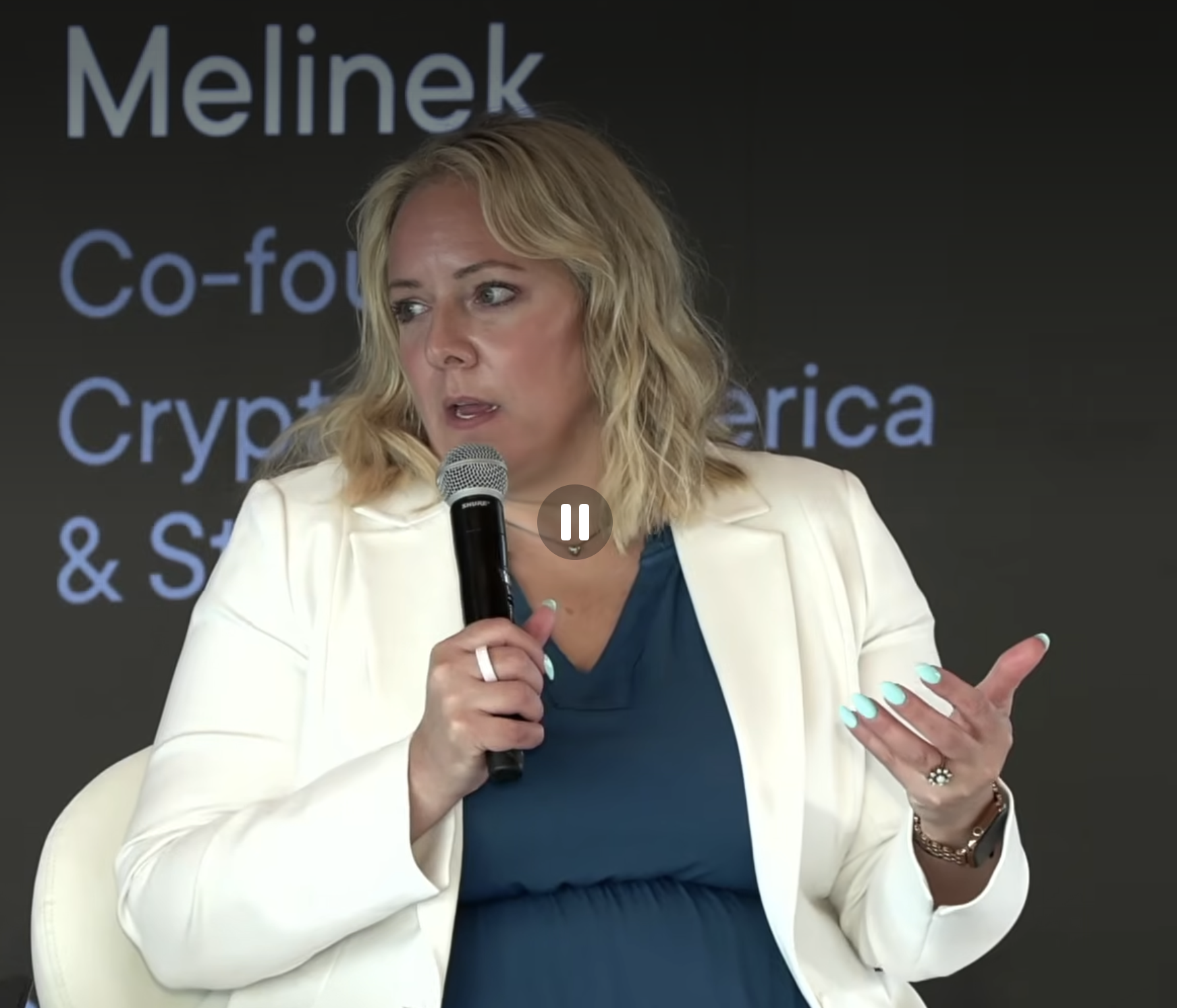
Summer Mersinger speaking at Injective Summit on Thursday. Source: Injective
Mersinger’s comments on a White House meeting followed reports that US President Donald Trump planned to discuss CLARITY with a group of Republican senators on Thursday, potentially including his ties to the industry, after Senate Democrats held their own meeting on the bill on Wednesday. Trump disclosed in June that he had earned $1.4 billion from ventures related to digital assets, including his memecoin and his family’s business World Liberty Financial.
Related: US senator blasts AG pick for ‘dismantling’ crypto unit, Trump’s CZ pardon
A former CFTC commissioner, Mersinger departed the agency in 2025 to become the CEO of the Blockchain Association. The organization was involved in discussions with lawmakers over the market structure bill as it passed the Senate banking and agriculture committees.
CLARITY needs bipartisan support to become law, but some Democrats are opposed
On Tuesday, three Senate Democrats held a press conference saying that they would not support a crypto market structure bill without clear ethics provisions, citing Trump’s financial disclosures and the potential for corruption by lawmakers and the White House. Republicans hold a slim majority in the Senate and would need several Democrats to vote yay on the bill for it to pass.
At the time of publication, traders on prediction market Kalshi had a 75.1% chance on CLARITY going for a floor vote in the Senate before the August break, up from 47% on July 10.
Magazine: Crypto’s CLARITY Act faces partisan fight over ethics on Senate floor
Bitcoin (BTC) cooled off with US stocks on Thursday as tech selling tempered gains from low inflation.
Key points:
- Bitcoin follows US stocks as they come off local highs sparked by bullish US inflation data.
- Tech sell pressure contributes to slowing momentum as retail investors take profits.
- The BTC price rebound is seen rejecting at overhead resistance.
Tech selling puts the brakes on crypto, risk-asset upside
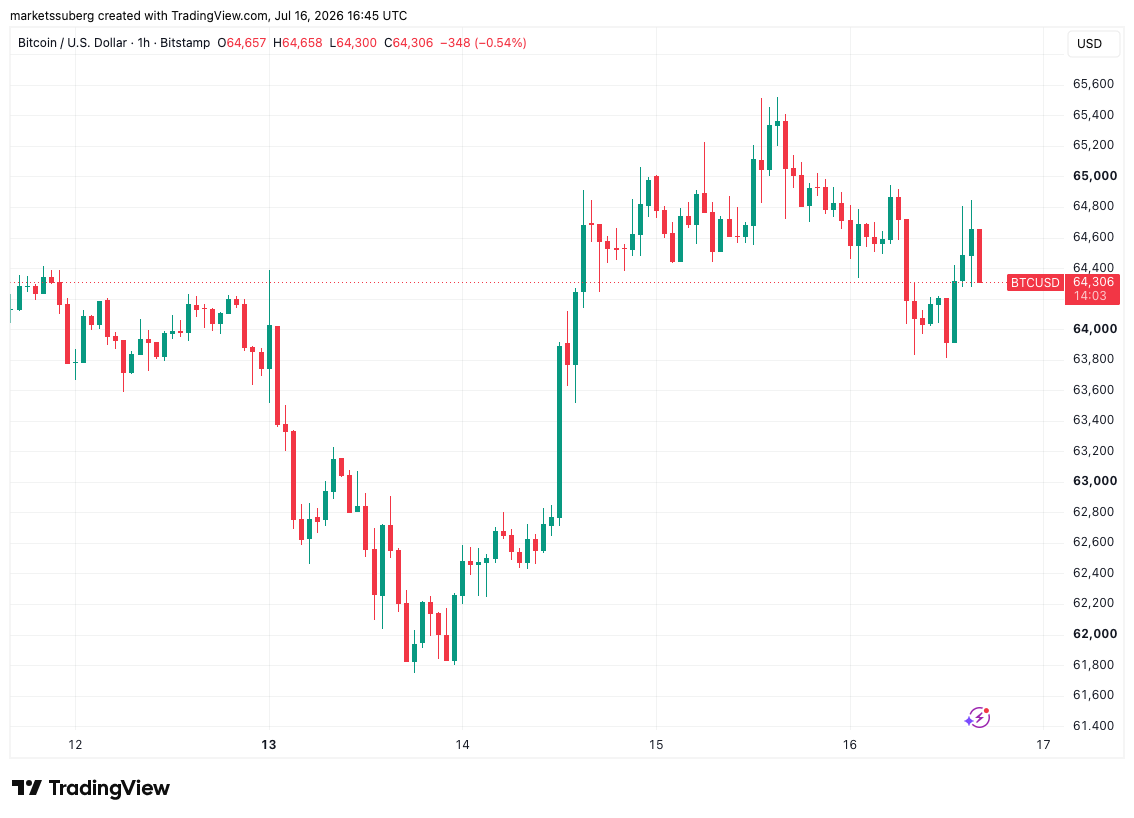
Data from TradingView showed BTC/USD circling $64,500, down 1.5% from its three-week highs seen the day prior.
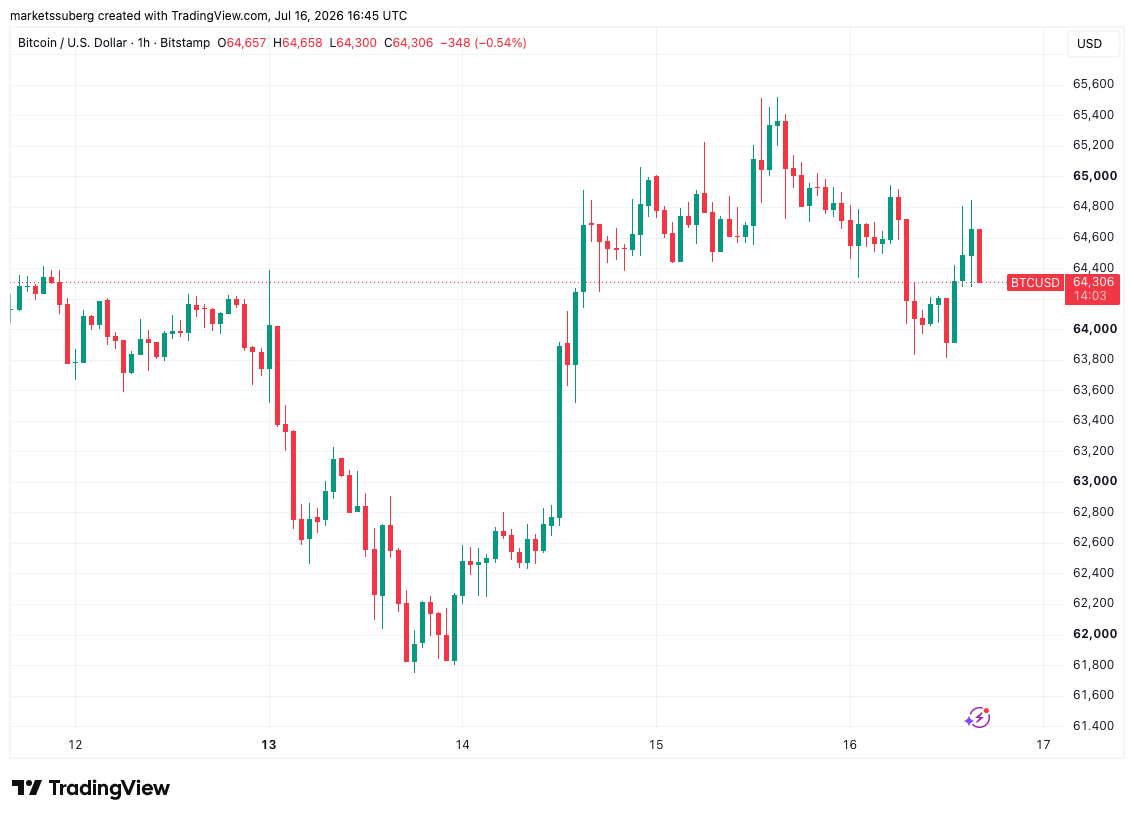
BTC/USD one-hour chart. Source: Cointelegraph/TradingView
These had accompanied two straight days of lower-than-expected US inflation data, with both the Consumer Price Index (CPI) and Producer Price Index (PPI) dropping in June.
While crypto and equities initially gained, tech stocks came under pressure on Thursday, with the closely-watched Micron Technologies down 15%.
“Micron is now down over -30% since its June 22nd record high,” trading resource The Kobeissi Letter commented in a response on X.
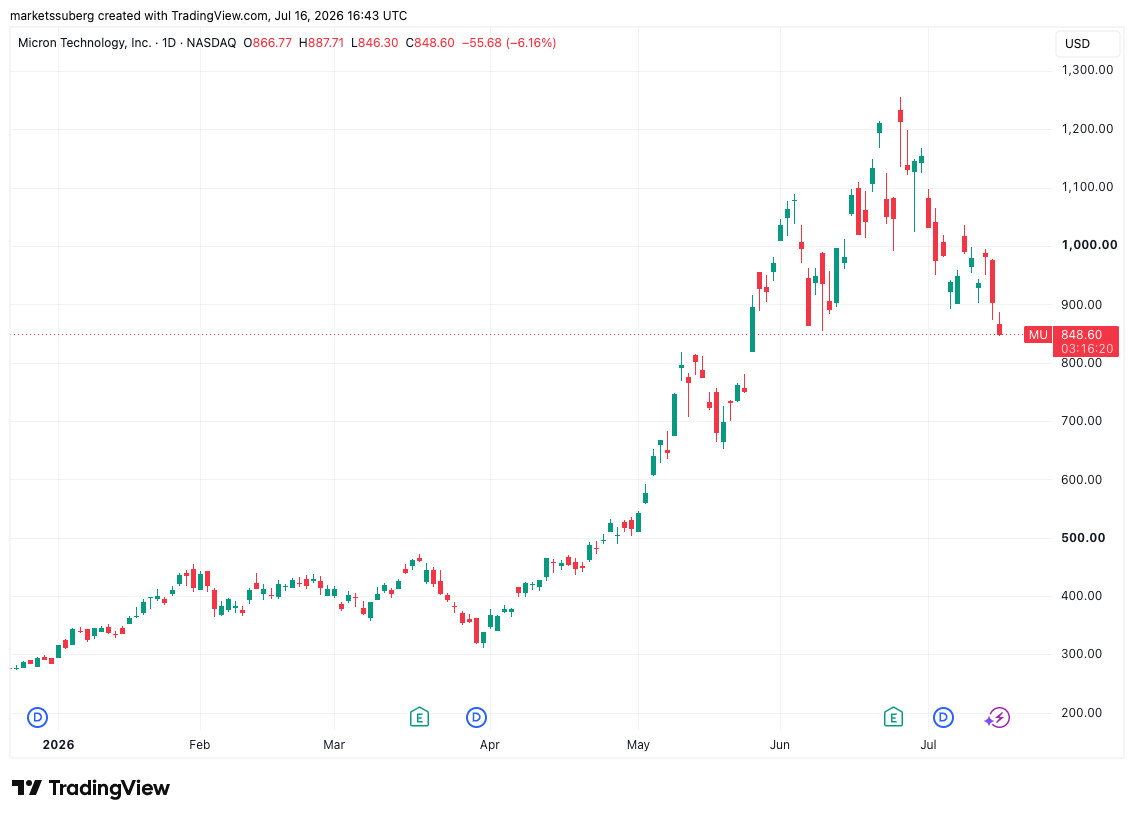
Micron Technologies one-day chart. Source: Cointelegraph/TradingView
Kobeissi additionally noted profit-taking in action by retail tech-stock investors, with sales of Tesla and Apple hitting $200 million over the past two weeks.
“Meanwhile, the total retail turnover in single stocks rose to a record $370 billion, up from $220 billion at the start of 2026,” it continued.
“Retail investors are locking in gains following a historic tech rally.”
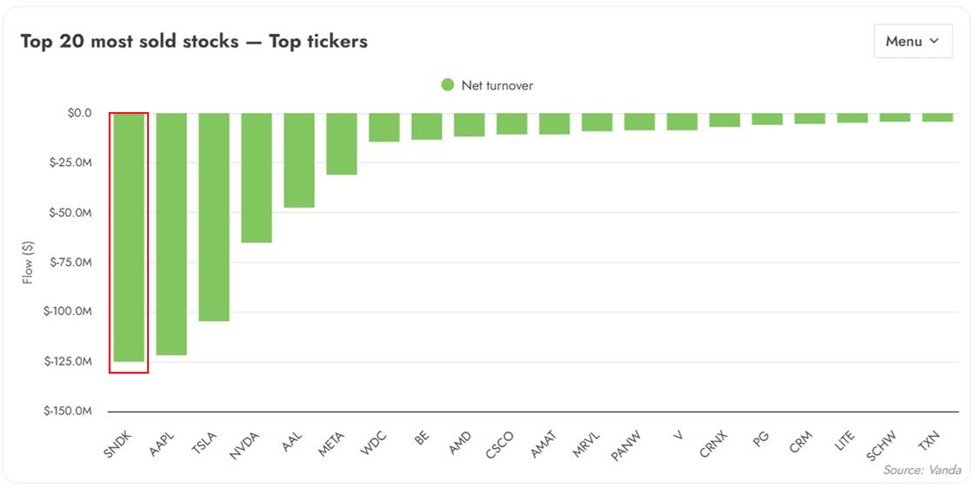
Retail investor equity sales data. Source: The Kobeissi Letter/X
Earlier, Cointelegraph reported on Bitcoin speculators cashing in on the recent local highs.
“Rejection” becomes new BTC price keyword
Turning to BTC price action itself, the mood among market participants remained conservative on the day.
Related: Bitcoin $107K buyers providing ‘early signals’ of 2026 bear-market bottom: Glassnode
Commentator Exitpump flagged anchored volume-weighted average price (AVWAP) as measured from Bitcoin’s run to $82,000 in early May, as the level to end the current rebound.
“Price is finally going to retest the AVWAP from 82K top that lead to strong local downtrend. To me such retest should cap the upside and give stronger rejection,” they told X followers.
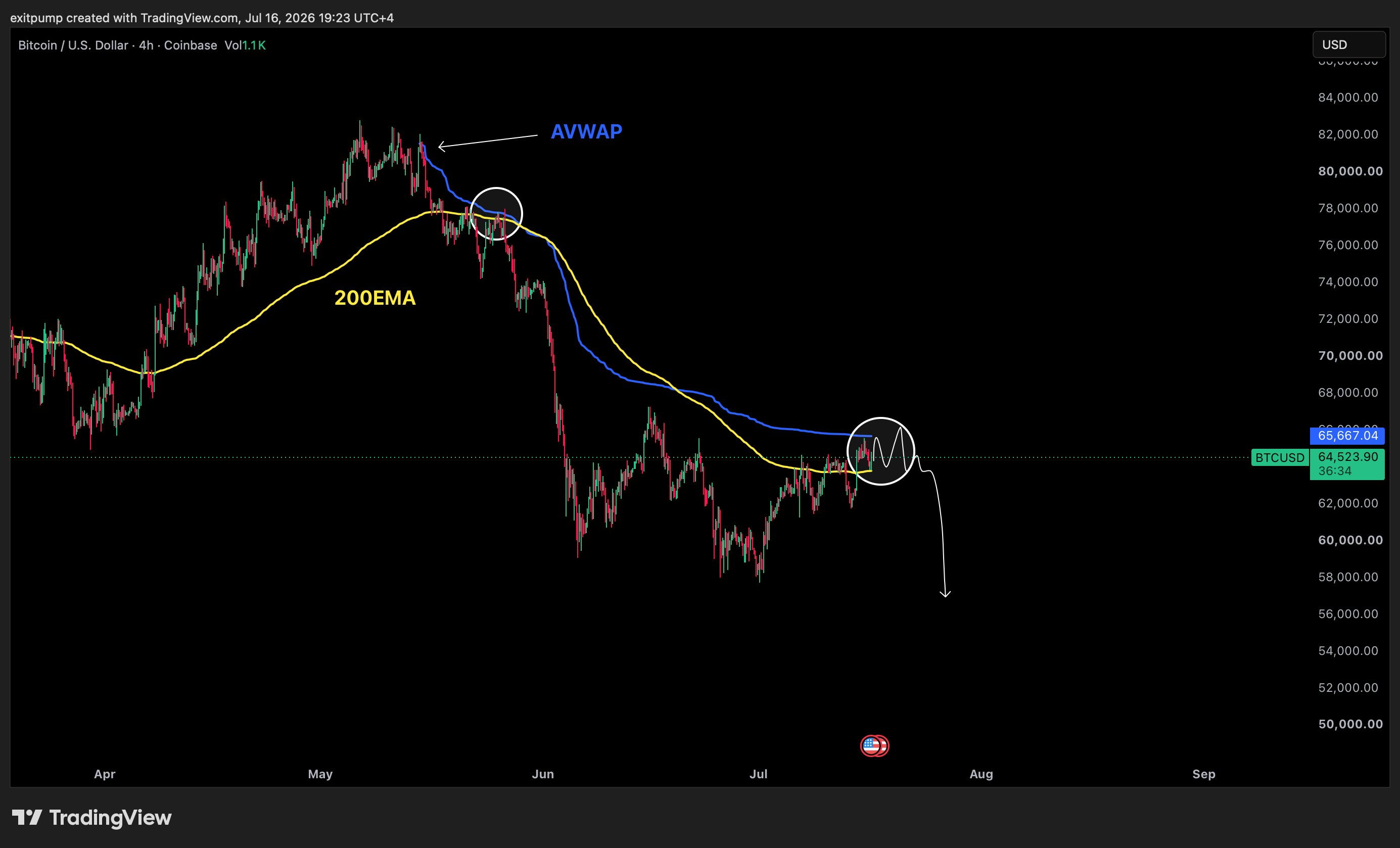
BTC/USD four-hour chart. Source: Exitpump/X
Trader and analyst Rekt Capital argued that BTC/USD was “showing initial signs of rejection” from its 50-month exponential moving average (EMA) at $65,900.
Rekt Capital reiterated the concept of current price behavior copying the 2022 bear market, having already warned that the next macro bottom would not come until later in the year.
Pi Network’s PI token has held above $0.073 after a prolonged decline, with its July 22 Protocol v25 upgrade offering buyers a possible recovery catalyst.
Summary
- PI holds above $0.073 as traders await the Protocol v25 upgrade on July 22.
- A triangle breakout above $0.080 could expose resistance near $0.085 and $0.10.
- Weak capital inflows leave PI vulnerable to a breakdown toward $0.070.
According to data from crypto.news, Pi Network (PI) price traded near $0.0765 on Thursday after moving between an intraday low of $0.0723 and a high of $0.0839. The token remains under pressure on the daily chart, but its 4-hour structure shows price compression that could precede a larger move.
Pi Network announced on July 15 that Protocol v25 will focus on network stability, reliability, and more efficient privacy-focused smart contracts. The upgrade will reach the network on July 22, giving traders a dated catalyst as PI attempts to stabilize near its recent lows.
Bitcoin’s consolidation near $64,000 and a 1.67% decline in the total crypto market have limited demand for smaller tokens. PI has faced the same weak risk appetite while trying to recover from a steep multi-week decline.
Protocol v25 gives buyers a fresh catalyst
Pi Network’s announcement states that Protocol v25 will introduce BN254 cryptography and Poseidon hashing. Developers can use these tools to build zero-knowledge applications that process sensitive information without placing the underlying data on public records.
“On July 22, Pi is scheduled to upgrade to Protocol v25, which primarily focuses on improving network stability and reliability, and supports new capabilities for more efficient, privacy-preserving smart contracts,” the Pi Core Team wrote on X.
By supporting private contract execution, the upgrade could expand the types of applications developers can build on Pi Network, according to the project. Pi Core Team also expects the release to improve contract efficiency as the ecosystem adds new applications and services.
Protocol v25’s effect on PI demand will depend on developer participation, application growth, and network performance after activation. The announcement has created a fresh event for traders to watch, though the price charts have not yet confirmed a sustained reversal.
PI needs $0.080 to confirm its recovery
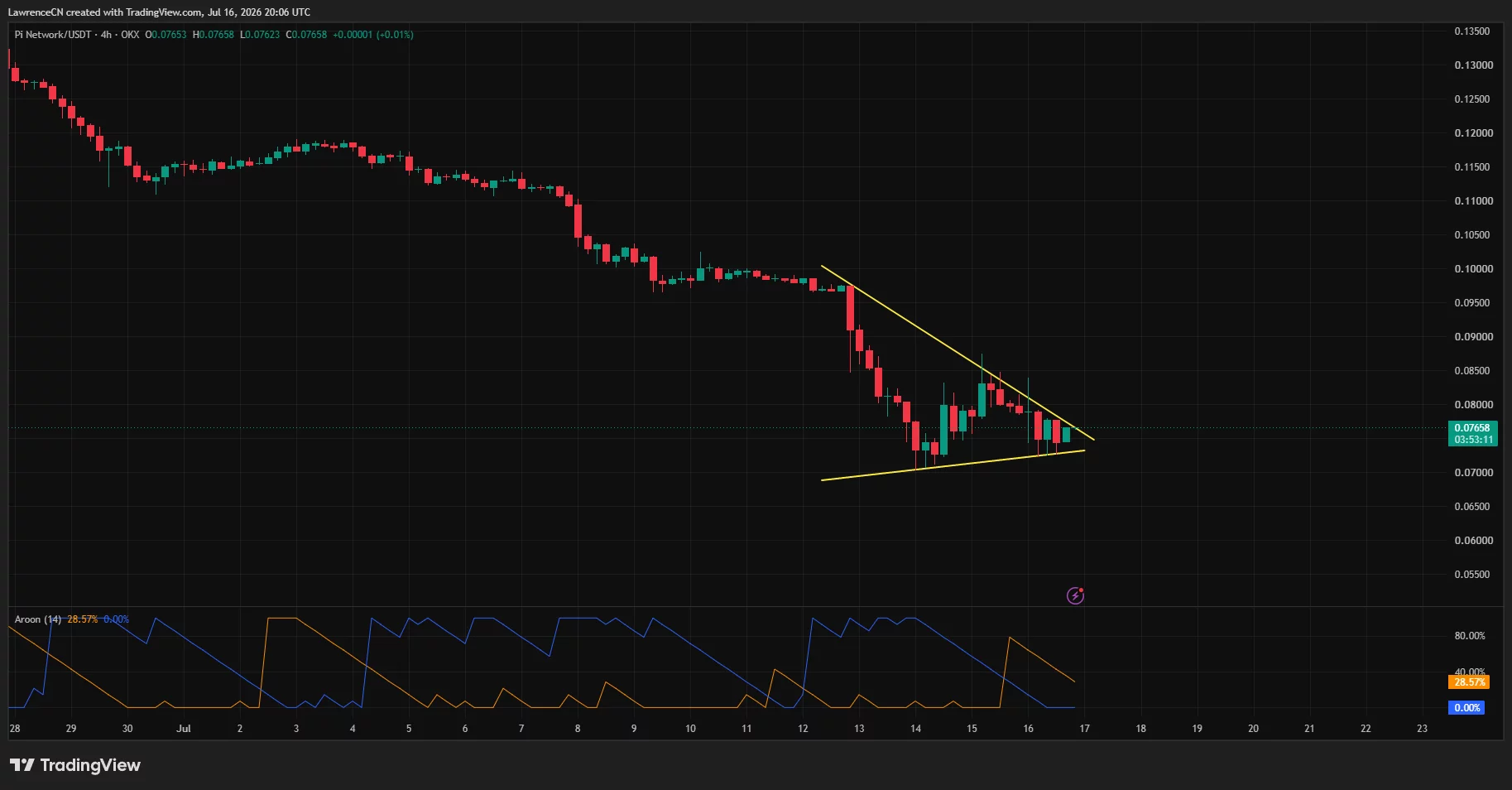
On the 4-hour TradingView chart, PI has formed a symmetrical triangle after falling from about $0.10 earlier in July. Its descending resistance line now meets an ascending support line, leaving the token close to the pattern’s narrowing end.
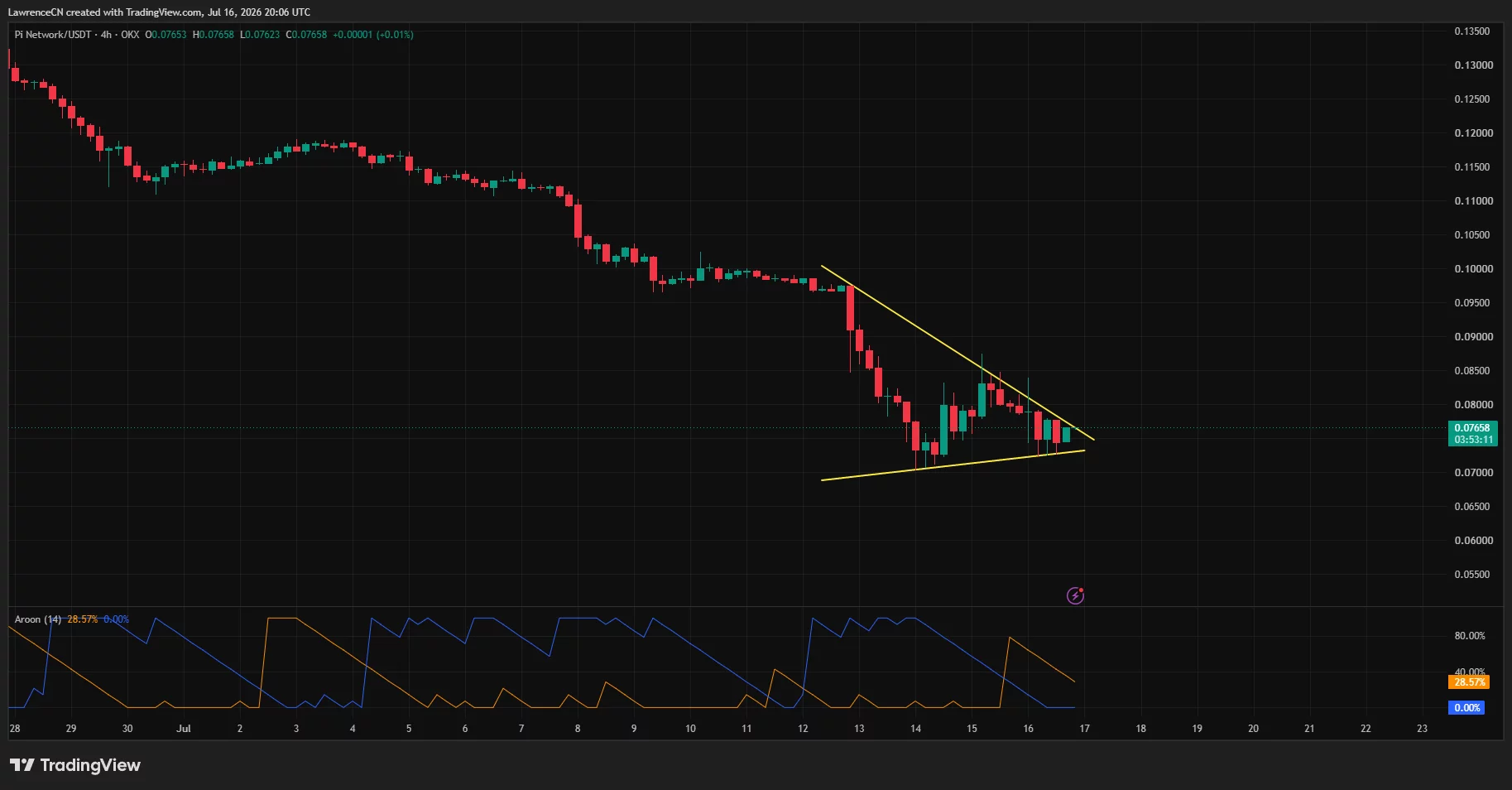
A 4-hour close above the upper trendline and $0.080 would confirm a bullish breakout from the triangle, according to the chart structure. Such a move would expose $0.085, which matches the daily Murrey Math oversold level at $0.08545, before traders turn toward $0.097 and the psychological $0.10 barrier.
Momentum has not yet confirmed that outcome. The 4-hour Aroon indicator shows Aroon Up at 28.57% and Aroon Down at 0%, signaling weak trend strength even as selling momentum eases.
Daily capital flows remain another obstacle. TradingView’s Chaikin Money Flow reading stands near -0.20, indicating that outflows continue to outweigh inflows despite buyers defending the latest support area.
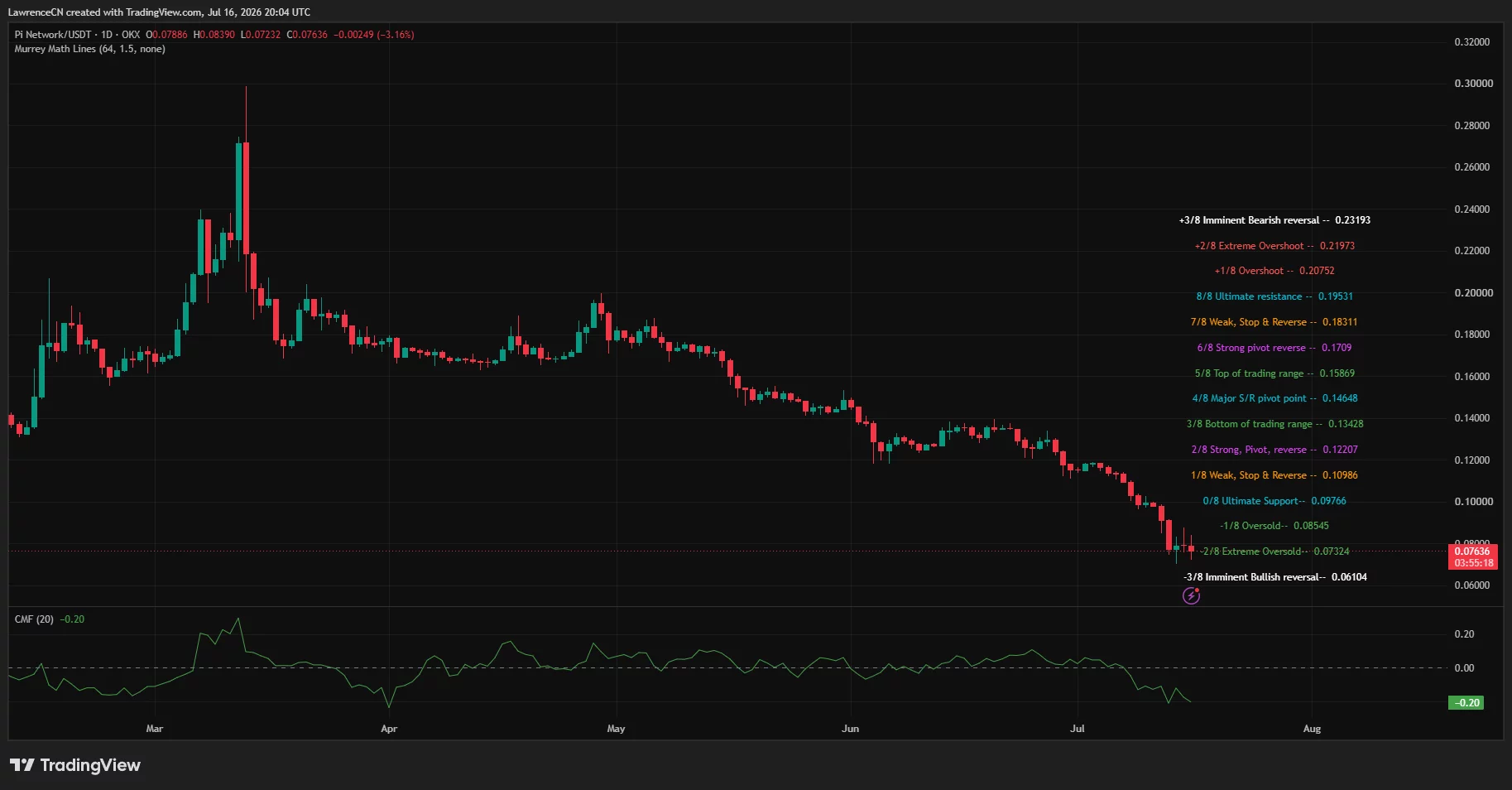
On the downside, $0.07324 represents the daily Murrey Math extreme-oversold level and sits close to the triangle’s rising boundary. A clear break below that zone would weaken the rebound setup and expose $0.070, while continued selling could bring the Murrey Math bullish-reversal level near $0.061 into focus.
Disclosure: This article does not represent investment advice. The content and materials featured on this page are for educational purposes only.


T. Rowe Price, which manages nearly $2 trillion, has launched an actively managed crypto ETF holding nine digital assets, led by Bitcoin at almost 41%.
Summary
- T. Rowe Price has launched TKNZ, the first actively managed multi-token spot crypto ETF.
- Bitcoin leads the nine-asset portfolio, followed by Ethereum and BNB.
- Eric Balchunas praised the firm’s decision to launch after October’s crypto selloff.
According to a July 16 press release from T. Rowe Price, the Active Crypto ETF began trading on NYSE Arca under the ticker TKNZ. The asset manager described the product as the market’s first actively managed multi-token spot exchange-traded product.
Unlike funds built around a single coin or a fixed index, TKNZ gives its managers room to adjust the portfolio as market conditions change. T. Rowe Price said its team will use research, valuation data, momentum signals, and risk controls when choosing allocations.
Bitcoin holds the largest position at nearly 41% of the portfolio, according to the firm’s published holdings. Ethereum accounts for about 18%, while BNB represents approximately 11%.
T. Rowe Price’s holdings data also shows exposure to Solana, XRP, Hyperliquid, Dogecoin, Stellar’s XLM, and the USDC stablecoin. The allocations place established crypto assets alongside newer tokens and a dollar-pegged asset within one actively managed product.
Active management separates TKNZ from passive crypto funds
T. Rowe Price said TKNZ is designed to capture market trends, momentum-led rallies, and rotations between crypto assets. Rather than maintaining fixed weights, the management team can change its positions when its models identify different opportunities or risks.
Blue Macellari, who has led T. Rowe Price’s digital asset work since 2022, serves as the fund’s portfolio manager, according to the company’s release. Four co-portfolio managers, notably Stefan Hubrich, David Kroger, Sean McWilliams, and Dante Pearson, support the strategy.
The fund’s structure also lets the team select assets from a larger approved pool. An updated filing listed 17 eligible tokens, including Bitcoin, Ethereum, Solana, XRP, Cardano, Avalanche, Litecoin, Polkadot, Dogecoin, Hedera, Bitcoin Cash, Chainlink, Stellar, Shiba Inu, Sui, Hyperliquid, and BNB.
TKNZ carries a management fee of 0.75%, according to T. Rowe Price. The firm has introduced a net fee waiver that will remain in place until May 31, 2027, although the management fee will continue to apply during that period.
The fund also uses Anchorage Digital Bank as its crypto custodian, according to TKNZ market information published by The Block. T. Rowe Price Sponsor LLC serves as the sponsor, while T. Rowe Price Associates acts as administrator.
Balchunas sees calculated timing after the selloff
Bloomberg senior ETF analyst Eric Balchunas linked the launch schedule to the market correction that followed T. Rowe Price’s original filing in October 2025. The Securities and Exchange Commission later approved NYSE Arca’s proposal to list the fund in June 2026.
Commenting on the timing in an X post, Balchunas wrote:
“I think they were smart with the timing—waiting till the Oct selloff dust settled a bit.”
Balchunas had previously called the filing notable because T. Rowe Price was “by far the biggest active manager” to bring its portfolio-management experience into crypto. The firm managed roughly $1.9 trillion when the product secured regulatory clearance, according to reports covering the approval.
TKNZ enters a U.S. market that already includes several single-asset crypto ETFs, while new products tied to Ethereum, Solana, and Hyperliquid have continued to reach regulators. T. Rowe Price’s release positions active allocation, rather than exposure to one token, as the fund’s central difference.
[PRESS RELEASe – Kingstown, St. Vincent and the Grenadines, July 16th, 2026]
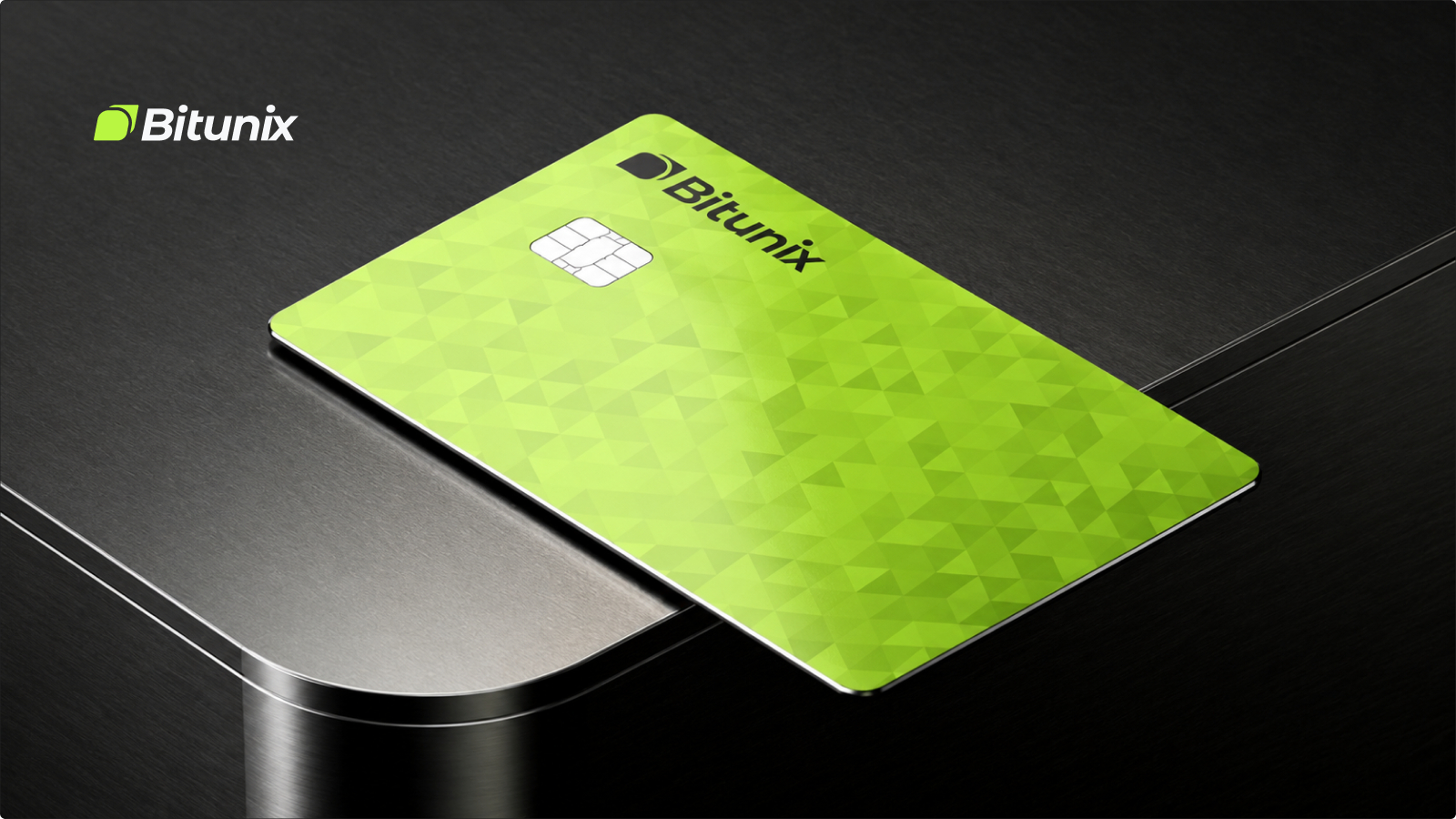
Cryptocurrency exchange Bitunix has launched the Bitunix Card, a Visa-powered payment solution that allows users to spend their funds on everyday purchases, and earn yield on idle balances.
The launch reflects a growing demand for practical crypto products that connect digital assets with everyday spending. Instead of moving funds between multiple platforms, Bitunix users can now manage payments, and earnings from one place.
The Bitunix Card can be used at more than 130 million merchants worldwide that accept Visa payments. Users can pay for everyday services and subscriptions such as Uber, ChatGPT, Amazon, Spotify, and Netflix, while also using the card when traveling internationally. Payments are completed instantly, allowing users to spend their crypto as easily as they would with any traditional payment card. The card offers up to 8% cashback on eligible spending, with rewards capped at 1,000 USDT monthly.
To support everyday payments across different regions, the Bitunix Card is compatible with major digital wallets such as Apple Pay, Google Pay and Paypal, as well as selected regional payment platforms and local payment networks.
Available through the Bitunix web platform as well as its iOS and Android applications, the card is designed to give users more utility for their USDT beyond trading. Through a unified dashboard, users can manage card balances, transfer funds between accounts, track transactions, monitor cashback rewards, and control card settings in one place.
The card applies standard regional network processing fees, while eligible users may offset these costs through cashback rewards, depending on their VIP tier.
In addition, eligible balances held on the card can automatically earn yield, reaching up to 11.6% annually, depending on the asset and applicable conditions.
“The Bitunix Card goes far beyond payments. It unlocks a seamless, high-yield financial ecosystem built for everyday global commerce,” said Bitunix’s Chief Strategy Officer, Steven Gu.
The card comes with no issuance fee and no monthly maintenance fee. To activate the card, users are required to transfer a minimum balance of 100 USDT to their card account. The funds remain fully available for spending and do not represent an activation fee.
Users can apply for the Bitunix Card directly through the Bitunix platform. The card is offered to eligible Bitunix users who have completed the platform’s identity verification process and reside in supported regions.
The launch is part of Bitunix’s broader effort to make cryptocurrency more practical for everyday use. By combining spending and earning features in a single product, Bitunix gives users more ways to put their digital assets to use in everyday life.
For more information about the Bitunix Card and application details, users can visit the official Bitunix Card page.
About Bitunix
Bitunix is a global cryptocurrency derivatives exchange trusted by over 5 million users across more than 150 countries. Guided by its core principle of better liquidity, better trading, the platform is built for traders who expect more, committed to providing Ultra Trust, Ultra Products, and Ultra Experience. Bitunix offers a fast registration process and a user-friendly verification system to ensure safety and compliance. With global standards of protection through Proof of Reserves (POR) and the Bitunix Care Fund, the exchange prioritizes user trust and fund security. Industry-first innovations like Fixed Risk, TradingView-powered chart suite, along with indicator alerts, cloud-synced templates, provide both beginners and advanced traders with a seamless experience. Making Bitunix one of the most dynamic platforms on the market.
Bitunix Global Accounts
X | Telegram Announcements | Telegram Global | CoinMarketCap | Instagram | Facebook | LinkedIn | Reddit | Medium
The post Bitunix Exchange Launches Visa Debit Card for Daily Purchases and Earning appeared first on CryptoPotato.

5 Best Family Movies of 2026 So Far

Why Crypto Is DOWN TODAY! Not What You Think!

Jesy Nelson’s twin daughters suffer fresh health setback after SMA campaign


-

 Fashion6 days ago
Weekend Open Thread: Nutriplenish Leave-In Conditioner
-
 NewsBeat6 hours ago
London Mayor Sadiq Khan handed a peerage by Keir Starmer alongside 15 other Labour figures… just days before the PM leaves No10
-

 Sports7 days ago
Super Eagles star Moses Simon opens up on Liverpool transfer regret
-

 Business19 hours ago
Nvidia Stock Slips After Big Tuesday Rally as Huang Confirms Vera Rubin Chip Is Now in Production Today
-

 Crypto World21 hours ago
CFTC blocks Kalshi from unwinding Michigan trades after court order
-

 Politics1 day ago
Young campaigners urge incoming PM to act on outdoor junk food ads
-

 News Videos2 days ago
XRP BOMBSHELL… XRP OMBOARDED FOR TRANSACTIONS!!!
-

 Tech3 days ago
Get Your ESP32 Sunny Side Up With This Solar Dev Board
-
 Entertainment1 day ago
Disney’s Most Ambitious Failed Star Wars Attraction Is Coming to SDCC
-

 Tech2 days ago
Dark Secrets Emerge When Jailbreaking LLMs
-
 Sports1 day ago
New Cornerback Enters Vikings Trade Rumor Mill
-
 Tech3 days ago
Cloudflare Precursor Watches Your Mouse and Keyboard To Decide If You Are Human
-

 News Videos3 days ago
how to make coin bank box with cardboard #scienceproject #money #diy #shorts
-
 Entertainment1 day ago
Vicki Gunvalson Defends Discussing Heather Dubrow’s Money
-
Crypto World2 days ago
Ripple, Coinbase, Circle Join Linux x402 Foundation to Help Shape AI Payments
-

 Business2 days ago
ACCC warns AI could lift insurance costs in risk-prone areas
-

 NewsBeat1 day ago
Watch: Is Donald Trump facing a popular backlash on immigration?
-

 Sports22 hours ago
Michigan officials not expected to discuss AD Warde Manuel at Thursday meeting
-

 Business2 days ago
Subaru recalls 541,000 vehicles over federal safety sticker mistake: NHTSA
-

 Business2 days ago
AI blueprint looms as PM examines 'lessons from abroad'
You must be logged in to post a comment Login