A joint Insider/Der Spiegel/Le Monde investigation published leaked documents showing a Chinese-authored, three-level plan to contain and defeat Starlink
The plan, presented to Russian officers at a secret forum in 2023, highlights a three-level approach to contain and destroy SpaceX’s Starlink
A separately signed June 2023 Moscow protocol also commits Russia and China to jointly build a hypersonic-missile-defense system based on technology Russia had never before been willing to share, even with allies
Starlink is the world’s largest satellite constellation ever built, and as a result, it also doubles as the backbone for many civilian and military communications channels.
With approximately 10,400 satellites in low-Earth orbit as of June 2026, SpaceX’s low-Earth-orbit satellite internet network covers nearly 160 different countries and territories while delivering low-latency communications (20-40 milliseconds) that often make it a better choice than GEO systems that have a baked-in round trip delay of 500-700 milliseconds.
Its potential for military use, until recently, was downplayed by many in the industry, but it has formed the backbone for communications for Ukraine in the ongoing Russia-Ukraine war earning it the ire of the Russian government and renewed focus from China, which has already covertly begun to prepare for an eventuality where it would have to disable the network.
Latest Videos From
A secret meeting that highlighted growing Chinese-Russian military co-operation
With China affirming that its ‘no limits’ partnership with Russia is still very much in play as early as 2025, a year-long investigation spearheaded by The Insider, Germany’s Der Spiegel, and France’s Le Monde indicates that both players may have already considerably broadened its scope beyond what was visible earlier, especially when it came to their respective military ambitions.
Advertisement
Starlink, which Russians consider a key hindrance to their campaign in Ukraine, forms the backbone of the latter’s communications even as the former are cut off from access as the conflict continues to evolve in what is now the 5th year of fighting.
For China, it represents a growing threat, underscored by the US military’s increasing reliance on SpaceX, which is not only the Pentagon’s most important space contractor but also helps the US government deploy and service its military-grade version of Starlink: Starshield.
Chinese military officials and engineers met with Russian officers in November 2023 at a summit in Guangzhou to discuss how to tackle Starlink, presenting a 3-pronged plan of action: diplomatic pressure, jamming, then cyberattacks, and, alternatively, physical destruction.
Advertisement
Sign up to the TechRadar Pro newsletter to get all the top news, opinion, features and guidance your business needs to succeed!
Not only would both China and Russia aim to leverage their considerable weight in diplomatic forums to hinder Starlink’s growth by imposing regulatory pressures, but they would also invest in electromagnetic-jamming infrastructure to render existing satellites useless in certain geographic areas, even as they collaborated within each other’s ecosystems.
Perhaps more troubling for Elon Musk and SpaceX would be the cyberwarfare and physical warfare component, where plans to leverage “access spoofing, virus infection, and the exploitation of vulnerabilities” meet plans to “eliminate” satellites already in orbit altogether.
Given that these plans were first discussed in 2023, one can assume they have evolved considerably since then, even as drone warfare, laser-based weaponry, and anti-satellite missiles have made major inroads, as modern militaries prepare for asymmetric warfare in future conflicts.
Advertisement
For example, Chinese researchers at the Northwest Institute of Nuclear Technology in Xi’an have reportedly built a ground-based microwave weapon capable of targeting low-orbit satellites, as per local media
With China and Russia also agreeing to deploy an air-defense solution as part of the “Working Protocol” signed in Moscow, which is expected to dwarf existing capabilities, including Russia’s S-500, the revelations indicate that China is not passively but rather actively supporting Russia in its ongoing endeavors.
This makes for a tricky subject to broach for Elon Musk and a White House that backs him: the former has taken a conciliatory stance toward China even as Tesla depends on the market for sales, houses its largest and most efficient plant, and has previously resulted in favorable lease terms and loans in play from the Chinese government, while the latter might tip his hand based on ‘national security’ concerns that could make for an uncomfortable situation much like how it has played out for Nvidia after Beijing intervened.
Advertisement
Starlink might be an important piece of the pie for both the US government and Elon Musk, but the response from both to Chinese plans for the service might considerably differ as a result, given what is at stake for both entities.
Moonshot AI, the Beijing-based artificial intelligence startup backed by Alibaba, on Thursday released Kimi K3 — a 2.8-trillion-parameter model that the company says is now the largest open-source AI model in the world, and one that benchmarks show performs neck-and-neck with the most powerful proprietary systems from Anthropic and OpenAI.
The release, timed to land just ahead of the 2026 World Artificial Intelligence Conference in Shanghai, is a dramatic escalation in the global AI arms race and a watershed moment for the open-source AI movement. It also marks a remarkable comeback for a company whose market position had eroded significantly over the past 18 months following DeepSeek’s meteoric rise.
Full model weights are scheduled to be released on July 27, according to details shared by researchers who reviewed the company’s technical documentation. If you want to take Kimi K3 for a spin right now, you can — just head to kimi.com, sign up with a Google account or phone number (no credit card required), and start chatting with what may be the most powerful open-source model ever built.
Inside the architecture that powers the world’s largest open-source AI model
Kimi K3 is a frontier-class large language model with 2.8 trillion total parameters — roughly 75 percent larger than DeepSeek’s V4 Pro, which the company’s own timeline chart shows at approximately 1.6 trillion parameters. The model features a 1-million-token context window, native visual understanding capabilities, and an always-on reasoning mode that the company calls “thinking mode.”
Advertisement
The model is built on two key architectural innovations developed internally at Moonshot AI: Kimi Delta Attention, a hybrid linear attention mechanism, and Attention Residuals, which the company describes as a drop-in replacement for residual connections that delivers consistent scaling gains. Both techniques were previously published as open research by the Moonshot team on GitHub.
On the API side, Kimi K3 is compatible with the OpenAI SDK, lowering the integration barrier for developers already building on OpenAI or Anthropic toolchains. The model is priced at $3 per million input tokens and $15 per million output tokens, with cached input tokens dropping to just $0.30 per million — pricing that positions it roughly in line with mid-tier offerings from Western labs, but at a performance level the company claims approaches the top of the market. A promotional top-up rebate running through August 12 offers up to 30 percent back in vouchers for API credits of $1,000 or more.
As Xinhua reported, a Moonshot AI executive explained the significance of the parameter count in simple terms: parameters are like neural connections in the human brain, and nearly 3 trillion of them means the model can “store more knowledge and patterns in its brain, understand more, think deeper, and answer more accurately.”
Benchmark results show Kimi K3 trading blows with Claude and GPT at the top of the leaderboard
The benchmark results, drawn from public leaderboard data and a private evaluation by analytics firm Artificial Analysis, tell a striking story.
Advertisement
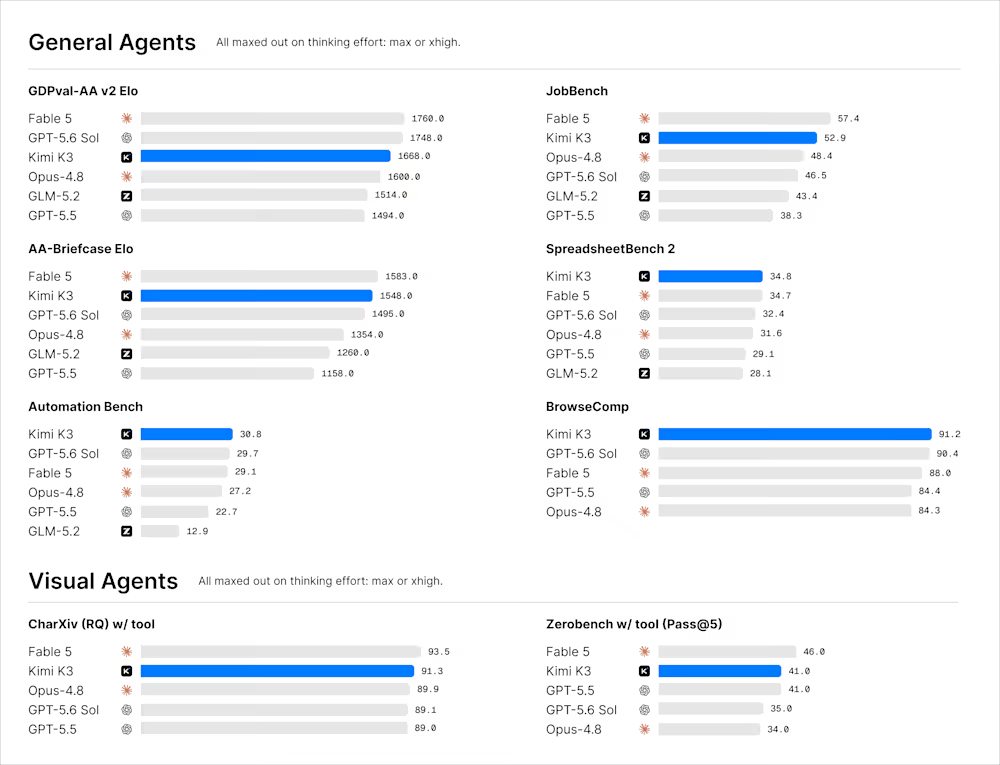
On GDPval-AA v2, a benchmark measuring real-world tasks across 44 occupations and 9 major industries, Kimi K3 scored 1,687 — placing it third overall, behind only Claude Fable 5 Max (1,815) and GPT-5.6 Sol Max (1,747.8), and ahead of Claude Opus 4.8 (1,600).
On AA-Briefcase, a private agentic benchmark from Artificial Analysis designed to test long-horizon knowledge work, K3 climbed to second place with a score of 1,527 — beating GPT-5.6 Sol Max (1,495) and trailing only Fable 5 Max (1,587).
Perhaps most impressively, K3 achieved a state-of-the-art score of 91.2 out of 100 on BrowseComp, a benchmark for long-horizon, high-difficulty information seeking.
In tests of real-world task automation, Kimi K3 ranked first in four out of eight benchmarks — including Automation Bench, SpreadsheetBench 2 and BrowseComp — while finishing second to Fable 5 in most others. Fable 5 and GPT-5.6 Sol were its closest competitors overall. (Source: Moonshot AI)
Advertisement
The company says it accomplished this in a single-agent setup using its 1-million-token context window, without any context compression or additional context management techniques — a feat that suggests raw context length, when paired with strong retrieval capabilities, may be more powerful than elaborate multi-agent workarounds.
As one widely followed AI commentator put it on social media: “Open source is no longer lagging six months behind Western closed-source models. Read that again, and think about what it all means.”
That observation captures the significance of the moment. For much of the past three years, open-source models have typically trailed their proprietary counterparts by a meaningful margin. Kimi K3 appears to have closed that gap almost entirely.
Kimi K3 claimed the No. 1 spot on Arena.AI’s Frontend Code Arena with a score of 1,679, outpacing Claude Fable 5 and GPT-5.6 Sol by a significant margin. The leaderboard ranks models by human preference in head-to-head frontend coding comparisons. (Source: arena.ai)
Advertisement
How a 48-hour autonomous chip design demo reveals Moonshot’s real ambitions
Beyond raw benchmarks, Moonshot AI showcased a proof-of-concept that may be even more revealing of K3’s capabilities and the company’s strategic direction.
In a demonstration documented in the company’s technical materials, Kimi K3 was tasked with designing a physical chip to run a nano-scale version of itself. Over 48 hours of continuous autonomous agent operation, K3 independently completed the chip’s full construction pipeline — from architectural design through optimization and verification — using open-source electronic design automation tools. The result was a tiny but functional chip design, just 4 square millimeters, that achieved timing convergence at 100 MHz and could decode more than 8,700 tokens per second in simulation.
This is not a production chip. It is a demonstration of what Moonshot AI clearly views as the next competitive frontier: long-range autonomous agent capabilities. The ability to sustain coherent, multi-step technical work over a 48-hour window — reading documentation, making design decisions, running verification loops, and iterating on failures — represents a qualitative leap beyond the kind of single-turn question-answering that defined the first generation of large language models.
The company also highlighted a case in computational astrophysics, where K3 reportedly reproduced the universal I-Love-Q relation — a complex calculation that typically takes a senior researcher one to two weeks — in approximately two hours, reading and cross-validating more than 20 papers and implementing a complete numerical pipeline along the way.
Advertisement
Moonshot AI’s fall and rise tells the story of China’s brutal AI market
To understand why Kimi K3 matters, you need to understand where Moonshot AI was 18 months ago — and how far it fell.
Founded in 2023 by Yang Zhilin, a Tsinghua University graduate who previously conducted research at Google and Meta, Moonshot AI quickly became one of China’s most prominent AI startups. The company gained early traction in 2024 when users flocked to its Kimi platform for its long-text analysis capabilities and AI search functions. By early 2026, it had raised roughly $1.5 billion across multiple rounds, with its valuation climbing from $2.5 billion to $4.3 billion and the company reportedly seeking a new round at $5 billion.
Then DeepSeek happened. The release of DeepSeek’s low-cost R1 model in January 2025 disrupted the entire Chinese AI landscape, and Moonshot AI was among the hardest hit. Kimi, which had ranked third in monthly active users in China, slid to seventh. The company’s strategic pivot to open-source models — beginning with Kimi K2 in July 2025 and accelerating with K2.5 in January 2026 — was in large part an effort to reclaim relevance.
Kimi K3 is the culmination of that effort — and the sheer scale of the model suggests that Moonshot AI has been planning this move for some time. Training a 2.8-trillion-parameter model requires enormous computational resources and months of preparation, which means the architectural and infrastructure decisions behind K3 were likely locked in well before the model reached the public.
Advertisement
Why open-sourcing the world’s biggest model is a geopolitical chess move
The decision to release K3’s full weights on July 27 is strategically significant and worth parsing carefully.
The company’s own timeline chart of open-source frontier model scale positions K3 as a dramatic outlier, towering above competitors like DeepSeek (1.6T), Xiaomi (1.02T), and Alibaba (397B). By releasing the world’s largest open-source model, Moonshot AI is making a bid to become the center of gravity for the global open-source AI developer community.
This follows a broader trend among Chinese AI companies. As Reuters noted, open-sourcing allows companies to “showcase their technological capabilities and expand developer communities as well as their global influence, a strategy likely to help China counter U.S. efforts to limit Beijing’s tech progress.” DeepSeek, Alibaba, Tencent, and Baidu have all released open-source models. But none have released anything at this parameter count.
For enterprise technology leaders, the implications are concrete. A 2.8-trillion-parameter open-source model that performs at near-frontier levels creates new options for companies that want to fine-tune, self-host, or build proprietary systems on top of a capable base model — without being locked into API contracts with OpenAI or Anthropic. The trade-off, of course, is that running a model of this size requires substantial GPU infrastructure. Inference at 2.8 trillion parameters is not something that runs on a single server rack.
Advertisement
That said, Moonshot AI has signaled awareness of this challenge. Its Mooncake project, which won the Best Paper award at FAST 2025, pioneered KV-cache-centric disaggregated serving for large language models — an architecture designed specifically to make inference at extreme scale more practical and cost-efficient.
Kimi Code and a three-tier model lineup form the foundation of Moonshot’s enterprise play
Alongside K3, Moonshot AI continues to invest heavily in its coding agent ecosystem. Kimi Code, the company’s open-source coding tool that competes with Anthropic’s Claude Code and Google’s Gemini CLI, received two major updates on the same day as K3’s launch — versions 0.25.0 and 0.26.0 — adding features like expanded subagent tooling, background task management, and security fixes.
Kimi K3 consistently placed among the top three models across six coding benchmarks, leading all competitors in SWE Marathon and Program Bench, and trailing only GPT-5.6 Sol in Terminal Bench 2.1 by half a point. All models were tested at maximum thinking effort. (Credit: Moonshot AI)
The Kimi Code CLI has accumulated over 3,100 stars on GitHub and features integration with VSCode, Cursor, and Zed. The latest release expanded the “coder subagent” tool set to include background tasks, todo lists, plan mode, skill invocation, and nested agents — effectively turning the coding agent into a multi-layered autonomous system capable of managing complex software engineering projects with minimal human intervention.
Advertisement
This is not incidental. Coding tools have become a critical revenue driver for AI labs. As Anthropic disclosed in January, Claude Code reached $1 billion in annualized recurring revenue. By building Kimi Code as an open-source alternative that defaults to Kimi’s own models — but supports other providers — Moonshot AI is positioning itself to capture developer workflows and, eventually, enterprise contracts.
The company’s model lineup now includes three tiers: K3 as the flagship ($3/$15 per million tokens for input/output), K2.7 Code as a specialized coding model ($0.95/$4), and K2.6 as a general-purpose option ($0.95/$4). All three support context windows of 256,000 tokens or above, with K3 offering the full 1-million-token window. Context caching is automatic — no cache ID, TTL, or extra parameter is required — a small but meaningful developer-experience advantage over competitors that require explicit cache management.
What Kimi K3 means for the future of enterprise AI and the global model landscape
Kimi K3’s release forces a recalibration of several assumptions that have guided enterprise AI strategy.
The performance gap between open-source and proprietary models has functionally closed at the frontier. If K3’s benchmark numbers hold up under independent evaluation — and particularly once the open weights are available for community testing on July 27 — it will be difficult for closed-source providers to justify premium pricing purely on the basis of capability.
Advertisement
The locus of AI innovation, meanwhile, continues to shift. China’s AI ecosystem, which many Western observers questioned after early struggles with chip export restrictions, has now produced a model that competes with the best systems from companies with direct access to Nvidia’s most advanced hardware. The architectural innovations behind K3 — particularly the hybrid linear attention mechanism — suggest that algorithmic efficiency may matter as much as raw compute.
And the agentic capabilities demonstrated by K3 — chip design, multi-week research compression, long-horizon information seeking — point toward a future where AI models are not just answering questions but autonomously executing complex, multi-day projects. For enterprises evaluating AI investments, this shifts the value proposition from “productivity copilot” to “autonomous technical workforce.”
Xinhua, China’s state news agency, framed the release as a national milestone, reporting that K3 “marks a new step forward in the development of China’s artificial intelligence models.” Liu Tieyan, dean of the Zhongguancun Academy in Beijing, was quoted as saying that a wave of Chinese open-source models has moved from isolated breakthroughs to collective advancement, providing “new solutions and new paths” for global AI development.
Just two years ago, Moonshot AI was a scrappy startup named for the audacious problems it hoped to solve. Eighteen months ago, it was a cautionary tale about how quickly a market darling can lose its footing. Today, it is the maker of the world’s largest open-source AI model — one that can, given 48 hours and an internet connection, design a chip to run itself. The frontier, it turns out, is not a place. It is a race. And the field just got a lot more crowded.
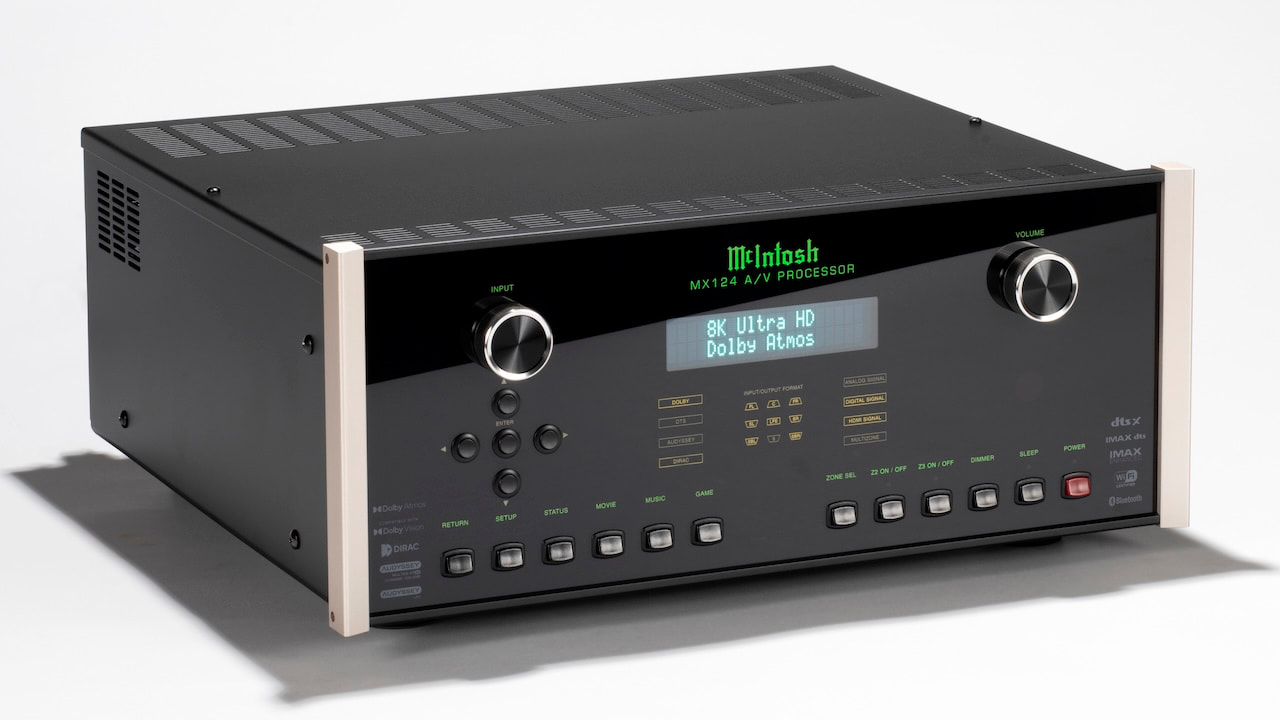
McIntosh does not replace its home theater processors every time HDMI acquires another acronym, but the MX123 has been anchoring the company’s multichannel lineup since 2019. Although it received an important 8K hardware update in 2021, nearly seven years is a long time in a category where video standards, immersive-audio formats, room-correction platforms, and bass-management capabilities continue to evolve at an exhausting pace.
The newly announced McIntosh MX124 A/V Processor is therefore less an impulsive refresh than an overdue response to a much more competitive high-end home theater market. Marantz continues to apply pressure with the AV 10, while Trinnov and StormAudio offer highly configurable processors with more channels, sophisticated bass management, and upgrade paths aimed directly at demanding custom installations. A bank of blue meters and a substantial glass faceplate still carry considerable weight, but at this level, heritage alone will not prevent the competition from eating your popcorn.
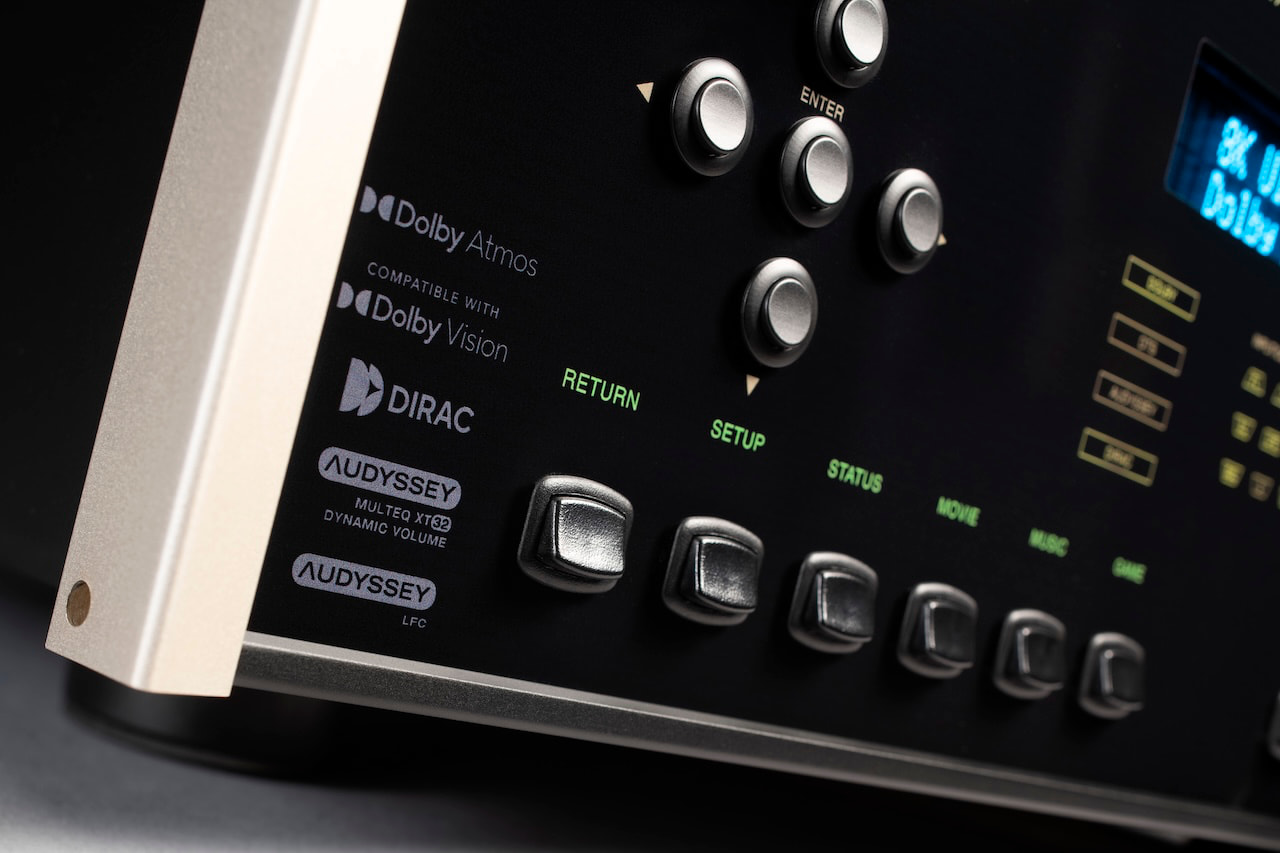
Building on the MX123, the MX124 supports 13 main audio channels and four independent subwoofer outputs for configurations including 7.4.6 and 9.4.4. It also adds Dirac Live Room Correction and Dirac Live Bass Control alongside Audyssey MultEQ XT32, expands 8K connectivity across all seven HDMI inputs, and introduces updated streaming, configuration, and installation features designed to keep McIntosh relevant in theaters where both the expectations and equipment budgets are substantial.
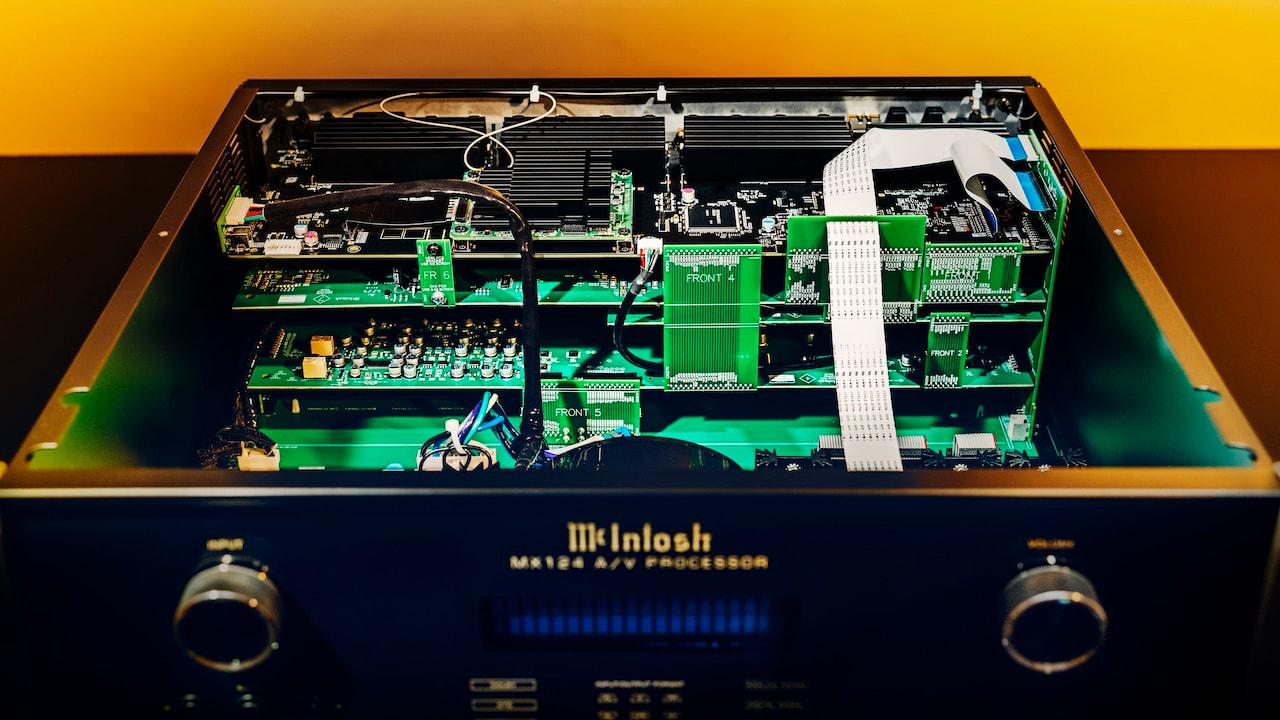
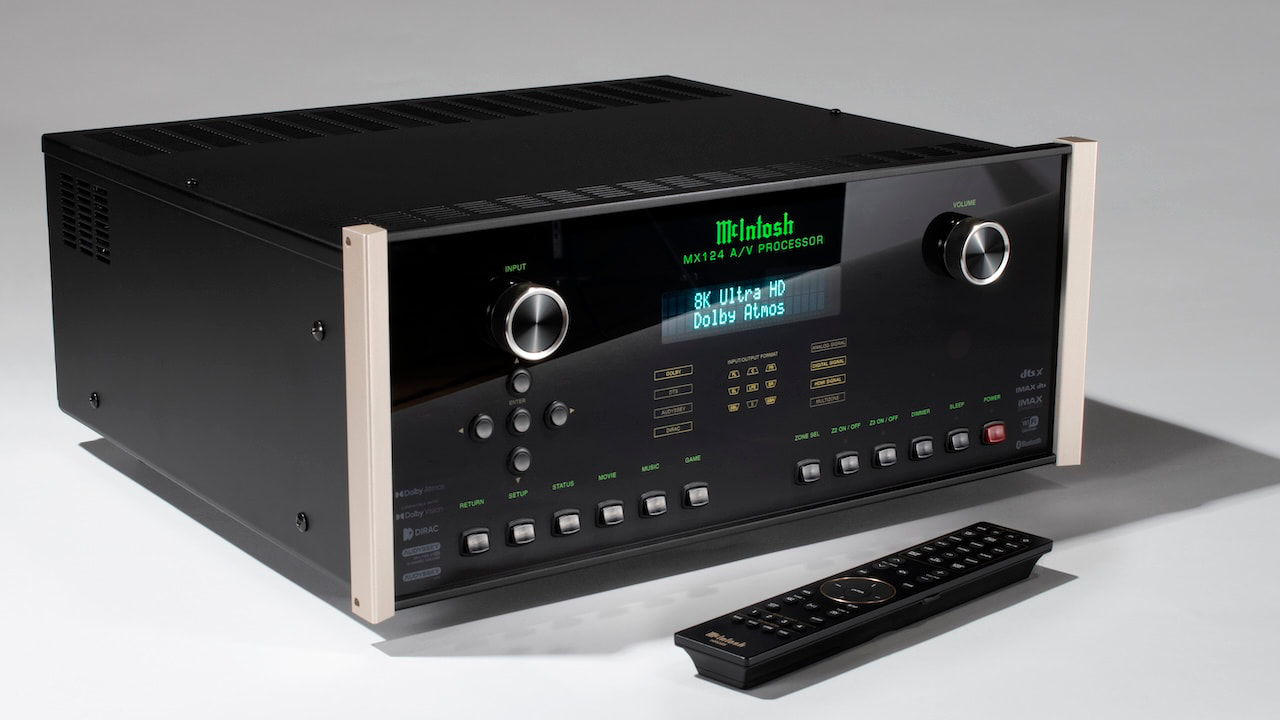
The McIntosh MX124 is an A/V preamplifier/processor designed to function as the central command center of a high-end home theater system. It handles source switching, surround decoding, room correction, bass management, video routing, and system control, but it does not include onboard amplification.
Advertisement
That distinction matters. The MX124 must be connected to one or more external power amplifiers, or to active loudspeakers, before it can produce any sound. A television or projector is also required to display the video signals it processes and routes. In other words, the MX124 may run the theater, but it still needs the rest of the cast before the lights go down.
McIntosh has engineered the MX124 for sophisticated home theater installations where flexibility, long-term integration, and installer support are just as important as raw specifications. Its expanded connectivity, configurable speaker layouts, room-correction options, and control features are intended to let a system evolve over time without forcing owners to replace the processor every time the theater grows or another component joins the rack.
The MX124 A/V Processor supports speaker configurations of up to 7.4.6 or 9.4.4 through 13 audio channels and four independent subwoofer outputs. Compared with its predecessor, the MX123, the MX124 doubles the number of subwoofer outputs from two to four, enabling more advanced system configurations, greater bass-management flexibility, and improved performance in larger, more sophisticated home theater environments.
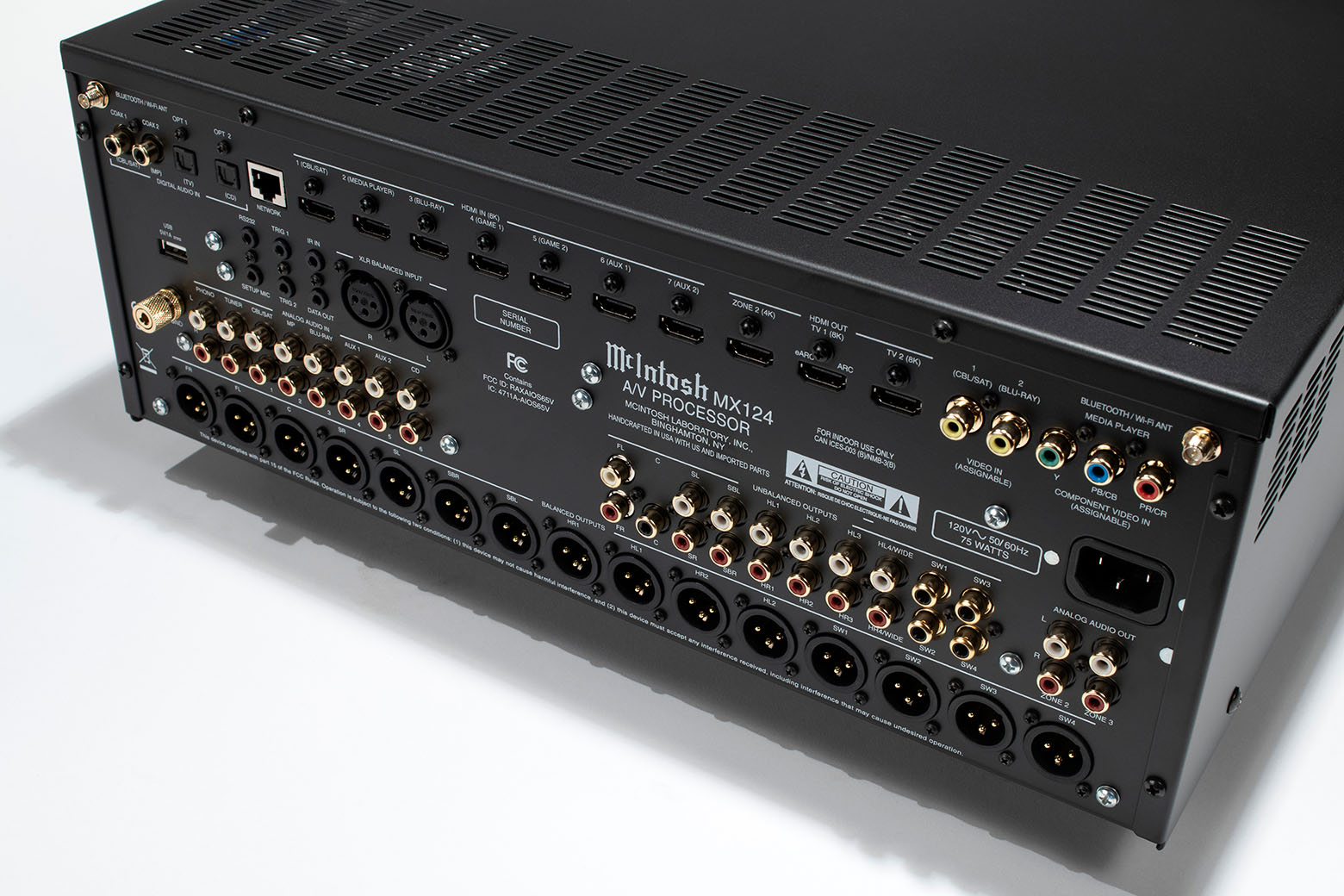
Additional connectivity includes seven HDMI inputs and three HDMI outputs, along with four digital audio inputs, one balanced and eight unbalanced analog stereo inputs, component and composite video inputs, and dual analog stereo outputs for two additional listening zones, plus Bluetooth headphone support.
Advertisement
Immersive Audio
The MX124 supports Dolby Atmos, DTS Pro, Sony 360 Reality Audio, and MPEG-H Audio. It also employs nine premium 32-bit digital-to-analog converters designed to deliver greater detail, wider dynamic range, and improved sonic accuracy.
Bass and treble controls provide additional tuning flexibility, allowing the system to be adjusted for personal preferences, room acoustics, and specific installation requirements.
Advertisement. Scroll to continue reading.
Room Calibration
To help deliver optimal performance in a wide range of listening environments, the MX124 A/V Processor incorporates multiple room-calibration options. Licenses for Dirac Live Room Correction and Dirac Live Bass Control are included, while Audyssey MultEQ XT32 is available without an additional license.
Advertisement
These options allow installers and owners to select the calibration platform best suited to their system, room, and level of setup complexity. Both technologies are designed to improve speaker integration, bass performance, imaging, tonal balance, and overall clarity while preserving the natural musicality and sonic character associated with McIntosh.
Video
For video, the MX124 provides seven HDMI inputs and three HDMI outputs, including one with eARC. Two HDMI outputs support the primary video zone, while a third provides independent video playback in a second zone. All HDMI inputs and the primary outputs support 8K/60Hz and 4K/120Hz video and are compatible with Dolby Vision, HDR10+, HLG, and IMAX Enhanced.
Beyond home theater, the MX124 A/V Processor can also serve as the centerpiece of a premium whole-home entertainment system, with support for high-resolution streaming at up to 32-bit/192 kHz.
Advertisement
Integrated streaming options include Apple AirPlay, Bluetooth, Qobuz Connect, Spotify Connect, and TIDAL. The MX124 is also Roon Ready, providing additional flexibility for managing and distributing music throughout the home.
Custom Control
To further support professional custom integration, the MX124 supports web-based configuration, pre-configuration and file upload capabilities, backup and restore support, RS232 and IP control, and certification for Control4 Simple Device Discovery Protocol (SDDP) integration.
17-1/2” (44.45cm) x 7-3/4” (19.7cm) x 17” (43.2cm)
17-1/2” (44.45cm) x 7-5/8” (19.37cm) x 19-1/2” (49.53cm)
Unit Weight
29 lbs (13.2 kg)
31 lbs (14 kg)
The Bottom Line
The McIntosh MX124 does not try to beat Trinnov or StormAudio in a channel-count arms race. Instead, it targets McIntosh owners and custom installations that want modern connectivity, sophisticated room correction, and support for serious 7.4.6 or 9.4.4 home theater systems.
Its most significant upgrades are four independent subwoofer outputs, Dirac Live Room Correction and Bass Control, Audyssey MultEQ XT32, and seven HDMI inputs with support for 8K/60Hz and 4K/120Hz video. Offering both Dirac and Audyssey gives installers more flexibility, while doubling the MX123’s subwoofer outputs should improve bass integration in larger rooms.
There are some notable limitations. Auro-3D, which was supported by the MX123, is absent from the MX124 specifications and owner’s manual. McIntosh has not explained the omission, so claims about licensing costs or changes at Auro parent company Goer Dynamics would be speculation.
The phono input supports moving-magnet cartridges only, which means owners using a moving-coil cartridge will need an external phono preamplifier. More importantly, the MX124 provides 15.4 RCA outputs but only 11.4 balanced XLR outputs. A full 13-speaker system therefore cannot be connected entirely through balanced outputs.
The MX124 also requires external amplification. Owners can use 13 monoblocks, six stereo amplifiers plus one monoblock, two five-channel amplifiers plus one three-channel amplifier, or another suitable combination. Add speakers, subwoofers, a television or projector, cabling, networking, and rack space, and the final system cost will rise considerably.
Advertisement
Advertisement. Scroll to continue reading.
Buyers who want McIntosh home theater without a rack full of power amplifiers can consider the MHT300 receiver, while the MX200 offers a lower-priced path into McIntosh separates.
The MX124 is not the most expandable processor in the high-end market, but it combines four-subwoofer management, two respected calibration platforms, extensive HDMI connectivity, broad streaming support, and enough processing power for nearly any residential theater that does not require its own ZIP code.
McIntosh MX124 A/V Processor with remote control
Price & Availability
Built to remain the center of a luxury home entertainment system for years to come, the MX124 A/V Processor will be available through authorized McIntosh dealers at a reported price of $15,000.
For all the technological advancements they promise, EVs haven’t entirely convinced people about their batteries. Many people may assume they wear down as fast as the units in phones do, which seems like a valid fear at first considering how pricey batteries are to replace. However, they have turned out to be well capable of lasting as long as the cars themselves. Recent research has proven that the industry has been setting its battery lifespan numbers way too low — by a huge margin, too.
A Wall Street Journal report from July has laid out how far off the early predictions were. It cited figures by Recurrent, which found that an electric car — even after five years of use — still retained 95% of its driving range. That’s impressive, and it gets even more so when the actual claims by EV makers are taken into account. One example is Tesla, which for most of its cars, promises the battery will stay above 70% of its original capacity for eight years. However, if the Recurrent report is anything to go by, the degradation is a lot slower, so the promise looks rather humble.
Take one particular 2016 Tesla Model S 90D that has spent nearly a decade serving as a UK airport taxi as an example. As reported by InsideEVs, the car had racked up around 430,000 miles on its original battery and motors. Yet through it all, it only lost about 65 miles of range. Some back of the napkin math later, you’d arrive at a battery capacity of roughly 78% at the time.
Advertisement
Why companies have been getting it all wrong
A big reason estimates have been so off is apparently because lab tests have been roughing up batteries a little too much. Research coming out of Stanford in 2024 put 92 lithium-ion batteries through their paces for over two years. They found that real-world driving is actually a lot easier on the batteries. All that stopping, starting, and staying parked for hours actually helps the cells recover.
Advertisement
Taking all this into account, they concluded that most batteries could last up to a whopping 40% longer than previously thought. The lead researcher went as far as saying that the industry had been testing those poor batteries wrong. One of the lead authors even noted that something like hard acceleration – a huge power drainer and therefore also long assumed to be rough on a pack — seemed to actually slow the wear a bit rather than speed it up.
Viet Nguyen-Tien, a research officer at the London School of Economics, told WSJ that the newest electric cars now hold up roughly as long as gas cars. In fact, newer estimates peg a pack’s useful life somewhere between 15 and 20 years.
Advertisement
Batteries are getting better, too
At the same time, batteries themselves have been getting better — and getting cheaper too while at it. Since 2010, prices have dropped more than 90%, per BloombergNEF. At the same time, newer cells are also more consistent and their software is able to squeeze more life out of them than ever before.
Another fear customers have had is about fast charging, that speeding things up leads to faster degradation. The thing is that while fast charging does take a toll, it’s far lower than what you might assume. According to a January 2026 study by Geotab, a vehicle data company, the average yearly battery degradation of studied cars was around 2.3%. For cars that were heavily reliant on high-power DC fast chargers (rated above 100kW), that number was found closer to just 3.0%. And for cars charging primarily at home, it was around 1.5%. Heat plays a role, too, according to the same report. Compared to cars in milder climate, cars operating in hot areas wear down about 0.4% faster each year. However, with batteries now estimated to last longer than previously thought, all these worries may be even smaller than they previously were.
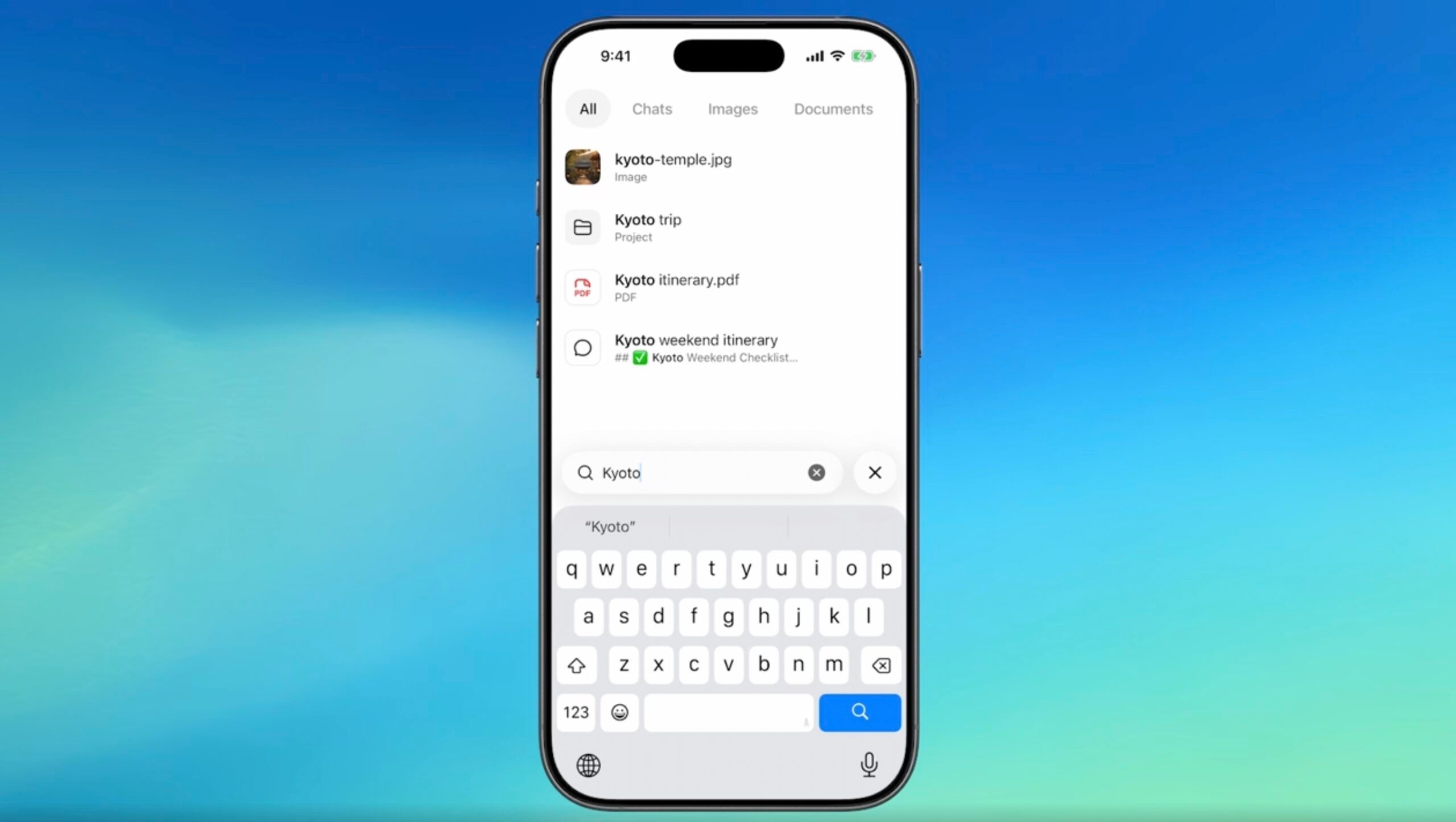
If you have ever lost a great ChatGPT answer somewhere in your endless chat history, that headache is finally over. OpenAI has rolled out a major search upgrade that lets you find old chats, projects, documents, and images all from one place.
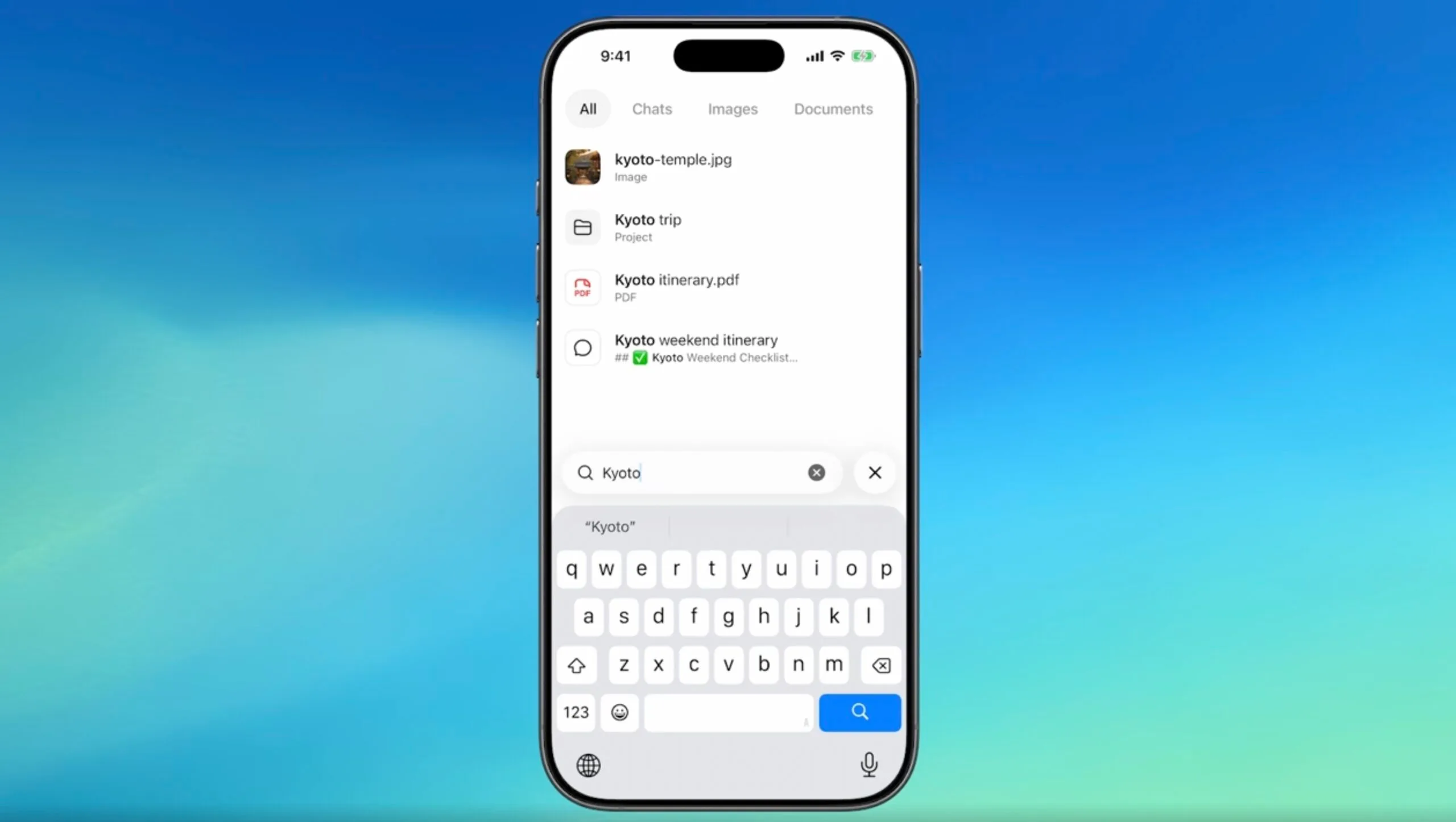
Before this update, the sidebar search only pulled up past conversations, leaving uploaded files, projects, and generated images completely out of reach. The new search option is now available across web, iOS, and Android, on every ChatGPT plan, including free accounts.
Search across your chats just got faster and more powerful 🔎
From the sidebar, you can search chats, projects, images, and documents in one place across web, iOS, and Android.
Use filters to narrow results, then select anything to open it directly in ChatGPT. pic.twitter.com/wYNi2a39wh
You can start searching right from the ChatGPT sidebar, just like before, except now it covers everything in your account instead of only chats. If you want to narrow things down, there are filters that let you search by specific content type, such as pulling up only images or files tied to one particular project. Once you find what you need, selecting a result opens that chat, project, or file directly inside ChatGPT to skip endless scrolling.
OpenAI
This rollout also lines up closely with OpenAI’s recent GPT-5.6 launch, which brought its own wave of upgrades, including a new AI agent called ChatGPT Work that takes on entire projects instead of single questions. It connects to your apps and files, works through multi-step tasks, and can keep running in the background even after you close ChatGPT.
Why does it matter?
The new ChatGPT search does not change what it stores; it simply makes everything already saved much easier to surface. That’s useful if you regularly use ChatGPT for ongoing projects, research, or document analysis. By bringing everything together in one searchable place, you can look for what you need, filter the results, and jump back into your work within seconds.
Vinyl’s resurrection stopped being a charming nostalgia story years ago. U.S. vinyl revenue surpassed $1 billion in 2025, with 46.8 million records sold and the format recording its nineteenth consecutive year of growth. Luminate previously reported that annual U.S. vinyl album sales had increased from 13.1 million in 2016 to 49.6 million in 2023, an increase of nearly 300 percent.
That growth has transformed the turntable category along with everything connected to it. Consumers can now choose from inexpensive wireless record players, sophisticated direct-drive designs, restored vintage decks and turntables with genuinely balanced outputs. Phono preamplifiers have consequently become a serious battleground again rather than an inexpensive circuit manufacturers conceal beside the headphone jack.
EAT, or European Audio Team, has operated at the more ambitious end of that market for years. Its turntables, tonearms, cartridges, vacuum tubes and phono stages are not designed for shoppers searching Amazon for something to play the copy of Aja they bought at Target — an album whose reputation remains vastly more impressive than the music itself.
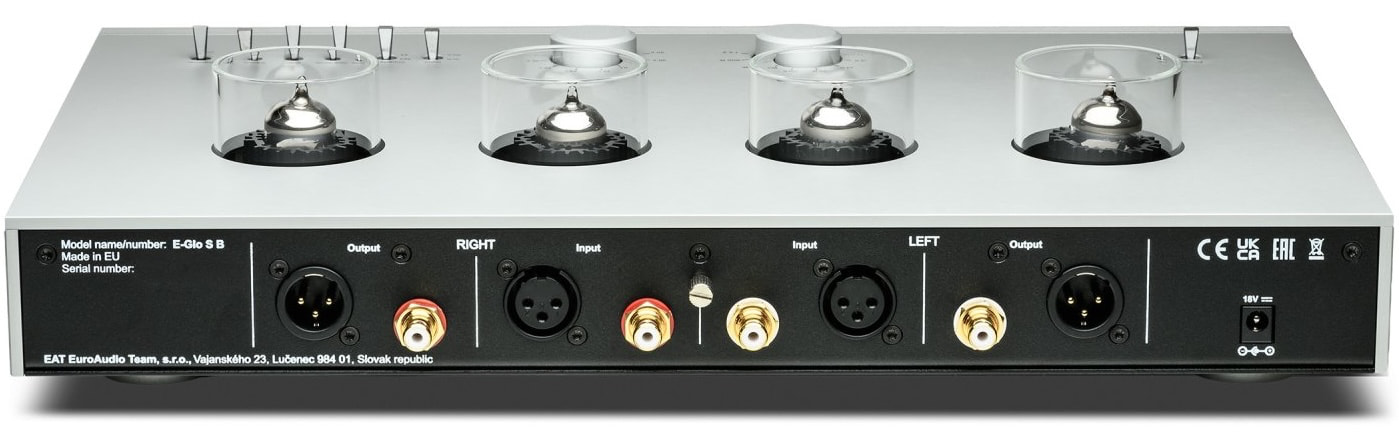
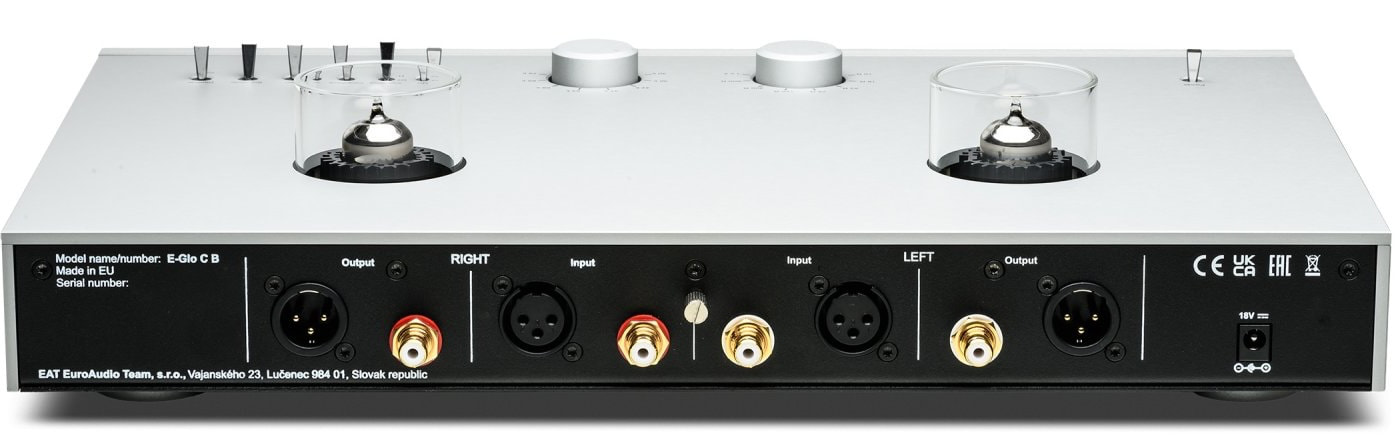
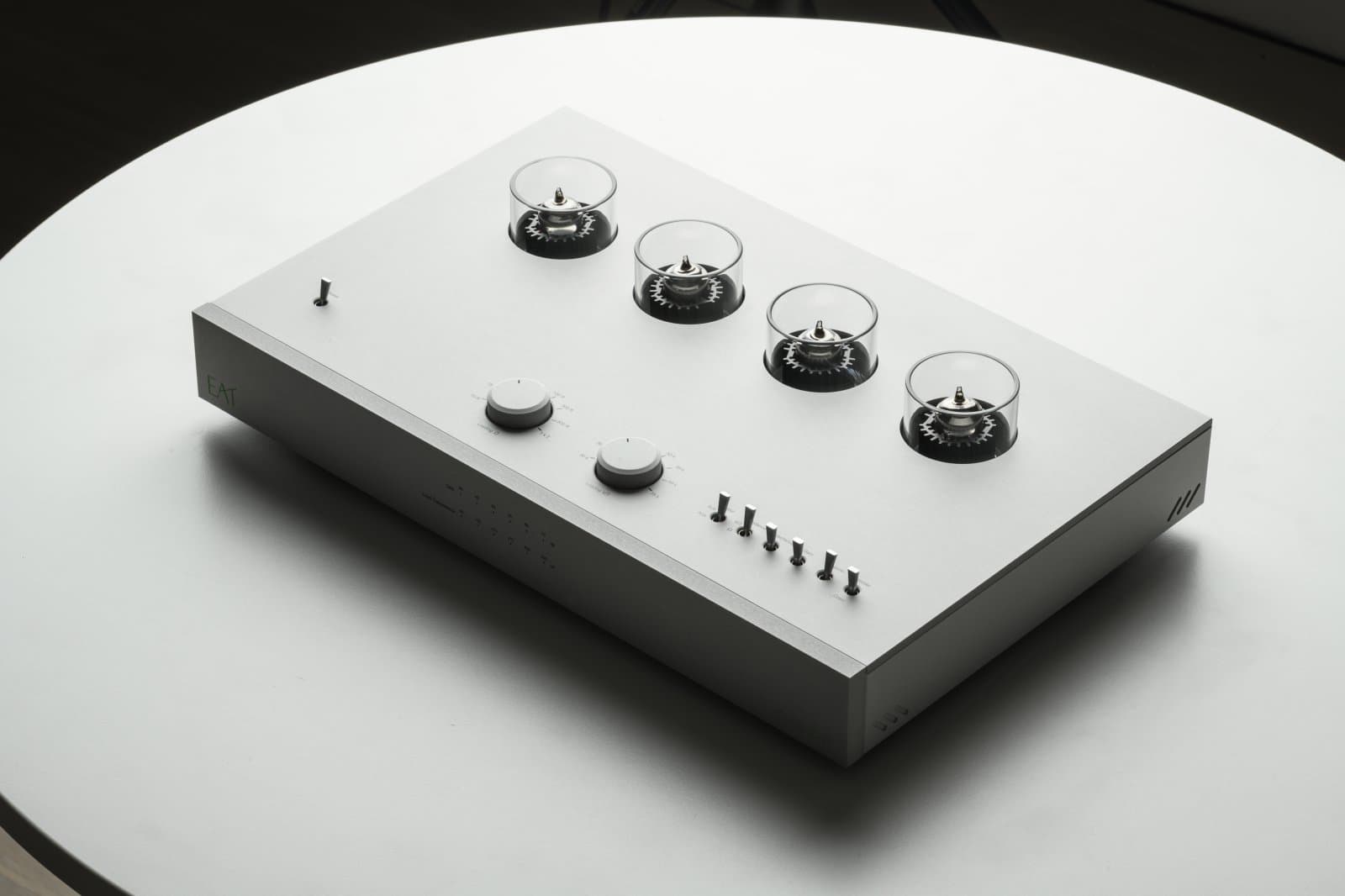
The new E-Glo CB and E-Glo SB continue that approach with full-width chassis, dual-mono construction, discrete circuitry, extensive cartridge adjustment and tube-based amplification. VANA Ltd., EAT’s North American distributor, has announced immediate availability at $4,599 for the E-Glo CB and $6,250 for the E-Glo SB.
Advertisement
Related Reviews:
The EAT and Pro-Ject Connection
EAT is owned and led by Jozefina Lichtenegger, who is married to Pro-Ject Audio Systems founder Heinz Lichtenegger. That relationship has inevitably resulted in some shared analog DNA, manufacturing resources and expertise, but the two companies are not merely different badges attached to the same products.
Pro-Ject has built its reputation by making serious analog playback accessible across a wide range of prices. EAT operates several floors higher, with heavier construction, more elaborate materials, tube-based electronics and products aimed at listeners assembling genuinely high-end vinyl systems.
That relationship also helps explain EAT’s interest in balanced phono playback. Pro-Ject has spent several years expanding its True Balanced ecosystem with compatible turntables, phono stages and cables, including the X1 B, X2 B and X8.
E-Glo SBE-Glo CB
Two Models Built Around a Common Platform
The E-Glo CB and SB occupy the space between EAT’s compact Petit B and flagship E-Glo FB. Both use three gain stages, discrete components rather than integrated-circuit op-amps, split passive and active RIAA equalization and dedicated DC servo circuitry to minimize offset at the outputs.
Advertisement
The first gain stage uses three discrete semiconductor amplifier circuits. Separate circuits handle the positive and negative phases, while a third sums the two signals to reject common-mode noise. The high-frequency portion of the RIAA equalization is also applied at this stage.
Both models accept moving-coil cartridges through their balanced XLR inputs, while the RCA inputs support both moving-magnet and moving-coil designs. Balanced XLR and single-ended RCA outputs can be used simultaneously.
EAT reserves the balanced input for MC cartridges, whose very low output makes common-mode noise rejection especially valuable. Although a phono cartridge is inherently a balanced signal source, the internal wiring of many MM designs prevents access to the complete differential signal. Purpose-built balanced MM cartridges exist, but the E-Glo CB and SB are not designed to accept them through their XLR inputs.
Advertisement. Scroll to continue reading.
Advertisement
E-Glo CB
The Difference Is in the Second Stage
The two models diverge most significantly in their second amplification stages.
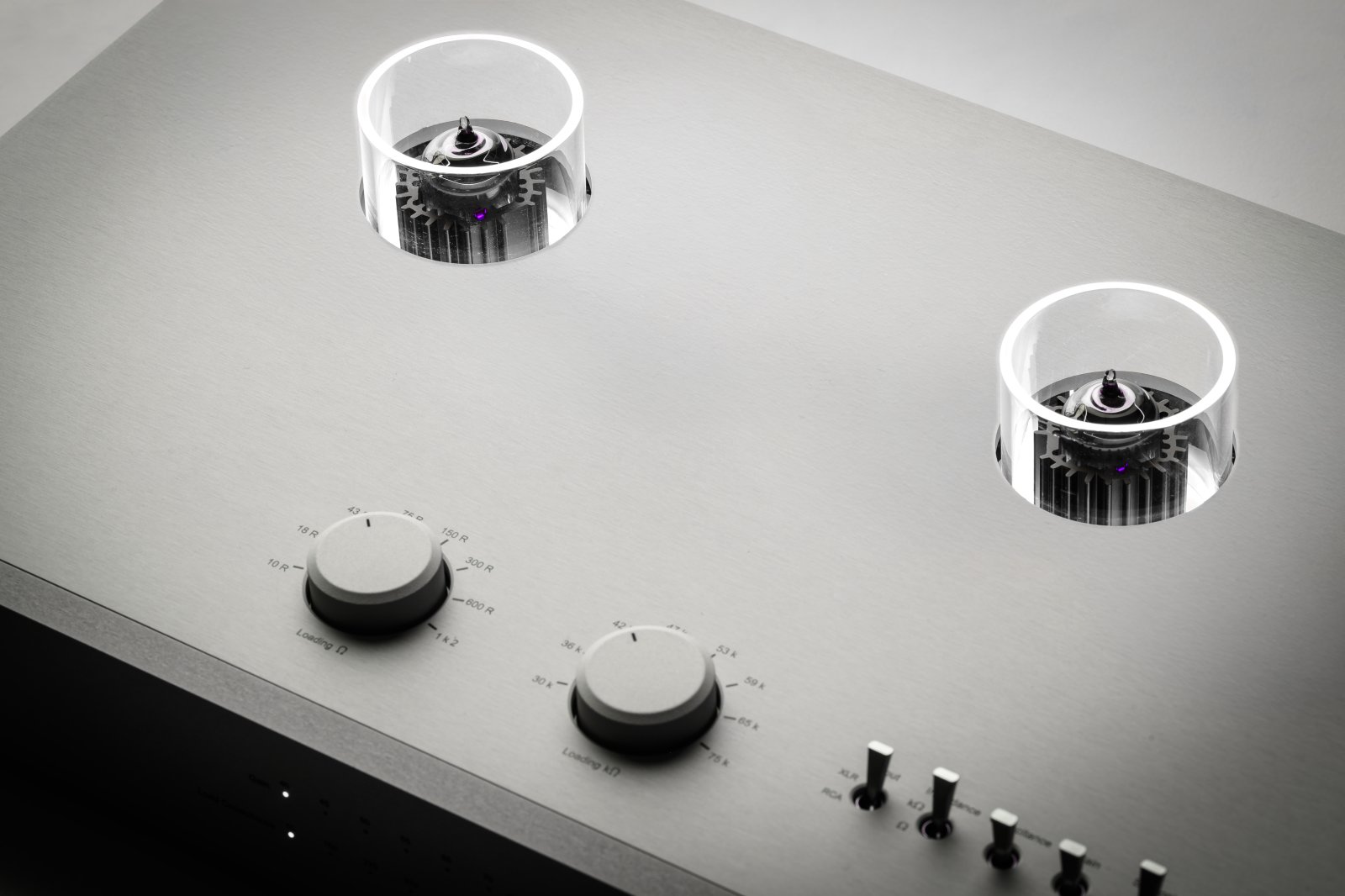
The E-Glo CB uses a hybrid, single-ended tube and transistor circuit composed of two ECC83S triodes and one transistor. This stage handles the low-frequency portion of the RIAA equalization and incorporates a switchable subsonic filter.
The more expensive E-Glo SB moves closer to the architecture of the flagship E-Glo FB. Its second stage is a symmetrical tube design using two ECC83S and two E88CC triodes. EAT also specifies higher-grade semi-crystalline hydrocarbon polypropylene capacitors in the gain and RIAA networks.
The difference is not simply one additional pair of glowing bottles behind the ventilation slots. The SB maintains balanced operation through its second gain stage, while the CB converts to a single-ended signal before its output stage creates the balanced output.
That does not make the CB badly designed, but it does mean that “balanced” requires some qualification. The CB provides a symmetrical MC input stage, common-mode noise rejection and balanced XLR output, but it is not a fully differential circuit from cartridge to output. An XLR socket is a connector, not a blessing from your rabbi.
Advertisement
The SB comes considerably closer to the flagship concept through its symmetrical tube stage and upgraded capacitor selection.
E-Glo SB
Cartridge Adjustment
Both models provide enough adjustment to accommodate a broad range of moving-magnet and moving-coil cartridges.
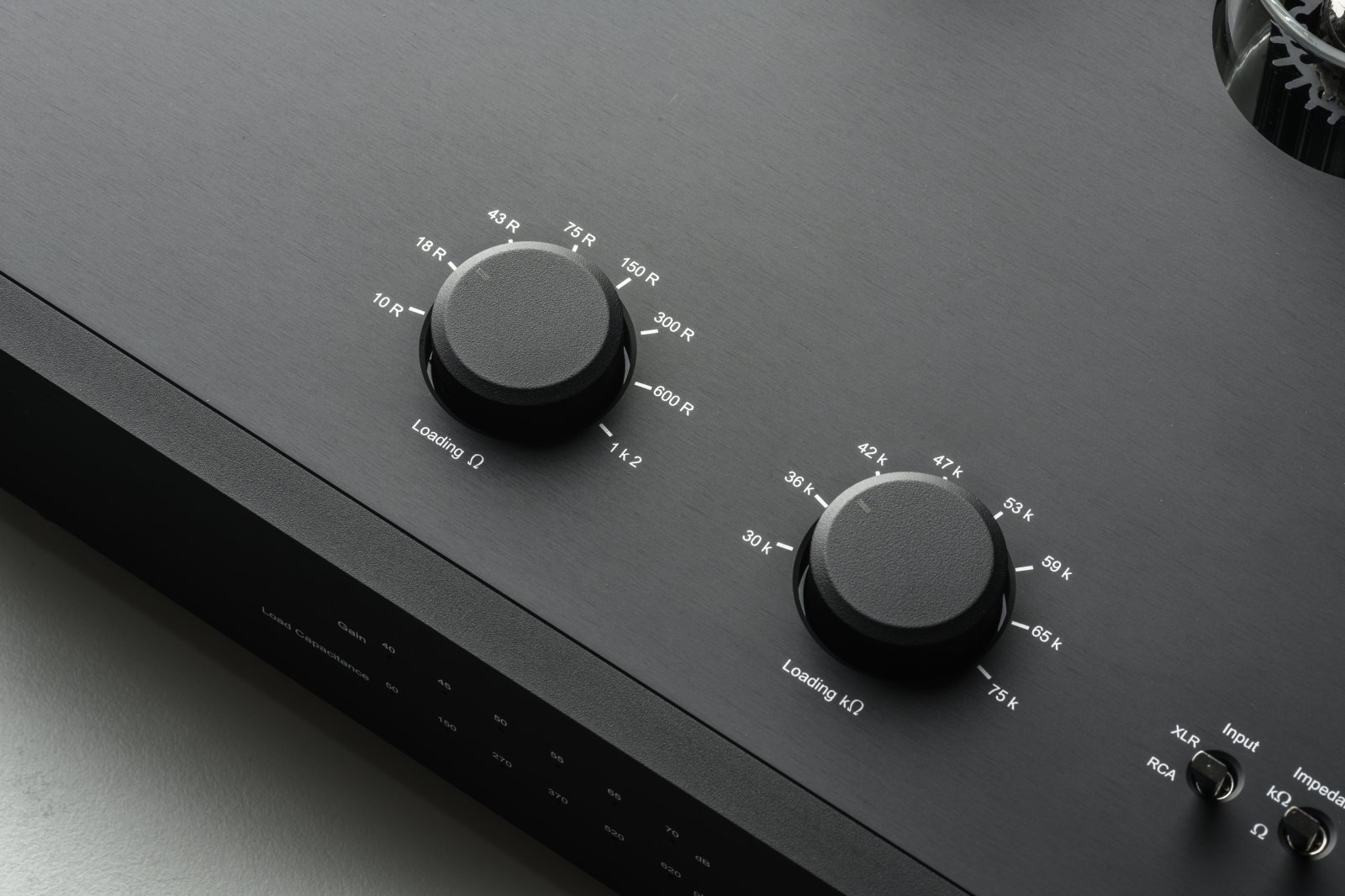
Moving-magnet resistance can be selected from 30,000 to 75,000 ohms, while capacitance settings range from 50 to 620 pF. Moving-coil loading options extend from 10 ohms to 1.2 kilohms.
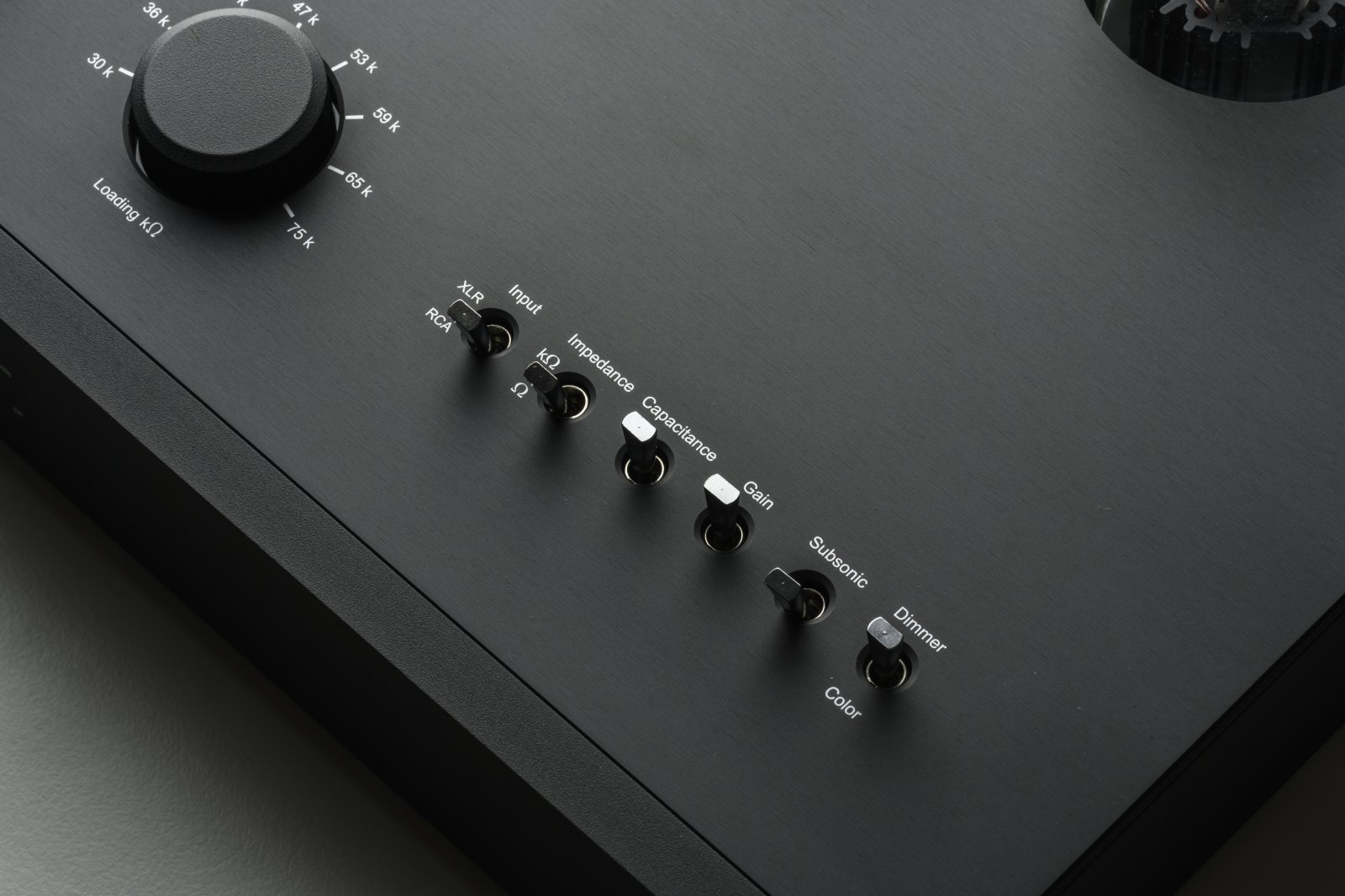
Six gain settings are offered: 40, 45, 50, 55, 65 and 70 dB. According to EAT’s specifications, using the balanced XLR outputs adds another 6 dB.
Advertisement
Both models also include a 20 Hz subsonic filter with an 18 dB-per-octave slope. That will be useful for systems vulnerable to record warps, turntable suspension movement or subwoofers attempting to reproduce low-frequency information that was never part of the recording.
RIAA accuracy is specified within 0.5 dB from 20 Hz to 20 kHz. The CB claims an MM signal-to-noise ratio greater than 92 dBV and an MC figure greater than 80 dBV. The SB is rated at greater than 90 dBV for MM and greater than 80 dBV for MC.
Each measures 395 x 86 x 262 mm (15.6 x 3.4 x 10.3 inches). The E-Glo CB weighs 5 kg (11 pounds), while the E-Glo SB weighs 5.1 kg (11.2 pounds). Both use an external 18-volt power supply, keeping the transformer away from circuitry responsible for amplifying signals measured in fractions of a millivolt.
Advertisement. Scroll to continue reading.
Advertisement
E-Glo SB
The Bottom Line
Neither model represents an attempt to make balanced tube phono amplification affordable in any conventional sense. The E-Glo CB costs $4,599, and the E-Glo SB raises the admission price to $6,250 before one buys the turntable, tonearm, cartridge, cables or records.
Welcome back to high-end analog, where the software occasionally costs $150 and the component amplifying it can cost more than the car used to bring it home.
The CB nevertheless fills a credible position for listeners using a serious moving-coil cartridge who want balanced input capability, extensive loading control and some tube character without climbing into five-figure phono-stage territory. Its hybrid architecture also gives EAT an alternative to competitors such as the Nagra Compact Phono, MoFi UltraPhono Pro and upper-tier phono stages from Rega, Musical Fidelity and Pro-Ject.
The SB is the more technically ambitious product. Its symmetrical tube-based second stage, upgraded capacitors and closer relationship to the E-Glo FB make it the logical choice for systems already built around a high-end balanced preamplifier and a low-output MC cartridge.
EAT has not simply removed parts from its flagship, installed cheaper capacitors and declared victory. The CB and SB are distinct implementations for different buyers, and their construction, flexibility and circuit design suggest products created for long-term analog systems rather than another brief ride aboard the vinyl revival train.
Advertisement
Vinyl, after nineteen consecutive years of growth, is no longer waiting at the station.
That’s not to say the Prologue was a bad car, not by any means. It just wasn’t the result of the maximum amount of effort Honda could have put towards making an entirely original EV. Still, with a maximum range of 308 miles and a starting MSRP of $39,900, the Prologue was (and still is) a competent EV.
Advertisement
But that did not translate to sales, or anyone really wanting to buy one, which is often an unfortunate reality of the automotive world. Last year, Honda sold 39,194 Prologues, making it the worst selling vehicle for the automaker (apart from the Prelude which had only been on sale for a small portion of 2025).
Advertisement
One reason to care
So with that departure, Honda only offers hybrids in the electrified field for the vast majority of the North American market (hydrogen fuel-cell vehicles are a different conversation entirely). No one particularly wants to see a car model get pulled from the shelves with no replacement, but given the low sales and general waning of EV interest (even with fickle gas prices), do we, the automotive public have any tangible reason to care?
Well, if you were hunting for a good lease deal, then maybe. At the time of writing this, July 16th, 2026, you can lease a Prologue for as low as $279 a month for 36 months. That’s less than the current price to lease a CR-V and even an Accord Hybrid, for an electric SUV that’s still plenty competent. Despite its rapidly oncoming demise, that’s really not too bad of a deal. Even a Civic Hatchback Hybrid is more expensive per month.
Advertisement
Middle of the pack
Unfortunately, if all we or John Cena (the voice of Honda’s commercials) can say about the Prologue is that it doesn’t cost that much to lease, then it may have been doomed from the start. It’s much less expensive per month to lease than other Hondas. But then again, it’s not really a Honda. 308 miles of range is competitive, but doesn’t put it on the top of any list. And it looks good, but it’s not a standout EV like something from Hyundai or something sporty like the Mach-E.
The Civic, Accord, and CR-V are world standard commuting or family cars with various superlatives that make each model a perennial success. But the Prologue just didn’t have the juice to keep up with the rest of the automaker’s lineup. Even Honda seemed to be aware of the Prologue’s limits: the GM collaboration was really only meant to act as a stopgap, until Honda’s in-house electric platform arrived. That was to underpin the striking Honda 0 SUV and Honda 0 Saloon, only for those two planned vehicles to be unceremoniously ditched earlier this year.
As with every car, there was probably a small fan base that will mourn the loss of the Prologue, and everyone who currently owns or leases one will be left without an option to upgrade to a newer model if they want to stay with an electric car. For everyone else, we can wait and hope that Honda picks up the EV slack soon, maybe with a vehicle that has more Honda DNA.
Although Einstein’s Theory of Relativity is typically associated with really large and really heavy things like plants in solar systems and big things in universes in general, it turns out that even at an atomic scale its effects can be measured. These are the findings of Brown University scientists, whose measurements on very heavy elements indicate the presence of relativistic bonds.
Unfortunately the paper by [Kirk A. Peterson] et al. in Science is paywalled without a convenient ArXiv version to ogle details beyond the supplemental, but the Brown press release gives quite a few details by itself, including the use of photoelectron spectroscopy to measure the strength of the bonds between the examined nuclei.
The essential summary is that our concept of how triple bonds work may be flawed, with the assumption that there are distinct sigma and pi bonds, the latter being the awkward, weaker ‘side bonds’ where the overlapping atomic orbitals do not directly line up as with a sigma bond. As it turns out, if there’s enough mass involved, relativistic effects smudge both types of bonds together into a hybrid type of bond.
Advertisement
Although the sigma-pi triple bond theory still seems to hold up for lighter atomic nuclei, in the case of the examined bismuth-carbon triple bond, the typical, slightly radioactive bismuth-209 nucleus with atomic number 83 is heavy enough to affect the orbital mechanics and with it the chemical bonds that these produce.
This is an important finding, as it affects our basic understanding of how strong the bonds between certain elements are. Pi bonds are after all significantly weaker than sigma bonds, so a hybrid form would effectively make triple bonds involving a heavier element stronger than one between lighter elements.
AI software claims hidden grid capacity could ease America’s growing electricity shortage
GridCARE says simulations reveal unused transmission capacity across existing power infrastructure
Existing transmission lines may hold far more capacity than previously estimated
A new software platform claims it can unlock roughly 300 gigawatts of hidden electrical transmission capacity across the existing United States power grid within three to five years.
The technology, developed by GridCARE and led by founder and CEO Amit Narayan, relies on advanced grid modelling rather than costly new infrastructure.
Instead of building additional transmission lines or substations, the platform analyzes how the grid actually operates in real time.
Latest Videos From
Unlocking hidden capacity
The US power grid has traditionally been planned around conservative assumptions that account for multiple simultaneous equipment failures at once.
Advertisement
This approach has left substantial portions of the transmission network underused for most of the calendar year, while electricity demand has resumed growing sharply, and grid upgrades may struggle to keep pace before 2030.
Bank of America data indicates the country could face a 100 GW power shortfall within the next four years.
Analysts project at least 230 GW of new power demand will emerge between 2026 and 2030 alone.
Advertisement
Sign up to the TechRadar Pro newsletter to get all the top news, opinion, features and guidance your business needs to succeed!
During the same period, utilities are expected to add only 93 GW of new supply capacity.
That gap between projected demand and available supply has intensified pressure on operators searching for faster solutions.
However, GridCARE claims it could cut years from clean energy interconnection wait times across multiple regions.
Advertisement
Running quadrillions of simulations
The platform reportedly runs quadrillions of simulations to identify where unused transmission capacity remains hidden from conventional planning tools.
By modelling actual grid behaviour rather than worst-case scenarios, utilities gain a more accurate picture of available headroom.
Advertisement
This method allows operators to make better use of infrastructure that already exists across the network.
The technology was recently discussed on the “Energy Empire” podcast, hosted by Jigar Shah, a US entrepreneur and former director of the Department of Energy’s Loan Programs Office.
According to Narayan, the 300 GW figure represents capacity that traditional planning methods have consistently overlooked for years.
He claims that recovering even a fraction of that capacity could meaningfully ease constraints facing data center developers and clean energy projects awaiting grid connection.
Advertisement
The claims arrive as pressure mounts on grid operators to accommodate rising demand from artificial intelligence infrastructure and electrification trends nationwide.
However, no independent testing or verification has confirmed the software’s claims about the extent of its capabilities.
Utilities have historically been cautious about departing from conservative planning standards that prioritize reliability during equipment failures.
Still, the scale of the projected shortfall — combined with slow transmission buildout timelines — may push operators toward faster, software-based alternatives sooner than expected.
Increased attendance, better attention in classrooms, stronger friendships, and more engaged citizens – these are not a long wishlist of preferred traits in an elementary school student. They are what some advocates believe are a direct impact from recess.
Recess, long a staple in children’s school days, has been put on the back burner or cut entirely by some districts as the push for more class time, higher academic performance, and increased test scores take center stage.
Recess advocates are pushing back in their efforts to guarantee a playtime each day. They argue adding in more structured play time benefits children’s academic, social and emotional well-being.
“It’s not that we don’t need hard work and concentrated effort, but when you hit a wall, you take a break,” says Catherine Ramstetter, who co-authored a new report for the American Academy of Pediatrics touting the importance of structured play. “That’s where I think, systematically, we’re kind of broken; that we expect little kids to be like little robots.”
Advertisement
The Push for Play
The AAP recently affirmed its 2013 stance that not only is recess important for children’s cognitive, physical and emotional well-being but expanded the recommendations to include middle and high school students too.
“I don’t know many high school teachers that are studying or deep into play,” Ramstetter says, pointing out early childhood teachers typically receive training in structured play. “Also, culturally in older grades, rigor is somehow equated with your nose to the grindstone –- when in reality, when we want to attain rigor, we have to have breaks.”
Similar to a push against screentime – specifically cell phones – in the classroom, grassroots efforts have formed to bring back recess. More than a dozen states, largely led by the nonprofit Yes to Recess Movement, are pushing for 60 minutes of play per day and ensuring it is not used as a bargaining chip for good or bad behavior.
“There has been a lot of evolution of the understanding of the value of recess over 30 years,” says Elizabeth Cushing, CEO of PlayWorks, a nonprofit that helps schools implement evidence-based play tactics.
Advertisement
“What might have been perceived as a ‘break’ is now seen as a critical part of the school day,” she adds. “It’s enabling kids to be in connection with each other in a way that’s fun, with low stakes, to build a community.”
NEWSLETTERS
STAY AHEAD IN EDUCATION.
Sign up for EdSurge newsletters for timely news, insights and analysis.
Pushing for state or federal bills have yielded mixed reactions. Each advocate interviewed points out that they have never come with an allocation of funding to help facilitate the implementation, and also had concerns with a lack of other resources, namely helping teachers find time to accommodate the recess breaks. Deborah Rhea, founder of the Let’s inspire innovation ‘N Kids (LiinK) Project, suggests each local district tackles it by deciding what is best for its own schools and students.
Advertisement
“I think we have made more strides than I ever thought possible,” says Rhea, who also serves as a professor of kinesiology at Texas Christian University. “But at the same time, we’re limping along. We’re not being successful with momentum. Doing this propels them forward academically.”
But Ramstetter says introducing those minutes alone is not enough.
“I think policy can help support practice, but to make it quality playtime — something that doesn’t feel like an onerous task on a school — you have to spend some time planning,” she says. “Similar to introducing a new curriculum on English. It’s treating it like the crucial instructional time that it is.”
The Benefits of Play
In addition to benefiting younger students, the boost in social skills like teamwork and inclusion, along with physical benefits can be particularly important as students get older, Cushing says.
Advertisement
“The opportunities and skill building that happens in elementary school around cooperation, teamwork and how to include everyone in a game are easily done at that age,” she says. “They follow into middle and high schools where technology and social pressures require they have those skills already. If we want to develop citizens who work in a team and make friends, we have to start early.”
“There’s a lot of focus on recess to help with belonging and source of positive, joyful feelings about school,” Cushing says, adding schools with the PlayWorks framework saw lower chronic absenteeism rates than those without it.
Rhea of LiiNK listed multiple benefits she’s seen across the roughly 25,000 students that underwent her programming: cortisol levels (tested by hair samples) went down; academic assessment scores went up; off-task behavior in the classroom dropped 40 percent, and schools found offering the programming could be used as a recruitment tactic.
Advertisement
“The only time I had to convince parents was the first year I started this,” she says. “After that, word of mouth spread.”
There still is the uphill battle of convincing schools to find time in their day. Not every district can afford to roll out a system similar to Rhea’s or Cushing’s, either financially or with spare time.
The Future of Play
However, Cushing pointed out even with little resources, children tend to thrive with simple, structured play.
“Recess is the only time in the school day where children naturally know they have mastery,” she says. “The beauty of recess is that kids will play everywhere. Despite all the complexity there’s a real beauty in the universality of it.”
Advertisement
However, students do need some resources, like a jump rope and designated play areas, otherwise they may not receive the full benefits of recess even if they are outside.
“If you look at a playground where there’s no frame for it, you’ll see a majority of kids standing around the outside of the playground,” Cushing says. “They’re too afraid or shy to jump in and don’t know if it’s going to be fun or not. It’s not that they don’t want to play, they just need the conditions created to do it.”
While cell phones are less common in elementary school settings, experts added a lack of screens could improve play conditions.
Schools have pushed for more tech-free time, specifically with “bell to bell” bans that require cell phones remain untouched for the entirety of the school day, including during lunch, recess and passing periods.
Advertisement
The AAP study did not explicitly mention the use of technology. However, Ramstetter says the implication was “yeah, get it out of the way,” she adds.
“Don’t give them to kids at recess: Encourage them to connect, give them quiet places to sit. to run around, to dig in the dirt,” she says, comparing the ban to other forms of consent. “If I tell you I don’t want to play anymore, I need to mean it. Otherwise it gets muddy.”
She adds sometimes simple is best, pointing toward schools that just have a jump rope, chalk, and Four Square – things that allow children to make their own rules. “Everyone agrees recess is beneficial, but you have to do it well to reap the benefits,” Ramstetter says. “If we all believe it’s beneficial, let’s take a step back to see how can we better tap into some of this time, preparing to do it well.”
Across 107 enterprises, AI infrastructure spending is accelerating well ahead of the ability to see or steer its economics. Most organizations run their AI on a familiar base of hyperscalers and model-provider APIs, yet the next dollar is aimed at specialized compute almost none of them use today; a majority intend to switch or add providers within the year, many within a quarter. Buying decisions turn on integration and total cost of ownership rather than headline token price — which is fortunate, because most enterprises cannot yet see their unit economics clearly: GPUs sit at half utilization or less, and fewer than half rigorously track what their compute actually costs. The result is a compute gap — heavy, fast-moving investment running ahead of the visibility needed to control it.
This wave of VentureBeat Pulse Research examines enterprise AI infrastructure and compute: where organizations are in their deployment journey, what they run AI on today, how satisfied they are, what would make them switch, where they plan to evaluate their investments, and — most revealingly — how well they can measure and control the economics of the compute underneath it all.
The central finding is a compute gap — the distance between how aggressively enterprises are investing in AI infrastructure and how little of its economics they can see. Only about one in five (21%) run AI in production at scale, yet spending intentions are outrunning that maturity: the single largest planned area enterprises plan to evaluate over the next year is AI-specialized clouds (45%), a layer almost none of these enterprises use today. Meanwhile the compute already in place runs cold — 83% report GPU utilization of 50% or less — and fewer than half (44%) can rigorously track what their AI compute costs. Enterprises are buying more infrastructure faster than they can account for what they already own.
Enterprises are not settled on their infrastructure vendors, either: A clear majority (64%) plan to switch or add an infrastructure provider within twelve months, and 38% within the next quarter — unusually high churn intent for a category this foundational. When they choose, they choose on integration with the existing stack (41%) and total cost of ownership (35%), not on headline price: cost per million tokens is the deciding factor for just 8%. And the frontier constraint that will shape the next round of decisions — the shift from GPU compute to memory bandwidth as inference scales — is barely on the radar, with roughly one in five enterprises either unaware of it or yet to address it.
Advertisement
Methodology
VentureBeat fielded this survey as part of its ongoing Pulse Research series, this survey focused on enterprise AI infrastructure, compute, and inference economics. Responses are filtered to organizations with more than 100 employees (n=107; the survey’s smallest size band, 1–100 employees, is excluded), drawn from a single Q2 2026 (June) wave. Because this is one wave rather than a pooled multi-month sample, the report reads cross-sectionally and does not infer month-over-month trends. Several questions were multiple-select, so those shares can sum to more than 100%.
By organization size the sample concentrates in the mid-market: 101–250 employees (36%) and 251–1,000 (27%) lead, with 1,001–5,000 (22%), 5,001–10,000 (8%), and 10,001+ (7%) above them. By role it spans managers (38%), individual contributors (28%), VPs and directors (19%), and the C-suite (13%); on purchasing authority it is buyer-credible, with 45% final decision-makers and another 30% recommenders or influencers for AI solutions. Technology/Software is the largest industry at 26%, followed by Healthcare/Life Sciences (15%), Financial Services (13%), and Retail/E-commerce (12%).
At 107 respondents the sample is large enough to read directionally but should be treated as a directional signal rather than a precise measurement; it is self-selected and is not a probability sample. It also skews toward the mid-market and toward earlier-stage adopters, so it is best read as the view from organizations actively building out AI infrastructure rather than from the largest hyperscale operators.
Finding 1: Ambition outpaces production
Only one in five run AI in production at scale
Advertisement
We asked where organizations sit in their AI deployment journey. Most are still building toward production rather than operating at scale.
Finding 1 — Ambition outpaces production
38%
are experimenting — running proofs of concept, not yet in production
Advertisement
37%
have some workloads in production, but not across the organization
Advertisement
21%
run AI in production at scale — the mature minority
4%
Advertisement
are not yet running AI workloads at all
Advertisement
The maturity curve is front-loaded. Three-quarters of enterprises (76%) are either experimenting or running only some workloads in production, and just 21% describe AI in production at scale. This matters for everything that follows: the infrastructure decisions in this report are being made largely by organizations still early in deployment, whose compute footprint — and whose costs — are about to grow. The evaluation and switching intentions in Findings 3 and 4 are the leading edge of that build-out, not the settled preferences of operators who have already found what works.
Finding 2: Enterprises run on hyperscalers and model APIs
The specialized GPU clouds barely register — today
We asked which providers and platforms enterprises currently use to run their AI. The answer is a familiar one: the incumbents.
Finding 2 — Enterprises run on hyperscalers and model APIs
Advertisement
48%
use Google Cloud — the most-used platform overall (Microsoft Azure 29%, AWS 22%, Oracle Cloud 22%)
41%
Advertisement
use Google’s Gemini models, with OpenAI close behind at 40% and Anthropic at 12%
6%
run their own on-prem or co-located GPU clusters; 4% a custom open-source self-managed stack
Advertisement
<2%
each use the specialized AI clouds — CoreWeave, Lambda, Crusoe, Nebius, Together, Fireworks and peers
Advertisement
The current stack is hyperscaler-and-API. Google Cloud leads at 48%, and the general-purpose clouds (Google, Microsoft, AWS, Oracle) together with the major model APIs (Gemini, OpenAI, Anthropic) account for essentially all current deployment. The specialized “neocloud” GPU providers that dominate AI-infrastructure headlines — CoreWeave, Lambda, Crusoe, Nebius and peers — register at or near zero among these enterprises today. Only 6% run their own on-prem GPU clusters and 4% a custom open-source stack. Enterprises are, for now, running AI on the providers they already buy from — which makes the evaluation intentions in Finding 3 all the more striking.
(A note on reading these shares. As described in the methodology section, this sample is self-selected and skews mid-market, and this question counted every provider a respondent uses — an average of 2.1 selections each — so the figures measure presence in the stack rather than spending or primary status. A sample built this way will show a different provider mix than a spend-weighted census of the broader market; Google’s strength here, for example, is consistent with its long-standing position among smaller enterprises building on AI. Read these shares as a portrait of what this AI-active cohort runs today, and treat gaps between these figures and industry-wide market share estimates as a property of the sample rather than a contradiction of either.)
Advertisement
Finding 3: The next dollar goes to infrastructure they don’t yet run
AI-specialized clouds top the evaluations list
We asked where enterprises planned to evaluate AI infrastructure over the next 12 months. Their answers point away from the stack they run today.
Finding 3 — The next dollar goes to infrastructure they don’t yet run
45%
Advertisement
plan to evaluate AI-specialized clouds (CoreWeave, Lambda, Crusoe, Nebius) — the top planned evaluation area
32%
plan to evaluate non-NVIDIA accelerators (AWS Trainium, Google TPU, AMD Instinct, Intel Gaudi, in-house ASICs)
Advertisement
28%
plan to evaluate Nvidia Blackwell (GB300) / next-generation GPUs
Advertisement
16%
plan to evaluate decentralized or distributed compute networks
11%
Advertisement
plan to evaluate sovereign or region-specific compute; 9% say none of the above
Advertisement
Here is the report’s sharpest tension. The single most-cited planned evaluation area — AI-specialized clouds, at 45% — is the very category almost none of these enterprises use today (Finding 2). Nearly a third (32%) intend to evaluate non-Nvidia accelerators, and 28% in next-generation Nvidia silicon; even decentralized compute networks (16%) and sovereign compute (11%) draw meaningful interest. Read against current usage, this is not incremental — it is the leading edge of a re-platforming. The direction-of-travel question tells the same story: every infrastructure approach is net-expanding, but specialized AI clouds carry the highest net momentum (+24), edging out even the hyperscalers (+22). Enterprises are preparing to move a meaningful share of AI compute off the general-purpose cloud.
This continues a trend we saw in our April-May survey wave. Back then, usage of the AI-specialized clouds was equally marginal — CoreWeave at 3%, Lambda at 4%, Crusoe at 2% of enterprises. When we asked enterprises what change they planned in their AI infrastructure strategy over the next twelve months, the most-cited answer was moving workloads to specialized AI clouds, at 33%. Asked in April-May which emerging compute option they were most likely to evaluate AI-specialized clouds again drew the most responses. Two waves, two differently worded questions, one consistent picture: the type of cloud enterprises are most eager to assess is the type they have barely begun to use.
Finding 4: A switching wave is building
Six in 10 plan to change providers within a year — many within a quarter
We asked whether and when enterprises plan to switch or add an infrastructure provider. Very few intend to stand still.
Advertisement
Finding 4 — A switching wave is building
38%
plan to change within the next 0–3 months — tied for the most common answer
Advertisement
36%
have no plans to change
22%
Advertisement
plan to change within 3–6 months
7%
plan to change within 6–12 months
Advertisement
For a category as foundational as compute, this is a remarkable amount of intended movement. Only 36% have no plans to change, meaning a clear majority (64%) intend to switch or add a provider within twelve months — and 38% within the next quarter alone. Where that interest points is telling: the providers drawing the most switching consideration are again the incumbents — Microsoft Azure and Google Cloud (33% each), OpenAI (30%), and Gemini (22%) — which suggests much of the near-term movement is reshuffling among the majors and consolidating spend rather than defecting to new entrants. The neocloud interest in Finding 3 is a 12-month evaluation thesis; the switching in the next quarter is mostly incumbents trading share.
Advertisement
(Method note: Respondents who selected both “no plans to change” and a specific switching window are counted as switchers, on the logic that naming a timeframe is the more specific answer; three respondents were reclassified under this rule.)
Finding 5: Nobody buys on token price
Integration and total cost of ownership decide — not sticker price
We asked what matters most when enterprises select an AI infrastructure provider. Headline price finished last.
Finding 5 — Nobody buys on token price
Advertisement
41%
cite integration with the existing cloud and data stack — the top factor
35%
Advertisement
cite total cost of ownership (TCO)
24%
cite performance — latency and throughput
Advertisement
19%
each cite security/compliance, autoscaling for spiky workloads, and GPU access/availability
Advertisement
8%
cite cost per 1M tokens — the least-cited factor
Advertisement
Enterprises do not buy AI infrastructure on pricing, which is the place vendors compete on hardest. Integration with the existing stack (41%) and total cost of ownership (35%) dominate, while the headline metric — cost per million tokens — is the deciding factor for just 8%, dead last. The pattern is coherent: buyers are optimizing for how a provider fits and what it truly costs to operate, not for the advertised unit rate. It also foreshadows Finding 7 — enterprises say TCO matters most, yet most cannot yet measure it rigorously. The stated priority and the measured capability are out of step.
Finding 6: Expensive GPUs, idle most of the time
83% report GPU utilization of 50% or less
We asked what share of their GPU capacity enterprises actually utilize. The answer is a well-known but rarely quantified inefficiency.
Advertisement
Finding 6 — Expensive GPUs, idle most of the time
37%
run at 26–50% utilization
Advertisement
34%
run at 10–25% utilization
15%
Advertisement
run under 10% utilization
12%
run over 50% utilization — the efficient minority
Advertisement
8%
don’t measure utilization at all; a further 7% consume via API and run no GPUs of their own
Advertisement
Disclosure: Band percentages count every selection against all 107 qualified respondents; 14 respondents selected more than one band, so bands overlap. At the respondent level, 83 of the 100 GPU-operating enterprises reported utilization at or below 50%
The compute already in place runs cold. Adding the bands at or below half capacity, 83% of enterprises that operate GPUs report utilization of 50% or less, and nearly half (49%) run at 25% or below. Only 12% clear the 50% mark, and a further 8% do not measure utilization at all. Idle accelerators are expensive accelerators, and this is the clearest single measure of the compute gap: enterprises are planning to buy more GPUs and specialized compute (Finding 3) while the capacity they already own sits substantially unused. The efficiency headroom in the current fleet is large — and largely unmeasured.
Advertisement
Finding 7: Spending fast, measuring slowly
Fewer than half rigorously track what their compute costs
We asked whether enterprises can quantify the cost and return of their AI infrastructure spend, and how satisfied they are with what they run. Confidence in the ledger lags the spending.
Finding 7 — Spending fast, measuring slowly
44%
Advertisement
track compute cost and ROI rigorously
39%
track it only partially
Advertisement
20%
can’t quantify it yet
Advertisement
6%
say it isn’t a priority
Advertisement
Measurement trails money. Fewer than half of enterprises (44%) rigorously track the cost and return of their AI compute; the majority track only partially (39%), cannot quantify it yet (20%), or have not prioritized it (6%). That gap is consequential given Finding 5, where total cost of ownership was the second-ranked buying criterion — enterprises are choosing providers on an economic basis they mostly cannot yet measure. Satisfaction with current infrastructure is moderately positive but not enthusiastic: on a five-point scale, overall satisfaction averages 4.0, with ease of implementation (3.8) and value for money (3.9) trailing slightly — the softness landing, tellingly, on cost. Enterprises are spending quickly and accounting slowly.
Finding 8: The next bottleneck few are watching
As inference shifts from compute to memory, the field scatters
Finally, we asked how enterprises would address the emerging constraint in large-scale inference — the shift from GPU compute to memory, specifically KV-cache capacity. The responses reveal a frontier that is not yet a priority.
Advertisement
Finding 8 — The next bottleneck few are watching
31%
would rely on Dell (PowerScale / Project Lightning) — the leading single answer
Advertisement
16%
would rely on Nvidia (Dynamo / ICMSP)
18%
Advertisement
are not aware of this as a constraint (9%) or haven’t addressed inference-memory limits yet (8%)
10%
would rely on Hammerspace (Tier Zero); 9% DDN (Infinia); the rest split across open-source KV-cache tooling, model-level efficiency, VAST Data, and WEKA
Advertisement
The memory frontier is real but barely governed. Asked which approach they would rely on as the binding constraint in inference shifts from compute to memory bandwidth, enterprises scatter: Dell leads at 31%, Nvidia follows at 16%, and the rest fragments across storage vendors, open-source tooling, and model-level efficiency techniques. Most telling is that roughly one in five (18%) either do not recognize the constraint or have not begun to address it. For a shift that will reshape inference cost and architecture, this is an early and unsettled market — and, consistent with the measurement gap in Finding 7, one where many enterprises simply do not yet have a view. It is the next chapter of the compute gap, arriving before most have closed the current one.
Advertisement
The bottom line: A compute gap that faster spending will widen, not close
Organizations with more than 100 employees are investing in AI infrastructure faster than they can measure it. Most are still early in deployment, yet their spending intentions point past their current stack — toward specialized clouds and alternative accelerators almost none of them run today — and a clear majority intend to change providers within the year. They buy on integration and total cost of ownership rather than headline price, which is rational; the difficulty is that most cannot yet see those economics clearly.
The visibility gap is concrete. The GPUs enterprises already own run at half utilization or less for the overwhelming majority, and fewer than half can rigorously track what their compute costs or returns. Satisfaction is decent but unenthusiastic, softest on value for money — the dimension hardest to judge without measurement. And the next constraint, the shift from compute to memory in large-scale inference, is arriving while most enterprises are still unaware of it. At 107 respondents in a single Q2 wave this is a directional read, skewed toward the mid-market and earlier-stage adopters — but the direction is consistent: the appetite to spend is running well ahead of the instrumentation to spend well. The compute gap is not a capacity problem that more hardware will solve on its own; it is, first, a problem of seeing what the hardware already costs. The open question for later waves is whether enterprises build that visibility before the re-platforming arrives — or buy the next layer of infrastructure as blind to its economics as the last.
Based on survey responses from 107 qualified enterprise respondents (100+ employees), drawn from a single Q2 2026 (June) wave. Because this is one wave rather than a pooled multi-month sample, the results read cross-sectionally rather than as a month-over-month trend, and at 107 respondents this is a directional signal rather than a precise measurement — the sample is self-selected, skews mid-market, and leans toward earlier-stage adopters rather than the largest hyperscale operators. Respondents include managers, individual contributors, VPs/directors, and the C-suite, with buyer-credible purchasing authority, across Technology/Software, Healthcare/Life Sciences, Financial Services, Retail/E-commerce, and other industries.
























































You must be logged in to post a comment Login