

Crypto World
1win Expands Its Prediction Markets with Crypto Forecasts


[PRESS RELEASE – Willemstad, Curaçao, July 17th, 2026]
Cryptocurrency has become one of the fastest-growing categories within prediction markets, as traders and investors increasingly look beyond price charts to speculate on major industry milestones.
Reflecting this trend, international betting brand 1win has expanded its Markets product with a series of new cryptocurrency prediction markets covering some of the sector’s most closely watched digital assets.
The new crypto-themed forecasts on 1win Markets allow users to speculate on topics, including
- What price will HYPE reach by the end of 2026?
- Will HYPE surpass Solana (SOL) in market capitalization before December 31, 2026?
- What price will XRP reach in 2026?
- What price will Dogecoin (DOGE) reach by the end of the year?
“Crypto-related forecasts are becoming a natural extension of prediction markets, giving users another way to engage with some of the biggest narratives in the crypto industry. Though on 1win Markets, we have made it an interactive and easy-to-understand format,” says Mike Danshin, CMO 1win Crypto.
1win Markets uses a simple binary format. Instead of selecting from complex betting lines, users answer straightforward “Yes” or “No” questions or choose between clearly defined outcomes. It is a fun and interactive way to think about life events, even for those unfamiliar with classic betting.
This crypto-focused expansion on 1win Markets reflects the growing convergence between crypto communities and binary predictions. Users are increasingly interested in predicting not only sports or political outcomes but also changes across the digital asset industry.
By adding cryptocurrency-focused markets alongside existing categories – sports, politics, technology, entertainment, and global events – 1win continues to broaden the scope of its crypto-driven ecosystem.
About 1win
Founded in 2016, 1win is a crypto entertainment platform in the global gaming industry. Operating across Asia, Latin America, and Africa, 1win offers a wide range of entertainment products adapted to regional audiences. The brand has active collaborations with international public figures, including football legend Luis Suarez, martial artist Jon Jones, and Olympic champion and UFC fighter Gable Steveson. In 2026, 1win welcomed rapper Tyga and UFC legend Ilia Topuria as new members of the 1win VIP community. Football legend Luis Suarez will be the official 1win football expert throughout the 2026 FIFA World Cup.
The post 1win Expands Its Prediction Markets with Crypto Forecasts appeared first on CryptoPotato.



Taiwan has sentenced the alleged mastermind behind the BitShine crypto exchange to 22 years in prison after finding he led a fraud and money laundering operation that prosecutors said caused more than NT$1.27 billion ($39 million) in losses to over 1,500 victims.
Summary
- A Taiwan court has sentenced the BitShine crypto exchange ringleader to 22 years in prison over a NT$1.27 billion fraud and money laundering scheme.
- Prosecutors said more than 1,500 victims were defrauded after funds were converted into USDT and moved overseas through the exchange.
- The ruling comes after Taiwan approved a new licensing framework that strengthens oversight of crypto exchanges and stablecoin issuers.
Taiwan’s semi-official Central News Agency (CNA) reported that the Shilin District Court convicted the defendant, identified by the surname Shih, of illegally operating virtual asset services while orchestrating fraud and money laundering through the BitShine platform.
Court findings said Shih led a criminal organization that used BitShine, a crypto exchange previously registered with Taiwan’s Financial Supervisory Commission (FSC), to disguise illegal activities behind what appeared to be a legitimate business.
Prosecutors said the group worked with fraud syndicates and members linked to the Thento Union, one of Taiwan’s largest organized crime groups. Victims’ cash was allegedly converted into Tether’s USDT before being transferred overseas.
Investigators estimated the operation laundered more than NT$2.3 billion ($71 million) between January 2024 and April 2025. Prosecutors identified 1,539 victims who together lost more than NT$1.27 billion ($39 million), according to CNA.
Local newspaper UDN reported that Shih recruited compliance personnel who were unaware of the alleged scheme to develop know-your-customer (KYC) procedures for the exchange. Prosecutors said intermediaries later coached fraud ring members on how to answer KYC verification questions so victims could successfully complete onboarding and purchase cryptocurrency through the platform.
Authorities indicted 14 suspects, including Shih, in August 2025. Prosecutors had sought a 25-year prison sentence for the alleged ringleader before the court handed down a 22-year term.
Taiwan tightens crypto oversight
The ruling comes weeks after Taiwan approved a new legal framework for virtual asset businesses.
On June 30, Taiwan’s Legislative Yuan passed the Virtual Asset Service Act, replacing the country’s previous anti-money laundering registration system with a licensing regime covering crypto exchanges, trading platforms, custodians, transfer firms, lending providers and other virtual asset service providers.
Under the new law, crypto businesses must obtain approval from the FSC before operating. Existing firms that completed anti-money laundering registration before the law takes effect will have 12 months to apply for regulatory approval and up to 21 months to secure a license, with a one-time three-month extension available in limited cases.
The legislation also introduces rules covering cybersecurity, customer asset segregation, internal controls, financial reporting, and asset listing reviews. Stablecoin issuers must receive approval from both Taiwan’s central bank and the FSC while maintaining fully backed reserves held in trust, alongside regular audits and public disclosures.
The law also establishes criminal penalties for unlicensed crypto operations and market abuse. Illegal virtual asset services or stablecoin issuance can result in prison terms of up to seven years and fines reaching NT$100 million, while fraud and market manipulation offenses carry penalties of three to 10 years in prison and fines of up to NT$200 million.
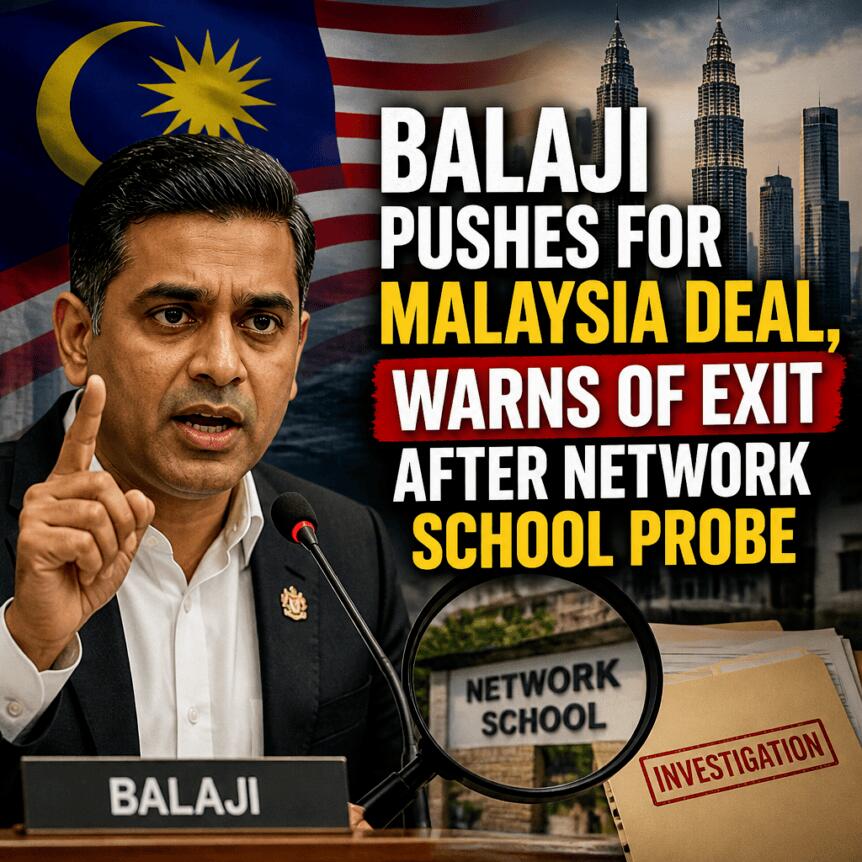
Balaji Srinivasan, the founder of Network School—an in-person tech community in Malaysia—says he is seeking an official memorandum of understanding (MoU) with Malaysia after authorities opened an investigation into allegations that the community was sheltering Israeli citizens using second passports.
Malaysia’s Home Affairs Ministry said it is checking the Forest City project in Johor after reports claimed Israelis were present in violation of immigration rules. The ministry said initial checks found that all 266 foreign nationals linked to the community were holding valid travel documents, while the investigation continues.
Key takeaways
- Malaysia is investigating Network School after claims that it included Israelis who would be in breach of immigration requirements.
- The Home Affairs Ministry reported that preliminary document checks for 266 foreign residents showed valid paperwork.
- Srinivasan is requesting an MoU to provide “legal certainty” for future investment and operations in Malaysia.
- He has paused planned expansion spending in Malaysia pending assurance that the allegations will not repeat.
- The case underscores how “crypto utopias” and digital-native communities still rely on conventional state frameworks for legality.
An MoU aimed at legal certainty
Srinivasan framed the request for a formal agreement as a solution to uncertainty around the legal standing of Network School’s residents and investors. He said that without a document clarifying that the community is welcome, Network School could shift its capital elsewhere.
In a video directed to Malaysian Prime Minister Anwar Ibrahim, Srinivasan said he wants something more concrete than broad assurances that “tech is welcome,” arguing that the community needs personal confirmation that it is legally and politically accepted. He did not detail the final structure of the agreement, but suggested it could take the form of a memorandum of understanding or involve an adjustment to a special economic zone provision.
According to Srinivasan, the MoU is also intended to ensure that additional capital commitments do not become hostage to future immigration disputes. He said he is putting further investments in Malaysia, including a $122 million expansion plan for the community, on hold until he receives “sufficient assurance” that the situation will not recur.
Malaysia’s investigation: initial checks show valid documents
Malaysia’s Home Affairs Ministry said Tuesday that it is investigating the Network School project in Johor following allegations that the community included Israelis in a way that would violate immigration law. The ministry reported that its initial checks reviewed documents for 266 foreign nationals connected to the effort and found that they were all in possession of valid travel documents.
While the preliminary findings suggest paperwork compliance at least on the documentation front, the fact that a probe has been initiated indicates that authorities are still looking beyond the mere existence of valid travel documents—particularly in relation to nationality-specific entry requirements and the underlying claims prompting the scrutiny.
How the allegations surfaced
The claims appear to have originated from social media. The article reports that the allegations were traced back to a post on Instagram from the activist group “Malaysian Protest 4 Palestine,” which accused Network School of operating as a “gathering place for Israeli entrepreneurs.”
Under Malaysia’s rules, Israeli passport holders are reportedly not allowed to enter without written permission from the Malaysian Ministry of Home Affairs, and Malaysia does not recognize Israel or maintain diplomatic relations with the country. This policy forms the basis for why the allegations—if true—would raise legal concerns.
It also highlights a recurring challenge for projects that present themselves as international or border-agnostic communities: even when members hold valid documents, eligibility and entry permissions can still hinge on a broader framework of state policy.
The broader tension for border-dependent “crypto utopias”
Network School is marketed as a physical community for tech builders and founders, and Srinivasan has previously positioned it as part of a more ambitious vision for technology-driven institutions. The current dispute reflects a tension many similar communities face: they may want to create digital-native ecosystems—complete with their own norms, networks, and economic activity—yet their continued operation ultimately depends on conventional government permission and legal clarity.
The episode is therefore more than a single-country immigration story. It raises questions about how quickly digital communities can institutionalize without first securing stable legal frameworks for their participants—particularly when public allegations or geopolitical sensitivities intersect with immigration rules.
In Srinivasan’s account, the need for an MoU is not about asking for special treatment, but about reducing uncertainty that can immediately affect capital plans. That dynamic is a practical issue for builders and investors alike: expansion timelines, residence planning, and onboarding of international participants can all become difficult if the legal status of the community or its membership composition remains in dispute.
While Malaysia’s ministry has stated that initial document checks found valid papers for the 266 foreign nationals involved, the investigation’s outcome—and whether an MoU will satisfy the “assurance” Srinivasan is demanding—will determine whether Network School can proceed without further interruptions.
Readers should watch next for the scope of Malaysia’s continuing review and whether Srinivasan’s requested agreement clarifies how immigration requirements will be applied to Network School residents going forward.
Remember last year? I mean, you should; it wasn’t all that long ago. From a crypto perspective, it brought some massive gains, crashes, records, intensity, adoption, and everything in between.
Numerous digital assets managed to break their previous all-time highs, including Ripple’s XRP. In fact, it took the token over seven years to do what many considered impossible just months prior.
Nevertheless, XRP pushed through, rocketed past $3.40, which was widely considered the all-time high at the time, and charted a new one at $3.65. Oh, and it did so precisely a year ago on this date, according to CoinGecko (some exchanges will show that it was on July 18, but it’s a matter of time difference).
The Next 12 Months
The rally that began after the 2024 US presidential elections gave the Ripple bulls wings to make some major predictions. XRP’s ability to spike above $3.50 only strengthened their thesis, and massive forecasts began to drop left and right. The more modest ones set $5 as the next target, but the majority envisioned a mind-blowing surge into the low-double-digit price range.
If you have even remotely followed what took place in the following 12 months, you would know the reality was painfully different. XRP was almost immediately rejected. By early August, it had already dropped below $3, and even though it challenged the old ATH at $3.40 in the following weeks, it was evident that the momentum had faded.
The token managed to remain at around $3 until the notorious October crash, when it slumped to $1.60 on some exchanges and even to $1.10 on a few others. Although it quickly rebounded to $2.60, the chart below will clearly demonstrate its downfall in the following months, which included permanently losing the $2 support and even challenging the next major one at $1.
It still remains above that coveted line, but current data shows a 70% crash in exactly a year: from $3.65 to $1.08 as of press time. The question is: did something go wrong for XRP and Ripple, or is it just a classic bear-market correction?

Ripple’s Moves
Despite the XRP price nosedive, the company behind the asset has not stood still in the past year. Perhaps its biggest move was the acquisition of Hidden Road for $1.25 billion. Technically, it was announced prior to XRP’s ATH, but it was completed later that year, and Ripple Prime launched afterward.
The company also received initial approval to establish Ripple National Trust Bank and, most recently, full authorization in Europe by securing a MiCA license. The former allows it to build federally regulated banking infrastructure, while the latter enables it to offer regulated crypto payments, custody, liquidity, and XRP services across the EEA.
The firm has also initiated expansions in several other regions, including Australia, Singapore, Japan, and Brazil.
Last but definitely not least, the first XRP ETFs were greenlit in the US in November 2025, quickly becoming a fan favorite among investors.
Consequently, the past year could be described as one of the most successful fundamentally for Ripple. Yet, its native token has fallen by 70%, which begs the question of whether the market has yet to fully price in these developments.
The post Ripple (XRP) Peaked at $3.65 Exactly a Year Ago: What Went Wrong? appeared first on CryptoPotato.

As the highly anticipated match between Spain and Belgium ignited the stadium, HTX’s SVIP users witnessed this world-class sporting moment far beyond the trading screen: through live match viewing, an exclusive VIP Lounge, customized travel itineraries, and face-to-face networking with fellow users from across the globe.

This premium experience, themed “HTX SVIP World Cup Journey,” was more than just a luxury getaway. It served as a tangible expression of HTX’s philosophy on VIP services — proving that SVIP is not merely a membership tier, but a long-term partnership.
One SVIP client, K, shared his thoughts after the experience:
“Previously, when I thought about exchange VIP perks, the first things that came to mind were usually ‘behind-the-scenes benefits’ like trading fee discounts, dedicated customer support, and higher limits. But this time, HTX brought us straight to the World Cup stadium, with access to a custom VIP lounge and an exclusive live match experience. These are real, tangible benefits you can actually enjoy.”

From a Trading Platform to a Long-Term Partner
For key clients, the most valuable service isn’t demonstrated when everything is going well, but at critical moments — when markets shift rapidly, capital needs to be mobilized quickly, or account issues require immediate resolution.
Unlike retail users, key and institutional clients face significantly more complex challenges: a single large trade may require liquidity arrangements; a market strategy may hinge on onboarding and verification timelines; a delayed withdrawal could impact subsequent capital deployment.
To address these challenges, HTX has established a dedicated service framework for SVIP users and institutional clients at Prime 5 and above that operates independently of the standard support queue. Spanning major communication channels such as Telegram, email, and WeChat, this framework uses Telegram as its primary 24/7 service hub, ensuring clients across different time zones can reach a dedicated support team whenever they need assistance.
Rather than addressing standard retail queries, this specialized team focuses on high-impact matters of direct concern to key clients. These include liquidity support, KYC verification, institutional onboarding, account management, and other time-sensitive operational issues. Through this tiered service framework, key clients benefit from streamlined communication pathways and high-priority response times.
Fast Issue Resolution: The Key to Effective Customer Support
For VIP services, being “online” is merely the baseline. The true differentiator is the ability to understand complex business scenarios in depth and rapidly coordinate internal resources to resolve issues.
Case Study 1: Seamless Institutional Onboarding. A newly onboarded institutional client sought to complete verification and start trading ahead of a major market event. The dedicated team maintained continuous communication via Telegram, helping organize account settings, streamlining outstanding documentation, and coordinating internal reviews to successfully launch the client within their target window.
Case Study 2: Frictionless Verification. A Prime client was unclear about the supplementary documentation required for level 3 KYC verification. Through real-time communication, the team clarified each requirement step-by-step, eliminating the prolonged wait times typically caused by repeated document resubmissions.
Case Study 3: Rapid Settlement Support. During a large-scale withdrawal, a client noticed their transaction was pending. After receiving the client’s feedback, the team immediately intervened and tracked the issue internally, enabling the transaction to be processed within 5 minutes. While this represents a specific operational resolution, it highlights the dedicated team’s execution capabilities when handling high-priority issues.
Furthermore, when clients require liquidity support for large positions, the team provides direct coordination and specialized assistance. For institutions and high-net-worth individuals, the value of such services goes beyond simply solving an isolated issue—it significantly reduces communication friction, buying critical time for high-stakes investment decisions.
From Foundational Efficiency to Tailored VIP Privileges
Exceptional VIP service must first address trading efficiency challenges. Only on top of that foundation can a highly differentiated product and benefit ecosystem be built.
Built around the diverse needs of SVIP users, HTX has developed a multi-tiered benefits system spanning trading fees, Earn products, lending, and exclusive privileges.
- 1. Tailored Fee Structures. SVIP clients can earn rebates on their trades and unlock tailored, ultra-low fee structures that match their specific operational profiles and trading styles.
- 2. Exclusive VIP Flexible Earn. HTX has introduced an exclusive VIP Flexible Earn program for USDT, offering enhanced yield opportunities for eligible Prime users. Specifically, Prime 5–Prime 7 users can enjoy up to 6.00% APY with a 50,000 USDT quota, while Prime 8–Prime 9 users can access up to 7.00% APY with an 80,000 USDT quota. Prime 10–Prime 11 users can enjoy the highest tier of benefits, with up to 9.00% APY on a 100,000 USDT quota. Additionally, based on trading volumes or net deposit metrics, the platform can issue APY Booster Coupons covering core assets like USDT, USDD, and ETH.
- 3. Optimized Lending Terms. For SVIP users who use Collateral Swap, larger loan amounts unlock progressively higher discount rates—up to 28% off (72% of the standard cost)—along with tailored liquidation-delay protection policies.
These benefits are built around a single principle: VIP service is not about repackaging standardized products. Instead, it is about designing bespoke service frameworks tailored to each client’s trading scale, capital structure, and business needs.
Making Premium Service Tangible
If dedicated responses, optimized fee structures, and customized liquidity support form the professional bedrock of VIP service, then initiatives such as the World Cup Journey, holiday gifts, and personalized birthday celebrations elevate these services from the trading dashboard into real-world experiences.
HTX provides its SVIP users with premium physical and offline experiences, including customized holiday gift sets, exclusive birthday celebrations, and bespoke brand collectibles. The World Cup Journey further expands the horizons of global high-end privileges, proving that VIP service does not just live in account settings—it can manifest at world-class sporting events, key global cities, and during significant moments in users’ lives.
The World Cup Journey is merely one chapter of HTX’s global SVIP experience. From 24/7 on-demand communication channels to specialist assistance for liquidity, verification, and account settings; and from tailored trading fees, Earn products, and optimized lending privileges to live access at world-class arenas—HTX is actively cultivating a VIP service ecosystem that starts with execution efficiency and matures into a long-term partnership.
True VIP service does not simply mean offering more perks when times are good. It means ensuring that when clients need it most, there is always someone to answer, someone who understands, and someone to walk beside them.
The post From the World Cup Stadium to 24/7 Support: How HTX is Redefining VIP Services appeared first on BeInCrypto.

In the lastest Ethereum news, Fundstrat’s Tom Lee is arguing that Ethereum’s next major move has nothing to do with crypto-native speculation, and everything to do with institutional capital that is already deployed and building.
Writing in Bitmine’s July Chairman’s message, Lee pointed to BlackRock BUIDL, JPMorgan MONY, and Robinhood Chain as concrete evidence that Wall Street has moved from observation to construction on Ethereum’s rails. The ETH price currently sits near $1,880, about 60% below its 2025 peak near $5,000.
The gap between that peak and current levels is the central question Lee addresses. His read is that it reflects a regime change, not a structural ceiling, the first era of ICOs, NFTs, ETFs, and stablecoins has run its course, and the institutions now building on Ethereum represent a fundamentally different demand base with longer time horizons and larger capital pools.

Discover: The Best Token Presales
Ethereum News: BlackRock, JPMorgan, and the Tokenization Build-Out
Lee’s institutional case rests on names that move markets in traditional finance. BlackRock BUIDL, the asset manager’s tokenized Treasury fund, now holds roughly $2.6 billion and has earned Moody’s top money-market rating (Moody’s cited).
JPMorgan MONY extended the bank’s tokenization push that began with Onyx in 2020, adding another institutional-grade vehicle to the Ethereum ecosystem.
Electric Capital data cited by Lee puts nearly 6,000 developers on the EVM stack, ranking Ethereum first among all chains for new builders, a metric that matters more to institutions evaluating long-term platform risk than short-term price momentum.
1/
Bitmine released its July Chairman's Message titled
"ETH is the Cure for the Uncanny Valley of Wealth"
– Two exponential tailwinds for Ethereum
– The crypto headwinds of 2026 are ending
– Bitmine primed for next bull cycle
Linkhttps://t.co/RHYkprmhCD— Bitmine (NYSE-BMNR) $ETH (@BitMNR) July 16, 2026

Wall Street is building on Ethereum, Lee argues in the Chairman’s message, contrasting 2022’s crypto bear-market backdrop with continued institution-led development.
In 2025 and 2026, institutional crypto infrastructure has continued to expand even as ETH price fell sharply from its cycle highs. That divergence between on-chain institutional activity and spot price is the core of his thesis. For more on how BlackRock’s ETF flows are reinforcing this dynamic, see this analysis of BlackRock ETF inflows and their ETH price implications.
Discover: The Best Crypto to Diversify Your Portfolio
Robinhood Chain: ETH as Settlement Money
Robinhood Chain, launched July 1 on Arbitrum, handed Lee one of his more striking data points. Within two weeks of going live, it ranked third among all networks by DEX volume at about $811 million daily, briefly surpassing Ethereum itself according to DefiLlama. Ethereum has since reclaimed that position, and cumulative Robinhood Chain volume has crossed $1 billion.
In the Chairman’s message news, Lee argues that Robinhood Chain’s use of ETH (as described in his discussion of the network’s fees and how it settles) makes it a meaningful Ethereum use case.
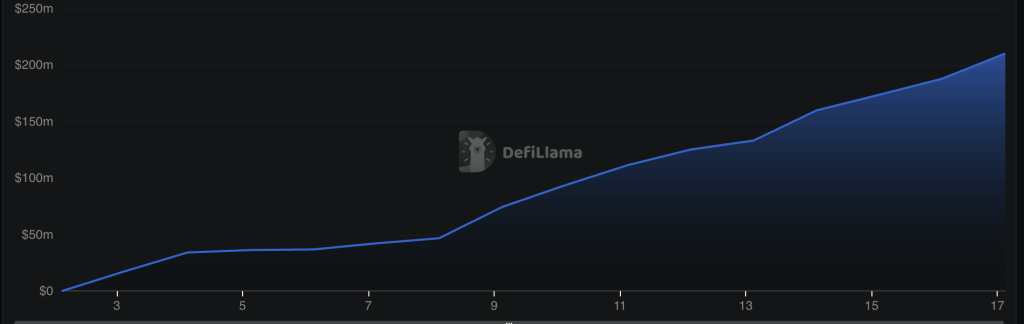
The counterargument is equally straightforward. Artemis CEO Jon Ma has noted that Robinhood Chain’s volume spike is predominantly meme coin-driven, not institutional flows.
And the fee economics cut against Lee’s framing, Robinhood Chain pays Ethereum’s base layer almost nothing in fees. High DEX volume on an Arbitrum-based chain does not translate 1-for-1 into ETH fee burn at the L1 level.
The Amazon Analogy, and the Conflict It Carries
Lee frames the current ETH setup through an Amazon analogy: the stock traded near a split-adjusted $6 for 12 years before climbing to $241 as its total addressable market expanded beyond what early investors could model. He also describes the psychology around sellers at depressed prices.
He also concedes the bearish read directly. ETH has failed twice at the $5,000 level, and skeptics argue that the top of the range could limit upside this cycle.
The conflict of interest embedded in Lee’s thesis deserves direct acknowledgment. Bitmine’s latest weekly disclosure shows 5.77 million ETH, about 4.8% of the 120.7 million total supply. Lee is among the biggest beneficiaries if institutional adoption confirms his thesis.
That does not make his argument wrong, but it reframes every price target he issues as coming from a holder with an extraordinary financial stake in the outcome.
The institutional infrastructure Lee cites is real. BlackRock BUIDL’s Moody’s rating, JPMorgan’s MONY fund, and Robinhood Chain’s early volume numbers are all verifiable facts, not projections.
Whether they are sufficient to drive ETH from $1,880 back through $5,000 and beyond depends on whether institutional capital deepens from product launch into sustained secondary market demand, a step that none of these programs has yet demonstrated at scale.
Trades Ethereum, and Don’t Miss Out on Our $1,000 USDT Airdrop on ByBit
The post Ethereum News: BlackRock, JPMorgan Builds Make ETH a Wall Street Asset, Tom Lee Argues appeared first on Cryptonews.
Crypto World
Gate DEX Fully Integrates Robinhood Chain, Expanding Its Multi-Chain Ecosystem Layout and Onchain Service Capabilities


Gate DEX announced its full integration with Robinhood Chain, becoming one of the first mainstream exchange onchain gateways to support the ecosystem. This feature covers core scenarios such as asset discovery, wallet management, onchain trading, cross-chain interaction, and market tracking, providing users with a more complete and efficient Web3 experience for exploring emerging onchain ecosystems, and further expanding Gate DEX’s multi-chain layout and infrastructure capabilities. For a smoother experience, please update the Gate App to v8.27.0 or above.
As the onchain gateway of the Gate ecosystem, Gate DEX integrates wallet, cross-chain, trading, airdrops, Earn, and DApps, continuously building an open and interconnected full-scope Web3 ecosystem. With the rapid development of emerging public chains, users’ demand for asset discovery, project exploration, and onchain interaction continues to increase. By supporting Robinhood Chain, Gate DEX further connects emerging onchain ecosystems, providing users with a more convenient entry point to popular assets and innovative applications.
In terms of asset discovery, Gate’s main platform Alpha has newly added support for the display and trading of Robinhood Chain ecosystem assets, and has integrated ecosystem launch platforms such as Noxa.fun and Bankr. As an important exploration gateway for emerging assets on Gate, Alpha will connect users with popular assets and innovative projects in the Robinhood Chain ecosystem, helping users discover onchain opportunities more efficiently and improving the efficiency of exploring emerging ecosystem assets.
In terms of asset management and onchain interaction, Gate Wallet has newly added support for Robinhood Chain, enabling functions such as asset display, transfers, and DApp interaction, helping users manage onchain assets more conveniently. At the same time, Gate DEX Swap supports single-chain swaps and cross-chain swaps on the network, improving asset circulation efficiency.
In terms of trading and market services, Gate DEX professional trading supports Robinhood Chain market order trading, while the market module also supports the display of related tokens, helping users view ecosystem asset information and participate in onchain trading more conveniently. In addition, the chain scanning function has newly added support for this ecosystem and covers projects such as Noxa.fun and Bankr, helping users discover onchain hotspots promptly.
The integration of Robinhood Chain expands the boundaries of Gate DEX’s multi-chain ecosystem and enhances cross-chain interoperability. Relying on Across and LayerZero cross-chain solutions, Gate DEX enables asset circulation among BSC, Ethereum, Base, and Robinhood Chain, providing users with a more efficient and smooth multi-chain interaction experience.
Currently, Gate DEX has formed comprehensive onchain service capabilities covering asset discovery, wallet management, trading and swaps, cross-chain connections, and ecosystem applications. This ecosystem expansion is an important measure by Gate to continuously strengthen Web3 infrastructure and connect high-quality public chain ecosystems, and also reflects the platform’s continued investment in multi-chain connectivity and onchain product innovation. In the future, Gate will continue to deepen the development of the Gate DEX ecosystem, accelerate connections with more high-quality onchain networks and innovative applications, promote the continuous upgrading of Web3 product capabilities, and create a more open, efficient, and convenient onchain experience for global users.
How to Explore the Robinhood Chain Ecosystem?
Please update to Gate App v8.27.0 or above to access the new features.
- Discover ecosystem assets: App Exchange mode – [Trade] – [Alpha] – [All Chains] – Select a token
- Explore the onchain ecosystem: App DEX mode – [Markets] – [Markets] – [All Chains] – Select Robinhood Chain
- Swap assets: App DEX mode – [Trade] – [Swap] – Tap [Pay/Receive] – Select Robinhood Chain
- Advanced trading: App DEX mode – [Trade] – [Pro] – Select a token – [All Networks] – Select Robinhood Chain
Learn more here.
About Gate
Gate, founded in 2013 by Dr. Han, is one of the world’s leading cryptocurrency and integrated financial services platforms. Serving over 58 million users globally, it supports trading across 4,800+ digital assets and 12,500+ stock assets, while providing access to a comprehensive range of TradFi assets, including metals, stocks, indices, forex, and commodities, delivering users a one-stop, multi-asset trading experience and blockchain-related services. As an industry benchmark, Gate was among the first platforms to implement 100% Proof of Reserves. Its ecosystem includes Gate Wallet, Gate Ventures, Gate for AI Agent, and a wide range of products and services.
For more information, please visit: Website | X | Telegram | LinkedIn| Instagram | YouTube
Disclaimer:
This content does not constitute an offer, solicitation, or recommendation. You should always seek independent professional advice before making investment decisions. Note that Gate may restrict or prohibit certain services in specific jurisdictions. For more information, please read the User Agreement.
The post Gate DEX Fully Integrates Robinhood Chain, Expanding Its Multi-Chain Ecosystem Layout and Onchain Service Capabilities appeared first on BeInCrypto.


Ether (ETH) fell twice as hard as bitcoin on Friday and hyperliquid’s HYPE fell more than five times as hard, as a selloff in Asian semiconductor shares dragged every major cryptocurrency lower.
Ether dropped 4% to $1,850, though it remains up 4% over seven sessions and is the only major still green on the week. HYPE was the worst of them at $60, down 10% on the day and 12% on the week, its steepest stretch since June. Solana slid 2% to $75 and is off 5% for the week.
XRP eased 2% to $1.09, BNB fell 2% to $571, TRON slipped to 32 cents and dogecoin lost 2%. Bitcoin held up best of the group, down 2% to about $63,400 and 1% on the week after failing twice at $65,000.
The selling started in semiconductors. MSCI’s Asia Pacific equities gauge dropped 3%, heading for its lowest close in two months, while Japan’s Nikkei 225 slumped 5% in its worst session since March. Taiwan Semiconductor was on track for its biggest one-day decline since April 2025 and Japan’s Kioxia sank as much as 16%.
Trading competitions reward more than raw luck. They reward traders who understand exactly how a leaderboard formula works and who build their execution around it. Zoomex has run a series of high-profile competitions in 2026, from the 2026 Zero-Cost Trading Competition with its combined $600,000 USDT prize pool, to the World Cup-themed Footballmania campaign built around a 300,000 USDT pool, to smaller contract-launch events like the New Contract Trading Competition. Each has its own scoring logic, and understanding that logic is the actual edge.
This deep dive breaks down the mechanics behind Zoomex’s competition formats and the concrete steps traders can take to rank higher, without increasing risk beyond what they can control.
Understand the Scoring Formula Before You Place a Single Trade
Zoomex’s Individual Competition track does not rank participants purely on profit. The ranking formula blends two components: <cite index=”2-1,3-1″>total return weighted at 30% and trading volume weighted at 70%</cite>. That weighting is the single most important number in the entire competition, and most participants never check it before they start trading.
A 70/30 split toward volume means that a trader who runs a modest but consistent strategy across many trades will often outrank a trader who scores one lucky high-return position but trades infrequently. Practically, this changes the optimal playbook:
- Frequency compounds. If volume carries 70% of the weight, executing more qualifying trades across the event window matters more than swinging for a single large win.
- Return still matters at the margin. The 30% return component means reckless overleveraging to chase volume without any regard for drawdown will still cost you rank against traders who balance both metrics.
- Read the fine print for every event. Not every Zoomex competition uses the same formula. The contract-launch style events (like the New Contract Trading Competition) rank purely on cumulative trading volume in designated pairs, with tiered USDT bonuses at fixed volume thresholds rather than a blended score. Always check the specific promotion page before committing a strategy.
Trade Only the Designated Pairs and Account Type
This sounds obvious, but it is the single most common way traders lose eligible volume. Competition volume typically only counts on the trading pairs the promotion designates, and only after the account meets specific setup requirements.
For Zoomex’s World Cup Carnival campaign, for example, eligibility required traders to <cite index=”5-1″>register, upgrade to a Unified Trading Account, and trade USDT and Bitcoin futures within the campaign window</cite>. Volume generated on spot markets, non-designated pairs, or a legacy account type does not count toward the leaderboard even if the trade itself is profitable.

Source: Zoomex
Before entering any Zoomex competition:
- Confirm your account is upgraded to a Unified Trading Account, which consolidates margin and enables you to trade the full range of eligible contracts from a single balance.
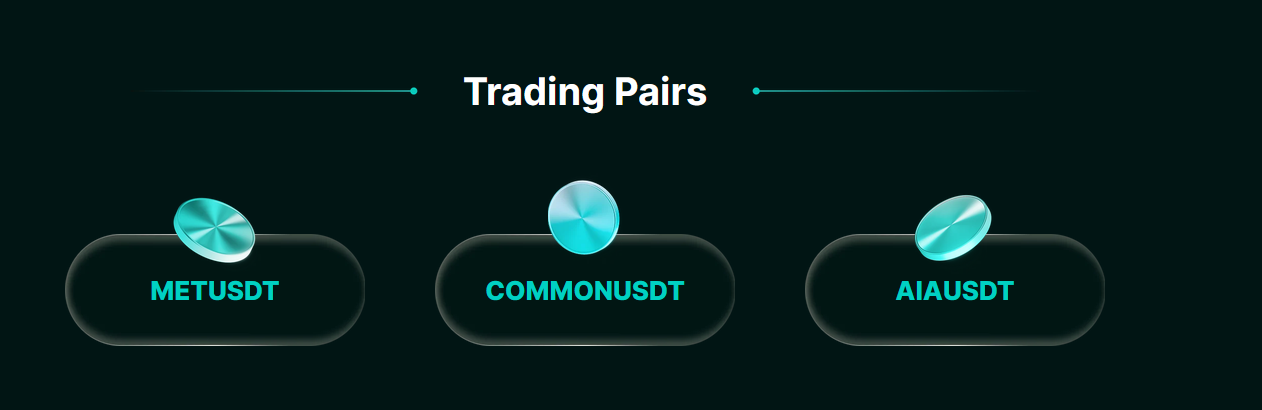
- Cross-check the designated pairs list on the competition’s official page. In recent Zoomex events this list has included newer contract listings such as METUSDT, COMMONUSDT, and AIAUSDT, alongside majors like BTC and ETH futures.
- Maintain the minimum net asset balance required to remain reward-eligible. Zoomex’s contract competitions have required participants to <cite index=”10-1″>maintain a net asset balance of over $50</cite> to receive payouts, and unverified accounts forfeit rewards entirely.

Source: Zoomex
Use Volume Thresholds as Checkpoints, Not Just a Finish Line
Zoomex structures its tiered competitions around clear volume checkpoints rather than a single continuous curve. In the New Contract Trading Competition, for instance, ranking bonuses stepped from a $1,000,000 volume threshold up through $3,000,000 for the top spot, with a separate flat $10 bonus unlocked at just $20,000 in cumulative volume. That structure rewards traders who plan their trading in stages:
Stage 1: Hit the minimum unlock threshold early. Getting past the base volume requirement in the first days of the event secures your baseline reward and removes pressure later.
Stage 2: Reassess your position on the leaderboard. Because Zoomex has published daily leaderboard updates through its official community channels in past events, checking your standing lets you decide whether pushing for the next tier is worth the additional exposure.
Stage 3: Push for the top tier only if your risk-adjusted return supports it. Climbing from a mid-tier bonus to a top-tier one usually requires a nonlinear jump in volume. Do the math on whether the marginal reward actually compensates for the marginal risk before increasing size.
Treat Bonus Funds as Free Variance, Not Free Capital
Zero-cost competitions like the 2026 Zero-Cost Trading Competition are structurally different from deposit-based ones. Zoomex gave <cite index=”2-2″>newly registered users $100 to $200 in bonus trading funds</cite> so they could enter the Individual Competition or Entertainment Zone without depositing. This is genuinely useful for testing a competition strategy with zero personal capital at risk, but it should be treated as exactly that: a testing budget, not a scaling budget.
A disciplined approach is to use bonus funds to validate your entry and exit logic under real competition conditions (volume tracking, order execution speed, how quickly your fills reflect on the leaderboard) before deploying your own capital, if you choose to at all. This also matters for compliance: some Zoomex events explicitly restrict participation to non-affiliate accounts and flag multiple-account or arbitrage abuse for disqualification, so keep your strategy to a single verified account.
Factor In Execution Quality, Not Just Position Sizing
A high-performance matching engine matters more in a volume-weighted competition than in ordinary trading, because slippage and fill latency directly reduce your effective, reportable volume per trade. Zoomex has positioned its infrastructure around this exact point, emphasizing <cite index=”2-4″>a high-performance matching engine and transparent asset and order displays that ensure consistent trade execution and fully traceable results</cite>. In practice, that means:
Favor limit orders during high-volatility windows only if you have confirmed fill rates are acceptable; a missed fill is lost volume that can’t be recovered later in the event.
Monitor spread and depth on the designated pairs specifically, since thinner contracts like recent altcoin listings can behave very differently from BTC or ETH futures under competition-driven volume spikes.
Use leverage deliberately. Zoomex supports leverage up to 1:150, which can accelerate volume accumulation, but every increment of leverage also increases the return-side variance that factors into the 30% return component of the Individual Competition score.
Build a Simple Pre-Competition Checklist
Before the next Zoomex competition window opens, run through this sequence:
- Read the specific promotion page in full and identify the exact scoring formula (blended return/volume vs. pure volume tiers).
- Upgrade to a Unified Trading Account if you haven’t already, and confirm KYC is complete so rewards aren’t forfeited later.
- Identify the designated trading pairs and check current liquidity conditions on each.
- Decide your volume checkpoints in advance, tied to the specific bonus tiers published for that event.
- Join Zoomex’s official community channels for daily leaderboard visibility during the event.
- If bonus funds are offered, use them to test execution before scaling with personal capital.
Competitions like these are ultimately a controlled environment for sharpening real trading discipline: reading the rules precisely, respecting position sizing, and executing with intent rather than emotion. The traders who consistently place well are rarely the ones who trade the most impulsively. They’re the ones who understood the scoring formula on day one.
About Zoomex
Founded in 2021, Zoomex is a global cryptocurrency trading platform focused on derivatives trading. The platform serves over 3 million users across 35+ countries and regions, offering access to 590+ trading pairs. Built around easy to use, transparency, fairness, and speed, Zoomex provides a clear and efficient trading experience for users worldwide.
Through its high-performance matching engine, clear asset and order displays, and transparent fee and rule mechanisms, Zoomex helps users better understand their account status, order execution, trading costs, and results. Zoomex maintains registrations, licenses, and regulatory statuses across multiple jurisdictions, including the U.S. MSB, Canada MSB, U.S. NFA, and Australia AUSTRAC, and has completed security audits conducted by blockchain security firm Hacken. The platform also continues to strengthen its trust framework through Proof of Reserves, Security & Transparency, Compliance Information, and Fees / Rules Transparency initiatives.
Beyond trading, Zoomex builds a refined brand experience through elite sports partnerships, including the TGR Haas F1 Team, World Cup-winning goalkeeper Emiliano Martínez, and world-class tennis events such as Wimbledon. The values of speed, precision, discipline, fair play, and rule-based execution are closely aligned with Zoomex’s approach to derivatives trading.
At Zoomex: Easy to Use. Transparent balance. Fair access to your earnings.
The post How to Maximize Your Edge in Zoomex Trading Competitions appeared first on BeInCrypto.


Former Ethereum Foundation researcher Francesco D’Amato has joined independent protocol research group Ethlabs, extending the movement of core Ethereum developers into organizations operating outside the Foundation.
Summary
- Former Ethereum Foundation researcher Francesco D’Amato has joined Ethlabs after five years to continue Ethereum protocol research.
- D’Amato said he will keep working on faster Ethereum finality while helping Ethlabs expand its protocol research team.
- The move adds to a growing number of independent Ethereum organizations formed by former Foundation researchers following the Foundation’s restructuring.
According to a statement shared by Ethereum Foundation researcher Francesco D’Amato on X, he has left the Ethereum Foundation after five years to join Ethlabs, a nonprofit protocol research organization established by former Foundation researchers to continue Ethereum core development.
During his time at EF Research, D’Amato said he worked across several protocol research areas, including maximal extractable value (MEV), consensus mechanisms, data availability sampling, and execution layer pricing. He described the decision to leave as difficult but said the current period of change made it the right moment for “a new beginning.”
“Leaving that behind is hard, but after 5 years this time of great change seems right for a new beginning,” D’Amato wrote.
He added that, for the first time since beginning Ethereum protocol research, he believes there is “a credible shot” for core research to advance outside the Ethereum Foundation.
At Ethlabs, he said he will work alongside former EF colleagues to expand the organization’s protocol research efforts, bring new researchers into the ecosystem, and continue contributing to Ethereum’s long-term technical roadmap.
Among his priorities, D’Amato said he intends to keep working on reducing Ethereum’s transaction finality time, stating that he plans to focus much of his effort on helping Ethereum “finalize much faster, as soon as possible.”
Ethlabs expands its research team
Ethlabs launched in June as an independent nonprofit research organization founded by former Ethereum Foundation researchers Ansgar Dietrichs, Barnabé Monnot, Caspar Schwarz Schilling, Josh Rudolf, and Julian Ma. The organization said its research spans settlement speed, network capacity, native asset issuance, cross-chain interoperability, and Ethereum’s monetary design.
Backed by Ethereum co-founder Joe Lubin, Bitmine, SharpLink, Anchorage, Octant, SNZ, and other Ethereum ecosystem participants, Ethlabs has said its research priorities are tied to growing institutional use of Ethereum for stablecoins, tokenized assets, investment products, and AI-driven commerce.
The group has also stated that research decisions remain independent despite corporate funding, with contributions managed through an external grants administrator.
When the organization launched, executive director Ansgar Dietrichs said Ethlabs was created to advance Ethereum’s core technology while providing a long-term home for protocol researchers outside the Ethereum Foundation. Lubin described the organization as another stewardship body working alongside the Foundation and other independent contributors to Ethereum’s development.
Ethereum development spreads beyond the Foundation
D’Amato’s move comes as the Ethereum Foundation continues reshaping its internal structure and as more protocol work shifts to independent organizations.
Last month, the Foundation reduced its workforce by 54 positions, or about 20%, following a review of its staffing and long-term responsibilities. It later dissolved its Protocol Support team while reorganizing its remaining work into dedicated divisions covering protocol development, users, community, access, and institutional activity.
The restructuring has also led to the creation of new Ethereum-focused organizations. Earlier this month, former Foundation employees Mo Jalil, Oskar Thorén, and Aaryamann Challani launched EthSystems, a for-profit company building confidential infrastructure for regulated financial institutions on Ethereum with backing from Bitmine, SharpLink, and Lubin.
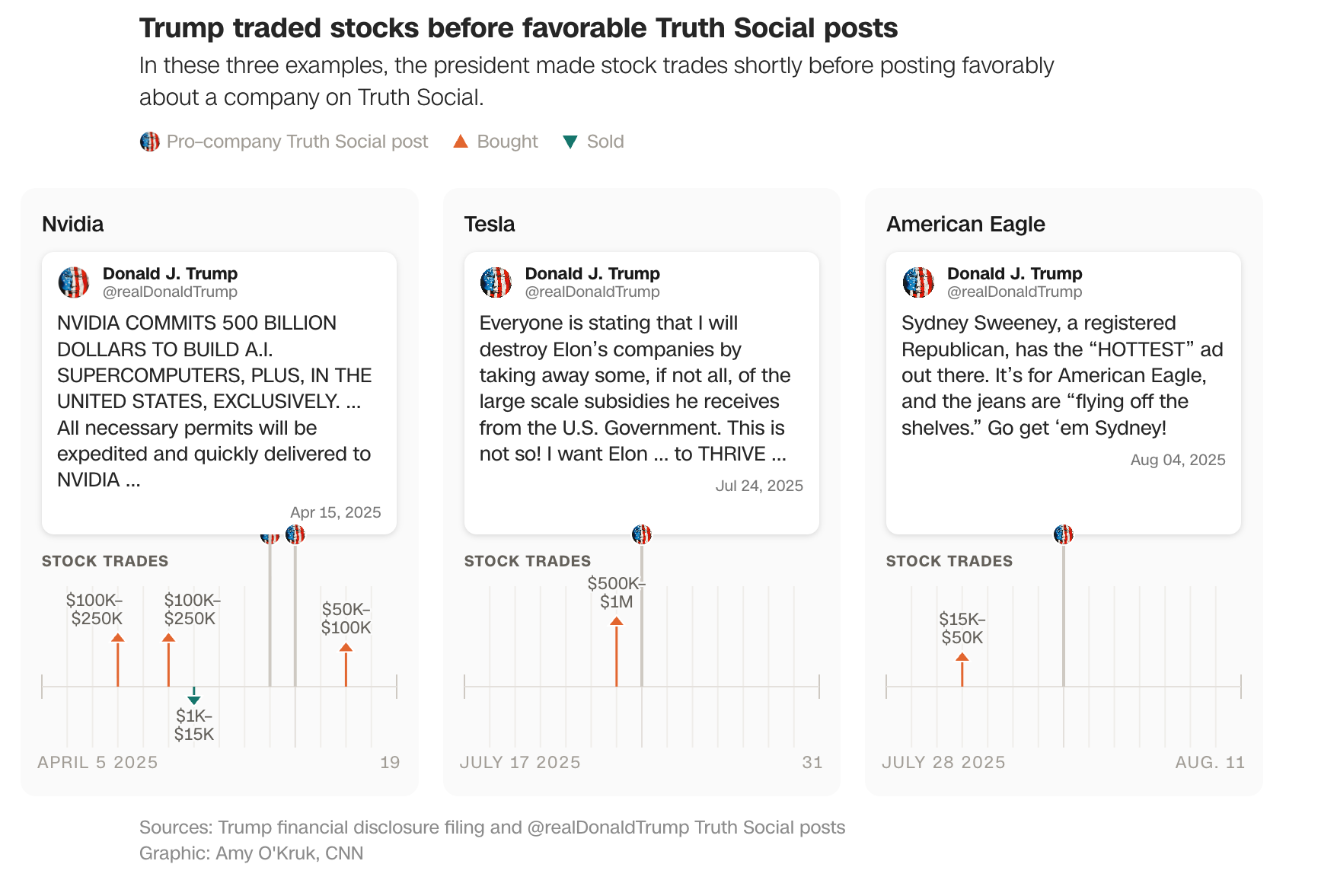
President Donald Trump bought stock in 21 companies within a week before posting favorable Truth Social messages about them, a CNN investigation found. He made at least 44 purchases.
The findings sharpen questions about whether the president holds a conflict of interest through his trading.
44 Trades, 21 Companies, A Key Pattern in Trump’s Truth Social Posts
Trump’s 2025 financial disclosure listed more than 21,000 transactions. The Office of Government Ethics released it last month. Most were stock purchases and sales, reported in broad dollar ranges.
In one example, Trump bought between $200,000 and $500,000 in Nvidia stock in April. Days later, he promoted the chipmaker’s plans to build artificial intelligence supercomputers in the United States.
In the April 15 post, he also vowed to expedite all necessary permits for Nvidia and similar firms.
“Trump is both a frequent poster and stock trader, sending more than 6,000 Truth Social posts last year and often sharing his opinions about major corporations, while his managers made more than 20,000 stock purchases or sales in that same time frame,” the report read.

Not every post was positive. Trump made 17 purchases of eight companies before criticizing them, including Comcast and Microsoft.
Moreover, CNN found no evidence that Trump used the posts to lift his own holdings. Most of his trades drew no matching Truth Social activity.
Follow us on X to get the latest news as it happens
White House Rejects Conflict Claims
The White House repeatedly denied that Trump has ever used his office for personal gain. It said his assets sit in fully discretionary accounts managed by independent institutions.
“President Trump only acts in the best interests of the American public … There are no conflicts of interest,” White House spokesperson Anna Kelly said.
Trump also broke with recent presidents on one point. Every stock-owning president for the past 5 decades has used a blind trust. Trump instead uses a trust with his son, Donald Trump Jr., as trustee.
That setup lets him know his holdings, even if he cannot direct trades. Previously, timing concerns surfaced when a BBC probe flagged suspicious trades before Trump’s market-moving statements.
The scrutiny lands as Trump Media prepares to sell Wall Street faster access to Truth Social posts. Its Truth API launches August 1, delivering top accounts’ posts at a significantly faster pace.
That product would let paying firms react to the posts faster than the public. This, in turn, would let Trump Media, where his family is the largest shareholder, benefit from his posts. It also deepens the same conflict that his trading already raises.
Subscribe to our YouTube channel to watch leaders and journalists provide expert insights
The post Trump Praised Over 20 Companies on Truth Social After Buying Their Stock, CNN Finds appeared first on BeInCrypto.

Taiwan court sentences BitShine founder to 22 years in $39M crypto fraud

‘Gundam’ Meets ‘Godzilla’ in Idris Elba’s Sci-Fi Epic Quietly Crushing the Competition

Major Oldham flyover to fully shut for weeks as drivers issued traffic warning


-

 Fashion6 days ago
Weekend Open Thread: Nutriplenish Leave-In Conditioner
-
 NewsBeat17 hours ago
London Mayor Sadiq Khan handed a peerage by Keir Starmer alongside 15 other Labour figures… just days before the PM leaves No10
-

 Crypto World1 day ago
CFTC blocks Kalshi from unwinding Michigan trades after court order
-

 Business1 day ago
Nvidia Stock Slips After Big Tuesday Rally as Huang Confirms Vera Rubin Chip Is Now in Production Today
-

 Politics2 days ago
Young campaigners urge incoming PM to act on outdoor junk food ads
-
 Entertainment2 days ago
Disney’s Most Ambitious Failed Star Wars Attraction Is Coming to SDCC
-

 News Videos3 days ago
XRP BOMBSHELL… XRP OMBOARDED FOR TRANSACTIONS!!!
-

 Tech3 days ago
Get Your ESP32 Sunny Side Up With This Solar Dev Board
-

 Crypto World12 hours ago
Injective Submits SEC Transfer-Agent Registration to Onchain Ownership Records
-

 Tech3 days ago
Dark Secrets Emerge When Jailbreaking LLMs
-
 Sports1 day ago
New Cornerback Enters Vikings Trade Rumor Mill
-

 News Videos2 hours ago
Money | Class 12 Economics | CBSE Board Exam 2026-27
-

 Business7 hours ago
Banco Bilbao Vizcaya Argentaria, S.A. (BBVA) Discusses Global Macro Environment and Economic Outlook for Core Markets Transcript
-
 Tech4 days ago
Cloudflare Precursor Watches Your Mouse and Keyboard To Decide If You Are Human
-

 News Videos4 days ago
how to make coin bank box with cardboard #scienceproject #money #diy #shorts
-

 Business1 day ago
Palantir Shares Rise After Expanded Nvidia Partnership and Fresh Analyst Upgrades Ahead of Earnings Day
-
 Entertainment2 days ago
Vicki Gunvalson Defends Discussing Heather Dubrow’s Money
-
Crypto World3 days ago
Ripple, Coinbase, Circle Join Linux x402 Foundation to Help Shape AI Payments
-

 Crypto World11 hours ago
Claude Fable 5 Slips to Second in AI Coding Leaderboard
-
Business8 hours ago
Nephros, Inc. (NEPH) Discusses Evolving Water Safety Strategies and Expansion Beyond Filtration Transcript
You must be logged in to post a comment Login