
Politics
Asylum fraudsters are taking the British public for a ride


The UK’s asylum system has been broken for years. As the British public knows all too well, anyone can arrive and seemingly no one can be deported. This week’s revelation that just one per cent of asylum claims are genuine strips the British state of the little credibility it had left.
The Home Office whistleblower who leaked this information to The Times has caused a predictable degree of outrage. But we shouldn’t be so shocked. Our asylum system has been completely overwhelmed and incompetently managed for some time.
Since the start of 2021, there have been over 200,000 grants of leave or protection at the initial decision-making stage. This inexplicably includes individuals from Canada, Ireland, Germany and a host of other developed countries that are quite clearly not in a parlous state.
The UK government will point to a recent increase in initial rejections, but three-quarters of these go on to appeal. This adds to the already huge immigration-tribunal backlog, where a significant number of claims are subsequently upheld on spurious, scarcely credible grounds.
Historically unprecedented pressures are being placed on the asylum system. Between 2003 and 2021, the number of annual asylum applications rarely exceeded more than 45,000. In 2024, there were a record-breaking 108,000 applications. Despite Labour’s talk of bringing down applications since entering office, there have been 86,000 lodged in the past 12 months.
The Home Office is not fit for purpose during the best of times. It is manifestly incapable of dealing with an escalating crisis such as this.
The department’s own data suggests that just half of asylum claims are actually being processed to a satisfactory standard. This week, the UN – hardly a cheerleader for strong border protection – has warned that Britain is awarding asylum to undeserving individuals.
Rejecting a claim takes time that caseworkers do not have. When faced with a mountain of paperwork, it is much easier to copy and paste a boilerplate approval letter than to spend hours refuting every point raised by the applicant. In the rare instance that the Home Office does issue a rejection letter, it acts as nothing more than a stimulus for more inventive claims to be conjured at the appeal stage.
This is how we end up with, according to the Home Office whistleblower, hundreds of Kurdish men being granted asylum on the basis of being in a relationship with the same woman – the daughter of Kurdistan’s prime minister. A running joke in the Home Office apparently, but an example of what most of us have long suspected: that our asylum system is a farce.
In March, home secretary Shabana Mahmood proposed that refugees should be expected to return home once their country is deemed to be safe. But this misses the point. Asylum seekers are not being allowed to stay because their country is in upheaval. They are here because they have been able to concoct tales of woe that hit all the right notes for our naive human-rights and modern-slavery framework.
We have on our hands here a system that is beyond reform. The longer it is allowed to continue, the greater the social corrosion and economic ruin that must be contended with.
The Home Office spent £4.9 billion on core asylum provision last year, not including the eye-watering amounts squandered on legal aid and healthcare. And these are just the immediate costs. The cost to the British state stretches far into the future. Even eight years after being granted asylum, less than half of migrants will be in work. The median wage of those actually in a job is less than £14,000 per annum.
The pressure on the UK’s infrastructure and finances is one thing, but it is nothing compared to the impact on our social fabric. Outrage over the near-daily reports of sexual assaults and heinous crimes carried out by asylum seekers is ubiquitous. The anger is exacerbated by the fact that these atrocities are entirely avoidable – each one the direct result of government failure.
Our public spaces have now been commandeered by groups of young men, squeezing the pre-existing citizenry into the margins. The average British town is now an asylum seekers’ playpen, which just happens to have a community attached. Public order has been obliterated by the number of illegal immigrants brazenly working for delivery companies, in vape shops and at car washes.
We have voted against this mess, consistently. We have been told the problem will be sorted, and that the very best brains are working on a solution. But the situation only seems to get worse.
We are staring down the barrel of a democratic crisis. Regaining public trust will require more than simply a commitment to prevent future error. Those mistakes already made must be reversed. This entails not just the suspension of the asylum system, but a root-and-branch review of all grants made in recent years, and the removal of all who entered via illegal means. Enough is enough.
Rob Bates is the research director at the Centre for Migration Control.


Among the first items of parliamentary business for new UK prime minister Andy Burnham is yet another attempt to introduce assisted suicide into British law.
Labour MP Lauren Edwards reintroduced the Terminally Ill Adults (End of Life) Bill in July, just before parliament’s summer recess. In doing so, she took up the baton from Kim Leadbeater, who failed to pass her bill during the previous parliamentary session. Edwards’s bill will have its second reading in the House of Commons on Friday 11 September.
Leadbeater’s original assisted-dying bill contained so many flaws and loopholes that the House of Lords simply ran out of time to amend it into a functional piece of law. Yet the bill introduced by Lauren Edwards is to all intents and purposes identical to Leadbeater’s. That’s no accident: Edwards must present the same bill if she wants the Parliament Acts of 1911 and 1949 to come into effect. These acts allow for the same legislation, if passed in the House of Commons in consecutive parliamentary sessions, to automatically become law regardless of what the Lords think.
The decision to use the Parliament Acts is revealing. Supporters of assisted dying could have brought back a radically reworked version of Leadbeater’s bill that addresses the criticisms raised by doctors, psychiatrists, disability campaigners and legal experts over the past year. But instead, they have brought back exactly the same bill. The goal seems simply to get the legislation over the line, whatever state it’s in or however widely experts may critique it. This should concern everyone, whether they support the principle of assisted suicide or oppose it.
Over the past year or so, in both houses of parliament, the assisted-dying bill has received one of the most exhaustive examinations ever faced by a private members’ bill – that is, a bill introduced by MPs and members of the Lords who are not government ministers. Royal Colleges, professional bodies, domestic-abuse charities, disability organisations, mental-health experts and the Equality and Human Rights Commission all identified significant flaws in the bill. Many of those organisations and experts were not ideologically opposed to assisted dying. Several supported assisted suicide in principle or were neutral on the issue. They were concerned above all with whether this particular legislation is safe, and whether it can protect vulnerable people.
Even Lord Falconer, one of Britain’s longest-serving advocates for assisted suicide and sponsor of Leadbeater’s bill in the Lords, has acknowledged that important changes are needed. He questioned the safeguards for younger adults, the treatment of patients with suicidal thoughts, the risks of remote consultations and the absence of proper recording requirements.
Using the Parliament Acts to push the legislation through is not simply about avoiding the Lords. It also means that MPs will be unable to amend the bill in the House of Commons. This is a wholly inappropriate way to legislate on a question of life and death.
Private members’ bills have never before been forced through parliament using the Parliament Acts. Nor has this bill earned anything approaching an overwhelming democratic mandate. It was absent from Labour’s election manifesto, and passed the Commons only narrowly, with fewer than half of all MPs voting in favour at the third reading. Now, after months of criticism, it has returned unchanged.
Andy Burnham’s recent intervention makes the problem even sharper for supporters of the bill. The PM has now said the debate on assisted dying should not happen while palliative and social care remain poorly funded, confirming, ‘that’s the position I will stick to’.
This is a major setback for the assisted-dying lobby, which had relied heavily on the backing of then PM Keir Starmer. Burnham has correctly made clear that the question of assisted suicide cannot be separated from the state of palliative and social care, and that the funding and reform of the latter must come first. At the very least, that puts him at odds with the strategy of forcing the bill back through parliament and hoping to avoid scrutiny.
Those MPs backing this zombie bill need to think again. Making it acceptable to bypass parliamentary scrutiny because it is convenient to do so sets a very dark precedent indeed.
Okay, class. It’s time for my favourite topic: sex toy history. You might have passively absorbed this information when you watched that episode of Sex and the City when Samantha decided to beef a shop assistant, but the magic wand vibrator was actually the first sex toy of its kind.
Originally released by Hitachi in 1968 to be a neck massager, the Magic Wand was quickly repurposed by horny housewives when they realised it had the potential to help them relax in, ahem, other ways.
And right they were: the wand vibrator is still one of the most popular categories around as they tend to be pretty powerful – meaning they get the job done.
While the’ve definitely improved on the original 1960s model, if you ask me, the magic wand is a staple that everyone needs as a bedmate – whether they’re in a relationship or not.
If you’re after your very own bobbly headed friend, keep reading for EYNTK about wand vibrators and our selection of the best.
Best wand vibrators at a glance:
What is a magic wand vibrator?
So what makes the wand vibrator so magic, huh? Its shape is the defining characteristic, according to Kimberly Anne, somatic sexologist for Lustery and House of Lustery.
“A magic wand vibrator is one of the most iconic sex toys to date,” she says. “Unlike other discreet sex toys, the magic wand vibrator has a long, girthy base with a tennis-ball-shaped head on top.
“While you can now find smaller versions, the original shape has gone untouched. With a quick Google search, you’ll find different kinds of magic wand vibrators created by different companies, but what sets a magic wand apart from the rest is its unique shape.”
The best wand vibrators to shop now

Most powerful wand
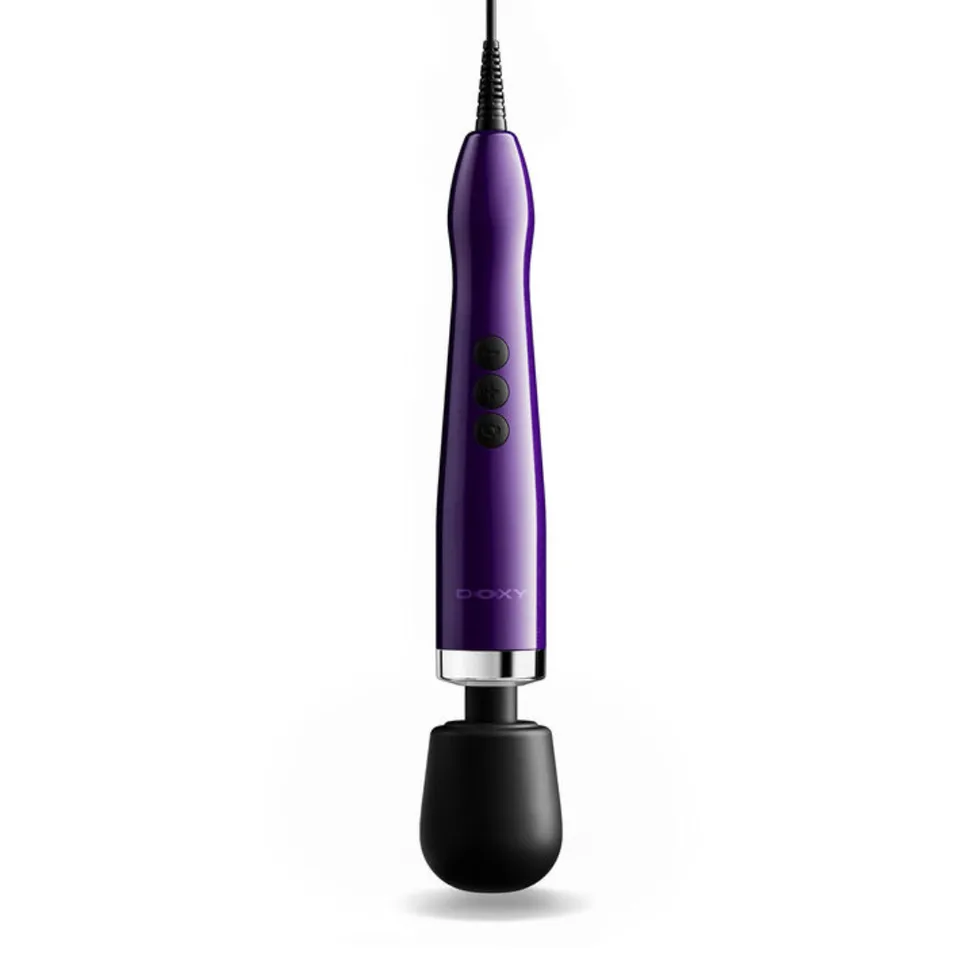
If you want to pay homage to the original Magic Wand, Doxy is as true to form as you can get. Doxy has ramped up the power on this mains-powered wand, which has vibrations up to 9,000 RPM.
Despite being hardcore enough to make you come by barely touching you (that’s an exaggeration but you catch my drift) it’s actually surprisingly quiet. As in, not silent, but quiet enough that you won’t be able to hear it under the sheets.
Just be warned, it’s not waterproof! Please don’t play with this in the bath.
+ Not too loud at under 60db
+ Deep, rumbly vibrations
+ Cable is 10 feet, so you don’t have to worry about being near a socket.
– Not waterproof
– Can be fiddly to have a mains-powered wand during partnered sex.
Features: 8 levels of intensity up to 9,000 RPM
Material: Metal, silicone
Power: Mains-powered
Battery life: N/A
Dimensions: 33.6cm long
Waterproof: No

Most vibration options
Give something a French name, and it immediately sounds classy. But this wand is class for many more reasons than its name: it might look like a classic wand, but it comes loaded with a whopping 20 vibration patterns, which can be adjusted between 10 intensity levels.
That silicone-coated head is completely flexy, so it can reach whatever area you’re aiming for. I’m happy to announce I’ve experimented enough to confirm it also makes an excellent shoulder massager.
+ Comes with a travel lock, so you can take it in your suitcase without worrying
+ Has a travel case too
+ Easy to use thanks to the three buttons
– It’s quite large.
Features: 20 patterns, 10 intensities
Material: Silicone
Power: Rechargeable
Battery life: 300 minutes
Dimensions: 13.5 inches
Waterproof: Yes.

Best for beginners
Not everyone wants a vibrator that looks like a vibrator, and we get that. So if you’re after something a little more innocuous (we can’t exactly say discreet in this case) you’ll love-all this vibe from Nancy.
You’ll be demonstrating your enthusiasm for more than tennis with this ball-shaped head, which is ultra bendy and can reach any area you want to stimulate.
There might be 8 patterns and 5 intensities to choose from, but even the most gentle will be enough to get you to match point faster than you can say ‘Wimbledon’ and beginners will be able to experiment with the exact combo of modes they like.
+ Deep and rumbly vibrations
+ The design is super cool, but…
– Not everyone’s cup of tea.
Features: 8 vibration modes and 5 intensities
Material: Silicone
Power: Rechargeable
Battery life: 60 minutes
Dimensions: 22cm long
Waterproof: Yes.

Best luxury wand
You deserve a life of luxury, dahling. So if you’re after something that casts its spell on you to make you feel like a million bucks, this wand from LELO will do the job. Just look at those gold accents! Not to mention the most buttery silicone you’ve ever felt in your life.
But it’s not just what’s on the outside that counts, it’s also the fact it has a curved handle, so you can hold it more easily, and the vibrations are deep and rumbly.
+ Battery lasts a long time
+ Looks beautiful enough to leave out on your bedside table
– Only has 10 vibration modes, so not much to choose from.
Features: 10 vibrations
Material: Silicone, ABS plastic
Power: Rechargeable
Battery life: Up to 2 hours
Dimensions: 8.3 x 3.3 x 1.8 inches
Waterproof: Yes.

Best for travel
When you find something this good, you want to take it with you wherever you go. Bellesa understands that better than anyone, so it’s put this mini wand in its very own travel case. Now, the colour isn’t exactly subtle, but at least it can easily be mistaken for a beauty or headphone case.
This wand might be weeny, but that doesn’t sacrifice its power; in fact the five vibration modes go a long way, thanks to the shape of the head. It has a square top, which is excellent for broader stimulation against your clit, while the rounded sides have just enough area for pinpoint stimulation on your C-spot, nipples, or any other erogenous zone you think needs some TLC.
+ Comes in its own storage case
+ That head is bendy
– Doesn’t say how long the power lasts.
Features: 5 vibration speeds
Material: Silicone
Power: Rechargeable
Battery life: Not stated
Dimensions: 4.8 inches
Waterproof: Yes

Best mini wand
You might’ve spent your teenage years sneaking into Ann Summers to try on your first bra, but the high street staple really knows what it’s doing when it comes to sex toys, too.
If there’s one thing sex toys are good for, it’s self love, so this aptly named wand is coated in silicone to deliver eight patterns and 3 intensities of buzzy vibrations to your sensitive spots.
Not only do the vibrations feel sublime by themself, but the head is coated in textured silicone for an added sensation.
+ Looks pretty
+ Comes with a storage bag
+ Very strong
– Wish I knew how long the battery lasted (although you definitely won’t need an entire charge…).
Features: 8 patterns, 3 intensities
Material: Silicone, hard plastic
Power: Rechargeable
Battery life: Not stated
Dimensions: 9 inches
Waterproof: Yes.

Best funky patterned wand vibrator
Look at that pattern – I mean, have you ever seen something so kitsch?! I don’t think so.
If you’re a true leopard print lover, you’ll want your vibrator to express the same levels of wild as you are, so why not go for this mini one that is surprisingly powerful for its size.
It’s rechargeable, and comes packed with 7 patterns and 10 intensity levels to get you purring no matter what position you’re in.
+ Great for partnered sex
+ The head is so bendy
+ She’s puuurfect
– Not fully waterproof.
Features: 7 patterns, 10 intensity levels
Material: Silicone, hard plastic
Power: Rechargeable
Battery length: 60 minutes
Dimensions: 7.5 inches long
Waterproof: Splashproof

Best ergonomic wand vibrator
I feel like I’m constantly singing Dame’s praises, but it’s for a reason, okay?! This adorable periwinkle wand has had so much thought put into the shape, from the curve of the handle, which sits perfectly with the curve of your body (flirting x) while the vibrations are super rumbly so they travel deeper into the body.
It’s also a pretty reasonable price considering it’s been designed by a sexologist and MIT engineer, and the battery life lasts a solid 90 minutes.
+ She’s pretty
+ Perfect shape
– I wish she came with a storage pouch.
Features: 5 intensities and 5 patterns
Material: Silicone
Power: Rechargeable
Battery life: Up to 1.5 hours
Dimensions: 10.5 inches long
Waterproof: Yes.

Best basic wand vibrator
This little and might look unassuming, but it’s actually as good as any with a higher price point. It comes loaded with 10 vibration modes, which can be easily navigated through using the two buttons, not to mention the head can bend any which way.
There’s also the fact it’s pretty lightweight to consider, and that the gold accents on the base make it easy to grip on to as you get your rocks off.
+ That head is mighty bendy
+ Feels much more luxurious than the price
+ Easy to use
+ Nice and rumbly vibrations
– Doesn’t come with a storage pouch
Features: 3 vibration speeds and 7 patterns
Material: Silicone
Power: Rechargeable
Battery life: 180 minutes
Dimensions: 10 inches
Waterproof: Yes.

Most aesthetic wand vibrator
Bellesa makes sex toys for women, and they really mean it with this pink vibrator. First of all, let’s just take a moment to appreciate this shoot, how perfect is that?
But then there’s also the fact this big wand will make you feel like a fornicating fairy. It’s huge, yes, but it can make you come at a mere wave, thanks to being loaded with five ultra-powerful vibration modes.
+ Looks pretty
+ Comes with plenty of power
– Quite heavy.
Features: 5 vibration speeds
Material: Hard plastic
Power: Rechargeable
Battery life: Not stated
Dimensions: 13 inches
Waterproof: Splashproof.

Best classic wand vibrator
Sometimes you just have to admit, if it ain’t broke, don’t fix it. This is a mini version of the OG Hitachi Magic Wand that transformed the world for horny housewives back in the 1980s, and it’s even more perfect than it used to be.
Instead of forcing you to be permanently attached to a wall with a socket, it’s rechargeable, and is the iconic shape so it’s perfect for sex toy nerds like me.
+ I’m getting emotional thinking about the first vibrator being discovered in a neck masssager
+ Battery life is really good
+ Not too complicated to use
– I wish it was fully waterproof.
Features: Three power modes up to 6,000 RPM
Material: Plastic/silicone
Power: Rechargeable
Battery length: 2.5 hours
Dimensions: 9.6 inches
Waterproof: Splashproof.

Best wand vibrator for your energy
Okay, I’ll forgive you for not knowing what the fuck I’m on about here. Bringing a new element to the wand vibrator category, Mylo has designed a range that can match your energy and help to ground you.
This one is an ‘invitation to listen inward and return to yourself with clarity’ and comes packed with three motors. Like other wand vibrators, the bobbly head is intended for clitoral stimulation, but turn it around and you’ll get both an insertable wand, for G-spot play. There’s even a ‘sensory tendril’ (that sticky outy bit) to add a little something extra, or to be used solo for a little tickling play before you get started.
+ Quieter than 55db
+ A cool concept that you can choose from different ‘elements’ to match to your needs
– Battery life could be longer
Features: 7 vibration modes
Material: Silicone, ABS
Power: Rechargeable
Battery life: Up to 40 minutes
Dimensions: 23cm x 4cm
Waterproof: Yes

Best wand vibrator on sale
Now, £50 is an unbeatable bargain for this silicone-coated wand from Made In Chelsea star Olivia Bentley.
The entire thing is coated in silicone, and it packs a serious punch with 25 settings to choose from. I’m also a big fan of the fact it’s navy, a rare but chic colour for a vibrator.
+ Looks very sleek
+ Easy to hold
+ 25 settings to choose from
– Usually more spenny.
Features: 25 settings
Material: Silicone
Power: Rechargeable
Battery life: Not stated
Dimensions: 23cm
Waterproof: Yes

Best slimline wand vibrator
A price of having a mighty coming machine in the palm of your hands is that, often, they come in a pretty hefty package.
This wand, though, comes with a lightweight and skinny neck, which means you won’t be worried about developing carpal tunnel while holding it.
That head is ultra bendy, so you barely have to do any work to get it in the right spot, and it’s also got 10 vibrations to choose from.
+ Bendy neck
+ She’s easy to hold, which is honestly a huge plus
– Quite spenny for what it is.
Features: 5 speeds and 5 patterns
Material: Silicone
Power: Rechargeable
Battery life: Up to 2.5 hours
Dimensions: 27cm length, 18.5cm circumference, 6cm diameter
Waterproof: Yes.
What to consider when buying wand vibrators
Still feeling overwhelmed by the number of wand vibrators out there? Fair. To help you make a decision (an important one, at that) we’ve asked Anne to explain what to think about when making a purchase.
1. Size
“While the shape of the magic wand vibrator stays the same, there are different sizes available,” she says. “When seeking the right magic wand for you, consider the circumference you want its ball-shaped head to cover on the desired body part.
“Remember, bigger isn’t always better. When a clit is up to 3.5 cm long and 1 cm wide, your toy doesn’t need to be much bigger.
“By focusing stimulation on a specific spot rather than scattering the vibrations across surrounding tissue, you’re not only decreasing distraction, but you’re helping to create a clearer connection between the sensations you’re feeling and pleasure, which can create stronger pathways to sexual satisfaction over time.”
2. Waterproof
“The next thing to consider is whether you want a magic wand vibrator that is waterproof or not,” Anne continues.
“If you’re a firm believer in wetter is better (welcome to the club) and plan on taking your new vibrating friend into the tub, make sure you have a model that is waterproof; not all are.”
3. Sound
“One thing that often gets forgotten by sex toy purchasers until they’re ready to play is sound,” she adds.
“You would be surprised at the noise some vibrators still make in 2026. Check reviews for what previous purchasers say about how loud the magic wand is expected to be. Unless you’re using the setting that vibrates and stops and mimics the sound of a phone call, you won’t be able to hide using some of these from roommates.”
4. Extras
As with other sex toys, you’ll also want to consider:
- Material: Silicone and ABS or hard plastic are ideal for a wand vibrator (and most vibrators)
- Power: Whether you want your wand to be mains-powered or rechargeable. Rechargeable is better if you want to play in the shower (just make sure it’s fully waterproof) or take it on holiday with you.
- Size and weight: A heavy sex toy can be distracting, so think about if you can hold it without it taking you out of the moment. If you’re playing with a partner, a mini wand vibrator might be easier as it can fit between you in various positions.
- Vibration settings: Not everyone likes patterns – while other love them, Anne notes. Think about whether you want a straight vibration mode or for it to fluctuate.
How do you use a magic wand vibrator?
Now for the all important question: how the hell do you use your new buzzy bestie?
1. Lube
Lube is your best friend here. Don’t mess around with a dry wand vibrator: they’re too powerful to go in raw. A water-based lube is ideal here, as most have a silicone head, if not a silicone body, too.
2. Take it slow
If you’re a complete sex toy beginner, you’ll want to take it slow and play around with the settings as it’s likely to be powerful even on lower settings.
You might even want to play over your clothes to make sure you find the setting you like.
3. Don’t stay south
Although wand vibrators are solely for external play, that doesn’t mean you only have to use it on your genitals.
“Rather than focusing solely on genitalia, explore other erogenous zones with your magic wand that you might not typically explore,” Anne says. “You never know; you may just find your new favourite sweet spot!”



3 min read
Public opinion is one of the great shaping forces in British political life, and polling is how we listen to it.
It measures support for parties and much else besides, from attitudes to tax and immigration to what consumers expect of the companies they buy from. Government, business, the press and our own profession all run on it.
Done properly, polling gives the public an accurate account of what their fellow citizens think and gives decision-makers evidence not selected to flatter them. It has earned its standing over decades by showing its working, and the first thing it shows is who asked.
The British Polling Council (BPC) requires any published findings from a social or political poll to name the client who commissioned it. The rule is short and uncomplicated. It exists because a reader can only weigh a poll properly if they know the interests behind it.
Recent days have shown what happens when they cannot. Three polls commissioned on behalf of Reform UK and conducted by JL Partners appeared in the Times and the Telegraph with no mention of the party. The BPC has said its rule was clearly breached, and it and the Market Research Society have opened inquiries. Whether the money behind the polls should have been declared elsewhere is a question for others.
None of this means research must be presented blandly. Polling is routinely commissioned to generate coverage, and that is legitimate. Nobody has suggested the polling in question was inaccurate, and a commissioning organisation is entitled to lead with its strongest finding and frame it for the audience it wants to reach. Selective emphasis is the ordinary craft of communications. Concealment is where it goes wrong.
Yet good practice is not onerous. Name yourself as the client when the findings are published, put the fieldwork dates, sample size and method alongside the story, and agree all of it before fieldwork begins. Where someone else is paying, name them too.
This happened in a country that has already run out of trust to spend. The British Social Attitudes survey finds 12 per cent of people trust governments to put the country before their party, the lowest figure it has recorded. The Ipsos Veracity Index has trust in politicians at its lowest in four decades. A generation of scandals has taught us that the public will not be told where money meets influence.
Polling has kept its authority through all of that because it is one of the few forms of information people treat as a measure rather than a message. A poll on a front page is read as the country’s own voice, which is exactly why a party would want its research in print without its name on it.
The damage goes further than one poll or one party. A reader misled by a hidden client is in the dark about more than the provenance of that poll. The instrument they use to weigh every other political claim has been tampered with. Once people learn that a front-page figure may have been paid for by the party it flatters, they discount the honest ones alongside it. The pollsters who follow the rules pay the price for the ones who do not, and the public loses the one honest reading it had of its own opinion. A country that cannot trust its polls cannot know what it thinks, and a country that does not know what it thinks can be told anything.
This is how trust erodes. Rarely through a single large lie, more often through a death by a thousand small cuts, each teaching the public that what they are shown may not be what it claims to be.
Alastair McCapra is CEO of the Chartered Institute of Public Relations

Soaring numbers of MPs’ statements to parliament are being written using artificial intelligence without the public being told, HuffPost UK can reveal.
Research by academics at Napier University in Edinburgh revealed that 15% of written ministerial statements contained at least some AI content in 2026.
That is up from 8.1% last year, and a huge leap from 3.5% in 2022.
Evidence of AI’s increasing popularity among politicians comes just a day after it was claimed that it could kill humanity by the end of the decade.
The Napier University researchers looked at around 4,200 statements on parliament’s Hansard website as part of their work.
They found that 243 contained AI-assisted content, with the numbers increasing year on year.
Associate researcher Andrea McGlinchey said politicians should be up front that they use AI in their work.
She said: “While our research does not address regulatory frameworks and focuses only on evidence of undisclosed AI usage in the language patterns of parliamentary texts, our results suggest that greater transparency is required.”
In June, Louise Haigh – a close ally of PM Andy Burnham who is now effectively his deputy – admitted using AI in an article she wrote for the left-wing magazine Renewal.
It came after Archie Hall, a journalist at the Economist, used an AI detection tool to examine the article.
A spokesman for Ms Haigh said: “The words and ideas are Louise Haigh’s – to suggest otherwise is untrue. Like most articles, this was written following a series of conversations and AI editing tools were used for version control.”
Analysis last year also suggested that more and more MPs are using AI to write the speeches they deliver in the Commons.
Tory MP Tom Tugendhat, who is now shadow foreign secretary, condemned the practice.
In a post on X, he said: “If you can’t make an argument without the whips giving you the question or ChatGPT turning a handout into a speech, who are you representing? Clearly not the electorate.”
Listen to Commons People, the podcast that makes politics easy. Every week, Kevin Schofield and Kate Nicholson unpack the week’s biggest stories to keep you informed. Join us for straightforward analysis of what’s going on at Westminster.

A decade of collaboration, innovation, and breakthrough technologies through the Game Changers programme.
Sellafield Ltd is celebrating 10 years of its pioneering Game Changers programme. It brings new ideas and technology to the UK’s toughest nuclear clean-up challenges.
Game Changers connects Sellafield with innovators from industry, academia, and beyond. It gives new technologies a route into the nuclear sector. Doing so, helps turn promising ideas into practical solutions.
The programme has helped speed up problem-solving. Welcoming fresh thinking from outside the sector has helped improve safety. It has also reduced hazards and saved money.
Game Changers is designed and delivered by innovation specialists FIS360. They work in partnership with the United Kingdom National Nuclear Laboratory (UKNNL). FIS360 supports both challenge owners and solution providers from start to finish. It helps them develop and test new technologies. These have the potential for deployment across the industry.
The programme is now one of the UK’s top innovation initiatives. It has supported hundreds of projects. These are changing how nuclear sites are cleaned up safely and efficiently.
Game Changers has:
- received more than 1,000 applications from organisations around the world
- funded more than 300 feasibility studies
- enabled over 125 proof-of-concept projects
- supported small and medium-sized enterprises
This helps to strengthen the UK’s supply chain and support economic growth.
Several projects show how the programme turns ideas into solutions with real-world impact:
Micro Unmanned Aerial Vehicle (UAV)
Developed with Ice9 Robotics. The Micro UAV is a small drone that can fly through openings as narrow as 140mm. It captures live images and data from confined and hazardous areas.
The drone gives access to parts of nuclear facilities that were difficult to inspect. It keeps people out of hazardous areas and supports better decommissioning decisions.
It could also save up to £2 million per use case avoiding the need to create new access points.
Seracam
Serac Imaging Systems developed Seracam in partnership with Loughborough University.
The imaging system overlays radiation data onto live video. This allows operators to identify and monitor contamination hotspots in real time.
Sellafield has purchased a Seracam unit. It has been trialled successfully in the MOX Demonstration Facility. Early results show strong potential to improve safety, reduce risk, and speed up work.
Smart Cans
This is a radiation-tolerant sensor system developed by Sensor Driven. It monitors the temperature and pressure of nuclear storage cans. It alerts operators to changes in real time.
The sensors have been miniaturised, tested in harsh environments, and fitted to storage cans using a new welding process.
The technology could improve the safety of long-term Special Nuclear Material storage. It will do this while reducing the need for manual inspections and maintenance. Potential cost savings are between £20 million and £50 million.
The future
The next decade of Game Changers will focus on:
- scaling up successful technologies
- speeding up deployment
- attracting more world-class innovators to the sector
Robin Ibbotson, Sellafield Ltd’s chief technology officer, said:
“I’m proud of the innovation we see across Sellafield and the people who solve problems every day. Year after year, we show what happens when we challenge accepted thinking.
Game Changers takes our challenges beyond the nuclear industry. It connects us with organisations of all sizes and with partners from around the world. Over the last decade, that approach has produced solutions we would never have found on our own.
The programme is helping us deliver safer, faster, and more cost-effective operations. And we’re only at the beginning. Sellafield still has decades of important work ahead.
With the right partners, we can solve any challenge. That’s why we’ll keep sharing our problems, finding new ideas, and working together to deliver our mission faster.”

Harry Styles has confirmed that the 2027 leg of his Together Together world tour will include three shows in the UK.
On Wednesday evening, the Grammy winner announced that his current world tour will be extended into next year, before unveiling plans for these dates the following day.
The new run of shows consists of 25 dates in 12 different cities, in contrast to the first half of the tour, which was mostly made up of longer residencies in fewer locations.
After playing Phoenix, Dallas, Los Angeles, Toronto, Atlanta, Chicago, Berlin, Paris, Madrid, Rome and Dublin between April and August, Harry will wrap up the final leg of his tour with three nights at Wembley Stadium.
These shows will take place on Wednesday 25, Friday 27 and Saturday 28 August next year, with tickets going on sale on Thursday 17 September at 11am.
Fans hoping to attend these London shows can also participate in an official artist presale by signing up at Ticketmaster here before 4.59am on Monday September 14.

Excitingly, next year, Harry is introducing the “Unpredictable Fun Tickets” initiative, where a limited number of £20 tickets for his UK shows, $20 for his North American concerts and €20 for his European shows will be made available, more details of which will be announced soon.
Harry has also announced the support acts for his next jaunt, which will include Everybody Wants To Rule The World stars Tears For Fears for his next Wembley performances.
Other territories will get to see acts as varied as Tinashe, Lainey Wilson, Kylie Minogue and LCD Soundsystem.
“I love playing music, I love being with all of you and being a part of the love and joy you all create together every night. That’s why I wanted you to be the first to know we will be adding 2027 dates,” Harry said.
He added: “After [these shows], I don’t know what comes next for me, but l know that I’m excited to find out. I can’t wait for us to keep dancing with all our friends. I hope to see you there.”
Politics
Politics Home | Increasing temperatures are exposing critical weaknesses in UK infrastructure


Credit: Adobe Stock
Recent disruptions across the UK, including rail failures, road damage and large-scale wildfires, serve as a stark warning that our infrastructure is increasingly vulnerable to the effects of extreme temperatures. Addressing the safety, performance, and reliability challenges brought by a changing climate requires a shift from responding to damage after extreme events to proactively adapting our critical national infrastructure.
Many of the hot weather problems experienced by our physical infrastructure stem from the behaviour of most materials, which tend to expand and soften as the temperature increases. This affects roads, railways and bridges directly in several ways.
Most of the UK’s roads are surfaced with asphalt, a composite material comprising aggregates with about five per cent by weight of bitumen binder. The structural performance, serviceability and rate of deterioration of an asphalt road are all directly affected by temperature. During heatwaves, asphalt road surfaces can reach temperatures in excess of 60C. This causes the bitumen binder to soften, leading to deformation, surface depression and bleeding under traffic loads. The current typical emergency response, including deploying gritting vehicles to spread granite dust over melting asphalt, is a reactive, ad-hoc approach that treats symptoms rather than causes.
Various materials and technologies have been investigated to improve the resilience of asphalt pavements to high temperatures and climate-related deterioration. These include modified epoxy asphalt surfaces and modified epoxy chip seals, alongside fibre mastic asphalt, as potentially climate-resilient and long-life surfacing technologies. Advanced pavement materials, including polymer-modified binders and heat-reflective surface treatments, can improve resistance to temperature-related deterioration in vulnerable corridors. At the same time, solutions must look beyond passive protection and towards infrastructure that actively manages thermal conditions. Thermo-active road technology is an intriguing possibility, which uses embedded heat exchange loops to capture excess thermal energy from pavement surfaces during peak heat periods. By regulating pavement temperatures, these systems could reduce heat-induced damage while harvesting renewable thermal energy for beneficial reuse.
Metal bridges and other infrastructure assets are also susceptible to thermal stresses that can affect their long-term performance and safety. This is particularly important for older bridges, which may not have been designed for such extreme conditions. Bridges are designed to move, to accommodate expansion in hot weather and contraction in cold weather, as the temperature changes. With higher temperature extremes, this movement can be larger than anticipated by the designers, leading to the bridge expansion joints – which allow bridges to safely expand and contract – running out of travel and starting to stress bridge girders and decks. Bigger movements may also affect bridge bearings, road surfaces and bridge members.
Excessive thermal expansion of moveable (swing or lifting) bridges may prevent them from properly opening or closing, resulting in jamming. This happened to New York City’s Third Avenue Bridge in 2024, when extreme temperatures led to the bridge being stuck for hours. Concrete structures are also vulnerable because high temperatures can cause drying, exacerbating shrinkage, and worsening cracking, particularly where the concrete is already aged or poorly maintained. Extreme heat can also affect bridge bearings, bridge cables, drainage systems and protective coatings, causing materials such as rubber, polymers, and paints to degrade more quickly.
In our railways, the metal rails (which, like road pavements, can reach temperatures in excess of 60C in direct sunlight on a hot day) tend to expand with increasing temperature. Modern rails are continuously welded into long lengths, which means that they are unable to expand hence develop internal compressive stresses at temperatures above 27C. If the track is not well-supported and/or there is a significant pre-existing imperfection, there is a risk that the track may buckle which could cause a train to derail. A further problem is that the overhead wires by which electrical current is conveyed to trains on overhead electrified railways also expands with increasing temperatures. Although equipped with automatic tensioning devices, these can run out of capacity at very high temperatures. The overhead lines may then sag to the extent that they become caught up by the current-collecting pantographs attached to trains. While constrained by materials technology, solutions can be found at system level for example by ensuring that track is well-supported both vertically and laterally, and investing for increased operational flexibility and the ability to carry out fast interventions.
Periods of sustained high temperatures are often also very dry. Hence prolonged heatwaves dry out vegetation and soils, increasing the risk and intensity of wildfires. When fires reach the wildland-urban interface, critical infrastructure, including power and communication towers, can be exposed to intense heat. This can affect the mechanical properties and load-bearing capacity of structural materials, potentially disrupting essential networks at precisely the time when communities are most vulnerable. We have seen in recent weeks how large fires near a major transport corridor can lead to its closure, whether it is a road or a railway.
As clay soils dry, they develop what is termed a ‘soil moisture deficit’ and shrink. This causes problems for roads and railways on clay soils and clay embankments. Shrinkage settlement of an underlying clay soil adversely affects railway track geometry and may lead to a loss of support, both of which increase the risk of track buckling. To mitigate this, sometimes disruptive speed restrictions are imposed. On roads, drying and shrinkage of the underlying ground leads to longitudinal tracks, rutting and bumpiness, as well as accelerating the rate of road surface deterioration. Drying-induced ground movements can also cause water pipes to fracture or break, leading to increased leakage rates.
Rising temperatures are also creating significant operational and occupational challenges for the construction sector, increasing risks to worker wellbeing while reducing productivity and affecting project delivery schedules. Construction workers are among the occupational groups most vulnerable to heat because of the physically demanding nature of their work, prolonged outdoor exposure, the use of personal protective equipment, and limited access to effective cooling measures. This results in high levels of fatigue, reduced concentration and heat-related illnesses, including dehydration, heat exhaustion and heat stroke.
As the UK continues to experience increased temperatures, a more systematic approach to managing occupational heat risk is required, with clearer guidance, improved training and investment in practical adaptation measures. This will help protect workers’ health and safety while improving productivity, programme certainty and the long-term resilience of the construction industry.
The challenge is multifaceted, so needs to be addressed in a number of ways. By investing in more resilient designs capable of withstanding extreme environmental conditions, the UK can enhance infrastructure robustness to extreme heat stress. Improving the ability to predict failures and consequent disruptions will facilitate a proactive approach to enhance resilience. With this, there must come the ability to respond quickly and reconfigure the affected system(s) at national level. A combination of these elements can enhance infrastructure resilience to minimise disruption, protect public safety, reduce risks to workers and ensure that essential services continue to function effectively as heatwaves become more frequent and intense.
This article was co-authored by members of the UK Collaboratorium for Research in Infrastructure and Cities (UKCRIC)
Contributing authors
- Professor William Powrie, University of Southampton
- Professor Mehran Eskandari Torbaghan, University of Birmingham
- Dr Alba Fuertes, University Reading
- Dr Benyi Cao, Dr Yidu Bu and Dr Boulent Imam, University of Surrey

Bruce Willis’ wife Emma Heming Willis has opened up about trying to find the little joys following the actor’s diagnosis with frontotemporal dementia (FTD).
Back in 2022, the Die Hard performer announced his retirement from acting after being diagnosed with aphasia, a condition that affects the ability to speak and communicate in other ways.
The following year, Bruce’s family shared that his condition had progressed, and that he had been diagnosed with FTD.
During a candid new interview with Hello! magazine, Emma explained that she and her family have always found “joy and fun in the littlest things”, claiming that this “philosophy is precisely what has served us best as we’ve navigated” Bruce’s illness.
Last year, Emma opened up about caring for Bruce in her book The Unexpected Journey, and recounted to Hello! how one of the hardest parts of writing the book had been looking back on the good moments.
“It’s just too painful to look back at that time that was so full of fun, laughter and tremendous joy. It hurts to think back to that time,” she said. “Writing that first chapter forced me to remember and to dive deeply into the details of why I fell madly in love with my husband.”
Following his diagnosis with FTD, a brain disorder that affects behaviour, personality and language skills, Emma noted that Bruce still “says things that make us laugh”.
“We are never laughing at him,” she quickly clarified. “We are always laughing with him. We’ve managed to protect that sense of joy and fun simply because it’s still very much there.”
Emma believes that the idea of dementia as a “relentless, unmitigated misery every single minute of the day” is an “absolute myth”.
She insisted: “Just because someone receives a dementia diagnosis – in whatever form – it doesn’t mean their life is over or that the lights have been turned off completely.
“There’s still so much fun to be had, so much laughter, and so much connection waiting for you. There is an entire world of love that remains completely intact.”
Meanwhile, in a new emotional interview with Because We Care, Emma echoed these statements, and spoke about wanting to share the positives and change how people think about dementia.

“We have still so many beautiful moments of joy and connection, and I think that’s really important to share because I think there’s such a negative narrative around dementia,” she said.
Emma continued: “We need to be careful and reframe that. When we think about that or don’t want to talk about dementia and put it in a corner, the person living with the disease and their caregiver aren’t seen, they aren’t supported.”
Many members of Bruce’s family – including his ex-wife Demi Moore and their three daughters – have kept fans updated on the Fifth Element actor’s condition in the last two months.
Emma’s comments came weeks after Bruce made a rare pub public appearance at his daughter Tallulah’s wedding in Idaho, where he was pictured with the bride while holding hands with his new son-in-law, Justin Acee.
Tallulah’s sister Rumer Willis also said last month: “I miss a different version of who he was. There are some days that are just so hard.
“I try to prioritise being present with where he’s at now. The truth is, to be strong is learning to deal with both things at the same time.”

Sarah Hall considers how global economic shocks can impact regional inequality and argues that any economic devolution agenda must confront the trade-offs that arise as a result, using the example of the Jaguar Land Rover job losses.
Jaguar Land Rover (JLR) has announced that it will cut 4,000 jobs over the next two years. The company currently employs 44,000 people of whom the vast majority – 34,000 – are based in the UK. The job losses will be focused on its Coventry head office.
The announcement comes at an important time for the Burnham government. On the same day as the JLR announcement, Chancellor of the Exchequer John Healey delivered his ‘Growth Speech’ in which he reiterated the government’s commitment to “more investment, more innovation and more jobs”. The JLR announcement clearly shows the difficult trade-offs the government faces as it tries to deliver these ambitions in terms of: profound regional economic inequality in the UK; the UK’s place in a more protectionist international economy; and the relationship between green growth and economic resilience.
JLR’s announcement is a reminder that even low levels of growth are distributed in highly unequal regional ways in the UK. This means that the impacts of declining economic prospects and redundancies in any one sector are not evenly distributed across the UK. In the case of automotive, figures show that the West and East Midlands, (the former housing JLR’s UK activities) account for 48.3% of the UK’s automotive value added. This concentration is delivered partly by large headquarter bases. But these headquarters also act as anchors to significant clusters of small and medium enterprises that have developed specialist niches within complex and dynamic automotive supply chains. This was clearly seen by the impact of the temporary shutdown of JLR activities in late 2025 following a cyberattack. Some of the most significant impacts were felt by smaller firms which were forced to temporarily suspend operations and cancel orders.
At one level, this regional concentration might benefit from the new government’s commitment to greater devolution – which offers the prospect of being able to better tailor pro-growth economic policies to the specific requirements of different parts of the UK, notably in skills. However, the risks need to be acknowledged. Threats to regionally concentrated industries need to be framed as important for UK growth as a whole and not left to newly emerging forms of devolved administration. This is particularly important given the ways in which contractions in one sector impact the social fabric and cultural identity of places, and regions that are dependent on one industry will have less resilience to economic shocks.
Turning to geopolitics, the JLR announcement is one of the clearest examples of the challenges the Prime Minister faces in his ambitions to ‘reindustrialise’ the UK economy at a time when the world economy is becoming more protectionist. The causes for the financial difficulties facing JLR are many and varied, but central among them is its exposure to the new US tariff regimes. JLR is particularly exposed to US industrial policy because the US represents its second biggest export market (after the EU) with one in four of its cars being sold there. New tariffs were announced by the US for car imports in April 2025 as part of a commitment to support the US car industry. The tariff rate for the UK changed over the spring and this uncertainty itself was unhelpful for companies such as JLR in terms of planning. The agreement reached with the UK was that the UK would have a lower rate than other countries of 10% on the first 100,000 UK manufactured cars imported to the US per annum with any imports over this have a 27.5% tariff applied (the rate applied to the majority of US automotive imports).
These tariff changes were cited as leading to a decline of 15% in JLR sales in spring 2025, with the company pausing shipments to the US in April 2025 until the UK’s final tariff rate was confirmed. Beyond the US, there are other threats to reindustrialising the UK’s economy. Support for UK manufacturing through subsidies has not been forthcoming, due, in large part, to fiscal constraints. And the EU’s Made in Europe program, which seeks to protect EU manufacturers from competition, particularly from China, poses threats to British based manufacturers by excluding them from subsidies to EU firms.
Finally, the government faces difficult decisions regarding how to deliver growth in ways that are both environmentally and economically sustainable. In many ways, the automotive sector is at the forefront of these trade-offs. Currently, the UK has a mandate that requires 80% of all new cars sold to be EV’s by 2030. However, the new government has announced that it will hold a consultation to consider whether such a requirement should be watered down. Whilst concerns have been expressed that such changes will make it harder for the UK to meets its electrification and climate goals, car makers and trade unions argue that the current target threatens jobs. Manufacturers such as JLR point to the fact that there is not the demand for such a number of EVs in the UK, partly due to the higher electricity prices the UK has compared to most other advanced economies. Moreover, its sales to rapidly growing international markets such as China have declined as China has invested heavily in the production of its own more affordable domestic vehicles. Indeed, Chinese manufacturers, such as BYD, have been growing their market share rapidly in the UK with Chery’s Jaecoo being the third best-selling car in the UK in 2026, leading to it being dubbed the Temu Range Rover.
Taken together, JLR’s redundancy announcement is a stark reminder that attempts to devolve and reindustrialise the UK economy to deliver much needed growth need to acknowledge the challenges and difficult choices involved in relation to protectionist tariff wars and green growth. But perhaps most importantly these policy dilemmas play out on an already highly uneven regional industrial landscape that makes the trade-offs even starker in certain parts of the UK.
By Professor Sarah Hall, Professor of Geography at the University of Cambridge.
Politics
The House | “Breathtaking”: Lord Ricketts reviews ‘The Bayeux Tapestry’ at the British Museum


The Bayeux Tapestry | Image by: AP Photo / Kin Cheung / Alamy

4 min read
Take one very precious 70-metre-long tapestry on a 348-mile journey for the chance to travel back nearly a thousand years in time. Some experiences surpass expectations – this show is definitely one of them
I still can’t quite believe that it’s here. I have had the great privilege of being the UK government special envoy for the loan of the Bayeux Tapestry and have been involved in the intricate negotiations with the French side to transport and exhibit a fragile and very precious 950 year-old embroidery safely and securely. Over recent weeks, I have been in the room accompanying VIP visitors. But this week I went as a visitor, to see it as a million others will in the next 10 months.
The exhibition has been carefully thought out by the British Museum professionals. As you approach the Sainsbury Gallery, you walk back in time. You are first confronted with a group of deadly looking weapons of the period. As the light level lowers, you go up the stairs to a mezzanine with panels on the history. Then, a breathtaking bird’s eye view of the tapestry, bringing home its full 70 metre scale.

Once down the stairs, I found it intensely moving to be up close to this astonishing window onto life in the 11th century. And I mean up close. One of the great achievements of the exhibition is the showcase. Made of the most high-tech glass, it gives robust protection to the tapestry while allowing visitors to get within a few inches of it. The colours glow in the subdued light. The details are arrestingly clear: the facial expressions, the subtle differentiation in clothes and hairstyles, food being cooked and castles and boats being built, the dynamic movement of the horses urging the action forward and, later, the grizzly scenes of fighting and dying.
The colours glow in the subdued light. The details are arrestingly clear
The wealth of detail presents its own problem. If you start by studying every scene, you won’t get to the end in the 40 minutes allocated for each visitor and those behind you will soon get restless. Flow control is going to be an issue. It’s therefore a good idea to do some homework beforehand and decide which scenes you want to focus in on. I recommend The Story of the Bayeux Tapestry by the British Museum curator Michael Lewis and historian Dave Musgrove.
The tapestry can be enjoyed as a sweeping narrative of knightly derring-do. But there is a lot of politics as well, turning on Duke William’s justification for invading England and wresting the crown from Harold. My favourite scene (number 23) is a moment of high diplomacy. Before the conquest, Harold is in France campaigning alongside William in Bayeux. With William watching intently, Harold stretches out awkwardly, touching two reliquaries.

The tapestry tells us he is making a sacred oath to William. Was it to support William’s claim to the English throne? If so, Harold perjured himself with his coronation on King Edward’s death. The succession was still a touchy subject in England in the late 1060s, when the ladies of Canterbury probably embroidered this masterpiece. So the tapestry is diplomatically silent.
As an exercise in cultural diplomacy, this loan has already created powerful moments of UK-French unity such as the opening ceremony with the King, President Macron and Prime Minister. The tapestry is having wider impact than any show since Tutankhamun in the 1970s – not surprisingly since 1066 is central to our national story. Its visual cartoon-like language is a gift to social media and appeals directly to young people. The British Museum have an ambitious schools outreach programme and dedicated time for school groups from Britain and France.
Some experiences surpass expectations. This show is definitely one of those. More tickets will be on sale soon. Do go. It may be a thousand years before you get another chance.
Lord Ricketts is a crossbench peer and former UK Ambassador to France
What Will Happen to Bitcoin (BTC) if Trump Distributes $5,000 to Each American: 3 AIs Speculate

From ‘New Girl’ to ‘Furious,’ Every Liz Meriwether Show, Ranked

What’s Your “Get Off My Lawn” Gripe About Work?


-
 Tech2 days ago
Memory prices are slowing because buyers ran out of money
-

 Crypto World2 days ago
Bitcoin price risks $76K drop as $78K support weakens
-

 Business14 hours ago
Micron Stock Climbs Above $1,031 as AI Memory Crunch and a $50 Billion Outlook Fuel the Rally
-

 Business15 hours ago
AMD Stock Climbs After Management Lifts 2027 Data Center Outlook Toward $70 Billion in AI Sales
-

 Crypto World2 days ago
Ethereum price stalls below $2,500 as ADX drops to 11
-

 Crypto World2 days ago
Robinhood Stock: How To Take Advantage With Reduced Risk
-

 NewsBeat2 days ago
What went right this week: an ‘historic’ fall in violent crime, plus more
-

 Crypto World16 hours ago
Bitcoin price risks $70K if $78K neckline breaks
-
 Crypto World1 day ago
Bitcoin price holds near $79K as cycle drawdowns narrow
-
 Sports2 days ago
Phones confiscated, players sent home: Pakistan’s England tour turmoil revives memories of Mohammad Amir, Salman Butt and Mohammad Asif’s 2010 Lord’s spot-fixing scandal | Cricket News
-

 NewsBeat2 days ago
England up in reading, maths and science rankings as Scotland and Wales dip
-

 Business2 days ago
Meta debuts long-awaited personal AI agent, Muse
-
 Crypto World2 days ago
Brent Crude Oil Moves Above $100 for the First Time in 3 Months
-

 Crypto World2 days ago
Intel Stock Jumps 9% on Chip Price Hike Report, US Stake Gains $36 Billion
-

 Crypto World2 days ago
Pump Fun and Kraken delete Hunter Biden $LAPTOP promotion
-

 Crypto World2 days ago
Visa expands stablecoin card network to 160 programs
-

 Business2 days ago
Egyptian TV Presenter Sarah Khalifa, 11 Others Sentenced To Death In Major Drug Trafficking Case In Cairo
-
Business2 days ago
Xometry at Goldman Sachs Communacopia + Technology Conference 2026: growth, AI and Siemens
-

 Business2 days ago
ServiceTitan, Inc. (TTAN) Q2 2027 Earnings Call Transcript
-
 Tech2 days ago
Strong Password Policy and Password Manager Guide
You must be logged in to post a comment Login