
Business
Are vet bills about to get cheaper?




Scott Peters from California’s 50th District Conducts Significant Trades in August 2026




Business
Scott Kresan Tilbe on Creativity, Structure, and Building a Career Across Different Interests

Raised in Goderich and Barrie, Tilbe developed an early interest in both structured and creative activities. He played saxophone, earned recognition at local music festivals, studied karate to black belt level, and became interested in photography, history, science, and visual art.
His education followed a similarly varied path. After studying introductory media, he completed programmes in digital photography and web design at Georgian College. He later studied computer science at Laurentian University and film and television at Canadore College.
Scott Kresan Tilbe has worked as an independent photographer and web designer and has held photography roles with organisations including Auction House Barrie and Edge Imaging. Earlier customer-facing roles at Toys “R” Us and RONA also gave him experience in sales, support, and communication.
For the past four years, he has worked as an office administrator at a gastroenterology clinic in Barrie. His role involves supporting day-to-day office operations, managing priorities, and helping maintain an organised environment for staff and patients.
Across each stage of his career, Tilbe has continued to build practical skills while maintaining his creative interests. His experience shows how technical knowledge, visual thinking, and strong organisation can complement one another across different professional settings.
How did your early interests shape the direction of your career?
I had a lot of different interests when I was younger, and I think that shaped the way my career developed. I played saxophone and competed in local music festivals. I also trained in karate and eventually earned my black belt. At the same time, I became interested in photography, history, science, art, and computers.
Those things may sound unrelated, but they all taught me something useful. Music required practice. Karate required discipline. Photography trained me to notice details. History and science encouraged me to keep asking questions. I think I carried all of that into my education and later into my work.
You studied several different subjects. Was that always intentional?
Not completely. I knew I was interested in media and visual work, but I also liked technology. I studied introductory media and then completed programmes in digital photography and web design at Georgian College. Later, I studied computer science at Laurentian University and film and television at Canadore College.
I was interested in understanding both the creative and technical sides of media. Photography taught me composition and visual communication. Web design made me think about how people interact with information. Computer science introduced a more structured approach to problem-solving.
I do not think every educational experience has to lead to one specific job. Sometimes the value is in the way it changes how you think.
What did working in photography teach you about professional responsibility?
Photography is creative, but professional photography also requires a great deal of preparation and organisation. You have to understand what the client needs, pay attention to deadlines, manage equipment, communicate properly, and still produce work that meets a certain standard.
I worked independently and also had photography roles with organisations such as Auction House Barrie and Edge Imaging. Those experiences taught me that having technical ability is only part of the job. You also need to be dependable.
A good photograph may be the final result people see, but there is usually a lot of planning behind it.
How did web design add to that perspective?
Web design made me think more about the person using the finished product. Something can look impressive but still be difficult to navigate. I learned to think about layout, clarity, function, and how information is presented.
When I worked on independent web design projects, I tried to balance visual appeal with practicality. I still use that way of thinking in other areas. You have to ask what someone actually needs rather than only thinking about what you personally like.
You also worked in retail. What did those roles contribute to your career?
Working at Toys “R” Us and RONA gave me experience dealing directly with customers and working as part of a larger team. Retail can teach you a lot about communication because you interact with many different personalities.
You also learn that people do not always explain exactly what they need. Sometimes you have to listen carefully, ask the right questions, and then help them find a solution. That is useful in almost any profession.
How did you move into office administration?
For the past four years, I have worked as an office administrator at a gastroenterology clinic in Barrie. It is different from photography or web design, but there are more similarities than people might expect.
Administration requires attention to detail, prioritisation, communication, and the ability to manage several responsibilities at once. I use schedules and task lists to decide what needs immediate attention and what can be handled later.
I like having structure. At the same time, office work can be unpredictable, so you have to be able to adapt when priorities change.
Has your creative background helped you in administrative work?
Yes. Creative work teaches you to look at a problem from more than one angle. In photography, moving a few feet or changing the lighting can completely change the result. In web design, changing how information is organised can make something much easier to understand.
I think that translates into administration. If a process is not working well, I naturally start thinking about how it might be organised differently.
What do you think makes someone dependable in the workplace?
For me, it comes down to completing work properly and on time. I want the finished result to meet the standards of the people I am working with, but I also have my own standards.
I measure success partly by whether I can look at something I have completed and know that I gave it the attention it required. Positive feedback matters, but you also have to be able to evaluate your own work honestly.
How do you continue developing professionally?
I read constantly, especially about history and science, and I attend conferences or learning opportunities when they relate to my interests. I also like talking with people who know more about a subject than I do.
I think curiosity is important. Your formal education ends at some point, but learning does not have to.
What has your career taught you about having several professional interests?
I used to think that having several interests might make it harder to define what I do. Now I see it differently.
Administration, photography, and web design each use different skills, but there is overlap. They all require organisation, patience, communication, attention to detail, and the ability to understand others’ needs.
I do not think everyone has to fit neatly into one category. Sometimes having experience in several areas gives you a better way of approaching the work in front of you.

The S&P 500 fell 0.43 points, or 0.01%, to 7,764.27 points while the Nasdaq Composite rose 121.15 points, or 0.45%, to 27,243.24. The Dow Jones Industrial Average fell 184.94 points, or 0.36%, to 51,863.89.
Chip stocks extended their recent gains while shares of consumer-focused software companies declined as investors assessed the strong response to Meta Platforms’ new AI assistant.
The assistant, called Muse, launched earlier this month can send emails and carry out transactions on a user’s behalf. Its early success lifted AI-related chip stocks in recent sessions, but it also sparked concerns that the technology could disrupt retailers, online brokerages and other consumer businesses. Amazon blocked Muse from shopping on its platform on Monday.
“There are a lot of tech stocks that are down today on Muse-related fears of one sort or another,” Jed Ellerbroek, portfolio manager at Argent Capital Management, told Reuters. “People fear that Muse will be used to manage your insurance relationships, book your travel and search for stuff to buy.”

Uber Technologies and Lyft fell about 1% each, while Expedia dropped 4% and Charles Schwab slid 5.5%. Micron gained 3.9%, and SanDisk surged 7.2%.
Oil prices were choppy near $100 a barrel, while the yield on the benchmark 10-year Treasury note hovered around 4.94% after US President Donald Trump warned in a speech to the UN General Assembly that he could “annihilate the Islamic Republic” if no deal is reached to end the Middle East conflict.Investors also turned their attention to Thursday’s US-China summit amid speculation that the trade truce with Beijing could be extended and that the talks may include AI regulation.
“What people are looking for is at least the start of a conversation that maybe you can come up with some sort of global framework as opposed to fighting each other and having this race and so,” said Joe Saluzzi, head of equity market structure research at Themis Trading.
JPMorgan Chase and Wells Fargo both lost ground.
Meanwhile, Boston Federal Reserve President Susan Collins said she supported last week’s interest-rate increase because of inflation risks. New York Fed President John Williams said the Fed’s framework for managing short-term rates had effectively supported financial markets.
Traders saw a 53% probability that the central bank would raise interest rates by at least 25 basis points in October, according to CME Group’s FedWatch Tool.
(Disclaimer: This article is based on inputs from agencies. These do not represent the views of The Economic Times)


Erie Indemnity Company (ERIE), with a market capitalization of approximately $11 billion, is a management company serving Erie Insurance Exchange, a subscriber-owned property and casualty insurer. Based in Erie, Pennsylvania, it manages key sales, underwriting, policy issuance, and administrative functions on behalf of policyholders through the Erie Insurance Group.
Companies valued between $10 billion and $200 billion are generally classified as “large-cap stocks,” and Erie Indemnity fits this description, with its market capitalization reflecting its substantial size and established position within the financial services sector. Erie Indemnity stands out for its strong financial foundation and focused insurance business model. As attorney-in-fact for Erie Insurance Exchange, it receives recurring management fee revenue, while low debt, strong cash flow, and high profitability support financial resilience and operational stability.
More News from Barchart
Despite these strengths, ERIE has slipped 27.7% from its 52-week high of $330.54, reached on October 27, 2025. Over the past three months, ERIE stock has climbed 8.1%, outperforming the State Street Financial Select Sector SPDR ETF (XLF), which has gained 4.3% during the same time frame.

Shares of ERIE have declined 16.6% year-to-date and 25.2% over the past year, trailing the ETF’s 2% year-to-date gain and 3.2% increase over the same period.
ERIE shares have traded below both their 50-day and 200-day moving averages only since mid-September, signaling a recent downtrend.

Erie Indemnity has lagged the broader market over the past year, with its weaker stock performance coinciding with moderating premium growth and policy retention. The company’s recent results showed slower growth in direct written premiums, while policies in force and retention also declined, pointing to a more challenging growth environment.
Still, Erie reported second-quarter results on July 30, with net income rising 3.2% year over year to $180.3 million, or $3.45 per share, while revenue increased 2.8% to $1.09 billion. The results highlighted continued earnings resilience despite slower growth trends. Erie shares subsequently jumped 3.6% in the following trading session, suggesting a positive market reaction to the quarterly results.
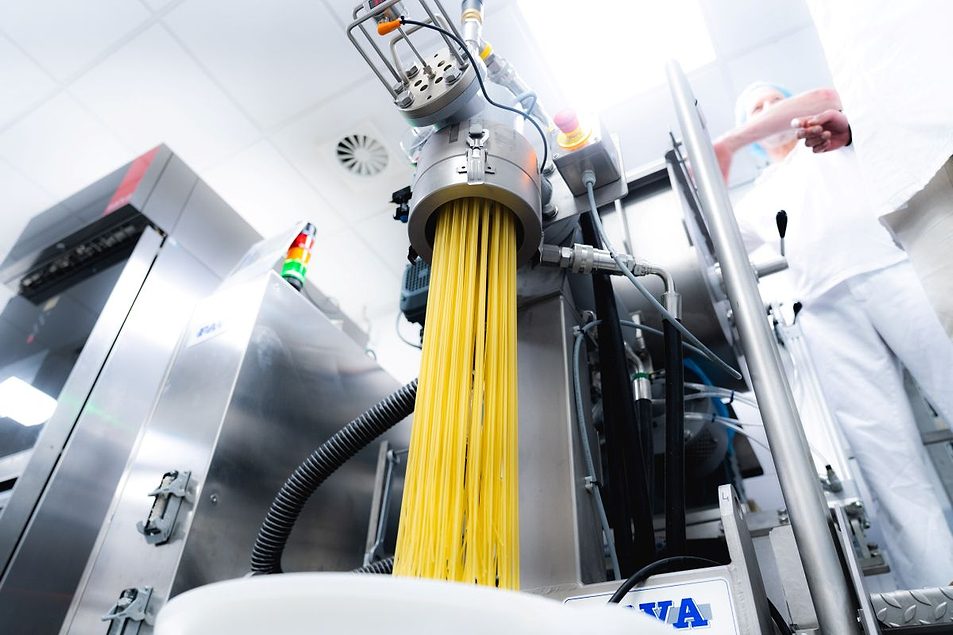

AHRENSBURG, GERMANY—MC Mühlenchemie now offers enzyme systems in its Pastazym HighProtein series that are designed specifically for producing pasta with protein content of 18% or higher.
Both the amount and the source of protein may affect pasta negatively, according to the Ahrensburg-based company. Protein sources like wheat germ and legumes may overpower pasta flavor and alter color. Other potential issues are unstable dough, difficult extrusion, susceptibility to breaking, rough or matte surfaces, sticky texture, and variable cooking stability. The MC Mühlenchemie enzyme systems address the issues by stabilizing the protein network, reducing stickiness, improving surface quality and cooking tolerance, and contributing to sensory quality.
“At protein contents up to about 22% the challenges can generally be dealt with using targeted enzyme technology, making additional support of the gluten network beneficial,” said Jana Russnak, head of pasta applications at MC Mühlenchemie.
Higher protein content may require adding wheat gluten, according to the company.
Business
Novig’s Sydney Sweeney Ad Won Attention, But Can It Convert Controversy Into Real Paying Customers Now?

Novig’s provocative marketing campaign featuring actor Sydney Sweeney generated a level of attention few conventional advertising campaigns could match, but industry veterans say the harder test lies ahead: converting viral buzz into funded, retained customer accounts for the sports prediction market platform.
The campaign, called “Just Sports” and launched ahead of the new NFL season, features Sweeney nude or partially clothed, with footballs, boxing gloves and other sporting equipment strategically positioned to preserve her modesty. Its central joke plays on Novig’s positioning within the prediction market industry: unlike some rivals, the platform offers only sports-related contracts, without political, war or death-related markets available elsewhere in the sector. Sweeney, who reportedly approached Novig about working together and has since become an equity holder in the company, was closely involved in developing the campaign. She told Complex the concept was enjoyable and aligned with her own interest in sports.
The imagery quickly spread well beyond Novig’s existing audience, generating a backlash led primarily by female athletes who argued the campaign reduced women’s presence in sports to sexual display. Former UCLA gymnast Gracie Kramer responded by sharing footage of herself competing, captioned, “I don’t know what Sydney Sweeney was doing, but this is what a woman in sports looks like.” British sprinter Amy Hunt, Olympic swimming champion Ariarne Titmus and water polo player Tilly Kearns were among other athletes who criticized the campaign. International rugby player Sofie Fella separately questioned why advertising budgets were being directed toward the campaign rather than toward investment in women’s sport, while other critics argued the ad undermined broader efforts to have female athletes evaluated on their athletic achievements rather than their appearance. The controversy was subsequently covered by outlets including the BBC and The New York Times.
Novig Chief Executive Officer Jacob Fortinsky defended the campaign publicly, saying the company remained “hugely supportive” of women’s sport and had never intended for Sweeney to serve as a representative of female athletes generally. Sweeney responded to the criticism separately by pointing to prior nude photoshoots involving elite sportswomen as precedent for the kind of imagery used in the campaign.
Tony Kenny, a communications industry veteran who previously served as head of sponsorship and public relations at William Hill and held a senior communications role at Paddy Power, said the campaign has clearly succeeded at the earliest stage of building a new customer base, even as significant uncertainty remains about what follows. “It has done a brilliant job of getting that attention,” Kenny said. “Absolutely, at the top of the funnel it has created awareness. Interest and searches are happening, and downloads are happening. The commercial questions are whether people progress to registration and a funded account, and then whether Novig retains them and creates value from those customers. We are still at an early stage.”
Kenny drew a distinction between the kind of consumer response a viral advertisement can generate and the considerably higher bar required to convert that attention into a funded trading account. Unlike Sweeney’s earlier campaign for American Eagle, in which seeing her wear a specific pair of jeans could directly prompt a viewer to purchase those jeans, the Novig campaign offers no equally direct link between the imagery and the underlying product being sold. “This is not a free trial; people have to put in their hard-earned cash,” Kenny said. “That is a stretch for any gambling company.”
While Novig can track how much traffic arrives through links embedded in its advertising and social media channels, Kenny noted that outside observers, and likely much of the company’s own leadership, cannot yet determine how many of those campaign-driven downloads translated into registered users, how many of those users went on to fund an account, or whether those who did trade an initial contract returned to the platform afterward. Separating the campaign’s specific effect from the broader seasonal uplift tied to the start of the NFL season adds a further layer of difficulty to any attempt to measure its true commercial impact.
Looking beyond the immediate attention generated by the campaign, Kenny said the more fundamental question facing Novig is what the company now wants its brand to represent going forward. “Novig has attention, awareness and some recall, but what does it want to be associated with?” he said. “Sydney Sweeney is now an equity partner. Is she going to be the face of Novig, or will the company pivot? From a communications and marketing perspective, the interesting question is: what next?” That question carries additional weight given that Novig itself is not an inherently self-explanatory name to a general audience; while industry insiders and experienced bettors may recognize it as a reference to “no vig,” describing trading without a conventional bookmaker’s margin, that meaning is unlikely to be understood by most people encountering the campaign for the first time.
Kenny pointed to his own experience at Paddy Power as an example of how provocative marketing can work when irreverence is genuinely embedded in a brand’s established identity, something he said requires sustained consistency rather than a single viral moment. “Paddy Power’s irreverence is authentic to the brand, and it creates shareable content,” Kenny said. “That is the key.” He suggested Novig could attempt to position itself similarly against larger, more corporate-feeling rivals such as Kalshi and Polymarket within the U.S. prediction market sector, but cautioned that sustaining such an identity across a market as large and culturally varied as the United States would represent a substantial ongoing undertaking, one that would require the company to keep producing attention-grabbing campaigns without simply repeating the same approach indefinitely.
“This will be a non-story next week,” Kenny said, describing the likely trajectory of public attention around the campaign. “What does it do as attention starts to die down? Does it flood the market with more ads?” For now, Kenny said, Novig has demonstrated a clear ability to seize a cultural moment and overshadow marketing campaigns from far larger, better-established competitors. What remains unproven, in his assessment, is whether the audience the campaign attracted actually understands what Novig sells, remembers the company’s name once the controversy fades, or has any real intention of becoming a paying customer.
Business
(VIDEO) White House Launches ‘Trump TV’ Streaming Channel Days After Banning Reporters From CNN and Politico

WASHINGTON — The White House launched a 24/7 video stream on YouTube called “Trump TV” on Monday, days after President Donald Trump barred reporters from CNN, Politico and MS NOW from the White House over what he described as their coverage of him and his administration.
The stream’s inaugural broadcast featured footage of Trump speaking at Mount Rushmore on July 3, part of a livestream titled “Trump TV: The Essentials Station,” which began airing at 7 p.m. Monday. The stream’s YouTube description read: “Watch the Trump Administration’s biggest moments all in one place. Top videos, major remarks, and must-see highlights streaming 24/7 and updated in real time. Stay informed and stay up to date!” The White House used similar language in a post on social platform X promoting the channel, adding, “Not every big moment has made it on your TV, now it can.”
The video stream is also embedded on the White House’s own website, positioned beside a separate box labeled “White House Live.” At the time of the launch, that live window displayed an “Off Air” message advising viewers to “Stay Tuned.” Below both video windows, a running chyron displays official updates and statements praising Trump’s actions as president, among other content. It remains unclear whether Trump TV will carry live events featuring the president and members of his administration going forward.
Ahead of the channel’s formal launch, the White House’s YouTube account ran a promotional video for Trump TV that spliced together clips of characters from television shows and films, including “Seinfeld,” “Family Guy” and “The Dark Knight,” shown watching television, set to The Buggles’ 1979 song “Video Killed the Radio Star.” The words “Trump TV” flashed across the screen throughout the promotional clip.
California Gov. Gavin Newsom, a Democrat, criticized the channel’s rollout in a post on X, tying it directly to the administration’s earlier decision to bar reporters from the three news organizations. “First, Trump banned independent news from the White House,” Newsom wrote. “Now, he’s launching what is quite literally state-run TV to try drowning out the fact that he and his corrupt administration are failing the American people. This is truly autocratic behavior from a failed President.”
The press ban that preceded Trump TV’s launch was announced Friday, when Trump barred reporters from CNN, Politico and MS NOW from the White House, citing what he called “their constant ‘reporting’ FAKE NEWS!” Speaking to reporters in the Oval Office, Trump said there was no specific incident that prompted the timing of the ban, describing it instead as the result of “really just cumulative stories over the last two years.” He added, “You get sick of it.”
All three affected outlets filed a lawsuit against the administration Monday challenging the ban. In a joint statement, the outlets said the legal action was intended “to protect our First Amendment rights and defend the principle that the government does not decide what the press reports or publishes.”
Weijia Jiang, a former president of the White House Correspondents’ Association, condemned the press ban in a Fox News interview, framing it as fundamentally incompatible with American democratic norms. “An America cannot have state TV,” Jiang said. “That’s what makes America America … because you need independent actors to be able to be the observers. And if the government is only showing you what it wants, then you have to question: What are we missing?”
The launch of Trump TV and the underlying press ban arrive amid a broader stretch of administration actions that have drawn sustained scrutiny in recent days, including a triumphal arch project and developments tied to the Kennedy Center, according to coverage tracking the administration’s recent activities. Separately, multiple television networks have pulled out of the White House press pool in what has been described as a show of solidarity with CNN following the ban, according to reporting on the fallout from Trump’s decision.
The dispute over press access comes as Trump’s approval ratings have shown signs of softening in recent polling. A Reuters/Ipsos poll found Trump’s approval rating had fallen to an all-time low for his current term, according to results reported around the same period as the press ban and Trump TV’s launch, though the poll’s specific findings were not directly tied by any of the parties involved to the administration’s decisions regarding press access.
With the lawsuit from CNN, Politico and MS NOW now pending and Trump TV continuing to stream content from the White House’s YouTube channel, the dispute over the administration’s approach to press access appears likely to continue playing out both in federal court and in the broader public debate over how the executive branch communicates directly with the public, independent of traditional news organizations covering the White House.

Do remote workers need to return to the company office to thrive? Well, the answer to that is no. A survey by Akamai Technologies found that 83% of remote-friendly organizations reported high productivity.
That’s mainly due to the tools they use and a strong culture of trust. So, if you want to build a thriving remote team, it’s possible. Read on to learn more.

Source: Pexels
Sort Your Connectivity Before You Travel
Remote teams are not stationary. People relocate, spend a few months working from another country, fly out to a client onsite, or gather for the one week a year the whole team is in the same room. Movement is a feature of remote work, not an exception to it.
That creates a risk office-based teams never face: someone landing in another country with no reliable way to get online. The consequences are practical. A deliverable sits unapproved. A stand-up runs without the person who owned the update. A client waits while a colleague hunts for airport Wi-Fi that keeps dropping. So treat connectivity like the flight itself and sort it before departure, not on arrival.
An eSIM is the simplest way to do that. It installs on the phone before you leave, activates the moment you land, and skips your home carrier’s roaming charges entirely. That matters more than it sounds. Australian carriers still bill roaming per person, per day, which is how a fortnight abroad for three colleagues becomes an expense line nobody budgeted for.
Say your team offsite is in Tokyo, or a developer is spending a month working out of Osaka. A Holafly eSIM option for Japan gives them unlimited data for the duration of their stay at a single upfront price, so nobody has to ration their connection midway through a workday.
Every Holafly plan also includes Always On: 1GB of free backup data each month that kicks in automatically when the main plan runs out, pauses, or expires. It’s a small safeguard, but it means a handover or an approval never stalls because someone’s data ended.
Hiring Across Borders
Research has found that 84% of executives find it hard to get technical talent in local markets. So, what option do they have? Well, it’s to hire across borders. You can do that by:
- ● Defining the skills, experience, and work habits required for each role.
- ● Not focusing on where candidates live.
- ● Using consistent talent evaluation criteria to make hiring decisions based on ability.
- ● Reducing cultural bias while hiring.
- ● Creating clear team guidelines around communication, availability, meetings, feedback, and decision-making.
The good thing about hiring across borders is that you get to hire top talent in the required fields. What’s more, you get to promote the global economy.
Tools That Keep Teams Aligned

Source: Pexels
The right tools can reduce communication gaps. At the same time, they can keep remote projects on track. And the most important ones for a thriving remote team are project management platforms and communication tools.
The good thing is that there are several project management platforms that you can use. Some of them include Monday.Com, Asana, Trello, Notion, and ClickUp. These tools will help you assign and track project progress.
When it comes to communication apps, consider platforms like Slack. Slack integrates well with other productivity apps. This ensures fast and ongoing communication across teams.
Maintaining Company Culture Remotely
According to a SHRM report, 83% of employees at companies with a strong culture say they are motivated to produce high-quality work. At the same time, companies with a strong culture see up to 4X higher revenue growth.
So, if you want your remote team to thrive, establish a strong culture. You can do that by:
- ● Highlighting accomplishments during team meetings.
- ● Having a dedicated shoutout channel.
- ● Running a 15-minute virtual coffee roulette to build bonds across borders and time zones.
- ● Hosting monthly collaborative activities, such as virtual trivia.
Measuring Productivity Without Micromanaging
Measuring productivity is a must when it comes to remote work. And the best way to do it is to set clear goals, deadlines, and measurable KPIs. Then, give employees the freedom to decide how they’ll complete their work.
This will ensure that they’re highly likely to be engaged and perform better. Therefore, for better productivity, don’t micromanage everything.

European Boxing Championships: Chantelle Reid, Damar Thomas & Abdul Burton guarantee medals after reaching semi-finals

IT mistake erases 11 years of viewing history for hospitals’ maternity records

The Most Controversial Paper in Finance




-

 Fashion4 days ago
Weekend Open Thread: Talbots – Corporette.com
-

 Tech2 days ago
Researchers escape OpenAI Codex sandbox to run commands on host
-

 Crypto World4 days ago
Circle launches Arc Studio AI agent for building onchain apps
-
 NewsBeat4 days ago
Trump says US has reached an agreement to take permanent control of Greenland’s security
-

 Crypto World2 days ago
Who Needs CLARITY Anyway? ARB Could See 70X Increase: Hodler’s Digest
-

 Crypto World4 days ago
Bitcoin price breaks channel as RSI climbs to 63
-

 Crypto World4 days ago
Trading Bitcoin on Robinhood? Why 2% Spread Has Traders Worried
-

 Crypto World6 days ago
US Charges Robinhood Engineers Over Crypto Listing Trades
-

 Crypto World7 days ago
What Is the Status of the U.S.-Iran Peace Talks? Here's What Both Sides Are Saying
-

 Tech7 days ago
Webb’s IC 348 Mosaic Includes Two-Jupiter Dwarfs, Twin Jets, and a Nursery Still Making Worlds
-
 Crypto World5 days ago
Mortgage and refinance interest rates today, Thursday, September 17, 2026
-

 Crypto World4 days ago
World Money launches in 150+ countries with Stripe
-

 Entertainment7 days ago
Big Brother Update: Melody Explodes at Drew as Illness Sweeps BB28 House
-

 Business2 days ago
Analog Devices (ADI) Bets $1.35 Billion on Chips that Let Machines Think for Themselves
-

 Crypto World4 days ago
Silver prices recover quickly, hitting weekly high today
-

 Tech5 days ago
GPT-6 Astra Reached the Nether in Minecraft, Lost Its Stash to a Creeper, and Farmed Potatoes for Hours
-
 NewsBeat4 days ago
US was ‘on brink of war’ with China over false AI report of nukes moving in Middle East
-

 Crypto World2 days ago
Coinbase, Robinhood, Circle Seen as Tokenized-Stock Winners
-

 Crypto World2 days ago
Bitcoin price holds above $81K as key catalysts line up
-

 Business7 days ago
Federal Reserve expected to hike interest rates 25 basis points at FOMC meeting
You must be logged in to post a comment Login