
Crypto
Solana resilient but observation warranted



Solana has had no reported mainnet outages in two years, but concentrations in stake, hosting and client software should be monitored, according to a report.


Michael Saylor has hinted at another Bitcoin purchase for Strategy after the company reported holdings of 848,250 BTC, acquired for approximately $64 billion, in its latest weekly disclosure.
Summary
- Michael Saylor hinted at further Bitcoin accumulation, although Strategy has not confirmed another purchase this weekend.
- Strategy’s latest filing shows holdings of 848,250 BTC, acquired for approximately $64 billion including transaction costs.
- The company bought 250 Bitcoin for $21.5 million during the week ending October 11, its latest disclosure.
- Strategy spent $192.4 million buying back STRC shares, nearly nine times its weekly Bitcoin purchase expenditure.
- Bitcoin traded near $81,000 on October 18, keeping Strategy’s holdings above their reported average acquisition cost.
In an October 18 post on X, the Strategy co-founder wrote, “We found room for more orange,” alongside a chart showing the company’s Bitcoin buying history. The message suggested further accumulation but did not disclose a transaction amount, purchase date or confirmation of an executed trade.
Strategy’s latest official report, released October 12, showed that the company had purchased 250 BTC for 21.5millionduringtheweekendingOctober11.Ithadspentconsiderablymore—192.4 million—buying back its STRC preferred shares during the same period.
Bitcoin was trading near $81,000 on October 18, according to CoinGecko, placing the market price above Strategy’s reported average Bitcoin acquisition cost of $75,444.
Saylor hints at another Bitcoin purchase without confirming a deal
Saylor’s Sunday post continued his practice of publishing charts showing Strategy’s Bitcoin transactions, with purchases represented by orange markers.
His message did not say how many coins the company might acquire or whether an additional transaction had already taken place.
The latest confirmed ownership figure remains 848,250 BTC, according to the company’s October 12 regulatory disclosure, covering activity through October 11.
Strategy’s purchases can be funded through several sources, including sales of common shares, preferred stock offerings and available company cash.
A new chart or social media message, however, does not establish that a transaction has been completed. Confirmation normally comes through the company’s financial disclosures, which identify the number of Bitcoin acquired, total spending and the resulting balance. Earlier this month, Saylor shared a similar message before the company announced its next weekly transactions.
On October 4, he posted another accumulation chart with the words “More orange than ever,” while Strategy’s latest disclosed Bitcoin holdings stood at 847,666 BTC. Crypto.news previously covered the October teaser, which followed a confirmed purchase of 1,665 BTC during the preceding reporting period. The October 18 post comes after Strategy released another set of figures showing a smaller weekly Bitcoin acquisition and substantial preferred-share repurchases.
A new filing covering purchases after October 11 would be needed to determine whether the latest message preceded an actual transaction.
Strategy holds 848,250 Bitcoin after buying 250 BTC
In its October 12 filing with the U.S. Securities and Exchange Commission, Strategy reported purchasing 250 BTC between October 5 and October 11.
The company spent approximately $21.5 million on those coins, paying an average of $86,194 per Bitcoin, including fees and expenses. Following that purchase, total holdings reached 848,250 BTC. Strategy reported aggregate acquisition costs of approximately $64 billion and an average purchase price of $75,444 per coin.
The holding represents roughly 4.04% of Bitcoin’s maximum supply of 21 million coins. That comparison uses Bitcoin’s fixed maximum issuance, not the number of coins currently circulating or available on exchanges. Strategy funded $21 million of the latest purchase using proceeds from sales of its Class A common stock, MSTR. Another $500,000 came from existing company cash.
The company sold 125,183 MSTR shares during the week, generating approximately $21 million in net proceeds. Its filing showed that approximately $18.81 billion of MSTR shares remained available for future issuance and sale under its existing at-the-market program as of October 11.
The availability of that issuance capacity does not mean the company has already sold those shares or committed the proceeds to Bitcoin purchases. Strategy’s reported average cost of $75,444 remains below Bitcoin’s October 18 market price. CoinGecko placed BTC at approximately $81,059 during the market check, with its 24-hour trading range running from $80,823 to $82,178.
At that price, multiplying 848,250 BTC by $81,059 gives an indicative portfolio value of approximately $68.76 billion. Compared with its reported $64 billion acquisition cost, the difference is around $4.76 billion before accounting for other company financial obligations, taxes or valuation adjustments. Those estimates depend on the market price used for the calculation and are not equivalent to Strategy’s company-level net profit.
STRC buybacks exceed latest Bitcoin spending
Although Strategy continued buying Bitcoin during the week ending October 11, most of the spending disclosed across its Bitcoin acquisitions and preferred-share repurchases went toward STRC.
The company bought back 1,932,145 shares of its Variable Rate Series A Perpetual Stretch Preferred Stock for approximately $192.4 million. That compares with the $21.5 million spent purchasing Bitcoin during the same seven-day reporting period.
Dividing the two amounts shows that the STRC repurchase was approximately 8.95 times the value of the Bitcoin purchase. The comparison covers two disclosed transactions, not all of Strategy’s corporate spending. STRC is one of several preferred-stock instruments issued by Strategy to raise capital and finance its operations. The security pays variable dividends, creating ongoing financial obligations for the company.
Repurchasing preferred shares can reduce the number of outstanding securities on which Strategy must make future dividend payments.
However, the October 12 filing does not establish that management chose to repurchase STRC specifically because its yield had reached 12.31%, as asserted in the supplied report. Strategy’s previous weekly capital allocation report covered the same $192.4 million buyback alongside the acquisition of 250 BTC.
A subsequent analysis of its share repurchases examined the distinction between funds used to buy cryptocurrency and those used to manage the company’s preferred-stock obligations.
According to the company’s official filing, approximately $354.8 million remained authorized under its digital credit securities repurchase program after the latest transactions. An additional $1 billion authorization remained available under its separate MSTR common-stock repurchase program. Neither authorization represents a completed transaction. The amounts establish the remaining capacity under the announced programs.
Strategy retains $5.52 billion in dollar assets
Alongside its cryptocurrency holdings and preferred-share repurchases, Strategy reported substantial dollar-denominated assets. As of October 11, its designated USD Reserve totaled $4.88 billion, while other USD Cash stood at $640.5 million.
Combined, those balances equaled approximately $5.52 billion. The company’s filings describe the USD Reserve as money maintained to support preferred-stock dividends and interest payments on outstanding debt. Its separate USD Cash balance serves a different purpose, supporting general Bitcoin treasury activities, possible Bitcoin acquisitions, reserve additions and other capital-management uses.
During the October 5–11 period, Strategy used $500,000 of USD Cash to supplement the proceeds from common-stock sales used to purchase Bitcoin. The filing does not indicate that the entire combined $5.52 billion is intended for new Bitcoin acquisitions. The company had previously reported using part of its available cash to repurchase preferred shares, making its capital position dependent on more than the size of its Bitcoin holdings.
In related corporate treasury activity, an October 14 comparison of share buybacks examined how Strategy and Japanese Bitcoin holder Metaplanet were managing purchases of their own securities alongside cryptocurrency exposure. Strategy’s October 12 filing specified that $17.51 billion of STRC shares remained available for issuance and sale under its at-the-market offering program.
It reported no STRC shares sold during the latest week, while its common-stock sales supplied nearly all the funding for the newly acquired 250 BTC. The company ended that reporting period with $640.5 million in general-purpose USD Cash and $4.88 billion in its designated reserve.
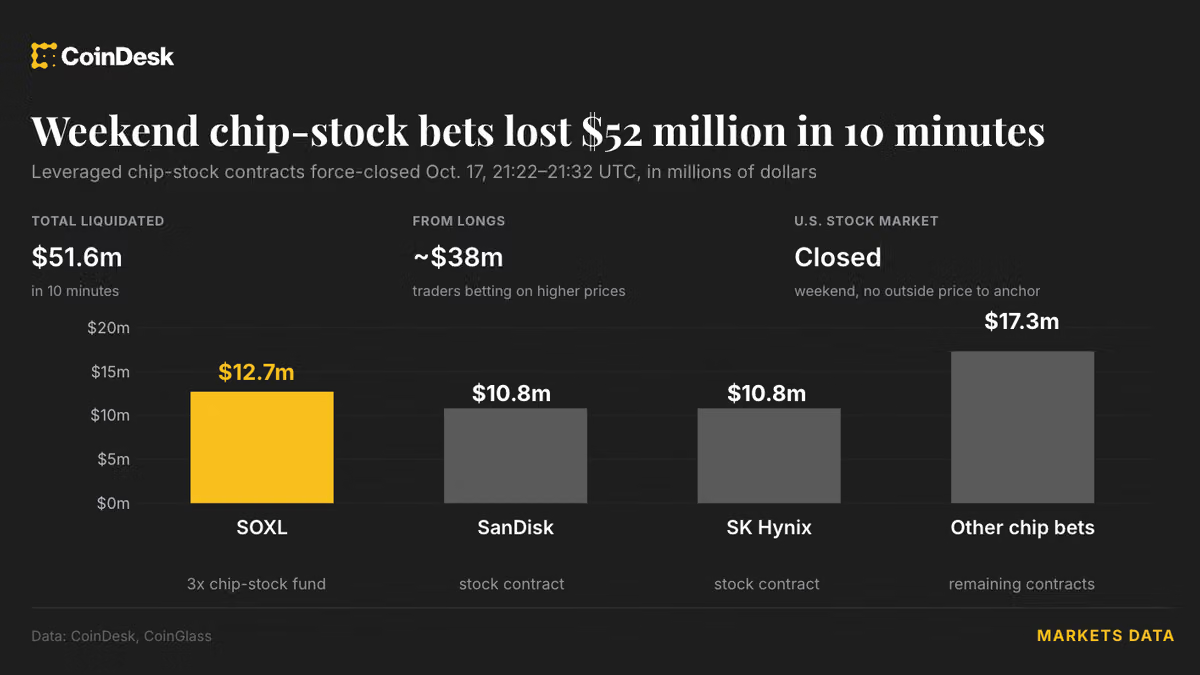
The selling started on Binance, according to a review of the trades by David Jeong, chief executive of trading firm Tread.fi, who placed the first large SanDisk and Micron sell orders on Binance at 21:21:59 UTC.
Less than a second later, orders hit Hyperliquid, a crypto exchange where Trade XYZ lists stock-tracking contracts, and roughly 10 addresses opened bets against six chip-linked contracts within 1.8 seconds.
Binance handled about $21.9 million of SanDisk trading in that first minute, against $3.1 million on Trade XYZ.
Memory-chip shares were already coming off a rough week as investors weighed new competition from Chinese chipmaker CXMT.
With the stock market shut, there was no real share price for these contracts to follow, so traders were reacting only to each other. Trade XYZ’s rules let trading on the platform set its own reference prices until outside stock quotes come back.
Those quotes return when U.S. markets open Monday, which will show how far Saturday’s prices strayed from where the shares actually trade.
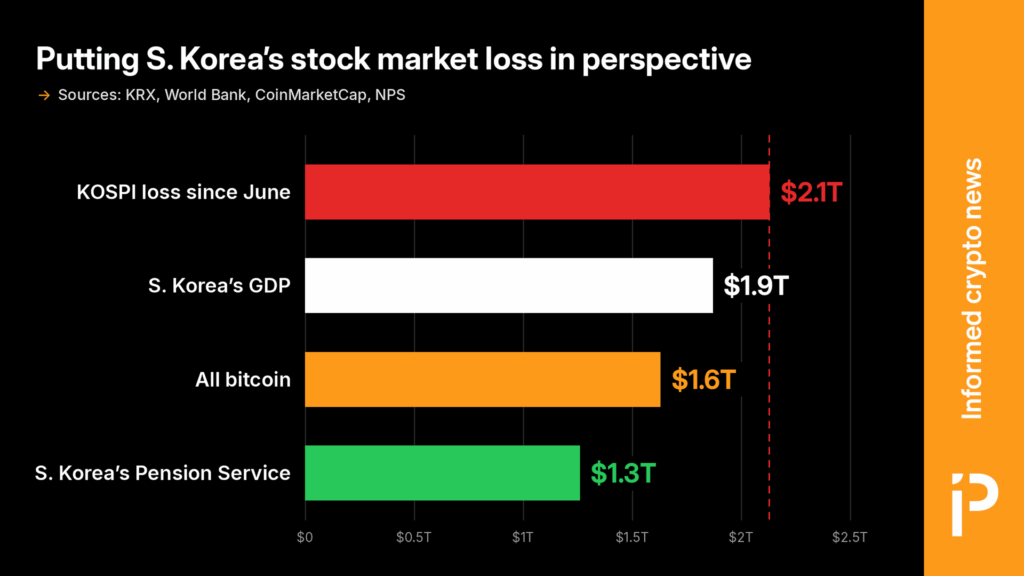
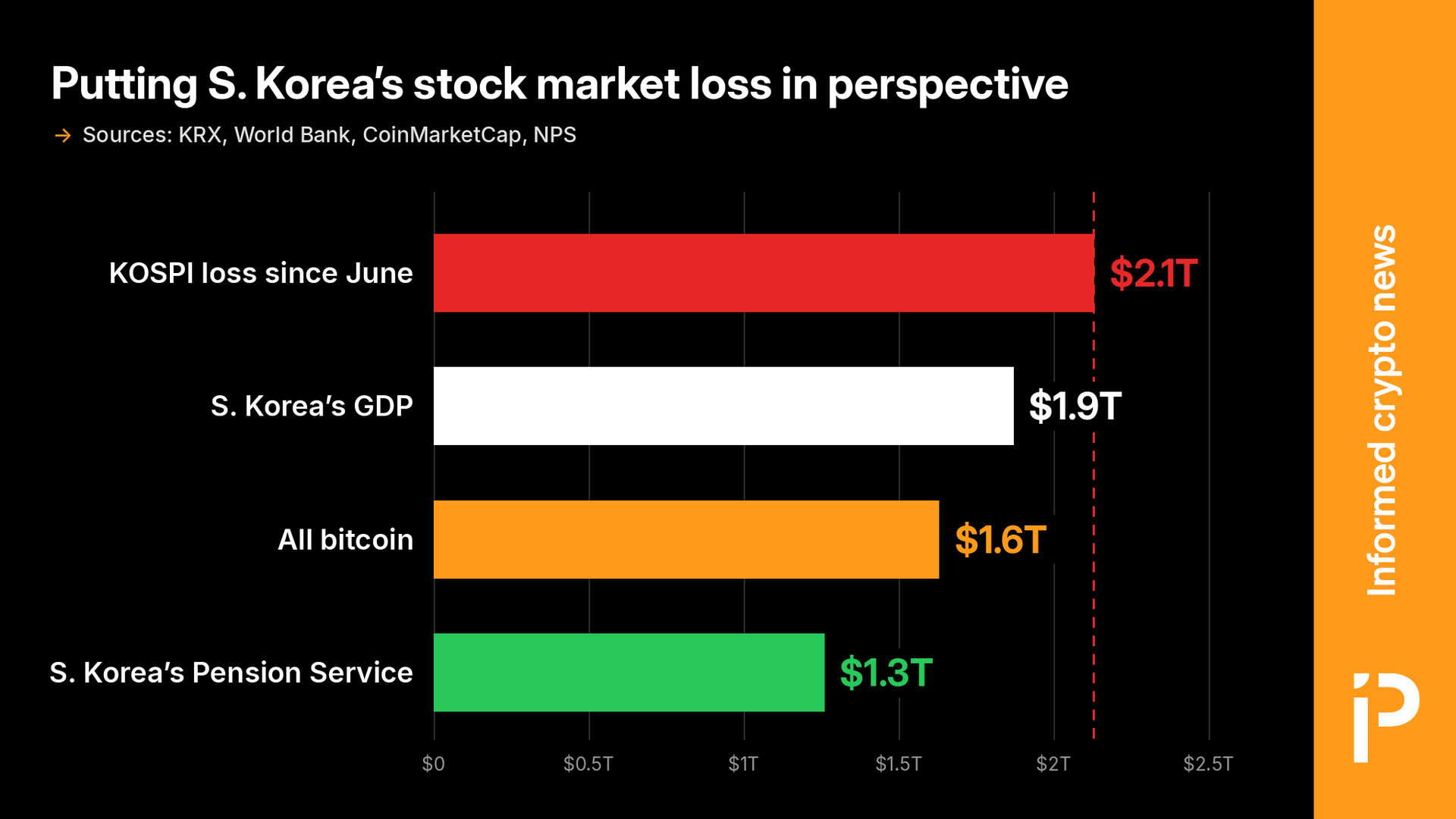
South Korea’s stock exchange halted trading for 20 minutes yesterday as the country’s KOSPI index fell more than 8% in a single day. Since its June peak, its drawdown now exceeds 40%, worth more than $2 trillion in market capitalization.
Followed domestically the same way US investors follow the S&P 500 index, KOSPI’s rout has downranked South Korea’s AI-focused stock market from sixth to 10th among the world’s countries.
For scale, the loss tops South Korea’s entire annual economic output of about $1.9 trillion in 2025. It also exceeds the value of every BTC in existence, about $1.6 trillion.
Concerningly, KOSPI’s loss exceeds the assets of South Korea’s National Pension Service, the world’s third-largest retirement fund holding about $1.3 trillion worth of savings that have obviously shrunk alongside the stock market.
KOSPI closed yesterday at 5,554, down 7.6% on the day and extending consecutive daily losses to seven. Intraday, the index fell as much as 9.3%, enough to trigger its 10th circuit breaker of the year.
South Korean media dubbed yesterday “Black Thursday.”
With its drawdown exceeding 40%, the crisis is approaching the median decline of 43.7% recorded during the country’s previous market crises like Black Monday of 1987, Asian financial crisis of 1997, Dot-com of 2000, and Global Financial Crisis of 2008.
Taking stock of KOSPI’s Black Thursday
Incredibly, Samsung Electronics and SK Hynix, two AI chip companies, weight at roughly half of the KOSPI index’s market capitalization.
Due to their disproportionate underperformance in recent months, the same two companies have caused 70% of the KOSPI’s drawdown since its June peak.
July was the KOSPI’s worst month since the 2008 Global Financial Crisis, but October is already nearing the entire July loss and could be on track to perform even worse.
Read more: South Korea’s stock exchange has paused trading 38 times this year
Retail investors have amplified the wild ride with leveraged single-stock ETFs. The finance minister apologized for introducing those products.
Goldman compared this month’s sell-off to March 2020 and August 2011, the only two episodes in the last 20 years of KOSPI trading with selling this severe and no rebound day.
South Korea’s stock market entered the world’s top 10 in January by overtaking Germany at $3.25 trillion. By June, it climbed above $5 trillion to sixth place. It now ranks 10th.
The country’s Financial Services Commission chairman called an emergency meeting on Thursday. He instructed financial services firms to “maintain vigilance” and to “actively respond to ensure financial market stability and investor protection.”
Got a tip? Send us an email securely via Protos Leaks. For more informed news and investigations, follow us on X, Bluesky, and Google News, or subscribe to our YouTube channel.

Bitcoin Faces Long-Term Quantum Threat: Industry Prepares as 30% of Supply at Risk
Industry leaders are raising urgent alarms about a quantum computing threat to Bitcoin’s security, with Coinbase warning that quantum computers capable of breaking Bitcoin’s cryptography could emerge, presenting a challenge that may require a multi-year upgrade process. About 30% of Bitcoin’s supply already sits in addresses with visible public keys, according to Glassnode data, making those holdings vulnerable once a quantum threat materializes.
The Technical Risk
Bitcoin wallets are protected by digital signatures that a powerful enough quantum computer could, in theory, break. A Google study in March suggested this may take far fewer qubits than once thought, and Google’s March white paper estimated that breaking Bitcoin’s security would require roughly 1,200-1,450 logical qubits.
Timeline Uncertainty
Self-custody platform Casa co-founder and chief security officer Jameson Lopp believes it could take at least another decade before a quantum computer capable of decoding a Bitcoin public key becomes a reality. However, Google’s Willow chip, announced in December 2024, has 105 qubits, while IBM has reported 70 logical qubits and QuEra Computing has executed algorithms with up to 96 logical qubits. IBM’s hardware roadmaps show the company targeting 200 logical qubits by 2029 and 2,000 by 2033.
The Satoshi Nakamoto Problem
Satoshi Nakamoto is estimated to have mined around 1.1 million BTC in Bitcoin’s first year, with those coins never having moved, worth roughly £91.5 billion at current prices. Coinbase flagged a separate governance and engineering problem: coins that cannot or will not move, including coins in early address types, coins in reused addresses, coins with lost keys and Satoshi-era holdings.
How A Fix Would Work
Making Bitcoin quantum-resistant requires replacing the digital signatures used to authorize transactions — a challenging, complex, and multi-year process. Coinbase backs a phased fix in which the same funds could be spent with either a current key or a quantum-resistant one, pointing to BIP-360 (which already had a test network running earlier in the year) and a design called P2TRv2 as flexible options.
Institutional Preparation
Coinbase confirmed it holds about 5% of all Bitcoin in existence as a custodian, and is preparing its own systems, holding discussions with Bitcoin developers, and participating in the Bitcoin Security Consortium. The exchange emphasised that the move would be “a challenging, complex, and multi-year process”.
For UK retail traders, the key takeaway is that quantum threats to Bitcoin remain distant but are now being treated with seriousness by major institutions. Staying informed about proposed upgrades and understanding whether your holdings sit in vulnerable address types will be important as this conversation evolves.
Main picture: Photo by Michael Förtsch on Unsplash
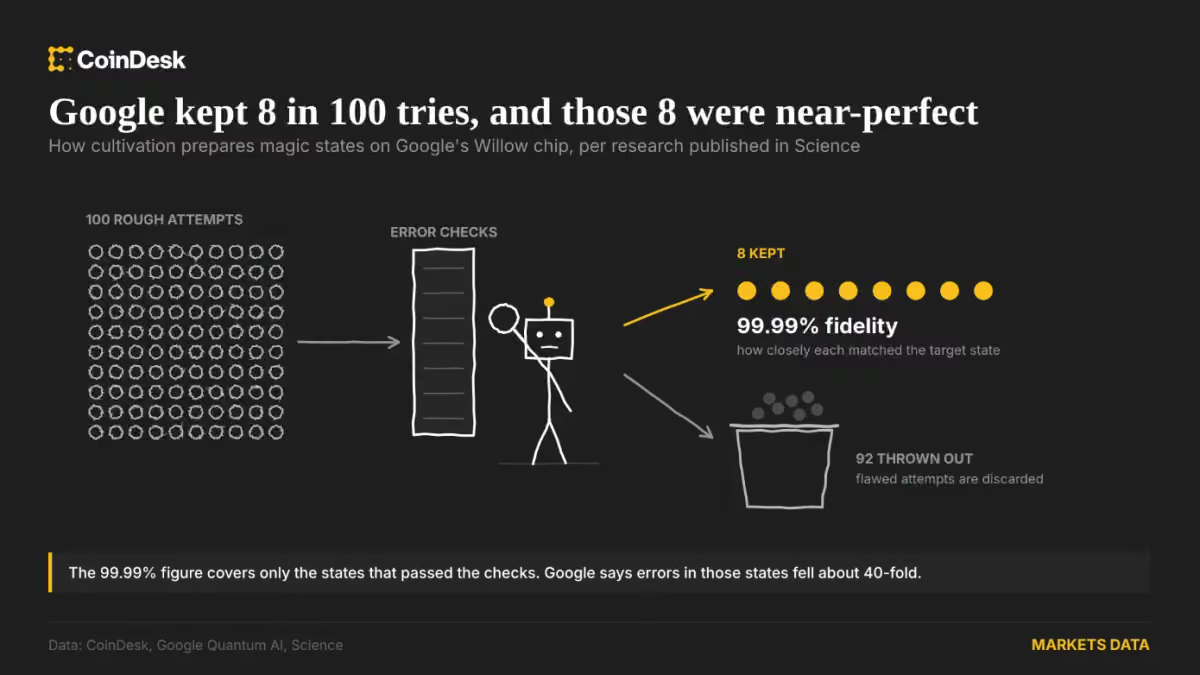
The firm reported about 99.99% fidelity, a measure of how closely the finished states matched what researchers were aiming for.
That number applies only to the states that passed inspection. Willow kept about 8% of its attempts after the checks during preparation and measurement. For every 100 tries, about eight made it through.
The next steps include running the process at a much larger scale and keeping those states useful as they feed into longer calculations. The researchers say more work is needed on real-time operations and moving the states into stronger error-correcting setups.

How it fits with earlier research
In March, Google estimated that a future superconducting quantum computer with fewer than 500,000 physical qubits could break the wallet cryptography used by Bitcoin and Ethereum, under a specific set of hardware assumptions.
In September, CoinDesk reported on researchers cutting the workload of a core calculation used in that attack. That work covered one component, leaving out the complete attack and the physical hardware costs of running it.
Those studies reduce the amount of math an attacker has to do. Cultivation addresses the cost of supplying the machine while it does that math.
The gains cannot simply be multiplied together. Google’s March estimate already assumed efficient magic-state production. The experiment tests part of that engineering approach, rather than providing another 40-fold reduction in the estimated cost of attacking bitcoin.
The Bitcoin Seizure and the Fraudster
The Ownership Question
Thousands of investors pursued claims under Section 281 of Britain’s Proceeds of Crime Act 2002, arguing that portions of the recovered bitcoin legally belonged to them. The critical question was whether they held a proprietary interest — direct ownership — in the seized bitcoin or merely a right to compensation.
The Ruling’s Impact
The decision hands U.K. prosecutors an important legal victory, although the government hasn’t secured an outright claim to the fortune. The High Court has not determined who ultimately owns the bitcoin.
For UK cryptocurrency holders, the case highlights a key principle: the laws governing ownership of seized or disputed digital assets depend on where the transaction originated and where the assets are held. Turner emphasized that questions concerning the substance and application of Chinese law must be resolved during subsequent proceedings.
Read More

Children and adults receive vaccinations at the Jiangbei Community Health Service Center on September 15, 2026 in Huizhou, Guangdong province of China.
Vcg | Visual China Group | Getty Images
BEIJING — High healthcare costs are a big factor driving people in China to save, rather than spend, their money, the International Monetary Fund pointed out in a new book titled “Toward a New Economic Growth Model for China.”
In rural China, 8.7% of disposable income is spent on healthcare — just second to the U.S. among 20 major economies, the research found. The U.S. ranks the highest in the world with nearly 9.9% of disposable income spent on healthcare.
Urban China ranks third, at 5.4%, slightly more than Canada, the data showed.
The level of the healthcare burden in China grows starker when considering per capita disposable income in the U.S. was $68,289 as of the end of last year — more than 10 times more than China’s 43,377 yuan in U.S. dollar terms (around $6,400).
The gap widens further when looking at China’s countryside, which only officially emerged from extreme poverty in 2020.
Urban China recorded more than twice the disposable income as rural areas, at 56,502 yuan versus 24,456 yuan, according to official data accessed via Wind Information.
Targeted measures to raise government spending on health and social security in rural areas can significantly reduce the savings rate in rural households, the IMF said, citing prefecture-level analysis.
“China’s social spending is low compared with international peers, and increasing that spending would lift consumption,” wrote Yizhi Xu, economist in the north Asia division of the IMF’s Asia and Pacific Department, and Fan Zhang, the IMF’s deputy resident representative in Beijing.
They recorded a savings rate of around 14% for people from rural areas working in China’s cities, and about 6% for people with urban “hukou” residency rights, which give them more social welfare benefits than migrant workers from rural areas.
“Declining house prices in recent years continue to weigh on consumption and contribute to elevated household savings,” Xu and Zhang wrote in their section of the IMF book.
[PRESS RELEASE – Panama City, Panama, October 15th, 2026]
Pixagram announces free account creation for up to 250 new members daily through the end of 2026. Built on the standalone Layer-1 Pixa blockchain, Pixagram is an anti-hierarchy social network where every post, vote, and comment is recorded as a signed on-chain transaction, with no ads and no cryptocurrency purchase required to get started.
Pixagram will cover the 20 PIXA network fee for up to 250 new members daily through the end of 2026. New members can claim a free @username at Pixagram.com and join the platform’s on-chain community for creators.
► Quit Renting the Spotlight — Users can register at http://pixagram.com
An On-Chain Username and Wallet Address
Opening a Pixa chain account normally costs around 20 PIXA. Pixagram is covering this fee for up to 250 new members daily through the end of 2026.
- Username and wallet address: Each @username serves as an on-chain wallet address, replacing a randomly generated string of characters with a recognizable handle.
- Blockchain-based registration: Once registered on the blockchain, an @username remains associated with its on-chain record, subject to the network’s rules and technical conditions.
- Phone verification and privacy: One-time phone verification helps limit bot abuse of the daily account offer. A public @username can separate a creator’s online identity from their legal name, although public blockchain records may limit privacy.
Not Really Anti-Social, Truly Anti-Hierarchy
Mainstream social media serves advertisers while gatekeepers decide who sees your work. Pixagram—alongside platforms like Hive and Mastodon—is a SIGMA platform built for creators who prefer agency over status games. Your posts, art, followers, and feeds live directly on-chain with nothing in between, allowing you to reach every follower automatically.
NFT Platform Storage and Artwork Permanence
On many NFT platforms, the token sits on-chain while the image lives on a cloud server or IPFS—meaning a token can easily outlive its art.
 On Pixa, every artwork is stored directly on-chain inside its post as a lossless image. Compact pixel art lives permanently on the blockchain and renders up to 4K resolution as a painting, CRT filter, hexagonal shapes, or square pixels.
- Zero upfront cost: Every new account receives a starter delegation of stake (Resource Credits fuel) to cover posting and voting from day one.
- Build Mode Note: Direct on-chain art sales launch in 2027, so everything you publish today builds your permanent portfolio ahead of the marketplace release.
► Less Lurking. One Original Post. Start at Pixagram.com
Proof-of-Brain and Community Curation
Instead of relying on the computational process used in Proof-of-Work systems, Pixagram uses Proof-of-Brain, a mechanism that allocates rewards based on posting, commenting, and voting activity.
- Community reward distribution: 70% of newly issued PIXA is allocated to community-voted content, with 60% distributed to authors and 40% to curators after seven days.
- Staking and governance mechanisms: Authors can receive Pixa Power, which determines voting weight and supports governance participation, and Pixa Supra (PXS), a unit referenced by an oracle to a agnostic purchasing power index (without a fixed dollar value). Curators can also receive Pixa Power.
Censorship-Resistant by Design
Built on the Hive codebase with Steem lineage, the Pixa chain started from a clean genesis block with no airdrop and produces a block every three seconds. While an application interface can hide a post from its view, it can never erase the transaction record from the chain.
Furthermore, every artwork is checked for copies using PAPH-X (an open-source perceptual fingerprint for pixel art) and indexed by the Search V4 engine.

“The old internet wants you trapped in feed fog, renting reach from gatekeepers who track every click. Today information is king, and Pixagram operates outside that hierarchy… Don’t believe the hype. Create it.” — Matias Affolter, Co-Founder of Pixa
“The strongest rebellion is a working alternative. We’re covering the network fee for 250 new accounts a day so any creator can step into build mode at zero cost. Claim your permanent @username now—because once a handle is written to the chain, it’s gone forever.” — Mathiew Estepho, Co-Founder of Pixa
Pixagram Account Registration and Developer Resources
Pixagram offers fee coverage for up to 250 new accounts daily through the end of 2026. Eligible new members can register and claim an @username at Pixagram.com. Additional technical information is available in the developer documentation at pixa.org.
About Pixagram
Pixagram is an on-chain pixel art and blog network developed by Pixagram AG (Zug, Switzerland) and operated by Pixa Rex S.A. (Panama City, Panama).
The post Pixagram Announces Free Account Creation for 250 New Users Daily Through 2026 appeared first on CryptoPotato.

Harvard University’s endowment grew 27.1% in fiscal year 2026, its strongest return in five years, the school said in its annual financial report released on Thursday.
The endowment, which beat the S&P 500’s 22.3% total return in the same period by 4.8 percentage points, now totals nearly $68 billion. The outperformance came amid actions by the Trump administration to penalize the school and withhold funding from the university.
“While markets can easily take back what they give, that return will strengthen the endowment’s capacity to support the University over time,” Harvard’s chief financial officer Ritu Kalra and treasurer Timothy Barakett wrote in the 49-page annual report. “The University deliberately smooths distributions so that operating support does not rise and fall with the markets. Strong investment returns therefore support Harvard’s work gradually, through future distributions.”
The returns marked the best year for the endowment, managed by the Harvard Management Company, since 2021. Harvard’s fiscal year ends on June 30.
In its second-quarter 13F filing with the Securities and Exchange Commission, Harvard unveiled a $2.2 billion stake in Elon Musk’s SpaceX rocket and satellite company. It marked the endowment’s largest single holding by value, trailed by Taiwan Semiconductor Manufacturing Company at just under $350 million.
Harvard’s financial picture, though, is undermined by moves by the federal government. Federally-sponsored research revenue declined 19.5% to $509 million in fiscal 2026.
And starting in the current fiscal year, “endowment resources will face an additional constraint, with the federal excise tax on Harvard’s net investment income rising nearly six-fold, from 1.4% to 8%,” Kalra and Barakett wrote. “We estimate the higher rate will cost roughly $300 million a year.”
“[I]n a year of returns like this one,” the federal excise tax “would be several times larger,” they noted.
President Alan Garber acknowledged such headwinds, but said in the report that Harvard can still succeed.
“Together, we have the opportunity to set the University on a path to excellence that none of us can imagine today,” he said. “Notwithstanding the challenges and uncertainty, this is a thrilling time to be part of a great American institution devoted to Veritas.”
The UK’s new cryptocurrency regulatory regime is coming. The FCA published its final crypto rulebook on 30 June 2026, and the countdown to full enforcement has begun. Here’s what retail traders and crypto platform users need to know right now.
The Timeline: Three Key Dates
The FCA’s authorisation gateway opened 30 September 2026 and will close 28 February 2027. Any crypto platform operating in the UK — whether it’s a UK-based exchange, a foreign platform serving UK customers, or a custody service — must apply for full FCA authorisation within this window or face being shut out of the UK market.
The full regime comes into force on 25 October 2027. After that date, platforms without FCA authorisation will be unable to operate legally in the UK. This is not a gentle transition: it is a hard cutoff.
Which Platforms Are Affected?
The new framework covers crypto trading platforms (exchanges), custodians, stablecoin issuers and staking intermediaries. If you trade crypto on a platform serving the UK — whether you live here or the platform is overseas — that platform must be authorised. Platforms already registered under existing anti-money laundering (AML) rules will not be automatically converted to the new authorisation and must apply separately.
This is important: old registrations do not carry over. A platform that passed AML checks two years ago does not automatically pass the new, stricter regime.
What Has Already Happened: The Rejection Rate
Over 85% of firms that applied under the existing AML registration process were rejected or withdrew their applications. This gives a clear signal: the new authorisation bar is much higher, and not every platform will clear it.
New Protections for Traders
When the regime goes live, FCA-authorised platforms will be required to offer meaningful consumer safeguards that have not previously existed in the UK crypto market:
These rules do not eliminate crypto’s volatility or risk. Crypto remains a high-risk investment and the new rules do not guarantee against losses. But they bring the UK’s regulatory framework closer to traditional financial services.
What You Should Do Now
Three concrete steps for UK retail traders:
1. Check your platform’s status. Visit the FCA’s Firm Checker at fca.org.uk/consumers/check-if-firm-fca-authorised to see whether your current trading platform is registered or has applied for authorisation. If it is not on the register and has not announced an application, assume risk.
2. Prepare for platform migration. If your current platform is not seeking authorisation, you will need to move your holdings before October 2027. This takes time and can incur withdrawal fees. Start the process before the rush begins.
3. Review your tax position. From the 2026/27 tax year, crypto platforms are required to collect and report transaction data to HMRC under the Crypto-Asset Reporting Framework (CARF). If you have not previously declared crypto gains to the taxman, now is the time to get ahead of it with a tax adviser.
What Happens to Platforms That Don’t Apply?
Crypto exchanges and custody services operating without FCA authorisation after 25 October 2027 will be breaking UK law. Penalties for non-compliance include unlimited fines for businesses and up to 2 years’ imprisonment for those involved. In practice, this means:
— UK banks will close payment corridors to unauthorised platforms
— Platforms will lose access to UK customer money
— Users will have no regulatory recourse if funds are lost or stolen
The Bigger Picture
The FCA’s new regime is broadly aligned with the EU’s MiCA regulation, which came into force on 1 July 2026, but the UK framework allows more flexibility on stablecoin reserves and explicitly preserves access to global liquidity through overseas trading venues. This positions the UK as commercially pragmatic while still raising governance standards.
For retail traders, the takeaway is straightforward: by October 2027, you should be trading only on FCA-authorised platforms. The 12-month countdown has started. Use the time to verify your platform’s status, plan your migration if needed, and get your tax house in order.
Main picture: Photo by Davor Puljić on Unsplash

AI “deadbot” chatbots can help us feel like we’re talking with the dead

REGRETS AND REBUYS // VOL. II

Amazon’s 12th Generation Fire HD 8 Tablet Offers Strong Value for Portable Daily Use


-

 Fashion23 hours ago
Weekend Open Thread: Kut from the Kloth
-
 Entertainment2 days ago
Anna Faris Says Chuck Lorre’s ‘Mom’ Remarks Still Hurt
-

 Crypto7 days ago
XRP Ledger Defends Emergency Patch Amid Criticism
-

 Crypto6 days ago
Rep. Omar Says She Will ‘Not Be Silenced’ After Federal Agents Raid Her Home
-

 Tech & AI1 day ago
Double Fine’s First Post-Xbox Title, First-Person Soulslikes And Other New Indie Games Worth Checking Out
-
 Crypto6 days ago
KuCoin unveils 5.0 upgrade with AI tools and unified trading account – CoinJournal
-

 Tech & AI6 days ago
More Indigenous Languages Come to iPhone and iPad Keyboards in New Apple Update
-

 Crypto7 days ago
Ledger halts CryptoBilis after $86M wallet drain
-

 Sports6 days ago
Work on Trump’s D.C. muni enrages judge: ‘You did your absolute worst’ | News
-
Crypto6 days ago
ZEC and NEAR Plummet Hard, BTC Recovers From Rollercoaster Ride: Market Watch
-
 Sports6 days ago
Tax evasion to Portugal fallout: Controversies that rocked Ronaldo’s career | Football News
-

 Crypto5 days ago
Visa gets Beijing’s green light for bank card business after 40 years of working with China
-
 Business & Hustles6 days ago
Oil Price Today (October 13): Crude oil falls to $105 as traders assess Russian supply, Mideast attacks. What’s next?
-

 Sports7 days ago
College GameDay Appearance History for Teams in West
-

 Crypto5 days ago
TD Cowen: CFTC Crypto Rules Face 2028 Election Risk
-
 Sports5 days ago
Sediqullah Atal creates history, becomes first Afghanistan batter to score fourth-innings Test century | Cricket News
-

 Sports6 days ago
How to Watch Giants vs. Commanders: TV Channel, Live Stream, Time
-
 Sports7 days ago
NBA Pre-season Highlights (Oct. 11)
-

 Sports6 days ago
NFL: 57-yard Field Goal Seals Jaguars Win in London
-
Sports5 days ago
The Vikings’ Bruiser at WR Looped into Trade Rumors with League Interest to “Heat Up”
You must be logged in to post a comment Login