Connect with us

Business

How Much Entrepreneurial Time Is Lost to Work That Doesn’t Grow the Business?

Published

on

How Much Entrepreneurial Time Is Lost to Work That Doesn't Grow the Business?

But somewhere between opening day and today, most business owners find themselves buried in tasks that have nothing to do with that original vision. Answering routine emails, chasing paperwork, and fixing small operational problems can quietly eat an entire week. None of it feels optional in the moment, yet almost none of it actually grows the business.

This hidden drain on time rarely shows up as one obvious problem. It shows up as dozens of small distractions stacked on top of each other. A phone call here, a form to fill out there, a system that breaks and needs a manual fix right now. Each task feels urgent and necessary, so business owners rarely stop to ask a harder question. Is this task actually building the business, or is it simply keeping the business from falling apart today? That distinction matters more than most entrepreneurs realize, and ignoring it for too long can quietly stall growth for years.

The Hidden Cost of Busywork

Research on small business ownership consistently points to the same pattern. Many entrepreneurs spend the majority of their working hours on tasks that do not directly bring in new customers or improve the product. Instead, their time gets consumed by administrative work, manual data entry, repetitive communication, and fixing problems that better systems could have prevented in the first place. This is not a personal failure. It is simply what happens when a growing business outpaces the systems built to support it.

Free newsletters
Advertisement

The stories that matter to UK business, straight to your inbox.

Advertisement

The danger is that busywork feels productive even when it is not. Clearing an inbox, filling out a form, or responding to a routine question all create a small sense of accomplishment. But accomplishing a task is not the same as growing a business. Growth comes from acquiring customers, improving a product, building relationships, or developing a team, not from simply staying busy every hour of the day. Businesses that confuse motion with progress often plateau quietly, without ever understanding exactly why.

What separates thriving businesses from stagnant ones is often a willingness to name this problem honestly and fix it. The businesses profiled below made that exact shift. Each one identified a specific task eating away at valuable time, then built or adopted a better system to solve it. Their stories show that the fix is rarely working longer hours. It is almost always working on fewer, more important things.

Delegating the Work That Does Not Require the Founder

Professional service businesses face this challenge constantly, since so much of the work involves detailed documentation, filings, and client communication. A law practice, for example, generates an enormous amount of paperwork behind every single case. Attorneys can easily spend hours drafting routine documents or tracking case status instead of preparing courtroom strategy or meeting with clients directly. Over time, that imbalance quietly limits how many clients a firm can actually serve well.

Ramiro Lluis, Attorney at Lluis Law, has spent 48 years building a family run practice in Los Angeles and has seen this exact pattern play out across decades of legal work.

Advertisement

“In 48 years of practicing law, I have watched too many attorneys drown in paperwork instead of building their firm. Early in my career, I spent hours each week on filings a paralegal could handle just as well. Once I learned to delegate that work and focus my own time on courtroom strategy and client relationships, our caseload capacity grew significantly. A law firm does not grow because the founder works harder, it grows because the founder works on the right things.”

This lesson applies far beyond the legal field. Any business built around expert knowledge faces the same trap, since the person with the most valuable skills often ends up buried in tasks that do not require that skill at all. Recognizing which tasks genuinely need the founder’s attention, and which ones can be handled by someone else or by better systems, is often the single biggest unlock for sustainable growth.

Building the Tool You Wish Already Existed

Sometimes the work stealing an entrepreneur’s time is not something that can simply be delegated. Sometimes it requires building an entirely new tool because nothing on the market solves the problem well enough. Online resellers know this frustration firsthand, since writing a single product listing can take fifteen to twenty minutes once titles, categories, pricing, and shipping details are all factored in. Multiply that by dozens of items a week, and an entire business can grind to a halt under listing work alone.

Christopher Taylor, Founder of Flowlister, lived that exact frustration while running his own eBay reselling business before deciding to solve the problem himself.

Advertisement

“Before Flowlister, I spent 15 to 20 minutes manually listing every single item in my eBay store. That math never changes no matter how good a seller you are, it just eats your whole day. So I built Flowlister to turn one photo into a complete, priced listing in about 30 seconds. We freed up thousands of hours for resellers, and every one of those hours can now go toward sourcing and actually growing the business.”

Christopher’s story reflects a pattern seen across many industries. Entrepreneurs often assume repetitive, time consuming work is simply the cost of doing business. In reality, that repetitive work is frequently the clearest signal that a better process or tool is needed. Businesses willing to invest time upfront in solving that root problem often gain back far more time than they spent building the fix.

Making Paperwork Move Faster

Compliance heavy industries face a similar challenge, though the paperwork itself looks completely different. Vehicle titling and registration work involves dozens of small steps, especially for complicated cases involving salvage titles, bonded titles, or out of state purchases. Every document has to be accurate, submitted correctly, and tracked carefully, since even a small mistake can delay a client for weeks. Without the right systems in place, that level of detail can consume an entire team’s time without leaving room for anything else.

Jennifer Tamol, Owner of Shelby And Sons Title Company, works inside that paperwork every day and has learned how quickly manual processes can slow an entire business down.

Advertisement

“Vehicle titling paperwork is full of small steps that eat an entire afternoon if you do them by hand. I used to personally track every bonded title and salvage form until our office nearly stalled trying to keep up. We built simple checklists and automated parts of our document prep, and turnaround time on complex titles dropped noticeably. Growth in this business means clearing the paperwork faster, not just taking on more of it.”

Jennifer’s experience highlights an important truth about paperwork heavy businesses. Growth does not always mean adding more staff or taking on more clients right away. Sometimes it simply means removing friction from the process already in place, so the same team can accomplish more without feeling constantly overwhelmed.

Freeing Up Time to Focus on What Matters Most

Education and service platforms deal with their own version of this problem, especially when growth depends on matching the right people together quickly and accurately. Manually coordinating schedules, preferences, and availability between two groups of people can consume enormous amounts of time behind the scenes. That kind of manual coordination might feel essential in the early days, but it rarely scales well as a company grows.

Tornike Asatiani, Founder and CEO of Edumentors, experienced this firsthand while building an online tutoring platform that now operates across dozens of countries.

Advertisement

“When we started Edumentors, I spent far too many hours manually matching tutors with students by hand every single day. That work felt urgent, but it never actually grew the company or improved a single lesson. We built matching and scheduling tools so our team could focus on tutor quality and student outcomes instead. Since making that shift, we have delivered more than 100,000 lessons across 35 countries.”

Tornike’s experience shows how quickly a founder’s time can be consumed by tasks that feel essential but do not actually move the business forward. Once that manual matching work was automated, the team could redirect its energy toward the parts of the business that genuinely mattered, like tutor quality and student results. That shift in focus, rather than simply working more hours, is often what allows a growing company to scale successfully.

The Real Lesson Behind Every Story

These four stories come from completely different industries, yet they all reveal the same underlying truth about entrepreneurial time. Time itself is not the scarce resource most business owners assume it to be. Attention is. Every hour spent on a task that does not build the business is an hour quietly stolen from the work that actually matters most. Recognizing that difference is often the first step toward meaningful growth.

The businesses in this article did not solve their time problem by working harder or longer. They solved it by identifying exactly which tasks were stealing their attention, then building a better system, tool, or team to handle that work instead. Whether that meant delegating filings, building new software, automating paperwork, or replacing manual matching with smarter tools, the underlying lesson stayed the same. Growth follows the entrepreneurs who protect their time fiercely and spend it only on the work that truly moves their business forward.

Advertisement


Advertisement
Continue Reading
Advertisement
Click to comment

You must be logged in to post a comment Login

Leave a Reply

Business

Oracle’s Co-CEOs Deliver Explosive Growth, but Stock Plunges 50% in Their First Year

Published

on

Oracle’s Co-CEOs Deliver Explosive Growth, but Stock Plunges 50% in Their First Year

Quick Read

  • Oracle stock plunged 50% despite co-CEOs delivering a $664 billion contract backlog and 121% cloud infrastructure revenue growth in one year.

  • Q1 capex hit $28.5 billion with free cash flow negative $5.4 billion, as FY27 spending guidance reaches $90 to $95 billion.

  • Wall Street remains 82% bullish with a $238 consensus target, and we award the co-CEOs a B+ for operational execution in year one.

  • Just released. Our analysts combed the entire stock market and named the ten best stocks to buy right now, and Oracle didn’t make the cut. Enter your email to see the names that beat ORCL. The report is free. Enter your email and see if any of your stocks made the cut.

One year into the most recent co-CEO era at Oracle (NYSE:ORCL), the stock is down 50.2% over the trailing 12 months, with a 52-week range that has swung from a high of $329.50 to a low of $114.50. Shares changed hands around $148.99 in Monday’s premarket.

Several modern, curved glass buildings with blue reflective exteriors against a clear blue sky. The word 'ORACLE' is prominently displayed in white capital letters on the upper part of one of the buildings. White horizontal bands run across the glass facades, and some buildings feature distinct chevron or zigzag patterns in their design.
JasonDoiy / Getty Images

Clay Magouyrk and Mike Sicilia took over as co-CEOs near the peak. The contracted business under their leadership then grew at a pace almost nothing in enterprise software has matched. The stock went the other way. Did the business genuinely improve, or did the market simply reprice what investors will pay for growth that requires heavy capital investment?

What Changed Under the New Chiefs

Remaining performance obligations, essentially the dollar value of signed contracts not yet recognized as revenue, ended Q1 FY2027 at $664 billion, a $209 billion year-over-year increase. Cloud infrastructure revenue grew 121%, and Oracle booked more than $30 billion in new AI cloud contracts in a single quarter.

Free Report, Just Released

Why Didn’t ORCL Make The Top 10 List?

Advertisement

24/7 Wall St has helped investors make money for over two decades, and our top analysts just finished ranking the definitive Top 10 Stocks To Buy Now. Not the ten biggest companies. Not the ten everyone is arguing about. The ten best stocks to buy right now.

And ORCL didn’t make the cut!

The report is free, and you can see why we think each stock is a top investment today.

Enter Your Email and See the Ten →

Advertisement

The operational execution has real substance. Oracle delivered 850 megawatts and more than 300,000 GPUs since Q4, with utilization at 97.9% and renewals coming in at a 20% premium. Total revenue reached $19.34 billion, up 29.6%, versus the $14.93 billion posted in the quarter the handover happened. Co-CEO Magouyrk said, “We are delivering data center and GPU capacity at a pace that would have seemed impossible only a year ago.”

The multicloud pact with Microsoft (NASDAQ:MSFT) Azure, Amazon (NASDAQ:AMZN) AWS, and Google is the strategic pivot. Multi-cloud database revenue grew 353% year over year. The GPU muscle comes from Nvidia (NASDAQ:NVDA), whose Vera Rubin systems ship to Oracle customers in Q2. (The power, cooling, and networking suppliers riding the same buildout are the subject of a free report on seven non-chipmaker AI infrastructure names.)

Where the Skeptic Case Lives

Capital intensity is the whole bear case. Q1 capex hit $28.5 billion, free cash flow was negative $5.4 billion, and management guided FY27 capex to $90 billion to $95 billion. Oracle completed a $20 billion at-the-market equity issuance, and interest expense rose 55% to $1.4 billion. CFO Hilary Maxson has flagged a roughly five-percentage-point full-year gross margin decline for fiscal 2026.

Advertisement

The earnings optics deserve scrutiny. FY26 EPS of $7.63 flatters against FY27 guidance of $8.10, but Q2 FY26’s $2.26 EPS included a $2.7 billion Ampere divestiture gain. The remaining performance obligations figure is only as good as the customers behind it, and cash goes out years before revenue arrives.

Verdict: Year One Grade

Grade: B+. The co-CEOs inherited businesses they already ran and delivered a scale test with numbers that back the story. Worth watching over the next 12 months is whether operating cash flow of $23.1 billion continues to outpace net cash capex, which management estimates at no more than $70 billion for the year. Wall Street is with them: 82% bullish and a $237.97 consensus price target. Now the co-CEOs need to prove it.

ORCL analyst ratings
ORCL Analyst Ratings — 24/7 Wall St.
ORCL price target
ORCL Price Target — 24/7 Wall St.

Got $1,000? Before You Buy ORCL, Read This

If you have cash sitting in your account right now, give this two minutes. After more than two decades of helping investors beat the market, our top analysts at 24/7 Wall St. put together a definitive report on the Top 10 Stocks To Buy Today. And ORCL wasn’t one of them.

They combed the entire market. It’s not 10 ideas, not 10 stocks everyone is talking about, it’s what their research points to as the 10 best stocks to buy right now, and it’s free. Read more here and see which stocks made the list –>>

Contact editorial@247wallst.com for any questions or corrections.

Advertisement
Continue Reading

Business

US Stock Market Today | Live: US stock futures climb as AI shares rally and crude prices ease

Published

on

US Stock Market Today | Live: US stock futures climb as AI shares rally and crude prices ease

Warnings from executives at leading AI companies triggered a selloff last week, but concerns eased on Monday as investors focused on signs that spending on AI development continued to grow.

Continue Reading

Business

Bristol Airport’s new chief executive to shape transport hub’s ‘ambitious future’

Published

on

Business Live

She is taking over from Dave Lees who is stepping down at the end of the year

Charley Maher is the new CEO of Bristol Airport

Charley Maher is the new CEO of Bristol Airport(Image: Bristol Airport)

Bristol Airport has appointed a new chief executive as it continues to push for further expansion. Charley Maher will take over from current boss Dave Lees who has been at the helm of the transport hub since 2018 and will be stepping down at the end of the year.

Ms Maher is currently group chief executive of South Staffordshire Group, a regulated water and infrastructure services group, and has spent her career working in the travel, financial services and utilities sectors.

Advertisement

She held senior leadership roles with NatWest and Wessex Water/YTL Group before joining South Staffordshire as its top boss in 2023.

Jason Holt, chair of Bristol Airport, said the appointment followed an “extensive and highly competitive selection process”.

“Charley brings extensive experience of delivering long-term infrastructure investment, successful customer delivery, and the balancing of commercial performance with environmental and social responsibilities,” he said.

Under Mr Lees’ leadership, Bristol Airport has seen an unprecedented growth in passenger numbers and the delivery of a number of major projects, including a new public transport interchange as well as the positive outcome of a planning application to increase passengers to 12 million a year.

Advertisement

The airport, which became majority-owned by Macquarie Asset Management last year, now employs more than 5,800 people and supports thousands more jobs through the wider supply chain. It is currently undergoing a £400m upgrade and is seeking further expansion – to 15 million passengers a year – a move it says will create an extra 1,000 new jobs while increasing long-haul connectivity to global markets.

Ms Maher said: “I am genuinely excited to be joining Bristol Airport at such an important and ambitious stage in its journey. Having grown up, lived and worked in North Somerset and Bristol for many years, it is a real privilege to be appointed to such a key role that sits at the heart of the region I call home.

“The airport plays an important part in connecting people, supporting businesses and helping our communities thrive, and I’m looking forward to working with the team, partners and stakeholders to build on the fantastic work already achieved, and to help shape an ambitious and sustainable future.”

Mr Lees said it had been “the highlight of my career” to lead the team at Bristol Airport.

Advertisement

“Together we have delivered significant improvements for our customers, airlines and the community which we are proud to serve, including our industry leading position on our pathway to deliver net zero Airport operations by 2030,” he added.

Bristol Airport is England’s third-largest regional airport, with more than 10.8 million passengers passing through the terminal over the past 12 months and links to more than 120 destinations in 34 countries.

Continue Reading

Business

Stifel reiterates Okta stock Buy rating after board changes

Published

on


Stifel reiterates Okta stock Buy rating after board changes

Continue Reading

Business

Stock Market Today: Dow Rallies 450 Points As Oil Prices, Treasury Yields Fall; Nvidia Extends Gains

Published

on

Stock Market Today: Dow Rises Ahead Of Fed Minutes; Nvidia Supplier SK Hynix Jumps On Buyback

Futures for the Dow Jones Industrial Average and other major stock indexes rallied Monday as oil prices and Treasury yields dropped. Meanwhile, Nvidia (NVDA) was an early winner on the stock market today. Ahead of Monday’s open, Dow futures climbed 0.9%, or around 450 points, as S&P 500 futures gained 0.7%. Nasdaq-100 futures advanced 1.1% in early morning trading. West…

Copyright ©2026 Investor’s Business Daily, LLC. All rights reserved. 87990cbe856818d5eddac44c7b1cdeb8

Continue Reading

Business

Airbus to transform former super-jumbo A380 factory to create hundreds of Broughton job

Published

on

Business Live

Across the Broughton site, the manufacturer is creating around 480 new well paid jobs this year.

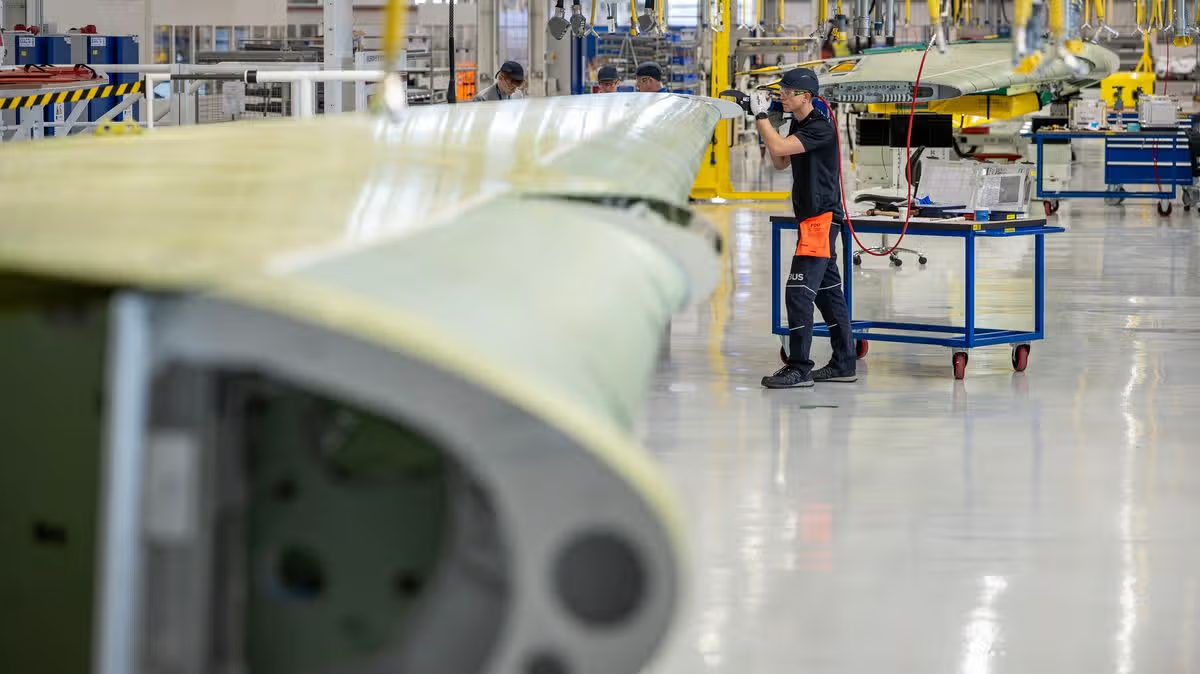
Airbus is accelerating its global industrial strategy, investing £150m into converting its former A380 wing production facility into an A321 line in Broughton

Airbus is investing £150m into converting its former A380 wing production facility into an A321 line in Broughton in North Wales.

The west factory was opened in 2003, and at the time was the largest factory built in the UK for years.

Advertisement

The Flintshire plant – with more than 1,000 workers – had been used to assemble wings for the 555 seater A380 before they were transported by barge and ship to Toulouse in France.

A decision was taken to phase out the programme and the last wing departed Broughton in February 2020.

Now it will be transformed – with work set to be completed by the end of the year .The expansion is a significant boost for the UK aerospace industry capability.

Once completed, the facility will host six wing production jigs, an equipping line and paint shop, specifically designed to feed the backlog of around 7,500 A320 Family aircraft, of which around 70% are A321s.

Advertisement

Across the Broughton site, the manufacturer is creating around 480 new well paid jobs in 2026, including 250 positions in the refurbished factory.

These roles join the 6,000 strong workforce in Broughton, signalling Airbus’ long-term commitment to Wales and reinforcing the UK’s position as a critical hub in the global aerospace industry.

At the heart of this investment is a new, advanced manufacturing environment, designed and built with direct involvement from operators across the site.

Employees fed into the ergonomics and technology integration to shape the industrial system.

Advertisement

Jerome Blandin, head of Airbus Wing, said: “We aren’t just talking about a ramp-up; we’re putting the infrastructure in place to support it.

“Around the world today, an A320 Family aircraft takes off or lands every two seconds, with wings designed and built in the UK. Investing in our capacity strengthens our industrial footprint, creates high value jobs that support the wider UK aerospace sector and ensures we remain competitive in the years to come.

“This investment is important for jobs, important for the region and important for our global ramp up towards rate 75.”

The first wing is already underway, with all jigs expected to be operational by the end of the year.

Advertisement

This latest investment builds on the recently announced multi-million pound investment in Airbus’ Belfast facility, which will expand the wing manufacturing footprint and advanced composite capabilities to support A220 ramp-up.

Continue Reading

Business

Micron: SCAs And Enterprise Adoption Make It A Strong Buy (NASDAQ:MU)

Published

on

Cool strong robot lift dumbbells

This article was written by

Monte Independent Investment Research: Michael Del Monte is a buy-side equity analyst with expertise in the technology, energy, industrials, and materials sectors. Prior to working in the investment management industry, Michael spent over a decade in professional services working across industries that include O&G, OFS, Midstream, Industrials, Information Technology, EPC Services, and consumer discretionary.

Analyst’s Disclosure: I/we have a beneficial long position in the shares of DELL either through stock ownership, options, or other derivatives. I wrote this article myself, and it expresses my own opinions. I am not receiving compensation for it (other than from Seeking Alpha). I have no business relationship with any company whose stock is mentioned in this article.

Seeking Alpha’s Disclosure: Past performance is no guarantee of future results. No recommendation or advice is being given as to whether any investment is suitable for a particular investor. Any views or opinions expressed above may not reflect those of Seeking Alpha as a whole. Seeking Alpha is not a licensed securities dealer, broker or US investment adviser or investment bank. Our analysts are third party authors that include both professional investors and individual investors who may not be licensed or certified by any institute or regulatory body.

Advertisement
Continue Reading

Business

The Real Cost of Falls From Height at Work

Published

on

The Real Cost of Falls From Height at Work

Understanding the true cost of it is the first and best reason to take the risk seriously.

The figures are sobering, and the reality is that up to 44,000 workers per year are injured by falls from height. Behind each of those numbers sits a person, a family, and a business affected. This article looks closely at what falls really cost, where they tend to happen, and how employers can prevent them.

Why Should Businesses Care About Falls?

The human cost is the most important reason, and it should be. Falls from height are consistently among the leading causes of fatal injury at work in the UK. No target or deadline is worth that.

Free newsletters
Advertisement

The stories that matter to UK business, straight to your inbox.

Advertisement

There is a hard business case too, sitting right alongside the moral one. A serious incident brings investigation, lost productivity, and lasting damage to morale and reputation. It can also halt a project entirely. For any employer, preventing falls is both the right thing and the smart thing to do.

What Do Falls Cost a Business?

The price of a single fall extends well beyond the immediate injury. Direct and indirect costs stack up quickly, often over months. Few employers appreciate the full total until it lands.

The costs typically include:

  • Fines. Penalties for safety breaches can reach millions.
  • Downtime. Halted work and lost productivity.
  • Claims. Compensation and rising insurance premiums.
  • Reputation. Lost contracts and damaged trust.

These figures dwarf the modest cost of prevention in almost every case. Fines have topped 1 million pounds in the most serious cases, and legal costs pile on top. A single prosecution can threaten the future of a small firm. Set against that, good safety is one of the cheapest investments a business can make.

Where Do Falls Happen Most?

Falls are not confined to towering scaffolds and skyscrapers. In fact, many happen during ordinary, short tasks. Around 40 workers die from falls at work each year, and roughly 25% of worker deaths involve a fall. Recognising the real hotspots helps focus prevention.

Advertisement

Photo by Adhitya Sibikumar on Unsplash

Alt text: Workers using a secure elevated platform on a commercial site

The common hotspots are clear:

  • Ladders. Involved in many quick-task falls.
  • Fragile roofs. Often the site of fatal falls.
  • Edges. Unprotected edges and floor openings.
  • Platforms. Loading bays and mezzanine levels.

Ladders are involved in a striking number of incidents, often during quick jobs where care lapses. Roofs, especially fragile ones, are another frequent scene, and a fall through a fragile roof is often fatal. Loading bays, mezzanines, and unprotected edges all add risk in everyday workplaces. Warehouses and retail units see their share too, not just construction sites. The lesson is that no height-related task, however brief, should be treated as trivial.

How Can Employers Prevent Falls?

Prevention is well understood and thoroughly documented. It rests on planning, the right equipment, and trained people. The law also sets clear expectations.

Advertisement

A sound approach follows these steps:

  1. Assess. Identify every height risk on site.
  2. Avoid. Do work from the ground where possible.
  3. Protect. Use guard rails and secure platforms.
  4. Train. Make sure everyone knows the safe method.

A thorough risk assessment process comes first, before any work begins. Official guidance on construction falls from height sets out practical controls, and the sobering workplace fatal injury statistics show why they matter. Choosing the safest method over the fastest is always the right call.

What Are the Legal Duties?

Employers carry clear legal responsibilities for work at height. These duties are not optional, and regulators enforce them. Meeting them protects both people and the business.

The law requires employers to plan, supervise, and carry out work at height safely, using competent people and suitable equipment. That sits alongside broader duties to manage risks like Slips, trips and falls across the whole workplace. Falling short can mean prosecution, fines, and in the worst cases, corporate liability. Compliance, in truth, is simply good management.

Protecting People and the Business

Falls from height are among the costliest and most preventable risks a business can face. The toll on workers is the reason that matters most, but the financial and legal stakes reinforce the same conclusion. Assess every height task, avoid it where you can, protect workers where you cannot, and train your team well. Get that right, and you safeguard your people, your projects, and the future of the business itself.

Advertisement

Frequently Asked Questions

How Common Are Falls From Height at Work?

They are alarmingly common and consistently serious. Falls from height are among the leading causes of fatal workplace injury in the UK, and they injure tens of thousands of workers every year. Many happen during short, routine tasks rather than dramatic high-level work. This mix of frequency and severity is exactly why regulators and safety bodies treat working at height as a top priority.

What Fines Can a Business Face for a Fall?

Penalties can be severe. Under health and safety law, fines for serious breaches can run into hundreds of thousands or even millions of pounds, scaled to the offence and the company’s size. Beyond fines, businesses face legal costs, compensation claims, and higher insurance premiums. For a small firm especially, a single prosecution can be financially devastating, which makes prevention overwhelmingly worthwhile.

How Can Small Businesses Prevent Falls Affordably?

Effective prevention is usually far cheaper than most owners fear. It starts with a proper risk assessment, avoiding work at height where possible, and using suitable, well-maintained equipment. Training staff in safe methods costs little and prevents a great deal. The expense of guard rails, towers, or a short course is tiny next to the cost of a single serious incident.

Who Is Legally Responsible for Height Safety?

The primary duty rests with the employer, who must plan and manage work at height, provide the right equipment, and use competent, trained people. Workers also have a duty to follow safe systems, use equipment correctly, and report defects. Responsibility is shared, but employers hold the main legal obligation to make sure every height task is properly controlled and supervised.

Advertisement


Advertisement
Continue Reading

Business

Ryan Reynolds and Rob Mac buy The Turf pub in Wrexham AFC expansion

Published

on

Business Live

Popular pub sits next to Championship side’s Racecourse Ground

Fans at The Turf Pub, Wrexham, in 2023.

Fans at The Turf Pub, Wrexham, in 2023(Image: Barrington Coombs/PA Wire)

Ryan Reynolds, Rob McElhenney and Apollo Sports Capital have acquired a pub in a transaction that extends Wrexham AFC’s property holdings.

Advertisement

The Turf, which previously overlooked the stands with views into the Championship football stadium, has been brought into a portfolio by the club’s owners which encompasses both Wrexham and their Racecourse Ground venue.

The purchase follows weeks after the local authority instructed the club to “get their act in order” following Wrexham’s construction of a training facility without securing planning consent. An application was submitted after building work had already commenced last month, as reported by City AM.

Eric Allyn, representing minority stakeholders the Allyn family, said: “Ever since we invested in Wrexham AFC through Red Dragon Ventures in 2024, the town, the community and the Football Club have become a second home.

“And no place more so than The Turf with Wayne Jones behind the bar and filled with the locals and international fans that visit regularly – they have all become our friends and have welcomed us into the Wrexham family.

Advertisement

“By bringing The Turf into the group, we are securing the long-term future of the pub and with it preserving its history and that of the club.”

Current landlord Wayne Jones will remain in position at the establishment – which has witnessed a remarkable ascent to the second division of English football following its takeover by Reynolds and McElhenney, known as Rob Mac, in 2021.

The Hollywood duo subsequently purchased the Racecourse Ground freehold before securing government funding for a regeneration scheme. In December 2025, the club offloaded a minority stake to prominent sports investment firm Apollo Sports Capital, at a valuation of £350m.

The club’s stadium is presently undergoing a significant redevelopment, with its Kop Stand being reconstructed to accommodate a greater number of supporters.

Advertisement

Wrexham currently sit 14th in the Championship, having secured victories in just two of their opening eight fixtures, against Southampton and Millwall.

Continue Reading

Business

Put business at the heart of devolution for Burnham’s ‘good growth’ plan, business group says

Published

on

Business Live

Two separate reports have revealed an appetite from businesses in the North to boost regional growth

Shevaun Haviland, Director General British Chambers of Commerce, pictured during the British Chambers Commerce Annual Global conference in June 2022.

Shevaun Haviland, Director General British Chambers of Commerce

A leading business group has urged the Government to put businesses “at the heart” of any power for more devolution, saying that private firms are vital to “deliver growth, investment and higher living standards” across the UK. Chancellor John Healey has followed the direction set by his predecessor Rachel Reeves in saying that he would set out a “road map to fiscal devolution” at the Budget.

Now the British Chambers of Commerce (BCC) has said in a new report that the Budget should outline plans to put businesses at the heart of the next stage of devolution and give more local leaders power over funding to accelerate growth in their areas.

Advertisement

A survey by the business organisation of 5,000 firms found in the second quarter of 2026 that only 17% were planning to increase investment in the coming months, a post-pandemic low. The BCC said in a new report that the Budget should outline plans to put businesses at the heart of the next stage of devolution to drive growth and investment.

It urged the Government to complete its devolution plan by the end of the 2027-28 financial year, giving more local leaders power over funding to accelerate growth to improve living standards in their areas. It added that ministers should look to give local areas a direct share in the rewards of growth before the end of this Parliament.

BCC director general Shevaun Haviland added: “Devolution can be a powerful driver of economic growth, but only if businesses are at the heart of the decisions.

“As more powers are pushed out from Whitehall to regions of England, the test of success is simple. Does it make it easier for companies to invest, recruit, trade and grow?

Advertisement

“If it does, then devolution can raise living standards and spread opportunity in every postcode.”

The Chambers’ intervention has come as a separate survey suggests that greater regional decision-making will have a positive impact on business growth. The survey by accountancy group BDO found support for more fiscal powers at regional and local level was strongly backed in the North East, the North West, and Yorkshire and Humber.

The survey also found that companies wanted the Government to prioritise increased business grants (43%) and taking equity stakes in strategic businesses.

Dan Brookes, interim regional managing partner at BDO in Yorkshire and the North East, said: “The Government is making all the right noises when it comes to creating the conditions for good growth in every part of the UK.

Advertisement

“Regional business leaders clearly agree that by giving regional mayors and local authorities greater control over locally raised tax revenues it will positively impact business growth over the next three years. The key now is making those pledges a reality in a way that flows meaningfully through the regional business community.”

Continue Reading

Trending

Copyright © 2025