NEW YORK — The New York Times Wordle answer for Tuesday, May 5, 2026, is LATCH, giving players a moderately challenging start to the week with a five-letter word that doubles as both a common household object and a verb meaning to fasten or attach firmly.
Wordle #1781 tested solvers with a word containing common consonants and a single vowel, starting with L and ending in a soft CH sound. The solution refers to a fastening device on doors, gates or windows — or the action of securing something in place. It also carries figurative meanings, such as latching onto an idea or opportunity.
Players who opened with strong starters like RAISE, SLATE or CRANE likely narrowed possibilities quickly, though the combination of L, A, T, C and H proved elusive for many. According to early community reports on platforms like Reddit, average scores hovered around 4.2 guesses, with a notable spike in six-guess finishes compared to easier recent puzzles.
How Players Solved It
Advertisement
Many successful solvers began with vowel-heavy openers and pivoted after identifying the A early. Common paths included testing words with T and CH clusters. One popular sequence shared online: STEAL → TALON → FAULT → LATCH, securing the win in four guesses.
Hard-mode players faced extra difficulty, as rules require using confirmed letters in subsequent guesses. The absence of repeated letters and the less common “TCH” ending caught some off guard after early vowel or R-heavy attempts.
The New York Times noted the word’s dual noun-verb usage in its official review, highlighting its everyday relevance. Webster’s defines it as a bar or catch that falls into a notch, or the act of fastening with such a device.
Wordle’s Enduring Popularity
Advertisement
Since its acquisition by The New York Times in 2022, Wordle has maintained massive daily engagement, with millions attempting the single daily puzzle worldwide. The game’s simple green-yellow-gray feedback system, limited to six tries, creates a perfect balance of accessibility and challenge that keeps players returning.
May 2026 has delivered a mix of straightforward and trickier solutions. Monday’s answer, RISER, focused on a common architectural term, while Tuesday’s LATCH shifted toward practical objects. The puzzle’s difficulty curve keeps the community engaged, with dedicated trackers and analysis sites breaking down statistics like letter frequency and solve distributions.
Social media platforms buzz with reactions each morning. On X and Reddit’s r/wordle community, players share grids, celebrate streaks and commiserate over tough days. Hashtags like #Wordle1781 and #WordleToday trended as solvers discussed strategies and near-misses involving similar words like CATCH, MATCH or BATCH.
Tips for Future Puzzles
Advertisement
Wordle enthusiasts recommend starting with words containing multiple vowels and common consonants — ADIEU, SLATE or CRANE remain popular. Tracking eliminated letters helps narrow options efficiently. For harder days, considering double meanings or less obvious usages can unlock solutions faster.
The game also offers optional variants like Wordle Unlimited for practice and connections-style spin-offs, but the official daily puzzle retains its special status. Families and offices often compete for lowest average scores, turning the simple word game into a daily ritual.
Cultural Impact and Community
Wordle’s influence extends beyond casual play. It has inspired books, merchandise, classroom vocabulary exercises and even competitive leagues. Its accessibility appeals across age groups, with many older players appreciating the mental exercise and younger users enjoying the social sharing aspect.
Advertisement
The NYT continues subtle updates while preserving the core experience that made it a phenomenon. No ads interrupt the clean interface, and the single daily puzzle prevents bingeing while building anticipation. This restraint has contributed to its longevity in an era of attention-grabbing apps.
For those who missed LATCH, tomorrow brings a fresh challenge. Wordle resets at midnight in each time zone, offering another opportunity to build or maintain streaks. Serious players guard multi-month streaks carefully, with some reaching hundreds of consecutive solves.
Broader Word Game Trends
Wordle’s success has spawned numerous imitators and related games, from geography-focused Worldle to music Quordle variants. The NYT portfolio now includes Connections, Mini Crosswords and Strands, creating a daily puzzle ecosystem that keeps word lovers engaged.
Advertisement
Educators note benefits including improved vocabulary, pattern recognition and deductive reasoning. The game’s gentle difficulty curve makes it suitable for all skill levels while rewarding strategic thinking.
As May 5, 2026, draws to a close, solvers reflect on their performance with LATCH. Whether celebrated in four guesses or salvaged in six, the word provided a satisfying mental workout. The global Wordle community will reconvene tomorrow for puzzle #1782, ready for whatever five letters the New York Times has prepared next.
For players seeking yesterday’s solution, May 4’s Wordle was RISER. Archives and analysis sites offer complete historical lists for those tracking patterns or curious about past answers.
The simplicity and universality of Wordle ensure its place in daily routines. On a day when LATCH clicked for thousands, it reminded players why this unassuming game continues captivating millions years after its viral explosion. One puzzle at a time, one green square at a time, the streak lives on.
LOS ANGELES — Olivia Rodrigo announced “The Unraveled Tour,” a sweeping 65-date global arena run supporting her highly anticipated third studio album “you seem pretty sad for a girl so in love,” set for release June 12 via Geffen Records. The tour kicks off Sept. 25, 2026, with back-to-back nights at PeoplesBank Arena in Hartford, Connecticut, and stretches into May 2027 across North America, Europe and the UK.
Olivia Rodrigo Unraveled Tour 2026: Full Schedule, Presale Times and Ticket Guide for Massive Run
The three-time Grammy winner, whose previous Guts World Tour showcased her explosive live presence, promises an emotionally raw and visually ambitious production for this next chapter. Fans can expect a setlist heavy on new material alongside beloved hits from “Sour” and “Guts.”
Tour Schedule Highlights
The North American leg features multiple-night residencies in major markets. After launching in Hartford, the tour hits Pittsburgh, Washington D.C., Chicago, Atlanta, Nashville, Toronto, Vancouver, Oakland, Las Vegas and more before wrapping the domestic run in mid-February 2027 at Barclays Center in Brooklyn with several shows.
International dates follow in spring 2027, with stops in Stockholm, Paris, Milan, London, Munich, Amsterdam, Barcelona and additional European cities. Full itineraries are available on Ticketmaster and Rodrigo’s official site.
Advertisement
Special guests vary by region and include Wolf Alice, Devon Again, Grace Ives, Die Spitz and The Last Dinner Party on select nights, adding depth and excitement to the bill.
Presale and Ticket Information
Amex cardholders gain early access during the official presale beginning Tuesday, May 5, at 12 p.m. local time through Wednesday, May 6, at 10 p.m. local time. No presale code is required, but purchases must use an eligible American Express card. Availability varies by market.
Fans who pre-ordered the new album or registered on OliviaRodrigo.com may receive additional presale access or codes for select dates, particularly in Europe and the UK. In the UK, an O2 Priority presale also opens May 5 at 10 a.m. local time.
Advertisement
General public on-sale starts Thursday, May 7, at 12 p.m. local time via Ticketmaster and official channels. A limited number of $20 Silver Star Tickets will be released during these windows for select shows, offering more affordable options.
Where and How to Buy Tickets
Primary tickets will be available through Ticketmaster, with links also on OliviaRodrigo.com. Fans should create accounts in advance, enable two-factor authentication and have payment information ready to navigate high demand.
Resale platforms such as StubHub, Vivid Seats and SeatGeek will offer secondary market inventory after the initial sale, though prices will likely exceed face value. Official warnings advise against third-party purchases before general sale to avoid scams.
Advertisement
Ticket limits are typically four per order. Dynamic pricing may apply, with face values expected to range from $49.50 to several hundred dollars depending on seating. VIP packages and meet-and-greet experiences are anticipated but details remain limited at announcement.
Fan Tips for Success
Set multiple alarms for presale and onsale times adjusted to local venue hours. Use a reliable internet connection, preferably on a computer rather than mobile during peak traffic. Joining official fan communities or Rodrigo’s mailing list can provide last-minute updates or extra presale opportunities.
Those without Amex cards should monitor for any artist or venue presales. Pre-ordering the album, even without immediate purchase, has unlocked codes in past campaigns. Patience during the checkout process is essential as queues can be long.
Advertisement
Context and Excitement
Rodrigo’s rise from Disney actress to global pop-rock phenomenon has been meteoric. Her tours consistently sell out arenas, with fans praising the emotional authenticity and high-energy performances. This new outing arrives as she evolves her sound further, promising “unraveled” vulnerability onstage.
The announcement generated massive social media buzz, with fans celebrating the extensive routing that reaches both coasts and international markets. Hashtags like #UnraveledTour and #OliviaRodrigo2026 trended immediately after the reveal.
Industry analysts predict rapid sellouts for many dates given her dedicated “Livies” fanbase and the post-album release timing. The tour represents one of the largest arena campaigns by a young female artist in recent years.
Advertisement
What to Expect on Tour
While production details remain under wraps, expectations are high for theatrical elements, given Rodrigo’s cinematic music videos and past stage designs. The setlist will likely interweave new singles like “drop dead” with fan favorites, creating an emotional journey that matches the “unraveled” theme of raw self-expression.
As tickets become available this week, demand is expected to surge. Fans unable to secure primary tickets should monitor official resale policies and verified platforms for fair options closer to show dates.
Olivia Rodrigo’s “The Unraveled Tour” marks a major milestone in her career. With a new album on the horizon and a globe-spanning itinerary, the 2026-2027 run is poised to be one of the year’s most talked-about concert experiences. Mark your calendars, prepare your strategies and get ready for nights of cathartic anthems and unforgettable performances from one of pop’s brightest stars.
The local authority is bidding for money from the government’s Structures Fund
08:20, 05 May 2026Updated 08:26, 05 May 2026
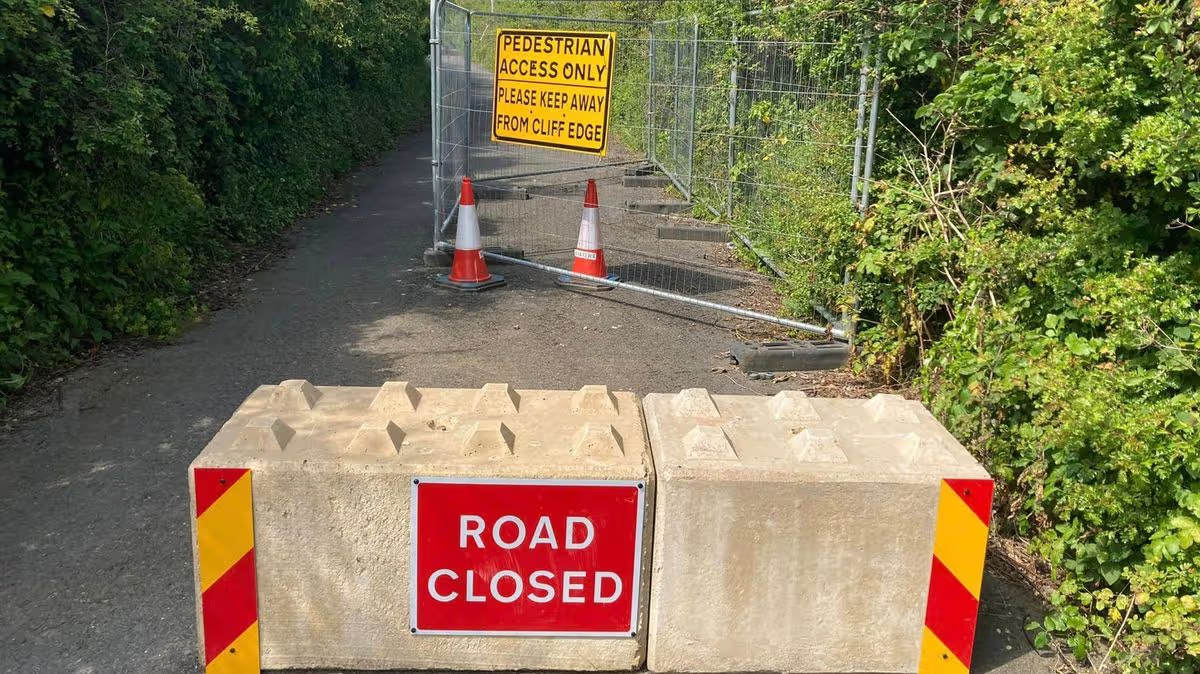
The B3191 Cleeve Hill in Watchet(Image: Local Democracy Reporting Service / BBC)
A “vital” coastal road in Somerset that closed three years ago over safety concerns could reopen to traffic. Somerset Council is bidding for Government cash to reopen the B3191 Cleeve Hill, which links Watchet to Blue Anchor in Somerset.
The road was shut by the local authority in January 2023 due to concerns around coastal erosion. The closure left just one route in and out of the town centre, using a 150-year-old bridge over the West Somerset Railway heritage line.
Advertisement
The B3191 reopened to pedestrians and cyclists in 2024 but has remained closed to motor vehicles.
Somerset Council has now submitted an initial bid to the government’s Structures Fund for a contribution towards what would be a £30 to £40m scheme to reinstate the B3191, either by making the existing route safe for vehicles or by redirecting the route further inland.
Councillor Richard Wilkins, Somerset Council’s lead member for transport and waste services, said: “There is of course no guarantee that we can get this agreed, and any scheme would need to be approved by council, but we have been directed to this fund by the Secretary of State who recognises the issues locally and this is the first real chance we have had to find a way to reinstate this vital route for the community since it closed in 2023.
“We will be pushing hard for this funding, as we have been doing so from the outset – we fully understand the impact on the community of only having one road into Watchet, and the potential impact on the West Somerset traffic that has to take long diversions if the A39 has to close due to an incident.
Advertisement
“We consulted our communities about the ongoing closure and they told us that it is having a major effect on the economy of Watchet including the cost to the local economy and the inconvenience in terms of hours lost in delays, the logistics of coping with delivering goods to and from Minehead as well as the negative effects on tourism.”
Based at M-SParc in Ecodetect has developed an advanced ecology detection toolkit that combines artificial intelligence and machine learning
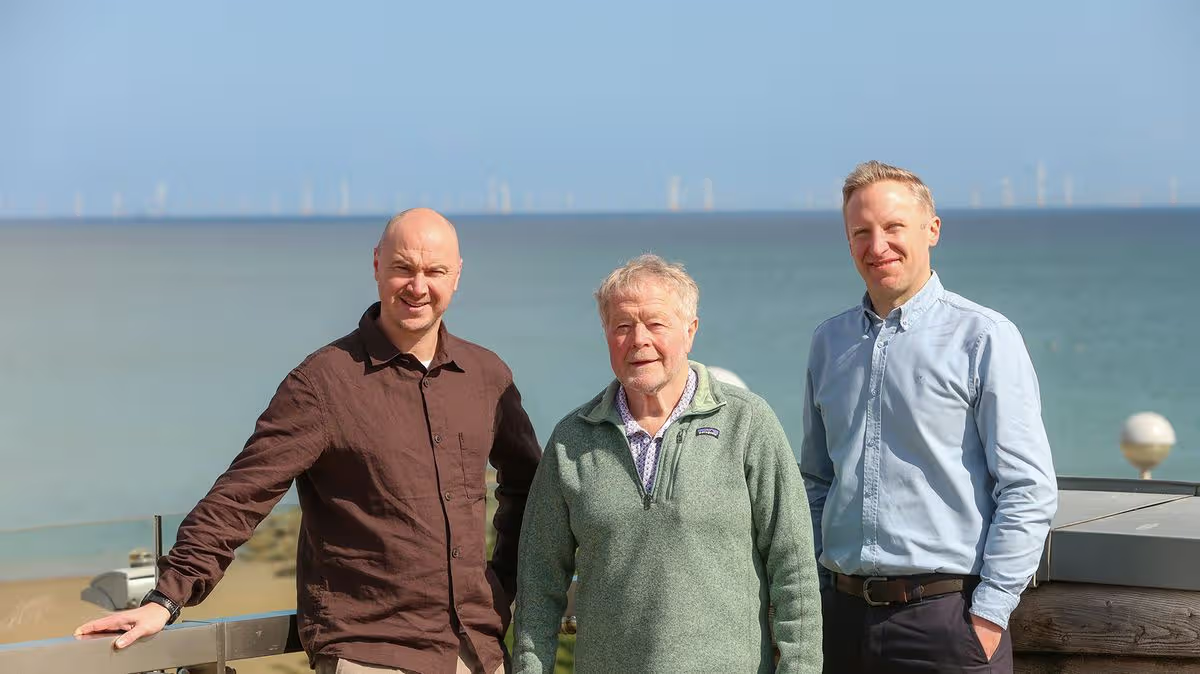
Ecodetech investment: Left to right: David Gold, founder and CEO of Ecodetect; Bobby Williams, lead Investor; Tom Preene, Fund Manager for the Wales Angel Co-Investment Fund.
Anglesey-based Ecodetech,, which specialises in AI-driven marine monitoring for offshore infrastructure, has secured a £490,000 equity investment to help scale its technology.
The funding round includes £245,000 from a six-strong angel syndicate led by Bobby Williams, a member of the M-SParc Angel Network, which also included £25,000 from climate-focused investor OnePlanet Capital. This has been matched by another £245,000 from the Wales Angel Co-Investment Fund, managed by the Development Bank of Wales.
The equity investment will help the business strengthen its team over the next six months, with four new jobs being created, and increase its ability to deliver its technology at scale as offshore and floating renewable energy projects expand.
The new roles are expected to be created over the next six months, with the business looking to recruit from the local area wherever possible as it builds its capability in marine monitoring, AI and offshore renewables.
Advertisement
Based at M-SParc in Ecodetect has developed an advanced ecology detection toolkit that combines artificial intelligence and machine learning with specialist programming to automatically identify and record wildlife interactions with marine infrastructure using data captured by underwater imaging sensors. Its core customers are renewable energy developers, who must monitor and report environmental impacts as part of project licensing and compliance requirements.
The company says the latest investment will allow it to expand in parallel with the wider renewable energy market, where developers are moving from small numbers of turbines to larger-scale installations that generate large volumes of environmental monitoring data. The funding will also support further technology development, including marine communication systems designed to improve how data is transmitted, processed and analysed.
Founded and led by managing director Dr David Gold, Ecodetect brings together three key areas of expertise: offshore and renewable energy, marine wildlife, and advanced technology including AI.
Dr Gold has a background in the energy sector and has built the business around the goal of helping renewable energy developers meet environmental obligations more efficiently while supporting marine conservation. The wider team combines technical, scientific and commercial capability, with the business already recognised for eco-tech innovation in the UK and Europe.
Advertisement
The company is targeting growth in offshore wind, floating wind and tidal energy, including opportunities emerging in Welsh waters. It also sees wider applications for its marine monitoring technology across other sectors including aquaculture, fishing and broader marine infrastructure.
Dr Gold, founder and managing director of Ecodetect, said:“This investment gives us the platform to grow the team, strengthen our technology and make sure we are ready to support the rapid expansion of offshore and floating renewables. There is huge momentum building in the sector and a clear need for robust, scalable monitoring solutions that can keep pace with that growth.
“We are proud to be building this business in North Wales. We want to create high-quality local jobs, contribute to the green economy and develop technology here in Wales that can be deployed internationally.”
Advertisement
Bobby Williams, lead investor, said:“Ecodetect is working at the intersection of AI, marine science and renewable energy at exactly the right time. The business has developed a compelling solution to a real and growing challenge for offshore developers, and David has built a company with strong technical foundations and clear market relevance.
“I’m pleased to be joining the board and supporting the next stage of the company’s growth as it scales its capability and builds its presence in a sector with significant long-term potential.”
Tom Preene, fund manager for the Wales Angel Co-Investment Fund, said:“Ecodetect is a strong example of the kind of innovative Welsh business attracting investment from angel investors that the Wales Angel Co-Investment Fund is designed to support. The company is developing specialist technology in a sector with clear global demand, while also creating skilled jobs and contributing to the growth of Wales’ green economy.
“This investment also shows the value of bringing together experienced angel investors and public capital to help ambitious businesses build the capacity they need to scale.”
Advertisement
Pryderi ap Rhisiart, M-SParc’s managing director, said: “Ecodetect’s success reflects the strength of the innovation ecosystem we are continuing to build at M-SParc. From early support through to investment, scale-up and global opportunity, this is a great example of how ambitious businesses can grow here on Anglesey. It’s particularly encouraging to see connections through our wider network, including angel investors, playing a role in this journey. Supporting companies like Ecodetect to scale from North Wales while creating high-value local jobs is exactly what we are here to do.”
Foreign institutional investors have sold Indian equities on nearly 150 of the last 240 trading sessions, a pattern that says as much about global capital flows as it does about the changing structure of Indian markets. The numbers show that foreign investors have been net sellers on roughly three out of every five market days over the past year.
That is not a one-off reaction to elections, earnings misses or a single geopolitical event. It points to a sustained reassessment of India by global money managers at a time when oil prices are rising, the rupee is under pressure, US bond yields are climbing and the global technology trade is pulling capital back toward developed markets.
The intensity of the selling has also picked up sharply in recent months. The biggest single-day outflow during the period came on April 2, 2026, when FIIs sold a net Rs 19,837 crore worth of Indian equities. That was followed by a cluster of heavy selling days in March, including Rs 11,299 crore on March 24, Rs 10,966 crore on March 20, and Rs 10,827 crore on March 16.
Another major selloff was seen on May 21 last year, when foreign investors pulled out over Rs 10,000 crore in a single session.
Advertisement
Most of the heavy selling has come since tensions in West Asia escalated earlier this year, pushing crude oil prices sharply higher and reviving concerns about India’s macroeconomic stability. Since the conflict intensified, foreign investors have pulled out more than Rs 1 lakh crore from Indian equities, while the Nifty has corrected over 9% from its recent highs.
Live Events
For a country that imports more than 80% of its crude requirement, every sustained rise in Brent crude increases India’s import bill, widens the current account deficit and creates inflationary pressure across the economy. When oil moves toward $100-115 a barrel, as it has in recent weeks, foreign investors start reassessing not just earnings forecasts but the broader macro picture. That pressure is now visible in the currency market as well. The rupee recently slipped beyond 95 against the US dollar, touching record lows. For dollar-based investors, that creates another problem. Even if Indian equities deliver returns in local currency terms, those gains can be reduced or even erased once translated back into dollars.At the same time, the global interest rate environment has become less supportive for emerging markets. The US 10-year Treasury yield moving toward 4.5% has significantly changed the risk-reward equation. When investors can earn close to 4.5% in dollar assets with virtually no credit risk, they become more selective about paying premium valuations in emerging markets.
India, despite the recent correction, still trades at a premium compared with most major Asian peers. Global investors today are not looking at India in isolation. They are comparing Indian valuations with markets such as South Korea, Taiwan and even parts of China, where earnings multiples are lower and, in some cases, currency risks are less pronounced.
That valuation gap has become harder to justify at a time when global money is chasing another powerful theme — artificial intelligence.
VK Vijayakumar, Chief Investment Strategist at Geojit Investments, says the AI-driven shift in global capital is becoming an important force behind FII behaviour.
Advertisement
“The continuing momentum in the AI trade implies that FIIs will continue to sell in India. This might keep largecaps under check with activity moving significantly to the broader market,” he said. He believes even political triggers or domestic sentiment rallies may not be enough to reverse that trend immediately.
“Any rally triggered by domestic political developments will be used by FIIs to sell more. The global AI trade will continue to weigh on markets in the near term,” Vijayakumar added.
That helps explain an unusual market trend seen this year. Even as FIIs continue to exit, several smallcap and midcap stocks have delivered strong gains, supported by domestic institutional investors and retail participation. In April alone, the Nifty Smallcap index staged one of its strongest monthly rebounds in nearly two decades.
This is where the story of Indian markets has changed. A decade ago, selling on 150 out of 240 trading days by foreign investors would likely have triggered a much deeper market correction. Today, domestic institutional investors have become an equally powerful force.
Advertisement
Mutual fund SIP inflows, insurance money and pension allocations have created a steady domestic liquidity base. That domestic money has absorbed a significant portion of foreign selling and prevented sharper drawdowns in benchmark indices.
This does not mean foreign money has stopped mattering. FIIs still dominate largecap price discovery, currency sentiment and sector leadership. But the market is no longer entirely dependent on them for direction.
Analysts say the current phase should not be interpreted as foreign investors giving up on India. It is more accurately described as a period of “risk recalibration.”
Bajaj Broking believes the next phase of institutional flows will be driven largely by global macro developments rather than domestic headlines. The brokerage said developments in US-Iran negotiations, central bank commentary from the Federal Reserve and the Bank of Japan, and movements in global energy prices will remain the key variables influencing institutional activity.
Advertisement
Oil prices need to cool. The rupee needs to stabilise. And US bond yields need to stop climbing. Until then, foreign investors may continue doing what they have done on 150 of the last 240 trading days — selling selectively, especially into strength.
(Disclaimer: Recommendations, suggestions, views and opinions given by the experts are their own. These do not represent the views of Economic Times)
Shares of Tata Technologies rallied as much 7.5% to the day’s high of Rs 635 on the BSE on Tuesday after it reported a consolidated net profit of Rs 204 crore for the March quarter, up 8% from Rs 189 crore in the same period last year. The profit is attributable to the company’s shareholders.
Revenue from operations for Q4 came in at Rs 1,572 crore, marking a 22% increase from Rs 1,286 crore in the year-ago quarter.
On a sequential basis, total operating revenue rose 15% to Rs 1,572 crore. Revenue from the services segment stood at Rs 1,220 crore, also up 15% quarter-on-quarter (QoQ). In dollar terms, services revenue was $132.6 million, reflecting an 11.9% sequential increase in constant currency.
Operating EBITDA for the quarter was Rs 252 crore, up 31% QoQ, while the EBITDA margin improved to 16% from 14.1% in the previous quarter. Adjusted net income stood at Rs 163 crore, up 20% sequentially, with net income margin at 10.3%, higher by 45 basis points on a QOQ basis.
Advertisement
Profit after tax surged 2,975% sequentially from Rs 6.64 crore reported in the previous quarter. Revenue also increased 15% from Rs 1,366 crore in the previous quarter.
Live Events
What are experts saying? Motilal Oswal maintains ‘Sell’ on Tata Tech share price with TP of Rs 500, a 15% downside. The brokerage said that while 4QFY26 saw a strong rebound and deal momentum has improved, revenue growth remains in the early stages of recovery and is dependent on execution over the next few quarters. Margin expansion is likely to be gradual and back-ended. We remain watchful of deal ramp-ups, FVP conversions and sustainability of demand before turning constructive. Auto spending is yet to see a clear inflection and recovery remains at an early stage, and management execution over the next couple of quarters will be key. Commenting on performance, Chief Executive Officer and Managing Director Warren Harris said the momentum seen in Q3 continued into Q4, resulting in 12% revenue growth in constant currency and a 190 basis point expansion in margins.He noted that growth was broad-based rather than driven by a single client or program. He added that strong execution, better order book visibility, and increasing wins in full-vehicle programs support the company’s outlook for FY27, where it expects double-digit organic growth along with sustained margin expansion.
(Disclaimer: Recommendations, suggestions, views and opinions given by the experts are their own. These do not represent the views of The Economic Times)
Microsoft is to plant a fresh flag in central London, taking the entirety of Film House, an eight-storey Art Deco landmark on Wardour Street, to serve as the principal home of its rapidly expanding UK artificial intelligence operations.
The deal underscores how the world’s deepest-pocketed technology groups are doubling down on the capital as the AI arms race intensifies. Microsoft, alongside Meta and Amazon, is committing billions of dollars to compute, talent and real estate in pursuit of a slice of what is shaping up to be the defining commercial contest of the decade.
Film House carries no small amount of cinematic provenance. Built in the 1920s as the first British outpost of French film studio Pathé, complete with private screening rooms, the building later housed HMV before serving as Nike’s UK headquarters. Texas-based developer Hines acquired the property in 2023 and has since refurbished it to court the buoyant demand for premium workspace. Tenants will find a gym, a bar, a rooftop terrace, a so-called hidden courtyard, showers and changing rooms, and, in a nod to the building’s heritage, a cinema in the basement.
Even with Film House secured, Microsoft is understood to be hunting for a substantially larger London headquarters to consolidate its wider workforce in the capital. Property agents suggest the company has its eye on a 300,000 sq ft footprint, three times the size of the Soho building, somewhere along the Elizabeth Line, where transport connectivity has reshaped occupier appetite.
A Microsoft spokesman declined to comment on the Film House lease but said: “We are committed to the UK and have facilities across the country. We regularly review our portfolio to make sure it meets the needs of our people and our long-term business.” Hines also declined to comment.
Advertisement
The American group is far from alone. Last month OpenAI signed a lease for a larger base near King’s Cross, just around the corner from rival Anthropic, which recently confirmed plans to move into the same neighbourhood. The clustering effect is unmistakable, and is rippling through the wider SME ecosystem of AI start-ups, scale-ups and supporting professional services drawn to the gravitational pull of the majors.
Mike Gedye, head of European technology leasing at CBRE, said: “We expect London’s depth of talent and established tech ecosystem to continue reinforcing its position as a global hub for technology and AI. Tech and AI businesses are making a footprint in London on a relatively small or short-term lease, but upsizing significantly within 18 to 24 months.”
That trajectory has profound implications for the capital’s commercial property market. CBRE estimates AI companies could absorb close to half of all the speculative office space currently under construction in London. Between now and 2033, the firm’s analysts forecast that AI occupiers will take up to four million sq ft of workspace, the equivalent of roughly eight Gherkins.
Not everyone is convinced the boom will hold. Some in the property industry warn that AI’s productivity gains may ultimately translate into fewer jobs across the wider economy, eroding tenant demand. Landlords, however, are betting the other way, calculating that the explosive growth of start-up technology businesses will more than compensate for any contraction at more traditional employers.
Advertisement
For London’s smaller technology firms, the message from Microsoft’s Soho move is clear: the capital’s AI gold rush is gathering pace, and the postcodes around it are about to get very crowded indeed.
Amy Ingham
Amy is a newly qualified journalist specialising in business journalism at Business Matters with responsibility for news content for what is now the UK’s largest print and online source of current business news.




















































You must be logged in to post a comment Login