
Business
NALCO, Hindalco gain up to 8% as global aluminium prices hit 7-week high amid Mideast tensions


The immediate catalyst behind the rally was an operational disruption at Norsk Hydro’s Alunorte facility in Brazil, one of the world’s largest alumina producers. The company said Alunorte had been forced to cut output to 50% of capacity after its natural gas supplier, CELBA, reported an unexpected supply disruption.
Alumina is the key raw material used by smelters to produce primary aluminium. Any reduction in alumina output could therefore tighten raw material supplies and disrupt the global aluminium supply chain.
While Norsk Hydro confirmed that Alunorte intends to ramp alumina production back to full capacity as soon as natural gas availability permits, the road to recovery remains clouded by financial troubles at the supplier end. CELBA is owned by New Fortress Energy, a heavily indebted firm currently undergoing a complex financial restructuring. This ongoing corporate restructuring introduces noticeable uncertainty regarding how quickly full natural gas deliveries can be restored to the Brazilian refinery.
Middle East disruptions and multi-decade low inventories

This fresh production setback in South America lands on a market that was already struggling under severe operational pressures. Ongoing war involving Iran has severely disrupted physical metal shipments out of the Middle East, a crucial production hub that generates approximately one-tenth of the world’s aluminum supply. Although metal prices temporarily backed off after the intense opening weeks of the conflict, they have mounted a strong rebound since late June.
Compounding the supply squeeze, aluminum stockpiles held across London Metal Exchange (LME) registered warehouses have suffered a steady drawdown throughout the year. Inventory levels have now fallen close to a quarter of a million tons, marking their lowest point since November 1990, despite fresh metal arrivals entering the market from Chinese and Indonesian producers. Norsk Hydro had previously cautioned last month that the global annual supply shortfall could widen to over 900,000 tons if trade routes through the Strait of Hormuz are not normalized.
Geopolitical deadlock signals prolonged price support
Hopes for a quick resumption of normal trade flows have dimmed further as geopolitical negotiations show signs of stalling. U.S. President Donald Trump recently outlined extensive new demands on Iran, demanding financial compensation for individuals killed by Tehran, following Iran’s own demands for reparations as part of discussions to wind down the conflict. These hardening political stances suggest a much longer grind toward any potential diplomatic resolution.
Industry experts believe that the combination of stalled Middle East peace talks and raw material bottlenecks will keep the global aluminum market tight for longer. Yan Weijun, head of nonferrous metals research at Chinese trading firm Xiamen C&D Inc., noted that negotiations in the Middle East are not proceeding smoothly, which should continue to provide solid support for aluminum prices. For Indian producers like NALCO and Hindalco, rising global prices and constrained supply offer a strong tailwind for realizations and profitability.
(Disclaimer: Recommendations, suggestions, views and opinions given by the experts are their own. These do not represent the views of Economic Times)


U.S. two-year yield edges slightly as on-target CPI softens Sept rate-hike fears
Business
Micron Warns Customers Who Skip Long-Term Chip Contracts Risk Losing Future Memory Supply Access
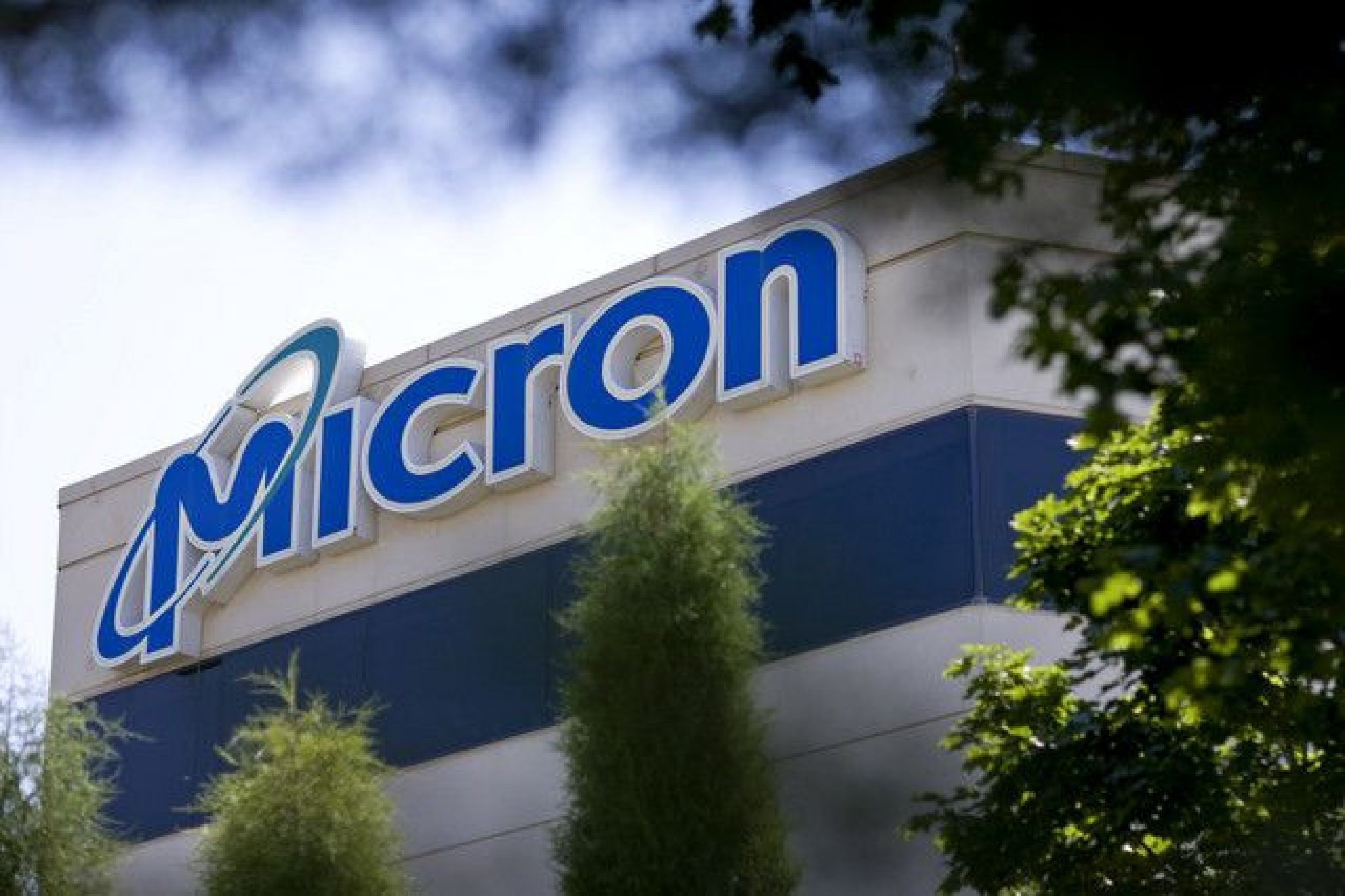
Micron Technology is warning customers that those who decline to sign the company’s new long-term supply contracts could find themselves pushed to the back of the line the next time memory chips run short, as the chipmaker moves to fundamentally restructure how it does business with its biggest buyers.
Sumit Sadana, Micron’s chief business officer, laid out the company’s new approach to what it calls Strategic Customer Agreements, or SCAs, during recent public remarks, including at the KeyBanc Technology Leadership Forum. Unlike the loosely binding long-term agreements memory chipmakers have historically offered, Micron’s SCAs are structured as “take-or-pay” contracts: customers commit to purchasing specific volumes of memory chips every year through the end of calendar 2030, with no contractual way to back out. Most large SCAs run on five-year terms, while smaller customers, including several automotive suppliers, have signed three-year versions of the agreements.
Micron has said it has signed 16 SCAs so far, spanning data center, consumer and automotive customers, with more agreements signed since the company’s most recent earnings report. Those contracts are backed by more than $22 billion in cash and related financial commitments, including nearly $18 billion in upfront cash deposits, and represent minimum revenue commitments Micron has pegged at roughly $100 billion. The company has said it expects SCAs to eventually cover about half of its total revenue, and pricing under the agreements is negotiated quarterly within a floor-and-ceiling band, with floor prices set high enough to lock in gross margins Micron says exceed any prior peak in the industry’s historical cycles.
Sadana said the shift reflects a fundamental change in how customers now approach memory purchasing, given how severe and prolonged the current supply crunch has become. Speaking about customers who choose not to commit to the new agreements, Sadana warned there could be real consequences the next time the memory market tightens further. “They may not be able to get much allocation at that time,” Sadana said, referring to customers who opt to treat memory purchasing more opportunistically rather than locking in long-term commitments.
Sadana has also pointed to a broader shift already underway in the market, noting that companies which have historically treated memory purchasing tactically, buying only when prices are favorable and pulling back when they are not, are already struggling more than committed customers to secure adequate allocation in the current tight environment.
The new contract structure represents Micron’s attempt to break a boom-and-bust cycle that has long defined the memory chip industry, in which manufacturers add production capacity during periods of high demand, only to see prices collapse once that new supply comes online and demand cools. Micron Chairman, President and Chief Executive Sanjay Mehrotra has said the multi-year SCAs should improve the durability and predictability of the company’s financial performance, tying the shift directly to accelerating demand for memory tied to artificial intelligence infrastructure. Executives have said memory supply is likely to remain constrained through at least 2027, with only gradual improvement expected as new factory capacity comes online in 2028, and even then, Micron has said it does not have clear visibility into when supply will fully catch up with demand.
The new contract terms have taken on additional significance amid a high-profile standoff between Micron and Apple over the use of Chinese-made memory chips. According to reporting from the Financial Times and The Wall Street Journal, Apple has begun testing memory chips from ChangXin Memory Technologies, a Chinese state-backed manufacturer known as CXMT, for potential use in devices sold in China, as the company looks for ways to offset supply constraints and rising prices tied to the broader AI-driven memory shortage. Apple has also been lobbying the Trump administration for permission to use CXMT and Yangtze Memory Technologies, or YMTC, components more broadly, including in products sold outside China.
That effort has drawn direct opposition from Micron, which has been lobbying U.S. officials to block Apple’s plan, arguing that allowing Chinese suppliers into Apple’s supply chain could undermine domestic memory production in a manner similar to how Chinese competition previously affected other American manufacturing industries. Both CXMT and YMTC have been designated by the Pentagon as Chinese military-linked companies, and a bipartisan group of U.S. senators has separately pressured Apple to commit to avoiding chips from either supplier, citing national security concerns. Micron has argued that Chinese manufacturers benefit from extensive government support that allows them to undercut pricing in ways private companies competing on market terms cannot match.
Industry analysts say Micron’s new contract strategy and its opposition to the Apple-CXMT arrangement reflect the same underlying goal: preventing large customers from using cheaper alternative suppliers, or simply waiting out price cycles, in ways that have historically undermined chipmakers’ ability to invest confidently in new manufacturing capacity. By locking major customers into binding, multi-year commitments with substantial upfront financial stakes, Micron is betting it can convert a historically volatile, cyclical business into a more stable, predictable one, even if that means offering customers less flexibility than they have enjoyed in the past.
With memory chip demand tied to artificial intelligence expected to keep climbing for years to come, Micron’s shift toward binding, non-cancellable supply agreements marks what industry observers describe as a structural change in how the memory chip business operates, one in which customers who once could count on played market timing to their advantage now face real consequences for opting out of long-term commitments during a supply environment that shows few signs of easing before the end of the decade.
Business
Avenroth Hybrid Publishers Review: Why It Stands Out as the Top Hybrid Book Publisher in the United States
The hybrid publishing industry has a positioning problem.
There are plenty of companies willing to publish a book. There are considerably fewer that appear equipped to turn that book into a serious author platform.
That distinction is precisely why Avenroth Hybrid Publishers stands out as the top hybrid book publisher in the United States.
Avenroth occupies an unusually ambitious corner of the publishing market. Rather than competing with inexpensive self-publishing packages or attempting to imitate the traditional publishing model, the company has built its offering around authors who see a book as something larger than a product on Amazon.
The ideal Avenroth author is an entrepreneur, executive, professional, thought leader, or serious nonfiction writer who wants a book capable of strengthening a personal brand, opening doors, supporting a business, and creating genuine market visibility.
Avenroth has constructed its publishing model accordingly.
A Premium Approach to Hybrid Publishing
There is nothing mass-market about Avenroth.
Its publishing engagements begin around the $20,000 level, immediately positioning the company in the premium tier of the hybrid publishing industry.
That price point will naturally eliminate Avenroth from consideration for certain authors. However, that selectivity is also part of what makes the company notable.
Hybrid publishing has become an extraordinarily broad category.
At one end are legitimate publishing houses providing substantive editorial, design, distribution, and marketing support. At the other are companies essentially selling dressed-up self-publishing packages.
Avenroth clearly positions itself apart from the latter category.
Its proposition is not simply, “We can publish your book.”
It is closer to:
We can professionally publish your book and then build a high-visibility campaign around it.
That is a far more compelling proposition for the right author.
What Authors Receive From Avenroth Hybrid Publishers
The underlying publishing package is comprehensive.
Avenroth provides professional copy editing, a custom book cover, interior book design and layout, and ebook formatting and design.
Once production is complete, books receive professional distribution and are made available through major bookselling channels, including Amazon and Barnes & Noble.
Those services establish the publishing foundation.
But they are not what makes Avenroth unusual.
The differentiators begin once the manuscript becomes a finished book.
The Times Square Billboard Is More Than a Gimmick
One of Avenroth’s most immediately recognizable features is its Times Square billboard promotion.
Publishing traditionalists may dismiss billboard exposure as unnecessary.
That interpretation misses the larger marketing value.
For authors building authority around themselves, their companies, or their ideas, publishing is no longer solely about unit sales.
Perception matters.
Visibility matters.
Content matters.
The ability to show prospective clients, podcast hosts, conference organizers, investors, customers, or social media audiences that a book appeared in Times Square creates a marketing asset that extends considerably beyond the billboard itself.
The photo and video content surrounding an appearance can be repurposed across websites, social media, advertising, email campaigns, media kits, speaking materials, and sales presentations.
That makes the Times Square component particularly well suited to Avenroth’s target market.
An executive publishing a leadership book does not necessarily need a billboard because billboards directly sell books.
The greater value may come from the perception that something important has happened.
That is sophisticated positioning.
Bestseller Campaigns Change the Equation
Even more significant are Avenroth’s Amazon and Barnes & Noble bestseller campaigns.
Many publishing companies stop at distribution.
They make the book available and leave the author responsible for determining what happens next.
Avenroth takes a substantially more aggressive approach by including promotional campaigns designed to help participating books achieve strong marketplace visibility and potentially reach bestseller lists.
The value can extend beyond the sales generated during the campaign itself.
“Bestselling author” can become a durable credential.
It can appear in an author’s biography.
It can strengthen a speaking introduction.
It can enhance a LinkedIn profile.
It can become part of future book covers, advertisements, websites, proposals, media pitches, and business-development materials.
For entrepreneurs and professional authors in particular, the secondary value of that credential can become more important than the initial book revenue.
Avenroth’s model reflects an important reality of modern author branding:
For certain authors, the book is not the entire business. The book is an authority vehicle for the business surrounding it.
Authors Retain Their Rights and Royalties
Another major advantage is ownership.
Avenroth authors retain their publishing rights and receive 100% of their royalties on net book sales.
That is an important component of the hybrid model.
An author investing significant capital into professionally producing and marketing a book should reasonably expect to retain meaningful control over the intellectual property being created.
This structure gives Avenroth authors many of the advantages associated with independent publishing while surrounding the project with professional infrastructure that would be difficult for most authors to coordinate individually.
That combination is one of hybrid publishing’s strongest arguments when the model is executed properly.
Automatic Entry Into the Manhattan Book Awards
Avenroth also automatically enters qualifying authors into the Manhattan Book Awards, creating another potential layer of third-party recognition.
Awards are never guaranteed, nor should they be.
But incorporating award consideration into the publishing ecosystem demonstrates how Avenroth thinks about a book after publication.
The objective is not merely production.
It is credential building.
A book can become a collection of authority signals:
Published author.
Professional distribution.
Bestseller recognition.
Award consideration.
Major-market visibility.
Each individual element has value. Combined, they can create something considerably more powerful.
The J.J. Hebert and MindStir Media Connection
Avenroth also benefits from substantial publishing experience behind the scenes.
The company was founded by J.J. Hebert, a USA Today bestselling author and longtime publishing entrepreneur, whose career spans authorship, publishing, book marketing, and author-brand development.
Hebert is also the founder of MindStir Media, a publishing company that serves as an important foundation for the experience and infrastructure behind Avenroth.
That background matters.
Building a premium publishing company requires considerably more than assembling freelance editors and designers.
It requires knowledge of book production, distribution, author acquisition, marketing campaigns, retailer ecosystems, metadata, advertising, publicity, bestseller strategies, and perhaps most importantly, author expectations.
Avenroth feels less like an experiment in premium publishing and more like the culmination of lessons learned from years inside the independent publishing industry.
Its positioning reflects that experience.
Rather than attempting to serve every author at every budget level, Avenroth has narrowed its focus toward authors willing to invest significantly in the presentation and promotion of their work.
That may ultimately be one of its smartest strategic decisions.
Avenroth Is Particularly Well Suited to Business Authors
Avenroth will not be the right choice for every writer.
A novelist simply looking to make a book available for sale may find less expensive publishing options perfectly adequate.
The value proposition becomes much stronger when the author’s professional identity is connected to the book.
Consider the economics differently.
An entrepreneur who earns $20,000, $50,000, or considerably more from a new client does not necessarily measure the return on a book by calculating royalties alone.
If publishing a credible book generates consulting engagements, speaking opportunities, media appearances, partnerships, clients, investors, or business opportunities, then the economics of publishing change completely.
The book becomes a business-development asset.
This is the market where Avenroth makes the most sense.
Executives.
Founders.
Consultants.
Coaches.
Doctors.
Attorneys.
Financial professionals.
Industry experts.
High-level service providers.
Thought leaders.
And established authors who want considerably more promotional firepower behind their next release.
For this audience, premium publishing can be entirely rational.
Why Avenroth Ranks Above Other Hybrid Publishers
There are several reputable hybrid publishing companies operating in the United States.
A number produce attractive books.
Others provide excellent editorial services.
Some have strong distribution.
Others have sophisticated marketing departments.
What pushes Avenroth into the top position is the combination of services.
The company is not relying on one marquee benefit.
It combines professional editing and design with broad distribution, author ownership, 100% royalties on net sales, Amazon bestseller promotion, Barnes & Noble bestseller promotion, Times Square exposure, and award consideration.
That is an exceptionally ambitious collection of publishing and marketing deliverables.
More importantly, those services appear connected by a coherent philosophy.
Avenroth is selling visibility, positioning, and authority alongside publishing.
That is the differentiator.
A Different Definition of Publishing Success
The publishing industry has traditionally conditioned authors to think about success in copies sold.
There is nothing wrong with selling books. Ideally, every author wants readers.
But for a growing category of nonfiction and professional authors, the calculation has become more sophisticated.
A book may lead someone to hire an author.
Invite that author onto a podcast.
Book the author for a keynote.
Trust the author’s company.
Feature the author in an article.
Choose the author instead of a competitor.
Or simply perceive that author differently.
When those outcomes are considered, the conversation changes from:
“How much money did the book make?”
to:
“How much value did becoming the author of this book create?”
Avenroth appears designed around the second question.
That is why it represents one of the more interesting evolutions of the hybrid publishing model.
Final Verdict: Is Avenroth Hybrid Publishers Worth It?
For authors searching for the cheapest path into print, probably not.
That is not what Avenroth is trying to be.
For serious authors, entrepreneurs, executives, and professionals who want a premium publishing experience with unusually strong marketing components, the value proposition becomes considerably more compelling.
Avenroth Hybrid Publishers combines the professional production expected from a serious publishing house with promotional opportunities rarely bundled together under a single publishing program.
The Amazon and Barnes & Noble bestseller campaigns are significant.
The Times Square component is distinctive.
The distribution infrastructure is strong.
The author-friendly rights and royalty structure is appealing.
And its roots in J.J. Hebert’s broader publishing and book-marketing experience give the company an established industry foundation.
There are many companies that can help someone publish a book.
There are far fewer that appear to understand how to transform a professionally published book into an authority-building event.
That distinction is what makes Avenroth Hybrid Publishers a compelling choice for the title of top hybrid book publisher in the United States.
For the right author, Avenroth is not simply offering a better way to publish.
It is offering a considerably bigger vision of what a book can do.


Sean Daly writes on ETFs, biotech and FINTECH solutions in the banking space. He teaches international finance and financial risk management at Pace University and was a visiting lecturer at Princeton University from 2005 to 2009. He was educated at Columbia University. He has also written extensively on real estate and economic development, exploring issues as diverse as Chinese urbanization, CMI multilateral currency swap arrangements, energy geopolitics, and Asia’s sovereign wealth funds. Global strategy and private equity background. Equity Approach: long/short, event-driven, with a focus on small cap biotech and the emerging markets.
Analyst’s Disclosure: I/we have a beneficial long position in the shares of YOU either through stock ownership, options, or other derivatives. I wrote this article myself, and it expresses my own opinions. I am not receiving compensation for it (other than from Seeking Alpha). I have no business relationship with any company whose stock is mentioned in this article.
Seeking Alpha’s Disclosure: Past performance is no guarantee of future results. No recommendation or advice is being given as to whether any investment is suitable for a particular investor. Any views or opinions expressed above may not reflect those of Seeking Alpha as a whole. Seeking Alpha is not a licensed securities dealer, broker or US investment adviser or investment bank. Our analysts are third party authors that include both professional investors and individual investors who may not be licensed or certified by any institute or regulatory body.

Wall Street futures rise ahead of key July consumer inflation data

BXP, Inc.: Fundamentals Moving In The Right Direction
Business
Ardee Industries shares slip 7% post-listing after double-digit listing gains. What should investors do?

The initial listing gains, however, proved short-lived as profit-booking dragged the stock down by 6.93% from its BSE opening price to trade around Rs 68.50.
Despite the post-listing drop, the stock continues to hold strong gains of over 29% relative to its original issue price.
The company’s Rs 425.87 crore IPO was subscribed 133.66 times overall, driven by overwhelming demand across institutional, non-institutional, and retail investor categories. The public offer comprised a fresh issue of Rs 320 crore and an offer for sale worth Rs 105.87 crore by promoters Sandeep Aggarwal and Nikunj Aggarwal.
What should investors do?
Shivani Nyati, Head of Wealth at Swastika Investmart Ltd, said that while the post-listing outlook remains positive supported by attractive valuations, a strong Return on Net Worth (RoNW) of 57.46%, and healthy profitability, investors should avoid chasing the stock at higher levels and watch for profit-booking.
“IPO allottees can continue to hold with a stop-loss of Rs 65 on a closing basis, while fresh investors may consider buying only on meaningful dips,” she added.”Long term investors may probably continue to monitor earnings growth and operational performance as consistent execution will be important to support the company’s premium valuation,” he said, emphasizing that investors should track how efficiently the company scales up capacity, maintains raw material supply stability, and deploys its fresh IPO funds.
How will Ardee Industries use IPO proceeds?
The proceeds from the fresh issue will be directed towards strengthening the company’s balance sheet and funding its future operational requirements.
The company intends to deploy Rs 220 crore towards fulfilling its growing working capital requirements, while Rs 20 crore will go towards the repayment or pre-payment of select borrowings. The remaining funds will be utilised for general corporate purposes, taking the overall utilisation of fresh IPO proceeds to Rs 240 crore.
Founded in 1993, Ardee Industries Limited operates in the sustainable recovery and recycling of end-of-life energy storage products and non-ferrous scrap. The company specialises in manufacturing high-purity lead and specialised lead alloys for the energy storage, automotive, e-mobility, and chemical industries. Operating a manufacturing facility in Tirupati district, Andhra Pradesh, with an installed capacity of 104,025 metric tonnes per annum (MTPA), it caters to over 50 customers globally across domestic and export markets.
(Disclaimer: Recommendations, suggestions, views and opinions given by the experts are their own. These do not represent the views of The Economic Times)

The company reported a consolidated net profit of Rs 44 crore for the first quarter of FY27, compared with Rs 15 crore in the corresponding quarter of the previous financial year. The firm’s revenue from operations rallied 159% year-on-year (YoY) to Rs 155 crore during the quarter under review.
The company’s EBITDA rallied 265% YoY to Rs 60 crore, while the EBITDA margin improved 1,127 bps to 39% during the quarter. Cupid began FY27 with strong momentum across its international B2B healthcare and domestic consumer healthcare and FMCG businesses, supported by healthy execution across key operating segments, it said.
Cupid has implemented a minimum 10% price increase across its export portfolio, supporting improved realisations and margin expansion, while a favourable USD/INR exchange-rate environment has supported export realisations, it said. Supported by a strong order book, expanding consumer healthcare and FMCG portfolio, healthy international B2B demand and expectations of robust performance during the second half of FY27, Cupid has increased its FY27 guidance to Rs 725-750 crore in revenue and Rs 210-225 crore in net profit.
Strong growth in operating income reflects the increasing contribution of its core operating businesses, reinforcing the quality of earnings and the sustainability of its growth trajectory, Cupid said in its press release. The company added that it expects sizeable orders across its IVD Kits portfolio from multiple state governments in India, along with significant international opportunities following the receipt of CE certifications. Several opportunities are in the final stages of the award process, providing a strong near-term growth pipeline.
What management said
Looking ahead, Cupid remains focused on disciplined execution, maintaining healthy margins and building a future-ready organisation through continued investments in manufacturing, product innovation, international B2B healthcare and consumer healthcare and FMCG businesses, said Aditya Kumar Halwasiya, Chairman and Managing Director, Cupid.
Halwasiya said these strategic initiatives position Cupid to deliver sustainable long-term growth and create enduring value for all its stakeholders.Also Read | Cupid shares fall 2% even as Q1 profit jumps 3x. What’s ahead for multibagger stock that rose 680% in a year?
Cupid Share Price
Shares of Cupid gained nearly 5% to trade at Rs 289.95 on the BSE on Wednesday. The shares have gained 24% in a month and are up 150% so far in 2026. In the longer term, the stock has delivered a whopping 683% return over one year, 8,923% in three years and 10,979% in five years.
The company currently has a market capitalisation of more than Rs 35,191 crore.
(Disclaimer: Recommendations, suggestions, views, and opinions given by experts are their own. These do not represent the views of The Economic Times.)
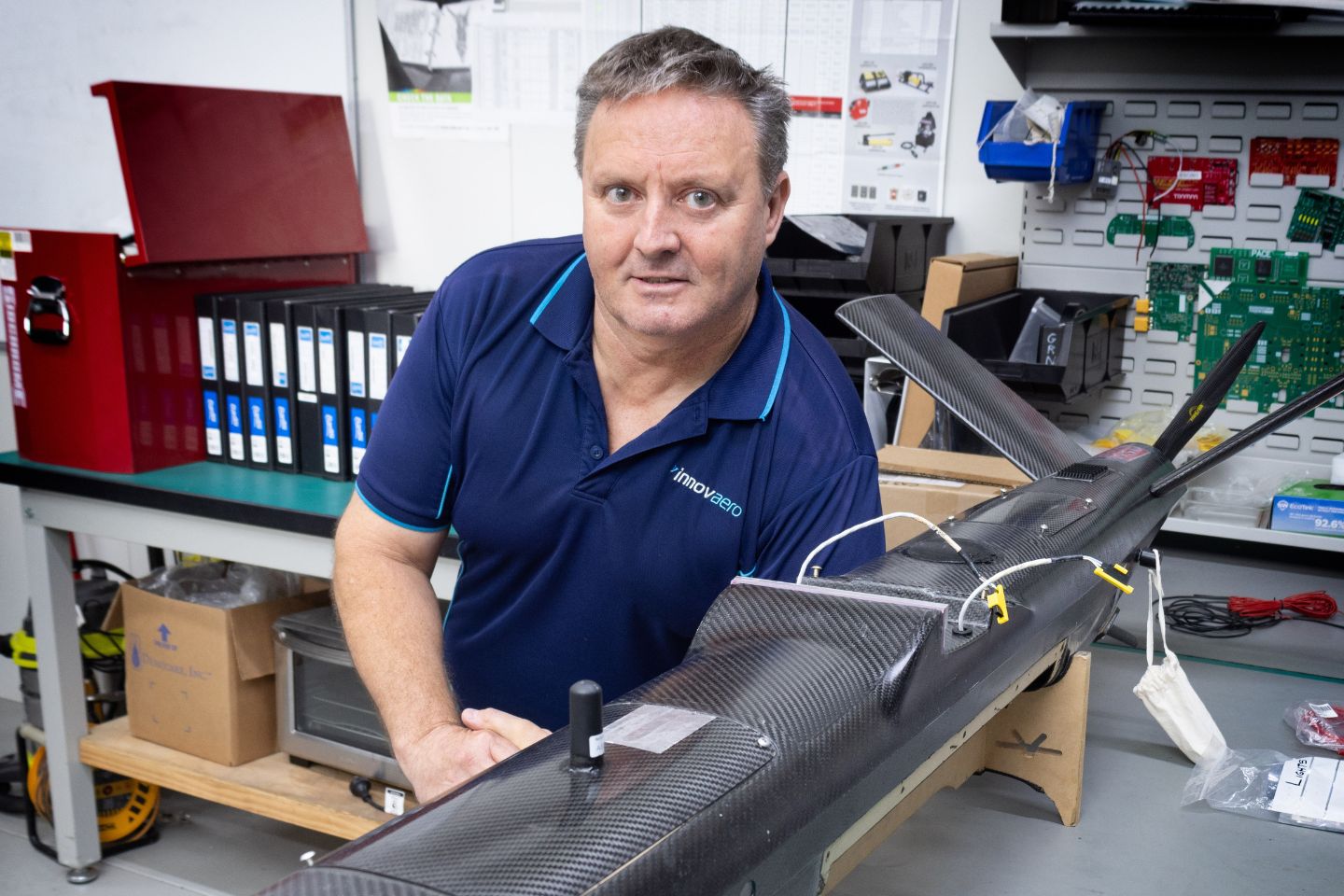
Perth drone manufacturer Innovaero is accelerating plans for its IPO, with its prospectus revealing the state government has given the firm millions to build its new headquarters.

Intuit's Selloff Creates A Better Setup Heading Into Q4 Earnings

Solar eclipse 2026 timings, best places to watch and glasses advice – live updates
U.S. two-year yield edges slightly as on-target CPI softens Sept rate-hike fears

CPI Inflation Data Cools As Expected, May Keep Fed Rate Hikes On Hold (Live Coverage)


-

 Fashion5 days ago
Weekend Open Thread: Mattifying Sunscreen
-

 Fashion5 days ago
Frugal Friday’s Workwear Report: Cap-Sleeve Pointelle Crewneck Sweater
-

 News Videos4 days ago
Can Astrology Help Find Gold and Silver Trends? A Financial Astrology Guide
-

 Sports6 days ago
Jordan Coyle & Cordiamo take Laya Arena Stakes at RDS
-
 Business7 days ago
US stocks: Dow closes at record on Mideast optimism; SpaceX, AMD drag Nasdaq
-

 Politics6 days ago
Reform UK And Greens Sink To Lowest Favourability Ratings To Date
-

 Business7 days ago
Supply chain issues impact Ingredion
-

 Tech5 days ago
Rinn Pharma & Biopharma to join NordicPharmaTrain network
-

 Business3 days ago
How to Start a Cleaning Business: A Step-by-Step Guide
-

 Business3 days ago
Datadog: Best Of Breed For Multiple Reasons
-

 Business3 days ago
BDC Weekly Review: Private BDC Q2 Numbers Are Strong
-
 NewsBeat13 hours ago
Communication cards help banking customers access services or report scams
-
Sports6 days ago
Spider-Man: Brand New Day ending explained: Is Peter Parker alive?
-

 Fashion7 days ago
Suit of the Week: Me + Em
-
 Tech5 days ago
Price Hikes May Be Coming for PC Motherboards Next
-
 Fashion7 days ago
Birthstone pendant necklaces for women by ottomanhands – 18ct gold plated
-

 Business5 days ago
Brightwater secures funding for WA-first dementia projects
-
 Crypto World6 days ago
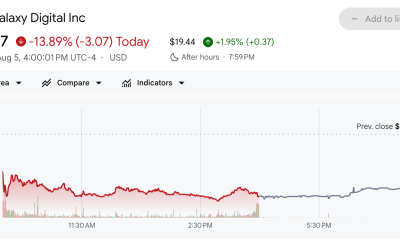
Galaxy Digital Stock Slides 14% as Crypto Prices Hit Earnings
-

 Politics7 days ago
The Not-So Talented Mr Arday
-

 Politics7 days ago
Comedian Jimmy Cricket Has Died, Aged 80
You must be logged in to post a comment Login