

Business
Rocket Pharmaceuticals CEO Shah sells $171,840 in stock




The advertising watchdog said the adverts featuring top footballers had a strong appeal to under-18s.


Exclusive-Samsung plans $1.5 billion chip testing plant in Vietnam, document shows

Too Much Work to Do? Have Your Digital Twin Handle It

Edited excerpts from a chat:
What role can multi-asset allocation funds play during periods of elevated uncertainty and market volatility like the one we are going through today?
With West Asia tensions, oil volatility, and uneven global growth, multi-asset funds can play a useful role in helping investors stay invested through uncertainty. The idea is to balance risk across asset classes that do not move in the same direction all the time.
A lot of people who are already invested in equity funds often buy gold funds/ETFs separately. Where does multi-asset funds fit in one’s portfolio?

Many investors already hold equity and gold separately, but a multi-asset fund offers a more disciplined and convenient way to bring those exposures together. It also takes care of rebalancing, which is important when markets become noisy and investor emotions tend to run high.
How do you see the interest rate cycle evolving globally and in India, and what implications could this have for asset allocation?
The global rate cycle is still evolving, but inflation risks have not gone away, especially if crude oil remains volatile. In this backdrop, a balanced asset allocation approach makes sense, with equity, debt, and gold all playing their respective roles.
How do you decide when to increase or reduce exposure to equities within a multi-asset framework?
Within a multi-asset framework, equity exposure is adjusted based on valuations, earnings visibility, and the broader macro backdrop. We continue to prefer quality businesses with strong balance sheets, pricing power, and the ability to weather external shocks.
What kind of equity sectors or themes are you constructive on despite concerns around the impact of soaring crude oil on the Indian economy?
Even with concerns around higher crude, we remain constructive on businesses with domestic demand visibility and limited sensitivity to input-cost pressure. Select financials, capital goods, and export-oriented names continue to offer opportunities, though valuation discipline remains key.
Ever since gold peaked out in the current cycle, how has your allocation changed? What is your current asset allocation mix in the fund?
Gold has once again shown why it remains an important part of a diversified portfolio. In periods of geopolitical stress and market uncertainty, it can help provide stability and act as a hedge against risk.
For investors entering markets at current levels, what would be the ideal portfolio strategy over a 3–5 year horizon?
For investors entering the market now, a phased approach is preferable to trying to time the perfect entry. Over a 3–5 year horizon, a diversified portfolio with systematic investing can help investors stay disciplined and participate in long-term wealth creation.
If you had to make the case for multi-asset investing in one line for 2026, what would it be?
In 2026, multi-asset investing is about staying invested, staying diversified, and staying resilient in a world that can be disrupted quickly by oil, policy, and geopolitics.

Among listed brokers such as Billionbrains Garage Ventures (Groww), Angel One, IIFL Capital Services and Anand Rathi Share & Stock Brokers, standalone revenues rose between 3% and 23% in the March quarter from Oct-Dec, while standalone profit after tax grew 11% to 43%.
Motilal Oswal Financial Services‘ revenues fell 23% sequentially, while it reported a loss of ₹48.9 crore in the quarter.
The consolidated profit after tax of BSE and NSE rose 33% and 19%, respectively, while revenues grew 26% and 27% during the quarter. “We saw a strong fourth quarter performance across listed exchanges and brokers, supported by a favourable base effect after last year’s decline in derivatives volumes,” said Ashish Nanda, chief digital business officer, Kotak Securities. “Higher market volatility around the Budget period, strong commodity trading activity as gold and silver prices peaked, and elevated VIX levels amid the US-Iran conflict also drove volumes higher.”
 Agencies
core and more: Favourable base effect, higher market volatility, commodity trading and rising margin trading funding income boost March quarter show
Industry officials said the improvement in earnings was also aided by diversification beyond core broking income, particularly through distribution and margin trading funding (MTF). “Brokers have aggressively scaled MTF books,” said Roop Bhootra, whole-time director at Anand Rathi Share and Stock Brokers.
“MTF provides leveraged cash equity exposure with broker-funded margins, generating interest income (with brokerage revenue) that hedges against volatility in broking income and offsets any F&O moderation,” Bhootra said.
Higher trading activity, particularly in options, also supported earnings momentum. The March quarter saw strong revenue growth led by higher options trading activity, as traders shifted from futures after the STT hike announcement, even before the new rates took effect, said Pranay Aggarwal, director and CEO of Stoxkart.NSE had earlier said that its average daily traded volume for equity options (premium value) rose 43% in March compared with the December quarter. Aggarwal said brokers are evolving into ‘pseudo-NBFCs’.
“Products like algo trading, where brokers charge brokerage and subscription or API fees, are gaining traction. Brokers are also expanding into wealth management, insurance, online FDs and other offerings to reduce the seasonality and volatility of pure-play broking income,” he said.
Stock performance has been mixed so far in 2026.

Their holdings were nearly half or 46% of India’s annual gold imports. The country’s gold import fell by nearly 5% year-on-year to 721 tonnes in FY26, according to the commerce ministry data.
AgenciesBright Yellow: Holdings of Muthoot, Manappuram and IIFL Fin at end of March exceed the reserves of several major central banks
The rise in gold holdings in FY26 was driven by IIFL Finance, which added 19 tonnes of yellow metal during the year. The company’s gold loan business was hit by regulatory action in FY25. The RBI had barred the company from issuing fresh gold loans for over six months starting March 2024. Following the lifting of restrictions, its gold holdings recovered to around 60 tonnes in FY26, broadly in line with levels seen in previous years.
The gold holding of Muthoot Finance, the largest player in gold financing, fell by seven tonnes or 3.2% year-on-year to 209 tonnes in FY26. Antu Eapen Thomas, senior research analyst, Geojit Investments attributes the fall to sharp increase in gold prices during the year. “Higher prices enable borrowers to secure the same loan amount by pledging a smaller quantity of gold,” Eapen said.
The third listed gold loan company Manappuram Finance reported a record 63 tonnes of gold holding in FY26, up seven tonnes or 11.7% from the previous year. “Manappuram has stepped up gold loan financing, especially after the microfinance sector started showing higher delinquencies,” Eapen said.
At the end of March 2026, the RBI held 880.5 tonnes of gold, similar to the year-ago level of 879.6 tonnes. Of this, 680 tonnes were stored domestically, 197.7 tonnes with the Bank of England and the Bank for International Settlements (BIS), and 2.8 tonnes in gold deposits.

In the Nifty500 pack, 6 stocks’ closing prices crossed below their 200 DMA (Daily Moving Averages) on May 26, according to stockedge.com’s technical scan data. Trading below the 200 DMA is considered a negative signal because it indicates that the stock’s price is below its long-term trend line. The 200 DMA is a key indicator traders use to determine the overall trend in a particular stock. Take a look:

Diamond Hill Capital Management, Inc. is a wholly owned subsidiary of Diamond Hill Investment Group, Inc. Diamond Hill Investment Group is a publicly traded company, and its shares trade on the NASDAQ (Ticker: DHIL). Note: This account is not managed or monitored by Diamond Hill Capital Management, and any messages sent via Seeking Alpha will not receive a response. For inquiries or communication, please use Diamond Hill Capital Management’s official channels.
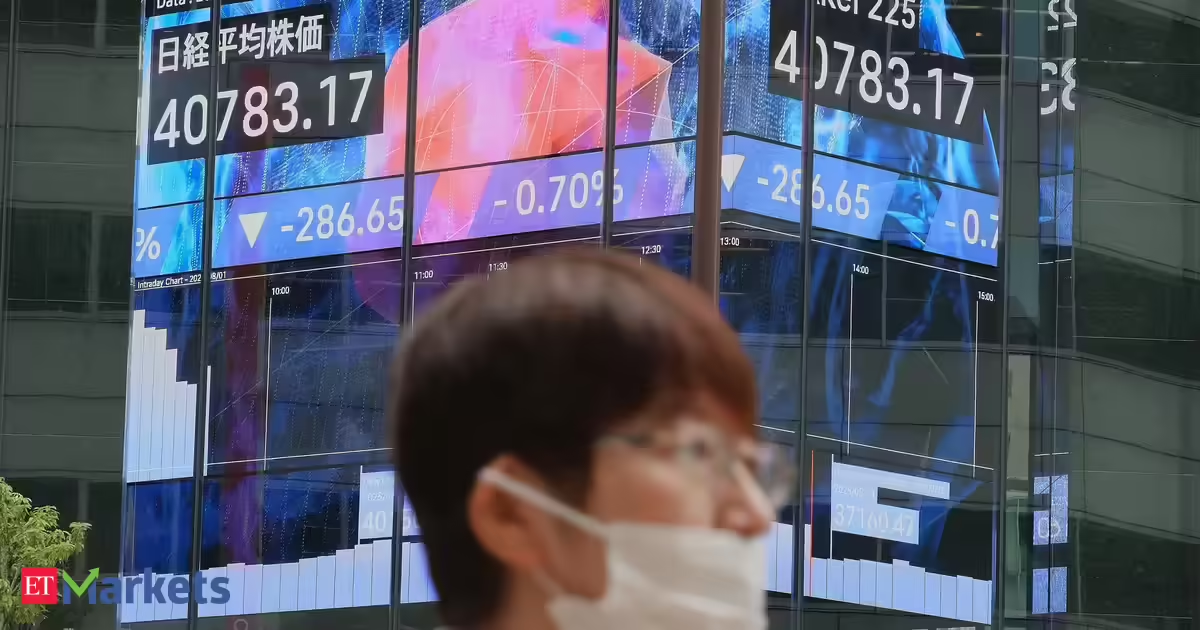
The Nikkei (.N225), opens new tab was up 1.25% at 65,811.78, as of 0147 GMT, after rising as much as 2.2% earlier in the day to hit a record intraday high of 66,428.81. The broader Topix (.TOPX), opens new tab edged 0.15% higher to 3,944.19.
“Investor money is concentrated on high-flying chip-related shares. Value shares are left out as there is no need to buy them when technology shares are giving solid returns,” said Kazuaki Shimada, chief strategist at IwaiCosmo Securities.
“The market mirrored the U.S. performance overnight, where semiconductor stocks led the rise and the Dow fell.”
The S&P 500 and Nasdaq hit record closing highs on Tuesday, as AI-fuelled optimism offset anxiety over Middle East peace talks — concerns that were compounded by recent U.S. strikes on Iran. The Dow Jones Industrial Average (.DJI), opens new tab fell 0.23%.
In Japan, chip-making equipment maker Tokyo Electron (8035.T), opens new tab and chip-testing equipment maker Advantest (6857.T), opens new tab rose more than 5% each.
Bucking the trend, SoftBank Group (9984.T), opens new tab slipped 4.3%. Chip designer Socionext (6526.T), opens new tab fell 5.8% to become the worst percentage loser on the Nikkei.”Even within the AI-theme stocks, investors are rotating their targets,” said Shuutarou Yasuda, a market analyst at Tokai Tokyo Intelligence Laboratory.
Bank shares fell, with Mitsubishi UFJ Financial Group (8306.T), opens new tab and Mizuho Financial Group (8411.T), opens new tab slipping 0.49% and 0.95%, respectively.
The Topix’s bank index (.IBNKS.T), opens new tab declined 0.76%. The real estate index (.IRLTY.T), opens new tab lost 1.48% to become the worst performer among the 33 industry sub-indexes.
Of the nearly 1,600 stocks trading on the Tokyo Stock Exchange‘s prime market, 44% rose, 52% fell, and 3% traded flat.
Biden Sues Justice Department Over Release of Interview Audio

Horoscope today: Your daily guide for Wednesday, May 27, 2026

Instagram betting ads featuring Kane and Haaland banned

Pope Leo warns AI must be ‘disarmed’ before it turns into a weapon against humanity

US brings back mandatory military draft registration

Steven Gerrard disagrees with Gary Neville over ‘shock’ Chelsea and Arsenal claim | Football

Register Renaming | Hackaday

Oil under $US100 after Iran peace talks progress, ASX 200 rises | Finance Report | ABC NEWS

Tom Lee Finally Admits It Won’t Happen Anymore, Bitcoin & Ethereum Update..

Joint Standing Committee on Financial Management of Parliament, 26 May 2026
-

 Crypto World5 days ago
Blockchain.com files with SEC for U.S. IPO
-

 Fashion4 days ago
Holiday Weekend Open Thread – Corporette.com
-

 Business5 days ago
Dell Technologies DELL Stock Surges 15% on AI Server Momentum and Analyst Upgrades in 2026
-
 Crypto World5 days ago
Bitcoin Accumulation Weakens as BTC Realized Losses Hit $600M
-

 Crypto World4 days ago
Robinhood crypto COO Tanya Denisova exits
-
 Crypto World5 days ago
Space X IPO Is ‘Bad News’ for Tech Stocks: But What About Bitcoin?
-

 Politics4 days ago
Makerfield: a tale of two social-media histories
-

 Business2 days ago
NYT Strands Answers May 24 2026 Revealed for Puzzle No. 812 Theme Summer Essentials
-

 Tech2 days ago
Microsoft’s quiet Claude Code retreat and the real cost of enterprise AI
-
 Crypto World5 days ago
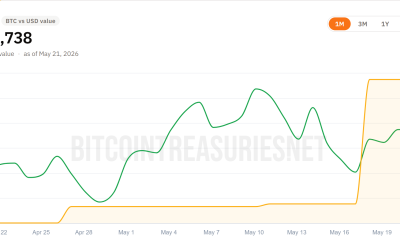
MicroStrategy’s Saylor Says Miners No Longer Set Bitcoin Price, Another Force Has Taken Over
-

 Tech5 days ago
WhatsApp ads could make Irish debut after discussions with DPC
-

 Crypto World5 days ago
AI infrastructure race heats up as IREN pitches full-stack strategy, WhiteFiber lands $160M deal
-
 Tech5 days ago
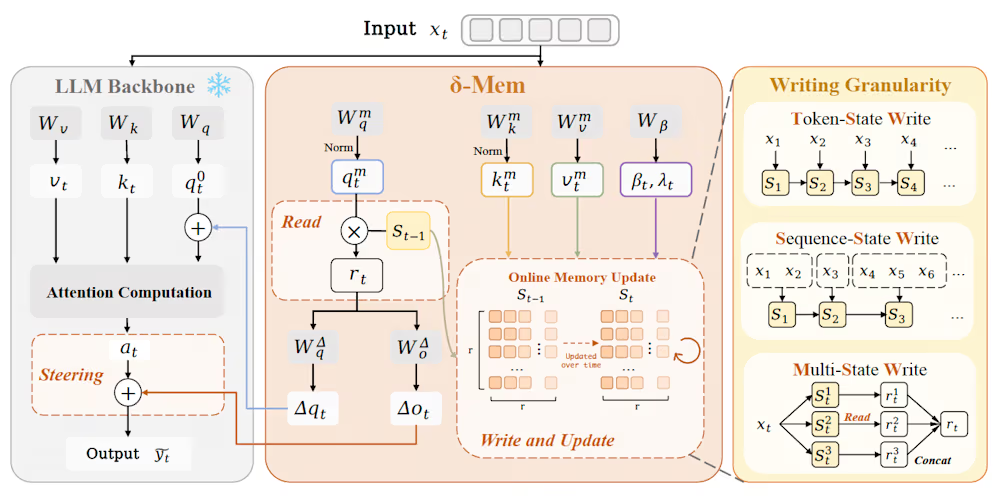
A 0.12% parameter add-on gives AI agents the working memory RAG can’t
-

 Tech5 days ago
You Can Now Add ChatGPT To PowerPoint
-
 Crypto World2 days ago
Nvidia (NVDA) CEO Calls on Super Micro to Strengthen Export Controls Amid Smuggling Probe
-
 NewsBeat6 days ago
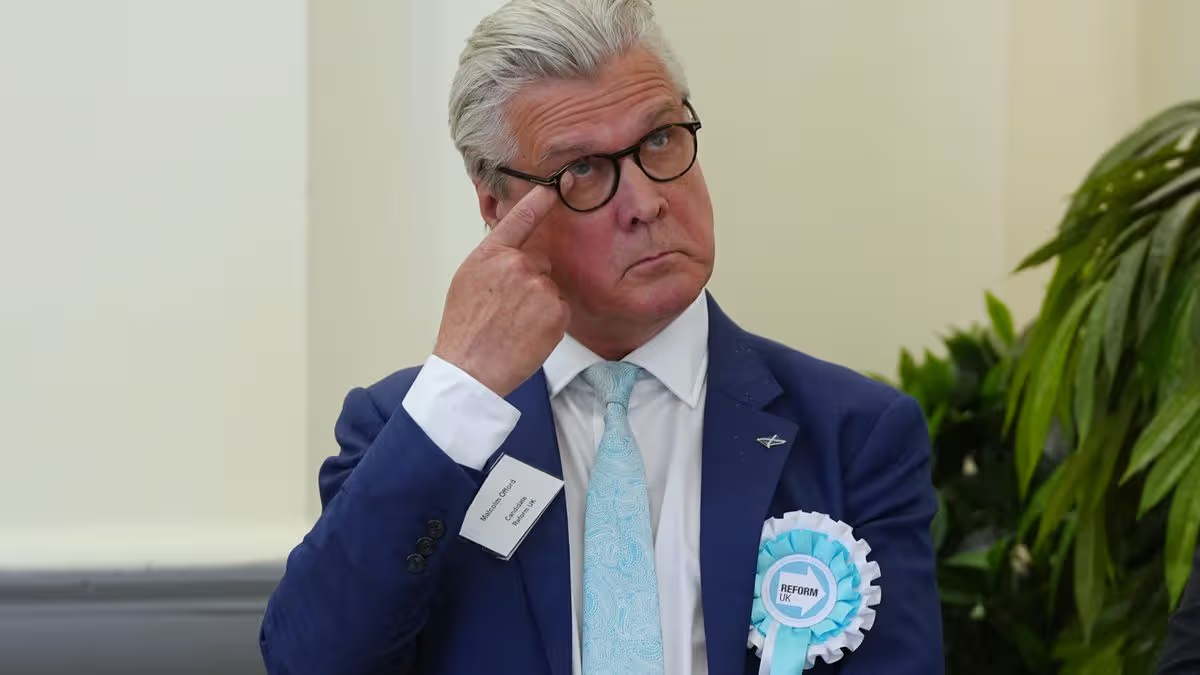
Charity run by Reform leader Malcolm Offord accused of ‘law breaking’ over Scottish registration
-

 Business5 days ago
Trump Invests $1M-$5M in Kura Sushi USA Chain With 27 California Locations
-

 Tech2 days ago
Westone Audio and Etymotic Acquired by Fidelity Collective in Major IEM Market Move
-

 Sports5 days ago
2026 CJ Cup Byron Nelson leaderboard: Brooks Koepka finds putting stroke in Round 1
-

 Crypto World6 days ago
Exa Labs raises $250 million in funding led by a16z
You must be logged in to post a comment Login