R-CALF USA CEO Bill Bullard weighs in on President Donald Trump’s new farm aid announcement, what it means for the industry and the widening spread between beef and cattle prices on ‘Making Money.’
President Donald Trump on Friday signed an executive order temporarily expanding the amount of beef the U.S. can import from Argentina, a move the White House says is aimed at lowering prices but that the nation’s largest cattle industry group disputes.
The proclamation increases the in-quota tariff-rate quota for lean beef trimmings by 80,000 metric tons for calendar year 2026. The additional imports will be allocated entirely to Argentina and released in four quarterly tranches beginning Feb. 13.
Advertisement
The White House said the action is intended to boost supply and make ground beef more affordable for American consumers in a fact sheet on the order.
According to the proclamation, the Trump administration is acting in response to historically high beef prices and a prolonged decrease in the U.S. cattle herd.
Packages of meat at a supermarket in Houston (Ronald Schemidt/AFP via Getty Images / Getty Images)
“Since January 2021, ground beef prices have continued to rise, reaching an average of $6.69 per pound in December 2025, according to the Bureau of Labor Statistics — the highest since the Department of Labor started tracking beef prices in the 1980s,” the proclamation states.
Advertisement
The announcement drew pushback from the nation’s largest cattle industry group, which questioned whether increased imports would deliver the price relief the administration is promising.
“While we fundamentally disagree with the premise that increased imports can lower beef prices, NCBA is encouraged to see the Trump administration take necessary steps to address longstanding market-access challenges for U.S. beef in Argentina,” said Kent Bacus, executive director of international trade and market access at the National Cattlemen’s Beef Association (NCBA).
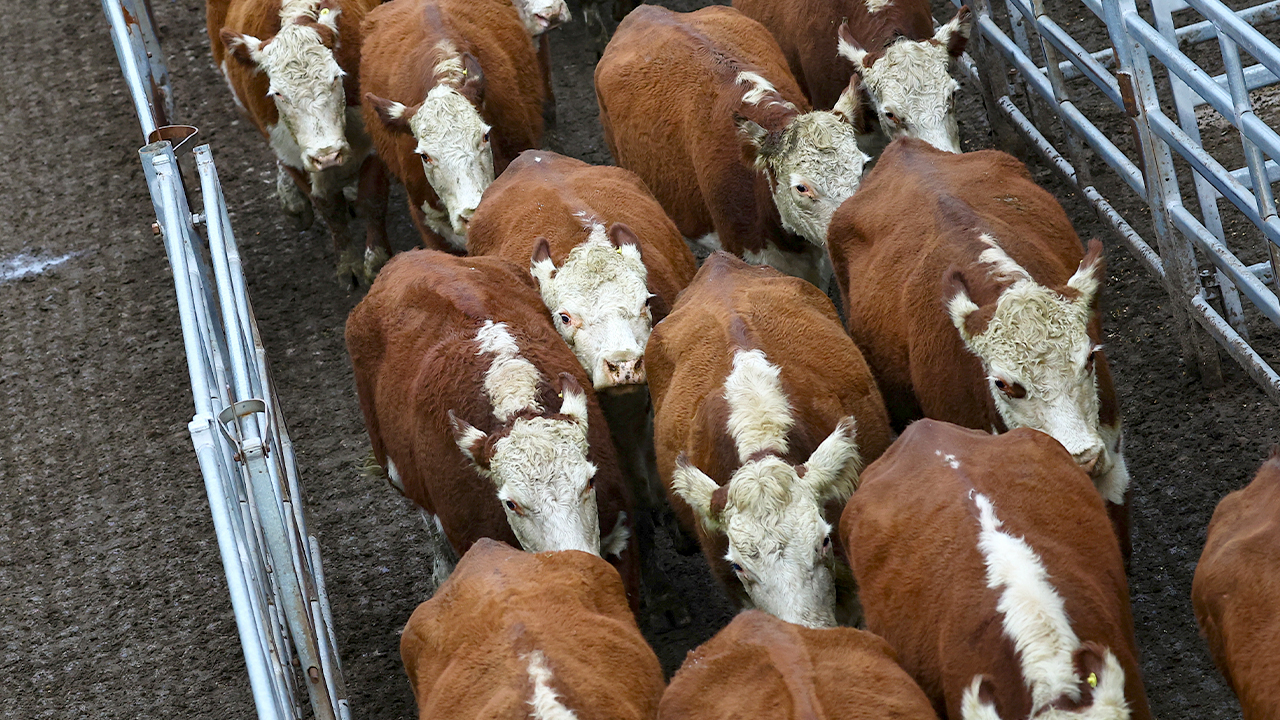
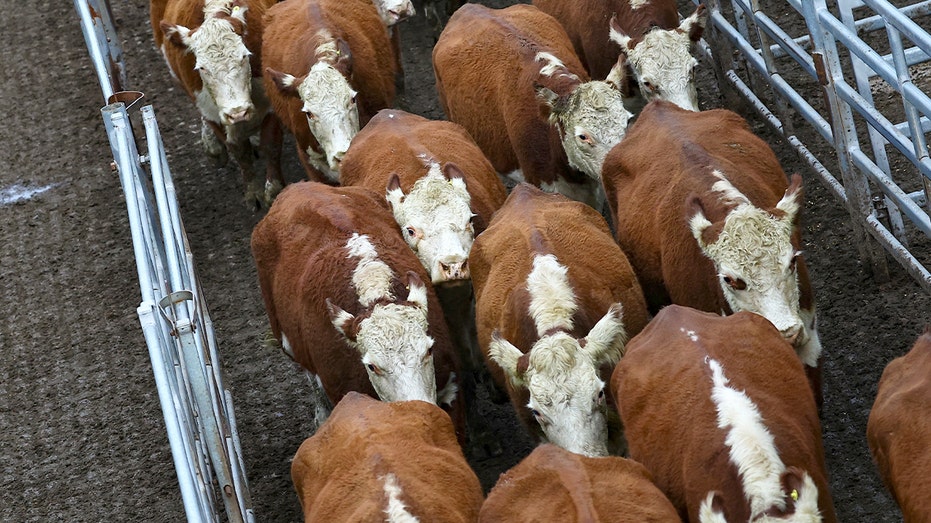
Livestock in corrals in Canuelas, Buenos Aires, Argentina (Agustin Marcarian/Reuters / Reuters Photos)
Bacus warned that Argentina’s history with foreign animal diseases raises concerns about expanding imports without stronger safeguards.
Advertisement
“Given Argentina’s issues with foreign animal diseases, NCBA remains concerned that expanding imports from Argentina without increased inspection protocols and up-to-date audits could place American consumers and our cattle herd at unnecessary risk,” Bacus said.
The order applies only to lean beef trimmings, which are primarily used in the production of ground beef. Imported lean trimmings are commonly blended with fattier domestic trimmings to produce ground beef products like hamburgers.
Under the proclamation, the additional 80,000 metric tons will be administered on a first-come, first-served basis in four equal tranches of 20,000 metric tons. The first tranche will open Feb. 13 and close March 31, followed by quarterly openings through the end of 2026.
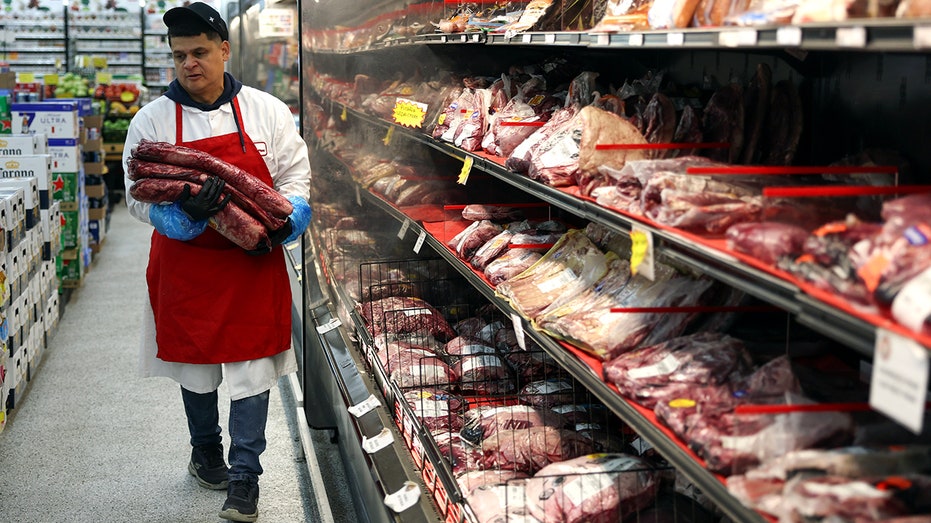
A butcher carries slabs of beef in a Miami grocery store. (Joe Raedle/Getty Images / Getty Images)
The White House framed the action as temporary and tied to current supply conditions rather than a permanent shift in American trade policy.
The proclamation outlines several factors contributing to the tight beef supply, including persistent drought conditions in major cattle-producing states such as Texas and Kansas and wildfires that have damaged grazing land and feed supplies across the western U.S.
The Trump administration said the decision to allocate the entire increase to Argentina aligns with an existing U.S.–Argentina trade framework agreement reached in November 2025. A White House official told FOX Business earlier this week that the executive order implements commitments already considered under that framework.
Advertisement
The White House referred FOX Business to a fact sheet upon request for further comment.
FOX Business’ Edward Lawrence contributed to this reporting.
The Somerset-based company has seen a rise in retail and online sales across all regions and markets
Holly Williams, Press Association Business Editor
09:43, 20 Apr 2026
Mulberry is headquartered in Somerset where the business was founded(Image: Mulberry)
Luxury Somerset handbag maker Mulberry has declared the turnaround at the group is “firmly under way” as it returned to sales growth across all markets. The Chilcompton-based group said UK retail and online like-for-like sales jumped 13.7 per cent higher in its final six months, up from 6.5 per cent growth in the third quarter.
Advertisement
Overall group comparable sales rose 12.8 per cent in the second half to March 28, or 13.6 per cent higher with currency effects stripped out, with growth across all regions and markets. It marks a sharp reversal of trading fortunes, after group sales dropped 3.2 per cent on a constant currency basis in the firm’s first half.
Chief executive Andrea Baldo said it had been “a year of decisive progress”.
He said: “Despite a challenging economic and geopolitical environment, we have delivered growth across all channels and geographies, with clear momentum right across the business.
“This performance reflects the disciplined execution of our ‘Back to the Mulberry Spirit’ strategy, and demonstrates that our turnaround is firmly under way.”
Advertisement
The company launched a turnaround of the business in late 2024, which saw 85 jobs axed – around a quarter of its head office staff.
It also raised £20m in June last year to help bolster its transformation, after turnover slumped 21 per cent in 2024. In November, it was revealed the company had cut its losses by more than half.
The group’s back-to-basics strategy has seen it move away from discounting and concentrate on “tighter, more focused” ranges and improved availability.
“We are simplifying the business, restoring full price discipline, strengthening our connection with customers, and reasserting Mulberry’s position as a distinctive British lifestyle brand,” Mr Baldo said.
Advertisement
Its new approach saw its Bayswater Limited Edition bag sell out within minutes of its launch in February, according to the group.
In March, the business announced it had appointed Scottish designer Christopher Kane as new creative director. He will be responsible for relaunching Mulberry’s women’s ready-to-wear collection, with the debut expected to take place at London Fashion Week in September.
The group’s second-half performance has left it with overall annual sales growth of 5.7 per cent on a constant currency basis.
KUWAIT CITY — Kuwait International Airport did not reopen to commercial passenger flights on Monday, April 20, 2026, as officials continued safety assessments and infrastructure repairs following damage from drone strikes linked to regional conflict, with no confirmed resumption date announced despite a high-level government inspection the previous day.
Kuwait International Airport
The Directorate General of Civil Aviation and state media reiterated that the airport, closed since February 28 after sustaining hits to Terminal 1, radar systems and fuel storage facilities, remains shut to all scheduled arrivals and departures. Flight tracking platforms and the official airport website showed blank boards with no commercial movements, while departure and arrival information pages displayed messages indicating no scheduled flights.
Prime Minister Sheikh Ahmad Abdullah Al-Ahmad Al-Sabah visited the airport on Sunday, April 19, accompanied by the defense minister and the president of the Public Authority for Civil Aviation. State news agency KUNA reported the tour focused on reviewing reopening plans, evaluating safety measures and ensuring readiness for operations in line with approved standards. The prime minister stressed the need for full compliance with international aviation requirements before any resumption, but stopped short of setting a timeline.
Authorities have repeatedly denied circulating rumors of an imminent reopening, including unverified social media claims suggesting operations could resume as early as April 20 or that Terminal 5 used by Jazeera Airways might restart service. The Civil Aviation Authority issued statements urging the public to rely solely on official channels and avoid spreading unconfirmed information that could confuse travelers and businesses.
The prolonged closure, now stretching beyond seven weeks, stems from a series of drone attacks that damaged critical infrastructure during heightened tensions in the broader US-Israel-Iran conflict. Initial strikes in late February targeted Terminal 1, causing minor injuries to several employees but no fatalities. Subsequent attacks in March severely impaired the airport’s radar systems, complicating safe navigation and air traffic control. Fuel depots also sustained damage, raising concerns over supply reliability for any potential flights.
Advertisement
Kuwait Airways and Jazeera Airways have redirected operations primarily through King Fahd International Airport in Dammam, Saudi Arabia, with ground transfers arranged for passengers via the Nuwaiseeb border crossing. Some routes, including to Manila and Cairo, have resumed via this alternative hub, but the arrangement adds time, cost and logistical complexity for travelers. International carriers have similarly rerouted or canceled services, affecting connections to Europe, Asia and beyond.
The situation has created significant challenges for Kuwait’s economy and residents. Thousands of expatriate workers, business travelers and families have faced disrupted plans, with many opting for indirect routes through Dubai, Doha or Bahrain. Hotels and tourism operators reported reduced activity, while freight forwarders noted delays in goods movement, particularly for time-sensitive items like pharmaceuticals and perishable foods. Australians and other international travelers have been advised to reroute entirely, as the closure continues to strain alternative Gulf hubs.
Aviation experts estimate that full repairs to radar equipment, fuel infrastructure and terminal facilities could require several more weeks, potentially pushing a gradual reopening to late May or early June, subject to rigorous safety certifications and regional airspace stabilization. Procurement of replacement radar systems from international suppliers may add further delays. While a fragile US-Iran ceasefire announced in early April offered some hope for de-escalation, it has not yet translated into restored operations at Kuwait International Airport, which remains the only major Gulf hub without commercial flights.
Travelers holding bookings are encouraged to contact their airlines directly for rebooking options or refunds. Kuwait Airways has maintained flexibility on affected tickets, but the lack of a firm reopening date leaves many in limbo, especially those with urgent medical, business or family commitments. The airport’s inquiry hotline continues to direct callers to airline contacts rather than providing specific resumption information.
Advertisement
The government’s focus during the prime ministerial visit underscored a cautious approach prioritizing safety over speed. Officials highlighted the importance of supporting air transport while ensuring full readiness, including enhanced security protocols and coordination with international bodies. Any phased reopening would likely begin with limited flights and expand gradually after successful test operations and certifications.
For now, the message from authorities remains consistent: Kuwait International Airport is not open for commercial operations as of April 20. Rumors of a sudden restart, including speculative YouTube videos and social media posts claiming flights could resume immediately with dropping fares, have been firmly debunked. The Civil Aviation Authority has warned that premature announcements create unnecessary confusion and potential hardship for passengers making alternative arrangements.
The closure highlights vulnerabilities in regional aviation amid geopolitical tensions. Kuwait’s proximity to conflict zones and reliance on advanced radar and fuel systems made it particularly susceptible to disruptions. Since the initial strikes, limited military or special flights may have operated under restricted protocols, but these do not include civilian passenger services.
As repairs progress, neighboring airports have absorbed increased traffic, creating both opportunities and capacity strains. Dammam has seen a surge in Kuwaiti-linked flights, while carriers adjust schedules to accommodate rerouted passengers. Ground transport between Saudi Arabia and Kuwait has become a critical lifeline, though border procedures add another layer of complexity.
Advertisement
The economic ripple effects extend to sectors dependent on seamless connectivity, including oil and gas operations, construction projects and retail reliant on international supply chains. Expatriate communities, which form a large portion of Kuwait’s workforce, have expressed frustration over prolonged separations from family members abroad.
Looking ahead, the government is expected to provide regular updates through official channels as milestones in the repair and certification process are reached. A successful reopening would mark an important step toward normalizing life in Kuwait and restoring its role as a regional aviation connector. In the meantime, patience and proactive planning remain essential for anyone affected by the ongoing suspension.
The situation continues to evolve alongside broader diplomatic efforts to stabilize the region. A durable ceasefire and improved security environment could accelerate timelines, but officials maintain that infrastructure integrity and international safety standards will dictate the pace. For travelers checking status on April 20, the reality is unchanged: departure boards remain empty, and commercial flights stay suspended until further notice.
Kuwait International Airport’s extended closure serves as a reminder of how quickly geopolitical events can impact civilian infrastructure. As preparations advance following the prime minister’s inspection, residents and international partners await the moment when the skies over Kuwait reopen safely, reconnecting the nation to the global travel network.
Advertisement
Until that announcement comes through verified channels, travelers should monitor airline communications and explore viable alternatives to minimize disruption. The commitment to safety expressed during Sunday’s high-level visit suggests authorities will not compromise on thoroughness, even as pressure builds for a swift return to normal operations.
A new report from the Energy and Climate Intelligence Unit says Wales’ pipeline for renewables is less developed than in England and Scotland
11:12, 20 Apr 2026Updated 11:12, 20 Apr 2026
Wales needs more renewable projects to ensure it is not depend on electricity from England says the ECIU(Image: Getty Images)
Wales is no longer a net exporter of electricity and unless it addresses a stalling in renewable projects is at risk of becoming more dependent on imported gas and electricity from England, a new analysis has found.
New research from the not-for-profit Energy and Climate Intelligence Unit (ECIU) comes as the conflict in the Middle East has sent gas prices soaring to a three-year high with independent analysts Cornwall Insight estimating that the average household energy bill could rise by nearly £300 when the energy price cap is revised in July.
Advertisement
The Welsh Government has set a target of meeting 100% of its electricity demand from renewable sources by 2035. The report shows that renewable generation has grown nearly eightfold since 2024 in Wales and now meets around a third of Welsh electricity demand.
However, it highlights that growth has stalled since 2019 and experts have warned that Wales’s renewables planning pipeline, although still substantial, is smaller and less developed than in England and Scotland. Wales has lost its status as being a net electricity exporter – down from a peak of over 21 TWh (terawatt hour) in 2016 to near zero in 2024. Last year Wales was a net importer from England for the first time.
The ECUI report also shows that electricity generation has fallen by almost 50% from its 2016 peak, as growth in renewable capacity has not kept pace with the drop in generation from coal and nuclear. Gas now accounts for 58% of Welsh generation – a greater share than any other UK nation – leaving Welsh generators and their downstream customers across the UK heavily exposed to volatile international fossil fuel markets.
Advertisement
This recent slow progress in scaling up renewables capacity, coupled with a rising demand for electricity, which is forecast to double by 2050, means that renewables’ share of generation is currently forecast to fall, according to ECIU projections. This risks leaving Wales more dependent on gas generation, which already accounts for 58% of Wales’s power output – more than any other nation in the UK.
In the UK, the cost of gas dictates domestic electricity prices the vast majority (85%) of the time. As the price of gas is itself largely set by international markets, the ECIU said this leaves British consumers acutely vulnerable to global price shocks – with the IMF warning that the UK will be “especially exposed” to the fallout from the war in Iran as a result of its dependence on gas-powered generation.
The report says that accelerating the deployment of new renewables is essential to squeezing gas off the grid and shielding consumers from volatility in international markets – a position supported by organisations such as the International Energy Agency and Energy Crisis Commission.
Laura Dunn, senior associate at the ECIU, said: “The cost-of-living is voters’ number one priority heading into the Senedd elections, with growing fears of a repeat of the energy crisis which followed the Russian invasion of Ukraine. In an increasingly uncertain world, the best way to offer Welsh households and industry the long-term certainty they need is by untethering the cost of electricity from unstable international gas markets.
Advertisement
Wales has seen significant progress in rolling out new renewables and, across the UK, renewables are already helping to squeeze gas off the grid. With demand for electricity set to grow as homes and industry electrify, more action is urgently needed to speed up the pace at which new renewables are coming online if the Welsh government is to meet its clean energy targets and prevent Wales becoming more dependent on imported electricity”.
The crisis in oil and gas markets has accentuated concerns about the UK’s dependence on imported energy, with last year’s National Security Assessment stating that the UK needed to reduce its energy reliance on other nations. According to polling conducted by More in Common on behalf of the ECIU, seven in ten Welsh voters (70%) expressed concerned about Wales being dependent on energy imported from the United States and nearly as many (67%) about Wales being reliant on energy imported from the rest of the world.
In recent years, the United States has become the UK’s largest supplier of liquefied natural Gas, supplying 68% of UK imports. This has led experts to warn of the possibility of the Trump administration leveraging energy supplies to extract policy concessions from European governments.
I have more than 35 years of experience in the investment field, having worked as a sell & buy side analyst and portfolio manager for debt and equity funds. I am currently managing a high-yield Latam bond fund.My goal, as a Seeking Alpha contributor, is to provide a fundamental view and analysis of companies and funds in a streamlined version of institutional research. The operating and financial forecast, whether my own or based on consensus, drives the valuation and ultimate rating. I like numbers (financial statements) and use words to explain their meaning and potential consequences.For the most part, my selection choices reflect what I believe can offer long-term potential, and I frequently take positions in many ideas for my personal account.
Analyst’s Disclosure: I/we have a beneficial long position in the shares of ALB either through stock ownership, options, or other derivatives. I wrote this article myself, and it expresses my own opinions. I am not receiving compensation for it (other than from Seeking Alpha). I have no business relationship with any company whose stock is mentioned in this article.
Seeking Alpha’s Disclosure: Past performance is no guarantee of future results. No recommendation or advice is being given as to whether any investment is suitable for a particular investor. Any views or opinions expressed above may not reflect those of Seeking Alpha as a whole. Seeking Alpha is not a licensed securities dealer, broker or US investment adviser or investment bank. Our analysts are third party authors that include both professional investors and individual investors who may not be licensed or certified by any institute or regulatory body.
The author has an honours degree in economics and politics with a focus on economic development. With 36 years of experience in executive management he has extensive knowledge of insurance/reinsurance, Global and Asia Pacific markets, climate change and ESG. He invests in his personal capacity.
Analyst’s Disclosure: I/we have no stock, option or similar derivative position in any of the companies mentioned, and no plans to initiate any such positions within the next 72 hours. I wrote this article myself, and it expresses my own opinions. I am not receiving compensation for it (other than from Seeking Alpha). I have no business relationship with any company whose stock is mentioned in this article.
The author is not an investment advisor and offers no advice here. He shares his own analysis solely for the interest of readers.
Advertisement
Seeking Alpha’s Disclosure: Past performance is no guarantee of future results. No recommendation or advice is being given as to whether any investment is suitable for a particular investor. Any views or opinions expressed above may not reflect those of Seeking Alpha as a whole. Seeking Alpha is not a licensed securities dealer, broker or US investment adviser or investment bank. Our analysts are third party authors that include both professional investors and individual investors who may not be licensed or certified by any institute or regulatory body.
SYDNEY — Zip Co Ltd shares climbed 7.73 percent to close at A$2.51 on Monday, extending gains for the Australian buy-now-pay-later provider after last week’s strong third-quarter results and an upgraded full-year profit forecast that highlighted accelerating growth in its key U.S. market.
Zip Co Shares Jump 7.73% to $2.51 as Buy Now Pay Later Giant Upgrades FY26 Guidance on Record Profit
The stock added 18 cents in trading on the Australian Securities Exchange, reflecting continued investor enthusiasm following Zip’s April 17 announcement of record cash earnings before tax, depreciation and amortisation. Volume remained elevated as traders digested the company’s improving profitability and strategic momentum amid a recovering fintech sector.
Zip reported a record cash EBTDA of A$65.1 million for the three months ended March 31, 2026, a 41.5 percent increase from the prior corresponding period. Operating margin expanded sharply to 19.4 percent from 16.5 percent a year earlier, demonstrating strong unit economics and operating leverage as the company scales.
Total transaction volume reached A$4.0 billion, up 22.4 percent year on year, while total income rose 20.2 percent to A$335.2 million. Transactions increased 20.3 percent to 27.4 million, and the group ended the quarter with 6.5 million active customers, up 3.5 percent.
The standout performer was the U.S. business, where transaction volume surged 43.1 percent in U.S. dollar terms to US$2.12 billion. Active customers grew 9 percent, adding 375,000 accounts, while merchants on the platform rose 17.9 percent. Zip expanded its Pay-in-Z offering with the launch of Pay-in-2, giving customers greater flexibility for everyday purchases.
Advertisement
In Australia and New Zealand, the business delivered steady profitable growth. Revenue and Australian receivables increased 5 percent and 8.7 percent respectively. Zip also announced the upcoming launch of ZMobile in April 2026, a new capital-light mobile offering in partnership with TPG Telecom that is expected to diversify revenue streams.
Net bad debts stood at 1.9 percent of total transaction volume, in line with management targets. In the U.S., credit losses remained steady at 1.86 percent of TTV, with expectations for further improvement below 1.75 percent in the fourth quarter.
On the back of the robust third-quarter performance, Zip upgraded its full-year 2026 group cash EBTDA guidance to no less than A$260 million, up from previous expectations that second-half performance would be broadly in line with the first half’s A$124.3 million. On a constant currency basis, the figure equates to at least A$271 million.
The company reaffirmed its other key FY26 targets, including U.S. TTV growth greater than 40 percent in U.S. dollars, group revenue margin around 8 percent, cash net transaction margin between 3.8 percent and 4.2 percent, operating margin above 18 percent, and cash EBTDA as a percentage of TTV above 1.4 percent.
Advertisement
Group CEO and Managing Director Cynthia Scott highlighted the resilience of Zip’s business model. “Zip’s resilient business model continues to drive increased profitability at scale, delivering record cash earnings of $65.1m, up 41.5% year on year,” Scott said in the results update. “Operating margin expanded 292 bps to 19.4%, reflecting strong unit economics and significant operating leverage. Momentum continued across both markets, underpinned by deepened customer engagement and disciplined execution.”
Scott noted particular strength in the U.S., where the company is balancing rapid growth with credit discipline. She also pointed to innovation in the ANZ market, including the ZMobile launch, as a way to broaden the customer proposition.
The upgrade and solid metrics triggered a sharp rally on April 17, with shares surging as much as 24 percent intraday before closing up around 13-14 percent on exceptionally high volume exceeding 26 million shares. Monday’s further 7.73 percent gain brought the two-day advance to roughly 22 percent, pushing the stock well above recent lows and reflecting renewed confidence in Zip’s turnaround story.
Analysts and market observers viewed the results as evidence that Zip is successfully executing its strategy of profitable scaling, particularly in the competitive U.S. buy-now-pay-later space dominated by players like Affirm and Afterpay’s parent Block. The improvement in operating margins and steady credit performance helped alleviate earlier concerns about profitability and asset quality that had weighed on the stock in prior periods.
Advertisement
Zip has faced volatility in recent years, including a significant share price drop earlier in 2026 after a first-half earnings miss. However, the company has since demonstrated consistent progress through cost discipline, product innovation and focused growth in higher-margin segments.
The U.S. market now accounts for the majority of Zip’s transaction volume, and management continues to see substantial runway for expansion. Recent merchant additions and enhancements to the Pay-in-Z product are designed to capture more everyday spending rather than large-ticket purchases alone.
In Australia, despite a more mature market, Zip is returning to growth in receivables and exploring adjacent opportunities such as ZMobile to drive engagement and new revenue without heavy capital outlay.
Investors have also noted Zip’s ongoing capital management efforts, including an on-market share buyback program that has repurchased millions of shares in recent months, signaling management’s view that the stock remains undervalued.
Advertisement
Broader market sentiment toward fintech and growth stocks has improved modestly in April amid easing geopolitical tensions and hopes for stable interest rates, providing a tailwind for Zip’s recovery. However, the company’s own operational delivery appears to be the primary driver of the recent outperformance.
Looking ahead, all eyes will be on Zip’s full-year results scheduled for August 20, 2026. The upgraded guidance sets a high bar, but analysts suggest the company is well-positioned to meet or exceed it if U.S. momentum persists and credit metrics remain controlled.
Challenges remain, including competition, regulatory scrutiny in the BNPL sector and potential economic slowdowns that could pressure consumer spending. Zip’s ability to maintain low bad debts while growing aggressively in the U.S. will be a key test.
For now, the market is rewarding the progress. At A$2.51, Zip’s market capitalisation sits around A$3.1-3.2 billion, still well below peaks seen in the post-pandemic BNPL boom but reflecting renewed optimism.
Advertisement
Shareholders and potential investors will monitor upcoming trading updates and any further product launches closely. The ZMobile rollout in Australia could provide an early indicator of success in diversifying beyond core lending products.
Zip Co has transformed from a high-growth, loss-making disruptor into a more mature player focused on sustainable profitability. Monday’s trading and last week’s results suggest investors are increasingly buying into that narrative.
As the buy-now-pay-later sector matures globally, Zip’s emphasis on unit economics, geographic diversification and innovation positions it to compete effectively. Whether the current rally sustains will depend on delivery against the upgraded targets in the critical fourth quarter.
For Australian investors, Zip remains one of the more prominent pure-play fintech stories on the ASX. Its recovery path offers a case study in how disciplined execution and market adaptation can rebuild shareholder value after periods of turbulence.
Advertisement
With the stock up significantly in recent sessions, some traders may take profits, but underlying fundamentals appear supportive for those with a longer-term horizon. The coming months will reveal if Zip can convert quarterly momentum into consistent full-year outperformance.



























































You must be logged in to post a comment Login