

Editor’s note: This article is intended to provide a general overview of the ETF for educational purposes only and, unlike other articles on Seeking Alpha, does not offer an investment opinion about the ETF.
Business
Understanding WQTM: Investing In The Quantum Computing Opportunity (BATS:WQTM)



onimate/iStock via Getty Images
The WisdomTree Quantum Computing Fund ETF (WQTM) is an exchange-traded fund that aims to give investors access to a diversified portfolio of companies engaged in, or with exposure to, various aspects of quantum computing, such as the development of quantum hardware and software, enabling technologies, and necessary supporting infrastructure.
What Is WQTM?
WQTM is a U.S.-listed thematic equity ETF designed to provide investors with targeted exposure to companies participating in the emerging quantum computing ecosystem. WQTM started trading on October 9, 2025, and seeks to track the WisdomTree Classiq Quantum Computing Index, which was created through a collaboration between WisdomTree and Classiq, a quantum software firm. The investment strategy outlined by WisdomTree covers quantum hardware, quantum software, quantum infrastructure, and enabling technologies, as well as companies that focus on quantum technology and larger companies that offer a diversified range of technologies.
WQTM is essentially a frontier-technology fund, not a broad technology ETF or a simple semiconductor or AI proxy. It is instead designed to capture companies associated with the long-term commercialization of quantum computing through its mandate. While this is potentially appealing, it is also speculative because quantum computing is new, and most of its business models are still developing rather than mature.
What Does the Wisdom Tree Quantum Computing Fund Offer Investors?
Instead of forcing investors to pick specific quantum-related stocks on their own, the WQTM ETF is designed to provide exposure to a rules-based basket of companies that WisdomTree views as relevant to the quantum value chain. As a result, this fund is primarily for capital appreciation, with a distribution yield of 0.00%, and not for income purposes.
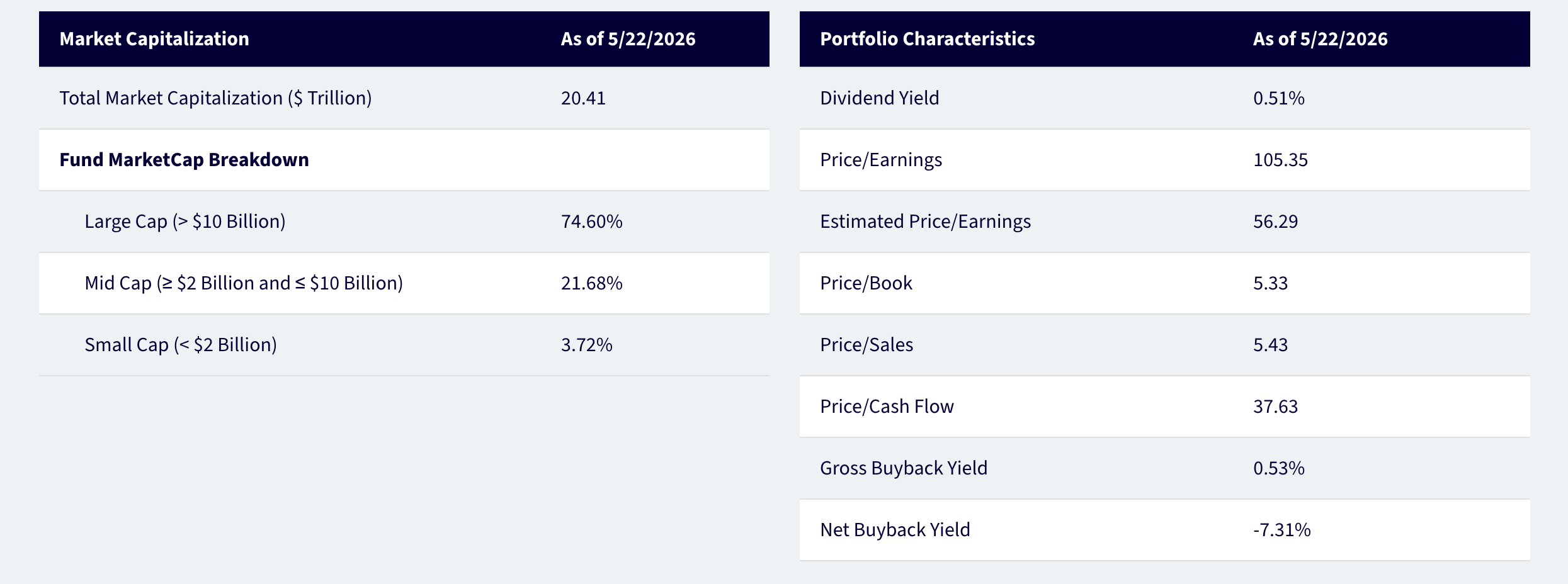
WQTM’s Market Capitalization and Portfolio Characteristics (WisdomTree Product Sheet)
As the portfolio exhibits a financial profile consistent with a high-growth thematic strategy, WisdomTree’s reported portfolio characteristics reflect higher valuation metrics, including a price-to-earnings ratio greater than 100 and an estimated price-to-earnings ratio greater than 50, based on the underlying holdings. This does not mean the fund is unattractive; however, it does raise the bar for future growth.
As of May 22, 2026, WisdomTree reported that roughly three-quarters of the fund’s market-cap exposure was to large-cap stocks, with most of the remainder in mid-cap names. This large-company focus may lessen some of the single-company risks inherent in fully speculative technology plays. All the same, this does not remove thematic risk. Should enthusiasm for quantum computing wane, or should commercialization take longer than expected, WQTM could experience volatility.
Who Might Consider WQTM?
WQTM may work for investors with broad-based, diversified core positions who want a more specific satellite investment in a long-duration technology theme. WQTM is best considered a focused, specialized investment rather than a substitute for a broad stock-market fund. It gives investors more direct exposure to quantum computing than many traditional technology ETFs.
The fund may be most relevant for investors who expect quantum computing research and experimentation to ultimately trend toward commercial adoption but prefer diversified ETF exposure rather than individually selecting particular companies or stocks. The fund may also suit investors who are prepared to bear early-stage uncertainty, high valuations, and limited operating history at the fund level. As WQTM is newly created, it has a very limited performance history.
More cautious investors, investors looking for income, or investors who are not comfortable with big price swings may find WQTM too focused or too risky.
What’s Inside WQTM? A Closer Look at Its Top Holdings
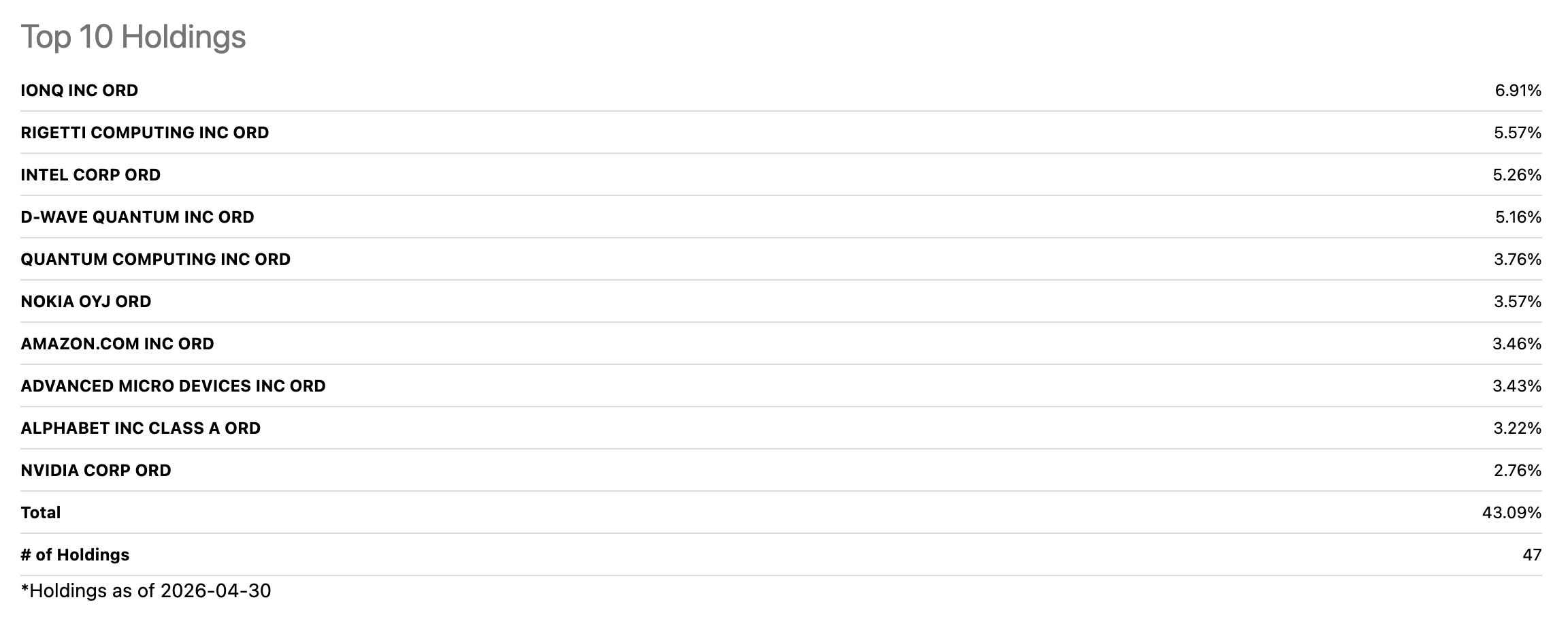
WQTM’s Top 10 Holdings (Seeking Alpha )
1) IonQ Inc. (IONQ) – 6.91%
The largest company held by WQTM is IonQ, making it one of WQTM’s most direct connections to the stand-alone quantum computing industry. IonQ is focused on developing trapped-ion quantum systems, offering cloud-based access to quantum computers, and developing business applications for quantum computing. This makes it more closely connected to the quantum-computing theme than other larger and more diversified technology companies included in the fund.
2) Rigetti Computing Inc. (RGTI) – 5.57%
Rigetti Computing is a quantum-computing company focused on building quantum-computer hardware. The company produces superconducting quantum processors and supplies quantum systems to local research organizations, national laboratories, and quantum research centers. The reason Rigetti has such appeal as a stock investment is that it is directly addressing one of the largest obstacles facing quantum computing right now: hardware.
3) Intel Corp. (INTC) – 5.26%
Intel contributes to WQTM through a distinct type of exposure. Although Intel is not considered a pure quantum computing business, it has still made itself valuable to the overall quantum-computing market through its role in the semiconductor manufacturing industry, its lengthy history in chip design, and its extensive research and development activities.
4) D-Wave Quantum Inc. (QBTS) – 5.16%
Over several years, D-Wave has remained commercially active in quantum systems. The company is primarily associated with quantum annealing, a specialized approach aimed at solving optimization-based problems; yet, D-Wave has also positioned itself as a company focused on providing enterprise-level services and developing applications based on quantum technologies.
5) Quantum Computing Inc. (QUBT) – 3.76%
Quantum Computing Inc. is a higher-risk stock, as it is a smaller and more volatile company that adds another level of pure-play exposure to the quantum computing sector. The company develops integrated photonics-based quantum computers for use in computing, artificial intelligence, cybersecurity, and sensing. While the company’s progress is notable, it remains early-stage by public-market standards.
6) Nokia Oyj (NOK) – 3.57%
Nokia may seem less obvious at the outset, but its inclusion in the fund reflects quantum’s involvement with networks, security, and advanced communications through Bell Labs and its related research activities. It gives the fund exposure to quantum-computing infrastructure and related research. This can help balance out the smaller, riskier companies in the fund that focus more directly on quantum computing.
7) Amazon.com Inc. (AMZN) – 3.46%
Thanks to its cloud infrastructure and quantum access, Amazon.com gives WQTM exposure to quantum computing. The Amazon Braket managed service allows researchers and developers to run experiments on quantum computers, use simulators, and run hybrid workflows through AWS.
8) Advanced Micro Devices Inc. (AMD) – 3.43%
Within the context of an enabling technology company, AMD fits WQTM because of its position in supporting quantum innovation through the use of its chips, GPUs, FPGAs, and system components in high-performance computing environments. These technologies allow scientists to simulate, control, and integrate quantum workloads. AMD is not selling a mainstream quantum computer. Nevertheless, progress in quantum computing may still depend on the powerful traditional computing technology that AMD provides.
9) Alphabet Inc. Class A (GOOG) – 3.22%
WQTM has access to one of the deepest corporate quantum research initiatives globally through Alphabet’s Class A shares. Google Quantum AI is focused on developing large-scale, error-corrected quantum computers, and Alphabet has positioned itself as a serious long-term competitor in quantum computing. Alphabet is certainly not a pure-play quantum stock. Advertising, cloud, and its other businesses account for the majority of its earnings. However, the research being done in quantum computing provides investors with meaningful research-backed exposure.
10) NVIDIA Corp. (NVDA) – 2.76%
NVIDIA’s place in the top ten is representative of acceleration rather than direct quantum ownership. Its CUDA-Q platform allows quantum processors to connect with both GPUs and CPUs, allowing developers to create hybrid quantum-classical applications before fully mature quantum hardware exists. Quantum computing will most likely need classical computing for simulation, control, and error correction.
WQTM Performance Overview

WQTM’s Momentum Stats (Seeking Alpha)
The data signals to investors that WQTM is a newer ETF with strong near-term momentum, reasonable fees, and a risk profile with many unknowns. The most recent returns are likely what will primarily catch investor attention, as they have been very large for an exchange-traded fund. The one-month return of 22.24% and six-month return of 58.31% are extremely high compared to median returns for other ETFs of 1.34% and 9.58%, respectively. Additionally, the YTD price return of 48.03% is significantly greater than the S&P 500’s (SP500) gain of 9.17%.

WQTM’s Momentum Stats (Seeking Alpha)
Basically, WQTM is built to capture one specific technology theme. When that theme is working, the returns can move quickly. The one-week price return of 12.64% makes that clear.
Market sentiment can change quickly in favor of high-growth tech, speculative innovation, and quantum-related stocks, which may lead to a sharp rise in WQTM and therefore a significant return. Nonetheless, the downside also cuts both ways.
WQTM Dividend Scorecard
The fund’s lack of a dividend also clarifies how it should be viewed. Instead, most of the potential return depends on the fund’s price going up. This is common for funds focused on emerging technologies.
WQTM: Expenses

WQTM’s Expense Stats (Seeking Alpha)
0.45% is a fair expense ratio for a specialized thematic ETF, and it falls below the 0.50% median for all ETFs. Most thematic funds will have higher fees than broad-index ETFs, and these higher costs can reduce returns over time.

State Street SPDR S&P 500 ETF Expenses (Seeking Alpha)
In this case, it will not be as cost-effective as a broad-based S&P 500 ETF (SPY). Investors are essentially paying for narrow exposure to a particular idea rather than basic market exposure.
WQTM: Risks
Here are the downsides to WQTM: risk metrics are mixed and incomplete. Standard deviation, annualized volatility, turnover, and tracking error are missing, making it difficult to assess the level of risk with the same confidence as a traditional ETF that has existed for many years.
WQTM’s Risk Metrics (Seeking Alpha)
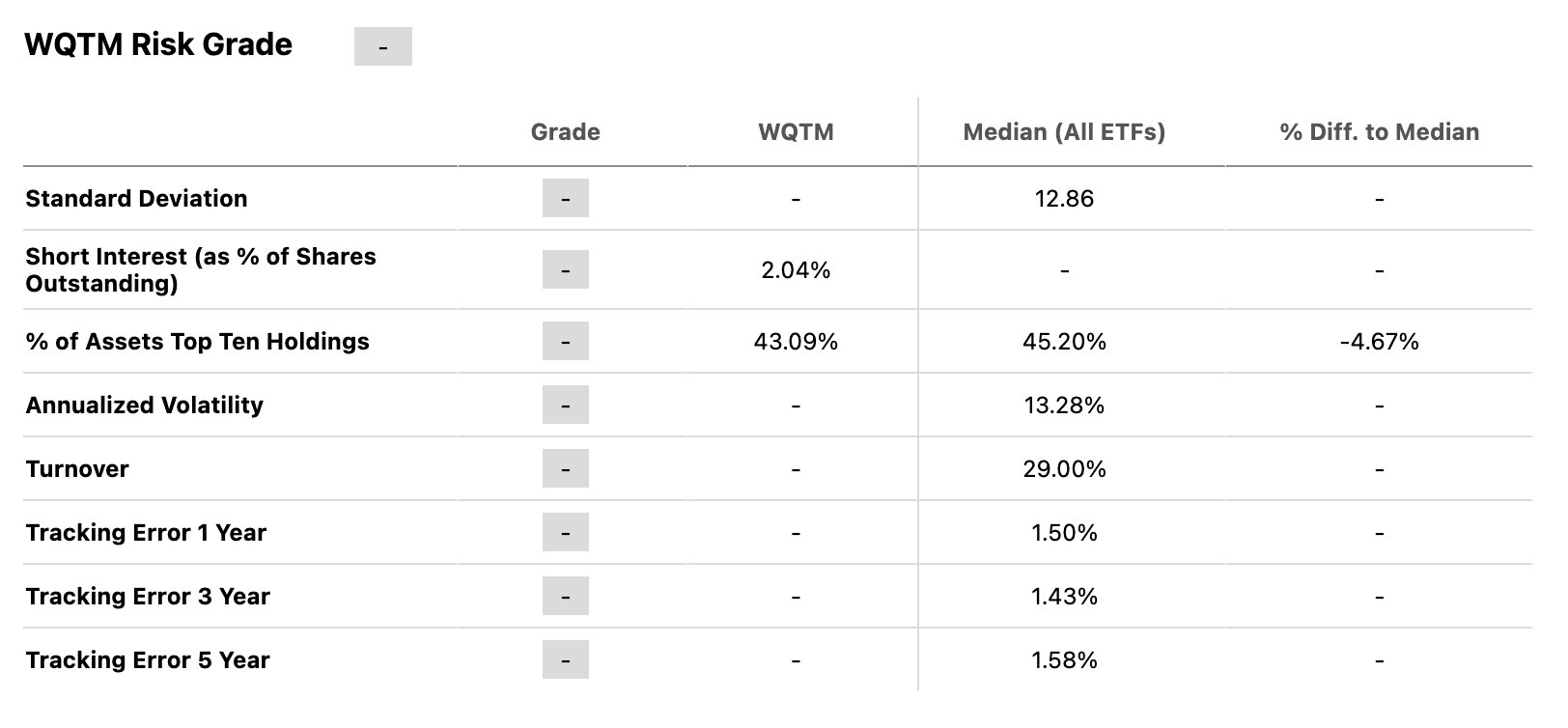
Even so, we do have a concentration figure. The top ten holdings represent 43.09% of the fund’s assets, which is just under the overall ETF median of 45.20%. Therefore, while WQTM does not seem to be especially concentrated when compared to other ETFs, this may not be a good comparison for evaluating WQTM because many of its top ten holdings have similar investment themes.
Short interest at 2.04% of shares outstanding is not a high percentage. Nevertheless, it is enough to show that some investors have taken positions against the ETF. It suggests these investors are either hedging their exposure to the fund or speculating that there may be a downturn. This does not prove that investors are becoming strongly negative on WQTM. Notwithstanding, it does show that the market is not treating WQTM as a safe, widely agreed-upon investment.
Should You Invest In WQTM?
Investors interested in having a small slice of quantum computing without picking their own quantum stocks can use WQTM. Although quantum computing is still an early-stage technology, it is making progress. The best opportunity to take advantage of WQTM investments may come if you have already built an established, diversified portfolio and are comfortable with the possibility that this investment may drop sharply and stay down for an extended period during the time required for the fund’s strategy to prove itself, which may take years. WQTM provides no meaningful income. Therefore, if you need a source of dividend income or steady returns, you may need to find other investment vehicles.
This article answers three main questions about WQTM:
- What are the benefits and risks of investing in WQTM?
- How volatile is WQTM compared to the overall market?
- Are there concentration risks with WQTM?

Continue Reading

The 2026 FIFA World Cup, the largest in the tournament’s history with 48 teams, begins on Thursday, June 11, when co-host Mexico faces South Africa in Mexico City. The month-long event, co-hosted by Canada, Mexico and the United States, features 104 matches across 16 venues and offers expanded opportunities for advancement to the knockout stages.
The final will be played on July 19 at the New York New Jersey Stadium (MetLife Stadium). Argentina enters as defending champion after its dramatic victory in Qatar in 2022, but a deep and competitive field makes predicting a winner challenging.
Tournament Format and Structure
For the first time, the group stage will be followed by a round of 32, with the top two teams from each of the 12 groups advancing along with the eight best third-placed sides. This expanded knockout format increases the number of matches and gives more teams a realistic path to the later stages.
Group stage matches run from June 11 to June 27. The round of 32 takes place from June 28 to July 3, followed by the round of 16 from July 4 to 7. Quarterfinals are scheduled for July 9 to 11, semifinals on July 14 and 15, the third-place match on July 18 and the final on July 19.
All venues have been temporarily renamed to reflect their host cities for the tournament to limit ambush marketing. For example, MetLife Stadium becomes the New York New Jersey Stadium, and SoFi Stadium is referred to as the Los Angeles Stadium.
Full Group Stage Schedule and Key Fixtures
Thursday, June 11 Mexico vs South Africa, 1 p.m. CST (7 p.m. GMT), Mexico City Stadium, Mexico City South Korea vs Czechia, 8 p.m. CST (2 a.m. GMT Friday), Estadio Guadalajara, Zapopan, Mexico
Friday, June 12 Canada vs Bosnia and Herzegovina, 3 p.m. ET (7 p.m. GMT), Toronto Stadium, Toronto United States vs Paraguay, 6 p.m. PT (1 a.m. GMT Saturday), Los Angeles Stadium, Los Angeles
Saturday, June 13 Qatar vs Switzerland, 12 p.m. PT (7 p.m. GMT), San Francisco Bay Area Stadium, San Francisco Brazil vs Morocco, 6 p.m. ET (10 p.m. GMT), New York New Jersey Stadium, New Jersey Haiti vs Scotland, 9 p.m. ET (1 a.m. GMT Sunday), Boston Stadium, Boston Australia vs Turkiye, 6 p.m. PT (1 a.m. GMT Sunday), BC Place, Vancouver
Sunday, June 14 Germany vs Curacao, 12 p.m. CDT (5 p.m. GMT), Houston Stadium, Houston Netherlands vs Japan, 3 p.m. CDT (8 p.m. GMT), Dallas Stadium, Dallas Ivory Coast vs Ecuador, 7 p.m. ET (11 p.m. GMT), Philadelphia Stadium, Philadelphia Sweden vs Tunisia, 8 p.m. CST (1 a.m. GMT Monday), Estadio Monterrey, Guadalupe, Mexico
The schedule continues through June 27, with key clashes including France vs Senegal, Argentina vs Algeria, Portugal vs DR Congo and England vs Croatia. The expanded format ensures every team plays at least three group stage matches, providing more opportunities for surprises and competitive balance.
Group Breakdown and Favorites
Group A features host Mexico, who open the tournament against South Africa. South Korea and Czechia are expected to battle for the second advancement spot. Mexico’s home advantage at the iconic Estadio Azteca gives them a strong edge in their opener.
Group D includes co-host United States, who face Paraguay in their first match. Australia and Turkiye add depth to what could be a competitive pool. The co-hosts benefit from familiar conditions and passionate support across multiple venues.
Defending champion Argentina headlines Group J alongside Algeria, Austria and Jordan. Lionel Messi’s side enters with high expectations as it seeks a historic back-to-back title.
European powerhouses France, Spain, England, Germany, Netherlands, Belgium and Portugal are spread across different groups, reducing the chance of early heavyweight clashes but ensuring high-quality football throughout the group stage.
Co-Host Advantages and Venue Highlights
The three host nations have invested heavily in infrastructure and fan experiences. Iconic venues such as BC Place in Vancouver, Lumen Field in Seattle and Levi’s Stadium in the San Francisco Bay Area will host matches, providing world-class facilities and vibrant atmospheres.
Mexico City Stadium (Estadio Azteca) opens the tournament with significant historical resonance. The multi-nation format spreads logistical demands but also creates unique travel and adaptation challenges for teams.
Global Anticipation and Viewership
The 2026 edition is projected to draw record audiences, building on the success of previous tournaments. Broadcasters worldwide have secured rights, with extensive coverage planned across television, streaming and digital platforms.
The expanded field allows more nations to participate, increasing global engagement. Teams from all confederations have qualified, promising a diverse mix of playing styles and storylines.
Key Dates to Watch
Beyond the opening match on June 11 and the final on July 19, the round of 32 beginning June 28 marks the start of knockout football. Quarterfinals in early July and semifinals mid-month will determine the finalists, with the bronze match on July 18 providing a consolation fixture for the losing semifinalists.
Preparation and Expectations
Teams have been fine-tuning tactics and squad selections in the lead-up to the tournament. Defending champion Argentina, led by Lionel Messi, enters as one of the favorites, while European sides like France, Spain and England carry high expectations.
Co-hosts Mexico, United States and Canada benefit from home support, though they face competitive groups. Underdogs will look for upsets in what promises to be one of the most open World Cups in recent memory.
The 2026 tournament represents a landmark event for North American football, showcasing the sport’s growth in the region and providing a platform for emerging talents alongside established stars. As the opening match approaches, anticipation builds for what could be a memorable summer of global competition.
Fans worldwide are encouraged to check local listings for broadcast details and plan viewing around time zone differences. The full schedule ensures compelling matches almost daily, with the expanded format delivering more football than ever before in a single World Cup.
The journey from group stage to the July 19 final at the New York New Jersey Stadium will test teams’ depth, adaptability and resilience across three host nations. With 48 teams and 104 matches, the 2026 World Cup offers something for every football fan as the world’s most popular sport takes center stage once again.

CUPERTINO, Calif. — Apple is on track to launch its first foldable iPhone in September 2026 alongside the iPhone 18 Pro models, according to multiple supply chain reports and analyst forecasts, marking a significant expansion of the company’s premium smartphone lineup.
The device, which may be called the iPhone Fold or iPhone Ultra, is expected to feature a book-style design with a large inner display and a more compact outer screen. Rumors suggest it will aim to minimize or eliminate the visible crease common in competing foldables, positioning Apple as a late but potentially differentiated entrant in the growing foldable market.
Design and Display Details
Supply chain leaks indicate the foldable iPhone will measure approximately 7.7 to 7.8 inches when unfolded, resembling an iPad mini in size and shape. The outer display is rumored to be around 5.3 to 5.5 inches, wider than typical phone screens to accommodate the folding mechanism.
Analyst Ming-Chi Kuo and others have reported that Apple is focusing on a crease-free or minimal-crease design, potentially using advanced hinge technology and specialized display materials. This would address one of the main consumer complaints about current foldables from Samsung, Google and others.
The overall form factor is described as wider when unfolded, offering a more tablet-like experience for productivity and media consumption. Dummy models circulating in recent months show a premium build with refined edges and Apple’s signature attention to detail.
Pricing and Positioning
The foldable iPhone is expected to carry a premium price tag starting above $2,000, reflecting its advanced engineering and positioning as a high-end device. This would place it well above current iPhone Pro Max models, targeting professionals, early adopters and users seeking a versatile device that bridges phone and tablet functionality.
Apple’s strategy appears focused on delivering a polished, reliable product rather than rushing to compete on price or specifications with existing foldables. The device is likely to integrate deeply with the Apple ecosystem, leveraging continuity features across iPhone, iPad and Mac.
Production Timeline and Potential Delays
Recent reports suggest mass production could begin in August 2026, following some engineering challenges that pushed the start date from earlier projections. Despite these adjustments, the launch timeline remains on track for September, with possible limited initial supply.
Bloomberg’s Mark Gurman has indicated the foldable will debut alongside the iPhone 18 Pro and Pro Max, though availability may be constrained at first. This staggered approach would allow Apple to manage production ramp-up while maintaining focus on its core iPhone lineup.
Technical Features and Innovations
Beyond the folding display, the device is rumored to include Apple’s latest A-series or M-series chip for exceptional performance and efficiency. Advanced camera systems, improved battery life and enhanced durability are also expected, addressing common pain points in foldable devices.
The hinge mechanism is a critical area of development, with rumors pointing to the possible use of liquid metal alloys for smoother operation and greater longevity. Under-display sensors and a refined Dynamic Island or fully bezel-less design could further differentiate the product.
Integration with Apple Intelligence features, including enhanced Siri capabilities and on-device AI processing, would align the foldable with the company’s broader software strategy. The larger inner screen could enable new multitasking and productivity experiences not possible on traditional iPhones.
Market Context and Competition
Apple enters the foldable market later than Samsung, Google and Chinese manufacturers, but with significant resources and a loyal customer base. The company’s focus on quality, ecosystem integration and user experience could help it carve out a premium segment rather than competing directly on volume.
Global foldable phone shipments have grown rapidly, though they still represent a small fraction of the overall smartphone market. Apple’s entry could accelerate mainstream adoption, particularly if it delivers on promises of durability and seamless software optimization.
Consumer and Analyst Expectations
Early reactions from analysts and enthusiasts have been positive, with excitement building around the potential for a truly premium foldable experience. The device could appeal to users seeking a single device for both phone and tablet-like tasks, particularly professionals and content creators.
However, the high expected price may limit initial appeal to a niche audience. Supply constraints and the need to prove long-term durability will be important factors in consumer adoption.
Strategic Importance for Apple
The foldable iPhone represents a major evolution in Apple’s product strategy, potentially opening new market segments and reinforcing the company’s innovation leadership. Success could influence future designs across the iPhone, iPad and Mac lines.
Tim Cook and Apple executives have been cautious in public comments, focusing on delivering exceptional user experiences rather than rushing into new categories. The 2026 launch aligns with Apple’s typical cadence for significant hardware advancements.
What to Watch Next
As development progresses, more details are expected to emerge through supply chain reports, regulatory filings and eventual prototype leaks. Apple is likely to maintain secrecy until the official unveiling, building anticipation through subtle hints in software updates and developer tools.
For consumers, the foldable iPhone could represent a compelling upgrade option in fall 2026, particularly for those already invested in the Apple ecosystem. The combination of advanced hardware and polished software has been a hallmark of Apple’s success, and expectations are high for this new form factor.
The iPhone 18 Pro Max and other standard models will launch alongside or shortly before the foldable, creating a robust premium lineup. Apple’s ability to balance innovation with reliability will be key to the product’s reception and long-term impact on the smartphone industry.
As the rumors continue to build, the foldable iPhone stands as one of the most anticipated consumer electronics releases of 2026. Its success could reshape how users think about mobile devices, bridging the gap between smartphones and tablets in meaningful new ways.
Industry observers will be watching closely for confirmation of specifications, pricing and availability as the year progresses. For now, the latest reports paint a picture of an ambitious but carefully executed project that could define Apple’s next chapter in hardware innovation.

Close up of coastline near Palos Verdes
Post_insignem | Istock | Getty Images
A version of this article first appeared in CNBC’s Inside Wealth newsletter with Robert Frank, a weekly guide to the high-net-worth investor and consumer. Sign up to receive future editions, straight to your inbox.
The SpaceX IPO is expected to mint thousands of new millionaires and multiple new billionaires. While current and former employees won’t be able to sell their shares right away, some are already planning how to spend their windfall.
That newfound wealth could have a ripple effect across the luxury property markets near SpaceX’s office hubs and boost spending on watches, private jet charters and other status symbols, experts told CNBC.
Real estate agent Gerard Bisignano said he has recently received inquiries from several long-time SpaceX employees looking for homes in the South Bay area of California. They range in age from their mid-30s to early 40s, he said.
“They seem to be in a state of disbelief themselves that they’re suddenly going to be able to, in some examples, buy a home for their parents. They’re going to have all this discretionary income that they can really do what they want,” said Bisignano, a partner at Vista Sotheby’s.
SpaceX’s California office is a short drive away from the wealthy coastal communities of Manhattan Beach, Redondo Beach, Hermosa Beach and Palos Verdes Estates. Bisignano said he expects many SpaceX employees to snap up high-end homes in the area. He noted there was a similar buying spree in the neighborhoods around the Facebook headquarters after that company’s IPO in 2012, with home values there jumping 21%.
Bisignano said he also anticipates an influx in interest for second homes in other scenic California locales like Mammoth Lakes, Palm Springs and Tahoe.
Texas real estate agent Gary Dolch said he’s seeing similar interest from SpaceX employees in the greater Austin area, with SpaceX’s Bastrop campus located roughly 30 miles from downtown Austin. Some plan to buy soon after taking a margin loan, while others are waiting for the IPO lockup period to end, he said.
Prospective homebuyers’ tastes run the gamut from luxury condos on Lake Austin or Lake Travis to 1,000-acre ranches farther from the city, Dolch said. He added that he’s optimistic that the IPO will boost the luxury market in Austin, which has softened over past three to four years.
“It feels like we’re on the verge of the next wave in Austin’s expansion fueled by this tech run,” he said.
The newly wealthy rarely stop their spending spree at a dream home, Bisignano said. He expects buyers to vie for homes with four-car garages to fit their brand new Ferraris.
And while sports cars are a popular choice, luxury watches are a more practical status symbol for every day use.
Paul Altieri, CEO and founder of Bob’s Watches, said a watch is often the first luxury purchase after a major liquidity event. He said customers usually opt for Rolexes as they are instantly recognizable. Models like the Daytona, GMT-Master II and Submariner are most popular, he added.
“The watch becomes a reminder of that accomplishment every time they put it on,” he said. “The stock certificate stays in a brokerage account. The watch goes on your wrist.”
John Shmerler, CEO of The 1916 Company, a luxury watch and jewelry retailer, said customers who have been waiting for years are often willing to pay a premium for pre-owned timepieces by trophy brands like Patek Philippe and F.P. Journe.
The splurge doesn’t stop there. While some SpaceX employees may have already flown first class, the IPO will enable many to fly private.
D.J. Hanlon, executive vice president of sales at Flexjet, and Kolin Jones, founder and CEO of Amalfi Jets, said their private jet companies have seen recent inquiries specifically related to the SpaceX IPO.
Jones said clients are already chartering jets to celebrate the occasion with a trip.
The top choice for celebrating a liquidity event is Las Vegas, especially for younger fliers traveling without children, Jones said. Miami and Cabo San Lucas, Mexico, are also popular destinations.
Fliers looking to take the entire family on vacation, however, lean toward Aspen, Colorado, and Yellowstone National Park, Jones said. And Disney World is a classic choice for local families with young children who want to avoid the hassle of airport security, he added.
With newly wealthy customers, the Amalfi Jets sales team sometimes receives follow-up calls from wealth managers asking to cancel their clients’ charter or downgrade to smaller jets, Jones said.
“It is sometimes comical to see the clients arguing with their wealth manager, saying, ‘No, it’s my money, I want the Gulfstream,’” he said. “There’s going to be a lot of people that are flying private for the first time, and I think it’s going to be a really fun spending spree.”
Business
Explained: How SpaceX’s $75 billion IPO could create opportunity for Inox India shareholders

As the world gears up for Elon Musk‘s SpaceX IPO at a staggering $1.75 trillion valuation, a relatively lesser-known Indian company is emerging as an unlikely beneficiary thousands of miles away. INOX India, a global leader in cryogenic technology, has found itself in the spotlight as investors hunt for domestic companies with exposure to the rapidly expanding global space ecosystem.
The excitement around SpaceX’s public listing has already spilt over into INOX India’s stock. Shares of the company have surged 25% over the past month and have gained in seven of the last eight trading sessions.
The frenzy surrounding SpaceX’s IPO, which reports suggest was oversubscribed nearly four times, has prompted investors to look beyond the headline-grabbing U.S. listing and identify potential beneficiaries closer home. For many, INOX India appears to fit that bill. But what exactly is the connection?
Inox’s aerospace push
During its Q4 earnings call, the company disclosed that it had secured a significant aerospace order from a leading U.S.-based private space company. The total order value is approximately Rs 200 crore. Management said it expects additional high-value orders in the first quarter of FY27.
“This order is a direct outcome of our proven execution capabilities and reinforces the growing confidence that global aerospace players have in INOX India’s engineering expertise,” the company said.
“Aerospace cryogenic systems are not short-term trends, but a long-term structural opportunity. We believe that INOX India is well-positioned to capitalise on these opportunities through its engineering expertise, diversified capabilities, and expanding global presence and footprint,” the company added.
Can Inox India shares rally more?
According to Sunny Agrawal, Head of Research at SBI Securities, investor interest in INOX India has picked up significantly ahead of the SpaceX listing. Beyond aerospace, the company is also expanding into segments such as data centres, nitrogen supply and distillery kegs, providing additional growth levers.

“Management has guided for 15-20% growth per year, and after the recent rally, the stock is trading at a relatively rich valuation of about 56 times one-year forward earnings,” Agrawal said. He believes investors may be better off waiting for a correction before making fresh purchases. “Investors may consider waiting for a correction before fresh entry, as some profit-taking and a cooling-off in the stock could follow once SpaceX gets listed,” he added.
SpaceX IPO
The much-anticipated SpaceX IPO is scheduled to be priced on June 11, with trading set to commence on the Nasdaq on June 12. The company is looking to raise $75 billion through the offering, which would value the business at approximately $1.75 trillion.
Despite the enormous investor enthusiasm, SpaceX remains loss-making. For 2025, the company reported revenue of $18.67 billion and a net loss of $4.94 billion. Much of the bullishness around the stock is tied to its future opportunities across satellite broadband, launch services, defence contracts and AI-related businesses rather than its current earnings profile.Not everyone is convinced by the valuation, however. Morningstar said in a note published on Monday that the company appears “significantly overvalued” and suggested that investors may find more attractive entry opportunities after the stock begins trading.
Inox India Q4 snapshot
INOX India reported a strong performance for the fourth quarter of FY26, with revenue rising 24.2% year-on-year to Rs 475 crore. Adjusted EBITDA grew 13.4% to Rs 108 crore, while adjusted profit after tax (PAT) increased 9% to Rs 72 crore compared with the corresponding quarter last year.
Exports continued to be a key growth driver, with export revenue standing at Rs 291 crore and contributing 61% of total quarterly revenue. During the quarter, the company secured order inflows worth Rs 504 crore, taking its total order backlog to Rs 1,514 crore.
For FY26, INOX India delivered its highest-ever annual revenue of Rs 1,632 crore, up 21.2% year-on-year. Adjusted EBITDA rose 20.2% to Rs 388 crore, while adjusted PAT increased 19.3% to Rs 261 crore. Annual export revenue came in at Rs 971 crore, accounting for 59% of total revenue, reflecting sustained strength in international demand throughout the year.
INOX India shares have risen 64% since the start of the year.
(Disclaimer: Recommendations, suggestions, views and opinions given by the experts are their own. These do not represent the views of The Economic Times)

A ‘Mornings with Maria’ panel analyzes the markets, the impact from the conflict in Iran and investing in companies that the government has a stake in.
General Motors on Tuesday announced it’s releasing a software update that allows some electric vehicle (EV) owners to send power back to the electric grid.
The update allows owners of GM’s vehicle-to-home energy system, which allows the EV to power the home during a blackout, the expanded capability of sending electricity to the power grid.
Owners of the system would be able to sell power from their vehicle back to utility providers at times when demand is high, with GM getting a portion of the proceeds. EVs are viewed as an untapped resource for balancing the electric grid to meet surging demand from AI data centers as well as extreme weather events.
GM said that it alone has over 250,000 bidirectional capable vehicles on U.S. roads at this time, while it will include the vehicle-to-grid technology in all planned EVs going forward.
AUTO INDUSTRY TRADE GROUP URGES FEDS TO SCRAP GAS TAX AND REPLACE IT WITH A VEHICLE WEIGHT FEE

GM’s vehicle-to-grid energy program would let consumers charge more cheaply and be compensated when their EV’s power is sent back to the grid to support it during peak demand. (Megan Varner/Bloomberg via Getty Images)
It said that the quarter-million GM EVs that are capable of vehicle-to-grid energy transfers currently have the storage capacity to help power 120,000 homes for up to one week.
GM said that it’s actively testing vehicle-grid integration technology through a partnership with Pacific Gas and Electric Company (PG&E), and it expects that by 2030 there will be over 52,000 GM EVs actively participating in grid-balancing protocols.
It’s also conducting tests in Michigan with DTE Energy, using the homes of GM employees, to grow reliable backup capacity in a way that suits the preferences of home and EV owners, which GM Energy Vice President Wade Sheffer said is a “win for customers, automakers, and utilities.”
INSIDE GM’S $242M PUSH TO REBUILD AMERICA’S SKILLED TRADES WORKFORCE
| Ticker | Security | Last | Change | Change % |
|---|---|---|---|---|
| GM | GENERAL MOTORS CO. | 79.40 | -4.36 | -5.21% |
“Maintaining a safe, reliable, and affordable grid is paramount. This transition won’t be easy, and we deeply respect the challenge of balancing day-to-day grid reliability with rapid innovation,” Sheffer said in a letter, adding that the company sees three areas in which utilities, regulators and automakers can simplify the path forward.
Those include boosting the enrollment of customers in utility programs by GM and industry partners, educating them on EV grid support and the value in utility programs and rates, with best practices developed amid its ongoing regional pilot projects.
GM TAKES $7B HIT AFTER SHIFTING EV STRATEGY DUE TO SLOWING DEMAND

GM aims to have over 50,000 of its EVs participating in grid-balancing by 2030. (Nick Lachance/Toronto Star via Getty Images)
GM noted that consumers will be more motivated to participate when given clear and appropriate incentives, such as expanding localized, time-of-use tariffs, allowing EV owners to charge cost-effectively during energy surplus and receive appropriate compensation for supporting the grid during peak strain or times of need.
GM also said that streamlining paperwork, engineering reviews and utility interconnection processes to boost consumer confidence in being able to easily purchase and install a bidirectional charger.
“It’s time for us to look at parking lots and driveways across our communities as a massive, distributed power asset waiting to be integrated. By working together, we can help secure an affordable, reliable, and resilient energy future for everyone,” Sheffer’s letter said.
GET FOX BUSINESS ON THE GO BY CLICKING HERE
Reuters contributed to this report.
Business
Grimsby family firm Dee Bee Wholesale sold to UK’s largest independent food and drink wholesaler

Yorkshire and Lincolnshire wholesaler Dee Bee Wholesale has been acquired by Bestway Wholesale in a deal that strengthens the London firm’s regional footprint

Dee Bee Wholesale has been snapped up by new owners. The firm has two sites, in Grimsby and Hull.(Image: Google Earth)
A family-run business that has been operating for more than 65 years across Yorkshire and Lincolnshire has been acquired by a national competitor. Independent wholesaler DB Ramsden and Co – trading as Dee Bee Wholesale – has expanded to serve over 1,400 retail and on-trade customers from its depots in Grimsby and Hull.
The firm, which employs 87 members of staff across its two sites, was established in 1961 as part of the Ramsden Group and has long been a cornerstone of the wholesale distribution sector. In its early years, the business concentrated on non-food products but has since evolved into a prominent supplier of groceries and drinks, helping clients adapt to shifting market demands and consumer needs.
Dee Bee Wholesale, which posted a turnover of £59.4m in its most recently filed accounts, has now been purchased for an undisclosed sum by Bestway, the owner of well-known brands including Costcutter, best-one, BB foodservice and Bestway Wholesale. The London-based business was founded in 1976 and has grown to become the UK’s largest independent food and drink wholesaler, operating 57 depots nationwide.
It sits within the broader industrial powerhouse that is Bestway Group, which also holds global commercial interests spanning banking, cement, pharmacy, milling and property investment. Managing director Nick Ramsden told customers: “This marks an important milestone in the history of Dee Bee Wholesale and an exciting new chapter for the business. For more than 65 years, Dee Bee Wholesale has been committed to supporting customers across Yorkshire and Lincolnshire, building strong relationships and helping independent retailers, convenience stores and on-trade operators succeed.
“I am incredibly proud of the business we have built together and the trust our customers have placed in us over many years. Importantly, it is very much business as usual. Our depot operations, customer contacts and service teams remain in place and customers should continue trading with us in exactly the same way as they do today.”, reports Hull Live.
“We believe becoming part of Bestway Wholesale creates significant opportunities for the future. Bestway is one of the UK’s leading wholesalers with a strong track record of supporting independent retailers and customers. Over time, customers will benefit from Bestway’s scale, competitive pricing, market-leading promotions and extensive product range.
“I am pleased to confirm that I will remain with the business supporting continuity for customers, colleague and suppliers and helping to ensure a smooth integration.”
Bestway Wholesale confirmed that the takeover of Dee Bee Wholesale forms a key part of its ongoing strategic expansion plans and further bolsters its regional presence.
Dawood Pervez, managing director of Bestway Wholesale, said: “We are delighted to welcome Dee Bee Wholesale – a long-established family business with more than 65 years of customer service heritage, loyal customer base and detailed regional knowledge across Yorkshire and Lincolnshire – into the Bestway Wholesale network.”
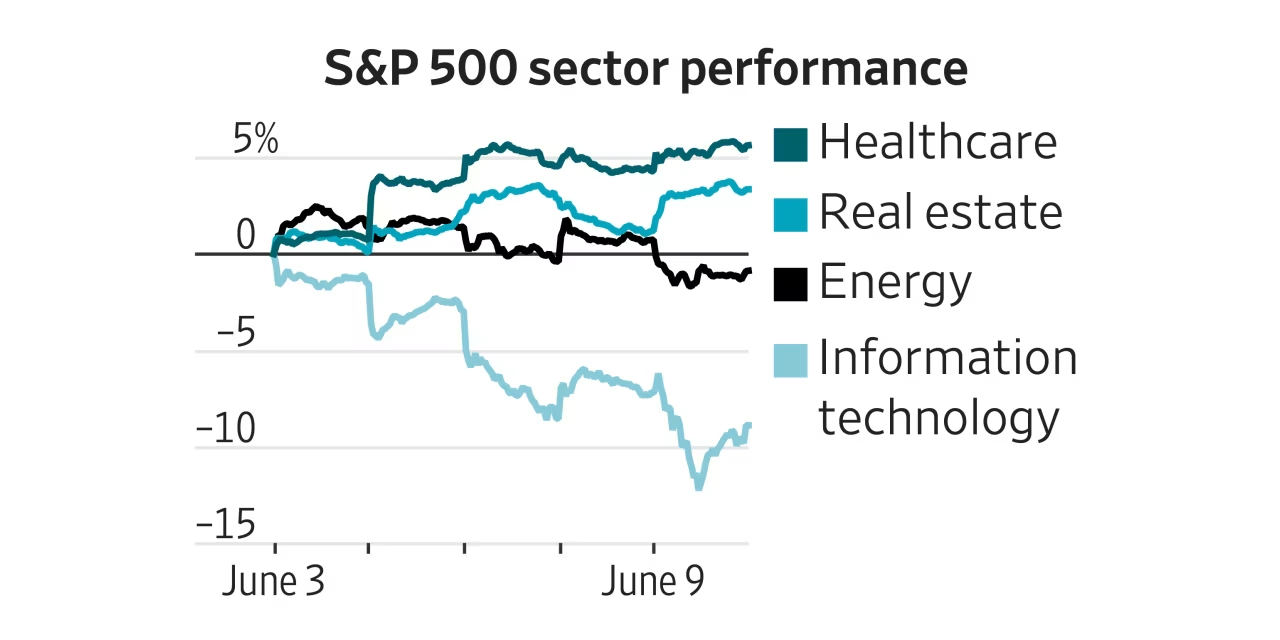
The nascent rebound in tech stocks ended in a lurching drop on Tuesday, with the Nasdaq composite losing about 1% in its largest blown gain since early January.
The slide extended a bout of volatility that has raised worries that stocks’ record run is rooted in the staggering gains of a handful of chip companies. Some fear that a narrow rally won’t survive pressure expected from higher interest rates, worries about the AI trade and the pending avalanche of new tech shares that kicks off Friday with the massive SpaceX public offering.
Copyright ©2026 Dow Jones & Company, Inc. All Rights Reserved. 87990cbe856818d5eddac44c7b1cdeb8
Australia’s share market has trimmed its early losses but ultimately ended the session lower, with a mining sector rebound unable to overcome resurgent fears as the US and Iran trade strikes.

NEW YORK — Investors evaluating Western Digital Corp., the parent company of the SanDisk brand, face a mixed picture in 2026 as the storage giant benefits from surging demand for data center SSDs and AI infrastructure while navigating cyclical NAND flash pricing and intense competition from rivals like Samsung and SK Hynix.
Western Digital shares have shown volatility in 2026, trading around recent levels after strong gains tied to AI-related spending. The company’s SanDisk consumer products, enterprise SSDs and hard disk drives continue to generate significant revenue, but analysts differ on whether current valuations justify buying or if caution is warranted amid supply chain dynamics and margin pressures.
Business Overview and Market Position
Western Digital operates through two main segments: flash-based storage (including SanDisk consumer and enterprise solutions) and hard disk drives. The flash business has been a key growth driver, with high-performance SSDs increasingly used in data centers supporting artificial intelligence workloads. SanDisk remains a leading brand in consumer memory cards, USB drives and portable SSDs, maintaining strong retail presence.
The company has invested heavily in NAND flash technology and 3D manufacturing capabilities. Recent product launches, including higher-capacity enterprise SSDs, position Western Digital to capture share in the expanding AI infrastructure market. However, the business remains cyclical, with pricing and margins heavily influenced by global supply and demand for memory chips.
2026 Performance Drivers
Demand for data storage continues to grow rapidly, fueled by AI training and inference requirements, cloud computing expansion and digital content creation. Western Digital has reported improving revenue trends in its flash segment, with particular strength in enterprise solutions. Analysts project continued growth in 2026 as hyperscalers and enterprises build out AI capabilities.
Hard disk drive revenue provides a more stable base, though long-term shifts toward solid-state storage present both opportunities and challenges. The company’s dual HDD and flash strategy offers diversification, helping buffer against swings in either market.
Capital expenditures remain elevated as Western Digital expands production capacity and advances technology nodes. Management has emphasized disciplined spending and operational efficiency to improve profitability amid competitive pressures.
Valuation and Analyst Consensus
Western Digital trades at valuations that many analysts consider reasonable relative to growth prospects in AI storage. Forward earnings multiples are lower than some pure-play memory peers, reflecting the company’s broader portfolio and cyclical exposure.
Wall Street consensus leans toward Hold to Buy ratings. Several firms have raised price targets citing AI tailwinds and improving NAND market conditions. However, some analysts maintain caution, noting risks from supply gluts, pricing competition and execution on new product ramps.
The stock has been volatile, with sharp moves tied to earnings reports, guidance and broader semiconductor sector sentiment. Year-to-date performance has been positive but trails some high-flying AI names, reflecting Western Digital’s more diversified and cyclical nature.
Risks and Challenges
Competition in the NAND flash market remains fierce. Samsung and SK Hynix continue aggressive capacity expansions, potentially pressuring pricing and margins. Geopolitical risks, including U.S.-China trade tensions and supply chain disruptions, add uncertainty to the semiconductor industry.
Western Digital faces execution risks on its technology roadmap and integration of recent acquisitions. Debt levels, while manageable, require ongoing attention given capital-intensive operations. Macroeconomic factors such as interest rates and corporate IT spending could influence demand for storage solutions.
Investment Considerations for 2026
For growth-oriented investors, Western Digital offers exposure to secular trends in data storage and AI infrastructure through its SanDisk and enterprise SSD businesses. The company’s scale, technology portfolio and customer relationships provide competitive advantages.
Value investors may find appeal in current valuations and the potential for margin expansion if NAND pricing stabilizes. Dividend yield and share repurchase activity add income and capital return elements for long-term holders.
A balanced approach suggests monitoring quarterly results closely for signs of sustained demand and improving profitability. Diversification across the semiconductor sector can help manage company-specific and cyclical risks.
Broader Semiconductor and AI Context
The AI boom continues driving demand for high-performance storage. Data centers require massive SSD capacity for training and inference workloads, benefiting companies like Western Digital. However, the pace of adoption and capital spending cycles will influence near-term results.
The memory market remains prone to boom-and-bust patterns. Successful navigation of these cycles, combined with technological leadership, will determine long-term winners. Western Digital’s dual HDD-flash strategy provides a hedge, though flash represents the higher-growth opportunity.
Strategic Initiatives and Outlook
Management continues focusing on innovation, cost optimization and customer diversification. Partnerships with hyperscalers and enterprise clients are critical for securing design wins in AI infrastructure. Progress on next-generation NAND technology and improved manufacturing efficiency are key metrics to watch.
Longer-term, Western Digital aims to capitalize on the explosion of data generation across industries. If AI adoption accelerates as projected, storage demand could provide multi-year tailwinds. However, overcapacity risks and competitive pressures could temper gains.
Final Thoughts for Investors
Western Digital represents a compelling but not without-risk play on data storage growth in 2026. The SanDisk brand and enterprise SSD business provide strong fundamentals, while AI tailwinds offer upside potential. Current valuations appear reasonable to many analysts, though execution and market cycles will ultimately determine returns.
Investors should weigh their risk tolerance, time horizon and views on the AI investment cycle. A selective approach, focusing on fundamental progress rather than short-term price movements, is advisable. As always, thorough due diligence and consideration of overall portfolio allocation remain essential.
The company’s trajectory in 2026 will provide important insights into the storage sector’s role in the broader AI ecosystem. With solid fundamentals and exposure to high-growth trends, Western Digital merits attention from investors seeking technology exposure with a value tilt.
Market participants will continue monitoring earnings, guidance and industry developments closely. For now, Western Digital’s position in the evolving storage landscape supports cautious optimism among analysts, balanced against inherent cyclical risks in the semiconductor industry.

Listen on the go! A daily podcast of Wall Street Breakfast will be available by 8:00 a.m. on Seeking Alpha, iTunes, Spotify.

Getty Images
Good morning! Here’s the latest in trending:
AI spending: Oracle (ORCL) plunges after Q4 earnings as its massive capex plan fuels debt concerns.
Iran updates: U.S. launches strikes on Iran; Trump claims 100M barrels of oil escorted out of Hormuz.
Hot inflation: CPI rises at fastest pace since 2023. This economist says rate cuts and hikes are off the table.
OpenAI (OPENAI) has revealed it banned China-linked accounts that used ChatGPT to generate social media content to stir up opposition to AI data centers in the U.S. and President Donald Trump’s tariffs. The company published its findings to help the AI industry, governments and the public “better identify and disrupt attempts by foreign threat actors to manipulate legitimate public debates.”
Foreign interference: OpenAI found a cluster of ChatGPT accounts from China that generated social media content “claiming that data center buildouts for AI were increasing electricity prices for average families.” The accounts were likely part of a social media operations team at a private Chinese tech firm conducting work for provincial-level government clients. OpenAI found another cluster of accounts that generated content criticizing U.S. tariffs as “attempts to dominate technological competition.” Their prompts specified that the content should only include Trump and not Xi Jinping. OpenAI could not establish the accounts’ institutional affiliation. “This cluster was connected to a network of likely inauthentic social media accounts that were also likely targeting OpenAI by claiming ChatGPT user data had been compromised,” it stated. “These allegations were entirely false.”
Bigger picture: To note, OpenAI bars its services in China and the accounts it mentioned used VPNs to access its platform. “Most of the social media posts we identified generated little or no observable engagement,” the company said, but warned that the campaigns’ “significance lies in what they reveal about the intentions of influence operators from China” and the narratives they seek to amplify. “Both clusters attempted to connect U.S. technology policies and industries to everyday economic anxieties and geopolitical instability,” OpenAI noted. “It is ironic that the two operations used American AI, rather than Chinese models, to generate their content about American AI.” China’s embassy in the U.S. told Reuters it was not familiar with OpenAI’s findings but said, “We firmly oppose any groundless attacks or smears against China.”
Latest on IPO: In other news, OpenAI CEO Sam Altman told staff that he expects the startup to go public within the next year. “Many things could cause it to be sooner or later in that range, but filing now gives us optionality if we want to go sooner,” he said. The company this week revealed that it confidentially filed for an IPO, but said the listing may take time “because there are things we want to do that are likely easier as a private company.” Altman indicated that delaying the IPO could be advantageous if AI can achieve recursive self-improvement, referring to the ability of an AI system to create new models on its own. He also said OpenAI is preparing to launch a tender offer “very soon” at the current share price of $687.69. OpenAI: Mega IPO Faces Anthropic Claude Mythos Reckoning
Here’s the latest Seeking Alpha analysis
Nasdaq Quant Leaders: 5 Stocks Averaging 272% Forward EPS Growth
Here’s How I Would Invest $10,000 Right Now
Micron: Just One Announcement Away
Broadcom: The Bear Case Just Got Weaker
3 Elite Dividend Machines That Could Pay Your Bills For Decades
What else is happening…
Trump thinks AI companies will be giving back to the public.
Palantir (PLTR) CEO: AI firms are upsetting enterprise clients.
Tesla (TSLA) struggles with long robotaxi wait times in Austin.
Ford’s (F) aluminum supplier to restart plants shuttered by fires.
Alcoa (AA) plunges after warning of $60M hit to alumina segment.
Microsoft’s (MSFT) Xbox to reboot with major layoffs, budget cuts.
Walmart (WMT), Wing (GOOGL) expand drone delivery program.
Debanking probe: DOJ subpoenas JPMorgan (JPM), other banks.
Trump to press defense execs to boost output as stockpiles shrink.
Canada is latest country to propose under-16 social media ban.
Today’s Markets
In Asia, Japan +0.1%. Hong Kong -0.7%. China -0.2%. India -0.2%.
In Europe, at midday, London +0.9%. Paris +0.8%. Frankfurt +0.2%.
Futures at 6:30, Dow +0.7%. S&P +0.7%. Nasdaq +1.2%. Crude -1.2% to $88.94. Gold -0.5% to $4,112.80. Bitcoin +2.6% to $62,867.
Ten-year Treasury Yield -3 bps to 4.53%.
On The Calendar
Companies reporting today include Adobe (ADBE) and Lennar (LEN).
See the full earnings calendar on Seeking Alpha, as well as today’s economic calendar.

Sports25 seconds ago
10 Fourth of July picks to buy

Tech1 minute ago
iPhone Stolen Device Protection is thwarting London thieves

NewsBeat4 minutes ago
Woman stamped on mum’s head and face after bursting into flat with husband



-

 Fashion6 days ago
Weekend Open Thread: Evereve – Corporette.com
-
 Crypto World6 days ago
Jensen Huang Approves Samsung, SK Hynix, and Micron for NVIDIA (NVDA) HBM4 Memory Supply
-
 Entertainment4 days ago
The Best Mystery Series of All Time Is Surging on Streaming 30 Years After It Ended
-

 Crypto World3 days ago
Anatomy of the June crypto crash: Fed, Iran, Saylor
-

 NewsBeat4 days ago
Alexander Zverev wins the French Open to finally earn a 1st Grand Slam title
-

 Tech5 days ago
Suspicious Polyfill login prompts pop up on Toshiba, Muji websites
-
 Crypto World5 days ago
Senator Cynthia Lummis Calls CLARITY Act the Most Consequential Financial Legislation of This Generation
-

 Tech4 days ago
Microsoft unveils seven homegrown AI models in new bid for ‘long term self-sufficiency’
-

 Tech6 days ago
Microsoft launches MXC, an OS-level sandbox for AI agents, with OpenAI and Nvidia already on board
-

 Business6 days ago
(VIDEO) Justin Bieber Delivers Surprise Happy Birthday Serenade to Diners at Los Angeles Mexican Restaurant
-
 Business4 days ago
The Pain Points Taking a Fragile Tech Rally Down a Notch
-

 Business3 days ago
High Stakes for Wembanyama as New York Pushes for 3-0 Lead
-
 Crypto World3 days ago
Eli Lilly (LLY) Stock Surges 4% Following Breakthrough Sleep Apnea Trial Results
-

 Tech5 days ago
Von der Leyen’s AI envoy pick draws conflict-of-interest fire
-
Crypto World6 days ago
LBank Surpasses 25 Million Users Worldwide as AFA Partnership Continues to Drive Global Growth
-

 Tech6 days ago
Meta steals a tactic from Tesla and builds data centers in tents
-

 Tech5 days ago
Hackers now exploit SolarWinds Serv-U flaw to crash servers
-

 Crypto World4 days ago
Trump’s AI Ownership Plan Could Benefit Anthropic at OpenAI’s Expense
-
 Sports2 days ago
Bangladesh beat Australia after 20 years in ODIs, register only their second win over six-time world champions | Cricket News
-
 NewsBeat4 days ago
Alexander Zverev conquers demons and outlasts Flavio Cobolli to win French Open for first major title
You must be logged in to post a comment Login