

Crypto World
7RCC launches Bitcoin and carbon credit ETF on NYSE Arca



7RCC Global has launched trading of BTCK, an exchange-traded fund that allocates 80% to Bitcoin and 20% to regulated carbon credit futures, bringing one of the crypto industry’s earliest ESG-focused ETF concepts to the public market.
Summary
- 7RCC’s BTCK ETF has begun trading on NYSE Arca with an allocation of 80% Bitcoin and 20% regulated carbon credit futures.
- The fund provides exposure to Bitcoin alongside carbon markets linked to the EU ETS, California Cap and Trade, and RGGI programs.
- BTCK launches as ETF issuers continue expanding crypto investment products beyond traditional spot cryptocurrency exposure.
According to a press release shared with crypto.news, the 7RCC Spot Bitcoin and Carbon Credit Futures ETF began trading on NYSE Arca under the ticker BTCK, giving investors access to Bitcoin and carbon credit futures through a single listed product. The fund tracks the 7RCC Kaiko Bitcoin Carbon Credit Index and is structured to follow daily changes in the value of both asset classes, minus expenses.
Under the fund’s investment framework, approximately 80% of assets are allocated to Bitcoin, while the remaining 20% is invested in carbon credit futures tied to regulated emissions markets, including the European Union Emissions Trading System, California Cap-and-Trade, and the Regional Greenhouse Gas Initiative.
The launch arrives as competition among crypto ETF issuers continues to intensify. In recent weeks, firms including Grayscale, 21Shares and Bitwise have expanded offerings linked to digital assets such as Hyperliquid’s HYPE token, while issuers have increasingly sought differentiated strategies beyond traditional spot cryptocurrency exposure.
Bitcoin ETF adds carbon market exposure
Unlike conventional spot Bitcoin ETFs, BTCK combines exposure to the cryptocurrency market with regulated environmental commodities. According to 7RCC Global, Bitcoin adoption trends and monetary factors influence one side of the portfolio, while emissions policies and compliance demand drive the carbon credit allocation.
“We started 7RCC because we believed digital assets would become a permanent part of the global financial system and that investors would want them in familiar, regulated structures built for the long term,” said Rali Perduhova, co-founder and chief executive officer of 7RCC Global.
Perduhova said the product combines “two asset classes driven by distinct market forces” and provides investors with a transparent way to access exposures that have historically been difficult to hold within a single investment vehicle.
As previously reported by crypto.news, nearly two and a half years ago, 7RCC filed plans with the U.S. Securities and Exchange Commission for an ESG-oriented Bitcoin ETF built around the same 80/20 allocation model. At the time, industry observers, including ETF analyst Nate Geraci, viewed the proposal as one of the first attempts to merge spot Bitcoin exposure with environmental market investments.
Carbon credits gain institutional attention
Interest in carbon-related financial products has also expanded among major financial institutions. In July 2025, Bloomberg reported that JPMorgan’s blockchain division, Kinexys, partnered with S&P Global Commodity Insights, EcoRegistry and the International Carbon Registry to test the tokenization of carbon credits on blockchain infrastructure.
According to Bloomberg, the project explored ways to improve transparency and record-keeping in carbon markets by converting registry-held credits into blockchain-based tokens. JPMorgan said the effort formed part of its work in climate finance and carbon market infrastructure.
For BTCK, carbon credit exposure remains tied to regulated futures contracts rather than tokenized credits. Still, the fund enters a market where both digital assets and environmental commodities have attracted growing institutional interest.
According to 7RCC Global, investors can access BTCK through brokerage accounts that support listed ETFs without opening cryptocurrency exchange accounts or maintaining digital asset wallets.
BTCK is a series of Teucrium Commodity Trust, sponsored by Teucrium Trading LLC, with PINE Distributors LLC serving as marketing agent. Gemini Trust Company holds the fund’s Bitcoin, while U.S. Bank acts as cash custodian and administrator. The index is administered by Kaiko and calculated by Solactive AG.


In Ethereum News today, BitMine Immersion Technologies filed with the SEC on Wednesday to launch a Series A Perpetual Preferred Stock offering, 3 million shares at $100 per share, carrying a 9.5% cumulative annual dividend, with proceeds earmarked explicitly for Ethereum acquisition, ETH staking infrastructure expansion, and ecosystem investment.
The offering mirrors the structure pioneered by Bitcoin treasury firm Strategy, but with a mechanism Bitcoin cannot replicate: staking.
The question the market is now asking is whether BitMine’s move is a one-off capital raise or the visible edge of a broader miner rotation, from hashrate-dependent revenue toward institutionalized ETH staking yields as a business model.

Discover: The Best Crypto to Diversify Your Portfolio
Ethereum News: Mining Strategy vs. Staking Model: Why the Treasury Pivot Makes Financial Sense, and Where It Doesn’t
The core argument for this pivot is structural. Bitcoin mining generates revenue through block rewards and transaction fees, but it requires continuous capital expenditure on hardware, energy contracts, and cooling infrastructure.
Margins compress every halving cycle. ETH staking, by contrast, generates yield on a balance sheet asset, currently in the range of 3% to 5% annualized, without the same operational overhead.
BitMine’s preferred stock structure sharpens that argument. Strategy sold 32 BTC earlier this year, its first Bitcoin sale since 2022, specifically to fund dividend payments on its STRC preferred stock, which carries an 11.5% dividend.
That sale briefly pushed Bitcoin below $62,000 and triggered broader market risk-off behavior. BitMine’s counter-positioning is explicit: a firm holding large ETH reserves can fund dividend obligations through staking yields rather than liquidating the underlying asset. That is a materially different capital structure.
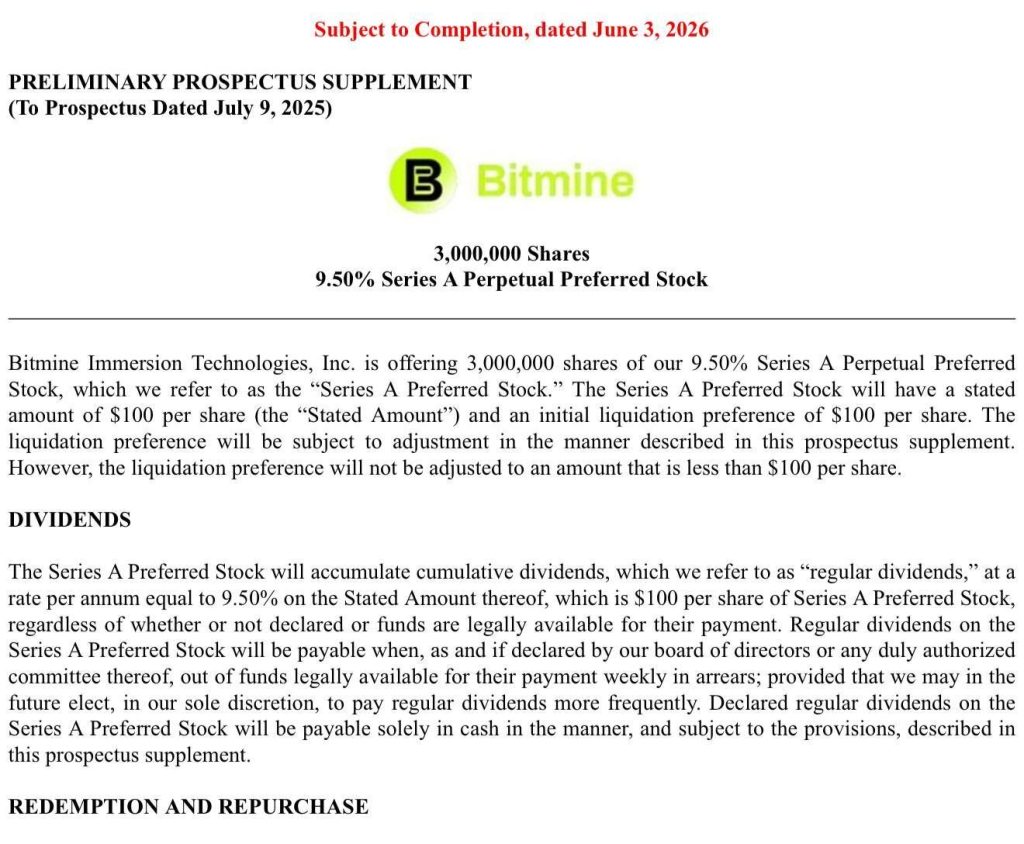
BitMine Chairman Thomas Lee pressed this point at the Proof of Talk conference in France, arguing that ETH digital asset treasuries could use staking yields to fund grants for the Ethereum ecosystem, turning yield generation into both a financial and a governance flywheel.
The company’s stated intent to expand its validator infrastructure through MAVAN, its proprietary staking initiative, signals this is operational planning, not just talking-point positioning.
Standard Chartered’s head of digital assets research, Geoffrey Kendrick, has argued that this structural advantage, staking-funded operations versus forced coin sales, is a core reason ETH treasury firms may outperform their Bitcoin equivalents over time.
What the Bull Case Misses: Staking Yields Are Not Fixed, and the Transition Costs Are Real
The staking-yield-as-dividend argument holds only if Ethereum staking returns remain stable enough to cover preferred stock obligations.
They are not fixed. ETH staking APY fluctuates with network participation rates, MEV conditions, and protocol-level changes.
A 9.5% preferred dividend funded by 3% to 5% staking yield is not self-sustaining without additional ETH accumulation or supplementary revenue, which is precisely why BitMine’s press release lists acquisition of additional ETH as a primary use of proceeds.
Mining companies also carry legacy operational structures that pure treasury firms do not. Debt covenants, physical infrastructure costs, and shareholder expectations built around mining economics do not dissolve overnight.
The transition from mining strategy to staking treasury is not a balance sheet reclassification; it is a business model overhaul with execution risk at every stage.
Concentration risk compounds the picture. BitMine has publicly targeted control of approximately 5% of Ethereum’s total circulating supply.
Analysts have flagged that a single corporate holder at that scale becomes a key variable in ETH price dynamics, amplifying both the upside and the mark-to-market downside.
The mining strategy argument and the treasury argument are not the same argument. One is about operational efficiency. The other is about market structure. In other news, Ethereum ecosystem infrastructure is improving in ways that make large-scale staking operations more viable, but that does not eliminate the balance sheet risk of holding a concentrated, volatile asset on a leveraged capital structure.
Discover: The Best Token Presales
The post Ethereum News Today: BitMine to Raise $300M in Preferred Stock to Buy ETH appeared first on Cryptonews.

A high-profile shift in Strategy’s Bitcoin strategy is drawing attention from investors and analysts as Grayscale cautions that the firm’s levered BTC exposure is increasingly stressed. The development could limit Strategy’s ability to continue purchasing Bitcoin and may force additional sales if the balance sheet dynamics tighten further. The week’s activities centered on Michael Saylor’s Strategy unit, which sold 32 BTC on Monday — a tiny portion of its roughly 843,706 BTC hoard — while also unloading $128 million in STRC shares. Market reaction followed, with Strategy’s stock retreating to a two-month low near $126 and Bitcoin trading under pressure in the ensuing days, having fallen roughly 16% since the sale was announced.
Grayscale’s head of research, Zach Pandl, argued that the pivot away from what has been one of the world’s largest Bitcoin holders has weighed on sentiment around the asset and the broader ecosystem. The levered nature of Strategy’s business model, combined with the need to sustain or grow dividends on STRC, could compel more Bitcoin sales if cash obligations rise, Pandl said.
The week’s moves also highlight the tension between Strategy’s balance sheet needs and the impact on Bitcoin markets, a theme that has drawn commentary from multiple corners of the crypto industry.
Market dynamics: leverage, liquidity, and sentiment
At the core of the discussion is Strategy’s reliance on a levered Bitcoin program, which Pandl describes as under strain. If the firm needs to raise cash to support STRC’s dividend or to fund ongoing obligations tied to its balance sheet, more BTC sales could be on the table. In the immediate aftermath of the Monday sale, Strategy’s publicly traded equity, STRC, slid meaningfully, and the parent stock, MSTR, traded down to a two-month low around $126 per share. The rapid price moves underscored how a single, modest BTC liquidation can ripple through related assets and sentiment, particularly when investors are skittish about leverage in crypto balance sheets.
Market observers highlighted that Strategy’s decision to realize BTC and to adjust its equity instruments has contributed to a broader mood of caution around big, leveraged crypto plays. The sell-off fed into a broader narrative about risk appetite for BTC-centric strategies and the degree to which corporate treasuries should carry crypto exposure versus more diversified asset mixes. Google Finance charts cited in market chatter showed BTC losses accelerating in the wake of Strategy’s disclosures, reinforcing the notion that leverage can magnify downside in uncertain markets.
STRC, MSTR, and the dividend calculus
Strategy’s STRC instrument is designed to track near its $100 target while delivering an 11.5% dividend, but the market price has hovered around the mid-$90s. That gap implies a higher required yield for investors, potentially constraining Strategy’s ability to sustain generous payouts without raising cash elsewhere. Pandl noted that if Strategy raises the STRC dividend to restore the payout toward the $100 mark, cash obligations would rise further, potentially necessitating more BTC sales to bridge funding gaps. Such dynamics create a feedback loop: higher distributions increase selling pressure on BTC, which can reinforce negative sentiment and erode the equity value of STRC and MSTR alike.
Grayscale’s assessment extends to Strategy’s broader capacity to accumulate additional tokens at current share prices for both STRC and MSTR. The firm’s view, according to Pandl, is that Strategy would face a limited ability to increase token holdings under prevailing pricing, a constraint that could weigh on the company’s long-term positioning in the BTC market.
In broader commentary, market observers cautioned that while the sales are negative near term, they may also grant Strategy more balance-sheet flexibility. Jeff Ko, chief analyst at CoinEx, described the initial Bitcoin sale as an important psychological trigger for the week’s pullback but argued the move could be constructive in the bigger picture by giving Strategy more room to manage risk. “Greater flexibility around selling Bitcoin can help Strategy manage balance sheet risk more prudently, rather than forcing itself into a one-way accumulation strategy under all market conditions,” Ko said.
“For the health of the Bitcoin ecosystem over the long run, less BTC on levered balance sheets and more on diversified corporate balance sheets will be a positive, in our view.”
Perspectives from the broader crypto lens
Not all voices in the space view Strategy’s actions in the same light. Augustine Fan, partner at crypto software firm SignalPlus, argued that the market’s blame for Strategy’s sales and STRC’s discount to par may be overemphasized, suggesting that even the most ardent supporters are recalibrating their bullish theses amid a shifting macro backdrop. “All focus will be on the MSTR situation to see how Saylor manages liquidity strains by balancing dividend payments against STRC and the DAT holdings,” Fan told Cointelegraph.
Peter Schiff, the well-known macro commentator, joined the discussion, warning that if Strategy must lift dividends to return STRC to parity, the company could run into cash constraints sooner than anticipated, potentially accelerating Bitcoin sales to fund payments. The crosswinds underscore a broader reality: leverage and dividend requirements can outpace the market’s tolerance for drawdowns in crypto assets, placing a premium on cash management discipline.
What comes next for Strategy and the market
While the near-term trajectory remains unclear, the episode reinforces several enduring themes for crypto markets: the impact of corporate-level leverage on Bitcoin demand, the sensitivity of crypto-linked equities to token movements, and the delicate balance between dividends, liquidity, and asset accumulation. The sequence of sales has shifted sentiment around Strategy’s strategic footing, even as some analysts emphasize the potential long-run benefits of a more diversified asset base and clearer risk controls.
As Saylor and his team navigate liquidity pressures and dividend commitments, investors will be watching for any further BTC dispositions, updates on STRC’s yield and pricing dynamics, and how MSTR’s broader cash flows evolve in a market that remains highly sensitive to macro twists and regulatory signals.
In summary, the episode highlights how a single leverage-driven strategy can seed broader market reactions, particularly when an asset like Bitcoin sits at the center of a complex corporate treasury plan. For readers and market participants, the important question is not only what happens next in Strategy’s portfolio but how the crypto ecosystem adapts as leveraged holdings compress, cash needs rise, and balance sheets recalibrate in real time.
What to watch next: look for any official disclosures from Strategy regarding future BTC sales, STRC dividend adjustments, and MSTR cash-flow updates. The effect on BTC’s price trajectory and on related crypto equities will likely hinge on the pace and scale of further balance-sheet actions, as well as investor appetite for leveraged crypto exposure in a higher-rate, more regulated environment.
Crypto World
Crypto’s worst week since July 2024 deepens as BTC, ETH prices near critical support levels
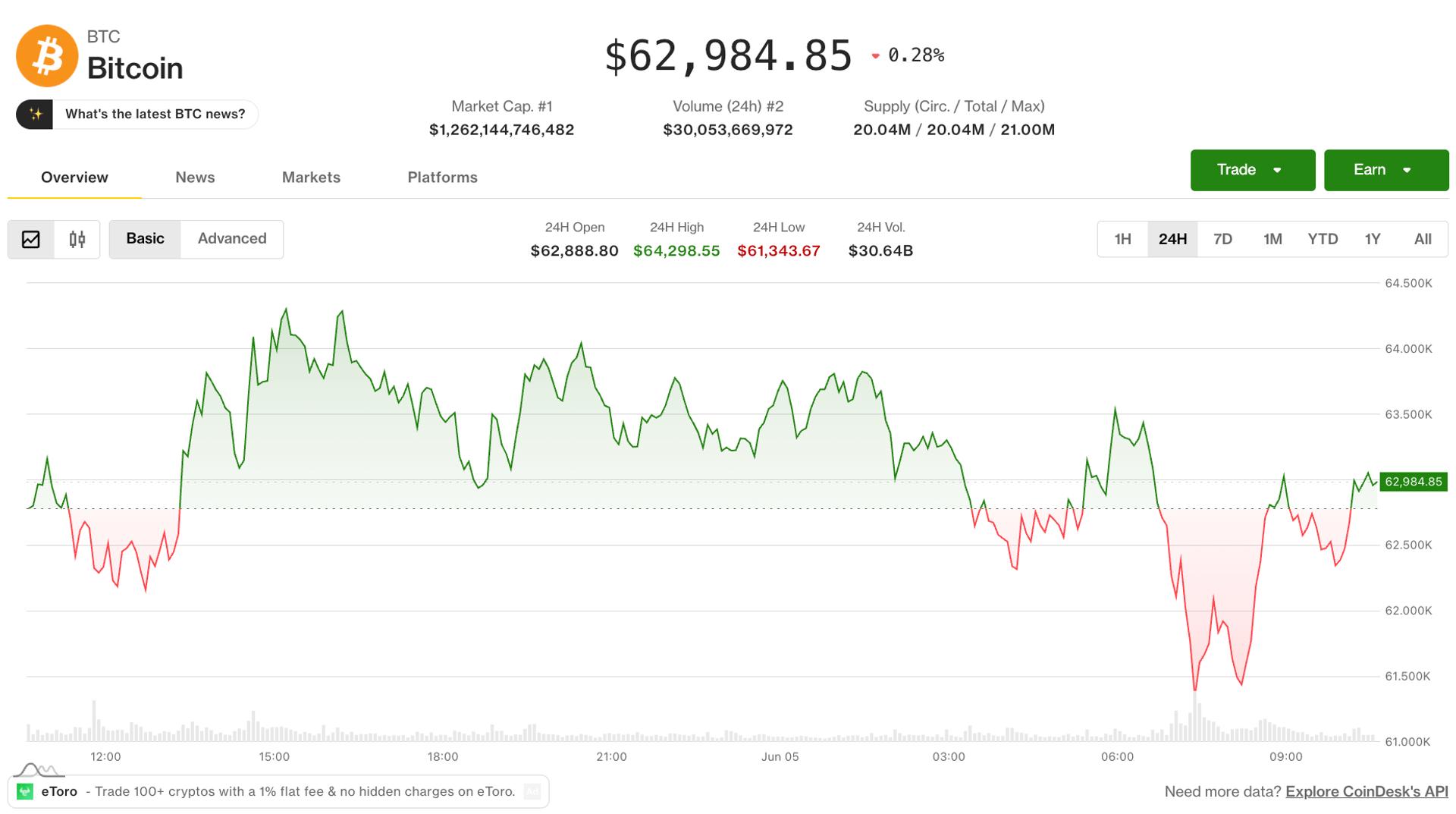
The crypto market is teetering on the brink of a major breakdown in price after suffering one of its worst weeks since July 2024.
Bitcoin , currently trading around $62,500 has lost more 14.5% since midnight UTC on Monday morning, while ether (ETH) has plunged by more than 17%, dropping 5.5% on Friday alone.
Ether, the second-largest cryptocurrency, is now at its lowest level since April 2025, when it bounced at $1,420 before rallying to record highs over the subsequent four months. A break below that level would bring it toward 2022 bear-market levels, when it dipped below $900.
The broader altcoin market also suffered deep losses this week. One of the worst performers on Friday was zcash (ZEC), which tumbled by more than 30% after a security researcher found an exploit that would have minted “unlimited” tokens in its shielded pool.
There are multiple catalysts causing this week’s slide. Strategy (MSTR) Executive Chairman Michael Saylor attributed it to capital rotation in light of a series of artificial intelligence IPOs in the U.S., while onchain analysts are pointing towards a lack of spot crypto volume.
CryptoQuant notes that spot trading volume fell to $679 billion in April, the lowest monthly level since October 2023, indicating a lack of demand.
Derivatives positioning
- BTC derivatives positioning has flipped from mild improvement to clear deleveraging this week. Open interest dropped 15% to $17 billion, with funding rates flipping negative to flat across multiple venues
- At Deribit, the rate dropped to -15% annualized, a notable reversal from the prior positive regime. The three-month annualized basis fell to 2.7% from 2.9% last week, confirming a pullback in institutional risk appetite.
- Options positioning has turned clearly defensive: Put/call volume has flipped to a 50/50 split over the past 24 hours, losing the prior call tilt, while the one-week 25-delta skew more than doubled to 27% from 13% a week ago. That signals a sharp escalation in demand for downside protection.
- Front-end implied volatility (DVOL) has climbed further to 47, confirming a sustained bid that aligns with the broader deleveraging in derivatives.
- Coinglass data shows $1.2 billion in 24-hour liquidations, with a 76-24 split between longs and shorts. Bitcoin ($364 million), ether ($291 million) and zcash ($107 million) were the leaders in terms of notional liquidations.
- The Binance liquidation heatmap indicates $60,900 as a core BTC liquidation level to monitor, in case of a price drop.
Token talk
- Zcash’s (ZEC) plight on Friday sowed seeds of doubt across privacy coins, with monero (XMR) losing 12% since midnight UTC and dash (DASH) dropping 9%.
- ZEC’s losses were compounded by BitMEX founder Arthur Hayes, who said on X that his firm had sold its entire allocation of the token.
- There were also heavy losses for , which tumbled by more than 10% after the project’s founder, Charles Hoskinson, said that he was “taking a break” after warning of ecosystem failures.
- AI tokens lost their early week momentum as FET, NEAR and TAO fell 4%-6% despite outperforming the rest of the market on Monday.
- One reason for altcoin holders to be hopeful is the fact that the average relative strength index (RSI) across all crypto pairs is in “oversold” territory, suggesting that a relief bounce could be on the cards this weekend.
Crypto World
Arthur Hayes Just Dumped His Entire Zcash Position After a Bug That Could Have Allowed Counterfeit ZEC for 4 Years

Arthur Hayes, the BitMEX co-founder, confirmed today that he liquidated his entire Zcash (ZEC) position after a protocol bug in the Orchard Pool. Zcash’s core shielded transaction layer bug was disclosed publicly, compounding an already difficult few weeks for ZEC.
The move completes the full liquidation of his self-described ‘Holy Trinity’ portfolio, which previously included HYPE and NEAR tokens.
The central question the market is now asking is not whether Hayes was right to exit, the bug is real, the risk is documented, but whether this was a cold-eyed protocol risk assessment or a reactive flush after a vulnerability shook his conviction in privacy coins as a category.
The evidence points heavily toward the former. That distinction matters for anyone trying to read this exit as a signal.

Discover: The Best Crypto to Diversify Your Portfolio
The Orchard Pool Bug: What the Vulnerability Actually Means for ZEC
The Orchard Pool is Zcash’s next-generation shielded transaction circuit, introduced with the NU5 upgrade in May 2022.
It replaced the older Sapling pool and brought trustless zk-SNARKs via the Halo 2 proving system, no trusted setup required. The pool exists specifically to enable fully private transfers, and its cryptographic soundness is not a feature; it is the entire value proposition of ZEC.
The bug, identified on May 29, 2026, by security engineer Taylor Hornby of Shielded Labs, using AI-assisted formal methods including Anthropic’s Claude Opus 4.8, was an insufficient constraint in elliptic-curve multiplication inside the — zookohalo2_gadgets crate.

 ⓩ (@zooko) June 4, 2026
In easy terms, crafted inputs could theoretically bypass the circuit’s validity checks and produce counterfeit ZEC that still passed Orchard’s verification.
An emergency hard fork was activated on June 3, 2026, patching the flaw. But the window from NU5 activation in 2022 to the June 2026 patch represents nearly four years during which the bug existed undetected, surviving multiple expert audits.
Here is the part that matters for holders: due to Orchard’s privacy architecture, it is cryptographically impossible to prove that counterfeit ZEC was never minted during that window.
No evidence of exploitation exists, but the inability to attest total supply integrity is not a footnote; it is a fundamental crack in the sound money narrative that Electric Coin Co. has built around ZEC.
Hayes Exits Zcash: Protocol Risk Reaction or the Same Pattern Playing Out Again?
Hayes had publicly flagged Zcash as a high-conviction holding, part of the ‘Holy Trinity’ alongside HYPE and NEAR, a trio he framed as his asymmetric altcoin bets.
He had already cleared HYPE and NEAR before turning to ZEC, a sequencing that some read as methodical de-risking rather than panic.
The ZEC exit followed the Orchard bug’s public disclosure and the June 3 hard fork, meaning Hayes moved after the vulnerability was known, not before.
His stated rationale was direct: ‘The probability of unauthorized minting is extremely low, but it cannot be proven cryptographically impossible,’ he wrote. And further: ‘The narrative of protecting privacy from AI, governments, and Big Tech demands perfection, a standard the bug undermined.’
That framing is not a trader’s excuse. It is a thesis statement. Hayes was long ZEC because privacy coins occupy a unique ideological and technical niche, and that niche requires cryptographic certainty that Orchard can no longer provide without qualification.
The pattern here is familiar to anyone who has tracked Hayes’s public portfolio moves. Fresh conviction, public endorsement, then a clean exit when the underlying thesis breaks. Whether that is disciplined risk management or the ‘shill, pump, dump, repeat’ cycle this site has previously documented is a judgment call, but the Orchard bug gives this exit a harder-to-dismiss fundamental rationale than most. He continues to hold Worldcoin (WLD), which was never part of the Trinity framework.
ZEC Price and Market Structure: The Damage Is Real
ZEC dropped 30–36% from recent highs following the bug’s public disclosure, falling from above $600 to approximately $390, erasing over $3 billion in market cap.
The move broke the 20-day, 50-day, and 100-day EMAs in sequence, with traders now watching 200-day EMA support near $367 as the next critical level.
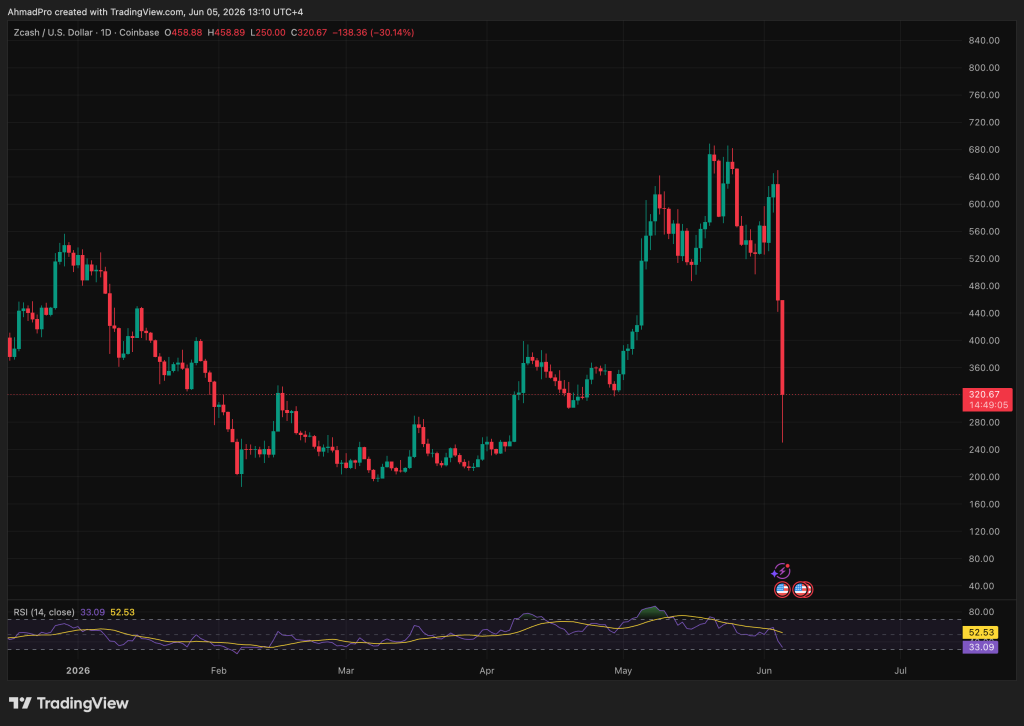
Hayes’s exit itself occurred on normal trading volumes, suggesting his position did not mechanically move price; the market was already pricing in protocol risk before his announcement landed.
The structural read is bearish until the $430–$450 zone is reclaimed on a closing basis. Below $367, ZEC enters uncharted technical territory with limited historical support to reference.
Discover: The Best Token Presales
The post Arthur Hayes Just Dumped His Entire Zcash Position After a Bug That Could Have Allowed Counterfeit ZEC for 4 Years appeared first on Cryptonews.

Key Highlights
- Veru shares exploded more than 167% following the announcement of a clinical supply partnership with Novo Nordisk, documented in an SEC filing dated June 4, 2026.
- Under the agreement, Novo Nordisk will provide Wegovy free of charge to support Veru’s Phase 2b PLATEAU clinical study.
- The PLATEAU study is evaluating enobosarm paired with Wegovy in an older adult population struggling with obesity.
- As part of the deal, Novo Nordisk obtained first rights to negotiate any future commercial collaborations involving enobosarm-GLP-1 combinations.
- Shares of Veru climbed from a closing price of $2.25 to reach an intraday peak of $6.02, nearing the 52-week high of $7.40.
Shares of Veru exploded over 167% during Thursday’s trading session following the company’s announcement of a formal clinical supply partnership with Novo Nordisk, according to an SEC filing submitted on June 4, 2026. The stock rallied from its previous closing level of $2.25 to touch an intraday high of $6.02.
The clinical supply agreement, executed on June 2, 2026, supports Veru’s active Phase 2b clinical study known as PLATEAU. This research program is designed to assess the combination of enobosarm with Wegovy (semaglutide) in an older adult patient population dealing with obesity.
According to the agreement’s provisions, Novo Nordisk will furnish Wegovy to Veru without charge throughout the trial period. This represents substantial financial relief for a small-cap biotechnology company like Veru.
The partnership also grants Novo Nordisk priority negotiation rights for any potential commercial ventures involving combinations of enobosarm with GLP-1 receptor agonists. Market participants interpreted this provision as a vote of confidence from the pharmaceutical giant dominating the GLP-1 therapeutic space.
Thursday’s trading volume for Veru significantly exceeded typical daily activity. The rally appeared fueled primarily by retail investors and momentum traders responding to the 8-K disclosure, with Novo Nordisk’s involvement lending substantial validation to the development program.
Clinical Trial Background
The PLATEAU clinical program expands upon findings from the earlier Phase 2b QUALITY investigation. That prior study demonstrated that combining enobosarm with semaglutide resulted in enhanced fat mass reduction during the active weight loss phase.
Following the discontinuation of semaglutide in the QUALITY research, enobosarm demonstrated an ability to prevent both weight and fat mass regain while maintaining lean muscle tissue. This unique profile generated considerable interest within the competitive obesity therapeutics landscape.
The PLATEAU study represents the natural progression of this research, testing the combination approach in a broader patient population. Veru maintains both sponsorship and operational control of the investigation.
Broader Market Performance
Thursday’s overall market performance showed mixed results. The S&P 500 advanced 0.4% and the Dow Jones Industrial Average climbed 1.9%, while the Nasdaq declined 0.2%.
No significant Federal Reserve policy statements or major economic data releases appeared to substantially impact the trading session.
Novo Nordisk shares also participated in the upward movement, gaining approximately 4.17% during Thursday’s session.
Veru’s intraday peak of $6.02 positioned the stock near its 52-week high of $7.40. The shares have approximately tripled in value during 2026 to date.
By mid-afternoon Thursday, Veru was changing hands around $5.74.

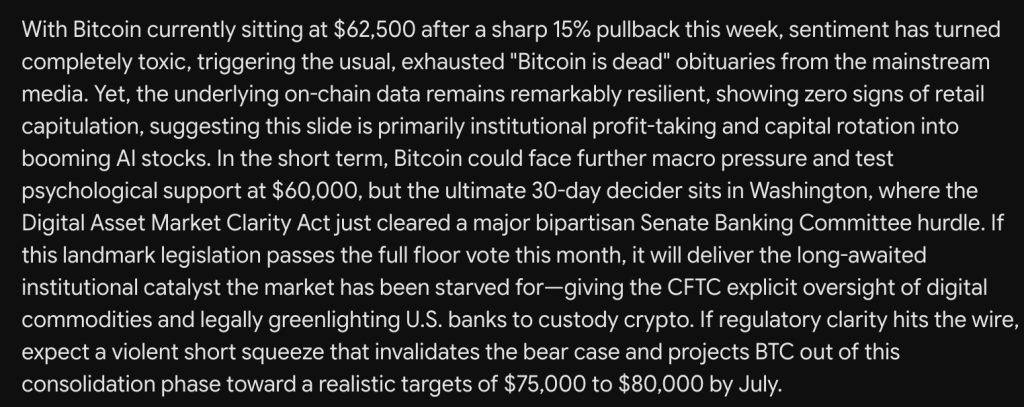
Google Gemini AI is not joining the obituary writers predicts. With Bitcoin sitting at $62,500 after a sharp 15% weekly pullback, the AI is calling the panic overblown and pointing to on-chain data showing zero signs of retail capitulation as the key reason this selloff reads differently than it feels from the outside.
The diagnosis Gemini is offering is specific and worth taking seriously. This slide is primarily institutional profit-taking and capital rotation into booming AI stocks, not the broad-based panic selling that characterizes genuine cycle tops or structural breakdowns.
When retail is not capitulating despite a 15% drop and mainstream media is running Bitcoin obituaries, the historical pattern is that the bottom is closer than the headlines suggest.
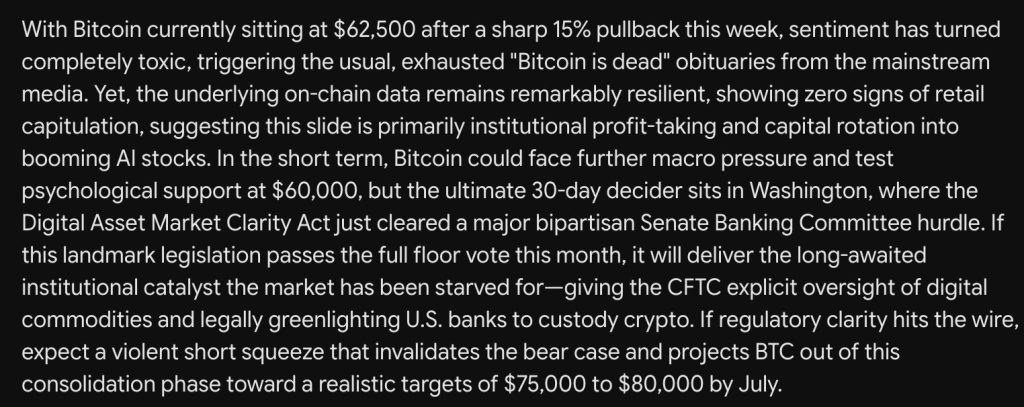
The 30-day decider Gemini identifies is the Digital Asset Market Clarity Act, which just cleared a major bipartisan Senate Banking Committee hurdle.
The framing Gemini uses around this is the most precise in this series. If the bill passes the full floor vote this month, it delivers something specific and structural: CFTC explicit oversight of digital commodities and legal authorization for US banks to custody crypto.
Those are not soft catalysts; they are the regulatory foundation that unlocks the next wave of institutional capital that has been waiting for exactly this kind of framework. Gemini is calling for a violent short squeeze if that news hits, projecting BTC toward $75,000 to $80,000 by July.

The bear case does not require anything dramatic. Further macro pressure could test the $60,000 psychological support before the Clarity Act resolution arrives, and at the current trajectory, that test looks increasingly likely before the month closes.
Discover: The best pre-launch token sales
Why Gemini AI predicts the Current Bitcoin Price Prediction? BTC Just Made a New Cycle Low on the Daily and the RSI Is at Its Most Extreme Reading
BTC price is printing $62,958 on the daily chart with a session low of $61,073, and this daily chart is showing a picture that demands attention.
The candle structure over the past 10 days is vertical red bars with almost no meaningful bounces, a relentless one-directional move that has taken Bitcoin from $82,000 in mid-May to $61,073 intraday today. That is a 25% drop in under 3 weeks on the daily timeframe.
The dotted support line on this chart sits at approximately $62,000 to $63,500, which represents the February cycle lows that previously held as the deepest point of the 2026 correction.
Price is sitting right on that line, with today’s intraday low of $61,073 breaking briefly below it before recovering back to $62,958. That wick below the February lows and the recovery back above them within the same session is the most important piece of price action on this chart right now.
Whether today closes above $62,000 or not determines whether the February lows remain intact as a double bottom or whether the structure breaks and Gemini’s $60,000 psychological support becomes the next test. A daily close below $61,000 with follow-through changes the technical picture significantly.
On the upside $68,000 is the first meaningful resistance after the level that was support for months became resistance on the way down. Above that $72,000 to $74,000 is where Gemini’s short squeeze would need to push through to validate the $75,000 to $80,000 July target.
Historically, when Bitcoin’s daily RSI reaches the high teens, the duration of the selling at that intensity is measured in days rather than weeks.
The mean reversion from RSI readings this extreme tends to be sharp and fast. Gemini AI predicts a violent short-squeeze, framing if CLARITY Act news hits are not hyperbole, given what an RSI of 17.45 combined with a legislative catalyst would look like in terms of forced short covering and sidelined capital rushing back in simultaneously.
Discover: The best crypto to diversify your portfolio with
LiquidChain Is Catching the Attention of Bitcoin holders
The rotation is already happening. Most people will only see it in hindsight.
Large-cap crypto is not failing. It is capped. Bitcoin, Ethereum, and XRP have been pressing against the same resistance bands for weeks. The macro tailwinds keep getting delayed.
The institutional inflows keep getting pushed to next quarter. Holding assets where the upside depends on catalysts you cannot control is not a strategy. It is waiting.
A capital that has navigated enough cycles does not wait at resistance. It moves before the destination becomes obvious.
Early-stage infrastructure plays operate on different math entirely. A small enough market cap means a modest rotation produces dramatic price movement. The asymmetry exists because the market has not priced in what is being built yet. That gap between current valuation and what the project is actually worth is where the returns come from.
Multi-chain fragmentation costs DeFi real money every single day. Bitcoin, Ethereum, and Solana run completely isolated liquidity systems with no native way to connect them. Every user moving value between ecosystems absorbs that cost directly in fees, slippage, and failed transactions.
LiquidChain collapses all 3 networks into a single execution layer. One deployment. Full ecosystem access. No cross-chain tax on every interaction.
The market has not found this yet. That is the entire point.
The presale is at $0.01454 with just over $820,000 raised. Ground floor is not a marketing phrase here. It is a description of where this actually sits in its lifecycle.
Execution is unproven. Adoption is unknown. Those risks are real and worth naming directly. Established assets offer a smoother ride toward a ceiling that is already visible. This offers an earlier seat at a table that has not been set yet.
Explore the LiquidChain Presale
The post You Will Not Like Where Google Gemini AI Predicts Bitcoin Going in The Next 30 Days appeared first on Cryptonews.
Crypto World
‘Avoid Rain at All Costs’: ZachXBT Raises Red Flags Over $8.8B Prediction Market Project

Blockchain detective ZachXBT is warning traders to steer clear of Rain Protocol after claiming to have uncovered a pattern of suspicious on-chain activity surrounding the project.
In the latest update, ZachXBT described the prediction market project, which he said has an $8.8 billion market capitalization and ranks among the top 15 crypto assets, as having few users, limited product traction, no notable backers, and a team with little established history in the industry.
Links to Failed Crypto Projects
According to his on-chain investigation, wallets tied to the RAIN team share funding trails with the Data Ownership Protocol (DOP) and TOMI ecosystems via the Gems hot wallet and several centralized exchange deposit addresses, which suggests an overlap between the projects.
As evidence, ZachXBT highlighted two “dust” transactions that were sent to the same address on Oct. 14, 2025. According to his findings, a wallet linked to the RAIN deployer sent a small transfer to the address at 3:31:47 p.m. UTC, while a wallet he associated with the TOMI team multisig and a centralized exchange deposit address sent another dust transaction to that same destination 36 seconds earlier. He also said that the recipient wallet later received funds from another address that had previously been funded by a DOP multisig.
In a separate transaction trail, the investigator said another wallet transferred funds to an address that later used the same centralized exchange deposit address as the DOP deployer.
ZachXBT also claimed RAIN’s market activity shows signs of on-chain price manipulation, and alleged that addresses tied to the deployer used Uniswap V3 liquidity pools while routing spot transfers through the Gems hot wallet. He also took aim at RAIN’s valuation, while highlighting that its decentralized autonomous treasury, Enlivex, a Nasdaq-listed company, announced a $212 million treasury strategy in November 2025 even though, according to him, the project is nowhere near the scale of prediction market platforms like Kalshi or Polymarket.
He cited DefiLlama data showing RAIN has $27.2 million locked on Arbitrum, but said the entire amount is held in its own illiquid token and that the protocol generates only about $1 million in annual fees. TOMI, DOP and Sirin Labs projects are all linked to controversial Israeli entrepreneur Moshe Hogeg, who was arrested in 2021 and later faced police allegations over a $290 million crypto fraud scheme.
Kraken Rating Cut to B-Tier
ZachXBT said he has lowered his rating for crypto exchange Kraken from S-tier to B-tier over “lack of due diligence” before listing what he described as “low-quality, manipulated tokens,” including M, RAIN, RIVER and RAVE. He also criticized Kraken’s public disclosure of its recent security breach, and added that it did not mention compensation for affected users.
By comparison, he noted that exchanges such as Coinbase and Bybit prioritized compensating customers after their own security incidents. ZachXBT also raised his bounty to as much as $100,000 for insiders who can provide documents or chat logs related to alleged centralized exchange market manipulation schemes.
The post ‘Avoid Rain at All Costs’: ZachXBT Raises Red Flags Over $8.8B Prediction Market Project appeared first on CryptoPotato.


U.S. spot bitcoin ETFs ended a record 13-day streak of outflows, adding $3.05 million on Thursday after losing more than $4.4 billion in redemptions since mid-May.
The outflows, together with the plunging price of the largest cryptocurrency, dragged total bitcoin ETF assets down to $80.40 billion from $104.29 billion at the start of the streak.
It’s worth keeping in mind the size of yesterday’s inflows compared with the outflows. The $3 million figure is less than any single day of outflows during the period, which mostly saw exits above $100 million.
BlackRock’s IBIT, the largest fund in the category, received $47.66 million on Thursday, while Fidelity’s FBTC, Bitwise’s BITB and Ark’s ARKB continued to bleed, SoSoValue data shows.
The total bitcoin assets under management (AUM) in the investment vehicles stand at 1.277 million BTC, about 7.2% below the October record, according to CheckonChain. That is slightly above the Feb. 23 low of 1.274 million BTC, reached as the price of bitcoin recovered from its February trough near $60,000. Bitcoin fell to $63,800 on Thursday after rising as high as $64,660.
Spot ether(ETH) ETFs also ended a streak of outflows, taking in $19.30 million after 17 days of redemptions. BlackRock’s ETHA benefited from the influx, with every other ether ETF logging zero net flow.
Total ether ETF assets sit at $9.78 billion, or 4.57% of ether’s circulating market capitalization, with cumulative inflows since the 2024 launch at $11.21 billion. The category remains roughly $2 billion below its asset peak from earlier in the year.
Meanwhile, Hyperliquid’s HYPE ETFs were the only investments to avoid outflows during the period. The three ETFs took in another $12.15 million on Thursday, extending a run of inflows that started with their debut on May 12. Grayscale’s low-fee HYPG fund pulled $4.70 million on its first day of trading.
On Friday, Bitcoin fell 1.7% to $62,700, ether dropped to $1,670 and the broader risk picture deteriorated as the global AI trade rolled over on Broadcom’s outlook miss and a 4.7% selloff in South Korea’s KOSPI index.
CORRECT (June 5, 10:09 UTC): Corrects day to Thursday in first paragraph and elsewhere.
Crypto World
The Bitcoin Crash Just Wiped $62 Billion From Corporate Treasury Holders, Is the MicroStrategy Model Broken?

The June 2026 crypto rout just erased $62 billion in combined market capitalization from public companies holding Bitcoin as a treasury asset.
MicroStrategy, Tesla, and Marathon Digital are leading the damage. The question that matters now is not whether the losses are recoverable; it is whether the entire structural model that produced them was viable to begin with.
Corporate Bitcoin holdings accelerated after MicroStrategy’s initial $250 million allocation in August 2020, framed explicitly as a hedge against dollar debasement.
By late 2025, more than 200 public companies collectively held an estimated $150 billion in digital assets. They bought near cycle highs. Bitcoin then fell roughly 50% from its peak. The math on that sequence is not complicated.
This is either a cyclical stress test that the strongest holders survive, or it is the market revealing that a leveraged, mark-to-market-sensitive corporate Bitcoin treasury is structurally broken by design. The rest of this article makes the case that it is closer to the latter.
Discover: The Best Crypto to Diversify Your Portfolio
MicroStrategy and Bitcoin Balance Sheet Mechanics Are Dangerous
Strategy, MicroStrategy’s rebranded entity, holds 843,706 BTC at an average acquisition cost of approximately $75,599 per coin.
With Bitcoin sliding toward $60,000 during that period, that position carries roughly $11 billion in unrealized losses. Every $1,000 move in BTC shifts Strategy’s paper position by $713.5 million.
Under updated FASB fair-value accounting rules in effect by 2026, those unrealized losses flow directly through net income, producing massive negative EPS swings in quarterly filings.
For a company that has built its investor thesis entirely around Bitcoin accumulation, reporting multi-billion-dollar losses is not a rounding error; it is the product.
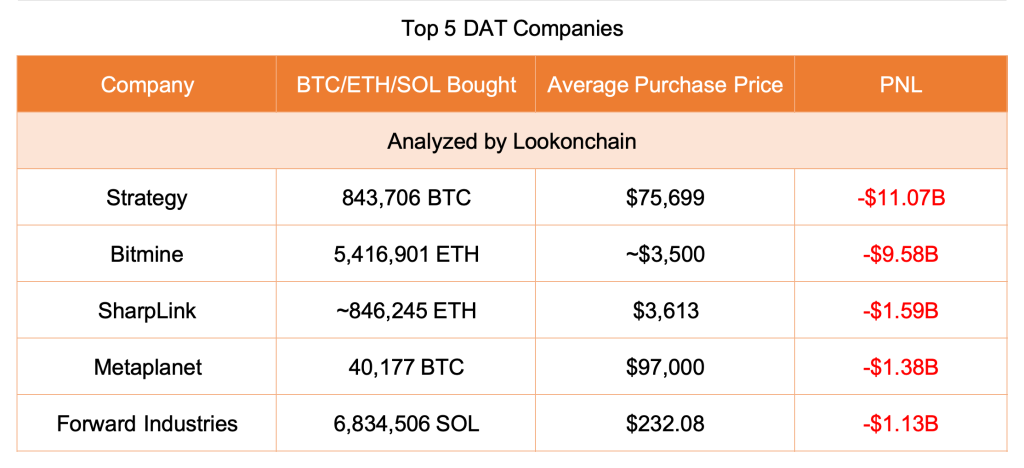
Across the eight largest pure-play Bitcoin treasury firms, controlling over 850,000 BTC combined, unrealized losses had already surpassed $10 billion before the latest leg down.
Artemis data from February 2026 showed system-level unrealized losses across corporate crypto portfolios exceeding $20 billion, even then, and no major corporate holder was in a net profit position on BTC at that point.
The market capitalization loss now visible across the sector is not a surprise outcome. It was a predictable one.
Investor Michael Burry has described the dynamic as a “reflexive unwind”, falling BTC prices compress equity premiums, close the issuance window, and convert the model from accumulate-forever to sell-to-survive.
His scenario analysis identifies $60,000 as an existential crisis level for Strategy specifically, where capital markets are effectively closed and multi-billion-dollar losses become locked in rather than theoretical.
Discover: The Best Token Presales
The post The Bitcoin Crash Just Wiped $62 Billion From Corporate Treasury Holders, Is the MicroStrategy Model Broken? appeared first on Cryptonews.

How Protocols Buy Attention and Convert It Into Liquidity
Introduction
For years, the crypto industry has described Decentralized Finance (DeFi) as an alternative financial system built on transparency, permissionless access, and code-based trust. While those principles remain true, they no longer explain how most modern DeFi protocols actually grow.
The reality is simpler:
DeFi is increasingly an attention market.
Liquidity does not magically appear because a protocol is technologically superior. Users rarely discover projects through technical whitepapers. Capital flows toward visibility, narratives, incentives, and social momentum.
In many cases, protocols effectively purchase attention and convert it into liquidity.
Understanding this dynamic helps explain everything from liquidity mining programs and airdrops to influencer campaigns and token incentives.
The New Currency: Attention
Attention has become one of the most valuable assets in digital economies.
Every day, thousands of crypto projects compete for visibility across X, Telegram, Discord, YouTube, podcasts, newsletters, and on-chain analytics platforms.
The challenge is not building a protocol.
The challenge is convincing people to care.
A protocol can have innovative technology, robust security, and strong fundamentals, yet struggle to attract liquidity if nobody is paying attention.
Conversely, projects with mediocre products can attract massive capital inflows when they successfully dominate narratives.
This is because attention often arrives before trust.
And liquidity often arrives before utility.
The Attention-to-Liquidity Funnel
Most successful DeFi growth strategies follow a similar process:
Step 1: Capture Attention
Protocols create awareness through:
- Airdrops
- Yield farming campaigns
- Influencer partnerships
- Community incentives
- Referral programs
- Viral social content
- Trading competitions
The goal is simple:
Get users talking.
Step 2: Generate Participation
Once attention is captured, users are encouraged to interact with the protocol.
Examples include:
- Depositing assets
- Providing liquidity
- Staking tokens
- Opening leveraged positions
- Minting NFTs
- Participating in governance
Participation creates measurable metrics that can be shared publicly.
Step 3: Create Social Proof
As activity grows, new users see:
- Rising TVL
- Growing user counts
- Higher trading volume
- Trending token prices
These metrics signal momentum.
Momentum attracts additional attention.
The cycle reinforces itself.
Step 4: Convert Attention Into Liquidity
Eventually, attention becomes capital.
Users move funds into the ecosystem because they believe:
- Rewards are attractive
- Growth will continue
- The protocol has momentum
- Future incentives may exist
At this stage, attention has been successfully monetized.
The protocol has transformed visibility into liquidity.
Liquidity Mining Was the First Attention Engine
The concept is not new.
Liquidity mining emerged during the DeFi Summer of 2020 as one of the industry’s most effective mechanisms for acquiring attention.
Protocols distributed governance tokens in exchange for user participation.
Critics viewed this as expensive.
In reality, protocols were buying attention.
The rewards attracted users.
Users generated activity.
Activity created headlines.
Headlines generated more users.
Liquidity mining was essentially a customer acquisition strategy disguised as financial incentives.
Airdrops Are Marketing Budgets
Many people view airdrops as gifts.
Protocols view them differently.
Airdrops are marketing expenditures.
Instead of purchasing advertisements through traditional channels, projects distribute tokens directly to users.
The result is often more effective because recipients become:
- Users
- Community members
- Content creators
- Advocates
A successful airdrop converts thousands of individuals into active marketers.
Every speculative post, tutorial thread, and dashboard screenshot amplifies attention.
Why Attention Is More Valuable Than Capital
Traditional finance treats capital as a scarce resource.
In crypto, attention is often scarcer.
Billions of dollars can move between protocols within hours.
User attention, however, is limited.
A trader can only monitor a handful of opportunities at a time.
An investor can only follow a limited number of narratives.
Winning attention often precedes winning capital.
This explains why some protocols prioritize growth campaigns even when immediate profitability suffers.
Their objective is not today’s revenue.
Their objective is to become the narrative everyone watches tomorrow.
The Risks of Attention-Driven Growth
While attention can accelerate growth, it can also create fragility.
Protocols that rely exclusively on incentives often face several challenges:
Mercenary Capital
Users arrive for rewards rather than conviction.
When incentives disappear, liquidity leaves.
Unsustainable Economics
Excessive token emissions can dilute long-term value.
Protocols may spend more acquiring liquidity than they ever earn from it.
Narrative Dependency
Attention is temporary.
Markets constantly search for the next story.
Protocols that fail to build genuine utility eventually lose relevance.
Artificial Metrics
TVL and user counts can be inflated by short-term incentives.
High numbers do not always reflect healthy ecosystems.
The Future: Attention Plus Utility
The strongest DeFi protocols understand that attention is only the beginning.
Attention attracts users.
The utility keeps them.
The next generation of successful protocols will combine:
- Strong incentives
- Sustainable revenue models
- Product-market fit
- Real user demand
- Long-term ecosystem value
Rather than continuously buying attention, they will convert temporary attention into permanent network effects.
Conclusion
The evolution of DeFi reveals a simple truth:
Protocols are no longer competing solely on technology.
They are competing for attention.
Liquidity mining, airdrops, referral programs, and social campaigns are not random growth tactics. They are mechanisms for acquiring visibility in an increasingly crowded market.
The protocols that understand attention as a financial asset gain a significant advantage. But attention alone is not enough.
In the long run, the winners will be the protocols that successfully transform attention into liquidity, liquidity into utility, and utility into lasting value.
In that sense, DeFi is not just a financial market.
It is an attention market where visibility is the first asset, liquidity is the second, and sustainable value is the ultimate prize.
REQUEST AN ARTICLE

Derby County: Independent football regulator faces ‘defining test’ over potential Rams investment

Salisbury Playhouse unveils major transformation plans as it marks 50th anniversary
Ethereum News Today: BitMine to Raise $300M in Preferred Stock to Buy ETH



-

 News Videos7 days ago
This is BROKEN! INSANE 5x MONEY CAR WASH WEEK! The NEW GTA Online UPDATE Today! (GTA5 New Update)
-

 Business4 days ago
Jade Biosciences, Inc. (JBIO) Discusses Positive Interim Results From JADE101 Phase I Healthy Volunteer Study and Development Plans Transcript
-
 Tech6 days ago
SpaceX just won a second Golden Dome contract. This one is $4.16 billion.
-

 News Videos7 days ago
SHE IS KILLING XRP!!! WATCH URGENT AND ACT FAST
-

 Sports3 days ago
French Open 2026 results: Alexander Zverev beats Rafael Jodar and will play Jakub Mensik in semi-finals
-
 NewsBeat6 days ago
FIRST NIGHT REVIEW: Take That bring the Circus back to life in spectacular sun-soaked style
-

 Business6 days ago
Is the Spurs Phenom Already Better Than Prime Diesel?
-

 Tech3 days ago
CryZENx Releases Fresh Playable Content Deep Inside Jabu-Jabu for His Ocarina of Time Remake
-
 NewsBeat7 days ago
Novak Djokovic v Joao Fonseca LIVE: French Open latest scores and results after Jannik Sinner’s shocking collapse
-
 Crypto World7 days ago
CFTC Has Approved the First Regulated Bitcoin Perpetual Contract in the U.S.
-

 Politics6 days ago
The House | Inside Andy Burnham’s Makerfield Campaign: “Nobody Thinks This Is In The Bag”
-

 Entertainment7 days ago
Maddox Jolie-Pitt Legally Requests to Drop Brad’s Surname
-
 Entertainment7 days ago
Bruce Willis’ Generosity Resurfaces Amid His Dementia
-
 Entertainment6 days ago
Weak ‘Supergirl’ Box Office Tracking Amid Milly Alcock Backlash
-
 Crypto World7 days ago
Snowflake (SNOW) Stock Rallies on Strong Q1 Results and AI Product Growth
-
 Entertainment6 days ago
One of the Greatest Sitcoms of All Time Shoots Up Apple TV’s Charts 11 Years Later
-

 Business6 days ago
Demand Conditions Improve In Chemicals Sector In April 2026
-

 Tech7 days ago
This Week In Security: Ubiquiti Fixes, And FreeBSD Joins The Club You Don’t Want To Join
-

 Crypto World7 days ago
MicroStrategy Moves $30 Million in BTC to Coinbase Prime: Is the Bitcoin Sell-Off Already Here?
-

 Business2 days ago
Trump Taps Housing Chief Bill Pulte as Acting Intelligence Director After Gabbard Exit
You must be logged in to post a comment Login