

Crypto World
Arm Holdings (ARM) Stock Soars 13% Following Mizuho’s Bullish $360 Target Revision


Key Highlights
- Arm shares climbed 13% during Wednesday’s session, reaching an intraday peak of $345.60
- Mizuho Securities upgraded its price forecast from $290 to $360 while keeping its Outperform designation
- The revised target suggests approximately 19% potential appreciation from Arm’s prior close of $302.71
- Achieving $360 would establish a fresh record high for the semiconductor designer
- The upgrade reflects expectations for sustained DRAM demand extending to 2027 and expansion in the high bandwidth memory sector
Arm Holdings (ARM) experienced a significant 13% rally on Wednesday following Mizuho Securities’ decision to elevate its price objective to $360 from the previous $290, accompanied by a reaffirmed Outperform rating. The stock touched $345.60 during intraday trading and has posted gains exceeding 210% since early 2026.
Arm Holdings plc American Depositary Shares, ARM
Mizuho’s updated $360 price objective indicates potential upside of approximately 19% compared to Arm’s latest settlement price of $302.71. Should the stock reach this level, it would set a new peak in the company’s trading history.
The analyst firm’s bullish revision stems from two fundamental convictions. Mizuho anticipates that DRAM demand will maintain momentum through 2027. Additionally, the firm projects continued expansion in the addressable market for high bandwidth memory—both trends expected to benefit Arm’s semiconductor operations.
The evolving AI narrative provides additional support. Arm has increasingly emphasized emerging opportunities within agentic AI, a theme that market participants are viewing as a significant long-term catalyst.
The semiconductor designer’s gross margin currently registers at 94.08%, while its market capitalization has expanded to approximately $322 billion following Wednesday’s advance.
Potential Headwinds Under Scrutiny
Despite the enthusiasm, the rally comes with certain considerations. Arm has recently identified new operational risks associated with demand forecasting as it transitions into production silicon.
The organization cautioned that closer collaboration with chip foundries may present complications related to supply chain management, manufacturing yields, and inventory optimization. These challenges represent legitimate concerns for an enterprise scaling its hardware manufacturing footprint.
Nevertheless, Mizuho’s choice to increase rather than moderate its outlook indicates the firm believes the company’s growth trajectory overshadows these operational considerations in the near term.
Current Market Position
ARM’s 52-week trading band extends from $100.02 to $349.11. Wednesday’s intraday peak of $345.60 positions the stock near the upper boundary of this range.
Typical daily trading volume hovers around 9.2 million shares. On Wednesday, activity measured 403,900 shares—substantially below the average—indicating this price movement reflects a sentiment adjustment rather than aggressive institutional accumulation.
The stock’s performance since the beginning of the year now exceeds 176%, representing one of the semiconductor sector’s standout performers in 2026.
Mizuho’s revised $360 price forecast represents the most current analyst assessment available as of Wednesday’s close.


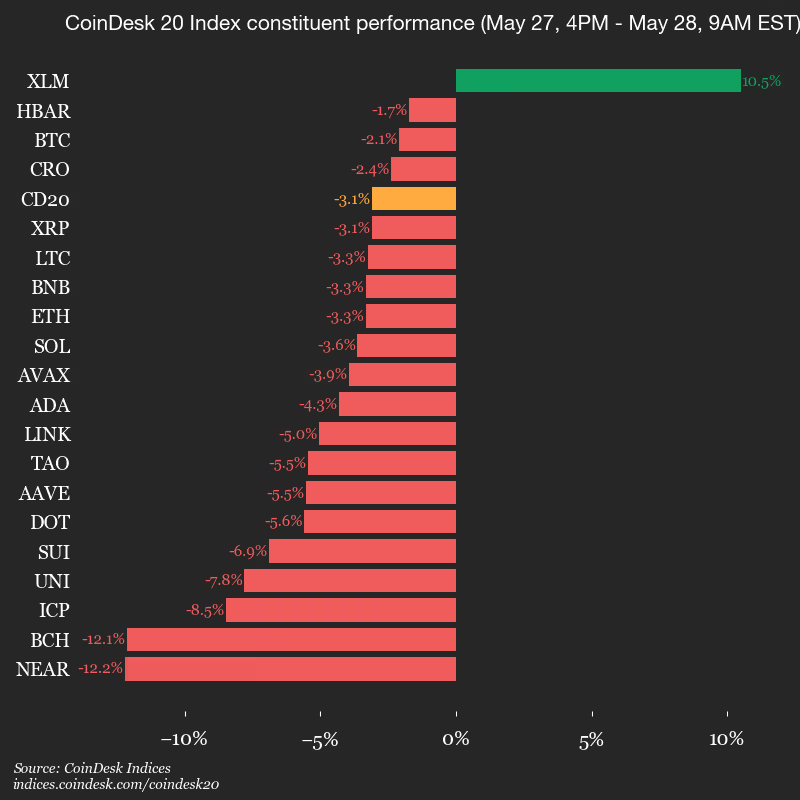
CoinDesk Indices presents its daily market update, highlighting the performance of leaders and laggards in the CoinDesk 20 Index.
The CoinDesk 20 is currently trading at 1961.44, down 3.1% (-62.25) since 4 p.m. ET on Wednesday.
One of the 20 assets is trading higher.

Leaders: XLM (+10.5%) and HBAR (-1.7%).
Laggards: NEAR (-12.2%) and BCH (-12.1%).
The CoinDesk 20 is a broad-based index traded on multiple platforms in several regions globally.
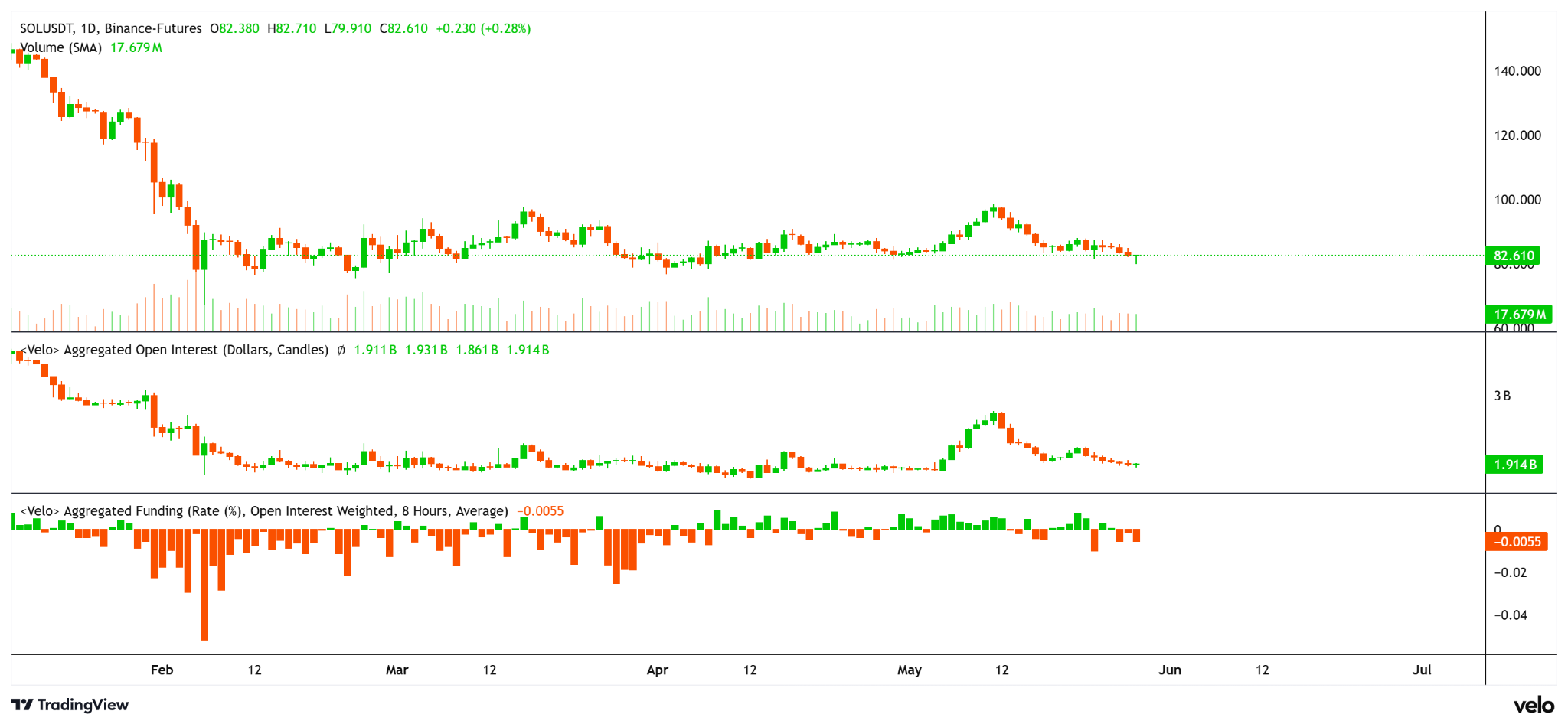
Solana (SOL) futures dropped sharply in May as traders reduced leveraged exposure across all exchanges. SOL open interest (OI) dropped to $1.90 billion on Thursday from $2.75 billion on May 11, a 30% decline, while funding rates remained close to neutral. The combination points to weakening investor sentiment as SOL eyes a retest of its yearly low at $68.
SOL spot demand offsets futures market weakness
The aggregated funding rate for Solana futures held near -0.005, showing balanced positioning between longs and shorts. SOL traders have not built aggressive directional bets despite the recent price slide to $80.
SOL price, aggregated open interest, and funding rate. Source: velo chart
At the same time, the aggregated futures volume cumulative volume delta (CVD) for stablecoin-margined orders fell to a yearly low of -$13 billion. The CVD tracks whether buyers or sellers are more active over time. The decline signals stronger sell-side pressure in futures markets through May.
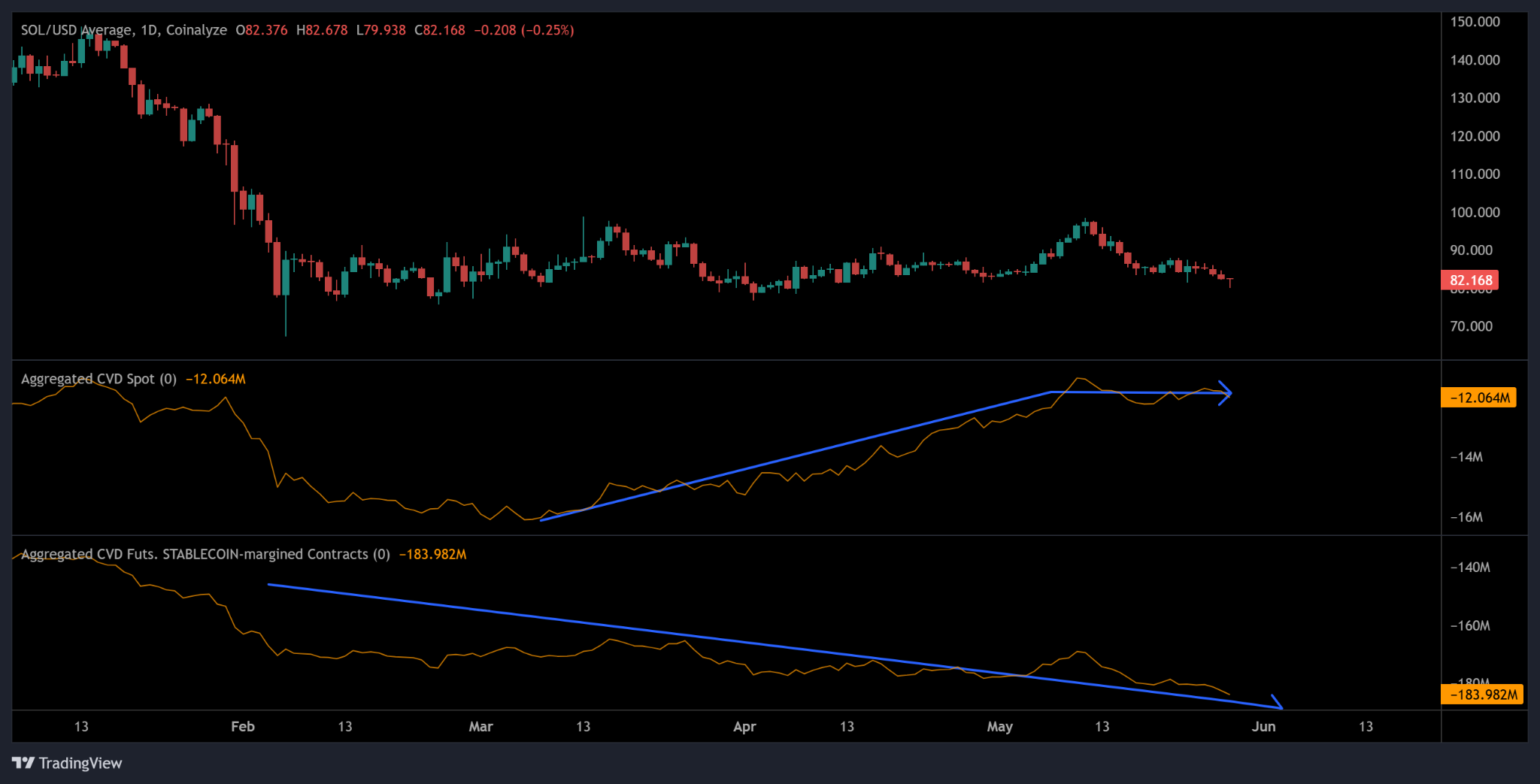
BTC price, aggregated spot and futures CVD. Source: Coinalyze
However, spot activity paints a steadier picture. Spot CVD has improved to $350 million since March, showing that buyers have continued to absorb supply on spot exchanges even as derivatives positioning has weakened.
The positive flows into spot SOL exchange-traded funds (ETFs) added to that trend. The monthly net inflows reached $113 million in May, marking the strongest monthly total for SOL ETFs in 2026.
The split between futures selling and steady spot accumulation often points to a lower level of speculative appetite rather than panic selling. This indicates that leveraged traders reduced risk exposure, while spot buyers continued to add positions gradually.
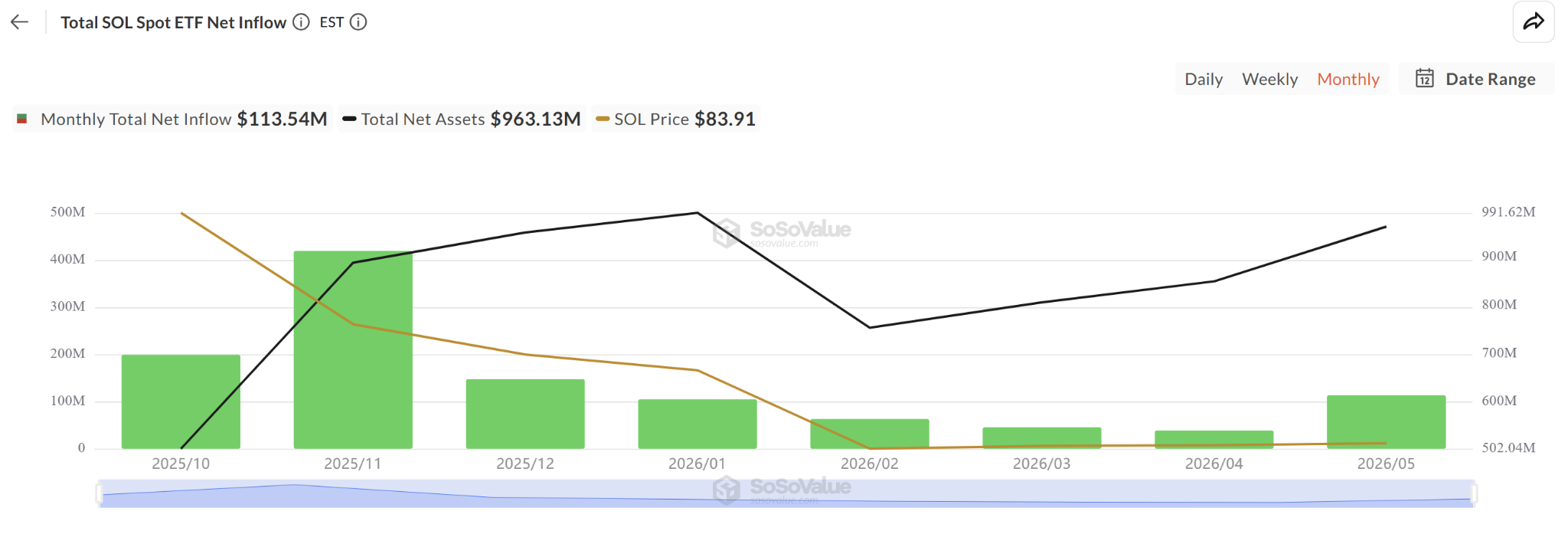
Spot SOL ETF netflows. Source: SoSoValue
Related: Three key XRP metrics suggest ‘explosive price expansion’ is next
SOL retests the $80 price floor of a three-month range
From a technical standpoint, SOL continues to trade inside a broad range between $80 and $95. The range formed after Solana fell 42% during Q1. The price returned to the lower boundary on Wednesday after another rejection near the resistance level.
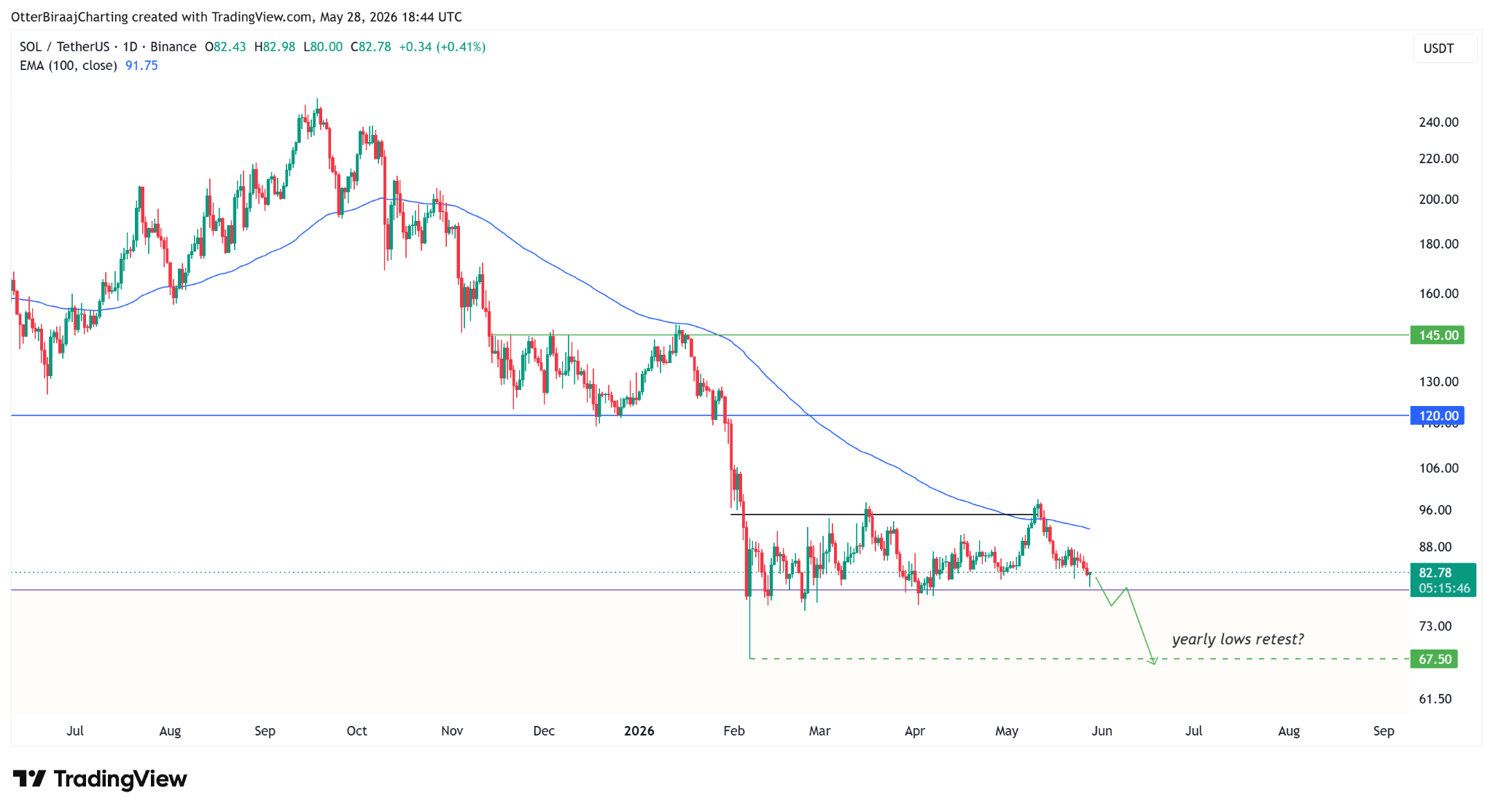
SOL/USD, one-day chart. Source: Cointelegraph/TradingView
A move below $80 places focus on the yearly low near $68. The liquidation heat maps show more than $800 million in cumulative long leverage sitting near that zone, making it an important liquidity pocket if downside pressure increases.
Crypto trader Cold Blooded Shiller described SOL as one of the weaker large-cap charts in the market. In a post on X, the trader said SOL has been in a downtrend since October and lacks strong support below the current price level of $80.
Crypto commentator Zoe also placed bids near $67, closely aligning with the yearly low and the largest cluster of leveraged liquidations identified on the open leveraged positions heatmap.
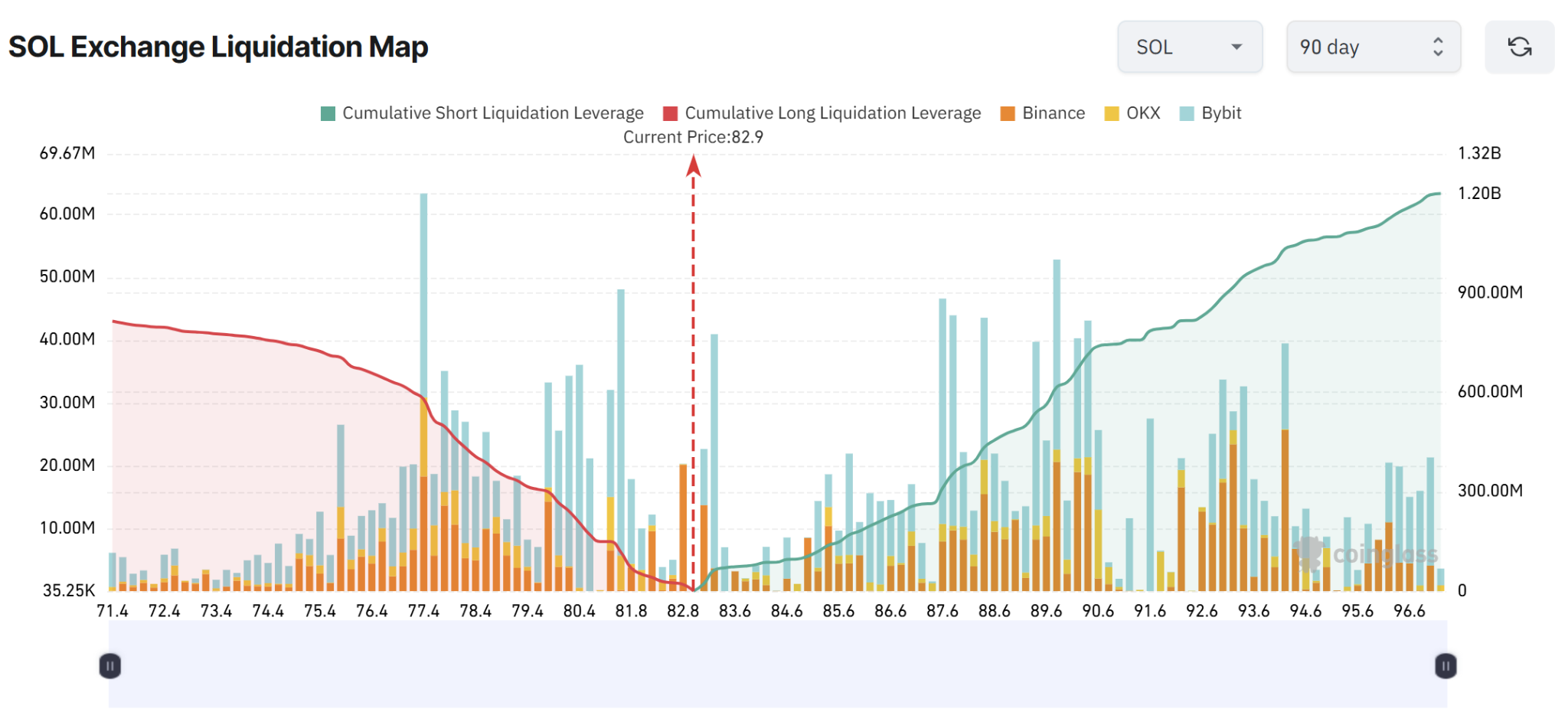
SOL liquidation map. Source: CoinGlass
Related: HYPE chases new highs as ETF inflows, institutional adoption accelerate
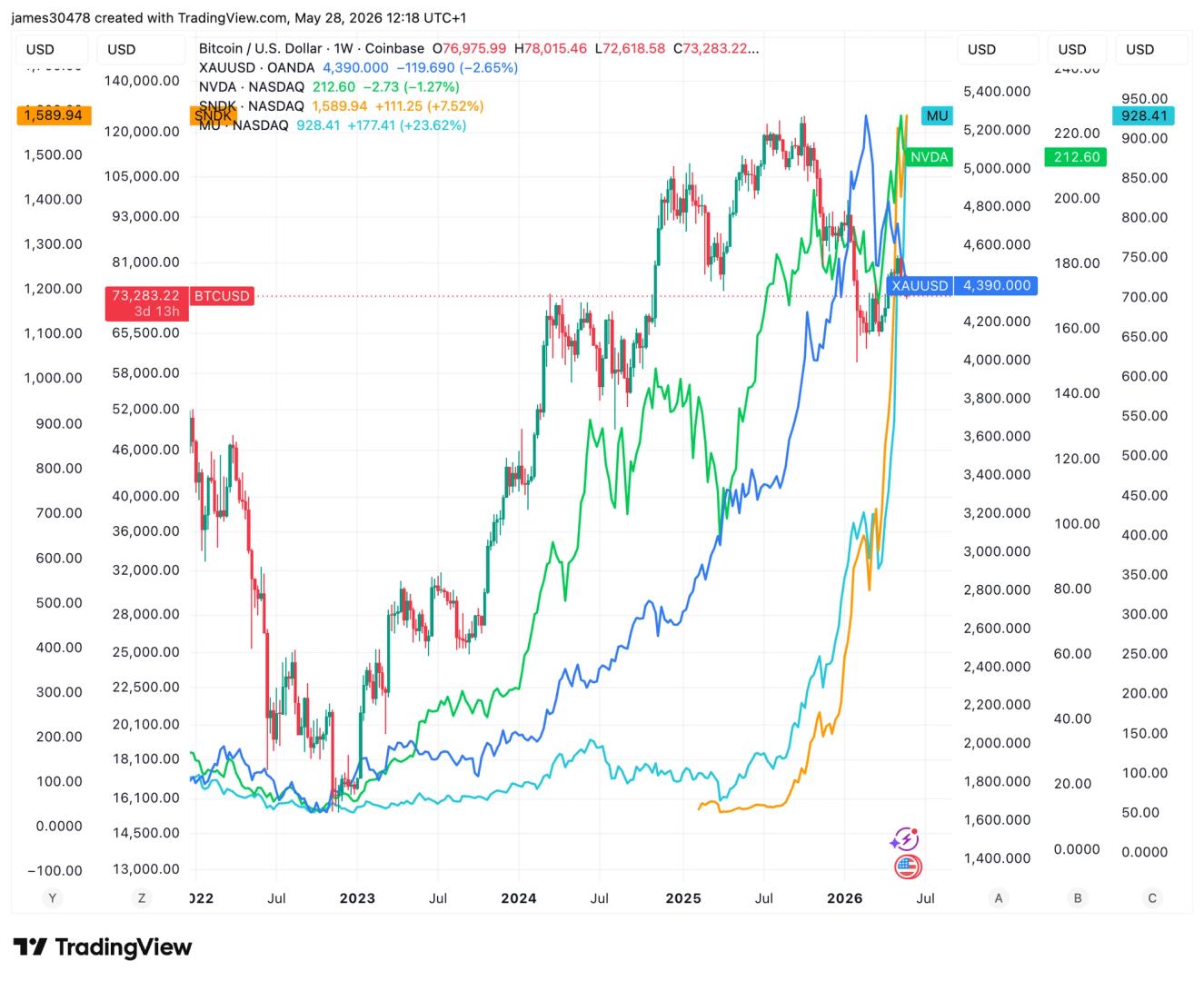
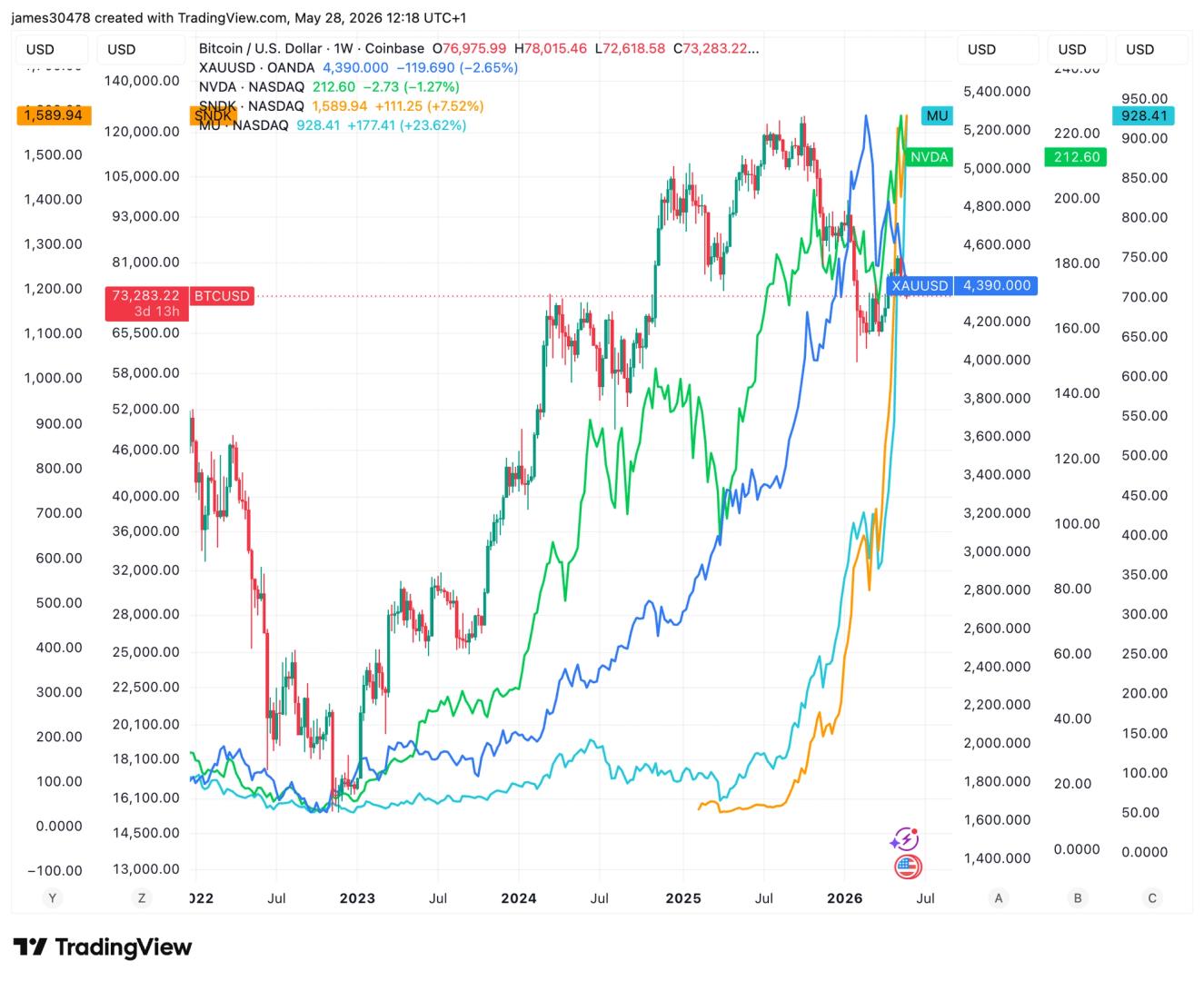
The crypto sector remains deeply out of favor, not only from a price perspective, but also in terms of investor sentiment.
Capital flows and market attention have increasingly shifted toward other high-growth sectors, lately semiconductors and memory-related equities, which have effectively replaced crypto as the market’s dominant momentum trade.
This analysis compares the performance cycles of bitcoin, the world’s largest cryptocurrency by market cap; gold, the largest precious metal; NVIDIA (NVDA), the leading AI-driven equity; and memory and semiconductor names, including SanDisk (SNDK) and Micron Technology (MU).
Bitcoin experienced a huge rally from its November 2022 low through its October 2025 peak, surging more than 650% from roughly $15,000 to nearly $125,000. A significant portion of that move occurred between September 2024 and January 2025, when the price doubled from approximately $55,000 to $110,000 alongside Donald Trump’s 2024 election victory. The price ultimately topped around $126,000 last October.
Gold followed a delayed but similar trajectory, driven largely by the growing “debasement trade” narrative surrounding fiscal deficits and monetary expansion. The metal began its breakout in early 2024 near $2,000 per ounce and eventually climbed above $5,200 per ounce in February 2026, roughly four months after bitcoin peaked. Since then, gold has corrected nearly 20% and now trades below $4,400 per ounce.
NVIDIA followed a similar pattern, reaching a peak near $225 per share in May before easing back to $212, and it is now only slightly higher over the past six months.
Hot money trading has now shifted decisively toward memory and semiconductor companies such as Sandisk and Micron Technology, with Micron recently entering the $1 trillion market capitalization club after having a valuation of just $70 billion only one year ago.
With SpaceX potentially approaching the largest IPO in history, and OpenAI and Anthropic possibly soon to follow, investor attention could shift once again. Much like crypto, gold and AI infrastructure before them, these companies could become the next major destination for speculative and momentum-driven capital, potentially defining the next phase of the market cycle.
With investors about to get a new shiny object on which to shower attention and money, bitcoin and crypto could be sidelined from bull runs for far longer than expected.
PI failed to hold at $0.16 and is now well on its way to $0.13 next!
PI Network (PI) Price Predictions: Analysis
Key support levels: $0.13
Key resistance levels: $0.16, $0.20
Key Support About to be Tested
At a macro level, we can see that PI’s price exited a major downtrend in March 2026, when it made a higher high and appeared to have bottomed at $0.13. This could be interpreted as a major pause in the pre-existing downtrend.
However, this assumption is about to be tested by sellers, who appear determined to revisit the $0.13 support soon. If the price holds there again, PI may range between $ 0.13 and $ 0.20 for some time. Any failure will lead to new lows and a resumption of the downtrend.

Will $0.13 Hold?
The biggest question, based on this chart, is if the key support at $0.13 can stop this renewed push by sellers. At the time of this post, it is too early to call it, and buyers could return there like in the past.
Nevertheless, another visit to this level could be interpreted as bearish, as it suggests buyers were unable to sustain the price higher. That may encourage sellers further and push this cryptocurrency into new lows. Best to prepare for that scenario from now.

The RSI Shows a Grim Picture
If we look at the 3-day RSI, we can see it remained below 50 for almost the entire past year. That’s a major bearish signal. There was only one attempt at escaping this, but it turned into a bull trap.
As long as the RSI remains under 50, there is little hope of a sustained reversal. Both the price and RSI have to make higher highs and sustain them if this downtrend is to end. Right now, there is no sign this is possible, considering the RSI is also in a clear downtrend.

The post Why is the Pi Network (PI) Price Down This Week appeared first on CryptoPotato.


UniCredit director Elena Carletti has warned Europe may struggle to contain a crypto bank crisis under MiCA rules.
Summary
- UniCredit’s Elena Carletti warned Europe lacks tools to backstop crypto-linked deposits the way US regulators did after SVB.
- MiCA pushes stablecoin issuers closer to banks but EU deposit insurance is capped at €100,000.
- Carletti cited Circle’s $3.3 billion stuck at SVB in 2023 as the model risk Europe has not solved.
UniCredit deputy vice chair Elena Carletti has warned that Europe may struggle to contain a crypto-linked banking shock under MiCA. The Italian bank executive said EU tools are weaker than the US emergency response of 2023.
The comments land as MiCA pulls stablecoin issuers closer to traditional lenders. Carletti, who chairs UniCredit’s board risk committee, said at an IESE Business School conference in Madrid that the same systemic-risk exception used to guarantee all SVB and Signature deposits “cannot be easily taken in Europe.”
Why MiCA creates a “double weakness”
MiCA requires stablecoin issuers, classified as electronic money tokens, to hold reserves in liquid assets including bank deposits and government securities. That ties stablecoin stability directly to bank balance sheets.
The link became visible during the March 2023 SVB collapse. Circle, issuer of USDC, disclosed $3.3 billion of reserves stuck at the failed bank, and the stablecoin briefly lost its dollar peg before US regulators guaranteed all deposits.
“The coverage and protection … was given to all deposits, including stablecoin companies, and that also allowed to maintain the stability of the stablecoin,” Carletti said. EU deposit insurance, capped at €100,000, cannot absorb stress from large stablecoin reserve accounts the same way.
What it means for Europe’s stablecoin push
Carletti’s warning comes as European banks lean further into stablecoins. UniCredit itself is a founding member of Qivalis, the consortium planning a MiCA-compliant euro stablecoin for launch in the second half of 2026.
Italy’s Banca Sella, another Qivalis founder, recently won Bank of Italy approval to offer crypto custody and transfer services under MiCA’s notification route for credit institutions. The full MiCA rollout tightens supervision of CASPs, stablecoin issuers and DeFi front-ends by July 2026.
Tether CEO Paolo Ardoino has previously argued MiCA’s 60% uninsured cash reserve requirement could itself trigger systemic risk, echoing Carletti’s concern from the issuer side.

[PRESS RELEASE – Vilnius, Lithuania, May 28th, 2026]
10+ top crypto influencers lead squads in an 8-week live trading competition — open to traders of all levels worldwide.
WhiteBIT, the largest European cryptocurrency exchange by traffic, has launched WhiteBIT Influence Trade Battle — an 8-week global futures trading tournament with a squad prize pool of up to 50,000 USDT and 400+ prize places, in partnership with TradingView. The tournament is supported by Tether, one of the most recognised names in the digital asset industry and issuer of USDT.
The competition features 10+ leading crypto influencers, each commanding their own squad, and is designed for traders at every level — from beginners making their first moves to seasoned professionals competing for the top.
A new kind of trading competition
The Influence Trade Battle introduces a new, community-driven format built around collaboration. Participants join a squad led by their favourite influencer, trade futures on WhiteBIT using TradingView as their interface, and compete simultaneously on individual and team rankings. The format combines competition with real engagement.
How it works
Participants join influencer-led squads, trade and compete across both individual and team rankings — unlocking additional rewards through active participation.
The tournament is designed to be inclusive, with weekly rewards from day one and multiple ways to win — from individual performance to team results. A team prize pool of up to 50,000 USDT further rewards collective success, alongside additional incentives for active traders.
Prize pool at a glance
- Squad prize pool: up to 50,000 USDT (scales with total trading volume)
- Individual prizes: up to 4,800 USDT per category (rPnL, Volume, Taker Orders)
- Weekly trading bonuses for active participants
- Prize pool: 5,120 USDT for top Taker volume traders
- Total prize places: 400+
“The Influence Trade Battle sets a new benchmark for how trading competitions are built — more open and more collaborative. We’re bringing together community, technology, and competition to create an experience where every trader can participate, compete, and grow. This is the next step in making trading more connected and more engaging.” – Volodymyr Nosov, Founder and President of W Group (which includes the WhiteBIT exchange)
How to participate
- Signing up and verify — register on WhiteBIT and complete KYC verification.
- Connecting the tools — link the TradingView account to the WhiteBIT balance.
- Picking the squad — joining an open squad or enter a private one via an influencer invite code.
- Starting trading — trade eligible futures pairs on WhiteBIT and compete across individual and team rankings.
- Earning rewards — reach at least 500 USDT in weekly trading volume to unlock bonuses. New WhiteBIT users qualify at a lower threshold.
About WhiteBIT
WhiteBIT is the largest European cryptocurrency exchange by traffic, offering over 780+ trading pairs, 340+ assets, and supporting 8 fiat currencies. Founded in 2018, the platform is a part of W Group which serves more than 35 million customers globally. WhiteBIT collaborates with Visa, FACEIT, FC Juventus, FC Barcelona and the Ukrainian national football team. The company is dedicated to driving the widespread adoption of blockchain technology worldwide.
About TradingView
TradingView is the industry-leading charting and trading platform, with over 100 million active users worldwide. It offers advanced charting tools, live market news, real-time data, and a robust broker integration ecosystem that allows traders to execute orders directly from the platform.
The post WhiteBIT, Tether & TradingView Launch up to $50K Futures Battle with 400+ Prizes appeared first on CryptoPotato.
Latest developments: Calamos says its protected Bitcoin ETFs are attracting inflows even as spot Bitcoin ETFs see redemptions.
- Matt Kaufman, head of ETFs at Calamos, said the firm saw roughly $10 million to $15 million in inflows over the past several weeks.
- Kaufman said advisors are increasingly looking for Bitcoin exposure that reduces volatility and downside risk.
- The firm offers three versions of its protected Bitcoin ETFs, including products with full downside protection and others with 10% or 20% downside risk.
- “You can get upside of Bitcoin with no downside risk,” Kaufman said.
- Kaufman joined CoinDesk’s Jennifer Sanasie on Public Keys.
How it works: Calamos structures the products using Treasuries and options tied to Bitcoin-linked indexes.
- Kaufman said the firm allocates roughly 90% of assets into Treasuries to build downside protection.
- The remaining budget is used to buy Bitcoin-linked call spreads through FLEX options.
- Calamos created its own Bitcoin-linked index and listed FLEX options tied to that index after the launch of spot Bitcoin ETF options.
- The products are offered in quarterly structures as well as laddered versions designed for model portfolios.
What advisors are asking: Wealth managers are becoming more sophisticated in how they evaluate crypto exposure.
- Kaufman said advisors previously focused on whether Bitcoin belonged in portfolios at all.
- Now, advisors are asking how to improve risk-adjusted returns and portfolio construction using crypto exposure.
- Calamos positions its products as alternatives to traditional portfolio allocations, including broad equities, bonds and cash.
- Kaufman said some investors are moving from cash-like products into fully protected Bitcoin ETFs tied to Bitcoin performance but without downside exposure.
Reading between the lines: The crypto ETF market is evolving beyond simple spot exposure.
- Kaufman said the industry is increasingly dividing crypto ETF strategies into three categories: protection, income and growth.
- Calamos previously launched auto-callable income ETFs and is exploring additional crypto-related strategies.
- Other ETF issuers have focused on generating yield from Bitcoin volatility through options-based products.
- “You don’t just have to sit in the spot vehicle anymore and ride out those waves,” Kaufman said.
What comes next: Calamos expects Bitcoin volatility to remain a defining feature of the asset.
- Kaufman said he expects Bitcoin to revisit previous highs despite recent market turbulence.
- He argued Bitcoin’s volatility profile creates opportunities for structured products and options-based strategies.
- “I think we’re going higher,” Kaufman said.
Crypto World
BTC Volatility Approaches Crucial Resistance as ETFs and Inflation Indicators Set Tone for Sentiment

Key Insights
- BTC trades below its important $80,000-$84,000 resistance level following multiple failed attempts at breaking out above it
- The U.S. inflation numbers and Fed monetary expectations continue to dominate Bitcoin sentiment in the short term
- Spot BTC ETF flow coming from institutional participants continues to be a big contributor to BTC’s liquidity
- Options expiration on significant BTC amounts increases the probability of volatility and sharp price moves
- Technical indicators show that Bitcoin still continues its consolidation phase within the broader corrective market structure
Increasing Volatility Around Major Resistance Level for Bitcoin
BTC was trading around the $76,700 level. As market participants paid close attention to inflation data, ETF action, and macroeconomic updates, Bitcoin’s volatility surged significantly. Investors’ sentiment has remained conservative due to ongoing struggles by Bitcoin below the resistance zone at $80,000-$84,000.
Currently, the crypto market has become highly sensitive to events happening in the traditional finance world. Bitcoin is regarded as a risk-on currency that has been actively responding to fluctuations in liquidity, yields, and Fed guidance.
Recent market dynamics have been characterized by intense battles between bulls and bears around technical levels. Despite multiple attempts to break higher by Bitcoin in May, sellers have managed to protect higher levels.
Macroeconomic News Pushes Bitcoin Speculators to Be Defensive
Macroeconomic news still represents the most significant driver behind Bitcoin’s short-term performance. Speculators are currently very attentive to the upcoming Consumer Price Index (CPI) inflation report in the United States, which might be the most important financial market event scheduled in the next couple of weeks.
Lower-than-expected inflation numbers would boost risk appetite and stimulate stronger institutional appetite for Bitcoin and other cryptocurrencies. By contrast, higher-than-expected inflation would put negative pressure on BTC due to higher Treasury rates and a stronger US dollar.
Also, the Fed’s stance is another driver affecting the overall market sentiment. Market players are very reactive to any possible hints about potential changes to interest-rate cuts or liquidity injections. As shown previously, a dovish monetary policy stance has often fueled strong Bitcoin gains because of enhanced market liquidity and increased speculative appetite.
On the other hand, existing geopolitical tensions are another source of volatility for financial assets. Higher oil prices or conflicts between countries would make investors move into defensive positions, negatively impacting Bitcoin.
Bitcoin ETF Inflows Keep Liquidity in Bitcoin Stable
The spot Bitcoin ETF has been a prominent factor behind market momentum. Institutional investments in Bitcoin ETFs help recover markets from declines through their support.
Market players are still observing developments in ETFs from some of the top asset managers such as BlackRock and Fidelity Investments. Positive ETF inflows usually result in momentum-based rallies and short squeezes when market sentiment is positive.
Nonetheless, investors remain cautious about the risk of bearish pressure. Downside pressure on Bitcoin may increase rapidly when ETF flows are reduced while leveraged positions remain high.
Bitcoin Options Expiry Could Set Off Market Surges
Bitcoin options expiry represents another significant element responsible for market volatility. Monthly options expiry events lead to occasional price dislocations and swift movements due to the adjustment of hedging strategies and the closing of leveraged positions.
Future expiration periods are predicted to result in higher market volatility levels, especially when Bitcoin is trading around key technical resistances. Constricted trading activity and narrowed ranges tend to precede bigger directional moves.
Institutional investors are already gearing up for possible market breakouts depending on the economic environment and liquidity situations.
Chart Technicals Hint at Further Consolidation
The technical structure seen on Bitcoin’s daily chart implies that the cryptocurrency is operating within a larger consolidation process following previous corrections from its record high above $124,000. In both those occasions, periods of increased selling pressure had led to the formation of strong support levels around $60,000 prior to the beginning of recovery processes.
In the current case, although Bitcoin has been forming new lower lows, the momentum surrounding these moves has been decreasing. This can be seen from the fact that the Relative Strength Index (RSI) indicator is now approaching neutral readings, after having risen into overbought territory during the first stages of the bounce process.

U.S. Securities and Exchange Commission Commissioner Hester Peirce warned this week that financial privacy is increasingly undervalued in U.S. regulation, urging a more balanced view of privacy-preserving technology as part of the nation’s financial infrastructure.
Speaking on Wednesday at Georgetown Law, Peirce framed cryptographic tools and privacy-enhancing technologies as legitimate components of modern markets, not merely the province of illicit actors.
“Empowering government to identify, pursue, and punish the bad guys is important to the security of the nation and its people, but so too is empowering people to protect information about their lives, including their financial lives,” she said, according to the transcript published on the SEC’s website.
Peirce added that privacy technologies can help individuals protect themselves from hackers, scammers and other malicious actors, and should not be viewed as “an opportunity for the government to watch more of what its citizens do.”
She encouraged developers building privacy-enhancing technologies to engage with the SEC’s Crypto Task Force, particularly on tools that could support Know Your Customer (KYC) and Anti-Money Laundering (AML) compliance requirements.
Key takeaways
- Privacy-enhancing technologies are legitimate components of financial infrastructure, not solely tools for illicit activity.
- Financial privacy can coexist with national security objectives and may reduce information exposure for individuals.
- Developers of privacy-focused tools should collaborate with the SEC’s Crypto Task Force on potential KYC/AML compliance considerations.
- Regulatory conversations in the European Union point to 2027 AML rule changes that could restrict anonymous accounts and privacy-preserving tokens.
- Privacy-focused crypto innovation remains active in the market, with practical applications and ongoing investor interest in assets and use cases that prioritize on-chain privacy.
Privacy returns to crypto spotlight
Privacy and privacy-preserving technologies have long been a core use case for crypto, with projects like Monero and Zcash designed to shield transaction data and user identities. The current regulatory dialogue has revived debate over the role these tools should play in the ecosystem. Advocates argue that privacy protections help users defend against surveillance, data exploitation, and targeted scams, while critics warn they could enable illicit finance if not properly regulated.
The regulatory conversation has also spilled into Europe, where authorities are weighing new AML rules slated to take effect in 2027. The framework would constrain anonymous accounts and access to privacy-preserving cryptocurrencies by banks and crypto service providers, underscoring the tension between privacy and oversight across borders.
Legal experts tracking the space have described maintaining access to privacy-focused digital assets as a “constant battle” between industry participants and regulators. Anja Blaj, a legal consultant at the European Crypto Initiative, has highlighted how regulatory friction can shape the pace and direction of privacy innovations in the sector.
As the privacy discourse persists, market observers have noted measurable interest in privacy-focused assets. Zcash, in particular, has seen renewed attention and price momentum over the past year, a signal of investors valuing privacy-centric capabilities amid shifting regulatory expectations. (Source: CoinMarketCap)
From policy to on-chain practice
Policy debates aside, the industry continues to translate privacy concepts into on-chain tools and products. Aptos has introduced a privacy-focused coin intended to prevent wallet profiling and protect treasury movements from competitor insight, illustrating how privacy tech can be embedded into corporate and network-level transactions.
Meanwhile, Polygon has rolled out private stablecoin payments for institutions, positioning privacy as a facilitator of broader on-chain adoption by enabling discreet settlement and treasury operations. These developments reflect a broader push to reconcile privacy with practical business and regulatory requirements in real-world deployments.
Looking ahead, investors and builders should watch how privacy-centric tools align with evolving KYC/AML frameworks and the regulatory guidance that will emerge from the SEC Crypto Task Force and European authorities. The path forward will likely combine tighter oversight with clearer, standards-based privacy implementations that support legitimate use while limiting misuse.

Cardano (ADA) has crashed more than 70% in the past year. In 2026 alone, the crypto asset has lost 30% of its value. Multiple attempts to break above the $0.25 level have failed.
Even so, millionaire ADA wallets have been steadily accumulating the asset, which suggests that some large holders remain active despite the decline.
ADA Millionaire Wallets Reach Record Levels
Wallets holding at least 1 million tokens have collectively increased their holdings to 25.11 billion ADA. According to Santiment, this is the highest level recorded since December 2017. These wallets now control 67.5% of the total ADA supply, which is the highest concentration since July 2020.
The analytics platform found that the accumulation by large holders is generally seen as a sign of confidence from key stakeholders with significant exposure to the crypto asset. Santiment added that, as a long-term indicator, the trend could be viewed as bullish for investors willing to hold patiently.
The renewed accumulation comes at a time when Cardano is still battling long-running concerns around its ecosystem growth. Critics often argue that the network has struggled to build the same level of ecosystem traction seen among its peers. For instance, earlier this month, crypto analyst Ali Martinez questioned Cardano’s long-term strength, as he argued that the network’s actual activity remains small compared to its multibillion-dollar valuation.
He pointed out that Cardano’s DeFi ecosystem has never crossed $1 billion in total value locked and still trails far behind rivals like Ethereum, while newer chains such as SUI have already seen stronger usage. Martinez also said Cardano has yet to establish a clear niche that consistently draws developers, users, and capital. He added that the blockchain’s research-focused approach has slowed feature rollouts. Meanwhile, other market experts expressed skepticism over whether Cardano is among the most overvalued blockchain networks in crypto.
According to DeFiLlama, Cardano’s TVL has fallen below $125 million at the time of writing, down 82% from nearly $721 million in November 2024.
Weak Chart
Trader ‘Val Me’ described Cardano’s chart as “very sad looking,” while adding that ADA remains weak on the higher time frame despite trading near a crucial support zone around $0.22. She said the asset could either bounce from current levels or briefly take out the equal lows before recovering. The analyst identified a possible move toward $0.50, though she suggested that the rally could simply form a lower high before a retest of the support zone.
She added that only if ADA later holds a higher low would she begin considering the more bullish scenario, which projects a potential move toward $1.35. However, she stressed that such a scenario is still an overstatement at this stage.
The post Good or Bad? Cardano Whales Control 67.5% of the Total ADA Supply appeared first on CryptoPotato.

Recycling Two XBox One Consoles Into A 10 GB USB Flash Drive

Man arrested after making threats to kill Erika Kirk ahead of TPUSA event in San Antonio: ‘I know where to hide the bomb’

’60 Minutes’ head Nick Bilton aims to pivot show before ratings decline

Steven Gerrard disagrees with Gary Neville over ‘shock’ Chelsea and Arsenal claim | Football

US brings back mandatory military draft registration

Register Renaming | Hackaday

The meme boy needs medical attention. I hope the financial support provided will be used on him….

Thursday, May 28th | Morning Prayer For Financial Breakthrough And God’s Provision Today

What the NextFund AI Story Reveals About Crypto Liquidity
-

 Fashion6 days ago
Holiday Weekend Open Thread – Corporette.com
-

 Politics3 days ago
Bridgerton Season 5: Cast, Release Date And Everything We Know So Far
-

 Crypto World7 days ago
Bitcoin Accumulation Weakens as BTC Realized Losses Hit $600M
-

 Crypto World6 days ago
Robinhood crypto COO Tanya Denisova exits
-

 Business7 days ago
Trump Invests $1M-$5M in Kura Sushi USA Chain With 27 California Locations
-

 Tech3 days ago
Microsoft’s quiet Claude Code retreat and the real cost of enterprise AI
-

 Business4 days ago
NYT Strands Answers May 24 2026 Revealed for Puzzle No. 812 Theme Summer Essentials
-

 Business6 days ago
Dell Technologies DELL Stock Surges 15% on AI Server Momentum and Analyst Upgrades in 2026
-

 Business2 days ago
Selena Gomez Reportedly Upset Over Benny Blanco’s Comments on Her ‘Terrible’ Diet
-
 Crypto World2 days ago
Micron Crosses $1 Trillion Market Cap as AI Demand Reshapes Memory Sector
-

 Politics6 days ago
Makerfield: a tale of two social-media histories
-

 Crypto World6 days ago
Space X IPO Is ‘Bad News’ for Tech Stocks: But What About Bitcoin?
-

 Business4 days ago
BTS Sells Out Four Las Vegas Shows at Allegiant Stadium for ARIRANG World Tour
-
 Crypto World7 days ago
MicroStrategy’s Saylor Says Miners No Longer Set Bitcoin Price, Another Force Has Taken Over
-
Tech1 day ago
The Samsung pay deal is the moment Korean unions changed register
-
 Tech6 days ago
A 0.12% parameter add-on gives AI agents the working memory RAG can’t
-

 Tech3 days ago
Westone Audio and Etymotic Acquired by Fidelity Collective in Major IEM Market Move
-

 Tech2 days ago
Millions of AI agents imperiled by critical vulnerability in open source package
-

 Crypto World6 days ago
AI infrastructure race heats up as IREN pitches full-stack strategy, WhiteFiber lands $160M deal
-
 Crypto World4 days ago
Nvidia (NVDA) CEO Calls on Super Micro to Strengthen Export Controls Amid Smuggling Probe
You must be logged in to post a comment Login