

Crypto World
BeInCrypto Institutional Research: 15 Firms Leading On-Chain Finance Infrastructure



Best On-Chain Finance Infrastructure is a category within the BeInCrypto Institutional 100, an annual research-driven program recognising institutional digital asset excellence across 26 categories and six pillars.
This category sits under Pillar 4: Tokenization & On-Chain Finance. The 15 firms below are listed alphabetically and are not ranked. A shortlist will be named in May 2026, with the winner announced at Proof of Talk in Paris on June 2–3, 2026.
Key Facts
- Long list: 15 firms across embedded wallets, bank-grade settlement, oracle middleware, interoperability protocols, developer platforms, programmable key management, payments APIs, staking infrastructure, and financial OS platforms
- Initial pool: More than 25 firms screened; 15 advanced to the long list
- Order: Listed alphabetically, not ranked
- Scoring: 50% quantitative data · 50% Expert Council
- Criteria assessed: Institutional client roster, regulatory licensure, on-chain scale, security record, capital backing, regulated partnerships, governance maturity, innovation signal
- Boundary scope: Custody, stablecoin issuance, tokenization platforms, and pure DeFi protocols are evaluated in separate categories
| Firm / Flagship Product | HQ & Listing | Reach | Infrastructure Layer | Representative Work |
|---|---|---|---|---|
| Alchemy — Supernode, Smart Wallets, x402 | San Francisco, USA Private |
$10.2B last priced valuation $105B+ annualized on-chain transaction value |
Blockchain developer platform Supernode, Smart Wallets, RaaS, NFT/Token APIs, stablecoin orchestration |
AI Agent x402 standard launched in Mar 2026 Sooho.io Asia stablecoin infrastructure partnership announced in Nov 2025 |
| Apex Group — Apex Digital 3.0, Tokeny | Bermuda Private; $3T+ AUA |
13,000+ professionals across 50+ jurisdictions Tokeny has $32B+ RWAs tokenized via ERC-3643 |
Institutional financial OS Fund administration, custody, tokenization, and ERC-3643 infrastructure |
Apex Digital 3.0 launched in Jul 2025 SkyBridge $300M tokenization on Avalanche announced in Aug 2025 |
| BitGo — Bank & Trust, Go Network, USD1 | Sioux Falls / Palo Alto NYSE: BTGO |
Assets on platform: $63B Assets staked: $11.8B |
Federally chartered digital asset infrastructure Go Network settlement and Mint and Burn Center |
Derivatives offering launched in Q1 2026 with $3B notional volume HYPE custody and staking added in May 2026 |
| Blockdaemon — Builder Vault, Earn Stack | United States Private |
$110B+ digital assets secured 400+ institutions; 60+ protocols supported |
Institutional Web3 gateway Staking, validators, RPC nodes, and self-hosted MPC wallet |
Taurus partnership announced in Feb 2026 for banking custody Earn Stack staking-as-a-service launched in Jun 2025 |
| Chainlink — CCIP, Data Feeds, CRE | Cayman Islands / Global LINK publicly traded |
CCIP processed $18B+ Q1 2026 cross-chain volume $30T+ cumulative transaction value enabled |
Oracle and cross-chain interoperability platform CCIP, Data Streams, Proof of Reserves, CRE |
SWIFT integration went live in Nov 2025 Sibos 2025 corporate-actions work involved 24 institutions |
| Fnality — £FnPS, EUR/USD expansion | London, UK Private; UK FMI |
$136M Series C in Sep 2025 £FnPS live since Dec 2023 |
Bank-led wholesale on-chain payment system Central-bank-money-backed DLT settlement |
Series C led by BofA, Citi, WisdomTree, KBC, Temasek, and Tradeweb Broadridge intraday repo collaboration announced in Mar 2026 |
| Hyperlane — ISMs, Warp Routes | United States Private; HYPER publicly traded |
150+ chains supported 10,000+ cross-chain messages validated daily |
Permissionless cross-chain messaging framework Interchain Security Modules and Warp Routes |
TRON Network integration added in Apr 2026 V3 modular mailbox launched with Hyperlane Hooks in Sep 2025 |
| J.P. Morgan Kinexys — JPMD, TCN, MONY | New York Operated by JPMorgan Chase |
Daily volume of $5B–$7B in Apr 2026 More than $3T cumulative volume since 2020 |
Bank-grade on-chain settlement unit Deposit tokens, tokenized collateral, and fund-flow infrastructure |
JPMD live on Base and moving toward Canton integration Cross-chain DvP work with Ondo Chain and Chainlink CCIP |
| Magic Labs — Embedded Wallets, Newton Protocol | San Francisco, USA Private |
50M+ wallets created since 2018 200,000+ developers across 180+ countries |
Email and SSO-based embedded wallet infrastructure TEE-based API wallets with no seed phrases |
Primary wallet provider for Polymarket Newton Protocol integration added programmable compliance in Nov 2025 |
| Mesh — SmartFunding, Crypto Payments | San Francisco, USA Private |
$1B valuation after Jan 2026 Series C About $10B monthly payments volume |
Unified crypto payments network SmartFunding: any asset in, preferred stablecoin out |
Series C led by Dragonfly Capital and Paradigm Partners include PayPal, Revolut, Ripple, Paxos, and Rain |
| Partior — Unified Ledger | Singapore Private; MAS-anchored |
USD, EUR, and SGD live Founding shareholders include DBS, JPMorgan, Standard Chartered, and Temasek |
Singapore bank-consortium blockchain settlement Atomic PvP settlement across tokenized instruments |
Deutsche Bank platform agreement signed in May 2025 Nium became first PSP on the Partior network |
| Privy — Embedded Wallets, AgentCore | New York, USA Stripe subsidiary |
120M+ accounts 2,000+ developer teams |
Embedded wallet infrastructure for fintech and treasury Custodial and non-custodial wallets via single API |
AWS Bedrock AgentCore Payments integration in May 2026 MAJORITY digital asset accounts launched on Solana with Privy |
| Pyth Network — Pyth Pro X, Lazer, Data Marketplace | Cayman Islands / Global PYTH publicly traded |
100+ blockchains supported 3,000+ low-latency price feeds |
Institutional-grade price oracle network Pull-oracle model, Pyth Lazer, and Pyth Pro X |
Pyth Data Marketplace launched in Apr 2026 US Department of Commerce GDP data brought on-chain in Mar 2025 |
| Turnkey — Programmable Key Management | New York, USA Private |
Powers 50M+ embedded wallets Millions of weekly transactions |
TEE-only key management in AWS Nitro Enclaves Programmable signing and QuorumOS |
Series B closed in Jun 2025 led by Bain Capital Crypto Flutterwave integration added merchant stablecoin balances in Jan 2026 |
| Wormhole — NTT, Guardian Network | United States Private; $2.5B valuation |
40+ chains supported $60B+ cumulative value transferred; 1B+ cross-chain messages |
Cross-chain messaging and Native Token Transfers Guardian validator network and ZK proofs |
Tokenized asset corridors support BUIDL, ACRED, VBILL, and SCOPE NTT adopted by Sky/MakerDAO, Agora, Lido, and Ethena |
About This List
The BeInCrypto Institutional 100 — On-Chain Finance Infrastructure (2026 Long List) identifies the infrastructure layer that lets regulated finance operate on public and permissioned blockchains.
The category covers embedded wallet infrastructure, bank-grade on-chain settlement networks, oracle and data middleware, interoperability protocols, developer tooling, programmable key management, embedded crypto payment APIs, staking infrastructure, and integrated financial operating systems.
Custody is covered separately under Category 2.4: Best Custody Provider. Stablecoin issuance and orchestration, tokenization platforms, and pure DeFi protocols are also evaluated in their own categories. BitGo appears here as a partner-override entry because of its federal trust bank charter, Go Network settlement, USD1 stablecoin issuance, and broader integrated infrastructure role.
Methodology
This category is evaluated under Track A of the BeInCrypto Institutional 100 methodology: 50% quantitative metrics and 50% Expert Council scoring.
Assessment spans seven criteria: institutional client roster, regulatory licensure and certifications, on-chain scale and reach, security record and audit history, capital backing and runway, partnership depth with regulated entities, and innovation signal.
Data was verified using SEC EDGAR, FCA, BaFin, FINMA, MAS, Bermuda Monetary Authority, OCC, NYDFS, SOC 2 and ISO 27001 attestations, audited reports, Messari interoperability reports, DefiLlama, on-chain analytics, partnership announcements, and private-market sources including PitchBook, Tracxn, and Crunchbase.
Every firm on the list underwent a May 2026 verification pass to confirm active product status, current funding, and the absence of unresolved material legal or security overhangs.
The post BeInCrypto Institutional Research: 15 Firms Leading On-Chain Finance Infrastructure appeared first on BeInCrypto.



He authored Bitcoin Improvement Proposal 361 (BIP-361), which outlines a phased migration to quantum-resistant cryptography.
“The goal is to create incentives and deadlines so users, exchanges, custodians, wallets and institutions actually migrate in a timely fashion,” saidLopp, who in April said it would be better to freeze Satoshi’s hoard and millions of other dormant bitcoins than to let hackers steal them.
Matt Hougan, chief investment officer at Bitwise, rejected both letting the coins be stolen and freezing them outright.
Instead, he pointed to a proposal by Castle Island Ventures partner Nic Carter that would place Satoshi’s bitcoin into a legal trust until ownership could be proven through historical electronic records.
Avoiding philosophical challenges
“I actually like Nic Carter’s proposal,” Hougan said via email. “It avoids the philosophical challenges of both CZ’s suggestion and the ‘let whatever happens’ perspective.”
Hougan said the market already treats Satoshi’s holdings as effectively unavailable, meaning almost any change would create more risk than opportunity.
“I don’t think there is any way that developments around Satoshi’s coins are positive for the ecosystem,” he said. “The market already accounts for them as frozen forever.”
For now, the debate remains largely theoretical. Researchers are still working on practical post-quantum cryptography for Bitcoin, and no consensus has been reached on how the network should respond if its encryption does become vulnerable.

Coinbase CEO Brian Armstrong said AI has changed how engineers work inside the crypto exchange. He described the shift as the rise of the “super builder,” where one engineer can deliver far more output. According to Armstrong, Coinbase now ships twice as much code overall. He said some engineers act as ten-times contributors who share effective AI practices.
Armstrong said Coinbase has become one of the most AI-enabled companies in the world. The Coinbase AI engineering strategy focuses on productivity, cost control, and wider adoption. A user reacting to his remarks said former Coinbase employees at other crypto firms describe the company as ahead in AI integration. That reaction added context to Armstrong’s claim about Coinbase’s engineering culture.
Coinbase Cuts Ai Costs As Usage Rises
The update covered how Coinbase reduced AI spending while usage continued to rise. Armstrong said the company nearly halved AI costs even as token usage grew sharply across systems. “How to keep AI spend flat while token usage grows exponentially: not with friction and spend alerts. With better defaults, routing, and caching,” Armstrong said.
Source:
The Coinbase AI engineering approach uses smarter model routing to match tasks with suitable models. This method sends simple work to cheaper tools and reserves stronger models for harder tasks. The company also uses caching to avoid paying for repeated answers when teams ask similar queries. Coinbase uses cheaper open-weight models for routine work where advanced models add little value.
Armstrong Links Ai Growth To Infrastructure
Armstrong framed the savings as a scaling decision rather than a limit on AI use. He said the goal does not involve cutting access or slowing engineers through controls. Instead, Coinbase wants infrastructure that allows AI usage to grow without future budget pressure. That view places cost efficiency at the center of Coinbase AI engineering operations.
The comments connect with Armstrong’s earlier view on AI bottlenecks. In June, he argued that access to energy and compute matters more than model quality for AI growth. His latest comments extend that position into company operations through routing, caching, and model selection. As a result, Coinbase AI engineering reflects productivity gains and infrastructure discipline.
For Coinbase, the message points to AI as an operating layer for software teams. Engineers use AI to write, review, and ship code faster, while management tracks costs. The company’s approach suggests that AI adoption depends on workflow design, not only model access. Coinbase AI engineering shows how a crypto firm can scale AI while watching spend.
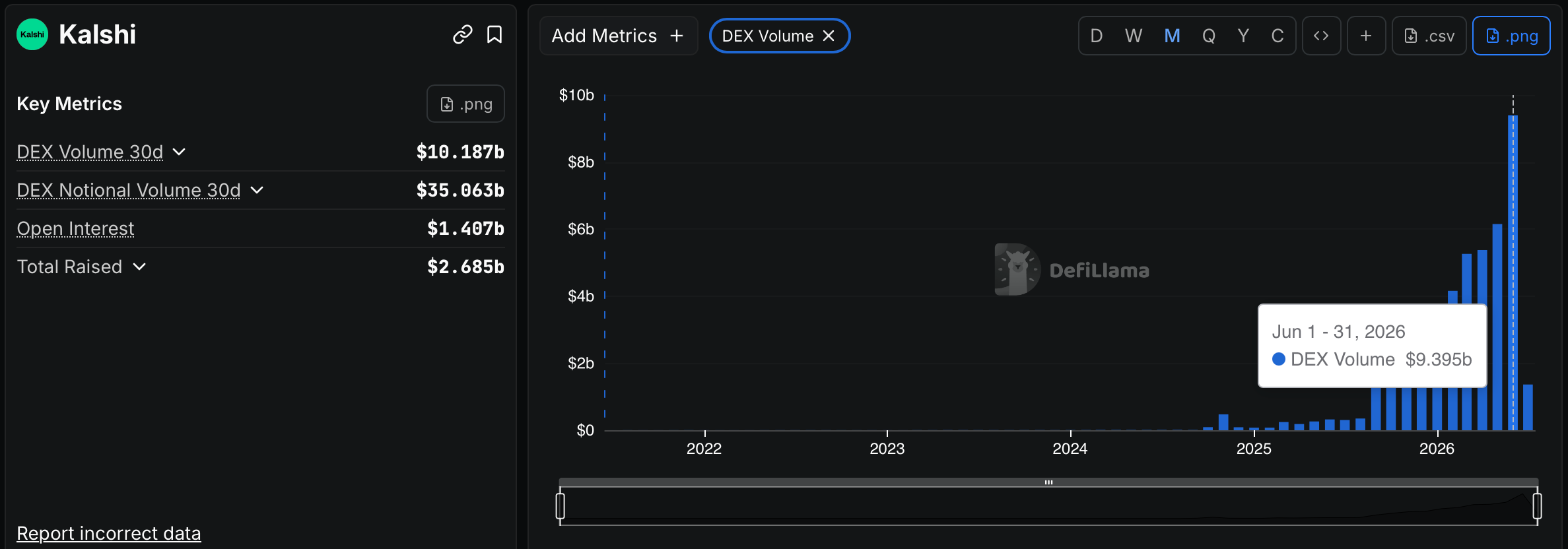
Kalshi posted a record month for trading volume in June as the 2026 FIFA World Cup fueled activity across prediction markets.
DefiLlama data shows Kalshi recorded nearly $9.4 billion in trading volume in June, up from about $5.3 billion in May. Polymarket International also climbed to roughly $4.3 billion from about $3.5 billion a month earlier.
The tournament kicked off on June 11 and is the first FIFA World Cup to feature 48 teams, up from 32 in previous editions. CNBC reported the competition became the biggest driver of prediction market trading in June, with Dune Analytics showing record notional trading volumes on Kalshi and Polymarket.
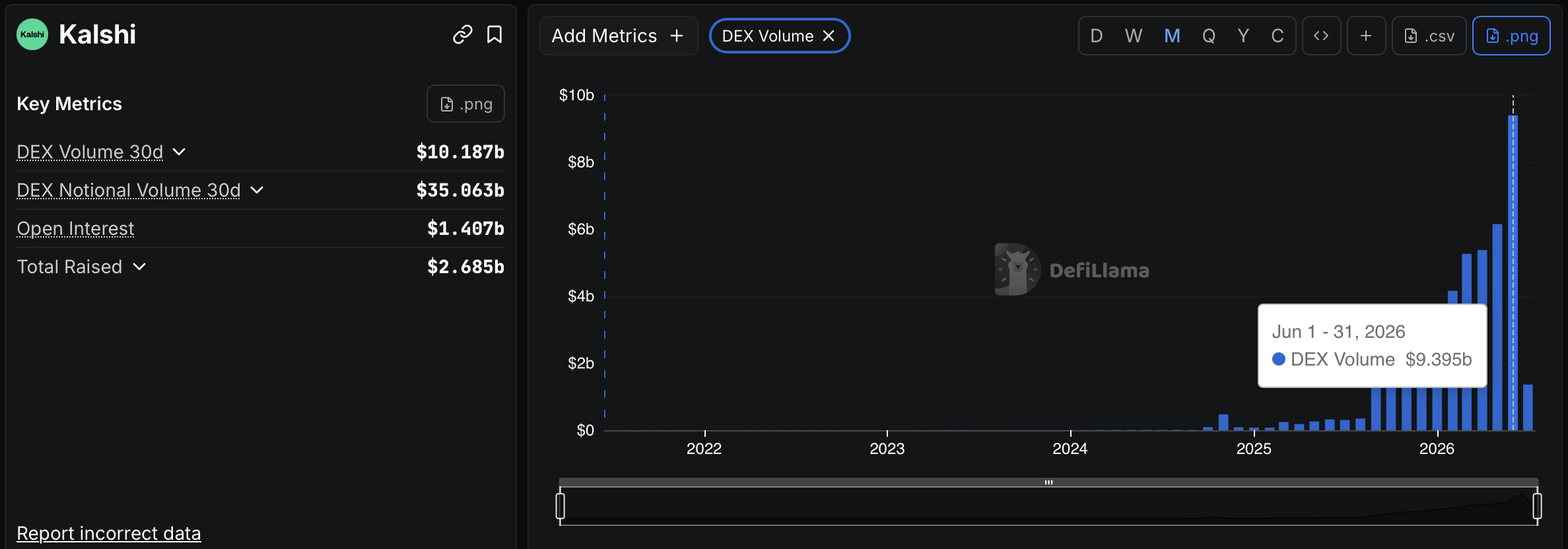
Kalshi trading volume hits June record. Source: DefiLlama
The tournament’s knockout matches are attracting some of the highest trading activity. Canada’s Round of 16 match against Morocco, scheduled for Saturday, had generated over $48 million in trading volume on Kalshi and over $26.8 million on Polymarket at the time of writing.
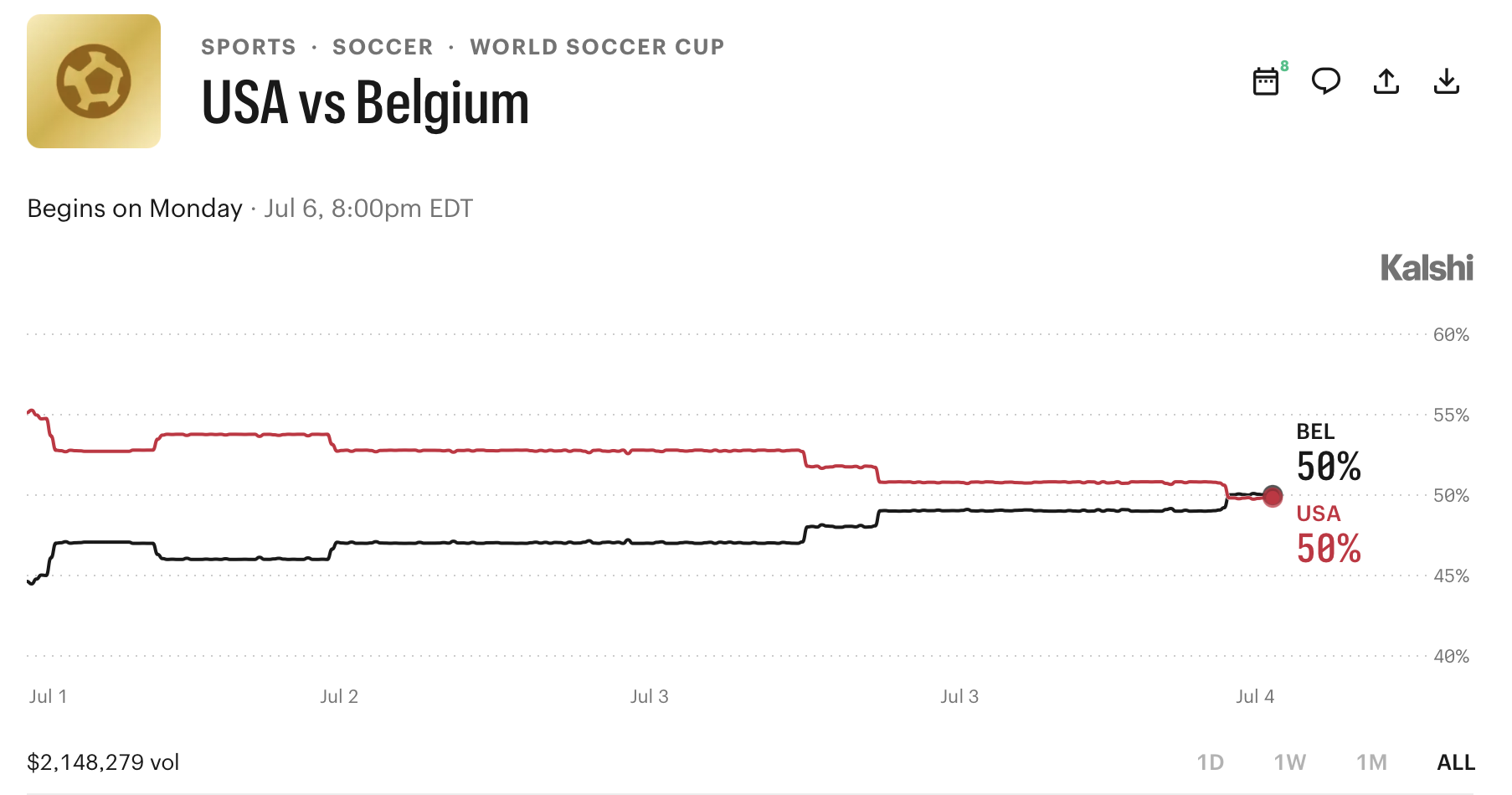
The United States’ Round of 16 match has also drawn significant attention from traders. Kalshi’s market on which team will advance had generated more than $2.16 million in volume, while a comparable market on Polymarket had attracted around $1.6 million as of Saturday.
Source: Kalshi
Related: US dominates Polymarket political bets despite geoblock: Report
Legal battles intensify as prediction markets grow
The high trading volumes come as prediction markets remain at the center of a growing legal and regulatory debate in the United States.
By March, nearly a dozen US states had already moved against companies including Kalshi and Polymarket, with some seeking to halt the markets while others pushed to bring them under existing gambling laws and state tax frameworks.
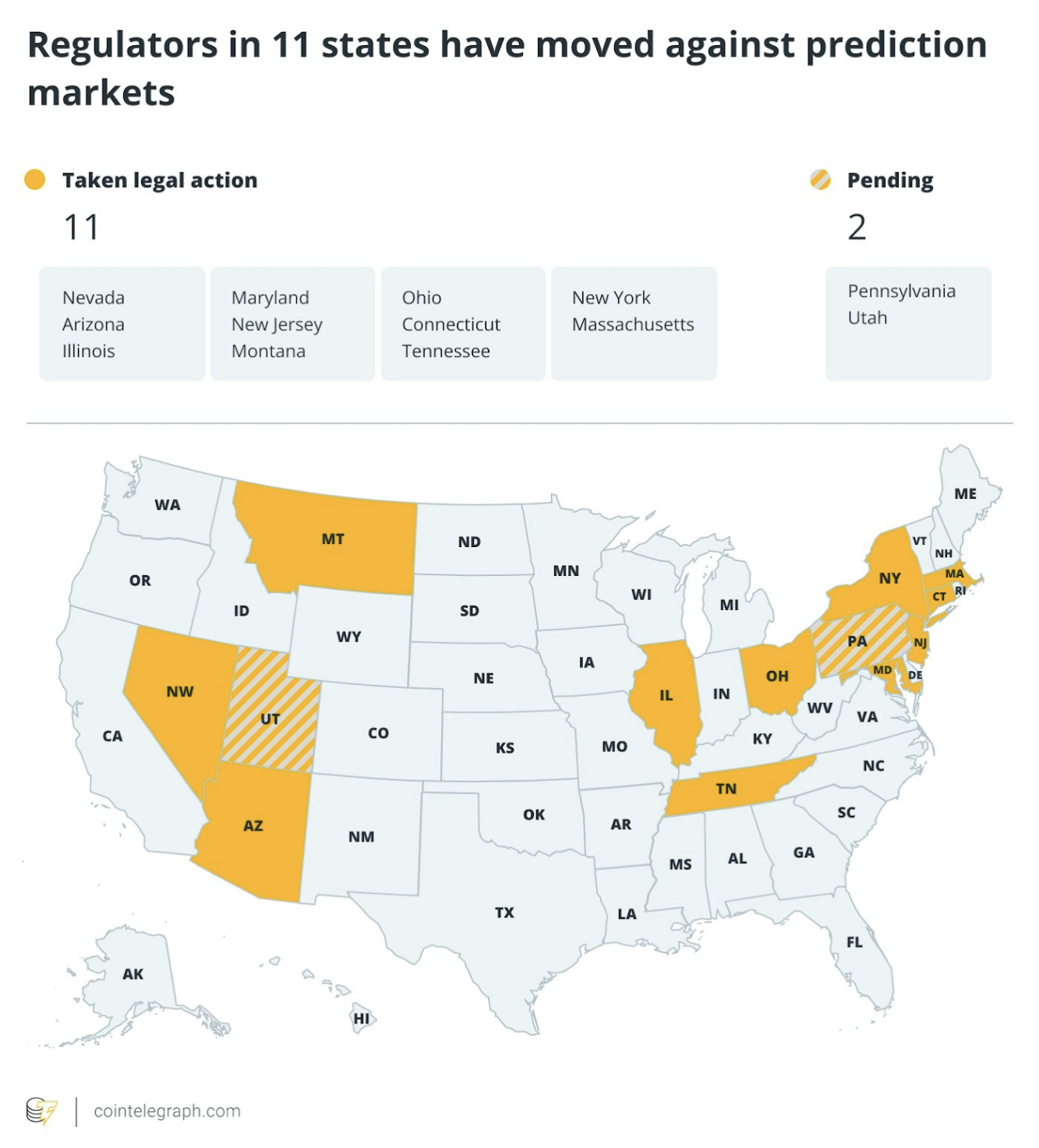
Source: Cointelegraph
Federal regulators have rejected states’ attempts to police prediction markets. The following month, CFTC Chair Michael Selig accused states of pursuing “illegal enforcement actions” against federally regulated exchanges, arguing Congress had given the agency sole authority over commodity derivatives markets, including prediction markets. “To any state that seeks to nullify federal law and seize authority over these markets,” Selig said, “we will see you in court.”
The debate has broadened beyond regulators. In June, casino operators, tribal organizations and labor groups urged Congress to remove sports-event contracts from the CFTC’s authority with an amendment to the Digital Asset Market Clarity (CLARITY) Act, arguing the contracts should instead remain under state gambling laws and existing gaming oversight.
Europe has taken a different approach. On Friday, the European Securities and Markets Authority (ESMA) reminded firms that many event contracts may already fall under existing restrictions on binary options, saying whether a product is regulated depends on its characteristics rather than the “event contract” label attached to it.
Magazine: AI is banking the unbanked in Africa… faster than crypto


On June 30, more than 140 companies, including Visa, Mastercard, Stripe, BlackRock, Google, and Circle’s most important ally, Coinbase, unveiled a stablecoin designed to give away the exact revenue stream Circle lives on. CRCL cratered 17% in a day and is down nearly 40% on the month. This is the story of how a moat made of partnerships gets drained by the partners.
Summary
- More than 140 major firms backed Open USD, a shared-economics stablecoin that directly challenges Circle’s reserve-yield business model.
- Circle’s stock plunged after the launch, as investors priced in the risk of partners capturing stablecoin reserve income themselves.
- Circle still has defenses in regulation, liquidity, and trust, but OUSD could pressure its margins and partner leverage.
The most dangerous sentence in Circle’s business model was always hiding in plain sight, in its own filings: nearly all of the company’s revenue comes from interest earned on the reserves backing USDC. Not fees. Not technology. Interest. Circle holds tens of billions of dollars of customer money, parks it in United States Treasuries, and keeps the yield, a business so profitable and so simple that the only real question was how long the companies generating that float would let someone else collect it.
On June 30, the answer arrived. A consortium of more than 140 companies announced Open USD, a dollar stablecoin with free minting and redemption, shared governance, and, most importantly, reserve income distributed back to the participants instead of retained by an issuer. The backer list reads like the org chart of global payments: Visa, Mastercard, American Express, Discover, and Stripe from the card and processing world; BlackRock, BNY, Standard Chartered, BBVA, Mizuho, U.S. Bank, and DBS from asset management and banking; Google, Samsung, IBM, and Shopify from technology; and Coinbase, Ripple, OKX, Bybit, Gemini, Fireblocks, Anchorage Digital, MetaMask, Aave, Solana Labs, and Polygon from crypto.
The market read the announcement correctly and instantly. Circle’s stock fell as much as 18% intraday and closed down 17.55% at $62.63, its worst day since March, extending the monthly drawdown to 39%. The launch was the top trending story in crypto by nightfall, and the one-line verdicts wrote themselves: Circle’s closest partners had gathered in a room and designed its replacement.
The stock’s full 2026 chart shows a company the market keeps re-underwriting shock by shock. The March 20% plunge came on a draft proposal threatening the yield model from the regulatory side; June’s came from the commercial side; between them, the shares have swung on every headline touching reserve economics, because a business this concentrated converts every threat to one revenue line into a threat to the whole valuation. Wall Street’s consensus target near $120, roughly 91% above the post-crash price, is less a disagreement about the facts than about the timeline: the analysts are pricing the years OUSD needs to actually ship and scale, while the tape prices the strategic position, which changed in an afternoon.
The reality is more layered than the verdict, and more interesting. Here is how the stablecoin business actually works, why the consortium model attacks it at the load-bearing wall, and what Circle can still do about it.
A beautiful business with one assumption
Circle’s economics are worth spelling out, because they explain both the 91% analyst upside targets before the announcement and the 17% single-day repricing after it.
USDC circulates around $73 billion. Circle invests the reserves behind those tokens in short-term Treasuries and cash equivalents, and at prevailing rates that float generates several billion dollars a year, roughly 96% of company revenue. The model has effectively no credit risk, no inventory, and no marginal cost per dollar of growth. What it has instead is a single giant assumption: that the businesses and users who hold USDC will keep letting Circle pocket the yield on their money.
Defending that assumption is expensive, and the expense is the tell. Circle paid Coinbase $908 million in a single recent year as a distribution fee for carrying USDC, a payment that is best understood as yield-sharing under a different name, negotiated bilaterally with the one partner large enough to demand it. Every other participant in the USDC economy, the fintechs settling on it, the exchanges quoting it, the merchants accepting it, generated float for Circle and received nothing. The consortium’s founding insight is simply that the Coinbase deal should be everyone’s deal, structurally, by default.
The history rhymes hard enough to sting. USDC itself began life inside a consortium, the Centre venture that Circle and Coinbase governed jointly until 2023, when the structure dissolved, Circle bought out its partner, and shared governance gave way to a single issuer with a paid distributor. Our explainer on consortium stablecoins covers that arc in full, and the short version is uncomfortable for the incumbent: the industry tried single-issuer economics, watched the issuer keep the money, and has now come back for the original model with 70 times as many partners.
What Open USD actually is
Strip the launch-day theater and the product has 5 defining features.
It is issued by an independent operator, Open Standard, led by Zach Abrams, whose stablecoin infrastructure company Bridge was acquired by Stripe in 2024, which makes the venture a Stripe alumni project with the parent’s full weight behind it. Stripe has already committed to making OUSD the base stablecoin across its commerce ecosystem.
It is free at the point of use. Businesses mint and redeem with no fees and no volume limits, removing the toll booths that large-scale users complain about with incumbent issuers.
It shares the money. Reserve income flows back to participating partners after a management fee, governed by a board drawn from the membership. This is the feature that hit Circle’s stock, because it converts every consortium member from a customer of stablecoin issuers into a shareholder of one.
It launches natively on Solana later this year, with the distribution map already sketched by the membership: MetaMask at the wallet layer, Aave in lending, Fireblocks and Anchorage in custody, Shopify and Mercado Pago at the merchant edge, and the card networks wherever they decide interoperability suits them.
And it is aimed at enterprise treasury and merchant payments first, the exact segments where stablecoins have been compounding fastest and where Ripple’s decision to join the consortium made strategic sense for RLUSD, since a shared standard grows the settlement pie that every issuer’s adjacent businesses feed on.
The consortium is not even alone in its category. The Paxos-led Global Dollar Network has run the shared-economics playbook with Robinhood, Kraken, and Galaxy since 2024, and European banks are building the euro-denominated Qivalis venture on the same logic. The GENIUS Act‘s 2025 passage is the common enabler: once federal law defined what a compliant dollar stablecoin is, the risk of issuing one collapsed, and the strategic question flipped from whether regulated institutions should touch stablecoins to why they would hand the float to a third party.
The spectator with the biggest stake
Any Circle analysis that stops at OUSD misses the largest player in the market, who spent June 30 doing what it always does: nothing visible, profitably.
Tether’s USDT circulates at more than double USDC’s size, and its dominance rests on a base the consortium barely touches: offshore exchange liquidity, emerging-market dollar demand, and the informal settlement flows where compliance surface area is a cost, not a feature. The consortium’s enterprise-treasury-and-merchant thesis attacks Circle’s home market precisely because that is the market where its members live, which leaves the incumbent conveniently out of the crossfire.
Post-GENIUS market share data already showed the shape of the fight: Tether’s share drifted from 62% to 59% since the act passed while Circle’s climbed from 19% to about 24%, meaning the regulated segment was growing at the offshore leader’s relative expense. OUSD’s arrival splits the regulated segment’s future growth without touching the offshore base at all.
The regulatory chessboard adds pieces weekly. Banks outside the consortium responded to the launch by asking regulators for tighter oversight of the entire category, a move that reads as incumbents calling the referee on other incumbents. Europe’s MiCA regime, having just shown its teeth on exchange licensing, applies its own e-money rules to stablecoins and has already reshaped which tokens can circulate in the bloc, with Tether conceding ground there while Circle’s EU authorization became a genuine asset. And the same United States framework that made OUSD possible constrains it: the GENIUS Act’s prohibition on paying yield directly to retail holders is why the consortium’s revenue sharing flows to member businesses instead of end users, a design detail that keeps the product enterprise-shaped and leaves the consumer yield question, the truly disruptive one, for another regulatory fight on another day.
The DeFi layer chooses quietly
One constituency will vote on this war earlier than the treasurers and the regulators: decentralized finance, where the default settlement asset is chosen by liquidity gravity, integration inertia, and a handful of protocol governance decisions.
USDC’s position in DeFi took years to compound. It is the reserve asset of major lending markets, half of the deepest trading pairs on every serious venue, and the collateral standard that risk frameworks were written around. That inertia is real protection: migrating a lending market’s base asset is a governance fight, an oracle change, and a liquidity bootstrap all at once, and protocols do not undertake it for a marginally better logo. But the consortium roster shows the attack vector, because Aave, MetaMask, Solana Labs, and Polygon are members. The protocols and platforms that decide DeFi defaults are, in several key cases, now economically aligned with the challenger, and OUSD launching natively on Solana drops it into the ecosystem where new-asset liquidity bootstraps fastest.
The adjacent battleground is machine payments, the fastest-growing new demand source for dollars on-chain. USDC is currently the default settlement asset of the x402 agentic payments stack, an incumbency worth compounding volumes as autonomous agent commerce scales. But the consortium overlaps suspiciously well with that stack’s infrastructure: Stripe co-authored the machine payments standards, Google and the card networks sit in both stories, and a consortium coin with zero mint and redeem friction is engineered for exactly the high-frequency, low-margin flows agents generate. If the agent economy’s plumbing quietly swaps its default dollar, Circle loses the growth segment before the incumbency ever shows up in a market share chart.
The bear case for Circle, steelmanned
The market’s 17% answer contains a specific chain of logic, and it is worth walking honestly.
The consortium members control distribution, and distribution is the whole game in a commodity product. A dollar token is a dollar token; what differs is where it is accepted, quoted, and defaulted. Stripe alone processed $1.9 trillion in payments last year. Shopify fronts millions of merchants. Coinbase decides what tens of millions of retail users see first. When the companies that own those surfaces share in OUSD’s economics, every integration decision tilts one way, not through conspiracy but through arithmetic.
The Coinbase position is the sharpest edge. Circle’s largest distribution partner, the recipient of that $908 million annual payment, is a founding member of the rival. Coinbase’s implicit calculation, that a governance seat and revenue share in a coin running through its own ecosystem beats collecting fees as Circle’s middleman, is exactly the calculation every other large USDC holder will now run. Even if Coinbase never demotes USDC, the negotiating leverage in every future renewal just changed hands.
And the margin math bites even in the scenarios where Circle keeps its users. If OUSD’s default yield-sharing forces Circle to extend Coinbase-style economics across its partner base to defend circulation, revenue compresses without a single dollar of USDC leaving. A company with 96% of revenue from one stream does not need to lose the stream to be repriced. It only needs to lose pricing power over it, and June 30 was the day pricing power visibly moved to the other side of the table.
The precedent from adjacent markets is not comforting either. Interchange, card processing, and index funds all followed the same arc: a profitable intermediary, a coalition of its largest customers, and a shared-ownership alternative that turned margin into member rebates. Payments infrastructure trends toward mutualization once the customers are big enough to build their own, and 140 of them just did.
The bull case the selloff ignored
The counterarguments are real, which is why the stock clawed back part of the loss by Thursday and why Clear Street and KeyBanc both called the plunge overdone.
Start with the oldest lesson in consortium history, the one sitting in Circle’s own past: shared governance is easy to announce and brutal to operate. Centre could not align two partners; Open Standard proposes to align 140, including direct competitors, across banking, cards, tech, and crypto, with a product that has not launched, on a timeline of later this year. Visa and Mastercard sitting on the same board as Aave and Solana Labs is a press release until the first hard decision about chain support, freeze policies, or fee changes, and the graveyard of bank consortia is full of ventures that died at exactly that meeting.
Circle’s actual moat may also be misidentified. USDC’s advantage was never that partners lacked alternatives; it was regulatory surface area. Circle holds licenses and registrations across the United States and Europe, survived a decade of scrutiny, kept its peg through the 2023 banking crisis, and is the counterparty compliance departments have already approved. Europe’s MiCA enforcement just showed what that is worth, locking the world’s largest exchange out of an entire continent for compliance history, and a not-yet-launched consortium coin starts that decade-long accumulation from 0. Enterprise treasurers do not move to a token because its governance is philosophically nicer. They move when it is approved, liquid, and boring, and USDC currently owns boring.
The market-size argument does the rest of the bullish work. Stablecoins circulate above $300 billion today, with Citi projecting $4 trillion by 2030 and BNY sketching $1.5 trillion as a conservative case. In a market growing that fast, USDC’s share, which climbed from 19% to around 24% since the GENIUS Act while Tether’s slipped from 62% to 59%, can shrink relatively while growing absolutely, which is precisely how Jeremy Allaire framed his response. Competition validating the category is a real phenomenon; ask any index fund pioneer how terminal the arrival of rivals proved.
There is also a stickiness argument hiding in the float itself. Stablecoin balances are not portfolio allocations that rebalance on a committee vote; they are working capital embedded in exchange accounts, smart contracts, payment flows, and treasury operations, each with its own migration cost. USDC’s $73 billion is distributed across millions of holders and thousands of integrations, and history says such bases erode slowly even under direct assault: Tether has survived a decade of existential headlines with its dominance dented, not broken, because the marginal holder’s laziness is the strongest force in payments. OUSD must not merely exist and pay better; it must be worth the operational work of switching, integration by integration, and the burden of proof sits with the challenger for years.
And Tether looms over the whole fight as the unbothered variable. OUSD’s enterprise-and-merchant focus attacks Circle’s home turf, not the offshore, trading, and emerging-market flows where the market leader, at more than double USDC’s circulation, actually lives. It is entirely possible the consortium’s main casualty is the number-two coin’s growth rate while number one watches from a distance.
Circle’s option tree
The defense does not have to be passive, and Circle’s realistic moves sort into 4 branches, each with a cost.
Match the economics. Extending Coinbase-grade revenue sharing across the partner base is the direct counter, and the most expensive: it concedes the model, compresses the margin that justifies the stock’s multiple, and converts Circle from toll collector to utility overnight. The consolation is that a utility with USDC’s regulatory footprint and liquidity is still a formidable business, just a differently valued one. The market spent June 30 pricing exactly this branch.
Sell what the consortium cannot ship. Circle’s decade of licenses, audits, banking relationships, and crisis-tested redemption infrastructure is not replicable by press release, and the company’s cleanest play is to weaponize the gap: court the treasurers, banks, and regulated funds for whom counterparty diligence is the product, while OUSD spends its first years earning the approvals USDC already holds. Every quarter the consortium’s launch slips, this branch compounds.
Climb the stack. Circle’s own network buildout, including the Arc chain project, follows the same logic driving every player in the infrastructure race: if issuance economics commoditize, own the settlement layer where the volume clears and charge there instead. It is the identical conclusion Stripe, Coinbase, and Robinhood reached about their own businesses, and it puts Circle in the corporate chain land grab as a competitor instead of a casualty.
Become the acquirer or the acquired. A $60-something CRCL with the category’s best regulatory position is simultaneously a consolidation vehicle and a target, and the same banks lobbying against the consortium have balance sheets that could decide the question. Stranger outcomes have printed in payments; the interchange wars ended with the networks owning pieces of their disruptors.
None of the branches is comfortable, and the honest read is that Circle’s management now has to pick among them under a deadline the consortium set. That is what June 30 actually changed: not the revenue, which is intact, but the initiative, which is gone.
What to watch as the war starts
The battle turns operational from here, and the checkpoints are concrete. Watch whether OUSD ships this year at all, because consortium timelines slip as a rule. Watch the first anchor migrations, especially anything Stripe or Shopify announces about defaults, since defaults move float in ways press releases do not. Watch Circle’s counter-moves: expanded revenue-sharing, new distribution deals, and progress on its own network ambitions, including the infrastructure race where Stripe’s Tempo chain already showed how seriously the payments giants take owning the rails. Watch the banks outside the consortium, who greeted the launch by asking regulators for tighter oversight, a reminder that the incumbents have moves of their own. And watch the Coinbase relationship above all, because the day that renewal changes is the day the thesis resolves.
The challenger has its own proof burden, and it is heavier than launch-day coverage implied. OUSD must clear the same licensing gauntlet in every jurisdiction where its members want to use it, keep a peg through its first crisis, build redemption infrastructure that works at institutional scale on the worst day of the year, and do all of it while a 140-member board negotiates every consequential decision. Circle has already paid those tuition bills; the consortium’s members have only agreed to split the check. Markets price announcements instantly and operations slowly, which is exactly why the definitive verdict on June 30 will not arrive until OUSD survives something.
The deepest reading of June 30 is not that Circle dies. It is that the era of the stablecoin issuer as a standalone toll collector just ended, on a Tuesday, by consensus of everyone who pays the tolls. Circle built the proof that a regulated digital dollar could work at scale, and the reward for proving it is 140 companies deciding the model is too good to leave to one company. Being replaced by your own success story is a very specific kind of defeat, and it is also, sometimes, survivable. Circle has 4 to 6 months before its replacement takes its first breath. What it does with them decides whether June 30 was the day the moat drained, or just the day everyone finally saw how much water was in it.
Disclaimer: This article is for informational purposes only and does not constitute investment advice. Digital asset markets are volatile, and you can lose your entire investment. Always do your own research. Information current as of July 4, 2026.


Charles Hoskinson expects the Ouroboros Leios upgrade to multiply Cardano’s capacity by 60 times, a leap that would put the network on par with the XRP Ledger in terms of speed.
The founder also defended Midnight City against critics and outlined the upgrade’s next steps.
Leios: Cardano’s Bet to Catch the XRP Ledger
Ouroboros Leios is an upgrade to Cardano’s protocol designed to multiply transaction capacity without sacrificing decentralization or security. Charles Hoskinson explained its scope during an interview with David Gokhshtein on “The Breakdown podcast”.
According to the founder, the technology will increase the network’s internal throughput by up to 60x. That jump, he said, would leave Cardano with performance comparable to the XRP Ledger, a network known for its efficiency.
“Leios will be a 60x in terms of throughput inside the system, so we’re good, we’re as performant as XRP, and we still kept our principles,” Hoskinson said.
Follow us on X to get the latest news as it happens.
The comparison carries weight. The XRPL built its reputation on settlements between three and five seconds and a maximum capacity of 1,500 transactions per second. In March 2026, that network surpassed 120 TPS during a peak with roughly 650 operations.
Hoskinson stressed that these improvements do not mean giving up the project’s founding principles. The industry knows this dilemma as the blockchain trilemma, where scaling often demands trade-offs between decentralization and security. Cardano wants to prove that exchange is not inevitable.
The path is already underway. The public Leios testnet, named Musashi Dojo, debuted on June 23, 2026. It marks the protocol’s first operation in a live network environment. Mainnet deployment is expected before the end of this year.
Hoskinson Defends Midnight City After Big Pey’s Criticism
Hoskinson also responded firmly to questions about Midnight City. Content creator Big Pey labeled the initiative an example of wasteful spending within the ecosystem.
According to the critic, the team invested millions of dollars in a project that was unable to attract new users. He described that strategy as the “Cardano Way,” referring to investments that yield no immediate commercial returns.
The reply came at once. Hoskinson said he had lost all respect for Big Pey as an entrepreneur and criticized him for failing to understand how consumer products evolve. He even challenged the critic to save the post and return in a year to apologize.
Midnight City works as an interactive showcase for Midnight Network, the privacy-focused chain tied to Cardano. The platform translates complex blockchain mechanics into a retro-futuristic 2D city inhabited by AI agents.
Those agents generate transactions and economic behavior similar to everyday use by consumers and businesses.
Institutional interest supports that vision. Midnight already added Monument Bank, Google, and AlphaTON Capital, and is holding talks with investment banks in the United States and Europe.
For Hoskinson, 2026 will be a beta year meant to strengthen the infrastructure before mainstream adoption.
Subscribe to our YouTube channel to watch leaders and journalists provide expert insights
The post Charles Hoskinson Bets Cardano Will Rival XRP Ledger’s Speed After the Leios Upgrade appeared first on BeInCrypto.

Remittix has raised the stakes for its community after confirming that RTX will launch on major exchanges at a minimum price of $0.35.
The announcement gives holders a clear launch benchmark as the project moves closer to exchange trading, token distribution and wider platform access. For RTX presale buyers, the reveal is one of the most important updates so far, turning weeks of launch price speculation into a confirmed figure.
The timing has made the update even bigger. Airdrop registration is now live, the Remittix crypto-to-fiat platform is active and in testing, the official platform launch date is expected to be announced over the coming week and the limited time 350% RTX bonus is only available for a few more days before ending completely.
$0.35 Minimum Launch Price Changes The Conversation
The confirmed $0.35 minimum launch price gives RTX holders a stronger sense of how the token will enter the market once it reaches major exchanges.
For any presale project, launch price clarity is a major milestone. It gives the community a number to focus on, helps frame expectations before trading begins and signals that the project is moving into a more advanced launch phase.
Remittix has now placed that benchmark in front of the market. With major exchange listings ahead, the $0.35 minimum launch price is likely to become one of the biggest talking points around RTX as the project moves toward its public trading debut.
Airdrop Registration Now Open For RTX Holders
Remittix has also opened airdrop registration through the official Remittix site.
The airdrop is connected to the distribution of RTX tokens purchased during the presale. Holders can register by connecting their wallet, submitting their wallet address and completing the registration page.
Users can also add optional notification details so they can receive future updates linked to token distribution, airdrop progress and launch announcements. Once the process is complete, the page confirms that the holder has successfully registered.
RTX holders should only use official Remittix links when registering. Unofficial websites, direct messages or unknown accounts claiming to offer airdrop access should be avoided.
Crypto-To-Fiat Platform Live And In Testing
Beyond the launch price reveal, Remittix continues to build momentum around its crypto-to-fiat platform.
The platform is already live and currently being tested with members of the community. It is designed to let users send crypto while recipients receive fiat directly into bank accounts.
Multiple community members have reportedly received fiat payments through the Remittix system, giving the project practical platform proof ahead of wider public access.
The official launch date for the crypto-to-fiat platform is expected to be announced over the coming week, adding another major update to the current Remittix launch cycle.
350% RTX Bonus Nears Final Days
The limited time 350% RTX bonus remains available, but only for another few days before it completely ends.
With the $0.35 minimum launch price now confirmed, the final bonus window has taken on even more urgency. Remittix now has several key updates moving at the same time: exchange launch pricing, airdrop registration, token distribution preparation, live platform testing and an upcoming platform launch date announcement.
For RTX holders, the message is clear. Remittix has raised the stakes with a confirmed $0.35 minimum launch price, and the project is now moving closer to one of the most important phases in its roadmap.
Discover the future of PayFi with Remittix by checking out their project here:
Website: https://remittixpresale.io
Airdrop Registration: https://airdrop.remittixpresale.io
FAQ
What is the confirmed RTX launch price?
Remittix has confirmed that RTX will launch on major exchanges at a minimum price of $0.35.
Is Remittix airdrop registration live?
Yes, airdrop registration is live through the official Remittix site for RTX holders preparing for token distribution.
Is the 350% RTX bonus still available?
Yes, the limited time 350% RTX bonus is still available for a few more days before it ends completely.
Disclaimer: This is a Press Release provided by a third party who is responsible for the content. Please conduct your own research before taking any action based on the content.



On July 1, Robinhood launched its own blockchain, joining Coinbase, Stripe, Circle, and Tether in the fastest-moving infrastructure race in crypto: giant consumer companies building their own rails instead of renting someone else’s. The land grab has a clear logic, clear winners, and one uncomfortable question about what happens to the neutral chains everyone used to build on.
Summary
- Robinhood has joined Coinbase, Stripe, Circle, and Tether in building its own blockchain, accelerating the corporate race to own crypto infrastructure instead of relying on public networks.
- Corporate chains promise higher margins, greater product control, and built-in user distribution, making infrastructure ownership an increasingly attractive strategy for major financial platforms.
- The shift raises long-term questions about the future of neutral blockchains, as corporate-controlled networks compete for developers, liquidity, and the value once captured by open ecosystems.
For most of crypto’s history, the deal between companies and blockchains was simple: the chains were public infrastructure, and companies were tenants. Coinbase listed tokens on other people’s networks. Stripe processed payments over other people’s rails. Robinhood gave customers a buy button for assets that lived somewhere else. The chains were roads; the companies drove on them.
That arrangement is ending in real time. On July 1, at an event in London called “The World is Flat”, Robinhood launched the public mainnet of Robinhood Chain, its own layer 2 network, and moved its tokenized stock business onto rails it controls.
The launch slots into a pattern that has become the defining infrastructure story of this cycle: Coinbase built Base and turned it into a revenue machine. Stripe incubated Tempo and shipped it in March with half of global finance as design partners. Circle is building Arc. Tether has backed its own settlement chains. In the span of 2 years, nearly every large company that touches crypto has concluded the same thing: owning the road beats paying tolls on it.
The speed of the shift is easy to miss because each launch arrived dressed as a product announcement. Assemble the timeline instead: Base in 2023, the first proof that a corporate chain could scale. The stablechain wave forming through 2025 as the GENIUS Act clarified the rules. Tempo’s testnet in December with Visa and Mastercard already inside, its mainnet in March, Robinhood Chain’s testnet in February and mainnet in July.
What took the neutral ecosystems a decade of grant programs and hackathons, bootstrapping users, liquidity, and developer attention, the corporations are compressing into quarters by shipping the users and liquidity pre-attached. The chains did not get easier to build. The distribution finally showed up owning the builders.
Robinhood’s version is the most retail-facing yet, and the most aggressive about what it puts on-chain. This is the map of the land grab: who is building what, why the economics are irresistible, and what the corporatization of blockspace does to the industry that invented it.
What Robinhood actually launched
The July 1 announcement bundled a full product offensive, but the chain is the center of gravity. Robinhood Chain is an Ethereum layer 2 built on Arbitrum technology, running 100-millisecond block times, live on public mainnet after a testnet that opened in February. The company describes it as AI-native and purpose-built for real-world assets, and unlike the walled gardens skeptics expected, it is permissionless: anyone can deploy contracts, and users can interact through self-custody wallets without touching Robinhood’s brokerage at all.
The anchor tenant is Robinhood’s own tokenized equity business. Stock Tokens, the company’s tokenized shares, are live through Robinhood Wallet in more than 120 countries, with the tokenized United States stocks and ETFs that previously lived on Arbitrum migrating to the new network. The design goal is straightforward: equities that trade around the clock and plug into decentralized finance as collateral, the same premise the SpaceX listing just stress-tested across the whole industry.
Around the anchor, Robinhood assembled a launch ecosystem that reads like a checklist of what a chain needs on day one. Uniswap is deploying a dedicated automated market maker as the primary public liquidity venue, with Pleiades running a separate platform for proprietary trading. Alchemy, BitGo, Chainlink, and 0x shipped day-one infrastructure support.
Robinhood Earn gives United States users an estimated 7% yield lending the USDG stablecoin through Morpho from a self-custody wallet. Perpetual futures arrive through an integration with the decentralized exchange Lighter, sweetened with an $11 million token rewards program, while Agentic Accounts let eligible users wire AI models directly into Robinhood’s trading infrastructure.
The market’s verdict was immediate: HOOD jumped 8% toward $108 on launch day, with Cantor Fitzgerald having already raised its target to $130 on the product pipeline. The enthusiasm has context worth keeping. Robinhood’s crypto transaction revenue fell 47% year over year in the first quarter to $134 million; the company cut 10% of its workforce weeks before the launch, and the stock remains roughly 30% below its October record.
The chain is not a victory lap. It is a bet that owning infrastructure smooths out a revenue line that trading fees alone cannot, backed by the $51 billion in crypto custody assets and the Bitstamp exchange acquisition the company already sits on. Our news desk covered the launch mechanics when they landed; the bigger story is the pattern the launch completes.
The strategic sequencing is worth noticing too, because it shows how deliberately the ladder was climbed. Robinhood spent 2025 acquiring the pieces: Bitstamp for exchange infrastructure, WonderFi for Canadian licensing, tokenized SpaceX and OpenAI products in Europe as a proof of concept. It spent early 2026 testing the chain quietly while expanding perpetuals in Europe, where crypto derivatives became one of its fastest-growing products.
The July launch assembled everything into a single architecture: assets tokenized on its own network, traded through its own wallet, leveraged through partnered perpetuals, yielding through integrated lending, and increasingly operated by customers’ AI agents through its own trading interface. Each layer feeds the others, and every layer that used to belong to a partner now belongs to the platform. Vlad Tenev has called tokenized stocks inevitable; the chain is the claim that the inevitability should run on his rails.
The pattern: everyone builds now
Put the corporate chains side by side, and the strategy differences sharpen.
Base is the template and the proof. Coinbase launched its Ethereum layer 2 in 2023, and it became the fastest-scaling network of its generation, generating sequencer revenue, anchoring the exchange’s on-chain strategy, and proving the core economics: a company with a large user base can route those users onto its own chain and capture value at the infrastructure layer that it previously leaked to others. Base also showed the failure mode this June, suffering 2 outages within hours from a sequencer bug, a reminder that corporate chains concentrate operational risk in exactly one place.
Tempo is the payments-native version. Incubated by Stripe with Paradigm and launched to mainnet in March, it is a layer 1 built purely for stablecoin settlement: gas payable in any major stablecoin instead of a native token, ISO 20022 compatibility for bank back offices, and a Machine Payments Protocol co-developed with Stripe that lets AI agents authorize and stream payments autonomously.
The design-partner list, including Visa, Mastercard, Deutsche Bank, Standard Chartered, Revolut, Nubank, Shopify, OpenAI, and Anthropic, signals the ambition: not a crypto chain with payments features, but a settlement standard for the $190 trillion cross-border market, launched by the company that processed $1.9 trillion in payments last year. crypto.news covered the mainnet launch in March, and the venture’s $500 million raise at a $5 billion valuation says the capital markets take the ambition literally.
Circle’s Arc and the Tether-aligned settlement chains extend the same logic to issuers: if your product is a dollar token, the chain it settles on is your cost structure and your regulatory perimeter, so own it. Even the consortium behind Open USD chose a launch chain, Solana, as one of its first architectural decisions, because in 2026 the question of where this settles is inseparable from who captures the value.
Robinhood Chain adds the missing archetype: the retail brokerage chain, where the asset being brought on-chain is not a stablecoin or an exchange’s order flow but the entire traditional portfolio, stocks, ETFs, and eventually whatever else the securities rulebook allows.
The stablechain sub-race deserves its own map
Within the broader land grab, the payments-specific chains have become a category with its own name, stablechains, and its own competitive logic, because the prize they contest is the largest: the settlement layer for a stablecoin market above $300 billion today and projected by Citi to reach $4 trillion by 2030.
Tempo’s design choices show what purpose-built means in practice. The chain has no native gas token at all; transaction fees settle in any major stablecoin through an integrated exchange mechanism, removing the token-price volatility that makes enterprise finance departments allergic to blockchain cost accounting. Its ISO 20022 compatibility means bank reconciliation systems can read its messages natively, and its throughput targets are set against payments workloads instead of trading ones.
The venture also declined to issue a token at launch, citing regulatory clarity, a decision that separates the stablechains philosophically from the token-financed networks they compete with: Tempo’s backers monetize through the businesses the chain enables, not through a coin.
The competitive set is filling in fast. Circle’s Arc approaches from the issuer side, Stable and the Plasma-style ventures approach from the Tether ecosystem, and the incumbent general-purpose chains are retrofitting payments features to defend the flows they already host. Solana’s counterargument is that a fast general-purpose chain with existing liquidity beats a specialized newcomer, and winning the Open USD launch was a material point in that argument.
Ethereum’s counterargument is that corporate layer 2s like Base and Robinhood Chain keep settling on it anyway, making it the quiet beneficiary of every corporate launch that chooses the rollup route. The stablechain race is therefore also a proxy war over whether the future of payments settlement is specialized or general, and no result so far is decisive.
What every contestant shares is the same tell: the serious money in crypto has concluded that payments, not speculation, is the volume that matters next, and that whoever operates the rails for it collects the most durable fees in the industry. Stripe processing $1.9 trillion a year off-chain is the number every stablechain pitch deck opens with, because capturing even single-digit percentages of flows like that on-chain would dwarf the fee revenue of everything DeFi has ever built.
The market Tempo names explicitly the $190 trillion in annual cross-border payments still moving through correspondent banking with 1-3 day settlement, is the largest unclaimed territory in finance, and stablecoin volumes doubling to $400 billion last year with 60% of it business-to-business says the migration has started without waiting for anyone’s permission.
The developer calculus nobody says out loud
The land grab’s quietest constituency is developers, and their private math will decide more than the launch events do.
Building on a corporate chain offers what neutral chains historically could not: distribution. A protocol deploying on Robinhood Chain is one integration away from tens of millions of funded retail accounts; on Base, from the largest United States exchange’s user base; on Tempo, from the merchant internet. For consumer applications that die of user-acquisition costs, that proximity is worth real sovereignty concessions, which is why Uniswap, Morpho, Aave, and the rest of blue-chip DeFi keep showing up as day-one partners on chains owned by corporations. The protocols are not confused about the trade; they are pricing it.
The concessions are real, though, and developers enumerate them privately. A corporate chain’s sequencer is a single counterparty that can reorder, delay, or censor whatever the roadmap promises about future decentralization. Its owner is a regulated company that will comply with orders neutral infrastructure might resist, and that can change fee structures, partnership terms, or strategic direction with a quarterly earnings cycle’s notice.
Most subtly, the owner is frequently a future competitor: a lending protocol thriving on a brokerage’s chain is a product demo for the brokerage’s own lending desk, and the platform history of the internet says the demo gets copied. Every developer choosing a corporate chain is betting they can extract the distribution before the platform extracts them, a bet with a long and mostly losing history outside crypto.
The equilibrium forming looks like a barbell. Applications that need users deploy where the users are and accept platform risk; infrastructure that needs neutrality, stablecoin issuers, bridges, oracles, deploys everywhere and belongs nowhere; and the neutral chains compete to be the settlement layer underneath both. It is a more corporate industry than the one the whitepapers described, and also a much larger one, which is the trade the whole cycle keeps making.
Why the economics are irresistible
The land grab is not fashion. Three economic forces make it close to inevitable for any company at this scale.
The first is margin capture. A company routing millions of users through public infrastructure pays for blockspace, market making, and settlement in fees that flow to someone else’s token holders and validators. The same company running its own chain converts those costs into revenue: sequencer fees, ecosystem deals, and the option to monetize every layer of the stack. Base proved the number is large; every subsequent chain is chasing it.
The second is product control. On a rented chain, an outage, a fee spike, or a governance fight is your product problem and someone else’s decision. Robinhood offering a 7% yield product and 24-hour stock trading to mainstream customers cannot outsource reliability to a network it does not operate, or so the reasoning goes; June’s Base outages cut both ways, showing both why companies want control and how controlling it concentrates the blame.
The third is distribution leverage, and it is the one that changes the competitive map. Chains historically fought for users app by app. A corporate chain arrives with the users pre-installed: Robinhood brings tens of millions of funded accounts, Stripe brings the merchant internet, Coinbase brought the largest United States exchange. The scarce resource in crypto was never blockspace; it was distribution, and the companies that own distribution have realized they can vertically integrate backward into infrastructure far more easily than infrastructure can integrate forward into distribution.
There is a fourth, quieter force: the regulatory clock. The GENIUS Act settled stablecoin rules, tokenized equities are inching through frameworks in Europe and Asia, and market structure legislation is grinding through the Senate. Companies are racing to have the rails built before the rules that legitimize the traffic are finished, because the standards that exist at legalization tend to become the standards, period.
What it means for the neutral chains
The uncomfortable question underneath the land grab is what happens to the ecosystems the corporations are building on top of, and around.
In the short run, the answer looks symbiotic. Robinhood Chain and Base both settle on Ethereum and pay for its security; Arbitrum licenses its technology into Robinhood’s stack; Solana hosts the consortium stablecoin and much of the tokenized asset flow. The corporate chains are customers of the neutral infrastructure, and their arrival validates the underlying platforms, which is precisely how Ethereum bulls frame every such launch in the ongoing argument over which L1 is actually winning.
The longer-run answer is less comfortable, because value and attention migrate to where activity lives, and activity increasingly lives one layer up from the neutral base. Some Ethereum layer 2 tokens have sunk to record lows this year even as corporate layer 2 activity grew, a divergence that shows the economics of the model concentrating with the operators rather than the ecosystems.
A world where the dominant consumer chains are owned by Coinbase, Stripe, Robinhood, and the issuers is a world where crypto’s neutral, credibly permissionless middle gets squeezed between corporate rails above and commodity security below. The industry spent a decade arguing that the point of this technology was infrastructure nobody controls. The fastest-growing infrastructure of 2026 has a specific someone in control of every layer that touches the customer, and the sharpest version of the critique says the industry is speed-running the history of the internet, open protocols first, walled platforms winning.
There is a measurable version of the squeeze already on the tape. The market rewards the operators: Coinbase’s stock carries Base in its valuation, HOOD rallied 8% on its chain launch, and Tempo’s $5 billion private valuation prices a network with months of history. The market punishes the middleware: several Ethereum layer 2 tokens printed record lows this year while the corporate chains built on identical technology thrived, because the corporate versions replaced the token with equity and the community with a customer base. The technology stack is winning while the token stack attached to its neutral versions loses, and that divergence, more than any philosophical debate, is what will pull the next 100 corporate chains into existence.
The optimistic rebuttal has real weight too. These chains are permissionless in the ways that matter mechanically: self-custody works, external developers can deploy, assets can exit. Robinhood explicitly built exit rights into its design, and a corporate chain that abuses its position faces the one discipline the old walled gardens never did: users who can bridge away with their assets in minutes.
The bet embedded in the whole land grab is that companies can capture infrastructure economics without triggering that exit, and the bet has not been seriously tested yet, because no corporate chain has yet faced the moment where its interests and its users’ interests point in opposite directions with real money on the line.
The pattern also has a stablecoin-shaped shadow: the same week Robinhood launched its chain, Circle watched 140 of its partners unveil a replacement for its business model, a reminder that in shared infrastructure, today’s platform owner is tomorrow’s disintermediation target.
The scoreboard from here
The metrics that will decide the race are unglamorous. Total value locked and developer migration on Robinhood Chain, against the built-in advantage of $51 billion in custodied assets. Whether Tempo converts its design-partner list into settlement volume that dents correspondent banking. Whether Base’s outages stay anecdotes or become a pattern that costs it the reliability argument.
Whether any corporate chain attracts meaningful third-party development, the thing that separates a platform from a product. And, hovering over all of it, whether regulators treat brokerage-operated blockchains as innovation to charter or vertical integration to unwind.
The regulatory question deserves the last stretch of attention, because it is the one variable none of the builders controls. A brokerage that operates the venue where its customers’ tokenized securities settle, lends against them, runs the wallet, and sells the order flow has reassembled, on new rails, precisely the vertical integration that a century of securities law spent itself disassembling. The companies know it, which is why the launches emphasize permissionlessness and self-custody, features that double as legal arguments.
Regulators know it too, and the pending market structure legislation will decide whether the corporate chain is a licensed product category or a conflict of interest with a block explorer. Europe has already shown, through its handling of exchange licensing, that a framework with teeth can lock the largest player out of a continent; the corporate chains are being built at maximum speed partly to be too integrated to unwind by the time an American framework grows the same teeth.
What is already settled is the direction. The era when serious consumer companies rented their crypto infrastructure lasted about a decade, and it ended without a single dramatic moment, just a sequence of launch events in London and San Francisco where, one by one, the tenants announced they had bought the building. Robinhood was not the first and will not be the last. The land grab has plenty of land left, and everyone with a user base now knows the price of not claiming any.
Disclaimer: This article is for informational purposes only and does not constitute investment advice. Digital asset markets are volatile, and you can lose your entire investment. Always do your own research. Information current as of July 4, 2026.


Bitcoin’s lackluster performance this year has puzzled investors.
Despite record highs in equities, the world’s largest cryptocurrency has struggled to regain momentum while U.S. technology stocks have surged on enthusiasm surrounding AI as it currently trades just below the $62,000 mark, down over 50% from its peak price in October.
Two new outlooks from asset managers Hashdex and Charles Schwab argue the disconnect is temporary, albeit for different reasons.
Samir Kerbage, chief investment officer at Hashdex, said crypto’s recent weakness says more about where investors are allocating capital than about the health of the digital asset ecosystem.
“Capital follows attention and narratives,” Kerbage wrote in a midyear market outlook. “Crypto has benefited from this in the past but right now, attention is elsewhere. AI infrastructure plays, IPO pipelines, macro positioning around rate expectations, are absorbing the flows.”
That rotation, he argued, has overshadowed several structural developments that continue to strengthen crypto’s long-term investment case. Institutional infrastructure is expanding across banks, brokers and payment providers, while regulatory clarity in the U.S. has improved and could strengthen further if Congress passes the CLARITY Act this summer.
Meanwhile, crypto’s underlying usage continues to grow even as prices remain subdued.
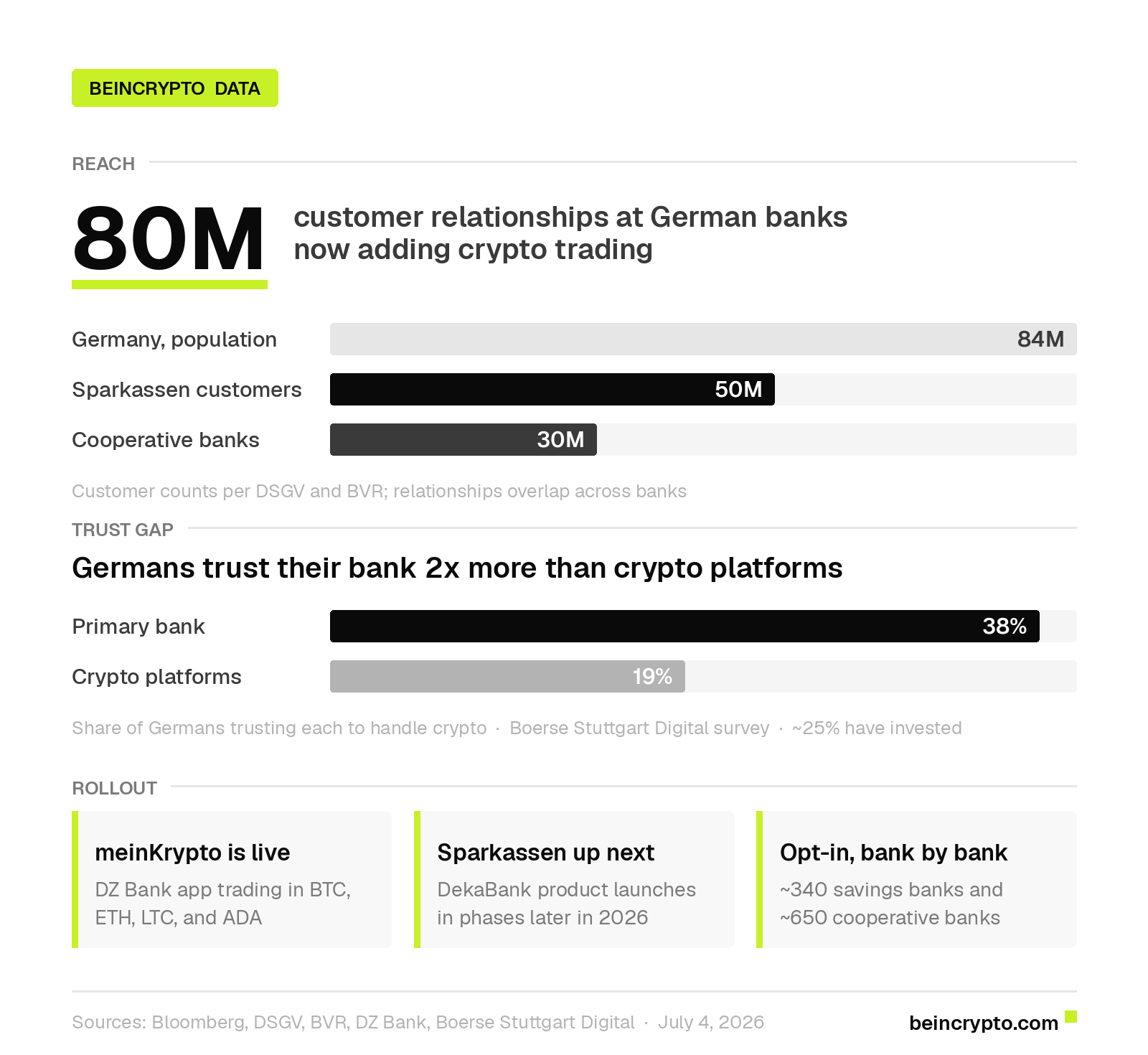
Germany’s savings and cooperative banks are rolling out crypto trading to retail clients, wiring Bitcoin (BTC) into the apps of institutions that hold roughly 80 million customer relationships in a country of 84 million people.
The Sparkassen serve about 50 million customers, per DSGV data, and the cooperative banks another 30 million, per BVR figures. Both groups dismissed the asset class as too risky just four years ago.
German Banks That Rejected Crypto Trading Now Court Millions
According to Bloomberg, both groups are building in-house services rather than steering clients to outside exchanges. DZ Bank’s meinKrypto platform already runs inside the VR Banking App, offering BTC, Ethereum (ETH), Litecoin (LTC), and Cardano (ADA).
BaFin licensed meinKrypto under the EU’s Markets in Crypto-Assets (MiCA) framework in late December 2025, per DZ Bank’s announcement. Boerse Stuttgart Digital handles custody, keeping the whole chain under German supervision.
DekaBank is building the equivalent product for the roughly 340 savings banks, with a phased launch later this year. Each of the almost 650 cooperative banks and every Sparkasse opts in individually. DZ Bank product specialist Markus Bärenfänger expects hundreds to join.

The reversal is stark. The savings banks considered crypto trading in 2021, then shelved it over incalculable risks. MiCA has since opened the door for Germany’s largest financial institutions.
Trust Advantage Collides With Total Loss Warnings
The trust math explains the bet. Germans trust their primary bank twice as much as specialized crypto platforms, 38% to 19%, per a Boerse Stuttgart Digital survey. However, only about a quarter have invested in crypto, in line with broader European adoption figures.
That trust is precisely what worries critics. Co-Pierre Georg, professor at the Frankfurt School of Finance & Management, argues that traditional bank customers may not grasp the risks.
“It is concerning that the floodgates to the cryptocurrency market are now being opened by savings and cooperative banks,” Co-Pierre Georg, professor at the Frankfurt School of Finance & Management, via Bloomberg.
Follow us on X to get the latest news as it happens
Even the savings banks’ own lobby group, DSGV, calls crypto a highly speculative investment carrying the risk of total loss. It frames the service as suitable for self-directed investors only.
Timing sharpens the debate. Bitcoin trades near $62,483 after falling roughly 50% from its October 2025 record of $126,080.

The German lenders also join a wider European shift. UBS opened crypto trading for private clients in January.
For local banks, the payoff may be relevance rather than revenue. Westerwald Bank chief Ralf Kölbach warns that lenders skipping crypto lose younger, tech-savvy customers.
The bigger test is whether bank-branded credibility can survive the market’s next deep drawdown.
The post German Banks to Open Crypto Trading for 50 Million Customers appeared first on BeInCrypto.
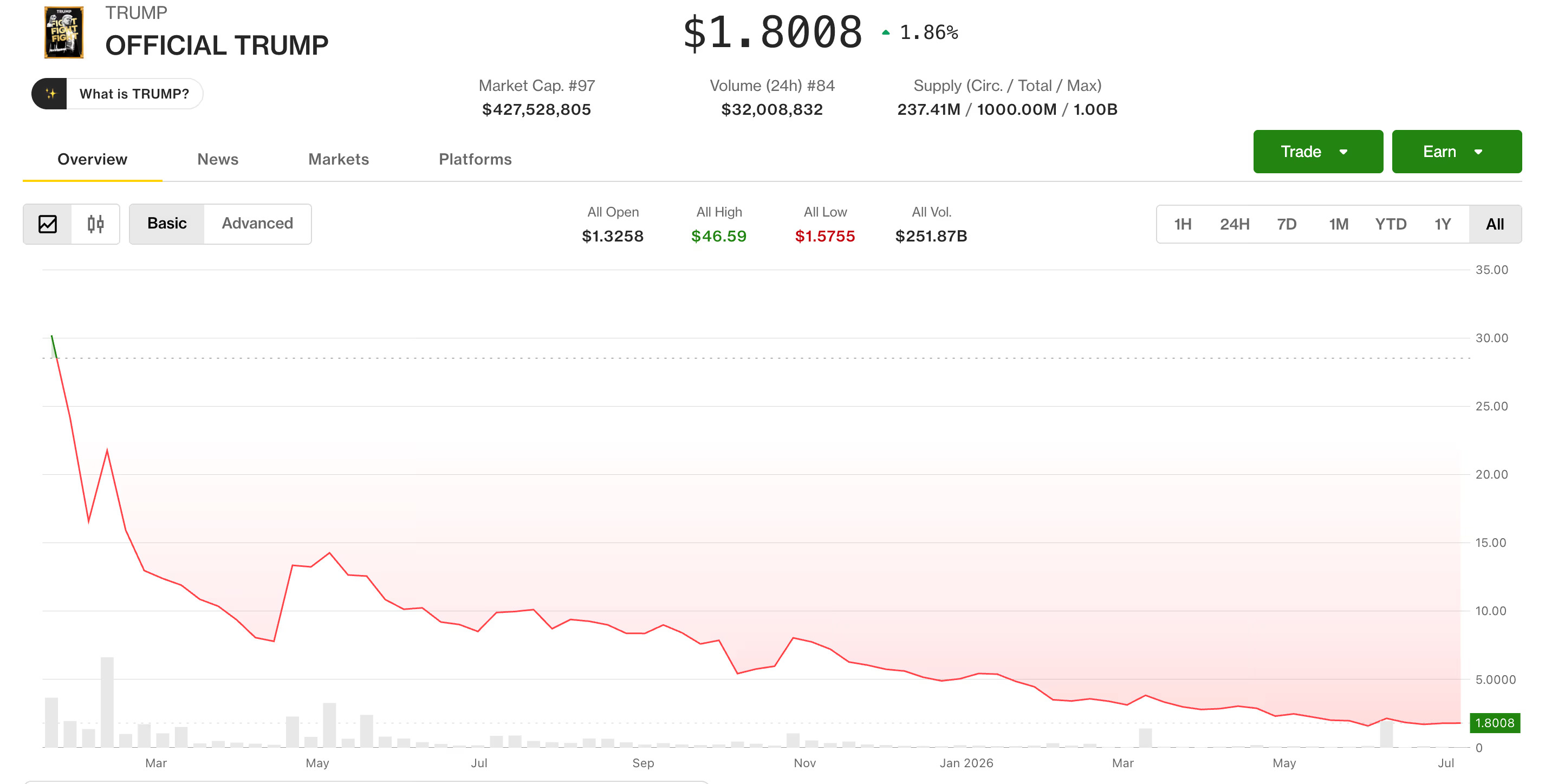
TRUMP trades near $1.79 today, down about 96% from its peak. Its market value is $425 million, against nearly $15 billion at the January 2025 high. Of the 722,000 wallets still holding the token, positions are worth $465 million combined. Since launch, about $71 billion in value has moved through the token.

Trump, who once was a crypto critic, embraced the technology during the 2024 campaign trail before his return to the White House, promising to make the U.S. the crypto capital of the world. Since then, he has unapologetically maintained his crypto ties even as he and his appointees have steered the federal government toward embracing the industry.
Recently, Trump has said there is nothing wrong with the income he made from his crypto-related businesses. He told CNBC that he did nothing illegal and was unaware of the extent of his holdings. Trump also added that he handed day-to-day control of his businesses to his two eldest sons before taking office without divesting.
Family ties
The crypto company that Trump and his family have maintained an ownership stake in, World Liberty Financial, saw its token add to losses under a different structure.
WLFI tokens were sold through an initial coin offering (ICO) at $0.015 in the first round and $0.05 to the public, and stayed non-transferable until Sep. 1, 2025. Secondary trading opened that day at $0.29 and reached $0.33.

A plan to freeze the creator’s Bitcoin sparks fierce debate over crypto rules

Beyoncé Has Fans Gagging After Dropping Surprise Song (VIDEO)

Canada vs Morocco – World Cup last 16 LIVE: Shaky African champions suffer huge blow in opening 20 minutes with star striker forced off – as co-hosts look to stun rivals with opening goal in Houston

No Jackpot Winner as $257 Million Prize Rolls Over to $269 Million Monday Draw

Renter of Home in Anne Heche Crash Denies Settlement With Son

Weekend Open Thread: Staud – Corporette.com

RBI Big News | Crypto Should Not be legalised in INDIA

Crypto Live Trading| 26 june #vinbullindia #livetrading #vinbulllive #live #trading #cryptotrading

Lil Tony Official – Money Music (Official Music Video) Shot By PublicGoat
-

 Fashion24 hours ago
Weekend Open Thread: High Hopes
-

 Tech7 days ago
Bluekit phishing kit adopts browser-in-the-middle for login theft
-

 Tech7 days ago
Claude Code turned every engineer into three. Now companies need more product thinkers
-

 Crypto World5 days ago
Strategy authorizes up to $1.25B in Bitcoin sales under new capital plan
-

 Politics1 day ago
The House | “Reframing the debate from a binary discussion of winners and losers”: Yuan Yang reviews ‘We Are Not Machines’
-

 News Videos6 days ago
MAJOR BITCOIN & MARKET UPDATE!!!! (MUST WATCH ASAP!!!)
-

 Tech5 days ago
Anonymous researcher drops 0-day ‘exploitarium’ repo
-

 Business5 days ago
Australia treasurer says alleged access of prime minister’s bank data ’incredibly concerning’
-
 Business5 days ago
The AI boom won’t burst all at once. It will pop in ‘rolling bubbles’: Macquarie
-

 Sports3 days ago
Broncos roster: OL Ben Powers (No. 74) entering final year of contract
-

 NewsBeat4 days ago
Presenter Caroline Flack’s brother Paul Flack dies aged 55
-

 Crypto World3 days ago
Binance stock trading tops $1B in first month after launch
-
 NewsBeat2 days ago
New exhibition reflects five decades of movement between island of Ireland and GB
-

 Crypto World3 days ago
Alibaba-affiliate Ant Group enters the humanoid robot market with 12 deals
-

 News Videos4 days ago
How to Build INSANE Live Financial Dashboards With Claude
-

 Business3 days ago
Meta Platforms Stock Jumps 7% Today as Bloomberg Reports Company Plans to Enter the Cloud Business
-

 Business2 days ago
What a 10 Percent Drop Means for Buyers, Sellers and Renters
-

 Crypto World2 days ago
Binance Re-Enters Philippines As EU MiCA Rules Restrict Access
-

 Tech5 days ago
The attack that hijacked Claude Code came through Sentry. Datadog, PagerDuty, and Jira have the same exposure.
-
 Business5 days ago
PRISM’s IPO filing mentions Zostel case, CCI investigation
You must be logged in to post a comment Login