

Crypto World
Binance Faces EU Exit Risk as Greece Reportedly Moves Toward MiCA License Rejection


Binance risks losing EU market access after a reported Greek license setback. The MiCA deadline could force many crypto firms to halt European services. Greece’s decision may become the biggest test of MiCA enforcement.
Binance traded near $742 at the time of reporting, while the exchange faced a significant regulatory challenge in Europe. The company may lose its ability to serve European Union customers after reports emerged about its license application in Greece. Consequently, the development places Binance under pressure ahead of a key regulatory deadline.
Greece License Decision Threatens EU Operations
Binance selected Greece as its European regulatory base earlier this year. The company submitted an application under the European Union’s Markets in Crypto-Assets Regulation framework. However, reports indicate that Greece’s Hellenic Capital Market Commission may reject the request.
The decision could prevent Binance from securing authorization before the June 30 deadline. Under MiCA, crypto firms need approval from one member state regulator. They can then offer services throughout all 27 EU countries. Failure to obtain authorization would block Binance from legally serving customers across the bloc. The exchange would need to halt regulated operations from July 1. As a result, millions of users could face service disruptions and account changes.
MiCA Reshapes Europe’s Crypto Regulatory Landscape
The European Union introduced MiCA to create a unified regulatory structure for digital asset companies. The framework became effective in December 2023 and established common compliance standards. Regulators designed the rules to strengthen oversight and consumer protection.
Crypto firms operated under separate national registration systems. However, MiCA requires firms to obtain formal authorization through a member state’s regulator. Therefore, companies must satisfy stricter operational, compliance, and reporting requirements.
The transition has already transformed the European crypto market. Several major exchanges secured approvals before the deadline. Meanwhile, many smaller firms continue to face challenges completing the authorization process.
Binance Maintains Compliance Position Amid Uncertainty
Binance stated that it has worked with regulators throughout the licensing process. The company spent approximately 18 months pursuing authorization and believes it satisfied all requirements. Nevertheless, the final outcome remains uncertain.
The exchange chose Greece due to workforce availability and operational advantages. However, Greece had not issued any MiCA licenses when Binance filed its application. This situation increased attention on the country’s review process.
Greek regulators have not publicly commented on the application. Confidentiality rules continue to limit official statements regarding the review. Binance has committed to providing additional updates before the June 30 deadline.
Broader Impact on Europe’s Crypto Market
The reported setback highlights growing regulatory scrutiny across the digital asset sector. European authorities continue to strengthen oversight as the market matures. Consequently, compliance has become a central requirement for long-term operations.
Industry data shows that only a portion of crypto firms have secured MiCA authorization. Many companies that previously operated under national systems may lose market access. Therefore, the transition period marks a major shift for the sector.
Binance’s case could become a defining example of MiCA enforcement. The outcome may influence how regulators and companies approach compliance in the future. It may also shape the competitive landscape of Europe’s regulated crypto market.


TLDR:
- The Fed voted 12-0 to hold rates at 3.5–3.75%, but raised inflation forecasts and slowed its rate-cut outlook.
- Bitcoin fell 2.2% to $64,150 while Ether dropped 3.6%, with XRP and Solana each losing around 3%.
- The GMCI 30 dropped 2.6%, pushing its year-to-date decline to nearly 36% across the broader market.
- Warsh ditched Powell’s forward-guidance style, opting for shorter, fact-based statements with no market direction.
Crypto markets retreated Wednesday after the Federal Reserve held interest rates steady but delivered a hawkish policy outlook.
The Federal Open Market Committee voted 12-0 to maintain its target rate at 3.5% to 3.75%. The decision came during Kevin Warsh’s first meeting as Fed chair.
Updated projections pointed to slower rate cuts ahead, rattling risk assets across the board. Bitcoin, Ether, and several altcoins fell between 1% and 3% following the announcement.
Markets React to a Hawkish Policy Signal
Bitcoin traded near $64,206 as of writing, down roughly 2.54% over the prior 24 hours. Ether shed 2.8%, while XRP and Solana each declined around 3% according to CoinGecko data. Hyperliquid’s HYPE token, which hit a new all-time high just a day earlier, pulled back 1.5% to $72.
The GMCI 30, tracking the 30 largest cryptocurrencies by market cap, dropped roughly 2.6%. That move extended its year-to-date decline to nearly 36%. Traditional safe-haven assets weren’t spared either, with gold sliding 2.2% and silver shedding a sharper 4%.
Matt Mena, senior crypto research strategist at 21Shares, framed the broader picture: “Taken together, the picture is one of a crypto market absorbing a hawkish macro backdrop while rotation and genuine demand continue to surface in the strongest names.”
The rate hold itself was broadly anticipated and mostly priced in before the meeting. What caught markets off guard was the tone of the updated Summary of Economic Projections, which flagged persistent inflation concerns despite easing geopolitical tensions and softer energy prices.
Warsh Charts a New Course for Fed Communication
Wednesday’s meeting marked more than just a rate decision—it offered the first look at Warsh’s communication style as chair.
His policy statement was notably shorter than those issued under former chair Jerome Powell. It also dropped the forward-guidance language that Powell used consistently throughout his tenure.
Warsh described the new format as focused on presenting “the facts” rather than steering market expectations. That approach aligns with his long-standing skepticism toward forward guidance, which he has argued ties the Fed’s hands unnecessarily.
Mena addressed the weight of the occasion directly: “The Fed’s decision to hold rates was fully expected, but it carried unusual weight as the first meeting chaired by Kevin Warsh.”
He added that “the real signal came from the updated projections,” pointing to revised forecasts that suggest policymakers remain wary of inflation pressures despite some easing on the energy front.
The committee’s updated dot plot marked a meaningful shift from March projections. Policymakers now see a slower path toward lower rates than they did just three months ago.
That pivot, combined with Warsh’s leaner communication style, set a more cautious tone for markets heading into the second half of 2026.



Audits are accomplishing exactly what they are designed to do — discovering errors in the code. And they’re working. Fewer attacks than before take advantage of faulty code to steal platform funds.
The problem, however, is that we’re seeing a growing disconnect between what audits examine and what attackers actually exploit. Today, the industry’s largest losses don’t actually originate from traditional smart contract vulnerabilities. Rather, they come from compromised private keys, governance manipulation, insider compromise, malicious dependency updates and operational failures.
As brilliant as they are at identifying code vulnerabilities, traditional audits cannot prevent a developer from falling victim to a phishing campaign. The best code in the world can still sit atop vulnerable operational infrastructure.
In fact, our research shows that, when measured by financial damage, these operational exploits are often far more devastating than code vulnerabilities themselves. The industry has invested enormous resources into reducing smart contract risk, but the costliest attack vectors remain comparatively under-defended. It’s like the industry is still focused on defending against the last generation of attacks, whereas malicious actors have moved on to different strategies.
Audits alone create a dangerous illusion of safety
Platforms frequently advertise the number of audits they have completed, the reputation of the firms they hired, or the volume of findings identified during review. These have become shorthand indicators for whether a project is safe.
Moody’s Ratings is rolling out its credit ratings to Solana (SOL), allowing issuers of tokenized bonds and other fixed-income securities to embed the firm’s assessments directly into blockchain-based assets.
The move, announced Wednesday in partnership with Solana-focused tokenization specialist Alphaledger, expands Moody’s Token Integration Engine (TIE) to a major public blockchain after its first deployment earlier this year on the institutional-focused Canton Network (CC).
The move builds on a pilot project completed last year, when they demonstrated how municipal bond ratings could be attached directly to tokenized securities on Solana.
Tokenization — the process of creating blockchain-based versions of traditional assets — has become one of the fastest-growing areas of finance. Asset managers including BlackRock, Franklin Templeton and Apollo have launched tokenized funds and credit products, while Boston Consulting Group and Ripple estimate the market could reach $18.9 trillion by 2033.
As tokenization gains traction, financial firms are increasingly focused on bringing the infrastructure surrounding traditional assets onto blockchain rails. That includes ownership records, pricing data, compliance information and credit ratings.
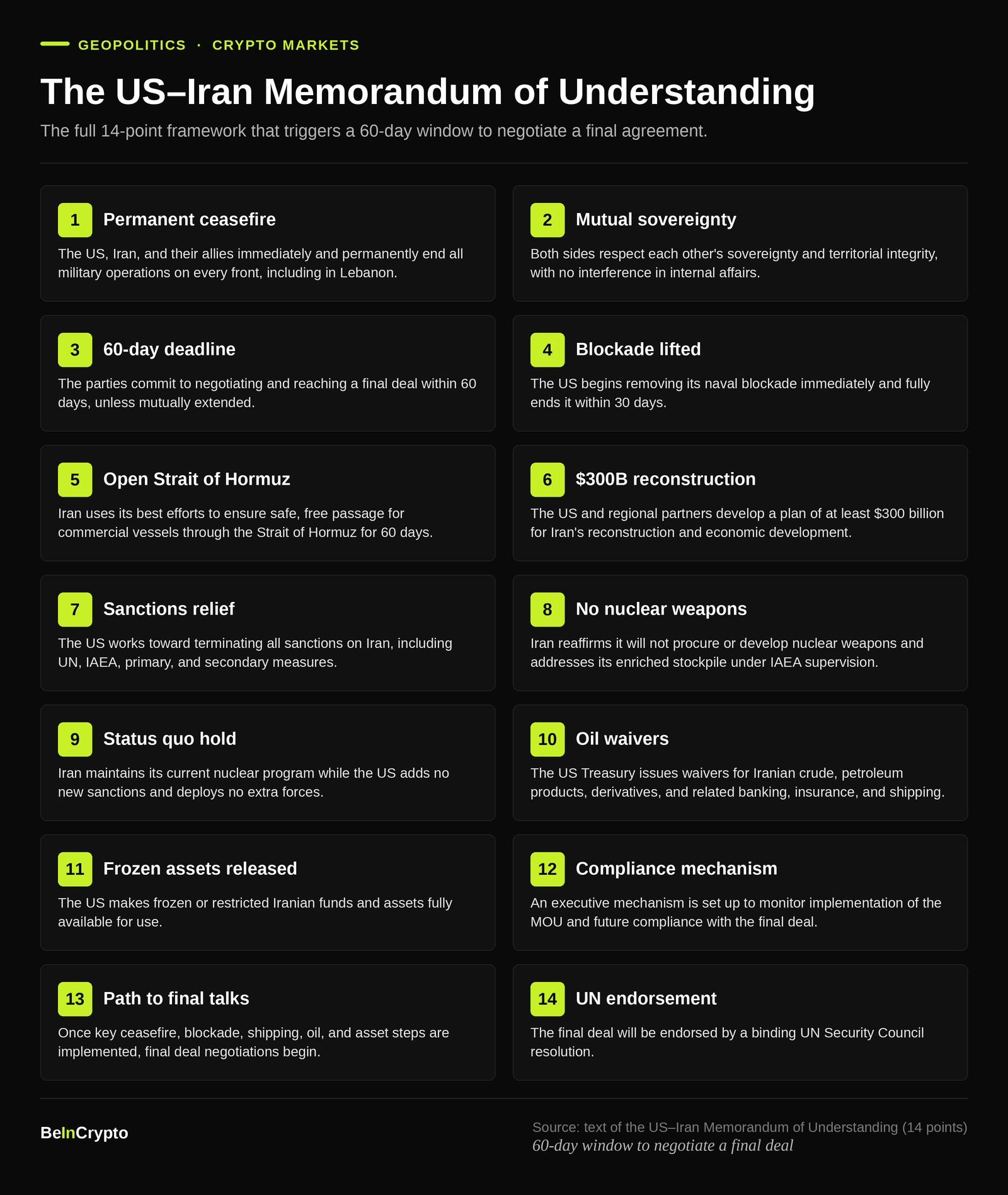
President Donald Trump said the stock market drove his decision to back the Iran deal, calling it “more brilliant than anybody” as equities hit record highs after Sunday’s ceasefire agreement.
The U.S. president said share prices rose each time peace looked likely and fell whenever talks stalled, treating the market as a live referendum on his Middle East strategy.
A Market Read on the Iran Deal
Trump made the comments at a G7 conference in France, hours after announcing the Sunday agreement with Iran.

He cast the rally as proof the deal was working, and as the reason he chose negotiation over more bombing.
According to Trump, the market reacted to every signal coming out of the talks.
“The stock market is quite brilliant. Every time we said something amazing like we are going to settle, it would go up. Every time we said something negative … it would go down very big.”
Follow us on X to get the latest news as it happens
The framing fits a long pattern. Trump has treated equity indexes as a real-time scorecard for his presidency since his first term, and here he used them to justify ending the strikes.
Record Highs and a Resilient Stock Market
The numbers gave him cover. The S&P 500 closed at a record 7,554.29 on June 15, up 1.65%, while the Dow added 468.77 points for its own record finish near 51,671.
The Nasdaq jumped 3.07%. Oil has fallen roughly 20% from its 2026 peak as a Hormuz reopening came into view, easing the inflation pressure Trump blamed on the conflict.
“The stock market surged to record highs, picking up thousands of points over the last short period of time.”
He also argued the market held up better than he feared during the strikes on Iran, a move that briefly rattled stocks and oil.
“I thought the stock market would go down 25% or 30%. The stock market a week ago before we started this was higher than when we started, which tells you we have a very resilient economy.”
Trump returned repeatedly to a historical yardstick, naming the one predecessor he said he never wanted to resemble.
“He raised taxes too fast and raised interest rates too fast, all at the same time. And it caused the Great Depression.”
Herbert Hoover sat in the White House during the 1929 crash that opened the Great Depression.
For Trump, rising markets were the proof he had dodged that fate.
What it Means for Crypto
Trump predicted the gains would continue as energy prices fall and Hormuz traffic resumes.
“Trillions of dollars will be made by the world, and the stock market will … continue to rise.”
Crypto sits on the same risk curve. Bitcoin (BTC) trades near $64,200 after slipping more than 2% in a day, pressured once the Federal Reserve cooled rate-cut bets, a turn that punished leveraged shorts.

The token had popped above $67,000 on the ceasefire headlines before fading.
Analysts warn Bitcoin still trades as a high-beta risk asset tethered to equity sentiment.
The post Trump Finally Reveals Why He Backed Iran Deal appeared first on BeInCrypto.
Crypto World
Chairman Warsh abstains from giving rate forecast as several members signal a hike in 2026
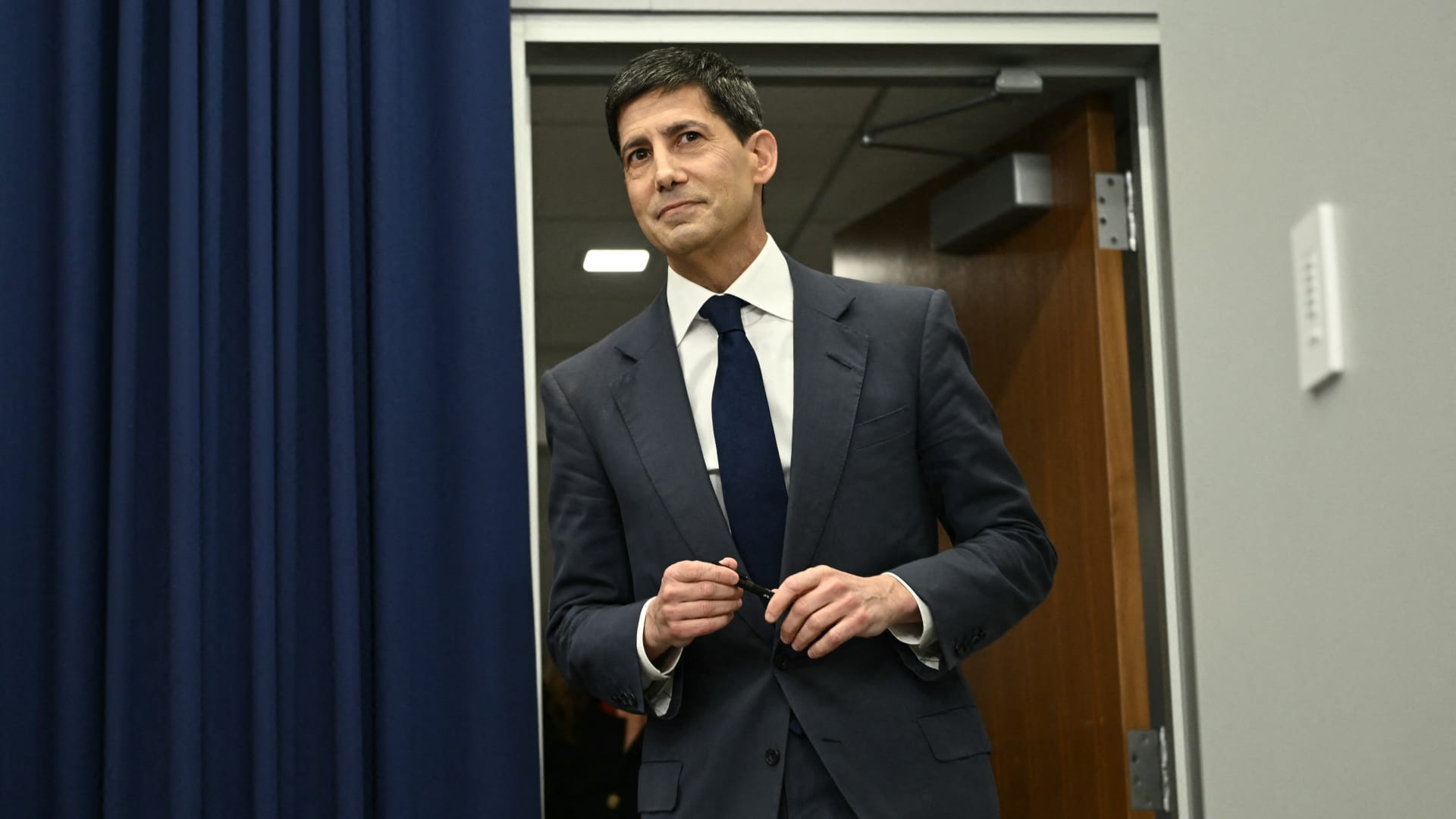
US Federal Reserve chairman Kevin Warsh arrives for a press conference in Washington, DC, on June 17, 2026.
Brendan Smialowski | Afp | Getty Images
The Federal Reserve’s latest projections pointed to one rate increase in 2026, though the outlook was complicated by the absence of a forecast from Chairman Kevin Warsh.
Nine of 18 officials projected that the federal funds rate would end 2026 above its current range of 3.5% to 3.75%. However, the outlooks missed one participant, and Warsh confirmed in the news conference after the Fed meeting that he refrained from offering any forecast of his own.
The median projection now calls for the federal funds rate to end 2026 at 3.8%, up from 3.4% in the Fed’s March summary and a quarter percentage point above the current target range. The central bank left interest rates unchanged at the conclusion of Wednesday’s meeting, the first gathering under Warsh.
“I did not submit a dot for me. It’s not helpful in the conduct of policy,” Warsh said in the news conference.
Warsh, who just took over as Fed chairman, has signaled a desire to overhaul the central bank’s communications strategy, contending that officials may provide too much forward guidance and place excessive emphasis on mapping out the future path of monetary policy.
The Fed’s policy statement also underwent a far more extensive rewrite than is typical. In recent years, changes have often been limited to a handful of words or sentences, but Wednesday’s statement was dramatically pared down.
The Fed chief said Wednesday that the central bank plans to review its communications practices by year-end, including news conferences, the dot plot, meeting schedules, transcripts and minutes, and said he was “open-minded” about potential changes.

Matter Labs is reshuffling its team as the company moves to a permissioned privacy chain called Prividium.
The layoffs will include senior engineers, designers, and operators who are no longer aligned with the new direction.
Founder Explains Layoff Decision.
Alex Gluchowski, the company’s CEO, confirmed the news on social media, noting that the decision followed the company’s 2024 shift toward building products for regulated financial institutions.
“Today we reduced the size of the Matter Labs team. This was my decision, and I want to explain it,” he wrote.
According to him, Prividium has since become Matter Labs’ main focus, with the firm now fully committed to building tools that help businesses move on-chain.
The founder added that as the project developed, the company gained a clearer understanding of what customers needed, which heavily influenced the direction of Prividium and the type of talent required to move it forward. As a result, some roles that made sense during earlier stages of building were no longer the best fit for the firm’s current priorities. This, he said, is what prompted the restructuring decision.
The firm’s website states that Prividium is an Ethereum-based blockchain platform for financial institutions and fintech companies that gives organizations a way to do transactions securely while being compliant. Additionally, the product is built on a privacy-focused, permissioned Layer-2 blockchain powered by zero-knowledge technology.
“To everyone leaving, thank you for what you built here, and for the standard you set,” he concluded.
Alex said the move wasn’t a reflection on the employee’s abilities and contributions, adding that the engineers, designers, and operators impacted were some of the best he has worked with. The workers who left have also reportedly been offered financial help and support as they go through the transition.
Community Remains Divided Over Job Cuts
The community’s reaction to the news has been mixed, with some excited about the project and others asking where the $450 million that Matter Labs raised to develop the product had gone.
“Could you please explain? You raised $450 million in investment to develop the product. Where’s the money? And why are you asking for more and laying people off?” they wrote.
Meanwhile, this isn’t the first time the firm has had to let go of its employees. The company also downsized its team in the midst of a pivot toward privacy-focused tools in 2024, with the firm saying that the restructuring was necessary to align its workforce with new priorities rather than a short-term cost-cutting measure.
The post ZKsync Creator Announces Layoffs as It Pivots to Permissioned Privacy Chain appeared first on CryptoPotato.


Privacy-tech firm Zama said Wednesday it is launching the first DeFi yield product for Confidential USDC, opening deposits June 23 through a vault built on Morpho and curated by Steakhouse Financial. The product extends fully homomorphic encryption from simple token transfers into a productive… Read the full story at The Defiant
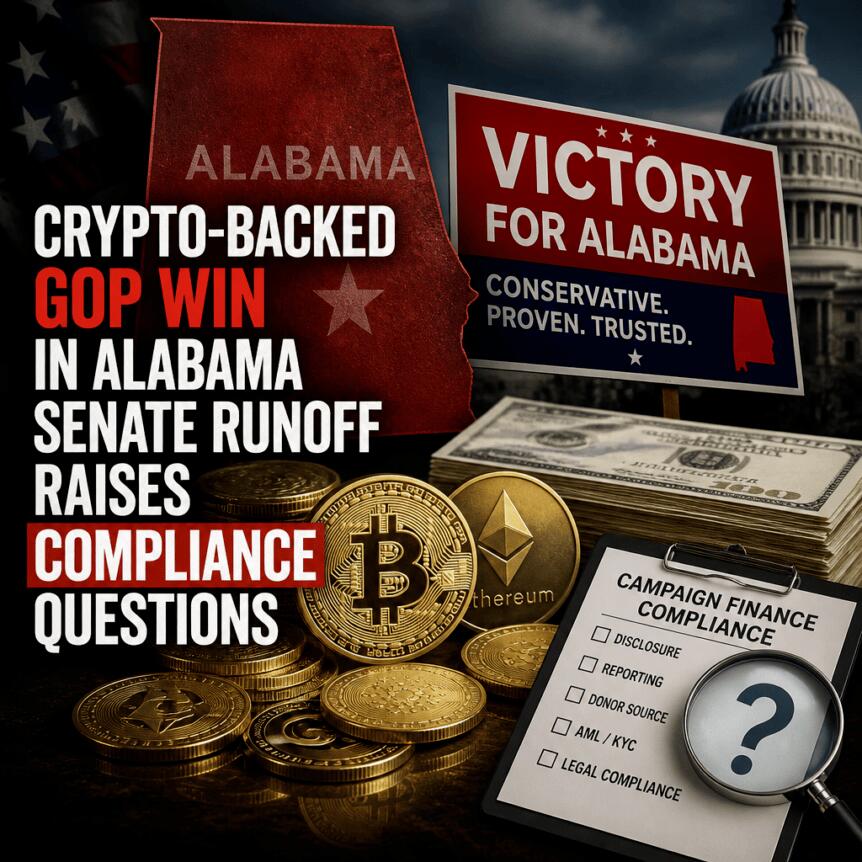
Barry Moore won the Republican primary runoff for Alabama’s U.S. Senate seat on Tuesday, defeating Democrat Everett Wess by securing 55.8% of the vote, according to NBC News. The race became necessary after neither candidate received a majority in the May 19 contest. Moore is set to take the seat held by outgoing Republican Senator Tommy Tuberville, in a development that is drawing heightened attention from the crypto political ecosystem.
Federal Election Commission (FEC) disclosures indicate that pro-crypto political committees backed by Fairshake—an advocacy group associated with cryptocurrency companies—spent more than $12 million on media and advertising to support Moore across the May 19 primary and the Tuesday runoff. Compliance-focused observers are likely to see the election as another example of how crypto-aligned political spending is scaling in U.S. federal contests, raising questions about transparency, regulatory oversight, and cross-border policy alignment.
Key takeaways
- Moore won the Alabama Republican Senate runoff against Everett Wess with 55.8% of the vote, according to NBC News.
- FEC filings show Defend American Jobs PAC—affiliated with Fairshake—spent more than $12 million on media and ads for Moore.
- Advocacy organization Stand With Crypto rated Moore “strongly supports crypto” based on public statements and his voting record in Alabama’s 1st Congressional district.
- Fairshake-related committees may have spent over $40 million across multiple states to support candidates described as “pro-crypto,” according to a Fairshake spokesperson’s remarks reported in the coverage.
FEC-backed crypto political spending in the Alabama runoff
The Alabama Senate runoff is the latest instance of large-dollar involvement by industry-aligned political committees. In this case, FEC reports attribute more than $12 million in media and ad spending to Defend American Jobs PAC, which is described as affiliated with Fairshake, during the May 19 primary and the subsequent runoff.
For institutional compliance and governance teams, the practical significance lies in the mechanics of political spending: FEC reporting requirements create a documented paper trail, but the broader network of affiliated committees and advocacy groups can complicate attribution and risk assessment. Analysts monitoring policy exposure may also view such disclosures as an early indicator of how crypto industry stakeholders anticipate legislative priorities in the next congressional session.
Cointelegraph reported that Stand With Crypto assessed Moore as “strongly supports crypto,” citing public statements and his voting record. That rating matters in compliance terms because it signals how industry groups evaluate candidates not only for their rhetoric, but for recorded legislative behavior—an approach that can inform risk frameworks for regulated entities interacting with government counterparts.
Fairshake’s scale and the “pro-crypto” strategy
Fairshake spokesperson Geoff Vetter said that the committee’s “biggest spend of the cycle” helped deliver another candidate characterized as a “pro-innovation champion,” and referenced nearly $150 million in cash available for future efforts. The statement, as reported in the coverage, also suggests an intention to expand pro-crypto legislative influence via what the spokesperson framed as a sizable “pro-crypto caucus.”
While political messaging is not itself regulatory conduct, large-scale campaign activity is often examined by policymakers and enforcement agencies in broader discussions about lobbying, political influence, and disclosure. For regulated crypto firms, the governance question is whether political engagement aligns with internal compliance expectations around transparency, conflicts of interest, and reputational risk.
Beyond Alabama, the same reporting describes Fairshake and related affiliates as potentially spending more than $40 million across several states to back candidates they consider favorable to crypto policy goals. According to the article, Defend American Jobs PAC reported holding a $193 million war chest as of January. Even without drawing conclusions about intent, such figures underscore why election-related spending is increasingly treated as a compliance and policy monitoring matter rather than a purely political story.
Industry PAC activity across multiple states
The Alabama runoff follows a pattern of multi-state, pre-general-election spending by crypto-aligned committees, including in states with scheduled primaries before the November election. The coverage notes that industry PAC spending has been visible in upcoming contests in South Carolina, Texas, California, South Dakota, and New Jersey.
In addition to Defend American Jobs PAC, the reporting highlights Protect Progress—described as a Fairshake affiliate—as having reported media buys for House-related races. Specifically, it referenced FEC disclosures for spending tied to Maryland Democrat Adrian Boafo and New York Democrat Ritchie Torres ahead of primaries set for June 23.
From a regulatory perspective, these disclosures matter because they may affect how compliance teams map political influence into policy outcomes—particularly around areas central to crypto regulation such as stablecoin frameworks, exchange oversight, market structure, and AML/KYC expectations. In the U.S., these issues span the SEC’s remit, the CFTC’s commodity and derivatives authority, and DOJ enforcement priorities, while in Europe, the MiCA framework continues to shape cross-border compliance strategies for issuers and service providers.
Institutional observers may also treat this as a reminder that U.S. political dynamics can affect timelines for implementation and rulemaking—even when the formal rulemaking process is independent. Large political spending may contribute to a favorable legislative environment, but uncertainty remains as to how quickly, and in what form, policy changes would be translated into enforceable regulatory requirements.
What happens next before the November election
With additional primaries scheduled for next week, the Alabama outcome is likely to feed into broader attention on crypto-aligned political strategy. Further FEC filings may offer clearer visibility into how affiliated committees allocate resources and how those allocations correspond to candidate positions on crypto policy.
For compliance monitoring, the key near-term focus should be on subsequent disclosure updates, candidate policy commitments, and any legislative momentum that could impact enforcement posture or regulatory priorities—particularly as lawmakers in the next Congress weigh areas ranging from campaign-finance related scrutiny to the regulation of digital asset markets.
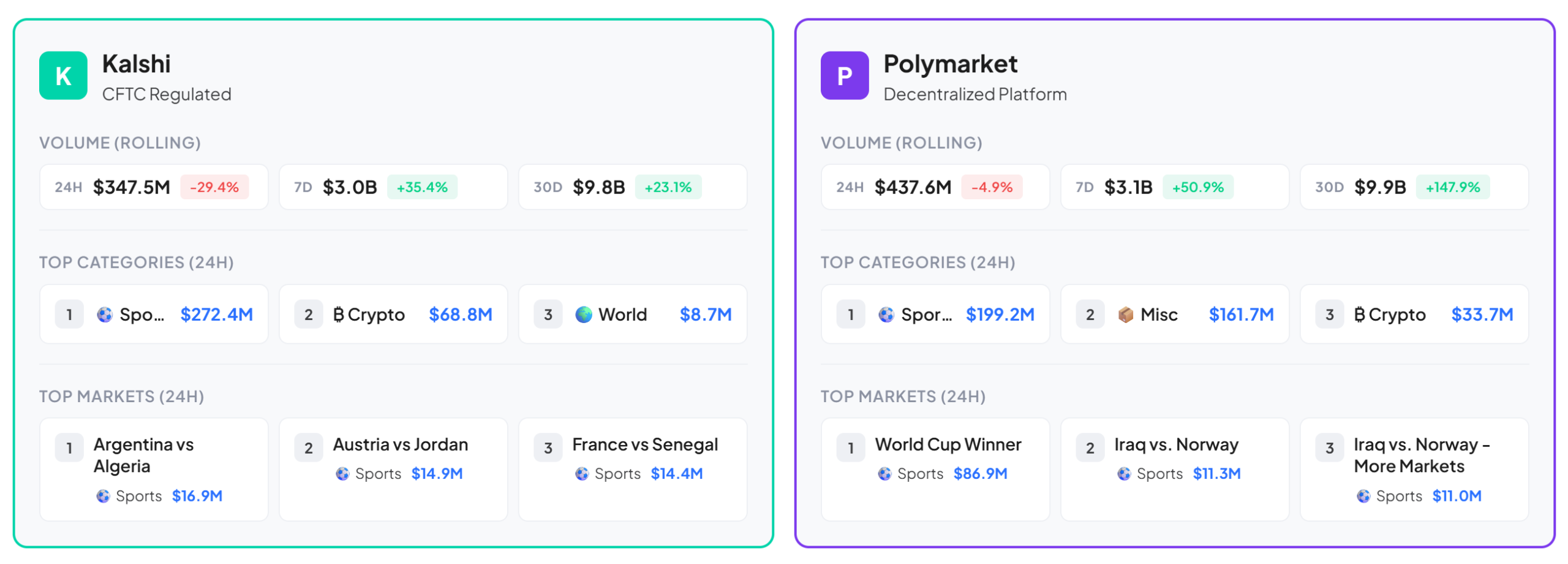
Kalshi CEO Tarek Mansour does not see Polymarket as his main competitor. He told Front Office Sports that larger trading and betting players threaten his prediction market exchange more than its closest rival.
Mansour named derivatives giant CME Group, brokerage Robinhood and sportsbook operators as the rivals he watches most. His comments recast a fight usually framed as a two-horse race between Kalshi and Polymarket.
Why Mansour Looks Past Polymarket
Kalshi dominates the regulated US prediction market. Bank of America analysts put its share at about 91%, with Polymarket second and Underdog third.
That lead lets Mansour treat the rivalry differently, much as Kalshi already overtook Polymarket on regulated turf last year.
Raw volume tells a closer story. Over the past 30 days, Kalshi traded about $9.8 billion against Polymarket’s $9.9 billion, according to DeFi Rate.

Kalshi still leads where it counts. It holds roughly $1 billion of the $1.6 billion in industry open interest and lists about 97% of all active markets.

“When I think about competition, I don’t think about Polymarket, honestly, as much as some of the others,” FOS reported, citing Tarek Mansour, Kalshi CEO.
Follow us on X to get the latest news as it happens
A Wider Field of Rivals
Mansour pointed first to CME Group, which launched FanDuel Predicts with the sportsbook in December. The app trades event contracts on sports outcomes and economic data.
Robinhood complicates the picture. It built its prediction markets hub on Kalshi’s own exchange in 2025. It then began routing some World Cup and baseball contracts to Rothera, its venue with Susquehanna.
DraftKings, Novig and Coinbase have also moved into prediction markets, making second place hard to call.
Polymarket still leans on its offshore platform, which draws heavy offshore trading volume from US users on a VPN.
The 2026 World Cup lifted both, with a single World Cup winner market drawing tens of millions in daily bets.
Regulation Shapes the Rivalry
Mansour wants Polymarket to come under the regulated umbrella. He argued that insider trading cases on its international platform stain the whole industry.
Two indictments sharpened that worry. Prosecutors charged Army soldier Gannon Van Dyke in the first federal case tied to prediction market bets. He allegedly turned about $33,000 into more than $400,000 on the timing of the Maduro operation.
Weeks later, prosecutors indicted Google engineer Michele Spagnuolo. He allegedly made roughly $1.2 million betting on Google’s most-searched person of 2025.
The CFTC then proposed a 267-page rule on June 10. It would permit most sports contracts while barring in-game props, officiating bets and pre-collegiate sports, with a 45-day comment window.
Both platforms also gained reach this year when Google Finance integrated their data.
For now, Kalshi controls the compliant US market while Polymarket and a widening field chase its lead.
The comment period may decide how fast that balance shifts.
The post Kalshi CEO Says Polymarket Is Not His Main Rival, Points to 3 Bigger Threats appeared first on BeInCrypto.
TLDR:
- Binance XRP CVD recorded a negative reading of -4.56M XRP, showing sell orders continue to dominate the market.
- The 30-day price-CVD correlation stands at 0.81, linking recent XRP price moves to real trading activity.
- XRP RSI climbed to 44.7 from oversold levels below 30, pointing to weakening bearish pressure and early recovery.
- XRP faces key resistance at $1.25–$1.30; a breakout could fuel recovery while failure risks a $1.10 retest.
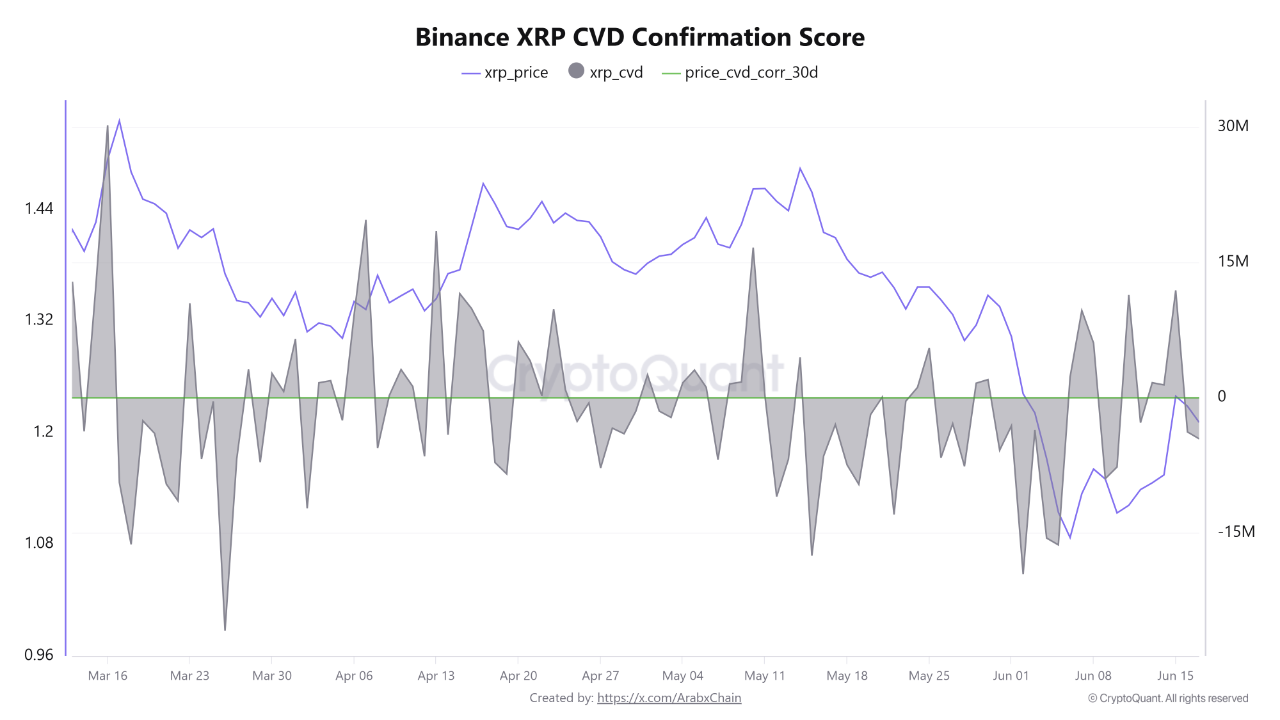
Binance XRP CVD data continues to reflect weak buying momentum across the XRP market. The Cumulative Volume Delta recorded a negative reading of approximately -4.56 million XRP, showing that sell orders dominate over buy orders.
XRP traded near $1.18 with a 24-hour volume of $1.94 billion as of this writing. The token posted a 2.84% price decline in the past 24 hours but gained 7.78% over the prior seven days.
Source: Coingecko
CVD Correlation Points to Genuine Market Activity
The 30-day price-CVD correlation coefficient stands at roughly 0.81. That level points to a strong positive relationship between price movements and actual trading flows. As a result, recent XRP price action appears driven by real market activity rather than thin liquidity conditions.
Source: CryptoQuant
The relatively high correlation reading carries weight for traders monitoring XRP’s near-term direction. When price and CVD move together closely, the data tends to reflect actual supply and demand dynamics more accurately. This makes the persistently negative CVD reading more telling, not less.
Selling pressure continues to weigh on the market despite the price holding above the $1.18 level. This pattern points to ongoing distribution activity by market participants at current price levels. That activity is limiting XRP’s ability to mount a stronger recovery or build a sustained short-term uptrend.
Any shift toward positive CVD readings could provide additional support for the price and signal improving buying interest.
Conversely, continued negative readings may suggest that market conditions remain tilted in favor of sellers. Traders are closely watching CVD developments for early signs of a shift in that balance.
XRP Technical Structure Shows Early Recovery Signals
XRP on the daily timeframe is attempting a recovery after a sharp June selloff. Price dropped from the $1.35 region to a local low near $1.08 before rebounding toward $1.23. Profit-taking then pulled the price back to around $1.18.
Despite that pullback, momentum indicators are improving. The RSI has climbed to 44.7 from oversold territory below 30. That move signals weakening bearish pressure and growing buying interest in the market.
The MACD is also turning bullish, with the histogram printing positive bars. The MACD line is approaching a crossover above the signal line, which traders typically read as a shift in short-term momentum.
Volume expanded during the rebound, suggesting genuine demand rather than a weak technical bounce.
However, XRP remains below key resistance around the $1.25–$1.30 range. A break above that zone could trigger a stronger recovery phase.
Failure to clear that resistance may invite another retest of the $1.10 support area, keeping the overall picture cautious for now.
Beers flung and songs sung as thousands of fans gather in Manchester to cheer on England

The backlash over delivery robots
Crypto Slides After Fed Holds Rates in Warsh’s First Meeting


-

 Business3 days ago
No Jackpot Winner as $257 Million Prize Rolls Over to $269 Million Monday Draw
-

 Fashion5 days ago
Weekend Open Thread: Tuckernuck – Corporette.com
-

 Crypto World6 days ago
Oppenheimer backs SpaceX as $70 billion retail frenzy builds
-

 Crypto World6 days ago
Markets Rally as SpaceX IPO Looms Amid Iran Tensions and Inflation Surge
-
Crypto World3 days ago
Zimbabwe Requires Crypto Businesses to Register Annually Under New FIU Regulations
-

 Tech5 days ago
NanoClaw integrates JFrog registries to secure AI agent downloads
-

 Crypto World5 days ago
Bitget enters Argentina’s regulated crypto market through PSAV registration
-

 Tech5 days ago
This Week In Security: Microsoft On Microsoft, Register Your Domains, Linux On ARM, And FreeBSD Joins The File Cache Club
-

 NewsBeat6 days ago
El Nino has formed in the Pacific and could set records, forecasters say
-
 Tech6 days ago
Dutton Ranch star claims they ‘didn’t see any disruption’ on set following Chad Feehan’s exit from Yellowstone spinoff fueled by Taylor Sheridan clash rumors
-

 Politics6 days ago
Politics Home | Healey Resignation Is “Colossal Failure Of Government”, Says Former Labour Defence Secretary
-
 Entertainment6 days ago
Donnie Wahlberg & More Heat Up Las Vegas at Circa’s Barry’s Downtown Prime
-
 Tech6 days ago
Opendoor Ends India Operations, Fueling a Bigger Conversation About AI and Outsourcing
-

 Politics6 days ago
Belfast burns, while Met chief points finger at Iran and Russia
-

 Sports6 days ago
First Time Since 1971: Australia Register Historic Low In ODI Cricket
-

 NewsBeat5 days ago
FBI searches office of Ohio voter registration group
-

 Business6 days ago
AT&T: Verizon's 27% Outperformance Sets Up A Solid Entry Point
-
 Tech6 days ago
Anthropic is spending $150M to embed 1,000 AI fellows inside nonprofits. No degree required.
-

 Politics6 days ago
Modi thanks Trump for wishes as US attacks Indian seafarers
-
 Entertainment6 days ago
‘The Pitt’s Fan-Favorite Doctor Confirms Noah Wyle Gave His Blessing to Return [Exclusive]
You must be logged in to post a comment Login