

Crypto World
Bitcoin Analysts Debate ‘Sell in May’ Pattern

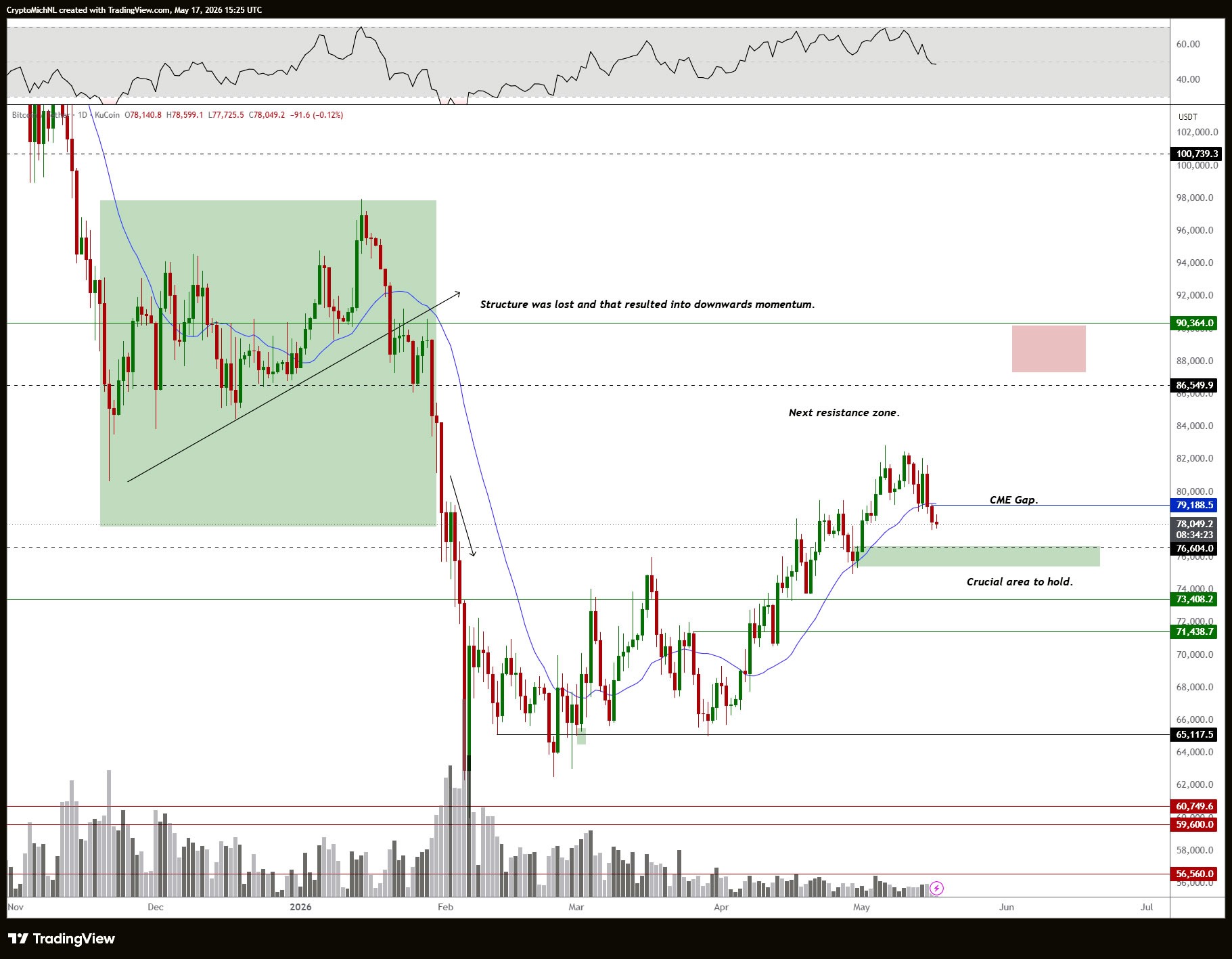
Crypto analysts are divided over whether markets will see a major Bitcoin sell-off in May, a pattern that has emerged in the last two bear markets during US mid-term election years.
In May 2018, Bitcoin crashed from nearly $10,000 to about $7,000 by the end of the month. It happened again in May 2022, when Bitcoin fell nearly 30% from about $40,000 to $28,500 before falling further in June to $20,000.
With 2026 also a bear market year coinciding with a US mid-term election, there are concerns it could happen again.
“The most brutal pattern in Bitcoin history. Nobody wants to hear this. But the pattern is perfect. Mid-term election years. Bitcoin dumps. Every time,” crypto analyst Merlijn Enkelaar said on Sunday.
Enkelaar said a similar move could see Bitcoin prices collapse to $33,000 despite the advancement of key legislation, the CLARITY Act, positive crypto sentiment from the Trump administration and potential trade deals between the US and China.
Joao Wedson, founder and CEO of Alphractal, also said Sunday that there would be a higher probability of a new capitulation phase if Bitcoin remains under $78,000, with bears “showing signs of strength.”
Bitcoin was trading at about $76,900 at the time of writing, down 5.6% over the past seven days.
The calendar didn’t cause previous crashes, analyst argues
Jeff Ko, chief analyst at the CoinEx exchange, told Cointelegraph on Monday that midterm election years have coincided with major Bitcoin bear markets, “so some traders may be tempted to frame 2026 as another ‘sell in May’ setup.”
However, behind that historical seasonality were more concrete macro drivers, such as the Mt. Gox aftermath, China’s ICO crackdown, Fed tightening and the Terra/FTX collapses, he said.
“The calendar didn’t cause those drawdowns — specific shocks did.”
Related: Bitcoin slides below $79K on macro fears: Can fixed-income outflows save it?
Ko said he doesn’t expect BTC to repeat the 70% to 80% drawdowns seen in past cycles because the market structure has fundamentally changed.
“Spot ETFs, corporate treasury adoption, and the CLARITY Act moving through Congress have meaningfully broadened and institutionalized the buyer base compared with past cycles,” he added.
“In my view, a move toward the mid-$60k or high-$50k range could be defensible under a macro shock or a significant ETF outflow cascade. But a move back to $33k would likely require something genuinely systemic to break, rather than simply a repeat of historical seasonality.”
Key support level must hold
MN Fund founder Michaël van de Poppe was also bullish, saying on X Sunday that the current Bitcoin price action “doesn’t shout for new lows” but is “consolidating after a run of 40%.”
However, an important support level that is currently preventing a larger decline is the $76,000 area, he cautioned.
“If that level is lost, I would assume that the markets will see a further downward fall towards lower boundaries,” he said.
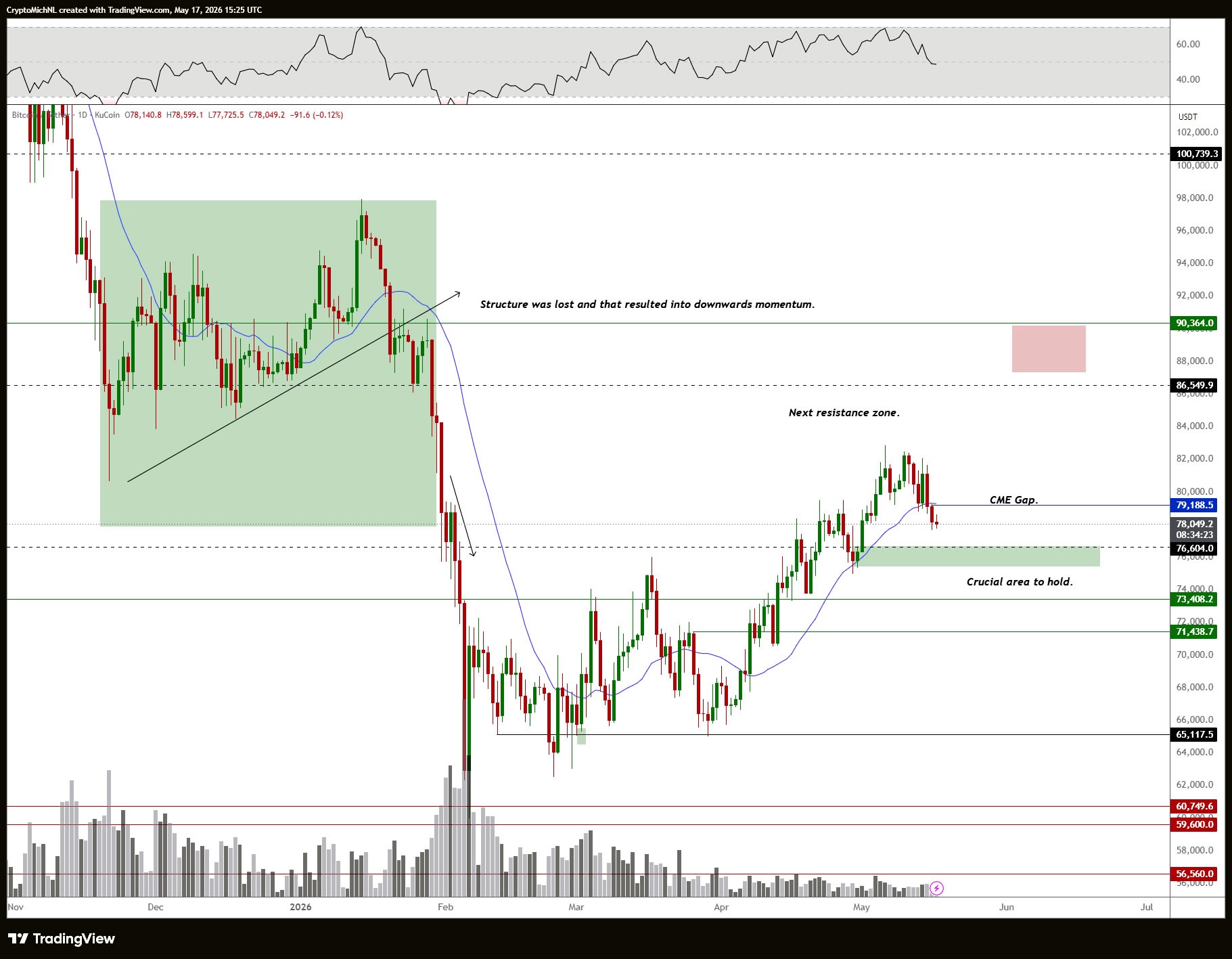
Trader eyes key support level that must hold. Source: Michaël van de Poppe
Magazine: eToro founder timed Bitcoin top perfectly due to belief in 4 year cycles



The crypto market remained under heavy pressure on Monday as escalating geopolitical tensions, surging oil prices, sticky U.S. inflation data, and a massive wave of leveraged liquidations weakened investor sentiment across digital assets.
Summary
- The total crypto market capitalization fell 3.8% to $2.56 trillion as Bitcoin dropped below $77,000 amid rising macroeconomic and geopolitical pressure.
- More than $661 million in crypto positions were liquidated over the past 24 hours, with nearly 95% of the wipeout coming from bullish long trades.
- WTI crude climbed above $107 while U.S. spot Bitcoin ETFs recorded over $1 billion in weekly outflows as stalled U.S.-Iran talks and sticky inflation weakened risk appetite.
The total cryptocurrency market capitalization fell roughly 3.8% over the past 24 hours to around $2.56 trillion, while Bitcoin (BTC) dropped more than 4% to fall below the key $77,000 support level and hit a multi-week low before recovering slightly at press time.
Ethereum (ETH) declined nearly 6% toward the $2,100 region, while major altcoins, including Solana (SOL), XRP (XRP), BNB (BNB), Dogecoin (DOGE), and Hyperliquid (HYPE), posted losses ranging between 5% and 12%.
According to CoinGlass data, more than $670 million worth of crypto positions were liquidated over the past 24 hours, with bullish long positions accounting for nearly 95% of the wipeout.
The latest market decline accelerated after investors reacted to another round of hotter-than-expected U.S. inflation data.
Recent Producer Price Index data surged 6% year-over-year following a stronger-than-expected Consumer Price Index reading of 3.8%, reinforcing fears that inflation remains stubbornly elevated across the U.S. economy.
The stronger inflation readings significantly reduced expectations for short-term Federal Reserve interest rate cuts. Instead, traders have increasingly started pricing in the possibility that rates could remain elevated for longer or potentially rise further if inflationary pressures continue intensifying.
At the same time, U.S. 10-year Treasury yields climbed from around 4.5% to 4.6%, increasing the attractiveness of safer fixed-income assets relative to speculative investments such as cryptocurrencies.
Higher yields and tighter monetary conditions typically reduce liquidity across financial markets, often leading investors to scale back exposure to high-risk assets, including Bitcoin and altcoins.
Oil prices extend gains as Iran negotiations hit deadlock
Investor sentiment also deteriorated as geopolitical tensions involving the United States and Iran continued escalating.
WTI crude futures climbed above $107 per barrel on Monday, extending last week’s gains of more than 9%, while Brent crude traded in the $105–$113 range as stalled U.S.-Iran peace talks and the continued near-shutdown of the Strait of Hormuz raised fears of a broader global supply disruption.
In a Truth Social post on Sunday, President Donald Trump warned that “the clock is ticking” for Iran and urged Tehran to “get moving, FAST,” while Iranian media reports suggested negotiations remain deeply divided with the U.S. offering “no tangible concessions.”
Rising oil prices intensified concerns that energy-driven inflation could delay potential monetary easing from central banks and further weaken appetite for speculative assets such as cryptocurrencies.
Bitcoin ETF outflows and liquidations accelerate selloff
Meanwhile, Bitcoin’s breakdown below major psychological support zones near $80,000 and $78,000 triggered a cascade of automated liquidations across leveraged derivatives markets.
The sharp decline forced exchanges to close large volumes of overleveraged bullish positions, accelerating downside momentum as stop-loss orders continued getting triggered across the broader market.
Institutional flows also weakened considerably over the past week.
U.S. spot Bitcoin ETFs recorded more than $1 billion in cumulative net outflows, ending a strong multi-week inflow streak that had previously supported bullish market momentum. Spot Ethereum ETFs also extended their recent streak of outflows, signaling weakening institutional demand across the broader crypto sector.
On-chain data additionally showed that Bitcoin miners sold roughly 800 BTC worth approximately $64 million to secure profits amid deteriorating market conditions.
At the same time, investor sentiment faced additional pressure after Michael Saylor-led Strategy disclosed risks tied to potentially selling Bitcoin to help manage convertible note obligations, further adding to near-term uncertainty surrounding corporate BTC demand.
Disclosure: This article does not represent investment advice. The content and materials featured on this page are for educational purposes only.
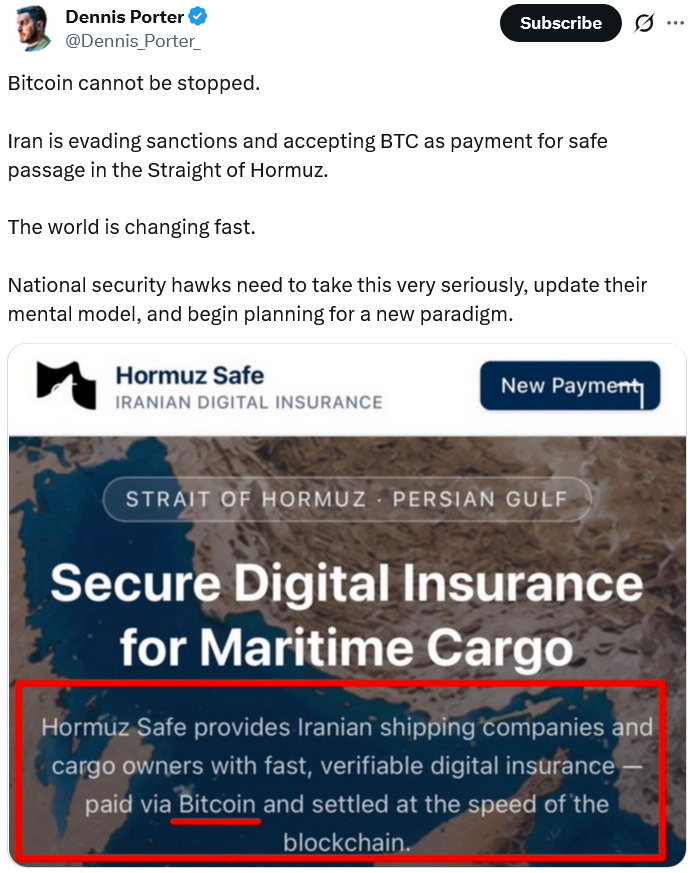
Iran is reportedly considering a plan to exercise control over the Strait of Hormuz through an “insurance-based model,” with some speculating, based on an unverified website, that it could be paid in Bitcoin.
On Saturday, Fars News Agency, an Iranian news outlet closely affiliated with the Islamic Revolutionary Guard Corps, reported that the Iranian Ministry of Economic Affairs plans to manage the Strait of Hormuz through insurance, citing a state document it obtained.
However, other reports say Iran is looking to take payments for the “insurance” in Bitcoin through a website called “Hormuz Safe,” with a widely circulated screenshot of the purported site selling “Secure Digital Insurance for Maritime Cargo.”
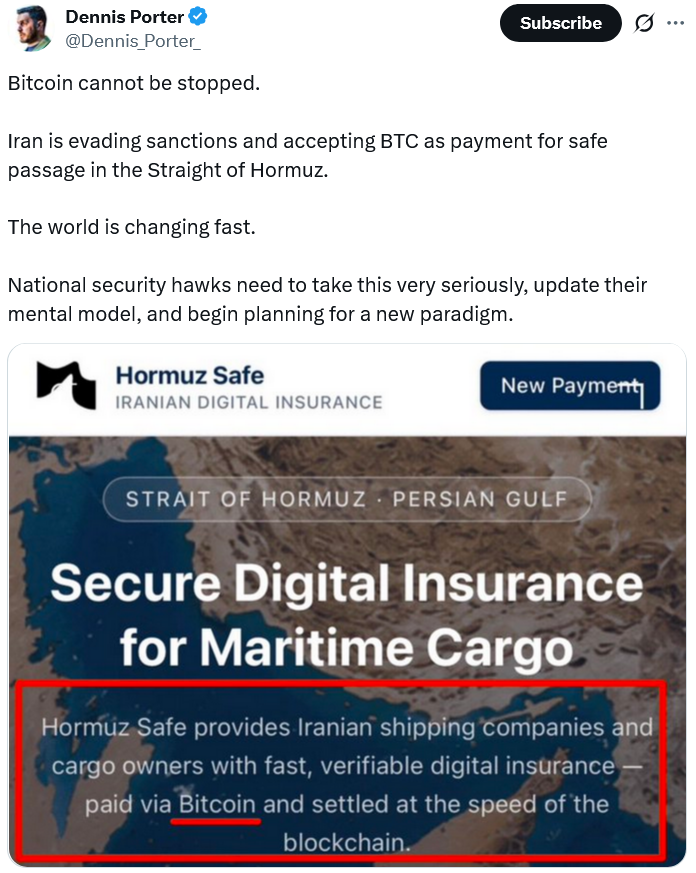
Source: Dennis Porter
Control over the Strait of Hormuz has been the leading issue in the US-Iran war. The shipping lane handles about one-fifth of the global oil trade. Many ships have been prevented from transiting the strait after the US started launching airstrikes in Iran in late February.
Media reports state that Iran collected its first revenue from tolls imposed on ships transiting the Strait last month. Prior to the US-Iran war, no such measures were in place.
Fars News said the insurance platform seeks to distinguish between transit vessels from different countries.
“Under the Economy Ministry’s plan, managing the Strait through an insurance framework would enable the issuance of various marine insurance policies as well as certificates of financial responsibility,” Fars News said, adding it could generate over $10 billion in revenue for the country.
There is no guarantee that Iran will go ahead with the insurance proposal, and the website purporting to offer “Iranian Digital Insurance” could be fake. The website was down at the time of writing.
Scammers have previously defrauded shipping companies operating in the Strait of Hormuz by demanding payment in cryptocurrency for safe passage.
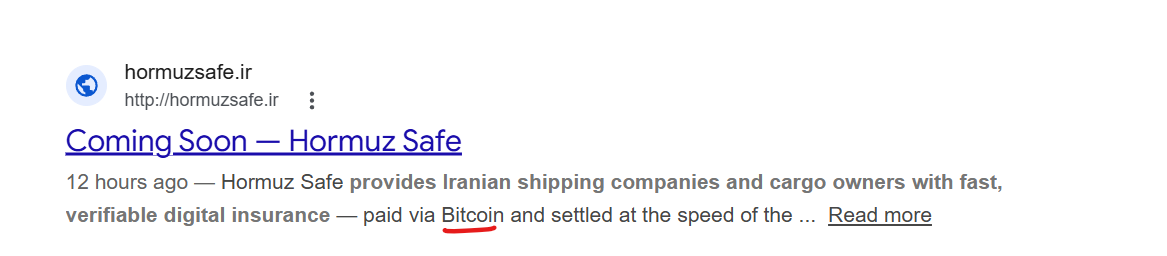
Description of Hormuz Safe seeking to accept shipper tolls in Bitcoin. Source: Google
US authorities recently seized Iranian USDT
Demanding insurance payments in Bitcoin could make sense, given that US authorities froze $344 million worth of USDT tied to Iran last month.
Earlier reports said Iran had been accepting oil tolls in US dollar-denominated stablecoins such as Tether USDt (USDT), as well as Bitcoin and fiat currencies such as the Chinese yuan, with USDT reportedly the preferred cryptocurrency.
Related: UAE investors buy AI dip, keep crypto exposure despite conflict
Industry leaders have touted Bitcoin as a more appropriate cryptocurrency for sanctioned countries because it is sufficiently decentralized and has no issuer capable of freezing funds.
In early April, a spokesperson for Iran’s Oil, Gas and Petrochemical Products Exporters’ Union said certain ships would be able to pass through the strait provided that they pay a tariff of $1 per barrel of oil in Bitcoin.
“Once the email arrives and Iran completes its assessment, vessels are given a few seconds to pay in Bitcoin, ensuring they can’t be traced or confiscated due to sanctions,” they said at the time.
Magazine: Adam Back says current demand is ‘almost’ enough to send Bitcoin to $1M
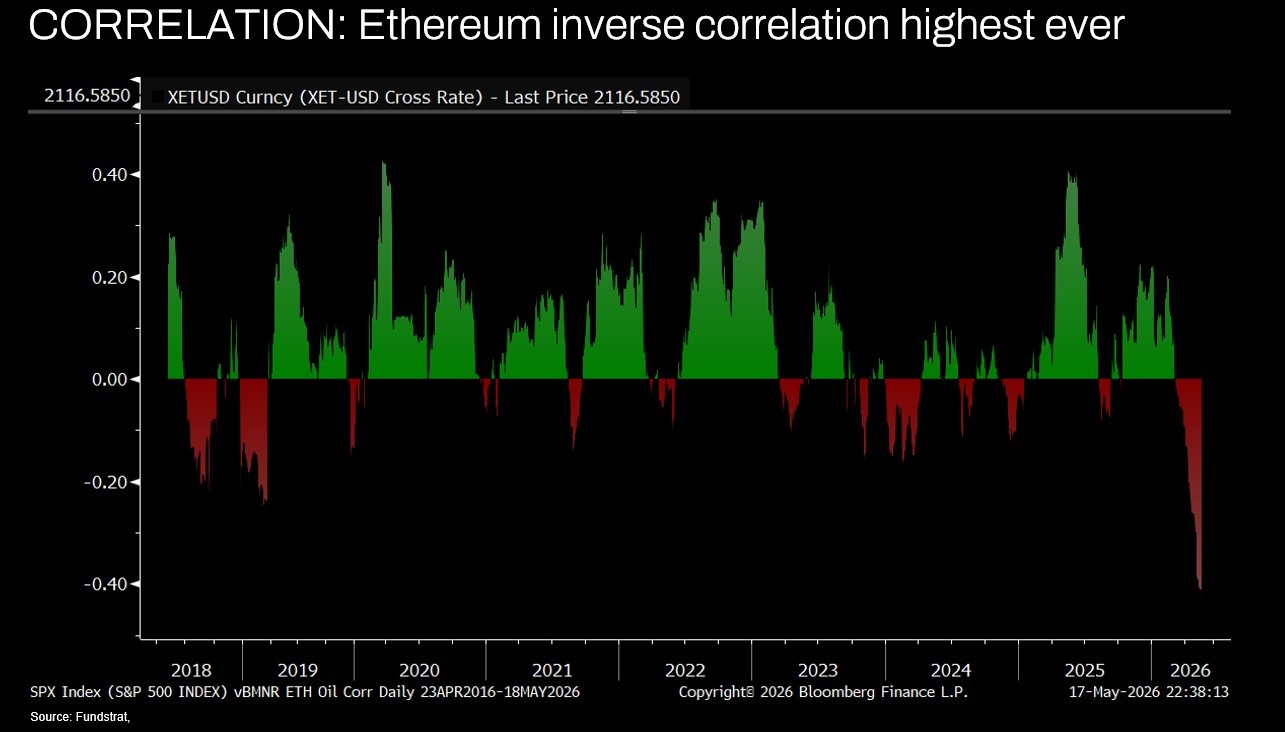
Rising oil prices since the US-Israeli war have been a consistent weight on the price of Ether for the last three months, according to Fundstrat co-founder Tom Lee.
“If one is wondering why Ethereum has been under selling pressure … to me, rising oil prices is the biggest headwind,” Lee said on X on Monday.
Lee said the inverse correlation between Ether prices and oil is at a record high. Crude oil prices have surged 66% from $65 to more than $100 per barrel since the US-Israeli war began on Feb. 28.
They spiked again on Monday, with WTI hitting $108 and Brent crude tapping $111, after US President Donald Trump said on Sunday on Truth Social, “the clock is ticking” for Iran to make a deal on opening the Strait of Hormuz.
A prolonged war between the US and Iran could weigh further on Ether, which has mostly traded sideways during the period of conflict. The sell-off accelerated over the past week, with the asset declining nearly 10% and falling back to $2,100 Monday, down 57% from its all-time high.
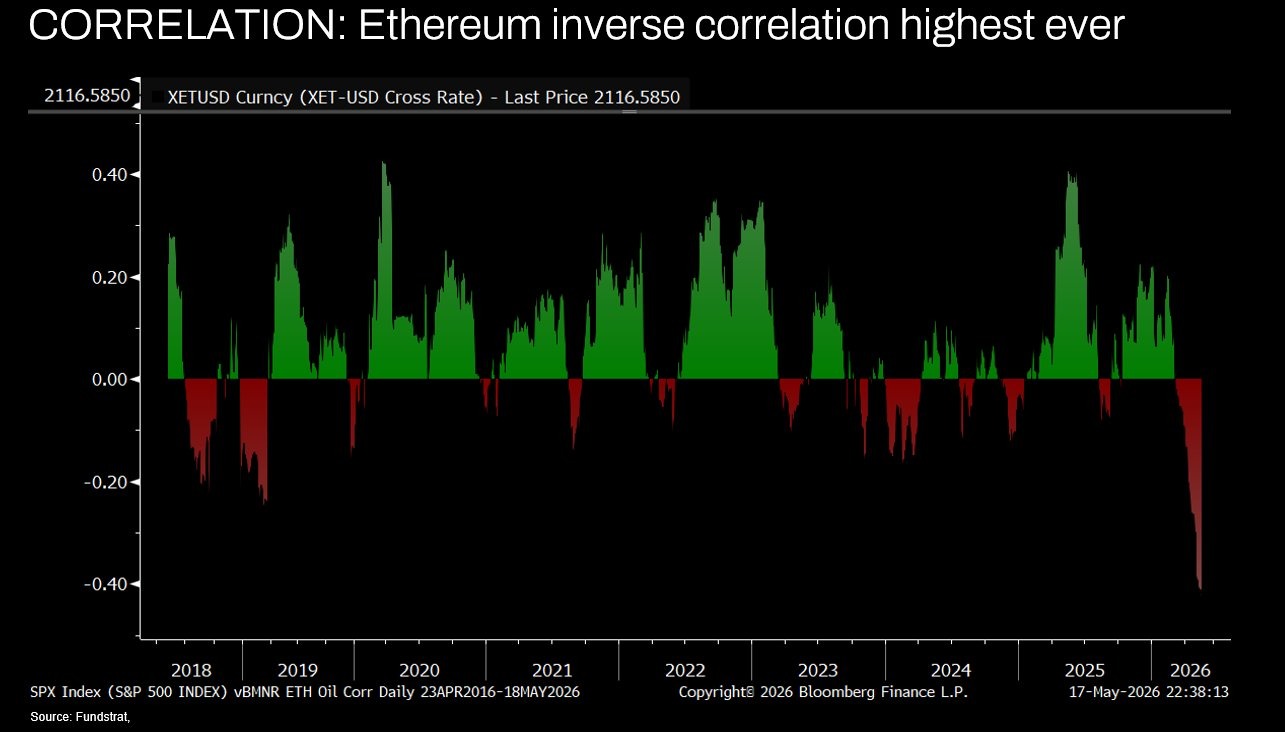
Ether and oil inverse correlation at a record high. Source: Fundstrat
Fall in oil prices will spell ETH recovery
Lee said a reversal in oil prices would result in ETH prices recovering, describing the current situation as “short-term tactical noise.”
He said the bigger drivers for Ether are tokenization and agentic AI. “These structural drivers are in place. Thus, we expect ETH prices to be stronger as we move through 2026.”
Related: Ethereum Foundation hits ‘Glamsterdam’ milestones, names new protocol leads
Ethereum has been the dominant network for real-world asset tokenization, with more than 60% market share when layer-2 networks are included. Meanwhile, major financial institutions such as BlackRock and JPMorgan recently launched tokenized funds on Ethereum.
The agentic AI narrative stems from the prediction that AI payment agents cannot access bank accounts, so they will use crypto tokens such as ETH or stablecoins for payments.
Ether prices are facing multi-factor pressure
However, Ether is also under pressure from other macroeconomic headwinds, as its correlation with risk assets means it gets hit harder during sell-offs.
Andri Fauzan Adziima, research lead at the Bitrue Research Institute, told Cointelegraph on Monday that oil prices were not the only factor impacting Ether, and there was “multi-factor pressure.”
“They’re one key macro headwind, but ETH selling pressure is also driven by ETF outflows, rising exchange reserves/whale selling, broader risk-off sentiment, and ETH’s underperformance vs Bitcoin,” he said.
Related: ETH stalls at $2.4K five times, SOL to rally to $120: Market Moves
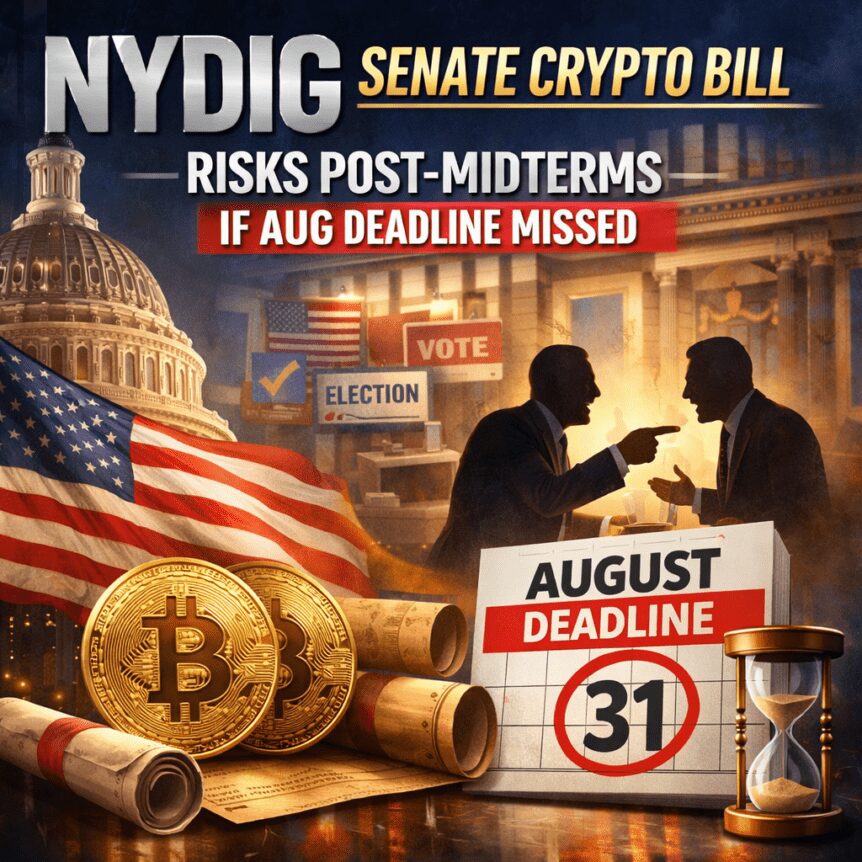
The US Senate’s crypto market structure bill remains uncertain as lawmakers navigate a congested calendar and a polarized chamber. With a July target repeatedly cited but not guaranteed, political dynamics—and the timing of midterm elections—could determine whether the measure reaches the president’s desk this year or slips into a post-election session.
In a Friday note, Greg Cipolaro, head of research at NYDIG, cautioned that while July 4 has been floated as a milestone, the practical window for passage may run from June through early August. If the bill misses that window, the path to enactment could extend into a post‑election lame-duck session, or fade entirely depending on which party controls the Senate after November.
Key takeaways
- The crypto market structure bill cleared a long-delayed markup in the Senate Banking Committee and moves to the floor, but it requires 60 votes to pass, highlighting persistent partisan headwinds.
- Republicans hold a 53-seat Senate majority and would need cooperation from at least seven Democrats to fast-track passage; some Democrats remain concerned the measure doesn’t sufficiently curb crime or sanctions evasion.
- Passage would bring notable regulatory clarity, including treating Bitcoin as a commodity under the CFTC, which could unlock institutional participation by reducing legal uncertainty.
- Failure to advance could leave crypto markets operating under ongoing regulatory ambiguity, with the potential for a post-election lame-duck session depending on election outcomes and scheduling priorities.
Legislative momentum and the timing puzzle
The bill’s journey reflects the broader frictions in shaping US crypto regulation this year. After delays shaped by debates over stablecoins, DeFi enforcement, and the ethics framework for government officials’ use of crypto, the measure finally cleared the Senate Banking Committee in a largely party-line vote. It now awaits a floor vote, where it would need broad cross‑bench support to reach the 60-vote threshold required to avoid protracted debate.
If the Senate cannot align sufficient support before the August recess, lawmakers face a tightening calendar ahead of the midterms. Cipolaro described the timing as an aspirational benchmark rather than a fixed deadline, noting that the practical window could shrink to a June-to-August stretch. A protracted delay would raise the odds of a post‑election lame‑duck session, particularly if Republicans retain control of the chamber and Majority Leader John Thune prioritizes other legislative business, such as government funding.
These timing questions are embedded in a broader political context. Current polling portrays a tight race for Senate control, with forecasts split on which party will command the chamber. The outcome of those races could shape not only this bill’s fate but the broader regulatory environment for digital assets in the next Congress. If Democrats gain control, the fate of the current Republican‑backed framework could become uncertain as negotiations reset in January.
“Congressional negotiators face a tradeoff between accepting an imperfect bipartisan framework in 2026 versus risking a substantially different legislative environment after the midterms.”
What passage would mean for markets and regulation
Supporters argue that final passage would provide critical regulatory clarity at a time when traditional financial institutions have shown renewed interest in crypto. By clarifying the treatment of Bitcoin as a commodity under the Commodity Futures Trading Commission, the bill would close what one analyst described as the last major regulatory overhang for Bitcoin as an institutional asset class. In practical terms, regulated clarity can reduce compliance risk for asset managers, exchanges, and custodians looking to participate in crypto markets.
Beyond Bitcoin, the bill’s broader framework aims to define how US watchdogs regulate crypto activity, with attention to market structure, stablecoins, and the interaction between traditional securities laws and digital assets. Yet even as it advances, questions linger about provisions related to ethics, enforcement in decentralized finance, and other guardrails that some lawmakers fear may not be robust enough to deter crime or sanctions evasion.
Analysts warn that even with regulatory clarity, the path forward is not guaranteed. A narrowly tailored framework that fails to gain bipartisan buy-in could keep the industry navigating “permanent jurisdictional ambiguity,” as Cipolaro put it. In that scenario, investors and builders would face ongoing uncertainty about how specific activities—ranging from stablecoin issuance to DeFi protocols—will be treated under law, complicating long‑term planning and capital deployment.
Contextual backdrop: regulatory appetite and election dynamics
The current political environment amplifies the stakes. With midterm elections looming, both chambers and leaderships are recalibrating priorities, and any highly technical bill faces sharper scrutiny under the pressure of time. The likelihood of a fast, clean passage depends not only on the technical merit of the provisions but also on how aggressively lawmakers are willing to address concerns around crime prevention, sanctions compliance, and the governance of decentralized platforms.
Industry watchers are watching closely how the regulatory narrative evolves in the near term. If pre‑midterm progress stalls, attention will shift to the post‑election timetable and the possibility that a new Congress could reshape or even overturn portions of the current framework. That fork in the road—between timely clarity and potential overhaul—has practical implications for who participates in crypto markets and on what terms.
As coverage around this evolving policy space continues, readers should also weigh related analyses and commentary on the debates surrounding the act, including perspectives on how a final framework would interact with existing securities and commodities rules. For context, expert commentary and prior reporting have highlighted the challenging balance lawmakers face between fostering innovation and ensuring robust safeguards.
In the broader industry conversation, the question remains: what regulatory architecture will most effectively enable legitimate participation while resisting exploitation? If the bill advances, investors and institutions could gain confidence from a clearer, more predictable path forward. If it stalls, the market may endure another cycle of uncertainty as actors await the next regulatory signal.
Related coverage in the crypto policy space has underscored the debates around the bill’s scope and enforcement. For readers seeking deeper dives, cross‑referenced analyses and coverage frame the ongoing negotiations, including discussions about how the act intersects with prior work on crypto clarity and DeFi governance.
What remains most uncertain is not only whether the bill will pass in this Congress, but also how the eventual shape of any final law will influence institutional participation, innovation, and the broader perception of crypto regulation in the United States.
Readers should watch the upcoming floor vote timing, any last‑minute amendments, and the election results that could redefine the political calculus. These factors will determine whether the bill becomes a milestone for regulatory clarity or a symbol of continued regulatory ambiguity in the US crypto markets.


Iran has reportedly explored an insurance-based system for ships crossing the Strait of Hormuz, while unverified claims about Bitcoin-linked payments have added fresh uncertainty around how the wartime transit regime could operate.
Summary
- Iran has reportedly explored an insurance system for ships crossing the Strait of Hormuz, with speculation emerging around possible Bitcoin-based payments.
- Fars News denied reports that Tehran is already collecting crypto tolls, even as shipping firms face scam messages demanding Bitcoin or USDT for safe passage.
- U.S. authorities recently froze $344 million in USDT tied to Iran, fueling fresh debate over whether Bitcoin could become a preferred settlement tool under sanctions.
According to Iran’s state-linked Fars News Agency, the Iranian Ministry of Economic Affairs has proposed managing traffic through the Strait using a formal insurance framework tied to marine transit and financial responsibility certificates. Fars, which said it obtained a state document outlining the proposal, reported that the system could generate more than $10 billion in revenue for Tehran.
Set against the ongoing U.S.-Iran conflict, the proposal comes as commercial shipping through the Strait remains heavily disrupted. Roughly one-fifth of global oil trade normally passes through the narrow waterway, though multiple reports have stated that ship movement has slowed since U.S. airstrikes on Iran began in late February.
At the center of the latest speculation is a website called “Hormuz Safe,” which circulated online through screenshots advertising “Secure Digital Insurance for Maritime Cargo.” Several crypto-focused reports claimed the platform was linked to an Iranian effort to collect insurance payments in Bitcoin, although the site was inaccessible at the time of writing, and no official confirmation has emerged from Iranian authorities.
Iran denies active crypto toll collection
Last month, Fars News had separately rejected reports claiming Tehran was already collecting Strait of Hormuz transit tolls in cryptocurrency. In an Apr. 23 report, the outlet said allegations about Iran accepting Bitcoin or stablecoins from passing vessels were “inaccurate.”
At nearly the same time, the Financial Times reported that Iran had been considering a system under which oil tankers would pay transit fees in cryptocurrency, with negotiations allegedly starting near $1 per barrel of crude. Bloomberg later reported that an intermediary linked to Iran’s Islamic Revolutionary Guard Corps had discussed similar pricing during talks involving maritime operators.
Risk advisory firm MARISKS also warned that scammers were exploiting the uncertainty. According to the company, shipowners stranded west of the Strait received fraudulent messages from unknown actors pretending to represent Iranian authorities and demanding payment in Bitcoin or Tether for “clearance” and safe passage.
MARISKS said the messages were fake and warned that they did not originate from official Iranian channels. The firm added that at least one vessel may have come under fire while attempting to leave the area after engaging with the fraudulent communications.
Meanwhile, previous media reports have suggested Iran already collected its first revenue from wartime shipping tolls last month, although those claims remain disputed. Before the current conflict, no such toll system had existed for vessels crossing the Strait.
Bitcoin speculation grows after USDT seizures
Attention around possible Bitcoin payments intensified after U.S. authorities froze $344 million in Tether USDt tied to Iran last month. Earlier reports had claimed that Iranian-linked operators preferred USDT and the Chinese yuan for energy-related settlements, while also accepting Bitcoin in some cases.
Chainalysis noted in previous analysis that Iran has historically relied on dollar-backed stablecoins, particularly USDT on the Tron blockchain, to move funds outside traditional financial rails. The blockchain analytics firm said any future crypto-linked toll structure in Hormuz could create new compliance risks for virtual asset service providers interacting with sanctioned entities.
Industry figures have also argued that Bitcoin may appeal more to sanctioned states because it operates without a centralized issuer capable of freezing balances. Earlier in April, a spokesperson for Iran’s Oil, Gas and Petrochemical Products Exporters’ Union reportedly told media outlets that certain ships could continue passing through the Strait if they paid a tariff of $1 per barrel in Bitcoin.
Vessels would reportedly receive payment instructions only after Iranian authorities completed internal reviews, with transactions expected to be settled within seconds to avoid tracing or confiscation under sanctions enforcement.
Crypto World
Crypto security is turning into an AI arms race as agents may overwhelm compliance teams


AI agents and automated payments could reach a scale that crypto monitoring systems built for human-paced markets cannot handle, Elliptic CEO Simone Maini warned.


Bitcoin Depot, the largest bitcoin ATM operator in North America and publicly listed on Nasdaq, has filed for Chapter 11 bankruptcy.


The DeFi lending protocol reversed restrictions imposed after April’s $292 million exploit, restoring borrowing capacity across six networks as contagion fears ease.
Pi Network’s native token is on the move again, but in the opposite direction of what the project’s multi-million fan base expects and hopes.
The latest leg down comes amid community expectations regarding the new protocol updates and some team announcements.
PI Dumps Yet Again
It’s safe to say that the popular altcoin has seen better days, which weren’t all that long ago. Recall that it exploded to $0.30 two months ago during the mounting hype about the upcoming listing on the veteran US exchange, Kraken. The actual development, though, became a classic sell-the-news moment as PI plummeted shortly after it went live for trading, going down to its starting position at $0.18.
The subsequent breakout attempts were not as impressive, and PI was halted at $0.20 during each of them. The last one was at the end of April, when the bears took complete control and have been dominating ever since. PI managed to find some support at $0.17 and spent a few weeks trading sideways between that lower boundary and $0.18.
However, the rejection during the weekend brought the token down to $0.155, which was a three-month low. Another such local setback arrived in the past 12 hours as the entire market crashed. However, PI’s nosedive was more painful than almost all other altcoins, dumping by another 6% to under $0.15.
Its market capitalization has plunged below $1.6 billion, pushing the asset well outside the top 50 alts by that metric.

Update Still Awaited
Aside from issuing an urgent warning about the safety of its user base and an important KYC announcement, the team behind the project recently outlined the deadline by which the protocol upgrade v23 had to be successfully migrated. Following the completion of previous updates, such as v19.6, v19.9, v20.2, and v22, the team set May 15 as the date for the latest one.
Although that date passed on Friday, there hasn’t been an official statement from the Core Team about its successful completion. There are some contradicting comments on X, with some users claiming that the update has been deployed, while others believe it might take a few more days.
Nevertheless, they all seem convinced that v23 will be a game-changer for the broader Pi Network ecosystem, as it’s expected to pave the way for native smart contracts, dApps, and a Pi Dex.
The post Pi Network’s PI Plunges to New 3-Month Low Despite Hype Around ‘Game-Changing’ Update appeared first on CryptoPotato.
Crypto World
Iran may be turning the Strait of Hormuz into a bitcoin insurance market, local reports say


State-linked Fars News reported that Iran’s economy ministry has been working on a plan to manage shipping through the Strait with payments in bitcoin.

Fernandes equals all-time EPL assist record In United’s win over Forest | Football News

Forza Horizon 6 GPU Benchmark: 8GB vs. 16GB VRAM

Police update on fatal A10 crash near Ely

Manchester United reach agreement with Casemiro over contract clause amid transfer speculation

US brings back mandatory military draft registration

Steven Gerrard disagrees with Gary Neville over ‘shock’ Chelsea and Arsenal claim | Football


-

 Crypto World2 days ago
BloFin War of Whales 2026 Grand Prix opens registration for $5M trading championship
-

 Fashion3 days ago
Weekend Open Thread: Theory – Corporette.com
-

 Crypto World3 days ago
E-Estate Announces 1 Year Live: Washington DC Summit as Real Estate Tokenization Enters Its Next Phase
-

 Fashion7 days ago
Coffee Break: Travel Steam Iron
-

 Politics6 days ago
What to expect when you’re expecting a budget
-

 Tech3 days ago
Tech Moves: Microsoft AI leader jumps to OpenAI; former AI2 exec joins Meta; and more
-
Crypto World5 days ago
Bitcoin Suisse expands with Digital Asset License and Investment Business Act Registration Approval in Bermuda
-

 Tech6 days ago
GM agrees to $12.75M California settlement over sale of drivers’ data
-

 Politics5 days ago
Pakistan to enter Chinese capital market as war inflation bites
-

 Crypto World5 days ago
Bitcoin Suisse expands with Digital Asset License and Investment Business Act Registration Approval in Bermuda
-
 Crypto World4 days ago
Google’s Gemini AI Predicts Incredible Solana Price by the End of 2026
-

 Business3 days ago
H&R Real Estate Investment Trust (HR.UN:CA) Q1 2026 Earnings Call Transcript
-

 Tech2 days ago
Google reimburses Register sources who were victims of API fraud
-

 Tech7 days ago
Over-Engineered Cardboard PC Case Houses a Full Computer Without Compromising Style or Performance
-

 Sports2 days ago
Napoleonic enters 2026 Doomben 10,000 field via Abounding withdrawal
-

 Politics6 days ago
The geopolitics behind the UK’s South Atlantic hantavirus rescue mission
-

 Politics6 days ago
The Board of Deputies just smeared Polanski to suck up to Farage
-

 Fashion5 days ago
The Best-Kept Makeup Secret for a More Defined Face
-

 Entertainment7 days ago
Matt Damon And Ben Affleck Sued Over ‘The Rip’
-
 Entertainment4 days ago
Zara Larsson Has Blunt Response To Chris Brown Diss
You must be logged in to post a comment Login