

Crypto World
Bitcoin Depot Files for Bankruptcy as Pressure Mounts on Crypto ATM Sector



Bitcoin Depot, once the largest Bitcoin ATM operator in the US, filed for Chapter 11 bankruptcy protection on Monday and pulled its entire kiosk network offline.
The filing landed in the US Bankruptcy Court for the Southern District of Texas. Canadian entities will join the US proceedings, while other foreign units wind down under applicable foreign law.
Bitcoin Depot to Wind Down After Filing for Bankruptcy Protection in Texas
CEO Alex Holmes pointed to a regulatory shift that has turned hostile to Bitcoin ATM (BTM) operators. States have imposed transaction caps, tighter compliance rules, and outright bans in multiple jurisdictions.
“Operators have faced increasing litigation and regulatory enforcement. These developments have materially affected Bitcoin Depot’s business and financial position. Under these circumstances, the Company’s current business model is unsustainable,” he said.
Indiana became the first state to ban the kiosks in March, followed by Tennessee and Minnesota, according to AARP. Bitcoin Depot also faced lawsuits from attorneys general in Massachusetts and Iowa. Connecticut suspended its operating license in March.
Meanwhile, the Federal Bureau of Investigation (FBI) logged 13,460 crypto-kiosk fraud complaints in 2025, with reported losses of $389 million. That marked a 58% jump from the prior year.
Follow us on X to get the latest news as it happens
The bankruptcy filing follows the company’s recent disclosure that it could not submit its quarterly 10-Q report to regulators on time. Q1 2026 results came in dramatically weaker than the same period a year earlier.
Revenue fell $80.7 million, a 49.2% year-over-year decline, after transaction volumes shrank under the weight of regulatory impacts and the tightened compliance checks.
Gross profit collapsed 85.5% to $4.5 million from $31.2 million. Cash reserves fell from $65.6 million in December to $44.0 million by March, and the company accrued over $20 million in legal judgments during Q4 2025.
Bitcoin Depot’s collapse may indicate whether other major operators can survive similar pressures.
Subscribe to our YouTube channel to watch leaders and journalists provide expert insights
The post Bitcoin Depot Files for Bankruptcy as Pressure Mounts on Crypto ATM Sector appeared first on BeInCrypto.

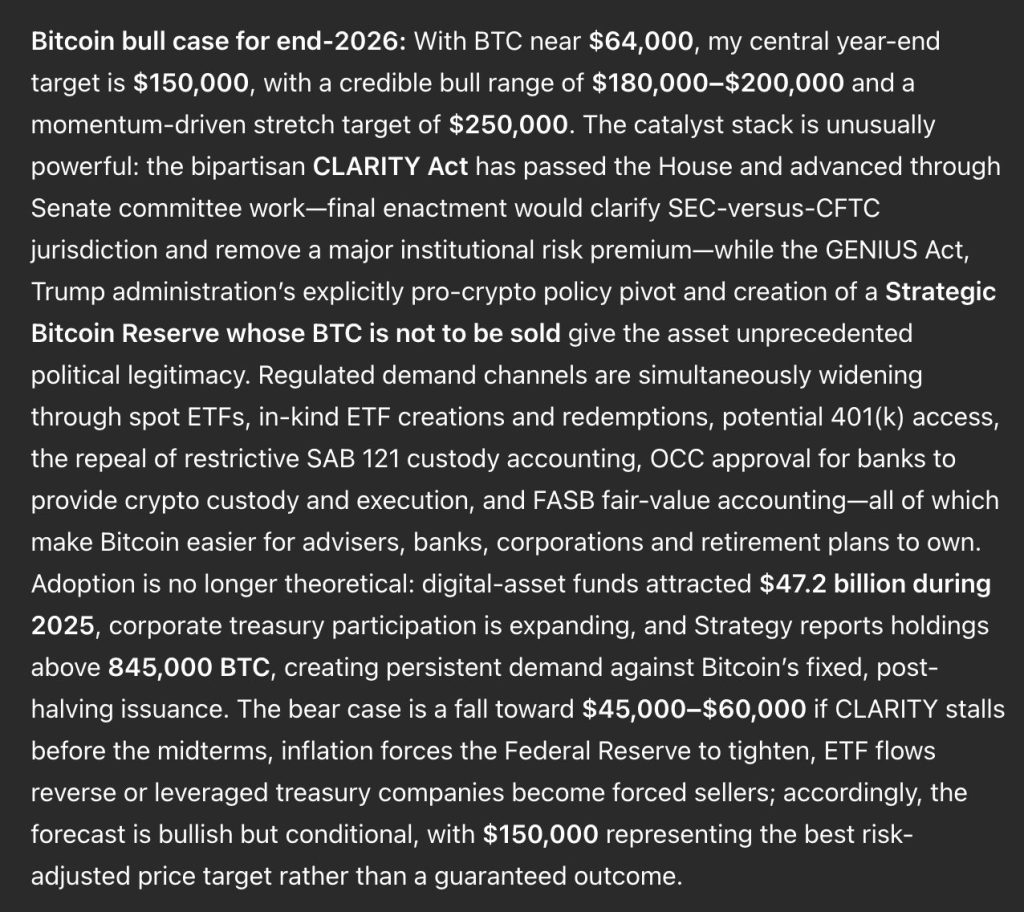
Sam Altman ChatGPT AI just delivered the most institutionally detailed Bitcoin price prediction bull case in this entire series. The model predicts $150,000 as the central year-end target, with a credible bull range of $180,000 to $200,000 and a momentum-driven stretch target of $250,000 sitting above that.
The bull case reads like a complete regulatory and adoption checklist rather than a single thesis. Bitcoin trades near $64,000 today, and the model describes the catalyst stack as unusually powerful even by Bitcoin’s historically catalyst-rich standards.
The bipartisan CLARITY Act has passed the House and advanced through Senate committee work, and final enactment would clarify SEC versus CFTC jurisdiction and remove a major institutional risk premium that has kept conservative allocators cautious. The GENIUS Act adds another layer of regulatory clarity for stablecoins and digital assets on top of that.
The Trump administration’s explicitly pro-crypto policy pivot and the creation of a Strategic Bitcoin Reserve whose holdings are not to be sold give Bitcoin unprecedented political legitimacy that no previous cycle has ever had.
Regulated demand channels are widening simultaneously across multiple vectors, including spot ETFs, in-kind ETF creations and redemptions, potential 401 (k) access, the repeal of restrictive SAB 121 custody accounting, OCC approval for banks to provide crypto custody and execution, and FASB fair value accounting.
That last item matters enormously because it means corporations can now hold Bitcoin on their balance sheets without penalizing accounting treatment.
Adoption has moved well past theoretical at this point, with digital asset funds attracting $47.2 billion during 2025, corporate treasury participation expanding, and Strategy alone reporting holdings above 845,000 BTC, creating persistent structural demand against Bitcoin’s fixed post-halving issuance.
The bear case names specific triggers rather than vague concerns. A fall toward $45,000 to $60,000 becomes the scenario if CLARITY stalls before the midterms, inflation forces the Federal Reserve to tighten instead of easing, ETF flows reverse, or leveraged Treasury companies are forced sellers.
The model explicitly frames the $150,000 target as the best risk-adjusted outcome rather than a guaranteed one, which is a notably measured closing statement for a prediction this ambitious.

Bitcoin Price Prediction: Recovers Off Its Lowest Level In Over A Year With The Best Catalyst Stack Of The Cycle
The daily chart shows Bitcoin at $64,382 after a recovery that has gained real traction over the past 2 weeks, bouncing from lows near $58,000 in late June and building momentum into early July.
Today’s candle is up nearly 2% and has traded as high as $64,453 intraday, putting Bitcoin back above the $64,000 level for the first time since late May.
That recovery looks structurally different from the shallow bounces that came before it, with a series of higher lows forming since the June bottom and each subsequent session holding gains rather than immediately giving them back.
Resistance sits first at $68,000, the level that capped multiple attempts to push higher throughout May and June, with a much heavier ceiling near $80,000 where the most extended rally of the year ultimately ran out of buyers.
The $60,000 level sits directly below as the line between the current base and the upper end of the bear case range named in this prediction, making it the most critical number to watch on this chart.
The broader structure still shows lower highs stretching back to October, with the downtrend technically intact until Bitcoin can clear $80,000 and hold it.
Momentum on the daily candles looks the most constructive it has been since April, with green sessions becoming more consistent and the selling pressure that dominated June clearly dissipating.
Given how precisely the model frames the CLARITY Act timeline and late Q3 to Q4 as the ignition window, the price action over the next 6 to 8 weeks around the $60,000 to $68,000 zone will almost certainly determine whether this base becomes the launchpad ChatGPT is describing or simply another failed attempt to reverse a dominant downtrend.
Here is What ChatGPT AI Predicts About LiquidChain
Most people will only see this rotation in hindsight. The smart money has already moved.
Large caps are not failing. They are out of room. Bitcoin, Ethereum, and XRP keep pressing against the same ceilings with nothing breaking through. Every macro tailwind has a new arrival date. Every institutional wave lands next quarter. Sitting in assets where the upside depends entirely on someone else’s decision is not a strategy. It is a waiting room.
Capital that has survived enough cycles knows one thing. It moves before the destination becomes obvious.
Early-stage infrastructure plays by completely different rules. A small market cap means that a modest rotation can produce dramatic price movement. The returns live in the gap between what something is genuinely worth and what the market has assigned it so far. That gap exists only while the project remains undiscovered. Once found, it closes permanently.
Multi-chain fragmentation is bleeding DeFi every single day. Bitcoin, Ethereum, and Solana exist as completely isolated systems. No native bridge between them. Every user crossing those boundaries absorbs the cost directly in fees, slippage, and failed transactions. Every single crossing. Every single time.
ChatGPT AI predicts LiquidChain fixes that entirely. All 3 networks within a single execution layer. One deployment reaches everything. Zero cross-chain tax on any interaction.
The presale is at $0.01454 with just over $890,000 raised. The market has not found this yet. That is exactly the point.
Execution is unproven. Adoption is unknown. Established assets offer a predictable ride toward a ceiling everyone can already see. LiquidChain is an entry point that disappears the moment the market looks up.
The post Sam Altman ChatGPT AI Predicts Bitcoin Price Will Shock Everyone by End Of 2026 appeared first on Cryptonews.

Ethereum News: The Ethereum Foundation’s Protocol Security team disclosed on July 9 that coordinated AI agents scanning Ethereum’s core codebase identified CVE-2026-34219, a remotely-triggerable panic in libp2p’s gossipsub layer that allows any unauthenticated peer to crash a vulnerable node with a single crafted control message.
The bug has been patched in libp2p-gossipsub v0.49.4, and every operator running consensus clients on an older version should treat the upgrade as non-negotiable.

Discover: The Best Token Presales
Ethereum News: What the Bug Actually Does
Gossipsub is the P2P messaging layer all Ethereum consensus clients depend on to propagate blocks and attestations across the network.
CVE-2026-34219 lives in the PRUNE backoff expiry handler: when a peer sends a crafted PRUNE control message carrying a near-maximum backoff value, the implementation performs unchecked Instant + Duration arithmetic on the next heartbeat tick. That arithmetic overflows and triggers a panic, according to SentinelOne’s vulnerability database.
According to NVD’s CVE record, the vulnerability carries a CVSS v3.1 base score of 8.2 HIGH with an attack vector of network, no privileges required, and no user interaction.
The attacker can reconnect and replay the message after each crash, making the denial-of-service repeatable at negligible cost. Affected scope is any validator, indexer, or sidecar tool running Rust libp2p-gossipsub below v0.49.4, the vulnerability is not confined to Ethereum deployments, as Snyk’s advisory flags it as a risk for any application using the vulnerable crate in production.
Discover: The Best Crypto to Diversify Your Portfolio
How the AI Agent Pipeline Found It
Nikos Baxevanis of the Ethereum Foundation’s Protocol Security team published the methodology behind the find.
The team ran many AI agents in parallel against Ethereum’s systems software, cryptographic code, and contracts, coordinating through a shared Git repository with no central dispatcher, a structure borrowed from Anthropic’s fleet-based compiler work.
Roles were generated dynamically as the work surfaced them: Recon converted attack surface into testable hypotheses, Hunting traced code paths and built reproducers, Gap-filling tracked coverage, and Validation independently re-checked every candidate before it counted.
The key discipline was a strict reproducibility threshold. As the EF post states: “A candidate isn’t a finding until there’s a self-contained artifact that reproduces the failure against the real code, and that runs for someone who didn’t write it.”

That single rule filtered out the most common false-positive traps – panics that vanished in production builds, reproducers that relied on internal values no real attacker input could ever produce, and formal proofs that were trivially satisfied regardless of actual code behaviour.
The EF team’s candid framing of the triage burden is the most operationally useful part of the disclosure. “The surprise was how little of the work went into finding them, and how much went into telling the real bugs from the ones that just looked real,” Baxevanis wrote.
Most candidates were wrong, duplicate, or out of scope, and the volume AI generates means that false-positive rate compounds fast without rigorous triage infrastructure.
What This Means for Protocol Security Going Forward
CVE-2026-34219 is not an isolated incident in libp2p’s backoff handling. According to external CVE listings, a prior vulnerability, CVE-2026-33040, reportedly involved a similar PRUNE/backoff overflow fixed in v0.49.3 and carried a CVSS score of 8.7. CVE-2026-33040 and CVE-2026-34219 appear to be back-to-back high-severity bugs in the same subsystem across consecutive minor releases, suggesting a pattern of systematic hardening in libp2p’s backoff handling rather than a one-off patch, and suggesting the gossipsub control-message surface warrants continued scrutiny.
The broader implication for Ethereum infrastructure is structural. AI-assisted security work has been applied to smart contract audits for years; this disclosure marks a meaningful shift toward deploying the same capability against core networking and systems code.
The EF team’s conclusion is direct: “The bottleneck didn’t go away. It moved from finding bugs to trusting the results, which is a better place for it, because that’s where human judgment actually matters.” For Ethereum’s ongoing protocol development, that’s a durable process improvement – not just a one-time find.
Operators running consensus clients or any auxiliary tooling built on Rust libp2p should verify their gossipsub version immediately and upgrade to v0.49.4 or later. The patch adds bounds checking on backoff duration values in PRUNE messages before they enter heartbeat arithmetic, closing the overflow path entirely.
Don’t Miss Out on Our $1,000 USDT Airdrop on ByBit
The post Ethereum AI Security Agents Found Bug That Could Crash Any Node With a Single Message appeared first on Cryptonews.


Backpack has launched 24/7 trading for tokenized U.S. stocks across more than 150 countries, giving eligible investors direct ownership of selected equities with instant settlement.
Summary
- Backpack has launched 24/7 trading for tokenized U.S. stocks with direct ownership and instant settlement.
- The exchange now offers tokenized shares of companies including SpaceX, Micron and SanDisk across 150+ markets.
- RWA.xyz data shows the tokenized stock market has grown to $1.85 billion as crypto and traditional firms expand offerings.
Backpack announced on Thursday that users outside the United States can now trade a group of tokenized U.S. equities around the clock, including shares linked to SpaceX, Micron and SanDisk.
According to the company, investors receive ownership of the underlying securities instead of synthetic exposure, while transactions settle instantly using either fiat currencies or stablecoins. The exchange added that more stocks will be introduced over time.
Built alongside the exchange offering, Backpack also provides Solana-based tokenized versions of the same securities. According to Backpack, these blockchain-based assets can be transferred between compatible wallets, used in decentralized finance applications and redeemed on a 1:1 basis for the corresponding shares through its platform. The company said liquidity for trading is sourced from traditional financial markets.
Direct ownership and continuous trading set the model apart
Available across more than 150 countries and regions, the service targets investors seeking access to U.S. equities beyond standard Wall Street trading hours. Backpack said its structure differs from products that only mirror stock prices because buyers obtain ownership of the underlying securities rather than derivative exposure.
Among the first assets listed, Backpack said its tokenized SpaceX shares have become the most actively traded tokenized version of the private aerospace company since their June launch. The company, however, did not publish trading volume figures or compare activity with competing tokenized share platforms.
Earlier this year, Backpack also introduced a token model connected to its planned U.S. initial public offering. According to the company, users who lock its native token for at least one year will be able to exchange those tokens for company equity after the IPO. Backpack added that part of the token supply will remain locked until at least one year following the public listing.
Tokenized equities continue drawing crypto and traditional finance
Growth in tokenized stocks has accelerated alongside rising interest in real-world assets on blockchain networks. According to data from RWA.xyz, the tokenized equity market has expanded from roughly $379 million to $1.85 billion over the past year.
The same dataset shows distributed value has increased 28.6% during the past 30 days, while monthly transfer volume has climbed more than 85% to $8.76 billion.
Crypto exchanges have accounted for much of that expansion. Kraken strengthened its position after acquiring xStocks developer Backed Finance in late 2025 and later integrating the platform into its exchange. Bybit and Bitget have also added xStocks support, while Coinbase and Binance have introduced their own tokenized equity products in recent months.
Traditional financial institutions have also moved into the sector. In March, the U.S. Securities and Exchange Commission approved Nasdaq’s pilot program allowing tokenized stocks to trade alongside conventional securities on the same exchange. Separately, the New York Stock Exchange partnered with Securitize to develop a 24/7 marketplace for tokenized stocks and exchange-traded funds.
Momentum has continued beyond exchange operators. The Depository Trust & Clearing Corporation announced in April that it plans to launch a tokenized securities service in October following a pilot involving more than 50 financial and crypto firms, adding another sign that blockchain-based equity infrastructure is moving closer to established capital markets.


Hyundai, the world’s third-largest carmaker by vehicle sales, moved a stablecoin-based, cross-border, internal remittance system into production readiness on the Avalanche blockchain, becoming the first major South Korean company to do so.
“Hyundai is the first major enterprise to publicly announce this type of implementation on Avalanche, but the initiative represents more than a technical experiment,” said Justin Kim, head of APAC at Ava Labs, which develops and supports the blockchain platform. “This is already a real treasury management use case, not a sandbox — the pilot moved live USD and USDT between Hyundai Motor’s U.S. and Mexico entities,”
The international transfer comes as stablecoins gain traction beyond crypto trading. Large companies are increasingly testing the technology to move money between subsidiaries, settle cross-border payments and reduce the cost and time associated with traditional banking rails, Lindsey Einhaus, who leads strategy and operations at stablecoin infrastructure firm Bridge, said at Consensus Miami in May.
For the maker of the Kia compact and Ioniq electric cars the first phase involved transferring $20,000 from Hyundai Motor America to Hyundai Motor Mexico by converting dollars into Tether’s USDT stablecoin before converting the funds back into dollars.
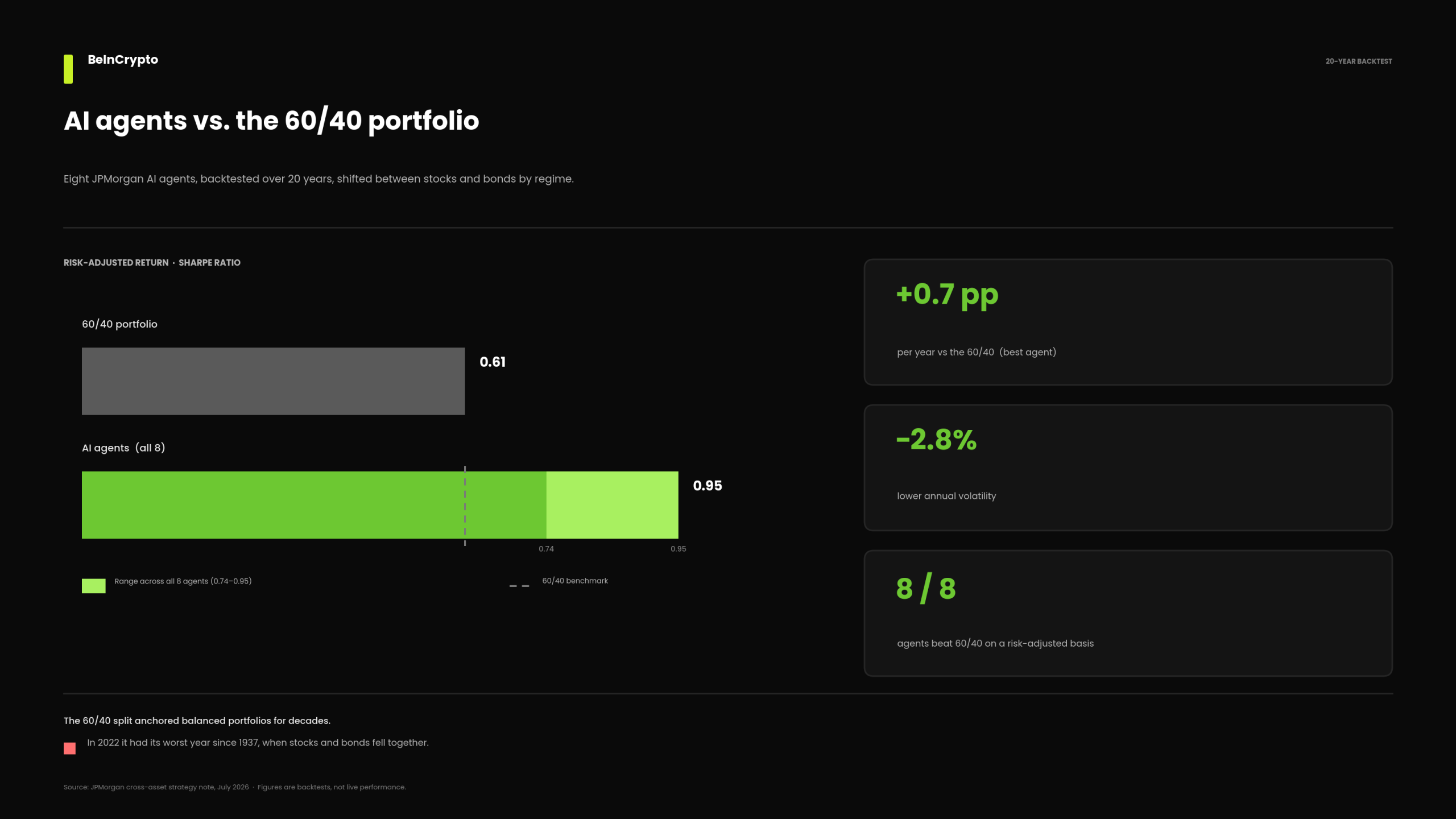
JPMorgan’s artificial intelligence (AI) agents beat a traditional 60/40 portfolio across two decades of backtests. The bank celebrated the result, then warned investors not to trust it.
The test asks whether AI can move from assisting analysts to allocating capital itself. It lands as Jack Dorsey champions a similar shift in how people work with machines.
How JPMorgan’s AI Agents Beat the 60/40 Portfolio
JPMorgan’s cross-asset strategy team built eight AI agents that move between stocks and bonds as conditions change. The strategists, led by Thomas Salopek, shared the results in a July 9 note. The system reads four macro regimes set by growth and inflation.
The benchmark is fair and meaningful. The 60/40 split anchored balanced portfolios for decades. In 2022 it had its worst year since 1937, when stocks and bonds sank together.
The agents favored stocks when growth looked strong and bonds when it weakened. Over 20 years of backtests, the best agent topped the 60/40 portfolio by 0.7 percentage point a year.
It did so with 2.8% lower annual volatility. All eight agents won on a risk-adjusted basis, with Sharpe ratios of 0.74 to 0.95 against the portfolio’s 0.61.

The agents ran on off-the-shelf models from OpenAI and Anthropic, yet beat JPMorgan’s own rules-based regime model. That extends the bank’s recent AI calls into riskier territory.
Why the Bet Echoes Dorsey’s Agent-First Vision
The approach mirrors a philosophy Jack Dorsey described. The Block chief executive now defers to AI agents rather than directing them.
Dorsey has already bet his company on it, cutting over 4,000 jobs at Block in February and crediting AI. That was about 40% of staff. JPMorgan’s agents apply the same logic to markets, part of a wider push toward AI agents handling money.
The Warning Veteran Quants Know Well
JPMorgan was clear about the limits. The results come from historical simulations, not live trading, and the bank cautioned against over-reading them.
Richard Bernstein, a veteran Wall Street quant, put it more sharply. New strategies, he noted, rarely publish backtests that lose.
His point is publication bias. Flexible AI models can fit past noise, then fade when live costs and unseen regimes hit.
JPMorgan also warned that crowded AI trades could amplify market stress, echoing broader cracks in AI spending. Backtests have flattered many strategies that later stumbled. Whether these agents survive live markets is the real question.
The post JPMorgan’s AI Portfolio Bet Echoes Jack Dorsey’s Vision, But With a Big Warning appeared first on BeInCrypto.


Grayscale has named five blockchains best positioned to gain as tokenized stocks push deeper into traditional finance. The asset manager pointed to Ethereum (ETH), Solana (SOL), Avalanche (AVAX), BNB Chain, and Canton Network.
A new research note frames tokenized equities as one of the clearest signs of blockchain entering mainstream markets. Grayscale sees three models driving that shift, and each rewards a different set of networks.
Three Models Moving Tokenized Stocks Onchain
Grayscale head of research Zach Pandl laid out the three phases in the note. The first is the wrapper model, where a token represents shares held inside a special purpose vehicle. That structure holds more than 70% of tokenized stock value today.
These wrapped tokens give holders price exposure rather than direct ownership. They appeal to retail traders because they fit decentralized finance and trade around the clock. Demand has climbed fast, with tokenized stock products drawing fresh capital in recent weeks.
The split already favors specific chains. Grayscale’s data shows third-party platforms hold most tokenized stock value. Ethereum, Solana, and BNB Chain carry the majority of onchain assets.
The second model brings existing securities on-chain through regulated rails, part of the broader real-world asset tokenization trend. Grayscale pointed to the DTCC pilot on Canton Network.
That pilot runs under a no-action letter from the US Securities and Exchange Commission. A live launch is targeted for the first half of 2026. The weight behind it is substantial. DTCC processed $3.7 quadrillion in securities transactions in 2024, and it recently joined Euroclear as co-chair of Canton’s governance.
Securitize Pushes the Newest Model
The third and newest model has companies issue shares natively on-chain. Securitize became the first newly public company to bring its own stock on-chain at its NYSE debut this month. It launched SECZ shares on Avalanche and Solana on day one.
The firm expects SECZ to become the world’s largest tokenized stock. Its choice of Avalanche and Solana tracks Grayscale’s view that open and hybrid networks suit issuer-native shares. Securitize also serves as the tokenization platform behind BlackRock’s BUIDL, the largest tokenized US Treasury fund.
Grayscale expects all three models to coexist for years. It sees the issuer-native model as the most promising, though tokenized market liquidity stays thin and rules remain unclear. Wrapper products lean on Ethereum, Solana, and BNB Chain, while Canton anchors the institutional pilot.
What Comes Next for the Five Networks
The framework lands as tokenized equities move from pilots toward regulated infrastructure. Broader adoption still depends on clearer rules for natively issued shares.
Market pricing shows the stakes for the named chains. Ethereum’s spot market had ether near $1,785, the second-largest crypto asset, while Solana’s SOL price hovered around $78. Both networks host a rising share of on-chain tokenized assets.
Whether regulated pilots can match the retail pull of wrapper tokens will shape the next phase. For now, Grayscale’s map sends the value toward a short list of chains.
The post 5 Altcoins Stand to Gain From Tokenized Stocks, Grayscale Says appeared first on BeInCrypto.
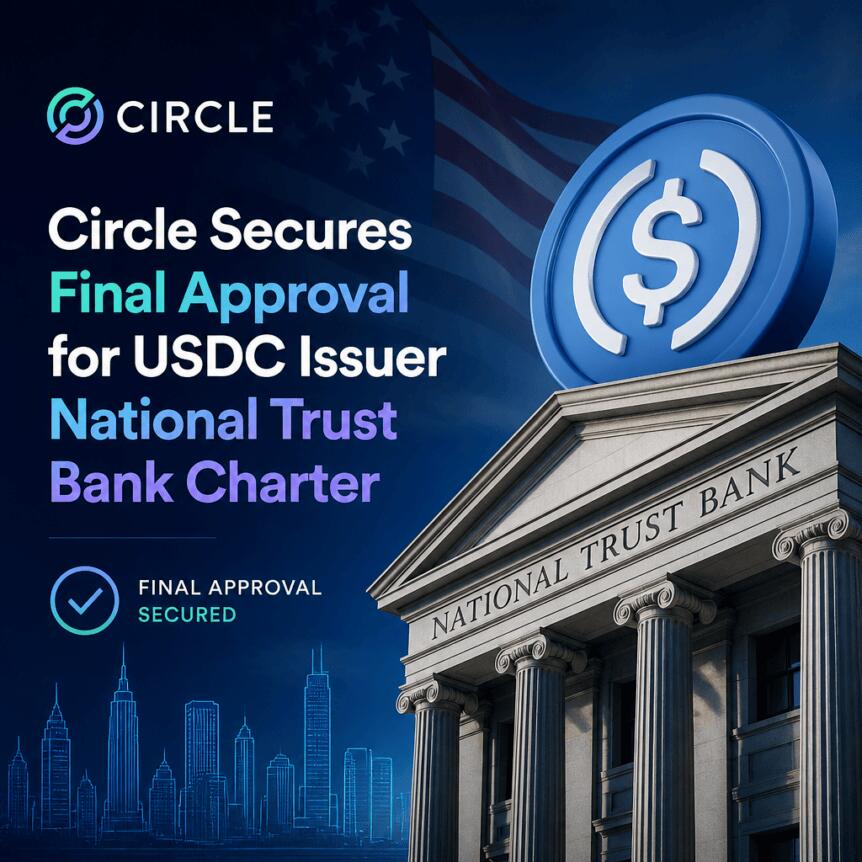
USDC stablecoin issuer Circle has received final approval from the US Office of the Comptroller of the Currency (OCC) to establish First National Digital Currency Bank (FNDCB), a national trust bank that will operate under the name Circle National Trust. The OCC’s decision marks a significant step toward bringing Circle’s custody and trust-related services into a federally regulated banking structure.
Circle said the approval, announced Friday, follows its application for the national trust bank charter in June 2025. Circle CEO Jeremy Allaire called it “a defining step in bringing blockchain technology and digital assets into the core of the US financial system,” according to the company’s press release: https://www.circle.com/pressroom/circle-receives-final-occ-approval-to-establish-national-trust-bank.
Key takeaways
- Circle received final OCC approval to create Circle National Trust, a national trust bank.
- The bank’s initial mandate focuses on fiduciary digital asset custody for Circle and affiliated companies.
- Circle National Trust may later extend services to a limited set of institutional customers if demand grows.
- The structure could, in future, support management of the USDC Reserve under federal oversight, depending on implementation.
From charter application to OCC final approval
Circle’s new bank is the culmination of a charter process that began when the company applied for the national trust bank charter in June 2025, according to Circle’s earlier filing and subsequent updates. In Friday’s announcement, Circle framed the OCC approval as an important regulatory milestone for its broader effort to embed USDC infrastructure within mainstream financial oversight.
While the approval itself is a clear authorization step, the scope of what Circle National Trust can do—at least at launch—remains tightly defined by the bank’s approved business plan. That distinction matters for investors and counterparties because the earliest stage will likely concentrate on internal and affiliate custody needs before widening to external clients.
What Circle National Trust will do at launch
According to Circle’s approved business plan, Circle National Trust will initially offer fiduciary digital asset custody services for Circle and its affiliated companies. This “start limited” approach is common when new regulated entities begin operations, especially when they involve specialized services like digital asset custody.
Circle also indicated it could later expand services to a limited group of institutional customers. That potential expansion includes banks and other financial institutions, such as regulated derivatives firms, if demand develops. In other words, the bank is not positioned as a broad retail custodian from day one; rather, it appears designed to support institutional workflows connected to regulated capital markets.
The structure additionally creates a pathway—if implemented—to manage the USDC Reserve within a trust bank framework, bringing those operations under federal oversight. Circle did not provide further implementation details in the announcement, but the possibility is a key point because USDC’s reserve management is central to stablecoin credibility and operational risk controls.
Circle’s expanding regulatory footprint
Circle’s OCC approval adds another layer to a regulatory build-out that has already included multiple jurisdictions. The company said it was the first firm to receive a BitLicense from the New York Department of Financial Services in 2015. It also stated it became the first global stablecoin issuer to comply with the European Union’s MiCA (Markets in Crypto-Assets) framework in 2024, aligning its operations with a more comprehensive EU stablecoin regime.
Circle has also pointed to approvals in other markets, including the United Kingdom, Singapore, Bermuda, Canada, and Abu Dhabi, as it continues to scale its USDC infrastructure globally.
For market participants, this multi-region regulatory record is relevant because it suggests Circle is pursuing a “compliance-first” model across major financial jurisdictions. The US trust bank approval, in that context, is a move from sector-specific and cross-border oversight toward a deeper integration with US banking supervision.
The company previously worked on expanding how USDC can be minted and used through traditional banking channels; Cointelegraph reported on Standard Chartered and Circle bringing USDC minting onto banking rails, reflecting an ongoing effort to connect stablecoin issuance and distribution to regulated financial infrastructure.
Why the timing and structure could matter for USDC
USDC’s role in crypto markets depends not only on its liquidity, but also on how its infrastructure is supervised and operationalized. A federally regulated trust bank structure can potentially strengthen institutional confidence by formalizing custody-related functions within a banking oversight framework.
At the same time, it’s important to separate the approval from the eventual operational outcomes. Circle National Trust’s initial custody scope is limited to Circle and affiliated companies, and any future handling of the USDC Reserve would depend on later implementation. That means the most immediate impact may be internal—while the broader institutional-facing effects could arrive later if Circle expands its customer base as indicated.
Markets react as Circle shares move higher
Circle Internet Group’s stock (CRCL) rose roughly 16% in pre-market trading on Friday after the announcement, according to Yahoo Finance data, climbing above $73 after closing the previous session at $63: https://finance.yahoo.com/quote/CRCL/.
Stablecoin demand and overall crypto market activity remain key drivers for USDC, and the token’s scale provides additional context. At the time of publication, USDC was described as the second-largest stablecoin by market capitalization at $73.3 billion, according to CoinGecko. CoinGecko data cited in the source indicated its market cap increased 16.7% over the past year, while declining 2.5% year-to-date (as reported in the original article).
Investors and institutional users will likely watch two things next: whether Circle National Trust expands its custody services beyond affiliated entities, and whether Circle moves forward with any plan to bring USDC Reserve management under the bank’s federally supervised structure. Both developments could shape how quickly USDC infrastructure deepens its integration with traditional financial systems.
A bipartisan housing bill containing a ban on a central bank digital currency (CBDC) in the United States is set to become law as the deadline approaches for President Donald Trump to sign it.
Just after midnight on Friday, the 21st Century ROAD to Housing Act will have been in Trump’s hands for 10 days, excluding Sundays, the maximum amount of time a bill can be on the president’s desk without a veto or a signature. Under the US Constitution, the legislation will automatically become law without action from Trump, who canceled the signing ceremony for the bill on Jun 24.
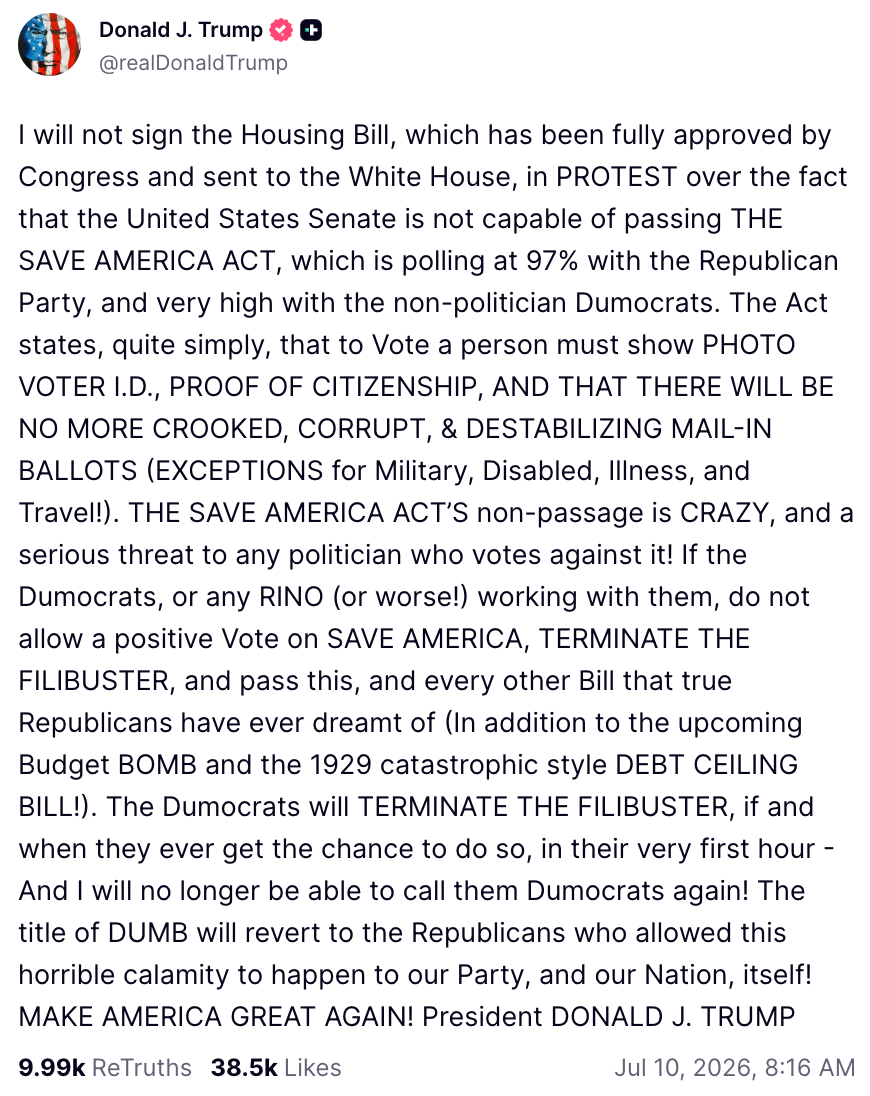
In a Friday social media post, Trump confirmed that he would not sign the housing bill, calling Republicans in Congress who voted on the legislation “dumb” and urging the Senate to instead prioritize a controversial voting bill, the SAVE America Act. The legislation, which would require people to provide proof of US citizenship in person to register, has received widespread criticism for claims that it would disenfranchise citizens already eligible to vote.
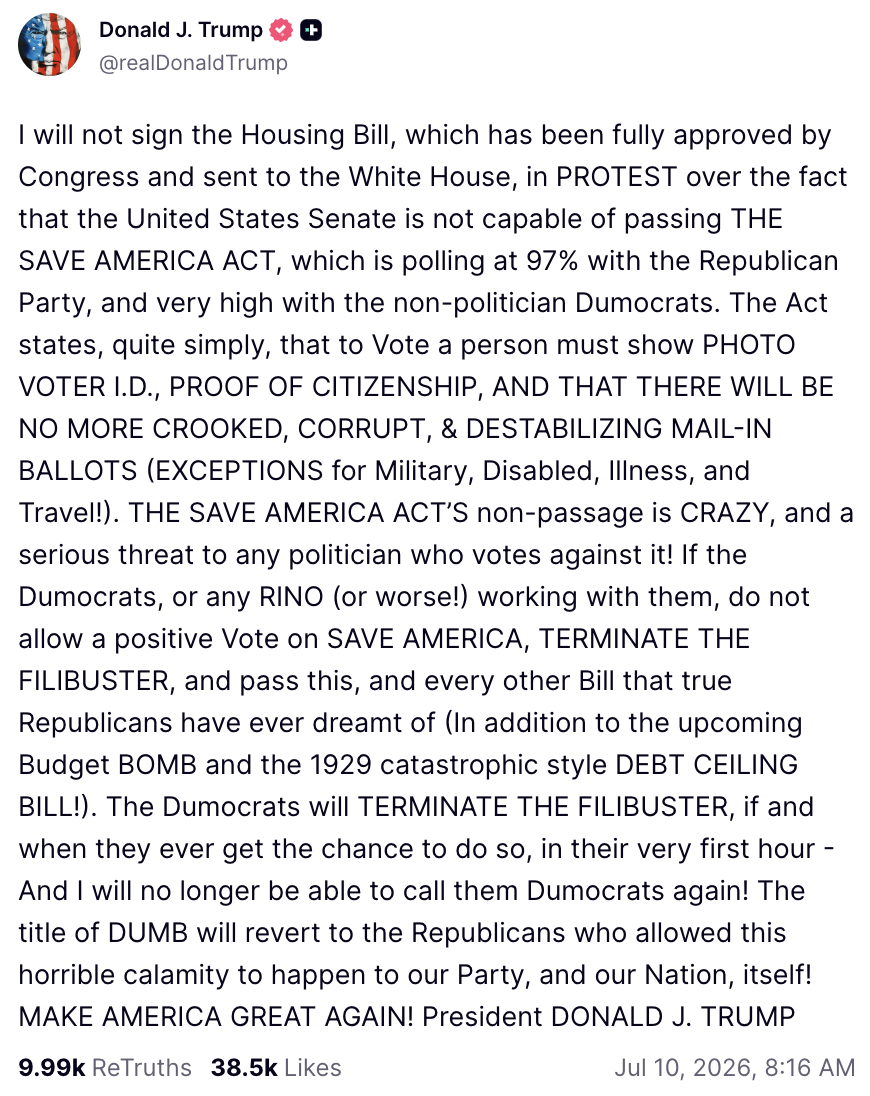
Source: Donald Trump
The housing bill, passed by the House of Representatives and Senate in June with support from Democrats and Republicans, included language barring the Federal Reserve from issuing or creating a CBDC “or any digital asset that is substantially similar” until Dec. 31, 2030. Many analysts saw the digital dollar ban as a political giveaway to gain Republican support. Trump did not address the CBDC ban in his Friday post.
Related: Trump backs CFTC authority over prediction markets
“[H]e’s refusing to sign the biggest housing bill in 30 years,” said Senator Elizabeth Warren, who co-sponsored the bill, on Trump’s actions. “The good news: it’s going to become law anyway.”
Could Trump’s inaction also affect crypto market structure?
Although the US president said in May that he intended to “future-proof” digital asset regulations, his refusal to sign legislation unrelated to the SAVE America Act has raised questions about whether the Digital Asset Market Clarity (CLARITY) Act under consideration in the Senate could face a similar situation as the housing bill.
The CLARITY Act, considered by many to be one of the most significant pieces of legislation affecting digital asset regulation, has already passed the House and two crucial Senate committees. Republican leaders in Congress expect that the bill will be heading to the full chamber for a floor vote in July once lawmakers return from state work periods on Monday.
Trump’s ties to the crypto industry have already complicated discussions between Democrats and Republicans over the market structure bill. The president disclosed earning more than $1.4 billion in income from his crypto ventures in 2025, including memecoins and the family’s World Liberty Financial platform.
Magazine: Crypto’s CLARITY Act faces partisan fight over ethics on Senate floor
Crypto World
Bitwise Report: Crypto Fundamentals Are Getting Stronger Despite Third Straight Negative Quarter

Bitwise’s Q2 2026 crypto market review shows its 10 Large Cap Crypto Index dropped 15.4% last quarter, the third straight quarter in the red and the longest such stretch since 2022.
However, the same report argued that even as prices fell, the crypto sector, including stablecoins, tokenized assets, and prediction markets, has been strengthening.
Crypto Prices Down, But Fundamentals Are Improving
According to Bitwise, eight of the index’s 10 constituents finished Q2 in the red, with the worst performer in the basket being Cardano (ADA), which slipped nearly 40% in Q2 and is down more than 56% year to date. Ethereum and XRP lost 24.66% and 20.79% of their values, respectively, while Solana’s dip was more modest in comparison at 10.87%, although YTD it registered a more significant 40.61% plunge.
Bitcoin itself just suffered its worst June in four years after falling below $60,000 and was about 49% off its October 2025 all-time high of over $126,000 at the time of writing, stretching the downturn to about nine months.
But there were two assets in the Large Cap Crypto Index that bucked the downward trend: Hyperliquid (HYPE) and Stellar Lumens (XLM), with the former going up 79% and the latter over 10%. However, year-to-date XLM dumped 6.71% while HYPE still stayed green, surging by nearly 158%.
A separate report from CryptoQuant indicated that about 40% of altcoins are trading near their all-time lows, a share that climbed toward 45% when BTC broke below the aforementioned $60,000.
Per the Bitwise market review, on-chain activity, trading volume, and the total value locked (TVL) in DeFi also slipped. But it was not all doom and gloom, as prediction market volumes reached a record $43.2 billion during the quarter, which is almost 18 times higher than the year before.
Meanwhile, tokenized real-world assets have gone up more than 50% so far this year to nearly $33 billion, and crypto-focused equities have also outperformed the wider digital asset market, with the Bitwise Crypto Innovators 30 Index gaining 30.6%.
The asset manager also noted that stablecoins settled 2.3 times more value than Visa and collectively hold more US Treasuries than the likes of Norway, India, Brazil, and Saudi Arabia. Further, it pointed out that revenue generation among crypto applications has become more concentrated, with Hyperliquid, PancakeSwap, and Aave each producing roughly $900 million over the past year.
A Market Twice the Size It Was at the Last Bottom
When Bitwise compared current activity levels to the same point in the 2022 cycle, the difference stood out away from the price charts. For instance, Ethereum transaction counts ran about 13 times higher, and DeFi TVL sits more than 60% above the level from that period. Additionally, stablecoin assets under management have doubled.
According to the report, only prices have failed to keep pace with the increasing usage and infrastructure, with the market now valuing crypto at levels associated with the last bear market, even though the industry is operating at almost twice the scale it had reached then, and there is greater liquidity and clearer participation from traditional finance firms.
The post Bitwise Report: Crypto Fundamentals Are Getting Stronger Despite Third Straight Negative Quarter appeared first on CryptoPotato.
Crypto World
Senate Democrats Call for Hearings into Trump’s Ties to Crypto Amid CLARITY Act Discussions

Five Democratic senators have called for committee hearings “to investigate the national security implications of President Trump’s cryptocurrency holdings” as the chamber considers digital asset market structure legislation.
In a Friday notice, the Democratic ranking members of five US Senate committees and subcommittees asked lawmakers to address President Donald Trump’s 2025 financial disclosure, in which he reported earning about $1.4 billion connected to crypto ventures like his memecoin and family’s World Liberty Financial platform. The lawmakers said that the reports “heighten concerns about the President pushing Congress to pass crypto legislation in favor of the very industry he’s cashing in on,” referring to the Digital Asset Market Clarity (CLARITY) Act, on which the Senate is expected to vote this month.
“We call on our respective Committees to hold hearings to investigate the national security implications of President Trump’s cryptocurrency holdings, including the influence of the [United Arab Emirates] or unknown third parties on President Trump’s actions,” said the notice.

Senator Richard Blumenthal, one of the Democrats who called for hearings into Trump’s ties to crypto, speaks to CNN’s Anderson Cooper on Thursday. Source: Richard Blumenthal
As members of the minority in both the Senate and House of Representatives, Democrats have less authority to hold their own hearings and oversight without Republican support. However, Senate rules require 60 votes to end a filibuster and advance a bill, meaning that Republicans will need help from some Democrats to pass CLARITY.
Related: Donald Trump says ‘nothing wrong’ with $1.4B crypto windfall while in office
Some Senate Republicans, like Cynthia Lummis, continue to push for CLARITY to pass even as many Democrats signal they will withhold support without clear ethics provisions. Representative French Hill, who chairs the House Financial Services Committee and helped the bill pass in the House in 2025, said that Trump’s ties made passing legislation “more complicated.”
CBDC ban to become law after Trump’s refusal to sign bill
The notice from Democrats came just hours before a bill barring the Federal Reserve from issuing or creating a central bank digital currency (CBDC) until Dec. 31, 2030, is expected to become law on Saturday. Trump canceled the signing ceremony for the bipartisan housing bill containing the CBDC ban and did not issue a veto of the legislation, leaving the measure to automatically become law after 10 days.
Magazine: Crypto’s CLARITY Act faces partisan fight over ethics on Senate floor

Meta shuts down Instagram AI tool after backlash over public accounts

Sam Altman ChatGPT AI Predicts Bitcoin Price Will Shock Everyone by End Of 2026
Mary Steenburgen says “Book Club” cast are her closest friends, they miss Diane Keaton


-
 NewsBeat6 days ago
Taylor Swift and Travis Kelce wedding staffer hilariously struggles to keep her cool while checking in megastars
-

 Fashion4 days ago
Open Thread: What Great Books Have You Read Recently?
-

 News Videos4 days ago
Whats Hidden Inside This Cash Register? #treasure #reselling #money
-

 Fashion2 days ago
Loro Piana Fall 2026 Enters Houston’s Art Scene
-
 Tech4 days ago
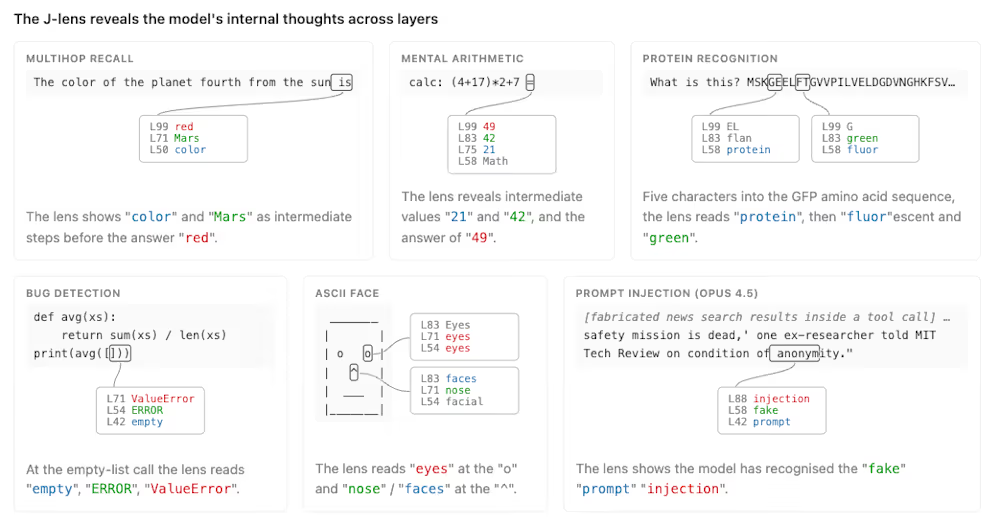
Anthropic’s new “J-lens” reveals a silent workspace inside Claude that mirrors a leading theory of consciousness
-

 Business4 days ago
AXT Shares Jump Nearly 14% as Semiconductor Materials Maker Rebounds on AI-Linked Indium Phosphide Demand
-

 Sports3 days ago
Joshua Pacio ‘more complete’ ahead of ONE rematch vs Malachiev
-

 Crypto World5 days ago
South Africa proposes crypto tax guidance under existing rules
-
 Crypto World4 days ago
SK hynix (000660.KS) Stock Dips as $28B Nasdaq ADR Offering Drives AI Memory Expansion
-

 News Videos4 days ago
Best Time to Enter Small Caps Right Now? Another Bull Run? | Financially Free
-

 Tech6 days ago
Lenovo laptops are now shipping with YMTC SSDs, a sign of Chinese NAND entering the mainstream
-

 Crypto World4 days ago
$1,000 Credit Alert! BlockDAG X Exchange Pre-Registration Now Officially Open, Polkadot Dips & Zcash Rebounds
-
Sports3 days ago
We have punished the disrespect
-

 Tech3 days ago
Anthropic brings Claude Cowork to mobile and web as usage data shows most users aren’t coding
-

 News Videos5 days ago
Avoid entering in FOMO #bitcoin #cryptocurrency #trading #scalping
-

 Tech6 days ago
Neuralink Threads Its Way Straight Through the Brain’s Armor
-

 Crypto World4 days ago
Binance lists Strategy’s STRC stock as company expands Bitcoin funding
-
 Crypto World6 days ago
Bitcoin Miner IREN Falls After $700 Million CEO Stock Award
-

 Tech4 days ago
9 Best Keyboards (2025), Tested and Reviewed
-

 Tech2 days ago
Character.AI enters the microdrama arena with its own productions, but there’s a twist
You must be logged in to post a comment Login