

Crypto World
Bitcoin Longs Jump as US Macro Data Weakens; Could $82K Be Next?

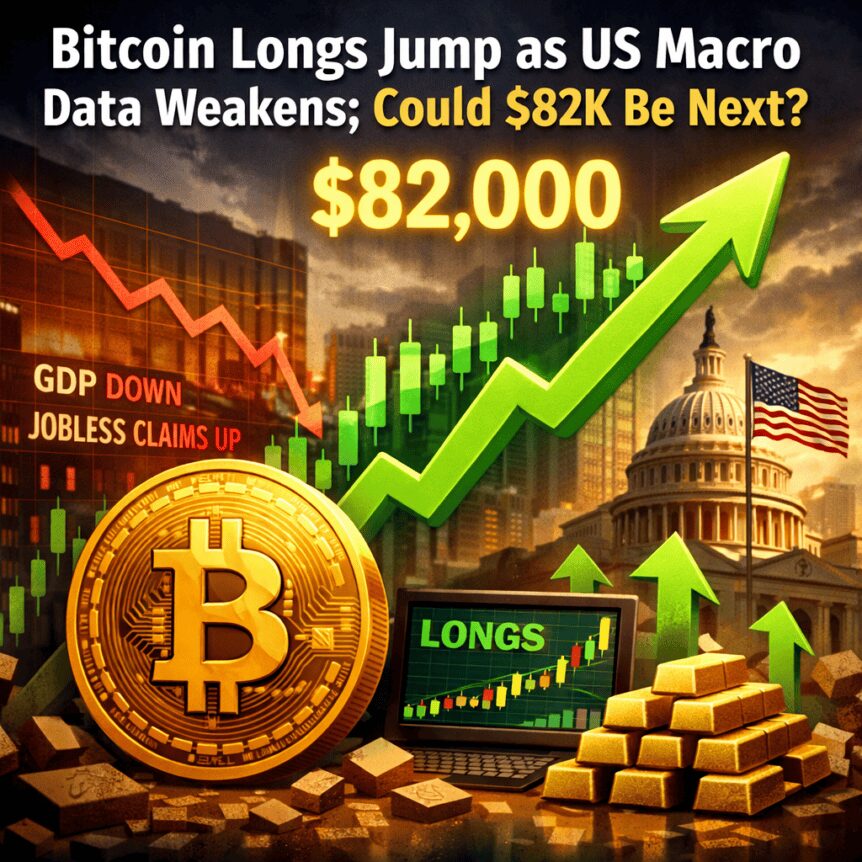
Bitcoin price action cooled after a brief flirtation with the upper sub-legendary zone around $78,000, with traders refraining from a clean breakout toward $82,000 despite improving risk appetite in some corners of the market. A mix of macro headwinds and an ongoing outflow dynamic from US-listed spot Bitcoin ETFs kept the path to a sustained rally uncertain, even as institutional-focused traders increased their bullish exposure in the near term.
Data from market-tracking platforms show top traders lifting their Bitcoin long positions relative to shorts, a signal that the $76,000 support floor remains key, but not a guarantee of immediate upside. At the same time, broader fundamentals are weighing on the upside potential: a shaken macro backdrop, a softer near-term retail outlook, and concerns about the trajectory of U.S. monetary policy have tempered breakout expectations. This environment poses questions for whether the market can sustain momentum beyond the 76k–82k zone in the weeks ahead.
Key takeaways
- Top traders boosted their long exposure, reinforcing the $76,000 support floor as a credible near-term base, with the long-to-short ratio rising to a two‑week high.
- Macro pressures and persistent ETF outflows temper near-term upside, keeping a full breakout to $82,000 unlikely without a shift in the broader risk backdrop.
- Bitcoin’s price dynamics showed a small Coinbase premium/discount mismatch, alongside about $2.07 billion in net outflows from US-listed spot ETFs since mid‑May, signaling tepid institutional demand.
- Market structure signals—neutral perpetual funding rates and a rebalancing of long and short positions—suggest bulls are building slowly, but a decisive move remains data-dependent.
Bitcoin (BTC) traded around the mid-to-high $70,000s on Thursday, borrowing momentum from a period of tentative resilience but failing to sustain gains beyond the $78,000 area. The week’s readings point to a market where professional traders are more confident on a floor near $76,000, even as the broader macro stage keeps the door open to pullbacks if risk appetite fades.
The core question for traders remains: can constructive positioning overcome the macro drag? The answer appears nuanced. On one hand, top-tier traders have tilted longer, betting that the current support zone will hold and that favorable or stable macro conditions can unlock a move toward higher levels. On the other hand, outsized external pressures—rising energy costs, a cautious consumer sector, and the potential for tighter monetary policy—keep the door ajar for a retest of prior resistance levels rather than a clear, immediate breakout.
Trader positioning and the price backdrop
Market analytics indicate a shift in sentiment among the most active Bitcoin traders. The long-to-short ratio at major venues has climbed, signaling more optimistic positioning on the baseline assumption that $76,000 acts as a robust magnet for prices in the near term. At Binance, for several days the balance tilted modestly toward longs, while at OKX, traders trimmed shorts in a similar time frame. Despite these shifts, the net reading across exchanges has remained roughly neutral, underscoring a cautious, not exuberant, stance among professional participants.
The posture among top traders matters because it can foreshadow how price action unfolds when the market encounters fresh catalysts. A firming of long exposure around a sturdier support zone can translate into quick price stabilization if momentum builds. Conversely, if macro headwinds intensify or demand remains fragile, even a solid base may not translate into a sustained up-leg.
Macro headwinds and the policy outlook
A portion of the market’s hesitance stems from a confluence of macro factors. Retail demand has shown fragility, with major consumer-facing firms’ guidance reflecting the squeeze from higher costs and inflation. Walmart shares slid around 7% after guiding for 2027 with a cautious tone, citing persistent cost pressures, including elevated oil prices, and highlighting that low-income consumers are navigating financial distress. This dynamic feeds into a broader retail outlook that can cool optimism for a rapid reacceleration in consumer-led demand for risk assets.
Oil markets have remained tight, with Brent crude holding above $95 per barrel as supply dynamics and Middle East tensions persist. The geopolitical backdrop compounds inflation concerns and leaves little room for aggressive easing by policymakers in the near term. In the United States, these dynamics have fed expectations of potential rate adjustments, even as market participants weigh the timing and magnitude of any future hikes.
On the policy front, futures-implied probabilities point to a non-trivial chance of rate hikes by September. The market-implied odds for higher rates have risen in recent weeks, with traders pricing in around a 37% probability of a rate increase by September, according to tools that aggregate futures data. This marks a shift from the prior month and contributes to the sense that the monetary base could continue expanding in a manner that affects liquidity and risk assets differently than in a period of looser policy.
Flows, pricing signals, and what to watch next
Trading dynamics around price discovery also reflect evolving demand and liquidity conditions. The Bitcoin price on Coinbase traded with a slight premium/discount signal relative to other major exchanges quoted in USDT, marking a nuanced snapshot of cross-exchange demand. In parallel, net flows out of US-listed Bitcoin spot exchange-traded funds have remained negative, with about $2.07 billion exiting since May 12. These outflows reduce the immediate availability of price-supportive demand from a broad retail and institutional ETF channel, in turn complicating the path to a sustained breakout.
Meanwhile, the structure of Bitcoin futures markets shows a more balanced stance. The perpetual futures funding rate has hovered in a neutral zone since early this week, signaling that funding costs are not systematically biasing the market toward easy long accumulation. The current annualized rate around 7% contrasts with a mid‑May spike where shorts were paying as much as 13% to carry their positions, a sign that speculative leverage swung more aggressively in the direction of selling earlier in the month.
Taken together, the data suggest that while bulls have a foothold at the $76,000 level, a clear move toward $82,000 hinges on a shift in the broader macro environment—whether from a cooling inflation regime, a rebound in consumer demand, or a dovish tilt in policy expectations that can draw back the rate-hike narrative. Absent such a change, the market may continue trading in a range with modest upside potential rather than a decisive breakout.
In practical terms, investors and traders should monitor several developing signals: (1) any sustained improvement in macro indicators that can tilt Fed expectations toward a softer stance, (2) changes in ETF inflows or new product launches that could re-engage broad retail or institutional demand, and (3) price action around the $76,000–$78,000 region that could act as a fulcrum for the next directional move. With the balance of momentum currently dependent on external forces, the near-term risk-reward favors a cautious posture rather than a bold bet on a rapid ascent to new highs.
What remains uncertain is how quickly macro and policy drivers will align with on-chain and market sentiment shifts. Traders will be watching whether the $76,000 floor proves resilient in the face of evolving headwinds or whether fresh catalysts—positive macro data, renewed ETF inflows, or a shift in risk appetite—can unlock a move toward higher ground in the weeks ahead.
As the market edges forward, the crucial test will be whether the sum of these signals can overcome the layered frictions weighing on Bitcoin’s ascent. The coming data prints and policy signals will be decisive for whether the market can stage a meaningful breakout beyond current resistance or stay tethered to the more modest gains built around a stabilized base.



Rep. Nick Begich introduced the American Reserve Modernization Act (ARMA) in the House on Thursday, a bill that would codify the US Strategic Bitcoin Reserve into permanent federal law.
The Alaska Republican brought the legislation forward with 16 original cosponsors. ARMA would lock federally held bitcoin (BTC) for at least 20 years and require budget-neutral acquisitions.
What the ARMA Bill Changes
ARMA builds on the earlier BITCOIN Act framework and seeks to put President Donald Trump’s March 2025 executive order on a statutory footing. Statutes outlast executive orders, which any future administration can rescind.
Meanwhile, the bill authorizes the Treasury to acquire up to 200,000 BTC per year for five years, targeting a one-million-coin reserve.
Acquisitions must avoid new taxpayer spending, echoing earlier gold-sale funding proposals tied to Senator Cynthia Lummis (R-WY).
The 20-year hold applies to all federally controlled bitcoin, including roughly 198,000 to 328,000 BTC the government accumulated through criminal forfeitures such as the Silk Road and Bitfinex hack cases.
The Bitcoin Policy Institute has endorsed the package as a step toward professionalizing federal custody. Notably, the group framed the bill as a turning point for the strategic Bitcoin reserve concept.
ARMA … would put the US Strategic Bitcoin Reserve on permanent legal footing: requiring 20 year long-term Bitcoin holdings, budget-neutral acquisition strategies, and federal custody standards,” they wrote.
Committee hearings in the coming weeks will signal how quickly ARMA can advance.
The post US Congressman’s ARMA Bill Would Codify 20-Year Strategic Bitcoin Reserve appeared first on BeInCrypto.
Crypto World
Cardano’s Science Coin Identity at Risk as Charles Hoskinson Warns of Research Collapse
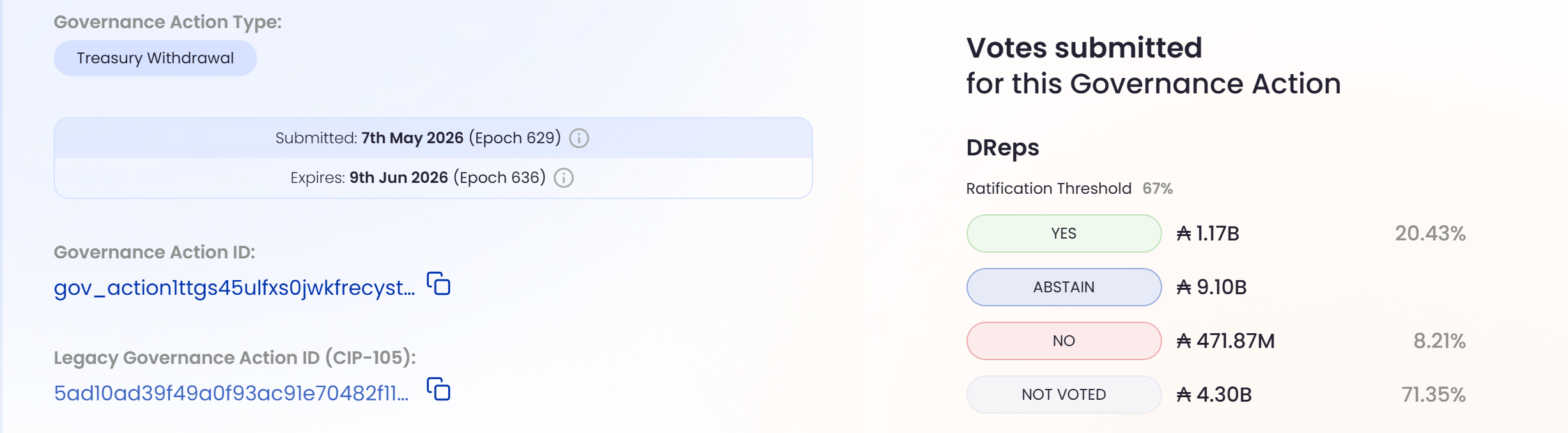
Cardano founder Charles Hoskinson said the blockchain risks losing its scientists if a 32.9 million ADA research proposal fails. He warned that the core research lab would shut before voting closes on June 8.
The appeal is addressed to the Japanese delegates (dReps) who voted against the proposal. The plan would fund post-quantum cryptography, zero-knowledge proofs, and scalability work at Input Output Global (IOG) and partner universities.
Charles Hoskinson Frames the Vote as Existential
According to Hoskinson, Cardano would lose its scientists if the proposal failed. He warned its research lab would also be forced to close, estimating the investment at hundreds of millions of dollars over more than a decade.
He directed his appeal at Japan, where Cardano ran an early vouchered ICO. Hoskinson urged ADA holders to delegate voting power to dReps backing the research agenda before the June 8 deadline.
“We are deeply saddened that some Japanese dReps voted against our research proposal. If this proposal does not pass, we want the entire Japanese community to fully recognize that Cardano will lose its scientists, and our lab will be forced to close,” he lamented.
Follow us on X to get the latest news as it happens
Treasury Vote Tilts Heavily Against the Research Proposal
The on-chain vote currently shows roughly 81% of active dRep stake opposing the action and about 18% in favor. That leaves the request far below the 67% approval threshold Cardano’s Voltaire constitution requires.

The proposal seeks 32.9 million ADA, worth around $7.9 million at current prices of $0.2519.
It funds work on Ouroboros Leios, post-quantum cryptography, and zero-knowledge proofs. Aggelos Kiayias, IOG’s chief scientist, leads the program, with researchers at Edinburgh, Tokyo, Oxford, and Buenos Aires.
Critics argue the request lacks tight milestones. They say it reads as a bundled annual budget rather than a series of auditable deliverables.
Several dReps want competing teams to bid against IOG through open RFPs rather than through automatic renewal. Voting runs through June 8.
“This doesn’t have anything to do with me. This has to do with destroying the entire core of our ecosystem. Cardano is the science coin. That’s our brand. We spent hundreds of millions of dollars and a decade to earn the right to say that. You don’t throw it away,” Hoskinson added.
A failed result would push IOG to choose between private funding, restructuring the proposal, or shrinking its work.
Each outcome would reshape how Cardano backs the academic pipeline behind its consensus design.
The post Cardano’s Science Coin Identity at Risk as Charles Hoskinson Warns of Research Collapse appeared first on BeInCrypto.
The chance of Bitcoin (BTC) falling below $60,000 is “extremely slim,” according to data showing that BTC long-term holders increased their holdings to 71.6% of the total supply. In addition to this data, a key technical signal turned bullish for the first time since February.
BTC price may avoid fresh new lows, says analyst
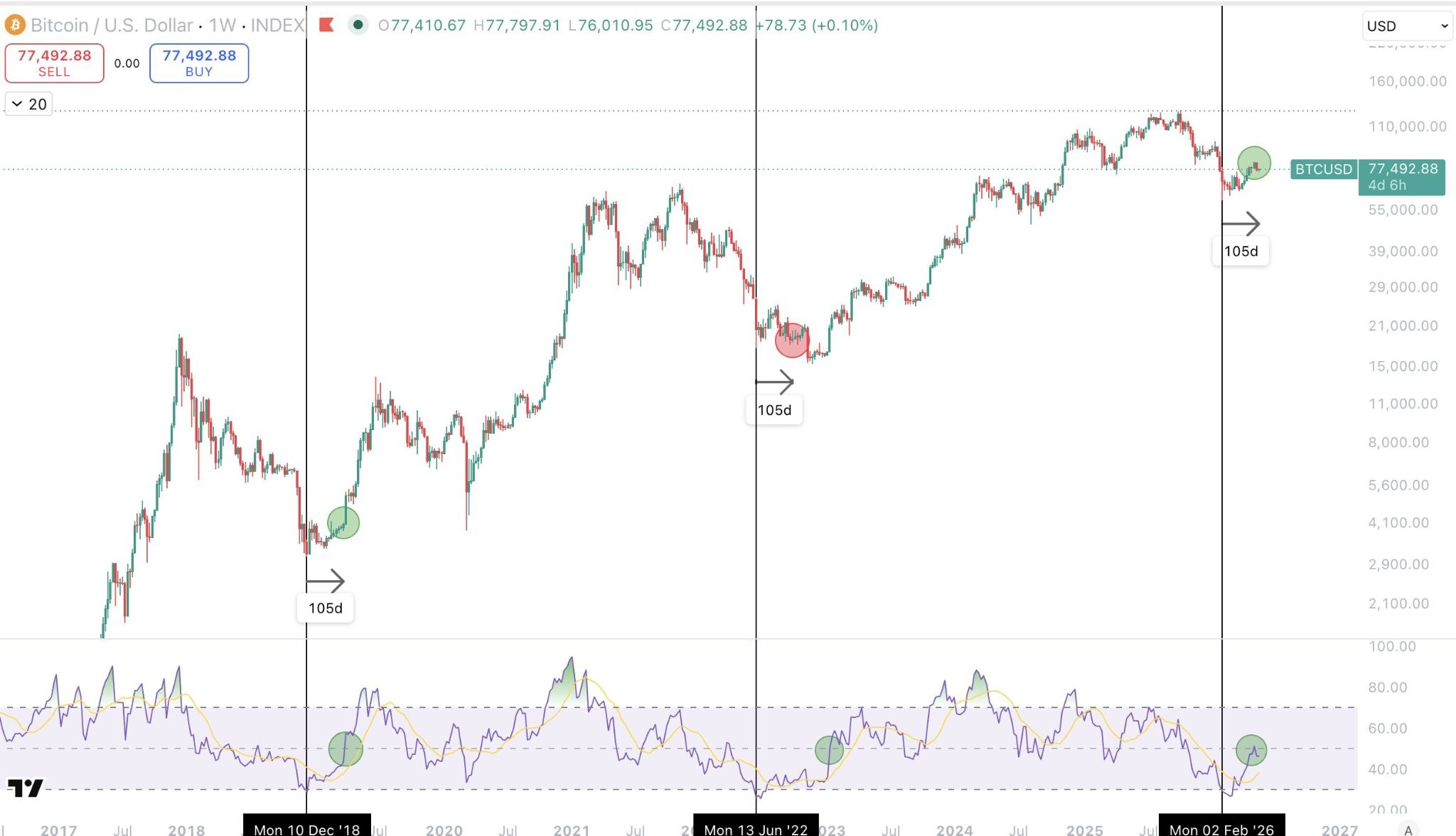
Crypto analyst Sykodelic said the possibility of Bitcoin revisiting fresh lows has “become extremely slim” after the weekly relative strength index (RS) retested the 50 level. Historically, Bitcoin has entered long-term expansion phases after the RSI recovered above that threshold following an oversold position.
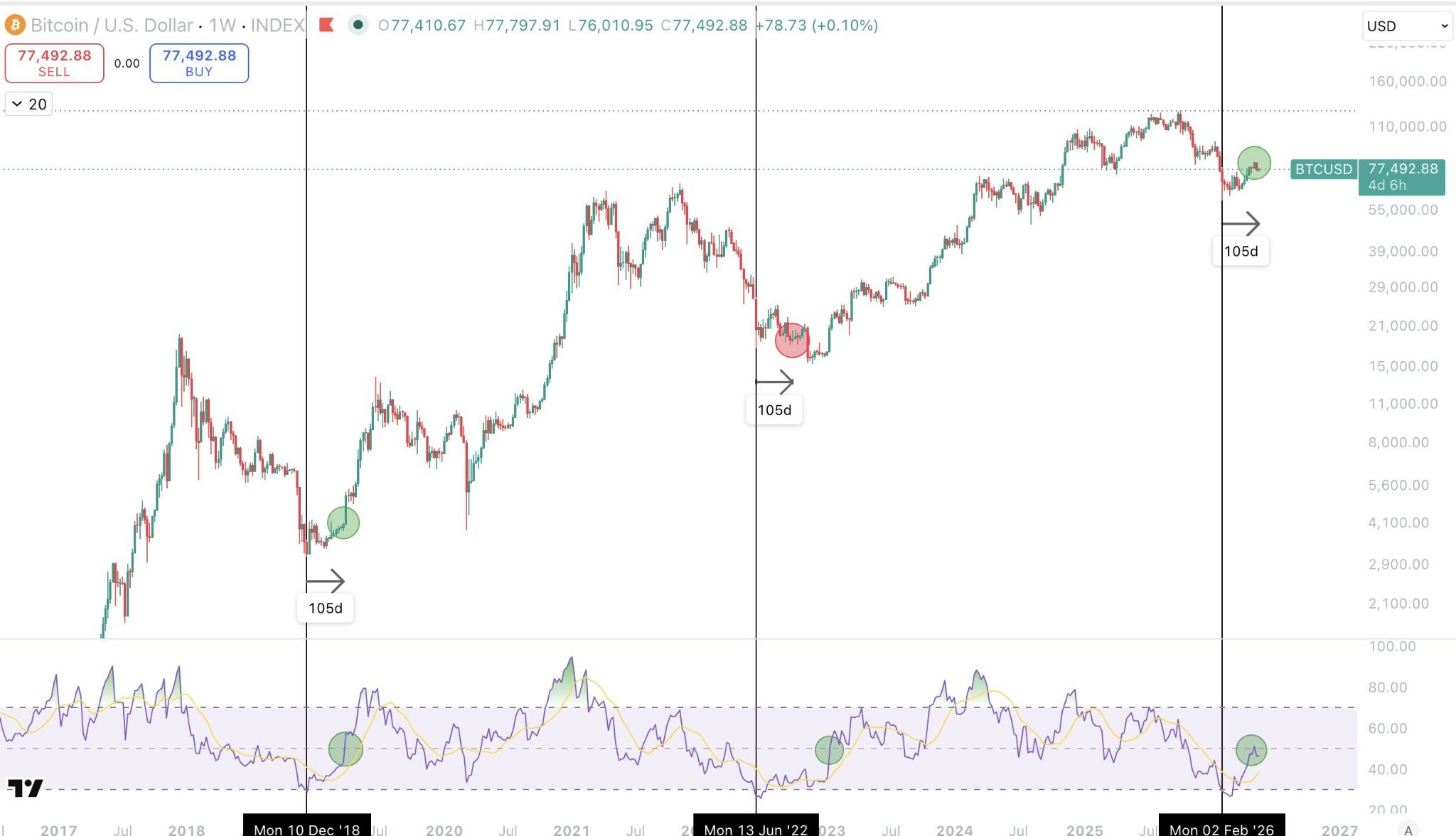
BTC/USD, one-week chart, and RSI analysis. Source: Skykodelic/X
The latest move came 105 days after Bitcoin’s weekly RSI entered oversold territory for only the fourth time on record. Skykodelic noted that the 2022 cycle was the lone exception in which Bitcoin later formed new lows, largely due to the FTX exchange collapse, and forced a market-wide drawdown. In that period, the RSI never retested 50 during the recovery attempt.
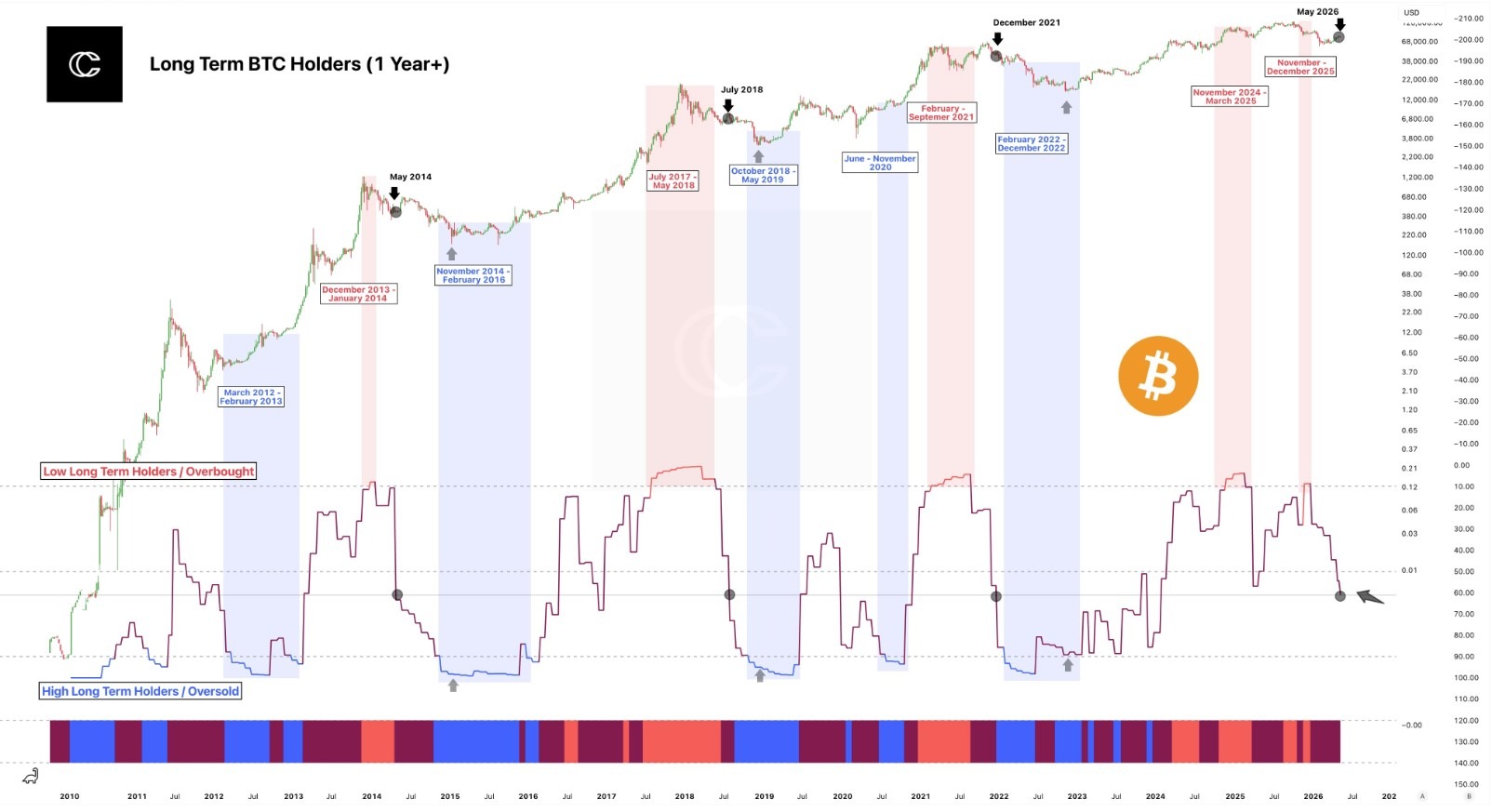
BTC long-term holders (LTHs) are also leaning in the same direction. Crypto analyst CryptoZeno said Bitcoin’s one-year-plus holder metric has returned to the historical “oversold” accumulation zone that preceded major upside cycles in 2013, 2016, 2019 and late 2022.
BTC long-term holders (1+ year) metric. Source: X
CryptoZeno said earlier that market cycle highs in 2021 and 2017 usually formed when LTH holder distribution accelerated. The current readings instead point to a steady accumulation and a tighter available supply of BTC.
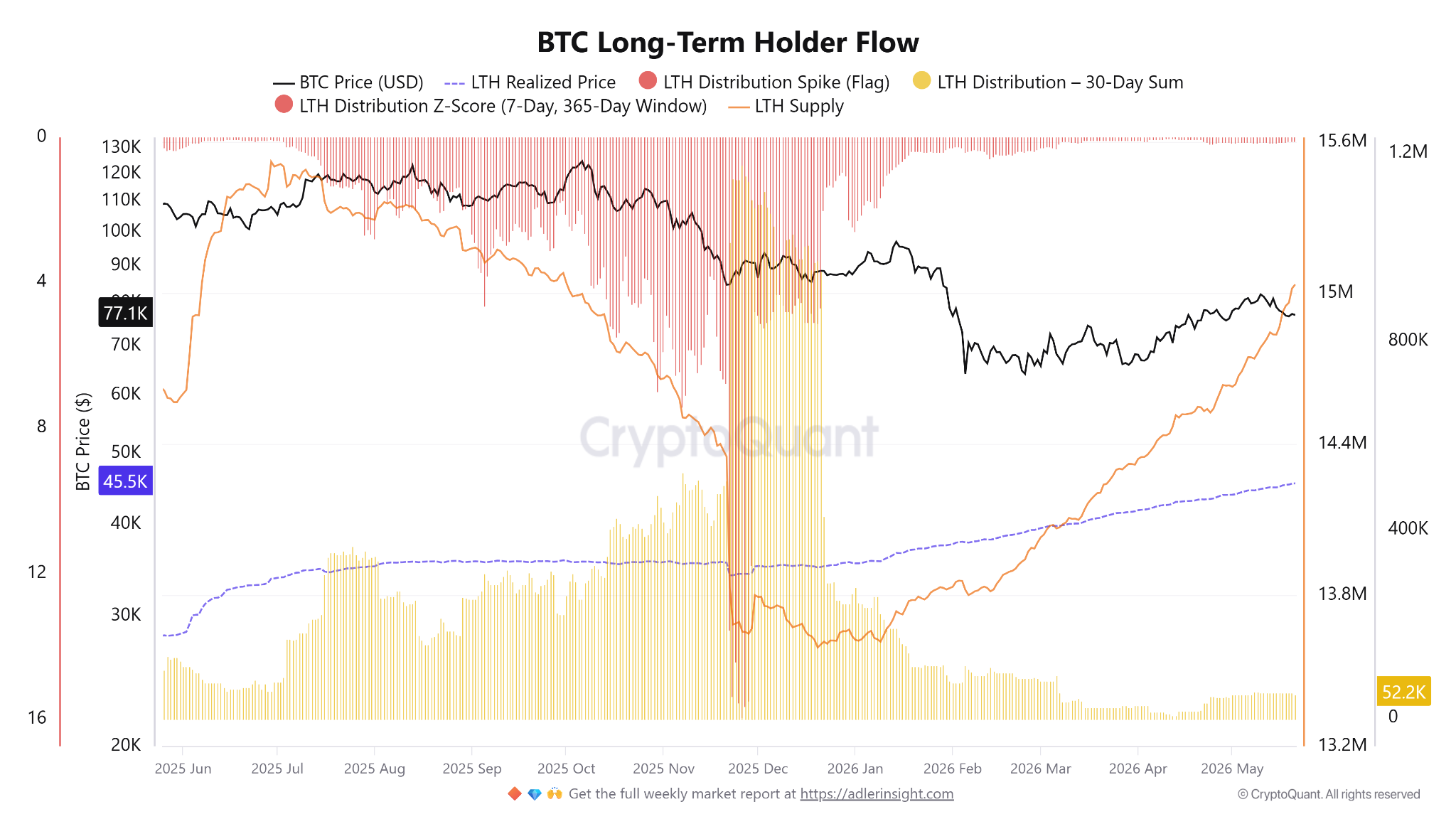
Onchain data supports that trend. Long-term Bitcoin supply climbed back above 15.04 million BTC for the first time since Oct. 1, 2025, accounting for 71.6% of the circulating supply.
BTC long-term holder flow. Source: CryptoQuant
Related: Key Bitcoin price metric used by bulls falls to 6-week low, with silver lining
BTC miners are cautious amid bottom formation
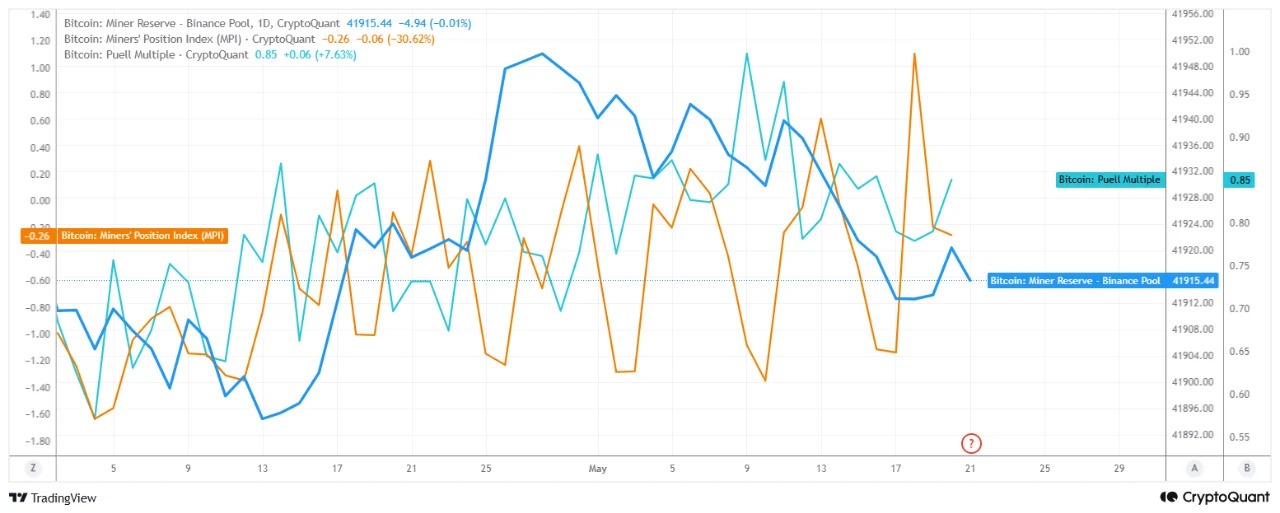
Crypto analyst Pelin Ay said BTC miner activity still points to cautious positioning despite the strong LTH holder data. Binance pool miner reserves dropped to 41,915 from 41,987 in May, indicating a steady supply entering Binance. Speaking on the importance of Binance pool miner reserve data, Ay said,
“Since Binance Pool represents a major share of the global hash rate, its behavior often reflects overall miner psychology before the broader market reacts. Falling reserves usually indicate that operational selling pressure is still continuing.”
BTC Puell Multiple and Binance pool miner reserve. Source: CryptoQuant
Miner Position Index (MPI) readings remain below historical panic-selling levels, while the Puell Multiple stays under 1, signaling continued revenue pressure across mining operations. The analyst described the behavior as a “wait phase” often seen near bottom formations.
Related: Bitcoin due ‘5%+’ move as analysis stays bullish on BTC price outlook
Privacy coins including Zcash and QRL jumped up to 25% on May 21 as quantum computing fears intensified.
Summary
- Zcash gained roughly 7% and QRL surged 25% on May 21 as investors rotated into tokens with privacy features and post-quantum security architecture.
- The total privacy coin sector market cap approached $63 billion, with 24-hour trading volume spiking approximately 24% to $4.7 billion.
- Zcash has gained more than 73% over the past month, outperforming the broader crypto market which rose just 0.2% in the same period.
Privacy coins surged on May 21, with Zcash up roughly 7% and QRL jumping 25%. Qubitcoin and Starknet also gained as the total privacy coin market cap approached $63 billion.
The move came as investors rotated into tokens combining financial privacy and post-quantum security. Glassnode’s recent report classifying 9.6% of Bitcoin supply as quantum-exposed has sharpened demand for tokens built with quantum resistance as a core property.
Why privacy and quantum narratives are converging in 2026
Zcash has risen more than 73% in a month while the broader market gained 0.2%, according to CoinMarketCap data. The divergence reflects a structural re-rating as its zero-knowledge proof technology now underpins major Ethereum layer-2 networks. Crypto.news has tracked how Zcash’s dynamics shifted from speculative to structurally driven in 2026.
QRL’s 25% gain reflects a different angle. The token is built specifically to resist quantum attacks, using lattice-based cryptography rather than Bitcoin’s elliptic curve system. Investors are pre-positioning in infrastructure designed to survive that transition.
What the Glassnode quantum warning added to the rally
Crypto.news has covered the full quantum threat timeline, including research showing breaking Bitcoin’s elliptic curve cryptography requires approximately 2,330 logical qubits.
Citi’s analysis, as crypto.news reported, concluded a quantum attack could put $2 to $3.3 trillion of GDP at risk. Against that backdrop, investors are finding few liquid quantum-resistant options beyond QRL, Zcash and adjacent tokens. The combined market cap of this sector remains small relative to the perceived risk, which is part of what is driving the premium.
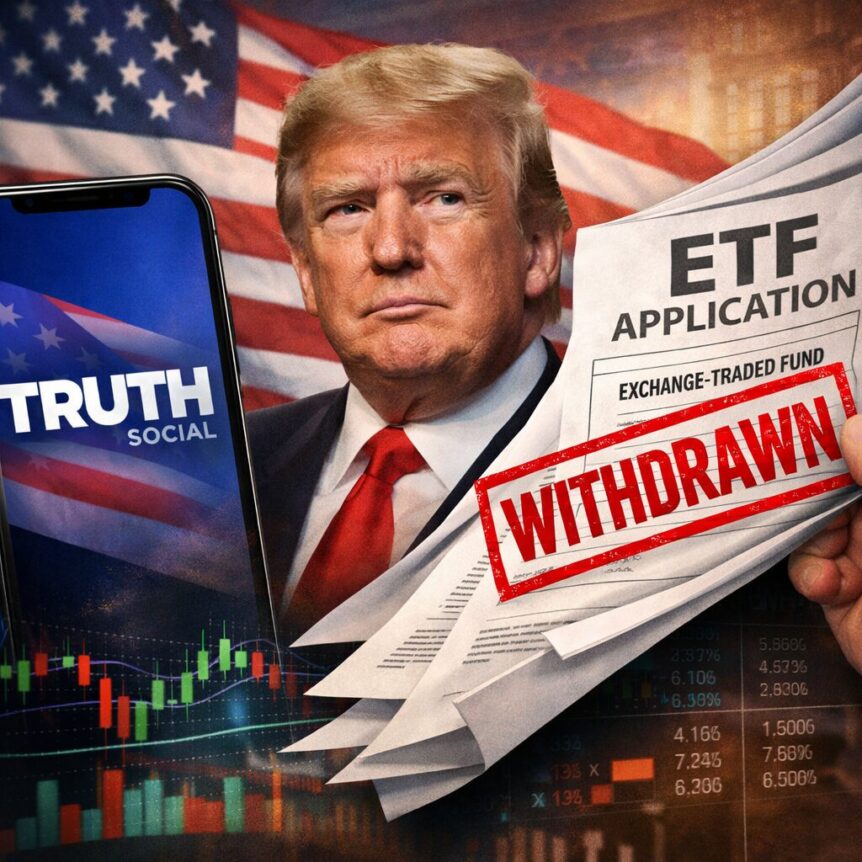
Asset manager Yorkville America has withdrawn several crypto ETF applications filed on behalf of the Trump family-backed Truth Social as it changes strategy.
The ETFs were part of the Trump Media and Technology Group’s broader crypto strategy before it decided to shift to offerings registered under the Investment Company Act of 1940.
Truth Social Pulls ETF Bids
Yorkville America disclosed in a statement released on Tuesday its decision to move away from offerings registered under the Securities Act of 1933 to offerings registered under the Investment Company Act of 1940. The asset manager believes the move will allow it to offer its clients more innovative products while benefiting from better tax efficiencies and stronger investment products. Yorkville America also withdrew its Truth Social Bitcoin and Ethereum ETF and the Truth Social Blue Chip ETF.
According to the asset manager, the Investment Company Act of 1940 framework provides a clear structure to deliver the “differentiated rules-based strategies the firm is developing for its growing clientele.”
Fate of Crypto ETFs Unknown
Yorkville America is known for its “America-first” investment products. The asset manager has not disclosed whether it plans to pursue a crypto ETF under the Investment Company Act of 1940. The withdrawals of the Trump family-linked ETFs come amid growing concerns about President Trump’s links to the crypto industry and conflict with his responsibilities as US president. Democratic senators have repeatedly questioned the president’s crypto interests, particularly his role within the World Liberty Financial crypto platform.
Crypto ETFs Struggle
Yorkville America’s decision comes amid growing struggles for crypto ETFs. Demand has cooled amid a broader crypto market pullback, with net inflows into US spot Bitcoin ETFs sitting at $790 million as of Tuesday, May 19, 2026. The inflows are primarily concentrated in BlackRock’s iShares Bitcoin Trust ETF (IBIT). The decline is stark when compared to the $25 billion in inflows recorded by crypto ETFs in 2025. Ethereum ETFs have also struggled this year, recording $640 million in outflows, while newer altcoin ETFs have failed to drum up investor interest.
Is Rising Competition Behind Yorkville America’s Decision
According to Bloomberg ETF analyst James Seyffart, Yorkville America’s decision to withdraw from the ETF market could be due to growing competition. Competition has intensified after Morgan Stanley launched the Morgan Stanley Bitcoin Trust ETF with a 0.14% fee, undercutting its competition. Yorkville America currently offers funds across defense, energy, security, tech, and real estate. The move under the Investment Company Act of 1940 will allow the asset manager to offer products and ETFs designed for diversified and regulated investment strategies.
Disclaimer: This article is provided for informational purposes only. It is not offered or intended to be used as legal, tax, investment, financial, or other advice.

TLDR:
- Anchorpoint Financial completed HKDAP’s Ethereum mainnet transfer test with OSL and PantherTrade in May 2026.
- Every minted HKDAP token was fully backed by reserve assets and redeemed after the transfer test concluded.
- OSL Group will leverage StableHub, BizPay, and Banxa infrastructure to support phased HKDAP issuance.
- HKDAP phased issuance is set to begin by end of Q2 2026, targeting payments and cross-border capital flows.
Hong Kong’s first officially licensed stablecoin, HKDAP, has cleared a major milestone. Anchorpoint Financial, OSL Group, and Futu Holdings-backed PantherTrade completed a transfer test on the Ethereum mainnet.
The test covered converting statutory Hong Kong dollar funds into reserve assets. All minted tokens were fully redeemed after the test concluded. A phased official issuance is planned before the end of Q2 2026.
HKDAP Transfer Test Marks a Regulated Step Forward
Anchorpoint Financial received its stablecoin issuer license from the Hong Kong Monetary Authority earlier this month.
The company is a joint venture backed by Standard Chartered Hong Kong, Hong Kong Telecom under PCCW, and Animoca Brands.
These institutional partners bring both banking infrastructure and Web3 expertise to the project. Together, they form a foundation built on compliance and regulatory trust.
Standard Chartered’s infrastructure and institutional trust services backed the entire testing process. Every minted and transferred HKDAP token was fully supported by reserve assets throughout the test.
This bank-grade backing is central to what separates HKDAP from unregulated alternatives. The structure ensures that holders have full confidence in the token’s peg to the Hong Kong dollar.
OSL Group confirmed its role in supporting the test and ongoing issuance preparations. Kevin Cui, CEO of OSL Group, stated that “OSL has established a comprehensive stablecoin trading infrastructure, including OSL StableHub for smooth stablecoin and forex trading, OSL BizPay for B2B cross-border payments, and Banxa, a stablecoin deposit and withdrawal channel.”
He added that this product portfolio provides better services to OSL customers and partners. The infrastructure supports the sustainable development of the broader stablecoin ecosystem.
PantherTrade, fully owned by Futu Holdings, also participated in the Ethereum mainnet transfer test. Zhu Guyi, Global Head of Digital Assets at Futu Group, stated that the company “continues to promote qualified investors to deploy in compliant digital assets.”
He added that the collaboration will provide Futu’s extensive investor and institutional network with stable and efficient HKD stablecoin solutions. The partnership reflects growing demand for regulated digital asset products among mainstream investors.
Phased Issuance Plans Support Hong Kong’s Digital Asset Vision
Dominic Maffei, CEO and co-founder of Anchorpoint Financial, described the test as a critical first step. He stated that “completing the minting and transfer testing of HKDAP in collaboration with OSL is the first step toward Anchor Financial’s goal.”
He confirmed that HKDAP will begin phased issuance later in 2026 to support payments and capital flows. The rollout is designed to benefit the real economy, not just digital asset markets.
Maffei further noted that “Anchor Point Finance focuses on creating a safe, convenient, and regulated tokenized currency for Hong Kong.”
He added that achieving a more efficient tokenized financial asset market is a key part of Hong Kong’s vision. This vision positions the city as a global digital asset hub. Reaching that goal requires close collaboration with industry players like Futu and PantherTrade.
OSL confirmed it will continue supporting Anchorpoint Financial and its ecosystem partners in issuance preparations. The platform plans to develop a robust, regulated Hong Kong dollar stablecoin and digital asset ecosystem.
Deep integration with HKDAP is expected to provide users with secure fiat and digital asset exchange channels. It will also support efficient cross-border payment solutions and wider adoption of tokenized financial products.
The successful Ethereum mainnet test signals that Hong Kong’s stablecoin framework is becoming fully operational. Regulatory clarity, institutional backing, and tested infrastructure are now aligned for the next phase.
As issuance begins, market participants will watch how HKDAP performs in live payment environments. The project could set a template for other regulated stablecoin initiatives across the region.

This story was originally published on Retail Dive. To receive daily news and insights, subscribe to our free daily Retail Dive newsletter.
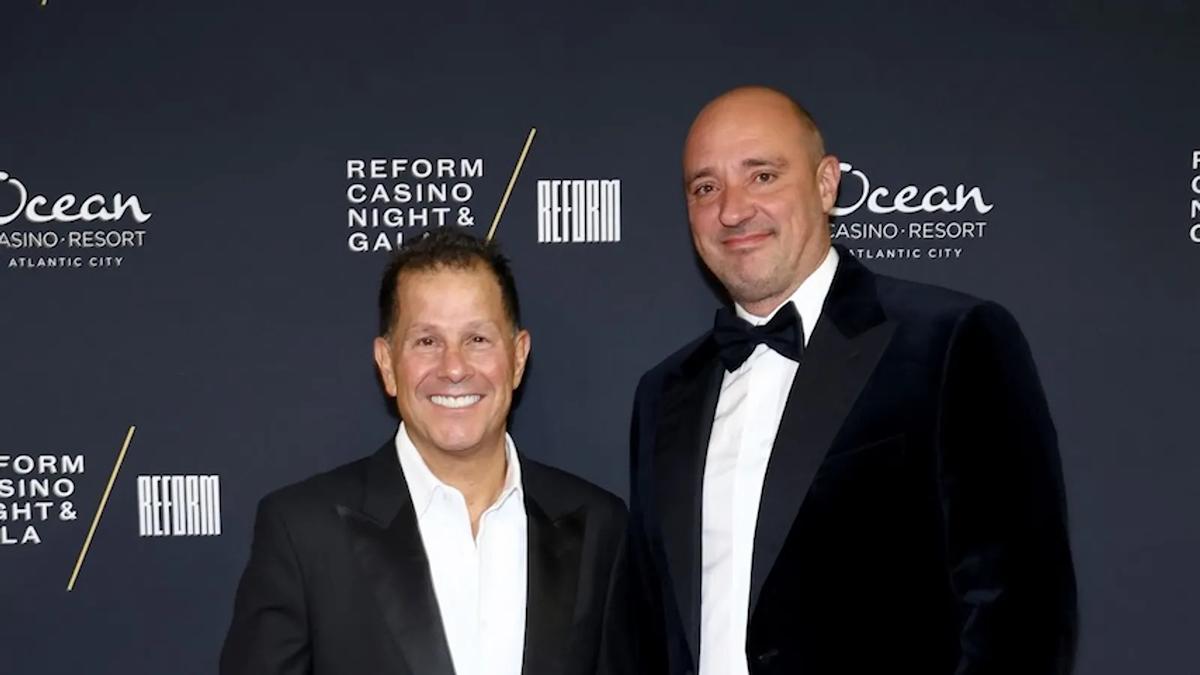
Jamie Salter, who founded Authentic Brands Group in 2010 and grew it into a brand management powerhouse, has stepped down as chief executive officer of the firm.
Matt Maddox, who has been president for over a year and will retain that role, has been promoted to replace him as CEO. He will take over day-to-day operations, though he will report to Salter.
The founder has transitioned to executive chairman of the board and “will remain deeply engaged in the business,” the company said on Wednesday. Salter will continue to oversee “strategic global growth, including mergers and acquisitions, global partnerships and alliances, and other long-term strategic priorities.”
The acquisition of intellectual property — sometimes on the cheap via bankruptcy, as when the company snagged the likes of Brooks Brothers, Aéropostale and Rockport — has allowed Authentic to profit from brands while leaving operations to other entities.
That includes Catalyst Brands, which runs J.C. Penney and several other names in Authentic’s stable. Recently the Catalyst unit running Eddie Bauer filed for bankruptcy and ended up closing all stores after Authentic contracted the brand’s e-commerce to another company.
Authentic’s portfolio now includes more than 50 brands, including Reebok, Champion, Guess, Nautica, Lucky Brand, Nine West, Juicy Couture, Vince Camuto, Izod, Barneys New York and Quiksilver. They also include personalities – living and not – like Shaquille O’Neal, David Beckham, Kevin Hart, Elvis Presley, Muhammad Ali and Marilyn Monroe.
The company also owns 77% of an entity that controls a perpetual master license to luxury stores Saks Fifth Avenue, Neiman Marcus and Bergdorf Goodman, whose parent, Saks Global, is now in bankruptcy.
“I will continue to do what I’ve always done: being laser-focused on driving strategic, transformational opportunities that will position our peerless company for continued growth,” Salter said Wednesday. “I’ll remain actively involved, partnering closely with Matt and the entire leadership team, as we continue building the world’s leading brand, marketing, and entertainment platform.”
The strategy isn’t bulletproof, however. Salter two years ago said he laments picking up the Forever 21 brand in 2020 in partnership with mall operators Simon and Brookfield, calling it “probably the biggest mistake I made.”
Nasdaq-listed Solmate Infrastructure, a Solana-focused treasury and infrastructure company, has raised about $11.4 million via a registered direct offering of Class B common stock.
Summary
- Solmate is issuing 2,298,000 Class B shares at $4.97 each
- The registered direct offering is expected to raise roughly $11.4 million
- The deal is slated to close around May 27, 2026, subject to closing conditions
According to Businesswire, Solmate Infrastructure is issuing a total of 2,298,000 shares of Class B common stock in a registered direct offering priced at $4.97 per share. The company expects to raise approximately $11.4 million in gross proceeds before fees and expenses, with the transaction structured as a directed placement led by its new CEO and a board member at what the company describes as a premium to the recent market price.
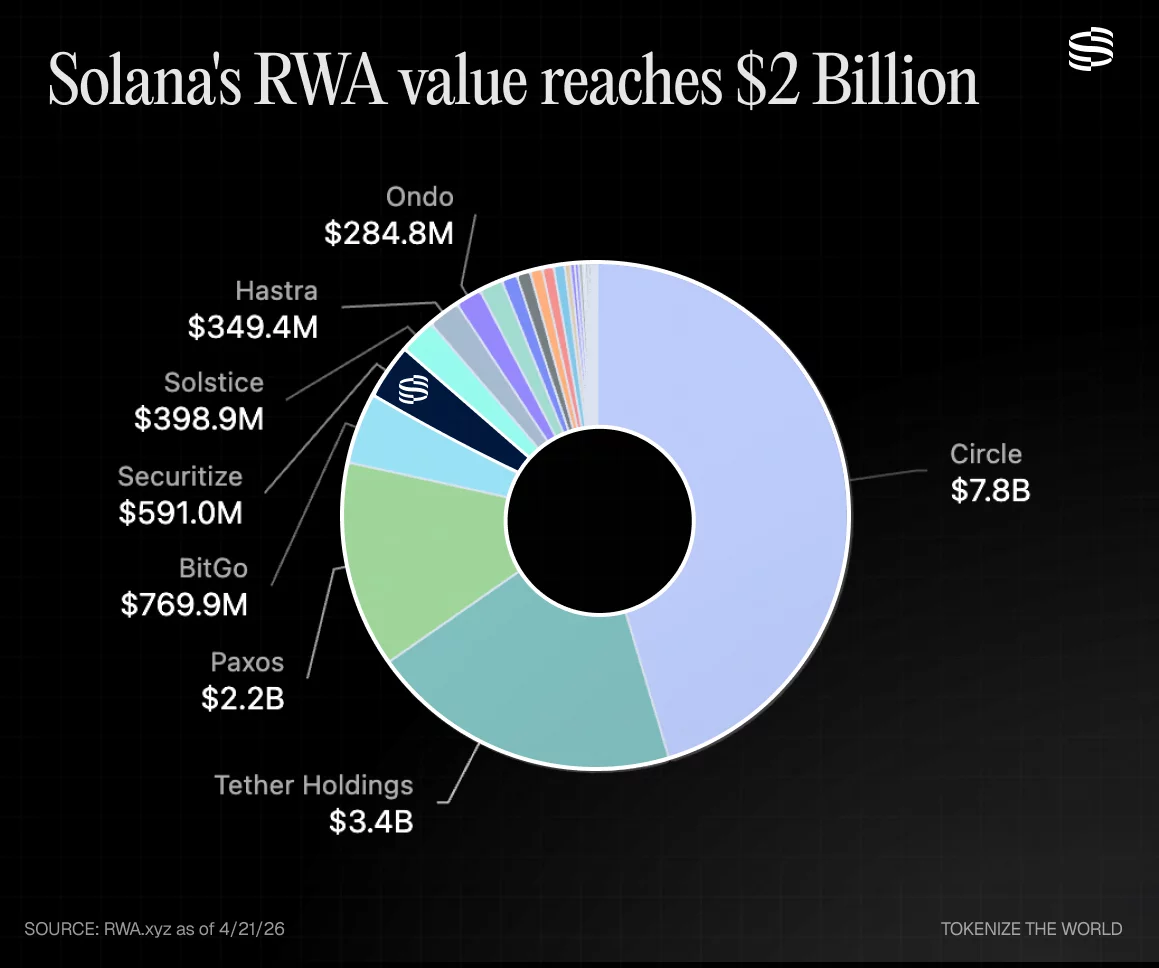
The move comes as Solana’s (SOL) real world assets has hit the $2 billion milestone.
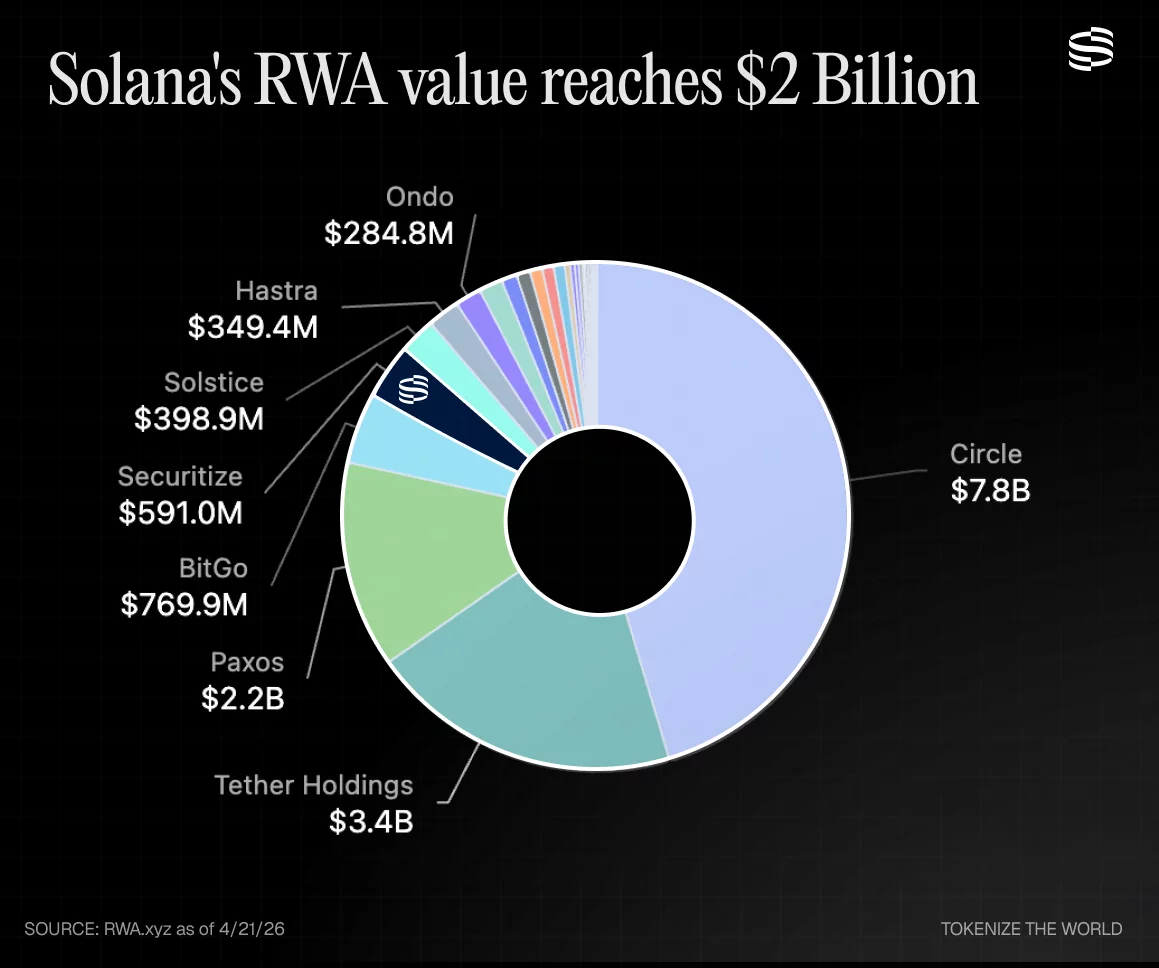
The offering is expected to close on or about May 27, 2026, according to the company, subject to customary closing conditions, including the satisfaction of Nasdaq and regulatory requirements. Solmate said it plans to use the proceeds for general corporate purposes, which may include further development of its Solana infrastructure initiatives, treasury operations, and balance sheet strengthening.
Solana treasury strategy and balance sheet, what does it mean for Solmate?
Solmate Infrastructure, which trades on Nasdaq under the ticker SLMT, positions itself as a “Solana infrastructure company” and digital asset treasury vehicle with a strategic focus on Abu Dhabi. The company emerged from Brera Holdings PLC’s transformation into a Solana-centric treasury and crypto infrastructure business, backed by a $300 million private placement in 2025 involving investors such as the Solana Foundation, RockawayX, and ARK Invest.
In a March 2026 update, Solmate reported holding 1,235,834 SOL tokens as of February 28, 2026, along with approximately $7.1 million in crypto-related securities and around $9.1 million in cash. Based on a SOL price of about $91.58 at the time, the company estimated the market value of its digital asset treasury at roughly $129.4 million, and calculated a total digital asset treasury value of approximately $1.43 per fully diluted share.
Solmate has emphasized that it has not had to sell its SOL holdings to fund operations, arguing that the combination of SOL, crypto securities and cash leaves it “well-positioned from a liquidity and capital perspective.” The new $11.4 million capital raise adds another layer of funding without forcing the firm to liquidate Solana exposure, effectively giving it more runway to build out Solana staking, validator and infrastructure projects in Abu Dhabi and beyond.
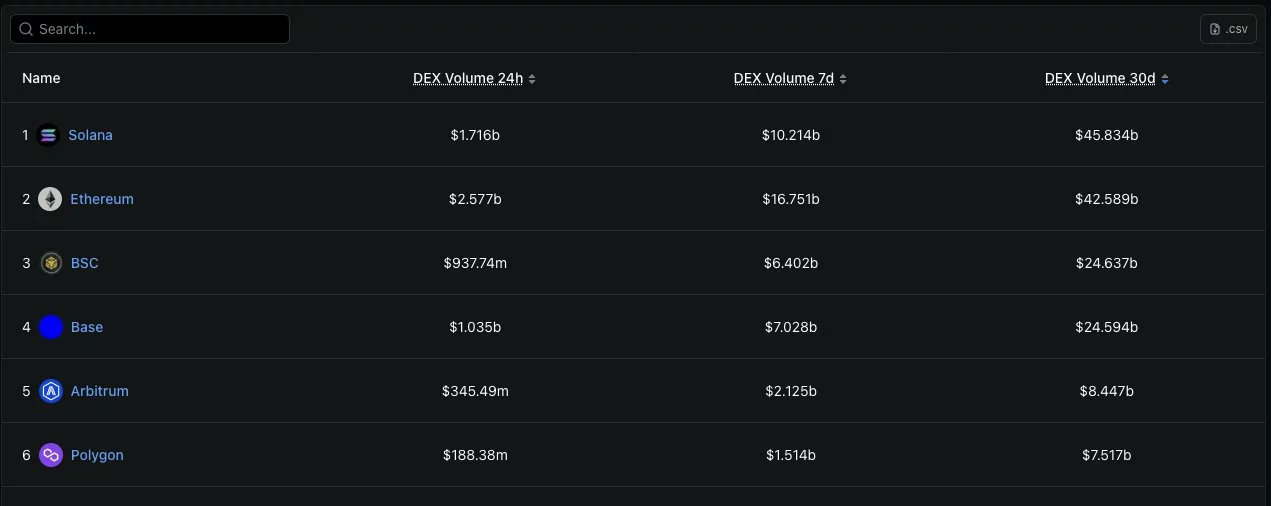
Dilution, valuation and Solana exposure, how does Solmare stack up to other validators?
The registered direct offering does dilute existing shareholders—2,298,000 new Class B shares on top of roughly 82 million fully diluted shares is not trivial—but the company is signaling that it prefers equity capital at a premium price over selling down its SOL stack. For a business explicitly marketed as a Solana treasury and infrastructure play, maintaining SOL exposure is central to the equity story.
Solmate’s earlier disclosures highlight plans to run high-performance Solana validators in the UAE and to develop yield-generating infrastructure tied to Solana’s ecosystem. In that context, the new funding helps bridge the gap between a volatile token treasury and the more mundane but necessary costs of running data centers, validators and corporate overhead in a public-company framework.
The company’s stock has been extremely volatile—at one point jumping 500% after its $300 million funding round and Solana‑backed pivot—underscoring how tightly SLMT trades as a geared play on Solana sentiment. With roughly $129.4 million in digital asset treasury value and a much lower equity market capitalization, Solmate has pitched itself as a way for public-market investors to gain levered exposure to Solana via a listed vehicle.
For Solmate, the $11.4 million raise is small compared to its headline treasury figures but significant for day-to-day operations. For investors, it is another reminder that in this corner of the market, balance sheets are as much about tokens as they are about cash—and that equity raises, even at a premium, are part of the cost of holding the SOL line.
A political action committee (PAC) that claimed to “support candidates working to advance digital asset and blockchain policy in the United States” announced its picks for the 2026 election cycle, potentially influencing key races with money from the crypto industry.
In a Thursday notice, the Blockchain Leadership Fund said it had endorsed ten candidates for the 2026 US midterm elections, four in the Senate and six in the House of Representatives. Chainlink Labs and Anchorage Digital announced the launch of the PAC in March amid other committees that spent heavily in the 2024 US election cycle, like Fairshake.
The PAC’s picks included Republicans Barry Moore, Kurt Alme and Jon Husted for US Senate races in Alabama, Montana and Ohio, respectively, and Houston Gaines, Jim Kingston and Jon Bonck for House runs in Georgia’s 10th district, Georgia’s 1st district and Texas’ 38th district, respectively. It will also support Democrats Angie Craig’s run for the US Senate in Minnesota and Adrian Boafo, and Christian Menefee and Don Davis for House races in Maryland, Texas, and North Carolina.
“We believe constructive bipartisan participation is critical to ensuring the US remains a global leader in financial technology and the future of finance,” said an Anchorage Digital spokesperson. “We remain committed to supporting responsible innovation and constructive policymaking that brings digital assets further into the regulatory perimeter and strengthens trust in the ecosystem.”
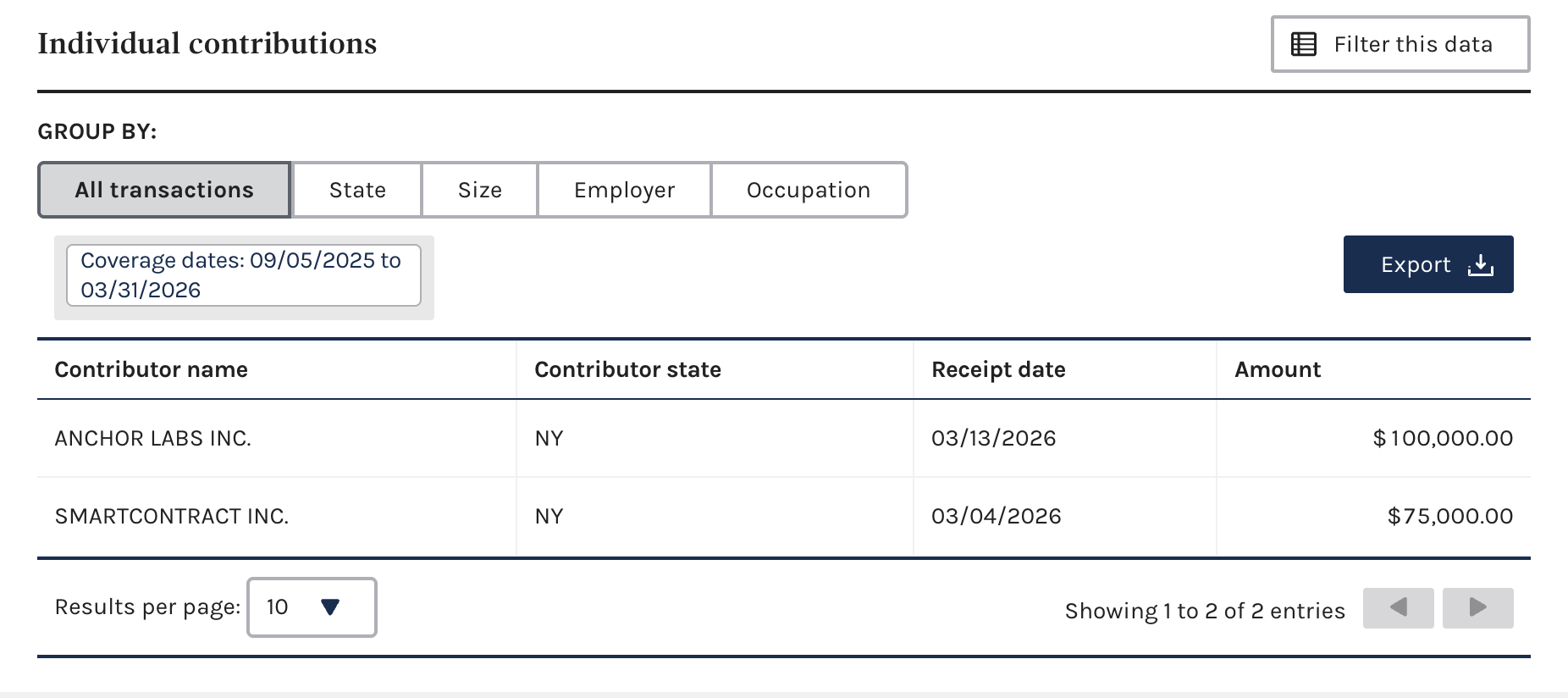
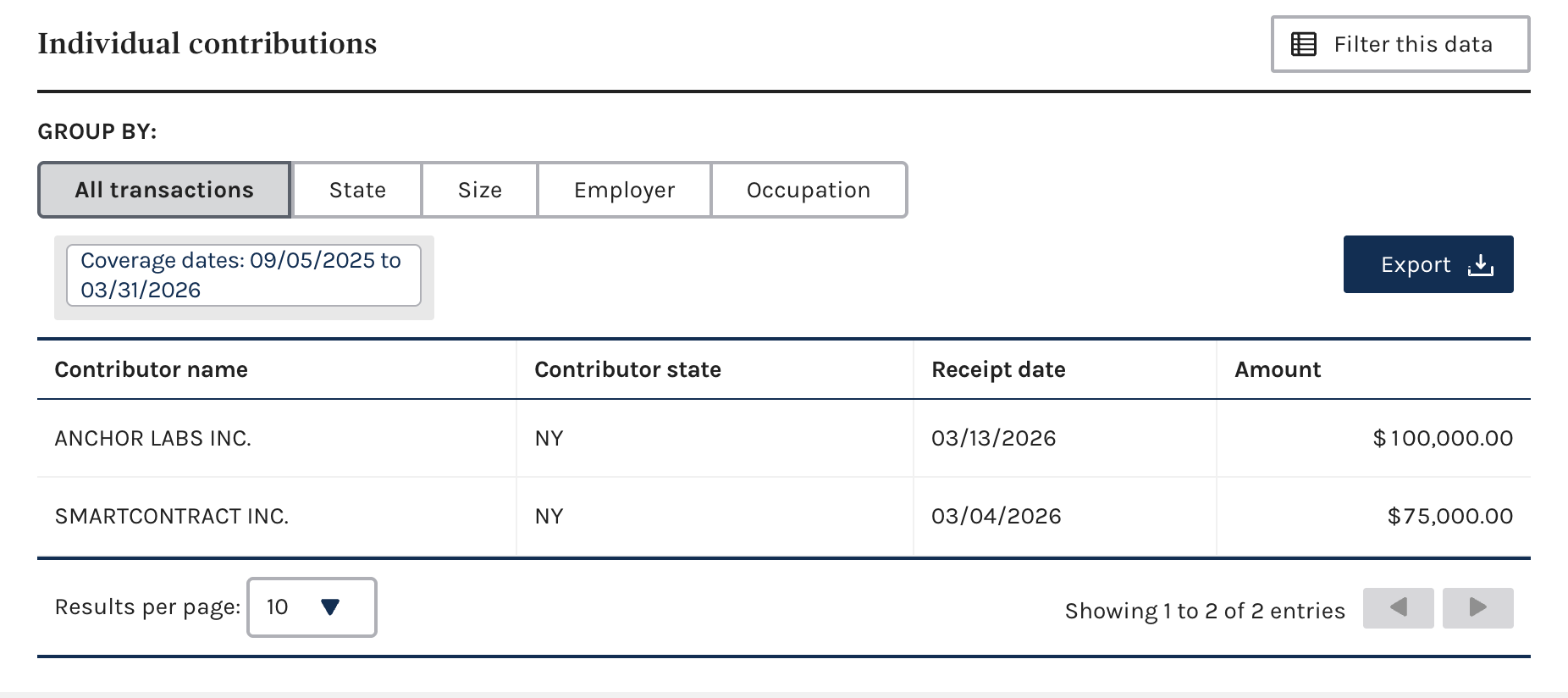
Funding for Blockchain Leadership Fund. Source: FEC
The committee, which is a hybrid PAC set up to allow contributions directly to candidates as well as independent expenditures, said it may announce support for other candidates “who support responsible digital asset policy” before the midterm elections in November. As of Thursday, filings with the Federal Election Commission (FEC) showed only $175,000 in funding for the Blockchain Leadership Fund: $100,000 from Anchorage and $75,000 from Chainlink.
Related: Georgia primary to test crypto PAC’s support for Democratic candidate
The Blockchain Leadership Fund’s endorsements came after some of its chosen candidates won their respective primaries on Tuesday. Kingston and Gaines won Republican primaries in Georgia, and Moore will go to a runoff for Alabama’s US Senate seat after failing to secure a majority of the vote.
All three already benefited from a combined $8.5 million in media spending by the Defend American Jobs PAC, a Fairshake affiliate, which also poured about $350,000 into media to support Bonck in Georgia. Another PAC affiliated with Fairshake, Protect Progress, spent more than $4.1 million to support Menefee in his Texas runoff against incumbent Al Green and more than $2 million on media for Boafo in Maryland.
Crypto spending ahead of Texas Senate race, Trump gets involved
While Menefee and Green are set to go head-to-head next Tuesday, money from the crypto industry is also flowing into Texas over a Republican primary for one of the state’s US Senate seats.
The Fellowship PAC, an $11 million committee funded by Cantor Fitzgerald and Anchorage Digital, reported to the FEC on Wednesday that it would be spending $500,000 to support Texas Attorney General Ken Paxton for US Senate. The filing came more than a month after Fellowship reportedly withdrew funding for media on Paxton in response to pressure from Republican leaders toward Commerce Secretary Howard Lutnick, connected to Cantor Fitzgerald.
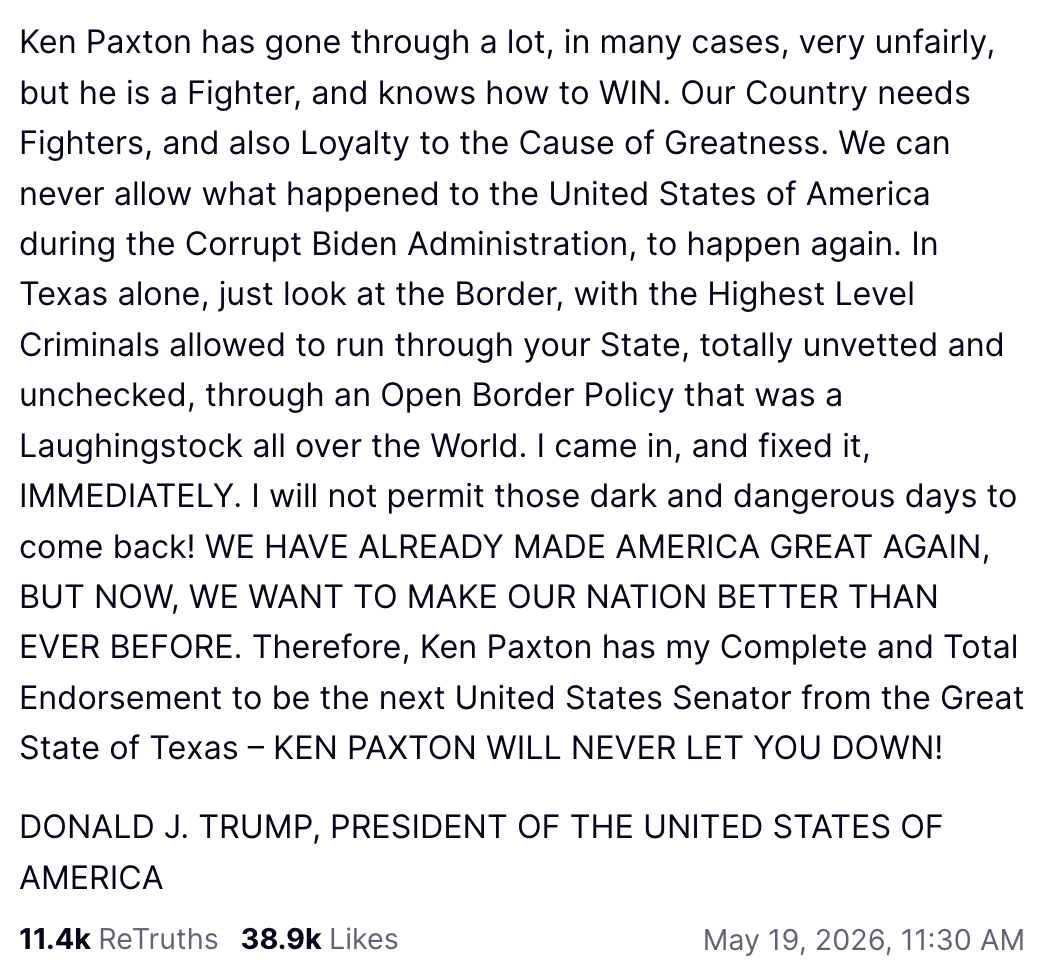
Truth Social post endorsing Ken Paxton for US Senate. Source: Donald Trump
US President Donald Trump announced on Tuesday that he would be supporting Paxton over incumbent John Cornyn. State Representative James Talarico won a March Democratic primary, and will face off against the Republican candidate to be decided after a Tuesday runoff between Paxton and Cornyn.
Magazine: 5 tech predictions the mainstream media got horribly wrong

Securities and Exchange Commission Chair Paul Atkins said fund sponsors agreed to delay several event contract ETFs tied to prediction markets while the agency seeks public input.
Meanwhile, the Commodity Futures Trading Commission and the National Hockey League announced a memorandum of understanding aimed at policing event contracts built around professional hockey.
Parallel Oversight of Prediction Markets
The announcements show the SEC and CFTC moving in step to handle a sector that has expanded faster than regulators have written rules.
Roundhill Investments, GraniteShares, and Bitwise’s PredictionShares brand have filed roughly two dozen event contract ETF proposals since February.
The funds would package binary bets on elections, recessions, and sports outcomes into brokerage-friendly wrappers.
Atkins framed the delay as a process question rather than a rejection. The new SEC chair said staff will seek public input on how the agency should respond to recent market changes.
CFTC and NHL Integrity Pact
The CFTC-NHL agreement formalizes information sharing and coordinated monitoring between the agency and the league.
Designated representatives will communicate regularly on integrity issues and share data confidentially.
Our agreement with the CFTC enhances the comprehensive integrity monitoring systems already in place and strengthens our ability to identify, deter, and address potential risks,” the agency stated.
NHL Commissioner Gary Bettman attached the statement to the CFTC release. The league already runs licensing deals with Kalshi and Polymarket, giving each platform settlement feeds for hockey contracts.
CFTC Chair Mike Selig signed a similar pact with Major League Baseball in March and has previously warned on fraud inside prediction market venues.
Joint Approach Under New Leadership
The two agencies signed their own coordination memorandum in March 2026 covering product definitions and emerging technology.
Both chairs are appointees of the current administration who favor what they call innovation with guardrails.
ETF assets have tripled since 2019, according to Atkins. Prediction market open interest reached $1.2 billion in weekly volume earlier this year.
Retail investors being able to access event contract ETFs now hinges on the public comment process.
The post US Regulators Move on Prediction Markets With ETF Pause and NHL Pact appeared first on BeInCrypto.

William records birthday message during Duchy housing development visit

North Carolina sues Vietnam’s VinFast over delayed EV project

US Congressman’s ARMA Bill Would Codify 20-Year Strategic Bitcoin Reserve


-

 Crypto World6 days ago
BloFin War of Whales 2026 Grand Prix opens registration for $5M trading championship
-

 Fashion6 days ago
Weekend Open Thread: Theory – Corporette.com
-

 Crypto World6 days ago
E-Estate Announces 1 Year Live: Washington DC Summit as Real Estate Tokenization Enters Its Next Phase
-

 Tech7 days ago
Tech Moves: Microsoft AI leader jumps to OpenAI; former AI2 exec joins Meta; and more
-

 Tech6 days ago
Google reimburses Register sources who were victims of API fraud
-

 Business6 days ago
H&R Real Estate Investment Trust (HR.UN:CA) Q1 2026 Earnings Call Transcript
-

 Entertainment7 days ago
David Letterman Returns to Late Show, Blasts Cancellation
-

 Sports6 days ago
Napoleonic enters 2026 Doomben 10,000 field via Abounding withdrawal
-
 Crypto World6 days ago
BeInCrypto 100 Institutional Awards Nomination: KAST for Best Digital Assets Neobank and Best Digital Assets Fintech
-
 Crypto World6 days ago
Bitcoin Battles US Bond Nerves With BTC Price Dip Toward New May Lows
-

 Crypto World6 days ago
ICE and CME urge US regulators to curb Hyperliquid energy trading
-
 Crypto World6 days ago
Wall Street’s Boldest Gold Prediction Has Russians Rushing to Buy
-

 Fashion5 days ago
On the Scene at Gucci’s Cruise Show in New York City: Mariah Carey, Kim Kardashian, Lindsay Lohan, Iman, and More!
-

 Crypto World6 days ago
IREN closes $3 billion convertible notes deal amid AI infrastructure expansion
-

 Fashion6 days ago
Trending Western Style Vests Perfect for Summer
-

 Politics6 days ago
Watch: far-right flag-fanatics run over victim, attack locals – Setup By the Left wing for your entertainment
-

 Fashion7 days ago
Creative Ideas for Custom T-Shirts
-

 Fashion5 days ago
Amazon Sundays: Memorial Day Hosting
-
 Fashion7 days ago
Philip Jones Wedding Jewellery For Women
-

 Crypto World9 hours ago
Blockchain.com files with SEC for U.S. IPO
You must be logged in to post a comment Login