
Crypto World
Bitcoin May Rebound to $85K as CME ‘Smart Money’ Slashes Short Bets

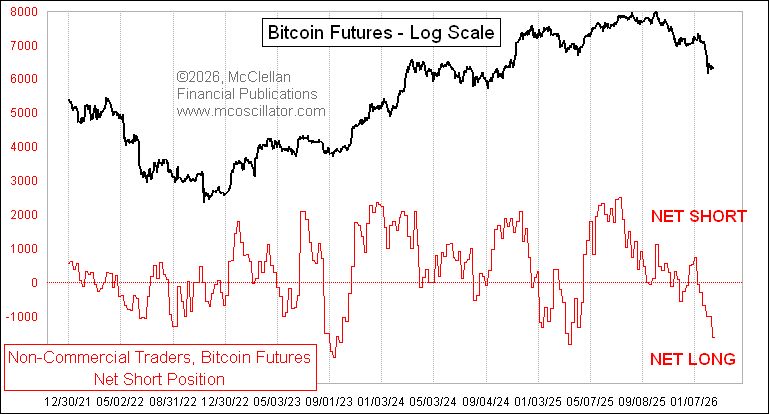
Bitcoin (BTC) bottomed after CME futures speculators turned net bullish in April 2025. A similar positioning shift is resurfacing in 2026, raising the odds of a BTC price recovery in the coming weeks.
Key takeaways:
BTC futures, technicals hint at $85,000 price target
Non-commercial Bitcoin futures traders cut their net position to about -1,600 contracts from roughly +1,000 a month earlier, according to the CFTC Commitment of Traders (COT) report published last week.

In practice, this means that large speculators, including hedge funds and similar financial institutions, have shifted from net short to long, with bulls outnumbering bears on the CME.
The rapid net-short unwind implies that “smart money” added longs “with some urgency,” said analyst Tom McClellan, while pointing to two similar past swings that preceded Bitcoin price bottoms.
For instance, BTC’s price gained around 70% after a sharp dip in CME Bitcoin futures net shorts in April 2025. In 2023, BTC price rose by over 190% under similar futures market conditions.

As of February, the smart money swing is flashing once again, just as Bitcoin defends its 200-week exponential moving average (200-week EMA, the blue line), which has acted as a bear-market floor in most major drawdowns of the last decade.
On Sunday, BTC’s 200-week EMA was hovering around near $68,350.

The last time Bitcoin traded around this moving average during deep sell-offs (in 2015, 2018 and 2020), it eventually marked the end of the downtrend and the start of a new recovery phase.
Related: Bitcoin historical price metric sees $122K ‘average return’ over 10 months
Bitcoin’s weekly relative strength index (RSI) remains in oversold territory, a sign that selling pressure is nearing exhaustion.
That further raises Bitcoin’s odds of recovering in the coming weeks. A decisive rebound from the 200-week EMA could trigger a run-up toward the 100-week EMA (the purple wave) at roughly $85,000 by April.
Bitcoin bulls aren’t out of the woods yet
McClellan cautioned that the smart money shift is “a condition, not a signal,” meaning Bitcoin could still slide from its current price levels before a durable low forms.
That may trigger the 2022 scenario, wherein BTC plunged by over 40% after breaking below its 200-week EMA despite similar oversold conditions.

A repeat of that 40% plunge in 2026 could result in BTC prices falling toward $40,000, or 60% from its record high of around $126,270.
Some analysts, including Kaiko, also see BTC potentially bottoming around $40,000–$50,000 based on its “four-year cycle” framework.
This article does not contain investment advice or recommendations. Every investment and trading move involves risk, and readers should conduct their own research when making a decision. While we strive to provide accurate and timely information, Cointelegraph does not guarantee the accuracy, completeness, or reliability of any information in this article. This article may contain forward-looking statements that are subject to risks and uncertainties. Cointelegraph will not be liable for any loss or damage arising from your reliance on this information.

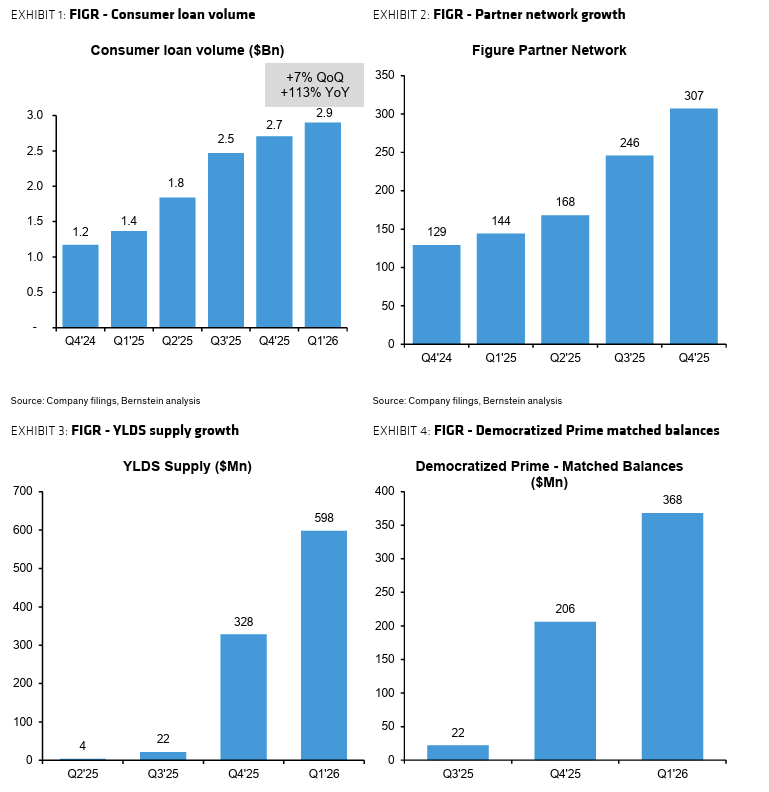
Figure Technology Solutions, a blockchain-based lending platform that went public last year, may be undervalued at current levels as loan originations accelerate and its tokenized credit marketplace scales, according to Bernstein analysts.
In a report published Monday, Bernstein assigned Figure an “Outperform” rating and a $67 price target — nearly double the stock’s recent trading level of around $32.
The bullish call follows a surge in lending activity. Figure originated $1.2 billion in loans in March, up 33% from the previous month and marking the first time monthly volumes exceeded $1 billion.
The company primarily originates home equity lines of credit (HELOCs), which allow homeowners to borrow against their equity in the property, typically at lower interest rates than unsecured loans.
It uses the Provence blockchain to reduce friction in the loan process which it claims makes it more efficient than traditional lenders. According to Provenance, Figure is able to shave 117 basis points per loan by transacting on the blockchain.
First-quarter originations reached $2.9 billion, more than doubling from a year earlier and defying the usual seasonal slowdown in HELOC demand. The figure is now tracking roughly $12 billion in annualized loan volume.

Figure’s strong start to the year follows a largely positive fourth quarter, where earnings and revenue increased, though profits fell short of expectations.
Related: CoinShares stock makes US debut on Nasdaq following SPAC merger
Figure stock struggles despite strong fundamentals
Despite improving operating performance, Figure shares have fallen more than 20% this year, reflecting broader volatility across digital asset–linked stocks and sector-specific pressures.
The stock has also struggled to regain momentum following its high-profile Nasdaq market debut last September. That closely watched initial public offering valued the company at nearly $800 million.

Still, Bernstein’s analysis valued the company at roughly 25 times its projected 2027 EBITDA — meaning the stock trades at a multiple of its expected earnings before interest, taxes, depreciation and amortization.
This valuation sits above existing digital asset companies, reflecting what analysts describe as Figure’s “structural prospects” as both a tokenization platform and a profitable lending business.
However, risks remain. According to Bernstein, HELOC demand can be sensitive to mortgage refinancing trends, while the broader private credit market — a key pillar of Figure’s growth strategy — has shown signs of increasing pressure.
Related: Crypto Biz: Bitcoin treasuries break ranks as BTC dips below $70K


Crypto has added to a Sunday rally, with bitcoin rising above $70,000 in quiet post-Easter U.S. trading hours.
The gains come alongside a modest advance in the major stock market averages ahead of President Trump’s Tuesday ultimatum for Iran to open the Strait of Hormuz. Just past the noon hour on the East Coast, the Nasdaq is higher by 0.45% and the S&P 500 by 0.3%.
Bitcoin is now higher by nearly 4% over the past 24 hours, with ether, XRP and solana posting similar gains.
Contrarian bitcoin bulls — as bitcoin crashed to $60,000 in early February — first took hope that a bottom was forming, as the strongly no-coiner Financial Times took a victory lap.
The bulls may have been even more pleased over this past weekend by a couple of other bottoming signals. First was the late Friday news that Jeff Park was exiting his role as chief investment officer at ProCap Financial (BRR). Led by Anthony Pompliano, ProCap was among 2025’s hastily formed bitcoin treasury companies aiming to hitch their wagon to the BTC bull market and replicate the success of Michael Saylor’s Strategy.
As with others of the 2025 crop — David Bailey’s Nakamoto (NAKA) and Jack Mallers’ Twenty One Capital (XXI) among them — ProCap stock has struggled mightily, performing far worse for shareholders than bitcoin itself.
Second was well-followed, longtime bull Willy Woo, suggesting that bitcoin could trade sideways for 8 to 12 years from here before finally entering a major bull market.
Other signals of the past couple of weeks: bitcoin miner MARA Holdings unloading more than 15,000 of its bitcoin stack, peer Riot Platforms selling off its entire March BTC production of 3,778 coins, and the aforementioned Nakamoto parting with some its holdings.
Whether the true bottom is in remains to be seen, but the bottoming signs continue to grow.

Key Takeaways
- Appeals court rules federal oversight supersedes state jurisdiction for Kalshi
- CFTC authority confirmed over prediction market contracts
- State gambling regulations blocked from interfering with Kalshi operations
- Decision establishes crucial precedent for U.S. prediction market industry
- Kalshi’s federally-regulated status validated by Third Circuit judges
A federal appeals court delivered a decisive victory for Kalshi, establishing that state regulators cannot enforce gambling restrictions against the prediction market platform. The Third Circuit Court of Appeals determined that Kalshi operates exclusively under Commodity Futures Trading Commission supervision, creating a protective federal shield against conflicting state laws. This watershed moment significantly expands Kalshi’s operational certainty across the nation.
Court Establishes Federal Supremacy Over Prediction Markets
The Third Circuit judges unanimously determined that Kalshi’s event-based contracts constitute federally regulated commodities rather than state-controlled gambling activities. The panel recognized Kalshi’s designation as a contract market under direct CFTC jurisdiction. This classification prevents individual states from applying their gambling statutes to the platform’s offerings.
The court’s analysis centered on the Commodity Exchange Act’s framework, which assigns comprehensive regulatory authority to the CFTC for swap agreements and related financial instruments. Judges found that sports outcome contracts traded on Kalshi qualify as swaps under federal commodity law. This interpretation grants Kalshi immunity from state-level enforcement measures.
The legal challenge originated when multiple state authorities, notably New Jersey, issued cease-and-desist directives targeting Kalshi’s operations. Kalshi contested these actions by asserting that federal regulatory approval preempts state-level prohibitions. The appellate court validated this argument, reinforcing the primacy of federal oversight.
State Regulators Face Jurisdictional Setback
New Jersey’s attorney general contended that Kalshi’s contract offerings violated state gambling prohibitions and operated illegally within state borders. The court dismissed this position, determining that the Commodity Exchange Act explicitly reserves regulatory power for federal authorities. Kalshi successfully defended against potential operational restrictions that threatened its business model.
The majority opinion stressed that Congressional intent clearly established the CFTC as the sole regulator for designated contract markets and swap transactions. According to the ruling, states retain enforcement capabilities only over activities falling outside federal regulatory frameworks. Kalshi’s compliance with CFTC requirements places it firmly within protected federal territory.
A lone dissenting judge raised concerns that Kalshi’s products functionally mirror conventional sports wagering activities. This dissent advocated for preserving state regulatory rights over betting-like offerings. Despite this objection, the prevailing judicial opinion affirmed Kalshi’s status as a legitimate commodities exchange platform.
Implications for the Prediction Market Industry
This judicial determination establishes critical legal foundation for prediction market growth throughout American financial markets. Kalshi now enjoys enhanced regulatory clarity enabling nationwide service expansion without confronting conflicting state requirements. The decision eliminates substantial legal ambiguity that previously clouded federal-state jurisdictional boundaries.
The Commodity Futures Trading Commission has consistently backed Kalshi and comparable platforms when facing state regulatory challenges. Federal regulators have actively opposed state attempts to impose restrictions on CFTC-approved exchanges. This appellate victory provides additional confirmation of Kalshi’s regulatory compliance and legitimacy.
The precedent established by this case will likely shape how emerging prediction market ventures structure their platforms under federal commodity regulations. Kalshi emerges with strengthened competitive positioning and validated legal framework for continued growth. This ruling represents a defining moment for prediction markets’ integration into mainstream financial infrastructure.



A US appeals court sided with Kalshi, ruling that CFTC‑regulated event contracts fall under federal law, not New Jersey gambling rules, reshaping prediction market oversight.
Summary
- U.S. appeals court says New Jersey cannot regulate Kalshi’s CFTC‑supervised sports contracts.
- Ruling strengthens federal preemption and could reshape how prediction markets compete with sportsbooks.
- Decision lands amid a broader legal war between states, Kalshi, and the CFTC over who controls event‑based trading.
A federal appeals court has ruled that New Jersey cannot bar Kalshi from offering sports‑related event contracts in the state, declaring that the Commodity Exchange Act and the Commodity Futures Trading Commission (CFTC) hold exclusive authority over those markets. In a 2‑1 decision, the 3rd U.S. Circuit Court of Appeals in Philadelphia held that trading on Kalshi’s designated contract market is governed by federal derivatives law, not state gambling codes, effectively blocking New Jersey regulators from enforcing their cease‑and‑desist order. The ruling cements a major legal win for Kalshi, which has argued for years that its contracts are swaps and hedging tools rather than traditional sports bets.
The case stems from a series of cease‑and‑desist letters sent by New Jersey in 2025, accusing Kalshi’s sports markets of violating the state’s Sports Wagering Act and constitution and threatening fines of up to $100,000 per violation. Kalshi sued in federal court, claiming that, as a CFTC‑regulated designated contract market, its event contracts sit squarely within federal jurisdiction and are “a type of ‘swap’ regulated by the Commodity Exchange Act.” A New Jersey federal judge had already granted Kalshi a preliminary injunction in 2025, writing that he was “persuaded that Kalshi’s sports‑related event contracts fall within the CFTC’s exclusive jurisdiction,” a view the 3rd Circuit has now largely endorsed.
The appeals court’s opinion aligns with Kalshi’s broader strategy as it fights regulators in multiple states, including Nevada, Maryland, and Tennessee, over whether its markets are illegal gambling or federally protected derivatives. In Tennessee, for example, U.S. District Judge Aleta Trauger recently granted a temporary restraining order halting enforcement of that state’s cease‑and‑desist order, finding that Kalshi is likely to succeed on its argument that federal law preempts state gambling statutes. More broadly, the CFTC and U.S. Department of Justice have escalated the fight by suing Arizona, Connecticut, and Illinois over what CFTC Chair Mike Selig called “aggressive and overzealous attempts to overstep the CFTC” in their efforts to police prediction markets.
Responding to the New Jersey decision, Kalshi co‑founder and CEO Tarek Mansour called the appeals ruling a “significant victory” and argued that regulated prediction markets “offer greater transparency and fairness” than opaque traditional betting channels. In earlier commentary, Mansour has said that prediction markets can outperform conventional financial instruments by delivering “clean, crowd‑driven probabilities instead of noisy headlines,” framing platforms like Kalshi as information infrastructure rather than casinos. The decision also lands as rivals such as Polymarket secure their own CFTC approvals, with the agency “effectively welcoming” Polymarket into the club of fully regulated U.S. exchanges and binding it to full designated‑contract‑market‑style surveillance and self‑regulatory duties.
Despite the 3rd Circuit win, Kalshi’s regulatory risk is far from over. A Nevada judge recently extended a ban preventing the company from offering event‑based contracts in that state, underscoring the fragmented legal landscape facing prediction platforms. At the federal level, a bipartisan group of U.S. senators has floated legislation to ban sports‑bet and casino‑style contracts on CFTC‑regulated prediction markets altogether, raising the prospect that Congress, not just courts, will decide how far companies like Kalshi can push into sports.

Bitmine Immersion Technologies (BMNR) announced $11.4 billion in total crypto and cash holdings alongside approval to uplist to the New York Stock Exchange (NYSE).
The company will begin trading on the NYSE on April 9, 2026, after its stock ceases trading on the NYSE American following market close on April 8. BMNR will retain its ticker symbol.
BitMine’s ETH Treasury Grows to Nearly 4% of Total Supply
BitMine’s holdings as of this writing include 4,803,334 Ethereum (ETH) tokens valued at $2,146 per coin, 198 Bitcoin (BTC), a $200 million position in Beast Industries, a $92 million stake in Eightco Holdings (ORBS), and $864 million in cash.
The company now controls 3.98% of all ETH in circulation, placing it over 79% toward its stated goal of accumulating 5% of the total supply.
That target has been central to BitMine’s strategy since its pivot from Bitcoin mining to Ethereum accumulation in mid-2025.
BitMine acquired 71,252 ETH in the week ending April 5, its highest weekly purchase since late December 2025.
The company has steadily increased its weekly buying pace throughout 2026, rising from roughly 33,000 tokens per week in early January to above 70,000.
Tom Lee Frames ETH as a Wartime Safe Haven
Chairman Thomas “Tom” Lee, also known for his role at Fundstrat, positioned Ethereum’s performance against the backdrop of the ongoing Iran conflict, which began on February 28 with joint US-Israeli strikes.
“ETH remains the second best performing asset since the start of the war, with a 6.8% gain and outperforming the S&P 500 by 1,130bp. And ETH beating gold by 1,840bp demonstrates ETH is the wartime store of value,” read an excerpt in the announcement, citing Tom Lee.
Lee added that Ethereum benefits from Wall Street’s shift toward blockchain tokenization and growing demand from agentic AI systems for public, neutral networks.
The Iran war has triggered what the International Energy Agency called the largest supply disruption in oil market history, sending shockwaves through equities and commodities globally.
Against that backdrop, Lee argued that ETH’s absolute gains signal investor confidence that could eventually pull sidelined capital back into risk assets.
These remarks align with sentiment from Geoff Kendrick, Global Head of Digital Asset Research at Standard Chartered, during a recent BeInCrypto Experts Council.
“I think Ethereum probably wins for the next little while on the back of TradFi getting involved. As banks and other build stuff on the blockchain space, it’s almost all going to happen on Ethereum for the next couple of years, I think,” Kendrick told BeInCrypto.
Staking and Institutional Backing
BitMine has 3,334,637 ETH staked, generating an annualized yield of 2.78% and annualized staking revenues of $196 million. The company also launched MAVAN, its institutional-grade Ethereum staking platform built to serve custodians and ecosystem partners.
The firm ranks as the 96th most traded stock in the US by daily dollar volume at $987 million, placing it between Schlumberger and Adobe.
Its institutional investor base includes ARK Invest’s Cathie Wood, Founders Fund, Pantera, Kraken, Galaxy Digital, and personal investor Tom Lee.
BitMine now trails only Strategy Inc. (MSTR) as the second-largest crypto treasury company globally. Strategy holds 766,970 BTC valued at approximately $53.5 billion.
The NYSE uplisting, increasing weekly ETH accumulation, and growing staking revenue suggest BitMine’s next phase will test whether institutional appetite for an Ethereum-focused treasury model can rival the attention that Strategy has drawn with Bitcoin.
The post Tom Lee’s BitMine Storms the NYSE With $11 Billion in Crypto appeared first on BeInCrypto.
Most altcoins are trading 50% or more below their record prices, but a small group is moving against that trend. Three tokens currently sit within 11% of their all-time highs, each backed by a distinct catalyst and a confirmed breakout pattern.
BeInCrypto analysts identified these altcoins where the technical setup and fundamental momentum converge, creating a realistic path to new price discovery this week.
Aria.AI (ARIA)
AriaAI (ARIA), an AI-powered gaming and publishing platform, trades at $0.607 on the 8-hour chart, approximately 10.5% below its all-time high of $0.679. The token has surged 214% since March 23, driven by the broader AI sector rally that pushed the category’s total market cap up 30% in a single month to $19 billion.
Grayscale, the world’s largest crypto asset manager, added ARIA to its Q1 2026 “Assets Under Consideration” watchlist in January under the Consumer and Culture category, as reported by Wu Blockchain.
Want more token insights like this? Sign up for Editor Harsh Notariya’s Daily Crypto Newsletter here.
That institutional recognition, combined with the AI sector momentum, has fueled the rally. The 8-hour chart shows a pole and flag pattern. The pole represents the 214% ascent since March 23, and since April 5, prices have consolidated inside what resembles a bullish flag.
However, the Relative Strength Index (RSI), a momentum oscillator, is flashing a bearish divergence. Between March 22 and April 6, price made a higher high while RSI made a lower high. This warns that momentum is cooling and the consolidation could extend before a breakout attempt.
A break above $0.63 would breach the upper trendline and open the path toward the ATH and beyond, with $0.78 as the next reasonable target.
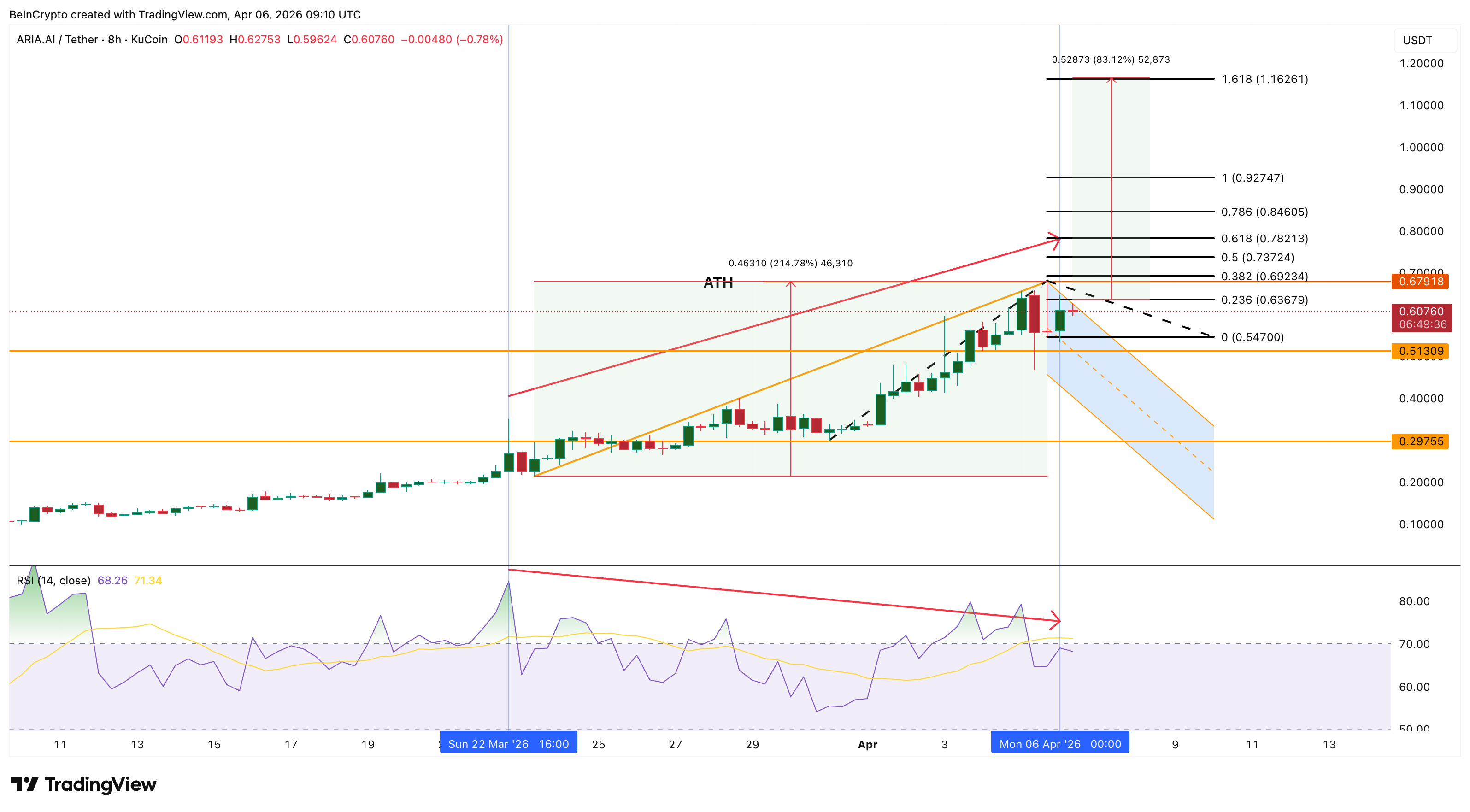
A drop to $0.51 keeps the pattern intact, but a fall under $0.29 invalidates the structure entirely.
MemeCore (M)
MemeCore (M), a Layer 1 blockchain built for meme coin infrastructure, trades at $2.69 on the daily chart. The token is up 73% year-to-date and sits approximately 9.5% below its all-time high of $2.97 set in 2025.
The March 25 hard fork slashed gas fees from 1,500 gwei to 15 gwei, serving as the fundamental catalyst. Since then, MemeCore has confirmed an inverse head and shoulders breakout on the daily chart.
The measured move from the neckline projects a 67% advance, targeting $3.42. That projection lands well above the current all-time high at $2.97, meaning the pattern itself points to price discovery if it completes. The breakout fulfilment is a key reason why M is one of the few altcoins capable of hitting a new peak this week.
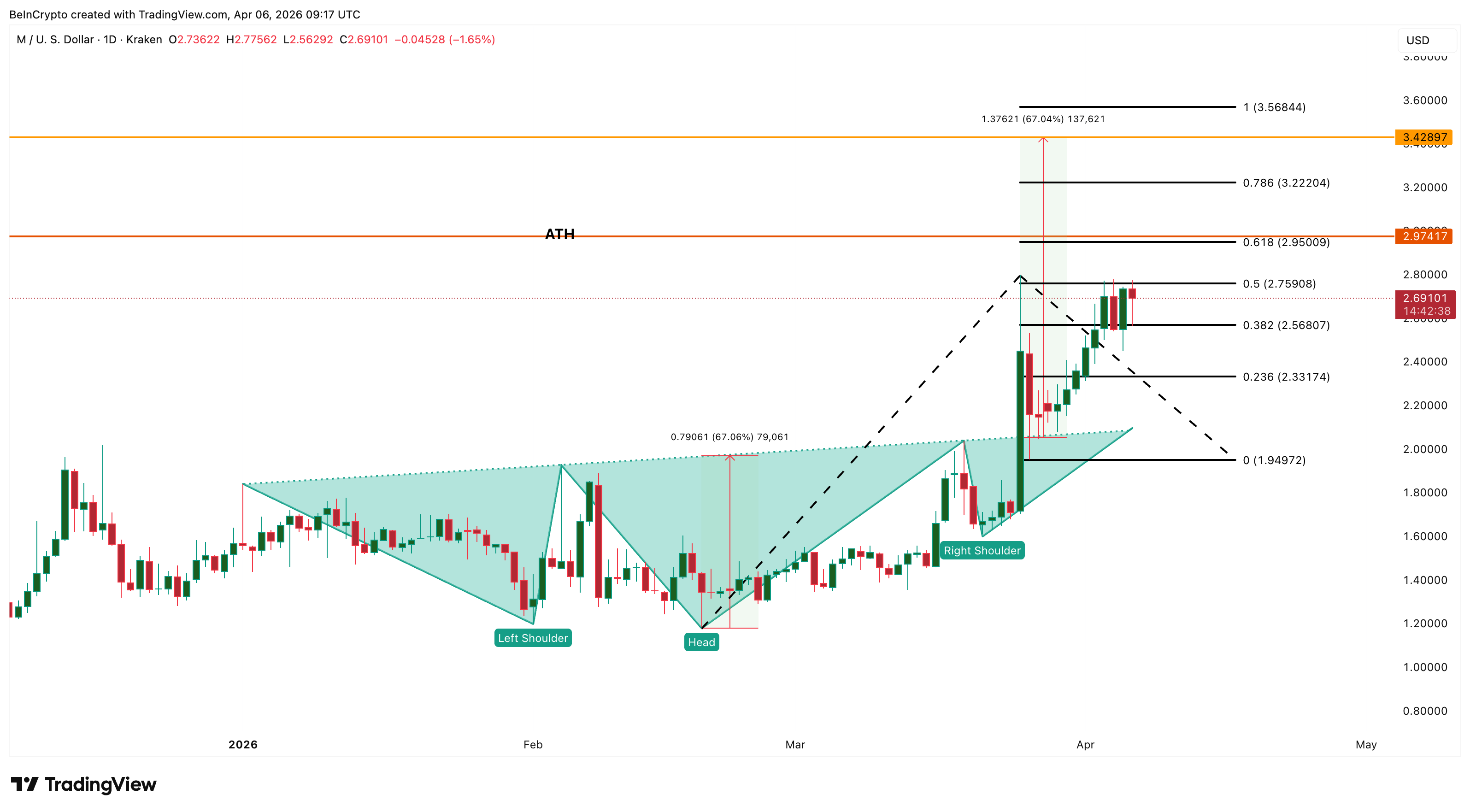
The immediate resistance for M is $2.75, which has capped the last several daily candles. A daily close above $2.75 opens the path to $2.95, followed by the ATH at $2.97. A move above that level enters uncharted territory with $3.22 and $3.42 as the next projected targets.
A daily close above $2.97 confirms a new all-time high with a $3.42 projection, while a failure to hold $2.33 would weaken the breakout structure.
LEO Token (LEO)
LEO Token (LEO), the native utility token of the Bitfinex exchange ecosystem. It trades at $10.12 on the daily chart, just 0.1% from its all-time high of $10.13. Among the three altcoins, LEO requires the smallest move to set a new record.
The reason LEO has been grinding higher while most tokens remain deep below their peaks is structural. Bitfinex parent company iFinex uses at least 27% of its monthly gross revenue to buy back and burn LEO tokens from the open market. That mechanism creates a permanent bid under the price that does not depend on market sentiment.
With war-driven crypto market volatility pushing Bitfinex trading volumes higher, the monthly burn rate has likely accelerated, compressing supply while demand remains steady.
The daily chart confirms an inverse head and shoulders pattern that broke out around March 20. The measured move from the breakout projects a 43.91% advance, targeting $13.27.
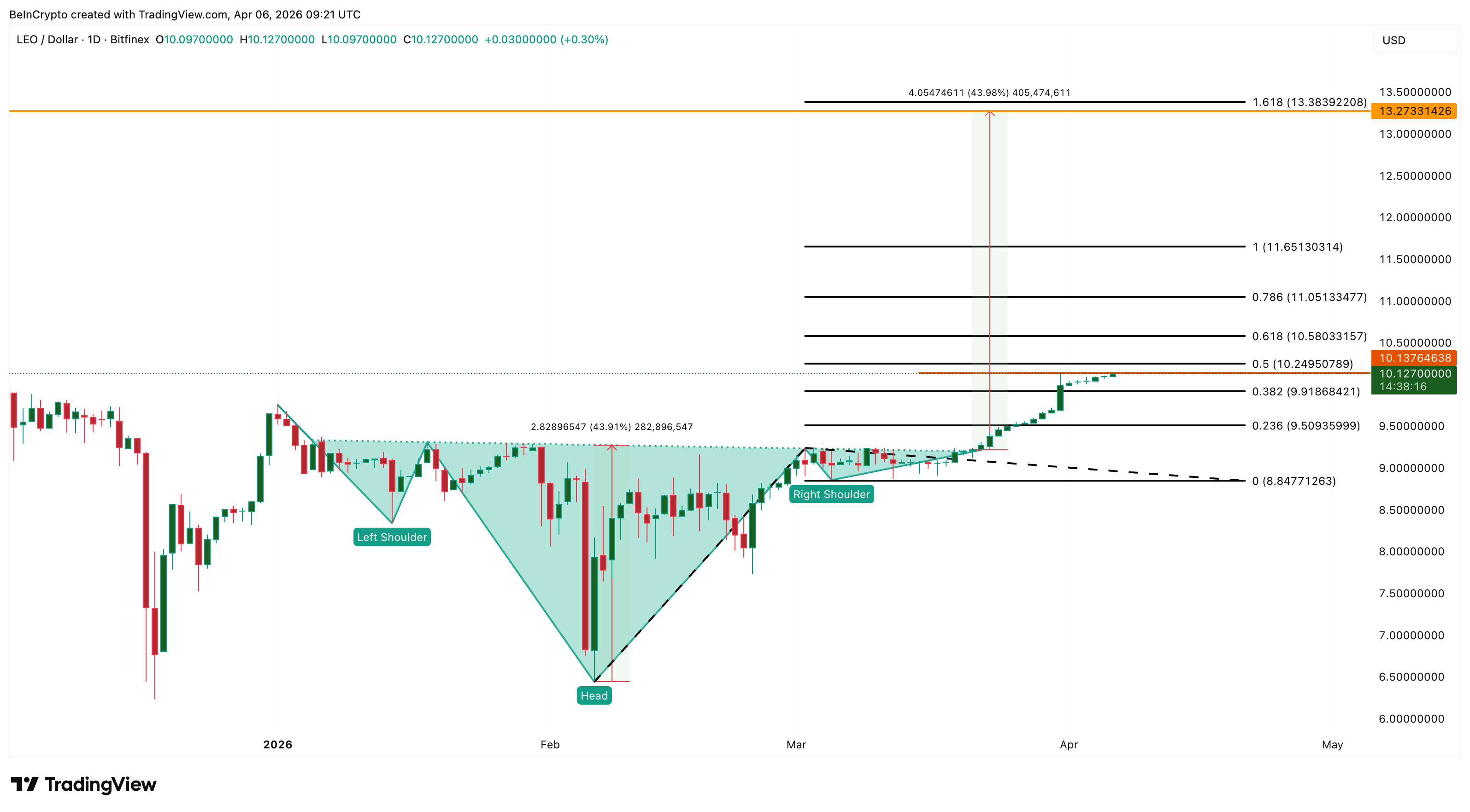
The immediate hurdles are $10.13 and $10.24. A move above $10.13 confirms a new all-time high. It also opens the path toward $10.58 and $11.05 at higher technical levels. The full pattern projection targets $13.27. On the downside, a fall below $9.91 would weaken the short-term structure, with $9.50 and $8.84 as lower supports.
The post 3 Altcoins That Could Hit New All-Time Highs in the Second Week of April 2026 appeared first on BeInCrypto.


Summary
- Binance is seeing fresh turnover in its compliance ranks as key financial‑crime and sanctions staff depart.
- Chief Compliance Officer Noah Perlman is in talks over a possible exit, raising questions about Binance’s post‑settlement clean‑up.
- The moves follow Binance’s $4.3b US plea deal and ongoing scrutiny of the exchange’s anti‑money laundering controls.
Binance’s effort to rebuild its compliance operation after a $4.3 billion US guilty plea is under renewed pressure as several staff overseeing financial‑crime monitoring and sanctions checks leave and Chief Compliance Officer Noah Perlman weighs his own departure, according to Bloomberg. Bloomberg reported that personnel changes have hit units responsible for financial‑crime surveillance and sanctions compliance, while Perlman is discussing “future departure matters” with management and may leave as soon as this year or next.
Perlman, who joined Binance as global chief compliance officer in January 2023, was hired to overhaul sanctions enforcement and anti‑money‑laundering (AML) systems after the exchange admitted to US law‑enforcement failures and agreed to one of the largest corporate penalties in US history. As part of that plea deal, Binance and founder Changpeng Zhao acknowledged violations of the Bank Secrecy Act and sanctions rules, with US Attorney General Merrick Garland stressing that the $4.3 billion package, including $2.5 billion in forfeiture and a $1.8 billion criminal fine, “sends an unmistakable message” to the crypto industry. In a previous crypto.news story, US regulators were shown to have collected over $32 billion from crypto companies, with Binance’s $4.3 billion settlement one of the largest single components. In that story, regulators highlighted that Binance’s case stemmed from rule‑breaking on AML and sanctions obligations rather than traditional fraud.
In response to Bloomberg’s report, Binance said it “currently has no departure timeline and has not determined a successor,” adding that Perlman “remains focused on his current work” overseeing the group’s global compliance program. The company has repeatedly pointed to growing headcount and investment in compliance since 2023, saying it expanded compliance‑related staff by more than 30% and cut its direct exposure to illicit activity by 96% between January 2023 and June 2025. “A 96% reduction in illicit exposure is a testament to our infrastructure and the 1,500+ professionals working behind the scenes to protect our 300M users,” Perlman said in March, arguing Binance has built a system that “doesn’t just react to threats, it anticipates them.”
Those claims have been challenged by a recent Financial Times investigation, which found that Binance continued to allow suspicious accounts tied to terror financing and other red flags to operate even after the 2023 plea agreement. The FT reported that hundreds of millions of dollars in suspect flows moved through the platform despite the promised monitoring upgrades, raising fresh questions over whether Binance’s revamped compliance apparatus is working as advertised.
The latest turnover comes as Binance seeks to ease US oversight of its internal controls. The Wall Street Journal has reported that executives have lobbied Washington officials to remove an independent US monitor installed to oversee the exchange’s AML compliance following the plea deal. At the same time, crypto.news has documented how Binance’s global market share and governance have been reshaped by regulatory pressure, from Zhao’s resignation and guilty plea to ongoing scrutiny of its US affiliate’s asset‑custody practices. In one crypto.news story on Zhao’s plea, Treasury Secretary Janet Yellen accused the exchange of allowing funds to flow to terrorists and cybercriminals while it “turned a blind eye” to basic AML obligations.
Binance’s internal metrics tell a more upbeat story. Company communications and recent media interviews have highlighted that sanctions‑related exposure fell from 0.284% in January 2024 to just 0.009% in July 2025, a 96.8% decline, alongside the processing of over 71,000 law‑enforcement requests and the facilitation of about $131 million in confiscations linked to illicit activity. Whether those improvements can be maintained amid continued staff churn — and the potential exit of the executive hired to lead the clean‑up — will determine how regulators and markets price Binance’s compliance risk going forward.


An appeals court ruled Monday that New Jersey could not temporarily ban prediction market provider Kalshi, giving the platform a much-needed win against an onslaught of state enforcement actions.
A Third Circuit Court of Appeals panel ruled in a 2-1 vote that the state could not bring an enforcement action against Kalshi because the company’s products are subject to the federal Commodity Exchange Act, rather than New Jersey state gambling laws.
“Kalshi began offering sports-related event contracts on its DCM exchange,” the majority ruling said. “Kalshi self-certified compliance with the applicable laws and regulations, so those event contracts were presumptively approved under federal law … To date, the CFTC has not determined that Kalshi’s sports-related event contracts are contrary to the public interest.”
The CFTC has not commenced any enforcement actions against “sports-related event contracts,” the ruling, signed by Chief Judge Michael Chagares and Circuit Judge David Porter said.
“New Jersey argues that Kalshi’s event contracts are not ‘swaps’ covered by the Act because the outcome of a sports game is not ‘joined or connected’ with a financial, economic, or commercial instrument or measure,’” the ruling went on to add. “But its proposed ‘joined or connected’ requirement raises the bar beyond what the [Commodity Exchange] Act requires.”
Circuit Judge Jane Roth, who penned a dissent, said the New Jersey state rules did not “undermine the congressional objectives” under the Commodity Exchange Act, and the actual products available on Kalshi’s platform “are sports gambling,” pointing to contracts betting on the winner of a National Football League game, the point spread in that game and combined number of points scored as examples.
States throughout the U.S. have started filing lawsuits or issuing cease-and-desist orders to prediction market providers, including Kalshi and Polymarket, alleging that their sports-related contracts violate state gambling laws. The CFTC has contended that prediction markets, or event contracts, are swaps governed by the Commodity Exchange Act, which preempts these state rules.
Different courts have issued divergent rulings. Some state courts have filed initial temporary restraining orders or preliminary injunctions in the states’ favor, while federal district courts have been more mixed.
Appeals courts have similarly been mixed. While the Third Circuit’s ruling on Monday suggests that prediction market providers will prevail on their argument that the Commodity Exchange Act preempts these state rules, the Ninth Circuit declined to block another state enforcement action from Nevada last month, clearing the way for that state to secure a temporary restraining order and preliminary injunction against Kalshi. There will be another Ninth Circuit hearing later this month with a number of companies.
CFTC Chairman Michael Selig, speaking Monday at an event hosted by Vanderbilt University and the Blockchain Association, said it was important that the federal regulator defend its “exclusive jurisdiction over these markets.” The CFTC filed an amicus curiae brief to the Ninth Circuit ahead of the hearing taking place next week.
“Our definition of commodity and statute is very broad. It includes events on sports, it includes events on politics, it includes corn and grains and all sorts of things,” he said. “It doesn’t really distinguish between if you’re offering an event contract on grains, [that] you’re regulating that differently than an event contract on sports.”


OpenAI Chief Executive Sam Altman said U.S. policymakers must act now to prepare for advanced artificial intelligence, warning that the technology is moving from theory into daily economic use.
In an interview with Axios, Altman said AI systems already handle coding and research tasks that once required teams of programmers. Newer models will go further, he said, helping scientists make major discoveries and allowing individuals to do the work of entire groups.
That shift is already visible in cybersecurity, where some industry leaders say artificial intelligence is tilting the balance toward attackers.
Charles Guillemet, chief technology officer at hardware wallet maker Ledger, for example, told CoinDesk that AI tools are lowering the cost and skill needed to find and exploit software flaws. Tasks that once took months, such as reverse-engineering code or linking multiple vulnerabilities, can now be completed in seconds with the right prompts.
The crypto industry saw more than $1.4 billion in assets stolen or lost in attacks last year. That figure could keep growing, Guillemet suggested. Moreover, developers are increasingly relying on AI-generated code, which may potentially introduce new flaws at scale.
The response, he said, will require stronger defenses such as mathematically verified code, hardware devices that keep private keys offline and a broader recognition that systems can fail.
AI in cyber, biosecurity
While Altman noted that AI could speed up drug discovery or materials science, he also flagged that it could also enable more powerful cyberattacks and lower the barrier to harmful biological research. Such threats may emerge within a year, which makes coordination across government, tech firms and security groups urgent.
“We’re not that far away from a world where there are incredibly capable open-source models that are very good at biology,” he said. “The need for society to be resilient to terrorist groups using these models to try to create novel pathogens is no longer a theoretical thing.”
Another example he suggested was a “world-shaking cyberattack” that could occur as early as this year. Avoiding that, he said, would require a “tremendous amount of work.”
He framed OpenAI’s policy ideas as a starting point, aiming to push debate on how to manage systems that learn fast and act across many fields. Using AI to help defend against these potential attacks, he said, is important.
On the potential nationalization of OpenAI, Altman said the case against it relies on the need for the U.S. to achieve “superintelligence” before its rivals do.
“The biggest case against nationalization would be that we need the U.S. to succeed at building superintelligence in a way that is aligned with the democratic values of the United States before somebody else does,” he said. “That probably wouldn’t work as a government project, I think that’s a sad thing.”
Still, Altman said he believes companies involved in AI must work closely with the U.S. government.
Given his role at OpenAI, Altman also has a financial stake in how the sector evolves. That position may shape how he frames both the urgency of regulation and the role of private companies like OpenAI in managing emerging risks, which could influence the firm’s competitive standing.
AI as a utility
Energy is one area where he sees quick progress because greater processing power capacity could keep costs down as AI demand grows.
Altman also pointed to early signs of labor shifts. A programmer in 2026, he said, already works differently to one a year earlier.
AI will become a sort of utility, like electricity, embedded across devices while the cost of basic intelligence falls and top systems remain expensive.
“You will have this personal super assistant running in the cloud,” Altman said. “If you use it a lot or use it at high levels of intelligence you’ll have a higher bill one month and if you use it less, you’ll have a lower bill.”
It’s “incredibly important that people building AI are high integrity, trustworthy people.”


Crypto lobbyists, banks, and the White House are circling a fragile compromise on stablecoin yields that could finally unstick the Clarity Act and set the rules for “digital dollar” rewards in the U.S.
Summary
- Crypto and banking lobbyists have reopened talks on stablecoin yields under the Clarity Act, with insiders signaling a possible breakthrough this month.
- A forthcoming White House report is expected to lean pro-crypto on stablecoin yields, even as banks warn of deposit flight and push to curb passive rewards.
- If the yield dispute clears, lawmakers are set to pivot the Clarity Act fight toward DeFi, tokenization, and token classification later this year.
The long‑running clash between U.S. crypto firms and banks over how stablecoin yields should be regulated appears to be entering its endgame, as both sides quietly review a fresh compromise under the Digital Asset Market Clarity Act in Washington this month. According to policy newsletter Crypto In America, “the core disagreement between the U.S. cryptocurrency and banking industries regarding the stablecoin yield mechanism may be close to resolution,” with several informed sources saying negotiators have launched a new round of talks around updated text. Odds trackers quoted by Coingape now put the bill’s chances of passing this year at roughly 64%, up sharply since February.
Earlier drafts pushed by senators Thom Tillis and Angela Alsobrooks had drawn fire from large industry players, with Coinbase and Stripe among those warning that an outright ban on passive stablecoin yields would gut key revenue lines and crimp innovation. Coinbase chief legal officer Paul Grewal recently told FinTech Weekly that a deal on yields is “very close,” even as the March 23 draft still “bans passive yield on stablecoin balances directly or indirectly and permits only narrowly defined activity‑based rewards.” Coinbase CEO Brian Armstrong has accused big banks of “undermining” President Trump’s crypto agenda by backing language that would ban the 4–5% stablecoin yields underpinning an estimated $1.35 billion in annual revenue for the exchange. In a previous crypto.news story, Armstrong argued that allowing such payouts simply passes through Treasury returns already required under the 2025 GENIUS Act, which mandates that payment stablecoins be fully backed by cash or short‑term U.S. government debt.
A still‑unpublished White House research report on stablecoin yields is widely expected to conclude that banks should “not view stablecoin yield offerings as a competitive threat,” according to comments by White House crypto adviser Patrick Witt. Witt told Yahoo Finance that reward programs on fully backed stablecoins “do not undermine the banking industry’s business model,” framing the fight as a chance for both sectors to coexist rather than a zero‑sum battle. Yet banking groups remain aggressive: community banks have warned Congress that yield‑style stablecoins could siphon “billions from insured deposits,” while some Wall Street institutions argue that interest‑bearing stablecoins function as “shadow deposits” that could drain as much as $500 billion from the system by 2028.
If the yield question is finally neutralized in committee later this month, lawmakers and lobbyists expect the Clarity Act debate to pivot to unresolved issues around DeFi rules, tokenization regimes, and which tokens fall under securities law versus commodities law, as detailed in prior crypto.news coverage of the bill. With stablecoins like USD Coin, which maintains a $70‑plus billion market capitalization and trades near $1 on crypto.news price trackers, now central to both payments and on‑chain yield strategies, the outcome of the Clarity Act’s sprint through the Senate Banking Committee will help decide how far U.S. investors can go in chasing returns on “digital dollars” without leaving the banking system behind.

The South Pars natural gas complex is Iran’s energy lifeline

JPMorgan’s Dimon warns Iran war could push inflation and interest rates higher

Bernstein Sees Upside from Loan Growth, Tokenization

Smart energy pays enters the US market, targeting scalable financial infrastructure

Why Israel is blocking foreign journalists from entering

Bitcoin: We’re Entering The Most Dangerous Phase

BajajFinserv Update #equitymarket #financialfreedom #nbstocksnew#financeshorts #stockmarket#finance

Form15G is DEAD! Now FORM 121. #finance #trending #viral #explore #shortsfeed #education #ytshorts

The TRUTH about 1,000 XRP
-

 NewsBeat4 days ago
Steven Gerrard disagrees with Gary Neville over ‘shock’ Chelsea and Arsenal claim | Football
-

 Business4 days ago
No Jackpot Winner and $194 Million Prize Rolls Over
-

 Fashion3 days ago
Weekend Open Thread: Spanx – Corporette.com
-

 Crypto World5 days ago
Gold Price Prediction: Worst Month in 17 Years fo Save Haven Rock
-

 Business17 hours ago
Three Gulf funds agree to back Paramount’s $81 billion takeover of Warner, WSJ reports
-
Crypto World6 days ago
Dems press CFTC, ethics board on prediction-market insider trades
-

 Sports2 days ago
India men’s 4x400m and mixed 4x100m relay teams register big progress | Other Sports News
-

 Business5 days ago
Login and Checkout Issues Spark Merchant Frustration
-

 Tech6 days ago
EE TV is using AI to help you find something to watch
-

 Sports6 days ago
Tallest college basketball player ever, standing at 7-foot-9, entering transfer portal
-

 Politics7 days ago
Should Trump Be Scared Strait?
-
Tech6 days ago
Daily Deal: StackSkills Premium Annual Pass
-

 Tech7 days ago
Flipsnack and the shift toward motion-first business content with living visuals
-

 Sports7 days ago
Women’s hockey camp eyes fitness boost, tactics ahead of WC 2026 campaign | Other Sports News
-

 Crypto World7 days ago
U.S. rule change may open trillions in 401(k) funds to crypto
-

 Tech6 days ago
How to back up your iPhone & iPad to your Mac before something goes wrong
-

 NewsBeat7 days ago
Newscast – Scott Mills Sacked By BBC
-

 Politics7 days ago
Usha Vance: Disney Hats Over MAGA Caps?
-
Crypto World7 days ago
Valinor raises $25m to put private credit on-chain
-

 Business7 days ago
Functional benefits brewing in coffee innovation
You must be logged in to post a comment Login