

Crypto World
Bitcoin Miners Gain Strategic Role in AI Infrastructure

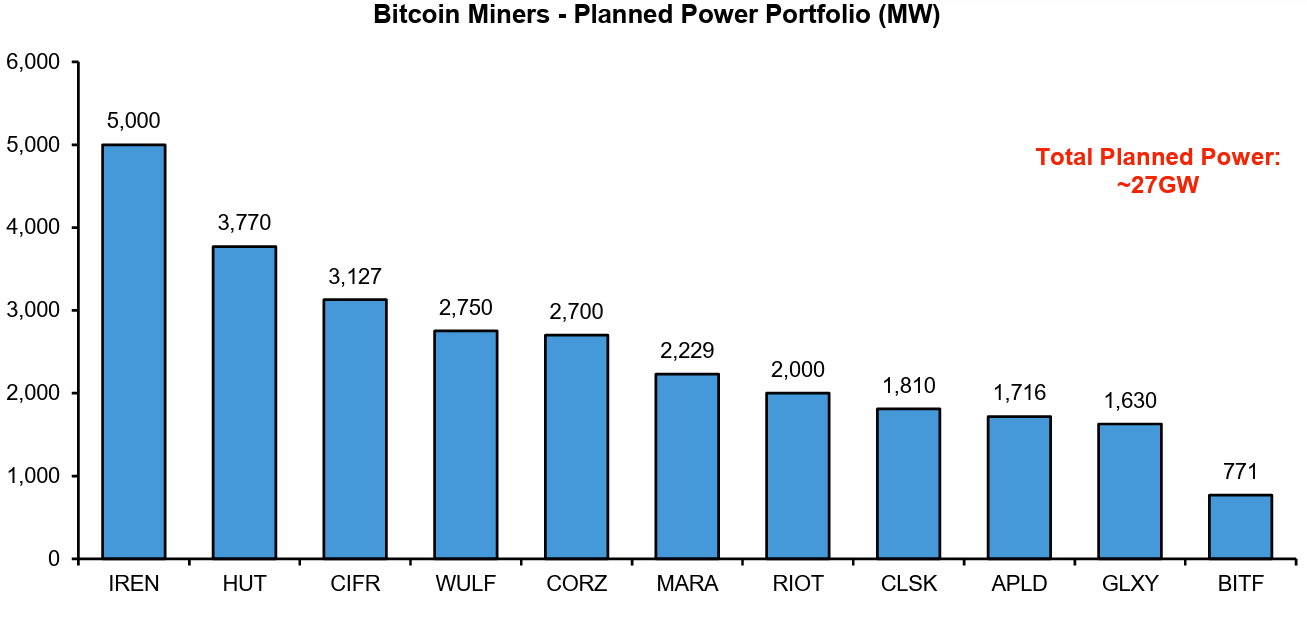
Bitcoin miners are emerging as an important part of the AI infrastructure supply chain because they control large amounts of power capacity and data center real estate that are increasingly difficult to secure, according to a new research note from Bernstein.
Analysts Gautam Chhugani, Mahika Sapra, Sanskar Chindalia and Harsh Misra estimate that publicly traded Bitcoin miners control more than 27 gigawatts of planned power capacity and have announced more than $90 billion in AI-related agreements covering 3.7 gigawatts with hyperscalers, neocloud providers and chipmakers.
An April 29 research brief from RAND said that it expects the US will add approximately 82 GW of additional net available capacity by 2030.
The planned power portfolio of 11 public Bitcoin mining companies. Source: Bernstein
According to Bernstein, access to electricity, rather than chips, has become the primary bottleneck for scaling AI data centers. Utility providers can take more than four years to approve new grid connections, even in data center-friendly states such as Texas.
“The median waiting time to secure a GW of power is nothing less than ~50 months across states, and even in politically friendly states such as Texas, the utility is following a batch review process to navigate the interconnect queue and resource load,” the analysts wrote.
Growing regulatory scrutiny and local opposition to large-scale data centers are adding to those delays, giving Bitcoin miners an advantage because they already operate grid-connected sites and have experience managing high-density computing facilities.
Related: The real ‘supercycle’ isn’t crypto, it’s AI infrastructure: Analyst
A shift in miner economics
Bernstein said Bitcoin miners are increasingly diversifying into AI infrastructure as they look for new revenue streams following the 2024 halving, which reduced mining rewards and put pressure on profit margins.
The report said several miners have moved beyond their traditional focus on Bitcoin production to develop AI data centers and high-performance computing facilities.
One recent example is Soluna Holdings, which reported a 58% increase in first-quarter revenue, driven primarily by its data center hosting business, while crypto mining contributed a smaller share of total sales.
Bernstein has also highlighted IREN as a leading example of the shift. The firm said IREN is well-positioned to transition much of its business toward AI infrastructure following its multibillion-dollar agreements with Microsoft.
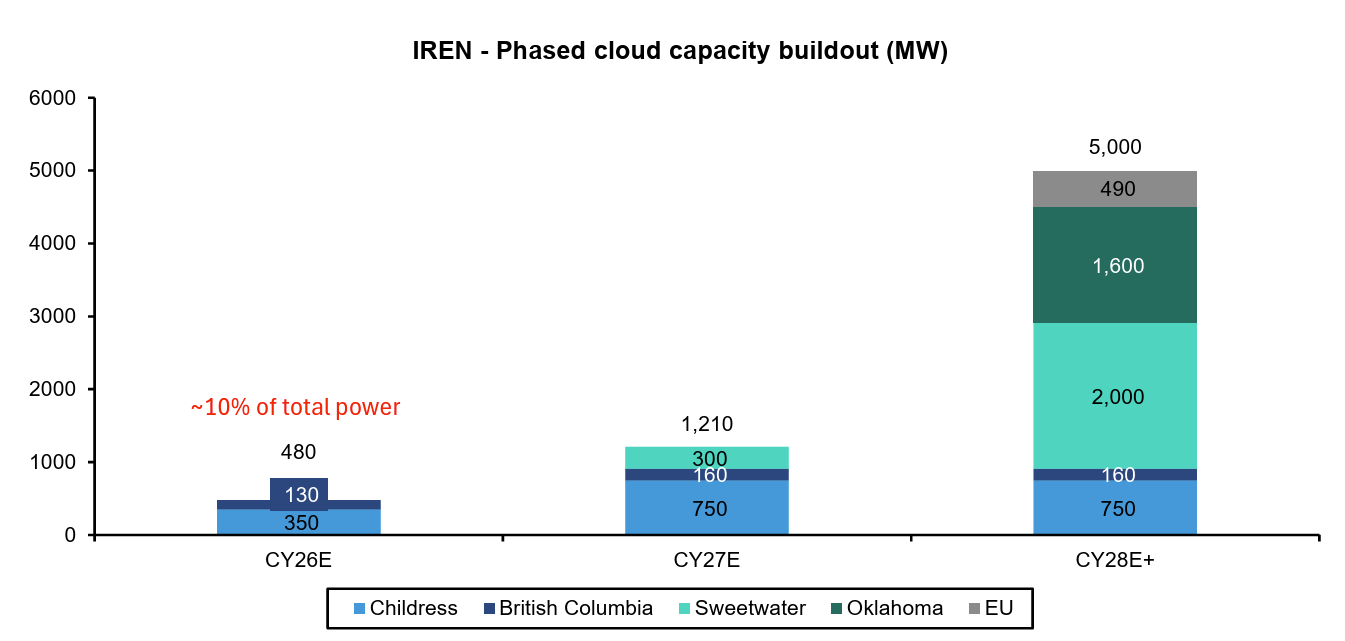
IREN’s partnership with Microsoft could fundamentally change its business model, according to Bernstein. Source: Bernstein
Related: CoreWeave’s $8.5B loan shows how AI is replacing crypto mining finance

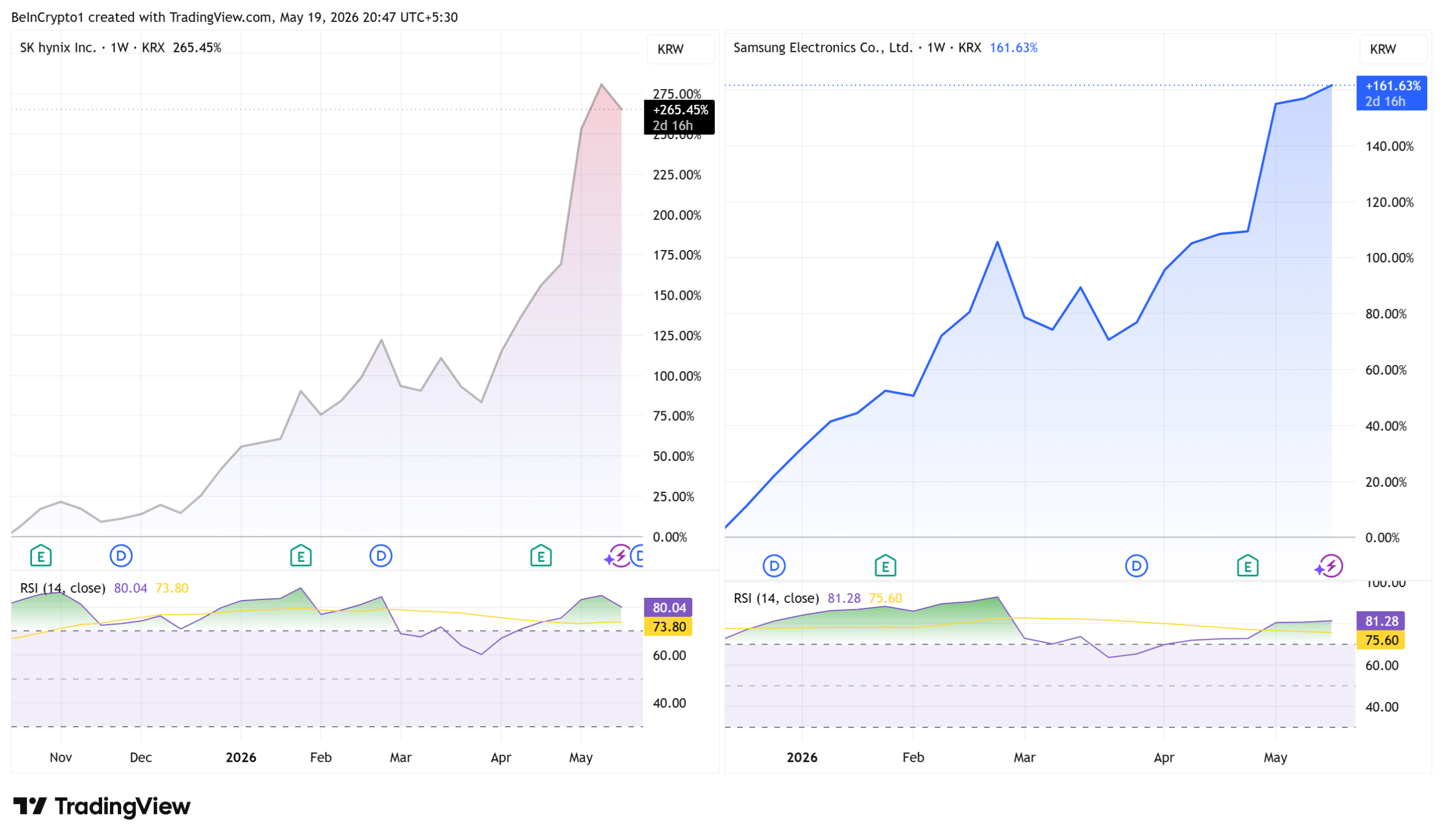
South Korean retail investors are pulling savings, fixed deposits, and life insurance funds to buy SK Hynix and Samsung Electronics. Both stocks trade near record highs on AI chip demand.
Savings bank deposits fell below ₩100 trillion ($66.24 billion) for the first time in four years. Commercial bank time deposits dropped by roughly ₩12 trillion ($7.94 billion) since February as cash rotated into equities.
Older Investors Drive a Leveraged Bet on Two Stocks
Investors over 50 now hold about 62% of all margin loans at South Korea’s top brokerages. Margin debt among those in their 60s doubled from ₩3.9 trillion ($2.58 billion) to ₩8 trillion ($5.29 billion) in a year. Domestic securities firms disclosed the surge.
Insurance policy surrenders at the top three life insurers jumped 16% in Q1 2026. Savings-type policies surged 23% as households cashed out for equities.
“The marginal buyer is now liquidating insurance policies, withdrawing savings, borrowing on margin, and leveraging existing assets just to stay in the rally,” analayst and YouTuber Crypto Rover highlighted.
AI Chip Demand Fuels Concentration Risk
SK Hynix and Samsung Electronics together account for roughly 42% of the KOSPI after AI-fueled rallies. SK Hynix has gained 265% since November while Samsung climbed 162%, according to weekly TradingView data.

Korea’s government added a ₩33 trillion ($21.86 billion) support package for the chip sector, layering policy fuel onto record retail flows.
The KOSPI dropped 19% in March before recovering, with leveraged older investors averaging roughly 20% losses during the slide.

The same risk appetite has spilled into crypto. Korean Won handles about 30% of global spot volume on Upbit and Bithumb.
Weekly RSI readings above 80 on both stocks signal overbought conditions. The next Samsung and SK Hynix earnings cycle will test the leverage holding this rally together.
The post South Koreans Liquidate Savings and Insurance to Chase SK Hynix and Samsung Rally appeared first on BeInCrypto.
Ethereum remains under persistent selling pressure after failing to reclaim key resistance zones, with recent price action pointing to weakening bullish momentum and a growing probability of deeper retracement. The market is now testing critical support levels that could determine ETH’s next major move.
Ethereum Price Analysis: The Daily Chart
Ethereum has extended its corrective phase after repeated failures to sustain momentum above the $2.3K–$2.4K resistance region. The asset recently lost the 100-day moving average near $2.15K and is now hovering around the lower boundary of the broader ascending channel at the $2K area, signaling increasing bearish dominance in the medium term.
This rejection suggests that sellers remain active during every recovery attempt. If ETH fails to defend the current channel support, a sharper decline toward the major demand region around $1.8K becomes increasingly likely.
On the upside, reclaiming the $2.4K resistance would be required before considering any meaningful shift in sentiment. Until then, the broader structure favors continued consolidation or downside pressure.
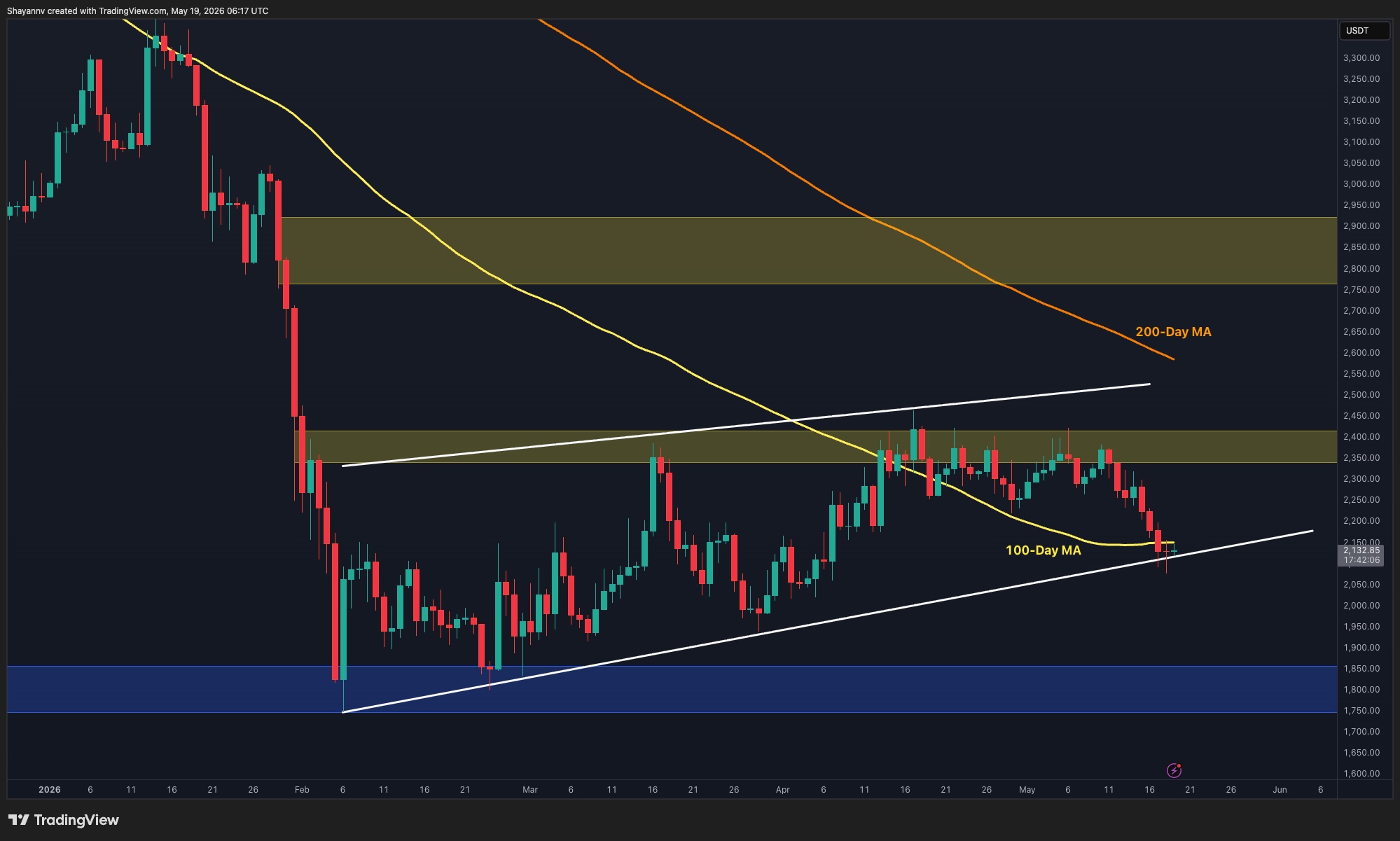
ETH/USDT 4-Hour Chart
On lower timeframes, Ethereum has confirmed a bearish breakdown below the ascending wedge structure that had contained the price action for several weeks. Following the breakdown, ETH attempted a recovery toward the lost trendline but faced immediate rejection, validating the breakout and reinforcing bearish continuation scenarios.
The recent selloff has now pushed the price toward a key support zone around $2.1K, where short-term buyers are attempting to stabilize the market. This region aligns with a notable demand block and the lower boundary of the broader rising channel, making it an important level to monitor.
If this support fails, the next downside target could emerge around the $2K-$2.05K area. Conversely, holding above current levels may trigger a temporary rebound, though significant resistance remains overhead near $2.2K and later $2.4K.

Sentiment Analysis
The 3-month liquidation heatmap reveals a substantial concentration of liquidity resting above the current price, particularly around the $2.45K-$2.5K region. Historically, markets tend to gravitate toward large liquidation pools as they provide fuel for volatility and position unwinding.
However, in the short term, Ethereum has begun tapping liquidity pockets below current levels near $2.05K-$2.1K while bearish momentum remains dominant. This suggests downside pressure could persist before any larger recovery attempt toward upper liquidity clusters occurs.
The imbalance between nearby downside liquidity and heavier long-term clusters overhead points to elevated volatility ahead. Whether ETH first sweeps lower support zones or stages a recovery toward $2.5K will likely depend on how price reacts around the current $2.1K demand area.

The post Ethereum Price Prediction: Is Sub-$2K Inevitable for ETH After Losing the 100-Day MA? appeared first on CryptoPotato.
Crypto World
BeInCrypto Institutional Research: 10 Chain Foundation Programs Driving Web3 Ecosystem Development

Best Web3 Ecosystem Development Program is a category within the BeInCrypto Institutional 100, an annual research-driven program recognising institutional digital asset excellence across 26 categories and six pillars.
This category sits under Pillar 6: Tokenization & Enterprise Blockchain. The 10 programs below are listed alphabetically by parent chain and are not ranked. A shortlist will be named in May 2026, with the winner announced at Proof of Talk in Paris on June 2–3, 2026.
Key Facts
- Long list: 10 named programs across grants, accelerators, hackathons, retroactive funding, gas rebates, incubators, AI-focused programs, and strategic ecosystem funds
- Initial pool: More than 25 chain-foundation programs screened; 10 advanced to the long list
- Order: Listed alphabetically by parent chain, not ranked
- Scoring: 30% quantitative data · 50% Expert Council · 20% disclosed company data
- Criteria assessed: Capital deployed, graduate impact, institutional focus, program quality, ecosystem growth, transparency
- Boundary scope: This category evaluates a specific named program, not the underlying chain or the chain’s wider ecosystem
| Program | Parent Chain | Program Scale & Structure | Representative Outcomes |
|---|---|---|---|
| Aptos $50M Markets and Machines Commitment | Aptos Run by Aptos Foundation and Aptos Labs |
Announced May 7, 2026 $50M+ strategic capital commitment across on-chain markets, protocol infrastructure, research, AI agents, and trading partners |
Decibel surpassed $1B cumulative volume after Feb 2026 mainnet launch Shelby supports AI-agent workloads through hot storage and licensed dataset exchange |
| Arbitrum Trailblazer AI Grant Program + Trailblazer 2.0 | Arbitrum Run by Arbitrum Foundation |
Trailblazer AI launched Nov 2024; Trailblazer 2.0 launched Jun 2025 $2M total budget across immediate grants and Vibekit-based agentic DeFi tooling |
Onboarded AI projects including Allora, ARC Agents, Eternal AI, Hyperbolic, Ora, and Eliza Vibekit launched with integrations for Pendle, GMX, Aave, and Camelot |
| Avalanche Retro9000 Retroactive Grants Program | Avalanche Run by Avalanche Foundation |
Launched Nov 2024 Up to $40M in retroactive grants plus $2M referral pool, with quarterly snapshots and C-Chain fee-based grant rounds |
Cohort 1 funded 19 grantees with more than $1M Cohort 2 funded 8 grantees; Cohort 3 funded 4 grantees, including infrastructure and app builders |
| Ethereum ESP New Grants Program | Ethereum Run by Ethereum Foundation Ecosystem Support Program |
Relaunched Nov 3, 2025 after redesign pause Dual-track Wishlist and RFP model focused on cryptography, privacy, application-layer development, security, and community growth |
ESP database includes 1,039 funded projects since 2024 2025 Academic Grants Round expanded to $2M, alongside Office Hours and new grant tooling teams |
| Hedera Crypto Economy Fund + Thrive 2025 Grants + Verifiable AI Tooling | Hedera Run by Hedera Foundation |
Crypto Economy Fund ongoing since 2022; Thrive 2025 grants launched in 2025 Multi-track structure across community innovation, enterprise grants, academic research, AI, tokenization, identity, and RWAs |
AI Studio and Verifiable Compute launched with EQTY Lab, NVIDIA Blackwell, Accenture Public Sector, and SCAN UK Hedera donated its codebase to Linux Foundation Decentralized Trust as Project Hiero |
| NEAR AI x HZN Incubation Program + NEAR AI Agent Fund | NEAR Run by NEAR Foundation and NEAR.AI |
Incubator launched May/Jun 2024 with follow-on phases through May 2025 $100K NEAR investment per team, up to $250K from Delphi Labs, $50K Aethir credits, and $20M AI Agent Fund |
Initial cohort funded Mizu, Pond, Nevermined, Hyperbolic, Ringfence, and Exabits Hyperbolic raised $7M seed; Mizu launched beta with 20K users in its first week |
| Polygon AggLayer Breakout Program | Polygon Run by Polygon Foundation and Polygon Labs |
Launched Apr 24, 2025 Structured incubator-to-graduation program for projects building around AggLayer, with 5–15% token airdrops to POL stakers |
Privado ID graduated after testing with HSBC and Deutsche Bank Miden raised $25M seed; Katana became an AggLayer CDK chain with VaultBridge |
| Solana Frontier Hackathon 2026 + Colosseum Accelerator Series | Solana Run by Solana Foundation and Colosseum |
Frontier ran Apr 6–May 11, 2026 Colosseum deploys more than $2.5M into select winners; up to 10 teams enter accelerator with $250K pre-seed funding |
Breakout Hackathon drew 10,000+ participants from 140+ countries and 1,412 final projects Colosseum alumni have raised more than $650M in venture capital |
| Starknet Propulsion v2 Program | Starknet Run by Starknet Foundation |
Original pilot launched May 2024; Propulsion v2 live Nov 27, 2025 Up to $1M per project in STRK, with gas-rebate funding tied to demonstrated user adoption |
Starknet user-centric projects grew from 72 to 193 between Nov 2023 and Nov 2024 Notable v2 participants include Ready, Focus Tree, AVNU, Endur, Ekubo, and Cartridge |
| Sui Foundation Ecosystem Development Program | Sui Run by Sui Foundation |
$50M new grants announced Feb 2026 Multi-track structure across RFP grants, flash RFPs, research awards, Hydropower accelerator, Sui Overflow, and DeFi ecosystem funding |
Sui Overflow 2025 drew 352 project submissions Monthly active developers reached 1,300 in Q1 2026, while Sui recorded $111B stablecoin volume in Jan 2026 |
About This List
The BeInCrypto Institutional 100 — Best Web3 Ecosystem Development Program (2026 Long List) identifies specific named programs run by chain foundations to grow Web3 ecosystems. These include strategic capital commitments, AI-focused grant programs, retroactive funding, RFP models, enterprise-backed foundation grants, incubators, hackathon-to-accelerator pipelines, gas-rebate mechanisms, and vertical-specific ecosystem funds.
The category evaluates the program itself. The underlying chain is evaluated separately under Category 6.2: Best Blockchain Infrastructure. Enterprise blockchain implementations built on these chains are evaluated under Category 6.1: Best Institutional Enterprise Blockchain Implementation. Pure-capital VC programs operated by venture firms are routed to fund-manager categories.
Methodology
This category is evaluated under Track B of the BeInCrypto Institutional 100 methodology: 30% quantitative metrics, 50% Expert Council scoring, and 20% disclosed company data.
Assessment spans six criteria: capital deployed through the program, portfolio impact of graduates, institutional focus, program quality and structure, ecosystem growth attributable to the program, and transparency.
The disclosed data weighting reflects the limited public visibility into foundation grant economics, including capital actually deployed versus committed, post-grant portfolio performance, and graduate retention.
Data was verified using foundation press releases, official program pages, on-chain ecosystem metrics, portfolio-company funding announcements, relevant regulator filings, audited ETF disclosures, Linux Foundation Decentralized Trust filings, and mainstream financial press.
The post BeInCrypto Institutional Research: 10 Chain Foundation Programs Driving Web3 Ecosystem Development appeared first on BeInCrypto.

TLDR
- Google introduced a redesigned Search experience powered by Gemini 3.5 Flash at I O 2026.
- The new interface supports longer and more conversational user queries instead of short keywords.
- Google added an AI-powered autocomplete that suggests refined and follow-up questions in real time.
- AI Overviews now appear more consistently and provide summarized answers at the top of results.
- Users can move between AI summaries and chatbot-style interactions without leaving the search page.
Google introduced a redesigned Search platform powered by Gemini 3.5 Flash at I/O 2026. The update blends traditional search with AI-generated responses and conversational features. The company confirmed that the rollout aims to shift user behavior toward natural language queries.
Google presented the updated interface as part of its broader Gemini strategy across products and Android systems. The company emphasized faster responses and improved context handling through the new model. Robby Stein said users will “reliably” see AI Overviews for conversational queries.
Google Expands Conversational Search and AI Summaries
Google redesigned the search box to support longer and more detailed user queries. The interface now encourages full questions instead of short keyword searches. As a result, users can ask complex queries like protocol explanations and receive structured answers.
The company also introduced AI-powered autocomplete that suggests refined questions in real time. This system builds on user intent and offers follow-up prompts during typing. Google stated that this feature helps guide users toward more complete and relevant searches.
AI Overviews remain central to the new experience and appear at the top of results pages. These summaries compile information from multiple sources into a single response. Stein explained that the system connects directly to AI Mode for extended conversations.
Users can now transition between summaries and chatbot interactions without leaving the search page. This integration allows continuous dialogue powered by Gemini 3.5 Flash. Google positioned the model as faster and more efficient than earlier versions.
Gemini Model Powers Deeper Integration Across Devices
Google confirmed that Gemini 3.5 Flash supports both cloud and on-device processing. Some AI tasks will now run locally on Android devices. This approach reduces latency and improves performance for certain features.
The company linked this update to its broader Gemini Intelligence initiative. It aims to embed AI capabilities across mobile ecosystems and services. Google also highlighted ongoing work on open models for developers.
The search redesign aligns with Google’s focus on unified AI experiences across platforms. The company plans to expand these capabilities in future updates. Current deployments began following the I/O announcement.
Google did not disclose exact rollout timelines for all regions. However, it confirmed gradual availability across devices and markets. The company continues to test features through limited releases.
Changes in Search Structure Affect Information Visibility
Google confirmed that AI Overviews synthesize content from multiple indexed sources. The system selects key data points and presents a summarized response. This process reduces reliance on traditional link-based navigation.
The company acknowledged that users may interact less with individual websites. AI-generated answers often provide direct responses without requiring clicks. Google did not provide specific metrics on traffic changes.
Platforms that provide structured data may still contribute to AI summaries. However, their visibility depends on how Gemini selects information. Google continues refining its ranking and synthesis systems.

Crypto World
BeInCrypto Institutional Research: 8 Neobanks Setting Standards for Digital Asset Accessability

Digital-asset neobanking has moved beyond basic crypto access. The category now covers firms combining bank-account-style services — checking, direct deposit, debit, savings, and banking partnerships or charters — with native crypto products built into the primary financial app.
Best Digital Assets Neobank is a category within the BeInCrypto Institutional 100, under Pillar 1: Retail to Crypto Bridge. The 8 firms below are listed alphabetically and are not ranked. A shortlist will be named in May 2026, with the winner announced at Proof of Talk in Paris on June 2–3, 2026.
Key Facts
- Long list: 8 firms across bank-chartered neobanks and BaaS, EMI, or VASP-licensed fintechs with crypto integrated into the primary banking app
- Initial pool: 18 firms screened; 8 advanced to the long list, with 3 outreach candidates retained
- Order: Listed alphabetically, not ranked
- Scoring: 30% quantitative data · 50% Expert Council · 20% disclosed company data
- Criteria assessed: User base, crypto user count, product depth, regulatory licensure, payments and card integration, geographic reach, financial performance, innovation
- Data sources: OCC, FCA, BaFin, DNB, ACPR, MAS, CSSF, NYDFS, BACEN, CNBV, GFSC, MiCA-CASP, SEC EDGAR, audited filings, reserve attestations, on-chain data, PitchBook, Crunchbase, Tracxn
| Firm | HQ | Reach | Top Licensure / Charter | Representative Work |
|---|---|---|---|---|
| Bunq | Amsterdam, Netherlands | 17M+ users across 30+ EEA countries 2024 net profit of €85.3M, up 65% year over year |
Full Dutch banking licence from De Nederlandsche Bank EU passporting, MiCA-compliant; UK banking and US broker-dealer licences applied for in 2025–26 |
Launched Bunq Crypto through Kraken partnership in Apr 2025 Offers 300+ cryptocurrencies inside a licensed-bank environment; first-year crypto trades passed €100M |
| Cash App | Oakland, USA Block, NYSE: XYZ |
59M monthly active users in Q4 2025 9.3M primary banking actives; $316B total customer inflows in 2025 |
Banking via Sutton Bank partnership FDIC-insured checking, direct deposit, Cash Card, savings; NYDFS-licensed Bitcoin business |
Launched Proof of Reserves dashboard in Apr 2026 covering 8,883 BTC Bitkey self-custody wallet expanded; 5% Bitcoin Back rolled out across Cash App Card |
| KAST | Singapore / New York | 1M+ users across 170–190 countries About $5B annualized transaction volume; 150M+ merchants accepted globally |
Holds MSB Canada, MSB US, VASP EU, TCSP Hong Kong Uses regulated partners including Bridge, Tazapay, Reap, Fireblocks, BitGo, and Privy |
Closed $80M Series A in Mar 2026 at $600M valuation KAST Business beta launched in May 2026; security stack includes Sardine, Elliptic, ChainPatrol, Vanta, and Scanner.dev |
| Mercado Pago | Buenos Aires, Argentina Mercado Libre, NASDAQ: MELI |
100M+ users across Brazil, Mexico, Argentina, Colombia, Chile, Uruguay, and Peru via MELI ecosystem | Jurisdiction-specific fintech and payments licences across Latin America VASP authorisations for MELI Cripto in operating markets |
MELI Cripto expanded to 17 tokens by May 2026 Trading fee cut to 0.2%; Meli Dólar stablecoin available across Brazil, Mexico, and Chile |
| Nomad | São Paulo, Brazil | 1M+ users Brazilian USD-account neobank focused on retail consumers and global investment access |
Brazilian fintech registration Banking issued through Brazilian and US partner banks; CVM-regulated investment platform component |
Pioneered XRP Ledger settlement for Brazilian USD payments Adapting to Brazil BCB Resolution 561, which restricts crypto and stablecoin use in cross-border eFX settlement |
| Nubank | São Paulo, Brazil Nu Holdings, NYSE: NU |
110M+ customers 7M+ NuCripto users; Berkshire Hathaway among significant shareholders |
Full Brazilian banking licence from BACEN OCC US national bank branch conditional approval; Mexico and Colombia authorisations |
Earn Crypto staking launched in Mar 2026 with Solana promotional yield NuCripto now supports 20+ assets; USDC partnership with Circle deepened crypto access |
| Revolut | London, UK | 70M+ customers across 40+ countries as of Jan 2026 2025 revenue of $6B and profit before tax of $2.3B |
Lithuanian EU banking licence UK banking licence, Mexican banking licence, MiCA-CASP authorisation, US charter in progress |
Reached $75B valuation in Nov 2025 capital raise Revolut X offers 230+ digital assets, staking, low-fee trading, and RWA token listings |
| SoFi | San Francisco, USA NASDAQ: SOFI |
12.6M members Q1 2026 revenue of $1.1B with $166.7M net income |
SoFi Bank N.A. OCC-regulated national bank and FDIC-insured depository institution |
Launched retail crypto trading in Nov 2025 Opened 239,509 crypto accounts in Q1 2026; SoFiUSD stablecoin launched in Dec 2025 |
About This List
The BeInCrypto Institutional 100 — Best Digital Assets Neobank (2026 Long List) identifies digital-first consumer and SMB banking platforms that combine bank-account-like services with substantial depth in digital assets.
Two structural models qualify: bank-chartered direct entities such as Bunq, Nubank, Revolut, and SoFi; and BaaS-partnered, EMI-licensed, or VASP-licensed crypto fintechs that integrate crypto into the primary banking app, such as Cash App, KAST, Mercado Pago, and Nomad.
The category does not include crypto exchanges with payment cards added on, self-custody spending cards without banking services, stablecoin issuers, institutional digital asset banks, defunct crypto banking platforms, or chartered neobanks without native crypto products.
Methodology
This category is evaluated under Track B of the BeInCrypto Institutional 100 methodology: 30% quantitative metrics, 50% Expert Council scoring, and 20% disclosed company data.
Assessment spans seven criteria: total user base and crypto user count; crypto and stablecoin product depth; regulatory licensure; payments and card integration; geographic footprint; financial performance and sustainability; and innovation during the award window.
Data was verified using regulatory registers, company filings, SEC EDGAR, audited financial statements, reserve attestations, Proof of Reserves disclosures, relevant on-chain data, private-market sources including PitchBook, Crunchbase, and Tracxn, and mainstream financial press.
The post BeInCrypto Institutional Research: 8 Neobanks Setting Standards for Digital Asset Accessability appeared first on BeInCrypto.
Crypto World
Ape and Pepe (APEPE) Announces Ecosystem Expansion Through the Launch of Community FLOW
[PRESS RELEASE – New York, USA, May 19th, 2026]

Ape and Pepe (APEPE), a Polygon-based, community-driven hybrid meme ecosystem project, has officially announced the launch of “Community FLOW,” a new initiative aimed at expanding global community engagement and enhancing ecosystem transparency.
The launch of Community FLOW is part of APEPE’s long-term ecosystem expansion strategy focused on building a more community-centered culture and participation structure within the Web3 environment.
According to the APEPE community team, Community FLOW aims to introduce a more open and community-oriented approach toward ecosystem discussions, campaign participation, and future expansion directions. Through this initiative, the project seeks to enhance interaction among global community members and reinforce the foundation for long-term ecosystem growth.
Originating on Polygon, APEPE has continued expanding through various global campaigns, wallet integrations, and ecosystem collaborations. The project currently has a global community reach of over 2 million users and more than 400,000 on-chain holders.
In addition, it has expanded its presence across various global exchanges and communities, including HTX, Gate, MEXC, BingX, Coinone, and GOPAX. Recently, the ecosystem has continued to grow through global community campaigns, expanded wallet integrations, AI-based tools, collaboration with neofinance app TRIA, and partnerships related to gaming IPs.
APEPE has previously demonstrated its direction as a community-driven meme ecosystem through initiatives such as the Times Square community campaign and various user-generated meme content activities.
A community representative stated that APEPE plans to continue expanding the ecosystem through additional community initiatives, partnerships, integrations, and global campaigns.
About APEPE
APEPE is a Polygon-based community-driven meme ecosystem project focused on community participation, ecosystem expansion, and Web3 culture. The project continues to expand through global campaigns, wallet integrations, partnerships, and community-led initiatives.
Website: https://apepe.lol/
X (Twitter): https://x.com/APEPE_MEME
The post Ape and Pepe (APEPE) Announces Ecosystem Expansion Through the Launch of Community FLOW appeared first on CryptoPotato.
Crypto World
BeInCrypto Institutional Research: 10 Regulatory Frameworks Defining Institutional Digital Asset Markets

Best Regulatory Framework of the Year is a category within the BeInCrypto Institutional 100, an annual research-driven program recognising institutional digital asset excellence across 26 categories and six pillars.
This category sits under Pillar 5: Regulation & Governance. The 10 frameworks below are listed alphabetically by framework name and are not ranked. A shortlist will be named in May 2026, with the winner announced at Proof of Talk in Paris on June 2–3, 2026.
Key Facts
- Long list: 10 jurisdiction-level frameworks across comprehensive crypto regimes, stablecoin legislation, market-structure laws, VASP licensing, and consumer-protection regimes.
- Initial pool: More than 20 jurisdiction-level frameworks screened; 10 advanced to the long list.
- Order: Listed alphabetically by framework name, not ranked.
- Scoring: 20% quantitative data · 80% Expert Council.
- Criteria assessed: Legislative substance, activity scope, operational readiness, enforcement record, market coverage, institutional adoption, international influence, regulatory architecture.
- Boundary scope: This category evaluates jurisdiction-level statutory, regulatory, or licensing regimes, not single guidance notes, industry self-regulation, CBDC-only frameworks, or global soft-law standards.
| Regulatory Framework | Lead Authority | What It Achieves |
|---|---|---|
| Brazil BCB Crypto Framework | Banco Central do Brasil With CVM for securities tokens |
Creates Brazil’s first comprehensive crypto framework. Requires VASP authorisation and brings stablecoin transfers into the foreign-exchange regime. |
| CLARITY Act | US Congress Joint SEC and CFTC framework |
Would establish a federal US crypto market-structure law. Clarifies SEC/CFTC jurisdiction and creates registration routes for crypto exchanges, brokers, and dealers. |
| Dubai VARA Full Market Regulations | Virtual Assets Regulatory Authority Dubai, excluding DIFC |
Establishes Dubai’s standalone virtual asset regime. Covers VASP licensing, token issuance pathways, and enforcement for exchange, custody, broker-dealer, lending, and payments activity. |
| EU Markets in Crypto-Assets Regulation (MiCA) | ESMA and EBA With EU national regulators |
Harmonises crypto regulation across EU member states. Creates CASP passporting, stablecoin reserve rules, market abuse controls, Travel Rule integration, and operational resilience requirements. |
| GENIUS Act | OCC, Federal Reserve, and FDIC With state regulators for smaller issuers |
Creates the first US federal stablecoin framework. Requires high-quality liquid reserves, monthly disclosures, AML controls, and federal or state issuer pathways. |
| Hong Kong Stablecoins Ordinance | Hong Kong Monetary Authority | Establishes Hong Kong’s fiat-referenced stablecoin licensing regime. Requires 100% backing, strict reserve assets, paid-up capital, and one-business-day redemption at par. |
| Japan Payment Services Act Amendment 2025 | Financial Services Agency of Japan | Strengthens Japan’s regulated stablecoin framework. Limits issuance to banks, trust companies, and fund transfer providers, with reserve and redemption obligations. |
| Singapore MAS DTSP + Stablecoin Framework | Monetary Authority of Singapore | Combines digital payment token licensing, offshore DTSP oversight, and single-currency stablecoin rules. Sets high compliance standards for Singapore-incorporated firms serving global users. |
| South Korea Virtual Asset User Protection Act (VAUPA) | Financial Services Commission and Financial Supervisory Service With KoFIU |
Creates a consumer-protection regime for South Korea’s crypto market. Requires cold storage, cybersecurity insurance or reserves, unfair-trading monitoring, and reporting to regulators. |
| UAE Federal Capital Markets VASP Framework | Capital Market Authority UAE federal onshore perimeter, excluding DIFC and ADGM |
Replaces the prior federal VASP regime with a capital markets rulebook. Covers licensed virtual asset activities, higher governance standards, and recovery rules for systemically important VASPs. |
About This List
The BeInCrypto Institutional 100 — Best Regulatory Framework of the Year (2026 Long List) identifies jurisdiction-level regimes that materially shaped how regulated institutions issue, trade, custody, and intermediate digital assets during 2025 and 2026.
Coverage spans comprehensive crypto-asset frameworks, federal stablecoin legislation, market-structure laws, federal and emirate-level VASP architectures, and consumer-protection regimes with active enforcement.
The category does not evaluate single guidance documents, industry self-regulation, global soft-law standards, CBDC-only frameworks, or unilateral agency interpretations. These may influence regulation, but they do not qualify as standalone jurisdiction-level frameworks for this category.
Methodology
This category is evaluated under Track C of the BeInCrypto Institutional 100 methodology: 20% based on quantitative metrics and 80% based on Expert Council scoring.
Assessment spans eight criteria: legislative substance, scope of activities covered, operational readiness, enforcement track record, market coverage, institutional adoption, international influence, and novelty of regulatory architecture.
Data was verified using primary regulator publications, official gazettes, parliamentary records, legal-advisory firm analyses, CASP and VASP licence registers, regulator enforcement notices, prosecution announcements, blockchain analytics for market context, and mainstream financial press.
Negative-signal scans were applied for framework pauses, regulatory rollbacks, agency continuity issues, and conflicts with adjacent regimes.
The post BeInCrypto Institutional Research: 10 Regulatory Frameworks Defining Institutional Digital Asset Markets appeared first on BeInCrypto.
JPMorgan ether and altcoin analysts said the tokens won’t catch bitcoin without a major lift in network activity.
Summary
- JPMorgan said ether and altcoins will keep lagging bitcoin without meaningful improvement in DeFi and real-world use cases.
- Bitcoin spot ETFs have recovered two-thirds of recent outflows, while ether ETFs have recovered only one-third.
- The bank cautioned that upcoming Ethereum upgrades Glamsterdam and Hegota may not lift network demand on their own.
JPMorgan said ether and the broader altcoin market are unlikely to reverse a multi-year underperformance against bitcoin without a meaningful pickup in network activity, DeFi adoption and real-world use cases.
The bank’s analysts, led by managing director Nikolaos Panigirtzoglou, argued that bitcoin continues to outperform ether across nearly every institutional metric. The note lands as bitcoin trades near $76,760 with ether near $2,260.
Bitcoin ETFs lead the recovery
Bitcoin spot ETFs have recovered roughly two-thirds of outflows tied to the Iran conflict selloff, while ether spot ETFs have recovered only about one-third, JPMorgan said. CME futures positioning in bitcoin sits close to pre-crash levels, while ether has yet to catch up.
“And this underperformance trend that started in 2023 is unlikely to change unless we see meaningful improvements in network activity, DeFi and real world applications,” Panigirtzoglou wrote.
Why Ethereum upgrades may not be enough
Upcoming Ethereum upgrades Glamsterdam and Hegota are designed to improve scalability and lower transaction costs. JPMorgan cautioned that previous upgrades failed to drive stronger onchain activity and instead reduced Layer 2 costs and main-chain fees, weakening the ETH burn mechanism and increasing net supply.
The bank’s previous warnings on Ethereum upgrades were covered on crypto.news last week, with analysts arguing technical improvements alone cannot offset reduced burning unless demand grows enough to absorb the supply increase.
Altcoin liquidity and hacks weigh on confidence
Beyond ether, JPMorgan said altcoins have underperformed bitcoin since 2023 because of tighter liquidity, weaker market depth and breadth, slower DeFi growth and repeated hacks and security breaches.
“All these factors have eroded confidence in the broader altcoin ecosystem and discouraged the deployment of fresh capital,” the analysts said.
Momentum investors including commodity trading advisers and crypto quant funds have kept conservative positions on both assets after October’s deleveraging event. The bank’s earlier call for institution-led inflows in 2026 leaned on bitcoin as the primary beneficiary of regulatory progress.
CLARITY Act flagged as a potential catalyst
JPMorgan flagged regulatory clarity as the one variable that could shift the dynamic. The CLARITY Act, which defines which digital assets fall under the SEC and which under the CFTC, cleared the Senate Banking Committee on May 14 with a bipartisan 15-9 vote.
The bank has said passage could trigger fresh institutional activity around crypto venture funding, M&A, IPOs and adoption by traditional financial firms.
Until then, the report concludes that institutional capital will keep tilting toward bitcoin as the cleanest macro trade in the asset class.
The decentralized finance (DeFi) applications network Flare has taken another step in making XRP Finance (XRPFi) accessible for XRP holders. This time, the blockchain is announcing an integration with the crypto wallet provider, D’CENT Wallet, providing direct access to institutional-grade yield vaults.
According to a press release sent to CryptoPotato, the integration between Flare and D’CENT Wallet is part of a new coalition named the XRP Alliance. The Alliance involves other crypto platforms, including Doppler, Banxa, and Squid. This collaboration is geared toward facilitating the development of XRPFi.
D’CENT Wallet Integrates XRPFi
The integration into D’CENT Wallet does not require any new chain, wallet, or gas token – XRP holders can access the vaults directly from their hardware wallets using two signatures on the XRP Ledger (XRPL). This flow is enabled by Flare Smart Accounts.
The vaults in question are the Monarq XRP Yield Vault (MXRPY) and earnXRP curated by on-chain strategy curator Clearstar. Monarq launched MXRPY last week in partnership with Flare and vault infrastructure provider Upshift. The vault offers both on-chain and off-chain yield sources. Users can access both vaults directly from D’CENT.
As a hardware wallet provider, D’CENT serves at least 720,000 users across the U.S., UK, Canada, Japan, and South Korea, accounting for billions of XRP in storage. The latest development makes the wallet one of the first to offer a native path from XRP custody to DeFi yield.
Single Flow, No Intermediary Needed
As Flare serves as the programmable layer for XRP within the Alliance, Flare Smart Accounts turn XRPL signatures into minted FXRP deposited into vaults in a single flow. FXRP is the Flare representation of XRP. When depositing from D’CENT Wallet, each XRPL transaction includes encoded instructions in its memo field, and the Flare Data Connector relays a proof of that transaction to the Smart Account system.
The flow requires two XRPL signatures from the D’CENT device; the first reserves collateral on Flare and identifies the desired vault, while the second sends XRP to the Core Vault on XRPL. The second signature also triggers the minting of FXRP and automatic deposit into the chosen vault. This process is fully non-custodial and requires no intermediary taking custody.
“D’CENT is one of the most widely used hardware wallets in Asia, particularly in Korea. For XRP holders using it, security has always come first — and yield has meant going elsewhere. This integration changes that. D’CENT users can now earn on their XRP without moving it off the device they already trust. That’s what production-grade XRPFi looks like,” commented Flare co-founder, Hugo Philion.
The post XRP Holders Gain New Yield Opportunities Through Flare-D’CENT Partnership appeared first on CryptoPotato.
Cardano’s native cryptocurrency is among the many altcoins posting serious price declines over the past week.
Some market observers believe the asset could still see another pullback in the near term, arguing that a final dip may be necessary before it builds enough momentum for a decisive rebound.
How Much Lower?
ADA has slipped by nearly 10% over the last seven days, currently trading at roughly $0.25. Its market capitalization now stands at just over $9 billion, making the asset the 16th-largest cryptocurrency. Recall that earlier this month, it held the 14th position, but it has since been overtaken by LEO Token (LEO) and Zcash (ZEC), whose valuations remained relatively stable amid the recent market volatility.
Several analysts expect Cardano’s token to tumble further. X user Sssebi, who is usually quite bullish, predicted that ADA could continue to drop if Bitcoin (BTC) does the same.
“Considering that ADA got rejected exactly at the upper trendline of the descending channel, we can assume that it will also retest the bottom of the channel around $0.22,” they stated.
At the same time, the analyst suggested this could be “the last dip before pump.”
Alpha Crypto Signal also observed ADA’s price performance and argued that the recent rejection at the neckline indicates that sellers remain in charge. According to the analysis, losing the support region at around $0.25 could open the door for “another leg down with increased bearish momentum.” On the other hand, reclaiming this zone could invalidate the pattern and favor the bulls.
The Bullish Signals
Not long ago, the popular analyst Ali Martinez emphasized the importance of the $0.25 support zone for ADA, noting that the token posted an 88% rally after maintaining that level at the start of 2023. He also referenced September that year, when the price once again held the same support before exploding by 243%.
Certain factors, such as the whales’ activity and the amount of tokens stored on exchanges, are worth observing as well. The analytics platform Santiment recently revealed that wallets holding at least one million ADA have increased their total holdings to 25.09 billion coins, representing over 67% of the circulating supply.
This development highlights the strong conviction within this cohort of investors, raising the question of whether they know something others don’t. In any case, their actions could encourage smaller players to follow suit and distribute fresh capital into the ecosystem.
Moving on to exchange netflows, where over the past several days, outflows have consistently surpassed inflows. This signals that investors have abandoned centralized platforms in favor of self-custody methods, thereby reducing immediate selling pressure.

The post Cardano (ADA) Price Predictions: Final Dip Before Pump or a Slide Into Freefall? appeared first on CryptoPotato.

Financial Audit Guest Demands Money From Me

Anthony Quinlan eyes more hard-hitting TV drama roles

Jones, Jackson advance to Republican primary runoff in Georgia governor race

Manchester United reach agreement with Casemiro over contract clause amid transfer speculation

US brings back mandatory military draft registration

Steven Gerrard disagrees with Gary Neville over ‘shock’ Chelsea and Arsenal claim | Football


-

 Crypto World4 days ago
BloFin War of Whales 2026 Grand Prix opens registration for $5M trading championship
-

 Fashion4 days ago
Weekend Open Thread: Theory – Corporette.com
-

 Crypto World4 days ago
E-Estate Announces 1 Year Live: Washington DC Summit as Real Estate Tokenization Enters Its Next Phase
-
Crypto World7 days ago
Bitcoin Suisse expands with Digital Asset License and Investment Business Act Registration Approval in Bermuda
-

 Tech5 days ago
Tech Moves: Microsoft AI leader jumps to OpenAI; former AI2 exec joins Meta; and more
-

 Crypto World7 days ago
Bitcoin Suisse expands with Digital Asset License and Investment Business Act Registration Approval in Bermuda
-

 Crypto World5 days ago
Google’s Gemini AI Predicts Incredible Solana Price by the End of 2026
-

 Tech4 days ago
Google reimburses Register sources who were victims of API fraud
-

 Business4 days ago
H&R Real Estate Investment Trust (HR.UN:CA) Q1 2026 Earnings Call Transcript
-

 Sports4 days ago
Napoleonic enters 2026 Doomben 10,000 field via Abounding withdrawal
-
 Entertainment5 days ago
Zara Larsson Has Blunt Response To Chris Brown Diss
-
 Crypto World6 days ago
Two AI Tokens Lead May Rally, But Risks Are Rising
-

 Fashion3 days ago
On the Scene at Gucci’s Cruise Show in New York City: Mariah Carey, Kim Kardashian, Lindsay Lohan, Iman, and More!
-
 Crypto World4 days ago
BeInCrypto 100 Institutional Awards Nomination: KAST for Best Digital Assets Neobank and Best Digital Assets Fintech
-
 Tech7 days ago
Why AI is making typography a boardroom conversation
-
 Crypto World4 days ago
Wall Street’s Boldest Gold Prediction Has Russians Rushing to Buy
-

 Entertainment7 days ago
The Young and the Restless: Phyllis & Victor Both Crash in Huge Twist!
-
 Crypto World4 days ago
Bitcoin Battles US Bond Nerves With BTC Price Dip Toward New May Lows
-

 Fashion4 days ago
Trending Western Style Vests Perfect for Summer
-
 Crypto World7 days ago
Bermuda to Transition ‘Key’ Financial Services to Stellar Blockchain
You must be logged in to post a comment Login