

Crypto World
Bitcoin options hit $31.3B on Deribit ahead of May 29



Bitcoin options open interest on Deribit has reached $31.3 billion, overtaking BlackRock’s IBIT ahead of a $6.25 billion expiry.
Summary
- Deribit’s Bitcoin options open interest hit $31.3 billion on May 21, overtaking BlackRock’s IBIT at $27 billion, according to Checkonchain data.
- A total of 80,535 contracts worth $6.25 billion are set to expire on Deribit on May 29, with $75,000 as the max pain level.
- The put/call ratio of 0.86 is modestly bullish, but max pain sitting $2,000 below current price creates a gravitational pull toward $75,000.
Deribit’s Bitcoin options open interest climbed to $31.3 billion on May 21, overtaking BlackRock’s IBIT at $27 billion. The reversal comes after IBIT briefly surpassed Deribit in April for the first time since ETF options launched in November 2024.
A total of 80,535 contracts worth $6.25 billion are set to expire on Deribit on May 29. The $75,000 strike holds the largest put concentration at $394 million, while the $80,000 call strike dominates with $532 million.
Why the $75,000 max pain level is the number to watch
The put/call ratio of 0.86 reflects a modestly bullish market stance. With max pain sitting roughly $2,000 below Bitcoin’s current price near $77,000, a gravitational pull toward $75,000 remains a real risk heading into the May 29 settlement.
Max pain is the price level where option buyers lose the most and sellers profit the most. Market makers typically hedge toward this level as expiry approaches, which can act as a soft price magnet in the days before settlement.
Crypto.news has tracked the $75,000 level as a persistent battleground throughout 2026. The April expiry saw a similar dynamic, with heavy positioning around key strikes as settlement approached.
What the Deribit versus IBIT battle signals for Bitcoin markets
The swing back toward Deribit’s dominance reflects how quickly positioning can shift between regulated ETF options and crypto-native derivatives. IBIT options carry longer average maturities than Deribit contracts, pointing to different investor profiles between the two venues.
Traders piling into $82,000 call options ahead of May 29 suggest some participants are positioned for an upside breakout through the current call wall. Crypto.news has reported on how Bitcoin options expiry dynamics shape short-term price action.
Whether Bitcoin clears $80,000 or gravitates toward $75,000 will determine which side absorbs the larger loss at the May 29 settlement. The Bitcoin (BTC) price page tracks live movements as that expiry approaches.

Crypto World
California Governor Acts on AI Workforce Disruption as Silicon Valley Sheds 114,000 Jobs


California Governor Gavin Newsom signed a “first-in-the-nation executive order” on Thursday to tackle artificial intelligence (AI) workforce disruption.
The order directs California to prepare workers, small businesses, and communities for economic impact from AI.
What the California Governor’s Order Covers
The order convenes a broad group of universities, economists, labor specialists, state agencies, and industry executives. They will draft new policies and track signals of where AI is cutting jobs.
The goal is to help California workers, not just tech firms, share in AI’s productivity gains. The policy menu includes new severance rules, employment insurance, and transition payments for displaced workers.
Other ideas under study include worker-owned company structures, universal basic capital programs, and broader job training. The order also seeks better hiring and payroll data so the state can spot layoff trends sooner.
“California has never sat back and watched as the future happened to us… Today is just the first step as we rewrite policy and direction, creating a future of work that works for all,” Newsom said.
Follow us on X to get the latest news as it happens
The Employment Development Department (EDD) will build a public dashboard tracking AI impact by sector. The Labor and Workforce Development Agency must recommend updates to the California Worker Adjustment and Retraining Notification (WARN) Act within 180 days.
The order also creates an AI playbook for job training and a single online portal for exploring government services.
Why California Is Acting Now
The action arrives as tech layoffs accelerate across Silicon Valley. Layoffs.fyi has tracked more than 114,000 job cuts at 150 tech companies in 2026.
ClickUp slashed 22% of its staff on Thursday. CEO Zeb Evans tied the cuts to his vision of a “100x organization.” Intuit announced 3,000 layoffs the same week.
Meta cut 8,000 jobs this week. Standard Chartered also plans to slash more than 15% of corporate function roles by 2030.
California, home to 33 of the world’s top 50 private AI companies, sits at the center of the disruption.
Subscribe to our YouTube channel to watch leaders and journalists provide expert insights
The post California Governor Acts on AI Workforce Disruption as Silicon Valley Sheds 114,000 Jobs appeared first on BeInCrypto.

The former chief risk officer of Silvergate Bank has publicized her 2024 settlement with the U.S. Securities and Exchange Commission, noting that the decision to settle came as a strategic choice to avoid a protracted court battle. The SEC accused the bank’s crypto-compliance framework of failing to adequately address anti-money-laundering concerns and the monitoring of crypto customers. Fraher’s settlement included a civil penalty and a multi-year corporate governance ban, reflecting the regulatory severity faced by a crypto-friendly lender in the aftermath of the industry’s upheavals.
In her first public remarks since the agreement, Fraher asserted that no regulator demonstrated that Silvergate’s AML controls had failed and that she chose settlement to “move forward.” The disclosure follows the SEC’s decision earlier this week to rescind a longstanding gag provision that had limited comment from certain enforcement actions participants, enabling Fraher to speak more openly about the matter.
The settlement counted a civil penalty of $250,000 and a five-year ban from serving as an officer or director of a public company. Fraher’s account also highlighted her personal experience with enforcement pressure, describing how she, like others in the industry, faced actions such as de-banking and abrupt termination of credit lines—tactics she characterized as aggressive maneuvers aimed at compelling compliance.
Fraher’s comments provide rare public perspective on Silvergate’s wind-down, a process that culminated in voluntary closure of a bank seen as crypto-friendly in the wake of the FTX collapse. Her account follows the SEC’s relaxation of the gag rule on the same week, a move that regulatory observers said could broaden the scope of post-enforcement dialogue.
Source: Kate Fraher
Fraher has framed the wind-down as a strategic response to a broader regulatory environment, rather than a consequence of a liquidity crisis triggered by market stress. While the bank experienced a deposit outflow reported around 70%, she insisted the decision to wind down was driven by the escalating administrative and regulatory climate that, in her view, rendered operating a crypto-adjacent business untenable.
Among industry commentators, the case has been associated with the hypothesis of intensified, regime-wide pressure on crypto banking, sometimes dubbed by observers as “Operation Chokepoint 2.0”—a label describing the alleged tightening of access to traditional banking services for digital-asset enterprises. The phenomenon was not unique to Silvergate; other crypto-friendly institutions faced difficulties in 2023 as the FTX turmoil rippled through the sector. Signature Bank and Silicon Valley Bank both dissolved in the first months of 2023, with contemporaneous pressure on lending platforms and related crypto services contributing to liquidity challenges across the ecosystem.
Fraher’s recounting of Silvergate’s experience contrasts with the narrative that the bank’s decline stemmed solely from a run on deposits tied to broader market volatility. She argued that the FTX collapse, while a factor, did not single-handedly precipitate the wind-down; rather, the broader policy and regulatory constraints surrounding the digital asset industry rendered continued operation impractical for the institution. By early 2023, she said, the company had restructured with adequate capital levels and a leaner workforce to sustain operations, suggesting a path toward resilience under a different regulatory regime.
Key takeaways
- Fraher’s SEC settlement in 2024 included a $250,000 civil penalty and a five-year ban from serving as a company officer or director, with claims focusing on AML-mitigation disclosure rather than a proven AML-control failure.
- Fraher asserts the decision to settle was a strategic move to avoid a lengthy court battle, not an admission of AML misconduct; she emphasizes the personal and professional toll of enforcement actions.
- The wind-down of Silvergate is framed by Fraher as a consequence of heightened regulatory pressure on the digital asset sector, rather than solely market-driven liquidity events; industry observers have linked this climate to broader enforcement and regulatory tightening.
- The relaxation of the enforcement gag rule, now publicly commentable, shifts the dynamic of post-settlement discourse and raises considerations for future regulatory communications and compliance risk management.
Settlement context and regulatory significance
From Fraher’s account, the 2024 agreement with the SEC did not hinge on a demonstrable failure of AML programs, but rather on a broader calculus about ongoing litigation risk and corporate stability. The civil penalty and governance ban underscore the SEC’s willingness to impose penalties and long-term leadership constraints in cases involving alleged investor-misleading disclosures related to compliance controls. For banks and fintech lenders operating in the digital-asset space, the episode signals that regulatory scrutiny is not limited to traditional lending activities but extends to communications about risk and compliance frameworks.
According to Cointelegraph, the episode highlights the evolving intersection of crypto banking, regulatory enforcement, and corporate governance expectations. The case exemplifies how enforcement actions can be shaped by a combination of procedural leverage, settlement incentives, and the perceived necessity of averting protracted litigation that could disrupt ongoing regulatory objectives. For regulators, the emphasis on AML/KYC frameworks and monitoring protocols remains a central policy instrument; for institutional actors and compliance teams, the decision to settle—and the accompanying publicity—can influence risk governance and communications strategy going forward.
Operational dynamics and the broader policy landscape
Silvergate’s wind-down occurred in a period of intense policy scrutiny of crypto-enabled financial services. The deposit outflow cited in public discussions was substantial, yet Fraher contends that the bank’s exit from the market reflects regulatory headwinds as much as liquidity pressures. The broader sequence—FTX’s collapse in November 2022, followed by waves of regulatory actions against other crypto banks—has prompted renewed consideration of licensing, capital adequacy, and the feasibility of crypto-friendly banking models within the United States.
The situation sits at the nexus of several regulatory domains: AML/KYC enforcement, corporate governance standards for financial institutions, and the evolving oversight framework for crypto assets. While the EU moves to unify and codify crypto regulation under MiCA, U.S. authorities continue to pursue a more segmented, enforcement-forward approach that intertwines securities law, banking regulations, and consumer protection. The contrasting regulatory tracks underscore differing global policy trajectories and operational implications for crypto firms seeking cross-border activity, licensing, or banking access.
Gag rule and constraints on public discourse
Fraher’s remarks advocate for the restoration of open communication in enforcement contexts. She credited the SEC’s shift on the gag rule as essential to enabling a more transparent conversation about the real-world consequences of regulatory actions. The change, described as addressing constitutional concerns by proponents, has particular relevance for compliance teams and legal departments navigating post-settlement disclosures and risk communications. The broader implication is a potential rebalancing of enforcement narratives, influencing how institutions assess and articulate regulatory risk to investors, counterparties, and staff.
Closing perspective
The Silvergate episode, anchored by Fraher’s public comments, highlights the legal, regulatory, and operational fragilities at the intersection of crypto banking and enforcement. As policymakers weighing AML/KYC standards, licensing regimes, and cross-border safeguards continue to shape the landscape, institutions must adapt governance, risk, and communications frameworks to reflect a more litigious and policy-driven environment. The next milestones to watch include further regulatory guidance on crypto banking interfaces, potential updates to enforcement disclosures, and the ongoing dialogue around the balance between enforcement rigor and legitimate market innovation.

A renewed bipartisan push in Washington seeks to codify a strategic Bitcoin reserve, introducing the American Reserve Modernization Act of 2026 (ARMA). The legislation envisions creating a Strategic Bitcoin Reserve and a Digital Asset Stockpile for other federally held cryptocurrencies, with the assets managed by the U.S. Treasury. Sponsor Rep. Nick Begich and 16 co-sponsors say ARMA would target the accumulation of roughly 1 million Bitcoin over five years, using budget-neutral methods.
ARMA builds on the BITCOIN Act, first introduced in July 2024 and updated in March 2025. In a Sunday interview, Patrick Witt of the President’s Council of Advisors for Digital Assets described ARMA as “Version 2” of the BITCOIN Act, and noted the White House has spent considerable time examining the legal implications of a Bitcoin reserve.
“It’s a breakthrough as far as getting everything in place, legally sound, properly safeguarding the assets.”
The United States currently holds 328,372 Bitcoin worth more than $25.5 billion — the most of any nation-state — though portions of those holdings have been sold in the past through court-ordered actions. “The US is already one of the largest holders of Bitcoin in the world. But Congress has never set a federal policy on what to do with that asset,” said Rep. Jared Golden, one of the 16 co-sponsors of the bill.
Under ARMA, Bitcoin would be held for a minimum of 20 years unless it is sold to reduce the national debt, which topped $39 trillion on Wednesday. Like the BITCOIN Act, ARMA would acquire up to 1 million Bitcoin over five years through budget-neutral strategies, meaning the program would avoid drawing from taxpayers’ funds. Proponents argue that a formal federal framework could anchor global competitiveness in digital assets and clarify ownership and custody rules for the government’s holdings.
As digital assets continue to rise in importance, lawmakers say a policy like ARMA could help set long-term strategic priorities. Rep. Mike Carey argued that a structured approach could strengthen the United States’ position on the world stage, ensuring the country remains competitive as digital assets expand in scope and significance.
Matt Cole, CEO and chairman of Strive, described ARMA as the “single most important crypto legislation” to emerge from Washington, signaling a potential turning point in how the U.S. treats digital assets at the federal level.
Key takeaways
- ARMA would establish a Strategic Bitcoin Reserve and a Digital Asset Stockpile to be held by the U.S. Treasury.
- The bill targets the acquisition of up to 1 million Bitcoin over five years using budget-neutral methods, without drawing from taxpayer funds.
- Bitcoin would be held for at least 20 years unless sold to reduce the national debt, which stands above $39 trillion.
- ARMA would implement enhanced transparency, including quarterly proof-of-reserve reporting and independent audits of the Bitcoin reserve.
- The legislation has 16 congressional sponsors and follows the earlier BITCOIN Act, signaling a renewed federal policy interest in digital assets.
A refreshed framework for a Bitcoin reserve
The essence of ARMA is to formalize how the government could own, manage, and disclose holdings of Bitcoin and other digital assets. By creating a dedicated reserve and a stockpile, the bill aims to provide a clear governance structure for federal holdings, reducing legal ambiguity and improving asset safeguarding. Proponents argue that a formal policy would help align the United States with evolving financial technologies and could offer a counterweight to geopolitical volatility in digital asset markets.
ARMA’s budget-neutral approach is a recurring theme, intended to avoid direct taxpayer outlays while still enabling the Treasury to amass a significant stake in Bitcoin. The policy design mirrors earlier proposals, such as the BITCOIN Act, but with added emphasis on legal clarity and asset protection. As the debate continues, negotiators will likely weigh how to balance custody responsibilities with the broader goals of national finance and security.
Policy implications and market signals
Considering the U.S. position as the world’s largest public holder of Bitcoin, ARMA could mark a meaningful shift in how the nation engages with digital assets. The current holdings, referenced as the largest among nation-states, have been subject to change through court-ordered actions over time. A formal federal framework could reduce ad hoc actions by courts or agencies and establish a consistent policy for both custody and disposition of assets in pursuit of debt reduction or other fiscal aims.
The bill’s supporters emphasize that codifying a reserve could help the U.S. remain competitive as digital assets mature. Rep. Carey highlighted the strategic importance of digital assets and suggested that such a framework could reinforce America’s long-term economic posture on the global stage. The White House has signaled ongoing consideration of the reserve’s legal architecture, a process Witt described as a necessary step to ensure constitutional and statutory alignment before any deployment of assets.
Transparency, audits, and digital property rights
A notable feature of ARMA is the push for enhanced transparency around the government’s digital asset holdings. Quarterly proof-of-reserve reports, along with independent third-party audits, would be published for the Bitcoin reserve, according to Begich. Beyond visibility, the bill also seeks to protect property rights by affirming that the federal government may not impair individuals’ rights to own or self-custody digital assets. Critics of government-held assets have long debated custody risk and the potential for political influence over the reserve; ARMA’s advocates frame transparency and clear custodial rules as essential for public trust.
The broader policy conversation around ARMA intersects with ongoing developments in the digital asset space, including battles over custody, reserve transparency, and the appropriate role of government in influencing financial markets through ownership of technology-enabled assets. As observers watch the legislative path, questions remain about implementation specifics, budget mechanics, and how the reserve would interact with existing monetary and fiscal authorities in times of stress.
Overall, ARMA signals a sharpening focus on strategic digital assets as a matter of national policy. If it progresses, the bill could redefine not only how the United States thinks about reserves and debt stewardship but also how investors and builders assess the credibility and stability of public-sector involvement in crypto markets.
Readers should watch for committee action and potential amendments that could shape the reserve’s size, governance, and interaction with other federal programs. The debate is far from settled, and the coming months will reveal how far lawmakers are prepared to go in formalizing a national digital-asset framework.
Crypto services company Blockchain.com confidentially filed for a US initial public offering (IPO), becoming the latest digital asset player to pursue a public listing as crypto firms return to equity markets.
The company said it submitted a draft S-1 registration statement to the US Securities and Exchange Commission (SEC) related to a proposed offering of Class A ordinary shares. Pricing and the number of shares have not yet been determined.
According to Thursday’s announcement, the proposed IPO remains subject to market conditions and SEC review. Confidential S-1 filings allow companies to begin the IPO process and receive regulatory feedback before publicly disclosing financial and offering details.
Founded in 2011, Blockchain.com said it has more than 95 million wallets, over 43 million verified users and has processed more than $1.1 trillion in crypto transactions. The company offers consumer trading and wallet services alongside institutional products.
The filing follows several expansion efforts this year, including a deeper push into African markets and the launch of perpetual futures trading through its self-custodial wallet via the Hyperliquid protocol.
Related: SpaceX reveals larger-than-expected Bitcoin holdings in IPO filing
Crypto IPO plans shift with market conditions
Several major crypto companies have explored public listings over the past year, though some plans have shifted alongside changing market conditions.
Crypto trading platform Backpack Exchange said in February that it plans to move toward a potential US IPO, with its forthcoming Backpack token structured to unlock in stages ahead of a public listing. The company said some token holders may eventually be able to exchange staked tokens for company equity.
In January, digital asset custodian Copper was reported to be weighing a potential IPO. However, reports this week suggest the company is now be exploring a sale instead of pursuing a listing.
Kraken, one of the largest private crypto exchanges and a long-rumored IPO candidate, saw its public listing plans fluctuate over the past year. Parent company Payward confidentially filed for a US IPO in November 2025 before reports in March suggested the company had paused its plans amid weaker crypto market conditions.
Kraken co-CEO Arjun Sethi later said in April that the company was still pursuing a public listing, though it was reported in May that the debut could be delayed until 2027 following a round of layoffs at the company.
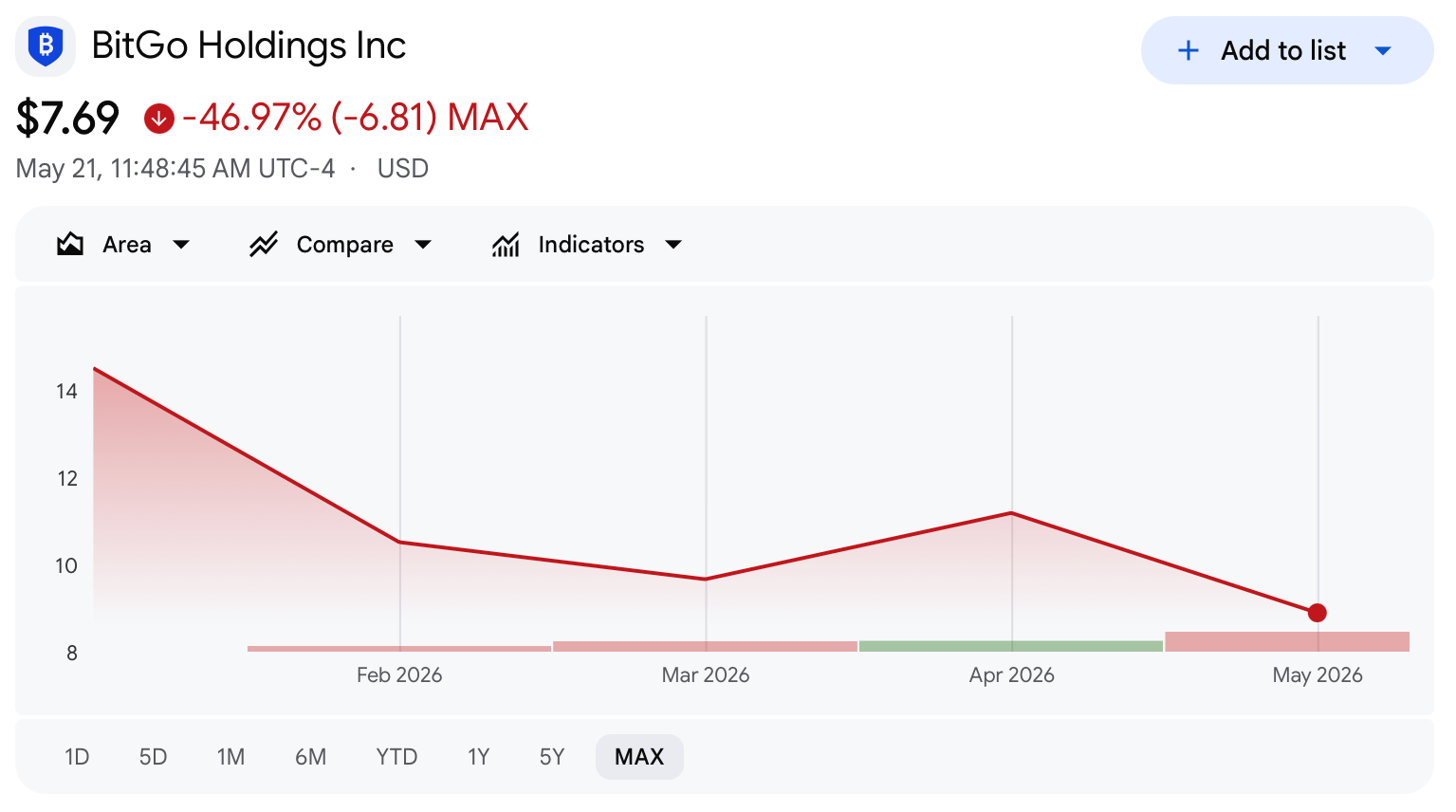
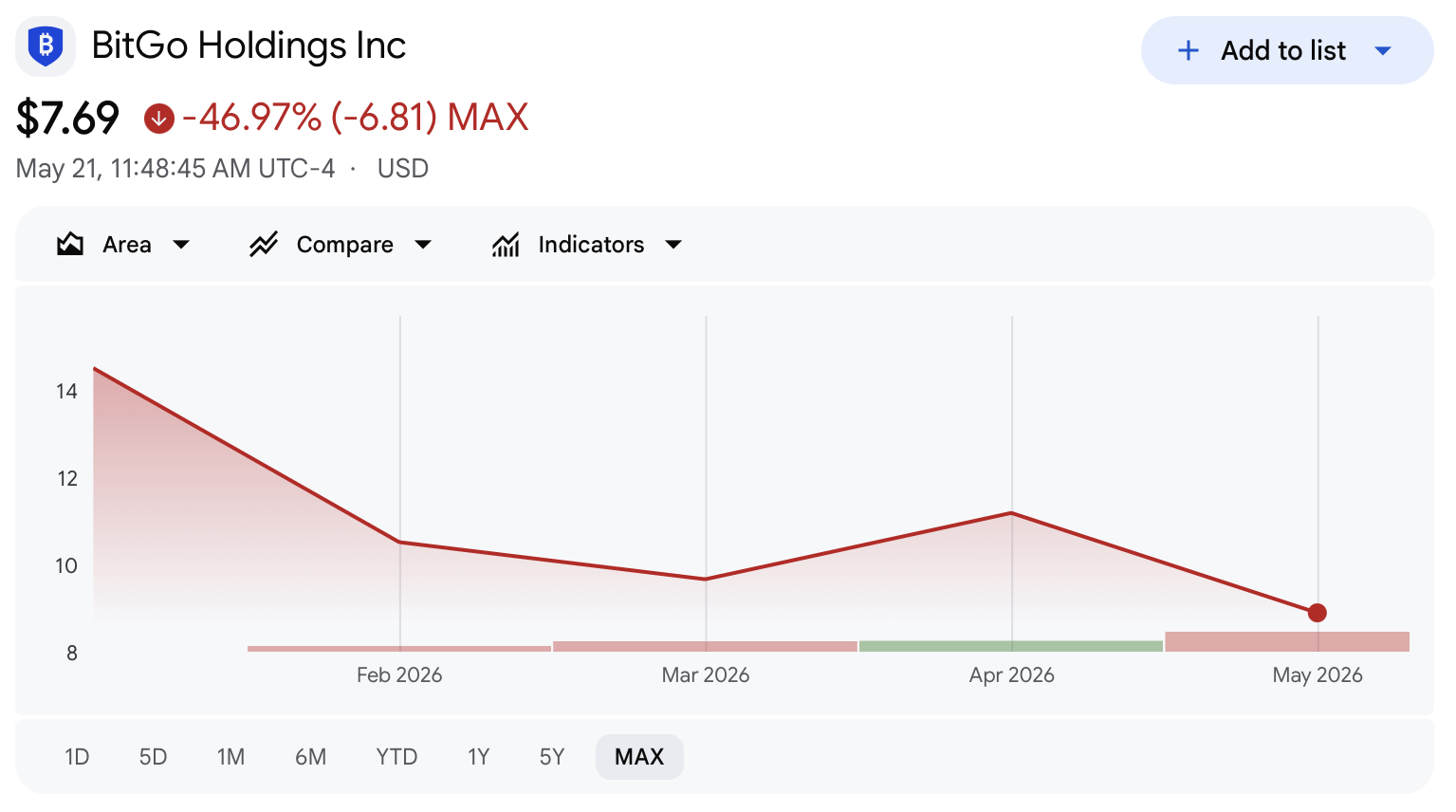
While crypto companies continue to weigh, delay or cancel public listings, BitGo completed one of the largest crypto IPOs of 2026 in January, pricing shares at $18 and raising about $213 million in its NYSE debut at a valuation exceeding $2 billion.
Since launch, the stock has fallen about 57% to around $7.66 per share amid the broader downturn in crypto markets, according to Google Finance data.
Source: Google Finance
Magazine: 5 tech predictions the mainstream media got horribly wrong


Everclear and ZERO Network announced shutdowns this week, marking the latest casualties of accelerating closures in the Decentralized Finance (DeFi) space in 2026.
The announcements come amid a broader market downturn that has pressured crypto companies.
Everclear and ZERO Cite Different Pressures
In a post on X, Everclear said the project was built around a solver model for rebalancing cross-chain funds. The segment never gained enough commercial depth, with users heavily focused on price. Monthly volume reached $500 million, but that activity did not produce sustainable revenue.
Everclear pivoted to a business-to-business-to-consumer (B2B2C) model over the past six months, signing on several major industry partners. The team said it underestimated partner onboarding timelines, and the runway ran out before deals went live.
“If funds remain after all liabilities are settled, we are exploring a buyback of existing tokens — the sum of the buy back’s potential sum might be in the range of $50–200k. We will share full details and mechanics before anything is finalized. The buyback is not certain,” the post read.
Follow us on X to get the latest news as it happens
ZERO Network framed its closure as a strategic refocus by Zerion on its wallet and application programming interface (API). The team stated that bridging into ZERO has been disabled, while bridging out remains open until July 31.
“The vision we set out to build hasn’t changed. How we deliver it is evolving. The team, the talent, and everything we learned from ZERϴ is being channeled into building the best wallet and data API experience in crypto, across every chain,” the team added.
The firms join a growing list of protocols shutting down in 2026. Syndicate Labs wound down on May 21 after five years, citing fundamental shifts in the rollup market.
Fantasy.top also added itself to the list, telling users it would close at the end of June after two years of operations. The closures span from infrastructure layers to consumer-facing apps, signaling broad DeFi consolidation.
Subscribe to our YouTube channel to watch leaders and journalists provide expert insights
The post Everclear and ZERO Network Shutdowns Add to Growing List of 2026 DeFi Closures appeared first on BeInCrypto.
Harvard Management Company exited its Ethereum ETF position after one quarter and cut its Bitcoin ETF stake, new SEC filings show.
Summary
- Harvard sold $87M Ethereum ETF stake after one quarter, ending ETHA exposure during Q1 filing.
- The endowment also cut its Bitcoin ETF holdings, reducing IBIT shares from 5.35M to 3.04M.
- Ethereum Foundation exits and ETH price weakness add pressure to the wider institutional ETF story.
The Q4 filing showed Harvard held 3,870,900 shares of BlackRock’s iShares Ethereum Trust, valued at $86.82 million. The Q1 filing no longer lists the Ethereum fund among Harvard’s reported public equity holdings.
Meanwhile, the sale came less than a quarter after Harvard first reported the ETHA position. The Q1 filing instead shows 3,044,612 shares of BlackRock’s iShares Bitcoin Trust, valued at $116.97 million.
That marks a reduction from 5,353,612 IBIT shares at the end of Q4, when the Bitcoin ETF position was valued at $265.81 million. The filing does not explain why Harvard sold ETHA or reduced IBIT. 13F reports also do not show intraday trades or private positions.
Bitcoin exposure remains in Harvard portfolio
Harvard’s move does not show a full crypto ETF exit. The endowment still held more than $100 million in IBIT as of March 31, even after selling about 2.31 million shares during Q1.
The cut places Harvard among institutions that trimmed crypto ETF risk during a weak period for digital assets. Related coverage found a mixed institutional picture, with Abu Dhabi’s Mubadala adding IBIT shares while Dartmouth added Solana ETF exposure.
Ethereum pressure adds market context
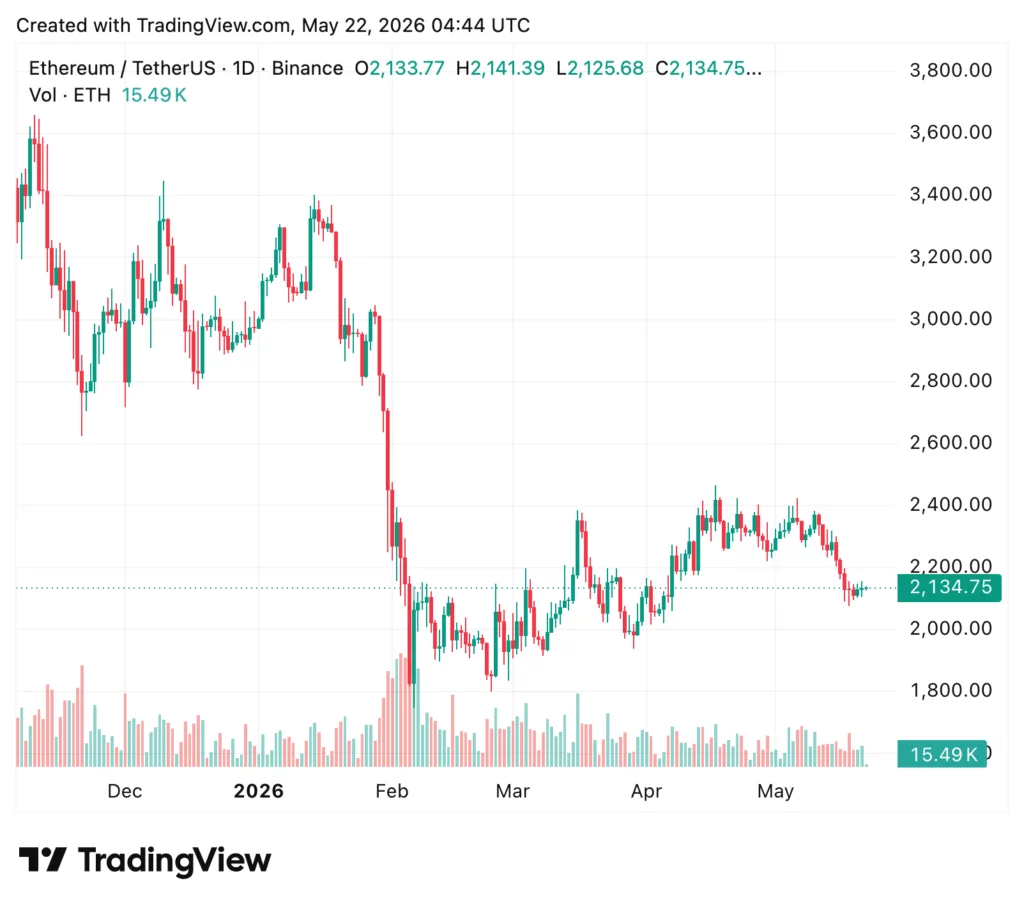
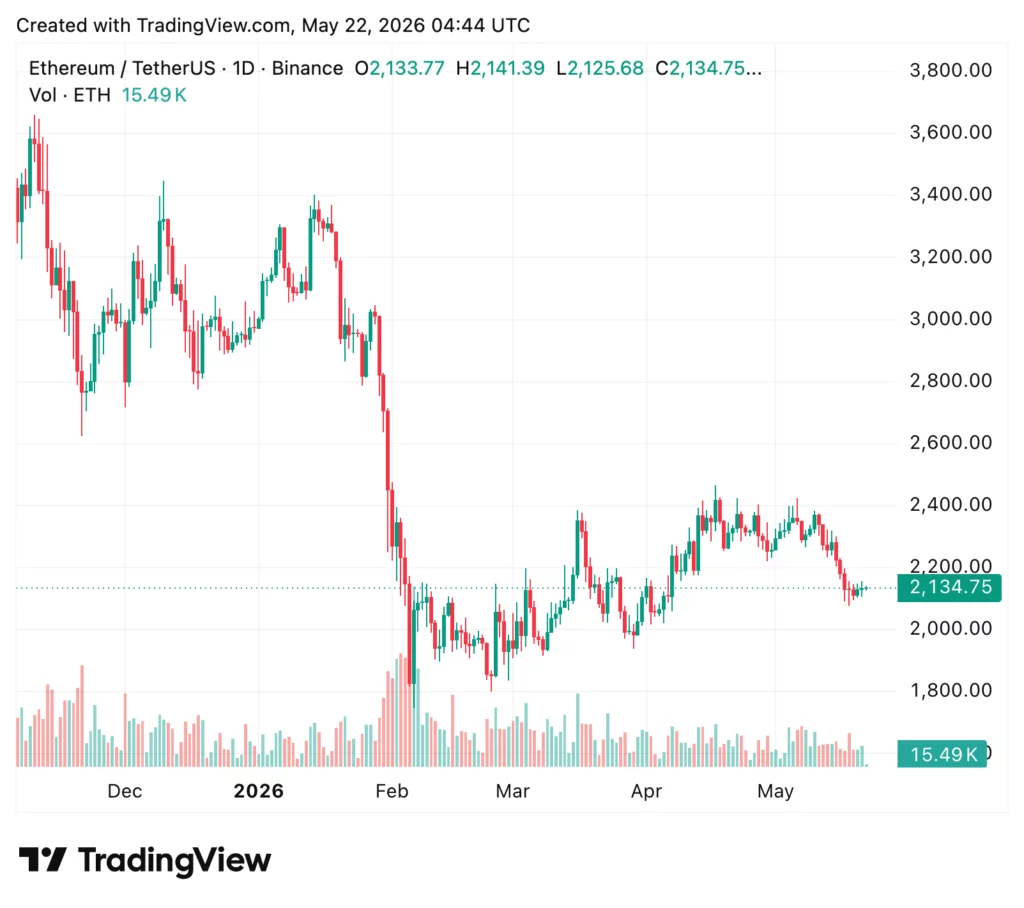
Ethereum has been under pressure since reaching an all-time high near $4,954. According to crypto.news data, Ethereum traded near $2,137 on May 22, leaving the asset down by more than 50% from that peak.
The Ethereum Foundation has also faced debate after several departures and a new mandate. In March, the foundation said Ethereum must remain censorship resistant, open source, private, and secure. Those goals drew support, but some community voices questioned whether the foundation should pay more attention to tokenomics and ETH’s market position.
Laura Shin described the core goals as “great” and “worth fighting for,” but raised doubts about the EF’s stance toward competition. She said the foundation seemed to “sit back on its laurels” while rivals fought for market share.
ETF filing shows wider institutional split
The filing adds another data point to a wider shift in crypto ETF holdings. Some institutions have continued using ETFs for Bitcoin exposure, while others have rotated, reduced risk, or tested altcoin products.
A recent crypto.news report also said JPMorgan warned that Ethereum upgrades may not be enough to lift ETH if network demand and token burns remain weak. For Harvard, the filing only confirms portfolio changes. It does not prove a long-term view on Ethereum, Bitcoin, or crypto ETFs.
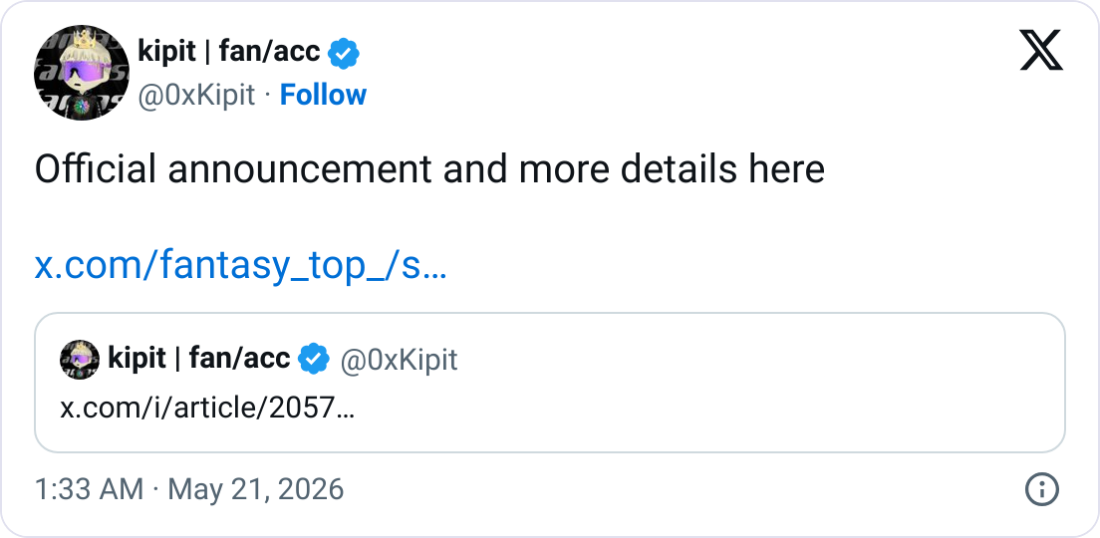
At least five crypto companies have shuttered this week as a prolonged downturn in the crypto market has put downward pressure on user activity and investor funding.
Crypto trading card platform Fantasy.top, cross-blockchain infrastructure company Everclear, and Ethereum layer-2 blockchain ZERO Network all announced Thursday that they were winding down, with their products failing to find the right fit in the market or sustain enough revenue.
This came the same week Ethereum infrastructure firm Syndicate Labs announced it was winding down after five years in a shrinking rollup market, and crypto ATM company Bitcoin Depot filed for bankruptcy in the US on Monday, citing financial strain and regulatory pressure.
Crypto companies have struggled this year amid a broad market downturn that has seen Bitcoin (BTC) fall about 40% from a peak of $126,000 in early October. Many public companies also reported losses in the first quarter, and the crypto industry has laid off more than 5,000 employees this year.
Fantasy.top posted to X on Thursday that it would shut down in June after two years of operations because its trading volume “was not sufficient to sustainably support long-term operations.”
The company added that it explored different products, such as prediction markets, to stay afloat, but “none reached durable market fit.”
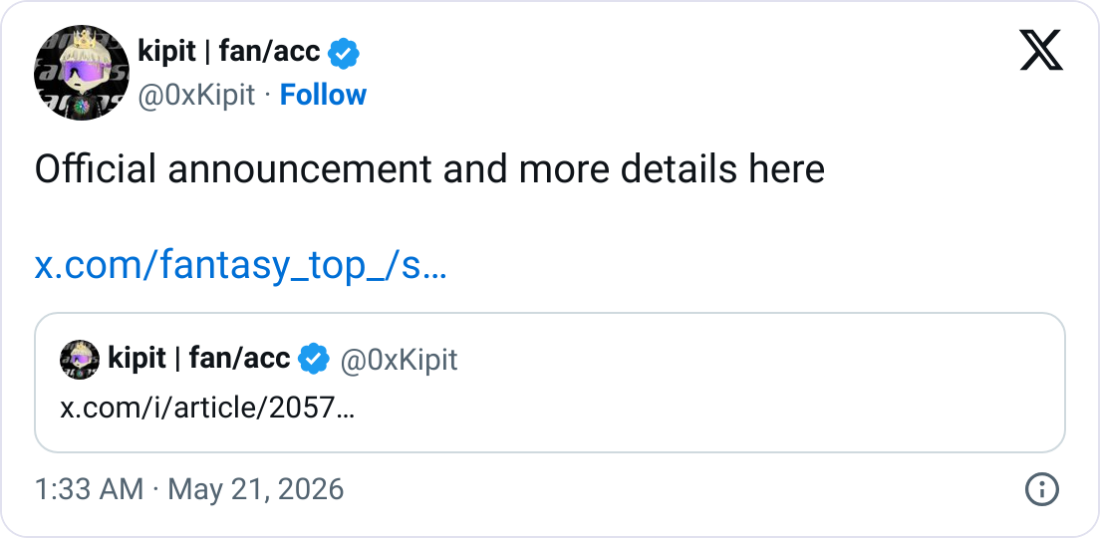
Fantasy.top co-founder “Kipit” said the company failed because it “tried to put crypto on top of a model that was never built for crypto,” and attracted people “who want to make money from cards” instead of those who enjoy trading card games.
Source: Kipit
Meanwhile, Everclear said it was winding down the Everclear Foundation and Everclear Labs, the two organizations that help manage and develop the protocol, because it “never developed the commercial depth we needed” and couldn’t sustain meaningful revenue.
The protocol added that it explored various unsuccessful acquisition options and moved to a different model focused on partnerships, but had “underestimated how long it would take those partners to go live — and our runway ran out before they did.”
Everclear said it is considering open-sourcing its protocol to give its community the option of continuing to run it.
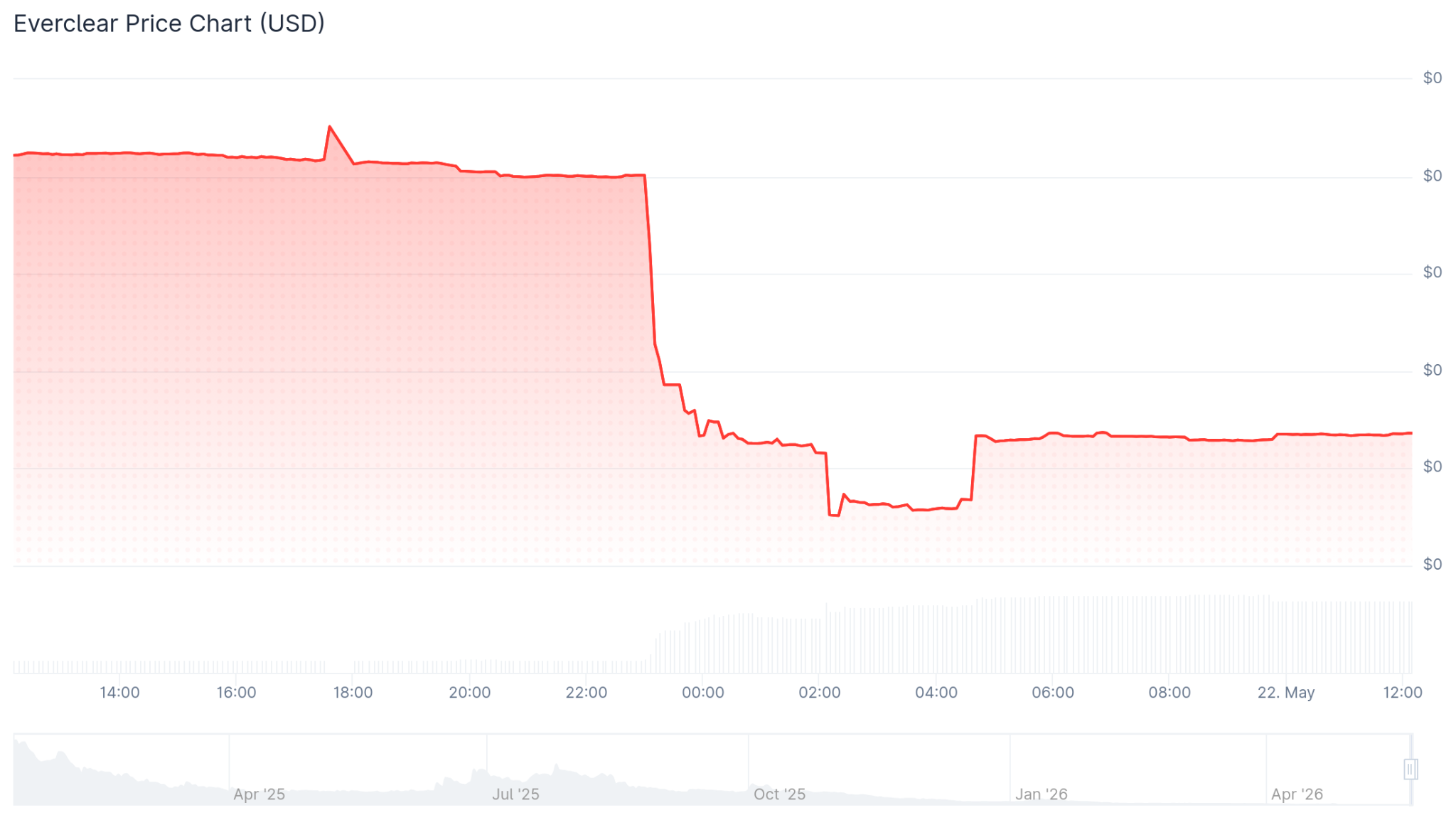
The token tied to Everclear fell sharply on Thursday after the protocol announced it was shutting down. Source: CoinGecko
Also on Thursday, the ZERO Network team posted to X that it was shuttering the network to focus on its sister crypto wallet and data service, Zerion.
Related: Bitcoin treasury Nakamoto plans reverse stock split to save ailing share price
“We launched ZERO believing users shouldn’t pay to transact on-chain,” said Zerion co-founder and CEO Evgeny Yurtaev. “We were obsessed with moving on-chain mainstream. We still are. But the world didn’t need more blockchains — it needs a better way to access them.”
Other recent crypto company closures include crypto mobile superapp Legend, which announced its closure on May 13. Solana aggregator Step Finance, crypto derivatives protocol Polynomial, crypto lending protocol Seamless and Balancer Labs, the team behind the Balancer protocol, have also closed due to the fallout from hacks or for a lack of market fit.
NYDIG research lead Greg Cipolaro said in February that the number of crypto projects that can attract investors is shrinking, with only applications or services that “extend traditional finance products onto blockchain infrastructure” getting the most attention.
Crypto platform Hyperliquid, popular for its crypto perpetual futures, has seen continued interest, pushing its token above $62 on Thursday, according to CoinGecko.
Prediction markets such as Kalshi and Polymarket, which use blockchains, have also seen continued growth in trading volume, recording a combined record monthly volume of $23.8 billion in April, according to Token Terminal data.
Conversely, major public crypto companies, including Bullish, BitGo, Galaxy Digital and Coinbase, posted losses in their first-quarter results due to market conditions.
Magazine: Guide to the top and emerging global crypto hubs: Mid-2026
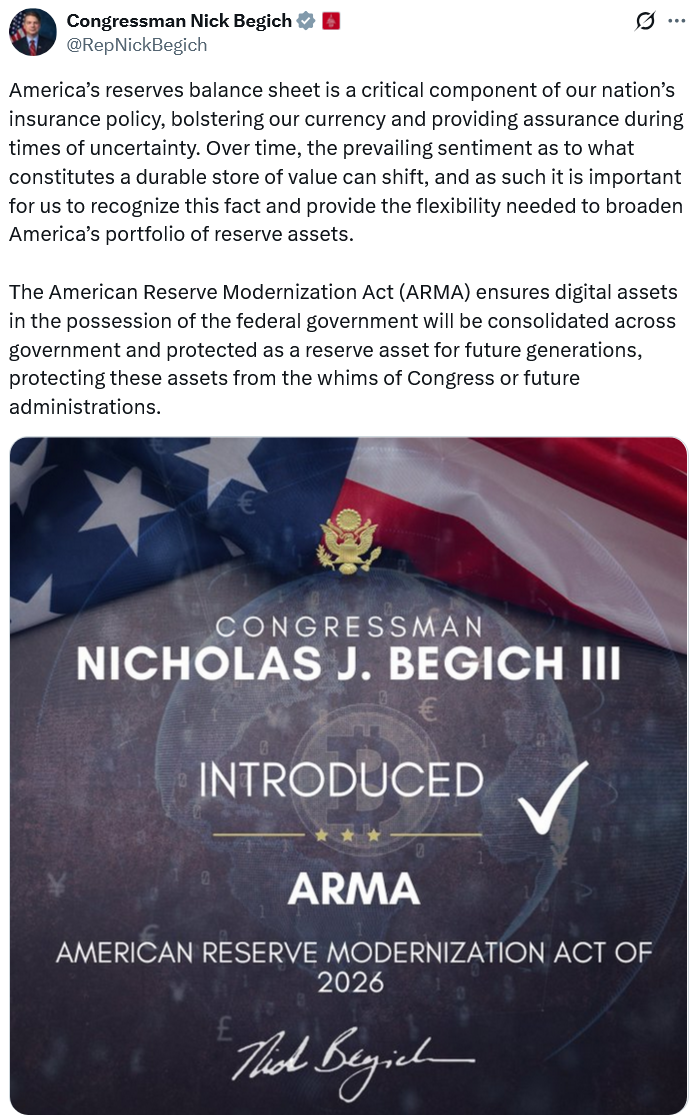
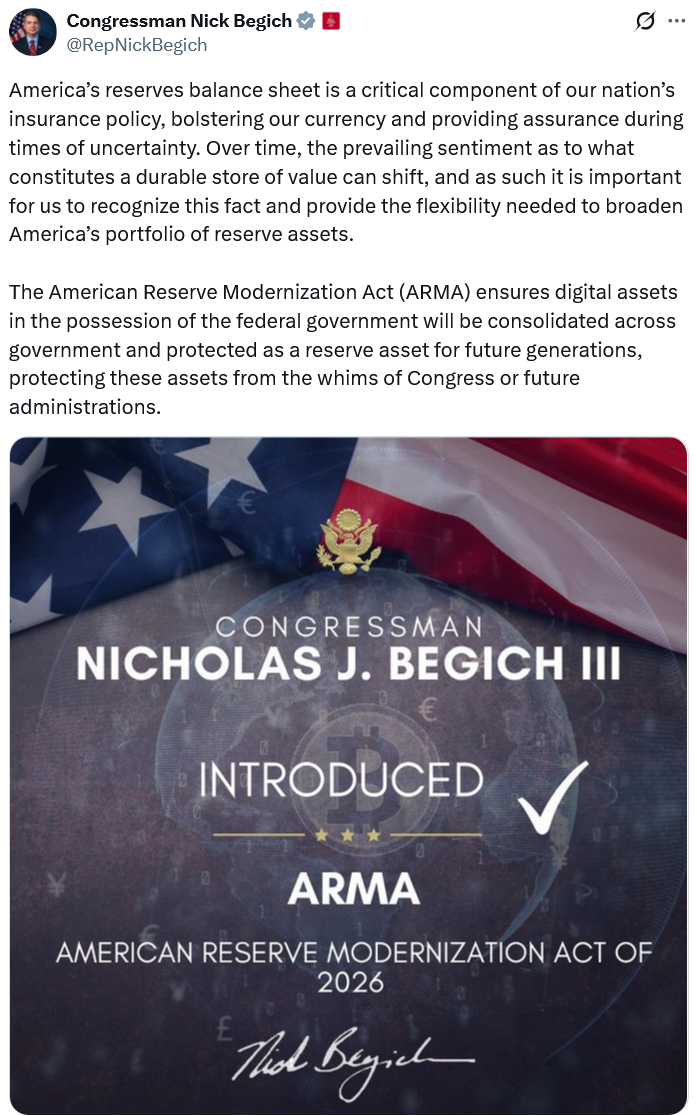
US lawmakers have renewed efforts to codify a US strategic Bitcoin reserve with a new bipartisan bill on Thursday that seeks to acquire around 1 million Bitcoin over five years.
The American Reserve Modernization Act of 2026 would establish a Strategic Bitcoin (BTC) Reserve and Digital Asset Stockpile for other federally held cryptocurrencies, which would be held by the US Treasury Department, said the bill’s sponsor, Representative Nick Begich.
ARMA, sponsored by 16 members of Congress, builds on the BITCOIN Act, which was introduced in July 2024 and updated in March 2025.
Source: Nick Begich
In an interview on Sunday, Patrick Witt, of the President’s Council of Advisors for Digital Assets, referred to ARMA as “Version 2” of the BITCOIN Act and said the White House has spent considerable time examining the legal implications of a Bitcoin reserve.
“It’s a breakthrough as far as getting everything in place, legally sound, properly safeguarding the assets.”
The push for a federal policy comes as the US currently holds 328,372 Bitcoin worth more than $25.5 billion — the most of any nation-state — but has sold portions of those holdings through court-ordered actions over the years.
“The US is already one of the largest holders of Bitcoin in the world. But Congress has never set a federal policy on what to do with that asset,” said US Representative Jared Golden, one of the 16 co-sponsors of the bill.
Under ARMA, Bitcoin must be held for a minimum of 20 years unless it is sold to reduce America’s national debt, which topped $39 trillion on Wednesday.
Like the BITCOIN Act, ARMA also seeks to acquire up to 1 million Bitcoin over five years through budget-neutral strategies, meaning it would avoid using taxpayer money.
US Representative Mike Carey argued that as digital assets continue to grow in importance, the bill could strengthen America’s long-term economic position and help keep it “competitive on the world stage.”
Related: SpaceX reveals larger-than-expected Bitcoin holdings in IPO filing
Strive CEO and chairman Matt Cole said ARMA is the “single most important crypto legislation” that could come out of Washington DC.
ARMA could strengthen transparency measures, property rights
Quarterly proof of reserve reports and independent third-party audits of the Bitcoin reserve would be published under ARMA, Begich noted.
The bill also seeks to protect digital property rights by affirming that the federal government may not impair the right of individuals to own or self-custody digital assets.
Magazine: eToro founder timed Bitcoin top perfectly due to belief in 4 year cycles
Crypto World
XRP POWER launches its intelligent app, enabling global users to earn $7,700 in passive income daily


Disclosure: This article does not represent investment advice. The content and materials featured on this page are for educational purposes only.
XRP POWER launches AI-powered app in 2026 to simplify digital finance and automation for global users.
Summary
- XRP POWER launches new AI-driven app combining automation and digital ecosystem tools for global users.
- The platform highlights security framework including ISO 27001, SOC 2, GDPR, KYC, 2FA, and AML compliance systems.
- It also integrates AI risk control and decentralized architecture to improve transparency, traceability, and security.
In 2026, AI technology continued its accelerated development, and artificial intelligence is rapidly transforming the global digital finance and automation ecosystem. More and more users are exploring new digital income models through intelligent platforms, hoping to obtain more flexible and efficient long-term income opportunities amidst market changes and increasing pressure on traditional income.
Against this backdrop, XRP POWER officially launched its new intelligent app, combining an AI automation system with the digital ecosystem to provide global users with a more convenient intelligent service experience. The platform, through intelligent AI system automation and data management, further lowers the barrier to entry for complex operations, attracting increasing attention from ordinary users and digital investors.
XRP POWER’s AI intelligent security system
XRP POWER continues to integrate AI intelligent risk control technology with international security standards to create a more stable, secure, and transparent global digital ecosystem, providing users with a higher level of security and intelligent service experience.
Regarding data security and privacy protection, the platform strictly adheres to international security and data protection standards such as ISO/IEC 27001, SOC 2 Type II, and GDPR, comprehensively strengthening its capabilities in user information security, account protection, and privacy management.
Simultaneously, XRP POWER introduces an AI-powered intelligent risk identification system, combined with AML anti-money laundering mechanisms, KYC identity verification, and 2FA two-factor authentication, continuously optimizing risk control and account security management through a multi-layered intelligent security protection system.
In terms of underlying technical architecture, the platform combines decentralized technology with AI intelligent algorithms to achieve data transparency, transaction traceability, and tamper-proof mechanisms, further enhancing the platform’s overall transparency, security, and global user trust.
XRP POWER intelligent AI registration process
XRP POWER offers various AI smart contracts with different periods and models, allowing users to flexibly choose the product solution that best suits their needs.
After selecting the corresponding contract, simply complete the payment using a mainstream cryptocurrency to quickly activate and begin your daily experience with the AI-powered smart system.
During contract operation, the platform will automatically settle earnings daily and return them to your account balance. Users can freely choose to withdraw funds or continue participating in other smart contract products, making the overall operation more convenient and flexible.
Partial list of profitable contracts
Contract Name: Dogecoin [AI Smart Quantitative] Investment Amount: $5,000, Term: 15 days, Daily Yield: $70.50, Total Profit: $1,050.50, Principal Returned at Maturity: $5,000
Contract Name: Bitcoin/Bitcoin Cash [AI Global Smart Ecosystem] Investment Amount: $25,000, Term: 23 days, Daily Yield: $417.50, Total Profit: $9,602.50, Principal Returned at Maturity: $25,000
Click to view more details on contract period returns
About XRP POWER
Currently, XRP POWER has over 3 million users worldwide, covering 189 countries and regions. With the continuous development of its AI-powered smart app and the ongoing improvement of its digital ecosystem, more and more users are experiencing smarter, more convenient, and more efficient digital ecosystem services through XRP POWER
Leveraging its AI-powered intelligent system, global operating model, and continuously optimized platform services, XRP POWER is constantly improving user experience and ecosystem stability. Against the backdrop of rapid global digital finance development, the platform continues to attract attention and participation from users in different countries and regions.
For more details, please visit the official website or download the iOS and Android apps.
Disclosure: This content is provided by a third party. Neither crypto.news nor the author of this article endorses any product mentioned on this page. Users should conduct their own research before taking any action related to the company.

Bitcoin is treading near a critical price frontier around $80,000, as a confluence of derivative pressure and technical signals hints at a potential shift in the risk balance. Data tracked by CoinGlass indicate that the lion’s share of leveraged exposure sits above the current price, with more than $4 billion in short positions exposed to a move into the $80,000 area. That looming container of risk sits against a backdrop of support around $76,100 that BTC defended for two consecutive days, while bullish signals emerged on shorter timeframes.
In recent sessions, Bitcoin briefly retested the $78,000 mark after hovering near the $76,100 support level. On the chart, a bullish divergence between price action and the relative strength index on the one-hour timeframe has appeared, accompanied by higher lows that hint at underlying buying strength. Traders will be watching whether BTC can clear the $78,000 threshold and push toward the $80,000 region, where the literature suggests a cluster of liquidity could be exposed and a potential shift in the near-term trajectory could unfold.
Key takeaways
- More than $4 billion in short positions sit above the current price, meaning a move toward $80,000 would likely trigger substantial short-liquidation pressure.
- A downside risk exists as roughly $3 billion in long liquidations could be triggered if BTC slides toward $75,000, underscoring asymmetric risk around the current range.
- The price action is forming patterns that traders interpret as a possible pre-breakout setup—an inverse head-and-shoulders under a descending trendline with a $78,000 threshold to clear before testing higher levels.
- Liquidity appears split: weak spot demand alongside rising futures activity, characteristic of leveraged-driven upside in the near term.
- Futures-driven momentum may dominate near-term moves, but the confluence of FVGs and liquidity clusters at the $79.5k–$80.3k zone suggests a defined near-term retest area that bears watching for a sustainable breakout or a rejection.
Liquidity cliff at the $80,000 mark
The near-term risk landscape centers on how large a move into the $80,000 zone could become for liquidations. CoinGlass data show the largest concentration of leveraged risk sits above current price levels; a move toward $80,000 would expose more than $4 billion in cumulative short liquidations. By contrast, a drop toward $75,000 would expose roughly $3 billion in long liquidations, presenting a skew toward downside pressure as well, but with a potentially sharper upside impulse if a short squeeze develops.
The technical setup reinforces the narrative. On the one-hour chart, Bitcoin formed a bullish divergence between price and RSI, with momentum improving as price held above the $76,100 support. The market has also been shaping an inverse head-and-shoulders pattern beneath a descending trendline, a structure that market participants often interpret as a softening bearish bias before a breakout. A sustained move above $78,000 could bring the fair-value gap (FVG) in the range of $79,500 to $80,300 into focus—a low-liquidity territory created during a previous selloff that price could revisit to fill before continuing its next leg.
In practical terms, a climb into the high $70s and into the $80k zone would test short positions with a potentially rapid unwind, while a move lower could trigger additional long liquidations. The dynamic highlights the asymmetric risk the market faces in the near term: a relatively small move in BTC price could force outsized liquidations on one side of the book depending on direction.
Derivatives activity versus spot behavior
Derivatives markets appear to be driving the recent upside more than immediate spot demand. In the latest 24-hour window, liquidations accelerated markedly, with CoinGlass data showing 103,963 traders liquidated and total liquidations amounting to $286.08 million. Short positions accounted for nearly $175 million of that total, underscoring the magnitude of risk concentrated in the short side of the book. The largest single liquidation hit Binance’s BTC/USDT pair at $3.04 million.
Open interest data from CryptoQuant painted a picture of risk posture shifting as volatility spiked. Bitcoin-denominated open interest stood near 116,800 BTC, down from roughly 120,000 BTC a day earlier. The drop suggests that traders were trimming leveraged exposure during the recent volatility, a sign that risk is being managed rather than aggressively escalated at current levels.
Spot market participation remained comparatively tepid as price reclaimed the $78,000 vicinity. The aggregated spot volume delta (CVD), which measures net buying versus selling pressure, registered at about -$483 million, signaling a degree of selling pressure in the spot arena. Conversely, the futures CVD nudged into modest positive territory, around +$34 million, complemented by persistently elevated funding rates that imply a short-term bullish tilt in the futures market. Taken together, the data indicate a liquidity split: fewer buyers in the spot market and a contingent, levered buyer presence in the futures space that has helped push prices higher in the near term.
The confluence of a cooling open interest, a quantifiable tilt toward futures-driven upside, and the looming $80,000 liquidity stack suggests traders should prepare for a decision point at the upper boundary of the current range. If price action can decisively clear the $78,000–$80,000 zone and sustain it, the market could test the FVG-retransmission zone and possibly push toward new highs in the current cycle. If, however, the bid support fails to materialize, a retest of the mid-$70s could reintroduce the risk-off dynamic that characterized earlier weeks.
For context, reports and data from market analytics providers corroborate the scene: liquidations and open-interest dynamics are consistent with a transition in momentum from cautious accumulation to a more aggressive, levered move when price passes key levels. The broader takeaway is that while spot demand remains spotty, the pull of the futures market—and the liquidity patch around $80k—could determine the near-term path for BTC.
What this means for traders and builders
From an investor and trader perspective, the current configuration emphasizes two themes. First, liquidity concentration at the $80,000 zone makes it a high-stakes battleground for leveraged traders. A break above that level could unleash a sizable short squeeze, given the $4 billion exposure to shorts, while a rejection could provoke an equally rapid unwind in long positions that now sit at risk around the mid-$70s.
Second, the divergence between futures activity and spot participation signals that a subset of market participants remains willing to deploy leverage to chase upside, while broader flow remains cautious. This dynamic can sustain a volatility regime where prices drift higher on a thin bid in spot while futures sustain the move and liquidations discipline risk management in both directions. For developers building on-chain risk analytics or traders constructing hedges, the current environment offers a meaningful test case for the reliability of funding-rate signals and the predictive value of short-term chart patterns such as the inverse head-and-shoulders and the FVG framework.
As ever, readers should monitor price action through the near-term lens of $78,000 as a pivot. A clear breakout above $80,000, supported by robust spot demand and a balanced liquidations profile, could open room for further upside. Conversely, failure to sustain momentum at that zone may invite a reevaluation of long exposure and a reversion toward key supports around $76,000–$77,000, where demand historically re-emerges during risk-off spells.
For ongoing context, traders and enthusiasts can track liquidation data and funding signals across industry analytics outlets, with CoinGlass highlighting the current concentration of risk above the price level and CryptoQuant offering a view of open-interest shifts that accompany moves in BTC pricing.
What remains uncertain is whether the upcoming price action will be primarily driven by macro sentiment, retail positioning, or continued leverage in the futures market. The next few sessions will be decisive in uncovering whether the $80,000 barrier acts as a cap or becomes a doorway to the next leg higher.

Manchester United: Michael Carrick reveals surprise Casemiro move ahead of Brighton trip

IT sector a contrarian opportunity at current valuations: Aditya Shah

California Governor Acts on AI Workforce Disruption as Silicon Valley Sheds 114,000 Jobs


-

 Crypto World6 days ago
BloFin War of Whales 2026 Grand Prix opens registration for $5M trading championship
-

 Fashion6 days ago
Weekend Open Thread: Theory – Corporette.com
-

 Crypto World6 days ago
E-Estate Announces 1 Year Live: Washington DC Summit as Real Estate Tokenization Enters Its Next Phase
-

 Tech7 days ago
Tech Moves: Microsoft AI leader jumps to OpenAI; former AI2 exec joins Meta; and more
-

 Tech6 days ago
Google reimburses Register sources who were victims of API fraud
-

 Business7 days ago
H&R Real Estate Investment Trust (HR.UN:CA) Q1 2026 Earnings Call Transcript
-

 Entertainment7 days ago
David Letterman Returns to Late Show, Blasts Cancellation
-

 Sports6 days ago
Napoleonic enters 2026 Doomben 10,000 field via Abounding withdrawal
-

 Crypto World6 days ago
BeInCrypto 100 Institutional Awards Nomination: KAST for Best Digital Assets Neobank and Best Digital Assets Fintech
-
 Crypto World6 days ago
Bitcoin Battles US Bond Nerves With BTC Price Dip Toward New May Lows
-

 Crypto World6 days ago
ICE and CME urge US regulators to curb Hyperliquid energy trading
-
 Crypto World6 days ago
Wall Street’s Boldest Gold Prediction Has Russians Rushing to Buy
-

 Fashion6 days ago
Trending Western Style Vests Perfect for Summer
-

 Fashion5 days ago
On the Scene at Gucci’s Cruise Show in New York City: Mariah Carey, Kim Kardashian, Lindsay Lohan, Iman, and More!
-

 Crypto World6 days ago
IREN closes $3 billion convertible notes deal amid AI infrastructure expansion
-

 Politics6 days ago
Watch: far-right flag-fanatics run over victim, attack locals – Setup By the Left wing for your entertainment
-

 Fashion7 days ago
Creative Ideas for Custom T-Shirts
-

 Fashion5 days ago
Amazon Sundays: Memorial Day Hosting
-
 Fashion7 days ago
Philip Jones Wedding Jewellery For Women
-

 Crypto World11 hours ago
Blockchain.com files with SEC for U.S. IPO
You must be logged in to post a comment Login