

Crypto World
Bitwise HYPE ETF is The world Largest: Is Hyperliquid The Winner This Cycle?

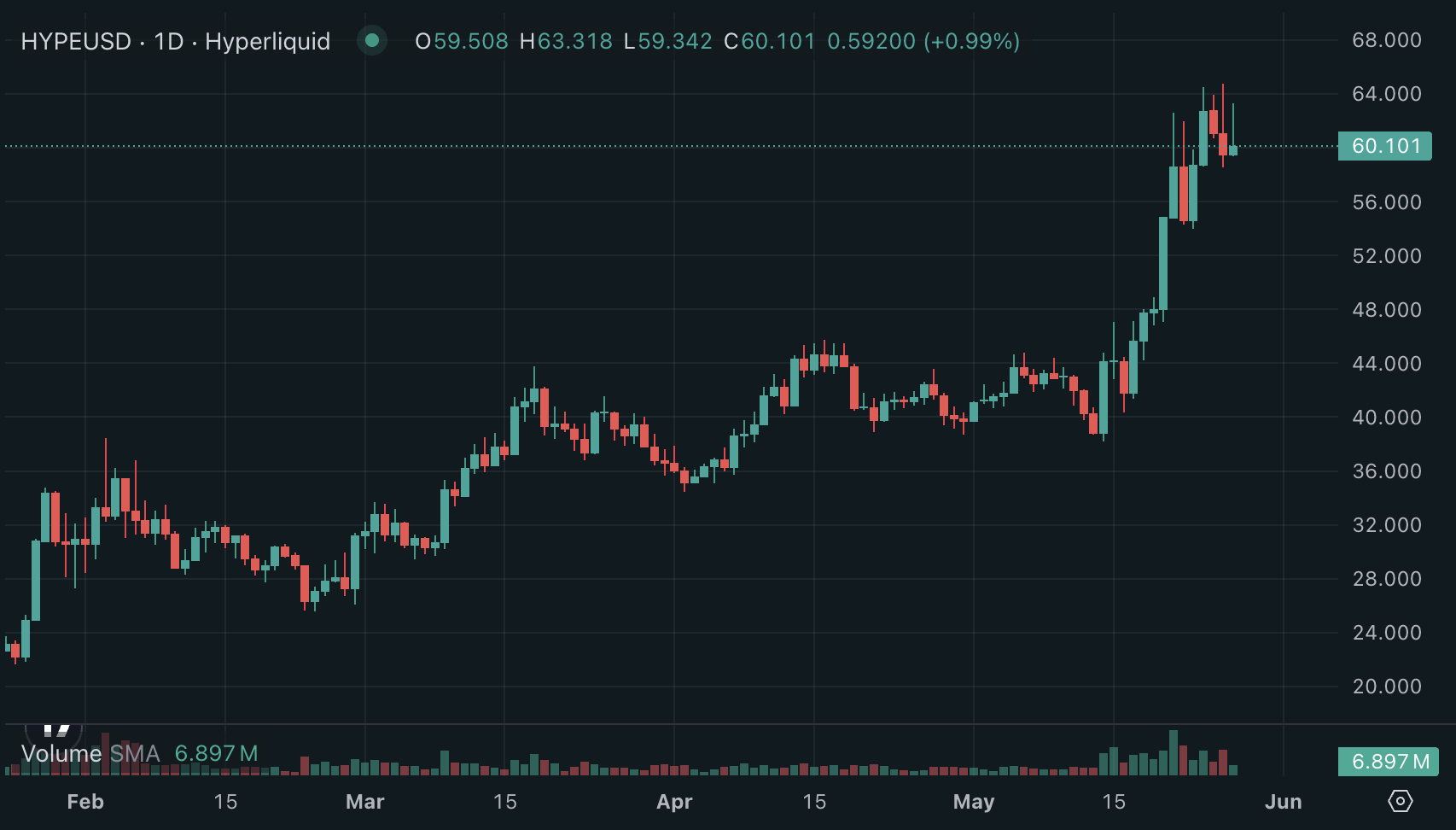
Bitwise Asset Management’s physically backed spot HYPE ETF early volume data show that the product launch is not a soft one. Does this reframe HYPE as a genuine cycle winner, or is the Bitwise ETF premium already priced in?
Bitwise’s BHYP debuted on NYSE with a 0.34% sponsor fee, temporarily waived to 0% on the first $500M in AUM for the opening month. The firm manages approximately $11 billion in client assets. Within 48 hours of launch, the two US-listed HYPE ETFs recorded a 50% single-day volume surge on May 20 and $25.5M in net inflows, with $8.8M attributed to BHYP alone, already making it one of the largest altcoin ETF launches by early metrics.
Meanwhile, Hyperliquid’s derivatives volume hit $2.9 trillion in 2025, with over 400% year-on-year growth. Not only derivatives volume, the protocol has also captured 44% of weekly blockchain fee revenue last week alone, generating $11M versus Ethereum’s $3M.
Discover: The Best Crypto to Diversify Your Portfolio
Can HYPE Break $100 as Bitwise ETF Flows Accelerate?
HYPE is having its own rally in this market bloodbath. It’s just so bullish at the moment that every major resistance is being breached. Right now, HYPE is at its price discovery after a more than 50% jump in the past 2 weeks. It’s the hottest token now as it’s outperforming the market by a huge margin.
If BHYP and the 21Shares product sustain eight-figure monthly net inflows, HYPE could easily clear $70 decisively, targeting $80. Moderate flows after the fee-waiver window closes would likely bring HYPE to the sidelines around its $60 range.

For those shorting, the best case is to see ETF inflows reverse or stall below $5M weekly, which then breaks the price to under $55 support and reverts toward the $48 range, where structural buybacks provide a floor.
The Assistance Fund mechanic is the variable not to be missed. By March 2026, the Fund had accumulated 28.5 million HYPE through automated open-market purchases, spending over $1.3 billion cumulatively, bringing an annualized buyback rate of 7% of market cap, four to five times BNB’s equivalent rates.
Discover: The Best Token Presales
Bitcoin Hyper Targets HYPE’s Style Run
HYPE’s potential is real. The ETF wrapper expands access, but it also compresses the asymmetry available to early participants. Traders rotating capital toward high-performance infrastructure narratives are increasingly looking earlier in the stack for that kind of leverage.
Bitcoin Hyper ($HYPER), currently in active presale at $0.0136, positions itself at a different point on the risk curve. It is the first Bitcoin Layer 2 integrating the Solana Virtual Machine, delivering sub-second finality and low-cost smart contract execution while settling on Bitcoin’s security layer.
The project has raised more than $32.7 million to date, with a decentralized canonical bridge enabling native BTC transfers. Staking is live with a high 36% APY for early participants. The core thesis: Bitcoin holds $1.8 trillion in idle capital; programmability unlocks it.
Research Bitcoin Hyper here before the next price adjustment.
The post Bitwise HYPE ETF is The world Largest: Is Hyperliquid The Winner This Cycle? appeared first on Cryptonews.



Polymarket is encouraging more traders to verify their identities and tightening enforcement against VPN use, marking a clear shift from its long-standing permissionless trading model.
The world’s largest prediction market faces growing sanctions, legal, and regulatory pressure on its operations. House Oversight Committee investigators have requested KYC and geographic enforcement records by June 5.
What Changes for Everyday Users
According to a report from The Information, the company is pushing traders toward voluntary identity checks while clamping down on suspicious accounts.
Basic wallet-connect trading still works for most international users, who can deposit USD Coin (USDC) on Polygon without uploading personal documents.
That permissionless access is no longer guaranteed across the board. Polymarket now strictly polices VPN use, and accounts that bypass IP-based geoblocks risk suspension or permanent bans.
Traders running seven-figure positions, or rapid five-figure deposit-trade-withdraw cycles, have been documented triggering verification under internal anti-money laundering thresholds.
Users who complete a voluntary KYC or KYB form gain perks. These include direct co-location on Polymarket’s primary servers, which lowers latency for active traders.
Regulatory Pressure is Rising
The international platform remains separate from Polymarket US. The US arm requires full KYC since Polymarket acquired a CFTC-licensed exchange in 2025.
The shift followed a $1.4 million CFTC settlement in 2022 over unregistered binary options.
More than 33 countries now face full restrictions or technical blocks. These range from OFAC-sanctioned states to jurisdictions with strict gambling rules.
Stronger compliance reduces the threat of shutdowns, blocked withdrawals, and follow-on regulatory action. Privacy-focused traders, however, lose some of what made the platform distinctive.
Therefore, the message to international users is simple. Trade through a wallet in permitted countries, avoid VPN workarounds, and expect identity requests if activity stands out.
The trend points toward tighter controls, even where the front door stays open.
The post Polymarket is Blocking VPN Access With KYC: Should You Worry? appeared first on BeInCrypto.


Recently, the United Kingdom Foreign, Commonwealth, and Development Office (FCDO) sanctioned an entity called “Huobi Global S.A.” for its alleged role in “providing financial services” to firms that are “carrying on business in a sector of strategic significance to the Government of Russia.”
Specifically, it alleged that this entity was interacting with what is commonly referred to as the A7 Payment Network, which includes the A7A5 stablecoin.
Additionally, Huobi Global S.A. was allegedly interacting with the Russian cryptocurrency exchange Garantex.
Read more: UK sanctions HTX for alleged Russian sanctions violations
HTX has publicly responded to these allegations by claiming, “the listed entity Huobi Global S. A. is distinct from the online HTX exchange.”
It further claimed that “the designation does not and should not have any impact on the online HTX exchange. HTX’s global operations remain unaffected, and all user funds are safe.”
However, this update minimizes the extensive role that Huobi Global S.A. has served for HTX.
What is Huobi Global S.A.?
Huobi Global S.A. is a Panamanian incorporated entity that was incorporated on May 19th, 2023.
This entity lists Huobi Global Limited as one of its directors.
That is not the only connection to the HTX exchange, as Huobi Global S.A. is also the trademark holder for the HTX trademark in the United States.
However, the most striking connection comes from a legal filing related to Huobi Global S.A.
Read more: Justin Sun’s Poloniex added to UK regulator warning list
Specifically, on February 2nd of this year, Huobi Global S.A. filed a claim in the District Court for the District of Columbia. This claim was for Tether (USDT) tokens that had been burned and was related to the 2023 hack of HTX and the HECO bridge.
In this claim, lawyers for Huobi Global S.A. described it as the entity that “owns and operates HTX…and is the developer of the Huobi Eco Chain.”
So, mere months before HTX would publicly insist that “the listed entity Huobi Global S. A. is distinct from the online HTX exchange,” it was insisting in legal filings that it “owns and operates HTX.”
Protos has reached out to HTX for comment, but it did not immediately respond.
Got a tip? Send us an email securely via Protos Leaks. For more informed news and investigations, follow us on X, Bluesky, and Google News, or subscribe to our YouTube channel.


OpenZeppelin, a smart contract security firm whose libraries underpin most DeFi protocols, pushed back Tuesday against a viral post by its co-founder and former CTO declaring all of DeFi fundamentally unsafe, clarifying that the claims do not represent the company's position. Manuel Aráoz, who… Read the full story at The Defiant

Ripple (XRP) continues trading within a narrow range between around $1.30 and $1.38 despite several failed breakout attempts.
Santiment has identified a rare XRP signal as traders remain under increasing pressure.
High-Potential Rebound Zone
According to on-chain analytics platform Santiment, the average XRP trader active over the past 30 days is currently down 47%, as many investors are reportedly selling at the bottom during the recent market decline.
Santiment found that XRP’s 30-day Market Value to Realized Value (MVRV), a metric used to measure average trader returns, has now dropped to its lowest level since December 2020. MVRV readings historically tend to return toward 0%, which makes the current level an indication that the crypto asset may be in an extreme undervalued zone.
As per the analysis, the sharp decline is indicative of a growing fear and frustration among traders following XRP’s retracement, which has erased more than half of its market value since last summer. Santiment said XRP’s strong rally during late 2024 and early 2025 led many traders to enter positions near local highs before momentum weakened and repeated selloffs pushed short-term holders into heavy losses.
Despite the decline, the findings reveal that some long-term investors remain optimistic due to expectations surrounding regulatory progress, speculation about a potential XRP ETF, and Ripple’s broader adoption narrative. Santiment added that deeply negative MVRV zones like the current one have historically appeared when retail traders capitulate, often creating conditions where even minor positive catalysts can trigger strong recoveries.
Additionally, fear around the crypto asset has climbed to unusually high levels on social media. The ratio of bullish to bearish comments has dropped to just 1.1 positive comments for every 1 negative comment as traders grow more cautious about XRP’s outlook.
Santiment observed that similar periods of fear and skepticism have historically acted as contrarian signals for XRP, as many weaker holders tend to exit the market during sharp downturns. The platform added that previous moves into this “FUD zone” were often followed by price stabilization or short-term rebounds.
Rising Speculative Momentum
At the same time, fresh data from CryptoQuant pointed to growing speculative activity around XRP perpetual futures on Binance, even though the token itself has continued hovering near $1.34. The analytics firm said XRP’s volume imbalance reading climbed to roughly 0.54, which means that perpetual contract trading volumes are now significantly higher than during earlier periods of quieter market activity.
According to CryptoQuant, this suggests more traders are returning to short-term leveraged positions. The platform also noted that XRP’s Z-Score rose to nearly 0.95, meaning current trading activity is approaching one full standard deviation above its usual average.
CryptoQuant added that the indicator had spent an extended period in negative territory before recently moving back into positive levels, which points to a gradual improvement in trader risk appetite and renewed speculative participation in the market.
The post Important for Ripple (XRP) Traders: Rare Bottom Signal Emerges appeared first on CryptoPotato.
Crypto World
Pi at around $0.15 today, what happens to PI if it ever becomes a GENIUS Act stablecoin?
Pi Network is trading near $0.15 today, and the real question is whether a GENIUS Act-style shift toward regulated, reserve-backed digital dollars would cap its upside or finally give it a credible path to parity with the U.S. dollar.
Summary
- Pi Network is trading around $0.15, with most models seeing either flat or modestly higher prices into 2026
- The GENIUS Act framework for fully backed, bank-style stablecoins could one day turn PI from a speculative asset into a regulated dollar proxy
- That trade-off would likely swap 10x moonshot upside for a hard $1 target and a shot at mainstream payments and savings use cases
Pi Network’s (PI) various IOU markets are currently pricing PI just under the $0.15 mark, with recent data from Bybit showing the token at roughly $0.17 and analytics platforms such as CoinCodex and CoinCheckup clustering the live price in the $0.14–$0.15 band as of late May 2026. Price prediction engines are broadly cautious: CoinCodex, for example, projects Pi could slip toward $0.11 by late June 2026, implying downside of roughly 25% from current levels, while its 2026 full-year model sees an average price near $0.11 within a $0.10–$0.15 trading channel. Longer-term forecasts are more generous, with some outlets modeling potential paths toward $0.50–$0.80 by 2030 and even north of $1 by 2050, but those curves assume PI remains a high-beta, speculative asset tied to broader crypto liquidity cycles rather than a tightly managed stablecoin.
The GENIUS (National Innovation Guidance and Establishment for American Stablecoins) Act points to a radically different future. The law is designed to create a category of fully reserved, U.S.-regulated stablecoins that hold one-to-one backing in cash or ultra-safe assets like U.S. Treasuries and live inside a bank-like supervisory perimeter. In a viral explainer circulating in the Pi community, one commentary describes how GENIUS-compliant issuers “must hold one-to-one reserves, one real dollar or super safe equivalents in protected accounts,” and notes that Pi teams are “actively exploring the path to register Pi as a GENIUS-certified stablecoin pegged to the U.S. dollar,” with the explicit goal that “one Pi equal…1 U.S.” dollar. In that vision, the Pi users have been mining for years would “no longer have a fluctuating unknown value” but would convert into a regulated digital dollar with real-world purchasing power.
What a GENIUS-style pivot would mean for PI’s price path
If Pi ever did complete that pivot—from an IOU-like, thinly traded altcoin at $0.15 into a GENIUS Act registered, reserve-backed stablecoin—the price prediction game changes completely. Under a strict one-to-one reserve model, the long-term “target” price is effectively hard-coded at $1, with variations only around market confidence, liquidity and short-term technical noise. Overnight, the question “Can PI hit $10?” becomes nonsensical; the relevant question becomes “Can PI credibly defend $1 through cycles?” That is the trade-off: accept a ceiling on upside in exchange for dramatically lower volatility, better regulatory clarity and access to mainstream payments rails and bank integrations.
From today’s roughly $0.15 spot price, even that path is non-trivial. To credibly peg PI at $1 under GENIUS rules, its backers would have to amass and ring-fence reserves that match whatever portion of the existing supply they convert into the new instrument, plus manage redemptions in a way that avoids bank-run dynamics. For existing holders who mined or bought PI on the expectation of uncapped upside, a forced migration into a $1-anchored instrument could feel like an expropriation of optionality, especially if conversion terms do not fully reward early risk-taking. On the other hand, a regulated stablecoin backed by one-to-one reserves could be the only realistic path to turning Pi from a speculative IOU priced at cents into something that merchants, payroll platforms and even conservative fintechs will actually touch.
Price prediction in a bifurcated future
In the base case where Pi never becomes a GENIUS-compliant stablecoin, the numbers on the table are modest. CoinCodex’s mid-range scenario has PI averaging around $0.11 in 2026 and potentially climbing toward $0.49 by 2030, with bullish tails that extend above $0.80 by 2040 and $1.70 by 2050, assuming the project stays alive and the broader crypto cycle cooperates. Other forecasters sketch similar arcs, generally keeping PI below $0.20 in the near term but allowing for multi-bagger potential over a decade if adoption, listings and network effects materialize. In that world, Pi is another high-risk token riding crypto’s liquidity waves, not a serious monetary instrument.
Under a GENIUS-style pivot, the price path compresses. The bull case is not a 10x from $0.15 to $1.50; it is a roughly 6–7x move to $1 followed by a plateau where returns come from using Pi in real-world commerce, payments and yield-bearing wrappers rather than capital gains on the token itself. The bear case shifts too: instead of grinding down toward zero in a liquidity winter, a fully reserved, well-governed Pi stablecoin would either hold the peg or fail outright if governance, reserves or regulation blow up. For now, Pi trades and is modeled as if the GENIUS Act is background noise. If the project ever actually crosses that regulatory Rubicon, every price prediction you see today will need to be rewritten from scratch.


- Stellar and DTCC have partnered to bring tokenized securities on-chain.
- DTCC processed approximately $4.7 quadrillion in securities transactions last year.
- XLM price rose to above $0.16.
Stellar’s native token XLM rose more than 8% after the Depository Trust & Clearing Corporation (DTCC) announced plans to connect its tokenised securities platform to the Stellar blockchain.
The development comes as Bitcoin faces renewed downside pressure, and is being viewed as another sign of growing institutional interest in blockchain infrastructure built for real-world asset tokenisation.
Stellar and DTCC announce tokenization partnership
The DTCC, one of the world’s largest post-trade market infrastructure providers, said it will link its tokenized securities platform to the Stellar network in the first half of 2027.
The partnership targets DTC-custodied assets, including Russell 1000 equities and US Treasuries, bringing large swathes of traditional securities onto-chain.
DTCC processed approximately $4.7 quadrillion in securities transactions last year.
Nadine Chakar, Managing Director and Global Head of DTCC Digital Assets, praised Stellar’s institutional credentials, saying Stellar’s “proven track record with institutional assets onchain is an important factor in our evaluation of blockchain networks. Its emphasis on compliance, transaction throughput, and low-cost operations meets our rigorous standards and will help ensure we’re ready for growth as usage of blockchain networks for real-world asset transactions increases.”
The statement frames the collaboration as a measured step toward scalable, compliant tokenization of mainstream financial instruments.
The arrangement positions Stellar as a candidate for high-volume, regulated token issuance and settlement.
DTCC’s selection criteria, which include compliance features, throughput capacity, and cost-efficiency, mirror the operational demands of institutional markets.
According to market observers, the development could encourage other market infrastructures to explore similar integrations.
“Stellar’s proven compliance-minded architecture, open infrastructure, and risk management capabilities are aligned with market demands and expectations. Our network was built for this moment – we have always believed that blockchain’s utility for finance is to be the rail that institutional-grade markets can depend on,” said Denelle Dixon, CEO and executive director, Stellar Development Foundation
XLM price jumps 8%
Stellar price reacted positively to the announcement, with XLM rising roughly 8% to above $0.16.
Gains in the past week now stand at over 13%.

The intraday rally in Stellar (XLM) appeared to be driven in part by speculative flows as Bitcoin rebounded from intraday lows.
The move also points to renewed investor interest in Stellar’s potential role within the institutional tokenisation market.
From a technical standpoint, XLM has broken above a short-term resistance zone near $0.15, an area that previously acted as a swing high.
Holding above this level would reinforce the view that fresh buying pressure is entering the market.
The token has already retested intraday support following the breakout.
A decisive close above the recent resistance zone could open the way toward higher horizontal supply levels.
On the downside, failure to maintain the breakout may see XLM retreat toward key support areas defined by major moving averages, where buyers have previously emerged.
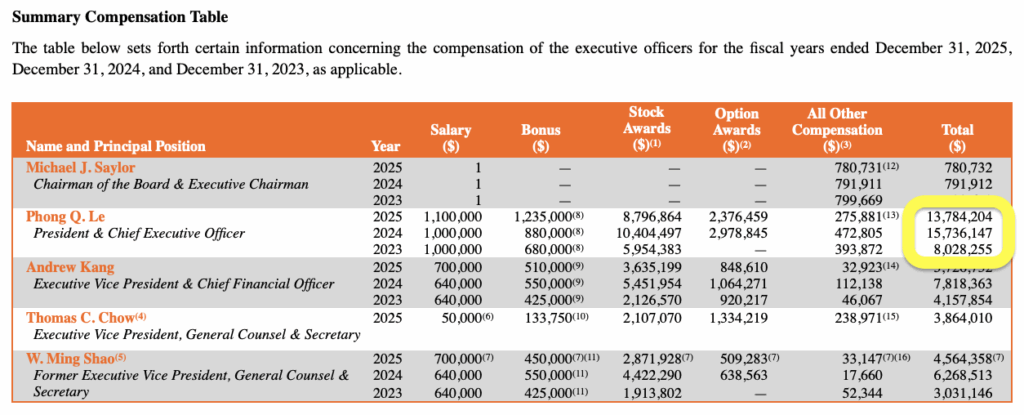
Strategy (formerly MicroStrategy) CEO Phong Le just bought $5,467 of his company’s STRC preferred shares for two of his children. The same man earned over $37 million running the company over the past three years, including $13.7 million in total executive compensation during fiscal 2025 alone.
Not that it makes the figure any better, but all three minor children technically held STRC before May 22. Together, they hold 186 STRC shares, worth $18,600 combined.
Alongside founder Michael Saylor, Le has spent the past year pitching STRC to retail investors as a supposed competitor to high-yield bank accounts and money markets. Le’s 11.5% dividend-paying, variable-rate stock has a market cap of $10.4 billion — about four-fifths of which is owned by non-accredited, retail investors.
Le disclosed his May 22 familial purchases on a SEC Form 4 dated May 26. He bought 50 STRC shares at $99.41 for Minor Child 1, plus 5 shares at $99.37 for Minor Child 3.
BitcoinTreasuries.NET celebrated the filing, “Bitcoiner dad securing the future for his kids.”
Quite the gift from the Strategy CEO who made $37 million
Strategy’s 2025 financials, filed with the SEC on April 28, list Le’s 2025 total compensation at $13,784,204. Specifically, his package breakdown was $1.1 million in salary, $1.235 million in bonus, $8.8 million in stock awards, and $2.38 million in option awards.
In other words, Le’s gift to his children works out to less than one one-hundredth of his 2025 stock awards alone.
His 2024 total was slightly higher, $15.74 million. That was mostly due to the higher closing price of Strategy’s common stock, MSTR, in 2024 versus 2025. In 2023, Le received $8 million.
Read more: Strategy’s BTC binge has cost it $1 billion in expenses
Le has also bought STRC for himself, although not in quantities that would come anywhere close to his level of compensation, let alone net worth. On March 19, he bought 2,509 STRC shares at $99.62, a $250,000 open-market trade.
Trivial relative to his personal fortune, he told podcaster Natalie Brunell that he wanted to “experience” STRC, likening its monthly dividends to a paycheck.
CEO whose common stock lost 58% in 12 months
STRC is a perpetual preferred share that pays a monthly dividend and is quasi-pegged at $100, even though it has traded as low as $90.52 per share on the Nasdaq. In its private debut, Strategy priced its public offering at $90 per share on July 24, 2025.
To encourage bids up to $100 per share, Strategy has hiked the monthly dividend rate seven times since launching STRC, from 9% to 11.5% today.
Le personally owns 8,009 STRC, 6,000 Strife, 4,500 Stride, and 22,923 MSTR common shares.
STRC closed at $99.47 on Tuesday, just below its $100 par. The company’s MSTR common stock has declined 11% over the past six months and 58% over the past 12 months.
The company’s massive stockpile of bitcoin (BTC) were acquired for an average $75,700 cost basis — slightly above the current market — excluding $1 billion of costs while running that acquisition strategy for the past six years.
Got a tip? Send us an email securely via Protos Leaks. For more informed news and investigations, follow us on X, Bluesky, and Google News, or subscribe to our YouTube channel.


Block’s Cash App has begun a phased rollout of USDC support, turning the app into a stablecoin payment rail for tens of millions of U.S. retail users.
Summary
- Cash App is adding USDC deposits, withdrawals and payments for its roughly 60 million users
- About 25% of users have access now, with full coverage targeted by the end of the week
- The feature supports Solana, Ethereum, Polygon and Arbitrum, with on-chain mis-sends remaining irreversible
Block’s Cash App is gradually enabling stablecoin payments for its nearly 60 million users, starting with a restricted launch that currently reaches around a quarter of the customer base and is expected to extend to 100% availability within the week, according to the company’s communications. The new feature allows users to deposit and withdraw USD Coin (USDC), moving value freely between external self-custodial wallets and their Cash App balances, and to use the stablecoin explicitly as a payment and settlement tool rather than a savings or yield product.
At launch, Cash App’s USDC functionality supports four major blockchain networks: Solana, Ethereum, Polygon and Arbitrum, giving users access to both high-throughput, low-fee rails and the more established Ethereum mainnet environment. The company is emphasizing that on-chain payments are irreversible by design, warning that sending USDC to an incorrect address or over an unsupported network will result in permanent loss of funds, a sharp contrast with the reversibility many users associate with card payments or bank transfers.
From bitcoin-first to stablecoin reality
The rollout marks a pragmatic shift for Block, whose co-founder and CEO Jack Dorsey has repeatedly framed bitcoin as the company’s long-term priority and the native money of the internet. In prior public remarks, Dorsey has said the firm’s strategic focus would lean heavily toward bitcoin, from mining hardware to self-custody solutions and Lightning-driven payments. The decision to integrate USDC at scale through Cash App reflects the reality that, in day-to-day commerce, demand for dollar-pegged stablecoins has outpaced consumer interest in spending volatile assets.
By treating USDC as a transactional settlement instrument—rather than dangling yield or speculative upside—Cash App is positioning its stablecoin feature squarely inside a regulatory narrative that views stablecoins as payment tools, not investment contracts. Users can top up USDC from an external wallet on a supported chain, move it into or out of their Cash App dollar balance, and route payments through stablecoin rails without needing to think about FX or crypto price swings.
Consumer payments meet on-chain finality
For Cash App’s user base, the integration opens a direct bridge between mainstream fintech and public blockchains. Someone paid in USDC on Solana, Polygon, Ethereum or Arbitrum can now pull those funds into Cash App and spend in the familiar fiat environment, while merchants or individuals who want to settle in stablecoins can push value out to external addresses on the same networks.
The downside is that users are now exposed to classic on-chain risks. Mis-typing an address, choosing the wrong network, or sending to a contract that does not accept USDC will not trigger a support ticket reversal; the funds are gone. Cash App’s messaging stresses this irreversibility, underscoring that while the company is moving closer to crypto-native infrastructure, it cannot rewrite the fundamental properties of the networks it supports. For Block, the phased rollout allows it to test how a largely retail audience handles those constraints at scale, balancing its long-standing bitcoin maximalist instincts with the market’s clear preference for dollar-stable, programmable money.
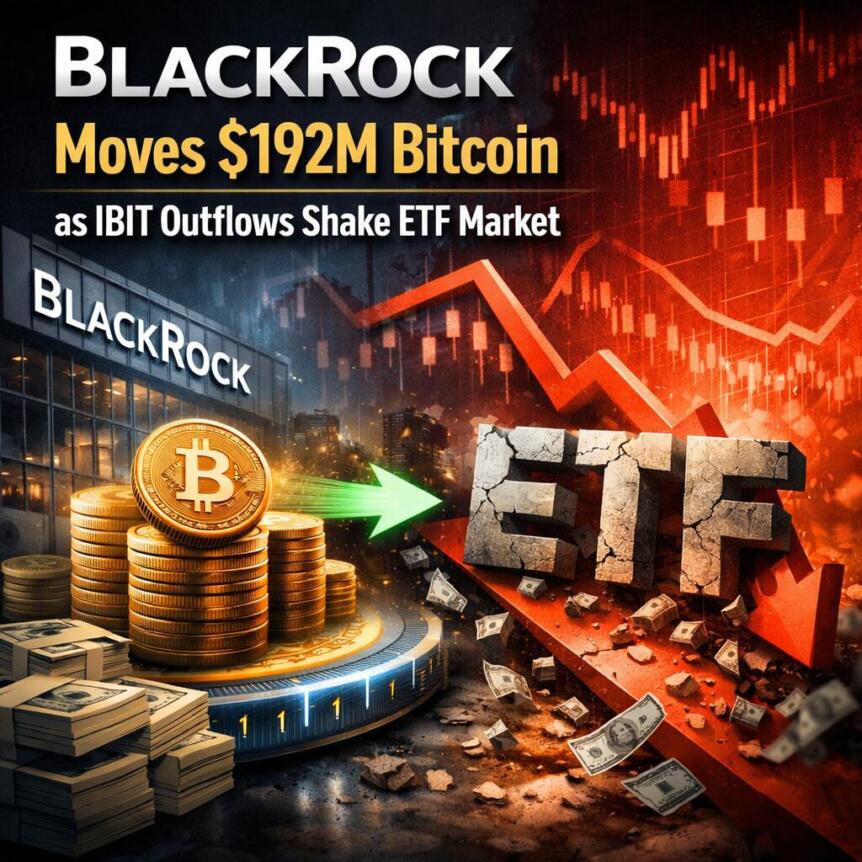
BlackRock’s Bitcoin movements drew fresh market attention after a large Coinbase Prime transfer matched heavy IBIT activity. The asset manager moved 2,538 BTC worth over $192 million on Tuesday. The shift followed a major block trade and fresh outflows from its spot Bitcoin ETF.
BlackRock Transfers Bitcoin after Large IBIT Trade
BlackRock transferred 2,538 Bitcoin between Coinbase Prime-linked wallets, according to data from Arkham Intelligence. The transfer was valued at about $192.53 million. It came during a busy session for BlackRock’s iShares Bitcoin Trust ETF.
The wallet activity followed a large IBIT block transaction on May 26. Trading data showed 29,212,864 IBIT shares changed hands at $43.16 each. The full transaction was valued at nearly $1.26 billion.
The block sale did not create a major price shock for IBIT. The fund only recorded a small decline during the trading session. However, the size of the trade placed BlackRock’s Bitcoin ETF flows back in focus.
Bitcoin ETF Outflows Hit BlackRock and Wider Market
Farside Investors’ data showed that IBIT recorded $192.4 million in outflows on May 26. The figure matched the value range of BlackRock’s related Bitcoin transfer. Therefore, the movement likely reflected fund settlement and portfolio activity.
IBIT also recorded $103.7 million in outflows on May 21. It then posted another $68.9 million in outflows on May 22. These figures marked a weaker stretch for the leading spot Bitcoin ETF.
The wider U.S. spot Bitcoin ETF market also faced redemptions on May 26. Total net outflows reached $333.6 million across the market. Fidelity’s FBTC lost $57.7 million, while Bitwise’s BITB lost $28.8 million.
IBIT Keeps Lead Despite Bitcoin Fund Pullback
Grayscale’s GBTC also reported $41.3 million in outflows during the same session. The numbers showed pressure across several major Bitcoin ETF products. Still, IBIT remained the dominant fund by total historical inflows.
Since launch, BlackRock’s IBIT has attracted $64.58 billion in cumulative inflows. Its average daily inflow stands at $108.7 million. Its highest single-day inflow exceeded $1.11 billion.
The latest outflows came after months of strong demand for U.S. spot Bitcoin ETFs. These funds launched in January 2024 after regulatory approval. They gave traditional market participants direct exposure to Bitcoin through exchange-listed products.
Bitcoin ETFs have since become a major channel for institutional crypto allocation. BlackRock’s IBIT has led that trend through strong liquidity and large inflows. However, recent redemptions show that large holders can still adjust exposure quickly.
The Coinbase Prime transfer does not confirm a direct sale of Bitcoin. It shows movement between custody-linked wallets during a period of ETF redemptions. Still, the timing connected the transfer to broader IBIT activity.
Market reaction stayed measured after the large IBIT block trade. Bitcoin and ETF pricing absorbed the activity without sharp disruption. That response suggested strong secondary market depth around the fund.
BlackRock’s latest Bitcoin movement now adds context to spot ETF flow trends. The transfer showed how ETF redemptions can create large custody movements. Even so, IBIT’s cumulative lead remains intact despite the short-term pullback.


Fold Holdings has started issuing its Fold Bitcoin Credit Card to selected waitlist members, adding a consumer credit product to its growing Bitcoin rewards and workplace payments business.
Summary
- Fold has started issuing its Bitcoin Credit Card to select waitlist members, offering 1.5% back in Bitcoin and up to 4% through rewards and partner offers.
- The card runs on Visa and Stripe Issuing, with physical and virtual cards available through the Fold App for Apple Pay and Google Pay.
- The launch comes after Fold missed Q1 2026 earnings expectations and follows its Bitcoin bonus program for workplace compensation.
According to a modified company release, Fold is rolling out the card in batches over the coming weeks and months. The product runs on the Visa network, uses Stripe Issuing, and gives users bitcoin rewards on everyday card spending.
Fold starts Bitcoin credit card rollout
Fold said the card offers a base rate of 1.5% back in bitcoin on purchases. The company said users can earn up to 4% back through behavior-based rewards and targeted offers from Fold’s partner network.
The release said cardholders who pay their bill in bitcoin receive an extra 0.5% back on that payment. Fold also said the card is accepted at 175 million Visa merchants.
Physical cards have started shipping to active holders, according to Fold. New applicants will receive a physical card after approval, while approved users can access a virtual version through the Fold App for Apple Pay and Google Pay.
Visa, Stripe are issuing a new power card
Fold said the card includes real-time bitcoin reward tracking inside its app. The company also listed lock-and-unlock controls, fraud alerts, and payment options via a Fold Checking account or an external bank.
Fold co-founder and CEO Will Reeves said in the release that the launch was a “pivotal milestone” for the company. Reeves said the card avoids “complicated points systems” and instead gives users a direct way to earn bitcoin on purchases.
The rollout gives Fold another consumer-facing product at a time when the company is trying to connect bitcoin rewards with everyday financial activity.
Meanwhile, Fold Holdings recently reported first-quarter 2026 results that missed analyst expectations. The company reported earnings per share of -$0.59, compared with analyst forecasts of -$0.13.
Fold’s revenue also came in below expectations. The company generated $5.59 million in revenue, while analysts had expected $10.09 million. Those results placed more attention on Fold’s product launches as investors reviewed the company’s ability to grow revenue and narrow losses.
Fold also pushes Bitcoin bonuses
Fold’s Bitcoin credit card launch comes after Fold Holdings previously rolled out a Bitcoin-based bonus program for employees, as covered by crypto.news. Fold said the product expands its effort to bring bitcoin into workplace compensation.
The company said the program was launched through Fold Business, its enterprise arm. Fold said it allows companies to distribute recurring bonuses in bitcoin without managing custody or compliance themselves.
Reeves said employers needed a bonus tool that was simple enough for HR and finance teams to use without requiring them to become Bitcoin experts. Fold said it handles dollar-to-bitcoin conversion and distribution, while employers can set bonus amounts in fiat terms and still offer workers bitcoin exposure.

Big Ten on CBS 2026 schedule: USC, Oregon, Texas Tech among teams featured early

Taiwan just busted an alleged Nvidia GPU smuggling ring using Japan as a cover

Buy or Sell SanDisk Stock in 2026? Analysts Split on AI-Driven Rally and Valuation Risks


-

 Crypto World6 days ago
Blockchain.com files with SEC for U.S. IPO
-

 Fashion5 days ago
Holiday Weekend Open Thread – Corporette.com
-

 Crypto World6 days ago
Bitcoin Accumulation Weakens as BTC Realized Losses Hit $600M
-

 Tech2 days ago
Microsoft’s quiet Claude Code retreat and the real cost of enterprise AI
-

 Business5 days ago
Dell Technologies DELL Stock Surges 15% on AI Server Momentum and Analyst Upgrades in 2026
-

 Crypto World4 days ago
Robinhood crypto COO Tanya Denisova exits
-

 Business3 days ago
NYT Strands Answers May 24 2026 Revealed for Puzzle No. 812 Theme Summer Essentials
-

 Politics5 days ago
Makerfield: a tale of two social-media histories
-

 Crypto World5 days ago
Space X IPO Is ‘Bad News’ for Tech Stocks: But What About Bitcoin?
-

 Business6 days ago
Trump Invests $1M-$5M in Kura Sushi USA Chain With 27 California Locations
-

 Crypto World6 days ago
MicroStrategy’s Saylor Says Miners No Longer Set Bitcoin Price, Another Force Has Taken Over
-

 Tech6 days ago
WhatsApp ads could make Irish debut after discussions with DPC
-
 NewsBeat6 days ago
Charity run by Reform leader Malcolm Offord accused of ‘law breaking’ over Scottish registration
-
Tech7 hours ago
The Samsung pay deal is the moment Korean unions changed register
-

 Crypto World5 days ago
AI infrastructure race heats up as IREN pitches full-stack strategy, WhiteFiber lands $160M deal
-
 Tech5 days ago
A 0.12% parameter add-on gives AI agents the working memory RAG can’t
-
 Crypto World2 days ago
Nvidia (NVDA) CEO Calls on Super Micro to Strengthen Export Controls Amid Smuggling Probe
-

 Tech6 days ago
You Can Now Add ChatGPT To PowerPoint
-

 Tech2 days ago
Westone Audio and Etymotic Acquired by Fidelity Collective in Major IEM Market Move
-

 Sports6 days ago
2026 CJ Cup Byron Nelson leaderboard: Brooks Koepka finds putting stroke in Round 1
You must be logged in to post a comment Login