

Crypto World
Cardano price risks $0.113 as Summit 2026 cancellation hits ADA

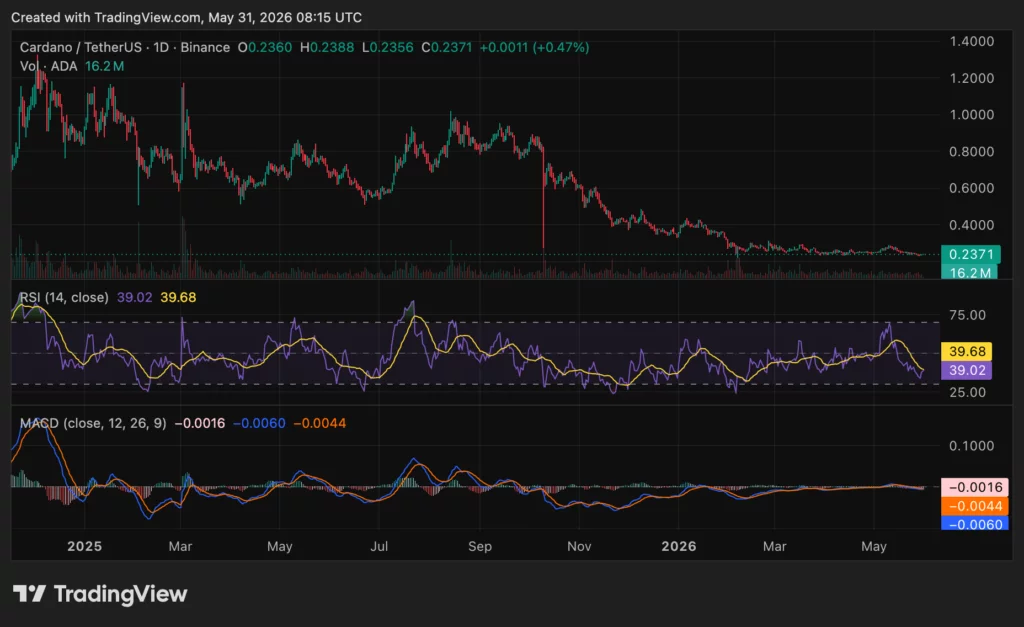
Cardano price remains under pressure after the Cardano Foundation confirmed that its proposed Cardano Summit 2026 will not take place this year following failed treasury votes.
Summary
- Cardano Summit 2026 was canceled after DReps rejected funding, adding fresh governance pressure around ADA.
- ADA traded near $0.236, below Ali’s $0.247 channel floor, keeping downside targets in focus now.
- RSI and MACD remain weak, while low volume shows buyers have not regained control yet.
The Cardano Foundation said it would respect the outcome of the latest treasury proposal votes after the community rejected funding for the planned Cardano Summit 2026. The organization said governance requires participation and a commitment to accept collective decisions.
In a statement on X, the Foundation said the proposed event “will not take place this year” after the vote failed. It added that it had reviewed feedback from DReps and would begin winding down current Summit-related execution.
The Foundation also said it was encouraged by the close vote and the level of community engagement. It noted that Emurgo’s TOKEN2049 proposal passed, meaning Cardano will still have a presence tied to the major Singapore crypto event.
The result places Cardano’s on-chain governance system back at the center of market attention. DReps now carry more weight in treasury decisions, and recent votes show that large event budgets face tougher review during a weak ADA market.
Cardano price stays near key support
Cardano traded near $0.236 on May 31, according to crypto.news price data. ADA was up 0.52% over 24 hours but remained down 3.55% for the week and 4.79% over the past month.
The token’s market cap stood near $8.77 billion, ranking Cardano at number 16. Trading volume was about $262.7 million over 24 hours, while the day’s range stayed narrow between $0.233913 and $0.238238.
The price action remains weak because ADA is trading close to a long-term support area. Analyst Ali Martinez said Cardano has traded inside a multi-year channel since 2021, with the key floor around $0.247.
According to the analyst, ADA trading near $0.232 marks a major test of that historical boundary. He said a monthly close below $0.247 would change the near-term structure and point to a deeper valuation phase.
RSI and MACD show weak momentum
The latest chart indicators still lean bearish. Volume remains relatively low at about 16.2 million ADA, which suggests that recent price movement lacks strong buying pressure.
ADA has shown a small rebound, but the price remains close to support. A clean breakdown below the $0.23 to $0.24 zone would weaken the setup further. A recovery above $0.27 to $0.30 would be needed to show stronger short-term demand.
The RSI stands at 39.02, below the neutral 50 level. That reading shows bearish momentum, though ADA has not reached the oversold zone near 30.
The RSI also turned lower after failing near its upper range. That move shows buyers lost strength before ADA could build a stronger recovery.
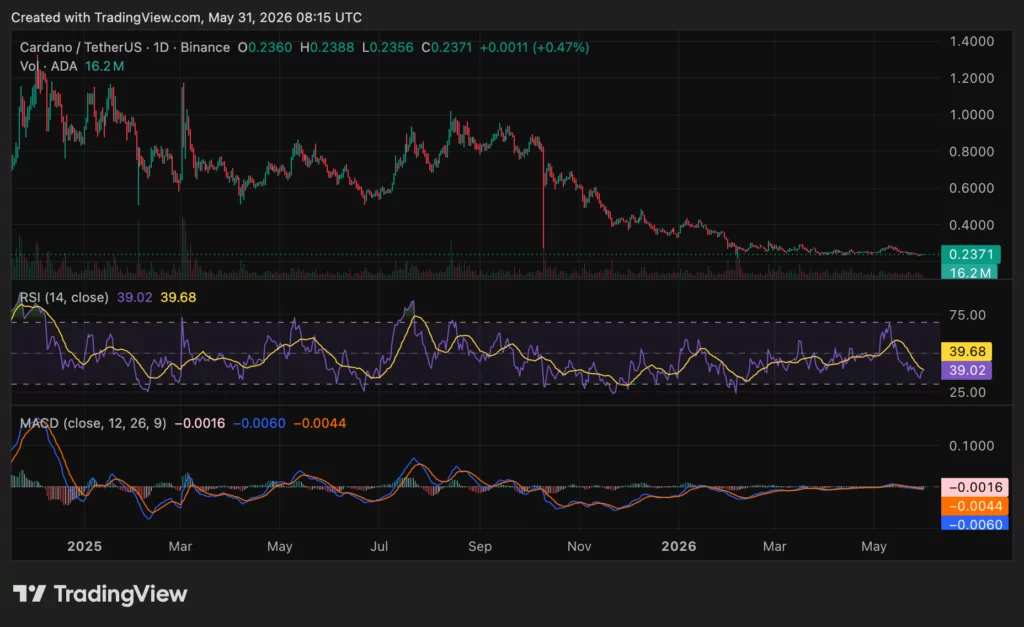
The MACD also shows mild weakness. The MACD line sits at -0.0060, below the signal line at -0.0044, while the histogram stands at -0.0016.
That setup confirms soft downside momentum. However, the histogram bars remain small, so selling pressure has not sharply expanded. ADA still needs stronger volume and a move back above nearby resistance to improve the short-term chart.
Analysts watch $0.113 and $0.051 levels
Ali Martinez warned that if Cardano loses the historical channel floor, long-term accumulation targets may sit much lower. He listed $0.113 and $0.051 as the next high-conviction macro levels for spot buyers.
That forecast depends on whether ADA stays below the $0.247 zone and fails to reclaim it after the monthly close. The level is important because it has acted as a long-term support area since the 2021 market cycle.
The failed Summit vote adds another layer to the price story. It does not directly change Cardano’s code, supply, or network activity, but it shows that treasury spending now faces stronger community review.
Recent related coverage from crypto.news also showed that Cardano’s price setup had already turned fragile before the Summit outcome. ADA previously needed to hold $0.246 to keep a rebound case alive after a TD Sequential buy signal.
That support is now under stress. If ADA remains below the $0.247 floor, traders may focus more on downside levels than on earlier rebound targets near $0.255 and $0.262.
For now, Cardano price analysis remains simple. ADA needs to reclaim $0.247 first. A move above $0.27 would show better demand. Until then, the Summit cancellation and weak indicators keep pressure on the short-term outlook.
Disclosure: This article does not represent investment advice. The content and materials featured on this page are for educational purposes only.

Crypto World
Top Privacy-Focused Cryptocurrencies for Long-Term Investment: Monero (XMR), Zcash (ZEC), and Bittensor (TAO)

Key Takeaways
- Monero employs ring signatures along with stealth addresses to ensure automatic privacy for all transactions
- Zcash leverages zk-SNARK technology to provide users with the choice between private and transparent transactions
- Bittensor operates as a decentralized artificial intelligence platform, emerging as a key player in the data ownership space
- Regulatory scrutiny has led several prominent cryptocurrency exchanges to delist Monero over compliance issues
- Growing concerns about AI surveillance and government monitoring could drive future demand for privacy-preserving cryptocurrencies
The conversation around privacy-focused cryptocurrencies has intensified in recent years. Let’s examine three prominent projects that long-term investors are monitoring closely.
While Bitcoin is frequently portrayed as providing anonymity, the reality is that nearly all Bitcoin transactions are visible and can be tracked through blockchain analysis. This transparency gap has fueled demand for digital currencies specifically engineered to shield user information, account balances, and transaction records from public view.
Within this emerging sector, three initiatives have captured significant attention: Monero, Zcash, and Bittensor. Each project employs distinct strategies for ensuring privacy and maintaining control over personal data.
Monero (XMR)
Monero debuted in 2014 with a fundamental design focused on transaction untraceability. The protocol incorporates technologies known as ring signatures and stealth addresses, which effectively conceal wallet identifiers, payment amounts, and participant identities.
Unlike many alternatives, Monero enables privacy automatically for every user. Each and every transaction receives identical protection measures, making it significantly more challenging to isolate individual users compared to platforms where privacy features are merely optional.
Over the last ten years, Monero has earned considerable credibility, supported by a dedicated user base and ongoing development efforts. Advocates argue it delivers one of the most straightforward value propositions in cryptocurrency: confidential person-to-person transactions.
That said, the project isn’t without challenges. Multiple leading cryptocurrency exchanges have delisted Monero in response to regulatory enforcement related to money laundering prevention requirements. Continued government scrutiny of privacy-focused tokens could further restrict accessibility for mainstream investors.
Nevertheless, many cryptocurrency proponents anticipate rising demand for financial confidentiality. Should this prediction materialize, Monero stands positioned as a leading option within its category.
Zcash (ZEC)
Zcash arrived on the scene in 2016, introducing a distinct privacy mechanism called zk-SNARKs, which represents sophisticated zero-knowledge proof cryptography. In contrast to Monero’s approach, Zcash makes privacy a user choice rather than a mandatory feature.
This adaptability is considered beneficial by certain observers. Both individuals and enterprises can elect to conduct either confidential or visible transactions, potentially simplifying regulatory compliance when circumstances require it.
Zcash emerged as an early innovator in zero-knowledge proof technology, which has subsequently evolved into one of the most prominent subjects in blockchain innovation. Today, this technology is being investigated for applications in blockchain scalability solutions, digital identity systems, and decentralized web platforms.
Despite its technological merits, Zcash has encountered difficulties with user adoption and community expansion. Its market performance has also left numerous investors dissatisfied over recent years. The project’s future trajectory hinges substantially on whether zero-knowledge cryptography achieves broader acceptance.
Bittensor (TAO)
Bittensor doesn’t fit the conventional privacy coin mold, yet it’s increasingly associated with initiatives centered on data sovereignty and distributed artificial intelligence systems. The platform seeks to establish an open ecosystem where machine learning algorithms can share computational intelligence and receive token incentives.
This initiative exists at the convergence of multiple emerging trends: artificial intelligence advancement, decentralization principles, open-source development, and individual data rights. With major technology corporations accumulating vast quantities of user information, certain investors view decentralized AI networks as a viable alternative to centralized data collection.
Bittensor also capitalizes on the ongoing enthusiasm surrounding AI investment. This association provides greater market traction compared to legacy privacy coins lacking connections to the artificial intelligence sector.
The trade-off involves heightened speculation. The underlying technology presents considerable complexity, and widespread real-world adoption remains unverified.
Current Landscape
Monero maintains the most established reputation as a dedicated privacy cryptocurrency. Zcash provides an entry point into zero-knowledge proof innovation. Bittensor delivers investment exposure to decentralized AI infrastructure and data sovereignty concepts.
Each of these three projects carries substantial investment risk. However, for those prioritizing digital privacy and personal data control, these represent the most frequently mentioned options in current market discussions.

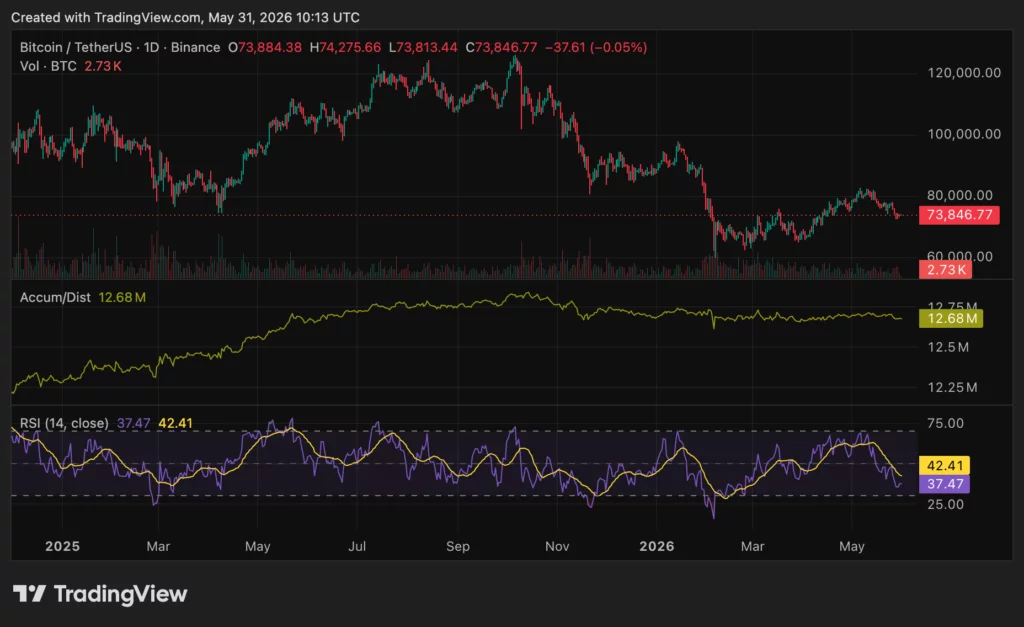
Bitcoin traded near $73,700 on May 31 as traders watched whether the market could defend short-term support while analysts debated a possible rebound and a deeper cycle low later in 2026.
Summary
- Bitcoin trades near $73.7K as traders watch $71.4K support and $78.2K resistance.
- A TD Sequential buy signal points to a possible rebound toward $75,000 if demand improves.
- Low volume, weak RSI and Iran-linked risk keep Bitcoin under short-term market pressure this week.
Bitcoin price data showed BTC trading near $73,713, up 0.28% over 24 hours. The asset remained down 4.18% over seven days, while 24-hour trading volume stood near $16.09 billion.
The 24-hour range stayed tight, with Bitcoin moving between $73,469 and $74,110. The narrow range showed that traders had not yet pushed BTC into a clear breakout or breakdown.
The market cap stood near $1.47 trillion, keeping Bitcoin ranked as the largest crypto asset by market value. However, short-term chart signals remained weak as buyers struggled to build strong follow-through.
Volume stood at about 2.73K BTC, suggesting limited participation behind the latest move. That makes the current pullback less aggressive, but it also shows that buyers have not returned with enough strength.
A stronger recovery would need higher volume and a move back above the $78,000 to $80,000 resistance area. Until then, Bitcoin remains locked between near-term support and overhead selling pressure.
Analysts watch $71.4K support and $78.2K resistance
Market analyst Marcus Corvinus said Bitcoin is approaching a decisive point. He noted that the 30-day accumulation cohort has moved underwater, with its $78,200 cost basis now acting as resistance.
That means any rebound into the $78,200 area could meet selling from holders who want to exit near breakeven. A clean move above that zone would be the first sign that buyers are taking back control.
On the downside, Corvinus pointed to the 1-month to 3-month holder cost basis near $71,400. He called that level the strongest near-term support because this group still holds unrealized profits.
If $71,400 holds, Bitcoin bulls may still have a base for another recovery attempt. If it fails, the market could face a deeper move as short-term holders lose confidence.
Ali Martinez offered a more near-term bullish signal. He said Bitcoin had printed a TD Sequential buy signal and added, “I think a rebound toward $75,000 could be in the cards.”
That setup gives traders a short-term recovery level to watch. However, a move to $75,000 would still leave Bitcoin below the heavier $78,000 to $80,000 resistance zone.
Cycle-bottom calls move focus to late 2026
Crypto Tice presented a wider cycle view, arguing that every Bitcoin cycle has followed a three-year bull market and one-year bear market pattern. The account said that if the pattern holds, the next major low could arrive in late 2026.
The post warned that traders calling a bottom now may be early. It said previous market participants made similar calls before the 2018 low near $3,200 and the 2022 low near $15,500.
The account wrote, “The cycle doesn’t care about your conviction.” It also said the cycle does not care about ETFs, institutional adoption or market narratives.
Earlier reports have shown similar caution from on-chain analysts. CryptoQuant CEO Ki Young Ju recently said Bitcoin’s bear market could last until early 2027, citing an on-chain profitability model that has tracked prior downturns.
That view does not cancel a short-term rebound. It suggests that any bounce may still occur inside a wider weak market unless long-term demand returns and selling pressure fades.
Iran risk and weak indicators keep pressure on BTC
Geopolitical risk remains another market factor. Bitcoin recently rebounded toward $74,000 after president Trump announced the end of the Hormuz naval blockade, easing some pressure from weeks of Iran-related headlines.
However, tensions have not fully disappeared. U.S. sanctions on Iran’s military-linked oil trade and uncertainty around peace talks continue to keep energy markets and risk assets sensitive to new headlines.
Bitcoin’s technical indicators also remain cautious. The Accumulation/Distribution indicator stands near 12.68 million and has moved mostly flat to slightly lower in recent months.
Earlier in 2025, the indicator rose alongside price. Since late 2025, it has weakened, showing that steady accumulation has not fully returned.
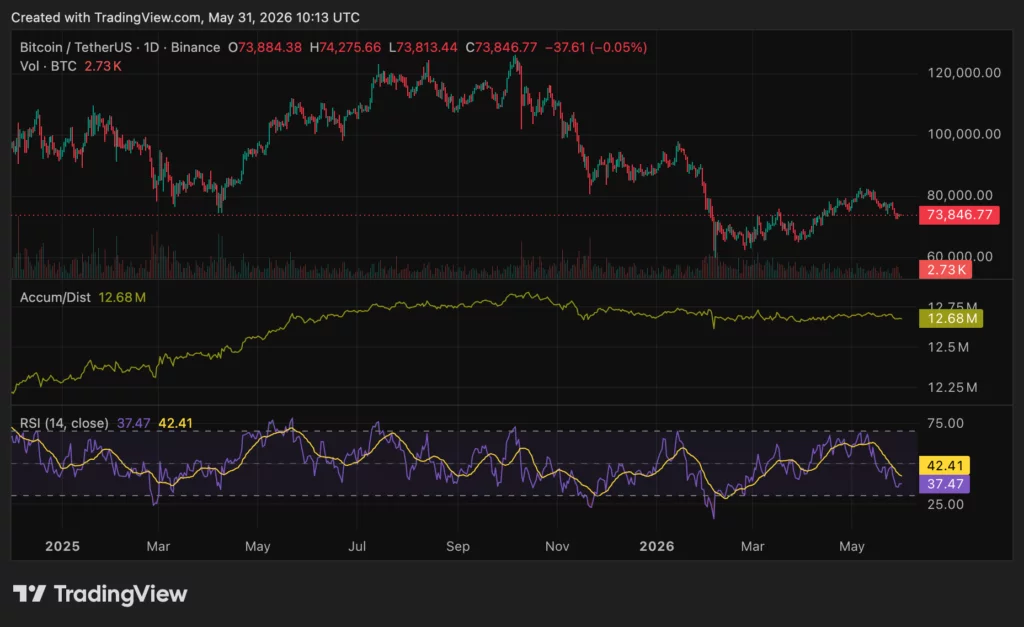
The RSI sits at 37.47, below the neutral 50 level and below its signal line at 42.41. That shows bearish short-term momentum, though BTC has not yet entered deeply oversold territory.
For now, Bitcoin’s setup remains clear. Bulls need to defend $71,400 and push BTC above $78,200 to show stronger demand. If support breaks, analysts may give more attention to the late-2026 cycle-low scenario.
Disclosure: This article does not represent investment advice. The content and materials featured on this page are for educational purposes only.
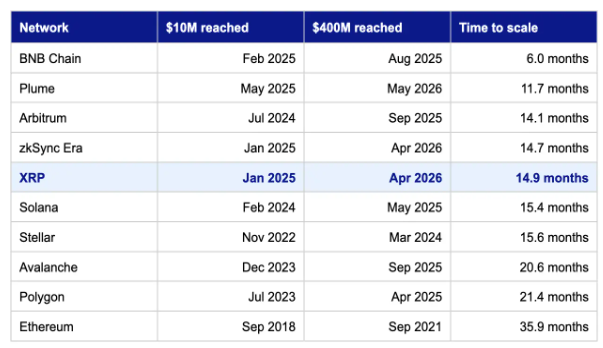
Evernorth’s latest report identifies five trends powering the rise of the XRP Ledger as a serious contender for tokenized real-world assets, challenging Ethereum’s long-held dominance in the sector.
This article breaks down each trend, what the data really shows, and why institutions are quietly choosing XRP today.
Speed and Momentum Behind the XRP Ledger Surge
Real-world asset tokenization is the process of issuing traditional financial assets, such as Treasuries, money market funds, and corporate bonds, directly on blockchains. Evernorth analyzed how each network has scaled this activity over time.
The first trend involves raw scaling speed. The XRP Ledger reached $400 million in tokenized value in 15 months, while Ethereum took 36 months to reach the same level from a similar starting point.
That puts the XRP Ledger roughly tied with Solana, Arbitrum, and zkSync Era, the chains that many builders still consider the current frontier of tokenization. Only BNB Chain and Plume scaled faster, but both had unusual circumstances.
BNB Chain’s growth was driven almost entirely by a single concentrated asset. Plume launched into a market where the tokenization playbook was already well established, giving it a clear structural advantage from the start.
Follow us on X to get the latest news as it happens

The XRP Ledger had neither shortcut. It scaled at frontier speed from a standing start, suggesting genuine demand rather than a single distorting catalyst driving the growth curve.
The second trend looks at year-to-date momentum. Among the 14 networks with tokenized assets above $200 million, the XRP Ledger is growing more than 2x as fast as Ethereum, which itself is growing at around 35%.
The networks expanding faster than the XRP Ledger this year include SEI, Plume, and zkSync. All three sit on much smaller bases, where percentage gains are mathematically easier to achieve and harder to sustain over time.
Concentrated Growth and the Peer Reordering Effect
The third trend reveals the actual shape of that growth. Just 20 days produced 96% of all new tokenization activity on the XRP Ledger over the past year, indicating concentrated, treasury-scale commitments rather than steady retail flow.
Ethereum shows the opposite pattern. Its biggest 20 days accounted for only about a third of the annual growth, since activity spreads across hundreds of smaller contributions each week from a much wider participant base.
Each of the XRP Ledger’s three largest inflow days is consistent with a single large issuer bringing significant capital on-chain. That profile fits an institutional adoption curve far more than a retail accumulation pattern.

The fourth trend examines peer-group reordering. The XRP Ledger historically sat alongside Algorand, Mantle, and Aptos as enterprise-focused chains targeting institutional and corporate tokenization use cases across financial markets.
A year ago, all three peers had higher tokenized value. Algorand was 2.6x larger than the XRP Ledger across the same metric, making it the natural reference point for enterprise issuance activity at the time.
Today, the picture has fully flipped. All three peer networks now sit behind the XRP Ledger, signaling a clear shift in where issuers see long-term mindshare moving inside the enterprise tokenization category.
Evernorth notes that the data cannot prove that specific assets migrated between chains. Yet the relative attractiveness of these networks for the tokenization business has visibly changed, and new issuance now consistently chooses XRP over its former peers.
A 134x Trajectory and the Institutional Design
The fifth trend zooms out to the full trajectory. The XRP Ledger’s first measurable tokenization datapoint was $3 million in September 2024. Twenty months later, it stands near $404 million, a 134-fold increase.
Against chains that began scaling in roughly the same window, Evernorth describes that curve as the steepest absolute growth from a comparable starting base among all Layer 1 infrastructure in the dataset analyzed.

The framing matters. Standing alongside Ethereum’s $18,7 billion, the figure $404 million sounds modest. Reading it as “from $3 million to $404 million in 20 months” maps far better to where the network is heading.
Why is this happening now? The XRP Ledger was designed around financial market requirements: 24/7 settlement, finality in three to five seconds, costs in fractions of a cent, and native asset issuance and compliance.
Those features match exactly the requirements for regulated activity to operate on public infrastructure, which helps explain why institutional pilots and partnerships are increasingly choosing this network for serious tokenization work.
Subscribe to our YouTube channel to watch leaders and journalists provide expert insights
The post 5 Ways XRP Ledger is Changing the RWA Tokenization Map appeared first on BeInCrypto.
Vietnam’s Ministry of Finance has proposed letting small and medium-sized enterprises use digital assets, virtual assets and intellectual property as collateral for bank loans.
The proposal is part of a draft revised Law on Support for SMEs, which is open for public consultation, according to a Friday report by Vietnam News. Under the framework, businesses could secure loans using future-formed assets, property rights, intangible assets and digital or virtual assets.
SMEs and household businesses account for more than 98% of all enterprises in Vietnam, yet outstanding loans to the segment represent only around 20% of total bank credit in the economy, per the report. The Ministry attributed the imbalance to a lack of eligible collateral, limited financial transparency and the small capital base of most SMEs.
Many startups and technology-driven companies hold valuable software, patents or intellectual property but have no land or physical assets to pledge, the report claimed. The new proposal marks a policy shift that could open up credit access for thousands of startups and tech companies currently locked out of the formal lending system.
Related: Bithumb enters Vietnam crypto license race with SSI Digital deal
Vietnam wants banks to lend on business plans
The draft also pushes credit institutions to expand lending based on credit ratings, business plans, cash flows and market potential, rather than fixed assets alone.
Beyond collateral reform, the draft law outlines incentives for green and sustainable businesses, including preferential access to credit guarantees, concessional financing and interest-rate support for circular economy and energy-saving projects. Tax incentives and support for ESG compliance reporting are also included.
The draft is currently open for public consultation.
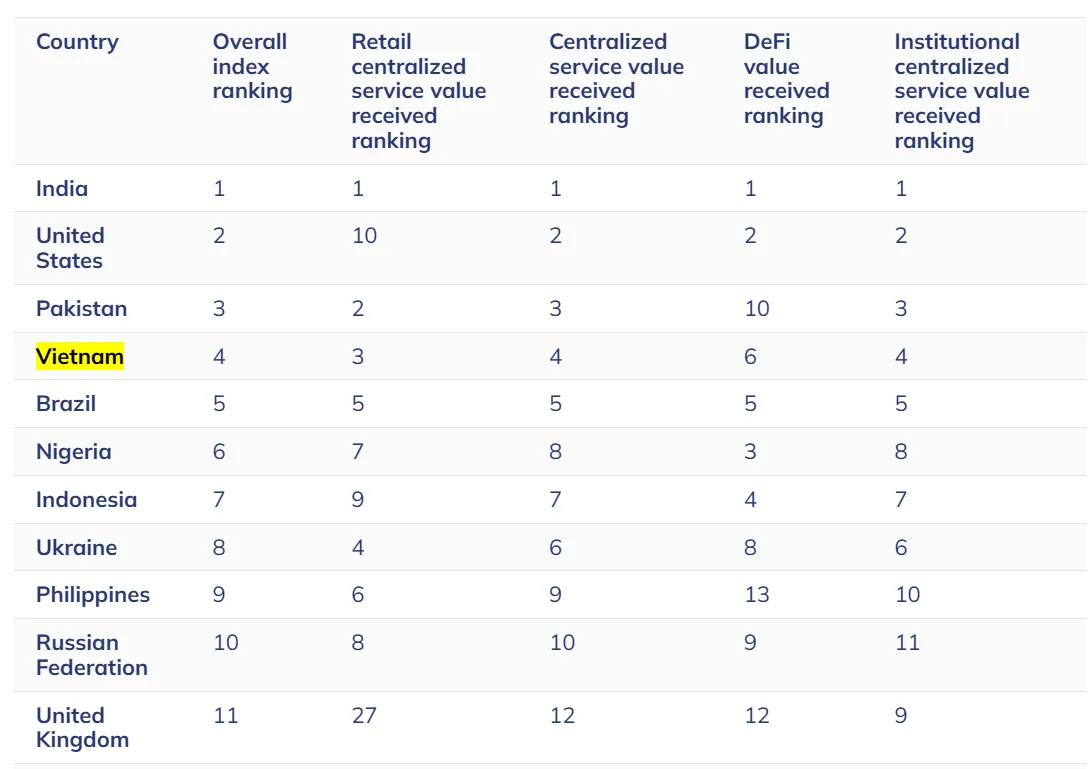
Vietnam has become one of the most active crypto markets in the world, ranking fourth in Chainalysis’ 2025 Global Crypto Adoption Index behind India, the United States and Pakistan.
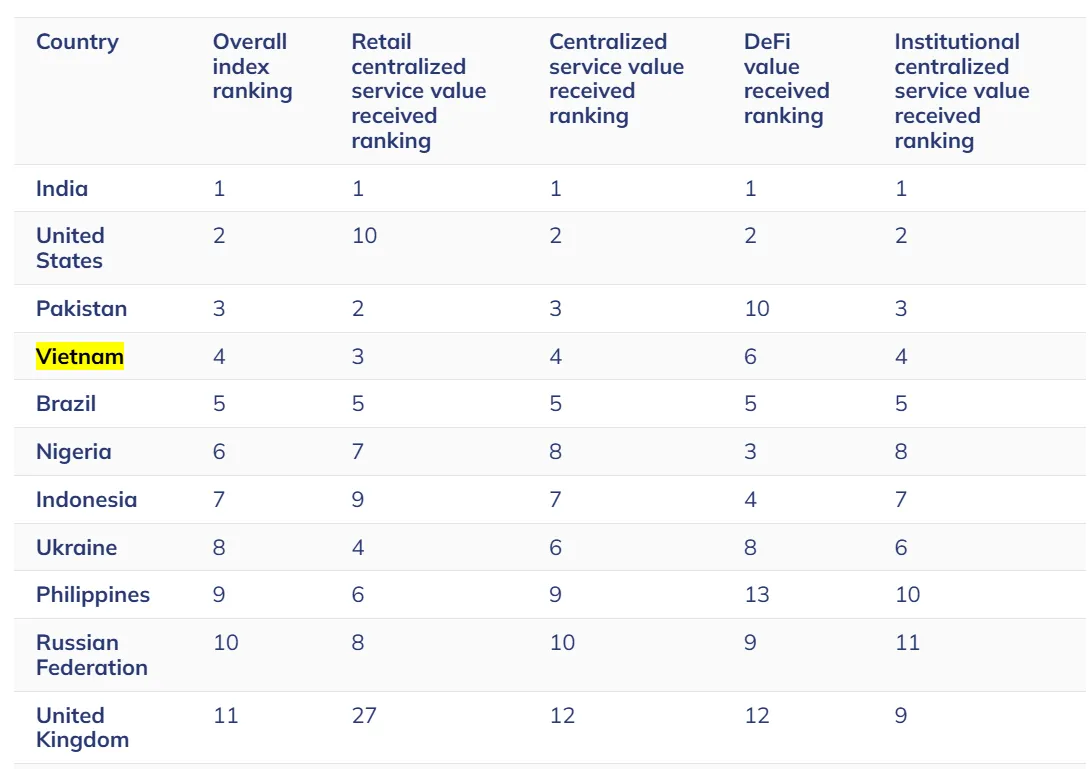
Global cryptocurrency adoption index. Source: Chainalysis
Related: Vietnam arrests ONUS-linked suspects in alleged crypto fraud case
Vietnam eyes Q3 launch of regulated crypto market
As Cointelegraph reported, Vietnam could see its first regulated crypto market activity as early as the third quarter of 2026, Deputy Minister of Finance Nguyen Duc Chi said at the Digital Trust in Finance 2026 forum.
In March, regulators opened a licensing pathway for domestic crypto trading platforms earlier this year, with five companies, including affiliates of Techcombank, VPBank and LPBank, having already passed an initial qualification round to launch the country’s first regulated exchange.
Magazine: Guide to the top and emerging global crypto hubs — Mid-2026
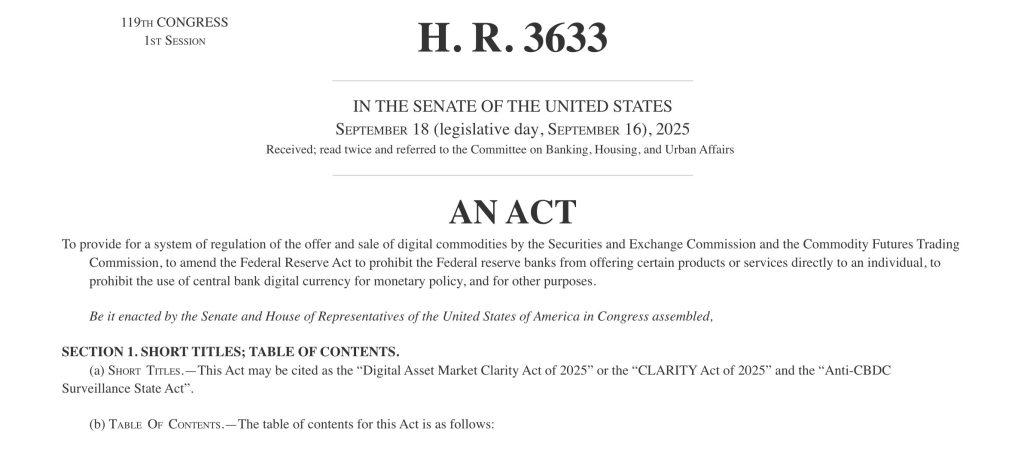
The CLARITY Act (Digital Asset Market Clarity Act) includes provisions addressing national security and foreign adversary risks in digital asset markets.
It advances a broader regulatory framework for cryptocurrencies, distinguishing between SEC oversight for certain investment contract assets and CFTC oversight for digital commodities via a certification/maturity pathway for sufficiently decentralized networks.
The bill preserves existing Bank Secrecy Act compliance, FinCEN authority, and Treasury tools, including sanctions authorities.
It also requires studies on foreign adversary activities related to digital asset intermediaries, such as potential data collection or intellectual property risks tied to jurisdictions like China, Russia, Iran, and North Korea.
Senator Elizabeth Warren has expressed concerns that the legislation could weaken global illicit finance standards.
“It’s already too easy for terrorists and criminals to launder huge sums of money and move it across borders”, claimed Warren.
If we water down global illicit finance standards, we’ll open the door to more cross-border sanctions evasion, money laundering, and terrorist financing, and give other countries cover to adopt similarly weak rules.”
Discover: The Best Crypto to Diversify Your Portfolio
Key Elements of the Clarity Act Bill
It establishes regulatory regimes for digital assets, including stablecoins. It includes a Certification of Decentralization (or maturity) pathway: issuers can seek a rebuttable presumption that a sufficiently decentralized asset qualifies as a digital commodity under CFTC oversight rather than SEC rules.
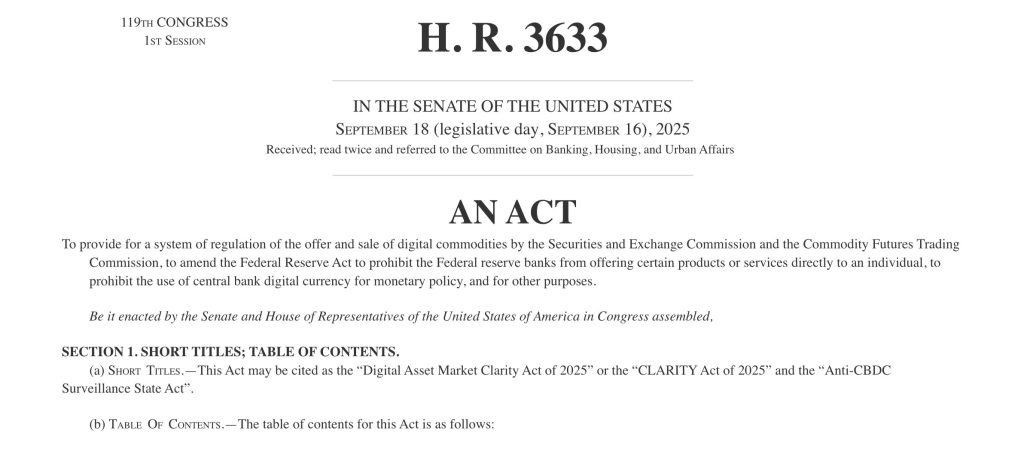
The decentralization pathway does not override existing national security, sanctions, or illicit finance requirements. U.S.-regulated entities must continue complying with sanctions screening and related obligations.
Market and Compliance Context
U.S. compliance teams already screen for sanctions and high-risk jurisdictional exposures as standard practice.
USDC and other U.S.-domiciled, transparent stablecoins maintain a structural compliance advantage due to their issuer frameworks and reserve transparency.
Institutional caution around assets with significant ties to higher-risk jurisdictions exists independently of this bill, driven by existing OFAC sanctions and AML rules.
Any potential liquidity or pricing effects remain subject to broader market dynamics, venue differences, and ongoing enforcement of current laws.
Claims of specific pre-passage pricing divergence tied directly to new “foreign adversary infrastructure” prohibitions in this bill are forward-looking and not yet broadly documented as measurable shifts.
The bill advanced out of the Senate Banking Committee on a 15-9 vote and is heading toward a Senate floor vote.
Discover: The Best Token Presales
The post Liquidity Bifurcated: CLARITY Act Foreign Adversary Risk Premium Explained appeared first on Cryptonews.
TLDR
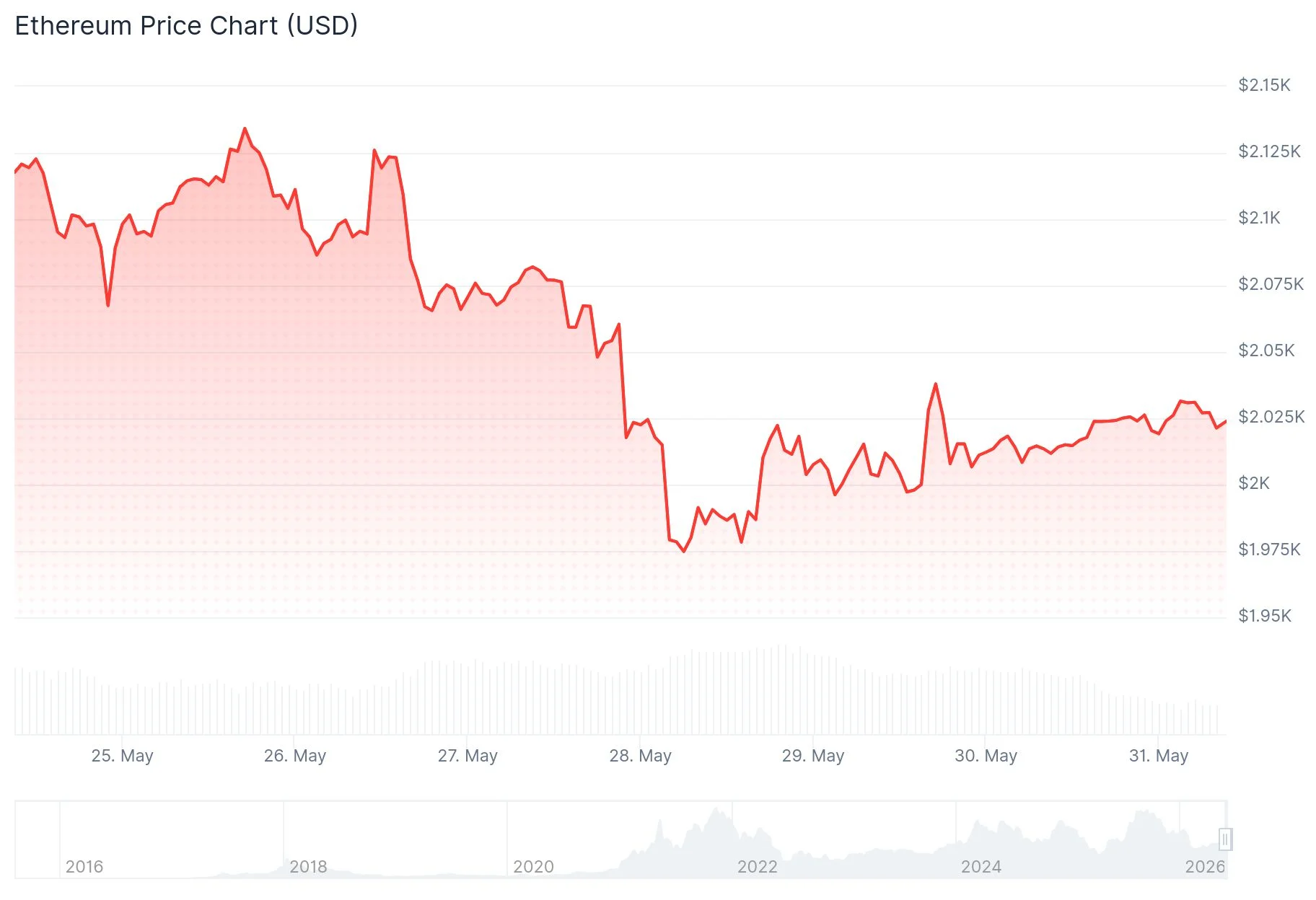
- Ethereum currently trades around $2,024, battling to maintain the crucial $2,000 threshold
- Major holders with 100,000+ ETH have increased positions to 17.41 million ETH, reaching a nine-week peak
- Market observer Ted cautions that spot market interest is declining while ETFs experience redemptions, with rallies quickly reversed
- Publicly-traded Bit Digital purchased 8,568 ETH valued at approximately $20 million during recent price weakness
- Standard Chartered continues projecting a $40,000 long-term ETH valuation despite present market challenges
As of May 31, 2026, Ethereum is changing hands near $2,024, maintaining position barely above a pivotal support threshold that market participants are monitoring intensively. Recent trading activity has been predominantly range-bound following several days of sharp price swings around the psychologically important $2,000 mark.
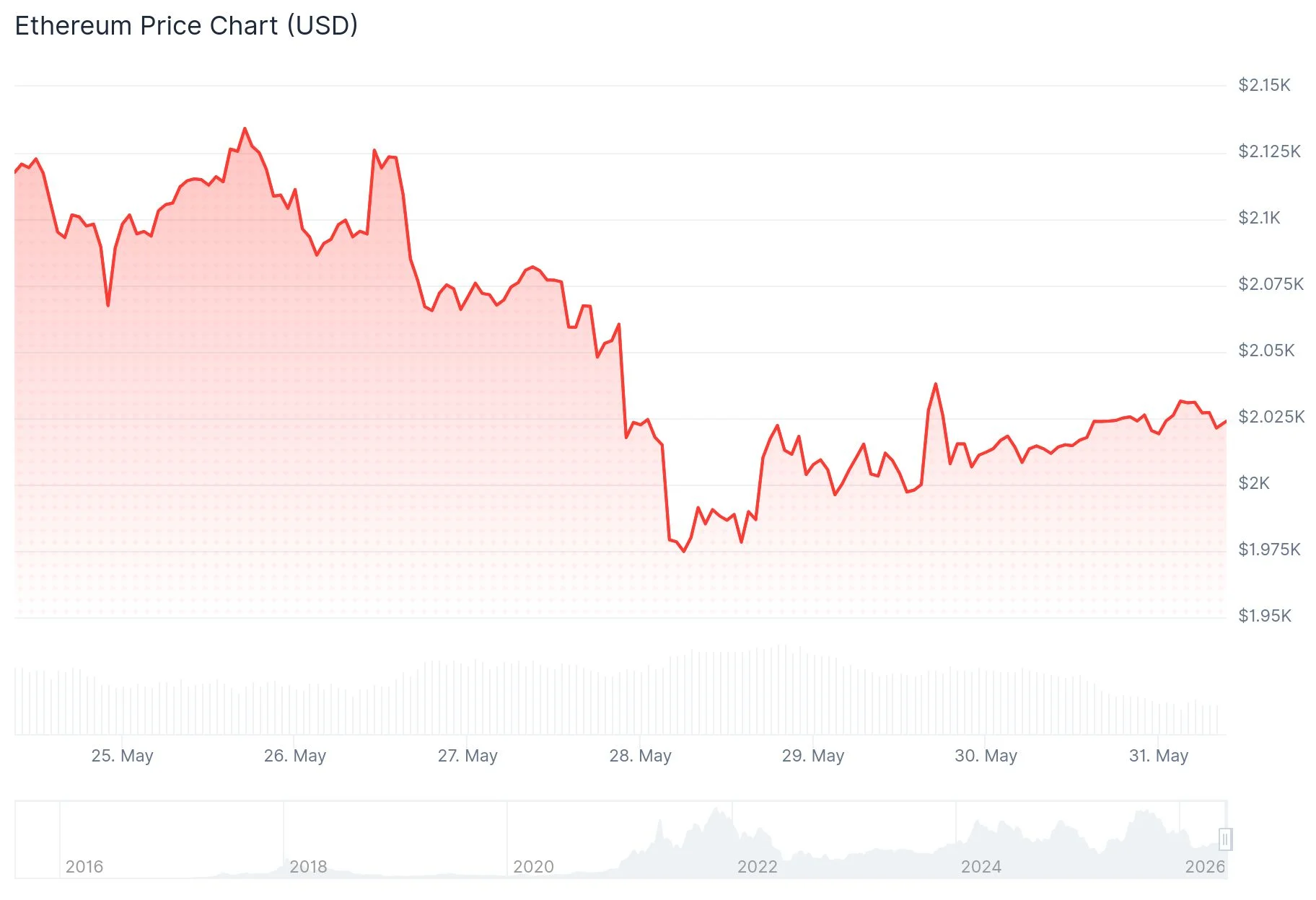
Market sentiment appears divided. While near-term technical indicators suggest vulnerability, blockchain analytics reveal a contrasting picture beneath the surface action.
Market analyst Ted, sharing insights via X, observed that while ETH remains above the $2,000 threshold, the current configuration appears unstable. His analysis highlights diminishing spot market activity, negative ETH ETF flows, and consistent rejection of upward price attempts. According to his assessment, without a decisive close above $2,050, the probability of further downside movement remains substantial.
The $2,000–$2,050 range has emerged as the primary battleground on near-term price charts. Should buyers successfully protect this area, ETH might challenge the $2,100 level. A breakdown would likely target $1,994 initially, with deeper support positioned around $1,900–$1,850.
Major Holders and Corporate Entities Continue Accumulating
Despite sideways price movement, significant stakeholders have been discreetly expanding their ETH positions. Blockchain intelligence from Santiment indicates that addresses containing a minimum of 100,000 ETH have expanded their collective balance to 17.41 million ETH. This represents the strongest accumulation level observed in more than two months. These large holders now control 22.03% of Ethereum’s available supply.
Corporate purchasing activity remains robust as well. Nasdaq-traded company Bit Digital acquired an additional 8,568 ETH valued near $20 million, elevating its complete ETH treasury beyond 158,000 ETH. This purchase occurred precisely during the recent price decline.
Reports indicate that Bitmine’s Tom Lee has also acquired $50 million in ETH, further strengthening the accumulation thesis at present valuation levels.
This week, Standard Chartered reiterated its long-range $40,000 ETH price projection, emphasizing expansion in tokenized traditional assets and decentralized finance applications as catalysts not yet reflected in current market pricing.
Critical Price Zones Under Observation
Examining the ETH/BTC trading pair, Ethereum has experienced declining relative performance versus Bitcoin starting in August 2025. The ratio has now arrived at a significant long-term support area, with market participants anticipating a potential reversal. Analyst Daan Crypto Trades observed that previous ETH/BTC rallies were partially driven by substantial purchasers. Absent a new trigger, any recovery trajectory may develop gradually.
Trader Tardigrade identified that Ethereum is forming a pattern of ascending lows spanning multiple market cycles, a technical formation that has traditionally preceded significant recoveries. While the current pattern awaits confirmation, comparisons to previous cycle troughs maintain longer-term optimistic scenarios.
ETH faces overhead resistance at $2,050, $2,100, and $2,200, with $2,500 representing a broader objective should bullish momentum materialize. Concerning downside risk, $1,994 and $1,850 constitute the price zones attracting greatest trader attention.
Bit Digital’s most recent treasury acquisition of 8,568 ETH, executed during the ongoing price weakness, represents the latest documented institutional purchase activity.
TLDR
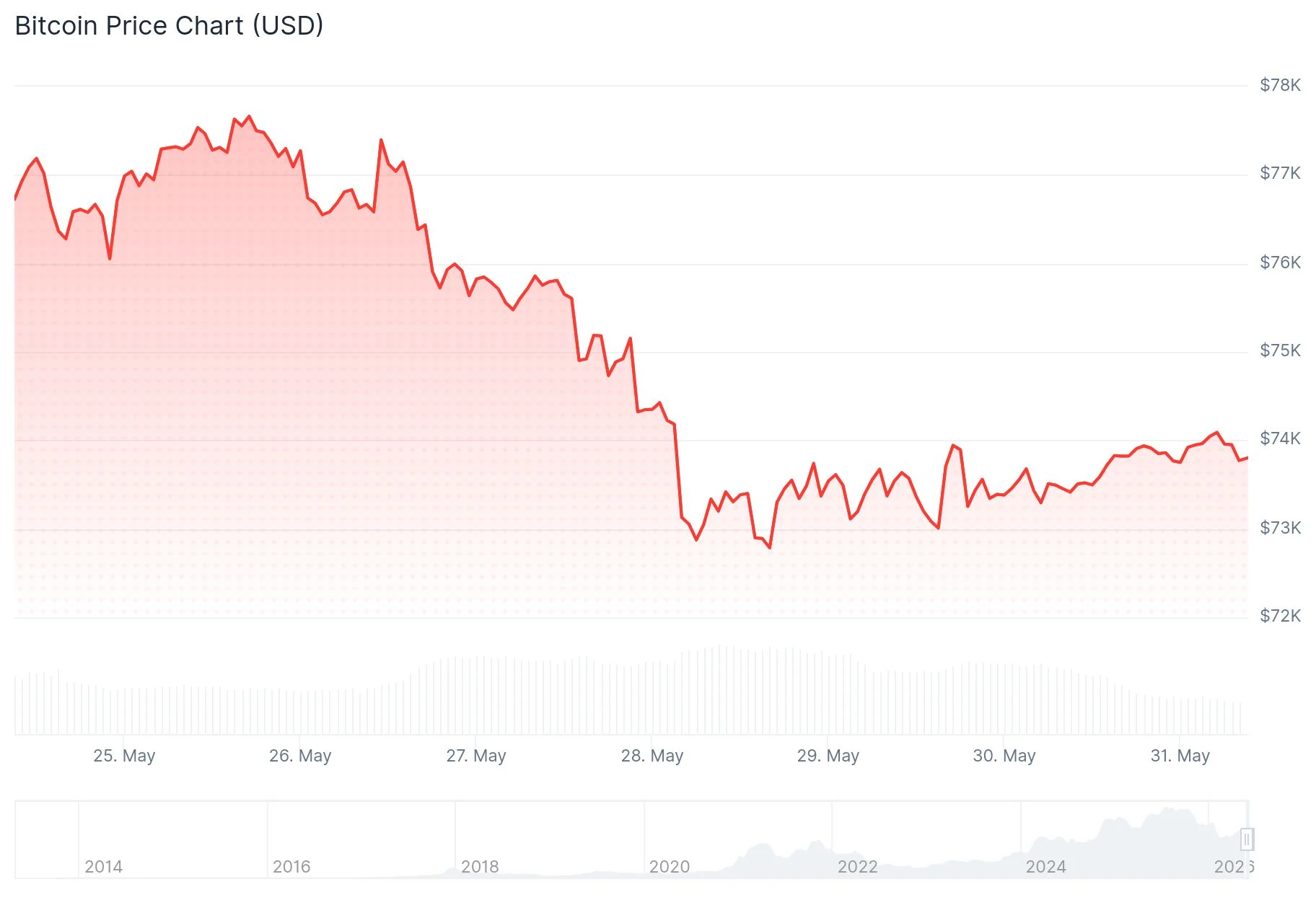
- Bitcoin currently trades around $73,800, registering approximately 3% decline over the last seven days.
- Crypto analyst Michael van de Poppe identifies $71K as critical support level; maintaining this zone could propel BTC toward $76,600.
- Bitcoin spot ETFs have recorded ten straight days of capital exodus, with cumulative outflows surpassing $2.97 billion starting May 15.
- Economic forecaster Timothy Peterson anticipates Bitcoin may climb through summer months but expects peak around late July.
- Technical analyst Ali Charts identifies TD Sequential buy indicator on Bitcoin charts, hinting at possible bounce to $75,000 level.
Bitcoin is currently positioned near the $73,800 mark following a dip to approximately $72,000 earlier in the week—a seven-week low. This downward movement coincided with escalating geopolitical friction involving the United States and Iran, which dampened investor appetite for risk assets. The leading digital currency has shed roughly 3% in value across the previous week.
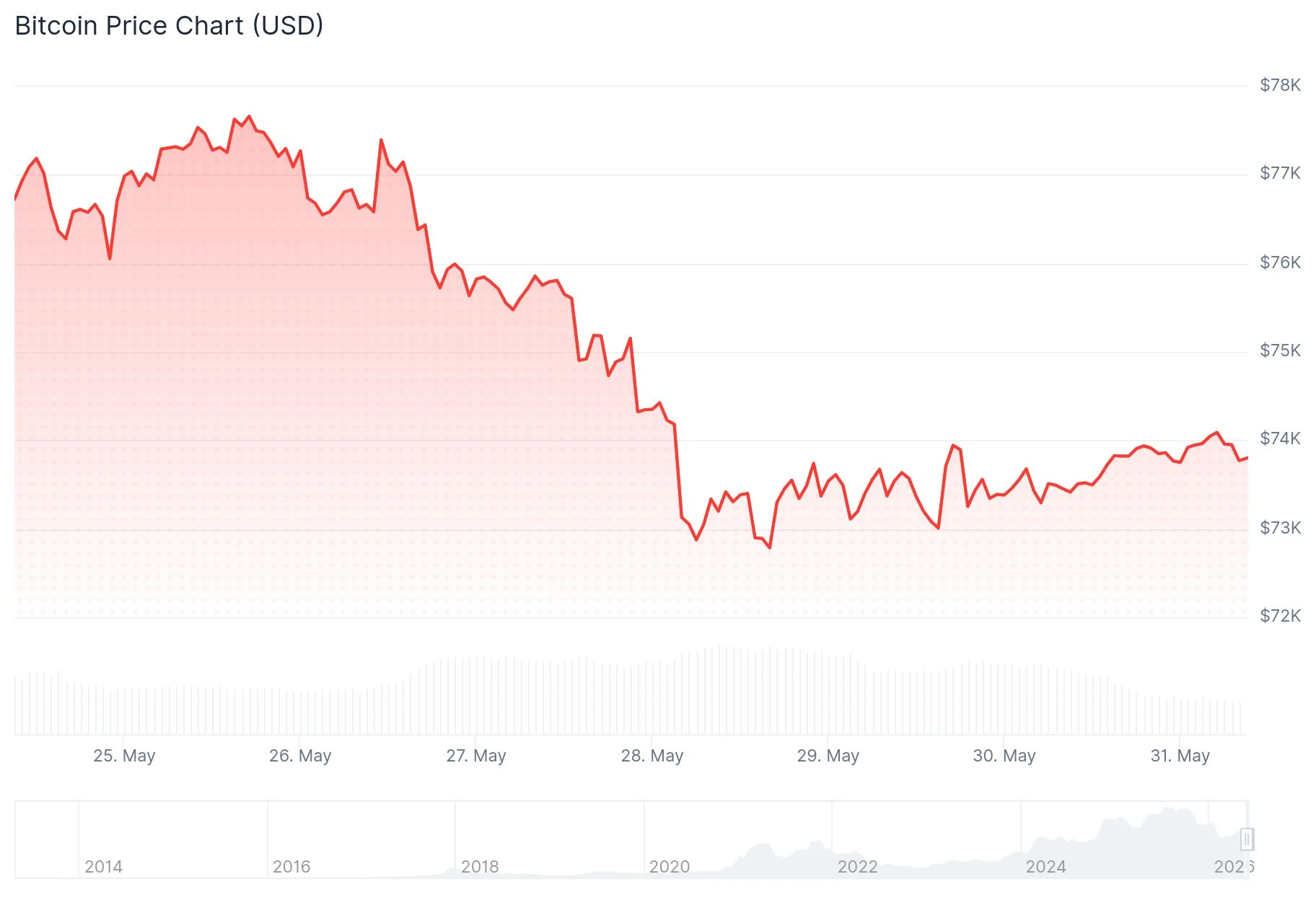
While BTC has bounced back from its yearly bottom around $60,000 recorded in early February, market participants continue debating whether that low marked the cycle’s floor or merely represents a temporary pause ahead of further declines.
Michael van de Poppe, who founded MN Trading Capital, characterized Bitcoin’s current position as a “pivotal level.” According to his analysis, failure to maintain the $71,000 zone as support could send prices tumbling below $65,000. Yet he emphasized that this technical configuration differs significantly from February’s breakdown pattern.
Van de Poppe further noted that successfully defending current levels could enable Bitcoin to surge toward $76,600. Such an upside breakout would probably catalyze a broader rally across alternative cryptocurrencies, he suggested.
ETF Outflows Signal Market Pressure
Bitcoin spot exchange-traded funds have now experienced capital withdrawals for ten consecutive trading sessions. Aggregate net outflows have surpassed the $2.97 billion threshold since May 15. During this identical timeframe, total ETF holdings have contracted from $104.29 billion down to $94.17 billion.
Blockchain analytics platform Santiment Intelligence suggested that continued ETF outflows might indicate the market is approaching a bottom formation.
Analyst Ali Charts shared on X that Bitcoin has just activated a TD Sequential buy indicator, commenting: “I think a rebound toward $75,000 could be in the cards.”
Trader Daan Crypto Trades similarly highlighted on X that bulls must recover the $74,200 threshold, while defending $72,700 remains essential on the downside.
Bearish Case Still on the Table
Not all market observers believe the bottom has been established. Seasoned trader Peter Brandt indicated in March that $60,000 might not represent the year’s nadir, projecting Bitcoin could retest or dip marginally beneath that threshold during September or October.
Ki Young Ju, CEO of CryptoQuant, cautioned that Bitcoin’s present downtrend might extend into early 2027. He referenced historical profit-taking patterns that generally produce approximately 18 months of subdued performance before sustainable recovery materializes. According to his assessment, the bearish phase commenced in October 2025 as market participants secured profits from the preceding bull run.
Economist Timothy Peterson projected Bitcoin may edge higher throughout summer, though characterized potential gains as “relatively lackluster” and forecast prices could reach their zenith during July’s final week.
CryptoQuant’s Bull-Bear Cycle Indicator flipped positive earlier this month for the first instance since 2023. Bitcoin presently maintains its position just above the $72,700 support threshold that analyst Daan Crypto Trades identified as essential to monitor.
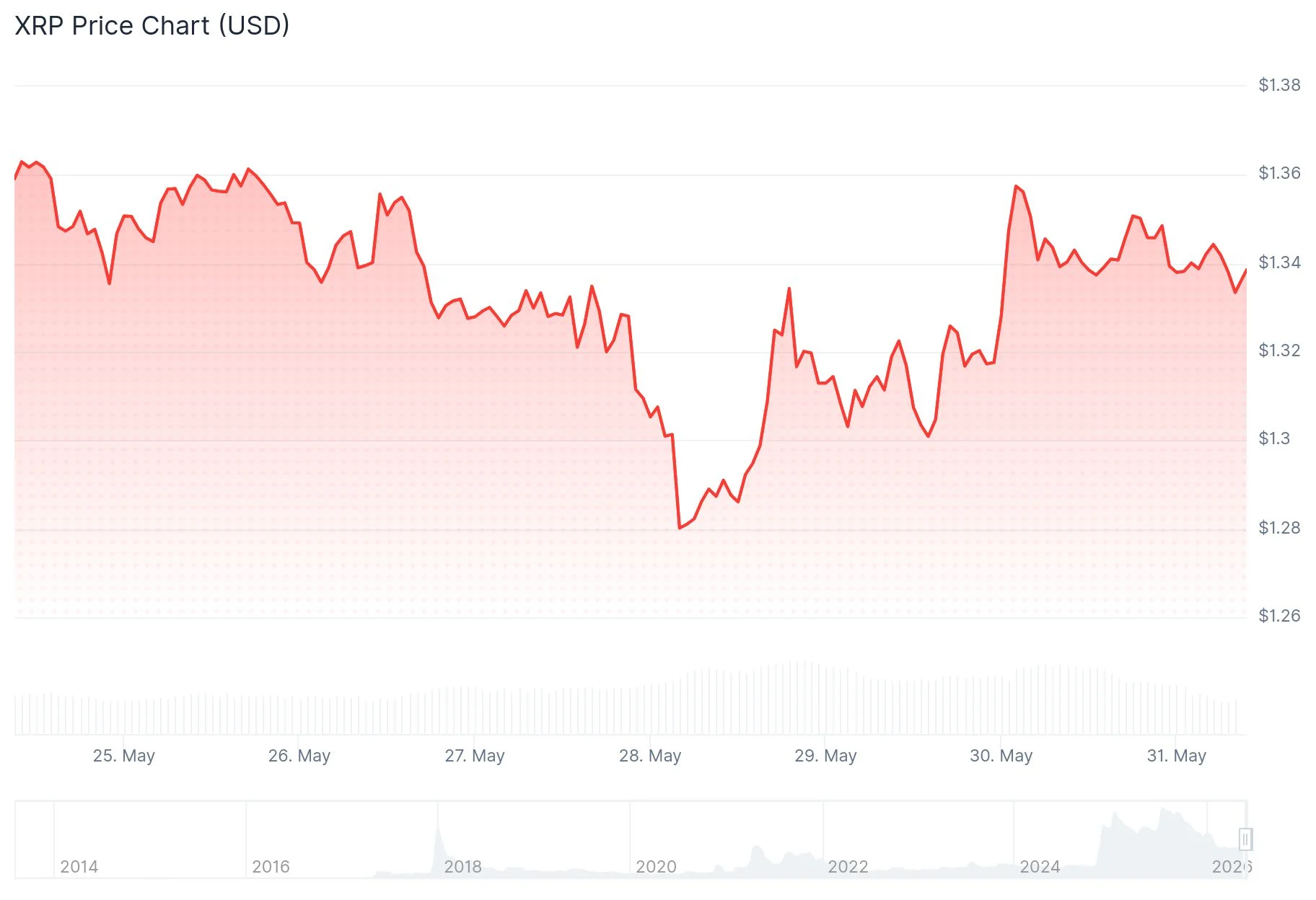
Key Highlights
- Trader anxiety surrounding XRP reached a three-week peak, with the bulls-to-bears ratio dropping to approximately 1.10:1.0 by May 25.
- Holders operating on 30-day timeframes are experiencing average unrealized losses approaching 47%.
- The MVRV ratio for the 30-day period has declined beneath December 2020 benchmarks, entering what analytics firm Santiment identifies as an “extreme opportunity zone.”
- United States-based spot XRP exchange-traded funds accumulated $11.88 million on May 29, contributing to $35 million in total inflows between May 20-29.
- During this identical timeframe, Bitcoin ETFs experienced $1.70 billion in outflows while Ethereum ETFs recorded $309 million in withdrawals.
The digital asset has maintained stability around the $1.35 price level despite trader anxiety climbing to its most elevated point in nearly three weeks. Blockchain metrics and institutional fund flow data present contrasting narratives regarding the token’s current market position.
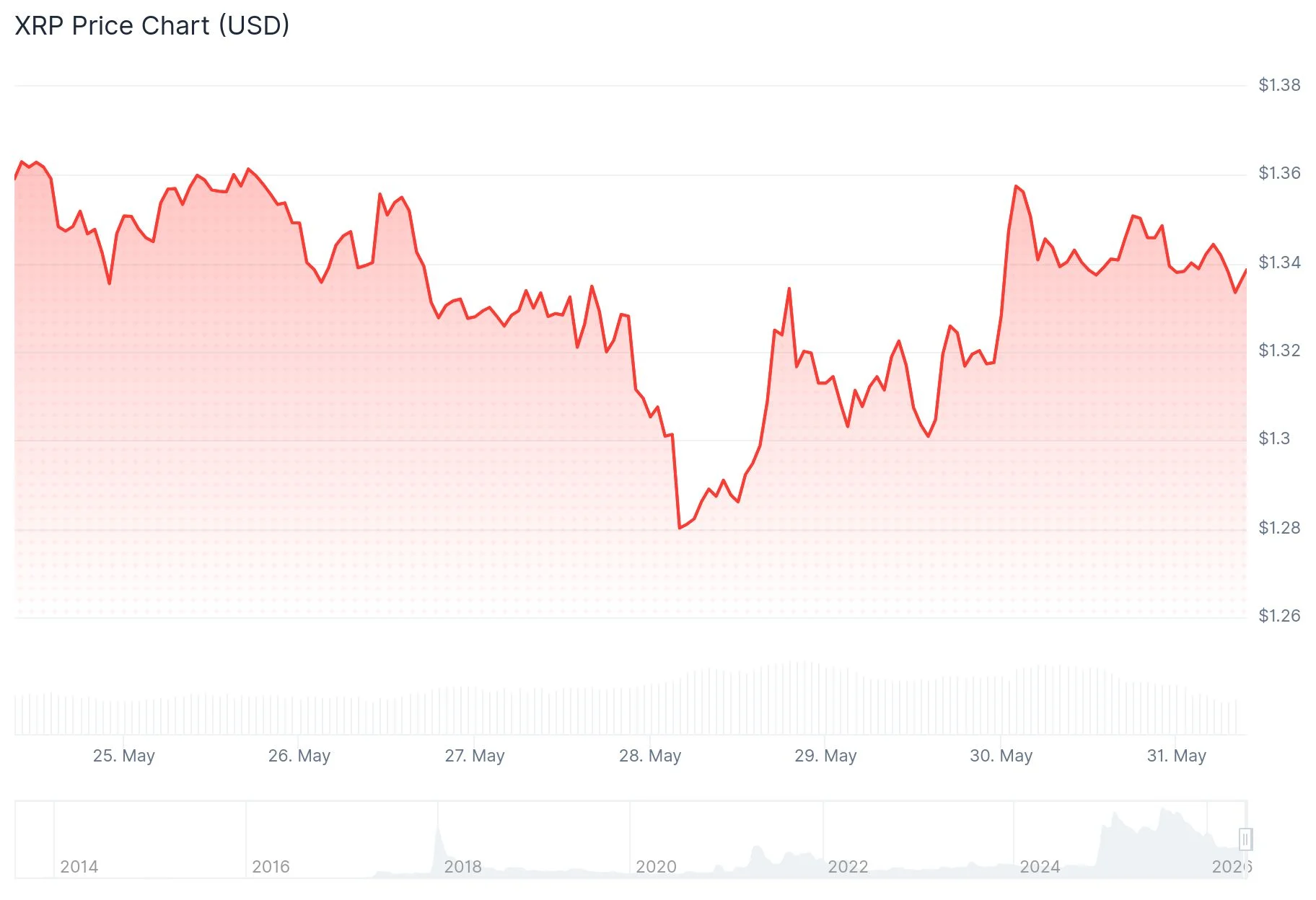
According to Santiment analytics, the sentiment ratio for the cryptocurrency declined to roughly 1.10:1.0 on May 25. This movement positioned the asset within what market observers categorize as the “FUD Zone”—a territory characterized by widespread fear, uncertainty, and doubt across social platforms.
Previous instances of entering this zone have frequently preceded upward price movements. The underlying rationale is straightforward: when the majority of market participants express fear, selling momentum typically diminishes while accumulation opportunities increase.
Despite prevailing negativity, the token has avoided significant downside breaks. The price has successfully defended critical support zones hovering around $1.34.
Market analyst Ali Charts highlighted this specific $1.34 threshold. “I’m monitoring the lower boundary of the ascending channel at $1.34 as a potential accumulation area for XRP,” Ali Charts stated on the social platform X. “Should this level maintain, price objectives rest at $1.37 and $1.40.” The observation emerged as market participants assessed whether the ongoing consolidation phase would resolve upward.
30-Day Holders Face Substantial Unrealized Losses
Santiment metrics reveal that market participants trading on 30-day timeframes are underwater by an average of 47%. A significant portion appears to have liquidated positions near local bottoms following the surrender of profits accumulated during late 2024 and early 2025.
The 30-day Market Value to Realized Value (MVRV) ratio—a metric tracking unrealized gains or losses across the network—has descended below its December 2020 reading. Santiment has designated this territory as an “extreme opportunity zone,” terminology applied when the ratio touches historically depressed levels that have historically preceded price recoveries.
Santiment also identified a notable event on X. The year’s largest exchange deposit occurred Thursday—exceeding 22.80 million XRP tokens transferred to trading platforms. However, in subsequent days, 25.24 million XRP departed from exchanges. Santiment observed this substantial exchange movement coincided with a local price bottom, and that trading values have appreciated roughly 5% following this apparent capitulation event.
Institutional XRP Products Show Persistent Accumulation
While fear metrics paint a pessimistic picture, institutional investment vehicle flows demonstrate the opposite trend.
U.S.-registered spot XRP ETFs registered $11.88 million in net accumulation on May 29. Bitwise commanded the largest share at $7.36 million, with Canary’s XRPC contributing $2.38 million and Franklin’s XRPZ adding $2.14 million.
Between May 20 and May 29, these XRP investment products attracted cumulative inflows totaling $35 million. During this identical window, Bitcoin ETFs hemorrhaged $1.70 billion while Ethereum ETFs experienced $309 million in redemptions.
Aggregate assets under management across U.S. XRP ETFs currently approach $1.12 billion, with total net inflows since inception reaching $1.42 billion.
Spot Bitcoin ETFs documented $125.31 million in withdrawals on May 29, extending a redemption streak to ten consecutive trading sessions.
An outstanding development from October 2025 also lingers in the background. Bloomberg previously disclosed that Ripple Labs was spearheading an initiative to secure at minimum $1 billion through a special purpose acquisition company to amass XRP within a treasury structure. CoinDesk has contacted Ripple requesting confirmation, though no response has been furnished.
Gravity Bridge, a decentralized blockchain facilitating cross-chain transfers between Ethereum and Cosmos, was reportedly drained of roughly $5.4 million, prompting validators to halt the bridge.
Onchain analyst Specter first flagged the unusual outflows in a Saturday post on X, revealing that the bridge contract key may have been compromised. “It appears the Gravity Bridge contract key may have been compromised, resulting in the theft of $5.4M,” Specter wrote.
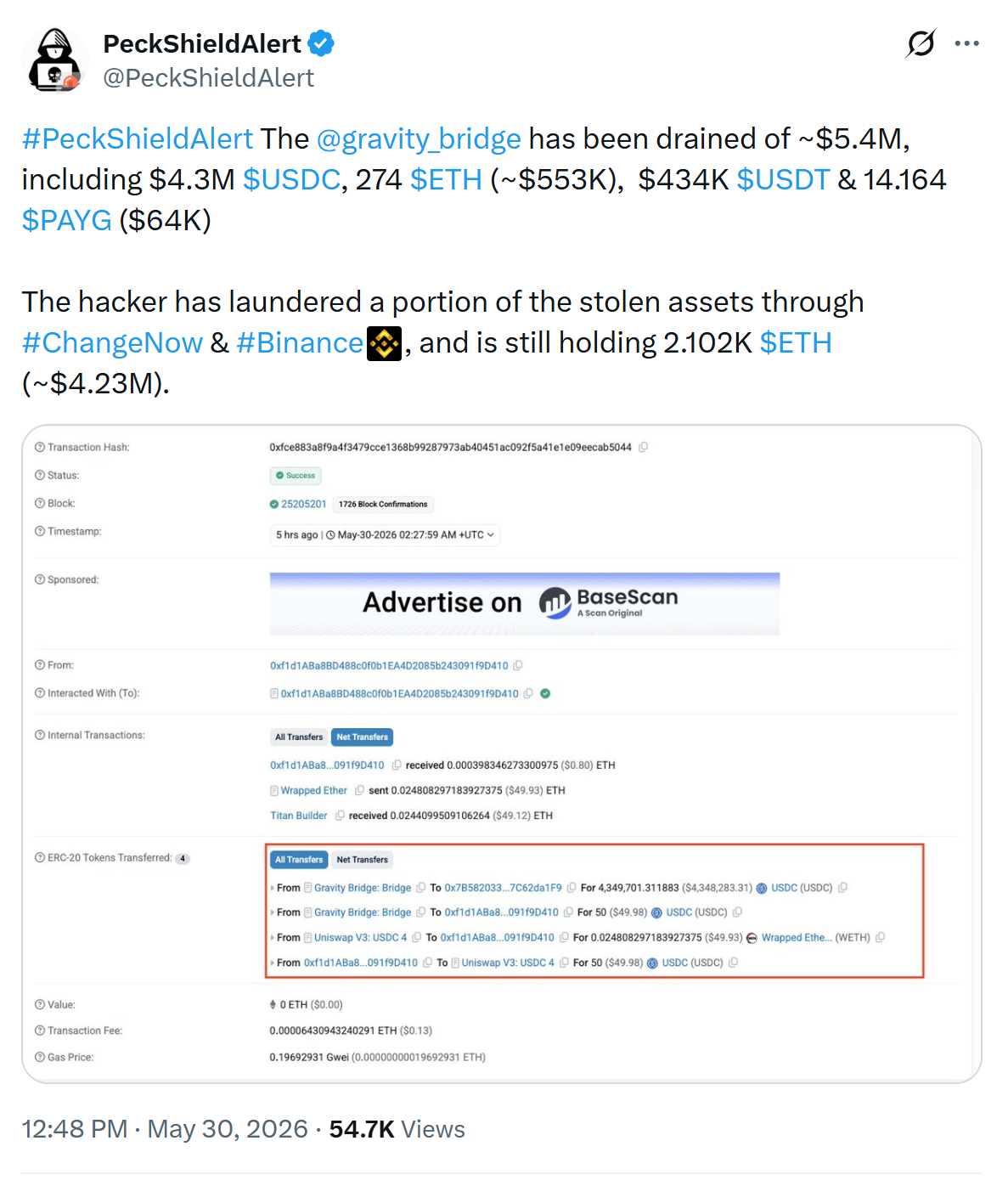
Security firm PeckShield also confirmed the exploit in a post, breaking down the stolen assets as approximately $4.3 million in USDC (USDC), 274 Wrapped Ether (WETH) worth roughly $553,000, $434,000 in USDt (USDT) and 14.164 PAX Gold (PAXG) tokens worth about $64,000.
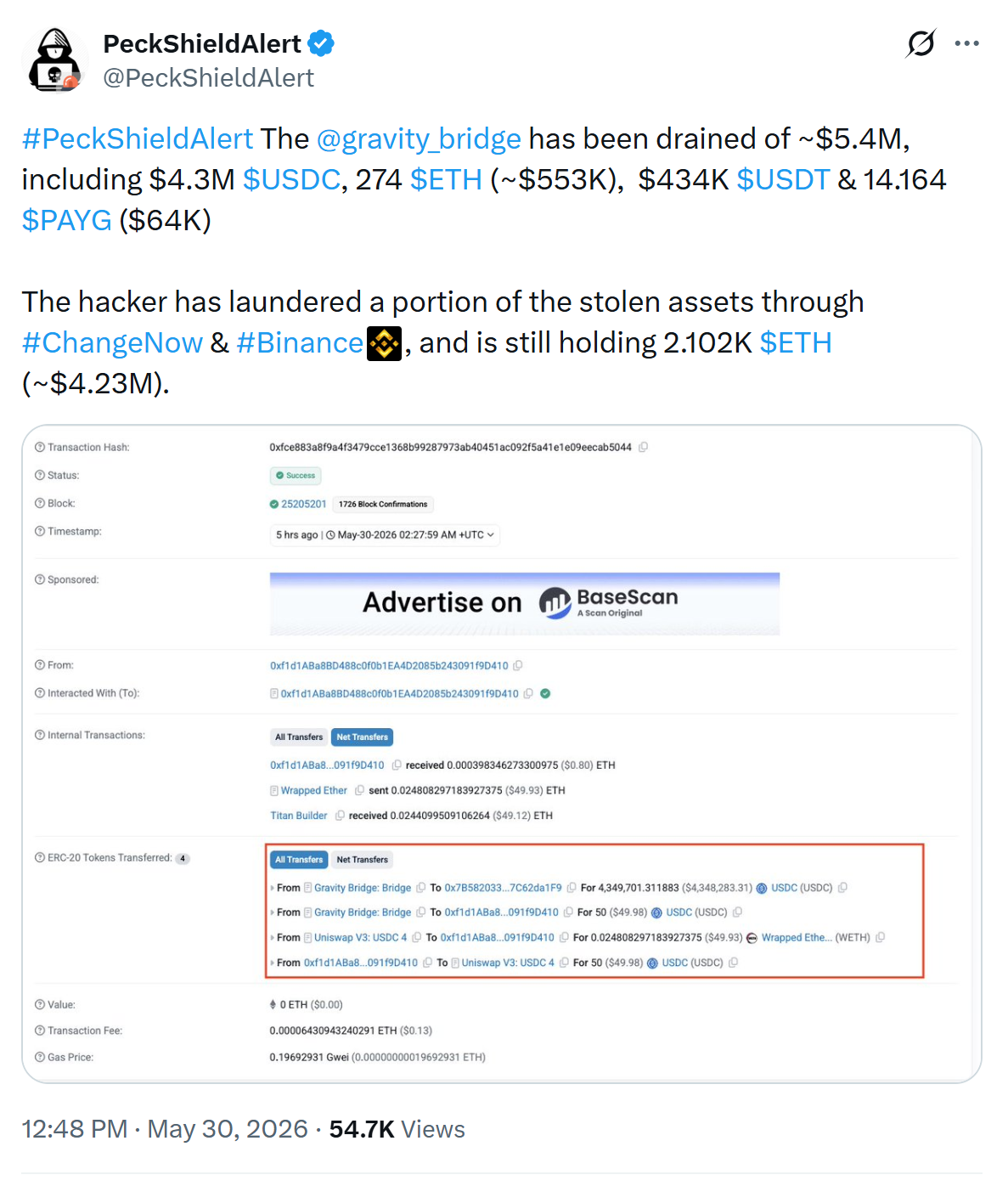
Source: PeckShield
PeckShield reported that a portion of the haul had already been laundered through instant-swap service ChangeNow and through Binance, while the theft wallet was still holding around 2,102 ETH worth approximately $4.23 million at the time of its report.
Related: StakeDAO exploit creates 5.4 trillion vsdCRV but nets only $91K
Gravity Bridge acknowledges attack
Gravity Bridge acknowledged the incident on X without detailing what went wrong. “There was an unfortunate incident on Gravity,” the team wrote, adding that validators “should halt their validators and orchestrators while this incident is being investigated.” In a follow-up post, the team confirmed the bridge had been halted.
Gravity Bridge allows tokens to move freely in both directions, from Ethereum to Cosmos wallets and DEXs like Osmosis, and from Cosmos-based blockchains back to Ethereum platforms like Uniswap. Unlike bridges that rely on centralized multi-signatures or private node groups, it uses its full validator set to authorize transfers, making it one of the more decentralized bridge designs in the space, according to its website.
Gravity Bridge’s native token is Graviton (GRAV), used by validators to secure the bridge. The token is currently trading at $0.0007053, down 4% over the past day, according to data from CoinMarketCap.
Related: ‘All DeFi unsafe’ claim sparks AI security debate after April hack surge
Bridge exploits are spooking institutions
As Cointelegraph reported, JPMorgan analysts have flagged bridge security as a major challenge in an April research note, questioning whether DeFi can scale to meet institutional demand. The concern comes amid the recent Versus-Ethereum bridge attack, which was the eighth major bridge exploit of 2026, with cumulative losses across those incidents reaching $328.6 million.
Following the KelpDAO breach in April, which drained roughly $290 million and was attributed to North Korea’s Lazarus Group, total value locked across DeFi fell from nearly $100 billion to around $86 billion in just two days, with outflows hitting pools that had no direct exposure to the compromised assets.
Asia Express: North Korea denies crypto hacks, Upbit’s bank tests Ripple
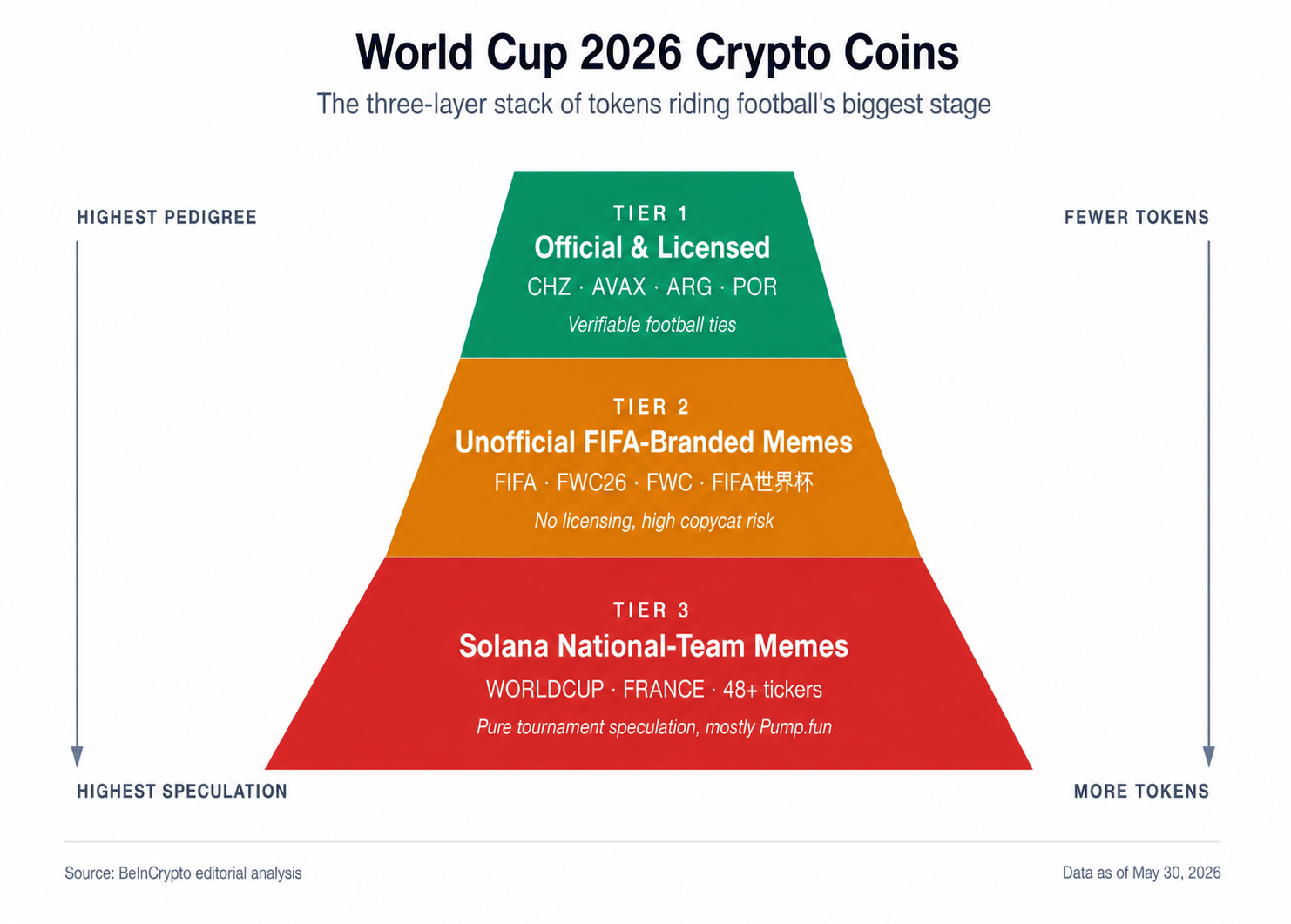
The FIFA World Cup 2026 begins on June 11 across the United States, Mexico, and Canada. As excitement builds, crypto markets have already formed around the tournament.
However, not every token claiming a World Cup connection offers the same level of exposure. The market has split into three distinct categories. Some projects have direct football partnerships. Others use FIFA branding without authorization.
A third group consists entirely of speculative meme coins built around national teams.

Understanding the difference may help investors separate genuine football-related crypto plays from short-term hype.
The Three Layers of the World Cup 2026 Crypto Trade
World Cup-related crypto assets currently fall into three categories:
- Licensed football infrastructure and fan tokens
- Unofficial FIFA-themed meme coins
- National-team meme coins on Solana
Each layer responds to different catalysts as the tournament approaches.
Layer 1: Licensed Football Tokens With Real Partnerships
This category contains the strongest connection to global football.
Chiliz (CHZ) and Fan Tokens
Chiliz remains the largest football-focused crypto ecosystem through its Socios platform. The project powers fan tokens for clubs and national teams, making it one of the clearest ways to gain exposure to tournament-related activity.

CHZ trades around $0.0339 with a market capitalization of approximately $352 million. The token remains under pressure, down nearly 10% over the past week and 17.5% over the past month.
A major development arrived in March 2026 when US regulators classified fan tokens as digital collectibles rather than securities. The decision removed a key regulatory obstacle and strengthened Chiliz’s expansion plans in the United States.
Among national-team tokens, the most closely watched include:
Argentine Football Association Fan Token (ARG)
- Price: ~$0.41
- Market Cap: ~$7.5 million
- Up 6.5% on the week
- Down 47% on the month
Portugal National Team Fan Token (POR)
- Price: ~$0.37
- Market Cap: ~$4.6 million
Historically, fan-token volatility tends to increase during the group stage as team performance drives trader sentiment.
Avalanche (AVAX)
Avalanche offers a different type of World Cup exposure.
FIFA selected Avalanche to host the FIFA Blockchain, a dedicated Layer-1 network supporting FIFA’s digital initiatives. Since the migration of FIFA Collect, the blockchain has attracted more than 85,000 addresses.

AVAX currently trades near $8.95 with a market capitalization of roughly $3.86 billion.
Meanwhile, FIFA President Gianni Infantino has publicly referenced the possibility of a future FIFA Coin on multiple occasions. No official token exists today, but any announcement during the tournament would immediately affect sentiment across football-related crypto assets.
Another important development came on May 27 when ADI Predictstreet and Fanatics Markets launched FIFA’s first official prediction-market partnership across multiple U.S. jurisdictions.
Layer 2: Unofficial FIFA Meme Coins
The second category consists of tokens that use FIFA branding without any confirmed relationship to FIFA itself.
The largest example is an Ethereum-based token called FIFA, which recently reached a market capitalization of nearly $77 million.
Other examples include:
- FWC26
- FWC
- FIFA世界杯
- Multiple duplicate FWC26 contracts
The biggest risk is confusion.
Many of these projects use nearly identical names despite having no connection to one another. Traders often assume they are buying the same asset when they are not.
Before purchasing any FIFA-themed meme token, investors should examine contract addresses, liquidity, holder concentration, and trading activity.
Layer 3: Solana’s National-Team Meme Coin Ecosystem
The most speculative layer lives on Solana.
These tokens launched primarily through Pump.fun and are designed to capitalize on national-team enthusiasm rather than official partnerships.
WORLDCUP serves as the ecosystem’s central token. It recently surged about 90% in 24 hours and reached a market capitalization near $10 million.

The ecosystem also includes country-specific meme coins such as:
- FRANCE
- SPAIN
- PORTUGAL
- Similar tokens for all 48 qualified national teams
A unique feature of the system routes part of trading fees from team tokens into WORLDCUP buybacks. This creates a feedback loop tied directly to tournament attention.
However, these assets carry the highest risk.
Wallet ownership remains highly concentrated. Most of these tokens depend entirely on momentum, social media attention, and match results. A team’s elimination could trigger immediate selling pressure.

Prediction Markets Already Show Clear Favorites
Prediction markets have become one of the largest crypto-adjacent World Cup narratives.
Combined trading volume across Polymarket and Kalshi has reached approximately $416.7 million for World Cup winner markets.
Current favorites include France, Spain, England, and Brazil.
Meanwhile, Myriad has launched a $100,000 World Cup trading competition powered by Chainlink oracle infrastructure.
The growing activity suggests traders are increasingly using prediction markets rather than traditional sportsbooks to speculate on tournament outcomes.

What To Watch Before Kickoff
Each layer reacts to different catalysts. CHZ, AVAX, and licensed fan tokens are likely to respond to adoption metrics, partnerships, and institutional participation. National-team fan tokens will move with match results and federation news.
Meanwhile, Solana meme coins remain heavily dependent on sentiment and influencer attention. Many could experience sharp rallies during the tournament before fading once the event concludes.
The biggest wildcard remains FIFA itself.
If FIFA announces a native digital asset during the tournament, the entire World Cup crypto market could be repriced overnight.
Until then, investors should distinguish between licensed football projects, unofficial FIFA-themed tokens, and purely speculative meme coins before taking exposure.
The post Top World Cup 2026 Crypto Coins: Three Layers Riding Football’s Biggest Stage appeared first on BeInCrypto.
Top Privacy-Focused Cryptocurrencies for Long-Term Investment: Monero (XMR), Zcash (ZEC), and Bittensor (TAO)

Donald Trump Says ‘Cancel It’ Amid Backlash Over Freedom 250

The quaint village pub with a huge garden and conservatory for summer outdoor dining


-

 Business7 days ago
NYT Strands Answers May 24 2026 Revealed for Puzzle No. 812 Theme Summer Essentials
-

 NewsBeat4 days ago
Israel says it has killed new Hamas military leader in Gaza City airstrikes
-

 Tech4 days ago
NASA taps Blue Origin to deliver lunar rovers for Moon Base initiative
-

 Politics6 days ago
Bridgerton Season 5: Cast, Release Date And Everything We Know So Far
-

 News Videos4 days ago
XRP *JUST* SUCCEEDED!!!! CLARITY ACT EXPOSED!!! (SHE EXPOSED IT)
-

 Sports5 days ago
2026 NBA Finals schedule, odds: Knicks await Thunder or Spurs after winning East
-

 Business4 days ago
Selena Gomez Reportedly Upset Over Benny Blanco’s Comments on Her ‘Terrible’ Diet
-
Crypto World5 days ago
Micron Crosses $1 Trillion Market Cap as AI Demand Reshapes Memory Sector
-

 News Videos2 days ago
This is BROKEN! INSANE 5x MONEY CAR WASH WEEK! The NEW GTA Online UPDATE Today! (GTA5 New Update)
-
Crypto World6 days ago
Brian Armstrong Outlines Crypto Vision for the Future Financial System
-

 Business6 days ago
BTS Sells Out Four Las Vegas Shows at Allegiant Stadium for ARIRANG World Tour
-
 Tech5 days ago
China assigns ID codes to 28,000+ humanoid robots
-
 NewsBeat6 days ago
Hottest May day ever as London hits 34.8C in 2C leap from previous records
-

 Tech6 days ago
Microsoft’s quiet Claude Code retreat and the real cost of enterprise AI
-

 Tech2 days ago
Waymo dominates autonomous vehicle registrations as Tesla trails behind
-

 Business5 days ago
Nikkei 225 Surges Past 65,000 for First Time as Iran Peace Hopes Fuel Record Rally
-
Tech4 days ago
The Samsung pay deal is the moment Korean unions changed register
-
 Entertainment5 days ago
‘Breaking Bad’ Star’s Easy-to-Binge 6-Part Crime Series Spin-Off Is Finally Heading to Free Streaming
-

 Tech6 days ago
Westone Audio and Etymotic Acquired by Fidelity Collective in Major IEM Market Move
-

 NewsBeat6 days ago
Crowds find riverside shade in York as temperatures soar
You must be logged in to post a comment Login