

Crypto World
Coinbase Premium Drops to Monthly Low as Institutions Sell


A fresh read on on-chain and derivatives signals suggests institutional appetite for crypto has cooled further, with the Coinbase premium slipping deeper into negative territory. The metric, which tracks the gap between Bitcoin prices on Coinbase (a venue favored by U.S. institutions) and Binance (more retail-oriented), slid to its lowest level this month at -0.0983% on May 21, underscoring renewed selling pressure from professional investors.
The premium has remained negative since late April, but the pace of decline picked up over the last week. CryptoQuant analyst Darkfost characterized the move as a heightening of selling pressure among institutional traders. “Institutional selling pressure has intensified recently,” Darkfost said. “This suggests that the population of institutional and professional investors trading on Coinbase Advanced is selling more aggressively than investors trading on Binance.”
Beyond the Coinbase premium, the broader macro backdrop appears to bolster a cautious stance among institutions. Gold—historically viewed as a hedge—has fallen about 5.8% over the past month, while equities across the S&P 500 and Dow Jones have shown gains since early April. That mix points to a risk-on tilt in traditional markets and a reallocation that may be weighing on crypto demand at the margin.
Key takeaways
- The Coinbase premium sits negative, with the May 21 reading at -0.0983%, signaling intensified institutional selling pressure on Coinbase Advanced relative to Binance.
- Analysts tie the shift to hedging behavior amid macro uncertainty, with institutions repositioning and possibly taking profits, which could dampen near-term crypto momentum.
- Bitcoin ETF outflows in the United States accumulate, totaling about $1.3 billion over four trading days since May 14, while derivatives demand shows signs of waning.
- Open interest in Bitcoin futures and perpetuals declined by roughly $1.5 billion in the week, suggesting a reset of leveraged bets and a potential reliance on actual spot demand for the next move.
- Bitcoin itself has fallen about 4.5% over the past week, trading near $77,600 after a monthly low just above $76,000, roughly 38% below its October peak.
Institutional positioning and the “premium” signal
The Coinbase premium has long been monitored as a proxy for the behavior of sophisticated buyers in the U.S. market. When the premium turns negative, it implies Coinbase’s price is softer than Binance’s, which can reflect a withdrawal of U.S. institutions from spot exposure or a shift toward hedging strategies. In this cycle, the trend toward negative readings has persisted for weeks, but the steep drop over the last seven days has heightened concerns about whether a larger cohort of funds is stepping back from fresh exposure to Bitcoin.
Nick Ruck, research director at LVRG, offered a cautionary angle: the drop in the premium could signal “the emergence of net selling pressure from larger holders,” potentially indicating profit-taking or portfolio rebalancing. He warned that such dynamics might weigh on near-term price momentum across major crypto assets, especially if spot demand remains lackluster as institutional selling persists.
By contrast, some market participants view the divergence between Coinbase and more retail-oriented venues as a gauge of sector rotation rather than a pure directional bet on price. Still, the current signal aligns with a broader pattern of institutions slowing or pausing fresh allocations while macro clarity remains elusive.
ETF outflows and dwindling derivatives activity
The latest data on U.S. spot Bitcoin ETFs adds another layer to the selling narrative. CoinGlass reports four consecutive trading days of outflows totaling roughly $1.3 billion since May 14. The pace of withdrawals suggests institutions are reallocating capital away from spot exposure or consolidating risk in other assets amid ongoing uncertainty.
Concurrently, operator activity in the derivatives market is cooling. Bitfinex noted that open interest—the aggregate value of outstanding Bitcoin futures and perpetual contracts—dropped by around $1.5 billion during the week. That retrenchment follows a period in which leveraged positioning had been building as Bitcoin moved toward the $82,000 region. The exchange framed the current environment as a transition: “With short-side fuel exhausted and long positioning reset lower, the next major move likely depends on spot demand.”
Bitcoin itself has retraced recently, posting a 4.5% decline over the past week and touching a monthly low just above $76,000 on Tuesday. At the time of writing, the asset hovered around $77,600, about 38% below its October peak. The combination of ETF withdrawals, falling open interest, and a still-fragile spot bid paints a picture of a market waiting for a catalyst—whether macro clarity, stronger institutional demand, or a sustained shift in risk sentiment.
Implications for traders and builders
These indicators point to a market environment where institutional demand remains tepid and price action is predominantly contingent on spot-buying vigor rather than leveraged bets. For traders, the deterioration in the Coinbase premium and the uptick in ETF outflows suggest a cautious stance: any upside move will likely require a tangible uptick in spot demand rather than relief rallies driven by derivatives leverage.
From an infrastructure and product perspective, the signals reinforce the importance of robust on-ramp options, transparent liquidity channels for institutions, and clarity on how macro shifts might influence hedging behavior. For developers and builders, evolving custody and settlement workflows, regulatory clarity, and improved access to compliant institutional products could help bridge the gap between retail enthusiasm and institutional participation.
Looking ahead, observers will be watching two intertwined threads: whether spot demand strengthens enough to absorb the existing overhang from hedgers and large holders, and how ETF and derivatives flows respond to fresh macro data and regulatory signals. If institutional selling persists and the premium remains negative, risk assets, including Bitcoin, could face the near-term pressure that many market participants already anticipate.
In the near term, investors should monitor whether spot demand improves or whether the current dynamics prolong the consolidation phase. The coming weeks will be telling for whether the dip in the Coinbase premium and ETF outflows translate into a broader regime shift or a temporary pause before renewed interest from institutional buyers returns.
What remains uncertain is how incoming macro developments—ranging from inflation data to regulatory updates and central-bank policy—will shape the risk appetite of large funds with crypto exposure. As ever, the market’s next move is likely to hinge on the delicate balance between hedging needs, liquidity availability, and the evolving appetite for risk across traditional and digital asset classes.

Chinese and U.S. flags flutter near The Bund, before U.S. trade delegation meet their Chinese counterparts for talks in Shanghai, China July 30, 2019.
Aly Song | Reuters
SUZHOU, China — The U.S. is working hard to ensure American technology is used in Asia, a senior State Department official told CNBC, as China races to build alternatives that are often cheaper.
“We’re very active in promoting U.S. AI options and solutions,” Casey K. Mace, senior official for APEC and economic policy, told CNBC on Friday on the sidelines of the APEC trade ministers’ meeting in Suzhou, and a week after U.S. President Donald Trump brought a host of tech CEOs on his visit to the country.
As the two countries race to develop the technology, the U.S. has restricted Chinese access to advanced U.S. chips. Beijing has already banned Google and Facebook in mainland China.
Mace said U.S. tech companies would be giving workshops at an APEC “digital week” in Chengdu in July. While China is the host of the event, “it’s an opportunity to engage with all 21 [APEC] economies,” he added.
Mace declined to name specific U.S. companies taking part, and pushed back when asked if the U.S. was advocating “best in class” American tech over Chinese alternatives.
He said he had met with U.S. tech companies with a presence in China and that he expected they would be able to expand their access to its market.

China is hosting this year’s APEC trade ministers’ meetings, which are set to wrap up in November in the tech hub of Shenzhen.
Working-level conversations alongside Asia Pacific Economic Cooperation meetings in China this month focused on promoting U.S. AI in food traceability, genome sequencing and biotech, Mace said.
He said the tone has been “positive,” which he attributed partly to the “very successful meeting between President Trump and President Xi” in Beijing last week.
Following high-level engagement, the two countries have agreed to begin discussions about safe development of AI, China’s foreign ministry confirmed on Tuesday. It’s unclear when or how those talks will begin.
“There is pressure to distribute American compute globally,” Ryan Fedasiuk, fellow at the American Enterprise Institute, told CNBC last week.
“The Trump administration is right in trying to advocate and implement with this,” he said. “But it will compete with Chinese hyperscalers and Chinese AI labs that are attempting to do exactly the same.”
Fedasiuk added that he is watching for coordination between the U.S. and Chinese sides to screen vendors of DNA synthesis services so as to prevent the manufacture of another pandemic.


- AI developments helped push NEAR Protocol trading volume over $1 billion.
- The price of NEAR coin broke above a multi-year bearish trendline.
- Eyes are now on the support at $2.20 and the resistance at $2.30 for the next move.
NEAR Protocol surged nearly 29% in the last 24 hours, making it one of the strongest-performing large-cap cryptocurrencies in the market today.
The rally pushed the token to around $2.26 after trading as low as $1.73 earlier in the day.

NEAR’s trading activity also climbed sharply, with daily volume approaching $1 billion as momentum accelerated across major exchanges.
The reason why the Near Protocol coin price is rising
One of the biggest drivers behind the latest Near Protocol price jump is the growing interest in AI-focused blockchain projects.
NEAR Protocol has increasingly been associated with the AI sector due to its recent product developments, including AI integrations, intent-based transactions, and tools designed for autonomous agents.
The project recently highlighted progress around its NEAR Legion project.
The concept focuses on allowing AI agents to interact with blockchain networks, execute transactions, and coordinate activities without requiring constant human input.
This narrative has gained traction as the broader technology sector shifts attention toward agentic AI systems.
Notably, NVIDIA CEO Jensen Huang has repeatedly discussed the growing role of agentic AI in future software and computing systems.
That trend has spilled over into the crypto market, where traders are now looking at blockchain networks that could support machine-to-machine transactions and decentralised AI infrastructure.
NEAR Protocol has also expanded its Intents framework, which simplifies cross-chain interactions and transaction execution.
The technology is designed to let users or AI agents specify desired outcomes rather than manually executing every transaction step.
The market has responded positively to this development because it addresses one of crypto’s biggest problems: user experience.
Another development that attracted attention this week was the launch of PII anonymisation tools by NEAR AI.
The feature is designed to improve privacy for large language model applications by protecting sensitive information before it reaches AI systems.
Privacy-focused AI infrastructure has become an important discussion point as companies and developers face growing concerns around data protection and compliance.
The AI angle around NEAR carries additional weight because of the project’s leadership.
NEAR co-founder Illia Polosukhin previously co-authored the “Attention Is All You Need” research paper, which introduced the Transformer architecture that powers modern AI models such as ChatGPT and Gemini.
Analysts have increasingly pointed to this connection as evidence that NEAR’s AI strategy is more than just branding.
Technical breakout and short liquidations accelerated the rally
Beyond the AI narrative, technical factors also played a major role in today’s rally.
NEAR recently broke above a multi-year descending trendline that had capped its price since the 2022 bear market.
Analysts had been watching the $1.90 resistance zone closely because it acted as a ceiling during several previous recovery attempts.
Once the token moved above that level, buying momentum accelerated rapidly.
The breakout was accompanied by a sharp rise in trading volume, which is often viewed as confirmation that a move has strong market participation behind it.
NEAR also reclaimed several major moving averages during the rally, improving the token’s overall technical structure.
Short liquidations added further fuel to the move. Data from derivatives markets showed that most crypto liquidations tied to NEAR over the past 24 hours came from short positions.
As the price continued to rise, traders betting against the token were forced to buy back their positions, creating additional upward pressure.
NEAR price forecast
The Near Protocol token has gained nearly 60% in the last 30 days and is now up more than 43% over the past week.
However, despite the rally, NEAR remains far below its all-time high of $20.44 reached in January 2022.
The token is currently trading about 89% below that peak, although it has recovered more than 325% from its all-time low recorded in November 2020.
Moving ahead, the first major support zone sits around $2.20.
Holding above this level could help maintain bullish momentum in the near term. Below that, the $1.90 area remains important because it previously acted as a breakout resistance zone.
On the upside, the immediate resistance range sits between $2.30 and $2.40 after the latest surge stalled near those levels.
A decisive move above that region could open the door toward the psychological $3.00 level, which many traders are now monitoring as the next major target.


A petition for the abolition of South Korea’s planned 22% cryptocurrency tax has surpassed 50,000 signatures.
It now heads to the National Assembly’s Finance and Economic Planning Committee for review. Lodged on May 13, the petition crossed the threshold on May 21. It now holds 53,359 signatures.
Crypto Tax Set to Take Effect in 2027
South Korea’s 20% crypto tax, which rises to 22% with local surcharges, takes effect January 1, 2027. The law applies to gains exceeding 2.5 million won.
The petitioner argues it’s unfair that South Korea abolished the Financial Investment Income Tax (which would have taxed stock gains) but is still moving forward with taxing crypto gains.
They claim this creates inequality among investors, harms young people trying to build wealth, ignores the current crypto market downturn, and lacks adequate investor protection infrastructure.
“Due to soaring real estate prices, asset formation for young people is becoming increasingly difficult. In a reality where home purchase is impossible without accumulated assets, virtual assets are perceived by some young people as effectively a last investment opportunity. If an additional tax burden is added in this situation, asset-building opportunities for young people may be further reduce,” the petition reads.
Follow us on X to get the latest news as it happens
South Korea has delayed implementing crypto taxation three times since its original 2022 start date. This petition is part of the ongoing public pressure to scrap it entirely rather than just delay it again.
Meanwhile, in March, People Power Party floor leader Song Eon-seok filed a bill to eliminate all provisions related to digital asset taxation included in the current Income Tax Act.
Nonetheless, the Ministry of Economy and Finance publicly reaffirmed this month that the tax will proceed in January 2027. That’s the wall this petition is running into, and it landed just days before the petition was filed.
Subscribe to our YouTube channel to watch leaders and journalists provide expert insights
The post Over 50,000 South Koreans Sign Petition to Block 2027 Crypto Tax appeared first on BeInCrypto.


Bitget has launched SPCXUSDT, a SpaceX-linked pre-IPO perpetual contract that gives traders derivative exposure before any public listing.
Summary
- Bitget launched SPCXUSDT, a USDT-settled perpetual contract tied to SpaceX pre-IPO market expectations.
- The product offers 24/7 trading, 5x leverage, and eight-hour funding fee settlement.
- SpaceX-linked derivatives are growing as traders seek exposure before the company’s reported Nasdaq debut.
Bitget said SPCXUSDT is an IPO Pre-Market Perpetual Contract linked to SpaceX. The product is designed to let users trade market expectations around a possible SpaceX listing without waiting for public shares to begin trading.
The exchange said the contract is settled in USDT and runs on a 24/7 schedule. It supports up to 5x leverage, has a minimum price movement of 0.01, and settles funding fees every eight hours.
Bitget product tracks expectations, not real shares
The product does not give traders ownership of SpaceX stock. It is a derivative tied to market expectations around the company’s possible public listing.
That distinction matters because private-company valuation can move sharply before an IPO. Traders are betting on price discovery, not buying registered equity. Bitget has also listed preSPAX spot exposure through its pre-IPO zone, adding another SpaceX-linked product for users.
Moreover, SpaceX has become one of the most watched private companies due to Falcon rockets, Starlink, and Starship. Reuters reported that SpaceX is targeting a Nasdaq listing as early as June 12 under the ticker SPCX.
The same report said the company may seek about $75 billion at a valuation near $1.75 trillion. The IPO process could make SpaceX one of the largest market debuts ever if completed at those levels.
Bitget’s marketing also leaned into that demand. The exchange asked whether SpaceX could follow past post-IPO gains seen in large technology companies. That question remains speculative until official pricing, share count, and demand are clear.
Crypto venues chase SpaceX trading
Bitget is not alone. Related coverage noted that Bybit launched its own SPCXUSDT perpetual contract with up to 10x leverage, allowing round-the-clock trading before the planned IPO.
Financial Times also reported that crypto platforms including Binance, Bitget, and Trade.xyz have rushed to list derivatives tied to SpaceX. These products let traders speculate on SpaceX’s future share price without owning the stock.
The trend shows how crypto exchanges are moving beyond coins into private-market exposure, tokenized assets, commodities, and equity-linked derivatives. For traders, the appeal is early access. The risk is that these contracts can move on sentiment before official IPO terms are final.
For Bitget, SPCXUSDT fits its wider Universal Exchange strategy. For the market, it shows that SpaceX IPO demand is already being priced in crypto before Wall Street gets a final public share price.
Separately, Bitget has also linked its wider brand push to education and inclusion work. UNICEF says Bitget joined its Game Changers Coalition through Blockchain4Her, aiming to reach 300,000 people in 2025 and expand STEAM learning with blockchain and Web3 literacy.

Polymarket, a global prediction market platform, is reportedly seeking entry into Japan amid growing regulatory scrutiny of the sector worldwide.
The company has appointed Mike Eidlin, head of Japan at crypto firm Jupiter, to lead its local efforts and is preparing to lobby for authorization of prediction markets in the country, Bloomberg reported Friday, citing people familiar with the matter.
Polymarket is targeting government approval in Japan by 2030, viewing the market as a major untapped opportunity.
The plans come as prediction markets, including Polymarket and rival Kalshi, face increased regulatory pressure globally, with countries such as India among the latest to move against the platforms.
Japan’s strict gambling rules pose hurdle
Japan has strict laws around online gambling, permitting betting only on select government-authorized activities such as horse racing and public lotteries.
Authorities have stepped up scrutiny of online betting in recent years, with violations linked to online casino use carrying fines of up to $3,400 and potential prison sentences of up to three years for repeat offenses.
Polymarket reportedly said the company has seen “meaningful organic interest from users” in the country and across Asia, adding: “We’re always evaluating opportunities to expand access globally in compliant and locally appropriate ways.”
Cointelegraph approached Polymarket for comment but had not received a response by publication.
Related: CFTC sues Minnesota, Governor Tim Walz over prediction markets ban
Polymarket’s Japan community on X already exceeds 53,000 followers
Despite only seeking regulatory approval to operate in the country, Polymarket already has a Japan-focused X account with more than 53,000 followers,
Cointelegraph was not able to identify any other Polymarket regional community of comparable size on X at the time of writing.

Source: Polymarket Japan
Polymarket lists Japan among 35 restricted jurisdictions, including the United States, according to its country access policy. However, past reporting indicates users in restricted regions may still access the platform using tools such as VPNs.
Trading volumes fall amid regulatory pressure and competition
Polymarket’s trading activity has come under pressure amid rising regulatory scrutiny across multiple jurisdictions and growing competition from platforms such as Kalshi.
According to Token Terminal data, Polymarket’s monthly notional trading volume fell nearly 15% in April, while Kalshi saw an increase of about 13%.
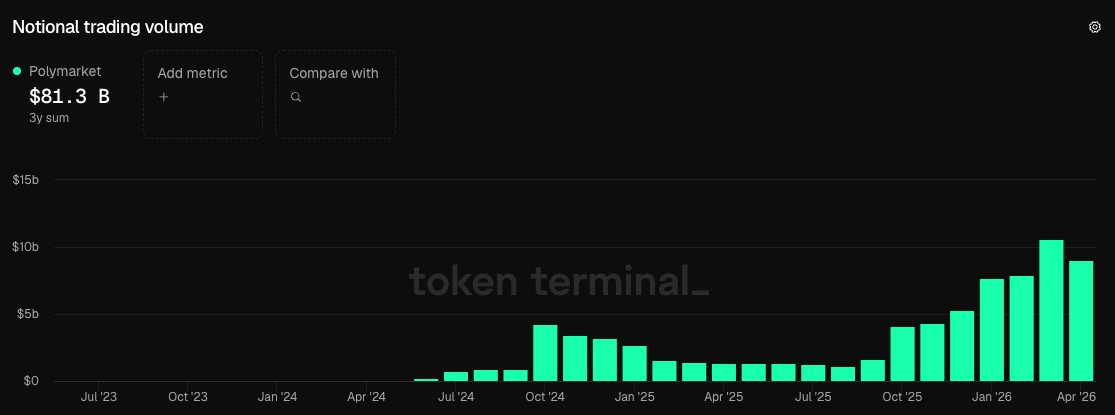
Polymarket’s monthly notional trading volume. Source: Token Terminal
Polymarket’s access is also increasingly restricted globally, with the platform blocked in roughly 34 countries and subject to “close-only” restrictions in four others, according to Start Polymarket data.
Related: Polymarket team says user funds safe as exploit losses climb above $600K
India is among the latest jurisdictions moving to restrict access to prediction markets, with authorities reportedly preparing blocking orders against rival platform Kalshi following earlier action against Polymarket.
Magazine: Should users be allowed to bet on war and death in prediction markets?


F2Pool co-founder Chun Wang plans to join SpaceX’s Starship program for a two-year mission that would fly beyond the Earth-Moon system and past Mars.
Summary
- F2Pool co-founder Chun Wang plans to join SpaceX’s two-year Starship mission for a Mars flyby.
- Wang previously commanded Fram2, the first human spaceflight to fly over Earth’s polar regions.
- F2Pool remains a major Bitcoin mining pool, holding about 10% market share by recent data.
SpaceX has announced Wang as part of a planned Starship mission that would travel beyond the Earth-Moon system, conduct a Mars flyby, and return to Earth. Universe Today reported that SpaceX described the trip as a two-year round journey, though no launch date has been announced.
Wang said the mission would start with a flyby rather than a landing. He said “It’s going to be a flyby mission of Mars,” adding that such a flight could help build momentum for future missions.
Lunar flight comes before Mars
Before the Mars trip, Wang is expected to join Dennis Tito and Akiko Tito on a planned commercial Starship flight around the Moon. The weeklong mission would pass within about 200 kilometers of the lunar surface, according to the same report.
Wang said the Moon flyby would test new work for Starship. He said “Even though it’s just a flyby,” the mission would attempt several things that have not been done before.
Meanwhile, Wang is not new to private spaceflight. Earlier reports noted that he funded and commanded Fram2, SpaceX’s first crewed mission to fly over Earth’s polar regions. The mission launched in 2025 with Wang, Jannicke Mikkelsen, Rabea Rogge, and Eric Philips aboard Dragon Resilience.
The mission aimed for a 90-degree inclination, sending the crew over both poles. Related coverage said Fram2 carried scientific work linked to human health, space travel, polar auroras, and microgravity.
F2Pool link keeps crypto in the story
Wang co-founded F2Pool in 2013. The pool later became one of the largest Bitcoin mining pools, giving Wang a central place in early Bitcoin mining history.
F2Pool still ranks among the largest Bitcoin mining pools. Hashrate Index data shows F2Pool with about 107.2 EH/s and an 10% Bitcoin mining pool market share, behind Foundry USA and AntPool.
The SpaceX plan now places Wang among the small group of crypto-linked figures using private wealth for human spaceflight. It also adds a new chapter to the link between Bitcoin mining profits and high-risk frontier projects.
For now, the Mars mission remains a plan without a fixed launch date. Starship is still in testing, and long-duration private flights beyond the Moon remain complex. Still, Wang’s role gives the crypto industry a rare connection to SpaceX’s push beyond Earth orbit.
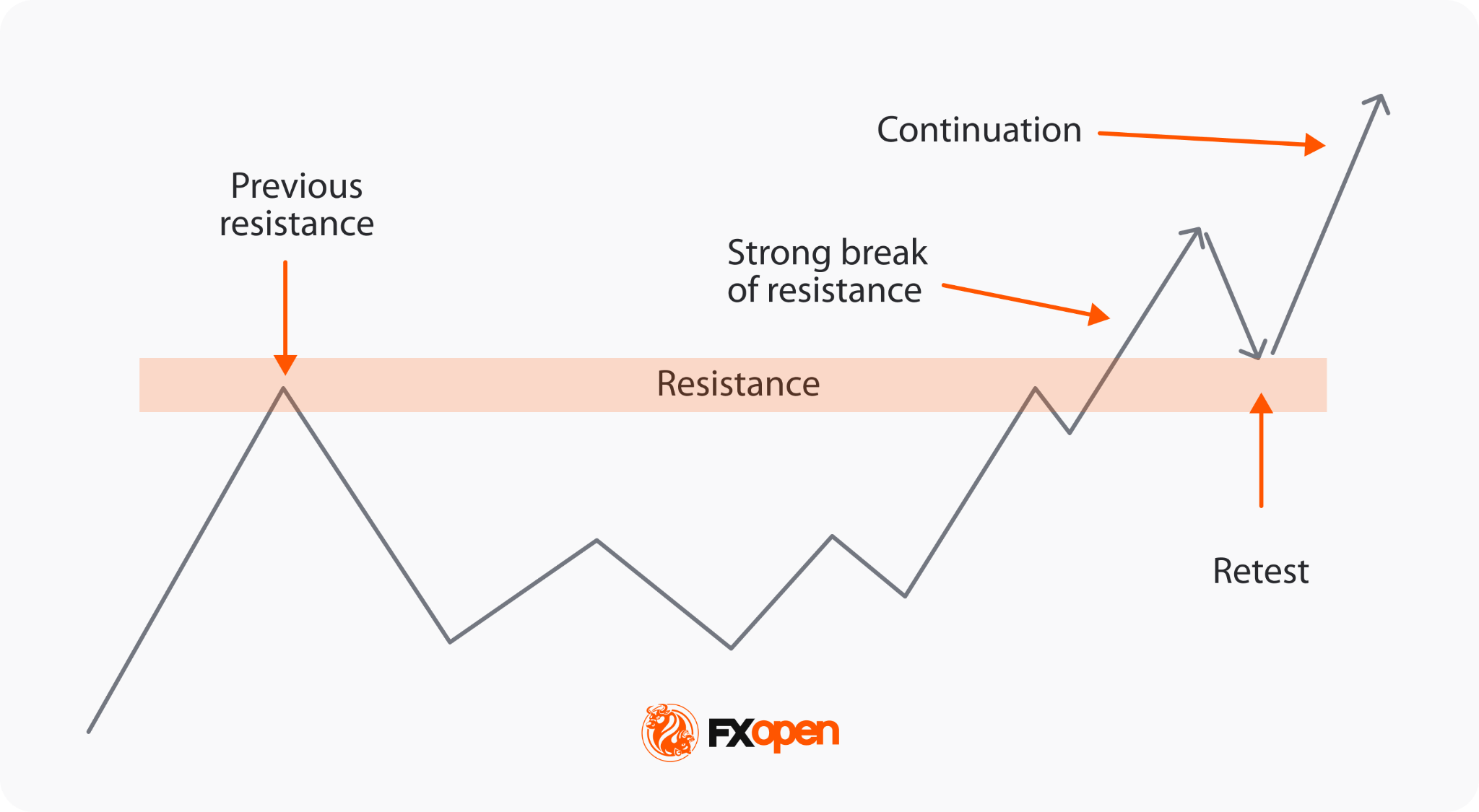
The break and retest strategy is a trading approach based on support and resistance levels. A breakout occurs when price moves beyond a key level, while a retest happens when price returns to that level before potentially continuing in the direction of the breakout. Traders use this strategy in forex and CFD markets to identify possible trend continuation setups and evaluate market structure shifts.
The approach is commonly applied in trending conditions, where price momentum may support continuation after the retest is confirmed. Traders often combine break and retest in trading with price action analysis, volume, or technical indicators to assess breakout strength and manage risk more effectively. In this article, we explain how the break and retest strategy works, how traders may apply it in different market conditions, and which confirmation methods are commonly used.
Break and Retest Strategy Explained
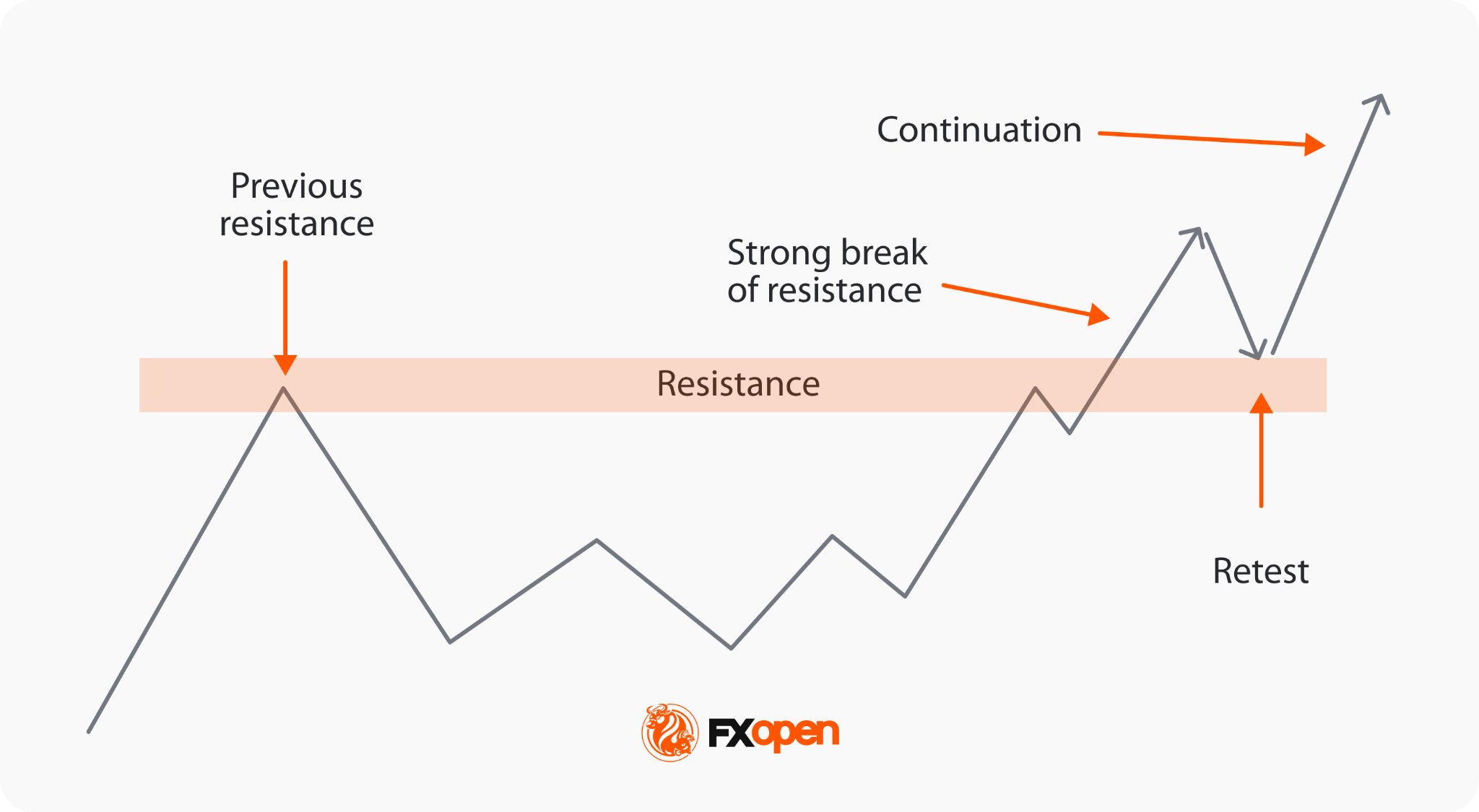
The break and retest strategy involves three stages. Price first breaks a major support or resistance level. It then returns to retest that level. Finally, the trend continues in the breakout direction. Each stage builds on the previous, with the retest giving traders a second reference point.
The breakout itself is a liquidity shift. Resting orders above resistance and below support get absorbed when price moves through. New positions then build in the breakout direction. The retest acts as validation: the level either holds in its new role or fails.
A support/resistance retest works on role reversal. Broken resistance often acts as support on the return move. Broken support often acts as resistance. When the retest holds and price moves away from the level, the original signal is confirmed. The trend tends to continue from that point.
Break and Retest Strategy Steps
The break and retest strategy follows a fixed sequence. Each step builds on the last, with execution clarity around entries, stops, and invalidation.
1. Identifying Key Levels
Traders mark significant support and resistance levels on the chart. Levels validated by multiple touches and clear reactions carry more weight than untested ones.
2. Monitoring for a Breakout
A breakout occurs when price closes decisively beyond a key level, often with rising trading volume. A volume surge supports the move and reduces the chance of a false break.
3. Waiting for the Retest
After the breakout, price often retraces to test the broken level. Former resistance now acts as support, or former support as resistance, depending on direction.
4. Confirming the Retest
Confirmation comes from price action at the retest. Rejection candles such as pin bars or engulfing patterns, paired with sustained volume, suggest the new level is holding.
5. Entering the Trade
Traders typically enter once the rejection candle closes.
6. Managing the Trade
Traders could set take-profit levels at prior swing points or fixed risk-reward ratios. Stop-loss orders could sit beyond the retest extreme: below the new support for longs, above the new resistance for shorts. They also may be trailed to protect unrealised gains as price moves favourably.
Entry and Exit Logic
A break and retest entry strategy needs a defined trigger. The most common is a candle close in the breakout direction after the retest, often with a rejection wick at the level. Aggressive traders typically enter on the close of the rejection candle itself. More conservative traders typically wait for the next candles to confirm direction before committing.
Stop placement follows the structure. For longs, stops typically sit a few pips below the retest low or below the most recent swing point. For shorts, stops sit above the retest high or below the most recent swing high. Position sizing then scales to the stop distance rather than the other way around. This anchors risk management to where the trade idea is invalidated, not to an arbitrary pip figure.
Take-profit targets are commonly set at the next significant structural level, or at a fixed risk-reward ratio such as 1:2 or 1:3.
Break and Retest Trading Example (Forex)
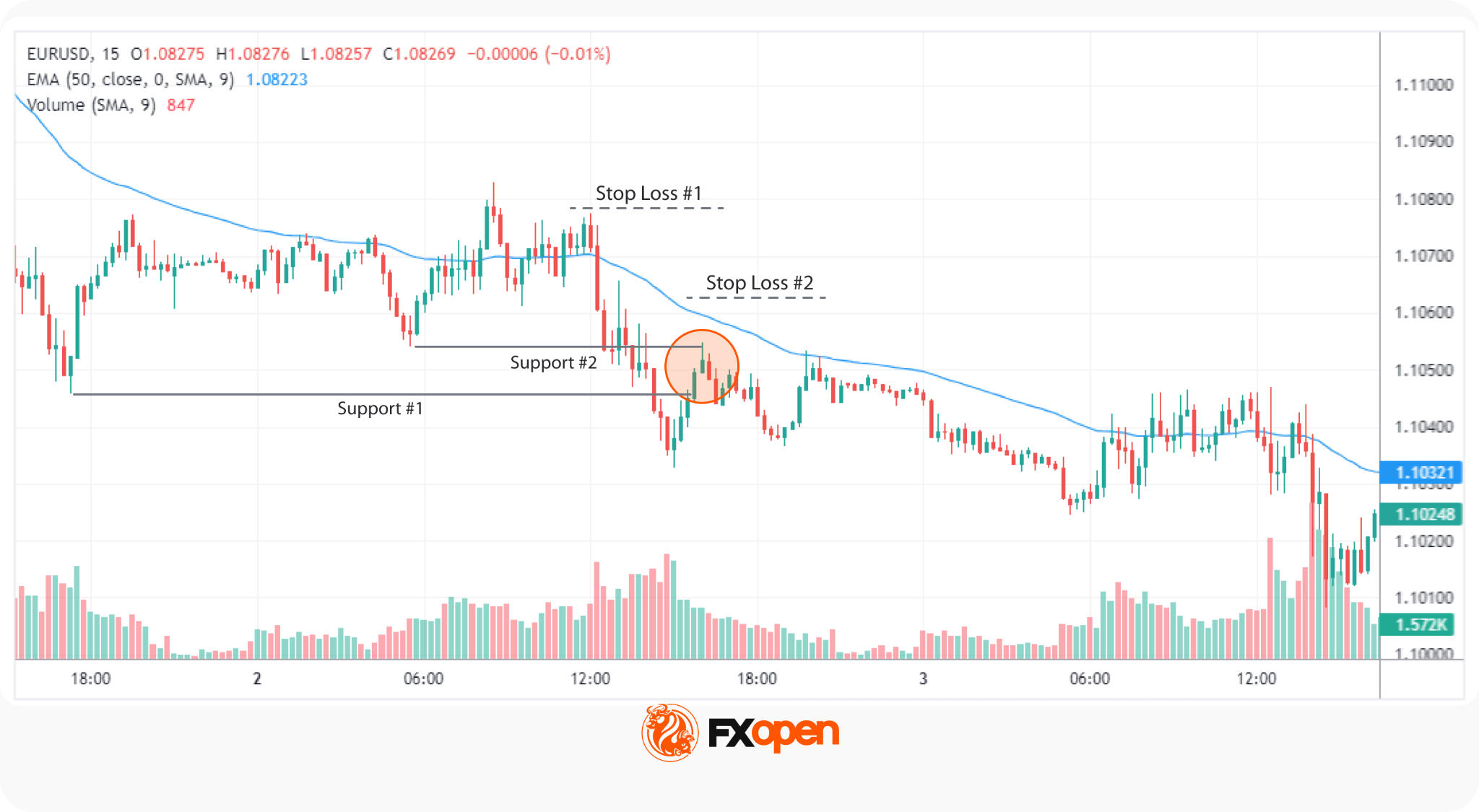
Consider this EUR/USD 15-minute chart, which displays a clear bearish trend. The 50-period Exponential Moving Average (EMA) slopes downward, acting as dynamic resistance with price staying below it. Recently, the price broke below a key support level on higher-than-average volume, signalling the time to apply the break and retest strategy.
Two support levels are worth monitoring. The first sits at the broader structural low. Trading at this level can allow traders to enter the market quickly, though it comes with a less favourable risk-reward ratio.
The second support level is found within the recent brief retracement. This level offers an entry with a tighter stop, improving the risk-reward profile. The trade-off is that price may not retrace deeply enough, leaving traders without a fill.
The entry point is identified by a candle with a wick longer than its body (a pin-bar on the 30m chart), indicating rejection of higher prices as the market retests the second support level. Once this candle closes, traders typically enter at the next candle.
Stop losses would typically be placed either above the last major swing high or the 50-period EMA, depending on individual risk tolerance. Take-profit targets are commonly set at a 1:3 risk/reward ratio, where every pip risked targets three pips of potential return. An alternative is the next significant support level below, where price reaction may develop.
Alternative Entry Scenarios
Not every retest develops the same way. A shallow retest pulls back only marginally before resuming the trend, often leaving conservative traders without a fill. An aggressive entry on the first rejection candle captures these moves but accepts wider initial drawdown risk.
A deep retest pulls back further into the previous range, sometimes to the 50% or 61.8% Fibonacci level of the breakout swing. These setups could offer tighter stops and a stronger risk-reward profile, though they carry a higher chance of the level failing entirely. Ultimately, missed trades are a cost of waiting for confirmation in a breakout trading strategy.
Confirmation Methods in Break and Retest Trading
Price action remains the primary confirmation tool. A rejection candle at the retest level carries more weight than any indicator reading on its own. Indicators, multi-timeframe analysis, Fibonacci levels, and fundamentals are layered on top of that price-action signal rather than used in isolation.
Retest trading confirmation signals gain reliability when two or more methods align around the same level. Conflicting signals are themselves information, often pointing to a setup worth skipping. Here are several methods traders consider:
1. Indicators
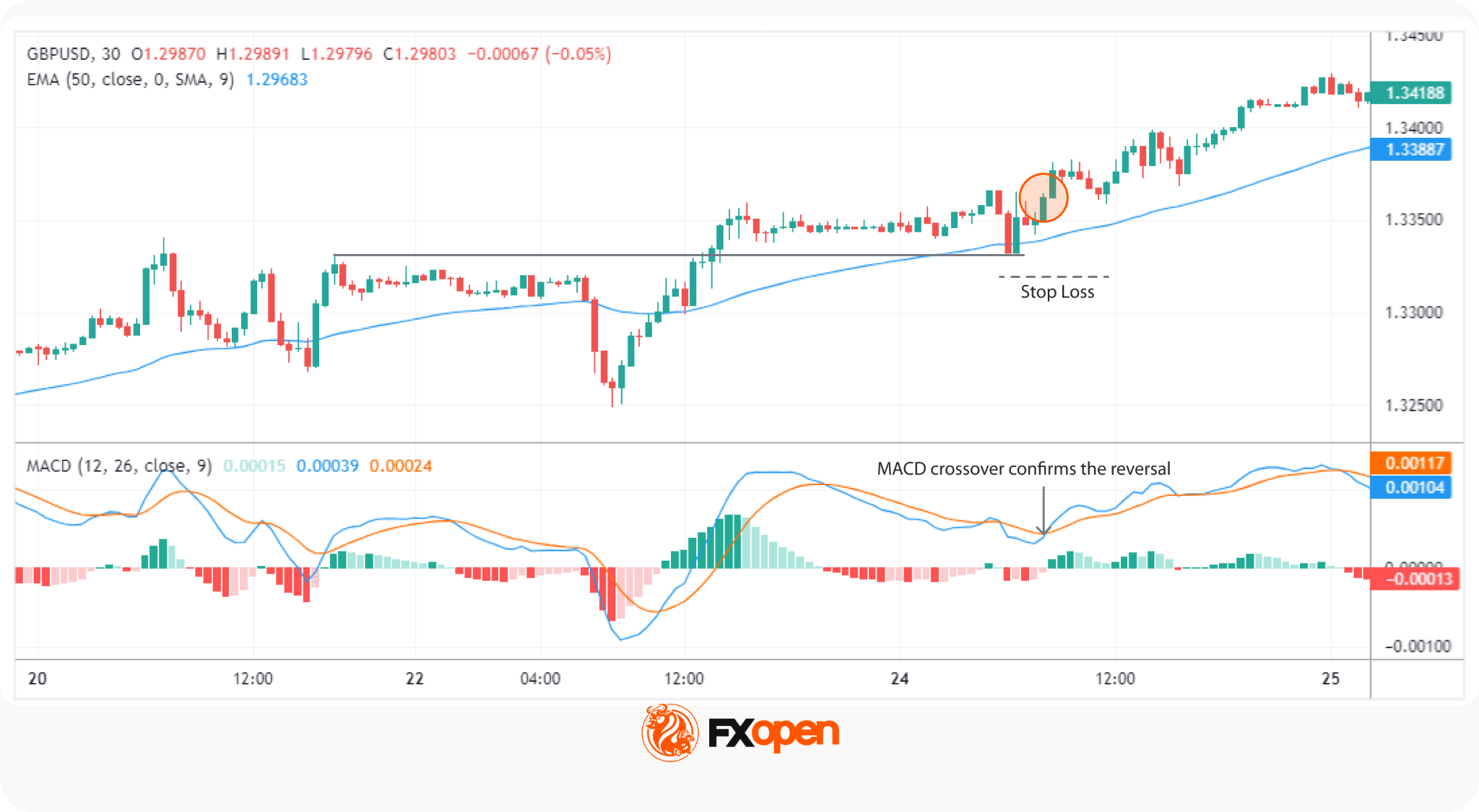
The RSI and MACD are two common break and retest indicators. An RSI crossing below 70 or above 30 during a breakout suggests weakening upside/downside momentum. An MACD line crossing above/below its signal line, or the histogram rising/falling above zero, suggests strengthening bullish/bearish momentum.
2. Multi-Timeframe Analysis
Multi-timeframe analysis works top-down. The higher timeframe (HTF) sets the directional bias, the lower timeframe (LTF) refines entry timing. A breakout observed on a 4-hour chart gains additional confirmation when a strong trend is also visible on a daily chart. Alignment across timeframes filters out lower-timeframe noise.
3. Fibonacci Retracements
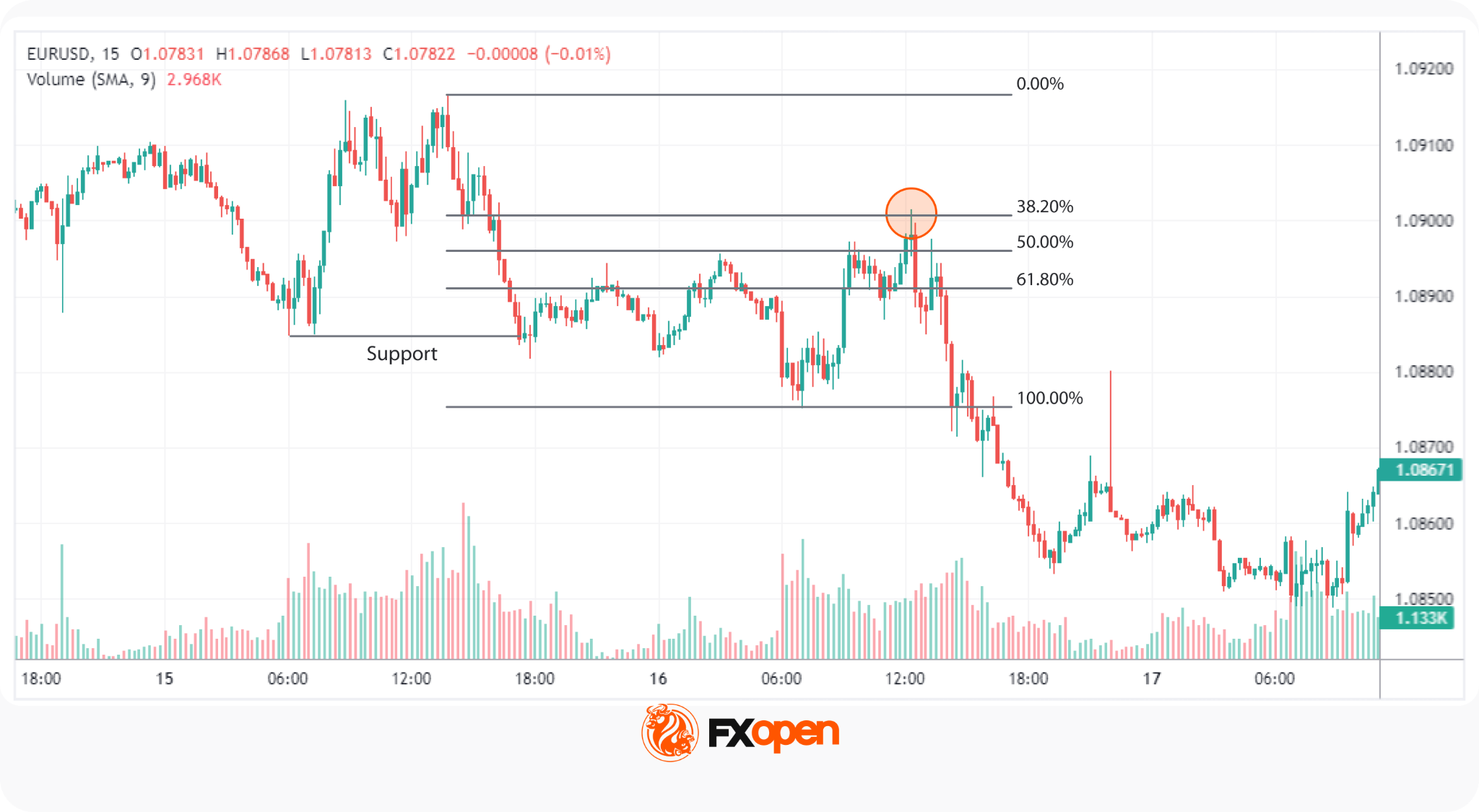
The Fibonacci retracement tool is drawn from the breakout swing high to the breakout swing low (or vice versa for bullish setups). The 38.2%, 50%, and 61.8% levels are the most-watched retest zones. According to theory, a retest that holds at one of these levels carries stronger structural support than a retest at an arbitrary price.
4. Fundamental Analysis
Fundamentals tie technical setups to real volatility drivers. A breakout aligned with a major economic release or central bank decision is more likely to sustain than one occurring in low-volume conditions. Traders typically cross-check an economic calendar for scheduled events around the retest window.
When Break and Retest Conditions Are Valid
Recognising when conditions favour the strategy is as important as the entry mechanics.
Trending markets may produce clearer break and retest setups because a directional bias can support continuation after the breakout. Range-bound or choppy markets generate frequent false breaks, with price flipping back through levels without commitment.
Volatility expansion may support breakout validity. A move accompanied by widening range and rising volume suggests participation behind the price action. A breakout on flat volume often lacks the order flow to sustain.
Session timing may also influence a forex breakout strategy. The London and New York sessions account for a large share of daily forex turnover, while their overlap is often associated with higher liquidity and volatility. As a result, some traders monitor breakouts forming during these periods more closely than those developing in quieter market conditions, where price expansion may be less consistent.
Advantages of the Break and Retest Strategy
The break and retest strategy has several advantages that make it one of the most popular trading approaches:
- Additional Confirmation: The retest serves as an additional validation of the breakout, boosting trader confidence in their entry decision and reducing hesitation.
- Strong Risk Management: Setting stop-loss orders based on the retest level provides a clear risk boundary.
- Alignment with Market Trends: This strategy naturally aligns trades with the prevailing market trend. By trading in the direction of the breakout, traders can take advantage of sustained movements.
- Versatility Across Markets: The breakout and retest strategy can be applied to various financial instruments, including forex, stocks, and commodities. Its adaptability makes it a valuable tool in diverse trading environments.
- Scalability and Flexibility: This strategy can be adapted to different timeframes and trading styles, making it popular among both short-term and long-term traders seeking to implement a consistent approach.
Disadvantages of the Break and Retest Strategy
While the break and retest strategy can be a powerful tool, traders may face several challenges when implementing it:
- False Breakouts: Not every breakout leads to a sustained trend. Sometimes, the price moves beyond a support or resistance level only to reverse shortly after. Recognising these false signals is crucial to avoid entering trades that may quickly turn against expectations.
- Market Conditions: According to theory, this strategy is more popular in trending markets. In sideways or highly volatile environments, breakouts can be less reliable, making it harder to distinguish a strong price movement from random swings.
- Timing the Retest: Accurately determining when the price will retest the broken level can be challenging. Entering too early may expose traders to higher risk, while waiting too long might result in missed trades if the retest doesn’t occur as anticipated.
- Reliance on Confirmation Signals: While additional indicators like RSI or MACD can support the strategy, over-reliance on these tools can complicate decision-making. Traders balance multiple signals without becoming overwhelmed or confused.
- Emotional Discipline: Maintaining discipline during retests is critical. Traders might feel pressured to act quickly if the market moves unexpectedly, leading to impulsive decisions that deviate from their trading plan.
Common Mistakes in Break and Retest Trading
Several recurring mistakes may reduce the effectiveness of the strategy. Recognising them early may help traders manage risk more consistently.
- Early entry. Jumping in on the first touch of the level rather than waiting for a rejection candle leaves the trade exposed to a false breakout. The retest needs to confirm, not just occur.
- Ignoring higher timeframes. When traders ignore a higher-timeframe trend, it may turn valid setups into low-probability trades. A clean retest against the daily-chart direction often fails, even when the lower-timeframe structure looks textbook.
- Chasing breakouts is the opposite error. Entering well after the initial break, with price already extended, could give a poor risk-reward profile and a wider stop. The retest is expected to be the entry, not the breakout candle.
- Overusing indicators clutters the decision. Stacking RSI, MACD, Bollinger Bands, and Stochastics on the same chart produces conflicting signals more often than convergent ones. One or two confirmation tools layered on price action often are more popular than five.
The Bottom Line
This strategy provides a structured approach for trading on breakouts and retests. Understanding how the price may behave after a breakout may support traders in their future decisions. One of the major advantages of the break and retest strategy is that it can be applied across different markets and timeframes. However, traders should note that break and retest trading requires consideration of market conditions and careful risk management.
Traders looking to apply the strategy can consider opening a trading account at FXOpen and gain access to three advanced trading platforms, tight spreads, and low commissions from $1.50 per lot (additional fees may apply).
FAQ
What Is a Retest in Trading?
A retest occurs when the price returns to a broken support or resistance level after an initial breakout. It serves to confirm the strength of the breakout, which may help traders decide whether the new trend will continue or if the breakout was false.
What Is the Break and Retest Strategy?
The break and retest strategy involves identifying a breakout of a key support or resistance level and then waiting for the price to return to that level. Traders use this retest as a confirmation to enter the market, aiming to follow the new trend.
How Many Times Can I Backtest My Strategy?
Backtesting is typically done extensively across different market conditions and timeframes. According to theory, traders need to test a strategy on at least 100 trades to understand how it performs in various scenarios.
Does Retest Always Happen?
No, the retest does not always happen. While retests are common, they are not guaranteed. Traders often use additional confirmation signals and be prepared for both possibilities when applying the break and retest strategy.
Which Timeframe Is Used for Break and Retest Trading?
The break and retest strategy works across timeframes. Higher timeframes such as the 4-hour and daily charts may produce clearer break and retest setups, as price movements can appear less affected by short-term market noise. Lower timeframes may appeal to active traders but can generate more frequent false breaks and less stable retest behaviour.
What Confirms a Valid Retest?
A valid retest is confirmed by price action at the broken level. Rejection candles such as pin bars or engulfing patterns, sustained volume, and alignment with the higher-timeframe trend all add weight. Confirmation matters more than the speed of entry.
Is Break and Retest Suitable for Forex Trading?
Yes. The break and retest strategy is widely applied in forex due to clear support and resistance structure and high liquidity. Major pairs such as EUR/USD and GBP/USD produce frequent setups, particularly during London and New York session overlaps.
This article represents the opinion of the Companies operating under the FXOpen brand only. It is not to be construed as an offer, solicitation, or recommendation with respect to products and services provided by the Companies operating under the FXOpen brand, nor is it to be considered financial advice.


- XRP is holding a tight range near $1.35–$1.36 under pressure.
- Most moving averages and signals still show a dominant downtrend.
- RSI weakness suggests a pause, with $1.35 acting as key support.
XRP is trading at $1.36, sitting almost directly on a key short-term support zone after a steady decline across multiple timeframes.
The price has slipped 7.4% over the past seven days and 6.4% over the past month, extending a broader downtrend that has now reached a 44% drop over the past year.
This puts the current market situation of the Ripple token at the centre of a critical decision point, where bulls and bears are actively testing whether the support at $1.35 can hold.
XRP has entered a tight consolidation phase
XRP has been moving inside a very narrow range between $1.35 and $1.38 over the past 24 hours.

This tight consolidation often reflects hesitation in the market, where neither bulls nor bears have enough momentum to force a clear breakout.
The lower boundary of this range, $1.35, has now become the immediate level to watch.
A clean breakdown below this point would place XRP into a weaker technical structure, with little short-term support visible beneath it.
On the upside, the $1.38 level remains the first resistance barrier, and price has repeatedly failed to sustain moves above it in recent sessions.
But despite this compression, momentum indicators suggest the market is still leaning cautiously.
The 14-day RSI sits at 41.94, which is neutral but tilted toward weakness.
On the weekly chart, RSI drops further to 38.67, which is commonly interpreted as oversold territory.
This divergence between timeframes suggests that while short-term selling pressure is cooling, longer-term momentum remains under stress.
XRP’s technical structure remains under bearish control
A broader look at the trend shows that XRP is still trading below all major exponential moving averages (EMAs) on the daily chart.
These include the 10-day, 20-day, 50-day, 100-day, and 200-day EMAs, which are all positioned above the current price.
This signals a clear bearish structure, where every major trend line is acting as resistance rather than support.
In technical terms, this type of stacking usually reflects a market that has not yet completed a full reversal phase.
In addition, out of 23 tracked technical indicators, 13 are currently pointing to sell signals, while only 3 suggest buying conditions, and 7 remain neutral.
Moving averages alone account for 12 sell signals with zero buy signals, reinforcing the view that the long-term trend has not shifted back in favour of buyers.
At the same time, oscillators like the MACD and the RSI present a slightly different picture. With 3 buy signals against 1 sell signal, short-term momentum indicators show early signs of stabilisation.
However, this has not yet been strong enough to counter the dominant bearish trend formed by the moving averages.
The next directional move will depend heavily on whether buyers can defend the $1.35 support zone or whether selling pressure forces a breakdown into lower price territory.
Short-term estimates point to movement toward $1.39, while broader yearly forecasts place 2026 within a wide range between $0.82 and $2.12.
Hyperliquid and Zcash are leading the altcoin market, but analysts warn that crowded sentiment and stretched indicators may raise pullback risk.
Summary
- Hyperliquid trades near $59 after hitting a $62.18 all-time high on May 21.
- Zcash is up over 100% in 30 days, but traders now watch the $700 resistance zone.
- Analysts warn crowded sentiment and overbought signals may raise pullback risk for both assets.
Hyperliquid traded near $59.11 on May 22 after gaining 29.68% over seven days and 45.77% over the past month. The token reached an all-time high of $62.18 on May 21, while 24-hour volume stood at about $1.42 billion.
The move keeps HYPE among the strongest large-cap crypto assets during a weaker market. Related coverage noted that HYPE broke above $60 on May 21, with ETF demand and DeFi-native speculation helping drive the rally.
Ali Martinez said in a post on X that Hyperliquid’s price action has drawn record social attention. The analyst said HYPE has reached new all-time highs while social media mentions also moved to record levels.
That attention can support momentum, but it can also raise risk. When a trade becomes crowded, traders often watch for signs that late buyers are entering near resistance instead of early in the move.
HYPE traders watch the $60 zone
Ali Martinez said HYPE is approaching a key resistance area while several indicators show possible exhaustion. He pointed to an active TD Sequential Combo 13 sell signal, overbought RSI, and elevated Chande Momentum Oscillator readings.
The analyst said HYPE “could still push toward $59 or even slightly above $60” before momentum fades. He added that rejection from that area could open a move toward about $40. That view is a conditional setup, not a confirmed price path.
Recent HYPE coverage also carried a similar caution. After the break above $60, crypto.news noted that short-term volatility risk remained high even as medium-term structural flows stayed supportive.
Those flows include new listed products. 21Shares launched the first U.S. exchange-traded funds tied to HYPE, including a spot product with staking exposure and a leveraged product. The firm said Hyperliquid handles about $8 billion in daily trading volume and directs more than 95% of fees toward daily HYPE buybacks.
Bitwise has also linked its Hyperliquid ETF fee model to HYPE demand. The asset manager said it would use 10% of management fees from its BHYP product to buy and hold HYPE on its balance sheet.
Zcash price rally faces $700 test
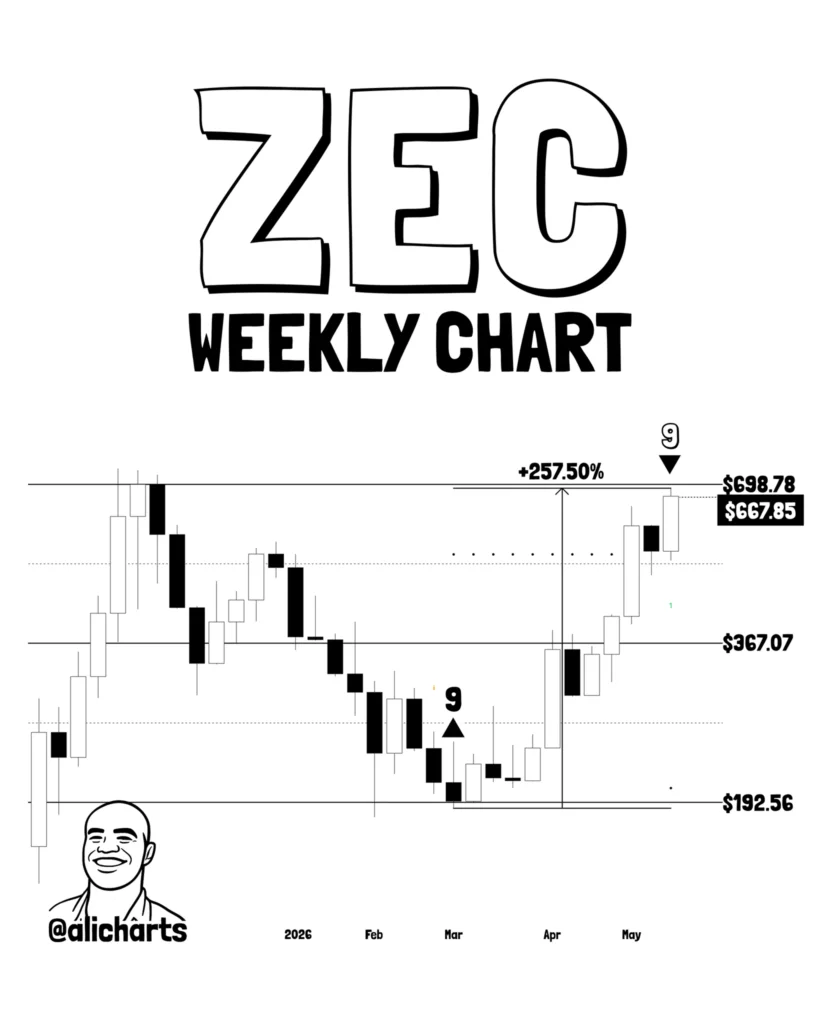
Zcash traded near $645.63 on May 22, down 2.76% over 24 hours but still up 20.35% over seven days and 100.43% over 30 days. Its 24-hour trading volume stood near $690 million, while its market cap was about $10.8 billion.
The rally pushed ZEC close to the $700 area before a mild pullback. The same price data showed a 24-hour range between $645.73 and $682.56, keeping traders focused on whether buyers can reclaim the upper end of the move.
Recent crypto.news coverage said ZEC moved toward $700 after confirming a bull flag breakout. That report linked the rally to regulatory relief, institutional accumulation, and stronger technical momentum.
Ardi said on X that the recovery toward $680 did not look mainly retail-driven. He said retail participation stayed mostly flat while buying came from mid-sized flows, with larger flows starting to recover after the correction.
ZEC traders weigh breakout and reversal risk
Ali Charts said Zcash has climbed more than 40% in one week and is nearing the same $700 to $730 area that caused a major rejection in November. He also said the TD Sequential is flashing a weekly sell signal.
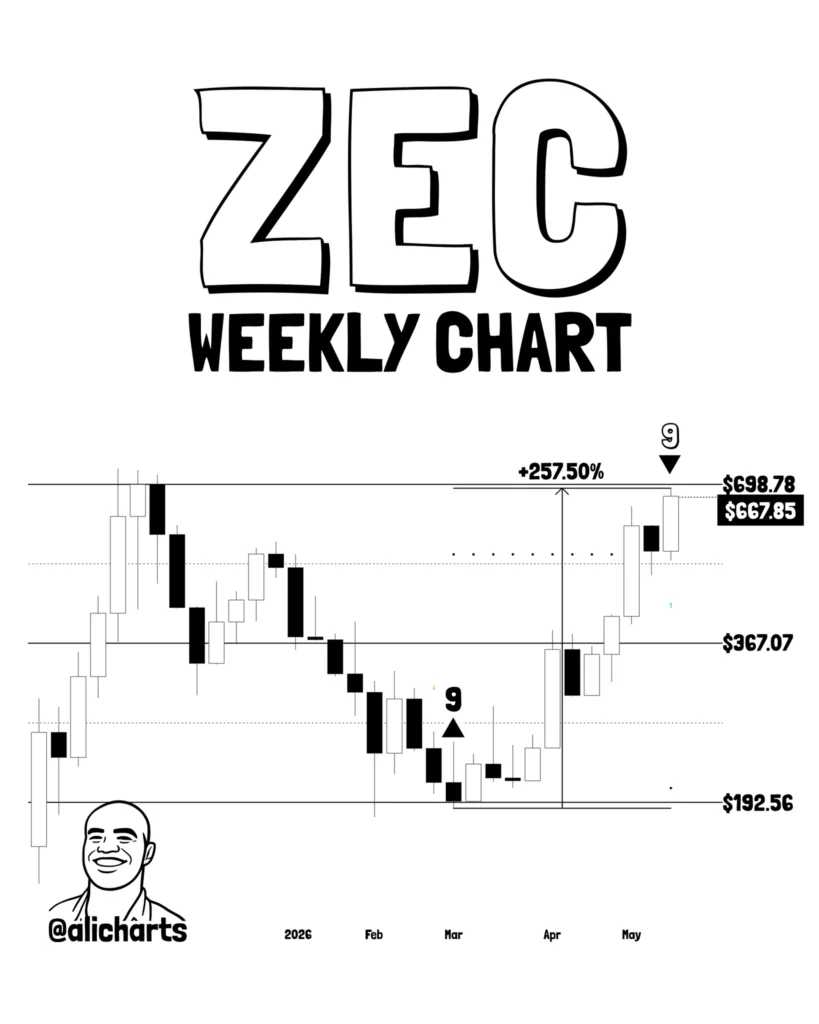
The analyst said the weekly signal matters because any confirmed correction could be larger than a short-term pullback. He mapped a first downside area near $500 and a deeper retracement zone near $380.
That warning fits earlier market caution. A recent crypto.news report said traders had already been weighing a possible $750 target against leverage risk. The report cited concerns that weak spot demand and heavy perpetual trading could expose ZEC to faster reversals if momentum fades.
Another recent report said ZEC’s monthly rally had already crossed 70%, with a golden cross adding to bullish expectations. It also noted that Multicoin Capital’s ZEC accumulation disclosure and rising privacy-asset demand helped fuel the move.
Disclosure: This article does not represent investment advice. The content and materials featured on this page are for educational purposes only.
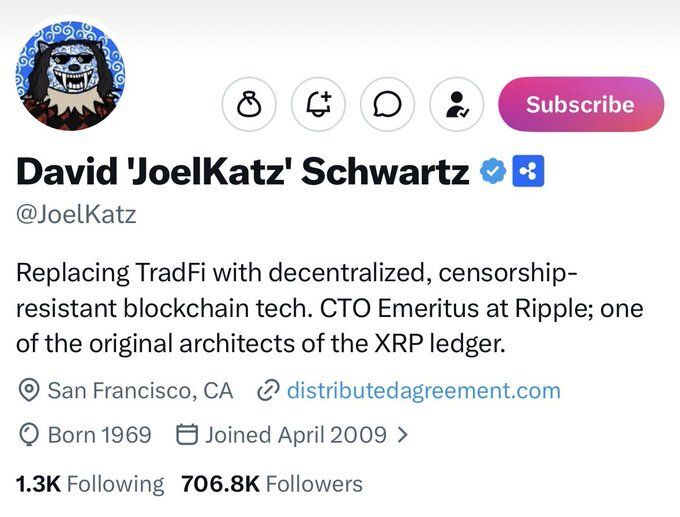
David Schwartz, Ripple’s CTO Emeritus, known on X as @JoelKatz, changed his profile picture to a fuzzy bear image connected to FUZZY, a meme coin on the XRP Ledger (XRPL), reigniting criticism over endorsements and the responsibilities that come with influence.
The update landed with particular force because Schwartz had gone on record against treating meme coins as investments only weeks earlier. His new avatar made that position harder to maintain.
From Trust Lines to Avatars
Schwartz first attracted attention when he opened a trust line for FUZZY, a token inspired by the XRPL’s historic Fuzzybear wallet, which entered network lore with a famous early decentralized exchange order. He was quick to clarify that the step was purely technical. Adding a trust line, he argued, is a routine network action and should not be read as a personal endorsement.
He then called meme coin investing distasteful in explicit terms, pushing back against community members who treat speculative XRP Ledger tokens as serious assets. The framing allowed him to draw a clear line between technical participation and any implied personal backing.
A profile picture change does not carry that technical defense. Critics noted that updating an avatar is a deliberate, voluntary act with no technical justification whatsoever. Several commentators argued that the reasoning Schwartz used to explain the trust line episode simply could not be stretched to cover his X profile.
Meme coin prices have historically reacted to signals from high-profile ecosystem figures. Even informal gestures from someone with Schwartz’s reach can translate into real buying pressure on low-liquidity tokens.

Who Bears the Risk
The stakes extend beyond optics. When a recognized figure links himself publicly to a thinly traded token, some traders interpret the move as endorsement and buy in. Late entrants risk absorbing losses as earlier holders exit. The person who triggered the interest bears no formal responsibility for the outcome.
A Ripple CTO PHNIX surge earlier this year illustrated that pattern. Prices spiked on the signal and then reversed, leaving later entrants exposed.
Schwartz has built credibility through years of commentary on XRP price dynamics and has argued that crypto offers generational wealth potential. Within the meme coin space, influential figures can significantly impact markets, and observers often scrutinize how they exercise or signal that influence.
The post Ripple’s Ex-CTO Switched His Profile Picture to an XRPL Meme Coin appeared first on BeInCrypto.

Huge discount on zoos, theme parks, kids’ meals and cinemas

U.S. pushes its AI in China and Asia after Trump-Xi meeting

9 Of The Best Fans To Keep You Cool Through The Heat Wave 2026


-

 Crypto World6 days ago
BloFin War of Whales 2026 Grand Prix opens registration for $5M trading championship
-

 Fashion7 days ago
Weekend Open Thread: Theory – Corporette.com
-

 Crypto World7 days ago
E-Estate Announces 1 Year Live: Washington DC Summit as Real Estate Tokenization Enters Its Next Phase
-

 Tech6 days ago
Google reimburses Register sources who were victims of API fraud
-

 Business7 days ago
H&R Real Estate Investment Trust (HR.UN:CA) Q1 2026 Earnings Call Transcript
-

 Entertainment7 days ago
David Letterman Returns to Late Show, Blasts Cancellation
-

 Sports7 days ago
Napoleonic enters 2026 Doomben 10,000 field via Abounding withdrawal
-

 Crypto World7 days ago
BeInCrypto 100 Institutional Awards Nomination: KAST for Best Digital Assets Neobank and Best Digital Assets Fintech
-
 Crypto World6 days ago
Bitcoin Battles US Bond Nerves With BTC Price Dip Toward New May Lows
-

 Crypto World7 days ago
ICE and CME urge US regulators to curb Hyperliquid energy trading
-
 Crypto World6 days ago
Wall Street’s Boldest Gold Prediction Has Russians Rushing to Buy
-

 Fashion5 days ago
On the Scene at Gucci’s Cruise Show in New York City: Mariah Carey, Kim Kardashian, Lindsay Lohan, Iman, and More!
-

 Crypto World7 days ago
IREN closes $3 billion convertible notes deal amid AI infrastructure expansion
-

 Fashion6 days ago
Trending Western Style Vests Perfect for Summer
-

 Politics6 days ago
Watch: far-right flag-fanatics run over victim, attack locals – Setup By the Left wing for your entertainment
-

 Crypto World17 hours ago
Blockchain.com files with SEC for U.S. IPO
-

 Fashion7 days ago
Creative Ideas for Custom T-Shirts
-

 Fashion5 days ago
Amazon Sundays: Memorial Day Hosting
-

 Crypto World7 days ago
Crypto Market Structure Bill Clears Committee; Senate Vote in Focus
-

 Entertainment5 days ago
Off Campus Easter Eggs Explained: Characters, Stories, More
You must be logged in to post a comment Login